March 1, 2018
DISTRESSED M&A
UNDERTHEINSOLVENCYANDBANKRUPTCYCODE
1 | P a g e
Distressed M&A under IBC
1. Introduction
Given the surge in stressed assets in the Indian economy, it is no wonder that the regulatory
landscape governing stressed assets is in the midst of a massive overhaul. The complexity of
the problem has necessitated multiple changes to various laws and introduction of several new
ones. With the introduction of new rules and regulations, new tools have been made available
with the aim of having a comprehensive approach for effective and timely resolution of stressed
assets.
One of the most significant tools introduced to address the problem of stressed assets is the
Insolvency and Bankruptcy Code, 2016 (“IBC”). It has been a little over a year that the IBC was
enacted. Till date more than 500 cases have been admitted by the National Company Law
Tribunal (“NCLT”) under IBC. Out of these, so far, resolution plans for around 11 companies
have been approved and orders for liquidating more than 40 companies have been passed.
While the ratio of successful resolution versus liquidation may not be encouraging, there has
been a flurry of activity in the distressed M&A space with many sensing an opportunity to
acquire some good assets.
This paper provides an overview of the legal framework under the IBC for undertaking
distressed M&A and the potential risks and challenges in the process.
2. The IBC
The IBC was enacted as a comprehensive code to consolidate laws relating to reorganisation
and insolvency resolutions of corporates, partnerships as well as individuals. The entire
process beginning from institution of proceedings until approval of a resolution plan or
liquidation, is intended to be time bound. The Insolvency and Bankruptcy Board (“IBBI”) has
also framed the IBBI (Insolvency Resolution Process for Corporate Persons) Regulations, 2016
(“CIRP Regulations”) to address several aspects pertaining to the corporate insolvency
resolution process.
Initiation of a corporate insolvency resolution process
Once a corporate debtor defaults for an amount of Rs. 1 lac, a financial creditor, an operational
creditor or the corporate debtor itself may initiate corporate insolvency resolution process in
respect of such corporate debtor by filing an application before the NCLT. The corporate
insolvency process commences from the date such application is admitted by NCLT. The IBC
mandates that the entire corporate insolvency resolution process should be completed within
180 days from the date of admission. This time period can be extended only once by NCLT for
upto an additional 90 days. Thus, the entire process has to be completed within 270 days.
What happens after admission?
Moratorium
Once an application for commencing corporate insolvency resolution process against a
corporate debtor is admitted, a moratorium order is passed prohibiting the institution of suits or
continuation of pending suits or proceedings against the corporate debtor or any action to
foreclose, recover or enforce any security interest created by the corporate debtor in respect of
its property. Transfer of assets by the corporate debtor is also prohibited. This order of
moratorium remains in effect till the completion of the corporate insolvency resolution process
or earlier if NCLT approves a resolution plan or passes an order for liquidation of corporate
debtor.
A moratorium, however, will not affect any suit or case pending before the Supreme Court
under Article 32 of the Constitution of India or where an order is passed under Article 136 of
2 | P a g e
Distressed M&A under IBC
Constitution of India1. A moratorium will also not affect the power of the High Court under
Article 226 of Constitution of India. However, a money suit or a suit for recovery, against the
corporate debtor, filed before any High Court under original jurisdiction, cannot proceed after
declaration of moratorium.
Appointment of Resolution Professional
An interim resolution professional (“IRP”) is appointed by NCLT for a term of 30 days. The
committee of creditors (discussed below) once formed, either appoints the IRP as a resolution
professional (“RP”) or replaces the IRP by another resolution professional.
Management of the corporate debtor
From the date of appointment of the IRP, the management of the affairs of the corporate debtor
vests in the IRP. The powers of the Board of Directors stand suspended and is exercised by
the IRP. The officers and managers of the corporate debtor are required to report to the IRP. If
any personnel of the corporate debtor, its promoter or any other person required to assist or
cooperate with the IRP does not assist or cooperate, then the IRP can make an application to
NCLT for necessary directions. This right has already been exercised in various ongoing
insolvency resolution processes, and NCLT has given directions to the personnel of corporate
debtors to extend all co-operation.
The IRP/RP has to make every endeavour to protect and preserve the value of the property of
the corporate debtor and manage the operations of the corporate debtor as a going concern.
The IRP and thereafter the RP, therefore, plays a central role in the entire insolvency resolution
process as unlike a debtor-in-possession bankruptcy regime in many other countries, the IBC
provides for the suspension of the Board of Directors and vesting of the management in the
IRP/RP.
Formation of Committee of Creditors
The IRP is required to constitute a committee of creditors (“COC”) comprising all financial
creditors (other than related parties) of the corporate debtor. If there are no financial creditors
or if all financial creditors are related parties of the corporate debtor, then the COC will
comprise of the 18 largest operational creditors by value, 1 representative elected by all
workmen and 1 representative elected by all employees.
While the RP is responsible to preserve and protect the assets of the corporate debtor,
including the continued business operations of the corporate debtor, the COC also plays an
important role. Prior approval of the COC (by obtaining consent of 75% of the voting shares) is
required before the RP can take certain actions. These include: raising any interim finance,
creating any security interest over the assets of the corporate debtor, changing the capital
structure of the corporate debtor, undertaking any related party transaction, amending any
constitutional documents, delegating any authority, change in the management, and
transferring rights or financial debts or operational debts under material contracts otherwise
than in the ordinary course of business.
3. Invitation to submit Resolution Plans
Information Memorandum
As a first step towards kickstarting the process of inviting resolution plans, the RP is required to
prepare an information memorandum (“IM”). The IM has to contain the following details of a
corporate debtor:
1 Canara Bank v. Deccan Chronicle Holdings Limited, Company Appeal (AT) (Insolvency) No. 147 of 2017, NCLAT.
3 | P a g e
Distressed M&A under IBC
▪ assets and liabilities, as on the insolvency commencement date;
▪ latest annual financial statements;
▪ audited financial statements of the corporate debtor for the last 2 financial years and
provisional financial statements for the current financial year made up to a date not
earlier than 14 days from the date of the application;
▪ a list of creditors containing the names of creditors, the amounts claimed by them, the
amount of their claims admitted and the security interest, if any, in respect of such
claims;
▪ particulars of a debt due from or to the corporate debtor with respect to related parties;
▪ details of guarantees that have been given in relation to the debts of the corporate debtor
by other persons, specifying which of the guarantors is a related party;
▪ the names and addresses of the members or partners holding at least 1% stake in the
corporate debtor along with the size of stake;
▪ details of all material litigation and an ongoing investigation or proceeding initiated by
Government and statutory authorities; and
▪ number of workers and employees and liabilities towards them.
The RP also has to provide all resolution applicants access to all relevant information in
physical and electronic form.
Evaluation Matrix
A recent amendment to the CIRP Regulations proposes that at the time of inviting resolution
plans, the RP should include an evaluation matrix containing such parameters to be applied
and the manner of applying such parameters, as approved by the COC for consideration of
resolution plans for its approval, at least 30 days before the last date of submission of
resolution plans.
Who can submit Resolution Plans?
The IBC, as originally enacted, allowed any person to be a resolution applicant i.e. any person
could submit a resolution plan for a corporate debtor. However, pursuant to a recent
amendment, the RP can invite only those applicants (“Resolution Applicant”) to submit a
resolution plan who fulfil the criteria as laid down by him with the approval of the COC, having
regard to the complexity and scale of operations of the business of the corporate debtor and
such other conditions which may be specified by IBBI.
Further, a new section 29A has been introduced in the IBC which sets out certain
disqualification parameters. Notably, a person is disqualified to submit a resolution plan if the
person or any other person acting jointly or in concert with such person, has an account which
is classified as a non-performing asset (“NPA”) or if such person is a promoter or in
management or control of a corporate debtor whose account has been classified as an NPA
and 1 year has lapsed from the date of classification till the date of commencement of the
corporate insolvency resolution process of the corporate debtor. Thus, existing promoters
would find it difficult to bid for their own companies which have been declared an NPA.
However, such persons can submit a resolution plan if they make payment within such period
decided by the COC (not exceeding 30 days) of all overdue amounts with interest thereon and
charges relating to NPA accounts before submission of resolution plan.
A person shall also not be eligible as a resolution applicant, if such person, or any other person
acting jointly or in concert:
▪ is an undischarged insolvent;
▪ is a wilful defaulter in accordance with the guidelines of Reserve Bank of India under the
Banking Regulation Act, 1949;
▪ has been convicted for any offence punishable with imprisonment for 2 years or more;
▪ is disqualified to act as a director under the Companies Act, 2013;
4 | P a g e
Distressed M&A under IBC
▪ is prohibited by Securities and Exchange Board of India (“SEBI”) from trading in
securities or accessing the securities markets;
▪ has been a promoter or in the management or control of a corporate debtor in which a
preferential transaction, undervalued transaction, extortionate credit transaction or
fraudulent transaction has taken place and in respect of which an order has been made
by NCLT under the IBC;
▪ has executed an enforceable guarantee in favour of a creditor in respect of a corporate
debtor against which an application for insolvency resolution made by such creditor has
been admitted;
▪ has been subject to any disability, corresponding to the above, under any law in a
jurisdiction outside India.
Conducting a due diligence
Due diligence becomes a critical exercise in the entire process because unlike in a normal M&A
transaction, a Resolution Applicant will not have the benefit of representations and warranties
from the promoters. Often the Resolution Applicant is required to submit a bid on an as is
where is basis, and to that extent the risks are passed on to the Resolution Applicant with very
little fall-back option.
A Resolution Applicant may work under various constraints while undertaking a due-diligence
of a corporate debtor. A potential constraint in conducting a due diligence is the quality of
information provided. The Resolution Applicant is dependant on the RP to provide all relevant
information who in turn may have to depend on the existing management to a large extent for
providing relevant information.
As the corporate insolvency process is a time bound process, a Resolution Applicant has a
limited time frame to complete the due-diligence process, which may further impact an effective
due-diligence.
Maintaining confidentiality
In order to maintain the integrity of the entire process, it is imperative that confidential
information pertaining to the corporate debtor which can be accessed by any potential
Resolution Applicant including competitors, is kept strictly confidential. The IBC recognises the
importance of maintaining confidentiality and accordingly requires all Resolution Applicants
accessing information about the corporate debtor to comply with provisions of law for the time
being in force relating to confidentiality and insider trading, protect any intellectual property of
the corporate debtor it may have access to and not to share relevant information with third
parties unless the above is complied with.
Liquidation value and fair value
Liquidation value is the estimated realizable value of the assets of the corporate debtor if the
corporate debtor were to be liquidated on the insolvency commencement date. The CIRP
Regulations as originally enacted provided that the IRP should appoint 2 registered valuers to
determine the liquidation value of the corporate debtor. The liquidation value was required to be
disclosed in the IM. However, pursuant to a recent amendment, the IM is not required to state
the liquidation value. After the receipt of resolution plans, the RP is required to provide the
liquidation value to every member of the COC after obtaining an undertaking from the member
to the effect that such member shall maintain confidentiality of the liquidation value and shall
not use such value to cause an undue gain or undue loss to itself or any other person. The RP
is also required to maintain confidentiality of the liquidation value.
A recent amendment proposed to the CIRP Regulations requires that, apart from the liquidation
value, the fair value should also be determined and provided to the COC after receipt of
resolution plans. ‘Fair value’ has been defined as the estimated realizable value of the assets of
the corporate debtor, if they were to be exchanged on the insolvency commencement date
5 | P a g e
Distressed M&A under IBC
between a willing buyer and a willing seller in an arm’s length transaction, after proper
marketing and where the parties had acted knowledgeably, prudently and without compulsion.
4. Resolution Plans
Mandatory contents
The IBC and CIRP Regulations stipulate certain matters which are mandatorily required to form
part of a resolution plan. These are discussed below.
Payment of IRP Costs
The insolvency resolution process costs (“IRP Costs”) have to be paid in priority to the
repayment of other debts of the corporate debtor. IRP Costs include the following:
▪ amount of any interim finance and the costs incurred in raising such finance;
▪ fees payable to the RP;
▪ costs incurred by the RP in running the business of the corporate debtor as a going
concern;
▪ costs incurred at the expense of the Government to facilitate the insolvency resolution
process;
▪ amounts due to suppliers of essential goods and services
▪ amounts due to a person whose rights are prejudicially affected on account of the
moratorium; and
▪ other costs directly relating to the corporate insolvency resolution process and approved
by the COC.
Debts of operational creditors
Specific sources of funds have to be identified for payment of the liquidation value due to
operational creditors. This has to be paid in priority to any financial creditor which shall in any
event have to be made before the expiry of 30 days after the approval of a resolution plan by
the NCLT.
Dissenting financial creditors
Specific sources of funds have to be identified for payment of the liquidation value due to
dissenting financial creditors. Such payment has to be made before any recoveries are made
by the financial creditors who voted in favour of the resolution plan. Dissenting creditors include
a financial creditor who voted against the resolution plan as well as a financial creditor who
abstains from voting for the resolution plan, approved by the COC.
Treatment of all stakeholders
A resolution plan has to include a statement as to how it has dealt with the interests of all
stakeholders, including financial creditors and operational creditors, of the corporate debtor.
Term and implementation schedule and adequate means for supervising
implementation
The term and manner of implementation of the resolution plan including timelines are required
to be provided in the resolution plan. To provide for a check and balance, the resolution plan is
also required to provide the manner in which the implementation of the plan will be supervised.
Typically, an independent agency or a representative of the financial creditors is proposed for
the supervision.
6 | P a g e
Distressed M&A under IBC
Management and control of the business
The resolution plan has to provide for the management and control of the business of the
corporate debtor during its term. This issue is discussed in detail hereinbelow.
Details of the Resolution Applicant and its connected persons
Pursuant to a recent amendment, a resolution plan is required to provide several details about
the Resolution Applicant and its connected persons. The expression ‘connected person’ has
been given a wide meaning. Following would qualify as connected persons:
▪ any person who is the promoter or in the management or control of the resolution
applicant; or
▪ any person who shall be the promoter or in management or control of the business of the
corporate debtor during the implementation of the resolution plan; or
▪ the holding company, subsidiary company, associate company or related party of a
person referred to in the clauses above2
.
What can a Resolution Plan provide?
IBC is a complete code
The Supreme Court of India, in the case of M/s Innoventive Industries Limited Appellant v.
ICICI Bank3, observed that a consolidating and amending act like the IBC enacted by the
Parliament of India forms a code complete in itself and is exhaustive of the matters dealt with
therein. If an earlier law enacted by a State Government is repugnant to the IBC such that it
hinders and obstructs in such a manner that it will not be possible to go ahead with the
insolvency resolution process outlined in the IBC, then the IBC will prevail.
Further, section 238 of the IBC states that the IBC shall have effect, notwithstanding anything
inconsistent therewith contained in any other law for the time being in force or any instrument
having effect by virtue of any such law.
Thus, the IBC is a complete code in itself and would have an overriding effect over other
legislations. However, such overriding effect would not extend to permitting something which is
illegal. For example, if foreign direct investment is not permitted in a sector, a resolution plan
cannot provide otherwise. Infact, the resolution professional is required to certify that a
resolution plan is in compliance with applicable laws.
Against the above backdrop, the issue that arises is the scope of powers of NCLT while
approving a resolution plan, and the matters which may be included in a resolution plan.
The CIRP Regulations provide that a resolution plan may provide for the measures required for
implementing it. These could include (but not limited to) the following:
▪ transfer of all or part of the assets of the corporate debtor to 1 or more persons;
▪ sale of all or part of the assets whether subject to any security interest or not;
▪ substantial acquisition of shares of the corporate debtor, or the merger or consolidation
of the corporate debtor with 1 or more persons;
▪ satisfaction or modification of any security interest;
▪ curing or waiving of any breach of the terms of any debt due from the corporate debtor;
▪ reduction in the amount payable to the creditors;
▪ extension of a maturity date or a change in interest rate or other terms of a debt due from
the corporate debtor;
2 Scheduled banks, asset reconstruction companies and alternate investment funds registered with SEBI are
exempt from this requirement.
3M/s Innoventive Industries Limited Appellant v. ICICI Bank & Another, Civil Appeal Nos. 8337-8338 of 2017.
7 | P a g e
Distressed M&A under IBC
▪ amendment of the constitutional documents of the corporate debtor;
▪ issuance of securities of the corporate debtor, for cash, property, securities, or in
exchange for claims or interests, or other appropriate purpose; and
▪ obtaining necessary approvals from the Central and State Governments and other
authorities.
Apart from the fact that it has been just over a year that the IBC has been enacted, so far only
about 11 resolution plans have been approved by the NCLT. Hence, the jurisprudence on the
scope of the powers of NCLT is still evolving. Summarised below are some of the decisions of
NCLT which may throw some light on this matter:
Interim order passed on February 7, 2018 by NCLT, Ahmedabad Bench in IDBI Bank
Limited v. Essar Steel Limited
Section 60(5) of the IBC states that notwithstanding anything to the contrary contained in any
other law for the time being in force, the NCLT shall have jurisdiction to entertain or dispose of:
(a) any application or proceeding by or against the corporate debtor or corporate person;
(b) any claim made by or against the corporate debtor or corporate person, including claims
by or against any of its subsidiaries situated in India; and
(c) any question of priorities or any question of law or facts, arising out of or in relation to the
insolvency resolution or liquidation proceedings of the corporate debtor or corporate
person under the IBC.
In the said case, Essar Steel Limited (corporate debtor) through its RP filed an application
before NCLT seeking a direction that a particular pipeline is the pipeline of the corporate
debtor. NCLT observed that it has jurisdiction under section 60(5) of IBC to decide the claims of
the corporate debtor, questions of fact or law, provided if such claims, questions of fact or law
arise out of or in relation to the corporate insolvency resolution process. However, such
jurisdiction does not extend to granting declaratory reliefs to the corporate debtor.
Order passed on December 15, 2017 by NCLT, Allahabad Bench in the matter of JEKPL
Private Limited
The NCLT approved a resolution plan which, inter alia, provided the following:
▪ Rescinding or cancellation of the existing equity and preference shares of the company;
▪ All security provided by the corporate debtor for the term loans granted by State Bank of
India and Central Bank of India shall be rescinded;
▪ All security provided by the shareholders, promoters and guarantors of the corporate
debtors to State Bank of India and Central Bank of India shall be assigned to the
resolution applicant or an SPV (special purpose vehicle);
▪ All contingent liabilities of JEKPL Private Limited, whether claimed or unclaimed,
excluding 1 bank guarantee, shall be extinguished or annulled. This would include
liabilities to the Government of India under production sharing contracts;
▪ There will be no liability under the Income Tax Act, 1961 including any liability under
minimum alternate tax on account of the transactions in the resolution plan;
▪ All liabilities of the corporate debtor shall be written off including contingent liabilities; and
▪ All approvals from the Government of India in a production sharing contract will be
granted by the Government of India.
NCLT also observed that NCLT is not expected to substitute its view with the commercial
wisdom of the RP or COC nor should it deal with technical complexity and merits of a resolution
plan unless it is found contrary to the express provisions of law and goes against public
interest. However, this matter is now pending before the National Company Law Appellate
Tribunal.
8 | P a g e
Distressed M&A under IBC
Order passed on December 13, 2017 by NCLT, New Delhi, Principal Bench in the matter
of Alchemist Asset Reconstruction Co. Ltd. v. Hotel Gaudavan Pvt. Ltd.
NCLT approved a resolution plan which, inter alia, provided that the existing share capital of the
corporate debtor will be transferred to the resolution applicant at Re. 1 per share, and thereafter
the resolution applicant shall take steps as per law for reduction of share capital.
Order passed on December 12, 2017 by NCLT, Mumbai Bench in the matter of Shirdi
Industries Limited
While approving the resolution plan submitted, NCLT held that the corporate debtor will be
liable to pay all applicable taxes without any exemption as sought in the resolution plan.
Binding nature of resolution plans
A resolution plan, once approved by NCLT, is binding on the corporate debtor and its
employees, members, creditors, guarantors and other stakeholders involved in the resolution
plan.
The CIRP Regulation provides that a provision in a resolution plan which would otherwise
require the consent of the members or partners of the corporate debtor, as the case may be,
under the terms of the constitutional documents of the corporate debtor, shareholders’
agreement, joint venture agreement or other document of a similar nature, shall take effect
notwithstanding that such consent has not been obtained. The Ministry of Corporate Affairs has
issued a circular (General Circular No. IBC/01/2017) dated October 25, 2017 clarifying that the
approval of shareholders/ members of the corporate debtor for a particular action required in a
resolution plan for its implementation which would have been required under the Companies
Act or any other law if the resolution plan was not being considered under the IBC will be
deemed to have been given on its approval by NCLT.
5. Some Considerations
Approval of third parties
While the IBC is a complete code in itself, it may not obviate the requirement of obtaining the
consent of other regulators and governmental authorities such as the Competition Commission
of India (“CCI”), Reserve Bank of India, SEBI, Stock Exchanges, Insurance Regulatory and
Development Authority etc, if the plan provides for a matter which would ordinarily require
approval from other authorities.
Further, as mentioned above, a resolution plan, once approved by NCLT, is binding on the
corporate debtor and its employees, members, creditors, guarantors and other stakeholders
involved in the resolution plan. The issue that arises is whether the resolution plan is also
binding on contractual counterparties. For instance, if a resolution plan provides for the
assignment of a contract entered into by the corporate debtor and the contract requires consent
of the counterparty for any assignment, then the issue that arises is whether such an
assignment can take place without obtaining such consent. Such a proposition is yet to be
tested in a court. It is pertinent to mention that there are multiple case laws under sections 391
to 394 of the Companies Act, 1956 (schemes of arrangements) which establish that the
sanction of a scheme of arrangement by courts would not affect the obligations of the parties to
apply for and receive the necessary consents under contracts and regulations, including
contracts relating to rights in immoveable property and under the specialized laws, as
applicable. However, as mentioned, the said case laws pertain to sanctioning of schemes of
arrangement under the Companies Act, 1956 (now replaced by the Companies Act, 2013).
9 | P a g e
Distressed M&A under IBC
Approval of CCI
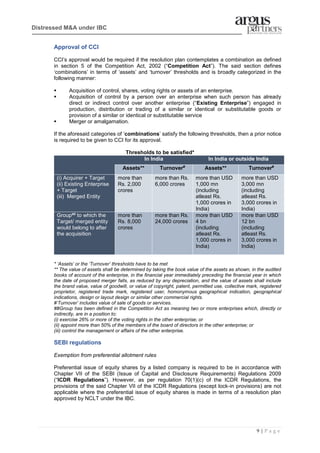
CCI’s approval would be required if the resolution plan contemplates a combination as defined
in section 5 of the Competition Act, 2002 (“Competition Act”). The said section defines
‘combinations’ in terms of ‘assets’ and ‘turnover’ thresholds and is broadly categorized in the
following manner:
▪ Acquisition of control, shares, voting rights or assets of an enterprise.
▪ Acquisition of control by a person over an enterprise when such person has already
direct or indirect control over another enterprise (“Existing Enterprise”) engaged in
production, distribution or trading of a similar or identical or substitutable goods or
provision of a similar or identical or substitutable service
▪ Merger or amalgamation.
If the aforesaid categories of ‘combinations’ satisfy the following thresholds, then a prior notice
is required to be given to CCI for its approval.
Thresholds to be satisfied*
In India In India or outside India
Assets** Turnover#
Assets** Turnover#
(i) Acquirer + Target
(ii) Existing Enterprise
+ Target
(iii) Merged Entity
more than
Rs. 2,000
crores
more than Rs.
6,000 crores
more than USD
1,000 mn
(including
atleast Rs.
1,000 crores in
India)
more than USD
3,000 mn
(including
atleast Rs.
3,000 crores in
India)
Group## to which the
Target/ merged entity
would belong to after
the acquisition
more than
Rs. 8,000
crores
more than Rs.
24,000 crores
more than USD
4 bn
(including
atleast Rs.
1,000 crores in
India)
more than USD
12 bn
(including
atleast Rs.
3,000 crores in
India)
* ‘Assets’ or the ‘Turnover’ thresholds have to be met
** The value of assets shall be determined by taking the book value of the assets as shown, in the audited
books of account of the enterprise, in the financial year immediately preceding the financial year in which
the date of proposed merger falls, as reduced by any depreciation, and the value of assets shall include
the brand value, value of goodwill, or value of copyright, patent, permitted use, collective mark, registered
proprietor, registered trade mark, registered user, homonymous geographical indication, geographical
indications, design or layout design or similar other commercial rights.
#‘Turnover’ includes value of sale of goods or services.
##Group has been defined in the Competition Act as meaning two or more enterprises which, directly or
indirectly, are in a position to:
(i) exercise 26% or more of the voting rights in the other enterprise; or
(ii) appoint more than 50% of the members of the board of directors in the other enterprise; or
(iii) control the management or affairs of the other enterprise.
SEBI regulations
Exemption from preferential allotment rules
Preferential issue of equity shares by a listed company is required to be in accordance with
Chapter VII of the SEBI (Issue of Capital and Disclosure Requirements) Regulations 2009
(“ICDR Regulations”). However, as per regulation 70(1)(c) of the ICDR Regulations, the
provisions of the said Chapter VII of the ICDR Regulations (except lock-in provisions) are not
applicable where the preferential issue of equity shares is made in terms of a resolution plan
approved by NCLT under the IBC.
10 | P a g e
Distressed M&A under IBC
Exemption under SEBI (Substantial Acquisition of Shares and Takeovers) Regulations, 2011
(“Takeover Regulations”)
Regulation 10(1)(da) of the Takeover Regulations exempts acquisitions made pursuant to a
resolution plan approved under section 31 of the IBC, from the obligation to make an open offer
under regulations 3 and 4 of the Takeover Regulations.
Other matters
No specific exemption has been provided from following the procedures prescribed by SEBI
through rules and regulations where a resolution plan provides for, inter alia, the following
matters:
▪ delisting of a listed corporate debtor;
▪ reduction of share capital;
▪ merger of demerger involving the corporate debtor;
▪ issuance of shares; and
▪ re-classification of existing promoters into public.
Tax issues
Carry forward of losses
Currently section 79 of the Income-tax Act, 1961 (“IT Act”) provides that if a change in
shareholding has taken place in a previous year then no loss incurred in any year prior to the
previous year can be carried forward and set off against the income of the previous year unless
there is continuity of ownership i.e. 51% of the voting power should be beneficially held by
same persons the previous year and the year or years in which the loss was incurred. The
Finance Bill, 2018 proposes to amend this provision to provide that nothing contained in the
said section shall apply to a company where a change in the shareholding takes place in a
previous year pursuant to approved resolution plan under the IBC after affording a reasonable
opportunity of being heard to the jurisdictional Principal Commissioner or Commissioner. This
implies that the income tax department would be heard before NCLT approves a resolution
plan.
Minimum alternative tax
Under section 115JB of IT Act, in case of a company, if the income tax payable is less than a
specified percentage of the book profit of the company, then such book profit is deemed to be
the total income of the company. The amount of loss brought forward or unabsorbed
depreciation, whichever is less as per books of accounts is reduced from the calculation of
such book profits. Companies against whom corporate insolvency resolution process had been
initiated were facing hardships due to restriction in allowance of both brought forward loss and
unabsorbed depreciation for computation of book profit under section 115JB of IT Act.
The Finance Bill, 2018 provides that in case of a company, against whom an application for
corporate insolvency resolution process has been admitted under IBC, the aggregate amount
of unabsorbed depreciation and loss brought forward shall be allowed to be reduced from the
book profit and the loss shall not include depreciation. However, waiver of loan or interest is not
specifically excluded from book profits; only a set-off for brought forward losses and
depreciation is excluded.
Section 56(2)(x) of the IT Act
Section 56(2)(x)(c) of the IT Act states the following:
“In particular, and without prejudice to the generality of the provisions of sub-section (1), the
following income, shall be chargeable to income-tax under the head “Income from other
sources”, namely -
11 | P a g e
Distressed M&A under IBC
…
(x) where any person receives, in any previous year, from any person or persons on or after
the 1st day of April, 2017,—
…
(c) any property, other than immovable property,—
…
(B) for a consideration which is less than the aggregate fair market value of the property by an
amount exceeding fifty thousand rupees, the aggregate fair market value of such property as
exceeds such consideration.”
Hence, if a resolution plan provides for issuance of shares for a consideration below the fair
market value, then the recipient of shares may be taxed with the amount by which the
aggregate fair market value of the shares exceeds the consideration being chargeable to
income-tax under the head ‘income from other sources’. Fair market value has to be
determined in accordance with Rules 11U and 11UA of the Income-tax Rules, 1962.
Section 50CA of the IT Act
Section 48 of the IT Act provides the manner in which capital gains tax chargeable under
section 45 of the IT Act is computed. Section 45 of the IT Act specifically provides for imposition
of capital gains tax in case of transfer of capital assets. The Finance Bill of 2017 had inserted a
new section 50CA in the IT Act which states that if the consideration received for the transfer of
unquoted shares, is less than the fair market value of such shares (determined as per the
Income-tax Rules, 1962) then, the value so determined shall, for the purposes of calculation of
tax on capital gains under section 48 of the IT Act, be deemed to be the full value of
consideration received or accruing as a result of such transfer.
Thus, if a transfer of shares of a corporate debtor undergoing a corporate insolvency resolution
process takes place at a price less than the fair market value of such shares, then there may be
a capital gains tax incidence.
Section 281 of the IT Act
Where a resolution plan contemplates an asset transfer or a business transfer, section 281 of
the IT Act may become relevant. Section 281 of the IT Act provides that where during the
pendency of any proceeding under the IT Act or after the completion thereof, but before the
service of notice of demand under rule 2 of the second schedule, an assessee creates a
charge on, or parts with the possession (by way of sale, mortgage, gift, exchange or any other
mode of transfer whatsoever) of, any of his assets in favour of any other person, such charge
or transfer shall be void as against any claim in respect of any tax or any other sum payable by
the assessee as a result of the completion of the said proceeding or otherwise, unless any of
the following conditions are satisfied:
a. such transfer is for adequate consideration and without notice of the pendency of such
proceeding or, as the case may be, without notice of such tax or other sum payable by
the assessee; or
b. with the previous permission of the Assessing Officer.
Therefore, a no-objection certificate maybe required from the income tax authorities. However,
in this connection it may be mentioned that a transfer does not become void ab initio. Section
281 only declares that any transfer is void against the claims of the Revenue in respect of the
tax finally determined in a proceeding which has been pending at the time of the transfer.
Having stated the above, it is pertinent to mention that an argument has been made that if the
transfer of assets is pursuant to an order of the NCLT approving a resolution plan, then section
281 of the IT Act should not apply as it may not be an inter vivos transfer. However, this
argument is yet to be tested in court.
12 | P a g e
Distressed M&A under IBC
Stamp duty
There may be a significant stamp duty incidence depending on the transactions contemplated
in a resolution plan which may include transfer of immovable property, amalgamation, issuance
of shares etc.
Management of the corporate debtor
The IBC provides that a resolution plan should provide for the management of the affairs of the
corporate debtor after approval of the resolution plan.
In certain cases, for a resolution plan to become effective, approvals of certain third parties may
be required such as CCI and SEBI. In such a case, it may be that though NCLT approves the
resolution plan, the plan becomes effective thereafter. The resolution plan has to provide for the
management of the corporate debtor in the interim as technically the resolution professional
may not continue after approval of the resolution plan by NCLT. However, where approval from
CCI is pending, a resolution applicant cannot takeover the management of the corporate debtor
as it may constitute gun-jumping in violation of the Competition Act. Section 6(2A) of the
Competition Act provides that a combination cannot be implemented until approval of CCI is
obtained. Any attempt to control a target company or exercise a significant influence in its
operations (whether directly or indirectly) pending approval of the CCI, such as by means of
standstill obligations and management control, is typically viewed as gun-jumping by CCI which
in turn may lead to imposition of penalty. Accordingly, while providing for the management of
the corporate debtor in the interim, the gun-jumping provisions of the Competition Act have to
be kept in mind.
With regard to the management of the corporate debtor, another issue that arises is when a
resolution plan provides for a slump sale of an undertaking of the corporate debtor and does
not provide for the management of the corporate debtor. This proposition has to be tested
against the requirement in the IBC that, a resolution plan should provide for the management of
the affairs of the corporate debtor after approval of the resolution plan. Further, ‘resolution plan’
itself is defined as a plan proposed by a resolution applicant for insolvency resolution of the
corporate debtor as a going concern. In this regard a reference may be made to the
observation of NCLT (Mumbai Bench) in Roofit Industries Limited, where a proposal from a
resolution applicant was for only one factory and excluded other units of the company. NCLT
held that this cannot be considered a resolution at all under the IBC and ordered the liquidation
of the company; thus, discouraging cherry picking of assets.
6. Summing up
Some have described distressed M&A as an art. It requires a special skill set and a certain
level of risk appetite. As the IBC is still at a relatively nascent stage with several ambiguities
and uncertainties, one has to be careful in assessing the potential risks and liabilities which
may arise in future, and also while drafting a resolution plan. However, distressed M&As have
their own benefits. Potentially an acquirer may get an asset at a lower valuation than in ordinary
circumstances.
We are at the beginning of distressed M&A deals under IBC and such deals are expected to
only increase as the IBC regime matures.
This paper has been written by Adity Chaudhury, Partner at Argus Partners. The author was assisted
by Associates Ashish Patel, Riya Dutta and Deeya Ray.
DISCLAIMER
This document is merely intended as an update and is
merely for informational purposes. This document should
not be construed as a legal opinion. No person should
rely on the contents of this document without first
obtaining advice from a qualified professional person.
This document is contributed on the understanding that
the Firm, its employees and consultants are not
responsible for the results of any actions taken on the
basis of information in this document, or for any error in
or omission from this document. Further, the Firm, its
employees and consultants, expressly disclaim all and
any liability and responsibility to any person who reads
this document in respect of anything, and of the
consequences of anything, done or omitted to be done by
such person in reliance, whether wholly or partially, upon
the whole or any part of the content of this document.
Without limiting the generality of the above, no author,
consultant or the Firm shall have any responsibility for
any act or omission of any other author, consultant or the
Firm. This update does not and is not intended to
constitute solicitation, invitation, advertisement or
inducement of any sort whatsoever from us or any of our
members to solicit any work, in any manner, whether
directly or indirectly.
You can send us your comments at:
argusknowledgecentre@argus-p.com
Mumbai I Delhi I Bengaluru I Kolkata

Distressed M&A under the Bankruptcy Code

  • 1.
    March 1, 2018 DISTRESSEDM&A UNDERTHEINSOLVENCYANDBANKRUPTCYCODE
  • 2.
    1 | Pa g e Distressed M&A under IBC 1. Introduction Given the surge in stressed assets in the Indian economy, it is no wonder that the regulatory landscape governing stressed assets is in the midst of a massive overhaul. The complexity of the problem has necessitated multiple changes to various laws and introduction of several new ones. With the introduction of new rules and regulations, new tools have been made available with the aim of having a comprehensive approach for effective and timely resolution of stressed assets. One of the most significant tools introduced to address the problem of stressed assets is the Insolvency and Bankruptcy Code, 2016 (“IBC”). It has been a little over a year that the IBC was enacted. Till date more than 500 cases have been admitted by the National Company Law Tribunal (“NCLT”) under IBC. Out of these, so far, resolution plans for around 11 companies have been approved and orders for liquidating more than 40 companies have been passed. While the ratio of successful resolution versus liquidation may not be encouraging, there has been a flurry of activity in the distressed M&A space with many sensing an opportunity to acquire some good assets. This paper provides an overview of the legal framework under the IBC for undertaking distressed M&A and the potential risks and challenges in the process. 2. The IBC The IBC was enacted as a comprehensive code to consolidate laws relating to reorganisation and insolvency resolutions of corporates, partnerships as well as individuals. The entire process beginning from institution of proceedings until approval of a resolution plan or liquidation, is intended to be time bound. The Insolvency and Bankruptcy Board (“IBBI”) has also framed the IBBI (Insolvency Resolution Process for Corporate Persons) Regulations, 2016 (“CIRP Regulations”) to address several aspects pertaining to the corporate insolvency resolution process. Initiation of a corporate insolvency resolution process Once a corporate debtor defaults for an amount of Rs. 1 lac, a financial creditor, an operational creditor or the corporate debtor itself may initiate corporate insolvency resolution process in respect of such corporate debtor by filing an application before the NCLT. The corporate insolvency process commences from the date such application is admitted by NCLT. The IBC mandates that the entire corporate insolvency resolution process should be completed within 180 days from the date of admission. This time period can be extended only once by NCLT for upto an additional 90 days. Thus, the entire process has to be completed within 270 days. What happens after admission? Moratorium Once an application for commencing corporate insolvency resolution process against a corporate debtor is admitted, a moratorium order is passed prohibiting the institution of suits or continuation of pending suits or proceedings against the corporate debtor or any action to foreclose, recover or enforce any security interest created by the corporate debtor in respect of its property. Transfer of assets by the corporate debtor is also prohibited. This order of moratorium remains in effect till the completion of the corporate insolvency resolution process or earlier if NCLT approves a resolution plan or passes an order for liquidation of corporate debtor. A moratorium, however, will not affect any suit or case pending before the Supreme Court under Article 32 of the Constitution of India or where an order is passed under Article 136 of
  • 3.
    2 | Pa g e Distressed M&A under IBC Constitution of India1. A moratorium will also not affect the power of the High Court under Article 226 of Constitution of India. However, a money suit or a suit for recovery, against the corporate debtor, filed before any High Court under original jurisdiction, cannot proceed after declaration of moratorium. Appointment of Resolution Professional An interim resolution professional (“IRP”) is appointed by NCLT for a term of 30 days. The committee of creditors (discussed below) once formed, either appoints the IRP as a resolution professional (“RP”) or replaces the IRP by another resolution professional. Management of the corporate debtor From the date of appointment of the IRP, the management of the affairs of the corporate debtor vests in the IRP. The powers of the Board of Directors stand suspended and is exercised by the IRP. The officers and managers of the corporate debtor are required to report to the IRP. If any personnel of the corporate debtor, its promoter or any other person required to assist or cooperate with the IRP does not assist or cooperate, then the IRP can make an application to NCLT for necessary directions. This right has already been exercised in various ongoing insolvency resolution processes, and NCLT has given directions to the personnel of corporate debtors to extend all co-operation. The IRP/RP has to make every endeavour to protect and preserve the value of the property of the corporate debtor and manage the operations of the corporate debtor as a going concern. The IRP and thereafter the RP, therefore, plays a central role in the entire insolvency resolution process as unlike a debtor-in-possession bankruptcy regime in many other countries, the IBC provides for the suspension of the Board of Directors and vesting of the management in the IRP/RP. Formation of Committee of Creditors The IRP is required to constitute a committee of creditors (“COC”) comprising all financial creditors (other than related parties) of the corporate debtor. If there are no financial creditors or if all financial creditors are related parties of the corporate debtor, then the COC will comprise of the 18 largest operational creditors by value, 1 representative elected by all workmen and 1 representative elected by all employees. While the RP is responsible to preserve and protect the assets of the corporate debtor, including the continued business operations of the corporate debtor, the COC also plays an important role. Prior approval of the COC (by obtaining consent of 75% of the voting shares) is required before the RP can take certain actions. These include: raising any interim finance, creating any security interest over the assets of the corporate debtor, changing the capital structure of the corporate debtor, undertaking any related party transaction, amending any constitutional documents, delegating any authority, change in the management, and transferring rights or financial debts or operational debts under material contracts otherwise than in the ordinary course of business. 3. Invitation to submit Resolution Plans Information Memorandum As a first step towards kickstarting the process of inviting resolution plans, the RP is required to prepare an information memorandum (“IM”). The IM has to contain the following details of a corporate debtor: 1 Canara Bank v. Deccan Chronicle Holdings Limited, Company Appeal (AT) (Insolvency) No. 147 of 2017, NCLAT.
  • 4.
    3 | Pa g e Distressed M&A under IBC ▪ assets and liabilities, as on the insolvency commencement date; ▪ latest annual financial statements; ▪ audited financial statements of the corporate debtor for the last 2 financial years and provisional financial statements for the current financial year made up to a date not earlier than 14 days from the date of the application; ▪ a list of creditors containing the names of creditors, the amounts claimed by them, the amount of their claims admitted and the security interest, if any, in respect of such claims; ▪ particulars of a debt due from or to the corporate debtor with respect to related parties; ▪ details of guarantees that have been given in relation to the debts of the corporate debtor by other persons, specifying which of the guarantors is a related party; ▪ the names and addresses of the members or partners holding at least 1% stake in the corporate debtor along with the size of stake; ▪ details of all material litigation and an ongoing investigation or proceeding initiated by Government and statutory authorities; and ▪ number of workers and employees and liabilities towards them. The RP also has to provide all resolution applicants access to all relevant information in physical and electronic form. Evaluation Matrix A recent amendment to the CIRP Regulations proposes that at the time of inviting resolution plans, the RP should include an evaluation matrix containing such parameters to be applied and the manner of applying such parameters, as approved by the COC for consideration of resolution plans for its approval, at least 30 days before the last date of submission of resolution plans. Who can submit Resolution Plans? The IBC, as originally enacted, allowed any person to be a resolution applicant i.e. any person could submit a resolution plan for a corporate debtor. However, pursuant to a recent amendment, the RP can invite only those applicants (“Resolution Applicant”) to submit a resolution plan who fulfil the criteria as laid down by him with the approval of the COC, having regard to the complexity and scale of operations of the business of the corporate debtor and such other conditions which may be specified by IBBI. Further, a new section 29A has been introduced in the IBC which sets out certain disqualification parameters. Notably, a person is disqualified to submit a resolution plan if the person or any other person acting jointly or in concert with such person, has an account which is classified as a non-performing asset (“NPA”) or if such person is a promoter or in management or control of a corporate debtor whose account has been classified as an NPA and 1 year has lapsed from the date of classification till the date of commencement of the corporate insolvency resolution process of the corporate debtor. Thus, existing promoters would find it difficult to bid for their own companies which have been declared an NPA. However, such persons can submit a resolution plan if they make payment within such period decided by the COC (not exceeding 30 days) of all overdue amounts with interest thereon and charges relating to NPA accounts before submission of resolution plan. A person shall also not be eligible as a resolution applicant, if such person, or any other person acting jointly or in concert: ▪ is an undischarged insolvent; ▪ is a wilful defaulter in accordance with the guidelines of Reserve Bank of India under the Banking Regulation Act, 1949; ▪ has been convicted for any offence punishable with imprisonment for 2 years or more; ▪ is disqualified to act as a director under the Companies Act, 2013;
  • 5.
    4 | Pa g e Distressed M&A under IBC ▪ is prohibited by Securities and Exchange Board of India (“SEBI”) from trading in securities or accessing the securities markets; ▪ has been a promoter or in the management or control of a corporate debtor in which a preferential transaction, undervalued transaction, extortionate credit transaction or fraudulent transaction has taken place and in respect of which an order has been made by NCLT under the IBC; ▪ has executed an enforceable guarantee in favour of a creditor in respect of a corporate debtor against which an application for insolvency resolution made by such creditor has been admitted; ▪ has been subject to any disability, corresponding to the above, under any law in a jurisdiction outside India. Conducting a due diligence Due diligence becomes a critical exercise in the entire process because unlike in a normal M&A transaction, a Resolution Applicant will not have the benefit of representations and warranties from the promoters. Often the Resolution Applicant is required to submit a bid on an as is where is basis, and to that extent the risks are passed on to the Resolution Applicant with very little fall-back option. A Resolution Applicant may work under various constraints while undertaking a due-diligence of a corporate debtor. A potential constraint in conducting a due diligence is the quality of information provided. The Resolution Applicant is dependant on the RP to provide all relevant information who in turn may have to depend on the existing management to a large extent for providing relevant information. As the corporate insolvency process is a time bound process, a Resolution Applicant has a limited time frame to complete the due-diligence process, which may further impact an effective due-diligence. Maintaining confidentiality In order to maintain the integrity of the entire process, it is imperative that confidential information pertaining to the corporate debtor which can be accessed by any potential Resolution Applicant including competitors, is kept strictly confidential. The IBC recognises the importance of maintaining confidentiality and accordingly requires all Resolution Applicants accessing information about the corporate debtor to comply with provisions of law for the time being in force relating to confidentiality and insider trading, protect any intellectual property of the corporate debtor it may have access to and not to share relevant information with third parties unless the above is complied with. Liquidation value and fair value Liquidation value is the estimated realizable value of the assets of the corporate debtor if the corporate debtor were to be liquidated on the insolvency commencement date. The CIRP Regulations as originally enacted provided that the IRP should appoint 2 registered valuers to determine the liquidation value of the corporate debtor. The liquidation value was required to be disclosed in the IM. However, pursuant to a recent amendment, the IM is not required to state the liquidation value. After the receipt of resolution plans, the RP is required to provide the liquidation value to every member of the COC after obtaining an undertaking from the member to the effect that such member shall maintain confidentiality of the liquidation value and shall not use such value to cause an undue gain or undue loss to itself or any other person. The RP is also required to maintain confidentiality of the liquidation value. A recent amendment proposed to the CIRP Regulations requires that, apart from the liquidation value, the fair value should also be determined and provided to the COC after receipt of resolution plans. ‘Fair value’ has been defined as the estimated realizable value of the assets of the corporate debtor, if they were to be exchanged on the insolvency commencement date
  • 6.
    5 | Pa g e Distressed M&A under IBC between a willing buyer and a willing seller in an arm’s length transaction, after proper marketing and where the parties had acted knowledgeably, prudently and without compulsion. 4. Resolution Plans Mandatory contents The IBC and CIRP Regulations stipulate certain matters which are mandatorily required to form part of a resolution plan. These are discussed below. Payment of IRP Costs The insolvency resolution process costs (“IRP Costs”) have to be paid in priority to the repayment of other debts of the corporate debtor. IRP Costs include the following: ▪ amount of any interim finance and the costs incurred in raising such finance; ▪ fees payable to the RP; ▪ costs incurred by the RP in running the business of the corporate debtor as a going concern; ▪ costs incurred at the expense of the Government to facilitate the insolvency resolution process; ▪ amounts due to suppliers of essential goods and services ▪ amounts due to a person whose rights are prejudicially affected on account of the moratorium; and ▪ other costs directly relating to the corporate insolvency resolution process and approved by the COC. Debts of operational creditors Specific sources of funds have to be identified for payment of the liquidation value due to operational creditors. This has to be paid in priority to any financial creditor which shall in any event have to be made before the expiry of 30 days after the approval of a resolution plan by the NCLT. Dissenting financial creditors Specific sources of funds have to be identified for payment of the liquidation value due to dissenting financial creditors. Such payment has to be made before any recoveries are made by the financial creditors who voted in favour of the resolution plan. Dissenting creditors include a financial creditor who voted against the resolution plan as well as a financial creditor who abstains from voting for the resolution plan, approved by the COC. Treatment of all stakeholders A resolution plan has to include a statement as to how it has dealt with the interests of all stakeholders, including financial creditors and operational creditors, of the corporate debtor. Term and implementation schedule and adequate means for supervising implementation The term and manner of implementation of the resolution plan including timelines are required to be provided in the resolution plan. To provide for a check and balance, the resolution plan is also required to provide the manner in which the implementation of the plan will be supervised. Typically, an independent agency or a representative of the financial creditors is proposed for the supervision.
  • 7.
    6 | Pa g e Distressed M&A under IBC Management and control of the business The resolution plan has to provide for the management and control of the business of the corporate debtor during its term. This issue is discussed in detail hereinbelow. Details of the Resolution Applicant and its connected persons Pursuant to a recent amendment, a resolution plan is required to provide several details about the Resolution Applicant and its connected persons. The expression ‘connected person’ has been given a wide meaning. Following would qualify as connected persons: ▪ any person who is the promoter or in the management or control of the resolution applicant; or ▪ any person who shall be the promoter or in management or control of the business of the corporate debtor during the implementation of the resolution plan; or ▪ the holding company, subsidiary company, associate company or related party of a person referred to in the clauses above2 . What can a Resolution Plan provide? IBC is a complete code The Supreme Court of India, in the case of M/s Innoventive Industries Limited Appellant v. ICICI Bank3, observed that a consolidating and amending act like the IBC enacted by the Parliament of India forms a code complete in itself and is exhaustive of the matters dealt with therein. If an earlier law enacted by a State Government is repugnant to the IBC such that it hinders and obstructs in such a manner that it will not be possible to go ahead with the insolvency resolution process outlined in the IBC, then the IBC will prevail. Further, section 238 of the IBC states that the IBC shall have effect, notwithstanding anything inconsistent therewith contained in any other law for the time being in force or any instrument having effect by virtue of any such law. Thus, the IBC is a complete code in itself and would have an overriding effect over other legislations. However, such overriding effect would not extend to permitting something which is illegal. For example, if foreign direct investment is not permitted in a sector, a resolution plan cannot provide otherwise. Infact, the resolution professional is required to certify that a resolution plan is in compliance with applicable laws. Against the above backdrop, the issue that arises is the scope of powers of NCLT while approving a resolution plan, and the matters which may be included in a resolution plan. The CIRP Regulations provide that a resolution plan may provide for the measures required for implementing it. These could include (but not limited to) the following: ▪ transfer of all or part of the assets of the corporate debtor to 1 or more persons; ▪ sale of all or part of the assets whether subject to any security interest or not; ▪ substantial acquisition of shares of the corporate debtor, or the merger or consolidation of the corporate debtor with 1 or more persons; ▪ satisfaction or modification of any security interest; ▪ curing or waiving of any breach of the terms of any debt due from the corporate debtor; ▪ reduction in the amount payable to the creditors; ▪ extension of a maturity date or a change in interest rate or other terms of a debt due from the corporate debtor; 2 Scheduled banks, asset reconstruction companies and alternate investment funds registered with SEBI are exempt from this requirement. 3M/s Innoventive Industries Limited Appellant v. ICICI Bank & Another, Civil Appeal Nos. 8337-8338 of 2017.
  • 8.
    7 | Pa g e Distressed M&A under IBC ▪ amendment of the constitutional documents of the corporate debtor; ▪ issuance of securities of the corporate debtor, for cash, property, securities, or in exchange for claims or interests, or other appropriate purpose; and ▪ obtaining necessary approvals from the Central and State Governments and other authorities. Apart from the fact that it has been just over a year that the IBC has been enacted, so far only about 11 resolution plans have been approved by the NCLT. Hence, the jurisprudence on the scope of the powers of NCLT is still evolving. Summarised below are some of the decisions of NCLT which may throw some light on this matter: Interim order passed on February 7, 2018 by NCLT, Ahmedabad Bench in IDBI Bank Limited v. Essar Steel Limited Section 60(5) of the IBC states that notwithstanding anything to the contrary contained in any other law for the time being in force, the NCLT shall have jurisdiction to entertain or dispose of: (a) any application or proceeding by or against the corporate debtor or corporate person; (b) any claim made by or against the corporate debtor or corporate person, including claims by or against any of its subsidiaries situated in India; and (c) any question of priorities or any question of law or facts, arising out of or in relation to the insolvency resolution or liquidation proceedings of the corporate debtor or corporate person under the IBC. In the said case, Essar Steel Limited (corporate debtor) through its RP filed an application before NCLT seeking a direction that a particular pipeline is the pipeline of the corporate debtor. NCLT observed that it has jurisdiction under section 60(5) of IBC to decide the claims of the corporate debtor, questions of fact or law, provided if such claims, questions of fact or law arise out of or in relation to the corporate insolvency resolution process. However, such jurisdiction does not extend to granting declaratory reliefs to the corporate debtor. Order passed on December 15, 2017 by NCLT, Allahabad Bench in the matter of JEKPL Private Limited The NCLT approved a resolution plan which, inter alia, provided the following: ▪ Rescinding or cancellation of the existing equity and preference shares of the company; ▪ All security provided by the corporate debtor for the term loans granted by State Bank of India and Central Bank of India shall be rescinded; ▪ All security provided by the shareholders, promoters and guarantors of the corporate debtors to State Bank of India and Central Bank of India shall be assigned to the resolution applicant or an SPV (special purpose vehicle); ▪ All contingent liabilities of JEKPL Private Limited, whether claimed or unclaimed, excluding 1 bank guarantee, shall be extinguished or annulled. This would include liabilities to the Government of India under production sharing contracts; ▪ There will be no liability under the Income Tax Act, 1961 including any liability under minimum alternate tax on account of the transactions in the resolution plan; ▪ All liabilities of the corporate debtor shall be written off including contingent liabilities; and ▪ All approvals from the Government of India in a production sharing contract will be granted by the Government of India. NCLT also observed that NCLT is not expected to substitute its view with the commercial wisdom of the RP or COC nor should it deal with technical complexity and merits of a resolution plan unless it is found contrary to the express provisions of law and goes against public interest. However, this matter is now pending before the National Company Law Appellate Tribunal.
  • 9.
    8 | Pa g e Distressed M&A under IBC Order passed on December 13, 2017 by NCLT, New Delhi, Principal Bench in the matter of Alchemist Asset Reconstruction Co. Ltd. v. Hotel Gaudavan Pvt. Ltd. NCLT approved a resolution plan which, inter alia, provided that the existing share capital of the corporate debtor will be transferred to the resolution applicant at Re. 1 per share, and thereafter the resolution applicant shall take steps as per law for reduction of share capital. Order passed on December 12, 2017 by NCLT, Mumbai Bench in the matter of Shirdi Industries Limited While approving the resolution plan submitted, NCLT held that the corporate debtor will be liable to pay all applicable taxes without any exemption as sought in the resolution plan. Binding nature of resolution plans A resolution plan, once approved by NCLT, is binding on the corporate debtor and its employees, members, creditors, guarantors and other stakeholders involved in the resolution plan. The CIRP Regulation provides that a provision in a resolution plan which would otherwise require the consent of the members or partners of the corporate debtor, as the case may be, under the terms of the constitutional documents of the corporate debtor, shareholders’ agreement, joint venture agreement or other document of a similar nature, shall take effect notwithstanding that such consent has not been obtained. The Ministry of Corporate Affairs has issued a circular (General Circular No. IBC/01/2017) dated October 25, 2017 clarifying that the approval of shareholders/ members of the corporate debtor for a particular action required in a resolution plan for its implementation which would have been required under the Companies Act or any other law if the resolution plan was not being considered under the IBC will be deemed to have been given on its approval by NCLT. 5. Some Considerations Approval of third parties While the IBC is a complete code in itself, it may not obviate the requirement of obtaining the consent of other regulators and governmental authorities such as the Competition Commission of India (“CCI”), Reserve Bank of India, SEBI, Stock Exchanges, Insurance Regulatory and Development Authority etc, if the plan provides for a matter which would ordinarily require approval from other authorities. Further, as mentioned above, a resolution plan, once approved by NCLT, is binding on the corporate debtor and its employees, members, creditors, guarantors and other stakeholders involved in the resolution plan. The issue that arises is whether the resolution plan is also binding on contractual counterparties. For instance, if a resolution plan provides for the assignment of a contract entered into by the corporate debtor and the contract requires consent of the counterparty for any assignment, then the issue that arises is whether such an assignment can take place without obtaining such consent. Such a proposition is yet to be tested in a court. It is pertinent to mention that there are multiple case laws under sections 391 to 394 of the Companies Act, 1956 (schemes of arrangements) which establish that the sanction of a scheme of arrangement by courts would not affect the obligations of the parties to apply for and receive the necessary consents under contracts and regulations, including contracts relating to rights in immoveable property and under the specialized laws, as applicable. However, as mentioned, the said case laws pertain to sanctioning of schemes of arrangement under the Companies Act, 1956 (now replaced by the Companies Act, 2013).
  • 10.
    9 | Pa g e Distressed M&A under IBC Approval of CCI CCI’s approval would be required if the resolution plan contemplates a combination as defined in section 5 of the Competition Act, 2002 (“Competition Act”). The said section defines ‘combinations’ in terms of ‘assets’ and ‘turnover’ thresholds and is broadly categorized in the following manner: ▪ Acquisition of control, shares, voting rights or assets of an enterprise. ▪ Acquisition of control by a person over an enterprise when such person has already direct or indirect control over another enterprise (“Existing Enterprise”) engaged in production, distribution or trading of a similar or identical or substitutable goods or provision of a similar or identical or substitutable service ▪ Merger or amalgamation. If the aforesaid categories of ‘combinations’ satisfy the following thresholds, then a prior notice is required to be given to CCI for its approval. Thresholds to be satisfied* In India In India or outside India Assets** Turnover# Assets** Turnover# (i) Acquirer + Target (ii) Existing Enterprise + Target (iii) Merged Entity more than Rs. 2,000 crores more than Rs. 6,000 crores more than USD 1,000 mn (including atleast Rs. 1,000 crores in India) more than USD 3,000 mn (including atleast Rs. 3,000 crores in India) Group## to which the Target/ merged entity would belong to after the acquisition more than Rs. 8,000 crores more than Rs. 24,000 crores more than USD 4 bn (including atleast Rs. 1,000 crores in India) more than USD 12 bn (including atleast Rs. 3,000 crores in India) * ‘Assets’ or the ‘Turnover’ thresholds have to be met ** The value of assets shall be determined by taking the book value of the assets as shown, in the audited books of account of the enterprise, in the financial year immediately preceding the financial year in which the date of proposed merger falls, as reduced by any depreciation, and the value of assets shall include the brand value, value of goodwill, or value of copyright, patent, permitted use, collective mark, registered proprietor, registered trade mark, registered user, homonymous geographical indication, geographical indications, design or layout design or similar other commercial rights. #‘Turnover’ includes value of sale of goods or services. ##Group has been defined in the Competition Act as meaning two or more enterprises which, directly or indirectly, are in a position to: (i) exercise 26% or more of the voting rights in the other enterprise; or (ii) appoint more than 50% of the members of the board of directors in the other enterprise; or (iii) control the management or affairs of the other enterprise. SEBI regulations Exemption from preferential allotment rules Preferential issue of equity shares by a listed company is required to be in accordance with Chapter VII of the SEBI (Issue of Capital and Disclosure Requirements) Regulations 2009 (“ICDR Regulations”). However, as per regulation 70(1)(c) of the ICDR Regulations, the provisions of the said Chapter VII of the ICDR Regulations (except lock-in provisions) are not applicable where the preferential issue of equity shares is made in terms of a resolution plan approved by NCLT under the IBC.
  • 11.
    10 | Pa g e Distressed M&A under IBC Exemption under SEBI (Substantial Acquisition of Shares and Takeovers) Regulations, 2011 (“Takeover Regulations”) Regulation 10(1)(da) of the Takeover Regulations exempts acquisitions made pursuant to a resolution plan approved under section 31 of the IBC, from the obligation to make an open offer under regulations 3 and 4 of the Takeover Regulations. Other matters No specific exemption has been provided from following the procedures prescribed by SEBI through rules and regulations where a resolution plan provides for, inter alia, the following matters: ▪ delisting of a listed corporate debtor; ▪ reduction of share capital; ▪ merger of demerger involving the corporate debtor; ▪ issuance of shares; and ▪ re-classification of existing promoters into public. Tax issues Carry forward of losses Currently section 79 of the Income-tax Act, 1961 (“IT Act”) provides that if a change in shareholding has taken place in a previous year then no loss incurred in any year prior to the previous year can be carried forward and set off against the income of the previous year unless there is continuity of ownership i.e. 51% of the voting power should be beneficially held by same persons the previous year and the year or years in which the loss was incurred. The Finance Bill, 2018 proposes to amend this provision to provide that nothing contained in the said section shall apply to a company where a change in the shareholding takes place in a previous year pursuant to approved resolution plan under the IBC after affording a reasonable opportunity of being heard to the jurisdictional Principal Commissioner or Commissioner. This implies that the income tax department would be heard before NCLT approves a resolution plan. Minimum alternative tax Under section 115JB of IT Act, in case of a company, if the income tax payable is less than a specified percentage of the book profit of the company, then such book profit is deemed to be the total income of the company. The amount of loss brought forward or unabsorbed depreciation, whichever is less as per books of accounts is reduced from the calculation of such book profits. Companies against whom corporate insolvency resolution process had been initiated were facing hardships due to restriction in allowance of both brought forward loss and unabsorbed depreciation for computation of book profit under section 115JB of IT Act. The Finance Bill, 2018 provides that in case of a company, against whom an application for corporate insolvency resolution process has been admitted under IBC, the aggregate amount of unabsorbed depreciation and loss brought forward shall be allowed to be reduced from the book profit and the loss shall not include depreciation. However, waiver of loan or interest is not specifically excluded from book profits; only a set-off for brought forward losses and depreciation is excluded. Section 56(2)(x) of the IT Act Section 56(2)(x)(c) of the IT Act states the following: “In particular, and without prejudice to the generality of the provisions of sub-section (1), the following income, shall be chargeable to income-tax under the head “Income from other sources”, namely -
  • 12.
    11 | Pa g e Distressed M&A under IBC … (x) where any person receives, in any previous year, from any person or persons on or after the 1st day of April, 2017,— … (c) any property, other than immovable property,— … (B) for a consideration which is less than the aggregate fair market value of the property by an amount exceeding fifty thousand rupees, the aggregate fair market value of such property as exceeds such consideration.” Hence, if a resolution plan provides for issuance of shares for a consideration below the fair market value, then the recipient of shares may be taxed with the amount by which the aggregate fair market value of the shares exceeds the consideration being chargeable to income-tax under the head ‘income from other sources’. Fair market value has to be determined in accordance with Rules 11U and 11UA of the Income-tax Rules, 1962. Section 50CA of the IT Act Section 48 of the IT Act provides the manner in which capital gains tax chargeable under section 45 of the IT Act is computed. Section 45 of the IT Act specifically provides for imposition of capital gains tax in case of transfer of capital assets. The Finance Bill of 2017 had inserted a new section 50CA in the IT Act which states that if the consideration received for the transfer of unquoted shares, is less than the fair market value of such shares (determined as per the Income-tax Rules, 1962) then, the value so determined shall, for the purposes of calculation of tax on capital gains under section 48 of the IT Act, be deemed to be the full value of consideration received or accruing as a result of such transfer. Thus, if a transfer of shares of a corporate debtor undergoing a corporate insolvency resolution process takes place at a price less than the fair market value of such shares, then there may be a capital gains tax incidence. Section 281 of the IT Act Where a resolution plan contemplates an asset transfer or a business transfer, section 281 of the IT Act may become relevant. Section 281 of the IT Act provides that where during the pendency of any proceeding under the IT Act or after the completion thereof, but before the service of notice of demand under rule 2 of the second schedule, an assessee creates a charge on, or parts with the possession (by way of sale, mortgage, gift, exchange or any other mode of transfer whatsoever) of, any of his assets in favour of any other person, such charge or transfer shall be void as against any claim in respect of any tax or any other sum payable by the assessee as a result of the completion of the said proceeding or otherwise, unless any of the following conditions are satisfied: a. such transfer is for adequate consideration and without notice of the pendency of such proceeding or, as the case may be, without notice of such tax or other sum payable by the assessee; or b. with the previous permission of the Assessing Officer. Therefore, a no-objection certificate maybe required from the income tax authorities. However, in this connection it may be mentioned that a transfer does not become void ab initio. Section 281 only declares that any transfer is void against the claims of the Revenue in respect of the tax finally determined in a proceeding which has been pending at the time of the transfer. Having stated the above, it is pertinent to mention that an argument has been made that if the transfer of assets is pursuant to an order of the NCLT approving a resolution plan, then section 281 of the IT Act should not apply as it may not be an inter vivos transfer. However, this argument is yet to be tested in court.
  • 13.
    12 | Pa g e Distressed M&A under IBC Stamp duty There may be a significant stamp duty incidence depending on the transactions contemplated in a resolution plan which may include transfer of immovable property, amalgamation, issuance of shares etc. Management of the corporate debtor The IBC provides that a resolution plan should provide for the management of the affairs of the corporate debtor after approval of the resolution plan. In certain cases, for a resolution plan to become effective, approvals of certain third parties may be required such as CCI and SEBI. In such a case, it may be that though NCLT approves the resolution plan, the plan becomes effective thereafter. The resolution plan has to provide for the management of the corporate debtor in the interim as technically the resolution professional may not continue after approval of the resolution plan by NCLT. However, where approval from CCI is pending, a resolution applicant cannot takeover the management of the corporate debtor as it may constitute gun-jumping in violation of the Competition Act. Section 6(2A) of the Competition Act provides that a combination cannot be implemented until approval of CCI is obtained. Any attempt to control a target company or exercise a significant influence in its operations (whether directly or indirectly) pending approval of the CCI, such as by means of standstill obligations and management control, is typically viewed as gun-jumping by CCI which in turn may lead to imposition of penalty. Accordingly, while providing for the management of the corporate debtor in the interim, the gun-jumping provisions of the Competition Act have to be kept in mind. With regard to the management of the corporate debtor, another issue that arises is when a resolution plan provides for a slump sale of an undertaking of the corporate debtor and does not provide for the management of the corporate debtor. This proposition has to be tested against the requirement in the IBC that, a resolution plan should provide for the management of the affairs of the corporate debtor after approval of the resolution plan. Further, ‘resolution plan’ itself is defined as a plan proposed by a resolution applicant for insolvency resolution of the corporate debtor as a going concern. In this regard a reference may be made to the observation of NCLT (Mumbai Bench) in Roofit Industries Limited, where a proposal from a resolution applicant was for only one factory and excluded other units of the company. NCLT held that this cannot be considered a resolution at all under the IBC and ordered the liquidation of the company; thus, discouraging cherry picking of assets. 6. Summing up Some have described distressed M&A as an art. It requires a special skill set and a certain level of risk appetite. As the IBC is still at a relatively nascent stage with several ambiguities and uncertainties, one has to be careful in assessing the potential risks and liabilities which may arise in future, and also while drafting a resolution plan. However, distressed M&As have their own benefits. Potentially an acquirer may get an asset at a lower valuation than in ordinary circumstances. We are at the beginning of distressed M&A deals under IBC and such deals are expected to only increase as the IBC regime matures. This paper has been written by Adity Chaudhury, Partner at Argus Partners. The author was assisted by Associates Ashish Patel, Riya Dutta and Deeya Ray.
  • 14.
    DISCLAIMER This document ismerely intended as an update and is merely for informational purposes. This document should not be construed as a legal opinion. No person should rely on the contents of this document without first obtaining advice from a qualified professional person. This document is contributed on the understanding that the Firm, its employees and consultants are not responsible for the results of any actions taken on the basis of information in this document, or for any error in or omission from this document. Further, the Firm, its employees and consultants, expressly disclaim all and any liability and responsibility to any person who reads this document in respect of anything, and of the consequences of anything, done or omitted to be done by such person in reliance, whether wholly or partially, upon the whole or any part of the content of this document. Without limiting the generality of the above, no author, consultant or the Firm shall have any responsibility for any act or omission of any other author, consultant or the Firm. This update does not and is not intended to constitute solicitation, invitation, advertisement or inducement of any sort whatsoever from us or any of our members to solicit any work, in any manner, whether directly or indirectly. You can send us your comments at: argusknowledgecentre@argus-p.com Mumbai I Delhi I Bengaluru I Kolkata