DISSERTATION PRESENTATION
By
DR. SADHANA. DAYANAND. PATIL
Under the Guidance of
DR. PRADEEPKUMAR A. PATIL
M.D.(HOM)
Professor, P.G Guide & P G Co- Ordinator
Department of Repertory
DOP: 05/05/2021
“UTILITY OF KENT’S REPERTORY AND BOGER BOENNINGHAUSEN’S
CHARACTERISTICS AND REPERTORY IN MANAGEMENT OF PRIMARY
DYSMENORRHEA WITH IMPROVEMENT OF QUALITY OF LIFE IN AGE
GROUP OF 15-25YEARS - A COMPARATIVE STUDY”
CONTENTS
 Aim and Objective
 Methodology
 Sample size estimation
 Results
 Discussion
 Conclusion
 Summary
 Graphs
 References
 Master chart
AIM and OBJECTIVE
AIM
 To assess the utility of Kent’s repertory and BBCR in management of primary dysmenorrhea
with the improvement of quality of life.
OBJECTIVES
 To assess the quality of life in patients of primary dysmenorrhea using WHOQOL-BREF
before and after the treatment.
 To assess the utility of Kent’s Repertory in management of primary dysmenorrhea with
improvement of quality of life.
 To assess the utility of BBCR in management of primary dysmenorrhea with improvement of
quality of life.
 To compare utility of Kent’s repertory and BBCR in management of primary dysmenorrhea
with improvement of quality of life.
HYPOTHESIS
 NULL HYPOTHESIS: Utility of Kent’s Repertory and BBCR both may be equal in
management of primary dysmenorrhea with improvement of quality of life in age group
of 15-25years.
 ALTERNATIVE HYPOTHESIS: Utility of Kent’s Repertory is more than BBCR in
management of primary dysmenorrhea with improvement of quality of life in age group
of 15-25years.
METHODOLOGY
 STUDY SETTINGS:-
Subjects for the study were selected from the Outpatient Department/village camps of Bharatesh Homeopathic
Medical College and Hospital, Belgaum.
 METHOD OF COLLECTION OF DATA:-
Subjects who are willing to participate and give written informed consent which will be explained in subject’s
own language.
 SELECTION CRITERIA :-
Subjects shall be selected on the inclusion and exclusion criteria. A detailed case history shall be taken by
interview as per the performance prepared for the topic and necessary investigation will be done.
 SCALE USED TO KNOW QUALITY OF LIFE:-
WHOQOL-BREF Scoring scale will be used to know quality of life before treatment and after 6 months of
treatment.
 STUDY SUBJECTS:- Subjects suffering from Primary Dysmenorrhea will be divided into two groups.
 Group A – Treated with individualized remedy by using Kent’s repertory.
 Analysis and evaluation of symptoms : After detailed case taking the symptoms of the patient were
analyzed into mental general, physical general and particulars.
 Selection of Remedy : Selection of remedy was done on the basis of reportorial results, after repertorising
through Kent’s repertory using Hompath software and close running remedies were differentiated with
further reference to Homoeopathic Materia Medica.
 Selection of potency : The potency selection and repetition of doses were done according to the demand
of the case.
 Group B – Treated with individualized remedy by using BBCR repertory.
 Analysis and evaluation of symptoms : After detailed case taking the symptoms of the patient were
analyzed into location , sensation , modalities and concomitants.
 Selection of Remedy : Selection of remedy was done on the basis of reportorial results after repertorising
through BBCR repertory using Hompath software and close running remedies were differentiated with
further reference to Homoeopathic Materia Medica.
 Selection of potency : The potency selection and repetition of doses were done according to the demand
of the case.
Mind Though Kent has classified
mental symptoms as will,
understanding and memory,
there are no separate chapters
given. All the rubrics are given
in alphabetical order.
No subdivisions exist. All the
rubrics in relation to emotion and
intellect are given under chapter
mind. Mental symptoms are also
given under conditions of agg and
amel in general.
Genitalia It contains rubrics on male
organs. A separate chapter on
Genitalia – female is given.
It contains rubrics like – in general
and sides. It has subchapters like
male organs, penis glans, prepuce,
testes, female organs. It follows
time conditions. Separate chapters
on sexual Impulse, Menstruation,
Leucorrhea are given.
Menstruation chapter contains
detailed concomitants.
Adaptability Cases having general and
characteristics particulars,
however, a short case of any
dimension can be repertorized
using this repertory.
Cases rich in particulars or
pathological generals or clinical
symptoms, or rich in concomitants
can be repertorized.
 COMPARISON CRITERIA :
KENT’S REPERTORY BBCR REPERTORY
Introduction This repertory is the result of a
vast clinical experience of Dr.
J.T.Kent. It is based on Dr.
Lipp’s handbook of
characteristics and Jahr’s
work.
This repertory embraces the
‘Pocket Book’, The Psoric and the
Antipsoric Repertories, The sides
of the body, the repertory part of
intermittent fever. It contains MM
in 1st
part.
Published 1897 1905
Philosophical
background
Mental, physical generals,
PQRS and Particulars
Doctrine of complete symptoms,
concomitants, pathological
generals, causation and time,
Clinical rubrics, Evaluation of
remedies , Fever totality,
Concordances.
Totality of
symptoms
1.Mind – Will, understanding
and intellect.
2.Physical generals – include
thermals, causative, aversion
and desires, type of discharges,
PQRS.
3.Physical Particulars
1.Change of personality and
temperament.
2.Pecularities of disease
3.The seat of disease
4.Concomitants
5.The cause
6.Modalities
7.Time
Construction This repertory has following
plan of arrangement – general
rubrics, side, time, modalities,
extension. Locations are
mentioned under various
rubrics.
This repertory has a general plan
of location and sensation as 1st
subchapter followed by other
subchapters like time, agg, amel,
concomitants chapters whereas at a
few places it contains a list of
medicines. However, concomitant
chapters are not given with all
chapters.
Repertory
Part
Mind to generals, 31 chapters Mind to Concordance, with 54
chapters
Arrangement
of rubrics
Side, Time, Modality,
Extension
Location, Sensation, Modality,
Concomitants
Gradation of
rubrics
3 – Bold
2 – Italics
1 – roman
5 – CAPITAL
4 – Bold
3 – Italics
2 – Roman
1 – (Roman) in parenthesis
 STUDY DURATION:- The duration of study was 18 months (from June 2019 to
December 2020).
 STUDY DESIGN:- Interventional study.
 TYPE OF RESEARCH:- Comparative study.
 SAMPLE DESIGN:- Purposive sampling.
 SAMPLE SIZE :– Total 60 in number. 30 subjects in each group.
 INCLUSION CRITERIA :-
 Subjects who are suffering with primary dysmenorrhea.
 Subjects aged between 15 years to 25 years of age with irrespective of socioeconomic status.
 EXCLUSION CRITERIA :-
 Subjects who are suffering from any other immunological diseases.
 Subjects where history, examination and routine investigation show evidence of pathological
changes, i.e., secondary dysmenorrhea.
FLOWCHART:-
Cases of Primary Dysmenorrhea
Consider inclusion, exclusion criteria and
WHOQOL Scale
Enrolled
Purposive sampling
Group A Group B
Individualized remedy using Individualized remedy using
Kent’s repertory BBCR repertory
Followed up for efficacy
 DIAGNOSTIC CRITERIA:-
Patients suffering from primary dysmenorrhea with change in quality of life.
 FOLLOW UP OF THE CASES:-
 Once in month for next 6months
 Whenever necessary in between these follow up.
 FOLLOW UP CRITERIA:-
 Reduction in symptoms severity.
 Improvement in quality of life.
 WITHDRAWAL CRITERIA:-
 Patient who do not wish to continue the treatment.
 When there is no change/ improvement in the symptomatology and quality of life.
 RESULT CRITERIA:-
 Improved: Improvement of the patient with disappearance of the symptoms and no recurrence of
complaints with improvement of quality of life.
 Not improved: No marked improvement in the presenting complaints and no change in quality of life.
 MATERIAL USED:-
 Informed Consent form.
 Standard proforma prepared for case taking.
 WHOQOL – BREF Score
 INVESTIGATIONS:-
 Investigations as per the need of the case: Blood examination and USG Abdomen & pelvis.
 STATISTICAL METHODS EMPLOYED:-
 The results were analyzed through “Chi-Square test” at level of 5% significance for both Group A and
Group B.
 For comparing the effectiveness of the treatment in improved and not improved Groups, in Group A and
Group B, Z-test was applied.
SAMPLE SIZE CALCULATION FORMULA
 [Based on standard deviation]
Sample size is calculated using the standard deviation formula: n = 2 (a+b)2σ2 / d2
Where,
n = Sample size
a = Probability of falsely rejecting a true null hypothesis = 1.96 (5% level)
b = Probability of failing to reject a false null hypothesis = 1.2816 (90% power)
σ = Standard deviation of the outcome measure or population being studied = 2.3
d = Size of the effect that is clinically worthwhile to detect = 2
 SAMPLE SIZE CALCULATION:
n = 2 ( 1.96 + 1.2816) 2 × ( 2.3 )2 / 22
= 2 ( 3.2416 ) 2 × 5.29 / 4
= 2 × 10.50797056 × 5.29 / 4
= 111.17432852 / 4
= 27.79 ≈28.
In the view of 5% drop outs, sample size was considered 30 in each group.
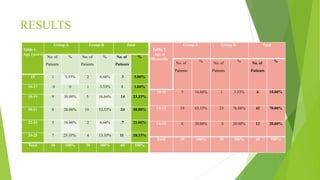
RESULTS
Table 1.
Age (years)
Group A Group B Total
No. of
Patients
% No. of
Patients
% No. of
Patients
%
15 1 3.33% 2 6.66% 3 5.00%
16-17 0 0 1 3.33% 1 1.66%
18-19 9 30.00% 5 16.66% 14 23.33%
20-21 8 26.66% 16 53.33% 24 40.00%
22-23 5 16.66% 2 6.66% 7 11.66%
24-25 7 23.33% 4 13.33% 11 18.33%
Total 30 100% 30 100% 60 100%
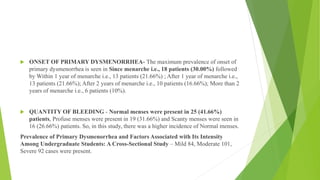
Table 2.
Age at
Menarche
Group A Group B Total
No. of
Patients
% No. of
Patients
% No. of
Patients
%
10-11 5 16.66% 1 3.33% 6 10.00%
12-13 19 63.33% 23 76.66% 42 70.00%
14-15 6 20.00% 6 20.00% 12 20.00%
Total 30 100% 30 100% 60 100%
Table 3.
Onset of
PD
Group A Group B Total
No. of
Patients
% No. of
Patients
% No. of
Patients
%
Since
menarche
9 30.00% 9 30.00% 18 30.00%
Within 1
year of
menarche
6 20.00% 7 23.33% 13 21.66%
After 1 year
of menarche
7 23.33% 6 20.00% 13 21.66%
After 2
years of
menarche
4 13.33% 6 20.00% 10 16.66%
More than 2
years of
menarche
4 13.33% 2 6.66% 6 10.00%
Total 30 100 30 100 60 100
Table 4.
Quantity
of
Bleeding
Group A Group B Total
No. of
Patients
% No. of
Patients
% No. of
Patients
%
Scanty 6 20.00% 10 33.33% 16 26.66%
Normal 13 43.33% 12 40.00% 25 41.66%
Profuse 11 36.66% 8 26.66% 19 31.66%
Total 30 100 30 100 60 100
Table 5.
Family history
of PD
Group A Group B Total
No. of
Patients
% No. of
Patients
% No. of
Patients
%
Mother only 7 23.33% 6 20.00% 13 21.33%
Sister only 7 23.33% 7 23.33% 14 23.33%
Both mother
and sister
3 10.00% 3 10.00% 6 10.00%
No History 13 43.33% 14 46.66% 27 45.00%
Total 30 100 30 100 60 100
Table 6.
Type of Pain
Group A Group B Total
No. of
Patients
% No. of
Patients
% No. of
Patients
%
Aching
Pain
6 20% 9 30% 15 25%
Spasmodic
Pain
13 43.33% 11 36.66% 24 40%
Others 11 36.66% 10 33.33% 21 35%
Total 30 100 30 100 60 100
S. No Group A
Constitutional
Remedies
No. of Patients Percentage
(%)
1 Lycopodium 4 13.33%
2 Ignatia 3 10%
3 Lachesis 3 10%
4 Nux Vomica 3 10%
5 Pulsatilla 3 10%
6 Belladonna 2 6.66%
7 Kalium Carb 2 6.66%
8 Natrium Mur 2 6.66%
9 Sepia 2 6.66%
10 Calcarea carb 1 3.33%
11 Hyoscyamus 1 3.33%
12 Platina 1 3.33%
13 Phosphorus 1 3.33%
14 Silicea 1 3.33%
15 Sulphur 1 3.33%
Total 30 100%
S. No Group B
Constitutional
Remedies
No. of Patients Percentage
(%)
1 Nux Vomica 7 23.33%
2 Sepia 6 20%
3 Pulsatilla 4 13.33%
4 Calcarea carb 2 6.66%
5 Cocculus Indicus 2 6.66%
6 Lycopodium 2 6.66%
7 Natrium Mur 2 6.66%
8 Bryonia 1 3.33%
9 Lachesis 1 3.33%
10 Magnesium Carb 1 3.33%
11 Platina 1 3.33%
12 Phosphorus 1 3.33%
Total 30 100%
Table 9
WHOQOL
Score
Group A Group B
Before
Treatment
After
Treatment
Before
Treatment
After
Treatment
35-45 30 0 30 0
46-56 0 3 0 5
57-67 0 3 0 2
68-78 0 2 0 1
79-89 0 3 0 0
90-100 0 19 0 22
Total 30 30 30 30
Table 10.
Result
Group A Group B Total
No. of
Patients
% No. of
Patients
% No. of
Patients
%
Improved 23 76.66% 22 73.33% 45 75%
Not
Improved
7 23.33% 8 26.66% 15 25%
Total 30 100 30 100 60 100
STATISTICAL STUDY
 The observed data obtained from Group A and Group B were analyzed by using the
Chi-Square test.
 STATISTICAL STUDY FOR GROUPA:
 Chi-Square Test for Goodness of Fit:
Calculation of degree of freedom = Df = k-1 (k = number of frequencies) = 2-1= 1
Stating alpha level (α) - 5%
Calculation of expected frequency = E = grand total/ number of frequencies E = 30/2 = 15
S. No Result No. of
Cases
%
1. Improved 23 76.66
%
2. Not
Improved
7 23.33
%
TOTAL 30 100
Formation of table with expected frequency =
Chi-Square value = ∑ (O-E)2/ E = 8.52
Test result for Group A:
The Chi-Square test was observed to be significant based on the p-value (0.001<0.05) which is
less than the standard 0.05 value as assumed for the above test. Further, it is also analyzed from
the calculated Chi-Square value that, calculated value is greater than the standard Chi-Square
table value with df = 1 & α = 5%, i.e. 8.52 >3.841. Therefore, the test result is significant, i.e.,
the medicines prescribed after repertorization using Kent’s repertory are effective.
Treatment
Outcome Observed N Expected N O-E (O-E)2
(O-E)2/E
Improved 23 15 8 64 4.26
Not Improved 7 15 -8 64 4.26
Total 30 -- -- 8.52
Chi-Square Test Statistics
Treatment Outcome
Chi-Square value 8.52
Df 1
p-value 0.001
 STATISTICAL STUDY FOR GROUP B:
 Chi-Square Test for Goodness of Fit:
Calculation of degree of freedom = Df = k-1 (k = number of frequencies) = 2-1= 1
Stating alpha level (α) - 5%
Calculation of expected frequency = E = grand total/ number of frequencies E = 30/2 = 15
S. No Result No. of Cases %
1. Improved 22 73.33%
2. Not improved 8 26.66%
TOTAL 30 100
Formation of table with expected frequency =
Chi-Square value = ∑ (O-E)2/ E = 6.52
Test result for Group B:
The Chi-Square test was observed to be significant based on the p-value (0.001<0.05) which is
less than the standard 0.05 value as assumed for the above test. Further, it is also analyzed from
the calculated Chi-Square value that, calculated value is more than the standard Chi-Square table
value with df = 1 & α = 5%, i.e. 6.52 > 3.841. Therefore, the test result is significant, i.e., the
medicine prescribed after repertorization using BBCR repertory is effective.
Treatment
Outcome Observed N Expected N O-E (O-E)2
(O-E)2/E
Improved 22 15 7 49 3.26
Not Improved 8 15 -7 49 3.26
Total 30 -- -- 6.52
Chi-Square Test Statistics
Treatment outcome
Chi-Square value 6.52
Df 1
p-value 0.001
Z test
Not improved: Group A and Group B
No. of not improved patients in Group A = 7
No. of not improved patients in Group B = 8
Total No. of patients: n1=30; n2 = 30
P1 = 7/30 = 0.23
Q1 = 1-p1 =1-0.23=0.77
P2 = 8/30 = 0.26
Q2 = 1- P2 = 1- 0.26 = 0.74
𝑍 =
0.23−0.26
0.23×0.77
30
+
0.26×0.74
30
= - 0.28
TABLE NO. 11 – Z-TEST RESULT
Result Group A Group B Z value p-value
Improved 23 22 0.275 0.393
Not improved 7 8 -0.280 0.610
𝑧 =
𝑝1 − 𝑝2
𝑝1𝑞1
𝑛1
+
𝑝2𝑞2
𝑛2
Improved: Group A and Group B
No. of improved patients in Group A = 23
No. of improved patients in Group B = 22
Total No. of patients: n1=30; n2 = 30
P1= 23/30 = 0.76
Q1= 1 - p1 = 1-0.76 = 0.24
P2 = 22/30 = 0.73
Q2 = 1- P2 = 1- 0.73 = 0.27
𝑍 =
0.76−0.73
0.76×0.24
30
+
0.73×0.27
30
= 0.275
 The z-test for comparing Group A and Group B was observed to be insignificant for
improved and not improved cases based on the p-value i.e. 0.393 and 0.610
respectively, which is greater than the standard 0.05 value as assumed for the above
test. Further, it is also analyzed from the calculated z value for improved and not
improved that calculated value is lesser than the standard z table value with α = 5%, i.e.
0.27 < 1.96 and -0.28 < 1.96 respectively, therefore the test result is insignificant,
showing Group A treatment and Group B treatment both are effective.
 ALTERNATIVE HYPOTHESIS: Utility of Kent’s Repertory is more than BBCR in
management of primary dysmenorrhea with improvement of quality of life in age group of
15-25years.
 NULL HYPOTHESIS: Utility of Kent’s Repertory and BBCR both may be equal in
management of primary dysmenorrhea with improvement of quality of life in age group of
15-25years.
 TEST RESULT:
From the above observations, the null hypothesis was accepted. Hence, this study proves that the
effectiveness of both the repertories in the management of primary dysmenorrhea.
DISCUSSION
 Dysmenorrhea is also known as painful menses or menstrual cramps. Its means painful
menstruation incapacitating the woman.
 The present study is to know whether Kent’s repertory (general to particular) or BBCR
repertory (particular to general) will be help to improve the quality of life in cases of
primary dysmenorrhea.
 In this study, the cases with primary dysmenorrhea were taken based on the signs,
symptoms and clinical examination.
 A total of 60 cases were selected according to inclusion and exclusion criteria fixed for
the study. Further, these 60 cases were divided into two groups consisting of 30 cases in
each group (GA – Treated with Kent’s repertory and GB – Treated with BBCR
repertory) by purposive sampling method. Steps of repertorization were followed. After
repertorization close running remedies were differentiated with further reference to
Materia Medica. These cases were followed for a period of 6-month duration.
 AGE INCIDENCE - The maximum prevalence of primary dysmenorrhea is seen in
age group 20-21 years i.e., 24 patients (40.00%) followed by 18-19 years i.e., 14
patients (23.33%) 24-25 years i.e., 11 patients (18.33%); 22-23 years i.e., 7 patients
(11.66%) 15 years i.e., 3 patients (5%) and 16-17 years i.e., 1 patient (1.66%)
Prevalence of Primary Dysmenorrhea and Factors Associated with Its Intensity
Among Undergraduate Students: A Cross-Sectional Study – In this study mean age
incidence in primary dysmenorrhea was 20.69
 AGE AT MENARCHE - The maximum prevalence of age at menarche was seen in
age group 12-13 years, i.e., 42 patients (70.00%) followed by 14-15 years i.e., 12
patients (20.00%) and lastly 10-11 years i.e., 6 patients (10.00%).
Prevalence of Primary Dysmenorrhea and Factors Associated with Its Intensity
Among Undergraduate Students: A Cross-Sectional Study – In this study mean age of
menarche was 13.26.
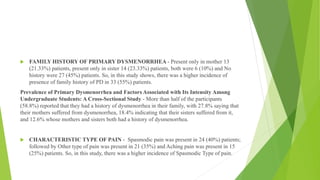
 ONSET OF PRIMARY DYSMENORRHEA- The maximum prevalence of onset of
primary dysmenorrhea is seen in Since menarche i.e., 18 patients (30.00%) followed
by Within 1 year of menarche i.e., 13 patients (21.66%) ; After 1 year of menarche i.e.,
13 patients (21.66%); After 2 years of menarche i.e., 10 patients (16.66%); More than 2
years of menarche i.e., 6 patients (10%).
 QUANTITY OF BLEEDING - Normal menses were present in 25 (41.66%)
patients, Profuse menses were present in 19 (31.66%) and Scanty menses were seen in
16 (26.66%) patients. So, in this study, there was a higher incidence of Normal menses.
Prevalence of Primary Dysmenorrhea and Factors Associated with Its Intensity
Among Undergraduate Students: A Cross-Sectional Study – Mild 84, Moderate 101,
Severe 92 cases were present.
 FAMILY HISTORY OF PRIMARY DYSMENORRHEA - Present only in mother 13
(21.33%) patients, present only in sister 14 (23.33%) patients, both were 6 (10%) and No
history were 27 (45%) patients. So, in this study shows, there was a higher incidence of
presence of family history of PD in 33 (55%) patients.
Prevalence of Primary Dysmenorrhea and Factors Associated with Its Intensity Among
Undergraduate Students: A Cross-Sectional Study - More than half of the participants
(58.8%) reported that they had a history of dysmenorrhea in their family, with 27.8% saying that
their mothers suffered from dysmenorrhea, 18.4% indicating that their sisters suffered from it,
and 12.6% whose mothers and sisters both had a history of dysmenorrhea.
 CHARACTERISTIC TYPE OF PAIN - Spasmodic pain was present in 24 (40%) patients;
followed by Other type of pain was present in 21 (35%) and Aching pain was present in 15
(25%) patients. So, in this study, there was a higher incidence of Spasmodic Type of pain.
 PRESCRIBED REMEDIES USING KENT’S REPERTOY - In Group A the most frequently
prescribed remedy was Lachesis which was given to 4 patients; followed by Ignatia, Lachesis, Nux V,
Puls in 3 patients each; Bell, Kali Carb, Nat Mur and sepia in 2 patients each; Calc Carb, Hyos, Platina,
Phosphorus, Silicea and Sulphur were indicated in only for 1 patient.
 PRESCRIBED REMEDIES USING BBCR REPERTOY - In Group B the most frequently prescribed
remedy was Nux Vomica which was given to 7 patients; followed by Sepia in 6 patients; Pulsatilla in 4
patients; Calc Carb, Cocculus, Lycopodium and Nat Mur in 2 patients each; Bryonia, Lachesis, Mag
Carb, Platina and Phosphorus were indicated in only for 1 patient.
Role Of Homoeopathy In Primary Dysmenorrhea– A Randomized Placebo Control Trial -
Homoeopathic Medicine and corresponding potency used during treatment: As per the totality of symptoms at
baseline Colocynth (n = 7, 23%); Belladonna (n = 5, 17%); Mag. Phos and Actea Racemose (n = 4 each, 13%)
and Pulsatilla nigricans (n = 4, 8%) were prescribed frequently
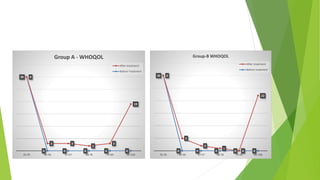
 WHOQOL-BREF SCORE - Quality of Life of Primary Dysmenorrhea patient was evaluated Group A
showed 24 patients improvement and in Group B showed 23 patients improvement in Quality of Life of
Primary Dysmenorrhea.
 RESULT OF TREATMENT –
 Chi-Square test and z-test were used for statistical analysis. The statistical analysis made was
based on the data obtained from 60 cases. Assessment of the clinical status was based on
improved and not improved.
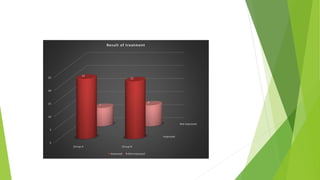
 In Group A, 23 cases showed improvement (76.66%) and 7 cases not improved (23.33%). In
Group B, 22 cases showed improvement (73.33%) and 8 cases showed no improvement
(26.66%).
 In total, Improved cases were 45 (75%) and Not Improved cases were 15 (25%).
 From the analysis of the above results obtained, it is obvious that the Homoeopathic
medicines selected after repertorising using Kent’s repertory and BBCR repertory are both
effective in the management of primary dysmenorrhea with improvement of quality of life.
Role Of Homoeopathy In Primary Dysmenorrhea– A Randomized Placebo Control Trial -
Homoeopathic medicine was not only reduce the suffering but also improve the quality of life of
patient with dysmenorrhea. This study show a significant role of homoeopathic medicine in primary
dysmenorrhea in comparison with placebo. If homoeopathic medicine prescribed on basis of totality of
symptoms and individualization.
 LIMITATIONS
 Number of samples used in this study was very small.
 Since the sample size was limited to 30 cases for each group, generalizing the result and
conclusions of this study needed to be done cautiously.
 Since this was a time-bound study, therefore cases could not be studied for a longer period of
time.
 If blinding would have been included, then this study would have been still better.
 RECOMMENDATIONS
 A bigger sample size with extended time of research would provide better results.
 Individual case can be repertorised with both the repertories and the remedy which is found in
both the repertories can be taken for prescription and studied.
CONCLUSION
 Study of the 60 cases led to the conclusion:
 From the statistical analysis standpoint, the individualistic homoeopathic remedies selected
using Kent’s Repertory and BBCR repertory were both effective in the management of
primary dysmenorrhea.
 By comparing improvement of WHOQOL-BREF Quality of life scale before after treatment
this study has proved homoeopathic medicines are effective in management of primary
dysmenorrhea.
 In both the group, the maximum prescribed remedy was Nux Vomica, followed by
Lycopodium, Sepia and Pulsatilla.
 Need for further research with large sample size and with long study duration for evaluation
of outcome would make the study more precise.
SUMMARY
 The research on “UTILITY OF KENT’S REPERTORYAND BOGER
BOENNINGHAUSEN’S CHARACTERISTICS AND REPERTORY IN MANAGEMENT
OF PRIMARY DYSMENORRHEAWITH IMPROVEMENT OF QUALITY OF LIFE IN
AGE GROUP OF 15-25YEARS” was done in the term of fulfilling the aim and objectives of
the study. It was conducted as a Comparative study by selecting 60 patients from the patients
who attended the OPD of BHMC, Belgaum. These cases were divided into two groups
consisting of 30 in each group (GA- Treated with Kent’s repertory, GB – Treated with BBCR
repertory) by purposive sampling method. The study was designed as a interventional study
conducted between June 2019 and December 2020.
 In this study, in both groups remedies were chosen after following steps of repertorization
and after repertorising with respective repertories. The most commonly prescribed medicines
in both groups were Nux Vomica, followed by Lycopodium, Sepia and Pulsatilla. The
potency selection and repetition of doses were done according to the demand of the case.
 In this study- Maximum prevalence of primary dysmenorrhea was seen in age group 18-21;
Maximum prevalence of age at menarche was seen in age group 12-13 years; Maximum
prevalence of onset of primary dysmenorrhea is seen in Since menarche; There was a higher
incidence of presence of family history of primary dysmenorrhea; There was a higher
incidence of Spasmodic Type of pain; Showed improvement in Quality of Life of females
during dysmenorrhea.
 Result analysis showed; In Group A, 23 cases showed improvement (76.66%) and 7 cases
not improved (23.33%). In Group B, 22 cases showed improvement (73.33%) and 8 cases
showed no improvement (26.66%). In total, Improved cases were 45 (75%) and Not
Improved cases were 15 (25%).
 This study highlights the individualistic homoeopathic remedies selected using Kent’s
Repertory and BBCR repertory were both effective in the management of primary
dysmenorrhea.
GRAPHS
0
2
4
6
8
10
12
14
16
15 16-17 18-19 20-21 22-23 24-25
1
0
9
8
5
7
2
1
5
16
2
4
AGE
Group A Group B
0
5
10
15
20
25
10-11 years 12-13 years 14-15 years
Group A 5 19 6
Group B 1 23 6
AGE OF MENARCHE
Group A Group B
0
1
2
3
4
5
6
7
8
9
Since
menarche
Within 1 year After 1 year After 2 years > 2 years
Group A 9 6 7 4 4
Group B 9 7 6 6 2
Onset of Primary Dysmenorrhea
Group A Group B
0
2
4
6
8
10
12
14
Scanty menses Normal menses Profuse menses
6
12
11
10
13
8
Quantity of menses
Group A Group B
0
2
4
6
8
10
12
14
Mother Only Sister Only Both mother and
sister
No history
7 7
3
13
6
7
3
14
Family History of PD
Group A Group B
0
2
4
6
8
10
12
14
Aching pain Spasmodic pain Others
6
13
11
9
11
10
Type of Pain
Group A Group B
0
0.5
1
1.5
2
2.5
3
3.5
4
4.5
Group A
Nux Vom
Sepia
Pulsatilla
Calc carb
Cocc
Lycopodium
Nat Mur
Bryonia
Lachesis
Mag Carb
Platina
Phos
0 1 2 3 4 5 6 7 8
Group B
30
0 0 0 0 0
0
3 3
2
3
19
35-45 46-56 57-67 68-78 79-89 90-100
Group A - WHOQOL
After treatment
Before Treatment
30
0 0 0 0 0
0
5
2
1
0
22
35-45 46-56 57-67 68-78 79-89 90-100
Group-B WHOQOL
After treatment
Before treatment
77%
23%
Group A
Improved Not Improved
73%
27%
Group B
Improved Not improved
Improved
Not improved
0
5
10
15
20
25
Group A Group B
23
22
7
8
Result of treatment
Improved Not improved
REFERENCES
 Dysmenorrhea Wikipedia. https://en.wikipedia.org/wiki/Dysmenorrhea (cited on 30/1/19)
 C. S. Dawn. Textbook of Gynecology and contraception. 7th ed. Calcutta: Dawn Books; 1984. p 166
 Stuart Campbell, Ash Monga. Gynecology by Ten Teachers. 17th ed. London: Arnold; 2000. p 60
 Prashant. N, Aashka. S. T, Priyanka. N. M, Asmita. D. T, ofKLE Institute of Physiotherapy. Variation of dysmenorrhea during stress and non
stress condition in college going girls in BELAGAVI city: A cross sectional study, International Journal of Physiotherapy and
Research,BELAGAVI,11th April 2015. https://www.ijmhr.org/ijpr.3.2/IJPR.2015.125.pdf (cited on 30/01/2019)
 Tiwari SK. Essentials of Repertorization. 5th Reprint Ed. New Delhi: B.Jain Publishers (P) Ltd; 2013
 Maitri. S, Anuradha. M, Sangita. P, Malay. S, Harsh. B. A study of prevalence of primary dysmenorrhea in young students- A cross-sectional
study. 2013. http://iapsmgc.org/index_pdf/127.pdf (cited on 30/01/2019)
 Alaettin. U, Unal. A, Mustafa. T, Gul Arslan, Eli. C. Prevalence of dysmenorrhea and its quality of life among a group of female university
students. Upsala Journal of Medical Sciences, 2010. https://www.ncbi.nlm.nih.gov/pmc/articles/PMC2853792/pdf/UPS-0300-9734-115-138.pdf
(cited on 30/1/2019)
 Dr. Lizmy Jose. Efficacy and significance of homoeopathy in primary dysmenorrhea. Govt. Homoeopathic Medical College, Kerala.
https://www.homeobook.com/pdf/homoeopathy-dysmenorrhoea.pdf(cited on 30/1/2019)
 Sakineh M. A. C, Mohammad Hossein. B, Khatereh. Y. R. Effect of homoeopathy on pain intensity and quality of life of students with primary
dysmenorrhea- A randomized controlled trial. Iran Red Crescent Med J, 18th September 2016. http://ircmj.com/en/articles/16756.html (cited on
30/1/2019)
 Dr. J. T. Kent. Kent’s Repertory of the Homoeopathic Materia Medica, published in 1897.
 Dr. Boger. Boger Boenninghausen’s Characteristics and Repertory, published in 1905.
 Prevalence of Primary Dysmenorrhea and Factors Associated with Its Intensity Among Undergraduate Students: A Cross-Sectional Study
https://www.sciencedirect.com/science/article/pii/S1524904215001022#:~:text=The%20prevalence%20of%20primary%20dysmenorrhea%20w
as%2089.1%25
 Role Of Homoeopathy In Primary Dysmenorrhoea-a Randomized Placebo Control Trial https://www.researchgate.net/publication/340248219
MASTER CHART
 MASTER CHART
THANK YOU…………

DISSERTATION PRESENTATION.pptx

  • 1.
    DISSERTATION PRESENTATION By DR. SADHANA.DAYANAND. PATIL Under the Guidance of DR. PRADEEPKUMAR A. PATIL M.D.(HOM) Professor, P.G Guide & P G Co- Ordinator Department of Repertory DOP: 05/05/2021
  • 2.
    “UTILITY OF KENT’SREPERTORY AND BOGER BOENNINGHAUSEN’S CHARACTERISTICS AND REPERTORY IN MANAGEMENT OF PRIMARY DYSMENORRHEA WITH IMPROVEMENT OF QUALITY OF LIFE IN AGE GROUP OF 15-25YEARS - A COMPARATIVE STUDY”
  • 3.
    CONTENTS  Aim andObjective  Methodology  Sample size estimation  Results  Discussion  Conclusion  Summary  Graphs  References  Master chart
  • 4.
    AIM and OBJECTIVE AIM To assess the utility of Kent’s repertory and BBCR in management of primary dysmenorrhea with the improvement of quality of life. OBJECTIVES  To assess the quality of life in patients of primary dysmenorrhea using WHOQOL-BREF before and after the treatment.  To assess the utility of Kent’s Repertory in management of primary dysmenorrhea with improvement of quality of life.  To assess the utility of BBCR in management of primary dysmenorrhea with improvement of quality of life.  To compare utility of Kent’s repertory and BBCR in management of primary dysmenorrhea with improvement of quality of life.
  • 5.
    HYPOTHESIS  NULL HYPOTHESIS:Utility of Kent’s Repertory and BBCR both may be equal in management of primary dysmenorrhea with improvement of quality of life in age group of 15-25years.  ALTERNATIVE HYPOTHESIS: Utility of Kent’s Repertory is more than BBCR in management of primary dysmenorrhea with improvement of quality of life in age group of 15-25years.
  • 6.
    METHODOLOGY  STUDY SETTINGS:- Subjectsfor the study were selected from the Outpatient Department/village camps of Bharatesh Homeopathic Medical College and Hospital, Belgaum.  METHOD OF COLLECTION OF DATA:- Subjects who are willing to participate and give written informed consent which will be explained in subject’s own language.  SELECTION CRITERIA :- Subjects shall be selected on the inclusion and exclusion criteria. A detailed case history shall be taken by interview as per the performance prepared for the topic and necessary investigation will be done.  SCALE USED TO KNOW QUALITY OF LIFE:- WHOQOL-BREF Scoring scale will be used to know quality of life before treatment and after 6 months of treatment.
  • 7.
     STUDY SUBJECTS:-Subjects suffering from Primary Dysmenorrhea will be divided into two groups.  Group A – Treated with individualized remedy by using Kent’s repertory.  Analysis and evaluation of symptoms : After detailed case taking the symptoms of the patient were analyzed into mental general, physical general and particulars.  Selection of Remedy : Selection of remedy was done on the basis of reportorial results, after repertorising through Kent’s repertory using Hompath software and close running remedies were differentiated with further reference to Homoeopathic Materia Medica.  Selection of potency : The potency selection and repetition of doses were done according to the demand of the case.  Group B – Treated with individualized remedy by using BBCR repertory.  Analysis and evaluation of symptoms : After detailed case taking the symptoms of the patient were analyzed into location , sensation , modalities and concomitants.  Selection of Remedy : Selection of remedy was done on the basis of reportorial results after repertorising through BBCR repertory using Hompath software and close running remedies were differentiated with further reference to Homoeopathic Materia Medica.  Selection of potency : The potency selection and repetition of doses were done according to the demand of the case.
  • 8.
    Mind Though Kenthas classified mental symptoms as will, understanding and memory, there are no separate chapters given. All the rubrics are given in alphabetical order. No subdivisions exist. All the rubrics in relation to emotion and intellect are given under chapter mind. Mental symptoms are also given under conditions of agg and amel in general. Genitalia It contains rubrics on male organs. A separate chapter on Genitalia – female is given. It contains rubrics like – in general and sides. It has subchapters like male organs, penis glans, prepuce, testes, female organs. It follows time conditions. Separate chapters on sexual Impulse, Menstruation, Leucorrhea are given. Menstruation chapter contains detailed concomitants. Adaptability Cases having general and characteristics particulars, however, a short case of any dimension can be repertorized using this repertory. Cases rich in particulars or pathological generals or clinical symptoms, or rich in concomitants can be repertorized.  COMPARISON CRITERIA : KENT’S REPERTORY BBCR REPERTORY Introduction This repertory is the result of a vast clinical experience of Dr. J.T.Kent. It is based on Dr. Lipp’s handbook of characteristics and Jahr’s work. This repertory embraces the ‘Pocket Book’, The Psoric and the Antipsoric Repertories, The sides of the body, the repertory part of intermittent fever. It contains MM in 1st part. Published 1897 1905 Philosophical background Mental, physical generals, PQRS and Particulars Doctrine of complete symptoms, concomitants, pathological generals, causation and time, Clinical rubrics, Evaluation of remedies , Fever totality, Concordances. Totality of symptoms 1.Mind – Will, understanding and intellect. 2.Physical generals – include thermals, causative, aversion and desires, type of discharges, PQRS. 3.Physical Particulars 1.Change of personality and temperament. 2.Pecularities of disease 3.The seat of disease 4.Concomitants 5.The cause 6.Modalities 7.Time Construction This repertory has following plan of arrangement – general rubrics, side, time, modalities, extension. Locations are mentioned under various rubrics. This repertory has a general plan of location and sensation as 1st subchapter followed by other subchapters like time, agg, amel, concomitants chapters whereas at a few places it contains a list of medicines. However, concomitant chapters are not given with all chapters. Repertory Part Mind to generals, 31 chapters Mind to Concordance, with 54 chapters Arrangement of rubrics Side, Time, Modality, Extension Location, Sensation, Modality, Concomitants Gradation of rubrics 3 – Bold 2 – Italics 1 – roman 5 – CAPITAL 4 – Bold 3 – Italics 2 – Roman 1 – (Roman) in parenthesis
  • 9.
     STUDY DURATION:-The duration of study was 18 months (from June 2019 to December 2020).  STUDY DESIGN:- Interventional study.  TYPE OF RESEARCH:- Comparative study.  SAMPLE DESIGN:- Purposive sampling.  SAMPLE SIZE :– Total 60 in number. 30 subjects in each group.
  • 10.
     INCLUSION CRITERIA:-  Subjects who are suffering with primary dysmenorrhea.  Subjects aged between 15 years to 25 years of age with irrespective of socioeconomic status.  EXCLUSION CRITERIA :-  Subjects who are suffering from any other immunological diseases.  Subjects where history, examination and routine investigation show evidence of pathological changes, i.e., secondary dysmenorrhea.
  • 11.
    FLOWCHART:- Cases of PrimaryDysmenorrhea Consider inclusion, exclusion criteria and WHOQOL Scale Enrolled Purposive sampling Group A Group B Individualized remedy using Individualized remedy using Kent’s repertory BBCR repertory Followed up for efficacy
  • 12.
     DIAGNOSTIC CRITERIA:- Patientssuffering from primary dysmenorrhea with change in quality of life.  FOLLOW UP OF THE CASES:-  Once in month for next 6months  Whenever necessary in between these follow up.  FOLLOW UP CRITERIA:-  Reduction in symptoms severity.  Improvement in quality of life.  WITHDRAWAL CRITERIA:-  Patient who do not wish to continue the treatment.  When there is no change/ improvement in the symptomatology and quality of life.
  • 13.
     RESULT CRITERIA:- Improved: Improvement of the patient with disappearance of the symptoms and no recurrence of complaints with improvement of quality of life.  Not improved: No marked improvement in the presenting complaints and no change in quality of life.  MATERIAL USED:-  Informed Consent form.  Standard proforma prepared for case taking.  WHOQOL – BREF Score  INVESTIGATIONS:-  Investigations as per the need of the case: Blood examination and USG Abdomen & pelvis.  STATISTICAL METHODS EMPLOYED:-  The results were analyzed through “Chi-Square test” at level of 5% significance for both Group A and Group B.  For comparing the effectiveness of the treatment in improved and not improved Groups, in Group A and Group B, Z-test was applied.
  • 14.
    SAMPLE SIZE CALCULATIONFORMULA  [Based on standard deviation] Sample size is calculated using the standard deviation formula: n = 2 (a+b)2σ2 / d2 Where, n = Sample size a = Probability of falsely rejecting a true null hypothesis = 1.96 (5% level) b = Probability of failing to reject a false null hypothesis = 1.2816 (90% power) σ = Standard deviation of the outcome measure or population being studied = 2.3 d = Size of the effect that is clinically worthwhile to detect = 2  SAMPLE SIZE CALCULATION: n = 2 ( 1.96 + 1.2816) 2 × ( 2.3 )2 / 22 = 2 ( 3.2416 ) 2 × 5.29 / 4 = 2 × 10.50797056 × 5.29 / 4 = 111.17432852 / 4 = 27.79 ≈28. In the view of 5% drop outs, sample size was considered 30 in each group.
  • 15.
    RESULTS Table 1. Age (years) GroupA Group B Total No. of Patients % No. of Patients % No. of Patients % 15 1 3.33% 2 6.66% 3 5.00% 16-17 0 0 1 3.33% 1 1.66% 18-19 9 30.00% 5 16.66% 14 23.33% 20-21 8 26.66% 16 53.33% 24 40.00% 22-23 5 16.66% 2 6.66% 7 11.66% 24-25 7 23.33% 4 13.33% 11 18.33% Total 30 100% 30 100% 60 100% Table 2. Age at Menarche Group A Group B Total No. of Patients % No. of Patients % No. of Patients % 10-11 5 16.66% 1 3.33% 6 10.00% 12-13 19 63.33% 23 76.66% 42 70.00% 14-15 6 20.00% 6 20.00% 12 20.00% Total 30 100% 30 100% 60 100%
  • 16.
    Table 3. Onset of PD GroupA Group B Total No. of Patients % No. of Patients % No. of Patients % Since menarche 9 30.00% 9 30.00% 18 30.00% Within 1 year of menarche 6 20.00% 7 23.33% 13 21.66% After 1 year of menarche 7 23.33% 6 20.00% 13 21.66% After 2 years of menarche 4 13.33% 6 20.00% 10 16.66% More than 2 years of menarche 4 13.33% 2 6.66% 6 10.00% Total 30 100 30 100 60 100 Table 4. Quantity of Bleeding Group A Group B Total No. of Patients % No. of Patients % No. of Patients % Scanty 6 20.00% 10 33.33% 16 26.66% Normal 13 43.33% 12 40.00% 25 41.66% Profuse 11 36.66% 8 26.66% 19 31.66% Total 30 100 30 100 60 100
  • 17.
    Table 5. Family history ofPD Group A Group B Total No. of Patients % No. of Patients % No. of Patients % Mother only 7 23.33% 6 20.00% 13 21.33% Sister only 7 23.33% 7 23.33% 14 23.33% Both mother and sister 3 10.00% 3 10.00% 6 10.00% No History 13 43.33% 14 46.66% 27 45.00% Total 30 100 30 100 60 100 Table 6. Type of Pain Group A Group B Total No. of Patients % No. of Patients % No. of Patients % Aching Pain 6 20% 9 30% 15 25% Spasmodic Pain 13 43.33% 11 36.66% 24 40% Others 11 36.66% 10 33.33% 21 35% Total 30 100 30 100 60 100
  • 18.
    S. No GroupA Constitutional Remedies No. of Patients Percentage (%) 1 Lycopodium 4 13.33% 2 Ignatia 3 10% 3 Lachesis 3 10% 4 Nux Vomica 3 10% 5 Pulsatilla 3 10% 6 Belladonna 2 6.66% 7 Kalium Carb 2 6.66% 8 Natrium Mur 2 6.66% 9 Sepia 2 6.66% 10 Calcarea carb 1 3.33% 11 Hyoscyamus 1 3.33% 12 Platina 1 3.33% 13 Phosphorus 1 3.33% 14 Silicea 1 3.33% 15 Sulphur 1 3.33% Total 30 100% S. No Group B Constitutional Remedies No. of Patients Percentage (%) 1 Nux Vomica 7 23.33% 2 Sepia 6 20% 3 Pulsatilla 4 13.33% 4 Calcarea carb 2 6.66% 5 Cocculus Indicus 2 6.66% 6 Lycopodium 2 6.66% 7 Natrium Mur 2 6.66% 8 Bryonia 1 3.33% 9 Lachesis 1 3.33% 10 Magnesium Carb 1 3.33% 11 Platina 1 3.33% 12 Phosphorus 1 3.33% Total 30 100%
  • 19.
    Table 9 WHOQOL Score Group AGroup B Before Treatment After Treatment Before Treatment After Treatment 35-45 30 0 30 0 46-56 0 3 0 5 57-67 0 3 0 2 68-78 0 2 0 1 79-89 0 3 0 0 90-100 0 19 0 22 Total 30 30 30 30
  • 20.
    Table 10. Result Group AGroup B Total No. of Patients % No. of Patients % No. of Patients % Improved 23 76.66% 22 73.33% 45 75% Not Improved 7 23.33% 8 26.66% 15 25% Total 30 100 30 100 60 100
  • 21.
    STATISTICAL STUDY  Theobserved data obtained from Group A and Group B were analyzed by using the Chi-Square test.  STATISTICAL STUDY FOR GROUPA:  Chi-Square Test for Goodness of Fit: Calculation of degree of freedom = Df = k-1 (k = number of frequencies) = 2-1= 1 Stating alpha level (α) - 5% Calculation of expected frequency = E = grand total/ number of frequencies E = 30/2 = 15 S. No Result No. of Cases % 1. Improved 23 76.66 % 2. Not Improved 7 23.33 % TOTAL 30 100
  • 22.
    Formation of tablewith expected frequency = Chi-Square value = ∑ (O-E)2/ E = 8.52 Test result for Group A: The Chi-Square test was observed to be significant based on the p-value (0.001<0.05) which is less than the standard 0.05 value as assumed for the above test. Further, it is also analyzed from the calculated Chi-Square value that, calculated value is greater than the standard Chi-Square table value with df = 1 & α = 5%, i.e. 8.52 >3.841. Therefore, the test result is significant, i.e., the medicines prescribed after repertorization using Kent’s repertory are effective. Treatment Outcome Observed N Expected N O-E (O-E)2 (O-E)2/E Improved 23 15 8 64 4.26 Not Improved 7 15 -8 64 4.26 Total 30 -- -- 8.52 Chi-Square Test Statistics Treatment Outcome Chi-Square value 8.52 Df 1 p-value 0.001
  • 23.
     STATISTICAL STUDYFOR GROUP B:  Chi-Square Test for Goodness of Fit: Calculation of degree of freedom = Df = k-1 (k = number of frequencies) = 2-1= 1 Stating alpha level (α) - 5% Calculation of expected frequency = E = grand total/ number of frequencies E = 30/2 = 15 S. No Result No. of Cases % 1. Improved 22 73.33% 2. Not improved 8 26.66% TOTAL 30 100
  • 24.
    Formation of tablewith expected frequency = Chi-Square value = ∑ (O-E)2/ E = 6.52 Test result for Group B: The Chi-Square test was observed to be significant based on the p-value (0.001<0.05) which is less than the standard 0.05 value as assumed for the above test. Further, it is also analyzed from the calculated Chi-Square value that, calculated value is more than the standard Chi-Square table value with df = 1 & α = 5%, i.e. 6.52 > 3.841. Therefore, the test result is significant, i.e., the medicine prescribed after repertorization using BBCR repertory is effective. Treatment Outcome Observed N Expected N O-E (O-E)2 (O-E)2/E Improved 22 15 7 49 3.26 Not Improved 8 15 -7 49 3.26 Total 30 -- -- 6.52 Chi-Square Test Statistics Treatment outcome Chi-Square value 6.52 Df 1 p-value 0.001
  • 25.
    Z test Not improved:Group A and Group B No. of not improved patients in Group A = 7 No. of not improved patients in Group B = 8 Total No. of patients: n1=30; n2 = 30 P1 = 7/30 = 0.23 Q1 = 1-p1 =1-0.23=0.77 P2 = 8/30 = 0.26 Q2 = 1- P2 = 1- 0.26 = 0.74 𝑍 = 0.23−0.26 0.23×0.77 30 + 0.26×0.74 30 = - 0.28 TABLE NO. 11 – Z-TEST RESULT Result Group A Group B Z value p-value Improved 23 22 0.275 0.393 Not improved 7 8 -0.280 0.610 𝑧 = 𝑝1 − 𝑝2 𝑝1𝑞1 𝑛1 + 𝑝2𝑞2 𝑛2 Improved: Group A and Group B No. of improved patients in Group A = 23 No. of improved patients in Group B = 22 Total No. of patients: n1=30; n2 = 30 P1= 23/30 = 0.76 Q1= 1 - p1 = 1-0.76 = 0.24 P2 = 22/30 = 0.73 Q2 = 1- P2 = 1- 0.73 = 0.27 𝑍 = 0.76−0.73 0.76×0.24 30 + 0.73×0.27 30 = 0.275
  • 26.
     The z-testfor comparing Group A and Group B was observed to be insignificant for improved and not improved cases based on the p-value i.e. 0.393 and 0.610 respectively, which is greater than the standard 0.05 value as assumed for the above test. Further, it is also analyzed from the calculated z value for improved and not improved that calculated value is lesser than the standard z table value with α = 5%, i.e. 0.27 < 1.96 and -0.28 < 1.96 respectively, therefore the test result is insignificant, showing Group A treatment and Group B treatment both are effective.
  • 27.
     ALTERNATIVE HYPOTHESIS:Utility of Kent’s Repertory is more than BBCR in management of primary dysmenorrhea with improvement of quality of life in age group of 15-25years.  NULL HYPOTHESIS: Utility of Kent’s Repertory and BBCR both may be equal in management of primary dysmenorrhea with improvement of quality of life in age group of 15-25years.  TEST RESULT: From the above observations, the null hypothesis was accepted. Hence, this study proves that the effectiveness of both the repertories in the management of primary dysmenorrhea.
  • 28.
    DISCUSSION  Dysmenorrhea isalso known as painful menses or menstrual cramps. Its means painful menstruation incapacitating the woman.  The present study is to know whether Kent’s repertory (general to particular) or BBCR repertory (particular to general) will be help to improve the quality of life in cases of primary dysmenorrhea.  In this study, the cases with primary dysmenorrhea were taken based on the signs, symptoms and clinical examination.  A total of 60 cases were selected according to inclusion and exclusion criteria fixed for the study. Further, these 60 cases were divided into two groups consisting of 30 cases in each group (GA – Treated with Kent’s repertory and GB – Treated with BBCR repertory) by purposive sampling method. Steps of repertorization were followed. After repertorization close running remedies were differentiated with further reference to Materia Medica. These cases were followed for a period of 6-month duration.
  • 29.
     AGE INCIDENCE- The maximum prevalence of primary dysmenorrhea is seen in age group 20-21 years i.e., 24 patients (40.00%) followed by 18-19 years i.e., 14 patients (23.33%) 24-25 years i.e., 11 patients (18.33%); 22-23 years i.e., 7 patients (11.66%) 15 years i.e., 3 patients (5%) and 16-17 years i.e., 1 patient (1.66%) Prevalence of Primary Dysmenorrhea and Factors Associated with Its Intensity Among Undergraduate Students: A Cross-Sectional Study – In this study mean age incidence in primary dysmenorrhea was 20.69  AGE AT MENARCHE - The maximum prevalence of age at menarche was seen in age group 12-13 years, i.e., 42 patients (70.00%) followed by 14-15 years i.e., 12 patients (20.00%) and lastly 10-11 years i.e., 6 patients (10.00%). Prevalence of Primary Dysmenorrhea and Factors Associated with Its Intensity Among Undergraduate Students: A Cross-Sectional Study – In this study mean age of menarche was 13.26.
  • 30.
     ONSET OFPRIMARY DYSMENORRHEA- The maximum prevalence of onset of primary dysmenorrhea is seen in Since menarche i.e., 18 patients (30.00%) followed by Within 1 year of menarche i.e., 13 patients (21.66%) ; After 1 year of menarche i.e., 13 patients (21.66%); After 2 years of menarche i.e., 10 patients (16.66%); More than 2 years of menarche i.e., 6 patients (10%).  QUANTITY OF BLEEDING - Normal menses were present in 25 (41.66%) patients, Profuse menses were present in 19 (31.66%) and Scanty menses were seen in 16 (26.66%) patients. So, in this study, there was a higher incidence of Normal menses. Prevalence of Primary Dysmenorrhea and Factors Associated with Its Intensity Among Undergraduate Students: A Cross-Sectional Study – Mild 84, Moderate 101, Severe 92 cases were present.
  • 31.
     FAMILY HISTORYOF PRIMARY DYSMENORRHEA - Present only in mother 13 (21.33%) patients, present only in sister 14 (23.33%) patients, both were 6 (10%) and No history were 27 (45%) patients. So, in this study shows, there was a higher incidence of presence of family history of PD in 33 (55%) patients. Prevalence of Primary Dysmenorrhea and Factors Associated with Its Intensity Among Undergraduate Students: A Cross-Sectional Study - More than half of the participants (58.8%) reported that they had a history of dysmenorrhea in their family, with 27.8% saying that their mothers suffered from dysmenorrhea, 18.4% indicating that their sisters suffered from it, and 12.6% whose mothers and sisters both had a history of dysmenorrhea.  CHARACTERISTIC TYPE OF PAIN - Spasmodic pain was present in 24 (40%) patients; followed by Other type of pain was present in 21 (35%) and Aching pain was present in 15 (25%) patients. So, in this study, there was a higher incidence of Spasmodic Type of pain.
  • 32.
     PRESCRIBED REMEDIESUSING KENT’S REPERTOY - In Group A the most frequently prescribed remedy was Lachesis which was given to 4 patients; followed by Ignatia, Lachesis, Nux V, Puls in 3 patients each; Bell, Kali Carb, Nat Mur and sepia in 2 patients each; Calc Carb, Hyos, Platina, Phosphorus, Silicea and Sulphur were indicated in only for 1 patient.  PRESCRIBED REMEDIES USING BBCR REPERTOY - In Group B the most frequently prescribed remedy was Nux Vomica which was given to 7 patients; followed by Sepia in 6 patients; Pulsatilla in 4 patients; Calc Carb, Cocculus, Lycopodium and Nat Mur in 2 patients each; Bryonia, Lachesis, Mag Carb, Platina and Phosphorus were indicated in only for 1 patient. Role Of Homoeopathy In Primary Dysmenorrhea– A Randomized Placebo Control Trial - Homoeopathic Medicine and corresponding potency used during treatment: As per the totality of symptoms at baseline Colocynth (n = 7, 23%); Belladonna (n = 5, 17%); Mag. Phos and Actea Racemose (n = 4 each, 13%) and Pulsatilla nigricans (n = 4, 8%) were prescribed frequently  WHOQOL-BREF SCORE - Quality of Life of Primary Dysmenorrhea patient was evaluated Group A showed 24 patients improvement and in Group B showed 23 patients improvement in Quality of Life of Primary Dysmenorrhea.
  • 33.
     RESULT OFTREATMENT –  Chi-Square test and z-test were used for statistical analysis. The statistical analysis made was based on the data obtained from 60 cases. Assessment of the clinical status was based on improved and not improved.  In Group A, 23 cases showed improvement (76.66%) and 7 cases not improved (23.33%). In Group B, 22 cases showed improvement (73.33%) and 8 cases showed no improvement (26.66%).  In total, Improved cases were 45 (75%) and Not Improved cases were 15 (25%).  From the analysis of the above results obtained, it is obvious that the Homoeopathic medicines selected after repertorising using Kent’s repertory and BBCR repertory are both effective in the management of primary dysmenorrhea with improvement of quality of life. Role Of Homoeopathy In Primary Dysmenorrhea– A Randomized Placebo Control Trial - Homoeopathic medicine was not only reduce the suffering but also improve the quality of life of patient with dysmenorrhea. This study show a significant role of homoeopathic medicine in primary dysmenorrhea in comparison with placebo. If homoeopathic medicine prescribed on basis of totality of symptoms and individualization.
  • 34.
     LIMITATIONS  Numberof samples used in this study was very small.  Since the sample size was limited to 30 cases for each group, generalizing the result and conclusions of this study needed to be done cautiously.  Since this was a time-bound study, therefore cases could not be studied for a longer period of time.  If blinding would have been included, then this study would have been still better.  RECOMMENDATIONS  A bigger sample size with extended time of research would provide better results.  Individual case can be repertorised with both the repertories and the remedy which is found in both the repertories can be taken for prescription and studied.
  • 35.
    CONCLUSION  Study ofthe 60 cases led to the conclusion:  From the statistical analysis standpoint, the individualistic homoeopathic remedies selected using Kent’s Repertory and BBCR repertory were both effective in the management of primary dysmenorrhea.  By comparing improvement of WHOQOL-BREF Quality of life scale before after treatment this study has proved homoeopathic medicines are effective in management of primary dysmenorrhea.  In both the group, the maximum prescribed remedy was Nux Vomica, followed by Lycopodium, Sepia and Pulsatilla.  Need for further research with large sample size and with long study duration for evaluation of outcome would make the study more precise.
  • 36.
    SUMMARY  The researchon “UTILITY OF KENT’S REPERTORYAND BOGER BOENNINGHAUSEN’S CHARACTERISTICS AND REPERTORY IN MANAGEMENT OF PRIMARY DYSMENORRHEAWITH IMPROVEMENT OF QUALITY OF LIFE IN AGE GROUP OF 15-25YEARS” was done in the term of fulfilling the aim and objectives of the study. It was conducted as a Comparative study by selecting 60 patients from the patients who attended the OPD of BHMC, Belgaum. These cases were divided into two groups consisting of 30 in each group (GA- Treated with Kent’s repertory, GB – Treated with BBCR repertory) by purposive sampling method. The study was designed as a interventional study conducted between June 2019 and December 2020.  In this study, in both groups remedies were chosen after following steps of repertorization and after repertorising with respective repertories. The most commonly prescribed medicines in both groups were Nux Vomica, followed by Lycopodium, Sepia and Pulsatilla. The potency selection and repetition of doses were done according to the demand of the case.
  • 37.
     In thisstudy- Maximum prevalence of primary dysmenorrhea was seen in age group 18-21; Maximum prevalence of age at menarche was seen in age group 12-13 years; Maximum prevalence of onset of primary dysmenorrhea is seen in Since menarche; There was a higher incidence of presence of family history of primary dysmenorrhea; There was a higher incidence of Spasmodic Type of pain; Showed improvement in Quality of Life of females during dysmenorrhea.  Result analysis showed; In Group A, 23 cases showed improvement (76.66%) and 7 cases not improved (23.33%). In Group B, 22 cases showed improvement (73.33%) and 8 cases showed no improvement (26.66%). In total, Improved cases were 45 (75%) and Not Improved cases were 15 (25%).  This study highlights the individualistic homoeopathic remedies selected using Kent’s Repertory and BBCR repertory were both effective in the management of primary dysmenorrhea.
  • 38.
    GRAPHS 0 2 4 6 8 10 12 14 16 15 16-17 18-1920-21 22-23 24-25 1 0 9 8 5 7 2 1 5 16 2 4 AGE Group A Group B 0 5 10 15 20 25 10-11 years 12-13 years 14-15 years Group A 5 19 6 Group B 1 23 6 AGE OF MENARCHE Group A Group B
  • 39.
    0 1 2 3 4 5 6 7 8 9 Since menarche Within 1 yearAfter 1 year After 2 years > 2 years Group A 9 6 7 4 4 Group B 9 7 6 6 2 Onset of Primary Dysmenorrhea Group A Group B 0 2 4 6 8 10 12 14 Scanty menses Normal menses Profuse menses 6 12 11 10 13 8 Quantity of menses Group A Group B
  • 40.
    0 2 4 6 8 10 12 14 Mother Only SisterOnly Both mother and sister No history 7 7 3 13 6 7 3 14 Family History of PD Group A Group B 0 2 4 6 8 10 12 14 Aching pain Spasmodic pain Others 6 13 11 9 11 10 Type of Pain Group A Group B
  • 41.
    0 0.5 1 1.5 2 2.5 3 3.5 4 4.5 Group A Nux Vom Sepia Pulsatilla Calccarb Cocc Lycopodium Nat Mur Bryonia Lachesis Mag Carb Platina Phos 0 1 2 3 4 5 6 7 8 Group B
  • 42.
    30 0 0 00 0 0 3 3 2 3 19 35-45 46-56 57-67 68-78 79-89 90-100 Group A - WHOQOL After treatment Before Treatment 30 0 0 0 0 0 0 5 2 1 0 22 35-45 46-56 57-67 68-78 79-89 90-100 Group-B WHOQOL After treatment Before treatment
  • 43.
    77% 23% Group A Improved NotImproved 73% 27% Group B Improved Not improved
  • 44.
    Improved Not improved 0 5 10 15 20 25 Group AGroup B 23 22 7 8 Result of treatment Improved Not improved
  • 45.
    REFERENCES  Dysmenorrhea Wikipedia.https://en.wikipedia.org/wiki/Dysmenorrhea (cited on 30/1/19)  C. S. Dawn. Textbook of Gynecology and contraception. 7th ed. Calcutta: Dawn Books; 1984. p 166  Stuart Campbell, Ash Monga. Gynecology by Ten Teachers. 17th ed. London: Arnold; 2000. p 60  Prashant. N, Aashka. S. T, Priyanka. N. M, Asmita. D. T, ofKLE Institute of Physiotherapy. Variation of dysmenorrhea during stress and non stress condition in college going girls in BELAGAVI city: A cross sectional study, International Journal of Physiotherapy and Research,BELAGAVI,11th April 2015. https://www.ijmhr.org/ijpr.3.2/IJPR.2015.125.pdf (cited on 30/01/2019)  Tiwari SK. Essentials of Repertorization. 5th Reprint Ed. New Delhi: B.Jain Publishers (P) Ltd; 2013  Maitri. S, Anuradha. M, Sangita. P, Malay. S, Harsh. B. A study of prevalence of primary dysmenorrhea in young students- A cross-sectional study. 2013. http://iapsmgc.org/index_pdf/127.pdf (cited on 30/01/2019)  Alaettin. U, Unal. A, Mustafa. T, Gul Arslan, Eli. C. Prevalence of dysmenorrhea and its quality of life among a group of female university students. Upsala Journal of Medical Sciences, 2010. https://www.ncbi.nlm.nih.gov/pmc/articles/PMC2853792/pdf/UPS-0300-9734-115-138.pdf (cited on 30/1/2019)  Dr. Lizmy Jose. Efficacy and significance of homoeopathy in primary dysmenorrhea. Govt. Homoeopathic Medical College, Kerala. https://www.homeobook.com/pdf/homoeopathy-dysmenorrhoea.pdf(cited on 30/1/2019)  Sakineh M. A. C, Mohammad Hossein. B, Khatereh. Y. R. Effect of homoeopathy on pain intensity and quality of life of students with primary dysmenorrhea- A randomized controlled trial. Iran Red Crescent Med J, 18th September 2016. http://ircmj.com/en/articles/16756.html (cited on 30/1/2019)  Dr. J. T. Kent. Kent’s Repertory of the Homoeopathic Materia Medica, published in 1897.  Dr. Boger. Boger Boenninghausen’s Characteristics and Repertory, published in 1905.  Prevalence of Primary Dysmenorrhea and Factors Associated with Its Intensity Among Undergraduate Students: A Cross-Sectional Study https://www.sciencedirect.com/science/article/pii/S1524904215001022#:~:text=The%20prevalence%20of%20primary%20dysmenorrhea%20w as%2089.1%25  Role Of Homoeopathy In Primary Dysmenorrhoea-a Randomized Placebo Control Trial https://www.researchgate.net/publication/340248219
  • 46.
  • 47.