1
MEASURING THE ATTITUDES OF
STUDENTS TOWARDS THE
REINTEGRATION OF SEXUAL
OFFENDERS IN LIGHT OF THE
“YEWTREE EFFECT”
Ryan William Cockrell: 638891
Supervisors: Lawrence Burke and Naomi Fisher
Word Count: 10,742
(Excluding Abstract, Bibliography and Appendices)
This dissertation is submitted in partial fulfilment of the requirements for the degree
of BSc (Hons) Forensic Psychology and Criminal Justice in Liverpool John Moores
University
Module 6005LAWCJ: Dissertation
15th April, 2016
1
Declaration:
I certify that all material in this dissertation which is not my own work has been fully
identified and acknowledged.
I further declare that no part of this dissertation has been previously submitted and
accepted for any degree, and is not concurrently being submitted in candidature for
any other degree.
Signed ..................................................................
Date ………………………………………………………………..
Name of candidate ………………………………………………
2
Acknowledgements:
It appears that three years has passedtoo quickly. I would like to thank Liverpool
John Moores University for providing me with the Vice-Chancellor’s award,
which undoubtedly encouraged me to continue setting high standards and
provided me with a sense of belonging. I also thank my supervisors, Lol Burke and
Naomi Fisher, for helping me stay on track and supporting me when I needed it.
I must give a special thanks to Jo Deakin. Firstly, for being involved in research
that inspired this dissertation. Secondly, for allowing me to use the questionnaire
from the original research. Without your kind reply, this work would not exist.
Finally, I’d like to say thank you to all my loved ones; friends and family. Not just
for putting up with me over the past thee years, but for making me who I am.
3
Contents Page:
Declaration Page 1
Acknowledgements Page 2
Abstract Page 5
Chapter 1: Introduction Page 6-9
Chapter 2 : Literature Review :
- 2.1. Legislative responses to sexual offending Page 9-11
- 2.2. The impact of media on legislation and public
attitudes
Page 11-14
- 2.3. Gender differences in attitudes towards sex
offenders
Page 14-15
- 2.4. Training, experience and knowledge Page 16-17
- 2.5. The Need for the Current Research Page 17-18
Chapter 3: Methodology:
- 3.1. Design Page 19
- 3.2. Participants Page 19-20
- 3.3. Materials Page 20-22
- 3.4. Procedure Page 22-23
- 3.5. Ethics Page 23-24
Chapter 4: Results:
- 4.1. Introduction Page 25
- 4.2. Reporting Assumptions Page 25
- 4.3. Descriptive Statistics Page 25-28
- 4.4. Hypotheses Testing Page 29-31
Chapter 5: Discussion:
- 5.1. Introduction Page 32
- 5.2. Summary of Results Page 32
4
- 5.3. Relating and Explaining the Results in line with
Previous Research
Page 32-35
- 5.4. Why is this research important? Page 36
- 5.5. Limitations Page 36
- 5.6. Recommendations for Future Research Page 37
Chapter 6: Conclusion Page 38-39
Bibliography Page 40-47
Appendix Page 48-68
5
Abstract
Aim: The current study aimed to explore attitudes towards the reintegration of sex
offenders in an undergraduate student sample in light of the” Yewtree effect”, with
particular focus on attitudinal differences between gender, programme of study and
attitude towards the media’s representation of sex offenders. Background: Previous
literature, aside from treating the chosen sample as a rather homogenous group, has
been inconclusive in establishing differences within student groups. Past research has
also neglected investigation of perceptions of media bias with little mention of the
media’s coverage of Operation Yewtree, which may contribute to overall attitudinal
displays towards sex offender reintegration. Method: Fifty-five undergraduate students
(26 males and 29 females) completed the public attitudes towards sex offenders
questionnaire, a comprehensive questionnaire measuring various components within
attitudes towards sex offenders. To assess attitudes towards reintegration, specifically,
the Attitudes Towards the Reintegration of Sex Offenders scale (ATRSO) was used. To
measure participants’ rating of the media’s portrayal of sex offenders, the Attitudes
Towards the Media’s Representation of Sex Offenders scale (ATMRSO) was used.
Both scales were components of the main questionnaire. Results: A three-way analysis
of variance displayed a significant interaction between gender and programme of study;
males who studied psychology and law reported significantly more positive attitudes
towards sex offender reintegration than other subgroups. Significant differences were
not found in regards to other variables, although mean scores both supported and
contrasted previous literature. Discussion: Findings from the current study indicate that
students who study psychology and law and are male are significantly more likely to
express positive attitudes towards the reintegration of sex offenders. This may highlight
that males studying psychology and law are capable of expressing more positive
attitudes towards sex offender reintegration due to a lack of, both perceived and
statistical, risk of sexual victimisation in addition to the more accurate knowledge of
sex offenders gained through their programme of study. Although no effect was found
for attitudinal expressions towards the media, future research should further explore the
ever-increasing role of the media. Due to the relative infancy of this research area,
findings should be considered foundations to future research in which larger and more
diverse samples are used.
6
Chapter 1: Introduction
Sexual offences are crimes that gain a significant amount of attention in society and the
media worldwide; crimes that cause significant issues for all parties involved (Frei,
2008). However, despite their “celebrification” (Harper & Treadwell, 2013), they are
not a new phenomenon (Madoc-Jones, Gorden, Dubberley & Hughes, 2014). Yet, there
has been a surge in interest regarding attitudes towards sex offenders, perhaps due to
the “Yewtree Effect”, the increased reporting of sexual offences as a result of Operation
Yewtree that took place in October 2012 (Office for National Statistics (ONS), 2013).
Attitudinal research, however, rather neglects the specific attitudes towards the
reintegration of sex offenders, despite concerns that exclusionist reactions from the
public are actually detrimental to the reintegration of sex offenders (Höing, Petrina,
Hare Duke, Völlm & Vogelvang, 2016). Furthermore, the opinions of the general public
are typically highly negative (Valliant, Furac & Antonowicz, 1994; Bogle & Chumney,
2006). What is particularly concerning is that the public’s attitudes towards sex
offenders may be inconsistent with the factual information (Federoff & Moran, 1997),
and instead mediated by factors such as gender (Ferguson & Ireland, 2006), fear
(Deakin, 2006; Kernsmith, Craun & Foster, 2009; Snedker, 2015), training (Hogue,
1995; Simon, 2010), experience (Gakhal & Brown, 2011) and legislation (Kernsmith
et al., 2009). Of particular concern is the role of the media (Brown, Deakin & Spencer,
2008; Frei, 2008; Ghakal & Brown, 2011), as the impact of the media on the public’s
behaviour has never ceased (Madoc-Jones et al., 2014).
In any discussion of crime, it is important to clarify the meaning of the term
reintegration. Reintegration is more than the completion of a jail sentence; reintegration
is the active management of a sex offender once their custodial sentence is complete.
Therefore, any recidivism should indicate that reintegration has been unsuccessful.
However, in sex offenders, despite the negative perception surrounding them,
recidivism is low (Ministry of Justice, 2016), implying that reintegration frequently
occurs successfully. There are also concerns regarding definitions of the term sex
offender. Although the current study will focus on attitudes towards the broad group
that is sex offenders, it is necessary to note that sex offenders are a heterogeneous group
(Harper, 2012), and, although it may be unwise to group them as homogenous (Fedoroff
7
and Moran, 1997; Rogers, Hirst & Davies, 2011), this research area is still developing.
Therefore, the current study sets out to investigate this ill-fitting group name, rather
than focusing on a specific sexual offence. This is supported by the assertion that the
public’s attitude to sex offenders does not vary based on type of offence (Ferguson &
Ireland, 2006). Furthermore, the division of sex offenders by offence may be
unnecessary. Sexual offences include those that take place in cyberspace, for example,
criminal “sexting”, the exchange of indecent images of an individual under the age of
18. Pitts (2015) suggests that this type of sexual offence is increasing rapidly, meaning
current statistics will include these crimes, whereas public attitudes may focus more
heavily on stereotypical physical sexual offences (Harper & Hogue, 2014) often found
in the media (Kjelsberg & Loos, 2008; Gakhal & Brown, 2011). Finally, much of the
existing literature in this topic area insists on providing the same definition of an
attitude, that is, “a psychological tendency that is expressed by evaluating a particular
entity with some degree of favour or disfavour” (Eagly & Chaiken, 1993, p. 1).
There are fundamental differences between men and women, particularly in regards to
sexual offences. Due to the notion that men are less likely to be victimised by a sexual
offender than women (Fisher & Cullen, 2000; Rennison, 2002), it is hypothesised that
male students will report more positive attitudes towards the reintegration of sex
offenders. Furthermore, students who study psychology and law, subjects that discuss
sexual offences more than other subject areas, may have more experience with
information that shapes their opinions differently to students who have not been
exposed to such information. For example, psychology students held more positive
attitudes towards female sex offenders than the general public (Gakhal & Brown, 2011),
implying that it may be that experience acquired through the study of psychology or
law allows students to gain a different understanding in regards to sexual offenders.
However, our opinions are yet to be deemed innate and are therefore influenced by our
environment. Perhaps unfortunately, our current environment is one that is also heavily
influenced by the media; as such, so too are our opinions regarding sex offenders
(McCartan, 2004). Due to these potential factors, it is important that the current research
investigate the relationships between gender, programme of study and attitudes to the
media in regards to attitudes towards sex offenders. As a result, the hypotheses for this
study are:
8
Hypotheses
I. Male participants will display significantly higher scores on the Attitudes
Towards the Reintegration of Sex Offenders (ATRSO) scale than female
participants, indicating more positive attitudes towards the reintegration of sex
offenders.
II. Students who study psychology and law will display significantly higher scores
on the ATRSO scale than students of other programmes of study, indicating
more positive attitudes towards the reintegration of sex offenders.
III. Students who indicate that the media exaggerates in it’s portrayal of sex
offenders will display significantly higher scores on the ATRSO scale than
those who think the media is accurate or underreports, indicating more positive
attitudes towards the reintegration of sex offenders.
IV. Male students who study psychology and law will display significantly higher
scores on the ATRSO scale than female students studying psychology and law,
and male and female students enrolled on other programmes of study.
V. Students enrolled in psychology and law courses who believe the media
exaggerate in their representation of sex offenders will display significantly
higher scores on the ATRSO scale.
VI. There will be a significant interaction between participants’ gender and their
rating of the media’s representation of sex offenders, on participants’ scores on
the ATRSO scale.
VII. There will be a significant interaction between participants’ gender, their
programme of study, and their rating of the media’s representation of sex
offenders, on their scores on the ATRSO scale.
9
Chapter 2: Literature Review
2.1. Legislative responses to sexual offending
Research shows that sex offender legislation is popular with the general public
(Kernsmith et al., 2009), despite increasingly punitive sex offender policy in the UK
(McAlinden, 2012). However, policy changes may reflect public attitude, as Levenson,
Brannon, Fortney & Baker (2007) demonstrated that 95% of their respondents thought
photos and names of sexual offenders should be publicly accessible. This, however,
would be reflective of the USA’s sex offender policy. In the UK, sex offenders have
been required to be registered to the police (Dugan, 2001). Unlike the USA, UK
Parliament are yet to allow the public to obtain this information without a specific
concern (Dugan, 2001; Home Office, 2013a). In the UK, the Child Sex Offender
Disclosure Scheme replaces community notification laws. This legislation authorised
members of the public to check if an individual is a convicted sex offender and is
functional in all 43 police areas (Home Office, 2013b). However, despite public
preference in the USA (Yeh, 2015), there is no online database accessible to the public
with this information in the UK. This is perhaps a positive of the UK’s criminal justice
system as, although there is public support for sex offender registries, this support is
not due to evidence that these measures prevent sexual offences or reduce recidivism
(Prescott & Rockoff, 2008). Initial concerns, in the UK, were that this system would be
irrelevant, in that only 20% of sexual offences against children are committed by
strangers (Home Office, 2013a), and potentially harmful, in that this focus on “stranger
danger” potentially grants parents false security, as children are at greater risk from
someone known to them (Levenson et al., 2007). Furthermore, the level of exposure
sex offenders face upon release may result in vigilante action (Lipscombe, 2012). As a
result, sex offender notifications may make it difficult for those on a register to
successfully reintegrate into society due to, aside from the logistical limitations, the
social limitations, such as housing and employment (Kang, 2012).
A particular problem faced during the reintegration of sex offenders is their
employment prospects. Understanding that employment reduces recidivism (Lipsey,
1995), legislation should prioritise the treatment and reintegration of sex offenders via
10
employment, yet, it is apparent that sex offenders will face certain barriers to
employment (Brown, Spencer & Deakin, 2007). For example, offenders who were
employed prior to their conviction may be prohibited from returning to their original
place of residence, meaning their employment in that area would end. Furthermore,
being forced to move to a new area could make establishing a place in the community
particularly difficult (Brown et al., 2007), in addition to the requirement to disclose
their criminal record to potential employers. However, these restrictions are based on
perceived risk of reoffending. Risk of reoffending is determined using risk assessment
tools in an attempt to accurately estimate the resources that will be necessary to prevent
recidivism (Tully, Chou & Brown, 2013; Ministry of Justice, 2014). Restrictions come
in the form of Sexual Harm Prevention Orders (SHPO), applied to offenders who have
been convicted, and Sexual Risk Orders (SRO), applied to any individual that poses a
risk of sexual harm regardless of conviction status (Home Office, 2013b); they can
include limiting internet use, travel abroad and notification requirements. These
requirements may also interfere with released sex offenders’ employability. For
example, notification requirements demand that offenders contact nominated police
stations in person, making employment that requires travel unrealistic. There are
concerns regarding society’s response to sex offender policy as, although designed to
ensure safety in the community, measures taken to limit and supervise offenders may
actually induce fear in the public as, logically, these systems imply that sex offenders
must warrant restrictions (Younglove & Vitello, 2003).
Through the committal of a crime, particularly a sexual offence, these offenders have
breached the trust of society, which, upon release, they must regain. Removing the
moral connotations of sexual offences, once the imposed sentence is completed the
offender has paid the debt owed to society. Yet, with sex offenders, punishment, or at
least surveillance, arguably continues post-custody (Brown et al., 2007; Theroux, 2009;
Hanson, Harris, Helmus & Thornton, 2014) through sex offender registration and
community notification statutes (Hynes, 2013). Although set in the United States,
Theroux (2009) highlights many of the issues, including bureaucracy, that exist in the
discussion of sex offender reintegration. This discussion is more than legislative;
arguably, reintegration occupies a social grey area. There are stereotypes about sex
offenders that are based on the public’s categorisation of sexual abuse as a moral and
social issue, notable in the view that juvenile sex offenders are more prone to recidivism
11
as age is seen as a risk factor (Kim, Benekos & Merlo, 2015). Although inaccurate,
these types of views impact public attitudes and prosecutorial responses (Chaffin,
2008). A particularly detrimental stereotype is that sex offenders cannot be “cured” and
are the least likely of all offenders to change (Federoff & Moran, 1997; Hanson et al.,
2014), making reintegration and therapies irrelevant. Critics of sex offender policy
highlight the alternatives to punitive responses that are available. McAlinden (2012)
argues that discussions of therapeutic interventions are largely overlooked in the UK
and more readily available in other European countries. A focus on rehabilitation, for
example, may be more beneficial for the reintegration of sex offenders. The key
question when discussing sex offender rehabilitation is whether such interventions
reduce recidivism (Wakeling, Beech & Freemantle, 2013). Using an extremely broad
definition of the word, Federoff and Moran (1997) demonstrated that recidivism after
group therapy and medroxyprogesterone was 15%. Research also shows that low-risk
offenders had recidivism rates of 1-5%, whereas high-risk offenders’ recidivism rates
decreased over time from 22% to 4.2% after 10 years of offence-free release (Hanson
et al., 2014). Recent statistics display a 12.1% recidivism rate for sexual offenders; the
lowest of the cohort (Ministry of Justice, 2016). In comparison with the average adult
recidivism rate of 25.2% (Ministry of Justice, 2016), it is difficult to understand the
negativity that surrounds rehabilitative approaches to the reintegration of sexual
offenders, particularly with the overestimation of sex offender recidivism (Brown et al.,
2008).
2.2. The impact of the media on legislation and public attitudes
The media influences both the attitudes of the public and the government (Brown et
al., 2008). Both public attitudes and the role of the media pressure the government
into developing legislation that is seen to protect the public from sex offenders living
in the community in order to ensure a sense of security in the public (Brown et al.,
2008). This is notable in the tougher penalties introduced in the Sexual Offences Act
2003 (Johnson, Hughes & Ireland, 2007). The driving force behind these legislative
decisions may be the notion that sex offenders comprise a particularly unusual group
of offenders who are distinguished from others (Thomas, 2005). This is arguably in
response to the media’s portrayal of sex offenders; mass discussions surrounding sex
12
offender punishment, recidivism and reintegration are often the result of the
committal of a particularly unusual sexual offence (Brown et al., 2008). Operation
Yewtree is a notable example due to the celebrity status of many of the perpetrators; a
story favoured by the media (Greer, 2003). Although isolated cases of celebrity sexual
offending have little impact on societal views (Iyengar, 1991), Operation Yewtree
was much more than an isolated incident. Perhaps then, contemporary attitudes
towards sex offenders may be reflective of the scathing of Savile in the media, with
Cree, Clapton and Smith (2014) comparing the events to a moral panic (Cohen, 1972).
Operation Yewtree, however, presented a threat to politicians, with their judgement
being questioned as a result of the apparent widespread ignorance of Savile’s crimes
(Erooga, 2015). Therefore, increasingly punitive public attitudes and legislation may
have developed specifically due to the coverage by the media, as “name and shame”
tactics were again permitted (Furedi, 2013).
A notable example of a “name and shame” campaign was carried out by, the now
defunct, News of the World newspaper, in response to the murder of Sarah Payne on
July 1, 2000 (Dugan, 2001). Through the publishing of names and photos of alleged
sexual offenders (Harper, 2012), the aim of this campaign was to pressure Parliament
into establishing legislation that would approve a system of notifying the community
of sex offenders who have been released, similar to Megan’s Law in the USA
(Lipscombe, 2012). Community notification laws, however, remove the anonymity of
sex offenders who have completed their custodial sentence (Caputo & Brodsky, 2004).
What was particularly detrimental about the campaign, however, was the causation of
public protests and vigilante action (The Economist, 2000); this was a firm affirmation
of the power of the media in regards to not only attitudes, but legislation. Due to this
apparent power, it is particularly important that the media convey accurate information
that may allow for more accurate attitudes towards the reintegration of sex offenders
(Levenson et al., 2007). However, this is not the case, despite the notion that inaccurate
reports in the media can set the tone for attitudes towards sex offenders (Fox, 2013).
Although researchers are typically in agreement regarding the negative, stereotypical
and distorted portrayal (Dowler, 2003) of sex offenders in the media (Bogle &
Chumney, 2006; Brown et al., 2008; Kjelsberg & Loos, 2008; Frei, 2008; Ghakal &
Brown, 2011), the media is arguably the main way in which the public gain information
regarding crime (Barak, 1994; Madoc-Jones et al., 2014), and, in particular, sex
13
offenders (Center for Sex Offender Management, 2010). A particular issue is that the
media is selective in what crimes are covered, with suggestions that certain patterns
could indicate the likelihood of coverage (Pritchard and Hughes, 1997); crimes that
were contrary to cultural and status norms were more prominent, stereotyping sex
offenders (Cheit, 2003; Malinen, Willis & Johnston, 2014). The coverage of these
specific, counter-cultural, stereotypical crimes demonstrate that not only are the media
selective in their output, they amplify certain elements of these crimes so much so that
the public interpret these particular crimes as both prevalent and the norm. A
particularly detrimental stereotype is that sexual offenders are inherently recidivistic
(Ducat, Thomas & Blood, 2009). Yet, despite very few outdated studies claiming sex
offender treatment is ineffective (Furby, Weinrott & Blackshaw, 1989), the media often
include such stories as if representing scientific discoveries (Lowenstein, 2010).
Furthermore, with news articles online and the inclusion of comment sections, it is
relatively easy to read some of the public’s opinions. This particular article
(Lowenstein, 2010) and its comment section reveal disturbing insights into the public’s
attitude. From discussions of the death penalty to applauses of Chinese law, the
comments on these articles reflect misinformation and unawareness; perhaps a
reflection of wider society (Malinen et al., 2014).
Not all of society is victim to misunderstanding. Although the media is prone to bias,
observable in the damaging misrepresentation of female sex offenders (Cheit, 2003;
Frei, 2008; Ghakal & Brown, 2011), the media might not impact all members of society
in the same way (Weitzer & Kubrin, 2004). The media, although an ever-present
(Madoc-Jones et al., 2014), requires the attention of the consumer. Although most
individuals in the Western world are media consumers, they remain individuals,
therefore, those individuals who are cognisant of media bias may question the accuracy
of the report, reject the information presented and endorse opposing views (Mancini &
Shields, 2014). This is perhaps due to the notion that individuals will often seek and
consume information that both confirms their existing beliefs and supports their
attitudes whilst avoiding information that disconfirms them (Bohner & Wänke, 2002).
If an individual’s belief opposes that presented in the media, for example someone who
has understanding of the process of sex offender reintegration, they may simply reject
this source of information as unreliable and adopt a different stance. Therefore, in terms
of those who have obtained this prior knowledge, the Yewtree effect may have had less
14
of an impact on their attitudes towards sex offender reintegration. Furthermore,
students, of whom it is estimated that 95% own mobile phones (Hoffman, Pinkleton,
Austin & Reyes-Velázquez, 2014), have a vast choice of media outputs at their disposal;
if they perceive bias, they will find another source. However, this is an issue in terms
of those who agree with the media’s portrayal of sex offenders. The media is not only
the main source of information for those who have relatively little understanding of
crime, increased media reliance is associated with lower levels of knowledge about
criminal punishment (Pickett, Mancini, Mears & Gertz, 2015). Therefore, those that
consume higher amounts of the media’s representation of sex offenders are less likely
to possess accurate knowledge regarding the topic. Furthermore, those who view the
media’s portrayal positively may continue obtaining information from that source,
confirming their prior beliefs (Bohner & Wänke, 2002). The continued exposure to the
crime-obsessed media (Thomas, 2005) is especially problematic as the socially
constructed perceived risk of victimisation, created by the media, may lead the public
to hold inaccurate views of sex offender reintegration.
2.3. Gender differences in attitudes towards sex offenders
Research into attitudes towards sex offenders has reported mixed findings in relation to
gender differences. Although some research reported that women held more positive
attitudes towards sex offenders than men (Ferguson & Ireland, 2006), other research,
with findings that have been replicated, suggest that males are less negative in their
attitudes towards sex offenders (Rogers et al., 2011). This gender difference was also
demonstrated by forensic professionals, with males reporting more positive attitudes
than females (Craig, 2005). However, there are suggestions that attitudes towards sex
offenders do not differ significantly based on gender (Levenson et al., 2007; Simon,
2010); other demographic factors, such as race or marital status, may play a more
important role in attitudinal differences in the public (Haghighi & Lopez, 1998). In
summary, research into gender differences in attitudes towards sex offenders has been
inconclusive (Rogers et al., 2011; Höing et al., 2016). It may be that other variables
significantly moderate attitudes towards sex offenders, though they are difficult to
separate from gender, for example, fear. Gender is the most powerful predictor of fear
of criminal victimisation; the majority of the literature suggests that women are more
15
afraid of crime than men (Ferraro, 1995; Fisher, Sloan & Wilkins, 1995; Warr, 2000;
Truman, 2007; Snedker, 2015). Sexual offences, such as rape, are the crimes most
feared by women (Hickman & Muehlenhard, 1997), despite the notion that all sex
offenders elicited fear (Kernsmith, Craun & Foster, 2009). Although there are many
variables in the committal of any crime, much of the research focuses on the fear of
sexual offences as the root of women’s increased fear of crime. Referred to as the
shadow of sexual assault (Ferraro, 1995), the theory suggests that women, generally,
have a higher fear of crime due to their increased likelihood of being victims of sexual
offences in comparison with men, who are much less likely to be victimised (Rennison,
2002). This increased fear in females is due to their inherent vulnerability to such a
crime (Hillinski, Pentecost Neeson & Andrews, 2011).
Although younger women in general are more at risk of sexual victimisation (Rennison,
2002), this is particularly important in research regarding student populations, as sexual
offences, such as rape, are more common amongst female university students, perhaps
indicating that women at university may have an increased fear of victimisation due to
this heightened risk (Fisher & Cullen, 2000). This notion is supported in the literature,
as female university students reported significantly higher fear of victimisation than
male students (Fisher et al., 1995). Female university students, consistent with the
general public, are also more fearful of being victimised by a stranger than by someone
known to them (Barbaret, Fisher, Farrell & Taylor, 2003), which is paradoxical as
perpetrators of sexual offences are more often known to the victim. This has been
described as the fear/risk paradox (Deakin, 2006), the notion that members of the public
tend to base their fear of crime on the perceived risk of that crime occurring rather than
the statistical likelihood of victimisation (Warr & Stafford, 1983). However, this
perception of risk requires an origin; how can an inaccurate perception of victimisation
by a stranger be so widespread despite a lack of statistical support? Cheit (2003) noted
that sexual offences committed by strangers are more likely to be reported in the media
than offences by familiar perpetrators, despite only 16% of sexual offences committed
being perpetrated by strangers (ONS, 2015b). This lack of accuracy in reports in the
media, and its affect on public attitudes and fear, highlight that, in addition to
demographic factors, social factors, including the media, also impact fear of crime
(Truman, 2007).
16
2.4. Training, experience and knowledge
The role of training may be important in improving attitudes towards sex offenders, as
counsellors displayed positive attitudes towards sex offenders due to the experience
they gain and the training they receive (Nelson, Herlihy & Oescher, 2002). Training
was also an important mediator in police officers’ attitudes towards sex offenders, with
officers who had no specialist training displaying the most negative attitudes (Lea,
Auburn & Kibblewhite, 1999). In a sample of psychologists, those who had received
more than 30 hours of sex offender training displayed significantly more positive
attitudes than those who had received less training and those who received no training
(Simon, 2010). Furthermore, the effects of training are lasting; prison officers and
psychologists who received a three-week sex offender training programme
demonstrated more positive attitudes towards sex offenders for at least six months after
the programme (Hogue, 1995). The effect of training was also demonstrated by Cichon
(2005), who reported that female psychologists who had received sex offender training
held more positive views towards sexual offenders than female psychologists without
training. This evidence suggests that individuals who have received some form of sex
offender training tend to have more positive attitudes towards sex offenders, implying
that, without experiencing training and gaining knowledge, attitudes reflect more
negative tone. This inevitably has implications for reintegration, as training may
contribute to not only more positive attitudes towards reintegration, but also actual
success rates (Harper, 2012).
Similar to the support for the effect of training on attitudes towards sex offenders, there
is also an important role played by experience (Gakhal & Brown, 2011); police officers,
professionals that have a degree of contact with sex offenders, displayed more positive
attitudes towards sex offenders than members of the general public (Johnson et al.,
2007). However, police officers displayed more negative attitudes towards sex
offenders than other professional groups, including psychologists (Hogue, 1993).
Furthermore, psychologists who had experience of working with sex offenders
displayed significantly more positive attitudes towards sex offenders than those who
had no experience (Simon, 2010). Although students, who have gained significantly
less experience of sex offenders than professionals, displayed less positive attitudes
17
towards the reintegration of sex offenders than forensic staff (Ferguson & Ireland,
2006), students who study psychology may have obtained enough information relating
to sex offenders that it increases positivity in measured attitudes. For example,
respondents with little knowledge regarding sexual offences were more likely to report
stereotypical views of sex offenders (Sanghara & Wilson, 2006). Students studying law
or psychology may have more knowledge of sex offenders than an individual studying
another subject, implying that the former may be less stereotypical than the latter. This
may suggest that students studying psychology might express more positive attitudes
than students studying other subjects, in line with the difference between the general
public and psychologists’ attitudes, due to a difference in knowledge. Furthermore, the
media, a source of bias and misinformation (Malinen et al., 2014), is the main
information source regarding sexual offences for those who have relatively little
understanding and experience of such phenomena (Pickett et al., 2015). Therefore,
psychology and law students, who have obtained a level of experience and
understanding, may be more positive in assessing the likelihood of sex offender
reintegration due to less reliance on the media in forming their attitudes.
2.5. The Need for the Current Research
The research presented so far indicates that there is a gap in the literature, specifically
regarding the sample population. Research regarding the reintegration of sex offenders
in the UK has largely included respondents from different demographic groups (Brown,
1999; Brown et al., 2008; Gakhal & Brown, 2011; Willis, Malinen, & Johnston, 2013;
Shackley, Weiner, Day & Willis, 2014), with comparison of these groups being the aim
of the research. Brown (1999) indicated that opinions differed depending upon specific
demographic characteristics, for example, students were more supportive of
rehabilitative intervention than the general public (Smith, 1999). Although the
demographic group “students” is often included in the research and has been
investigated specifically (Valliant et al., 1994; Smith, 1999; Harper, 2012), research
including area of study as a demographic characteristic is scarce. Research that
investigated the role of programme of study on attitudes towards sex offenders found
no significant differences between psychology and non-psychology students (Harper,
2012), suggesting that, before discounting such a relationship, further research is
18
required. Furthermore, Brown et al.’s (2008) study, one of the largest in the UK in this
research area, was performed prior to the “Yewtree Effect”, which sparked a
particularly strong increase in public discussion of sexual offenders and paedophiles.
The term refers to the increased reporting of sexual offences as a result of Operation
Yewtree, a much publicised investigation related to the Jimmy Savile inquiry that took
place in October 2012 (Office for National Statistics (ONS), 2013). Mainly, it refers to
the phenomenon of victims reporting historical sexual offences that, although not
connected to Operation Yewtree itself, are inspired by the outcome of the investigation.
This term was coined to reflect the 9% increase in sexual offences between June 2012
and June 2013 (ONS, 2013). This increase in reporting of sexual offences existed not
only in historical cases, but also recent cases; there was a 5% rise in the reporting of
contemporaneous sexual offences (Pitts, 2015). Furthermore, in the UK in 2015, police
recorded crimes displayed a 37% increase in sexual offences from 2014 (ONS, 2015a).
As a relatively new concept, the Yewtree effect is absent from much of the literature,
meaning that current attitudes may differ from those in past research, hence its
inclusion. The already stereotypical view of sex offenders (Gakhal & Brown, 2011)
held by the public may have been further affected by the widespread discussion that
took place in the media after this investigation. Therefore, it is viable to include novel
methodological choices, such as the inclusion of a scale assessing attitudes towards the
media. The necessity for the measurement of attitudes is that if those attitudes are
disadvantageous, they can be changed. What is disadvantageous regarding the negative
attitude of the public towards sex offenders is that these negative attitudes can hinder
their reintegration (Malinen et al., 2014). This is further highlighted in the sense that
positive attitudes amongst correctional staff were related to the improvement of positive
outcomes for sex offenders (Kjelsberg & Loos, 2008; Harper, 2012). In summary, due
to the lack of research in this specific domain, the aims of the current research are to
investigate the the nature of the relationships between gender, programme of study and
attitude towards the media’s portrayal of sex offenders on overall attitudes towards the
reintegration of sex offenders, in light of the Yewtree effect.
19
Chapter 3: Methodology
3.1. Design
The present study utilised a 2 x 2 x 3 factorial between-subjects design. There were
three independent variable (IV): gender, with two levels (male and female), programme
of study with two levels (psychology/law and other) and attitude towards the media’s
representation of sex offenders, with three levels (exaggerates, accurate and
underreports). Attitudes towards the media were measured using the Attitudes Towards
the Media’s Representation of Sex Offenders scale. These variables were measured for
both individual effects and for interactions in relation to the dependent variable (DV)
of total score on the Attitudes Towards the Reintegration of Sex Offenders (ATRSO)
scale. In addition to completing the ATRSO and the ATMRSO, participants also
completed two other scales, as well as other quantitative and qualitative measures,
although these provided more descriptive data.
3.2. Participants
Sixty student participants, 30 males and 30 females, were recruited both in person,
using opportunity sampling, and online, using volunteer sampling. Opportunity
sampling was deemed appropriate due to the speed with which data can be collected.
Although opportunity sampling can yield a biased sample (Lintern, 2012), for the
purposes of obtaining representative data from students studying a range of degrees, it
was appropriate. Volunteer sampling was chosen to obtain a sample of students
studying psychology and law, with the recognition that although this sampling method
can be victim of participant bias (McLeod, 2014), it could be beneficial in obtaining a
representative sample from a specific group. Sampling took place in three stages; at the
Liverpool John Moores University Aldham Robarts library, once in the morning and
once in the afternoon, and online, the questionnaire was available to psychology and
law students for a week. Inclusion criteria required that participants be current students
and at least 18 years of age. Table 1 displays the age distribution amongst participants.
Data from five participants was excluded due to incompletion, leaving 26 males and 29
20
females in the sample. Despite the loss of five participants’ data the samples still
contained a similar number of male and female participants.
Table 1: Cross tabulation of participants’ age distribution
Age
Gender
Programme of
study
Attitude towards the media’s
representation of sex offenders*
Male Female Psych/law Other Exaggerates Accurate Underreports
18-
21
21 23 19 25 16 9 10
22-
25
3 4 2 5 2 2 2
26-
35
2 2 3 1 2 2 0
Total 26 29 24 31 20 13 12
*Total number of participants is 45. This reflects the removal of incomplete ATMRSO data.
3.3. Materials
Public attitudes towards sex offenders
In this topic area it appears that there have been differences in methodology,
particularly the questionnaires and scales that have been utilised to measure public
attitudes. A prominent scale commonly used and discussed is the Sex Offender Attitude
Scale (SOAS) (Bogle & Chumney, 2006), one that attempted to address the public’s
stereotypical attitudes towards sex offenders. More recently, the Community Attitudes
Toward Sex Offenders (CATSO) scale was developed (Church, Wakeman, Miller,
Clements & Sun, 2008) in response to issues of validity in other scales. However, the
CATSO measures stereotypes of offenders (Church et al., 2008), which, although a
prominent research area in itself, may not be appropriate for research into attitudes as
an attitude requires emotion-based cognition whilst stereotypes are knowledge-based
(Harper & Hogue, 2014). Despite revisions made by Harper and Hogue (2014), the
current study will utilise an updated version of the questionnaire used in Brown et al.’s
(2008) study (Appendix 1). This is due to the aim of this study, to delve further into the
results obtained by Brown et al. (2008) but with a specific focus on a student population.
The questionnaire is adapted for the use of students, as the literature in this topic area
21
often groups students as a homogenous group rather than explore possible differences
within this group. Similar to the erroneous grouping of sex offenders, this arguably also
occurs methodologically in the flawed over-grouping of certain individuals.
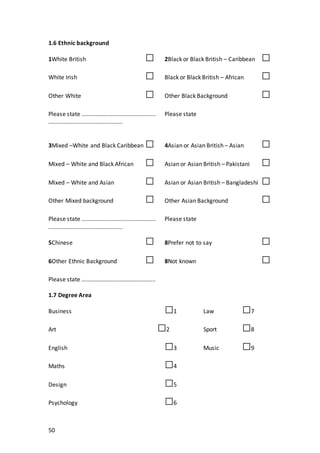
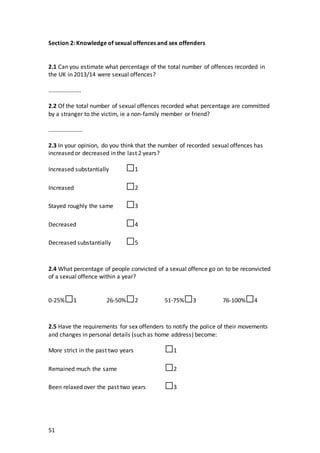
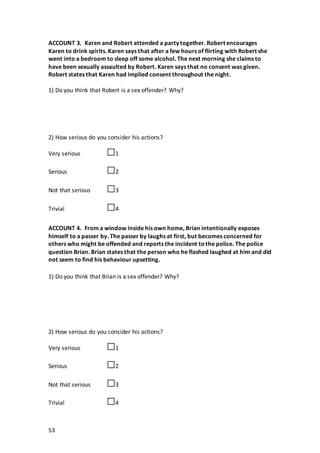
The questionnaire contained five sections. The first section contains questions designed
to obtain details regarding participants’ gender, age, marital status, parenthood,
residence and ethnic background. In addition to these questions, and the first deviation
from Brown et al.’s (2008) original questionnaire, participants also provide information
about their programme of study. Section two is designed to allow participants to
estimate the current trends in sexual offending. For the current research, Brown et al.’s
(2008) original section two was divided into the aforementioned section two, and
section three; scenarios. In the third section participants responded to four vignettes,
describing scenarios of sexual offending. Participants rated whether the scenario is a
sexual offence and, if so, how serious the matter is. Participants were also encouraged
to make a statement as to why the scenario described a sexual offence. Section four
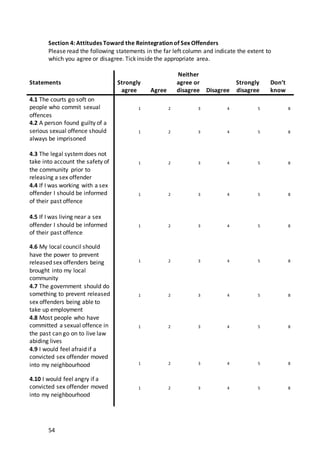
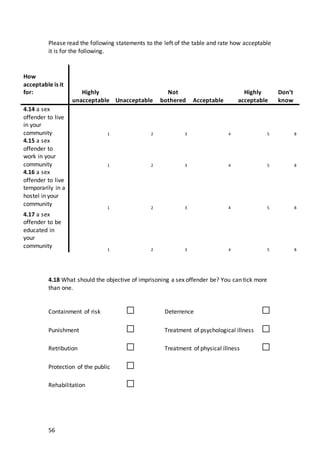
presented participants with three scales, the ATRSO, measuring attitudes towards
reintegration of sex offenders, the Acceptability of Community Reintegration scale,
measuring the perceived level of acceptability in regards to a sex offender being
reintegrated in the participant’s own community, and the Monitoring Technique scale,
measuring participants’ confidence in such techniques. Participants utilised 5 point
Likert scales to respond (Likert, 1932), although the Monitoring Technique scale did
not provide a “don’t know” option.
Attitudes Towards the Reintegration of Sex Offenders (ATRSO) scale
The ATRSO scale is a scale that features in the questionnaire provided to participants
of this study. The scale was first developed by Brown et al. (2008) in their survey of
public attitudes towards sex offenders, although in their study it was not used as the
source of primary analysis. The scale is comprised of 12 items which participants
respond to on a 5 point Likert scale ranging from 1, strongly agree, to 5, strongly
disagree. A “don’t know” option is included for every statement, however, if this option
is selected by a participant then the scale would be incomplete. Therefore, participants
who select “don’t know” are removed from any analysis referring to this scale.
22
Participants who complete the scale score between 12-60 with higher scores being
indicative of a more positive attitude towards the reintegration of sex offenders. Despite
the existence of similar scales, such as the Public Attitudes towards Sex Offender
Rehabilitation scale (PATSOR) (Rogers et al., 2011), the reliability coefficient for the
ATRSO was .836, indicating that the scale possesses good internal reliability (Gliem &
Gliem, 2003).
Attitudes Towards the Media’s Representation of Sex Offenders
(ATMRSO) scale
The ATMRSO scale is also a component of Brown et al.’s (2008) public attitudes
towards sex offenders questionnaire. To measure attitudes towards the media’s
representation of sex offenders, participants respond to four items using a 5 point Likert
scale ranging from 1, substantially exaggerates, to 5, substantially underreports. In this
scale the midpoint, three, indicates the participant thought the media was accurate in
it’s portrayal of the media. If participants select “don’t know” at any point during
completion of the scale, their data is discounted as the validity of the scale would be
compromised. Completed scales will provide scores of between 4-20with higher scores
indicating a more negative attitude towards the portrayal of sex offenders in the media.
The reliability coefficient for the ATMRSO was .845, indicative of a good internal
reliability (Gliem & Gliem, 2003). For the current study, participants were divided into
three groups; exaggerates, accurate and underreports, all relating to participants’ views
regarding the portrayal of sex offenders in the media. Participants with scores ranging
from 4-10 were grouped as believing the media exaggerates, participants with scores
ranging from 11-13 were grouped as believing the media is accurate and participants
with scores ranging from 14-20 were grouped as believing the media underreports.
3.4. Procedure
During the recruitment stage, participants who agreed to take part in the research were
provided with a participant information sheet (See appendix 2), which they were
instructed to read, stating their rights during participation. Subsequently, participants
signed consent forms (See appendix 3), outlining the nature of the study, ensuring that
23
consent was obtained. For participants who completed the questionnaire online, the
participant information sheet was available to participants prior to taking part in the
questionnaire. The consent form required an age confirmation and participants were
required to state that they understood the requirements of the study and their rights.
Participants were then handed the questionnaire and a pen and were instructed to
complete the questionnaire in their own time. The researcher maintained proximity to
the participant should a situation arise in which the participant sought assistance.
Mainly, participants followed instructions within the questionnaire itself. The first
section required participants to provide personal information such as gender, age,
location of residence and programme of study. The second section required participants
to provide estimates as to their knowledge regarding sex offenders. The third section
reminded participants of their right to withdraw before participants completed questions
based on four different scenarios. The fourth section presented participants with a three
5-point Likert scales in addition to multiple choice questions and again reasserted the
right to withdraw. Finally, the fifth section continued this format and participants,
again, completed a 5-point Likert scale and multiple choice questions. All Likert scales
provided a “don’t know” option, although if selected their data would be removed from
analysis of the scale.
Upon completion, questionnaires were collected and stored separately to consent forms
so as not to compromise confidentiality. Participants were then provided with a debrief
form (See Appendix 4) that both thanked them for participation, reiterated the aims of
the study and reminded participants of their rights as a participant. Due to the sensitive
nature of the study, participants were also provided with contact information for
specialists should they require any further support or have further queries. The data
from the questionnaires was then collated and analysed using SPSS.
3.5. Ethics
Prior to commencing the research, an ethics proposal was submitted to the Liverpool
John Moores University Ethical Approval Panel. Upon the granting of approval by the
panel (Appendix 5), the researcher began collecting data. Due to the sensitivity that
24
surrounds the topic of sex offenders, it was vital to ensure that participants would face
minimal harm and provide support in the event that such a case occur.
Participants who were approached or chose to respond to the online questionnaire were
provided with a participant information sheet prior to taking part. This ensured that
participants understood the nature of the questions that would be asked and advise them
of their rights within the study, particularly that they had the right to withdraw at any
time and their data would be confidential. Participants were then provided with a
consent form in order to obtain written consent and reiterate their rights. Upon
completion of the questionnaire participants who completed the questionnaire in person
were provided with a debrief form; this form was also displayed to participants who
completed the questionnaire online. The debrief form included details regarding the aim
of the study, a reminder of the rights they were entitled to, and an option to remove
their data from the research. Support details were also included for those who required
such a service.
25
Chapter 4: Results
4.1. Introduction
The questionnaires that were completed by participants were designed to provide raw
data regarding the nature of the attitudes towards the reintegration of sex offenders held
by participants and whether these attitudes were different based on gender and
programme of study. In order to measure attitudes towards the reintegration of sex
offenders, participants were given a scores based on their responses to questions 4.1 to
4.12 of the reintegration scale. This total score became the dependent variable for a
two-way analysis of variance, with gender, programme of study and scores on the
ATMRSO as the independent variables. This section will include the testing of
assumptions, an exploration of descriptive statistics, hypotheses testing and the
assessment of a possible interaction between gender and programme of study.
4.2. Assumptions
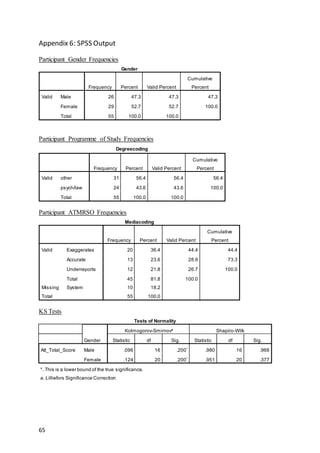
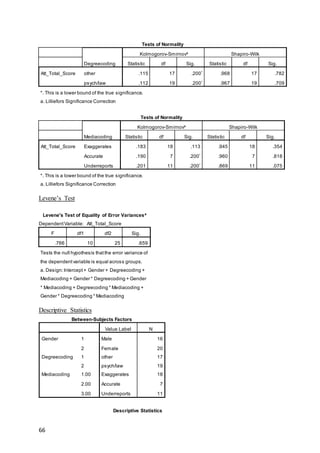
A Kolmogorov-Smirnov test was conducted to determine whether scores on the
ATRSO scale were normally distributed amongst the participants (See Appendix 6),
finding that the data was normally distributed for all conditions, p > .05. Therefore, it
can be assumed that the data are normal. A Levene’s test revealed that the variances
were homogenous, F > 1; the assumption of homogeneity of variance was satisfied.
4.3. Descriptive Statistics
Participants were instructed to estimate reconviction rates of sexual offenders. Table 2
displays these estimates as a percentage in terms of their distribution amongst
participants’ gender and programme of study.
26
Table 2: Cross tabulation of estimated reconviction rates by gender and programme of
study
*Data rounded to integers.
Participants also indicated the information source they utilised in the formation of their
attitudes towards the reintegration of sex offenders. Table 3 displays, in percentages,
the distribution of attitudes towards the media’s representation of sex offenders within
each information source. It should be noted that participants could select more than one
source of information.
Table 3: Cross tabulation of information source by attitude towards the media’s
portrayal of sex offenders
Attitude
towards the
media’s
representation
of sex
offenders
Source of information*
Information
from friends
and family
(%)
Official
crime
statistics
(%)
Media
(%)**
Court
proceedings
(%)**
Contact
with
offenders
(%)**
Yes No Yes No Yes No Yes No Yes No
Exaggerates 18 27 24 20 36 9 18 27 11 33
Accurate 11 18 9 20 29 0 7 22 2 27
Underreports 13 13 9 18 27 0 11 16 2 24
Total 42 58 42 58 92 9 36 65 15 84
*Data rounded to integers.
**Due to rounding,percentages may not add up to 100.
For the analysis of the ATRSO scale 19 participants were removed from the sample
due to the selection of the “don’t know” option on either of the scales (ATRSO &
ATMRSO) leaving the data of 36 participants to be analysed. The “don’t know” option
is invalid as, with the selection of this option, the scales would be incomplete.
Subsequent results reflect this removal.
Reconviction
rates
Gender* Degree*
Male
(%)
Female
(%)
Psychology and
law (%)
Other programme of
study (%)
0-25% 23 14 25 13
26-50% 62 55 46 68
51-75% 15 28 25 19
76-100% 0 3 4 0
27
Table 4 displays the mean score achieved on the ATRSO scale by participants in each
condition, the standard deviations and the number of participants in each condition.
Male students (M = 36.25, SD = 9.74) exhibited more positive attitudes towards sex
offender reintegration than female students (M = 33.60, SD = 8.54). Participants
studying psychology and law (M = 36.63, SD = 9.31) demonstrated more positive
attitudes than students studying other subjects (M = 32.71, SD = 8.56). Participants who
were male and studying psychology and law displayed the highest mean scores (M =
43.83, SD = 6.91), indicating that they held the most positive attitudes towards the
reintegration of sex offenders. This was in contrast to the relatively similar mean scores
achieved in the three other conditions.
Furthermore, there is an almost consistent pattern visible, as those who felt the media
exaggerated (M = 37.28, SD = 7.36) tended to score more highly than those who
thought the media was accurate (M = 34.71, SD = 11.51) or underreported (M = 30.73,
SD = 9.29), across most conditions.
Table 4: Mean scores on the Attitudes Towards the Reintegration of Sex Offenders
scale
*Data rounded to two decimal places.
**Value omitted as standard deviations are not available for cells with one participant.
4.4. Hypotheses Testing
A 2 x 2 x 3 factorial analysis of variance was conducted to examine the main effects
and interactions of gender, programme of study and scores on the ATMRSO scale on
attitudes towards sex offenders as measured by the ATRSO scale. Gender included two
levels (male/female), programme of study included two levels (psychology and
law/other), and scores on the ATMRSO scale included three levels
(exaggerates/accurate/underreports).
Male participants (M = 36.3, SD = 9.7) displayed higher scores on the ATRSO scale
than female participants (M = 33.6, SD = 8.5), indicating that males held more positive
28
attitudes towards the reintegration of sex offenders than females. However, this
difference was not statistically significant, F(1, 25) = 2.01, p = .17, η2 = .003. Therefore,
hypothesis 1 can be rejected.
Participants who were enrolled on psychology and law programmes (M = 36.6, SD =
9.3) scored more highly on the ATRSO scale than participants who were studying other
programmes (M = 32.7, SD = 8.6), demonstrating that psychology students held more
Gender
Programme
of study
Attitude towards
media
representations of
sexual offenders
Mean*
Standard
Deviation*
Number of
participants
Male
Psychology
and law
Exaggerates 43.75 7.93 4
Accurate 44.00 7.07 2
Total 43.83 6.91 6
Other
Exaggerates 32.50 5.20 4
Accurate 28.67 11.02 3
Underreports 33.67 11.55 3
Total 31.70 8.38 10
Total
Exaggerates 38.13 8.64 8
Accurate 34.80 11.99 5
Underreports 33.67 11.55 3
Total 36.25 9.74 16
Female
Psychology
and law
Exaggerates 36.00 6.78 7
Accurate 24.00 ** 1
Underreports 31.40 10.43 5
Total 33.60 8.50 13
Other
Exaggerates 38.00 7.21 3
Accurate 45.00 ** 1
Underreports 26.67 6.43 3
Total 34.14 9.28 7
Total
Exaggerates 36.60 6.57 10
Accurate 34.50 14.85 2
Underreports 29.63 8.94 8
Total 33.60 8.54 20
Total
Psychology
and law
Exaggerates 38.82 7.86 11
Accurate 37.33 12.58 3
Underreports 31.40 10.43 5
Total 36.63 9.31 19
Other
Exaggerates 34.86 6.28 7
Accurate 32.75 12.15 4
Underreports 30.16 9.20 6
Total 32.71 8.56 17
Total
Exaggerates 37.28 7.36 18
Accurate 34.71 11.51 7
Underreports 30.73 9.29 11
Total 34.78 9.06 36
29
positive attitudes towards the reintegration of sex offenders. However, the effect of
programme of study was not statistically significant, F(1, 25) = 1.50, p = .23, η2 = .002.
Due to this, hypothesis 2 can be rejected.
Participants who held beliefs that the media exaggerates (M = 37.3, SD = 7.4) in it’s
portrayal of sex offenders displayed higher scores on the ATRSO scale than students
who thought the media was accurate (M = 34.7, SD = 11.5). Both these groups
displayed higher ATRSO scores than students who thought the media underreports (M
= 30.8, SD = 9.1) in it’s portrayal of sex offenders. This indicates that more negative
attitudes are associated with a more positive rating of the media’s portrayal of sex
offenders. However, hypothesis 3 can be rejected as this effect was not statistically
significant, F(2, 25) = .28, p = .76, η2 = .0008.
There was a significant effect for an interaction between gender and programme of
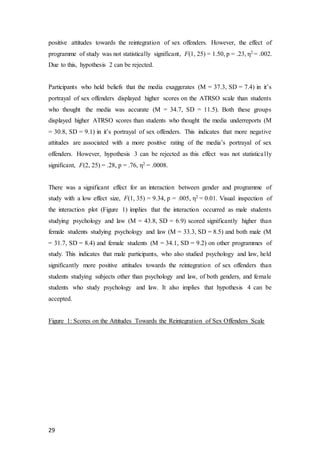
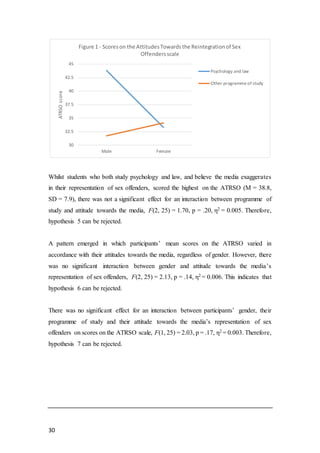
study with a low effect size, F(1, 35) = 9.34, p = .005, η2 = 0.01. Visual inspection of
the interaction plot (Figure 1) implies that the interaction occurred as male students
studying psychology and law (M = 43.8, SD = 6.9) scored significantly higher than
female students studying psychology and law (M = 33.3, SD = 8.5) and both male (M
= 31.7, SD = 8.4) and female students (M = 34.1, SD = 9.2) on other programmes of
study. This indicates that male participants, who also studied psychology and law, held
significantly more positive attitudes towards the reintegration of sex offenders than
students studying subjects other than psychology and law, of both genders, and female
students who study psychology and law. It also implies that hypothesis 4 can be
accepted.
Figure 1: Scores on the Attitudes Towards the Reintegration of Sex Offenders Scale
30
Whilst students who both study psychology and law, and believe the media exaggerates
in their representation of sex offenders, scored the highest on the ATRSO (M = 38.8,
SD = 7.9), there was not a significant effect for an interaction between programme of
study and attitude towards the media, F(2, 25) = 1.70, p = .20, η2 = 0.005. Therefore,
hypothesis 5 can be rejected.
A pattern emerged in which participants’ mean scores on the ATRSO varied in
accordance with their attitudes towards the media, regardless of gender. However, there
was no significant interaction between gender and attitude towards the media’s
representation of sex offenders, F(2, 25) = 2.13, p = .14, η2 = 0.006. This indicates that
hypothesis 6 can be rejected.
There was no significant effect for an interaction between participants’ gender, their
programme of study and their attitude towards the media’s representation of sex
offenders on scores on the ATRSO scale, F(1, 25) = 2.03, p = .17, η2 = 0.003. Therefore,
hypothesis 7 can be rejected.
30
32.5
35
37.5
40
42.5
45
Male Female
ATRSOscore
Figure 1 - Scoreson the AttitudesTowardsthe Reintegrationof Sex
Offendersscale
Psychology and law
Other programme of study
31
Chapter 5: Discussion
5.1. Introduction
The following section will provide a discussion of the findings of the three-way analysis
of variance. There will be a short summary of results in which hypotheses will be
summarised in terms of confirmation or rejection. Following this, there will be an
interpretation of the findings in comparison with existing literature in this topic area.
Societal impact will be examined, in addition to a discussion of limitations. The section
will conclude with recommendations for future research.
5.2. Summary of Results
32
The aim of the present study was to assess the nature of the relationships between
gender, programme of study and attitude towards the media’s portrayal of sex offenders
on overall attitudes towards the reintegration of sex offenders, in light of the Yewtree
effect. Statistically significant support was only found in relation to hypothesis 4, the
interaction between gender and programme of study. In particular, male students who
study psychology and law displayed significantly more positive attitudes towards the
reintegration of sex offenders than female students studying psychology and law and
both male and female students studying other degrees. Although there were differences
in mean scores in relation to other hypotheses, no statistically significant support was
found, thus, all hypotheses, aside from hypothesis 4, were rejected.
5.3. Relating and Explaining the Results in line with Previous Research
It was hypothesised that males would display higher scores on the ATRSO scale then
females, indicating that males possess more positive attitudes towards the reintegration
of sex offenders. Differences in mean scores between males and females, although not
statistically significant, indicated that males displayed more positive attitudes towards
the reintegration of sex offenders than females, contrasting findings that females
reported more positive attitudes towards sex offenders than males (Ferguson & Ireland,
2006). However, past literature in relation to gender differences in attitudes towards sex
offenders, overall, has been inconclusive (Rogers et al., 2011; Höing et al., 2016).
Therefore, it is difficult to establish whether statistically insignificant results in relation
to an effect for gender contrast previous research or whether they suggest that there
may simply be no effect for gender. A methodological explanation for the lack of
significance is also possible, as it may be that the role of fear, the theoretical background
for the original hypothesis, although stemming from gender differences, may be a factor
that was not measured by the ATRSO. Therefore, future research should consider the
different cognitive responses that contribute to attitude formation in regards to sex
offender reintegration. Another explanation is that, in line with suggestions that fear of
crime is mediated by factors beyond demographic characteristics (Haghighi & Lopez,
1998; Levenson et al., 2007), attitudes are also be mediated similarly; when coupled
with other factors. Although gender as an individual variable might not necessarily
33
influence attitudes towards the reintegration of sex offenders (Simon, 2010), a
significant interaction was found between gender and programme of study.
The interaction indicated that males who studied psychology and law displayed
significantly higher scores on the ATRSO scale than females studying psychology and
law and both genders of students enrolled on other programmes of study. Although no
statistically significant effect was found for gender or programme of study as individual
variables, together, these variables may influence attitudes towards the reintegration of
sex offenders. Theoretically, due to the increased risk of sexual offence victimisatio n
in females (Fisher et al., 1995; Fisher & Cullen, 2000; Rennison, 2002) and the
increased fear as a result (Hickman & Muehlenhard, 1997; Kernsmith et al., 2009;
Hillinski et al., 2011), this fear may be a mediator of attitudes when coupled with the
relatively increased knowledge of sex offender reintegration that may occur as the result
of studying psychology and law. The role of fear is important as fear is a factor that is
cited as a precursor to negative attitudes towards sex offenders (Benzvy-Miller, 1990).
Therefore, the disproportionate fear of sexual offences in females could result in more
negative attitudes towards sex offender reintegration, whereas this may not impact the
attitudes of males due to diminished fear as a result of less vulnerability to sexual
offences (Rennison, 2002; Hillinski et al., 2011). This lack of fear in males may
decrease further in individuals who have accurate knowledge of the statistical
likelihood of victimisation and sexual offender recidivism rates, as those with increased
knowledge of sex offenders are less likely to report stereotypical views of sex offenders
(Sangara & Wilson, 2006). Less stereotypical could be considered more accurate.
Although both student groups consistently overestimated the recidivism rate of sex
offenders, 87% of students on other programmes of study estimated the recidivism rate
to be over 25% whereas 75% of psychology and law students did the same. Perhaps
this 12% difference is an indication that, although not significant, psychology and law
students have enough accurate knowledge that male students in particular are able to
use this information to understand their lower risk of victimisation. The
acknowledgement of this low risk would lead to less overall fear and, thus, positive
attitudes towards the reintegration of sex offenders in males who study psychology and
law. Thus, with the knowledge gained from studying psychology and law, in addition
to the diminished fear of sexual offenders, male psychology and law students displayed
significantly more positive attitudes towards the reintegration of sex offenders.
34
Due to the content of psychology and law degrees, and in line with indications that
qualified psychologists possess more positive attitudes towards sex offenders (Johnson
et al., 2007; Simon, 2010), it was hypothesised that students studying psychology and
law would display higher ATRSO scores than students studying other degrees.
However, although mean scores reflected slightly more positive attitudes in students
studying psychology and law degrees, this was not supported with statistically
significant data. It may be that, despite assumptions regarding the difference in
knowledge between students who study psychology and law and those who do not, true
differences in knowledge are not as pronounced at undergraduate level. Although
research indicates that students held more positive attitudes, towards both sex offenders
(Gakhal & Brown) and their reintegration (Smith, 1999) than members of the general
public, this effect of student status may be limited to being a university student in
general, rather than studying a specific subject. Furthermore, the statistically
insignificant effect found in the current study is consistent with Harper’s (2012)
findings, that there was no significant difference between students studying psychology
and students who do not. However, Harper (2012) found that, though not statistically
significant, psychology students were more punitive, thus, held more negative attitudes
towards the reintegration of sex offenders; contrasting the results of the current study.
These differences could be based on methodological choices. There has been extremely
limited research into differences between student populations, meaning that contrasting
different studies leads to the comparison of findings based around different scales. The
current study utilised an updated version of the, arguably underused, ATRSO, whereas
Harper’s (2012) results were scores on the ATS scale, a scale that, although common
in the literature, does not measure attitudes towards the reintegration of sex offenders.
Instead, the ATS measures attitudes towards sex offenders in general. However, the
term “sex offender” is highly emotive (Federoff & Moran, 1997), meaning that attitudes
towards the existence of sex offenders and attitudes towards their reintegration may be
entirely different (Rogers et al., 2011). Although problematic in terms of comparing
findings, this is beneficial to understand as future research in this topic area should
make a clear distinction between sex offenders and their reintegration and develop
scales accordingly.
35
It was also hypothesised that participants who felt the media exaggerated in the
representation of sex offenders would display significantly higher scores on the
ATRSO scale than participants who thought the media was accurate or underreported
sexual offenders. Again, despite mean scores indicating that this pattern existed, no
significant difference was found. Although this research classified students as a
heterogeneous in terms of programme of study, it may be that students are relatively
homogenous in terms of their consumption of the media. This is perhaps due to the
dramatic changes in media consumption in recent years, with findings suggesting over
95% of students utilise social media (Hoffman et al., 2014). Although the media may
influence different members of society differently (Weitzer & Kubrin, 2004), in the
current study, 92% of participants indicated they used the media as an information
source to form their opinion towards the reintegration of sex offenders. This persistent
exposure to the media is not forced, therefore students are actively opting in to this
method of obtaining information. The consistent choice to reaffirm one’s beliefs
through information in the media is an issue due to the relationship between media
reliance and understanding of the criminal justice system (Pickett et al., 2015). It may
also be that attitudes towards the media’s portrayal of sex offenders are not related to
attitudes towards reintegration. Whilst one could critique the media for bias in terms of
both exaggerating and underreporting the prevalence and risk of sex offenders, it may
not alter attitudes towards the reintegration of sex offenders.
5.4. Why is this Research Important?
Despite the vast amount of research into attitudinal differences between demographic
groups, students as a heterogeneous demographic group are relatively neglected. Aside
from gaining a fuller understanding of public attitudes towards the reintegration of sex
offenders, future research in this area, building on the findings in the current study, may
have implications for education. It is estimated that 15-20% of psychology graduates
gain employment in professional psychology (BPS, 2011). If these students are not
displaying significant differences to students of other disciplines in terms of attitudes
towards the reintegration of sex offenders, it may be that these courses should place
greater emphasis on distributing accurate information regarding sex offender
reintegration. In turn, this may contribute to the necessary societal alteration of attitudes
36
towards sex offenders (Harper, 2012). Like all crime, sexual offences are inevitable.
However, legislation, although popular with society (Kernsmith et al., 2009), should
seek to improve the reliability of reintegration. Yet, the media, with frequent
stereotypical portrayals of sex offenders (Federoff & Moran, 1997; Kjelsberg & Loos,
2008; Gakhal & Brown, 2011; Hanson et al., 2014), are perhaps unaware of the
responsibility they have in ensuring that the public are provided with accurate
information rather than sensationalist headlines.
5.5. Limitations
Key limitations of the current study concern the sample obtained. Although cell
distribution was consistent for gender, programme of study and rating of the media’s
portrayal of sex offenders as individual variables, interactions left a smaller number of
participants in each group. However, this is partly due to the sampling method as a
result of the inability to predict participants’ rating of the media prior to completion of
the whole questionnaire. Though 60 participants were originally targeted, and 55
obtained, the sample was further impacted by the removal of 19 participants prior to
analysis; around 35% of the entire sample. Participants who selected “don’t know” as
a response during completion of either the ATRSO and ATMRSO were discounted
from further analysis as, with this response, their data would be incomplete. Therefore,
any estimates provided by the current study are likely conservative. Equally, in small
samples it is possible to fall victim to type II errors (Field & Hole, 2003). However, this
does not indicate that future research should employ forced choice methodology as, in
research of attitudes, it is essential that responses are not systematically manipulated
through the exclusion of ambivalence and unawareness. Furthermore, though a
limitation of a small sample size, this removal of data is interesting in itself. The
inclusion of a “don’t know” option is different to a neutral option, as the selection of
“don’t know” does not imply ambivalence. Instead, it implies a lack of understanding,
which, in regards to the reintegration of sexual offenders, is commonly accepted in the
literature; the general public are uninformed in regards to sex offenders (Barak, 1994;
CSOM, 2010; Madoc-Jones et al., 2014; Malinen et al., 2014). Therefore, although
these participants were removed from the analysis, their data can be used in itself to
37
highlight key issues in discussions of the reintegration of sex offenders; the public
simply lack understanding.
I’m starting to question what a “sex offender” is. (Respondent 48)
This response emphasises the notion that, despite the attitudes held towards sex
offender reintegration, the public are simply unaware of what constitutes a sex offender.
This also highlights the importance of research in this topic area. If sex offenders are to
be reintegrated, and recidivism rates are to decline, the public must be informed with
accurate information.
5.6. Recommendations for Future Research
From these findings, future research should further investigate the evolution of new
media in regards to attitude formation. Although the methodology of the current study
allowed insight into the source of information students rely on for opinion formation,
there are increasing sources of information that can be accessed due to developments
in new media. For example, although students may not read newspapers, they are likely
to read papers from numerous sources online. Furthermore, the current research could
not measure the extent to which these sources impact attitude formation. It may be that,
although people consume the media, they may reject information obtained from sources
of opposing views (Bohner & Wänke, 2002).
Chapter 6: Conclusion
Previous literature has examined the variables of gender (Ferguson & Ireland, 2006;
Rogers et al., 2011; Höing et al., 2016) and programme of study (Harper, 2012) in
attitudinal differences towards sex offenders. The aim of the current research was to
investigate these factors along with a new factor in this research area; attitudes
towards the media’s representation of sex offenders. Attitudes towards the media were
included in light of the Yewtree effect, as previous literature has not referred to this
phenomenon. Furthermore, this study introduced the notion of students as a
heterogeneous group with differences within them based on demographic and
sociodemographic factors. Main findings indicated that there was an interaction
38
between gender and programme of study; male students who study psychology and
law reported significantly more positive attitudes towards the reintegration of sex
offenders than other subgroups. However, any findings could be considered
foundations to future research in which the sample used should be both larger and
more diverse.
An issue with developing functional responses to crime is that the public’s attitude is
one based on ideals. To deal with sexual offences adequately is an ideal, however, the
ideal solution does not exist as the concept of an ideal is non-existent. Otherwise, there
would be no need for a response as ideally, these crimes would not occur. This world
is not one of ideals, the world of ideals is a philosophical ideology developed by Plato
(Buckingham et al., 2011) long before modern reactionary legislation (Dugan, 2001) to
sex offender reintegration was necessary. It would be particularly detrimental to the
development of effective responses to sex offenders if the UK were to follow the US in
the passing of civil commitment legislation or open-access registries (Hynes, 2013).
However, current interventions are not entirely misguided, they are a developed
response to a problematic behaviour in society. Changes were made post-Operation
Yewtree (Levitt, 2013), yet, with further cuts to policing such as those announced by
George Osborne (Beattie, 2015), it is how effective the policing of sex offenders
becomes in the future that will shape public attitudes towards this group of offenders.
With a 2.3% cut looming, sharing of responsibilities between the police and welfare
agencies will inevitably occur (Pitts, 2015). Roles once traditionally played by the
police will be taken over by non-policing agencies, such as the Troubled Families Unit
which was deemed a success by David Cameron (Department for Communities and
Local Government, 2015).
With the attention that is focused on sex offenders it is important for the academic
community to convey purely factual information (Federoff and Moran, 1997). This
could be applied to society’s approach as, due to the sensitive nature of the discussion,
it is easy to allow emotionality and opinion to taint what is necessary. For example,
when a debate emerges in the media as a result of the occurrence of a particular sexual
offence, discussions often revolve around the graphic nature of an offender’s crimes
(Cheit, 2003; Malinen et al., 2014). Yet, these individuals often did not choose their
sexual preferences (Theroux, 2009). Thus, it is essential that, along with policing
39
efforts to ensure safety, researchers must convey scientific truth to the public; in order
for the public to maintain accurate attitudes and beliefs they must feel secure. Yet, the
role of the media may somewhat impede this. The media dominates the majority of
the public’s knowledge of this particular group of offenders, particularly since
Operation Yewtree, perhaps detrimentally. What is important, then, is to address
stereotypical portrayals of sex offenders in the media (Federoff & Moran, 1997;
Kjelsberg & Loos, 2008; Gakhal & Brown, 2011; Hanson et al., 2014) and educate
the public. If anything, the current study has demonstrated that this area of research
must be expanded; if society is to change, attitudes must change.
Bibliography
Barak, G. (1994). Media, society, and criminology. In G. Barak (Ed.), Media, process,
and the social construction of crime (pp. 3-45). New York: Garland.
Barbaret, R., Fisher, B. S., Farrell, G., & Taylor, H. (2003). University student safety.
London: Home Office. Retrieved from:
http://www.homeoffice.gov.uk/rds/pdfs2/r194.pdf.
BBC News. (2000, July 24). To name and shame. BBC News. Retrieved from
http://news.bbc.co.uk/1/hi/uk/848759.stm
Beattie, J. (2015, December 17). Police funding is being cut despite pledge by George
Osborne. The Daily Mirror. Retrieved from http://www.mirror.co.uk/news/uk-
news/police-funding-being-cut-despite-7031000.
Benzvy-Miller, S. (1990). Community corrections and the NIMBY syndrome. Forum
on Corrections Research, 2, 18-22.
40
Bogle, C. B., & Chumney, F. (2006). Development of the sex offender attitude scale
(SOAS). Proceedings of The National Conference on Undergraduate Research
(NCUR), The University of North Carolina at Asheville, North Carolina.
Bohner, G., & Wänke, M. (2002). Attitudes and Attitude Change. Hove, UK:
Psychology Press.
British Psychological Society. (2011). Forensic psychology. Retrieved from:
http://www.bps.org.uk/careers/-what-do-psychologists-do/areas/forensic.cfm.
Brown, S. (1999). Public attitudes toward the treatment of sex offenders. Legal &
Criminological Psychology, 4(2), 239-252.
Brown, S., Deakin, J., & Spencer, J. (2008). What people think about the management
of sex offenders in the community. The Howard Journal of Criminal Justice, 47(3),
259-274.
Brown, S., Spencer, J., & Deakin, J. (2007). The reintegration of sex offenders:
Barriers and opportunities for employment. The Howard Journal of Criminal Justice,
46(1), 32-42.
Buckingham, W., Burnham, D., Hill, C., King, P. J., Marenbon, J., & Weeks, M.
(2011). The Philosophy Book. London, UK: Darling Kindersley Limited.
Caputo, A. A., & Brodsky, S. L. (2004). Citizen coping with community notification
of released sex offenders. Behavioural Sciences and the Law, 22, 239-252.
Center for Sex Offender Management. (2010). Exploring public awareness and
attitudes about sex offender management: Findings from a national public opinion
poll. A project of the US Department of Justice. Retrieved from:
http://www.csom.org/pubs/CSOM-Exploring Public Awareness.pdf.
Chaffin, J. (2008). Our minds are made up – Don’t confuse us with the facts:
Commentary on policies concerning children with sexual behaviour problems and
juvenile sex offenders. Child Maltreatment, 13, 110-121.
Cheit, R. E. (2003). What hysteria? A systematic study of newspaper coverage of
accused child molesters. Child Abuse & Neglect, 27(6), 607-623.
Church, W. T., Wakeman, E. E., Miller, S. L., Clements, C. B., & Sun, F. (2008). The
community attitudes toward sex offenders scale: The development of a psychometric
assessment instrument. Research on Social Work Practice, 18, 251-259.
Cichon, L. M. (2005). An investigation of psychologists’ attitudes towards sex
offenders. (Unpublished doctoral Dissertation). Retrieved from Dissertations &
Theses: Full Text. (Publication No. AAT 3199436)
Cohen, S. (1972). Folk Devils and Moral Panics. The Creation of the Mods and
Rockers. London, UK: MacGibbon & Kee.
41
Craig, L. A. (2005). The impact of training on attitudes towards sex offenders.
Journal of Sexual Aggression, 11, 197-207.
Cree, V., Clapton, G., & Smith, M. (2014). Moral panics, Jimmy Savile and social
work: A 21st century morality tale. Discover society, 4. Retrieved from:
http://www.discoversociety.org/moral-panics-jimmy-savile-and-social-work-a-21st-
century-morality-tale/.
Deakin, J. (2006). Dangerous people, dangerous places: The nature and location of
young people’s victimisation and fear. Children & Society, 20(5), 376-390.
Department for Communities and Local Government. (2015). PM praises Troubled
Families programme success. Retrieved from:
https://www.gov.uk/government/news/pm-praises-troubled-families-programme-
success. Accessed 17th January 2016.
Ducat, L., Thomas, S., & Blood, W. (2009). Sensationalising sex offenders and sexual
recivism: Impact of the Serious Sex Offender Monitoring Act 2005 on media
reportage. Australian Psychologist, 44(3), 156-165.
Dugan, M. J. (2001). Megan’s law or Sarah’s law? A comparative analysis of public
notification statuses in the United States and England. Loyola of Los Angeles
International and Comparative Law Review, 23(4), 617-644.
Dowler, K. (2003). Media consumption and public attitudes toward crime and justice:
The relationship between fear of crime, punitive attitudes, and perceived police
effectiveness. Journal of Criminal Justice and Popular Culture, 10(2), 109-126.
Eagly, A. H., Chaiken, S. (1993). The psychology of attitudes. Orlando, FL: Harcourt
Brace Jovanovich College Publishers.
Economist, The. (2000, August 10). Witch hunt: Would a British version of “Megan’s
law” work?. The Economist. Retrieved from http://www.economist.com/node/343373
Erooga, M. (2015). Moral crusades in an age of mistrust: The Jimmy Savile scandal.
Journal of Sexual aggression, 21(1), 119-121.
Federoff, J.P., & Moran, B. (1997) Myths and misconceptions about sex offenders.
The Canadian Journal of Human Sexuality, 6, 263-277.
Ferguson, K. & Ireland, C. (2006). Attitudes towards sex offenders and the influence
of offence type: A comparison of staff working in a forensic setting and students. The
British Journal of Forensic Practice, 8(2), 10-19.
Ferraro, K. F. Fear of crime: Interpreting victimisation risk. Albany: State University
of New York Press.
Field, A. P., & Hole, G. (2003). How to design and report experiments. London, UK:
Sage Publications.
42
Fisher, B. S., & Cullen, F. T. (2000). Measuring the sexual victimization of women:
Evolution, current controversies, and future research. In D. Duffee (Ed.),
Measurement and analysis of crime and justice (pp. 317-450). Washington, DC: US
Department of Justice.
Fisher, B. S., Sloan, J. J., & Wilkins, D. L. (1995). Fear and perceived risk of
victimization in an urban university setting. In B. S. Fisher & J. J. Sloan (Eds.),
Campus Crime: Legal, social, and policy perspectives. (pp. 179-209). Springfield, IL:
Charles C Thomas.
Frei, A. (2008). Media consideration of sex offenders: How community response
shapes a gendered perspective. International Journal of Offender Therapy &
Comparative Criminology, 52(5), 495-498.
Furby, L., Weinrott, M. R., & Blackshaw, L. (1989). Sex offender recidivism.
Psychological Bulletin, 105, 3-30.
Furedi, F. (2013). Moral Crusades in an Age of Mistrust: The Jimmy Savile Scandal.
London, UK: Palgrave Pivot.
Gakhal, B. K., & Brown, S. J. (2011). A comparison of the general public’s, forensic
professional’s and students’ attitudes towards female sex offenders. Journal of Sexual
Aggression, 17(1), 105-116.
Gliem, J. A., & Gliem, R. R. (2003, October 8-10). Calculating, Interpreting, and
Reporting Crobach’s Alpha Reliability Coefficient for Likert-Type Scales. Paper
presented at 2003 Midwest Research to Practice Conference in Adult, Continuing, and
Community Education, Columbus: OH.
Greer, C. (2003). Sex Crime and the Media. Cullompton, UK: Willian Publishing.
Haghighi, B., & Lopez, A. (1998). Gender and perception of prisoners and prisoners.
Journal of Criminal Justice, 26(6), 453-464.
Hanson, R. K., Harris, A. J., Helmus, L., & Thornton, D. (2014). High-risk sex
offenders may not be high risk forever. Journal of Interpersonal Violence, 29(15),
2792-2813.
Harper, C. A. (2012). In pursuit of the beast: Undergraduate attitudes towards sex
offenders and implications for society, rehabilitation and British psychology
education. Internet Journal of Criminology. Retrieved from:
http://eprints.lincoln.ac.uk/11939/1/Harper_In_Pursuit_of_the_Beast_IJC_July_2012.
pdf.
Harper, C. A., & Hogue, T. E. (2014). Measuring public perceptions of sex offenders:
Reimagining the Community Attitudes Toward Sex Offenders (CATSO) scale.
Psychology, Crime & Law, 21(5), 452-470.
43
Harper, C. A., & Treadwell, J. (2013). Counterblast: Punitive Payne, justice
campaigns, and popular punitivism – Where next for ‘public criminology’? The
Howard Journal of Criminal Justice, 52(2), 216-222.
Hickman, S. E., & Muehlenhard, C. L. (1997). College women’s fears and
precautionary behaviors relating to acquaintance rape and stranger rape. Psychology
of Women Quarterly, 21, 527-547.
Hillinski, C. M., Pentecost Neeson, K. E., & Andrews, H. (2011). Explaining the fear
of crime among college women, in their own words. Southwest Journal of Criminal
Justice, 8(1), 112-127.
Hoffman, E. W., Pinkleton, B. E., Austin, E. W., & Reyez-Velázquez, W. (2014).
Exploring college students’ use of general and alcohol-related social media and their
associations with alcohol-related behaviors. Journal of American College Health,
62(5), 328-335.
Höing, M. A., Petrina, R., Hare Duke, L., Völlm, B., & Vogelvang, B. (2016).
Community support for sex offender rehabilitation in Europe. European Journal of
Criminology, 1-24.
Home Office. (2013a). Find out if a person has a record for child sexual offences.
Retrieved from: https://www.gov.uk/guidance/find-out-if-a-person-has-a-record-for-
child-sexual-offences. Accessed: 14th January 2016.
Home Office. (2013b). New powers for tighter restrictions on sex offenders. Retrieved
from: https://www.gov.uk/government/news/new-powers-for-tighter-restrictions-on-
sex-offenders. Accessed: 17th January 2016.
Hogue, T. E. (1993). Attitudes towards prisoners and sexual offenders. Issues in
Criminological and Legal Psychology, 9, 27-32.
Hogue, T. E. (1995). Training multi-disciplinary teams to work with sex offenders:
Effects on staff attitudes. Psychology, Crime & Law, 1, 227-235.
Hynes, K. (2013). The cost of fear: An analysis of sex offender registration,
community notification, and civil commitment laws in the United States and the
United Kingdom. Penn State Journal of Law & International Affairs, 2(2), 351-379.
Iyengar, S. (1991). Is anyone responsible: How television frames political issues.
Chicago: University of Chicago Press.
Johnson, H., Hughes, J. G., & Ireland, J. L. (2007). Attitudes towards sex offenders
and the role of empathy, locus of control and training: A comparison between a
probationer police and general public sample. The Police Journal, 80, 28-54.
Kang, S. (2012). The consequences of sex offender residency restriction: Evidence
from North Carolina. Unpublished Manuscript, Duke University Department of
Economics.
44
Kim, B., Benekos, P. J., & Merlo, A. V. (2015). Sex offender recidivism revisited:
Review of recent meta-analyses on the effects of sex offender treatment. Trauma,
Violence & Abuse, 17(1), 105-117.
Kernsmith, P. D., Craun, S. W., & Foster, J. (2009). Public attitudes toward sex
offenders and sex offender registration. Journal of Child Sexual Abuse, 18(3), 290-
301.
Kjelsberg, E., & Loos, L. H. (2008). Conciliation or condemnation? Prison
employees’ and young peoples’ attitudes towards sexual offenders. International
Journal of Forensic Mental Health, 7(1), 95-103.
Lea, S., Auburn, T., & Kibblewhite, K. (1999). Working with sex offenders: The
perceptions and experiences of professionals and paraprofessionals. International
Journal of Offender Therapy and Comparative Criminology, 43(1), 103-119.
Levenson, J. S., Brannon, Y. N., Fortney, T., & Baker, J. (2007). Public perceptions
about sex offenders and community protection policies. Analyses of Social Issues and
Public Policy, 7(1), 1-25.
Levitt, A. (2013). In the matter of the late Jimmy Savile: Report to the director of
public prosecutions. London: DPP.
Likert, R. (1932.) A Technique for the Measurement of Attitudes. Archives of
Psychology. 140. p. 1-55.
Lintern, F. (2012.) OCR Psychology: Psychological Investigations. Oxfordshire:
Philip Allan.
Lipscombe, S. (2012). Sarah’s law: The child sex offender disclosure scheme. House
of Commons Library Standard Note SN/HA/1692, 6 March.
Lipsey, M. W. (1995). What do we learn from 400 research studies on the
effectiveness of treatment with juvenile delinquents? In J. MacGuire (Ed.) What
Works: Reducing Offending (pp. 63-78). Chichester, UK: John and Wiley and Sons.
Lowenstein, L. (2010, March 12). The sorry truth is that many offenders can’t be
rehabilitated. The Daily Mail. Retrieved from:
http://www.dailymail.co.uk/debate/article-1256779/Some-offenders-like-Jon-
Venables-Peter-Chapman-CANT-rehabilitated.html
Madoc-Jones, I., Godren, C., Dubberley, S., & Hughes, C. (2014). From celebrity
criminal to criminal celebrity: Concerning the ‘celebrification’ of sex crime in the
UK. British Journal of Community Justice, 12(3), 35-48.
Malinen, S., Willis, G. M., & Johnston, L. (2014). Might informative media reporting
of sexual offending influence community members’ attitudes towards sex offenders?
Psychology Crime & Law, 206, 535-552.
45
Mancini, C., & Shields, R. T. (2014). Notes on a (sex crime) scandal: The impact of
media coverage of sexual abuse in the Catholic Church on public opinion. 42(2), 221-
232.
McAlinden, A. M. (2012). The governance of sexual offending across Europe: Penal
policies, political economies and the institutionalization of risk. Punishment &
Society, 14, 166-192.
McCartan, K. (2004). “Here there be monsters”: the public’s perceptions of
paedophiles with particular reference to Belfast and Leicester. Medicine, Science &
the Law, 44(4), 327-342.
McCleod, S. A. (2014) Sampling Methods. Retrieved from:
www.simplypsychology.org/sampling.html
Ministry of Justice. (2014). Offender Behaviour Programmes (OBPs). London:
HMSO.
Ministry of Justice. (2016). Proven Re-offending Statistics Quarterly Bulletin: April
2013 to March 2014, England and Wales. London: HMSO.
Nelson, M., Herlihy, B., & Oescher, J. (2002). A survey of counsellor attitudes
towards sex offenders. Journal of Mental Health Counseling, 24(1), 51-67.
Office for National Statistics. (2013). Sexual offences in England and Wales year
ending June 2013. London: Office for National Statistics.
Office for National Statistics. (2015a). Crime in England and Wales, Year Ending
March 2015. London: Office for National Statistics.
Office for National Statistics. (2015b). Crime Statistics, Focus on Violent Crime and
Sexual Offences, 2013/14. London: Office for National Statistics.
Pickett, J. T., Mancini, C., Mears, D. P., & Gertz, M. (2015). Public
(mis)understanding of crime policy: The effects of criminal justice experience and
media reliance. Criminal Justice Policy Review, 26, 500-522.
Pitts, J. (2015). Youth crime and youth justice. Youth & Policy, 114, 31-42.
Prescott, J., & Rockoff, J. (2008). Do sex offender registration and notification laws
affect criminal behavior? Working Paper No. 08-006, John M. Olin Center for Law &
Economics, University of Michigan Law School. Retrieved February 14, 2016.
Rennison, C. (2002). Criminal victimization 2001: Changes 2000-20001 with trends
1993-2001. Washington, DC: Office of Justice Programs, Bureau of Justice Statistics.
Rogers, P., Hirst, L., & Davies, M. (2011). An investigation into the effect of
respondent gender, victim age and perpetrator treatment on public attitudes towards
sex offenders, sex offender treatment and sex offender rehabilitation. Journal of
Offender Rehabilitation, 50(8), 511-530.
46
Sanghara, K., & Wilson, C. (2006). Stereotypes and attitudes about sexual abusers: A
comparison of experienced and inexperienced professionals in sex offender treatment.
Legal & Criminological Psychology, 11, 229-244.
Shackley, M., Weiner, C., Day, A., & Willis, G. M. (2014). Assessment of public
attitudes towards sex offenders in an Australian Population. Psychology, Crime &
Law, 20(6), 553-572.
Simon, S. (2010). Psychologists’ attitudes towards sex offenders (Master’s thesis,
Pacific University). Retrieved from: http://commons.pacificu.edu/spp/173.
Smith, C. (1999). Attitudes towards sex offenders: A comparative analysis of Dip SW
students and the general public. Unpublished MPhil Thesis, University of Manchester.
Theroux, L. (Producer). (2009). A Place for Paedophiles [Documentary]. United
Kingdom: BBC.
Thomas, T. (2005). Sex Crime: Sex Offending and Society. Cullompton, UK: Willian
Publishing.
Truman, J. L. (2007). Fear of crime and perceived risk of victimization among college
students (Master’s thesis, University of Central Florida). Retrieved from:
http://etd.fcla.edu/CF/CFE0001622/Truman_Jennifer_L_200705_MAST.pdf
Tully, R. J., Chou, S., & Brown, K. D. (2013). A systematic review on the
effectiveness of sex offender risk assessment tools in predicting sexual recidivism of
adult male sex offenders. Clinical Psychology Review, 33(2), 287-316.
Valliant, P. M., Furac, C. J., Antonowicz, D. H. (1994). Attitudes toward sex
offenders by female undergraduate university students enrolled in a psychology
program. Social Behaviour & Personality, 22(2), 105-110.
Wakeling, H., Beech, A. R., & Freemantle, N. (2013). Investigating treatment change
and its relationship to recidivism in a sample of 3773 sex offenders in the UK.
Psychology, Crime & Law, 19(3), 233-252.
Warr, M., & Stafford, M. (1983). Fear of victimization: A look at the proximate
causes. Social Forces, 61(4), 1033-1043.
Warr, M. (2000). Fear of victimization: Why are women and the elderly more afraid?
Social Science Quarterly, 65(3), 681-702.
Weitzer, R., & Kubrin, C. E. (2004). Breaking news: How local TV news and real-
world conditions affect fear of crime. Justice Quarterly, 21, 497-520.
Willis, G. M., Malinen, S., & Johnston, L. (2013). Demographic differences in public
attitudes towards sex offenders. Psychiatry, Psychology & Law, 20(2), 230-247.
47
Yeh, S. (2015). Revealing the rapist next door: Property impacts of a sex offender
registry. International Review of Law and Economics, 44, 42-60.
Younglove, J. A., & Vitello, C. J. (2003). Community notification provisions of
“Megan’s Law” from a therapeutic jurisprudence perspective: A case study. American
Journal of Forensic Psychology, 21, 25-38.
Appendix 1: Questionnaire
Community Questionnaire
A pilot study of public attitudes towards sex offender reintegration
48
PLEASENOTE
This questionnairewill deal with issues of a sensitivenature. You can
stop at any stage and withdraw from the research if you wish. As you
will see fromthe information sheet, wehave provided you with contact
details for relevant organisations providing supportand advice. All
responses willbe treated confidentially and you are not required to give
your name.
You mustbe over 18 years of age to complete this questionnaire.
Ryan Cockrell
07562805925
R.Cockrell@2013.ljmu.ac.uk
Schoolof Law
LiverpoolJohn Moores University
49
Section1:About you
Please tick the boxes
1.1 Gender
Male □1
Female □2
1.2 Are you aged between?
18-21 □1
22-25 □2
26-35 □3
36-45 □4
45 or over □5
1.3 Are you married?
Yes □1 Cohabiting/significant other □2 No □3
1.4 Do you have any children?
Yes □1 No □2
1.5 Please state your (a) home residence e.g. Bolton, Lancashire; (b) university
residence
(a) ………………………………………
(b) ………………………………………
50
1.6 Ethnic background
1White British □ 2Black or Black British – Caribbean □
White Irish □ Black or Black British – African □
Other White □ Other Black Background □
Please state .............................................. Please state
..............................................
3Mixed –White and Black Caribbean □ 4Asian or Asian British – Asian □
Mixed – White and Black African □ Asian or Asian British – Pakistani □
Mixed – White and Asian □ Asian or Asian British – Bangladeshi □
Other Mixed background □ Other Asian Background □
Please state .............................................. Please state
..............................................
5Chinese □ 8Prefer not to say □
6Other Ethnic Background □ 8Not known □
Please state ..............................................
1.7 Degree Area
Business □1 Law □7
Art □2 Sport □8
English □3 Music □9
Maths □4
Design □5
Psychology □6
51
Section 2: Knowledge of sexual offences and sex offenders
2.1 Can you estimate what percentage of the total number of offences recorded in
the UK in 2013/14 were sexual offences?
………………….
2.2 Of the total number of sexual offences recorded what percentage are committed
by a stranger to the victim, ie a non-family member or friend?
…………………..
2.3 In your opinion, do you think that the number of recorded sexual offences has
increased or decreased in the last 2 years?
Increased substantially □1
Increased □2
Stayed roughly the same □3
Decreased □4
Decreased substantially □5
2.4 What percentage of people convicted of a sexual offence go on to be reconvicted
of a sexual offence within a year?
0-25%□1 26-50%□2 51-75%□3 76-100%□4
2.5 Have the requirements for sex offenders to notify the police of their movements
and changes in personal details (such as home address) become:
More strict in the past two years □1
Remained much the same □2
Been relaxed over the past two years □3
52
Section 3: Scenarios
Please read the following short made-up accounts.
You are again reminded that you can withdraw from this research at any
time.
ACCOUNT 1. Ted rents his house to a group of young professionals. Unknown to
any of the tenants Ted routinely records their bedrooms and bathroom via a digital
camera system. He collects hours of footage per day and has videos dating back a
number of years.
1) Do you think that Ted is a sex offender? Why?
2) How serious do you consider his actions?
Very serious □1
Serious □2
Not that serious □3
Trivial □4
ACCOUNT 2. Jim lends his computer to Sarah for a couple of weeks while he is on
holiday. Sarah finds a folder containing general pornographicmaterial
downloaded from the internet, one of the pictures is of someone in their early
teens.
1) Do you think that Jim is a sex offender? Why?
2) How serious do you consider his actions?
Very serious □1
Serious □2
Not that serious □3
Trivial □4
53
ACCOUNT 3. Karen and Robert attended a party together. Robert encourages
Karen to drink spirits. Karen says that after a few hours of flirting with Robert she
went into a bedroom to sleep off some alcohol. The next morning she claims to
have been sexually assaulted by Robert. Karen says that no consent was given.
Robert states that Karen had implied consent throughout the night.
1) Do you think that Robert is a sex offender? Why?
2) How serious do you consider his actions?
Very serious □1
Serious □2
Not that serious □3
Trivial □4
ACCOUNT 4. From a window inside his own home, Brian intentionally exposes
himself to a passer by. The passer by laughs at first, but becomes concerned for
others who might be offended and reports the incident tothe police. The police
question Brian. Brian states that the person who he flashed laughed at him and did
not seem to find his behaviour upsetting.
1) Do you think that Brian is a sex offender? Why?
2) How serious do you consider his actions?
Very serious □1
Serious □2
Not that serious □3
Trivial □4
54
Section 4: Attitudes Toward the Reintegration of Sex Offenders
Please read the following statements in the far left column and indicate the extent to
which you agree or disagree. Tick inside the appropriate area.
Statements Strongly
agree Agree
Neither
agree or
disagree Disagree
Strongly
disagree
Don’t
know
4.1 The courts go soft on
people who commit sexual
offences
1 2 3 4 5 8
4.2 A person found guilty of a
serious sexual offence should
always be imprisoned
1 2 3 4 5 8
4.3 The legal systemdoes not
take into account the safety of
the community prior to
releasing a sex offender
1 2 3 4 5 8
4.4 If I was working with a sex
offender I should be informed
of their past offence
1 2 3 4 5 8
4.5 If I was living near a sex
offender I should be informed
of their past offence
1 2 3 4 5 8
4.6 My local council should
have the power to prevent
released sex offenders being
brought into my local
community
1 2 3 4 5 8
4.7 The government should do
something to prevent released
sex offenders being able to
take up employment
1 2 3 4 5 8
4.8 Most people who have
committed a sexual offence in
the past can go on to live law
abiding lives
1 2 3 4 5 8
4.9 I would feel afraid if a
convicted sex offender moved
into my neighbourhood 1 2 3 4 5 8
4.10 I would feel angry if a
convicted sex offender moved
into my neighbourhood
1 2 3 4 5 8
55
Statements Strongly
agree Agree
Neither
agree or
disagree Disagree
Strongly
disagree
Don’t
know
4.11 Sex offenders who are
released into the community
should always be monitored
1 2 3 4 5 8
4.12 Society has an obligation
to assist sex offenders
released into the community
to live a law abiding lives
(including supporting them
towards education, training
and medical treatment)
1 2 3 4 5 8
4.13 Where do you think sex offenders released from prison should be housed?
□1 In a separate location, such a hostel with other sex offenders?
□2 In the community, where people around them are informed of their offence?
□3 In the community, but not mine
□4 In any community
□5 Somewhere else.
Please use the space below to state what you think they should be housed if
none of the above reflect your opinion.
56
Please read the following statements to the left of the table and rate how acceptable
it is for the following.
4.18 What should the objective of imprisoning a sex offender be? You can tick more
than one.
Containment of risk □ Deterrence □
Punishment □ Treatment of psychological illness □
Retribution □ Treatment of physical illness □
Protection of the public □
Rehabilitation □
How
acceptable is it
for: Highly
unacceptable Unacceptable
Not
bothered Acceptable
Highly
acceptable
Don’t
know
4.14 a sex
offender to live
in your
community 1 2 3 4 5 8
4.15 a sex
offender to
work in your
community 1 2 3 4 5 8
4.16 a sex
offender to live
temporarily in a
hostel in your
community
1 2 3 4 5 8
4.17 a sex
offender to be
educated in
your
community
1 2 3 4 5 8
57
How confident are you in the effectiveness of the following techniques used to
monitor sex offenders released into the community?
Monitoring
technique Very
confident Confident Don’t know Unconfident
Highly
unconfident
4.19 Electronic
tagging. Whereby
people have their
movement
restricted to certain
areas.
1 2 3 4 5
4.20 Curfew orders.
Requirements to be
at home within
certain hours of the
day 1 2 3 4 5
4.21 Sex offenders
register. Including
requirements to
report change of
address to the police 1 2 3 4 5
4.22 Should a sex offender be given additional support when they are released into
the community in relation to:
Housing □ Counselling □
Finding a job □ Finding education and training □
Health care □
They should receive no □
additional support
58
Section 5: Media representation of sex offenders
5.1 Thinking back over the views you have expressed, which information sources do
you think have helped form your attitudes. Please tick as many boxes as you wish.
Information from friends and family □ Court proceedings □
Official crime statistics □ Contact with offenders □
Media □
Other □
Please state
…………………………………..
5.2 If you have ticked media then please select one or more of the media sources
which have provided you with this information.
TV drama □ TV soap opera □
TV comedy □ Documentary/factual program □
Film □ Internet □
News broadcast (either radio or TV) □ Radio program □
Newspaper □ Other……………………………………
5.3 If you have ticked newspaper which daily newspaper/s do you read most
frequently?
The Guardian □ Daily Star □
The Times □ Daily Mirror □
The Independent □ The Sun □
Financial Times □ Daily Express □
The Daily Telegraph □ Daily mail □
1
How accurately does the media portray sex offenders and sexual offences? Please use the
table to rate if various aspects are in your opinion exaggerated, accurate or under reported.
Aspect of media
coverage
Substantially
exaggerates Exaggerates Is accurate
Under reports
Substantially
under reports Don’t
know
5.4 The fear in
society of being
a victim of a
sexual offence
1 2 3 4 5 8
5.5 The total
number of sexual
offences
recorded per
year
1 2 3 4 5 8
5.6 The violence
involved in
sexual offences
1 2 3 4 5 8
5.7 The risk sex
offenders pose
to the
community
1 2 3 4 5 8
5.8 Do you think that media coverage of sexual offenders is?
Highly beneficial □
Beneficial □
Neither □
Unbeneficial □
Very unbeneficial □
Don’t know □
60
Appendix 1: Participant Information Sheet
Participant Information Sheet
Title of Study: Measuring the attitudes of students towards the
reintegration of sexual offenders in light of the “Yewtree effect”.
Researcher: Ryan William Cockrell
You are being invited to participate in a research study. Before a decision is made, it is required
that you understand why the research is being conducted and what is involved. Please take
your time to read the following before you decide to take part or not, and don’t hesitate to ask
if there is anything you don’t understand or anything you need clearance on.
1. What is the purpose of the study being carried out?
The aim of the current research is to investigate the factors that influence students’ attitudes
towards the reintegration of sex offenders.
2. Who can participate in the study?
Male and female students over the age of 18 are eligible to take part in the study.
3. Do I have to participate in this study?
No, participation of this study is voluntary. You, and you alone, decide whether to take part. If
you do decide to participate, you have the right to leave any questions you do not wish to
answer incomplete. You also maintain the right to withdraw from the study for any reason at
any time, including after your data has been collected.
4. What the study involve me doing?
You will be asked to complete a questionnaire with five sections. Each section has different
questions and addresses a different topic. For clarification, simply ask for assistance.
Participation in this study will require your time for around 15 minutes.
61
5. Are there any risks / benefits involved in the study?
Although there are no intended risks associated with participation in this study, the subject
could be considered a sensitive area. If you do feel you have been affected by any of the
issues raised in the study, can either contact Liverpool John Moores University counselling
service at: counselling@ljmu.ac.uk. Or you can contact the sexual offence support line at:
01708 765200.
6. Will my participation in the study be kept confidential?
Any details you provide throughout this study will remain strictly confidential. Your name will
only be required on the participant consent form, which will then be kept separate from any
questionnaires you complete to provide confidentially. All data collected from this study will
be kept securely, and will be destroyed upon completion of the study.
7. Who should I contact with enquires about this study?
Ryan William Cockrell. R.Cockrell@2013.ljmu.ac.uk
Thank you for your participation and assistance in this study.
62
Appendix 2: ConsentForm
Consent Form
Title of Study: Measuring the attitudes of students towards the reintegration of sexual
offenders in light of the “Yewtree effect”.
Researcher: Ryan William Cockrell
1. I agree that I have been provided with enough information about this study to
understand my participation in it. I believe that I have been provided with a
sufficient chance to consider the information and I have had any questions
answered satisfactorily.
2. I am fully aware that my participation in this study is voluntary, and I am aware
of my right to withdraw at any time from the study without reason, and I am
aware this will not affect my legal rights.
3. I am fully aware that any personal information I provide throughout this study
will be anonymised and kept confidential.
4. I give my full consent to take part in this study.
Thank you for your participation and assistance in this study.
Participant name…………………………..
Participant signature………………………
Date………………………………………...
63
Appendix 3: Debrief Form
Debrief
Title of Study: Measuring the attitudes of students towards the
reintegration of sexual offenders in light of the “Yewtree effect”.
Researcher: Ryan William Cockrell
The aim of the current research is to investigate the factors that influence students’ attitudes
towards the reintegration of sex offenders. Specifically, to explore the differences in gender,
programme of study and attitude towards the media’s representation of sexual offenders.
There were no intended risks associated with participation in this study, however if you do
feel you have been affected by any of the issues raised in the study, can either contact
Liverpool John Moores University counselling service at: counselling@ljmu.ac.uk. Or you
can contact the sexual offence support line at: 01708 765200.
If you wish to withdraw from the study from this point, please contact the researcher on
R.Cockrell@2013.ljmu.ac.uk, to withdraw your data from the study.
Thank you for your participation and assistance in this study.
Participant name…………………………..
Participant signature………………………
Date………………………………………...
64
Appendix 4: Ethical Approval Form
27 November 2015
Ryan Cockrell
Dear Ryan
I am pleased to inform you that the Forensic Psychology and Criminal Justice Ethics Panel
have considered your application for your dissertation project and I am happy to confirm that
it has been approved.
You should retain this notice and submit it in the appendix of your dissertation.
The Ethics Panel approval is given on the understanding that:
(i) any adverse reactions/events which take place during the course of the project will
be reported to the Panel immediately;
(ii) any unforeseen ethical issues arising during the course of the project will be reported
to the Panel immediately;
(iii) any change in the protocol will be reported to the Panel immediately.
Please note that ethical approval is given for the academic year 2015-2016 and therefore
the expiry date for this project will be 31st
August 2016. An application for extension of
approval must be submitted if the project continues after this date.
Yours sincerely,
Sue Palmer-Conn
Senior Lecturer in Forensic Psychology
S.E.Palmer-Conn@.ljmu.ac.uk
CC: Supervisor
65
Appendix 6: SPSS Output
Participant Gender Frequencies
Gender
Frequency Percent Valid Percent
Cumulative
Percent
Valid Male 26 47.3 47.3 47.3
Female 29 52.7 52.7 100.0
Total 55 100.0 100.0
Participant Programme of Study Frequencies
Degreecoding
Frequency Percent Valid Percent
Cumulative
Percent
Valid other 31 56.4 56.4 56.4
psych/law 24 43.6 43.6 100.0
Total 55 100.0 100.0
Participant ATMRSO Frequencies
Mediacoding
Frequency Percent Valid Percent
Cumulative
Percent
Valid Exaggerates 20 36.4 44.4 44.4
Accurate 13 23.6 28.9 73.3
Underreports 12 21.8 26.7 100.0
Total 45 81.8 100.0
Missing System 10 18.2
Total 55 100.0
KS Tests
Tests of Normality
Gender
Kolmogorov-Smirnova
Shapiro-Wilk
Statistic df Sig. Statistic df Sig.
Att_Total_Score Male .096 16 .200*
.980 16 .966
Female .124 20 .200*
.951 20 .377
*. This is a lower bound of the true significance.
a. Lilliefors Significance Correction
66
Tests of Normality
Degreecoding
Kolmogorov-Smirnova
Shapiro-Wilk
Statistic df Sig. Statistic df Sig.
Att_Total_Score other .115 17 .200*
.968 17 .782
psych/law .112 19 .200*
.967 19 .709
*. This is a lower bound of the true significance.
a. Lilliefors Significance Correction
Tests of Normality
Mediacoding
Kolmogorov-Smirnova
Shapiro-Wilk
Statistic df Sig. Statistic df Sig.
Att_Total_Score Exaggerates .183 18 .113 .945 18 .354
Accurate .190 7 .200*
.960 7 .818
Underreports .201 11 .200*
.869 11 .075
*. This is a lower bound of the true significance.
a. Lilliefors Significance Correction
Levene’s Test
Levene's Test of Equality of Error Variancesa
DependentVariable: Att_Total_Score
F df1 df2 Sig.
.766 10 25 .659
Tests the null hypothesis thatthe error variance of
the dependentvariable is equal across groups.
a. Design:Intercept+ Gender + Degreecoding +
Mediacoding + Gender * Degreecoding + Gender
* Mediacoding + Degreecoding * Mediacoding +
Gender * Degreecoding * Mediacoding
Descriptive Statistics
Between-Subjects Factors
Value Label N
Gender 1 Male 16
2 Female 20
Degreecoding 1 other 17
2 psych/law 19
Mediacoding 1.00 Exaggerates 18
2.00 Accurate 7
3.00 Underreports 11
Descriptive Statistics
67
DependentVariable: Att_Total_Score
Gender Degreecoding Mediacoding Mean Std. Deviation N
Male other Exaggerates 32.5000 5.19615 4
Accurate 28.6667 11.01514 3
Underreports 33.6667 11.54701 3
Total 31.7000 8.38053 10
psych/law Exaggerates 43.7500 7.93200 4
Accurate 44.0000 7.07107 2
Total 43.8333 6.91134 6
Total Exaggerates 38.1250 8.64271 8
Accurate 34.8000 11.98749 5
Underreports 33.6667 11.54701 3
Total 36.2500 9.73995 16
Female other Exaggerates 38.0000 7.21110 3
Accurate 45.0000 . 1
Underreports 26.6667 6.42910 3
Total 34.1429 9.28132 7
psych/law Exaggerates 36.0000 6.78233 7
Accurate 24.0000 . 1
Underreports 31.4000 10.43072 5
Total 33.3077 8.49887 13
Total Exaggerates 36.6000 6.56929 10
Accurate 34.5000 14.84924 2
Underreports 29.6250 8.94327 8
Total 33.6000 8.54339 20
Total other Exaggerates 34.8571 6.28301 7
Accurate 32.7500 12.14839 4
Underreports 30.1667 9.19601 6
Total 32.7059 8.56420 17
psych/law Exaggerates 38.8182 7.85898 11
Accurate 37.3333 12.58306 3
Underreports 31.4000 10.43072 5
Total 36.6316 9.31075 19
Total Exaggerates 37.2778 7.36291 18
Accurate 34.7143 11.51397 7
Underreports 30.7273 9.28537 11
Total 34.7778 9.05889 36
68
Test of Between-Subject Effects
Tests of Between-Subjects Effects
DependentVariable: Att_Total_Score
Source
Type III Sum of
Squares df Mean Square F Sig.
Partial Eta
Squared
Corrected Model 1145.272a
10 114.527 1.658 .147 .399
Intercept 33010.188 1 33010.188 477.868 .000 .950
Gender 138.606 1 138.606 2.007 .169 .074
Degreecoding 103.313 1 103.313 1.496 .233 .056
Mediacoding 37.955 2 18.978 .275 .762 .022
Gender * Degreecoding 645.358 1 645.358 9.342 .005 .272
Gender * Mediacoding 294.528 2 147.264 2.132 .140 .146
Degreecoding * Mediacoding 233.971 2 116.985 1.694 .204 .119
Gender * Degreecoding *
Mediacoding
139.871 1 139.871 2.025 .167 .075
Error 1726.950 25 69.078
Total 46414.000 36
Corrected Total 2872.222 35
a. R Squared = .399 (Adjusted R Squared = .158)
Interaction between Participant Gender and Programme of Study

Dissertation FINAL (Autosaved)FINAINFINAL

  • 1.
    1 MEASURING THE ATTITUDESOF STUDENTS TOWARDS THE REINTEGRATION OF SEXUAL OFFENDERS IN LIGHT OF THE “YEWTREE EFFECT” Ryan William Cockrell: 638891 Supervisors: Lawrence Burke and Naomi Fisher Word Count: 10,742 (Excluding Abstract, Bibliography and Appendices) This dissertation is submitted in partial fulfilment of the requirements for the degree of BSc (Hons) Forensic Psychology and Criminal Justice in Liverpool John Moores University Module 6005LAWCJ: Dissertation 15th April, 2016
  • 2.
    1 Declaration: I certify thatall material in this dissertation which is not my own work has been fully identified and acknowledged. I further declare that no part of this dissertation has been previously submitted and accepted for any degree, and is not concurrently being submitted in candidature for any other degree. Signed .................................................................. Date ……………………………………………………………….. Name of candidate ………………………………………………
  • 3.
    2 Acknowledgements: It appears thatthree years has passedtoo quickly. I would like to thank Liverpool John Moores University for providing me with the Vice-Chancellor’s award, which undoubtedly encouraged me to continue setting high standards and provided me with a sense of belonging. I also thank my supervisors, Lol Burke and Naomi Fisher, for helping me stay on track and supporting me when I needed it. I must give a special thanks to Jo Deakin. Firstly, for being involved in research that inspired this dissertation. Secondly, for allowing me to use the questionnaire from the original research. Without your kind reply, this work would not exist. Finally, I’d like to say thank you to all my loved ones; friends and family. Not just for putting up with me over the past thee years, but for making me who I am.
  • 4.
    3 Contents Page: Declaration Page1 Acknowledgements Page 2 Abstract Page 5 Chapter 1: Introduction Page 6-9 Chapter 2 : Literature Review : - 2.1. Legislative responses to sexual offending Page 9-11 - 2.2. The impact of media on legislation and public attitudes Page 11-14 - 2.3. Gender differences in attitudes towards sex offenders Page 14-15 - 2.4. Training, experience and knowledge Page 16-17 - 2.5. The Need for the Current Research Page 17-18 Chapter 3: Methodology: - 3.1. Design Page 19 - 3.2. Participants Page 19-20 - 3.3. Materials Page 20-22 - 3.4. Procedure Page 22-23 - 3.5. Ethics Page 23-24 Chapter 4: Results: - 4.1. Introduction Page 25 - 4.2. Reporting Assumptions Page 25 - 4.3. Descriptive Statistics Page 25-28 - 4.4. Hypotheses Testing Page 29-31 Chapter 5: Discussion: - 5.1. Introduction Page 32 - 5.2. Summary of Results Page 32
  • 5.
    4 - 5.3. Relatingand Explaining the Results in line with Previous Research Page 32-35 - 5.4. Why is this research important? Page 36 - 5.5. Limitations Page 36 - 5.6. Recommendations for Future Research Page 37 Chapter 6: Conclusion Page 38-39 Bibliography Page 40-47 Appendix Page 48-68
  • 6.
    5 Abstract Aim: The currentstudy aimed to explore attitudes towards the reintegration of sex offenders in an undergraduate student sample in light of the” Yewtree effect”, with particular focus on attitudinal differences between gender, programme of study and attitude towards the media’s representation of sex offenders. Background: Previous literature, aside from treating the chosen sample as a rather homogenous group, has been inconclusive in establishing differences within student groups. Past research has also neglected investigation of perceptions of media bias with little mention of the media’s coverage of Operation Yewtree, which may contribute to overall attitudinal displays towards sex offender reintegration. Method: Fifty-five undergraduate students (26 males and 29 females) completed the public attitudes towards sex offenders questionnaire, a comprehensive questionnaire measuring various components within attitudes towards sex offenders. To assess attitudes towards reintegration, specifically, the Attitudes Towards the Reintegration of Sex Offenders scale (ATRSO) was used. To measure participants’ rating of the media’s portrayal of sex offenders, the Attitudes Towards the Media’s Representation of Sex Offenders scale (ATMRSO) was used. Both scales were components of the main questionnaire. Results: A three-way analysis of variance displayed a significant interaction between gender and programme of study; males who studied psychology and law reported significantly more positive attitudes towards sex offender reintegration than other subgroups. Significant differences were not found in regards to other variables, although mean scores both supported and contrasted previous literature. Discussion: Findings from the current study indicate that students who study psychology and law and are male are significantly more likely to express positive attitudes towards the reintegration of sex offenders. This may highlight that males studying psychology and law are capable of expressing more positive attitudes towards sex offender reintegration due to a lack of, both perceived and statistical, risk of sexual victimisation in addition to the more accurate knowledge of sex offenders gained through their programme of study. Although no effect was found for attitudinal expressions towards the media, future research should further explore the ever-increasing role of the media. Due to the relative infancy of this research area, findings should be considered foundations to future research in which larger and more diverse samples are used.
  • 7.
    6 Chapter 1: Introduction Sexualoffences are crimes that gain a significant amount of attention in society and the media worldwide; crimes that cause significant issues for all parties involved (Frei, 2008). However, despite their “celebrification” (Harper & Treadwell, 2013), they are not a new phenomenon (Madoc-Jones, Gorden, Dubberley & Hughes, 2014). Yet, there has been a surge in interest regarding attitudes towards sex offenders, perhaps due to the “Yewtree Effect”, the increased reporting of sexual offences as a result of Operation Yewtree that took place in October 2012 (Office for National Statistics (ONS), 2013). Attitudinal research, however, rather neglects the specific attitudes towards the reintegration of sex offenders, despite concerns that exclusionist reactions from the public are actually detrimental to the reintegration of sex offenders (Höing, Petrina, Hare Duke, Völlm & Vogelvang, 2016). Furthermore, the opinions of the general public are typically highly negative (Valliant, Furac & Antonowicz, 1994; Bogle & Chumney, 2006). What is particularly concerning is that the public’s attitudes towards sex offenders may be inconsistent with the factual information (Federoff & Moran, 1997), and instead mediated by factors such as gender (Ferguson & Ireland, 2006), fear (Deakin, 2006; Kernsmith, Craun & Foster, 2009; Snedker, 2015), training (Hogue, 1995; Simon, 2010), experience (Gakhal & Brown, 2011) and legislation (Kernsmith et al., 2009). Of particular concern is the role of the media (Brown, Deakin & Spencer, 2008; Frei, 2008; Ghakal & Brown, 2011), as the impact of the media on the public’s behaviour has never ceased (Madoc-Jones et al., 2014). In any discussion of crime, it is important to clarify the meaning of the term reintegration. Reintegration is more than the completion of a jail sentence; reintegration is the active management of a sex offender once their custodial sentence is complete. Therefore, any recidivism should indicate that reintegration has been unsuccessful. However, in sex offenders, despite the negative perception surrounding them, recidivism is low (Ministry of Justice, 2016), implying that reintegration frequently occurs successfully. There are also concerns regarding definitions of the term sex offender. Although the current study will focus on attitudes towards the broad group that is sex offenders, it is necessary to note that sex offenders are a heterogeneous group (Harper, 2012), and, although it may be unwise to group them as homogenous (Fedoroff
  • 8.
    7 and Moran, 1997;Rogers, Hirst & Davies, 2011), this research area is still developing. Therefore, the current study sets out to investigate this ill-fitting group name, rather than focusing on a specific sexual offence. This is supported by the assertion that the public’s attitude to sex offenders does not vary based on type of offence (Ferguson & Ireland, 2006). Furthermore, the division of sex offenders by offence may be unnecessary. Sexual offences include those that take place in cyberspace, for example, criminal “sexting”, the exchange of indecent images of an individual under the age of 18. Pitts (2015) suggests that this type of sexual offence is increasing rapidly, meaning current statistics will include these crimes, whereas public attitudes may focus more heavily on stereotypical physical sexual offences (Harper & Hogue, 2014) often found in the media (Kjelsberg & Loos, 2008; Gakhal & Brown, 2011). Finally, much of the existing literature in this topic area insists on providing the same definition of an attitude, that is, “a psychological tendency that is expressed by evaluating a particular entity with some degree of favour or disfavour” (Eagly & Chaiken, 1993, p. 1). There are fundamental differences between men and women, particularly in regards to sexual offences. Due to the notion that men are less likely to be victimised by a sexual offender than women (Fisher & Cullen, 2000; Rennison, 2002), it is hypothesised that male students will report more positive attitudes towards the reintegration of sex offenders. Furthermore, students who study psychology and law, subjects that discuss sexual offences more than other subject areas, may have more experience with information that shapes their opinions differently to students who have not been exposed to such information. For example, psychology students held more positive attitudes towards female sex offenders than the general public (Gakhal & Brown, 2011), implying that it may be that experience acquired through the study of psychology or law allows students to gain a different understanding in regards to sexual offenders. However, our opinions are yet to be deemed innate and are therefore influenced by our environment. Perhaps unfortunately, our current environment is one that is also heavily influenced by the media; as such, so too are our opinions regarding sex offenders (McCartan, 2004). Due to these potential factors, it is important that the current research investigate the relationships between gender, programme of study and attitudes to the media in regards to attitudes towards sex offenders. As a result, the hypotheses for this study are:
  • 9.
    8 Hypotheses I. Male participantswill display significantly higher scores on the Attitudes Towards the Reintegration of Sex Offenders (ATRSO) scale than female participants, indicating more positive attitudes towards the reintegration of sex offenders. II. Students who study psychology and law will display significantly higher scores on the ATRSO scale than students of other programmes of study, indicating more positive attitudes towards the reintegration of sex offenders. III. Students who indicate that the media exaggerates in it’s portrayal of sex offenders will display significantly higher scores on the ATRSO scale than those who think the media is accurate or underreports, indicating more positive attitudes towards the reintegration of sex offenders. IV. Male students who study psychology and law will display significantly higher scores on the ATRSO scale than female students studying psychology and law, and male and female students enrolled on other programmes of study. V. Students enrolled in psychology and law courses who believe the media exaggerate in their representation of sex offenders will display significantly higher scores on the ATRSO scale. VI. There will be a significant interaction between participants’ gender and their rating of the media’s representation of sex offenders, on participants’ scores on the ATRSO scale. VII. There will be a significant interaction between participants’ gender, their programme of study, and their rating of the media’s representation of sex offenders, on their scores on the ATRSO scale.
  • 10.
    9 Chapter 2: LiteratureReview 2.1. Legislative responses to sexual offending Research shows that sex offender legislation is popular with the general public (Kernsmith et al., 2009), despite increasingly punitive sex offender policy in the UK (McAlinden, 2012). However, policy changes may reflect public attitude, as Levenson, Brannon, Fortney & Baker (2007) demonstrated that 95% of their respondents thought photos and names of sexual offenders should be publicly accessible. This, however, would be reflective of the USA’s sex offender policy. In the UK, sex offenders have been required to be registered to the police (Dugan, 2001). Unlike the USA, UK Parliament are yet to allow the public to obtain this information without a specific concern (Dugan, 2001; Home Office, 2013a). In the UK, the Child Sex Offender Disclosure Scheme replaces community notification laws. This legislation authorised members of the public to check if an individual is a convicted sex offender and is functional in all 43 police areas (Home Office, 2013b). However, despite public preference in the USA (Yeh, 2015), there is no online database accessible to the public with this information in the UK. This is perhaps a positive of the UK’s criminal justice system as, although there is public support for sex offender registries, this support is not due to evidence that these measures prevent sexual offences or reduce recidivism (Prescott & Rockoff, 2008). Initial concerns, in the UK, were that this system would be irrelevant, in that only 20% of sexual offences against children are committed by strangers (Home Office, 2013a), and potentially harmful, in that this focus on “stranger danger” potentially grants parents false security, as children are at greater risk from someone known to them (Levenson et al., 2007). Furthermore, the level of exposure sex offenders face upon release may result in vigilante action (Lipscombe, 2012). As a result, sex offender notifications may make it difficult for those on a register to successfully reintegrate into society due to, aside from the logistical limitations, the social limitations, such as housing and employment (Kang, 2012). A particular problem faced during the reintegration of sex offenders is their employment prospects. Understanding that employment reduces recidivism (Lipsey, 1995), legislation should prioritise the treatment and reintegration of sex offenders via
  • 11.
    10 employment, yet, itis apparent that sex offenders will face certain barriers to employment (Brown, Spencer & Deakin, 2007). For example, offenders who were employed prior to their conviction may be prohibited from returning to their original place of residence, meaning their employment in that area would end. Furthermore, being forced to move to a new area could make establishing a place in the community particularly difficult (Brown et al., 2007), in addition to the requirement to disclose their criminal record to potential employers. However, these restrictions are based on perceived risk of reoffending. Risk of reoffending is determined using risk assessment tools in an attempt to accurately estimate the resources that will be necessary to prevent recidivism (Tully, Chou & Brown, 2013; Ministry of Justice, 2014). Restrictions come in the form of Sexual Harm Prevention Orders (SHPO), applied to offenders who have been convicted, and Sexual Risk Orders (SRO), applied to any individual that poses a risk of sexual harm regardless of conviction status (Home Office, 2013b); they can include limiting internet use, travel abroad and notification requirements. These requirements may also interfere with released sex offenders’ employability. For example, notification requirements demand that offenders contact nominated police stations in person, making employment that requires travel unrealistic. There are concerns regarding society’s response to sex offender policy as, although designed to ensure safety in the community, measures taken to limit and supervise offenders may actually induce fear in the public as, logically, these systems imply that sex offenders must warrant restrictions (Younglove & Vitello, 2003). Through the committal of a crime, particularly a sexual offence, these offenders have breached the trust of society, which, upon release, they must regain. Removing the moral connotations of sexual offences, once the imposed sentence is completed the offender has paid the debt owed to society. Yet, with sex offenders, punishment, or at least surveillance, arguably continues post-custody (Brown et al., 2007; Theroux, 2009; Hanson, Harris, Helmus & Thornton, 2014) through sex offender registration and community notification statutes (Hynes, 2013). Although set in the United States, Theroux (2009) highlights many of the issues, including bureaucracy, that exist in the discussion of sex offender reintegration. This discussion is more than legislative; arguably, reintegration occupies a social grey area. There are stereotypes about sex offenders that are based on the public’s categorisation of sexual abuse as a moral and social issue, notable in the view that juvenile sex offenders are more prone to recidivism
  • 12.
    11 as age isseen as a risk factor (Kim, Benekos & Merlo, 2015). Although inaccurate, these types of views impact public attitudes and prosecutorial responses (Chaffin, 2008). A particularly detrimental stereotype is that sex offenders cannot be “cured” and are the least likely of all offenders to change (Federoff & Moran, 1997; Hanson et al., 2014), making reintegration and therapies irrelevant. Critics of sex offender policy highlight the alternatives to punitive responses that are available. McAlinden (2012) argues that discussions of therapeutic interventions are largely overlooked in the UK and more readily available in other European countries. A focus on rehabilitation, for example, may be more beneficial for the reintegration of sex offenders. The key question when discussing sex offender rehabilitation is whether such interventions reduce recidivism (Wakeling, Beech & Freemantle, 2013). Using an extremely broad definition of the word, Federoff and Moran (1997) demonstrated that recidivism after group therapy and medroxyprogesterone was 15%. Research also shows that low-risk offenders had recidivism rates of 1-5%, whereas high-risk offenders’ recidivism rates decreased over time from 22% to 4.2% after 10 years of offence-free release (Hanson et al., 2014). Recent statistics display a 12.1% recidivism rate for sexual offenders; the lowest of the cohort (Ministry of Justice, 2016). In comparison with the average adult recidivism rate of 25.2% (Ministry of Justice, 2016), it is difficult to understand the negativity that surrounds rehabilitative approaches to the reintegration of sexual offenders, particularly with the overestimation of sex offender recidivism (Brown et al., 2008). 2.2. The impact of the media on legislation and public attitudes The media influences both the attitudes of the public and the government (Brown et al., 2008). Both public attitudes and the role of the media pressure the government into developing legislation that is seen to protect the public from sex offenders living in the community in order to ensure a sense of security in the public (Brown et al., 2008). This is notable in the tougher penalties introduced in the Sexual Offences Act 2003 (Johnson, Hughes & Ireland, 2007). The driving force behind these legislative decisions may be the notion that sex offenders comprise a particularly unusual group of offenders who are distinguished from others (Thomas, 2005). This is arguably in response to the media’s portrayal of sex offenders; mass discussions surrounding sex
  • 13.
    12 offender punishment, recidivismand reintegration are often the result of the committal of a particularly unusual sexual offence (Brown et al., 2008). Operation Yewtree is a notable example due to the celebrity status of many of the perpetrators; a story favoured by the media (Greer, 2003). Although isolated cases of celebrity sexual offending have little impact on societal views (Iyengar, 1991), Operation Yewtree was much more than an isolated incident. Perhaps then, contemporary attitudes towards sex offenders may be reflective of the scathing of Savile in the media, with Cree, Clapton and Smith (2014) comparing the events to a moral panic (Cohen, 1972). Operation Yewtree, however, presented a threat to politicians, with their judgement being questioned as a result of the apparent widespread ignorance of Savile’s crimes (Erooga, 2015). Therefore, increasingly punitive public attitudes and legislation may have developed specifically due to the coverage by the media, as “name and shame” tactics were again permitted (Furedi, 2013). A notable example of a “name and shame” campaign was carried out by, the now defunct, News of the World newspaper, in response to the murder of Sarah Payne on July 1, 2000 (Dugan, 2001). Through the publishing of names and photos of alleged sexual offenders (Harper, 2012), the aim of this campaign was to pressure Parliament into establishing legislation that would approve a system of notifying the community of sex offenders who have been released, similar to Megan’s Law in the USA (Lipscombe, 2012). Community notification laws, however, remove the anonymity of sex offenders who have completed their custodial sentence (Caputo & Brodsky, 2004). What was particularly detrimental about the campaign, however, was the causation of public protests and vigilante action (The Economist, 2000); this was a firm affirmation of the power of the media in regards to not only attitudes, but legislation. Due to this apparent power, it is particularly important that the media convey accurate information that may allow for more accurate attitudes towards the reintegration of sex offenders (Levenson et al., 2007). However, this is not the case, despite the notion that inaccurate reports in the media can set the tone for attitudes towards sex offenders (Fox, 2013). Although researchers are typically in agreement regarding the negative, stereotypical and distorted portrayal (Dowler, 2003) of sex offenders in the media (Bogle & Chumney, 2006; Brown et al., 2008; Kjelsberg & Loos, 2008; Frei, 2008; Ghakal & Brown, 2011), the media is arguably the main way in which the public gain information regarding crime (Barak, 1994; Madoc-Jones et al., 2014), and, in particular, sex
  • 14.
    13 offenders (Center forSex Offender Management, 2010). A particular issue is that the media is selective in what crimes are covered, with suggestions that certain patterns could indicate the likelihood of coverage (Pritchard and Hughes, 1997); crimes that were contrary to cultural and status norms were more prominent, stereotyping sex offenders (Cheit, 2003; Malinen, Willis & Johnston, 2014). The coverage of these specific, counter-cultural, stereotypical crimes demonstrate that not only are the media selective in their output, they amplify certain elements of these crimes so much so that the public interpret these particular crimes as both prevalent and the norm. A particularly detrimental stereotype is that sexual offenders are inherently recidivistic (Ducat, Thomas & Blood, 2009). Yet, despite very few outdated studies claiming sex offender treatment is ineffective (Furby, Weinrott & Blackshaw, 1989), the media often include such stories as if representing scientific discoveries (Lowenstein, 2010). Furthermore, with news articles online and the inclusion of comment sections, it is relatively easy to read some of the public’s opinions. This particular article (Lowenstein, 2010) and its comment section reveal disturbing insights into the public’s attitude. From discussions of the death penalty to applauses of Chinese law, the comments on these articles reflect misinformation and unawareness; perhaps a reflection of wider society (Malinen et al., 2014). Not all of society is victim to misunderstanding. Although the media is prone to bias, observable in the damaging misrepresentation of female sex offenders (Cheit, 2003; Frei, 2008; Ghakal & Brown, 2011), the media might not impact all members of society in the same way (Weitzer & Kubrin, 2004). The media, although an ever-present (Madoc-Jones et al., 2014), requires the attention of the consumer. Although most individuals in the Western world are media consumers, they remain individuals, therefore, those individuals who are cognisant of media bias may question the accuracy of the report, reject the information presented and endorse opposing views (Mancini & Shields, 2014). This is perhaps due to the notion that individuals will often seek and consume information that both confirms their existing beliefs and supports their attitudes whilst avoiding information that disconfirms them (Bohner & Wänke, 2002). If an individual’s belief opposes that presented in the media, for example someone who has understanding of the process of sex offender reintegration, they may simply reject this source of information as unreliable and adopt a different stance. Therefore, in terms of those who have obtained this prior knowledge, the Yewtree effect may have had less
  • 15.
    14 of an impacton their attitudes towards sex offender reintegration. Furthermore, students, of whom it is estimated that 95% own mobile phones (Hoffman, Pinkleton, Austin & Reyes-Velázquez, 2014), have a vast choice of media outputs at their disposal; if they perceive bias, they will find another source. However, this is an issue in terms of those who agree with the media’s portrayal of sex offenders. The media is not only the main source of information for those who have relatively little understanding of crime, increased media reliance is associated with lower levels of knowledge about criminal punishment (Pickett, Mancini, Mears & Gertz, 2015). Therefore, those that consume higher amounts of the media’s representation of sex offenders are less likely to possess accurate knowledge regarding the topic. Furthermore, those who view the media’s portrayal positively may continue obtaining information from that source, confirming their prior beliefs (Bohner & Wänke, 2002). The continued exposure to the crime-obsessed media (Thomas, 2005) is especially problematic as the socially constructed perceived risk of victimisation, created by the media, may lead the public to hold inaccurate views of sex offender reintegration. 2.3. Gender differences in attitudes towards sex offenders Research into attitudes towards sex offenders has reported mixed findings in relation to gender differences. Although some research reported that women held more positive attitudes towards sex offenders than men (Ferguson & Ireland, 2006), other research, with findings that have been replicated, suggest that males are less negative in their attitudes towards sex offenders (Rogers et al., 2011). This gender difference was also demonstrated by forensic professionals, with males reporting more positive attitudes than females (Craig, 2005). However, there are suggestions that attitudes towards sex offenders do not differ significantly based on gender (Levenson et al., 2007; Simon, 2010); other demographic factors, such as race or marital status, may play a more important role in attitudinal differences in the public (Haghighi & Lopez, 1998). In summary, research into gender differences in attitudes towards sex offenders has been inconclusive (Rogers et al., 2011; Höing et al., 2016). It may be that other variables significantly moderate attitudes towards sex offenders, though they are difficult to separate from gender, for example, fear. Gender is the most powerful predictor of fear of criminal victimisation; the majority of the literature suggests that women are more
  • 16.
    15 afraid of crimethan men (Ferraro, 1995; Fisher, Sloan & Wilkins, 1995; Warr, 2000; Truman, 2007; Snedker, 2015). Sexual offences, such as rape, are the crimes most feared by women (Hickman & Muehlenhard, 1997), despite the notion that all sex offenders elicited fear (Kernsmith, Craun & Foster, 2009). Although there are many variables in the committal of any crime, much of the research focuses on the fear of sexual offences as the root of women’s increased fear of crime. Referred to as the shadow of sexual assault (Ferraro, 1995), the theory suggests that women, generally, have a higher fear of crime due to their increased likelihood of being victims of sexual offences in comparison with men, who are much less likely to be victimised (Rennison, 2002). This increased fear in females is due to their inherent vulnerability to such a crime (Hillinski, Pentecost Neeson & Andrews, 2011). Although younger women in general are more at risk of sexual victimisation (Rennison, 2002), this is particularly important in research regarding student populations, as sexual offences, such as rape, are more common amongst female university students, perhaps indicating that women at university may have an increased fear of victimisation due to this heightened risk (Fisher & Cullen, 2000). This notion is supported in the literature, as female university students reported significantly higher fear of victimisation than male students (Fisher et al., 1995). Female university students, consistent with the general public, are also more fearful of being victimised by a stranger than by someone known to them (Barbaret, Fisher, Farrell & Taylor, 2003), which is paradoxical as perpetrators of sexual offences are more often known to the victim. This has been described as the fear/risk paradox (Deakin, 2006), the notion that members of the public tend to base their fear of crime on the perceived risk of that crime occurring rather than the statistical likelihood of victimisation (Warr & Stafford, 1983). However, this perception of risk requires an origin; how can an inaccurate perception of victimisation by a stranger be so widespread despite a lack of statistical support? Cheit (2003) noted that sexual offences committed by strangers are more likely to be reported in the media than offences by familiar perpetrators, despite only 16% of sexual offences committed being perpetrated by strangers (ONS, 2015b). This lack of accuracy in reports in the media, and its affect on public attitudes and fear, highlight that, in addition to demographic factors, social factors, including the media, also impact fear of crime (Truman, 2007).
  • 17.
    16 2.4. Training, experienceand knowledge The role of training may be important in improving attitudes towards sex offenders, as counsellors displayed positive attitudes towards sex offenders due to the experience they gain and the training they receive (Nelson, Herlihy & Oescher, 2002). Training was also an important mediator in police officers’ attitudes towards sex offenders, with officers who had no specialist training displaying the most negative attitudes (Lea, Auburn & Kibblewhite, 1999). In a sample of psychologists, those who had received more than 30 hours of sex offender training displayed significantly more positive attitudes than those who had received less training and those who received no training (Simon, 2010). Furthermore, the effects of training are lasting; prison officers and psychologists who received a three-week sex offender training programme demonstrated more positive attitudes towards sex offenders for at least six months after the programme (Hogue, 1995). The effect of training was also demonstrated by Cichon (2005), who reported that female psychologists who had received sex offender training held more positive views towards sexual offenders than female psychologists without training. This evidence suggests that individuals who have received some form of sex offender training tend to have more positive attitudes towards sex offenders, implying that, without experiencing training and gaining knowledge, attitudes reflect more negative tone. This inevitably has implications for reintegration, as training may contribute to not only more positive attitudes towards reintegration, but also actual success rates (Harper, 2012). Similar to the support for the effect of training on attitudes towards sex offenders, there is also an important role played by experience (Gakhal & Brown, 2011); police officers, professionals that have a degree of contact with sex offenders, displayed more positive attitudes towards sex offenders than members of the general public (Johnson et al., 2007). However, police officers displayed more negative attitudes towards sex offenders than other professional groups, including psychologists (Hogue, 1993). Furthermore, psychologists who had experience of working with sex offenders displayed significantly more positive attitudes towards sex offenders than those who had no experience (Simon, 2010). Although students, who have gained significantly less experience of sex offenders than professionals, displayed less positive attitudes
  • 18.
    17 towards the reintegrationof sex offenders than forensic staff (Ferguson & Ireland, 2006), students who study psychology may have obtained enough information relating to sex offenders that it increases positivity in measured attitudes. For example, respondents with little knowledge regarding sexual offences were more likely to report stereotypical views of sex offenders (Sanghara & Wilson, 2006). Students studying law or psychology may have more knowledge of sex offenders than an individual studying another subject, implying that the former may be less stereotypical than the latter. This may suggest that students studying psychology might express more positive attitudes than students studying other subjects, in line with the difference between the general public and psychologists’ attitudes, due to a difference in knowledge. Furthermore, the media, a source of bias and misinformation (Malinen et al., 2014), is the main information source regarding sexual offences for those who have relatively little understanding and experience of such phenomena (Pickett et al., 2015). Therefore, psychology and law students, who have obtained a level of experience and understanding, may be more positive in assessing the likelihood of sex offender reintegration due to less reliance on the media in forming their attitudes. 2.5. The Need for the Current Research The research presented so far indicates that there is a gap in the literature, specifically regarding the sample population. Research regarding the reintegration of sex offenders in the UK has largely included respondents from different demographic groups (Brown, 1999; Brown et al., 2008; Gakhal & Brown, 2011; Willis, Malinen, & Johnston, 2013; Shackley, Weiner, Day & Willis, 2014), with comparison of these groups being the aim of the research. Brown (1999) indicated that opinions differed depending upon specific demographic characteristics, for example, students were more supportive of rehabilitative intervention than the general public (Smith, 1999). Although the demographic group “students” is often included in the research and has been investigated specifically (Valliant et al., 1994; Smith, 1999; Harper, 2012), research including area of study as a demographic characteristic is scarce. Research that investigated the role of programme of study on attitudes towards sex offenders found no significant differences between psychology and non-psychology students (Harper, 2012), suggesting that, before discounting such a relationship, further research is
  • 19.
    18 required. Furthermore, Brownet al.’s (2008) study, one of the largest in the UK in this research area, was performed prior to the “Yewtree Effect”, which sparked a particularly strong increase in public discussion of sexual offenders and paedophiles. The term refers to the increased reporting of sexual offences as a result of Operation Yewtree, a much publicised investigation related to the Jimmy Savile inquiry that took place in October 2012 (Office for National Statistics (ONS), 2013). Mainly, it refers to the phenomenon of victims reporting historical sexual offences that, although not connected to Operation Yewtree itself, are inspired by the outcome of the investigation. This term was coined to reflect the 9% increase in sexual offences between June 2012 and June 2013 (ONS, 2013). This increase in reporting of sexual offences existed not only in historical cases, but also recent cases; there was a 5% rise in the reporting of contemporaneous sexual offences (Pitts, 2015). Furthermore, in the UK in 2015, police recorded crimes displayed a 37% increase in sexual offences from 2014 (ONS, 2015a). As a relatively new concept, the Yewtree effect is absent from much of the literature, meaning that current attitudes may differ from those in past research, hence its inclusion. The already stereotypical view of sex offenders (Gakhal & Brown, 2011) held by the public may have been further affected by the widespread discussion that took place in the media after this investigation. Therefore, it is viable to include novel methodological choices, such as the inclusion of a scale assessing attitudes towards the media. The necessity for the measurement of attitudes is that if those attitudes are disadvantageous, they can be changed. What is disadvantageous regarding the negative attitude of the public towards sex offenders is that these negative attitudes can hinder their reintegration (Malinen et al., 2014). This is further highlighted in the sense that positive attitudes amongst correctional staff were related to the improvement of positive outcomes for sex offenders (Kjelsberg & Loos, 2008; Harper, 2012). In summary, due to the lack of research in this specific domain, the aims of the current research are to investigate the the nature of the relationships between gender, programme of study and attitude towards the media’s portrayal of sex offenders on overall attitudes towards the reintegration of sex offenders, in light of the Yewtree effect.
  • 20.
    19 Chapter 3: Methodology 3.1.Design The present study utilised a 2 x 2 x 3 factorial between-subjects design. There were three independent variable (IV): gender, with two levels (male and female), programme of study with two levels (psychology/law and other) and attitude towards the media’s representation of sex offenders, with three levels (exaggerates, accurate and underreports). Attitudes towards the media were measured using the Attitudes Towards the Media’s Representation of Sex Offenders scale. These variables were measured for both individual effects and for interactions in relation to the dependent variable (DV) of total score on the Attitudes Towards the Reintegration of Sex Offenders (ATRSO) scale. In addition to completing the ATRSO and the ATMRSO, participants also completed two other scales, as well as other quantitative and qualitative measures, although these provided more descriptive data. 3.2. Participants Sixty student participants, 30 males and 30 females, were recruited both in person, using opportunity sampling, and online, using volunteer sampling. Opportunity sampling was deemed appropriate due to the speed with which data can be collected. Although opportunity sampling can yield a biased sample (Lintern, 2012), for the purposes of obtaining representative data from students studying a range of degrees, it was appropriate. Volunteer sampling was chosen to obtain a sample of students studying psychology and law, with the recognition that although this sampling method can be victim of participant bias (McLeod, 2014), it could be beneficial in obtaining a representative sample from a specific group. Sampling took place in three stages; at the Liverpool John Moores University Aldham Robarts library, once in the morning and once in the afternoon, and online, the questionnaire was available to psychology and law students for a week. Inclusion criteria required that participants be current students and at least 18 years of age. Table 1 displays the age distribution amongst participants. Data from five participants was excluded due to incompletion, leaving 26 males and 29
  • 21.
    20 females in thesample. Despite the loss of five participants’ data the samples still contained a similar number of male and female participants. Table 1: Cross tabulation of participants’ age distribution Age Gender Programme of study Attitude towards the media’s representation of sex offenders* Male Female Psych/law Other Exaggerates Accurate Underreports 18- 21 21 23 19 25 16 9 10 22- 25 3 4 2 5 2 2 2 26- 35 2 2 3 1 2 2 0 Total 26 29 24 31 20 13 12 *Total number of participants is 45. This reflects the removal of incomplete ATMRSO data. 3.3. Materials Public attitudes towards sex offenders In this topic area it appears that there have been differences in methodology, particularly the questionnaires and scales that have been utilised to measure public attitudes. A prominent scale commonly used and discussed is the Sex Offender Attitude Scale (SOAS) (Bogle & Chumney, 2006), one that attempted to address the public’s stereotypical attitudes towards sex offenders. More recently, the Community Attitudes Toward Sex Offenders (CATSO) scale was developed (Church, Wakeman, Miller, Clements & Sun, 2008) in response to issues of validity in other scales. However, the CATSO measures stereotypes of offenders (Church et al., 2008), which, although a prominent research area in itself, may not be appropriate for research into attitudes as an attitude requires emotion-based cognition whilst stereotypes are knowledge-based (Harper & Hogue, 2014). Despite revisions made by Harper and Hogue (2014), the current study will utilise an updated version of the questionnaire used in Brown et al.’s (2008) study (Appendix 1). This is due to the aim of this study, to delve further into the results obtained by Brown et al. (2008) but with a specific focus on a student population. The questionnaire is adapted for the use of students, as the literature in this topic area
  • 22.
    21 often groups studentsas a homogenous group rather than explore possible differences within this group. Similar to the erroneous grouping of sex offenders, this arguably also occurs methodologically in the flawed over-grouping of certain individuals. The questionnaire contained five sections. The first section contains questions designed to obtain details regarding participants’ gender, age, marital status, parenthood, residence and ethnic background. In addition to these questions, and the first deviation from Brown et al.’s (2008) original questionnaire, participants also provide information about their programme of study. Section two is designed to allow participants to estimate the current trends in sexual offending. For the current research, Brown et al.’s (2008) original section two was divided into the aforementioned section two, and section three; scenarios. In the third section participants responded to four vignettes, describing scenarios of sexual offending. Participants rated whether the scenario is a sexual offence and, if so, how serious the matter is. Participants were also encouraged to make a statement as to why the scenario described a sexual offence. Section four presented participants with three scales, the ATRSO, measuring attitudes towards reintegration of sex offenders, the Acceptability of Community Reintegration scale, measuring the perceived level of acceptability in regards to a sex offender being reintegrated in the participant’s own community, and the Monitoring Technique scale, measuring participants’ confidence in such techniques. Participants utilised 5 point Likert scales to respond (Likert, 1932), although the Monitoring Technique scale did not provide a “don’t know” option. Attitudes Towards the Reintegration of Sex Offenders (ATRSO) scale The ATRSO scale is a scale that features in the questionnaire provided to participants of this study. The scale was first developed by Brown et al. (2008) in their survey of public attitudes towards sex offenders, although in their study it was not used as the source of primary analysis. The scale is comprised of 12 items which participants respond to on a 5 point Likert scale ranging from 1, strongly agree, to 5, strongly disagree. A “don’t know” option is included for every statement, however, if this option is selected by a participant then the scale would be incomplete. Therefore, participants who select “don’t know” are removed from any analysis referring to this scale.
  • 23.
    22 Participants who completethe scale score between 12-60 with higher scores being indicative of a more positive attitude towards the reintegration of sex offenders. Despite the existence of similar scales, such as the Public Attitudes towards Sex Offender Rehabilitation scale (PATSOR) (Rogers et al., 2011), the reliability coefficient for the ATRSO was .836, indicating that the scale possesses good internal reliability (Gliem & Gliem, 2003). Attitudes Towards the Media’s Representation of Sex Offenders (ATMRSO) scale The ATMRSO scale is also a component of Brown et al.’s (2008) public attitudes towards sex offenders questionnaire. To measure attitudes towards the media’s representation of sex offenders, participants respond to four items using a 5 point Likert scale ranging from 1, substantially exaggerates, to 5, substantially underreports. In this scale the midpoint, three, indicates the participant thought the media was accurate in it’s portrayal of the media. If participants select “don’t know” at any point during completion of the scale, their data is discounted as the validity of the scale would be compromised. Completed scales will provide scores of between 4-20with higher scores indicating a more negative attitude towards the portrayal of sex offenders in the media. The reliability coefficient for the ATMRSO was .845, indicative of a good internal reliability (Gliem & Gliem, 2003). For the current study, participants were divided into three groups; exaggerates, accurate and underreports, all relating to participants’ views regarding the portrayal of sex offenders in the media. Participants with scores ranging from 4-10 were grouped as believing the media exaggerates, participants with scores ranging from 11-13 were grouped as believing the media is accurate and participants with scores ranging from 14-20 were grouped as believing the media underreports. 3.4. Procedure During the recruitment stage, participants who agreed to take part in the research were provided with a participant information sheet (See appendix 2), which they were instructed to read, stating their rights during participation. Subsequently, participants signed consent forms (See appendix 3), outlining the nature of the study, ensuring that
  • 24.
    23 consent was obtained.For participants who completed the questionnaire online, the participant information sheet was available to participants prior to taking part in the questionnaire. The consent form required an age confirmation and participants were required to state that they understood the requirements of the study and their rights. Participants were then handed the questionnaire and a pen and were instructed to complete the questionnaire in their own time. The researcher maintained proximity to the participant should a situation arise in which the participant sought assistance. Mainly, participants followed instructions within the questionnaire itself. The first section required participants to provide personal information such as gender, age, location of residence and programme of study. The second section required participants to provide estimates as to their knowledge regarding sex offenders. The third section reminded participants of their right to withdraw before participants completed questions based on four different scenarios. The fourth section presented participants with a three 5-point Likert scales in addition to multiple choice questions and again reasserted the right to withdraw. Finally, the fifth section continued this format and participants, again, completed a 5-point Likert scale and multiple choice questions. All Likert scales provided a “don’t know” option, although if selected their data would be removed from analysis of the scale. Upon completion, questionnaires were collected and stored separately to consent forms so as not to compromise confidentiality. Participants were then provided with a debrief form (See Appendix 4) that both thanked them for participation, reiterated the aims of the study and reminded participants of their rights as a participant. Due to the sensitive nature of the study, participants were also provided with contact information for specialists should they require any further support or have further queries. The data from the questionnaires was then collated and analysed using SPSS. 3.5. Ethics Prior to commencing the research, an ethics proposal was submitted to the Liverpool John Moores University Ethical Approval Panel. Upon the granting of approval by the panel (Appendix 5), the researcher began collecting data. Due to the sensitivity that
  • 25.
    24 surrounds the topicof sex offenders, it was vital to ensure that participants would face minimal harm and provide support in the event that such a case occur. Participants who were approached or chose to respond to the online questionnaire were provided with a participant information sheet prior to taking part. This ensured that participants understood the nature of the questions that would be asked and advise them of their rights within the study, particularly that they had the right to withdraw at any time and their data would be confidential. Participants were then provided with a consent form in order to obtain written consent and reiterate their rights. Upon completion of the questionnaire participants who completed the questionnaire in person were provided with a debrief form; this form was also displayed to participants who completed the questionnaire online. The debrief form included details regarding the aim of the study, a reminder of the rights they were entitled to, and an option to remove their data from the research. Support details were also included for those who required such a service.
  • 26.
    25 Chapter 4: Results 4.1.Introduction The questionnaires that were completed by participants were designed to provide raw data regarding the nature of the attitudes towards the reintegration of sex offenders held by participants and whether these attitudes were different based on gender and programme of study. In order to measure attitudes towards the reintegration of sex offenders, participants were given a scores based on their responses to questions 4.1 to 4.12 of the reintegration scale. This total score became the dependent variable for a two-way analysis of variance, with gender, programme of study and scores on the ATMRSO as the independent variables. This section will include the testing of assumptions, an exploration of descriptive statistics, hypotheses testing and the assessment of a possible interaction between gender and programme of study. 4.2. Assumptions A Kolmogorov-Smirnov test was conducted to determine whether scores on the ATRSO scale were normally distributed amongst the participants (See Appendix 6), finding that the data was normally distributed for all conditions, p > .05. Therefore, it can be assumed that the data are normal. A Levene’s test revealed that the variances were homogenous, F > 1; the assumption of homogeneity of variance was satisfied. 4.3. Descriptive Statistics Participants were instructed to estimate reconviction rates of sexual offenders. Table 2 displays these estimates as a percentage in terms of their distribution amongst participants’ gender and programme of study.
  • 27.
    26 Table 2: Crosstabulation of estimated reconviction rates by gender and programme of study *Data rounded to integers. Participants also indicated the information source they utilised in the formation of their attitudes towards the reintegration of sex offenders. Table 3 displays, in percentages, the distribution of attitudes towards the media’s representation of sex offenders within each information source. It should be noted that participants could select more than one source of information. Table 3: Cross tabulation of information source by attitude towards the media’s portrayal of sex offenders Attitude towards the media’s representation of sex offenders Source of information* Information from friends and family (%) Official crime statistics (%) Media (%)** Court proceedings (%)** Contact with offenders (%)** Yes No Yes No Yes No Yes No Yes No Exaggerates 18 27 24 20 36 9 18 27 11 33 Accurate 11 18 9 20 29 0 7 22 2 27 Underreports 13 13 9 18 27 0 11 16 2 24 Total 42 58 42 58 92 9 36 65 15 84 *Data rounded to integers. **Due to rounding,percentages may not add up to 100. For the analysis of the ATRSO scale 19 participants were removed from the sample due to the selection of the “don’t know” option on either of the scales (ATRSO & ATMRSO) leaving the data of 36 participants to be analysed. The “don’t know” option is invalid as, with the selection of this option, the scales would be incomplete. Subsequent results reflect this removal. Reconviction rates Gender* Degree* Male (%) Female (%) Psychology and law (%) Other programme of study (%) 0-25% 23 14 25 13 26-50% 62 55 46 68 51-75% 15 28 25 19 76-100% 0 3 4 0
  • 28.
    27 Table 4 displaysthe mean score achieved on the ATRSO scale by participants in each condition, the standard deviations and the number of participants in each condition. Male students (M = 36.25, SD = 9.74) exhibited more positive attitudes towards sex offender reintegration than female students (M = 33.60, SD = 8.54). Participants studying psychology and law (M = 36.63, SD = 9.31) demonstrated more positive attitudes than students studying other subjects (M = 32.71, SD = 8.56). Participants who were male and studying psychology and law displayed the highest mean scores (M = 43.83, SD = 6.91), indicating that they held the most positive attitudes towards the reintegration of sex offenders. This was in contrast to the relatively similar mean scores achieved in the three other conditions. Furthermore, there is an almost consistent pattern visible, as those who felt the media exaggerated (M = 37.28, SD = 7.36) tended to score more highly than those who thought the media was accurate (M = 34.71, SD = 11.51) or underreported (M = 30.73, SD = 9.29), across most conditions. Table 4: Mean scores on the Attitudes Towards the Reintegration of Sex Offenders scale *Data rounded to two decimal places. **Value omitted as standard deviations are not available for cells with one participant. 4.4. Hypotheses Testing A 2 x 2 x 3 factorial analysis of variance was conducted to examine the main effects and interactions of gender, programme of study and scores on the ATMRSO scale on attitudes towards sex offenders as measured by the ATRSO scale. Gender included two levels (male/female), programme of study included two levels (psychology and law/other), and scores on the ATMRSO scale included three levels (exaggerates/accurate/underreports). Male participants (M = 36.3, SD = 9.7) displayed higher scores on the ATRSO scale than female participants (M = 33.6, SD = 8.5), indicating that males held more positive
  • 29.
    28 attitudes towards thereintegration of sex offenders than females. However, this difference was not statistically significant, F(1, 25) = 2.01, p = .17, η2 = .003. Therefore, hypothesis 1 can be rejected. Participants who were enrolled on psychology and law programmes (M = 36.6, SD = 9.3) scored more highly on the ATRSO scale than participants who were studying other programmes (M = 32.7, SD = 8.6), demonstrating that psychology students held more Gender Programme of study Attitude towards media representations of sexual offenders Mean* Standard Deviation* Number of participants Male Psychology and law Exaggerates 43.75 7.93 4 Accurate 44.00 7.07 2 Total 43.83 6.91 6 Other Exaggerates 32.50 5.20 4 Accurate 28.67 11.02 3 Underreports 33.67 11.55 3 Total 31.70 8.38 10 Total Exaggerates 38.13 8.64 8 Accurate 34.80 11.99 5 Underreports 33.67 11.55 3 Total 36.25 9.74 16 Female Psychology and law Exaggerates 36.00 6.78 7 Accurate 24.00 ** 1 Underreports 31.40 10.43 5 Total 33.60 8.50 13 Other Exaggerates 38.00 7.21 3 Accurate 45.00 ** 1 Underreports 26.67 6.43 3 Total 34.14 9.28 7 Total Exaggerates 36.60 6.57 10 Accurate 34.50 14.85 2 Underreports 29.63 8.94 8 Total 33.60 8.54 20 Total Psychology and law Exaggerates 38.82 7.86 11 Accurate 37.33 12.58 3 Underreports 31.40 10.43 5 Total 36.63 9.31 19 Other Exaggerates 34.86 6.28 7 Accurate 32.75 12.15 4 Underreports 30.16 9.20 6 Total 32.71 8.56 17 Total Exaggerates 37.28 7.36 18 Accurate 34.71 11.51 7 Underreports 30.73 9.29 11 Total 34.78 9.06 36
  • 30.
    29 positive attitudes towardsthe reintegration of sex offenders. However, the effect of programme of study was not statistically significant, F(1, 25) = 1.50, p = .23, η2 = .002. Due to this, hypothesis 2 can be rejected. Participants who held beliefs that the media exaggerates (M = 37.3, SD = 7.4) in it’s portrayal of sex offenders displayed higher scores on the ATRSO scale than students who thought the media was accurate (M = 34.7, SD = 11.5). Both these groups displayed higher ATRSO scores than students who thought the media underreports (M = 30.8, SD = 9.1) in it’s portrayal of sex offenders. This indicates that more negative attitudes are associated with a more positive rating of the media’s portrayal of sex offenders. However, hypothesis 3 can be rejected as this effect was not statistically significant, F(2, 25) = .28, p = .76, η2 = .0008. There was a significant effect for an interaction between gender and programme of study with a low effect size, F(1, 35) = 9.34, p = .005, η2 = 0.01. Visual inspection of the interaction plot (Figure 1) implies that the interaction occurred as male students studying psychology and law (M = 43.8, SD = 6.9) scored significantly higher than female students studying psychology and law (M = 33.3, SD = 8.5) and both male (M = 31.7, SD = 8.4) and female students (M = 34.1, SD = 9.2) on other programmes of study. This indicates that male participants, who also studied psychology and law, held significantly more positive attitudes towards the reintegration of sex offenders than students studying subjects other than psychology and law, of both genders, and female students who study psychology and law. It also implies that hypothesis 4 can be accepted. Figure 1: Scores on the Attitudes Towards the Reintegration of Sex Offenders Scale
  • 31.
    30 Whilst students whoboth study psychology and law, and believe the media exaggerates in their representation of sex offenders, scored the highest on the ATRSO (M = 38.8, SD = 7.9), there was not a significant effect for an interaction between programme of study and attitude towards the media, F(2, 25) = 1.70, p = .20, η2 = 0.005. Therefore, hypothesis 5 can be rejected. A pattern emerged in which participants’ mean scores on the ATRSO varied in accordance with their attitudes towards the media, regardless of gender. However, there was no significant interaction between gender and attitude towards the media’s representation of sex offenders, F(2, 25) = 2.13, p = .14, η2 = 0.006. This indicates that hypothesis 6 can be rejected. There was no significant effect for an interaction between participants’ gender, their programme of study and their attitude towards the media’s representation of sex offenders on scores on the ATRSO scale, F(1, 25) = 2.03, p = .17, η2 = 0.003. Therefore, hypothesis 7 can be rejected. 30 32.5 35 37.5 40 42.5 45 Male Female ATRSOscore Figure 1 - Scoreson the AttitudesTowardsthe Reintegrationof Sex Offendersscale Psychology and law Other programme of study
  • 32.
    31 Chapter 5: Discussion 5.1.Introduction The following section will provide a discussion of the findings of the three-way analysis of variance. There will be a short summary of results in which hypotheses will be summarised in terms of confirmation or rejection. Following this, there will be an interpretation of the findings in comparison with existing literature in this topic area. Societal impact will be examined, in addition to a discussion of limitations. The section will conclude with recommendations for future research. 5.2. Summary of Results
  • 33.
    32 The aim ofthe present study was to assess the nature of the relationships between gender, programme of study and attitude towards the media’s portrayal of sex offenders on overall attitudes towards the reintegration of sex offenders, in light of the Yewtree effect. Statistically significant support was only found in relation to hypothesis 4, the interaction between gender and programme of study. In particular, male students who study psychology and law displayed significantly more positive attitudes towards the reintegration of sex offenders than female students studying psychology and law and both male and female students studying other degrees. Although there were differences in mean scores in relation to other hypotheses, no statistically significant support was found, thus, all hypotheses, aside from hypothesis 4, were rejected. 5.3. Relating and Explaining the Results in line with Previous Research It was hypothesised that males would display higher scores on the ATRSO scale then females, indicating that males possess more positive attitudes towards the reintegration of sex offenders. Differences in mean scores between males and females, although not statistically significant, indicated that males displayed more positive attitudes towards the reintegration of sex offenders than females, contrasting findings that females reported more positive attitudes towards sex offenders than males (Ferguson & Ireland, 2006). However, past literature in relation to gender differences in attitudes towards sex offenders, overall, has been inconclusive (Rogers et al., 2011; Höing et al., 2016). Therefore, it is difficult to establish whether statistically insignificant results in relation to an effect for gender contrast previous research or whether they suggest that there may simply be no effect for gender. A methodological explanation for the lack of significance is also possible, as it may be that the role of fear, the theoretical background for the original hypothesis, although stemming from gender differences, may be a factor that was not measured by the ATRSO. Therefore, future research should consider the different cognitive responses that contribute to attitude formation in regards to sex offender reintegration. Another explanation is that, in line with suggestions that fear of crime is mediated by factors beyond demographic characteristics (Haghighi & Lopez, 1998; Levenson et al., 2007), attitudes are also be mediated similarly; when coupled with other factors. Although gender as an individual variable might not necessarily
  • 34.
    33 influence attitudes towardsthe reintegration of sex offenders (Simon, 2010), a significant interaction was found between gender and programme of study. The interaction indicated that males who studied psychology and law displayed significantly higher scores on the ATRSO scale than females studying psychology and law and both genders of students enrolled on other programmes of study. Although no statistically significant effect was found for gender or programme of study as individual variables, together, these variables may influence attitudes towards the reintegration of sex offenders. Theoretically, due to the increased risk of sexual offence victimisatio n in females (Fisher et al., 1995; Fisher & Cullen, 2000; Rennison, 2002) and the increased fear as a result (Hickman & Muehlenhard, 1997; Kernsmith et al., 2009; Hillinski et al., 2011), this fear may be a mediator of attitudes when coupled with the relatively increased knowledge of sex offender reintegration that may occur as the result of studying psychology and law. The role of fear is important as fear is a factor that is cited as a precursor to negative attitudes towards sex offenders (Benzvy-Miller, 1990). Therefore, the disproportionate fear of sexual offences in females could result in more negative attitudes towards sex offender reintegration, whereas this may not impact the attitudes of males due to diminished fear as a result of less vulnerability to sexual offences (Rennison, 2002; Hillinski et al., 2011). This lack of fear in males may decrease further in individuals who have accurate knowledge of the statistical likelihood of victimisation and sexual offender recidivism rates, as those with increased knowledge of sex offenders are less likely to report stereotypical views of sex offenders (Sangara & Wilson, 2006). Less stereotypical could be considered more accurate. Although both student groups consistently overestimated the recidivism rate of sex offenders, 87% of students on other programmes of study estimated the recidivism rate to be over 25% whereas 75% of psychology and law students did the same. Perhaps this 12% difference is an indication that, although not significant, psychology and law students have enough accurate knowledge that male students in particular are able to use this information to understand their lower risk of victimisation. The acknowledgement of this low risk would lead to less overall fear and, thus, positive attitudes towards the reintegration of sex offenders in males who study psychology and law. Thus, with the knowledge gained from studying psychology and law, in addition to the diminished fear of sexual offenders, male psychology and law students displayed significantly more positive attitudes towards the reintegration of sex offenders.
  • 35.
    34 Due to thecontent of psychology and law degrees, and in line with indications that qualified psychologists possess more positive attitudes towards sex offenders (Johnson et al., 2007; Simon, 2010), it was hypothesised that students studying psychology and law would display higher ATRSO scores than students studying other degrees. However, although mean scores reflected slightly more positive attitudes in students studying psychology and law degrees, this was not supported with statistically significant data. It may be that, despite assumptions regarding the difference in knowledge between students who study psychology and law and those who do not, true differences in knowledge are not as pronounced at undergraduate level. Although research indicates that students held more positive attitudes, towards both sex offenders (Gakhal & Brown) and their reintegration (Smith, 1999) than members of the general public, this effect of student status may be limited to being a university student in general, rather than studying a specific subject. Furthermore, the statistically insignificant effect found in the current study is consistent with Harper’s (2012) findings, that there was no significant difference between students studying psychology and students who do not. However, Harper (2012) found that, though not statistically significant, psychology students were more punitive, thus, held more negative attitudes towards the reintegration of sex offenders; contrasting the results of the current study. These differences could be based on methodological choices. There has been extremely limited research into differences between student populations, meaning that contrasting different studies leads to the comparison of findings based around different scales. The current study utilised an updated version of the, arguably underused, ATRSO, whereas Harper’s (2012) results were scores on the ATS scale, a scale that, although common in the literature, does not measure attitudes towards the reintegration of sex offenders. Instead, the ATS measures attitudes towards sex offenders in general. However, the term “sex offender” is highly emotive (Federoff & Moran, 1997), meaning that attitudes towards the existence of sex offenders and attitudes towards their reintegration may be entirely different (Rogers et al., 2011). Although problematic in terms of comparing findings, this is beneficial to understand as future research in this topic area should make a clear distinction between sex offenders and their reintegration and develop scales accordingly.
  • 36.
    35 It was alsohypothesised that participants who felt the media exaggerated in the representation of sex offenders would display significantly higher scores on the ATRSO scale than participants who thought the media was accurate or underreported sexual offenders. Again, despite mean scores indicating that this pattern existed, no significant difference was found. Although this research classified students as a heterogeneous in terms of programme of study, it may be that students are relatively homogenous in terms of their consumption of the media. This is perhaps due to the dramatic changes in media consumption in recent years, with findings suggesting over 95% of students utilise social media (Hoffman et al., 2014). Although the media may influence different members of society differently (Weitzer & Kubrin, 2004), in the current study, 92% of participants indicated they used the media as an information source to form their opinion towards the reintegration of sex offenders. This persistent exposure to the media is not forced, therefore students are actively opting in to this method of obtaining information. The consistent choice to reaffirm one’s beliefs through information in the media is an issue due to the relationship between media reliance and understanding of the criminal justice system (Pickett et al., 2015). It may also be that attitudes towards the media’s portrayal of sex offenders are not related to attitudes towards reintegration. Whilst one could critique the media for bias in terms of both exaggerating and underreporting the prevalence and risk of sex offenders, it may not alter attitudes towards the reintegration of sex offenders. 5.4. Why is this Research Important? Despite the vast amount of research into attitudinal differences between demographic groups, students as a heterogeneous demographic group are relatively neglected. Aside from gaining a fuller understanding of public attitudes towards the reintegration of sex offenders, future research in this area, building on the findings in the current study, may have implications for education. It is estimated that 15-20% of psychology graduates gain employment in professional psychology (BPS, 2011). If these students are not displaying significant differences to students of other disciplines in terms of attitudes towards the reintegration of sex offenders, it may be that these courses should place greater emphasis on distributing accurate information regarding sex offender reintegration. In turn, this may contribute to the necessary societal alteration of attitudes
  • 37.
    36 towards sex offenders(Harper, 2012). Like all crime, sexual offences are inevitable. However, legislation, although popular with society (Kernsmith et al., 2009), should seek to improve the reliability of reintegration. Yet, the media, with frequent stereotypical portrayals of sex offenders (Federoff & Moran, 1997; Kjelsberg & Loos, 2008; Gakhal & Brown, 2011; Hanson et al., 2014), are perhaps unaware of the responsibility they have in ensuring that the public are provided with accurate information rather than sensationalist headlines. 5.5. Limitations Key limitations of the current study concern the sample obtained. Although cell distribution was consistent for gender, programme of study and rating of the media’s portrayal of sex offenders as individual variables, interactions left a smaller number of participants in each group. However, this is partly due to the sampling method as a result of the inability to predict participants’ rating of the media prior to completion of the whole questionnaire. Though 60 participants were originally targeted, and 55 obtained, the sample was further impacted by the removal of 19 participants prior to analysis; around 35% of the entire sample. Participants who selected “don’t know” as a response during completion of either the ATRSO and ATMRSO were discounted from further analysis as, with this response, their data would be incomplete. Therefore, any estimates provided by the current study are likely conservative. Equally, in small samples it is possible to fall victim to type II errors (Field & Hole, 2003). However, this does not indicate that future research should employ forced choice methodology as, in research of attitudes, it is essential that responses are not systematically manipulated through the exclusion of ambivalence and unawareness. Furthermore, though a limitation of a small sample size, this removal of data is interesting in itself. The inclusion of a “don’t know” option is different to a neutral option, as the selection of “don’t know” does not imply ambivalence. Instead, it implies a lack of understanding, which, in regards to the reintegration of sexual offenders, is commonly accepted in the literature; the general public are uninformed in regards to sex offenders (Barak, 1994; CSOM, 2010; Madoc-Jones et al., 2014; Malinen et al., 2014). Therefore, although these participants were removed from the analysis, their data can be used in itself to
  • 38.
    37 highlight key issuesin discussions of the reintegration of sex offenders; the public simply lack understanding. I’m starting to question what a “sex offender” is. (Respondent 48) This response emphasises the notion that, despite the attitudes held towards sex offender reintegration, the public are simply unaware of what constitutes a sex offender. This also highlights the importance of research in this topic area. If sex offenders are to be reintegrated, and recidivism rates are to decline, the public must be informed with accurate information. 5.6. Recommendations for Future Research From these findings, future research should further investigate the evolution of new media in regards to attitude formation. Although the methodology of the current study allowed insight into the source of information students rely on for opinion formation, there are increasing sources of information that can be accessed due to developments in new media. For example, although students may not read newspapers, they are likely to read papers from numerous sources online. Furthermore, the current research could not measure the extent to which these sources impact attitude formation. It may be that, although people consume the media, they may reject information obtained from sources of opposing views (Bohner & Wänke, 2002). Chapter 6: Conclusion Previous literature has examined the variables of gender (Ferguson & Ireland, 2006; Rogers et al., 2011; Höing et al., 2016) and programme of study (Harper, 2012) in attitudinal differences towards sex offenders. The aim of the current research was to investigate these factors along with a new factor in this research area; attitudes towards the media’s representation of sex offenders. Attitudes towards the media were included in light of the Yewtree effect, as previous literature has not referred to this phenomenon. Furthermore, this study introduced the notion of students as a heterogeneous group with differences within them based on demographic and sociodemographic factors. Main findings indicated that there was an interaction
  • 39.
    38 between gender andprogramme of study; male students who study psychology and law reported significantly more positive attitudes towards the reintegration of sex offenders than other subgroups. However, any findings could be considered foundations to future research in which the sample used should be both larger and more diverse. An issue with developing functional responses to crime is that the public’s attitude is one based on ideals. To deal with sexual offences adequately is an ideal, however, the ideal solution does not exist as the concept of an ideal is non-existent. Otherwise, there would be no need for a response as ideally, these crimes would not occur. This world is not one of ideals, the world of ideals is a philosophical ideology developed by Plato (Buckingham et al., 2011) long before modern reactionary legislation (Dugan, 2001) to sex offender reintegration was necessary. It would be particularly detrimental to the development of effective responses to sex offenders if the UK were to follow the US in the passing of civil commitment legislation or open-access registries (Hynes, 2013). However, current interventions are not entirely misguided, they are a developed response to a problematic behaviour in society. Changes were made post-Operation Yewtree (Levitt, 2013), yet, with further cuts to policing such as those announced by George Osborne (Beattie, 2015), it is how effective the policing of sex offenders becomes in the future that will shape public attitudes towards this group of offenders. With a 2.3% cut looming, sharing of responsibilities between the police and welfare agencies will inevitably occur (Pitts, 2015). Roles once traditionally played by the police will be taken over by non-policing agencies, such as the Troubled Families Unit which was deemed a success by David Cameron (Department for Communities and Local Government, 2015). With the attention that is focused on sex offenders it is important for the academic community to convey purely factual information (Federoff and Moran, 1997). This could be applied to society’s approach as, due to the sensitive nature of the discussion, it is easy to allow emotionality and opinion to taint what is necessary. For example, when a debate emerges in the media as a result of the occurrence of a particular sexual offence, discussions often revolve around the graphic nature of an offender’s crimes (Cheit, 2003; Malinen et al., 2014). Yet, these individuals often did not choose their sexual preferences (Theroux, 2009). Thus, it is essential that, along with policing
  • 40.
    39 efforts to ensuresafety, researchers must convey scientific truth to the public; in order for the public to maintain accurate attitudes and beliefs they must feel secure. Yet, the role of the media may somewhat impede this. The media dominates the majority of the public’s knowledge of this particular group of offenders, particularly since Operation Yewtree, perhaps detrimentally. What is important, then, is to address stereotypical portrayals of sex offenders in the media (Federoff & Moran, 1997; Kjelsberg & Loos, 2008; Gakhal & Brown, 2011; Hanson et al., 2014) and educate the public. If anything, the current study has demonstrated that this area of research must be expanded; if society is to change, attitudes must change. Bibliography Barak, G. (1994). Media, society, and criminology. In G. Barak (Ed.), Media, process, and the social construction of crime (pp. 3-45). New York: Garland. Barbaret, R., Fisher, B. S., Farrell, G., & Taylor, H. (2003). University student safety. London: Home Office. Retrieved from: http://www.homeoffice.gov.uk/rds/pdfs2/r194.pdf. BBC News. (2000, July 24). To name and shame. BBC News. Retrieved from http://news.bbc.co.uk/1/hi/uk/848759.stm Beattie, J. (2015, December 17). Police funding is being cut despite pledge by George Osborne. The Daily Mirror. Retrieved from http://www.mirror.co.uk/news/uk- news/police-funding-being-cut-despite-7031000. Benzvy-Miller, S. (1990). Community corrections and the NIMBY syndrome. Forum on Corrections Research, 2, 18-22.
  • 41.
    40 Bogle, C. B.,& Chumney, F. (2006). Development of the sex offender attitude scale (SOAS). Proceedings of The National Conference on Undergraduate Research (NCUR), The University of North Carolina at Asheville, North Carolina. Bohner, G., & Wänke, M. (2002). Attitudes and Attitude Change. Hove, UK: Psychology Press. British Psychological Society. (2011). Forensic psychology. Retrieved from: http://www.bps.org.uk/careers/-what-do-psychologists-do/areas/forensic.cfm. Brown, S. (1999). Public attitudes toward the treatment of sex offenders. Legal & Criminological Psychology, 4(2), 239-252. Brown, S., Deakin, J., & Spencer, J. (2008). What people think about the management of sex offenders in the community. The Howard Journal of Criminal Justice, 47(3), 259-274. Brown, S., Spencer, J., & Deakin, J. (2007). The reintegration of sex offenders: Barriers and opportunities for employment. The Howard Journal of Criminal Justice, 46(1), 32-42. Buckingham, W., Burnham, D., Hill, C., King, P. J., Marenbon, J., & Weeks, M. (2011). The Philosophy Book. London, UK: Darling Kindersley Limited. Caputo, A. A., & Brodsky, S. L. (2004). Citizen coping with community notification of released sex offenders. Behavioural Sciences and the Law, 22, 239-252. Center for Sex Offender Management. (2010). Exploring public awareness and attitudes about sex offender management: Findings from a national public opinion poll. A project of the US Department of Justice. Retrieved from: http://www.csom.org/pubs/CSOM-Exploring Public Awareness.pdf. Chaffin, J. (2008). Our minds are made up – Don’t confuse us with the facts: Commentary on policies concerning children with sexual behaviour problems and juvenile sex offenders. Child Maltreatment, 13, 110-121. Cheit, R. E. (2003). What hysteria? A systematic study of newspaper coverage of accused child molesters. Child Abuse & Neglect, 27(6), 607-623. Church, W. T., Wakeman, E. E., Miller, S. L., Clements, C. B., & Sun, F. (2008). The community attitudes toward sex offenders scale: The development of a psychometric assessment instrument. Research on Social Work Practice, 18, 251-259. Cichon, L. M. (2005). An investigation of psychologists’ attitudes towards sex offenders. (Unpublished doctoral Dissertation). Retrieved from Dissertations & Theses: Full Text. (Publication No. AAT 3199436) Cohen, S. (1972). Folk Devils and Moral Panics. The Creation of the Mods and Rockers. London, UK: MacGibbon & Kee.
  • 42.
    41 Craig, L. A.(2005). The impact of training on attitudes towards sex offenders. Journal of Sexual Aggression, 11, 197-207. Cree, V., Clapton, G., & Smith, M. (2014). Moral panics, Jimmy Savile and social work: A 21st century morality tale. Discover society, 4. Retrieved from: http://www.discoversociety.org/moral-panics-jimmy-savile-and-social-work-a-21st- century-morality-tale/. Deakin, J. (2006). Dangerous people, dangerous places: The nature and location of young people’s victimisation and fear. Children & Society, 20(5), 376-390. Department for Communities and Local Government. (2015). PM praises Troubled Families programme success. Retrieved from: https://www.gov.uk/government/news/pm-praises-troubled-families-programme- success. Accessed 17th January 2016. Ducat, L., Thomas, S., & Blood, W. (2009). Sensationalising sex offenders and sexual recivism: Impact of the Serious Sex Offender Monitoring Act 2005 on media reportage. Australian Psychologist, 44(3), 156-165. Dugan, M. J. (2001). Megan’s law or Sarah’s law? A comparative analysis of public notification statuses in the United States and England. Loyola of Los Angeles International and Comparative Law Review, 23(4), 617-644. Dowler, K. (2003). Media consumption and public attitudes toward crime and justice: The relationship between fear of crime, punitive attitudes, and perceived police effectiveness. Journal of Criminal Justice and Popular Culture, 10(2), 109-126. Eagly, A. H., Chaiken, S. (1993). The psychology of attitudes. Orlando, FL: Harcourt Brace Jovanovich College Publishers. Economist, The. (2000, August 10). Witch hunt: Would a British version of “Megan’s law” work?. The Economist. Retrieved from http://www.economist.com/node/343373 Erooga, M. (2015). Moral crusades in an age of mistrust: The Jimmy Savile scandal. Journal of Sexual aggression, 21(1), 119-121. Federoff, J.P., & Moran, B. (1997) Myths and misconceptions about sex offenders. The Canadian Journal of Human Sexuality, 6, 263-277. Ferguson, K. & Ireland, C. (2006). Attitudes towards sex offenders and the influence of offence type: A comparison of staff working in a forensic setting and students. The British Journal of Forensic Practice, 8(2), 10-19. Ferraro, K. F. Fear of crime: Interpreting victimisation risk. Albany: State University of New York Press. Field, A. P., & Hole, G. (2003). How to design and report experiments. London, UK: Sage Publications.
  • 43.
    42 Fisher, B. S.,& Cullen, F. T. (2000). Measuring the sexual victimization of women: Evolution, current controversies, and future research. In D. Duffee (Ed.), Measurement and analysis of crime and justice (pp. 317-450). Washington, DC: US Department of Justice. Fisher, B. S., Sloan, J. J., & Wilkins, D. L. (1995). Fear and perceived risk of victimization in an urban university setting. In B. S. Fisher & J. J. Sloan (Eds.), Campus Crime: Legal, social, and policy perspectives. (pp. 179-209). Springfield, IL: Charles C Thomas. Frei, A. (2008). Media consideration of sex offenders: How community response shapes a gendered perspective. International Journal of Offender Therapy & Comparative Criminology, 52(5), 495-498. Furby, L., Weinrott, M. R., & Blackshaw, L. (1989). Sex offender recidivism. Psychological Bulletin, 105, 3-30. Furedi, F. (2013). Moral Crusades in an Age of Mistrust: The Jimmy Savile Scandal. London, UK: Palgrave Pivot. Gakhal, B. K., & Brown, S. J. (2011). A comparison of the general public’s, forensic professional’s and students’ attitudes towards female sex offenders. Journal of Sexual Aggression, 17(1), 105-116. Gliem, J. A., & Gliem, R. R. (2003, October 8-10). Calculating, Interpreting, and Reporting Crobach’s Alpha Reliability Coefficient for Likert-Type Scales. Paper presented at 2003 Midwest Research to Practice Conference in Adult, Continuing, and Community Education, Columbus: OH. Greer, C. (2003). Sex Crime and the Media. Cullompton, UK: Willian Publishing. Haghighi, B., & Lopez, A. (1998). Gender and perception of prisoners and prisoners. Journal of Criminal Justice, 26(6), 453-464. Hanson, R. K., Harris, A. J., Helmus, L., & Thornton, D. (2014). High-risk sex offenders may not be high risk forever. Journal of Interpersonal Violence, 29(15), 2792-2813. Harper, C. A. (2012). In pursuit of the beast: Undergraduate attitudes towards sex offenders and implications for society, rehabilitation and British psychology education. Internet Journal of Criminology. Retrieved from: http://eprints.lincoln.ac.uk/11939/1/Harper_In_Pursuit_of_the_Beast_IJC_July_2012. pdf. Harper, C. A., & Hogue, T. E. (2014). Measuring public perceptions of sex offenders: Reimagining the Community Attitudes Toward Sex Offenders (CATSO) scale. Psychology, Crime & Law, 21(5), 452-470.
  • 44.
    43 Harper, C. A.,& Treadwell, J. (2013). Counterblast: Punitive Payne, justice campaigns, and popular punitivism – Where next for ‘public criminology’? The Howard Journal of Criminal Justice, 52(2), 216-222. Hickman, S. E., & Muehlenhard, C. L. (1997). College women’s fears and precautionary behaviors relating to acquaintance rape and stranger rape. Psychology of Women Quarterly, 21, 527-547. Hillinski, C. M., Pentecost Neeson, K. E., & Andrews, H. (2011). Explaining the fear of crime among college women, in their own words. Southwest Journal of Criminal Justice, 8(1), 112-127. Hoffman, E. W., Pinkleton, B. E., Austin, E. W., & Reyez-Velázquez, W. (2014). Exploring college students’ use of general and alcohol-related social media and their associations with alcohol-related behaviors. Journal of American College Health, 62(5), 328-335. Höing, M. A., Petrina, R., Hare Duke, L., Völlm, B., & Vogelvang, B. (2016). Community support for sex offender rehabilitation in Europe. European Journal of Criminology, 1-24. Home Office. (2013a). Find out if a person has a record for child sexual offences. Retrieved from: https://www.gov.uk/guidance/find-out-if-a-person-has-a-record-for- child-sexual-offences. Accessed: 14th January 2016. Home Office. (2013b). New powers for tighter restrictions on sex offenders. Retrieved from: https://www.gov.uk/government/news/new-powers-for-tighter-restrictions-on- sex-offenders. Accessed: 17th January 2016. Hogue, T. E. (1993). Attitudes towards prisoners and sexual offenders. Issues in Criminological and Legal Psychology, 9, 27-32. Hogue, T. E. (1995). Training multi-disciplinary teams to work with sex offenders: Effects on staff attitudes. Psychology, Crime & Law, 1, 227-235. Hynes, K. (2013). The cost of fear: An analysis of sex offender registration, community notification, and civil commitment laws in the United States and the United Kingdom. Penn State Journal of Law & International Affairs, 2(2), 351-379. Iyengar, S. (1991). Is anyone responsible: How television frames political issues. Chicago: University of Chicago Press. Johnson, H., Hughes, J. G., & Ireland, J. L. (2007). Attitudes towards sex offenders and the role of empathy, locus of control and training: A comparison between a probationer police and general public sample. The Police Journal, 80, 28-54. Kang, S. (2012). The consequences of sex offender residency restriction: Evidence from North Carolina. Unpublished Manuscript, Duke University Department of Economics.
  • 45.
    44 Kim, B., Benekos,P. J., & Merlo, A. V. (2015). Sex offender recidivism revisited: Review of recent meta-analyses on the effects of sex offender treatment. Trauma, Violence & Abuse, 17(1), 105-117. Kernsmith, P. D., Craun, S. W., & Foster, J. (2009). Public attitudes toward sex offenders and sex offender registration. Journal of Child Sexual Abuse, 18(3), 290- 301. Kjelsberg, E., & Loos, L. H. (2008). Conciliation or condemnation? Prison employees’ and young peoples’ attitudes towards sexual offenders. International Journal of Forensic Mental Health, 7(1), 95-103. Lea, S., Auburn, T., & Kibblewhite, K. (1999). Working with sex offenders: The perceptions and experiences of professionals and paraprofessionals. International Journal of Offender Therapy and Comparative Criminology, 43(1), 103-119. Levenson, J. S., Brannon, Y. N., Fortney, T., & Baker, J. (2007). Public perceptions about sex offenders and community protection policies. Analyses of Social Issues and Public Policy, 7(1), 1-25. Levitt, A. (2013). In the matter of the late Jimmy Savile: Report to the director of public prosecutions. London: DPP. Likert, R. (1932.) A Technique for the Measurement of Attitudes. Archives of Psychology. 140. p. 1-55. Lintern, F. (2012.) OCR Psychology: Psychological Investigations. Oxfordshire: Philip Allan. Lipscombe, S. (2012). Sarah’s law: The child sex offender disclosure scheme. House of Commons Library Standard Note SN/HA/1692, 6 March. Lipsey, M. W. (1995). What do we learn from 400 research studies on the effectiveness of treatment with juvenile delinquents? In J. MacGuire (Ed.) What Works: Reducing Offending (pp. 63-78). Chichester, UK: John and Wiley and Sons. Lowenstein, L. (2010, March 12). The sorry truth is that many offenders can’t be rehabilitated. The Daily Mail. Retrieved from: http://www.dailymail.co.uk/debate/article-1256779/Some-offenders-like-Jon- Venables-Peter-Chapman-CANT-rehabilitated.html Madoc-Jones, I., Godren, C., Dubberley, S., & Hughes, C. (2014). From celebrity criminal to criminal celebrity: Concerning the ‘celebrification’ of sex crime in the UK. British Journal of Community Justice, 12(3), 35-48. Malinen, S., Willis, G. M., & Johnston, L. (2014). Might informative media reporting of sexual offending influence community members’ attitudes towards sex offenders? Psychology Crime & Law, 206, 535-552.
  • 46.
    45 Mancini, C., &Shields, R. T. (2014). Notes on a (sex crime) scandal: The impact of media coverage of sexual abuse in the Catholic Church on public opinion. 42(2), 221- 232. McAlinden, A. M. (2012). The governance of sexual offending across Europe: Penal policies, political economies and the institutionalization of risk. Punishment & Society, 14, 166-192. McCartan, K. (2004). “Here there be monsters”: the public’s perceptions of paedophiles with particular reference to Belfast and Leicester. Medicine, Science & the Law, 44(4), 327-342. McCleod, S. A. (2014) Sampling Methods. Retrieved from: www.simplypsychology.org/sampling.html Ministry of Justice. (2014). Offender Behaviour Programmes (OBPs). London: HMSO. Ministry of Justice. (2016). Proven Re-offending Statistics Quarterly Bulletin: April 2013 to March 2014, England and Wales. London: HMSO. Nelson, M., Herlihy, B., & Oescher, J. (2002). A survey of counsellor attitudes towards sex offenders. Journal of Mental Health Counseling, 24(1), 51-67. Office for National Statistics. (2013). Sexual offences in England and Wales year ending June 2013. London: Office for National Statistics. Office for National Statistics. (2015a). Crime in England and Wales, Year Ending March 2015. London: Office for National Statistics. Office for National Statistics. (2015b). Crime Statistics, Focus on Violent Crime and Sexual Offences, 2013/14. London: Office for National Statistics. Pickett, J. T., Mancini, C., Mears, D. P., & Gertz, M. (2015). Public (mis)understanding of crime policy: The effects of criminal justice experience and media reliance. Criminal Justice Policy Review, 26, 500-522. Pitts, J. (2015). Youth crime and youth justice. Youth & Policy, 114, 31-42. Prescott, J., & Rockoff, J. (2008). Do sex offender registration and notification laws affect criminal behavior? Working Paper No. 08-006, John M. Olin Center for Law & Economics, University of Michigan Law School. Retrieved February 14, 2016. Rennison, C. (2002). Criminal victimization 2001: Changes 2000-20001 with trends 1993-2001. Washington, DC: Office of Justice Programs, Bureau of Justice Statistics. Rogers, P., Hirst, L., & Davies, M. (2011). An investigation into the effect of respondent gender, victim age and perpetrator treatment on public attitudes towards sex offenders, sex offender treatment and sex offender rehabilitation. Journal of Offender Rehabilitation, 50(8), 511-530.
  • 47.
    46 Sanghara, K., &Wilson, C. (2006). Stereotypes and attitudes about sexual abusers: A comparison of experienced and inexperienced professionals in sex offender treatment. Legal & Criminological Psychology, 11, 229-244. Shackley, M., Weiner, C., Day, A., & Willis, G. M. (2014). Assessment of public attitudes towards sex offenders in an Australian Population. Psychology, Crime & Law, 20(6), 553-572. Simon, S. (2010). Psychologists’ attitudes towards sex offenders (Master’s thesis, Pacific University). Retrieved from: http://commons.pacificu.edu/spp/173. Smith, C. (1999). Attitudes towards sex offenders: A comparative analysis of Dip SW students and the general public. Unpublished MPhil Thesis, University of Manchester. Theroux, L. (Producer). (2009). A Place for Paedophiles [Documentary]. United Kingdom: BBC. Thomas, T. (2005). Sex Crime: Sex Offending and Society. Cullompton, UK: Willian Publishing. Truman, J. L. (2007). Fear of crime and perceived risk of victimization among college students (Master’s thesis, University of Central Florida). Retrieved from: http://etd.fcla.edu/CF/CFE0001622/Truman_Jennifer_L_200705_MAST.pdf Tully, R. J., Chou, S., & Brown, K. D. (2013). A systematic review on the effectiveness of sex offender risk assessment tools in predicting sexual recidivism of adult male sex offenders. Clinical Psychology Review, 33(2), 287-316. Valliant, P. M., Furac, C. J., Antonowicz, D. H. (1994). Attitudes toward sex offenders by female undergraduate university students enrolled in a psychology program. Social Behaviour & Personality, 22(2), 105-110. Wakeling, H., Beech, A. R., & Freemantle, N. (2013). Investigating treatment change and its relationship to recidivism in a sample of 3773 sex offenders in the UK. Psychology, Crime & Law, 19(3), 233-252. Warr, M., & Stafford, M. (1983). Fear of victimization: A look at the proximate causes. Social Forces, 61(4), 1033-1043. Warr, M. (2000). Fear of victimization: Why are women and the elderly more afraid? Social Science Quarterly, 65(3), 681-702. Weitzer, R., & Kubrin, C. E. (2004). Breaking news: How local TV news and real- world conditions affect fear of crime. Justice Quarterly, 21, 497-520. Willis, G. M., Malinen, S., & Johnston, L. (2013). Demographic differences in public attitudes towards sex offenders. Psychiatry, Psychology & Law, 20(2), 230-247.
  • 48.
    47 Yeh, S. (2015).Revealing the rapist next door: Property impacts of a sex offender registry. International Review of Law and Economics, 44, 42-60. Younglove, J. A., & Vitello, C. J. (2003). Community notification provisions of “Megan’s Law” from a therapeutic jurisprudence perspective: A case study. American Journal of Forensic Psychology, 21, 25-38. Appendix 1: Questionnaire Community Questionnaire A pilot study of public attitudes towards sex offender reintegration
  • 49.
    48 PLEASENOTE This questionnairewill dealwith issues of a sensitivenature. You can stop at any stage and withdraw from the research if you wish. As you will see fromthe information sheet, wehave provided you with contact details for relevant organisations providing supportand advice. All responses willbe treated confidentially and you are not required to give your name. You mustbe over 18 years of age to complete this questionnaire. Ryan Cockrell 07562805925 R.Cockrell@2013.ljmu.ac.uk Schoolof Law LiverpoolJohn Moores University
  • 50.
    49 Section1:About you Please tickthe boxes 1.1 Gender Male □1 Female □2 1.2 Are you aged between? 18-21 □1 22-25 □2 26-35 □3 36-45 □4 45 or over □5 1.3 Are you married? Yes □1 Cohabiting/significant other □2 No □3 1.4 Do you have any children? Yes □1 No □2 1.5 Please state your (a) home residence e.g. Bolton, Lancashire; (b) university residence (a) ……………………………………… (b) ………………………………………
  • 51.
    50 1.6 Ethnic background 1WhiteBritish □ 2Black or Black British – Caribbean □ White Irish □ Black or Black British – African □ Other White □ Other Black Background □ Please state .............................................. Please state .............................................. 3Mixed –White and Black Caribbean □ 4Asian or Asian British – Asian □ Mixed – White and Black African □ Asian or Asian British – Pakistani □ Mixed – White and Asian □ Asian or Asian British – Bangladeshi □ Other Mixed background □ Other Asian Background □ Please state .............................................. Please state .............................................. 5Chinese □ 8Prefer not to say □ 6Other Ethnic Background □ 8Not known □ Please state .............................................. 1.7 Degree Area Business □1 Law □7 Art □2 Sport □8 English □3 Music □9 Maths □4 Design □5 Psychology □6
  • 52.
    51 Section 2: Knowledgeof sexual offences and sex offenders 2.1 Can you estimate what percentage of the total number of offences recorded in the UK in 2013/14 were sexual offences? …………………. 2.2 Of the total number of sexual offences recorded what percentage are committed by a stranger to the victim, ie a non-family member or friend? ………………….. 2.3 In your opinion, do you think that the number of recorded sexual offences has increased or decreased in the last 2 years? Increased substantially □1 Increased □2 Stayed roughly the same □3 Decreased □4 Decreased substantially □5 2.4 What percentage of people convicted of a sexual offence go on to be reconvicted of a sexual offence within a year? 0-25%□1 26-50%□2 51-75%□3 76-100%□4 2.5 Have the requirements for sex offenders to notify the police of their movements and changes in personal details (such as home address) become: More strict in the past two years □1 Remained much the same □2 Been relaxed over the past two years □3
  • 53.
    52 Section 3: Scenarios Pleaseread the following short made-up accounts. You are again reminded that you can withdraw from this research at any time. ACCOUNT 1. Ted rents his house to a group of young professionals. Unknown to any of the tenants Ted routinely records their bedrooms and bathroom via a digital camera system. He collects hours of footage per day and has videos dating back a number of years. 1) Do you think that Ted is a sex offender? Why? 2) How serious do you consider his actions? Very serious □1 Serious □2 Not that serious □3 Trivial □4 ACCOUNT 2. Jim lends his computer to Sarah for a couple of weeks while he is on holiday. Sarah finds a folder containing general pornographicmaterial downloaded from the internet, one of the pictures is of someone in their early teens. 1) Do you think that Jim is a sex offender? Why? 2) How serious do you consider his actions? Very serious □1 Serious □2 Not that serious □3 Trivial □4
  • 54.
    53 ACCOUNT 3. Karenand Robert attended a party together. Robert encourages Karen to drink spirits. Karen says that after a few hours of flirting with Robert she went into a bedroom to sleep off some alcohol. The next morning she claims to have been sexually assaulted by Robert. Karen says that no consent was given. Robert states that Karen had implied consent throughout the night. 1) Do you think that Robert is a sex offender? Why? 2) How serious do you consider his actions? Very serious □1 Serious □2 Not that serious □3 Trivial □4 ACCOUNT 4. From a window inside his own home, Brian intentionally exposes himself to a passer by. The passer by laughs at first, but becomes concerned for others who might be offended and reports the incident tothe police. The police question Brian. Brian states that the person who he flashed laughed at him and did not seem to find his behaviour upsetting. 1) Do you think that Brian is a sex offender? Why? 2) How serious do you consider his actions? Very serious □1 Serious □2 Not that serious □3 Trivial □4
  • 55.
    54 Section 4: AttitudesToward the Reintegration of Sex Offenders Please read the following statements in the far left column and indicate the extent to which you agree or disagree. Tick inside the appropriate area. Statements Strongly agree Agree Neither agree or disagree Disagree Strongly disagree Don’t know 4.1 The courts go soft on people who commit sexual offences 1 2 3 4 5 8 4.2 A person found guilty of a serious sexual offence should always be imprisoned 1 2 3 4 5 8 4.3 The legal systemdoes not take into account the safety of the community prior to releasing a sex offender 1 2 3 4 5 8 4.4 If I was working with a sex offender I should be informed of their past offence 1 2 3 4 5 8 4.5 If I was living near a sex offender I should be informed of their past offence 1 2 3 4 5 8 4.6 My local council should have the power to prevent released sex offenders being brought into my local community 1 2 3 4 5 8 4.7 The government should do something to prevent released sex offenders being able to take up employment 1 2 3 4 5 8 4.8 Most people who have committed a sexual offence in the past can go on to live law abiding lives 1 2 3 4 5 8 4.9 I would feel afraid if a convicted sex offender moved into my neighbourhood 1 2 3 4 5 8 4.10 I would feel angry if a convicted sex offender moved into my neighbourhood 1 2 3 4 5 8
  • 56.
    55 Statements Strongly agree Agree Neither agreeor disagree Disagree Strongly disagree Don’t know 4.11 Sex offenders who are released into the community should always be monitored 1 2 3 4 5 8 4.12 Society has an obligation to assist sex offenders released into the community to live a law abiding lives (including supporting them towards education, training and medical treatment) 1 2 3 4 5 8 4.13 Where do you think sex offenders released from prison should be housed? □1 In a separate location, such a hostel with other sex offenders? □2 In the community, where people around them are informed of their offence? □3 In the community, but not mine □4 In any community □5 Somewhere else. Please use the space below to state what you think they should be housed if none of the above reflect your opinion.
  • 57.
    56 Please read thefollowing statements to the left of the table and rate how acceptable it is for the following. 4.18 What should the objective of imprisoning a sex offender be? You can tick more than one. Containment of risk □ Deterrence □ Punishment □ Treatment of psychological illness □ Retribution □ Treatment of physical illness □ Protection of the public □ Rehabilitation □ How acceptable is it for: Highly unacceptable Unacceptable Not bothered Acceptable Highly acceptable Don’t know 4.14 a sex offender to live in your community 1 2 3 4 5 8 4.15 a sex offender to work in your community 1 2 3 4 5 8 4.16 a sex offender to live temporarily in a hostel in your community 1 2 3 4 5 8 4.17 a sex offender to be educated in your community 1 2 3 4 5 8
  • 58.
    57 How confident areyou in the effectiveness of the following techniques used to monitor sex offenders released into the community? Monitoring technique Very confident Confident Don’t know Unconfident Highly unconfident 4.19 Electronic tagging. Whereby people have their movement restricted to certain areas. 1 2 3 4 5 4.20 Curfew orders. Requirements to be at home within certain hours of the day 1 2 3 4 5 4.21 Sex offenders register. Including requirements to report change of address to the police 1 2 3 4 5 4.22 Should a sex offender be given additional support when they are released into the community in relation to: Housing □ Counselling □ Finding a job □ Finding education and training □ Health care □ They should receive no □ additional support
  • 59.
    58 Section 5: Mediarepresentation of sex offenders 5.1 Thinking back over the views you have expressed, which information sources do you think have helped form your attitudes. Please tick as many boxes as you wish. Information from friends and family □ Court proceedings □ Official crime statistics □ Contact with offenders □ Media □ Other □ Please state ………………………………….. 5.2 If you have ticked media then please select one or more of the media sources which have provided you with this information. TV drama □ TV soap opera □ TV comedy □ Documentary/factual program □ Film □ Internet □ News broadcast (either radio or TV) □ Radio program □ Newspaper □ Other…………………………………… 5.3 If you have ticked newspaper which daily newspaper/s do you read most frequently? The Guardian □ Daily Star □ The Times □ Daily Mirror □ The Independent □ The Sun □ Financial Times □ Daily Express □ The Daily Telegraph □ Daily mail □
  • 60.
    1 How accurately doesthe media portray sex offenders and sexual offences? Please use the table to rate if various aspects are in your opinion exaggerated, accurate or under reported. Aspect of media coverage Substantially exaggerates Exaggerates Is accurate Under reports Substantially under reports Don’t know 5.4 The fear in society of being a victim of a sexual offence 1 2 3 4 5 8 5.5 The total number of sexual offences recorded per year 1 2 3 4 5 8 5.6 The violence involved in sexual offences 1 2 3 4 5 8 5.7 The risk sex offenders pose to the community 1 2 3 4 5 8 5.8 Do you think that media coverage of sexual offenders is? Highly beneficial □ Beneficial □ Neither □ Unbeneficial □ Very unbeneficial □ Don’t know □
  • 61.
    60 Appendix 1: ParticipantInformation Sheet Participant Information Sheet Title of Study: Measuring the attitudes of students towards the reintegration of sexual offenders in light of the “Yewtree effect”. Researcher: Ryan William Cockrell You are being invited to participate in a research study. Before a decision is made, it is required that you understand why the research is being conducted and what is involved. Please take your time to read the following before you decide to take part or not, and don’t hesitate to ask if there is anything you don’t understand or anything you need clearance on. 1. What is the purpose of the study being carried out? The aim of the current research is to investigate the factors that influence students’ attitudes towards the reintegration of sex offenders. 2. Who can participate in the study? Male and female students over the age of 18 are eligible to take part in the study. 3. Do I have to participate in this study? No, participation of this study is voluntary. You, and you alone, decide whether to take part. If you do decide to participate, you have the right to leave any questions you do not wish to answer incomplete. You also maintain the right to withdraw from the study for any reason at any time, including after your data has been collected. 4. What the study involve me doing? You will be asked to complete a questionnaire with five sections. Each section has different questions and addresses a different topic. For clarification, simply ask for assistance. Participation in this study will require your time for around 15 minutes.
  • 62.
    61 5. Are thereany risks / benefits involved in the study? Although there are no intended risks associated with participation in this study, the subject could be considered a sensitive area. If you do feel you have been affected by any of the issues raised in the study, can either contact Liverpool John Moores University counselling service at: counselling@ljmu.ac.uk. Or you can contact the sexual offence support line at: 01708 765200. 6. Will my participation in the study be kept confidential? Any details you provide throughout this study will remain strictly confidential. Your name will only be required on the participant consent form, which will then be kept separate from any questionnaires you complete to provide confidentially. All data collected from this study will be kept securely, and will be destroyed upon completion of the study. 7. Who should I contact with enquires about this study? Ryan William Cockrell. R.Cockrell@2013.ljmu.ac.uk Thank you for your participation and assistance in this study.
  • 63.
    62 Appendix 2: ConsentForm ConsentForm Title of Study: Measuring the attitudes of students towards the reintegration of sexual offenders in light of the “Yewtree effect”. Researcher: Ryan William Cockrell 1. I agree that I have been provided with enough information about this study to understand my participation in it. I believe that I have been provided with a sufficient chance to consider the information and I have had any questions answered satisfactorily. 2. I am fully aware that my participation in this study is voluntary, and I am aware of my right to withdraw at any time from the study without reason, and I am aware this will not affect my legal rights. 3. I am fully aware that any personal information I provide throughout this study will be anonymised and kept confidential. 4. I give my full consent to take part in this study. Thank you for your participation and assistance in this study. Participant name………………………….. Participant signature……………………… Date………………………………………...
  • 64.
    63 Appendix 3: DebriefForm Debrief Title of Study: Measuring the attitudes of students towards the reintegration of sexual offenders in light of the “Yewtree effect”. Researcher: Ryan William Cockrell The aim of the current research is to investigate the factors that influence students’ attitudes towards the reintegration of sex offenders. Specifically, to explore the differences in gender, programme of study and attitude towards the media’s representation of sexual offenders. There were no intended risks associated with participation in this study, however if you do feel you have been affected by any of the issues raised in the study, can either contact Liverpool John Moores University counselling service at: counselling@ljmu.ac.uk. Or you can contact the sexual offence support line at: 01708 765200. If you wish to withdraw from the study from this point, please contact the researcher on R.Cockrell@2013.ljmu.ac.uk, to withdraw your data from the study. Thank you for your participation and assistance in this study. Participant name………………………….. Participant signature……………………… Date………………………………………...
  • 65.
    64 Appendix 4: EthicalApproval Form 27 November 2015 Ryan Cockrell Dear Ryan I am pleased to inform you that the Forensic Psychology and Criminal Justice Ethics Panel have considered your application for your dissertation project and I am happy to confirm that it has been approved. You should retain this notice and submit it in the appendix of your dissertation. The Ethics Panel approval is given on the understanding that: (i) any adverse reactions/events which take place during the course of the project will be reported to the Panel immediately; (ii) any unforeseen ethical issues arising during the course of the project will be reported to the Panel immediately; (iii) any change in the protocol will be reported to the Panel immediately. Please note that ethical approval is given for the academic year 2015-2016 and therefore the expiry date for this project will be 31st August 2016. An application for extension of approval must be submitted if the project continues after this date. Yours sincerely, Sue Palmer-Conn Senior Lecturer in Forensic Psychology S.E.Palmer-Conn@.ljmu.ac.uk CC: Supervisor
  • 66.
    65 Appendix 6: SPSSOutput Participant Gender Frequencies Gender Frequency Percent Valid Percent Cumulative Percent Valid Male 26 47.3 47.3 47.3 Female 29 52.7 52.7 100.0 Total 55 100.0 100.0 Participant Programme of Study Frequencies Degreecoding Frequency Percent Valid Percent Cumulative Percent Valid other 31 56.4 56.4 56.4 psych/law 24 43.6 43.6 100.0 Total 55 100.0 100.0 Participant ATMRSO Frequencies Mediacoding Frequency Percent Valid Percent Cumulative Percent Valid Exaggerates 20 36.4 44.4 44.4 Accurate 13 23.6 28.9 73.3 Underreports 12 21.8 26.7 100.0 Total 45 81.8 100.0 Missing System 10 18.2 Total 55 100.0 KS Tests Tests of Normality Gender Kolmogorov-Smirnova Shapiro-Wilk Statistic df Sig. Statistic df Sig. Att_Total_Score Male .096 16 .200* .980 16 .966 Female .124 20 .200* .951 20 .377 *. This is a lower bound of the true significance. a. Lilliefors Significance Correction
  • 67.
    66 Tests of Normality Degreecoding Kolmogorov-Smirnova Shapiro-Wilk Statisticdf Sig. Statistic df Sig. Att_Total_Score other .115 17 .200* .968 17 .782 psych/law .112 19 .200* .967 19 .709 *. This is a lower bound of the true significance. a. Lilliefors Significance Correction Tests of Normality Mediacoding Kolmogorov-Smirnova Shapiro-Wilk Statistic df Sig. Statistic df Sig. Att_Total_Score Exaggerates .183 18 .113 .945 18 .354 Accurate .190 7 .200* .960 7 .818 Underreports .201 11 .200* .869 11 .075 *. This is a lower bound of the true significance. a. Lilliefors Significance Correction Levene’s Test Levene's Test of Equality of Error Variancesa DependentVariable: Att_Total_Score F df1 df2 Sig. .766 10 25 .659 Tests the null hypothesis thatthe error variance of the dependentvariable is equal across groups. a. Design:Intercept+ Gender + Degreecoding + Mediacoding + Gender * Degreecoding + Gender * Mediacoding + Degreecoding * Mediacoding + Gender * Degreecoding * Mediacoding Descriptive Statistics Between-Subjects Factors Value Label N Gender 1 Male 16 2 Female 20 Degreecoding 1 other 17 2 psych/law 19 Mediacoding 1.00 Exaggerates 18 2.00 Accurate 7 3.00 Underreports 11 Descriptive Statistics
  • 68.
    67 DependentVariable: Att_Total_Score Gender DegreecodingMediacoding Mean Std. Deviation N Male other Exaggerates 32.5000 5.19615 4 Accurate 28.6667 11.01514 3 Underreports 33.6667 11.54701 3 Total 31.7000 8.38053 10 psych/law Exaggerates 43.7500 7.93200 4 Accurate 44.0000 7.07107 2 Total 43.8333 6.91134 6 Total Exaggerates 38.1250 8.64271 8 Accurate 34.8000 11.98749 5 Underreports 33.6667 11.54701 3 Total 36.2500 9.73995 16 Female other Exaggerates 38.0000 7.21110 3 Accurate 45.0000 . 1 Underreports 26.6667 6.42910 3 Total 34.1429 9.28132 7 psych/law Exaggerates 36.0000 6.78233 7 Accurate 24.0000 . 1 Underreports 31.4000 10.43072 5 Total 33.3077 8.49887 13 Total Exaggerates 36.6000 6.56929 10 Accurate 34.5000 14.84924 2 Underreports 29.6250 8.94327 8 Total 33.6000 8.54339 20 Total other Exaggerates 34.8571 6.28301 7 Accurate 32.7500 12.14839 4 Underreports 30.1667 9.19601 6 Total 32.7059 8.56420 17 psych/law Exaggerates 38.8182 7.85898 11 Accurate 37.3333 12.58306 3 Underreports 31.4000 10.43072 5 Total 36.6316 9.31075 19 Total Exaggerates 37.2778 7.36291 18 Accurate 34.7143 11.51397 7 Underreports 30.7273 9.28537 11 Total 34.7778 9.05889 36
  • 69.
    68 Test of Between-SubjectEffects Tests of Between-Subjects Effects DependentVariable: Att_Total_Score Source Type III Sum of Squares df Mean Square F Sig. Partial Eta Squared Corrected Model 1145.272a 10 114.527 1.658 .147 .399 Intercept 33010.188 1 33010.188 477.868 .000 .950 Gender 138.606 1 138.606 2.007 .169 .074 Degreecoding 103.313 1 103.313 1.496 .233 .056 Mediacoding 37.955 2 18.978 .275 .762 .022 Gender * Degreecoding 645.358 1 645.358 9.342 .005 .272 Gender * Mediacoding 294.528 2 147.264 2.132 .140 .146 Degreecoding * Mediacoding 233.971 2 116.985 1.694 .204 .119 Gender * Degreecoding * Mediacoding 139.871 1 139.871 2.025 .167 .075 Error 1726.950 25 69.078 Total 46414.000 36 Corrected Total 2872.222 35 a. R Squared = .399 (Adjusted R Squared = .158) Interaction between Participant Gender and Programme of Study