11
Disciplines and Ideas
in the Social Sciences
Quarter 2 – Module 16:
Applications and Intersections of the
Approaches in Addressing Social Problems
SENIOR HIGH SCHOOL
Disciplines and Ideas in the Social Sciences – Grade 11
Alternative Delivery Mode
Quarter 2 – Module 16: Applications and Intersections of the Approaches in
Addressing Social Problems
First Edition, 2020
Republic Act 8293, section 176 states that: No copyright shall subsist in any
work of the Government of the Philippines. However, prior approval of the
government agency or office wherein the work is created shall be necessary for
exploitation of such work for profit. Such agency or office may, among other things,
impose as a condition the payment of royalties.
Borrowed materials (i.e., songs, stories, poems, pictures, photos, brand
names, trademarks, etc.) included in this module are owned by their respective
copyright holders. Every effort has been exerted to locate and seek permission to
use these materials from their respective copyright owners. The publisher and
authors do not represent nor claim ownership over them.
Published by the Department of Education
Secretary: Leonor Magtolis Briones
Undersecretary: Diosdado M. San Antonio
Printed in the Philippines by ________________________
Department of Education –Region VII Schools Division of Negros Oriental
Office Address: Kagawasan, Ave., Daro, Dumaguete City, Negros Oriental
Tele #: (035) 225 2376 / 541 1117
E-mail Address: negros.oriental@deped.gov.ph
Development Team of the Module
Writer: Farrah B. Sedillo
Editors: Maria Reina Mae M. Ablir
Maria Eula Pauline A. Elumir
Reviewers: Gemma F. Depositario,Ed.D.
Illustrator:
Layout Artist: Richie C. Naingue
Management Team: Senen Priscillo P. Paulin, CESO V Rosela R. Abiera
Fay C. Luarez, TM, Ed.D., Ph.D. Maricel S. Rasid
Nilita L. Ragay, Ed.D. Elmar L. Cabrera
Carmelita A. Alcala, Ed.D.
11
Disciplines and
Ideas in the
Social Sciences
Quarter 2 – Module 16:
Applications and Intersections of
the Approaches in Addressing
Social Problems
ii
Introductory Message
For the facilitator:
Welcome to Disciplines and Ideas in the Social Sciences 11 Alternative
Delivery Mode (ADM) Module on Applications and Intersections of the
Approaches in Addressing Social Problems!
This module was collaboratively designed, developed and reviewed by
educators both from public and private institutions to assist you, the
teacher or facilitator in helping the learners meet the standards set by the K
to 12 Curriculum while overcoming their personal, social, and economic
constraints in schooling.
This learning resource hopes to engage the learners into guided and
independent learning activities at their own pace and time. Furthermore,
this also aims to help learners acquire the needed 21st century skills while
taking into consideration their needs and circumstances.
In addition to the material in the main text, you will also see this box in the
body of the module:
As a facilitator, you are expected to orient the learners on how to use this
module. You also need to keep track of the learners' progress while allowing
them to manage their own learning. Furthermore, you are expected to
encourage and assist the learners as they do the tasks included in the
module.
Notes to the Teacher
This contains helpful tips or strategies
that will help you in guiding the learners.
iii
For the learner:
Welcome to the Disciplines and Ideas in the Social Sciences 11 Alternative
Delivery Mode (ADM) Module on Applications and Intersections of the
Approaches in Addressing Social Problems!
This module was designed to provide you with fun and meaningful
opportunities for guided and independent learning at your own pace and
time. You will be enabled to process the contents of the learning resource
while being an active learner.
This module has the following parts and corresponding icons:
What I Need to Know
This will give you an idea of the skills or
competencies you are expected to learn in
the module.
What I Know
This part includes an activity that aims to
check what you already know about the
lesson to take. If you get all the answers
correct (100%), you may decide to skip this
module.
What’s In
This is a brief drill or review to help you link
the current lesson with the previous one.
What’s New
In this portion, the new lesson will be
introduced to you in various ways; a story, a
song, a poem, a problem opener, an activity
or a situation.
What is It
This section provides a brief discussion of
the lesson. This aims to help you discover
and understand new concepts and skills.
What’s More
This comprises activities for independent
practice to solidify your understanding and
skills of the topic. You may check the
answers to the exercises using the Answer
Key at the end of the module.
What I Have Learned
This includes questions or blank
sentence/paragraph to be filled in to process
what you learned from the lesson.
What I Can Do
This section provides an activity which will
help you transfer your new knowledge or
skill into real life situations or concerns.
iv
Assessment
This is a task which aims to evaluate your
level of mastery in achieving the learning
competency.
Additional Activities
In this portion, another activity will be given
to you to enrich your knowledge or skill of
the lesson learned.
Answer Key This contains answers to all activities in the
module.
At the end of this module you will also find:
The following are some reminders in using this module:
1. Use the module with care. Do not put unnecessary mark/s on any
part of the module. Use a separate sheet of paper in answering the
exercises.
2. Don’t forget to answer What I Know before moving on to the other
activities included in the module.
3. Read the instruction carefully before doing each task.
4. Observe honesty and integrity in doing the tasks and checking your
answers.
5. Finish the task at hand before proceeding to the next.
6. Return this module to your teacher/facilitator once you are through
with it.
If you encounter any difficulty in answering the tasks in this module, do
not hesitate to consult your teacher or facilitator. Always bear in mind
that you are not alone.
We hope that through this material, you will experience meaningful
learning and gain deep understanding of the relevant competencies. You
can do it!
References This is a list of all sources used in
developing this module.
1
Analyze the practical use of Social Sciences in addressing social concerns
and phenomenon
Social Problems occur in many ways and have plagued the life of humans. It
is safe to say that these issues arise due to inequalities in society and even humans
played the biggest role for these certain issues.
In this topic, major social problems will be tackled along with the approaches
for these issues and different applications will be explained in the most efficient and
practical way.
It is important to discuss this topic so that learners will be guided in
understanding the social problems that occur in the society and also help them
prepare and solve these issues. They will also learn the different approaches in
solving these problems.
At the end of the module, you should be able to:
Objectives:
 Identify the theoretical perspectives, its major assumptions and approaches in
addressing social problems;
 Explain the importance of application and intersections of the approaches in
addressing social problems;at
 Show appreciation for these theoretical perspectives by applying these
perspectives in their day to day lives.
What I Need to Know
MOST ESSENTIAL LEARNING COMPETENCY:
2
Pre-test:
Directions: Read the statements below, and write TRUE if the statement is
correct, and FALSE if it is wrong. Place your answers in your activity
notebook.
1. Adequate socialization and social integration are necessary for social stability.
2. Social problems weaken a society’s stability but it reflects fundamental faults
in how the society is structured.
3. Society is characterized by pervasive inequality based on social class, race,
gender, and other factors.
4. People construct their roles as they interact; they do not merely learn the roles
that society has set out for them.
5. Social problems do not arise from the interaction of individuals.
Match the following statements in Column A with its proponent in Column
B. Write the letter of the correct answer in your activity notebook.
Column A
6. Blaming-the-victim approach would say the
children’s parents do not care about their learning,
fail to teach them good study habits, and do not
encourage them to take school seriously.
7. The sociological imagination involves the ability to
recognize that private troubles are rooted in public
issues and structural problems.
8. Symbolic interactionists feel that people do not
merely learn the roles that society has set out for
them; instead they construct these roles as they
interact.
9. A society is divided into two classes based on the
ownership of the means of production (tools,
factories, and the like‖.
10.He felt that human beings have desires that result
Column B
a. Wright Mills
b. Karl Marx
c. Emile Durkheim
d. Herbert Blumer
e. William Ryan
f. Sigmund Freud
What I Know
3
in chaos unless society limits them.
Social sciences are like different people. Each discipline has its own interest
on how to approach society for help. Some forms of help raise awarenss among us,
others take the challenge to perform a task in different angles.
Sociological Perspectives on Social Problems
The Sociological Imagination
Many individuals experience one or more social problems personally. For
example, a lot of people are poor and unemployed, many are in poor health, others
have family problems, drink too much alcohol, or commit crime.
Sociology takes a different approach, as it stresses that individual problems
are often rooted in problems stemming from aspects of society itself. This key insight
informed C. Wright Mills’ (1959) classic distinction between personal
troubles and public issues. Personal troubles refer to a problem affecting individuals
that the affected individual, as well as other members of society, typically blame on
the individual’s own personal and moral failings. Examples include such different
What’s In
What’s New
4
problems as eating disorders, divorce, and unemployment. Public issues, whose
source lies in the social structure and culture of a society, refer to social problems
affecting many individuals.
To illustrate Mills’ viewpoint, let’s use our sociological imaginations to
understand some contemporary social problems. We will start with unemployment,
which Mills himself discussed. If only a few people were unemployed, Mills wrote, we
could reasonably explain their unemployment by saying they were lazy, lacked good
work habits, and so forth. If so, their unemployment would be their own personal
trouble. But when millions of people are out of work, unemployment is best
understood as a public issue because, as Mills (1959) put it, ―the very structure of
opportunities has collapsed. Both the correct statement of the problem and the range
of possible solutions require us to consider the economic and political institutions of
the society, and not merely the personal situation and character of a scatter of
individuals.‖
Picking up on Mills’ insights, William Ryan (1976) pointed out that Americans
typically think that social problems such as poverty and unemployment stem from
personal failings of the people experiencing these problems, not from structural
problems in the larger society.
To help us understand a blaming-the-victim ideology, let’s consider why poor
children in urban areas often learn very little in their schools. According to Ryan, a
blaming-the-victim approach would say that the children’s parents do not care about
their learning, fail to teach them good study habits, and do not encourage them to
take school seriously.
As this example suggests, a blaming-the-victim approach points to solutions
to social problems such as poverty and illiteracy that are very different from those
suggested by a more structural approach that blames the system. If we blame the
victim, we would spend the small amount of money we have to address the personal
failings of individuals who suffer from poverty, illiteracy, poor health, eating disorders,
and other difficulties. If instead we blame the system, we would focus our attention
on the various social conditions (decrepit schools, cultural standards of female
beauty, and the like) that account for these difficulties. A sociological understanding
suggests that the latter approach is ultimately needed to help us deal successfully
with the social problems facing us today.
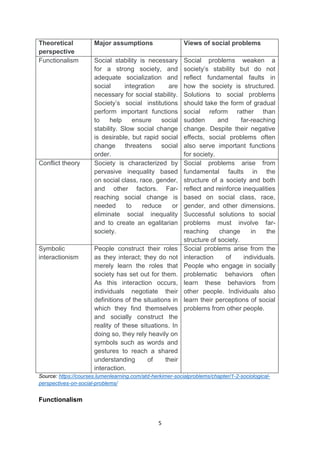
Theoretical Perspectives
Three theoretical perspectives guide sociological thinking on social problems:
functionalist theory, conflict theory, and symbolic interactionist theory. These
perspectives look at the same social problems, but they do so in different ways.
Their views taken together offer a fuller understanding of social problems than any of
the views can offer alone. Table 1.1 ―Theory Snapshot‖ summarizes the three
perspectives.
5
Theoretical
perspective
Major assumptions Views of social problems
Functionalism Social stability is necessary
for a strong society, and
adequate socialization and
social integration are
necessary for social stability.
Society’s social institutions
perform important functions
to help ensure social
stability. Slow social change
is desirable, but rapid social
change threatens social
order.
Social problems weaken a
society’s stability but do not
reflect fundamental faults in
how the society is structured.
Solutions to social problems
should take the form of gradual
social reform rather than
sudden and far-reaching
change. Despite their negative
effects, social problems often
also serve important functions
for society.
Conflict theory Society is characterized by
pervasive inequality based
on social class, race, gender,
and other factors. Far-
reaching social change is
needed to reduce or
eliminate social inequality
and to create an egalitarian
society.
Social problems arise from
fundamental faults in the
structure of a society and both
reflect and reinforce inequalities
based on social class, race,
gender, and other dimensions.
Successful solutions to social
problems must involve far-
reaching change in the
structure of society.
Symbolic
interactionism
People construct their roles
as they interact; they do not
merely learn the roles that
society has set out for them.
As this interaction occurs,
individuals negotiate their
definitions of the situations in
which they find themselves
and socially construct the
reality of these situations. In
doing so, they rely heavily on
symbols such as words and
gestures to reach a shared
understanding of their
interaction.
Social problems arise from the
interaction of individuals.
People who engage in socially
problematic behaviors often
learn these behaviors from
other people. Individuals also
learn their perceptions of social
problems from other people.
Source: https://courses.lumenlearning.com/atd-herkimer-socialproblems/chapter/1-2-sociological-
perspectives-on-social-problems/
Functionalism
6
Functionalism, also known as the functionalist theory or perspective, arose
out of two great revolutions of the eighteenth and nineteenth centuries. The first was
the French Revolution of 1789, whose intense violence and bloody terror shook
Europe to its core.
The Industrial Revolution of the nineteenth century reinforced these concerns.
Starting first in Europe and then in the United States, the Industrial Revolution led to
many changes, including the rise and growth of cities as people left their farms to live
near factories. As the cities grew, people lived in increasingly poor, crowded, and
decrepit conditions, and crime was rampant. Here was additional evidence, if
European intellectuals needed it, of the breakdown of social order.
This general framework reached fruition in the writings of Émile Durkheim
(1858–1917), a French scholar largely responsible for the sociological perspective,
as we now know it. Adopting the conservative intellectuals’ view of the need for a
strong society, Durkheim felt that human beings have desires that result in chaos
unless society limits them (Durkheim, 1952). It does so, he wrote, through two
related social mechanisms: socialization and social integration. Socialization helps
us learn society’s rules and the need to cooperate, as people end up generally
agreeing on important norms and values, while social integration, or our ties to other
people and to social institutions such as religion and the family, helps socialize us
and integrate us into society and reinforce our respect for its rules.
Today’s functionalist perspective arises out of
Durkheim’s work and that of other conservative intellectuals
of the nineteenth century. It uses the human body as a model
for understanding society. In the human body, our various
organs and other body parts serve important functions for the
ongoing health and stability of our body. Our eyes help us
see, our ears help us hear, our heart circulates our blood, and
so forth. Just as we can understand the body by describing
and understanding the functions that its parts serve for its
health and stability, so can we understand society by
describing and understanding the functions that its parts—or,
more accurately, its social institutions—serve for the ongoing
health and stability of society. Thus, functionalism
emphasizes the importance of social institutions such as the
family, religion, and education for producing a stable society.
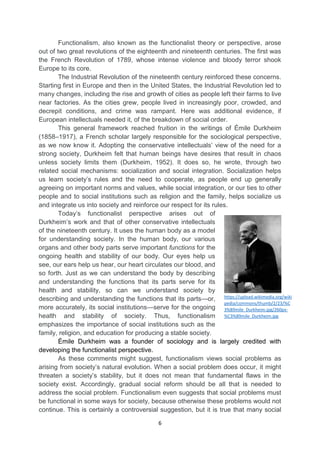
Émile Durkheim was a founder of sociology and is largely credited with
developing the functionalist perspective.
As these comments might suggest, functionalism views social problems as
arising from society’s natural evolution. When a social problem does occur, it might
threaten a society’s stability, but it does not mean that fundamental flaws in the
society exist. Accordingly, gradual social reform should be all that is needed to
address the social problem. Functionalism even suggests that social problems must
be functional in some ways for society, because otherwise these problems would not
continue. This is certainly a controversial suggestion, but it is true that many social
https://upload.wikimedia.org/wiki
pedia/commons/thumb/2/23/%C
3%89mile_Durkheim.jpg/260px-
%C3%89mile_Durkheim.jpg
7
problems do serve important functions for our society. For example, crime is a major
social problem, but it is also good for the economy because it creates hundreds of
thousands of jobs in law enforcement, courts and corrections, home security, and
other sectors of the economy whose major role is to deal with crime. If crime
disappeared, many people would be out of work! Similarly, poverty is also a major
social problem, but one function that poverty serves is that poor people do jobs that
otherwise might not get done because other people would not want to do those
(Gans, 1972). Like crime, poverty also provides employment for people across the
nation, such as those who work in social service agencies that help poor people.
Conflict Theory
In many ways, conflict theory is the opposite of functionalism but ironically
also grew out of the Industrial Revolution, thanks largely to Karl Marx (1818–1883)
and his collaborator, Friedrich Engels (1820–1895).
According to Marx and Engels, every society is divided into two classes based
on the ownership of the means of production (tools, factories, and the like). In a
capitalist society, the bourgeoisie, or ruling class, owns the means of production,
while the proletariat, or working class, does not own the means of production and
instead is oppressed and exploited by the bourgeoisie. This difference creates an
automatic conflict of interests between the two groups. Simply put, the bourgeoisie is
interested in maintaining its position at the top of society, while the proletariat’s
interest lies in rising up from the bottom and overthrowing the bourgeoisie to create
an egalitarian society.
Marx and Engels’ view of conflict arising from unequal positions held by
members of society lies at the heart of today’s conflict theory. This theory
emphasizes that different groups in society have different interests stemming from
their different social positions. These different interests in turn lead to different views
on important social issues. Some versions of the theory root
conflict in divisions based on race and ethnicity, gender, and
other such differences, while other versions follow Marx and
Engels in seeing conflict arising out of different positions in the
economic structure. In general, however, conflict theory
emphasizes that the various parts of society contribute to
ongoing inequality, whereas functionalist theory, as we have
seen, stresses that they contribute to the ongoing stability of
society. Thus, while functionalist theory emphasizes the
benefits of the various parts of society for ongoing social
stability, conflict theory favors social change to reduce
inequality.
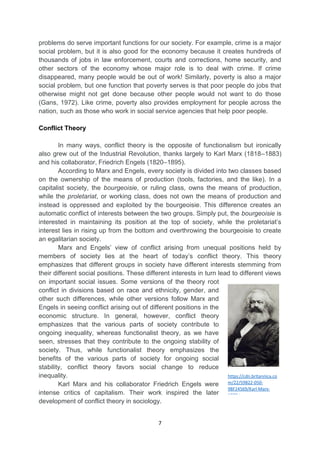
Karl Marx and his collaborator Friedrich Engels were
intense critics of capitalism. Their work inspired the later
development of conflict theory in sociology.
https://cdn.britannica.co
m/22/59822-050-
98F24569/Karl-Marx-
1870.jpg
8
Conflict theory in its various forms views social problems as arising from
society’s inherent inequality. Depending on which version of conflict theory is being
considered, the inequality contributing to social problems is based on social class,
race and ethnicity, gender, or some other dimension of society’s hierarchy. Because
any of these inequalities represents a fundamental flaw in society, conflict theory
assumes that fundamental social change is needed to address society’s many social
problems.
Symbolic Interactionism
Symbolic interactionism focuses on the interaction of individuals and on how
they interpret their interaction. Its roots lie in the work of early 1900s American
sociologists, social psychologists, and philosophers who were interested in human
consciousness and action. Herbert Blumer (1969), a sociologist at the University of
Chicago, built on their writings to develop symbolic interactionism, a term he coined.
Drawing on Blumer’s work, symbolic interactionists feel that people do not merely
learn the roles that society has set out for them; instead they construct these roles as
they interact. As they do so, they negotiate their definitions of the situations in which
they find themselves and socially construct the reality of these situations. In doing
so, they rely heavily on symbols such as words and gestures to reach a shared
understanding of their interaction.
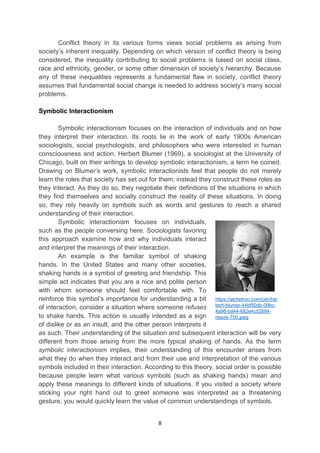
Symbolic interactionism focuses on individuals,
such as the people conversing here. Sociologists favoring
this approach examine how and why individuals interact
and interpret the meanings of their interaction.
An example is the familiar symbol of shaking
hands. In the United States and many other societies,
shaking hands is a symbol of greeting and friendship. This
simple act indicates that you are a nice and polite person
with whom someone should feel comfortable with. To
reinforce this symbol’s importance for understanding a bit
of interaction, consider a situation where someone refuses
to shake hands. This action is usually intended as a sign
of dislike or as an insult, and the other person interprets it
as such. Their understanding of the situation and subsequent interaction will be very
different from those arising from the more typical shaking of hands. As the term
symbolic interactionism implies, their understanding of this encounter arises from
what they do when they interact and from their use and interpretation of the various
symbols included in their interaction. According to this theory, social order is possible
because people learn what various symbols (such as shaking hands) mean and
apply these meanings to different kinds of situations. If you visited a society where
sticking your right hand out to greet someone was interpreted as a threatening
gesture, you would quickly learn the value of common understandings of symbols.
https://alchetron.com/cdn/her
bert-blumer-44bf50db-09bc-
4a98-bd44-682e4c52684-
resize-750.jpeg
9
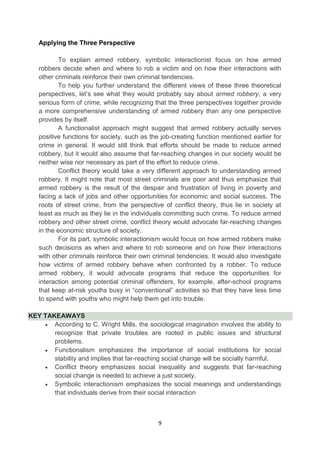
Applying the Three Perspective
To explain armed robbery, symbolic interactionist focus on how armed
robbers decide when and where to rob a victim and on how their interactions with
other criminals reinforce their own criminal tendencies.
To help you further understand the different views of these three theoretical
perspectives, let’s see what they would probably say about armed robbery, a very
serious form of crime, while recognizing that the three perspectives together provide
a more comprehensive understanding of armed robbery than any one perspective
provides by itself.
A functionalist approach might suggest that armed robbery actually serves
positive functions for society, such as the job-creating function mentioned earlier for
crime in general. It would still think that efforts should be made to reduce armed
robbery, but it would also assume that far-reaching changes in our society would be
neither wise nor necessary as part of the effort to reduce crime.
Conflict theory would take a very different approach to understanding armed
robbery. It might note that most street criminals are poor and thus emphasize that
armed robbery is the result of the despair and frustration of living in poverty and
facing a lack of jobs and other opportunities for economic and social success. The
roots of street crime, from the perspective of conflict theory, thus lie in society at
least as much as they lie in the individuals committing such crime. To reduce armed
robbery and other street crime, conflict theory would advocate far-reaching changes
in the economic structure of society.
For its part, symbolic interactionism would focus on how armed robbers make
such decisions as when and where to rob someone and on how their interactions
with other criminals reinforce their own criminal tendencies. It would also investigate
how victims of armed robbery behave when confronted by a robber. To reduce
armed robbery, it would advocate programs that reduce the opportunities for
interaction among potential criminal offenders, for example, after-school programs
that keep at-risk youths busy in ―conventional‖ activities so that they have less time
to spend with youths who might help them get into trouble.
KEY TAKEAWAYS
 According to C. Wright Mills, the sociological imagination involves the ability to
recognize that private troubles are rooted in public issues and structural
problems.
 Functionalism emphasizes the importance of social institutions for social
stability and implies that far-reaching social change will be socially harmful.
 Conflict theory emphasizes social inequality and suggests that far-reaching
social change is needed to achieve a just society.
 Symbolic interactionism emphasizes the social meanings and understandings
that individuals derive from their social interaction
10
Process questions:
1. Select an example of a ―private trouble‖ and explain how
and why it may reflect a structural problem in society.
2. At this point in your study of social problems, which one
of the three sociological theoretical perspectives sounds
most appealing to you? Why?
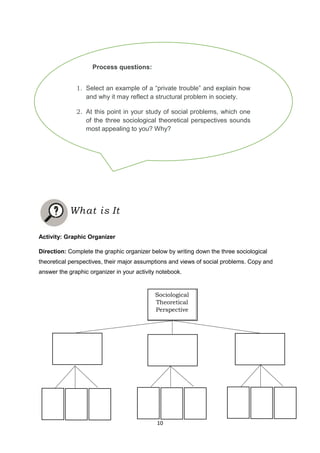
Activity: Graphic Organizer
Direction: Complete the graphic organizer below by writing down the three sociological
theoretical perspectives, their major assumptions and views of social problems. Copy and
answer the graphic organizer in your activity notebook.
What is It
Sociological
Theoretical
Perspective
11
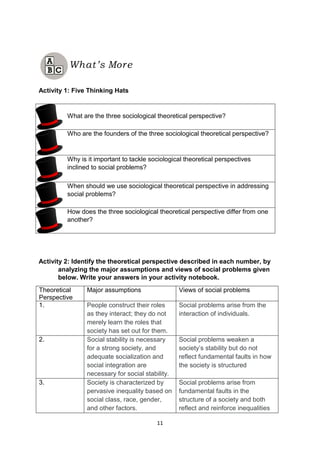
Activity 1: Five Thinking Hats
What are the three sociological theoretical perspective?
Who are the founders of the three sociological theoretical perspective?
Why is it important to tackle sociological theoretical perspectives
inclined to social problems?
When should we use sociological theoretical perspective in addressing
social problems?
How does the three sociological theoretical perspective differ from one
another?
Activity 2: Identify the theoretical perspective described in each number, by
analyzing the major assumptions and views of social problems given
below. Write your answers in your activity notebook.
Theoretical
Perspective
Major assumptions Views of social problems
1. People construct their roles
as they interact; they do not
merely learn the roles that
society has set out for them.
Social problems arise from the
interaction of individuals.
2. Social stability is necessary
for a strong society, and
adequate socialization and
social integration are
necessary for social stability.
Social problems weaken a
society’s stability but do not
reflect fundamental faults in how
the society is structured
3. Society is characterized by
pervasive inequality based on
social class, race, gender,
and other factors.
Social problems arise from
fundamental faults in the
structure of a society and both
reflect and reinforce inequalities
What’s More
12
The thing that strikes me the most about Sociological Perspective on Social Problems
is ________________________________________________________.
An all –encompassing statement that summarizes what addresses social problem
is____________________________________________________________.
Three most important concepts from this lesson are:
1.
2.
3.
based on social class, race,
gender, and other dimensions
4. Society’s social institutions
perform important functions to
help ensure social stability.
Slow social change is
desirable, but rapid social
change threatens social
order.
Solutions to social problems
should take the form of gradual
social reform rather than sudden
and far-reaching change.
5. As this interaction occurs,
individuals negotiate their
definitions of the situations in
which they find themselves
and socially construct the
reality of these situations
Individuals also learn their
perceptions of social problems
from other people.
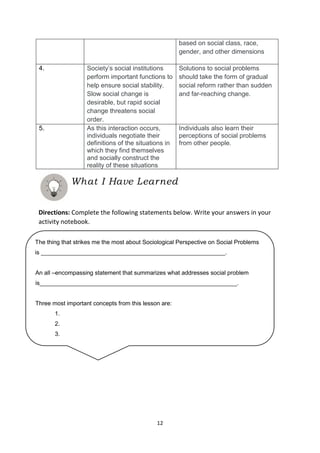
Directions: Complete the following statements below. Write your answers in your
activity notebook.
What I Have Learned
13
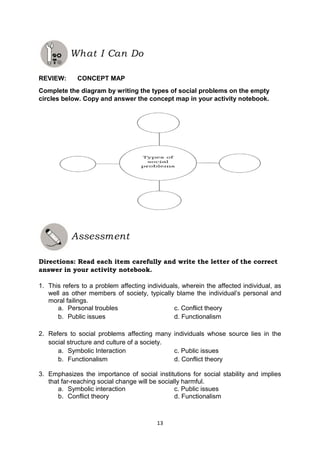
REVIEW: CONCEPT MAP
Complete the diagram by writing the types of social problems on the empty
circles below. Copy and answer the concept map in your activity notebook.
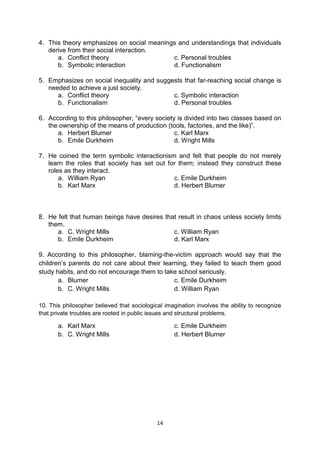
Directions: Read each item carefully and write the letter of the correct
answer in your activity notebook.
1. This refers to a problem affecting individuals, wherein the affected individual, as
well as other members of society, typically blame the individual’s personal and
moral failings.
a. Personal troubles c. Conflict theory
b. Public issues d. Functionalism
2. Refers to social problems affecting many individuals whose source lies in the
social structure and culture of a society.
a. Symbolic Interaction c. Public issues
b. Functionalism d. Conflict theory
3. Emphasizes the importance of social institutions for social stability and implies
that far-reaching social change will be socially harmful.
a. Symbolic interaction c. Public issues
b. Conflict theory d. Functionalism
What I Can Do
Assessment
14
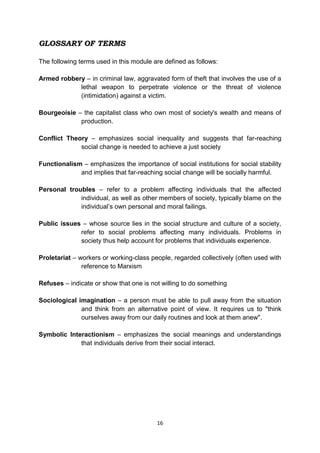
4. This theory emphasizes on social meanings and understandings that individuals
derive from their social interaction.
a. Conflict theory c. Personal troubles
b. Symbolic interaction d. Functionalism
5. Emphasizes on social inequality and suggests that far-reaching social change is
needed to achieve a just society.
a. Conflict theory c. Symbolic interaction
b. Functionalism d. Personal troubles
6. According to this philosopher, ―every society is divided into two classes based on
the ownership of the means of production (tools, factories, and the like)‖.
a. Herbert Blumer c. Karl Marx
b. Emile Durkheim d. Wright Mills
7. He coined the term symbolic interactionism and felt that people do not merely
learn the roles that society has set out for them; instead they construct these
roles as they interact.
a. William Ryan c. Emile Durkheim
b. Karl Marx d. Herbert Blumer
8. He felt that human beings have desires that result in chaos unless society limits
them.
a. C. Wright Mills c. William Ryan
b. Emile Durkheim d. Karl Marx
9. According to this philosopher, blaming-the-victim approach would say that the
children’s parents do not care about their learning, they failed to teach them good
study habits, and do not encourage them to take school seriously.
a. Blumer c. Emile Durkheim
b. C. Wright Mills d. William Ryan
10. This philosopher believed that sociological imagination involves the ability to recognize
that private troubles are rooted in public issues and structural problems.
a. Karl Marx c. Emile Durkheim
b. C. Wright Mills d. Herbert Blumer
15
Read the statements below and write your answers in your activity
notebook.
1. If you have problems with your allowance, to whom do you prefer to ask for it? Why?
2. If you have problems with your love life to whom do you open about it? Why?
3. If you have problems with your school projects, to whom do you approach to for help?
Why?
Additional Activities
16
GLOSSARY OF TERMS
The following terms used in this module are defined as follows:
Armed robbery – in criminal law, aggravated form of theft that involves the use of a
lethal weapon to perpetrate violence or the threat of violence
(intimidation) against a victim.
Bourgeoisie – the capitalist class who own most of society's wealth and means of
production.
Conflict Theory – emphasizes social inequality and suggests that far-reaching
social change is needed to achieve a just society
Functionalism – emphasizes the importance of social institutions for social stability
and implies that far-reaching social change will be socially harmful.
Personal troubles – refer to a problem affecting individuals that the affected
individual, as well as other members of society, typically blame on the
individual’s own personal and moral failings.
Public issues – whose source lies in the social structure and culture of a society,
refer to social problems affecting many individuals. Problems in
society thus help account for problems that individuals experience.
Proletariat – workers or working-class people, regarded collectively (often used with
reference to Marxism
Refuses – indicate or show that one is not willing to do something
Sociological imagination – a person must be able to pull away from the situation
and think from an alternative point of view. It requires us to "think
ourselves away from our daily routines and look at them anew".
Symbolic Interactionism – emphasizes the social meanings and understandings
that individuals derive from their social interact.
17
Explore
Process
question
Answer
may
vary
Keep
this
in
Mind
Symbolic
Interactionism
Functionalism
Conflict
theory
Major
assumptions
views
of
social
problems.
Answers
may
vary
What’s
More
Activity
1:
Five
Thinking
Hats

Functionalism,
Functionalism,
Conflict
theory

Émile
Durkheim,
Marx
and
Engels,
Herbert
Blumer



Answer
may
vary
Activity
2
1.
Symbolic
interactionism
2.
Functionalism
3.
Conflict
theory
4.
Functionalism
5.
Symbolic
interactionism
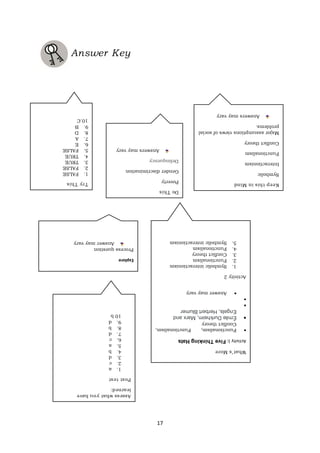
Answer Key
Assess
what
you
have
learned:
Post
test
1.
a
2.
c
3.
d
4.
b
5.
a
6.
c
7.
d
8.
b
9.
d
10
b
Do
This
Poverty
Gender
discrimination
Delinquency
Answers
may
vary
Try
This
1.
FALSE
2.
FALSE
3.
TRUE
4.
TRUE
5.
FALSE
6.
E
7.
A
8.
D
9.
B
10.C
18
References
Blumer, H. (1969). Symbolic interactionism: Perspective and Method. Englewood
Cliffs, NJ: Prentice Hall.
Boyd, E. M., Reynolds, J. R., Tillman, K. H., & Martin, P. Y. (2011). Adolescent girls’
race/ethnic status, identities, and drive for thinness. Social Science Research,
40(2), 667–684.
Durkheim, É. (1952). Suicide (J. Spaulding & G. Simpson, Trans.). New York, NY:
Free Press. (Original work published 1897).
Gans, H. J. (1972). The positive functions of poverty. American Journal of Sociology,
78, 275–289.
Lorber, J. (2010). Gender Inequality: Feminist Theories and Politics. New York, NY:
Oxford University Press.
Marx, K. (1906). Capital. New York, NY: Random House. (Original work published
1867).
Marx, K., & Engels, F. (1962). The communist manifesto. In Marx and Engels:
Selected works (Vol. 2, pp. 21–65). Moscow, Russia: Foreign Language
Publishing House. (Original work published 1848).
Mills, C. W. (1959). The sociological imagination. London, United Kingdom: Oxford
University Press.
Ryan, W. (1976). Blaming the victim (Rev. ed.). New York, NY: Vintage Books.
https://courses.lumenlearning.com/suny-hccc-socialproblems/chapter/1-2-
sociological-perspectives-on-social-problems/
https://courses.lumenlearning.com/atd-herkimer-socialproblems/chapter/1-2-
sociological-perspectives-on-social-problems/
https://courses.lumenlearning.com/atd-herkimer-socialproblems/chapter/1-2-
sociological-perspectives-on-social-problems/
Photo credits
https://upload.wikimedia.org/wikipedia/commons/thumb/2/23/%C3%89mile_Durkhei
m.jpg/260px-%C3%89mile_Durkheim.jpg
https://cdn.britannica.com/22/59822-050-98F24569/Karl-Marx-1870.jpg
https://alchetron.com/cdn/herbert-blumer-44bf50db-09bc-4a98-bd44-682e4c52684-
resize-750.jpeg
19
For inquiries or feedback, please write or call:
Department of Education – Schools Division of Negros Oriental
Kagawasan, Avenue, Daro, Dumaguete City, Negros Oriental
Tel #: (035) 225 2376 / 541 1117
Email Address: negros.oriental@deped.gov.ph
Website: lrmds.depednodis.net
DISCIPLINE AND IDEAS IN SOCIAL SCIENCES - MODULE

  • 1.
    11 Disciplines and Ideas inthe Social Sciences Quarter 2 – Module 16: Applications and Intersections of the Approaches in Addressing Social Problems SENIOR HIGH SCHOOL
  • 2.
    Disciplines and Ideasin the Social Sciences – Grade 11 Alternative Delivery Mode Quarter 2 – Module 16: Applications and Intersections of the Approaches in Addressing Social Problems First Edition, 2020 Republic Act 8293, section 176 states that: No copyright shall subsist in any work of the Government of the Philippines. However, prior approval of the government agency or office wherein the work is created shall be necessary for exploitation of such work for profit. Such agency or office may, among other things, impose as a condition the payment of royalties. Borrowed materials (i.e., songs, stories, poems, pictures, photos, brand names, trademarks, etc.) included in this module are owned by their respective copyright holders. Every effort has been exerted to locate and seek permission to use these materials from their respective copyright owners. The publisher and authors do not represent nor claim ownership over them. Published by the Department of Education Secretary: Leonor Magtolis Briones Undersecretary: Diosdado M. San Antonio Printed in the Philippines by ________________________ Department of Education –Region VII Schools Division of Negros Oriental Office Address: Kagawasan, Ave., Daro, Dumaguete City, Negros Oriental Tele #: (035) 225 2376 / 541 1117 E-mail Address: negros.oriental@deped.gov.ph Development Team of the Module Writer: Farrah B. Sedillo Editors: Maria Reina Mae M. Ablir Maria Eula Pauline A. Elumir Reviewers: Gemma F. Depositario,Ed.D. Illustrator: Layout Artist: Richie C. Naingue Management Team: Senen Priscillo P. Paulin, CESO V Rosela R. Abiera Fay C. Luarez, TM, Ed.D., Ph.D. Maricel S. Rasid Nilita L. Ragay, Ed.D. Elmar L. Cabrera Carmelita A. Alcala, Ed.D.
  • 3.
    11 Disciplines and Ideas inthe Social Sciences Quarter 2 – Module 16: Applications and Intersections of the Approaches in Addressing Social Problems
  • 4.
    ii Introductory Message For thefacilitator: Welcome to Disciplines and Ideas in the Social Sciences 11 Alternative Delivery Mode (ADM) Module on Applications and Intersections of the Approaches in Addressing Social Problems! This module was collaboratively designed, developed and reviewed by educators both from public and private institutions to assist you, the teacher or facilitator in helping the learners meet the standards set by the K to 12 Curriculum while overcoming their personal, social, and economic constraints in schooling. This learning resource hopes to engage the learners into guided and independent learning activities at their own pace and time. Furthermore, this also aims to help learners acquire the needed 21st century skills while taking into consideration their needs and circumstances. In addition to the material in the main text, you will also see this box in the body of the module: As a facilitator, you are expected to orient the learners on how to use this module. You also need to keep track of the learners' progress while allowing them to manage their own learning. Furthermore, you are expected to encourage and assist the learners as they do the tasks included in the module. Notes to the Teacher This contains helpful tips or strategies that will help you in guiding the learners.
  • 5.
    iii For the learner: Welcometo the Disciplines and Ideas in the Social Sciences 11 Alternative Delivery Mode (ADM) Module on Applications and Intersections of the Approaches in Addressing Social Problems! This module was designed to provide you with fun and meaningful opportunities for guided and independent learning at your own pace and time. You will be enabled to process the contents of the learning resource while being an active learner. This module has the following parts and corresponding icons: What I Need to Know This will give you an idea of the skills or competencies you are expected to learn in the module. What I Know This part includes an activity that aims to check what you already know about the lesson to take. If you get all the answers correct (100%), you may decide to skip this module. What’s In This is a brief drill or review to help you link the current lesson with the previous one. What’s New In this portion, the new lesson will be introduced to you in various ways; a story, a song, a poem, a problem opener, an activity or a situation. What is It This section provides a brief discussion of the lesson. This aims to help you discover and understand new concepts and skills. What’s More This comprises activities for independent practice to solidify your understanding and skills of the topic. You may check the answers to the exercises using the Answer Key at the end of the module. What I Have Learned This includes questions or blank sentence/paragraph to be filled in to process what you learned from the lesson. What I Can Do This section provides an activity which will help you transfer your new knowledge or skill into real life situations or concerns.
  • 6.
    iv Assessment This is atask which aims to evaluate your level of mastery in achieving the learning competency. Additional Activities In this portion, another activity will be given to you to enrich your knowledge or skill of the lesson learned. Answer Key This contains answers to all activities in the module. At the end of this module you will also find: The following are some reminders in using this module: 1. Use the module with care. Do not put unnecessary mark/s on any part of the module. Use a separate sheet of paper in answering the exercises. 2. Don’t forget to answer What I Know before moving on to the other activities included in the module. 3. Read the instruction carefully before doing each task. 4. Observe honesty and integrity in doing the tasks and checking your answers. 5. Finish the task at hand before proceeding to the next. 6. Return this module to your teacher/facilitator once you are through with it. If you encounter any difficulty in answering the tasks in this module, do not hesitate to consult your teacher or facilitator. Always bear in mind that you are not alone. We hope that through this material, you will experience meaningful learning and gain deep understanding of the relevant competencies. You can do it! References This is a list of all sources used in developing this module.
  • 7.
    1 Analyze the practicaluse of Social Sciences in addressing social concerns and phenomenon Social Problems occur in many ways and have plagued the life of humans. It is safe to say that these issues arise due to inequalities in society and even humans played the biggest role for these certain issues. In this topic, major social problems will be tackled along with the approaches for these issues and different applications will be explained in the most efficient and practical way. It is important to discuss this topic so that learners will be guided in understanding the social problems that occur in the society and also help them prepare and solve these issues. They will also learn the different approaches in solving these problems. At the end of the module, you should be able to: Objectives:  Identify the theoretical perspectives, its major assumptions and approaches in addressing social problems;  Explain the importance of application and intersections of the approaches in addressing social problems;at  Show appreciation for these theoretical perspectives by applying these perspectives in their day to day lives. What I Need to Know MOST ESSENTIAL LEARNING COMPETENCY:
  • 8.
    2 Pre-test: Directions: Read thestatements below, and write TRUE if the statement is correct, and FALSE if it is wrong. Place your answers in your activity notebook. 1. Adequate socialization and social integration are necessary for social stability. 2. Social problems weaken a society’s stability but it reflects fundamental faults in how the society is structured. 3. Society is characterized by pervasive inequality based on social class, race, gender, and other factors. 4. People construct their roles as they interact; they do not merely learn the roles that society has set out for them. 5. Social problems do not arise from the interaction of individuals. Match the following statements in Column A with its proponent in Column B. Write the letter of the correct answer in your activity notebook. Column A 6. Blaming-the-victim approach would say the children’s parents do not care about their learning, fail to teach them good study habits, and do not encourage them to take school seriously. 7. The sociological imagination involves the ability to recognize that private troubles are rooted in public issues and structural problems. 8. Symbolic interactionists feel that people do not merely learn the roles that society has set out for them; instead they construct these roles as they interact. 9. A society is divided into two classes based on the ownership of the means of production (tools, factories, and the like‖. 10.He felt that human beings have desires that result Column B a. Wright Mills b. Karl Marx c. Emile Durkheim d. Herbert Blumer e. William Ryan f. Sigmund Freud What I Know
  • 9.
    3 in chaos unlesssociety limits them. Social sciences are like different people. Each discipline has its own interest on how to approach society for help. Some forms of help raise awarenss among us, others take the challenge to perform a task in different angles. Sociological Perspectives on Social Problems The Sociological Imagination Many individuals experience one or more social problems personally. For example, a lot of people are poor and unemployed, many are in poor health, others have family problems, drink too much alcohol, or commit crime. Sociology takes a different approach, as it stresses that individual problems are often rooted in problems stemming from aspects of society itself. This key insight informed C. Wright Mills’ (1959) classic distinction between personal troubles and public issues. Personal troubles refer to a problem affecting individuals that the affected individual, as well as other members of society, typically blame on the individual’s own personal and moral failings. Examples include such different What’s In What’s New
  • 10.
    4 problems as eatingdisorders, divorce, and unemployment. Public issues, whose source lies in the social structure and culture of a society, refer to social problems affecting many individuals. To illustrate Mills’ viewpoint, let’s use our sociological imaginations to understand some contemporary social problems. We will start with unemployment, which Mills himself discussed. If only a few people were unemployed, Mills wrote, we could reasonably explain their unemployment by saying they were lazy, lacked good work habits, and so forth. If so, their unemployment would be their own personal trouble. But when millions of people are out of work, unemployment is best understood as a public issue because, as Mills (1959) put it, ―the very structure of opportunities has collapsed. Both the correct statement of the problem and the range of possible solutions require us to consider the economic and political institutions of the society, and not merely the personal situation and character of a scatter of individuals.‖ Picking up on Mills’ insights, William Ryan (1976) pointed out that Americans typically think that social problems such as poverty and unemployment stem from personal failings of the people experiencing these problems, not from structural problems in the larger society. To help us understand a blaming-the-victim ideology, let’s consider why poor children in urban areas often learn very little in their schools. According to Ryan, a blaming-the-victim approach would say that the children’s parents do not care about their learning, fail to teach them good study habits, and do not encourage them to take school seriously. As this example suggests, a blaming-the-victim approach points to solutions to social problems such as poverty and illiteracy that are very different from those suggested by a more structural approach that blames the system. If we blame the victim, we would spend the small amount of money we have to address the personal failings of individuals who suffer from poverty, illiteracy, poor health, eating disorders, and other difficulties. If instead we blame the system, we would focus our attention on the various social conditions (decrepit schools, cultural standards of female beauty, and the like) that account for these difficulties. A sociological understanding suggests that the latter approach is ultimately needed to help us deal successfully with the social problems facing us today. Theoretical Perspectives Three theoretical perspectives guide sociological thinking on social problems: functionalist theory, conflict theory, and symbolic interactionist theory. These perspectives look at the same social problems, but they do so in different ways. Their views taken together offer a fuller understanding of social problems than any of the views can offer alone. Table 1.1 ―Theory Snapshot‖ summarizes the three perspectives.
  • 11.
    5 Theoretical perspective Major assumptions Viewsof social problems Functionalism Social stability is necessary for a strong society, and adequate socialization and social integration are necessary for social stability. Society’s social institutions perform important functions to help ensure social stability. Slow social change is desirable, but rapid social change threatens social order. Social problems weaken a society’s stability but do not reflect fundamental faults in how the society is structured. Solutions to social problems should take the form of gradual social reform rather than sudden and far-reaching change. Despite their negative effects, social problems often also serve important functions for society. Conflict theory Society is characterized by pervasive inequality based on social class, race, gender, and other factors. Far- reaching social change is needed to reduce or eliminate social inequality and to create an egalitarian society. Social problems arise from fundamental faults in the structure of a society and both reflect and reinforce inequalities based on social class, race, gender, and other dimensions. Successful solutions to social problems must involve far- reaching change in the structure of society. Symbolic interactionism People construct their roles as they interact; they do not merely learn the roles that society has set out for them. As this interaction occurs, individuals negotiate their definitions of the situations in which they find themselves and socially construct the reality of these situations. In doing so, they rely heavily on symbols such as words and gestures to reach a shared understanding of their interaction. Social problems arise from the interaction of individuals. People who engage in socially problematic behaviors often learn these behaviors from other people. Individuals also learn their perceptions of social problems from other people. Source: https://courses.lumenlearning.com/atd-herkimer-socialproblems/chapter/1-2-sociological- perspectives-on-social-problems/ Functionalism
  • 12.
    6 Functionalism, also knownas the functionalist theory or perspective, arose out of two great revolutions of the eighteenth and nineteenth centuries. The first was the French Revolution of 1789, whose intense violence and bloody terror shook Europe to its core. The Industrial Revolution of the nineteenth century reinforced these concerns. Starting first in Europe and then in the United States, the Industrial Revolution led to many changes, including the rise and growth of cities as people left their farms to live near factories. As the cities grew, people lived in increasingly poor, crowded, and decrepit conditions, and crime was rampant. Here was additional evidence, if European intellectuals needed it, of the breakdown of social order. This general framework reached fruition in the writings of Émile Durkheim (1858–1917), a French scholar largely responsible for the sociological perspective, as we now know it. Adopting the conservative intellectuals’ view of the need for a strong society, Durkheim felt that human beings have desires that result in chaos unless society limits them (Durkheim, 1952). It does so, he wrote, through two related social mechanisms: socialization and social integration. Socialization helps us learn society’s rules and the need to cooperate, as people end up generally agreeing on important norms and values, while social integration, or our ties to other people and to social institutions such as religion and the family, helps socialize us and integrate us into society and reinforce our respect for its rules. Today’s functionalist perspective arises out of Durkheim’s work and that of other conservative intellectuals of the nineteenth century. It uses the human body as a model for understanding society. In the human body, our various organs and other body parts serve important functions for the ongoing health and stability of our body. Our eyes help us see, our ears help us hear, our heart circulates our blood, and so forth. Just as we can understand the body by describing and understanding the functions that its parts serve for its health and stability, so can we understand society by describing and understanding the functions that its parts—or, more accurately, its social institutions—serve for the ongoing health and stability of society. Thus, functionalism emphasizes the importance of social institutions such as the family, religion, and education for producing a stable society. Émile Durkheim was a founder of sociology and is largely credited with developing the functionalist perspective. As these comments might suggest, functionalism views social problems as arising from society’s natural evolution. When a social problem does occur, it might threaten a society’s stability, but it does not mean that fundamental flaws in the society exist. Accordingly, gradual social reform should be all that is needed to address the social problem. Functionalism even suggests that social problems must be functional in some ways for society, because otherwise these problems would not continue. This is certainly a controversial suggestion, but it is true that many social https://upload.wikimedia.org/wiki pedia/commons/thumb/2/23/%C 3%89mile_Durkheim.jpg/260px- %C3%89mile_Durkheim.jpg
  • 13.
    7 problems do serveimportant functions for our society. For example, crime is a major social problem, but it is also good for the economy because it creates hundreds of thousands of jobs in law enforcement, courts and corrections, home security, and other sectors of the economy whose major role is to deal with crime. If crime disappeared, many people would be out of work! Similarly, poverty is also a major social problem, but one function that poverty serves is that poor people do jobs that otherwise might not get done because other people would not want to do those (Gans, 1972). Like crime, poverty also provides employment for people across the nation, such as those who work in social service agencies that help poor people. Conflict Theory In many ways, conflict theory is the opposite of functionalism but ironically also grew out of the Industrial Revolution, thanks largely to Karl Marx (1818–1883) and his collaborator, Friedrich Engels (1820–1895). According to Marx and Engels, every society is divided into two classes based on the ownership of the means of production (tools, factories, and the like). In a capitalist society, the bourgeoisie, or ruling class, owns the means of production, while the proletariat, or working class, does not own the means of production and instead is oppressed and exploited by the bourgeoisie. This difference creates an automatic conflict of interests between the two groups. Simply put, the bourgeoisie is interested in maintaining its position at the top of society, while the proletariat’s interest lies in rising up from the bottom and overthrowing the bourgeoisie to create an egalitarian society. Marx and Engels’ view of conflict arising from unequal positions held by members of society lies at the heart of today’s conflict theory. This theory emphasizes that different groups in society have different interests stemming from their different social positions. These different interests in turn lead to different views on important social issues. Some versions of the theory root conflict in divisions based on race and ethnicity, gender, and other such differences, while other versions follow Marx and Engels in seeing conflict arising out of different positions in the economic structure. In general, however, conflict theory emphasizes that the various parts of society contribute to ongoing inequality, whereas functionalist theory, as we have seen, stresses that they contribute to the ongoing stability of society. Thus, while functionalist theory emphasizes the benefits of the various parts of society for ongoing social stability, conflict theory favors social change to reduce inequality. Karl Marx and his collaborator Friedrich Engels were intense critics of capitalism. Their work inspired the later development of conflict theory in sociology. https://cdn.britannica.co m/22/59822-050- 98F24569/Karl-Marx- 1870.jpg
  • 14.
    8 Conflict theory inits various forms views social problems as arising from society’s inherent inequality. Depending on which version of conflict theory is being considered, the inequality contributing to social problems is based on social class, race and ethnicity, gender, or some other dimension of society’s hierarchy. Because any of these inequalities represents a fundamental flaw in society, conflict theory assumes that fundamental social change is needed to address society’s many social problems. Symbolic Interactionism Symbolic interactionism focuses on the interaction of individuals and on how they interpret their interaction. Its roots lie in the work of early 1900s American sociologists, social psychologists, and philosophers who were interested in human consciousness and action. Herbert Blumer (1969), a sociologist at the University of Chicago, built on their writings to develop symbolic interactionism, a term he coined. Drawing on Blumer’s work, symbolic interactionists feel that people do not merely learn the roles that society has set out for them; instead they construct these roles as they interact. As they do so, they negotiate their definitions of the situations in which they find themselves and socially construct the reality of these situations. In doing so, they rely heavily on symbols such as words and gestures to reach a shared understanding of their interaction. Symbolic interactionism focuses on individuals, such as the people conversing here. Sociologists favoring this approach examine how and why individuals interact and interpret the meanings of their interaction. An example is the familiar symbol of shaking hands. In the United States and many other societies, shaking hands is a symbol of greeting and friendship. This simple act indicates that you are a nice and polite person with whom someone should feel comfortable with. To reinforce this symbol’s importance for understanding a bit of interaction, consider a situation where someone refuses to shake hands. This action is usually intended as a sign of dislike or as an insult, and the other person interprets it as such. Their understanding of the situation and subsequent interaction will be very different from those arising from the more typical shaking of hands. As the term symbolic interactionism implies, their understanding of this encounter arises from what they do when they interact and from their use and interpretation of the various symbols included in their interaction. According to this theory, social order is possible because people learn what various symbols (such as shaking hands) mean and apply these meanings to different kinds of situations. If you visited a society where sticking your right hand out to greet someone was interpreted as a threatening gesture, you would quickly learn the value of common understandings of symbols. https://alchetron.com/cdn/her bert-blumer-44bf50db-09bc- 4a98-bd44-682e4c52684- resize-750.jpeg
  • 15.
    9 Applying the ThreePerspective To explain armed robbery, symbolic interactionist focus on how armed robbers decide when and where to rob a victim and on how their interactions with other criminals reinforce their own criminal tendencies. To help you further understand the different views of these three theoretical perspectives, let’s see what they would probably say about armed robbery, a very serious form of crime, while recognizing that the three perspectives together provide a more comprehensive understanding of armed robbery than any one perspective provides by itself. A functionalist approach might suggest that armed robbery actually serves positive functions for society, such as the job-creating function mentioned earlier for crime in general. It would still think that efforts should be made to reduce armed robbery, but it would also assume that far-reaching changes in our society would be neither wise nor necessary as part of the effort to reduce crime. Conflict theory would take a very different approach to understanding armed robbery. It might note that most street criminals are poor and thus emphasize that armed robbery is the result of the despair and frustration of living in poverty and facing a lack of jobs and other opportunities for economic and social success. The roots of street crime, from the perspective of conflict theory, thus lie in society at least as much as they lie in the individuals committing such crime. To reduce armed robbery and other street crime, conflict theory would advocate far-reaching changes in the economic structure of society. For its part, symbolic interactionism would focus on how armed robbers make such decisions as when and where to rob someone and on how their interactions with other criminals reinforce their own criminal tendencies. It would also investigate how victims of armed robbery behave when confronted by a robber. To reduce armed robbery, it would advocate programs that reduce the opportunities for interaction among potential criminal offenders, for example, after-school programs that keep at-risk youths busy in ―conventional‖ activities so that they have less time to spend with youths who might help them get into trouble. KEY TAKEAWAYS  According to C. Wright Mills, the sociological imagination involves the ability to recognize that private troubles are rooted in public issues and structural problems.  Functionalism emphasizes the importance of social institutions for social stability and implies that far-reaching social change will be socially harmful.  Conflict theory emphasizes social inequality and suggests that far-reaching social change is needed to achieve a just society.  Symbolic interactionism emphasizes the social meanings and understandings that individuals derive from their social interaction
  • 16.
    10 Process questions: 1. Selectan example of a ―private trouble‖ and explain how and why it may reflect a structural problem in society. 2. At this point in your study of social problems, which one of the three sociological theoretical perspectives sounds most appealing to you? Why? Activity: Graphic Organizer Direction: Complete the graphic organizer below by writing down the three sociological theoretical perspectives, their major assumptions and views of social problems. Copy and answer the graphic organizer in your activity notebook. What is It Sociological Theoretical Perspective
  • 17.
    11 Activity 1: FiveThinking Hats What are the three sociological theoretical perspective? Who are the founders of the three sociological theoretical perspective? Why is it important to tackle sociological theoretical perspectives inclined to social problems? When should we use sociological theoretical perspective in addressing social problems? How does the three sociological theoretical perspective differ from one another? Activity 2: Identify the theoretical perspective described in each number, by analyzing the major assumptions and views of social problems given below. Write your answers in your activity notebook. Theoretical Perspective Major assumptions Views of social problems 1. People construct their roles as they interact; they do not merely learn the roles that society has set out for them. Social problems arise from the interaction of individuals. 2. Social stability is necessary for a strong society, and adequate socialization and social integration are necessary for social stability. Social problems weaken a society’s stability but do not reflect fundamental faults in how the society is structured 3. Society is characterized by pervasive inequality based on social class, race, gender, and other factors. Social problems arise from fundamental faults in the structure of a society and both reflect and reinforce inequalities What’s More
  • 18.
    12 The thing thatstrikes me the most about Sociological Perspective on Social Problems is ________________________________________________________. An all –encompassing statement that summarizes what addresses social problem is____________________________________________________________. Three most important concepts from this lesson are: 1. 2. 3. based on social class, race, gender, and other dimensions 4. Society’s social institutions perform important functions to help ensure social stability. Slow social change is desirable, but rapid social change threatens social order. Solutions to social problems should take the form of gradual social reform rather than sudden and far-reaching change. 5. As this interaction occurs, individuals negotiate their definitions of the situations in which they find themselves and socially construct the reality of these situations Individuals also learn their perceptions of social problems from other people. Directions: Complete the following statements below. Write your answers in your activity notebook. What I Have Learned
  • 19.
    13 REVIEW: CONCEPT MAP Completethe diagram by writing the types of social problems on the empty circles below. Copy and answer the concept map in your activity notebook. Directions: Read each item carefully and write the letter of the correct answer in your activity notebook. 1. This refers to a problem affecting individuals, wherein the affected individual, as well as other members of society, typically blame the individual’s personal and moral failings. a. Personal troubles c. Conflict theory b. Public issues d. Functionalism 2. Refers to social problems affecting many individuals whose source lies in the social structure and culture of a society. a. Symbolic Interaction c. Public issues b. Functionalism d. Conflict theory 3. Emphasizes the importance of social institutions for social stability and implies that far-reaching social change will be socially harmful. a. Symbolic interaction c. Public issues b. Conflict theory d. Functionalism What I Can Do Assessment
  • 20.
    14 4. This theoryemphasizes on social meanings and understandings that individuals derive from their social interaction. a. Conflict theory c. Personal troubles b. Symbolic interaction d. Functionalism 5. Emphasizes on social inequality and suggests that far-reaching social change is needed to achieve a just society. a. Conflict theory c. Symbolic interaction b. Functionalism d. Personal troubles 6. According to this philosopher, ―every society is divided into two classes based on the ownership of the means of production (tools, factories, and the like)‖. a. Herbert Blumer c. Karl Marx b. Emile Durkheim d. Wright Mills 7. He coined the term symbolic interactionism and felt that people do not merely learn the roles that society has set out for them; instead they construct these roles as they interact. a. William Ryan c. Emile Durkheim b. Karl Marx d. Herbert Blumer 8. He felt that human beings have desires that result in chaos unless society limits them. a. C. Wright Mills c. William Ryan b. Emile Durkheim d. Karl Marx 9. According to this philosopher, blaming-the-victim approach would say that the children’s parents do not care about their learning, they failed to teach them good study habits, and do not encourage them to take school seriously. a. Blumer c. Emile Durkheim b. C. Wright Mills d. William Ryan 10. This philosopher believed that sociological imagination involves the ability to recognize that private troubles are rooted in public issues and structural problems. a. Karl Marx c. Emile Durkheim b. C. Wright Mills d. Herbert Blumer
  • 21.
    15 Read the statementsbelow and write your answers in your activity notebook. 1. If you have problems with your allowance, to whom do you prefer to ask for it? Why? 2. If you have problems with your love life to whom do you open about it? Why? 3. If you have problems with your school projects, to whom do you approach to for help? Why? Additional Activities
  • 22.
    16 GLOSSARY OF TERMS Thefollowing terms used in this module are defined as follows: Armed robbery – in criminal law, aggravated form of theft that involves the use of a lethal weapon to perpetrate violence or the threat of violence (intimidation) against a victim. Bourgeoisie – the capitalist class who own most of society's wealth and means of production. Conflict Theory – emphasizes social inequality and suggests that far-reaching social change is needed to achieve a just society Functionalism – emphasizes the importance of social institutions for social stability and implies that far-reaching social change will be socially harmful. Personal troubles – refer to a problem affecting individuals that the affected individual, as well as other members of society, typically blame on the individual’s own personal and moral failings. Public issues – whose source lies in the social structure and culture of a society, refer to social problems affecting many individuals. Problems in society thus help account for problems that individuals experience. Proletariat – workers or working-class people, regarded collectively (often used with reference to Marxism Refuses – indicate or show that one is not willing to do something Sociological imagination – a person must be able to pull away from the situation and think from an alternative point of view. It requires us to "think ourselves away from our daily routines and look at them anew". Symbolic Interactionism – emphasizes the social meanings and understandings that individuals derive from their social interact.
  • 23.
  • 24.
    18 References Blumer, H. (1969).Symbolic interactionism: Perspective and Method. Englewood Cliffs, NJ: Prentice Hall. Boyd, E. M., Reynolds, J. R., Tillman, K. H., & Martin, P. Y. (2011). Adolescent girls’ race/ethnic status, identities, and drive for thinness. Social Science Research, 40(2), 667–684. Durkheim, É. (1952). Suicide (J. Spaulding & G. Simpson, Trans.). New York, NY: Free Press. (Original work published 1897). Gans, H. J. (1972). The positive functions of poverty. American Journal of Sociology, 78, 275–289. Lorber, J. (2010). Gender Inequality: Feminist Theories and Politics. New York, NY: Oxford University Press. Marx, K. (1906). Capital. New York, NY: Random House. (Original work published 1867). Marx, K., & Engels, F. (1962). The communist manifesto. In Marx and Engels: Selected works (Vol. 2, pp. 21–65). Moscow, Russia: Foreign Language Publishing House. (Original work published 1848). Mills, C. W. (1959). The sociological imagination. London, United Kingdom: Oxford University Press. Ryan, W. (1976). Blaming the victim (Rev. ed.). New York, NY: Vintage Books. https://courses.lumenlearning.com/suny-hccc-socialproblems/chapter/1-2- sociological-perspectives-on-social-problems/ https://courses.lumenlearning.com/atd-herkimer-socialproblems/chapter/1-2- sociological-perspectives-on-social-problems/ https://courses.lumenlearning.com/atd-herkimer-socialproblems/chapter/1-2- sociological-perspectives-on-social-problems/ Photo credits https://upload.wikimedia.org/wikipedia/commons/thumb/2/23/%C3%89mile_Durkhei m.jpg/260px-%C3%89mile_Durkheim.jpg https://cdn.britannica.com/22/59822-050-98F24569/Karl-Marx-1870.jpg https://alchetron.com/cdn/herbert-blumer-44bf50db-09bc-4a98-bd44-682e4c52684- resize-750.jpeg
  • 25.
    19 For inquiries orfeedback, please write or call: Department of Education – Schools Division of Negros Oriental Kagawasan, Avenue, Daro, Dumaguete City, Negros Oriental Tel #: (035) 225 2376 / 541 1117 Email Address: negros.oriental@deped.gov.ph Website: lrmds.depednodis.net