DIOIC
RELIGION
DIOIC RELIGION is also called as Taosim
In the chaotic periods of China, several
school of thoughts were born.
This is known as the hundred schools of thought , which was
characterized by the struggle to impose social order in china
through philosophical teachings of great Chinese thinkers.
Four of the most influencial schools of thought which was
flourished in China:
 Confucianism
 Daoism
 Mohism
 Legalism
These school of thoughts , together with elements of
Mahayana Buddhism and new religious movements
such as Cao Dai, Chen Dao, and Falun Gong, all
make up to the Daoic religions.
These religions are centered on the Chinese
philosophy of Dao ( The Way ) which refers to the
moral order
that permeates the universe or the force behind the
natural order.
CONFUCIANISM
There has always been a debate whether Confucianism should be
regarded as a religion or a philosophy.
PHILOSOPHY RELIGION
Kung Fuzi found it
because he wants to
interpret and revive the
ancient religion of Zhou
Dinasty.
It is considered as a religion
because its ideal were
inspirational but not in a
supernatural sense but the aim
for excellence in one’s
Adherents of Confucianism are called
“Confuciants or Confucianists”.
SYMBOL
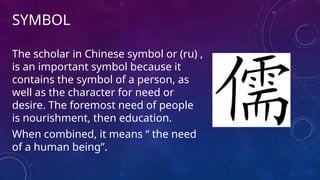
The scholar in Chinese symbol or (ru) ,
is an important symbol because it
contains the symbol of a person, as
well as the character for need or
desire. The foremost need of people
is nourishment, then education.
When combined, it means “ the need
of a human being”.
SYMBOL
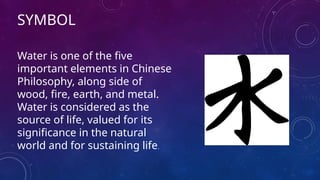
Water is one of the five
important elements in Chinese
Philosophy, along side of
wood, fire, earth, and metal.
Water is considered as the
source of life, valued for its
significance in the natural
world and for sustaining life.
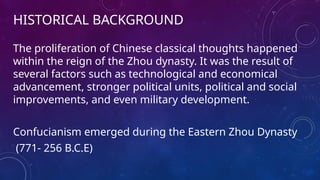
HISTORICAL BACKGROUND
The proliferation of Chinese classical thoughts happened
within the reign of the Zhou dynasty. It was the result of
several factors such as technological and economical
advancement, stronger political units, political and social
improvements, and even military development.
Confucianism emerged during the Eastern Zhou Dynasty
(771- 256 B.C.E)
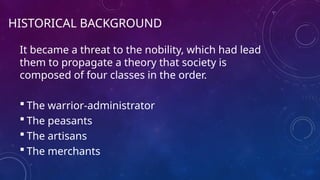
HISTORICAL BACKGROUND
It became a threat to the nobility, which had lead
them to propagate a theory that society is
composed of four classes in the order.
 The warrior-administrator
 The peasants
 The artisans
 The merchants
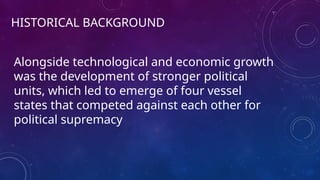
HISTORICAL BACKGROUND
Alongside technological and economic growth
was the development of stronger political
units, which led to emerge of four vessel
states that competed against each other for
political supremacy
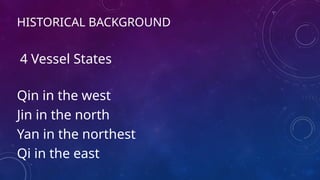
HISTORICAL BACKGROUND
Qin in the west
Jin in the north
Yan in the northest
Qi in the east
4 Vessel States
HISTORICAL BACKGROUND
Among the four rival states which competed for
supremacy,
The Qin dynasty would emerge as the victor and
would establish the first empire of china in the 3rd
century B.C.E.
The name China come form the Ch’in, the first to
create an imperial Chinese Dynasty.
THE LIFE OF CONFUCIUS
Confucius is the Latinized version of Kongzi and the
honorific Kong Fuzi both meaning “Master Kong”.
He was born on September 28 on 551 B.C.E.
His personal name was Qui and his family name is Kong
SACRED SCRIPTURES: THE CONFUCIAN
CLASSICS
The Five Classics are a group of books which was
regarded as early Confucianism’s basic text.
Book of Changes Classic of Rites
Book of History The Spring and Autumn Annals
Book of Poetry
SACRED SCRIPTURES: THE CONFUCIAN
CLASSICS
BOOK OF CHANGES
Known as the I-Ching , the Book of Change is believed
to have existed at the time of Confucius and is the
oldest of the Classics. It focuses on short predictions
following a type of divination called “eleromancy”
wherein six numbers are picked and arranged under
sixty-four hexagrams.
SACRED SCRIPTURES: THE CONFUCIAN
CLASSICS
BOOK OF HISTORY
Known as the Book of Documents or Shangshu
It is composed of speeches (or prose) of any royalty
and ministers mainly from Shang and Zhuo
dynasties
SACRED SCRIPTURES: THE CONFUCIAN
CLASSICS
BOOK OF POETRY
Known as the Book of Songs/Odes/Shijing, is a
collection of three hundred and five(305) songs
compiled around 600 B.C.E.
which includes the various themes such as love,
courtship,
abandonment and dances.
SACRED SCRIPTURES: THE CONFUCIAN
CLASSICS
CLASSIC OF RITES
Originally, the Three Li/Three Rites/ San Li, the Classic of
rites is a compilation of rituals, administration, and social
forms of the Zhou Dynasty
Considered as a complete body of work which includes
 Ceremonials(I-Li/Yili)
 The book of rites (Li-chi/Liji)
 Institutes of Chou( Chou-li/ Zhou Li)
SACRED SCRIPTURES: THE CONFUCIAN
CLASSICS
ANALECTS
Lunyu( “conversations” or “sayings”), known as the Analects
of Confucius
The collection of sayings and ideas attributed to the
Chinese philosopher Confucius and his contemporaries,
believed to be written by his followers
SELECTED ISSUES
FEMALE SUBORDINATION
AUTHORITARIANISM
ENVIRONMENTAL ETHICS
FEMALE SUBORDINATION
AUTHORITARIANISM
ENVIRONMENTAL ETHICS
THANK YOU!

Dioic religion introduction...............

  • 1.
  • 2.
    DIOIC RELIGION isalso called as Taosim In the chaotic periods of China, several school of thoughts were born.
  • 3.
    This is knownas the hundred schools of thought , which was characterized by the struggle to impose social order in china through philosophical teachings of great Chinese thinkers. Four of the most influencial schools of thought which was flourished in China:  Confucianism  Daoism  Mohism  Legalism
  • 4.
    These school ofthoughts , together with elements of Mahayana Buddhism and new religious movements such as Cao Dai, Chen Dao, and Falun Gong, all make up to the Daoic religions. These religions are centered on the Chinese philosophy of Dao ( The Way ) which refers to the moral order that permeates the universe or the force behind the natural order.
  • 5.
    CONFUCIANISM There has alwaysbeen a debate whether Confucianism should be regarded as a religion or a philosophy. PHILOSOPHY RELIGION Kung Fuzi found it because he wants to interpret and revive the ancient religion of Zhou Dinasty. It is considered as a religion because its ideal were inspirational but not in a supernatural sense but the aim for excellence in one’s
  • 6.
    Adherents of Confucianismare called “Confuciants or Confucianists”.
  • 7.
    SYMBOL The scholar inChinese symbol or (ru) , is an important symbol because it contains the symbol of a person, as well as the character for need or desire. The foremost need of people is nourishment, then education. When combined, it means “ the need of a human being”.
  • 8.
    SYMBOL Water is oneof the five important elements in Chinese Philosophy, along side of wood, fire, earth, and metal. Water is considered as the source of life, valued for its significance in the natural world and for sustaining life.
  • 9.
    HISTORICAL BACKGROUND The proliferationof Chinese classical thoughts happened within the reign of the Zhou dynasty. It was the result of several factors such as technological and economical advancement, stronger political units, political and social improvements, and even military development. Confucianism emerged during the Eastern Zhou Dynasty (771- 256 B.C.E)
  • 10.
    HISTORICAL BACKGROUND It becamea threat to the nobility, which had lead them to propagate a theory that society is composed of four classes in the order.  The warrior-administrator  The peasants  The artisans  The merchants
  • 11.
    HISTORICAL BACKGROUND Alongside technologicaland economic growth was the development of stronger political units, which led to emerge of four vessel states that competed against each other for political supremacy
  • 12.
    HISTORICAL BACKGROUND Qin inthe west Jin in the north Yan in the northest Qi in the east 4 Vessel States
  • 13.
    HISTORICAL BACKGROUND Among thefour rival states which competed for supremacy, The Qin dynasty would emerge as the victor and would establish the first empire of china in the 3rd century B.C.E. The name China come form the Ch’in, the first to create an imperial Chinese Dynasty.
  • 14.
    THE LIFE OFCONFUCIUS Confucius is the Latinized version of Kongzi and the honorific Kong Fuzi both meaning “Master Kong”. He was born on September 28 on 551 B.C.E. His personal name was Qui and his family name is Kong
  • 15.
    SACRED SCRIPTURES: THECONFUCIAN CLASSICS The Five Classics are a group of books which was regarded as early Confucianism’s basic text. Book of Changes Classic of Rites Book of History The Spring and Autumn Annals Book of Poetry
  • 16.
    SACRED SCRIPTURES: THECONFUCIAN CLASSICS BOOK OF CHANGES Known as the I-Ching , the Book of Change is believed to have existed at the time of Confucius and is the oldest of the Classics. It focuses on short predictions following a type of divination called “eleromancy” wherein six numbers are picked and arranged under sixty-four hexagrams.
  • 17.
    SACRED SCRIPTURES: THECONFUCIAN CLASSICS BOOK OF HISTORY Known as the Book of Documents or Shangshu It is composed of speeches (or prose) of any royalty and ministers mainly from Shang and Zhuo dynasties
  • 18.
    SACRED SCRIPTURES: THECONFUCIAN CLASSICS BOOK OF POETRY Known as the Book of Songs/Odes/Shijing, is a collection of three hundred and five(305) songs compiled around 600 B.C.E. which includes the various themes such as love, courtship, abandonment and dances.
  • 19.
    SACRED SCRIPTURES: THECONFUCIAN CLASSICS CLASSIC OF RITES Originally, the Three Li/Three Rites/ San Li, the Classic of rites is a compilation of rituals, administration, and social forms of the Zhou Dynasty Considered as a complete body of work which includes  Ceremonials(I-Li/Yili)  The book of rites (Li-chi/Liji)  Institutes of Chou( Chou-li/ Zhou Li)
  • 20.
    SACRED SCRIPTURES: THECONFUCIAN CLASSICS ANALECTS Lunyu( “conversations” or “sayings”), known as the Analects of Confucius The collection of sayings and ideas attributed to the Chinese philosopher Confucius and his contemporaries, believed to be written by his followers
  • 21.
  • 22.
  • 23.
  • 24.
  • 25.