Fractal Image Compression
By Cabel Sholdt and Paul Zeman
Overview
 Why Fractal Image Compression
 Mathematical Background
 How does it work?
 Examples
 Possible Improvements
Why Fractal Image Compression
 Different type of compression scheme
worth exploring
 Takes advantage of similarities within an
image
 Advanced detail interpolation
 High theoretical compression rates
 Fast decompression times
Mathematical Background
 Started with Michael Barnsley, and refined
by A. Jacquin
 Try and find a set of transforms that map
an image onto itself.
 The key is the Collage Theorem
 States that if the error difference between the
target image and the transformation of that
image is less than a certain value the
transforms are an equivalent representation of
the image.
How does it work?-Encoding
 Take a starting image and divide it into small, non-
overlapping, square blocks, typically called “parent blocks”.
 Divide each parent block into 4 each blocks, or “child
blocks.”
 Compare each child block against a subset of all possible
overlapping blocks of parent block size.
 Need to reduce the size of the parent to allow the comparison to
work.
 Determine which larger block has the lowest difference,
according to some measure, between it and the child block.
 Calculate a grayscale transform to match intensity levels
between large block and child block precisely. Typically an
affine transform is used (w*x = a*x + b) to match grayscale
levels.
How does it work? – Encoding
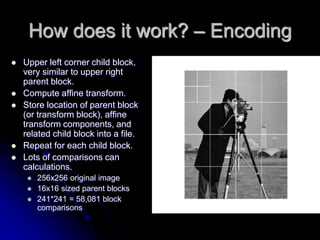
 Upper left corner child block,
very similar to upper right
parent block.
 Compute affine transform.
 Store location of parent block
(or transform block), affine
transform components, and
related child block into a file.
 Repeat for each child block.
 Lots of comparisons can
calculations.
 256x256 original image
 16x16 sized parent blocks
 241*241 = 58,081 block
comparisons
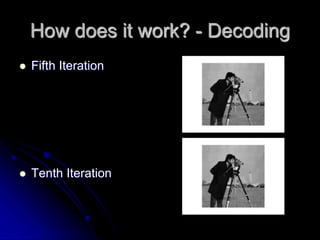
How does it work?- Decoding
 Read in child block and tranform block position,
transform, and size information.
 Use any blank starting image of same size as
original image
 For each child block apply stored transforms
against specified transform block
 Overwrite child block pixel values with transform
block pixel values
 Repeat until acceptable image quality is
reached.
Examples
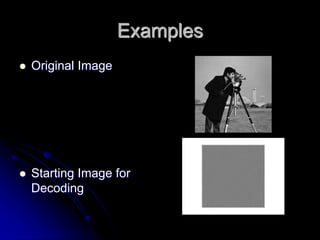
 Original Image
 Starting Image for
Decoding
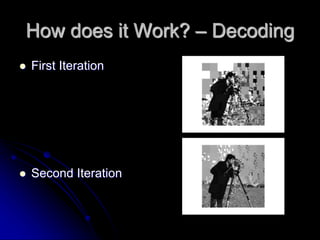
How does it Work? – Decoding
 First Iteration
 Second Iteration
How does it work? - Decoding
 Fifth Iteration
 Tenth Iteration
Possible Improvments
 Greatest weakness is time for encoding
 Possible speed ups
 Order transform blocks into domains based off of average
intensity and variance
 Only search through blocks with similar structures
 Do not search all possible blocks
 Reduce number of child blocks
 Quality and Compression Improvements through
 Quadtrees or HV Trees
 Rotations of Transform Blocks during comparison
 Improved grayscale transforms
Questions?

Digital fractal-image - compression-ppt.pptx

  • 1.
    Fractal Image Compression ByCabel Sholdt and Paul Zeman
  • 2.
    Overview  Why FractalImage Compression  Mathematical Background  How does it work?  Examples  Possible Improvements
  • 3.
    Why Fractal ImageCompression  Different type of compression scheme worth exploring  Takes advantage of similarities within an image  Advanced detail interpolation  High theoretical compression rates  Fast decompression times
  • 4.
    Mathematical Background  Startedwith Michael Barnsley, and refined by A. Jacquin  Try and find a set of transforms that map an image onto itself.  The key is the Collage Theorem  States that if the error difference between the target image and the transformation of that image is less than a certain value the transforms are an equivalent representation of the image.
  • 5.
    How does itwork?-Encoding  Take a starting image and divide it into small, non- overlapping, square blocks, typically called “parent blocks”.  Divide each parent block into 4 each blocks, or “child blocks.”  Compare each child block against a subset of all possible overlapping blocks of parent block size.  Need to reduce the size of the parent to allow the comparison to work.  Determine which larger block has the lowest difference, according to some measure, between it and the child block.  Calculate a grayscale transform to match intensity levels between large block and child block precisely. Typically an affine transform is used (w*x = a*x + b) to match grayscale levels.
  • 6.
    How does itwork? – Encoding  Upper left corner child block, very similar to upper right parent block.  Compute affine transform.  Store location of parent block (or transform block), affine transform components, and related child block into a file.  Repeat for each child block.  Lots of comparisons can calculations.  256x256 original image  16x16 sized parent blocks  241*241 = 58,081 block comparisons
  • 7.
    How does itwork?- Decoding  Read in child block and tranform block position, transform, and size information.  Use any blank starting image of same size as original image  For each child block apply stored transforms against specified transform block  Overwrite child block pixel values with transform block pixel values  Repeat until acceptable image quality is reached.
  • 8.
    Examples  Original Image Starting Image for Decoding
  • 9.
    How does itWork? – Decoding  First Iteration  Second Iteration
  • 10.
    How does itwork? - Decoding  Fifth Iteration  Tenth Iteration
  • 11.
    Possible Improvments  Greatestweakness is time for encoding  Possible speed ups  Order transform blocks into domains based off of average intensity and variance  Only search through blocks with similar structures  Do not search all possible blocks  Reduce number of child blocks  Quality and Compression Improvements through  Quadtrees or HV Trees  Rotations of Transform Blocks during comparison  Improved grayscale transforms
  • 12.