Diffusion in Polymers 2020
The Diffusion Equation can model:
Absorption of solvent
Desorption of solvent
Permeation of solvent
Charles M. Hansen
OUTLINE
 Laws of Diffusion
 Find correct diffusion coefficients
 Concentration dependent coefficients
 Surface effects can be significant
 Combine these in diffusion equation to model
Film formation by solvent evaporation and
”Anomalies” of absorption (S-shaped, Case II).
Reliability of the modeling: The software in Hansen
Solubility Parameters in Practice (HSPiP) used here
gives the same results as are found in Crank (The
Mathematics of Diffusion) and analytical solutions.
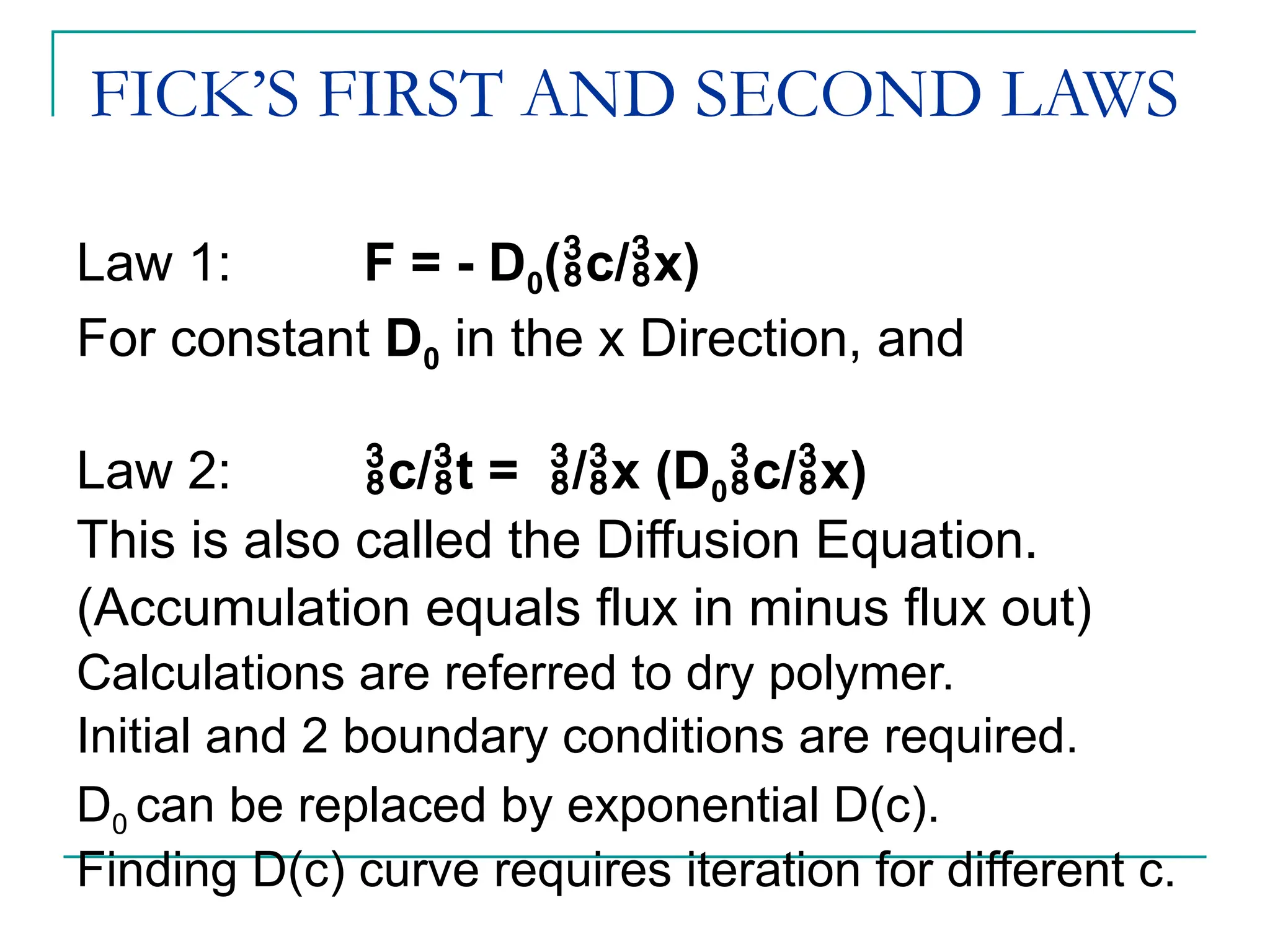
FICK’S FIRST AND SECOND LAWS
Law 1: F = - D0(c/x)
For constant D0 in the x Direction, and
Law 2: c/t = /x (D0c/x)
This is also called the Diffusion Equation.
(Accumulation equals flux in minus flux out)
Calculations are referred to dry polymer.
Initial and 2 boundary conditions are required.
D0 can be replaced by exponential D(c).
Finding D(c) curve requires iteration for different c.
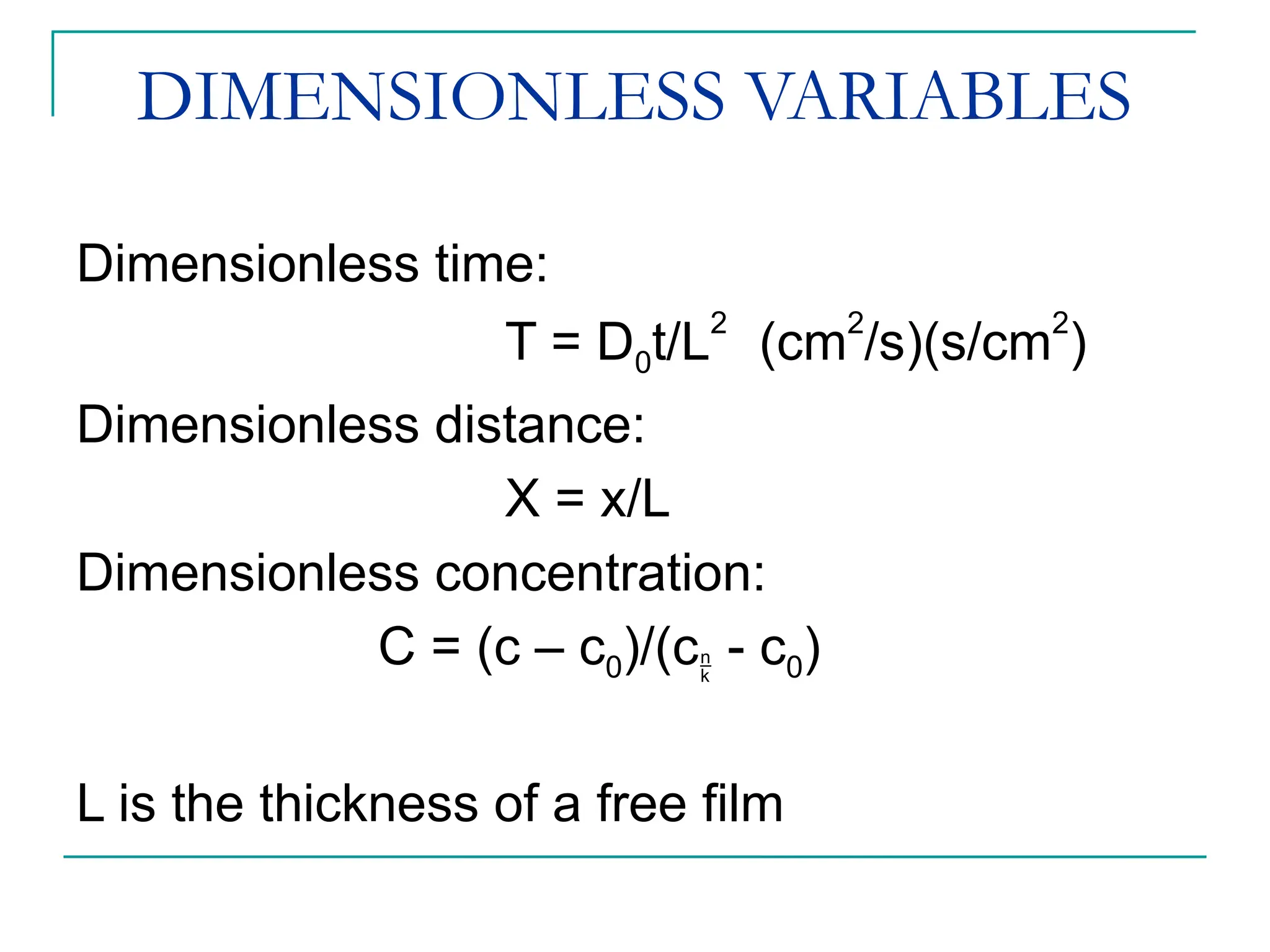
DIMENSIONLESS VARIABLES
Dimensionless time:
T = D0t/L2
(cm2
/s)(s/cm2
)
Dimensionless distance:
X = x/L
Dimensionless concentration:
C = (c – c0)/(c - c0)
L is the thickness of a free film
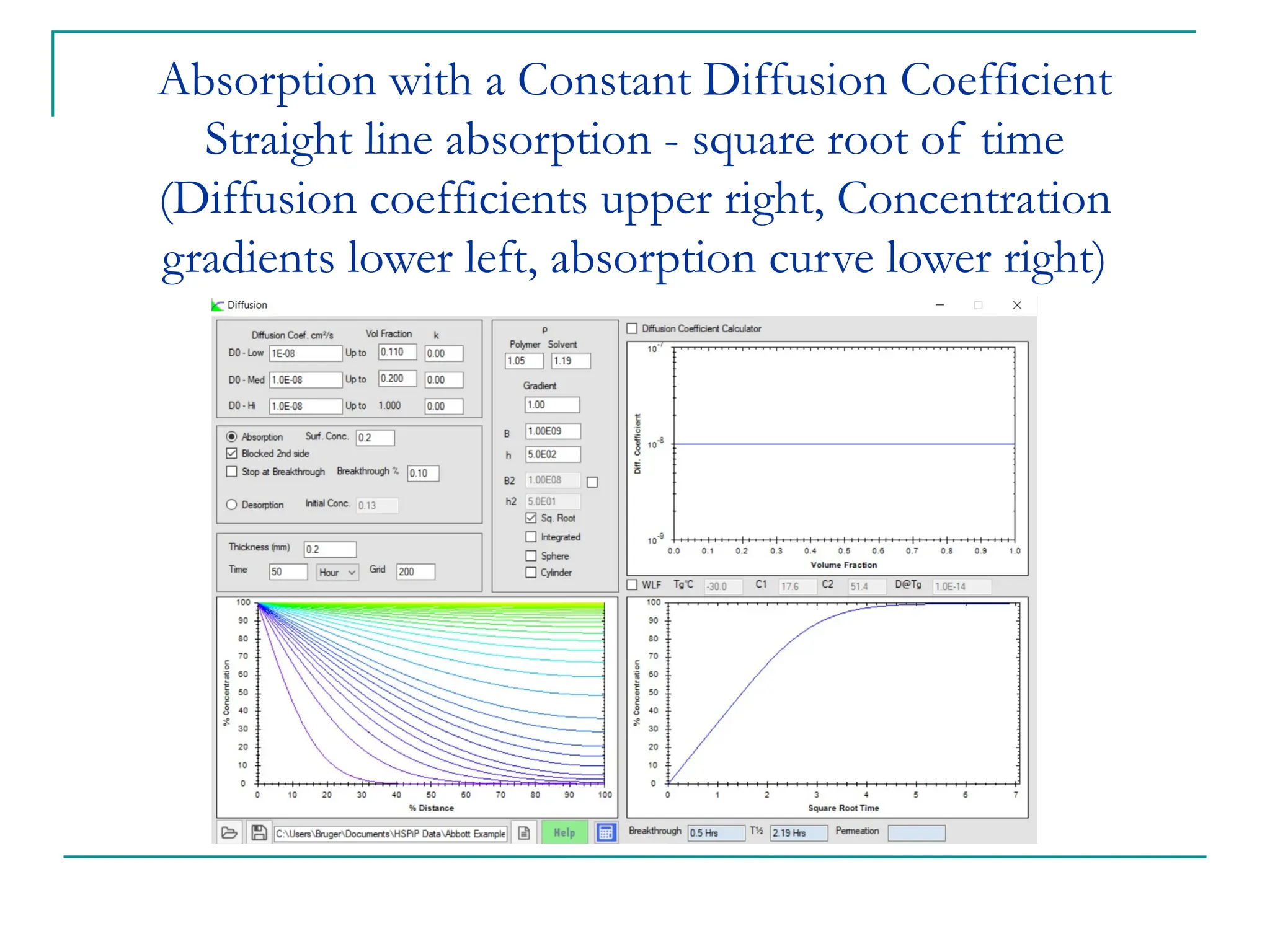
Absorption with a Constant Diffusion Coefficient
Straight line absorption - square root of time
(Diffusion coefficients upper right, Concentration
gradients lower left, absorption curve lower right)
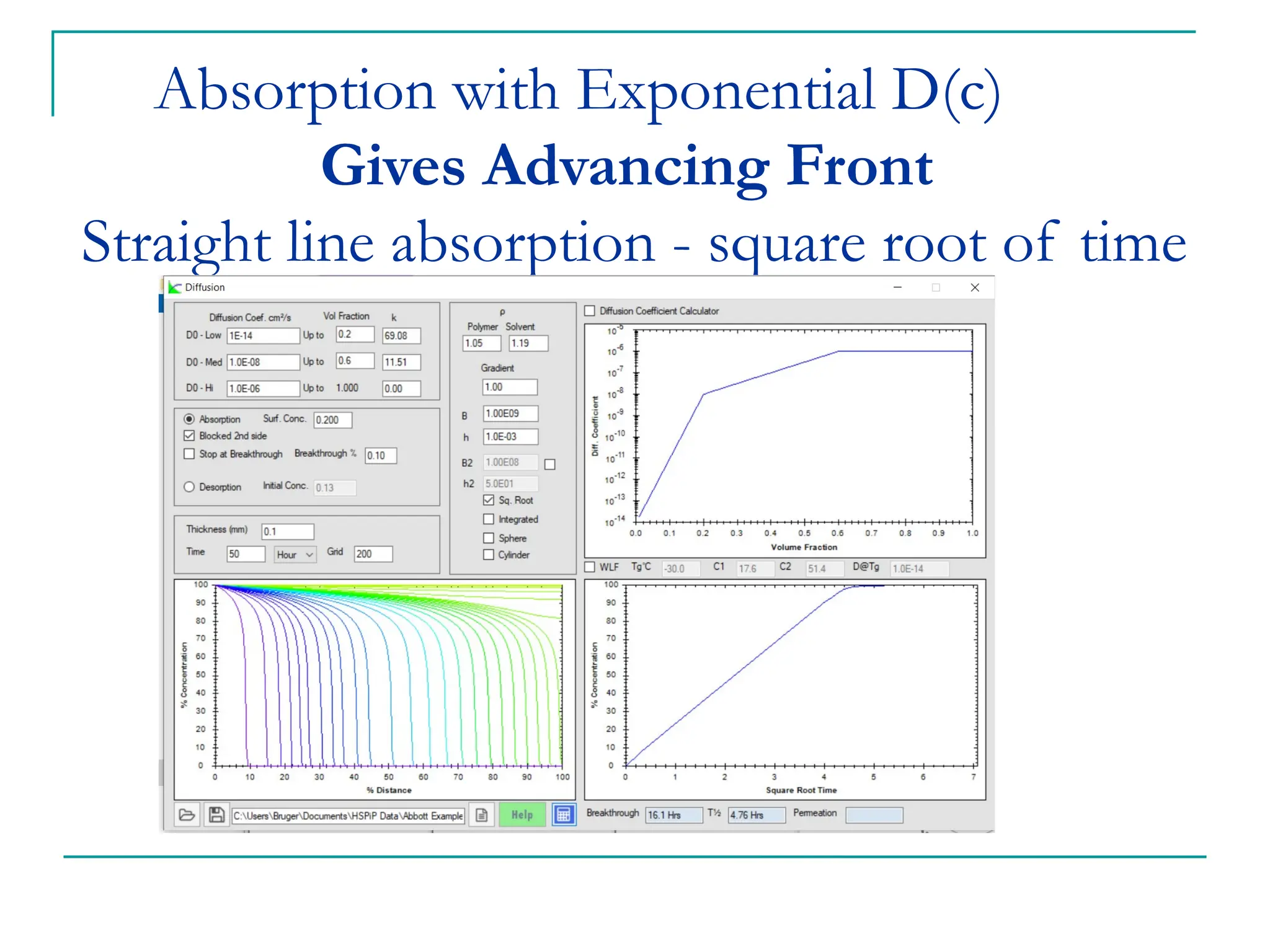
Absorption with Exponential D(c)
Gives Advancing Front
Straight line absorption - square root of time
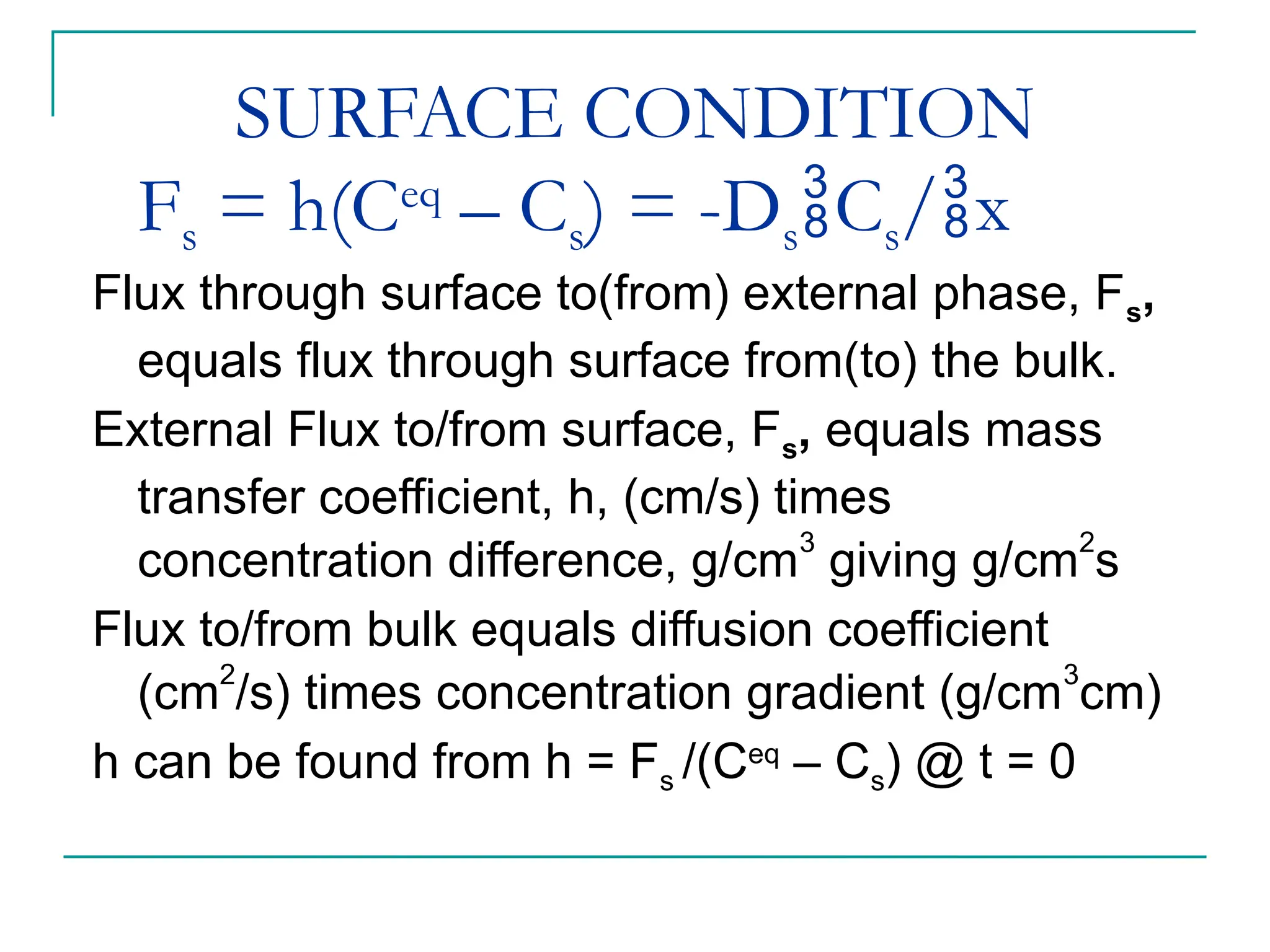
SURFACE CONDITION
Fs = h(Ceq
– Cs) = -DsCs/x
Flux through surface to(from) external phase, Fs,
equals flux through surface from(to) the bulk.
External Flux to/from surface, Fs, equals mass
transfer coefficient, h, (cm/s) times
concentration difference, g/cm
3
giving g/cm
2
s
Flux to/from bulk equals diffusion coefficient
(cm2
/s) times concentration gradient (g/cm3
cm)
h can be found from h = Fs /(Ceq
– Cs) @ t = 0
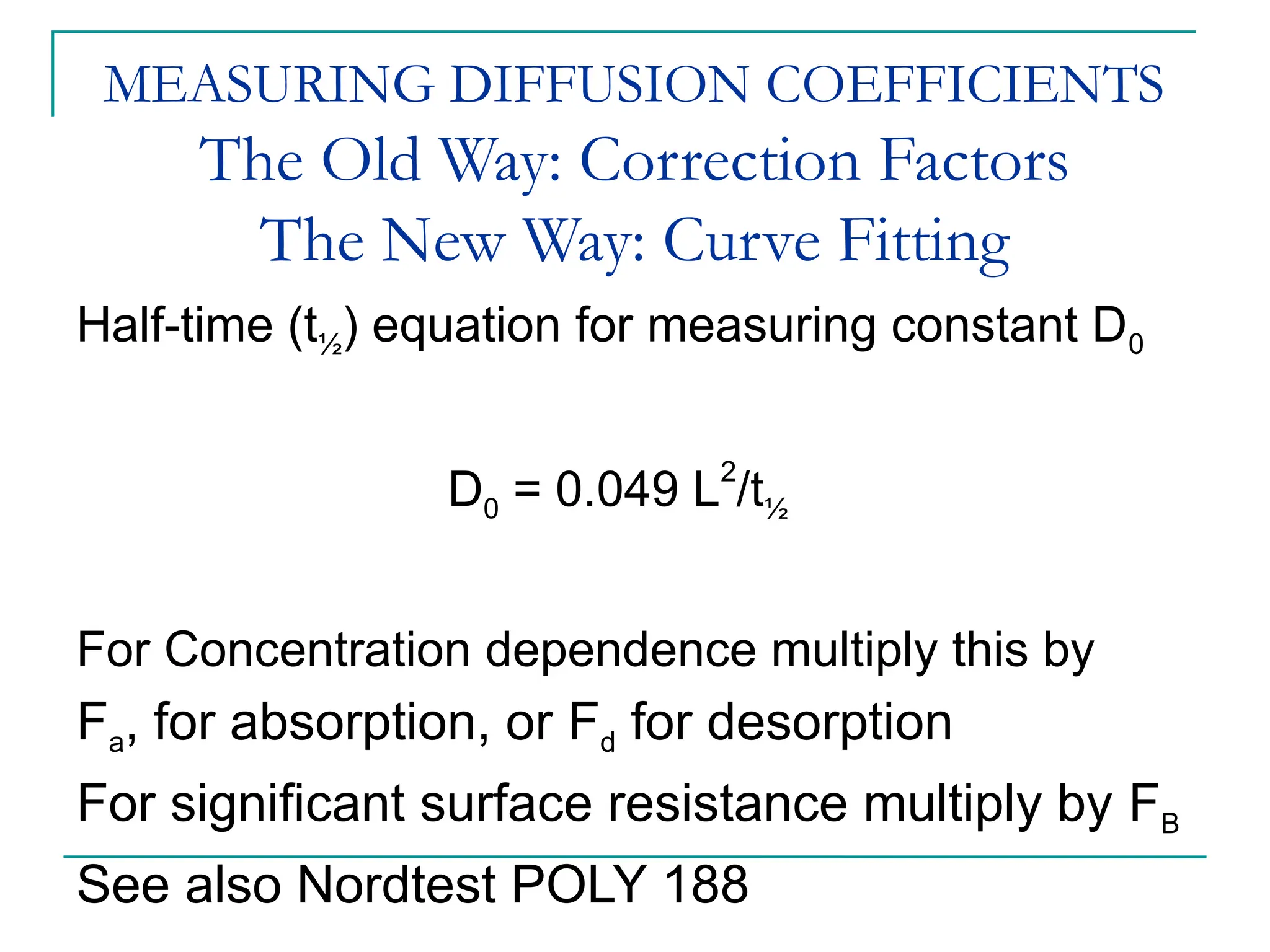
MEASURING DIFFUSION COEFFICIENTS
The Old Way: Correction Factors
The New Way: Curve Fitting
Half-time (t½) equation for measuring constant D0
D0 = 0.049 L2
/t½
For Concentration dependence multiply this by
Fa, for absorption, or Fd for desorption
For significant surface resistance multiply by FB
See also Nordtest POLY 188
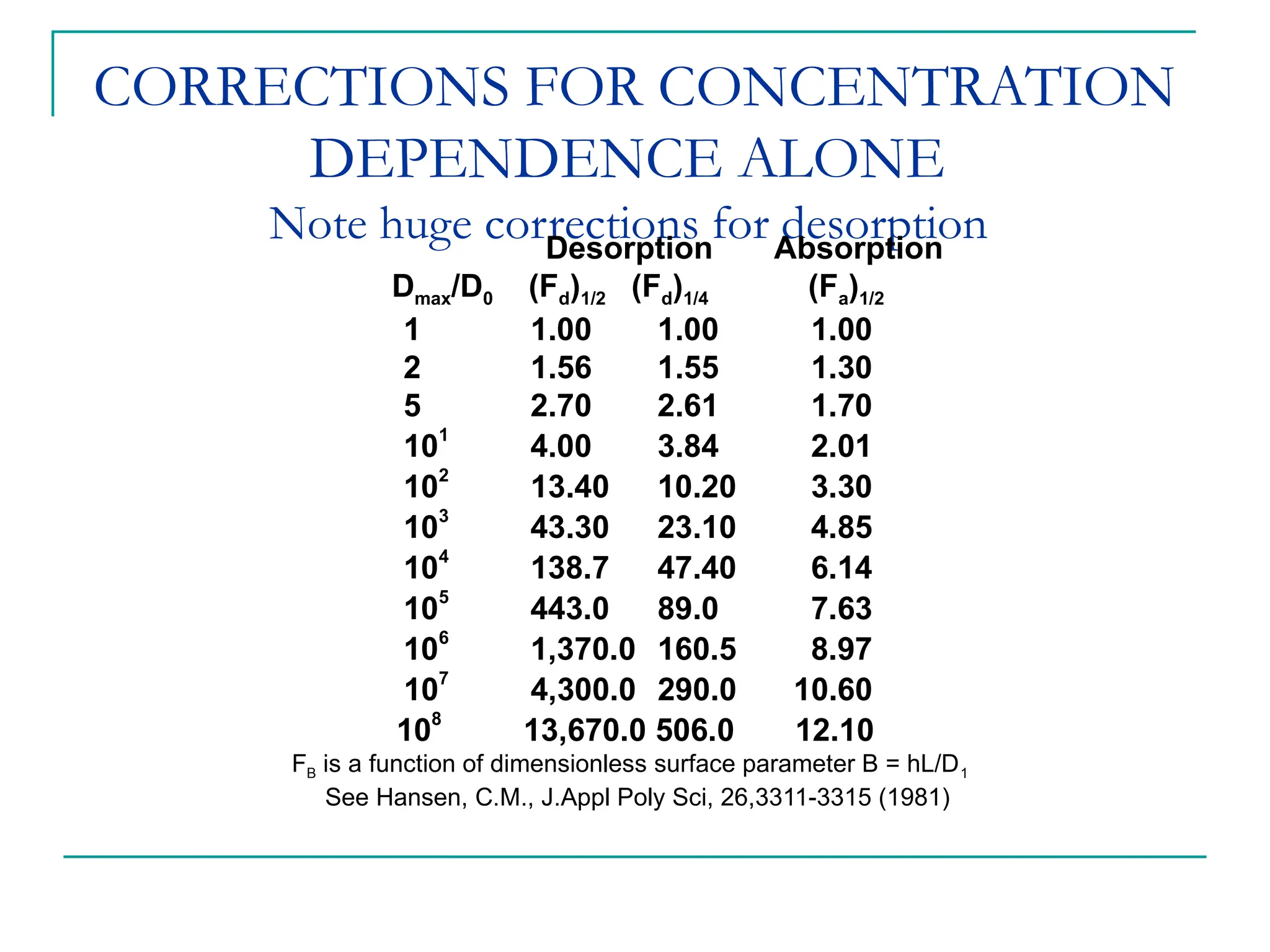
CORRECTIONS FOR CONCENTRATION
DEPENDENCE ALONE
Note huge corrections for desorption
Desorption Absorption
Dmax/D0 (Fd)1/2 (Fd)1/4 (Fa)1/2
1 1.00 1.00 1.00
2 1.56 1.55 1.30
5 2.70 2.61 1.70
101
4.00 3.84 2.01
10
2
13.40 10.20 3.30
103
43.30 23.10 4.85
10
4
138.7 47.40 6.14
10
5
443.0 89.0 7.63
10
6
1,370.0 160.5 8.97
107
4,300.0 290.0 10.60
10
8
13,670.0 506.0 12.10
FB is a function of dimensionless surface parameter B = hL/D1
See Hansen, C.M., J.Appl Poly Sci, 26,3311-3315 (1981)
EXPONENTIAL DIFFUSION COEFFICIENTS FOR
CHLOROBENZENE IN POLY(VINYL ACETATE)
The system chlorobenzene in poly(vinyl acetate)
has been studied extensively with all relevant
data reported in my dissertation and subsequent
journal articles. The experiments were for:
Absorption from one equilibrium to another,
Desorption from different equilibrium values to
vacuum, and film drying (years).
Coherent understanding is found only by
accounting for concentration dependence and
significant surface effects when present.
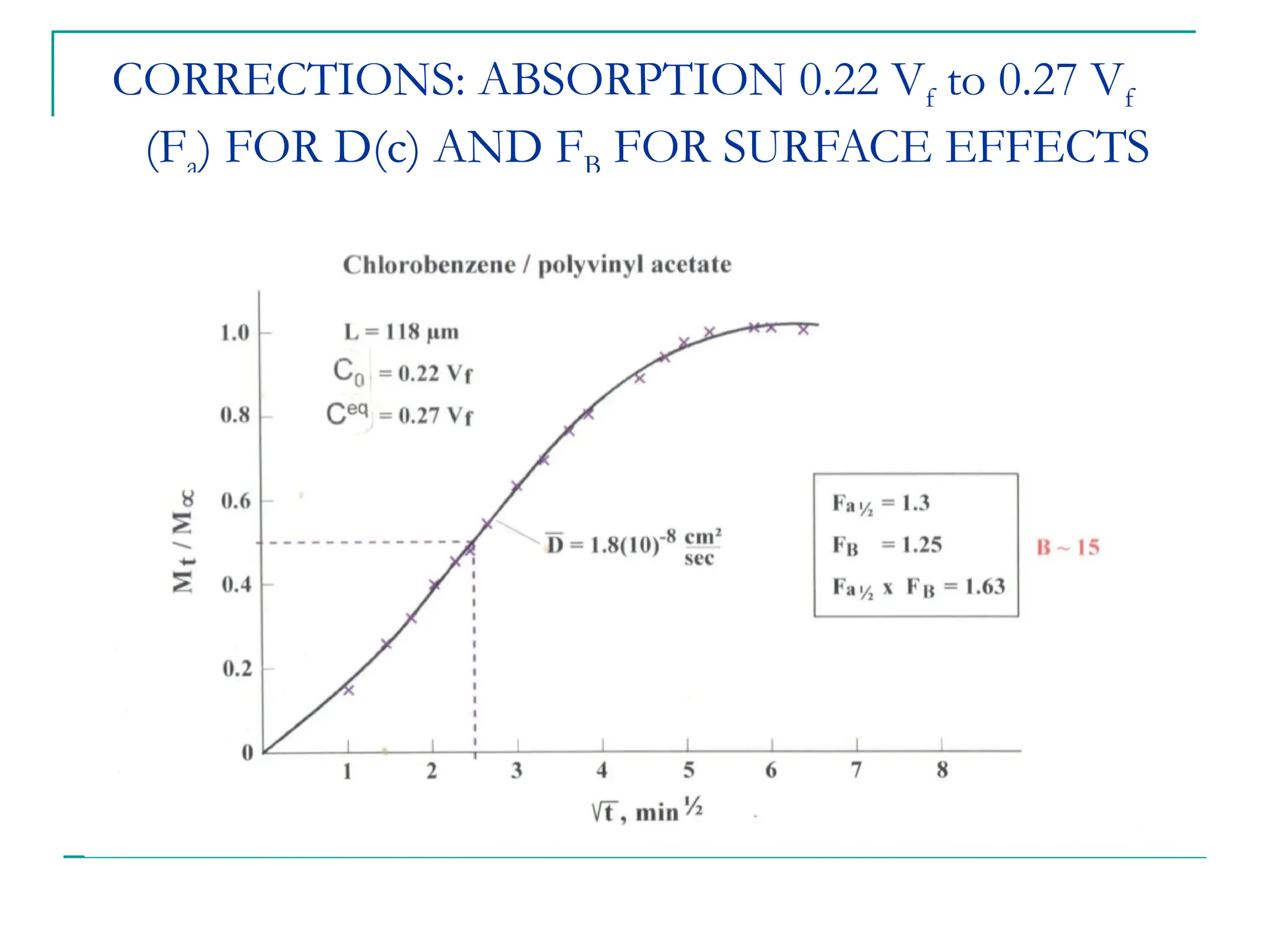
CORRECTIONS: ABSORPTION 0.22 Vf to 0.27 Vf
(Fa) FOR D(c) AND FB FOR SURFACE EFFECTS
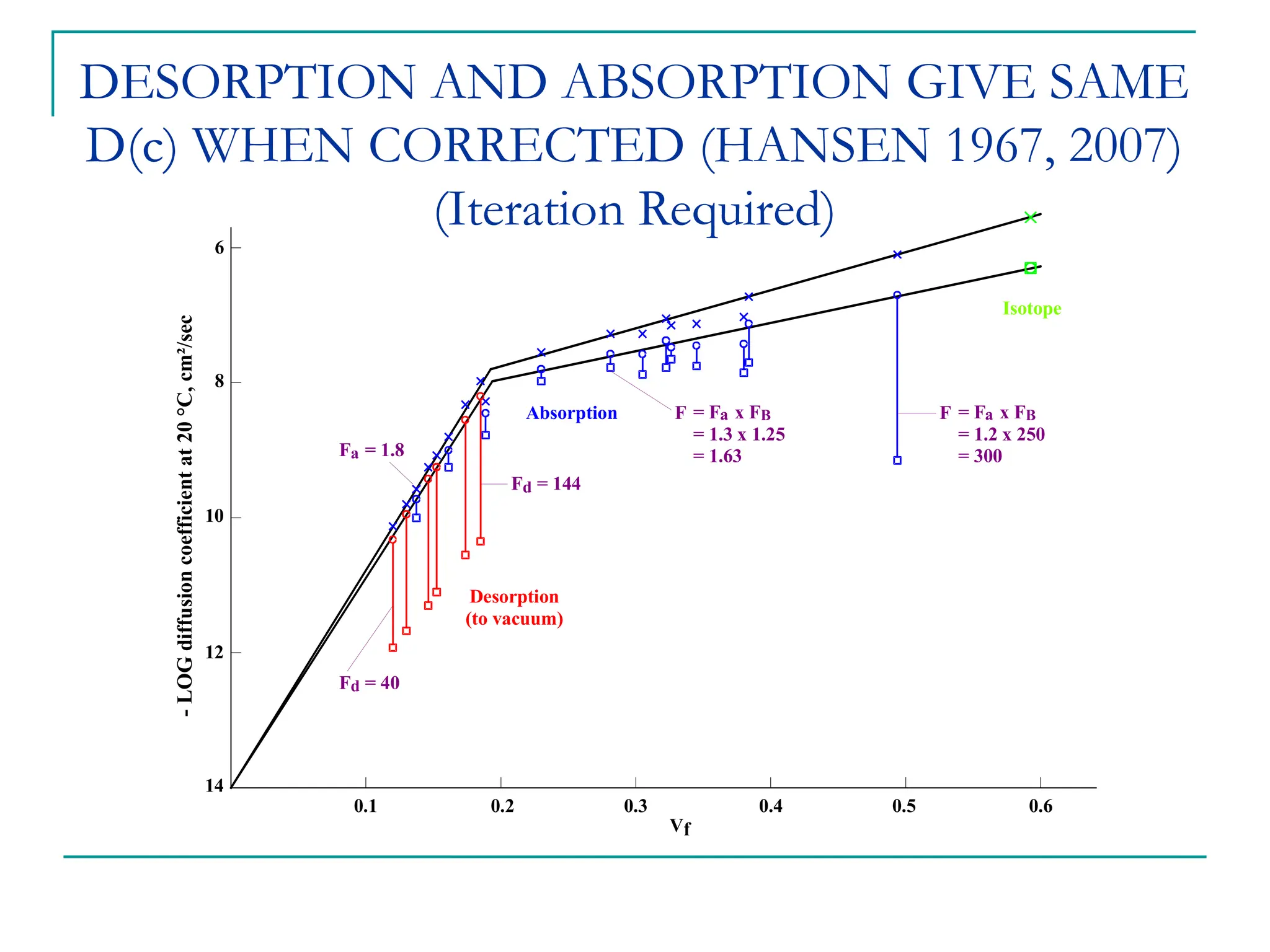
DESORPTION AND ABSORPTION GIVE SAME
D(c) WHEN CORRECTED (HANSEN 1967, 2007)
(Iteration Required)
14
12
10
8
6
-
LOG
diffusion
coefficient
at
20
°C,
cm²/sec
0.1 0.2 0.3 0.4 0.5 0.6
Desorption
(to vacuum)
Absorption
Isotope
F = 1.8
a
F = 40
d
F = 144
d
F = F x F
= 1.3 x 1.25
= 1.63
a B F = F x F
= 1.2 x 250
= 300
a B
Vf
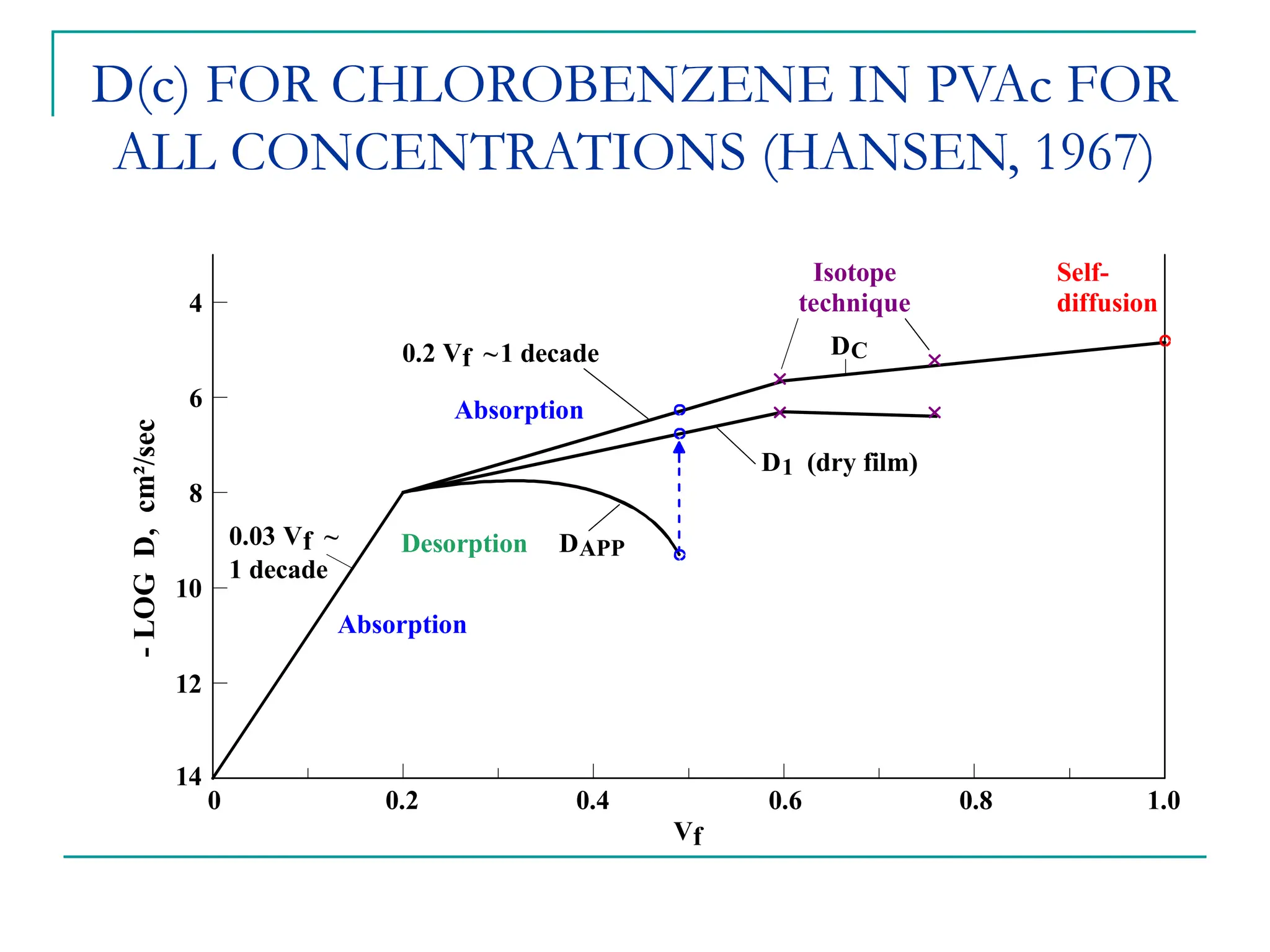
D(c) FOR CHLOROBENZENE IN PVAc FOR
ALL CONCENTRATIONS (HANSEN, 1967)
-
LOG
D,
cm²/sec
0.2
Desorption
Absorption
Absorption
0.03 Vf
1 decade
~
0.2 Vf 1 decade
~
DAPP
DC
D1 (dry film)
Isotope
technique
Self-
diffusion
0 0.4 0.6 0.8 1.0
Vf
14
12
10
8
6
4
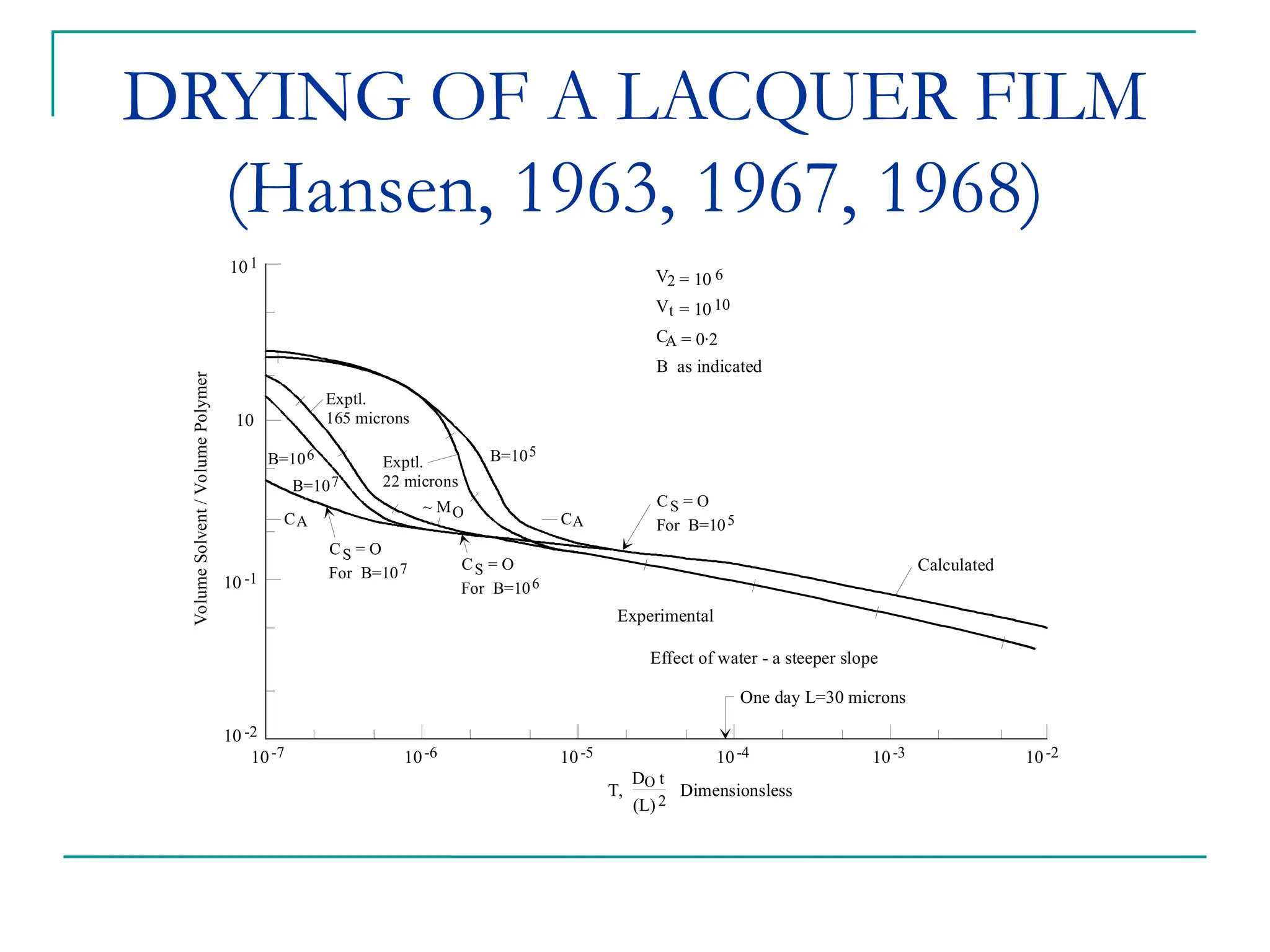
DRYING OF A LACQUER FILM
(Hansen, 1963, 1967, 1968)
10-7 10-6 10-5 10-4 10-3 10-2
10 -2
10 -1
10
101
B=106
B=107
CA CA
Exptl.
165 microns
Exptl.
22 microns
B=105
~ MO
CS = O
For B=107 CS = O
For B=106
CS = O
For B=105
Experimental
Calculated
One day L=30 microns
Effect of water - a steeper slope
DO t
(L) 2
T, Dimensionsless
Volume
Solvent
/
Volume
Polymer
V2 = 10 6
Vt = 10 10
CA = 0·2
B as indicated
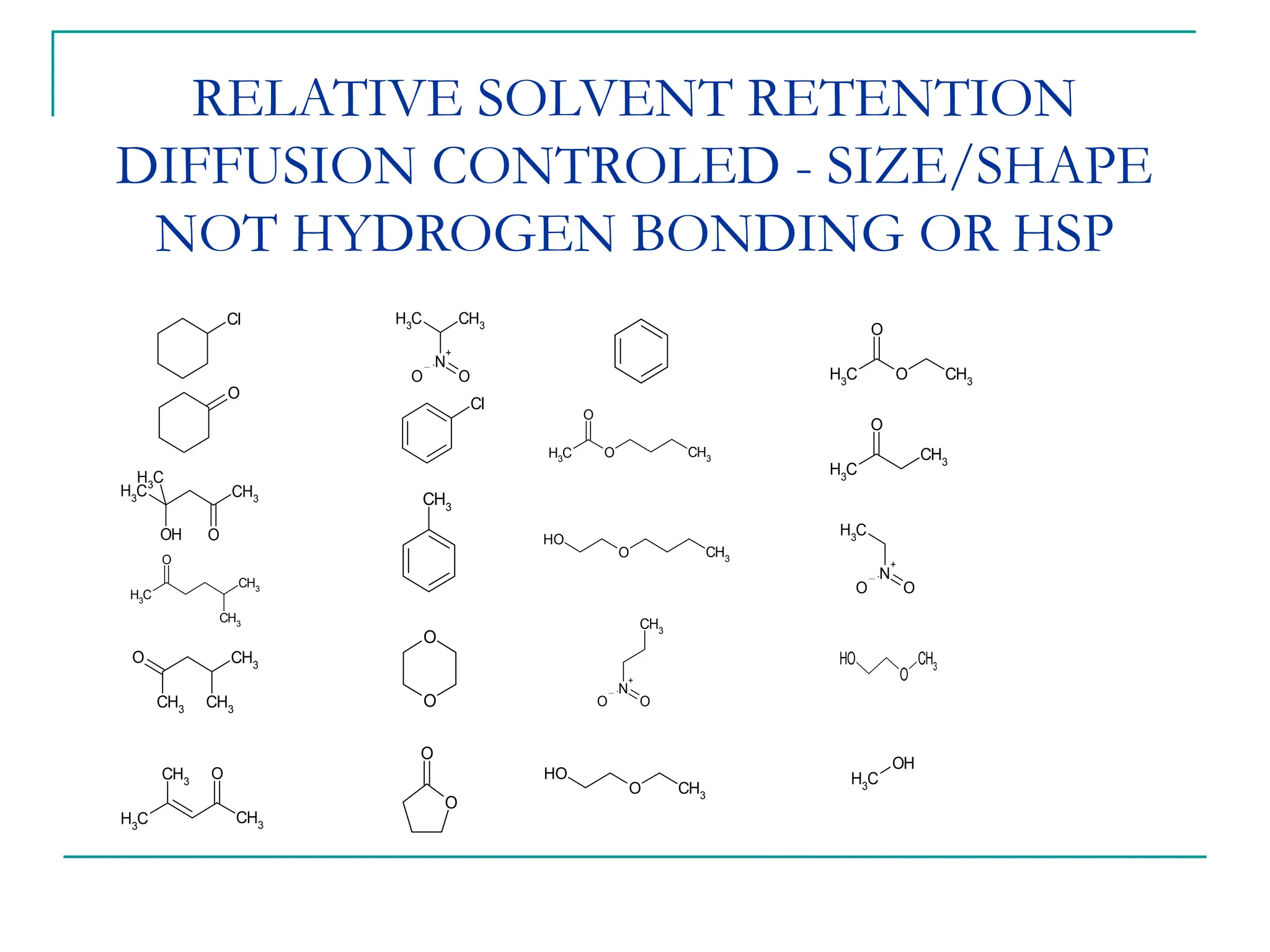
RELATIVE SOLVENT RETENTION
DIFFUSION CONTROLED - SIZE/SHAPE
NOT HYDROGEN BONDING OR HSP
Cl
O
CH3
O
C
H3
OH
C
H3
C
H3
O
CH3
C
H3
CH3
CH3
O
CH3
CH3
CH3
O
C
H3
CH3
CH3
O
N
+
O O
CH3
C
H3
Cl
CH3
O
O
O
O
C
H3
O CH3
O
O
O
H
CH3
N
+
O O
CH3
O
O
H
CH3
C
H3
O
O
CH3
C
H3
N
+
O O
O
O
H CH3
C
H3
OH
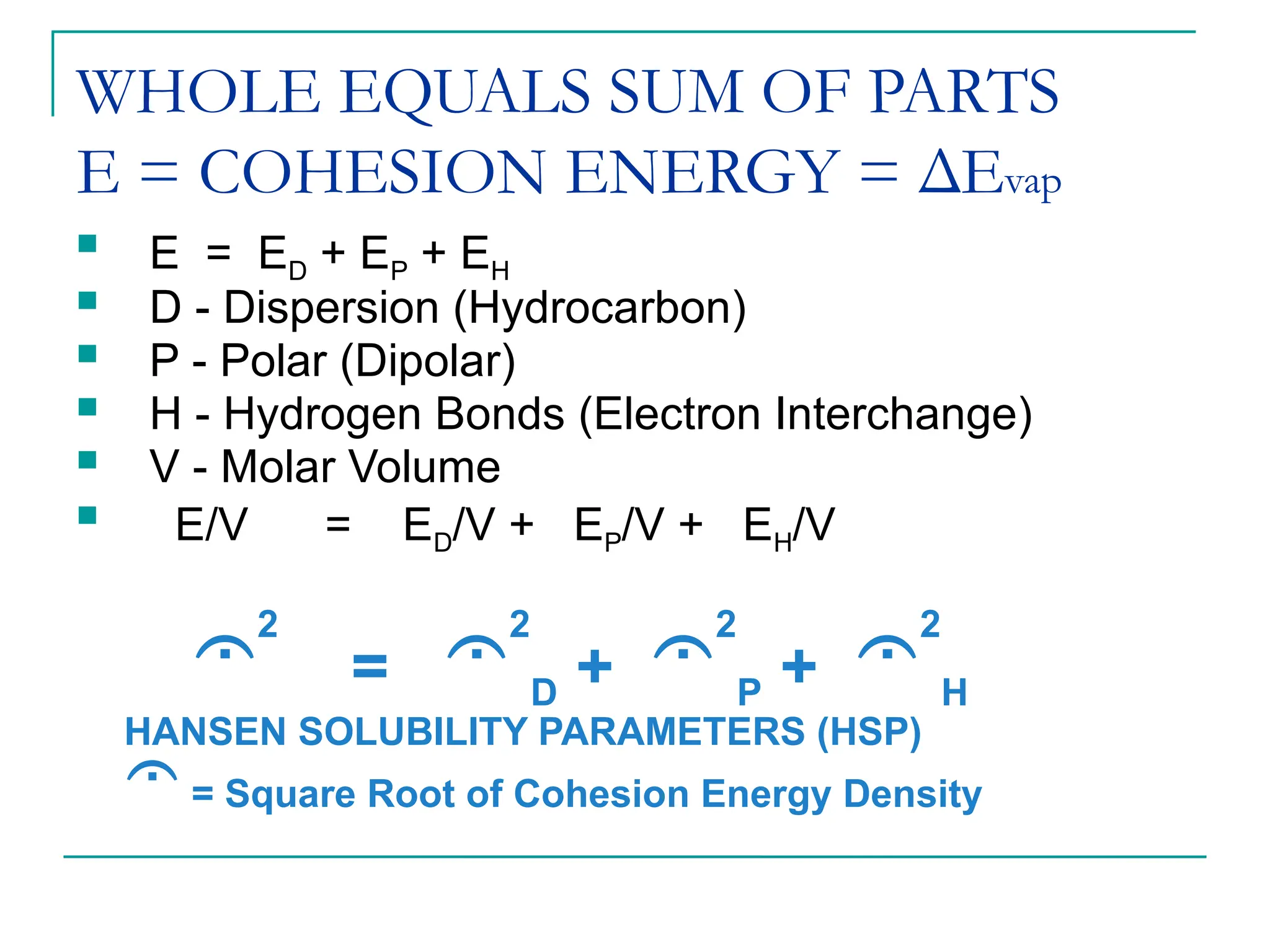
WHOLE EQUALS SUM OF PARTS
E = COHESION ENERGY = ΔEvap
 E = ED + EP + EH
 D - Dispersion (Hydrocarbon)
 P - Polar (Dipolar)
 H - Hydrogen Bonds (Electron Interchange)
 V - Molar Volume
 E/V = ED/V + EP/V + EH/V

2
= 
2
D + 
2
P + 
2
H
HANSEN SOLUBILITY PARAMETERS (HSP)
 = Square Root of Cohesion Energy Density
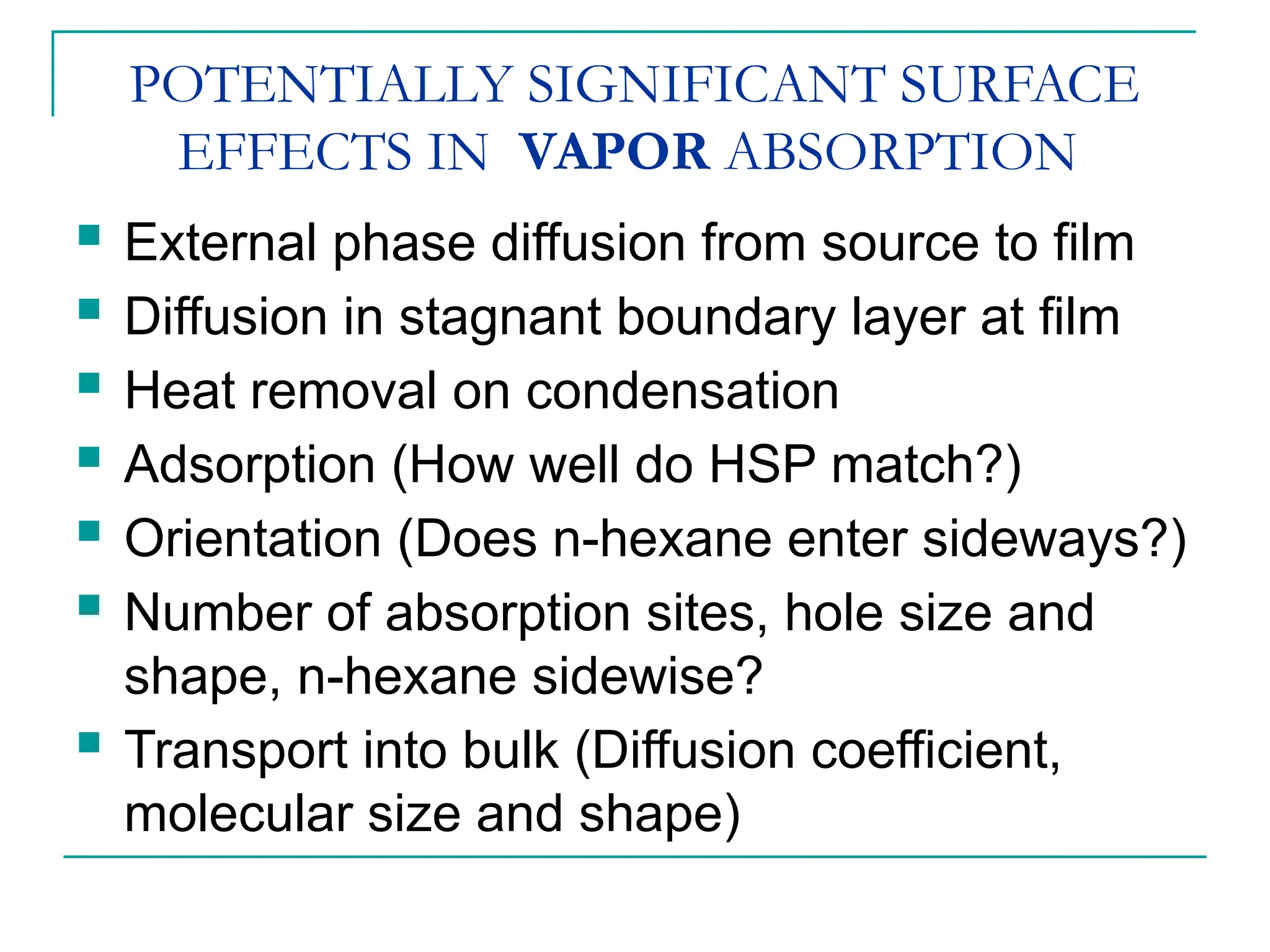
POTENTIALLY SIGNIFICANT SURFACE
EFFECTS IN VAPOR ABSORPTION
 External phase diffusion from source to film
 Diffusion in stagnant boundary layer at film
 Heat removal on condensation
 Adsorption (How well do HSP match?)
 Orientation (Does n-hexane enter sideways?)
 Number of absorption sites, hole size and
shape, n-hexane sidewise?
 Transport into bulk (Diffusion coefficient,
molecular size and shape)
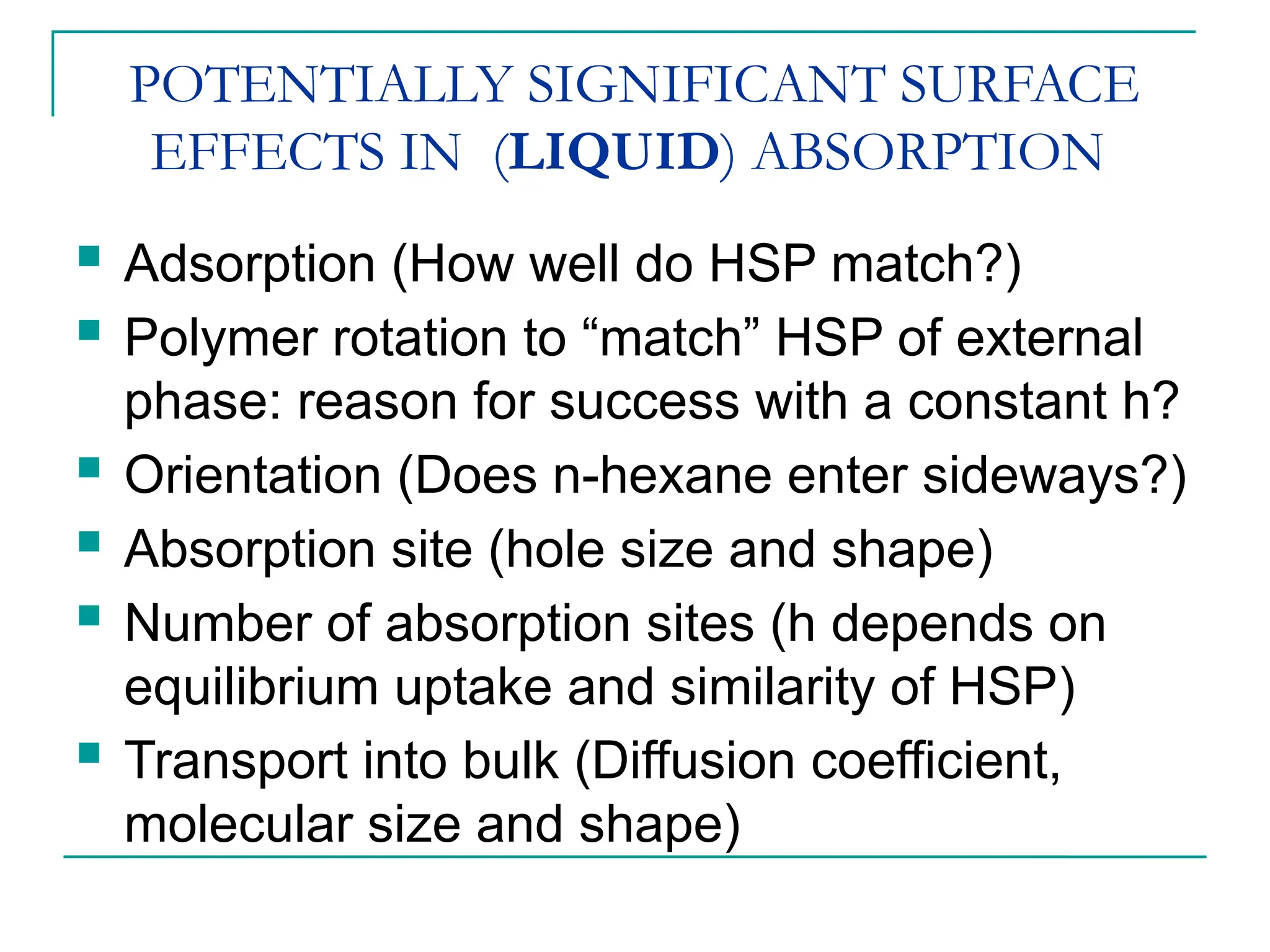
POTENTIALLY SIGNIFICANT SURFACE
EFFECTS IN (LIQUID) ABSORPTION
 Adsorption (How well do HSP match?)
 Polymer rotation to “match” HSP of external
phase: reason for success with a constant h?
 Orientation (Does n-hexane enter sideways?)
 Absorption site (hole size and shape)
 Number of absorption sites (h depends on
equilibrium uptake and similarity of HSP)
 Transport into bulk (Diffusion coefficient,
molecular size and shape)
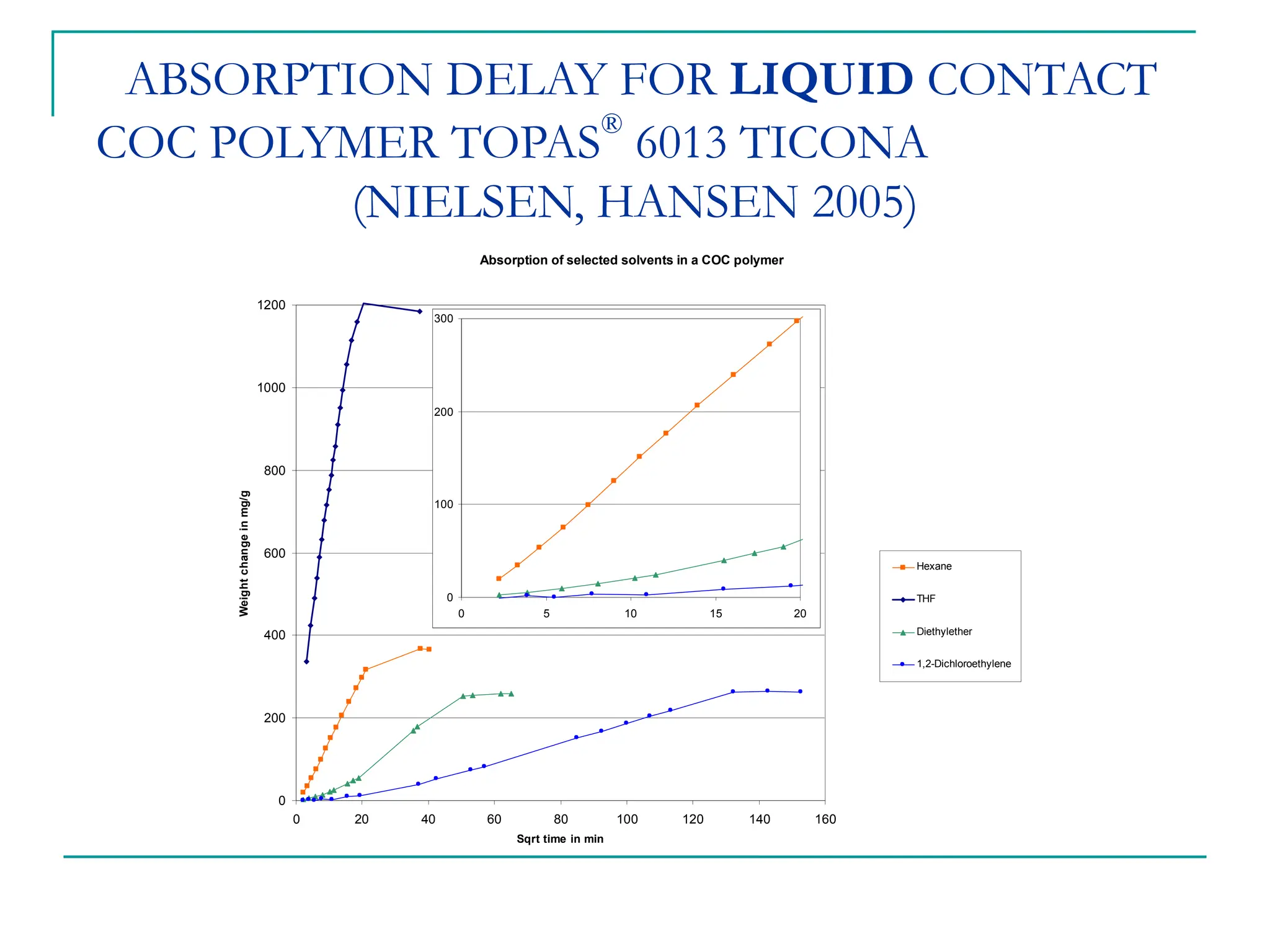
ABSORPTION DELAY FOR LIQUID CONTACT
COC POLYMER TOPAS®
6013 TICONA
(NIELSEN, HANSEN 2005)
Absorption of selected solvents in a COC polymer
0
200
400
600
800
1000
1200
0 20 40 60 80 100 120 140 160
Sqrt time in min
Weight
change
in
mg/g
Hexane
THF
Diethylether
1,2-Dichloroethylene
0
100
200
300
0 5 10 15 20
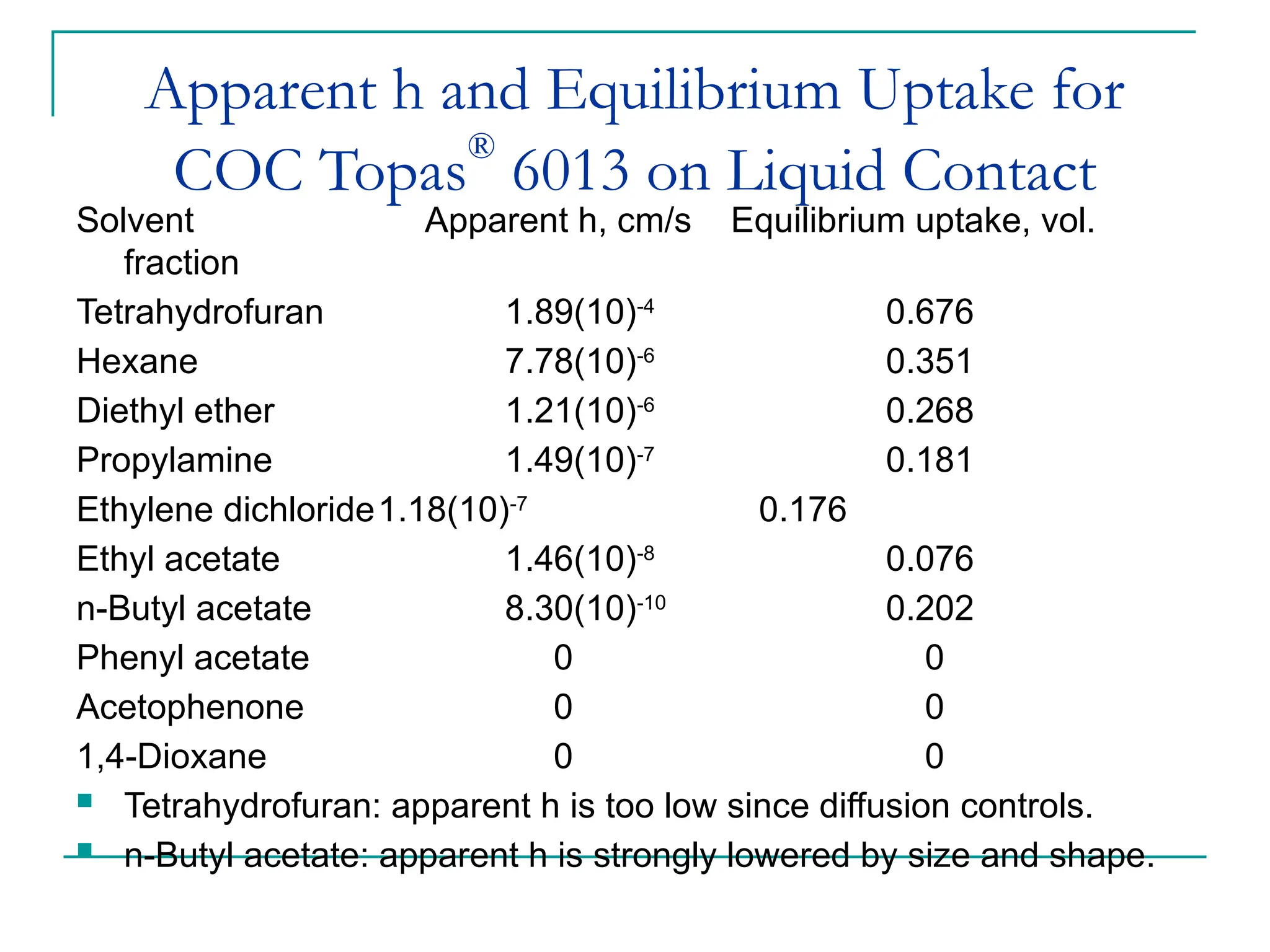
Apparent h and Equilibrium Uptake for
COC Topas
®
6013 on Liquid Contact
Solvent Apparent h, cm/s Equilibrium uptake, vol.
fraction
Tetrahydrofuran 1.89(10)-4
0.676
Hexane 7.78(10)-6
0.351
Diethyl ether 1.21(10)-6
0.268
Propylamine 1.49(10)-7
0.181
Ethylene dichloride1.18(10)-7
0.176
Ethyl acetate 1.46(10)-8
0.076
n-Butyl acetate 8.30(10)-10
0.202
Phenyl acetate 0 0
Acetophenone 0 0
1,4-Dioxane 0 0
 Tetrahydrofuran: apparent h is too low since diffusion controls.
 n-Butyl acetate: apparent h is strongly lowered by size and shape.
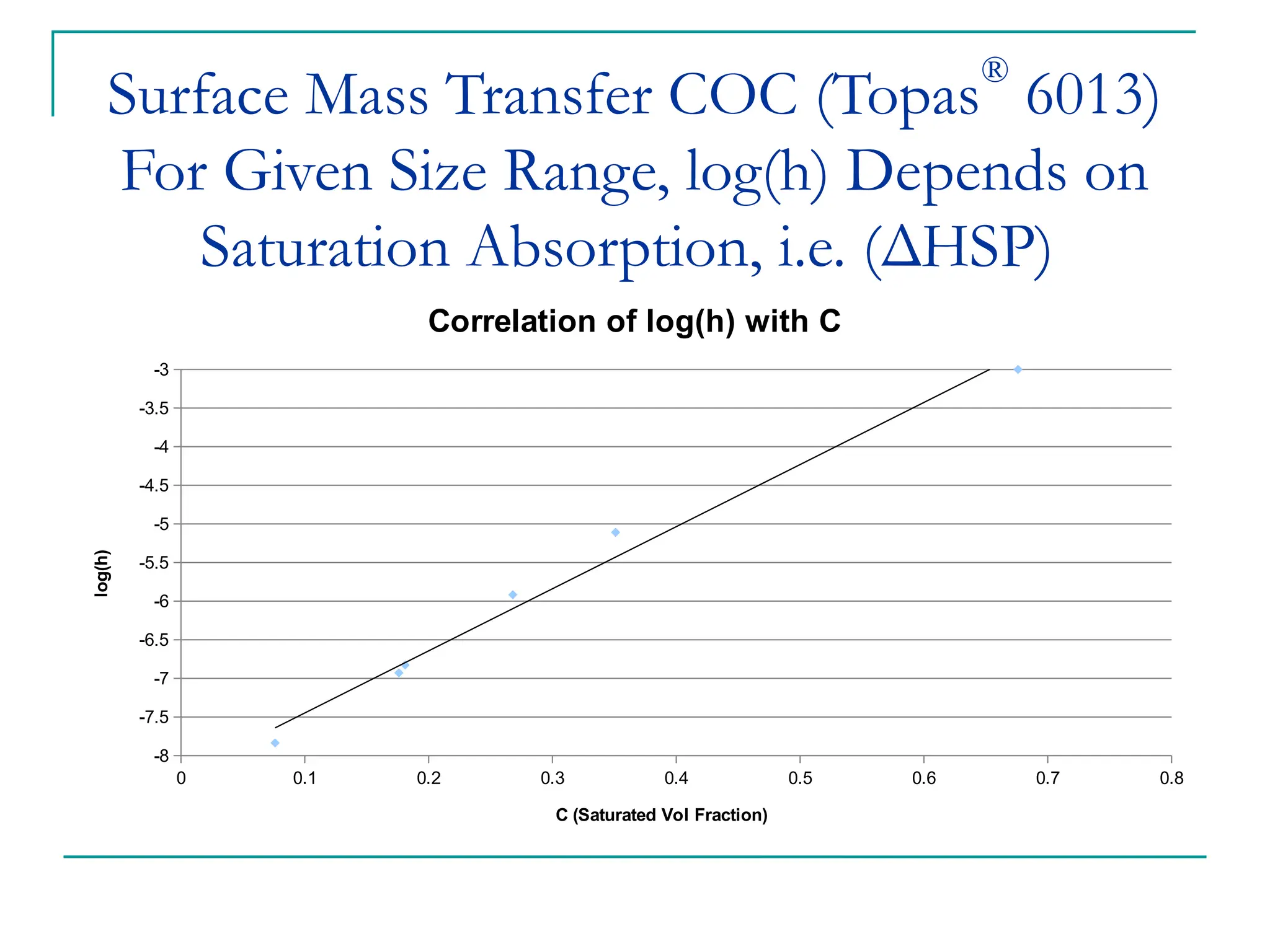
Surface Mass Transfer COC (Topas
®
6013)
For Given Size Range, log(h) Depends on
Saturation Absorption, i.e. (ΔHSP)
0 0.1 0.2 0.3 0.4 0.5 0.6 0.7 0.8
-8
-7.5
-7
-6.5
-6
-5.5
-5
-4.5
-4
-3.5
-3
Correlation of log(h) with C
C (Saturated Vol Fraction)
log(h)
MAJOR REFERENCES EXPLAINING
“ANOMALIES” USING DIFFUSION EQUATION
Chapter 16 of Second Edition of Hansen Solubility
Parameters: A User’s Handbook, CRC Press, 2007.
Hansen CM. The significance of the surface condition in
solutions to the diffusion equation: explaining
"anomalous" sigmoidal, Case II, and Super Case II
absorption behavior. Eur Polym J 2010;46;651-662.
Abbott S, Hansen CM, Yamamoto H. Hansen Solubility
Parameters in Practice (HSPiP),
www.hansen-solubility.com. (The HSPiP package
includes validated software for absorption, desorption
and permeation.) One can curve fit data for films,
cylinders, and spheres.
Several downloads on www.hansen-solubility.com.
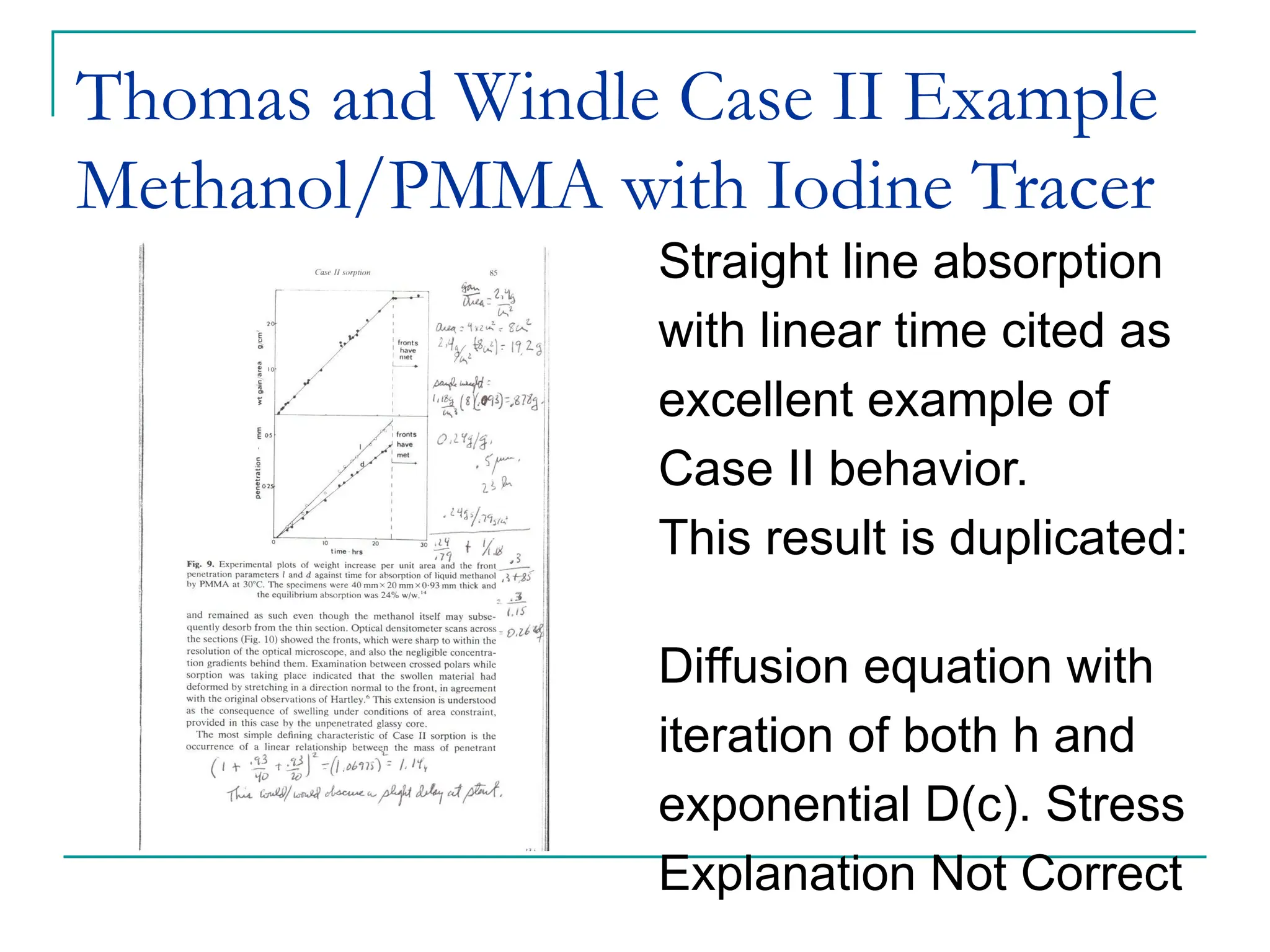
Thomas and Windle Case II Example
Methanol/PMMA with Iodine Tracer
Straight line absorption
with linear time cited as
excellent example of
Case II behavior.
This result is duplicated:
Diffusion equation with
iteration of both h and
exponential D(c). Stress
Explanation Not Correct
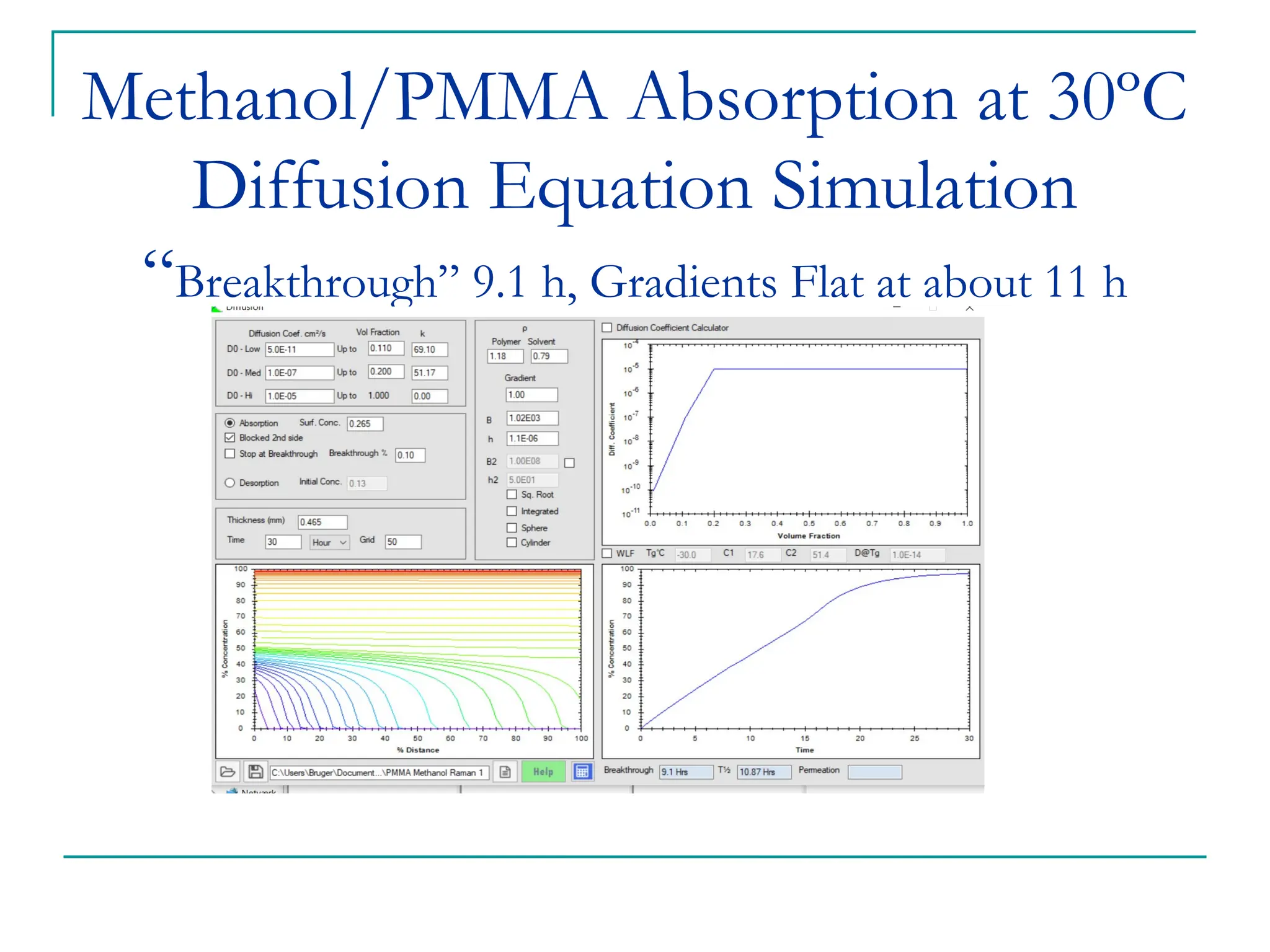
Methanol/PMMA Absorption at 30ºC
Diffusion Equation Simulation
“Breakthrough” 9.1 h, Gradients Flat at about 11 h
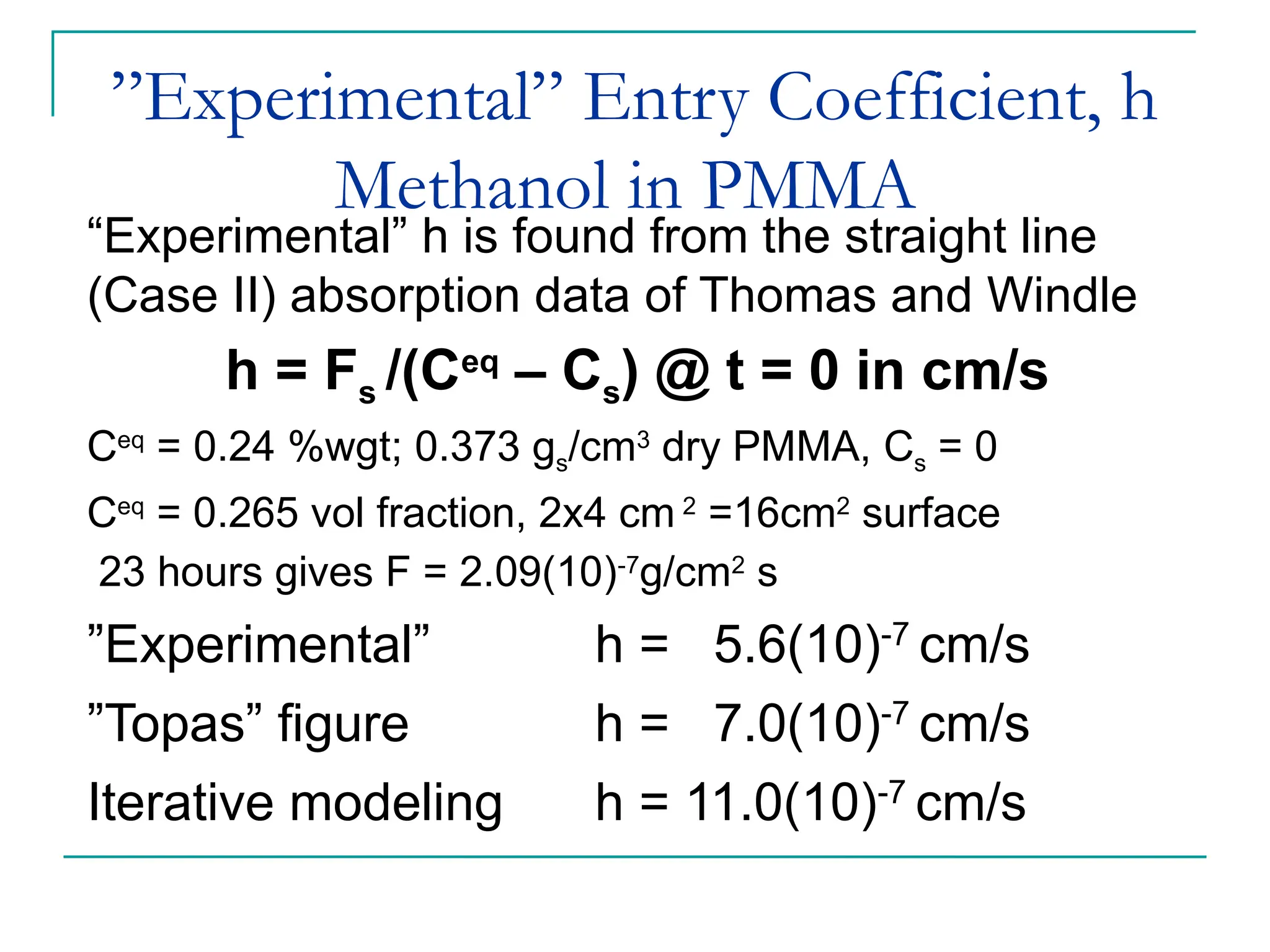
”Experimental” Entry Coefficient, h
Methanol in PMMA
“Experimental” h is found from the straight line
(Case II) absorption data of Thomas and Windle
h = Fs /(Ceq
– Cs) @ t = 0 in cm/s
Ceq
= 0.24 %wgt; 0.373 gs/cm3
dry PMMA, Cs = 0
Ceq
= 0.265 vol fraction, 2x4 cm 2
=16cm2
surface
23 hours gives F = 2.09(10)-7
g/cm2
s
”Experimental” h = 5.6(10)-7
cm/s
”Topas” figure h = 7.0(10)-7
cm/s
Iterative modeling h = 11.0(10)-7
cm/s
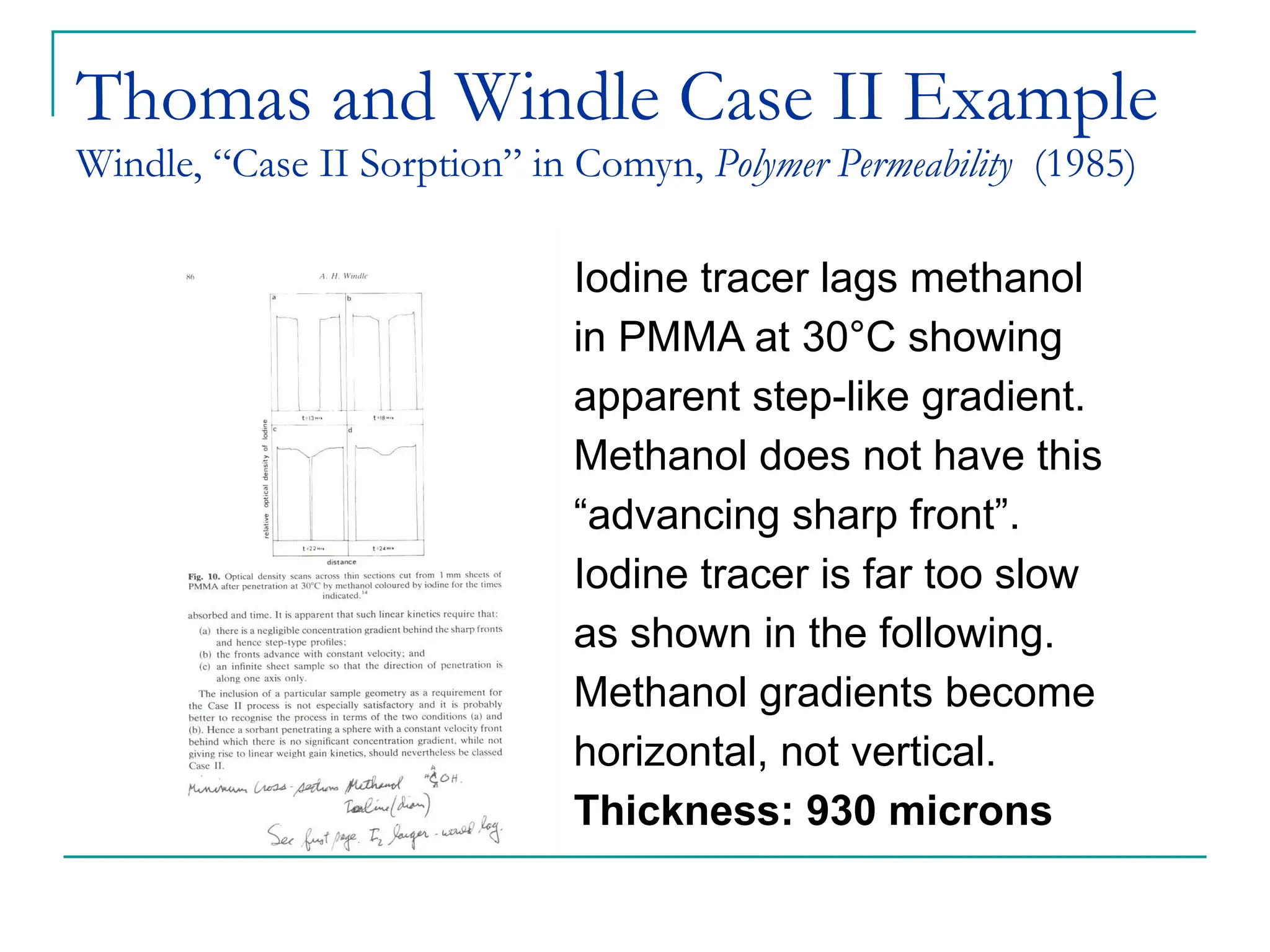
Thomas and Windle Case II Example
Windle, “Case II Sorption” in Comyn, Polymer Permeability (1985)
Iodine tracer lags methanol
in PMMA at 30°C showing
apparent step-like gradient.
Methanol does not have this
“advancing sharp front”.
Iodine tracer is far too slow
as shown in the following.
Methanol gradients become
horizontal, not vertical.
Thickness: 930 microns
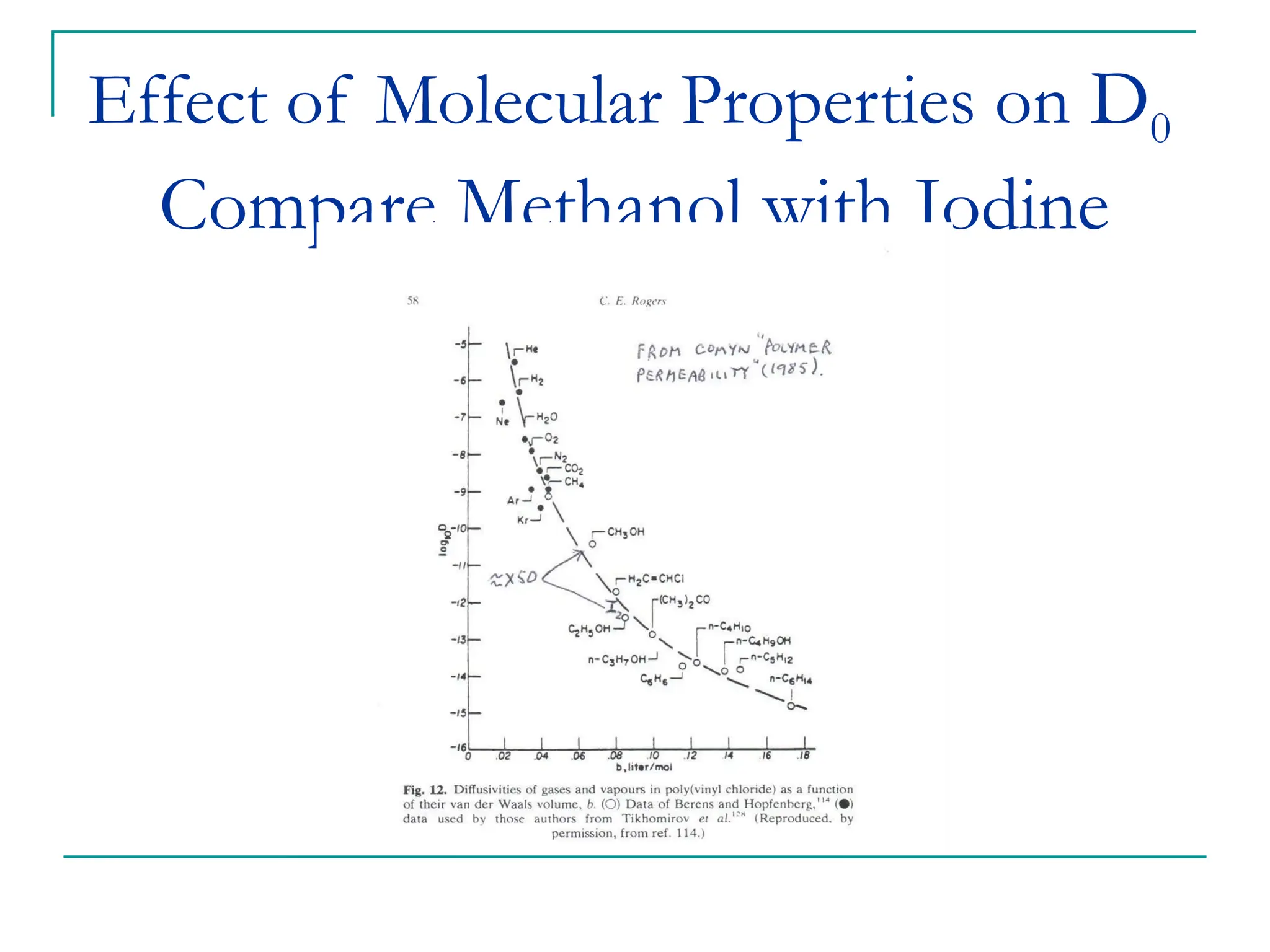
Effect of Molecular Properties on D0
Compare Methanol with Iodine
The Next Figure was
Reproduced from the Reference Below
Uptake of Methanol by Poly(methyl methacrylate):
An Old Problem Addressed by a Novel Raman
Technique
Jakob Nixdorf, Giuseppe Di Florio, Lars Bröckers, Carolin
Borbeck, Helen E. Hermes, Stefan U. Egelhaaf, and Peter
Gilch
Macromolecules 2019, 52, 13, 4997-5005
Heinrich-Heine University, Düsseldorf
FSRM (Femtosecond Stimulated Raman Microscopy)
Beam Focus at Middle of Disk Sample With
Sides Being Exposed
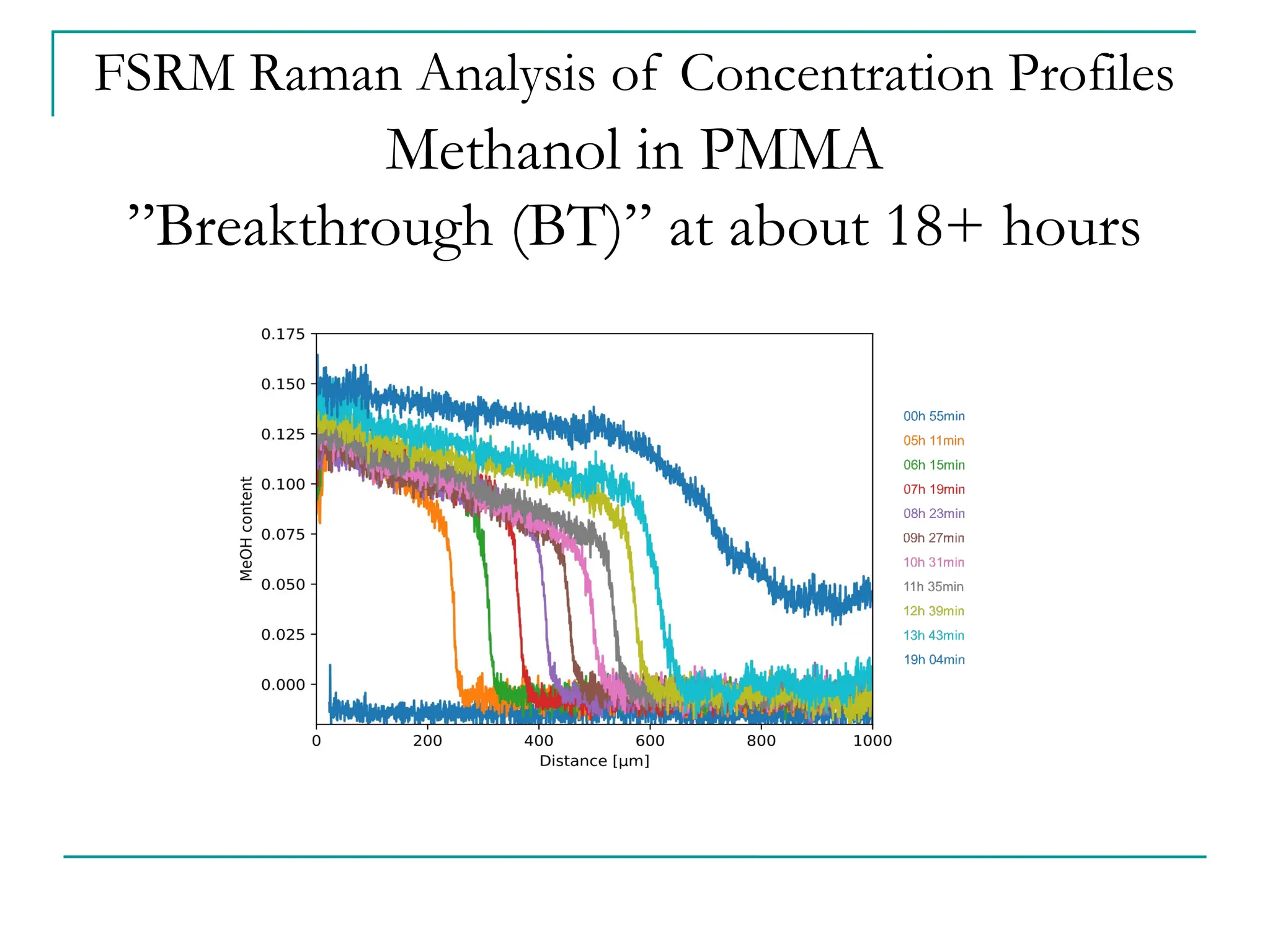
FSRM Raman Analysis of Concentration Profiles
Methanol in PMMA
”Breakthrough (BT)” at about 18+ hours
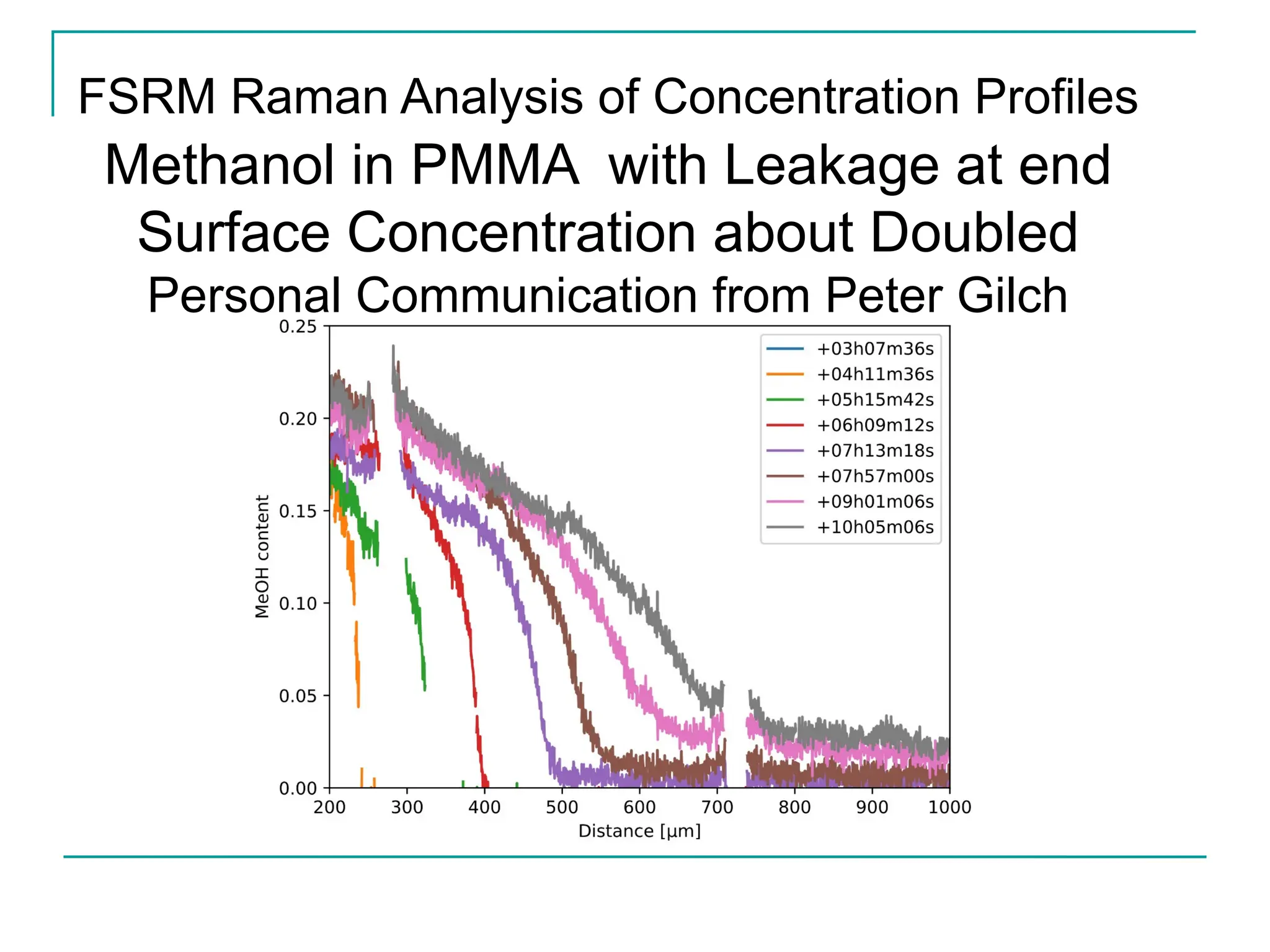
FSRM Raman Analysis of Concentration Profiles
Methanol in PMMA with Leakage at end
Surface Concentration about Doubled
Personal Communication from Peter Gilch
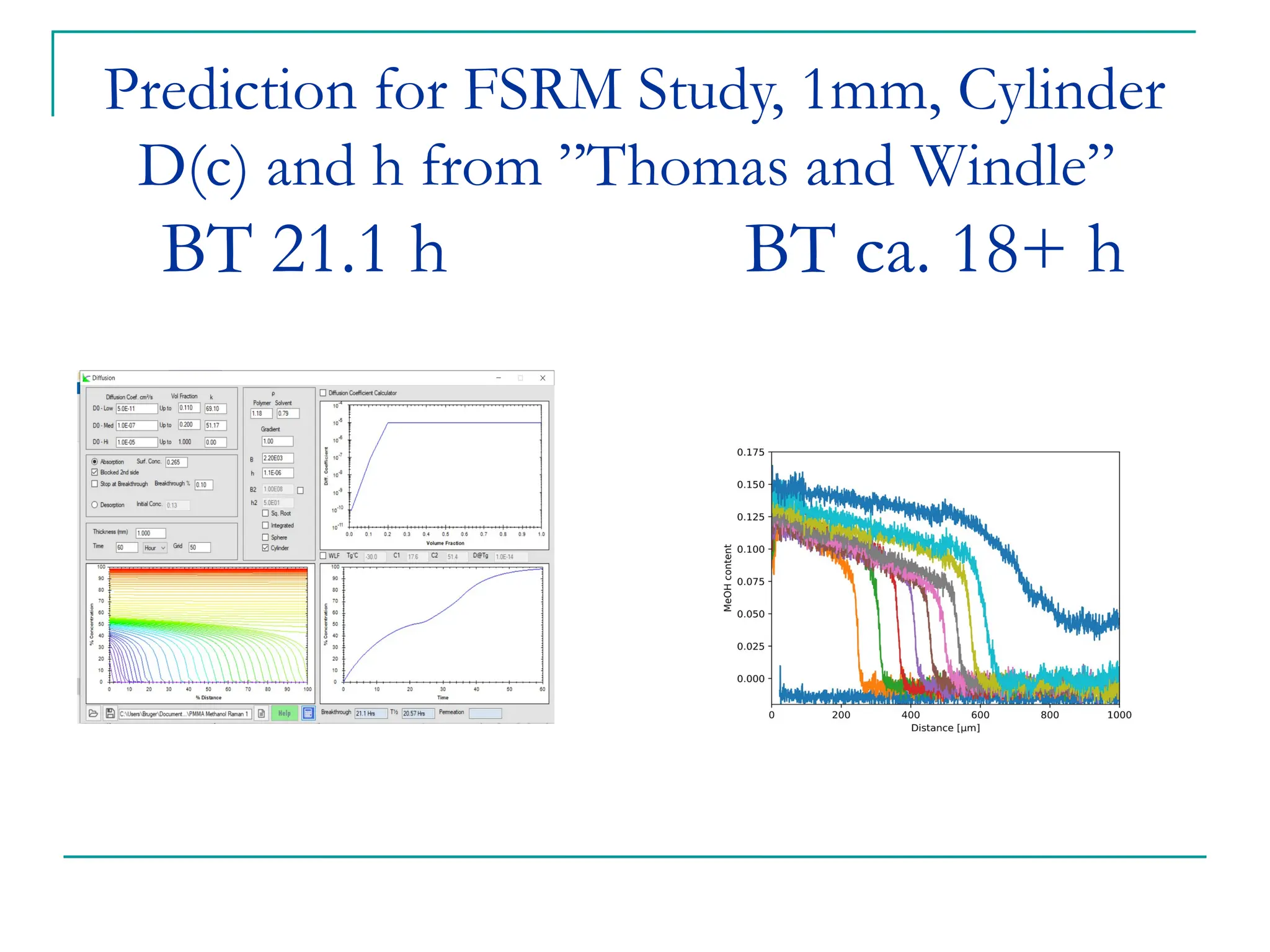
Prediction for FSRM Study, 1mm, Cylinder
D(c) and h from ”Thomas and Windle”
BT 21.1 h BT ca. 18+ h
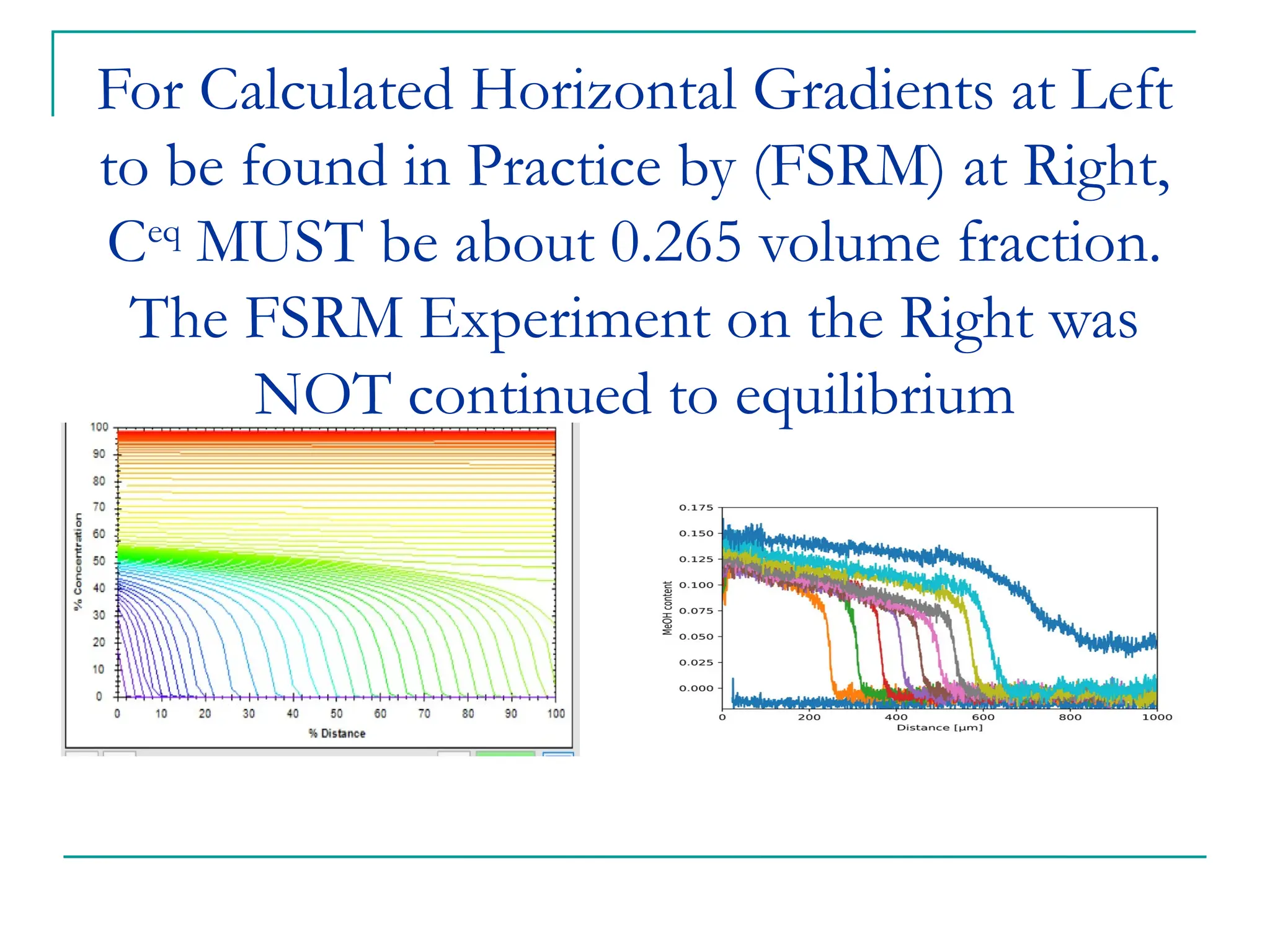
For Calculated Horizontal Gradients at Left
to be found in Practice by (FSRM) at Right,
Ceq
MUST be about 0.265 volume fraction.
The FSRM Experiment on the Right was
NOT continued to equilibrium
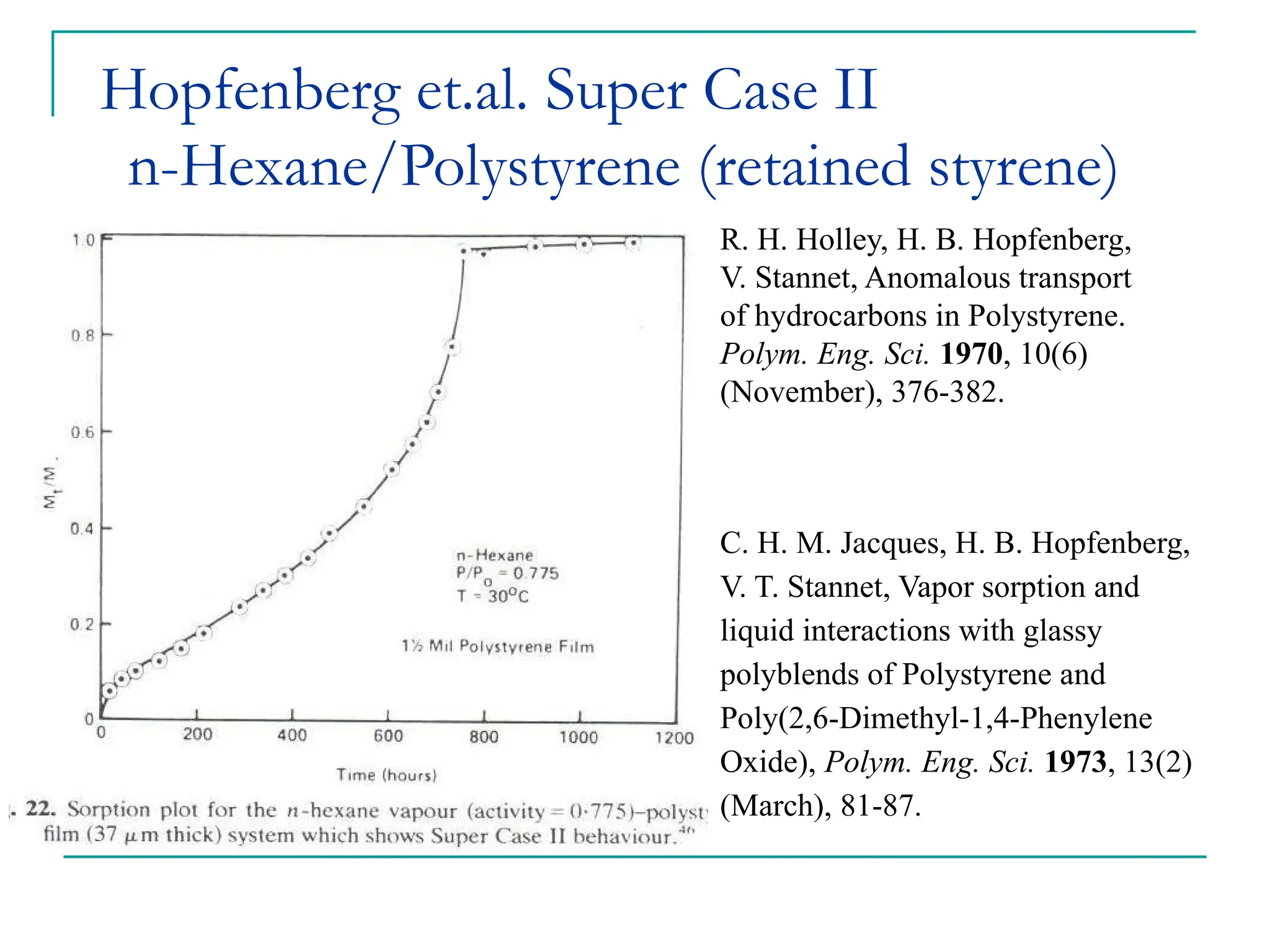
Hopfenberg et.al. Super Case II
n-Hexane/Polystyrene (retained styrene)
C. H. M. Jacques, H. B. Hopfenberg,
V. T. Stannet, Vapor sorption and
liquid interactions with glassy
polyblends of Polystyrene and
Poly(2,6-Dimethyl-1,4-Phenylene
Oxide), Polym. Eng. Sci. 1973, 13(2)
(March), 81-87.
R. H. Holley, H. B. Hopfenberg,
V. Stannet, Anomalous transport
of hydrocarbons in Polystyrene.
Polym. Eng. Sci. 1970, 10(6)
(November), 376-382.
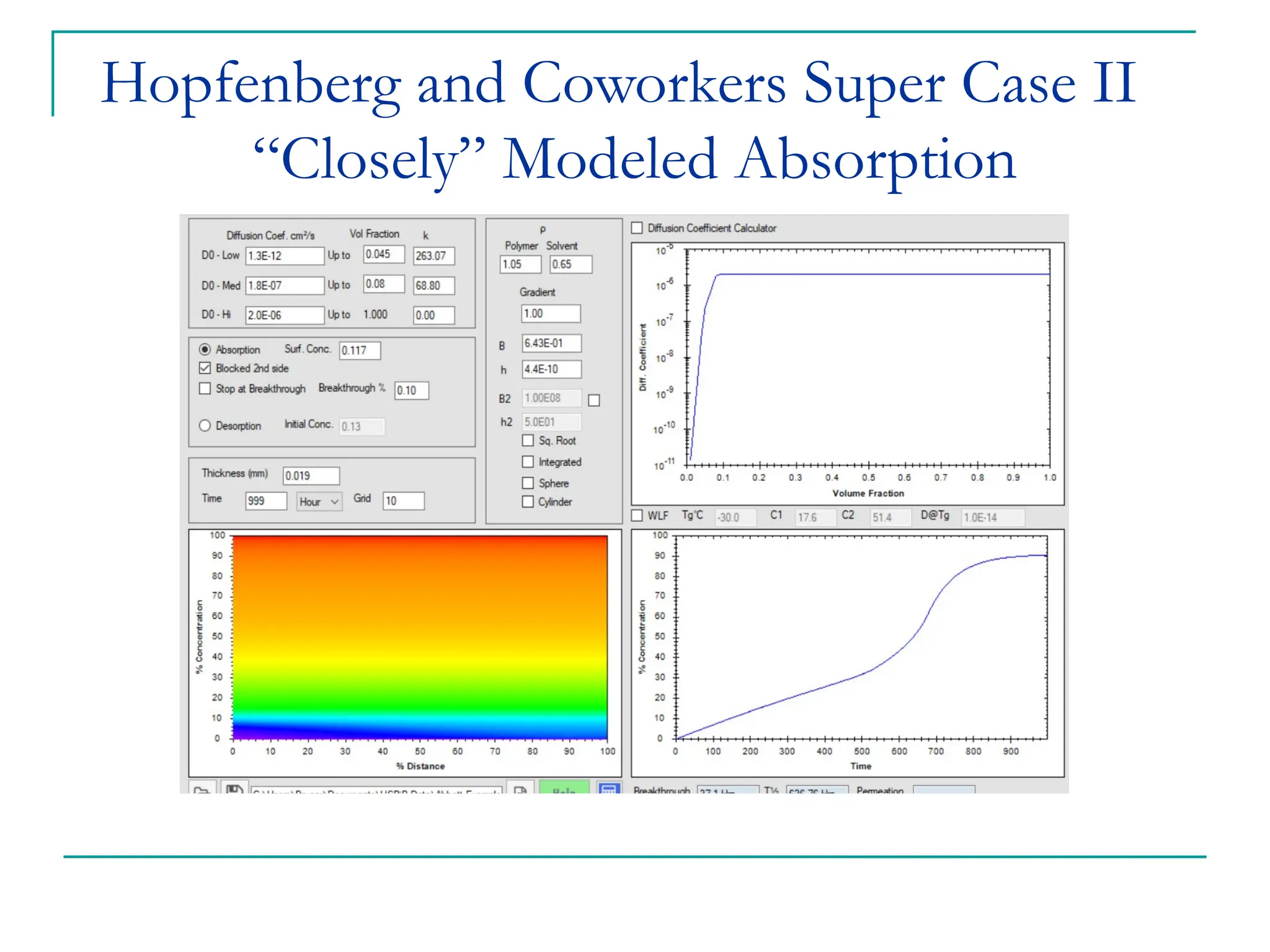
Hopfenberg and Coworkers Super Case II
“Closely” Modeled Absorption
PETROPOULOS et.al
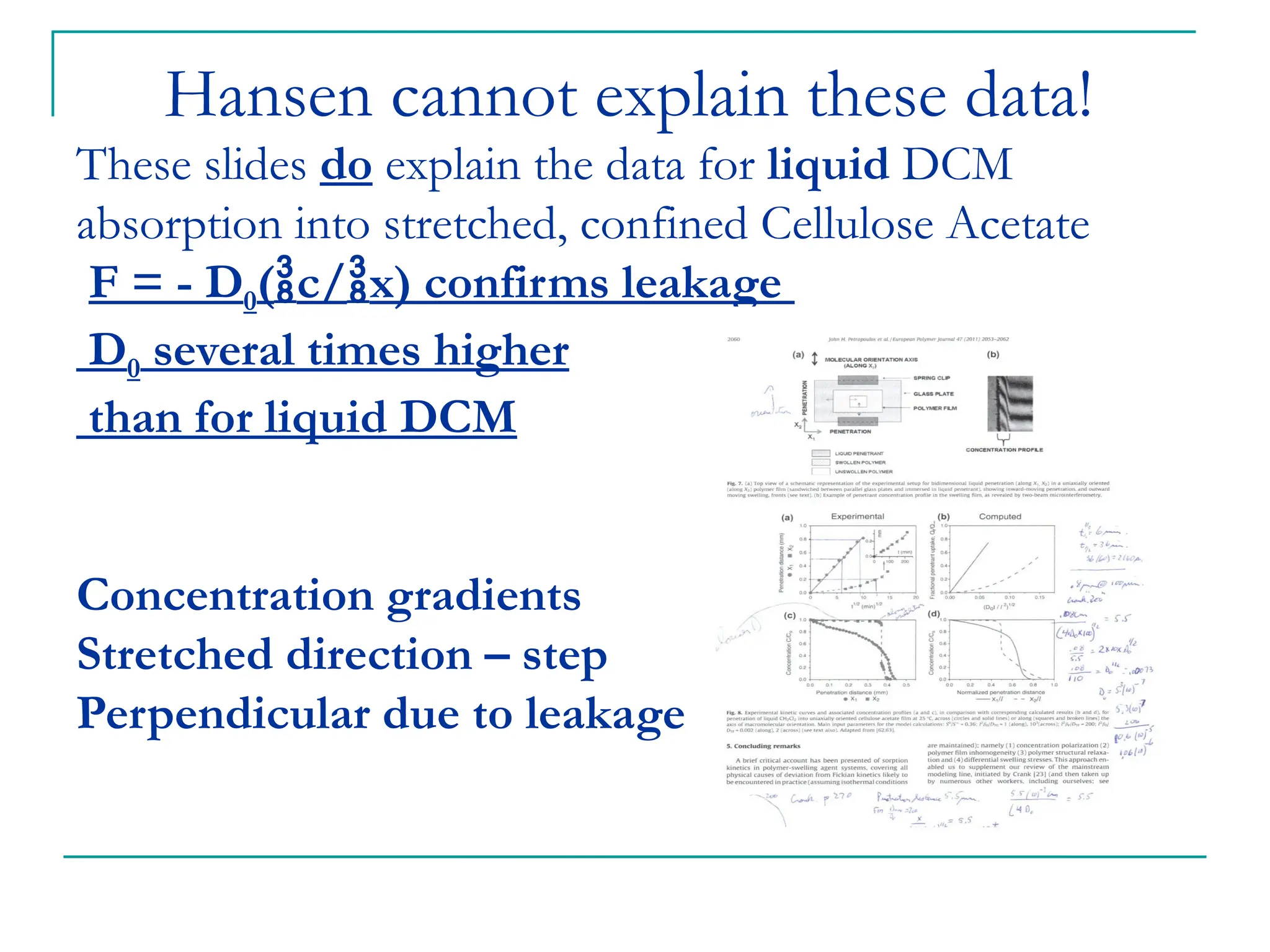
Hansen cannot explain these data!
Stress mechanism given as cause of
“anomalous” behavior.
Petropoulos JH Sanopoulou M Papadokostaki KG.
Physically insightful modeling of non-Fickian
kinetic energy regimes encountered in
fundamental studies of isothermal sorption of
swelling agents in polymeric media.
Eur Polym J 2011;47:2053-2062.
Hansen cannot explain these data!
These slides do explain the data for liquid DCM
absorption into stretched, confined Cellulose Acetate
F = - D0(c/x) confirms leakage
D0 several times higher
than for liquid DCM
Concentration gradients
Stretched direction – step
Perpendicular due to leakage
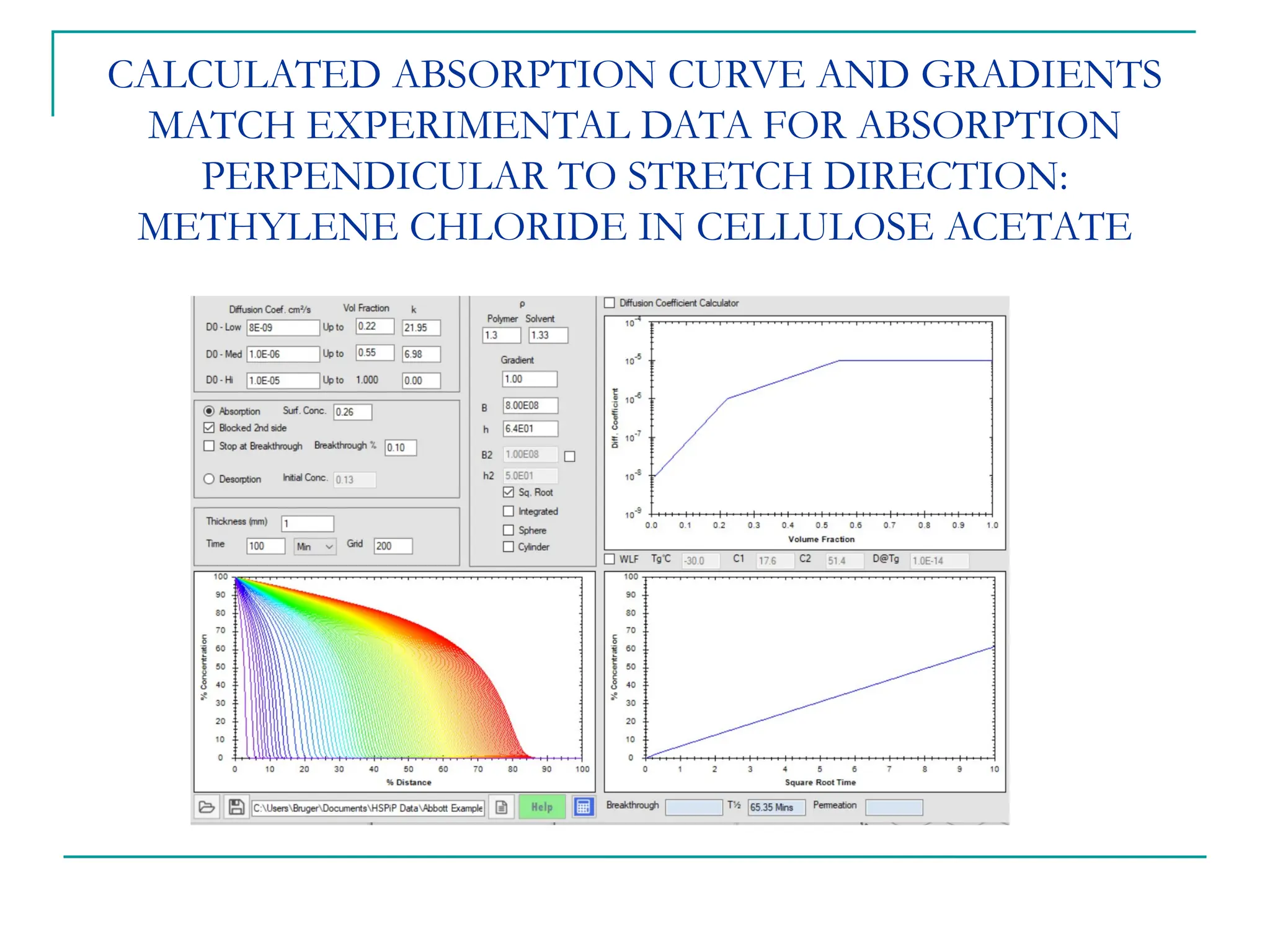
CALCULATED ABSORPTION CURVE AND GRADIENTS
MATCH EXPERIMENTAL DATA FOR ABSORPTION
PERPENDICULAR TO STRETCH DIRECTION:
METHYLENE CHLORIDE IN CELLULOSE ACETATE
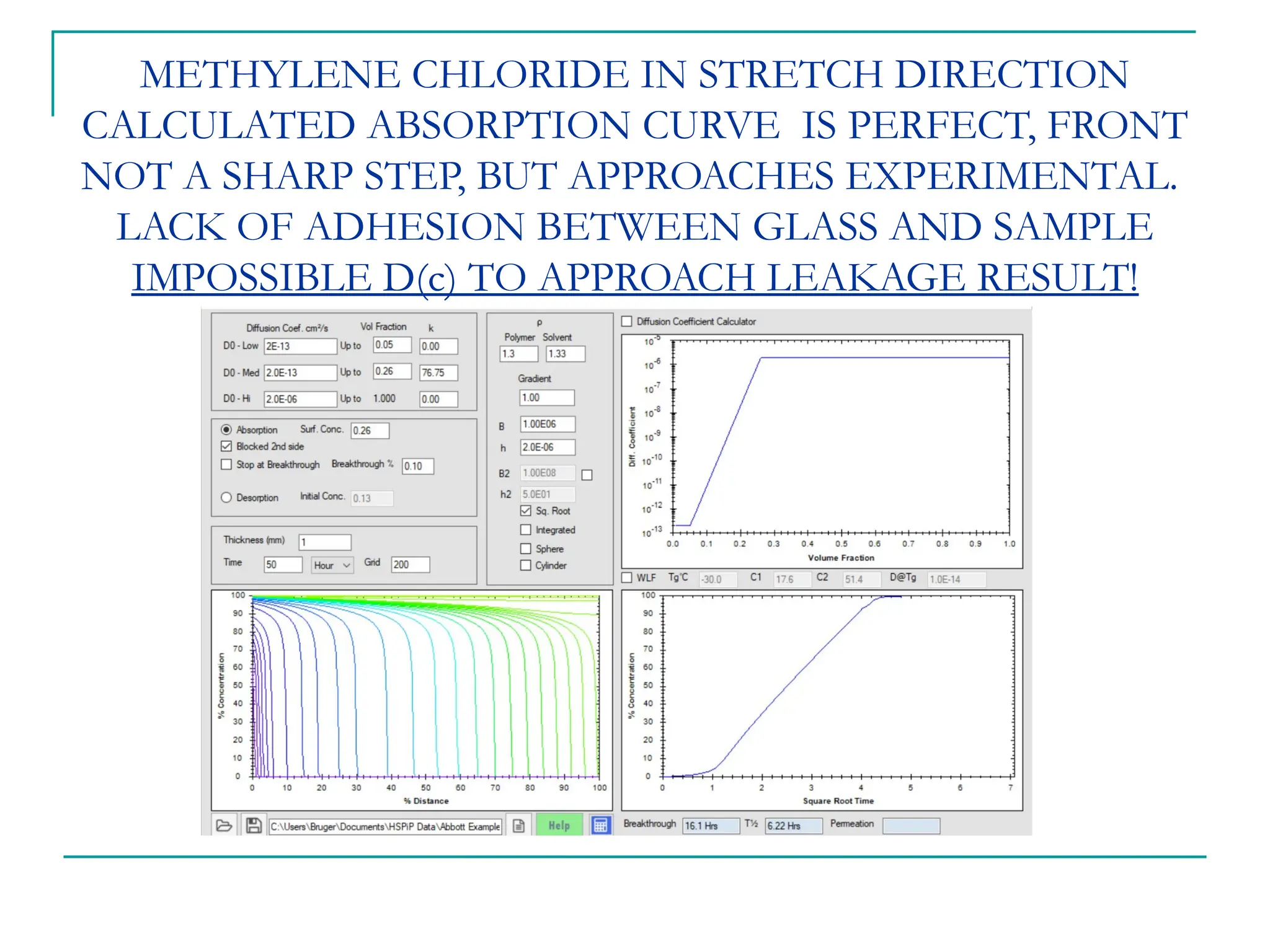
METHYLENE CHLORIDE IN STRETCH DIRECTION
CALCULATED ABSORPTION CURVE IS PERFECT, FRONT
NOT A SHARP STEP, BUT APPROACHES EXPERIMENTAL.
LACK OF ADHESION BETWEEN GLASS AND SAMPLE
IMPOSSIBLE D(c) TO APPROACH LEAKAGE RESULT!
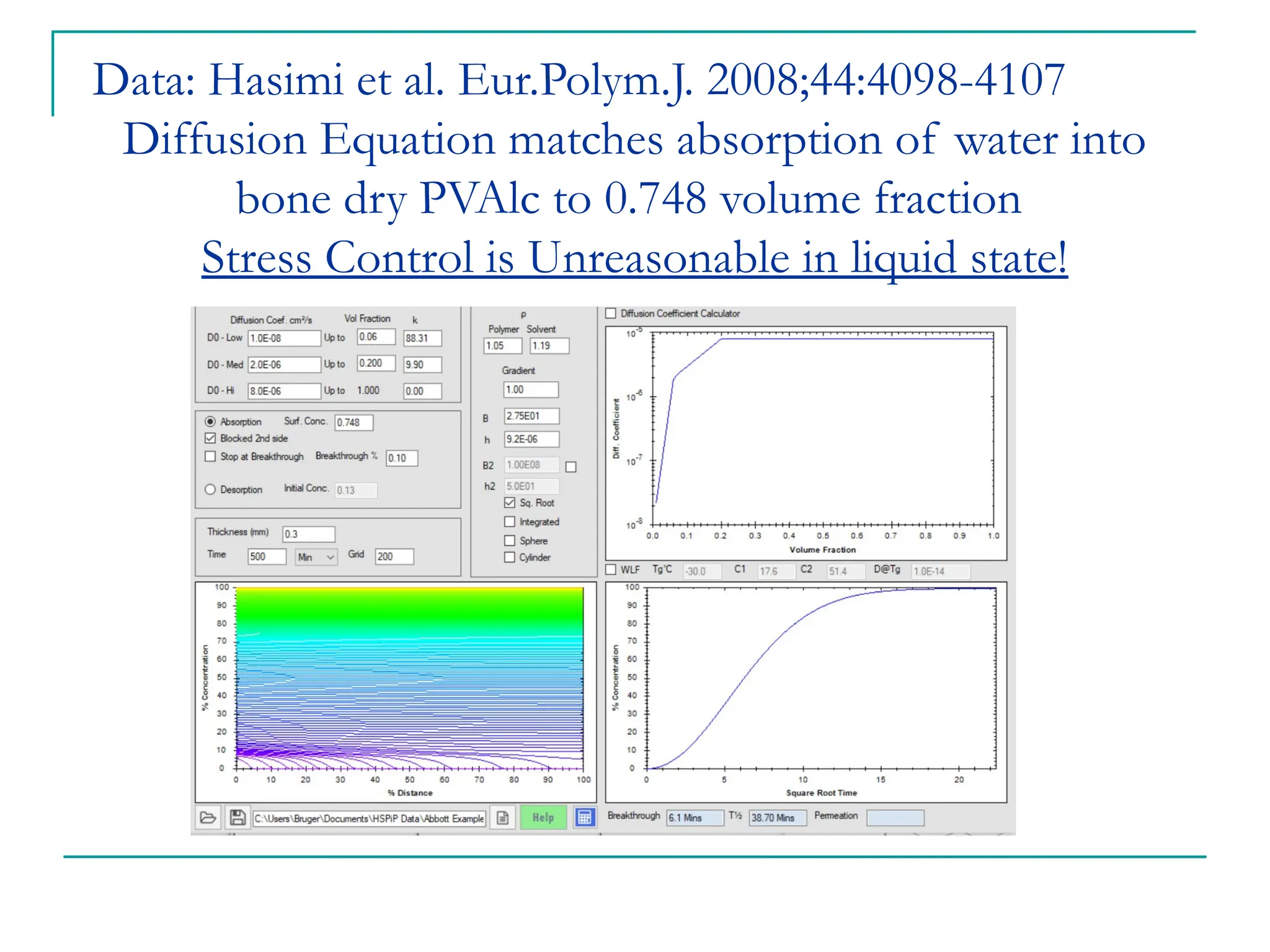
Data: Hasimi et al. Eur.Polym.J. 2008;44:4098-4107
Diffusion Equation matches absorption of water into
bone dry PVAlc to 0.748 volume fraction
Stress Control is Unreasonable in liquid state!
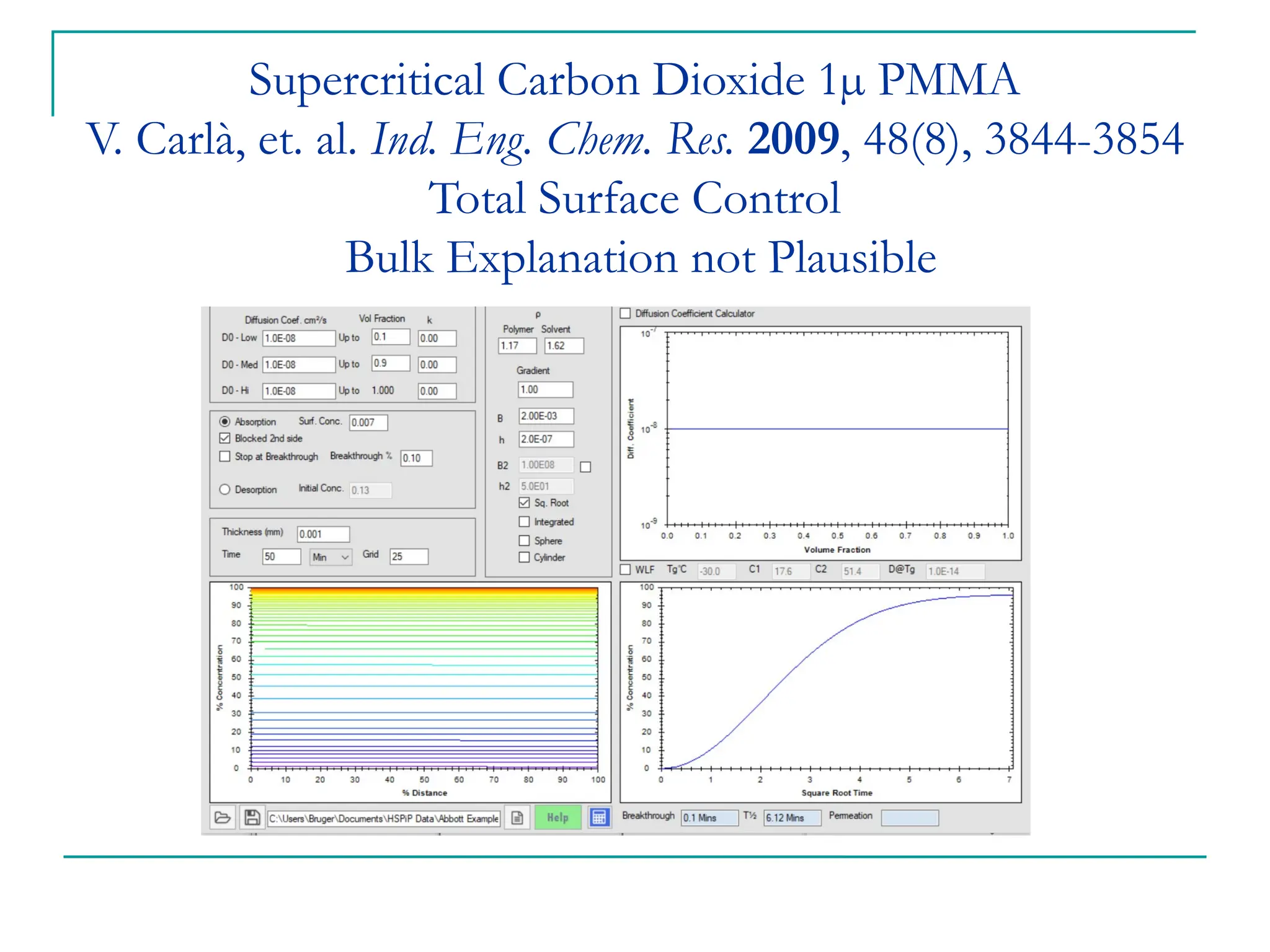
Supercritical Carbon Dioxide 1µ PMMA
V. Carlà, et. al. Ind. Eng. Chem. Res. 2009, 48(8), 3844-3854
Total Surface Control
Bulk Explanation not Plausible
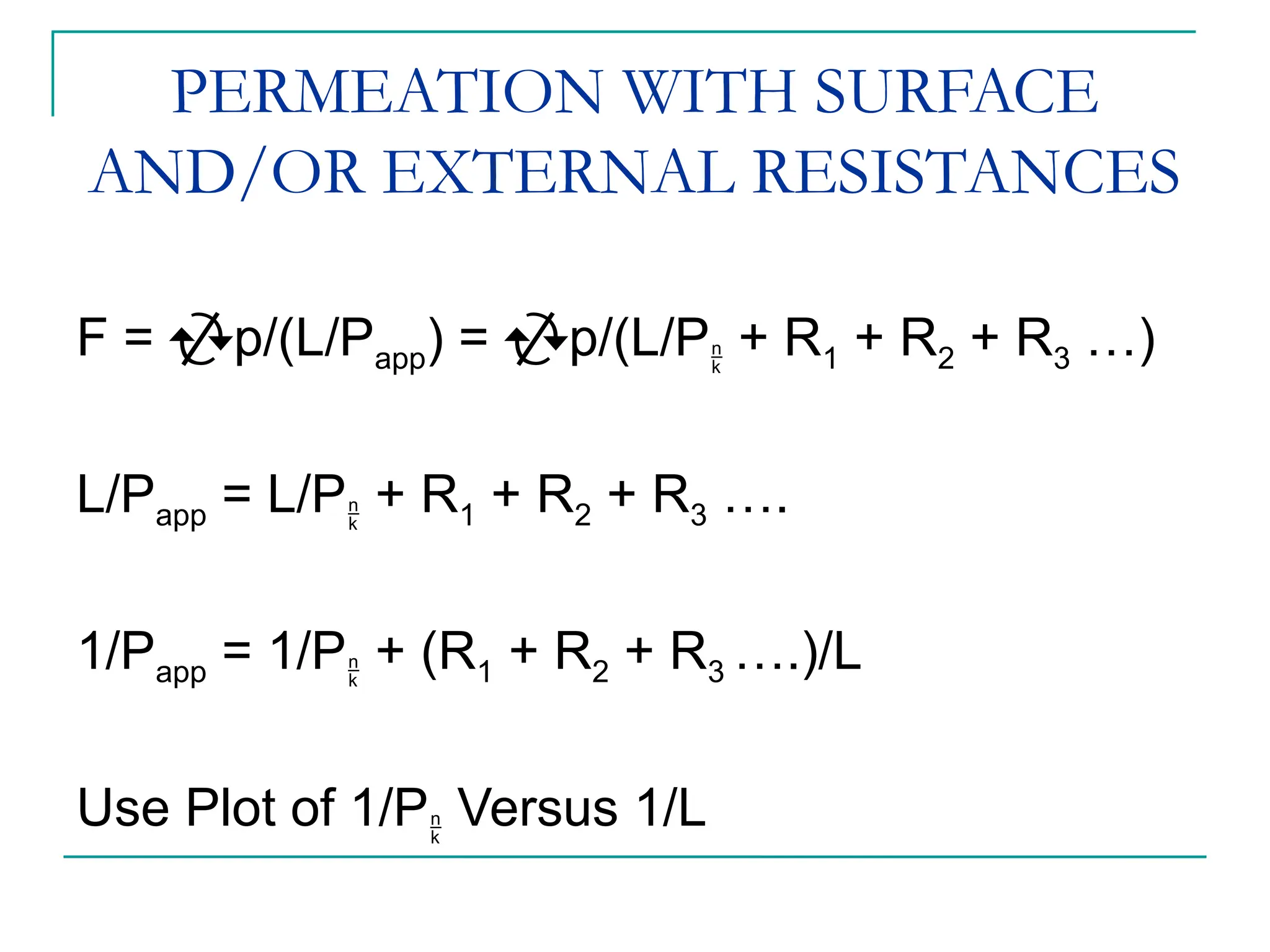
PERMEATION WITH SURFACE
AND/OR EXTERNAL RESISTANCES
F = p/(L/Papp) = p/(L/P + R1 + R2 + R3 …)
L/Papp = L/P + R1 + R2 + R3 ….
1/Papp = 1/P + (R1 + R2 + R3 ….)/L
Use Plot of 1/P Versus 1/L
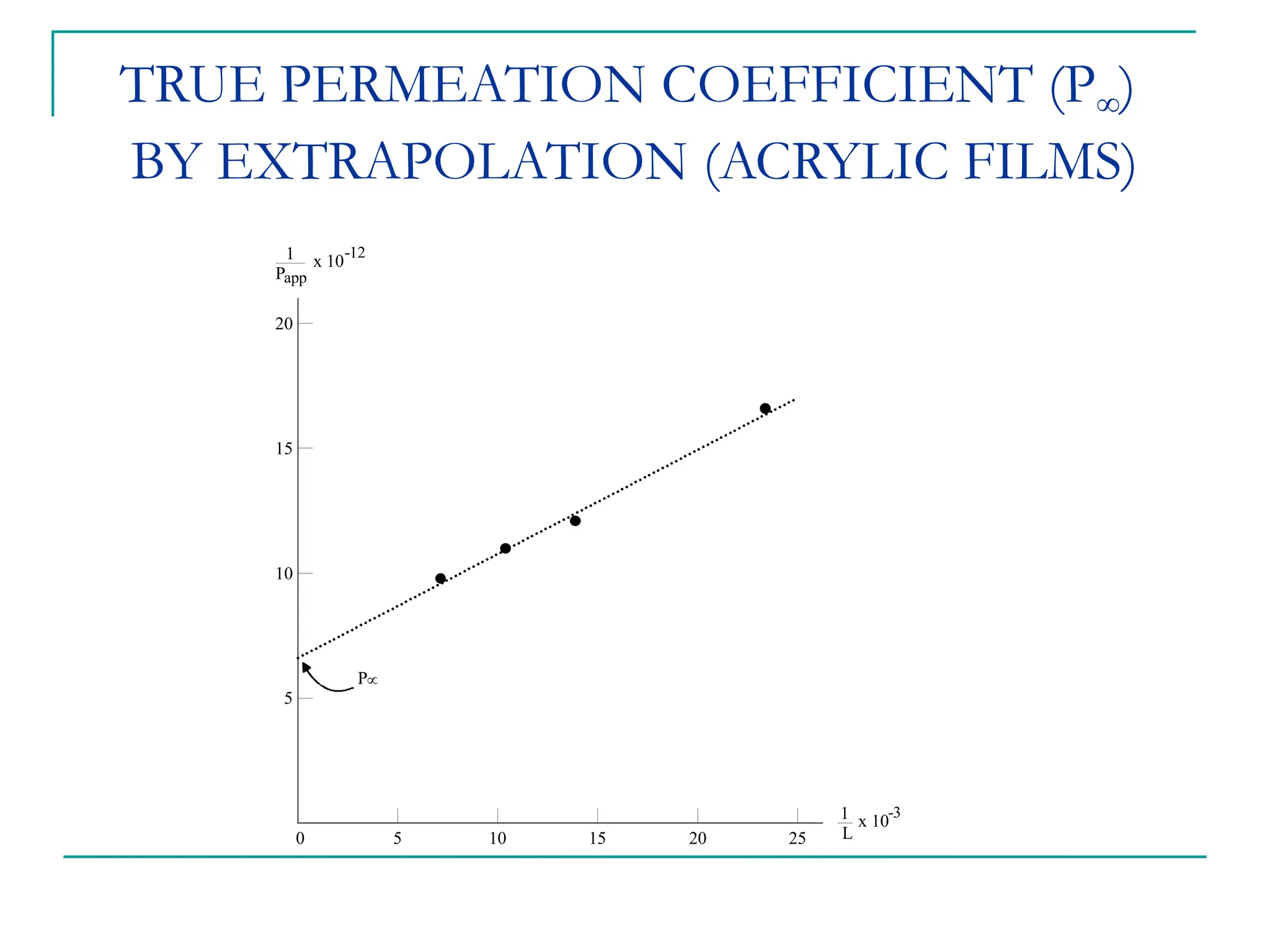
TRUE PERMEATION COEFFICIENT (P∞)
BY EXTRAPOLATION (ACRYLIC FILMS)
20
15
10
5
0 5 10 15 20 25
P
Papp
1 x 10
-12
L
1 x 10
-3
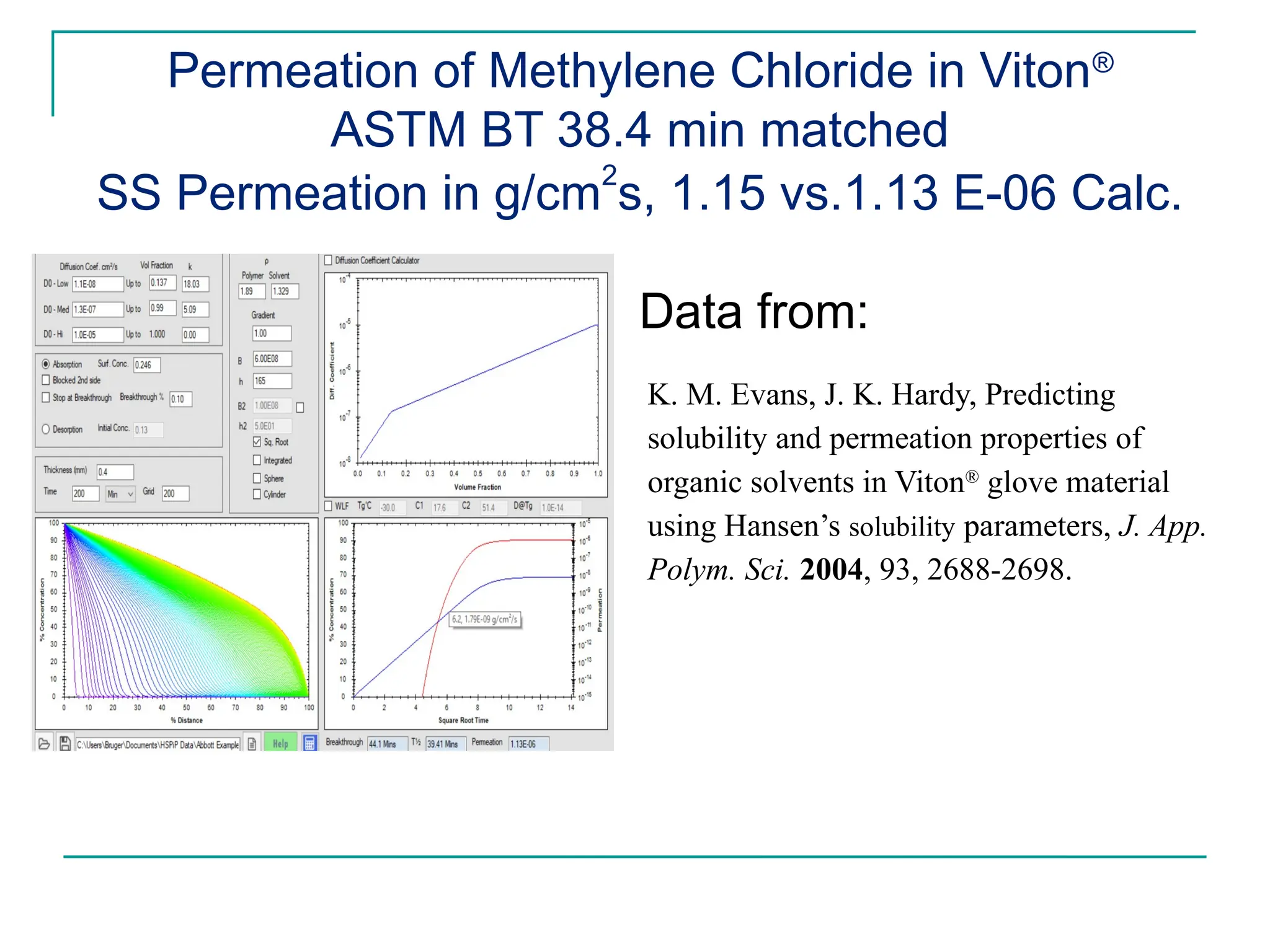
Permeation of Methylene Chloride in Viton®
ASTM BT 38.4 min matched
SS Permeation in g/cm2
s, 1.15 vs.1.13 E-06 Calc.
Data from:
K. M. Evans, J. K. Hardy, Predicting
solubility and permeation properties of
organic solvents in Viton®
glove material
using Hansen’s solubility parameters, J. App.
Polym. Sci. 2004, 93, 2688-2698.
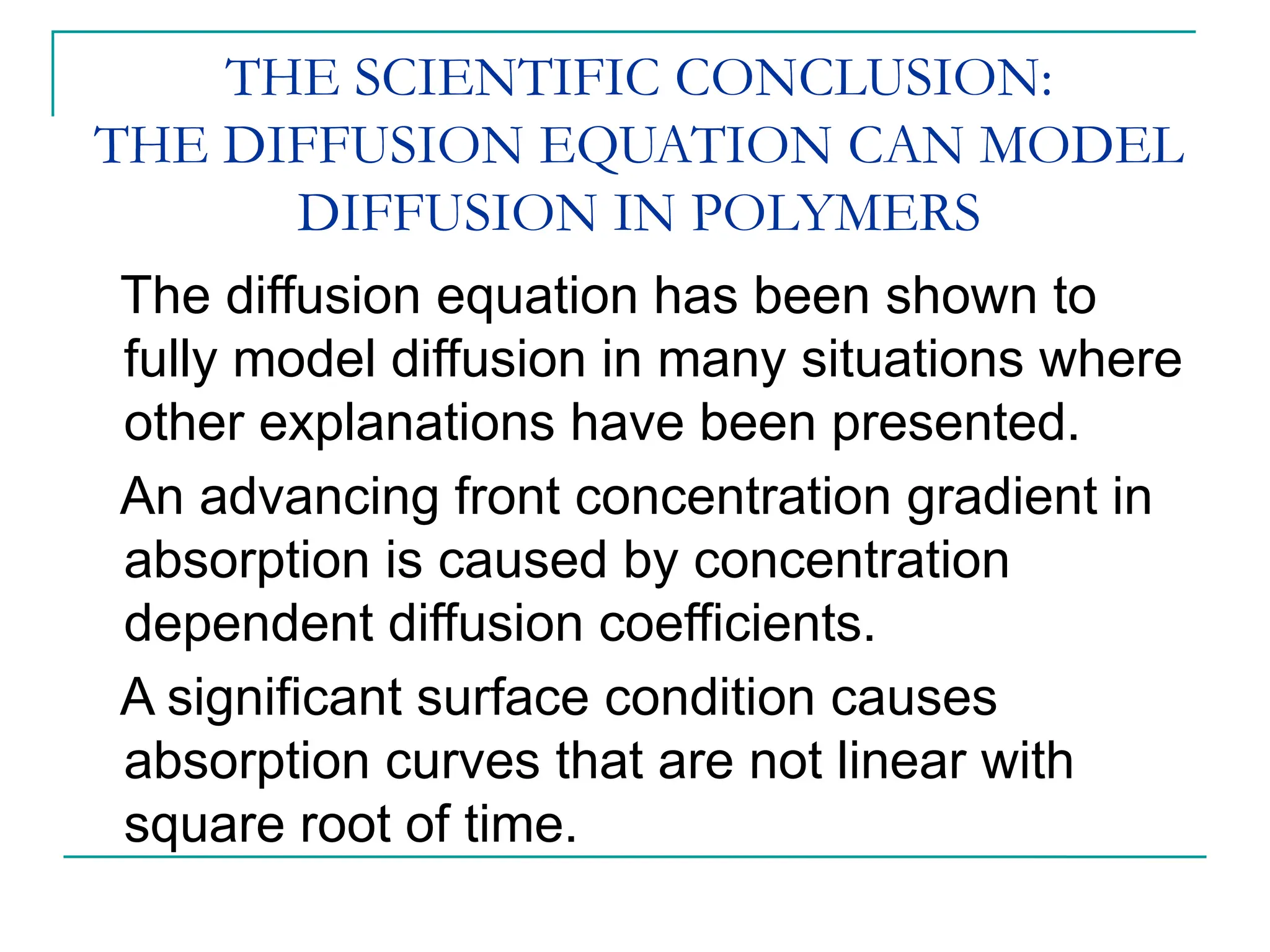
THE SCIENTIFIC CONCLUSION:
THE DIFFUSION EQUATION CAN MODEL
DIFFUSION IN POLYMERS
The diffusion equation has been shown to
fully model diffusion in many situations where
other explanations have been presented.
An advancing front concentration gradient in
absorption is caused by concentration
dependent diffusion coefficients.
A significant surface condition causes
absorption curves that are not linear with
square root of time.
THE PRACTICAL CONCLUSION
Mismatch Hansen solubility parameters to get
1. Lower equilibrium absorption, and therefore:
A. Lower concentration gradients
B. Lower diffusion coefficients
C. Lower surface entry coefficients
2. In practice, for drug and cosmetics packaging,
body suits, gloves, geomembranes, etc. Just -
Mismatch HSP for Better Barriers
SUMMARY
 Laws of Diffusion Valid for Diffusion in Polymers
 Exponential Diffusion Coefficients (D(c))
 Surface Condition (h) explains ”Anomalies”
 Combining D(c) and h - Complete Descriptions
 Estimate Behavior at Different Conditions
 Improved understanding and modeling of
absorption, desorption, and permeation
 Improve Barriers with (HSPp ≠ ≠ HSPs)
Thank you for your attention!
For further contact please visit:
www.hansen-solubility.com

DIFFUSION_IN_POLYMERS drug delivery systems

  • 1.
    Diffusion in Polymers2020 The Diffusion Equation can model: Absorption of solvent Desorption of solvent Permeation of solvent Charles M. Hansen
  • 2.
    OUTLINE  Laws ofDiffusion  Find correct diffusion coefficients  Concentration dependent coefficients  Surface effects can be significant  Combine these in diffusion equation to model Film formation by solvent evaporation and ”Anomalies” of absorption (S-shaped, Case II). Reliability of the modeling: The software in Hansen Solubility Parameters in Practice (HSPiP) used here gives the same results as are found in Crank (The Mathematics of Diffusion) and analytical solutions.
  • 3.
    FICK’S FIRST ANDSECOND LAWS Law 1: F = - D0(c/x) For constant D0 in the x Direction, and Law 2: c/t = /x (D0c/x) This is also called the Diffusion Equation. (Accumulation equals flux in minus flux out) Calculations are referred to dry polymer. Initial and 2 boundary conditions are required. D0 can be replaced by exponential D(c). Finding D(c) curve requires iteration for different c.
  • 4.
    DIMENSIONLESS VARIABLES Dimensionless time: T= D0t/L2 (cm2 /s)(s/cm2 ) Dimensionless distance: X = x/L Dimensionless concentration: C = (c – c0)/(c - c0) L is the thickness of a free film
  • 5.
    Absorption with aConstant Diffusion Coefficient Straight line absorption - square root of time (Diffusion coefficients upper right, Concentration gradients lower left, absorption curve lower right)
  • 6.
    Absorption with ExponentialD(c) Gives Advancing Front Straight line absorption - square root of time
  • 7.
    SURFACE CONDITION Fs =h(Ceq – Cs) = -DsCs/x Flux through surface to(from) external phase, Fs, equals flux through surface from(to) the bulk. External Flux to/from surface, Fs, equals mass transfer coefficient, h, (cm/s) times concentration difference, g/cm 3 giving g/cm 2 s Flux to/from bulk equals diffusion coefficient (cm2 /s) times concentration gradient (g/cm3 cm) h can be found from h = Fs /(Ceq – Cs) @ t = 0
  • 8.
    MEASURING DIFFUSION COEFFICIENTS TheOld Way: Correction Factors The New Way: Curve Fitting Half-time (t½) equation for measuring constant D0 D0 = 0.049 L2 /t½ For Concentration dependence multiply this by Fa, for absorption, or Fd for desorption For significant surface resistance multiply by FB See also Nordtest POLY 188
  • 9.
    CORRECTIONS FOR CONCENTRATION DEPENDENCEALONE Note huge corrections for desorption Desorption Absorption Dmax/D0 (Fd)1/2 (Fd)1/4 (Fa)1/2 1 1.00 1.00 1.00 2 1.56 1.55 1.30 5 2.70 2.61 1.70 101 4.00 3.84 2.01 10 2 13.40 10.20 3.30 103 43.30 23.10 4.85 10 4 138.7 47.40 6.14 10 5 443.0 89.0 7.63 10 6 1,370.0 160.5 8.97 107 4,300.0 290.0 10.60 10 8 13,670.0 506.0 12.10 FB is a function of dimensionless surface parameter B = hL/D1 See Hansen, C.M., J.Appl Poly Sci, 26,3311-3315 (1981)
  • 10.
    EXPONENTIAL DIFFUSION COEFFICIENTSFOR CHLOROBENZENE IN POLY(VINYL ACETATE) The system chlorobenzene in poly(vinyl acetate) has been studied extensively with all relevant data reported in my dissertation and subsequent journal articles. The experiments were for: Absorption from one equilibrium to another, Desorption from different equilibrium values to vacuum, and film drying (years). Coherent understanding is found only by accounting for concentration dependence and significant surface effects when present.
  • 11.
    CORRECTIONS: ABSORPTION 0.22Vf to 0.27 Vf (Fa) FOR D(c) AND FB FOR SURFACE EFFECTS
  • 12.
    DESORPTION AND ABSORPTIONGIVE SAME D(c) WHEN CORRECTED (HANSEN 1967, 2007) (Iteration Required) 14 12 10 8 6 - LOG diffusion coefficient at 20 °C, cm²/sec 0.1 0.2 0.3 0.4 0.5 0.6 Desorption (to vacuum) Absorption Isotope F = 1.8 a F = 40 d F = 144 d F = F x F = 1.3 x 1.25 = 1.63 a B F = F x F = 1.2 x 250 = 300 a B Vf
  • 13.
    D(c) FOR CHLOROBENZENEIN PVAc FOR ALL CONCENTRATIONS (HANSEN, 1967) - LOG D, cm²/sec 0.2 Desorption Absorption Absorption 0.03 Vf 1 decade ~ 0.2 Vf 1 decade ~ DAPP DC D1 (dry film) Isotope technique Self- diffusion 0 0.4 0.6 0.8 1.0 Vf 14 12 10 8 6 4
  • 14.
    DRYING OF ALACQUER FILM (Hansen, 1963, 1967, 1968) 10-7 10-6 10-5 10-4 10-3 10-2 10 -2 10 -1 10 101 B=106 B=107 CA CA Exptl. 165 microns Exptl. 22 microns B=105 ~ MO CS = O For B=107 CS = O For B=106 CS = O For B=105 Experimental Calculated One day L=30 microns Effect of water - a steeper slope DO t (L) 2 T, Dimensionsless Volume Solvent / Volume Polymer V2 = 10 6 Vt = 10 10 CA = 0·2 B as indicated
  • 15.
    RELATIVE SOLVENT RETENTION DIFFUSIONCONTROLED - SIZE/SHAPE NOT HYDROGEN BONDING OR HSP Cl O CH3 O C H3 OH C H3 C H3 O CH3 C H3 CH3 CH3 O CH3 CH3 CH3 O C H3 CH3 CH3 O N + O O CH3 C H3 Cl CH3 O O O O C H3 O CH3 O O O H CH3 N + O O CH3 O O H CH3 C H3 O O CH3 C H3 N + O O O O H CH3 C H3 OH
  • 16.
    WHOLE EQUALS SUMOF PARTS E = COHESION ENERGY = ΔEvap  E = ED + EP + EH  D - Dispersion (Hydrocarbon)  P - Polar (Dipolar)  H - Hydrogen Bonds (Electron Interchange)  V - Molar Volume  E/V = ED/V + EP/V + EH/V  2 =  2 D +  2 P +  2 H HANSEN SOLUBILITY PARAMETERS (HSP)  = Square Root of Cohesion Energy Density
  • 17.
    POTENTIALLY SIGNIFICANT SURFACE EFFECTSIN VAPOR ABSORPTION  External phase diffusion from source to film  Diffusion in stagnant boundary layer at film  Heat removal on condensation  Adsorption (How well do HSP match?)  Orientation (Does n-hexane enter sideways?)  Number of absorption sites, hole size and shape, n-hexane sidewise?  Transport into bulk (Diffusion coefficient, molecular size and shape)
  • 18.
    POTENTIALLY SIGNIFICANT SURFACE EFFECTSIN (LIQUID) ABSORPTION  Adsorption (How well do HSP match?)  Polymer rotation to “match” HSP of external phase: reason for success with a constant h?  Orientation (Does n-hexane enter sideways?)  Absorption site (hole size and shape)  Number of absorption sites (h depends on equilibrium uptake and similarity of HSP)  Transport into bulk (Diffusion coefficient, molecular size and shape)
  • 19.
    ABSORPTION DELAY FORLIQUID CONTACT COC POLYMER TOPAS® 6013 TICONA (NIELSEN, HANSEN 2005) Absorption of selected solvents in a COC polymer 0 200 400 600 800 1000 1200 0 20 40 60 80 100 120 140 160 Sqrt time in min Weight change in mg/g Hexane THF Diethylether 1,2-Dichloroethylene 0 100 200 300 0 5 10 15 20
  • 20.
    Apparent h andEquilibrium Uptake for COC Topas ® 6013 on Liquid Contact Solvent Apparent h, cm/s Equilibrium uptake, vol. fraction Tetrahydrofuran 1.89(10)-4 0.676 Hexane 7.78(10)-6 0.351 Diethyl ether 1.21(10)-6 0.268 Propylamine 1.49(10)-7 0.181 Ethylene dichloride1.18(10)-7 0.176 Ethyl acetate 1.46(10)-8 0.076 n-Butyl acetate 8.30(10)-10 0.202 Phenyl acetate 0 0 Acetophenone 0 0 1,4-Dioxane 0 0  Tetrahydrofuran: apparent h is too low since diffusion controls.  n-Butyl acetate: apparent h is strongly lowered by size and shape.
  • 21.
    Surface Mass TransferCOC (Topas ® 6013) For Given Size Range, log(h) Depends on Saturation Absorption, i.e. (ΔHSP) 0 0.1 0.2 0.3 0.4 0.5 0.6 0.7 0.8 -8 -7.5 -7 -6.5 -6 -5.5 -5 -4.5 -4 -3.5 -3 Correlation of log(h) with C C (Saturated Vol Fraction) log(h)
  • 22.
    MAJOR REFERENCES EXPLAINING “ANOMALIES”USING DIFFUSION EQUATION Chapter 16 of Second Edition of Hansen Solubility Parameters: A User’s Handbook, CRC Press, 2007. Hansen CM. The significance of the surface condition in solutions to the diffusion equation: explaining "anomalous" sigmoidal, Case II, and Super Case II absorption behavior. Eur Polym J 2010;46;651-662. Abbott S, Hansen CM, Yamamoto H. Hansen Solubility Parameters in Practice (HSPiP), www.hansen-solubility.com. (The HSPiP package includes validated software for absorption, desorption and permeation.) One can curve fit data for films, cylinders, and spheres. Several downloads on www.hansen-solubility.com.
  • 23.
    Thomas and WindleCase II Example Methanol/PMMA with Iodine Tracer Straight line absorption with linear time cited as excellent example of Case II behavior. This result is duplicated: Diffusion equation with iteration of both h and exponential D(c). Stress Explanation Not Correct
  • 24.
    Methanol/PMMA Absorption at30ºC Diffusion Equation Simulation “Breakthrough” 9.1 h, Gradients Flat at about 11 h
  • 25.
    ”Experimental” Entry Coefficient,h Methanol in PMMA “Experimental” h is found from the straight line (Case II) absorption data of Thomas and Windle h = Fs /(Ceq – Cs) @ t = 0 in cm/s Ceq = 0.24 %wgt; 0.373 gs/cm3 dry PMMA, Cs = 0 Ceq = 0.265 vol fraction, 2x4 cm 2 =16cm2 surface 23 hours gives F = 2.09(10)-7 g/cm2 s ”Experimental” h = 5.6(10)-7 cm/s ”Topas” figure h = 7.0(10)-7 cm/s Iterative modeling h = 11.0(10)-7 cm/s
  • 26.
    Thomas and WindleCase II Example Windle, “Case II Sorption” in Comyn, Polymer Permeability (1985) Iodine tracer lags methanol in PMMA at 30°C showing apparent step-like gradient. Methanol does not have this “advancing sharp front”. Iodine tracer is far too slow as shown in the following. Methanol gradients become horizontal, not vertical. Thickness: 930 microns
  • 27.
    Effect of MolecularProperties on D0 Compare Methanol with Iodine
  • 28.
    The Next Figurewas Reproduced from the Reference Below Uptake of Methanol by Poly(methyl methacrylate): An Old Problem Addressed by a Novel Raman Technique Jakob Nixdorf, Giuseppe Di Florio, Lars Bröckers, Carolin Borbeck, Helen E. Hermes, Stefan U. Egelhaaf, and Peter Gilch Macromolecules 2019, 52, 13, 4997-5005 Heinrich-Heine University, Düsseldorf FSRM (Femtosecond Stimulated Raman Microscopy) Beam Focus at Middle of Disk Sample With Sides Being Exposed
  • 29.
    FSRM Raman Analysisof Concentration Profiles Methanol in PMMA ”Breakthrough (BT)” at about 18+ hours
  • 30.
    FSRM Raman Analysisof Concentration Profiles Methanol in PMMA with Leakage at end Surface Concentration about Doubled Personal Communication from Peter Gilch
  • 31.
    Prediction for FSRMStudy, 1mm, Cylinder D(c) and h from ”Thomas and Windle” BT 21.1 h BT ca. 18+ h
  • 32.
    For Calculated HorizontalGradients at Left to be found in Practice by (FSRM) at Right, Ceq MUST be about 0.265 volume fraction. The FSRM Experiment on the Right was NOT continued to equilibrium
  • 33.
    Hopfenberg et.al. SuperCase II n-Hexane/Polystyrene (retained styrene) C. H. M. Jacques, H. B. Hopfenberg, V. T. Stannet, Vapor sorption and liquid interactions with glassy polyblends of Polystyrene and Poly(2,6-Dimethyl-1,4-Phenylene Oxide), Polym. Eng. Sci. 1973, 13(2) (March), 81-87. R. H. Holley, H. B. Hopfenberg, V. Stannet, Anomalous transport of hydrocarbons in Polystyrene. Polym. Eng. Sci. 1970, 10(6) (November), 376-382.
  • 34.
    Hopfenberg and CoworkersSuper Case II “Closely” Modeled Absorption
  • 35.
    PETROPOULOS et.al Hansen cannotexplain these data! Stress mechanism given as cause of “anomalous” behavior. Petropoulos JH Sanopoulou M Papadokostaki KG. Physically insightful modeling of non-Fickian kinetic energy regimes encountered in fundamental studies of isothermal sorption of swelling agents in polymeric media. Eur Polym J 2011;47:2053-2062.
  • 36.
    Hansen cannot explainthese data! These slides do explain the data for liquid DCM absorption into stretched, confined Cellulose Acetate F = - D0(c/x) confirms leakage D0 several times higher than for liquid DCM Concentration gradients Stretched direction – step Perpendicular due to leakage
  • 37.
    CALCULATED ABSORPTION CURVEAND GRADIENTS MATCH EXPERIMENTAL DATA FOR ABSORPTION PERPENDICULAR TO STRETCH DIRECTION: METHYLENE CHLORIDE IN CELLULOSE ACETATE
  • 38.
    METHYLENE CHLORIDE INSTRETCH DIRECTION CALCULATED ABSORPTION CURVE IS PERFECT, FRONT NOT A SHARP STEP, BUT APPROACHES EXPERIMENTAL. LACK OF ADHESION BETWEEN GLASS AND SAMPLE IMPOSSIBLE D(c) TO APPROACH LEAKAGE RESULT!
  • 39.
    Data: Hasimi etal. Eur.Polym.J. 2008;44:4098-4107 Diffusion Equation matches absorption of water into bone dry PVAlc to 0.748 volume fraction Stress Control is Unreasonable in liquid state!
  • 40.
    Supercritical Carbon Dioxide1µ PMMA V. Carlà, et. al. Ind. Eng. Chem. Res. 2009, 48(8), 3844-3854 Total Surface Control Bulk Explanation not Plausible
  • 41.
    PERMEATION WITH SURFACE AND/OREXTERNAL RESISTANCES F = p/(L/Papp) = p/(L/P + R1 + R2 + R3 …) L/Papp = L/P + R1 + R2 + R3 …. 1/Papp = 1/P + (R1 + R2 + R3 ….)/L Use Plot of 1/P Versus 1/L
  • 42.
    TRUE PERMEATION COEFFICIENT(P∞) BY EXTRAPOLATION (ACRYLIC FILMS) 20 15 10 5 0 5 10 15 20 25 P Papp 1 x 10 -12 L 1 x 10 -3
  • 43.
    Permeation of MethyleneChloride in Viton® ASTM BT 38.4 min matched SS Permeation in g/cm2 s, 1.15 vs.1.13 E-06 Calc. Data from: K. M. Evans, J. K. Hardy, Predicting solubility and permeation properties of organic solvents in Viton® glove material using Hansen’s solubility parameters, J. App. Polym. Sci. 2004, 93, 2688-2698.
  • 44.
    THE SCIENTIFIC CONCLUSION: THEDIFFUSION EQUATION CAN MODEL DIFFUSION IN POLYMERS The diffusion equation has been shown to fully model diffusion in many situations where other explanations have been presented. An advancing front concentration gradient in absorption is caused by concentration dependent diffusion coefficients. A significant surface condition causes absorption curves that are not linear with square root of time.
  • 45.
    THE PRACTICAL CONCLUSION MismatchHansen solubility parameters to get 1. Lower equilibrium absorption, and therefore: A. Lower concentration gradients B. Lower diffusion coefficients C. Lower surface entry coefficients 2. In practice, for drug and cosmetics packaging, body suits, gloves, geomembranes, etc. Just - Mismatch HSP for Better Barriers
  • 46.
    SUMMARY  Laws ofDiffusion Valid for Diffusion in Polymers  Exponential Diffusion Coefficients (D(c))  Surface Condition (h) explains ”Anomalies”  Combining D(c) and h - Complete Descriptions  Estimate Behavior at Different Conditions  Improved understanding and modeling of absorption, desorption, and permeation  Improve Barriers with (HSPp ≠ ≠ HSPs)
  • 47.
    Thank you foryour attention! For further contact please visit: www.hansen-solubility.com