Different metamorphic textures & identification under microscope Metamorphic rock Petrology Geology
1.
Different metamorphic texturesand their
identification under microscope
Team Members :
1. Fariha Islam
2. Shadia Afroj Nakshi
3. Hafiz Uddin Ifti
2.
Texture
Texture refers tothe sizes and shapes of grains, the relationships between neighboring
grains, and the orientation of grains within a rock.
Metamorphic texture are secondary texture that can be classified as Static texture
and Tectonic texture
Relict textures are inherited from the original rock type
Suffix ‘blust’ is used to textures that are metamorphic in origin
3.
Static Metamorphic Texture
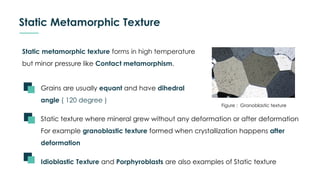
Staticmetamorphic texture forms in high temperature
but minor pressure like Contact metamorphism.
Figure : Granoblastic texture
Grains are usually equant and have dihedral
angle ( 120 degree )
Static texture where mineral grew without any deformation or after deformation
For example granoblastic texture formed when crystallization happens after
deformation
Idioblastic Texture and Porphyroblasts are also examples of Static texture
4.
Tectonics Metamorphic Texture
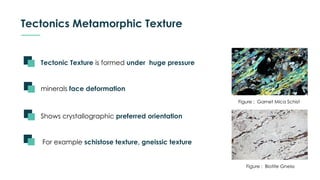
Showscrystallographic preferred orientation
Tectonic Texture is formed under huge pressure
For example schistose texture, gneissic texture
minerals face deformation
Figure : Garnet Mica Schist
Figure : Biotite Gneiss
5.
Types of MetamorphicTexture under Microscope
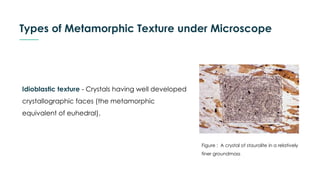
Idioblastic texture - Crystals having well developed
crystallographic faces (the metamorphic
equivalent of euhedral).
Figure : A crystal of staurolite in a relatively
finer groundmass
6.
Types of MetamorphicTexture under Microscope
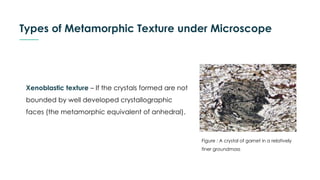
Xenoblastic texture – If the crystals formed are not
bounded by well developed crystallographic
faces (the metamorphic equivalent of anhedral).
Figure : A crystal of garnet in a relatively
finer groundmass
7.
Types of MetamorphicTexture under Microscope
❏ Porphyroblastic texture
❏ Poikiloblastic
❏ Foliated texture
❏ Non foliated textures
Crystalloblastic texture : The texture produced by metamorphic recrystallization of
minerals is referred to as crystalloblastic texture.
Crystalloblastic textures are of the following types :
8.
Types of MetamorphicTexture under Microscope
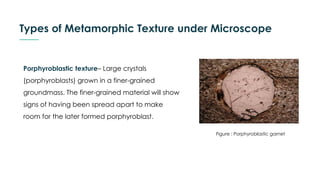
Porphyroblastic texture– Large crystals
(porphyroblasts) grown in a finer-grained
groundmass. The finer-grained material will show
signs of having been spread apart to make
room for the later formed porphyroblast.
Figure : Porphyroblastic garnet
9.
Types of MetamorphicTexture under Microscope
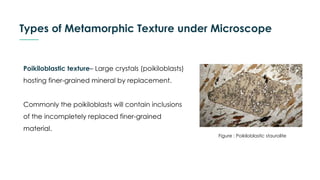
Poikiloblastic texture– Large crystals (poikiloblasts)
hosting finer-grained mineral by replacement.
Commonly the poikiloblasts will contain inclusions
of the incompletely replaced finer-grained
material.
Figure : Poikiloblastic staurolite
10.
Types of MetamorphicTexture under Microscope
Foliated textures – Foliated metamorphic rocks are generally associated with
regional metamorphism. The mineral constituents of foliated metamorphic rocks are
oriented in a parallel or subparallel arrangement due to differential stress/directed
pressure. For examples:
❏ Lepidoblastic Texture
❏ Nematoblastic Texture
11.
Foliated textures
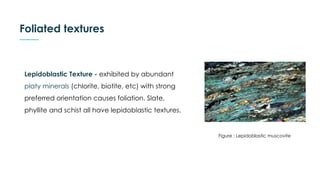
Lepidoblastic Texture- exhibited by abundant
platy minerals (chlorite, biotite, etc) with strong
preferred orientation causes foliation. Slate,
phyllite and schist all have lepidoblastic textures.
Figure : Lepidoblastic muscovite
Types of MetamorphicTexture under Microscope
Non foliated textures – Metamorphic rocks with no visible preferred orientation of
mineral grains have a nonfoliated texture.
Nonfoliated rocks commonly contain equidimensional grains of minerals such as
quartz, calcite, or dolomite. Examples of such rocks are Quartzite and Marble .
Some common textures seen in non foliated rocks are-
❏ Granoblastic texture
❏ Hornfelsic Texture
14.
Non-Foliated textures
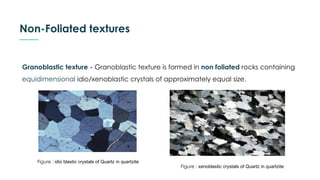
Granoblastic texture- Granoblastic texture is formed in non foliated rocks containing
equidimensional idio/xenoblastic crystals of approximately equal size.
Figure : idio blastic crystals of Quartz in quartzite
Figure : xenoblastic crystals of Quartz in quartzite
15.
Non-Foliated textures
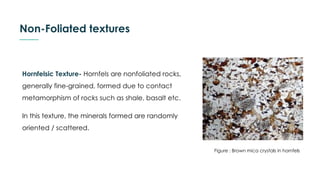
Hornfelsic Texture-Hornfels are nonfoliated rocks,
generally fine-grained, formed due to contact
metamorphism of rocks such as shale, basalt etc.
In this texture, the minerals formed are randomly
oriented / scattered.
Figure : Brown mica crystals in hornfels
16.
Other Metamorphic Texture
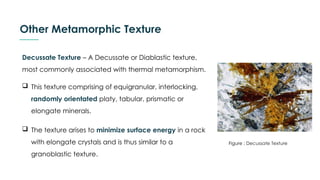
DecussateTexture – A Decussate or Diablastic texture,
most commonly associated with thermal metamorphism.
This texture comprising of equigranular, interlocking,
randomly orientated platy, tabular, prismatic or
elongate minerals.
The texture arises to minimize surface energy in a rock
with elongate crystals and is thus similar to a
granoblastic texture.
Figure : Decussate Texture
17.
Other Metamorphic Texture
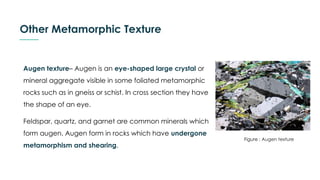
Augentexture– Augen is an eye-shaped large crystal or
mineral aggregate visible in some foliated metamorphic
rocks such as in gneiss or schist. In cross section they have
the shape of an eye.
Feldspar, quartz, and garnet are common minerals which
form augen. Augen form in rocks which have undergone
metamorphism and shearing.
Figure : Augen texture
18.
1.Essentials of Igneousand Metamorphic Petrology by Ronald and Carol Frost
2.INTRODUCTION TO METAMORPHIC TEXTURES - DSPMU UNIVERSITY, RANCHI
3. Pictures taken from
www.earth.ox.ac.uk
http://www.alexstrekeisen.it/
4. An Introduction to Geology by Johnson Affolter Inkenbrandt and Mosher
References





![TEXTURE OF IGNEOUS ROCKS[1].pptx](https://cdn.slidesharecdn.com/ss_thumbnails/textureofigneousrocks1-230427191135-f31996fc-thumbnail.jpg?width=640&height=640&fit=bounds)


![Polymer [ बहुलक ] Chemistry Notes PDF - Irfanullah Mehar - JJ Sir Chemistry.pdf](https://cdn.slidesharecdn.com/ss_thumbnails/polymerchemistrynotespdf-irfanullahmehar-jjsirchemistry-260210172118-3f9b37f7-thumbnail.jpg?width=640&height=640&fit=bounds)


