

Antioxidative Protective Effect of
Hydrated C60 Fullerene in experimental
Streptozotocin-Induced Diabetes

                                                                        Victor Nedzvetsky
                                                                       Grigoriy Andrievsky
                                                                         Tamar Chachibaia
                                                                       Artem Tykhomyrov

 1 Department of Biophysics & Biochemistry, Dniepropetrovsk National University, Ukraine
 2 Institute of Physiologically Active Compounds (IPAC) LLC, Kharkiv, Ukraine
 3 High Technology Medical Center, University Clinic, Tbilisi, Georgia
 4 Palladin Institute of Biochemistry of the National Academy of Sciences of Ukraine (NASU), Kyiv,
 Ukraine


  Journal of Diabetes & Metabolism, 3: 215. 2012, Volume 3 • Issue
 8 • 1000215
Carbon 60 (C60) - Buckminsterfullerene
   Fullerene with 60 atoms in the
    structure of a soccer ball (12
    pentagons and 20 hexagons)
   Buckyball was discovered in 1985
    among the byproducts of laser
    vaporization of graphite in which
    the carbon atoms are arranged in
    sheets.
   Robert F. Curl Jr. and Richard E.
    Smalley and Harold W. Kroto
    awarded the 1996 Nobel Prize for
    Chemistry for their discovery of
    buckminsterfullerene, the scientific
    name for buckyballs.
REVIEW OF 2007–2009 LITERATURE ON
TOXICOLOGICAL AND HEALTH-EFFECTS RELATING
TO SIX NANOMATERIALS
 Report prepared by Professor Brian G. Priestly,
  Director Australian Centre for Human Health
  Risk Assessment (ACHHRA) Monash University
  School of Medicine, Nursing and Health
  Sciences
Scope of the review
 The consultant was asked to draw out
  knowledge of toxicological/health information
  of: fullerenes, carbon nanotubes and nanoforms
  of zinc oxide, titanium dioxide, cerium oxide
  and silver.
Aim of the study
   C60 fullerene and hydrated nanostructures are
    proposed for prevention as well as treatment of
    various pathological conditions caused by oxidative
    stress.
   We studied antioxidative effects of hydrated C60
    fullerene (C60HyFn) in brain and liver of rats with
    experimental streptozotocin (STZ)-induced
    hyperglycemia and evaluated neuroprotective and
    hepatoprotective action of C60HyFn.
Materials and Methods
C60HyFn production, characterization and
preparation of C60FWS
   For C60FWS preparation (C60HyFn water
    solution), C60 fullerene samples with purity of
    more than 99.5% (MER Corporation, Tuscon,
    AZ, USA) have been used. C60FWS was
    produced without using of any solvent or
    chemical modification.
   This method is based on transferring of fullerene
    from organic solution into the aqueous phase
    with ultrasonic treatment with the size of
    C60FWS between 3-36 nm [24-26]..
   Preparation of C60HyFn with concentration of
    8.88×10⁻⁴ M was used as stock solution for
    preparing C60FWS prior the experiment.
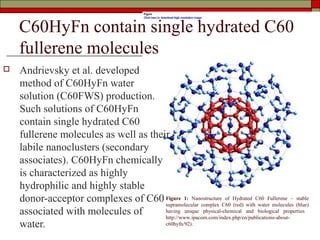
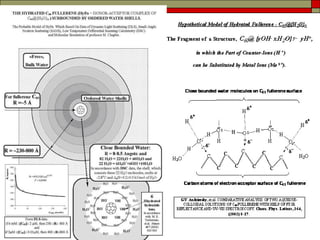
C60HyFn contain single hydrated C60
    fullerene molecules
   Andrievsky et al. developed
    method of C60HyFn water
    solution (C60FWS) production.
    Such solutions of C60HyFn
    contain single hydrated C60
    fullerene molecules as well as their
    labile nanoclusters (secondary
    associates). C60HyFn chemically
    is characterized as highly
    hydrophilic and highly stable
    donor-acceptor complexes of C60 Figure 1: NanostructureC60 Hydrated C60 Fullerene – (blue)
                                       supramolecular complex
                                                                of
                                                                   (red) with water molecules
                                                                                              stable

    associated with molecules of       having unique physical-chemical and biological properties
                                       http://www.ipacom.com/index.php/en/publications-about-
    water.                             c60hyfn/92).
Materials and Methods (continued)
To induce hyperglycemia, male Wistar rats received single
   intraperitoneal (i.p.) injection of STZ in a dose of 45 mg/kg
   body weight (b.w.). Thirty five rats were divided into 5
   groups (7 animals per group):
    Group I (control, saline-injected rats);
    Group II (STZdiabetic rats);
    Group III (rats injected with C60HyFn in a dose of 0.3
       mg/kg b.w. – C60HyFn control);
    Group IV (rats received single i.p. injection of C60HyFn
       in the same dose one week prior STZ injection –
       prophylactic regime);
    Group V (rats received single i.p. injection of C60HyFn in
       the same dose one week after development of stable
       hyperglycemia – therapeutic regime).
Materials and Methods (continued)
The following parameters were assessed in the
  groups of control and experimental animals:
 blood glucose concentration
 levels of end-products of lipid peroxidation
  (LPO)
 carbonylated proteins as markers of protein
  oxidative modifications (POM) in liver and brain
  tissues
 immunohystochemical determination of glial
  fibrillary acidic protein (GFAP) as sensitive
  marker of response to oxidative stress to evaluate
  intensity of astrocyte reactivity in CNS.
 astrocyte reactivity in various brain sections.
Results
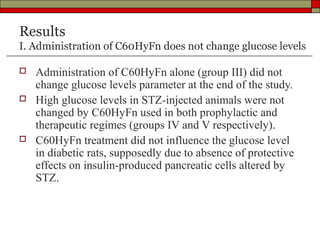
I. Administration of C60HyFn does not change glucose levels

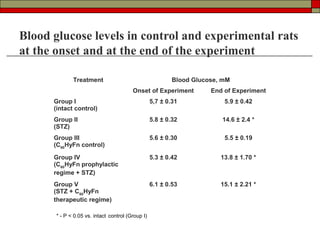
   Administration of C60HyFn alone (group III) did not
    change glucose levels parameter at the end of the study.
   High glucose levels in STZ-injected animals were not
    changed by C60HyFn used in both prophylactic and
    therapeutic regimes (groups IV and V respectively).
   C60HyFn treatment did not influence the glucose level
    in diabetic rats, supposedly due to absence of protective
    effects on insulin-produced pancreatic cells altered by
    STZ.
Blood glucose levels in control and experimental rats
at the onset and at the end of the experiment

              Treatment                                    Blood Glucose, mM
                                         Onset of Experiment          End of Experiment
      Group I                                      5,7 ± 0.31             5.9 ± 0.42
      (intact control)
      Group II                                     5.8 ± 0.32            14.6 ± 2.4 *
      (STZ)
      Group III                                    5.6 ± 0.30             5.5 ± 0.19
      (C60HyFn control)

      Group IV                                     5.3 ± 0.42            13.8 ± 1.70 *
      (C60HyFn prophylactic
      regime + STZ)
      Group V                                      6.1 ± 0.53            15.1 ± 2.21 *
      (STZ + C60HyFn
      therapeutic regime)

       * - P < 0.05 vs. intact control (Group I)
Results
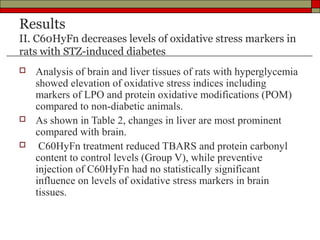
II. C60HyFn decreases levels of oxidative stress markers in
rats with STZ-induced diabetes
   Analysis of brain and liver tissues of rats with hyperglycemia
    showed elevation of oxidative stress indices including
    markers of LPO and protein oxidative modifications (POM)
    compared to non-diabetic animals.
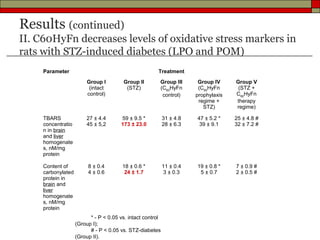
   As shown in Table 2, changes in liver are most prominent
    compared with brain.
    C60HyFn treatment reduced TBARS and protein carbonyl
    content to control levels (Group V), while preventive
    injection of C60HyFn had no statistically significant
    influence on levels of oxidative stress markers in brain
    tissues.
Results (continued)
II. C60HyFn decreases levels of oxidative stress markers in
rats with STZ-induced diabetes (LPO and POM)
     Parameter                                          Treatment
                         Group I        Group II        Group III       Group IV     Group V
                          (intact        (STZ)          (C60HyFn        (C60HyFn      (STZ +
                         control)                        control)      prophylaxis   C60HyFn
                                                                        regime +     therapy
                                                                          STZ)       regime)

     TBARS               27 ± 4.4      59 ± 9.5 *           31 ± 4.8   47 ± 5.2 *    25 ± 4.8 #
     concentratio        45 ± 5,2      173 ± 23.0           28 ± 6.3    39 ± 9.1     32 ± 7.2 #
     n in brain
     and liver
     homogenate
     s, nM/mg
     protein

     Content of          8 ± 0.4        18 ± 0.6 *          11 ± 0.4   19 ± 0.8 *    7 ± 0.9 #
     carbonylated        4 ± 0.6         24 ± 1.7           3 ± 0.3     5 ± 0.7      2 ± 0.5 #
     protein in
     brain and
     liver
     homogenate
     s, nM/mg
     protein
                          * - P < 0.05 vs. intact control
                    (Group I);
                          # - P < 0.05 vs. STZ-diabetes
                    (Group II).
Results (continued)
II. C60HyFn decreases levels of oxidative stress markers in
rats with STZ-induced diabetes (GFAP)
Brain section                                         Treatment


                    Group I          Group II          Group III        Group IV           Group V
                (intact control)      (STZ)        (C60HyFn control)    (C60HyFn        (STZ + C60HyFn
                                                                           prophylaxi          therapy
                                                                           s regime +          regime)
                                                                              STZ)

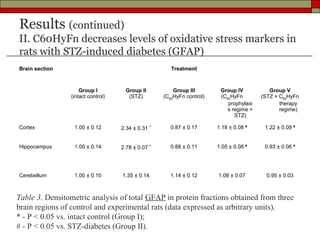
Cortex            1.00 ± 0.12      2.34 ± 0.31 *     0.87 ± 0.17       1.18 ± 0.08 #     1.22 ± 0.09 #


Hippocampus       1.00 ± 0.14      2.78 ± 0.07 *     0.88 ± 0.11       1.05 ± 0.08 #     0.93 ± 0.06 #


Cerebellum        1.00 ± 0.10      1.35 ± 0.14       1.14 ± 0.12       1.08 ± 0.07        0.95 ± 0.03


Table 3. Densitometric analysis of total GFAP in protein fractions obtained from three
brain regions of control and experimental rats (data expressed as arbitrary units).
* - P < 0.05 vs. intact control (Group I);
# - P < 0.05 vs. STZ-diabetes (Group II).
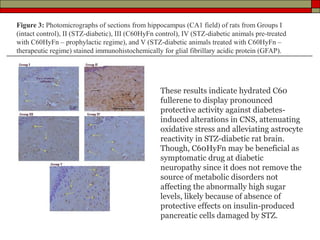
Figure 3: Photomicrographs of sections from hippocampus (CA1 field) of rats from Groups I
(intact control), II (STZ-diabetic), III (C60HyFn control), IV (STZ-diabetic animals pre-treated
with C60HyFn – prophylactic regime), and V (STZ-diabetic animals treated with C60HyFn –
therapeutic regime) stained immunohistochemically for glial fibrillary acidic protein (GFAP).


                                                   These results indicate hydrated C60
                                                   fullerene to display pronounced
                                                   protective activity against diabetes-
                                                   induced alterations in CNS, attenuating
                                                   oxidative stress and alleviating astrocyte
                                                   reactivity in STZ-diabetic rat brain.
                                                   Though, C60HyFn may be beneficial as
                                                   symptomatic drug at diabetic
                                                   neuropathy since it does not remove the
                                                   source of metabolic disorders not
                                                   affecting the abnormally high sugar
                                                   levels, likely because of absence of
                                                   protective effects on insulin-produced
                                                   pancreatic cells damaged by STZ.
Results (continued)
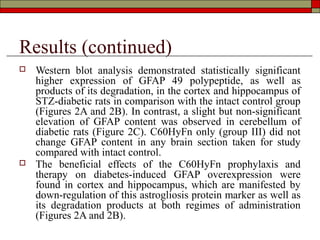
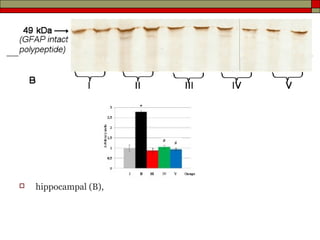
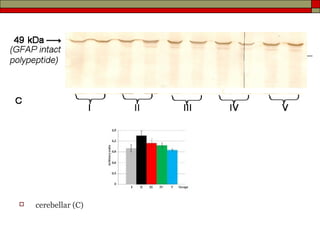
   Western blot analysis demonstrated statistically significant
    higher expression of GFAP 49 polypeptide, as well as
    products of its degradation, in the cortex and hippocampus of
    STZ-diabetic rats in comparison with the intact control group
    (Figures 2A and 2B). In contrast, a slight but non-significant
    elevation of GFAP content was observed in cerebellum of
    diabetic rats (Figure 2C). C60HyFn only (group III) did not
    change GFAP content in any brain section taken for study
    compared with intact control.
   The beneficial effects of the C60HyFn prophylaxis and
    therapy on diabetes-induced GFAP overexpression were
    found in cortex and hippocampus, which are manifested by
    down-regulation of this astrogliosis protein marker as well as
    its degradation products at both regimes of administration
    (Figures 2A and 2B).
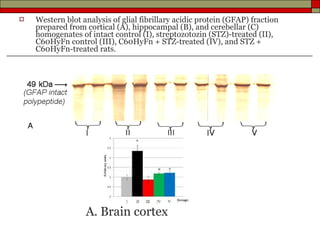
   Western blot analysis of glial fibrillary acidic protein (GFAP) fraction
    prepared from cortical (A), hippocampal (B), and cerebellar (C)
    homogenates of intact control (I), streptozotozin (STZ)-treated (II),
    C60HyFn control (III), C60HyFn + STZ-treated (IV), and STZ +
    C60HyFn-treated rats.


                  A. Brain cortex
   hippocampal (B),
   cerebellar (C)
Conclusion
   Nanostructures of hydrated C60 fullerene
    have been shown to exert beneficial effects in
    brain and liver of rats with STZ-induced
    diabetes mainly through the diminution of
    oxidative stress and can be applied for
    prevention and alleviation of diabetic
    complications such as liver injury and
    neuropathy.
Dep. of Biophysics & Biochemistry,
          Dniepropetrovsk National
                University, Ukraine
Thank you
   Questions?????

Differences in Antioxidant/Protective Efficacy of Hydrated C60 Fullerene Nanostructures in Liver and Brain of Rats with Streptozotocin-Induced Diabetes

  • 1.
    Antioxidative Protective Effectof Hydrated C60 Fullerene in experimental Streptozotocin-Induced Diabetes Victor Nedzvetsky Grigoriy Andrievsky Tamar Chachibaia Artem Tykhomyrov 1 Department of Biophysics & Biochemistry, Dniepropetrovsk National University, Ukraine 2 Institute of Physiologically Active Compounds (IPAC) LLC, Kharkiv, Ukraine 3 High Technology Medical Center, University Clinic, Tbilisi, Georgia 4 Palladin Institute of Biochemistry of the National Academy of Sciences of Ukraine (NASU), Kyiv, Ukraine  Journal of Diabetes & Metabolism, 3: 215. 2012, Volume 3 • Issue 8 • 1000215
  • 2.
    Carbon 60 (C60)- Buckminsterfullerene  Fullerene with 60 atoms in the structure of a soccer ball (12 pentagons and 20 hexagons)  Buckyball was discovered in 1985 among the byproducts of laser vaporization of graphite in which the carbon atoms are arranged in sheets.  Robert F. Curl Jr. and Richard E. Smalley and Harold W. Kroto awarded the 1996 Nobel Prize for Chemistry for their discovery of buckminsterfullerene, the scientific name for buckyballs.
  • 3.
    REVIEW OF 2007–2009LITERATURE ON TOXICOLOGICAL AND HEALTH-EFFECTS RELATING TO SIX NANOMATERIALS  Report prepared by Professor Brian G. Priestly, Director Australian Centre for Human Health Risk Assessment (ACHHRA) Monash University School of Medicine, Nursing and Health Sciences Scope of the review  The consultant was asked to draw out knowledge of toxicological/health information of: fullerenes, carbon nanotubes and nanoforms of zinc oxide, titanium dioxide, cerium oxide and silver.
  • 4.
    Aim of thestudy  C60 fullerene and hydrated nanostructures are proposed for prevention as well as treatment of various pathological conditions caused by oxidative stress.  We studied antioxidative effects of hydrated C60 fullerene (C60HyFn) in brain and liver of rats with experimental streptozotocin (STZ)-induced hyperglycemia and evaluated neuroprotective and hepatoprotective action of C60HyFn.
  • 5.
    Materials and Methods C60HyFnproduction, characterization and preparation of C60FWS  For C60FWS preparation (C60HyFn water solution), C60 fullerene samples with purity of more than 99.5% (MER Corporation, Tuscon, AZ, USA) have been used. C60FWS was produced without using of any solvent or chemical modification.  This method is based on transferring of fullerene from organic solution into the aqueous phase with ultrasonic treatment with the size of C60FWS between 3-36 nm [24-26]..  Preparation of C60HyFn with concentration of 8.88×10⁻⁴ M was used as stock solution for preparing C60FWS prior the experiment.
  • 6.
    C60HyFn contain singlehydrated C60 fullerene molecules  Andrievsky et al. developed method of C60HyFn water solution (C60FWS) production. Such solutions of C60HyFn contain single hydrated C60 fullerene molecules as well as their labile nanoclusters (secondary associates). C60HyFn chemically is characterized as highly hydrophilic and highly stable donor-acceptor complexes of C60 Figure 1: NanostructureC60 Hydrated C60 Fullerene – (blue) supramolecular complex of (red) with water molecules stable associated with molecules of having unique physical-chemical and biological properties http://www.ipacom.com/index.php/en/publications-about- water. c60hyfn/92).
  • 8.
    Materials and Methods(continued) To induce hyperglycemia, male Wistar rats received single intraperitoneal (i.p.) injection of STZ in a dose of 45 mg/kg body weight (b.w.). Thirty five rats were divided into 5 groups (7 animals per group):  Group I (control, saline-injected rats);  Group II (STZdiabetic rats);  Group III (rats injected with C60HyFn in a dose of 0.3 mg/kg b.w. – C60HyFn control);  Group IV (rats received single i.p. injection of C60HyFn in the same dose one week prior STZ injection – prophylactic regime);  Group V (rats received single i.p. injection of C60HyFn in the same dose one week after development of stable hyperglycemia – therapeutic regime).
  • 9.
    Materials and Methods(continued) The following parameters were assessed in the groups of control and experimental animals:  blood glucose concentration  levels of end-products of lipid peroxidation (LPO)  carbonylated proteins as markers of protein oxidative modifications (POM) in liver and brain tissues  immunohystochemical determination of glial fibrillary acidic protein (GFAP) as sensitive marker of response to oxidative stress to evaluate intensity of astrocyte reactivity in CNS.  astrocyte reactivity in various brain sections.
  • 10.
    Results I. Administration ofC60HyFn does not change glucose levels  Administration of C60HyFn alone (group III) did not change glucose levels parameter at the end of the study.  High glucose levels in STZ-injected animals were not changed by C60HyFn used in both prophylactic and therapeutic regimes (groups IV and V respectively).  C60HyFn treatment did not influence the glucose level in diabetic rats, supposedly due to absence of protective effects on insulin-produced pancreatic cells altered by STZ.
  • 11.
    Blood glucose levelsin control and experimental rats at the onset and at the end of the experiment Treatment Blood Glucose, mM Onset of Experiment End of Experiment Group I 5,7 ± 0.31 5.9 ± 0.42 (intact control) Group II 5.8 ± 0.32 14.6 ± 2.4 * (STZ) Group III 5.6 ± 0.30 5.5 ± 0.19 (C60HyFn control) Group IV 5.3 ± 0.42 13.8 ± 1.70 * (C60HyFn prophylactic regime + STZ) Group V 6.1 ± 0.53 15.1 ± 2.21 * (STZ + C60HyFn therapeutic regime) * - P < 0.05 vs. intact control (Group I)
  • 12.
    Results II. C60HyFn decreaseslevels of oxidative stress markers in rats with STZ-induced diabetes  Analysis of brain and liver tissues of rats with hyperglycemia showed elevation of oxidative stress indices including markers of LPO and protein oxidative modifications (POM) compared to non-diabetic animals.  As shown in Table 2, changes in liver are most prominent compared with brain.  C60HyFn treatment reduced TBARS and protein carbonyl content to control levels (Group V), while preventive injection of C60HyFn had no statistically significant influence on levels of oxidative stress markers in brain tissues.
  • 13.
    Results (continued) II. C60HyFndecreases levels of oxidative stress markers in rats with STZ-induced diabetes (LPO and POM) Parameter Treatment Group I Group II Group III Group IV Group V (intact (STZ) (C60HyFn (C60HyFn (STZ + control) control) prophylaxis C60HyFn regime + therapy STZ) regime) TBARS 27 ± 4.4 59 ± 9.5 * 31 ± 4.8 47 ± 5.2 * 25 ± 4.8 # concentratio 45 ± 5,2 173 ± 23.0 28 ± 6.3 39 ± 9.1 32 ± 7.2 # n in brain and liver homogenate s, nM/mg protein Content of 8 ± 0.4 18 ± 0.6 * 11 ± 0.4 19 ± 0.8 * 7 ± 0.9 # carbonylated 4 ± 0.6 24 ± 1.7 3 ± 0.3 5 ± 0.7 2 ± 0.5 # protein in brain and liver homogenate s, nM/mg protein * - P < 0.05 vs. intact control (Group I); # - P < 0.05 vs. STZ-diabetes (Group II).
  • 14.
    Results (continued) II. C60HyFndecreases levels of oxidative stress markers in rats with STZ-induced diabetes (GFAP) Brain section Treatment Group I Group II Group III Group IV Group V (intact control) (STZ) (C60HyFn control) (C60HyFn (STZ + C60HyFn prophylaxi therapy s regime + regime) STZ) Cortex 1.00 ± 0.12 2.34 ± 0.31 * 0.87 ± 0.17 1.18 ± 0.08 # 1.22 ± 0.09 # Hippocampus 1.00 ± 0.14 2.78 ± 0.07 * 0.88 ± 0.11 1.05 ± 0.08 # 0.93 ± 0.06 # Cerebellum 1.00 ± 0.10 1.35 ± 0.14 1.14 ± 0.12 1.08 ± 0.07 0.95 ± 0.03 Table 3. Densitometric analysis of total GFAP in protein fractions obtained from three brain regions of control and experimental rats (data expressed as arbitrary units). * - P < 0.05 vs. intact control (Group I); # - P < 0.05 vs. STZ-diabetes (Group II).
  • 15.
    Figure 3: Photomicrographsof sections from hippocampus (CA1 field) of rats from Groups I (intact control), II (STZ-diabetic), III (C60HyFn control), IV (STZ-diabetic animals pre-treated with C60HyFn – prophylactic regime), and V (STZ-diabetic animals treated with C60HyFn – therapeutic regime) stained immunohistochemically for glial fibrillary acidic protein (GFAP). These results indicate hydrated C60 fullerene to display pronounced protective activity against diabetes- induced alterations in CNS, attenuating oxidative stress and alleviating astrocyte reactivity in STZ-diabetic rat brain. Though, C60HyFn may be beneficial as symptomatic drug at diabetic neuropathy since it does not remove the source of metabolic disorders not affecting the abnormally high sugar levels, likely because of absence of protective effects on insulin-produced pancreatic cells damaged by STZ.
  • 16.
    Results (continued)  Western blot analysis demonstrated statistically significant higher expression of GFAP 49 polypeptide, as well as products of its degradation, in the cortex and hippocampus of STZ-diabetic rats in comparison with the intact control group (Figures 2A and 2B). In contrast, a slight but non-significant elevation of GFAP content was observed in cerebellum of diabetic rats (Figure 2C). C60HyFn only (group III) did not change GFAP content in any brain section taken for study compared with intact control.  The beneficial effects of the C60HyFn prophylaxis and therapy on diabetes-induced GFAP overexpression were found in cortex and hippocampus, which are manifested by down-regulation of this astrogliosis protein marker as well as its degradation products at both regimes of administration (Figures 2A and 2B).
  • 17.
    Western blot analysis of glial fibrillary acidic protein (GFAP) fraction prepared from cortical (A), hippocampal (B), and cerebellar (C) homogenates of intact control (I), streptozotozin (STZ)-treated (II), C60HyFn control (III), C60HyFn + STZ-treated (IV), and STZ + C60HyFn-treated rats. A. Brain cortex
  • 18.
    hippocampal (B),
  • 19.
    cerebellar (C)
  • 20.
    Conclusion  Nanostructures of hydrated C60 fullerene have been shown to exert beneficial effects in brain and liver of rats with STZ-induced diabetes mainly through the diminution of oxidative stress and can be applied for prevention and alleviation of diabetic complications such as liver injury and neuropathy.
  • 21.
    Dep. of Biophysics& Biochemistry, Dniepropetrovsk National University, Ukraine
  • 22.
    Thank you  Questions?????