ISLAMIC
FINANCIAL
ACCOUNTING
AAOIFI
VS
IFRS
AAOIFI vs IFRS – ISLAMIC FINANCIAL ACCOUNTING
INTRODUCTION
Prohibition of interest in financial dealings is the primary reason why Islamic
financial accounting methods and principles have to be carefully distinguished
from their conventional counterparts
Separate accounting treatment and disclosure requirement are now required by
AAOIFI (Accounting and Auditing for Islamic Financial Institution) according to
the nature of Shari’a compliant product in order to present true and fair view of the
transactions to the stakeholders.
Standards setting body, AAOIFI, has till now issued 26 Accounting Standards, 48
Shari’a Standards, 5 Auditing Standards, 7 Governance Standards & 2 Ethics
Standards.
AAOIFI vs IFRS – ISLAMIC FINANCIAL ACCOUNTING
OBJECTIVES OF THE WORKSHOP
This workshop is designed to provide the participants with an understanding
of the followings:
- Why there is need for Islamic Accounting Standards.
- Composition & Structure Standards Setting Body – AAOIFI (Accounting
and Auditing for Islamic Financial Institution).
- Key Islamic Products Used by the Islamic banking Industry.
- Difference between Framework of AAOIFI and IFRS.
- Difference between Financial Accounting Standards Issued by AAOIFI and
International Financial Reporting Standards issued by IASB (International
Accounting Standards Board).
- Differences between the Financial Accounting Standards Issued by AAOIFI
& Islamic Financial Accounting Standards Issued by Institute of Chartered
Accountants of Pakistan (ICAP).
- Key Differences between the Financial Statements of Islamic Banks and
Conventional Banks
AAOIFI vs IFRS – ISLAMIC FINANCIAL ACCOUNTING
WHY THERE IS NEED FOR ISLAMIC ACCOUNTING STANDARDS
Prohibition of interest in financial dealings is the primary reason why
Islamic financial accounting methods and principles have to be carefully
distinguished from their conventional counterparts, but there are various
other issues and fine details which make up for the case of Islamic financial
accounting standards.
Two most discussed Concerns are as follows :
- Substance over form
- Time Value of Money
AAOIFI vs IFRS – ISLAMIC FINANCIAL ACCOUNTING
Difference between Financial Accounting Standards Issued by AAOIFI
and International Financial Reporting Standards issued by IASB
(International Accounting Standards Board)
1. Different Objectives of Financial Reporting :
The fundamental differences between IFRS and AAOIFI accounting standards
arise from the different objectives of accounting, as seen by the two standard
setting bodies.
The objectives of IFRS :
IFRS are published by the International Accounting Standards Board (IASB).
In 2001 the IASB adopted its "Framework for the Preparation and
Presentation of Financial Statements." Paragraph 12 states:
"The objective of financial statements is to provide information about the
financial position, performance and changes in financial position of an entity
that is useful to a wide range of users in making economic decisions.”
AAOIFI vs IFRS – ISLAMIC FINANCIAL ACCOUNTING
In paragraph 33 and 34 the framework emphasizes the need to faithfully
represent the transactions that have taken place:
"To be reliable, information must represent faithfully the transactions and
other events it either purports to represent or could reasonably be expected
to represent. Thus, for example, a balance sheet should represent faithfully
the transactions and other events that result in assets, liabilities and equity
of the entity at the reporting date which meet the recognition criteria.
Most financial information is subject to some risk of being less than a faithful
representation of that which it purports to portray. This is not due to bias,
but rather to inherent difficulties either in identifying the transactions and
other events to be measured or in devising and applying measurement and
presentation techniques that can convey messages that correspond with
those transactions and events. In certain cases, the measurement of the
financial effects of items could be so uncertain that entities generally would
not recognise them in the financial statements; for example, although most
entities generate goodwill internally over time, it is usually difficult to
identify or measure that goodwill reliably. In other cases, however, it may be
relevant to recognise items and to disclose the risk of error surrounding
their recognition and measurement."
AAOIFI vs IFRS – ISLAMIC FINANCIAL ACCOUNTING
Paragraph 35 emphasises the importance of substance over form:
"If information is to represent faithfully the transactions and other events
that it purports to represent, it is necessary that they are accounted for and
presented in accordance with their substance and economic reality and not
merely their legal form. The substance of transactions or other events is not
always consistent with that which is apparent from their legal or contrived
form. For example, an entity may dispose of an asset to another party in such
a way that the documentation purports to pass legal ownership to that party;
nevertheless, agreements may exist that ensure that the entity continues to
enjoy the future economic benefits embodied in the asset. In such
circumstances, the reporting of a sale would not represent faithfully the
transaction entered into (if indeed there was a transaction)."
AAOIFI vs IFRS – ISLAMIC FINANCIAL ACCOUNTING
The objective of AAOIFI
Statement of Financial Accounting No. 1
“Conceptual Framework for Financial Reporting By Islamic Financial
Institutions”
Para 3.1 Objectives of Financial Accounting
“To determine the rights and obligations of all interested parties, including
those rights and obligations resulting from incomplete transactions and
other events, in accordance with the principal of Islamic Sharia and its
concept of fairness, clarity and compliance with ethical values.”
“To contribute to the enhancement of the managerial and productive
capabilities of IFI and encourage compliance with its established goals and
policies and, above all, compliance with Sharia in all transactions and
events”.
AAOIFI vs IFRS – ISLAMIC FINANCIAL ACCOUNTING
Para 3.2 Objectives of Financial Reports
Financial reports provide the following information:
“Information about the IFI’s Compliance with Islamic Sharia’ and its
objectives and to establish such compliance; and information regarding the
manner in which prohibited earnings, if any, were recorded and dealt with.
Summary of the different objectives
The above objectives can be summarized as follows:
- IFRS focuses on reporting the economic substance of the transactions
undertaken.
- AAOIFI’s primary aim is that the IFI’s accounting should demonstrate its
compliance with Shariah.
Accordingly it should be no surprise if IFRS and AAOIFI standards give rise to
different reporting when applied to the same transactions. Many examples
can be found where IFRS and AAOIFI result in different accounting
treatments for identical transactions
AAOIFI vs IFRS – ISLAMIC FINANCIAL ACCOUNTING
2. Recognition of Revenue as per IAS-18 & FAS -02.
AAOIFI has been less welcoming to two key concepts in IFRS: substance over
form and time value of money.
Accordingly, a financial statement prepared in accordance with AAOIFI
standards can yield vastly different results from an IFRS-compliant one.
Take, for example, the sale of a house by a bank to a customer. Let us say in
2001 a bank buys a house at $500,000 and sells it to the customer at
$696,650. The customer will pay in monthly installments over a period of 10
years. If the overall economic objective was ignored and only the legal
contract considered, it could be said that this is a sale of goods where the
gross profit is $196,650. However, it would be most unusual for a bank to
immediately report a $196,650 profit.
AAOIFI appears to agree that recognition of profit is related to the
repayment period, and under its Financial Accounting Standard (FAS) No. 2,
Murabaha and Murabaha to the Purchase Orderer, the profit of $196,650
would either be recognised proportionately over the repayment period or, in
a departure from the accruals concept, as and when installments are
received.
AAOIFI vs IFRS – ISLAMIC FINANCIAL ACCOUNTING
The concept of time value of money is, conversely, central to IFRS
requirements for recognition of a financing element. Under IAS 18, Revenue,
(paragraphs 29 and 30) when there is a difference between the fair value
(i.e. $ 500,000) and the nominal amount of consideration (i.e. $696,650) the
difference (i.e. $196,650) is recognised as interest revenue (or ‘financing’
revenue, for the squeamish) using the effective interest method under IAS
39 (para 9, AG5- to AG8), Financial Instruments: Recognition & Measurement.
The effective interest method amortises the cost of the financial asset (i.e.
$500,000) and allocates the interest income (i.e. $196,650) over the relevant
period (i.e. 10 years), based on the effective interest rate (which, using a
calculator, comes to about 7%).
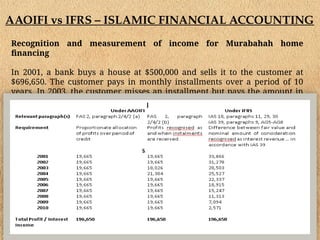
The table below provides an example of how different the pattern of income
recognition can be under AAOIFI and IFRS. To further illustrate how even
within AAOFI standards there may be differing outcomes, the table shows
both AAOIFI recognition based on proportionate allocation and recognition
based on actual receipts, given the scenario that the customer misses an
installment in 2003 but pays-up in 2004.
AAOIFI vs IFRS – ISLAMIC FINANCIAL ACCOUNTING
Although the financial accounting standards (FAS) of AAOIFI essentially
refer to fair value as the ‘value agreed between the partners’ in a
transaction, there is little reference to the measurement of this fair value in
the absence of active markets – and whether the fair value could be derived
by reference to net present value of future cash flows. Article 8/8 of AAOIFI
Shari’a standard 13 on Mudaraba is, however, more explicit: ‘In measuring
receivables, neither time value (interest rate) nor discount on current value
for extension of period of payment shall be taken into consideration’.
Crucially, AAOIFI does not seem to acknowledge that the profit represents a
financing element that is related to a principal disbursement. AAOIFI’s
requirement for proportionate allocation is often taken by stakeholders to
mean a simple arithmetic division of total profit over the number of
installments during the repayment period. This is because FAS 2 was
prepared in accordance with AAOIFI’s original conceptual framework,
which propounded that “money does not have a time-value”. Hence, AAOIFI
does not require the pattern of profit recognition to be related to the amount
of principal outstanding.
AAOIFI vs IFRS – ISLAMIC FINANCIAL ACCOUNTING
Recognition and measurement of income for Murabahah home
financing
In 2001, a bank buys a house at $500,000 and sells it to the customer at
$696,650. The customer pays in monthly installments over a period of 10
years. In 2003, the customer misses an installment but pays the amount in
2004. Below are the possible ways that the bank could recognise and
measure income over the 10 years.
AAOIFI vs IFRS – ISLAMIC FINANCIAL ACCOUNTING
3. Deposits & Equity of Investment Account Holders
Deposits of Conventional Banks are classified as “Liability” Under IFRS
Whereas “Deposits” (other than Current Accounts) of Islamic Banks are
categorized as “Equity of Investment Accounts and their Equivalents”.
The term ‘equivalent’ accounts is used in the standards to allow for similar
investments like Term Deposits Receipts, Certificate of Investment etc. issued
by Islamic banks at face value and share in the bank’s profits.
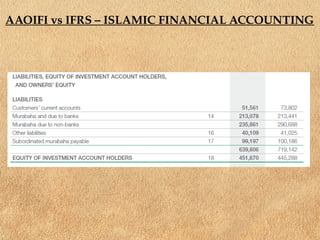
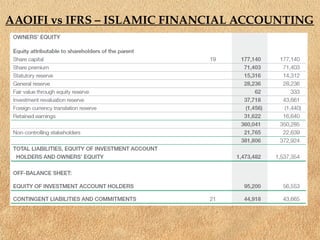
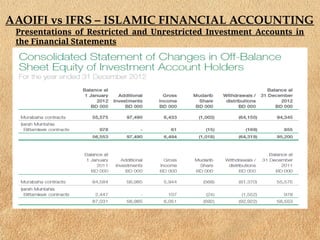
There are two major categories of investment Accounts Classified as under:
Unrestricted investment accounts and their equivalents
These are funds received by the Islamic bank from investors, whereby the
Islamic bank is held free to invest those funds without prior restrictions,
including the mixing of these funds with the bank’s own investment.
AAOIFI vs IFRS – ISLAMIC FINANCIAL ACCOUNTING
Restricted investments and their equivalents
The Islamic bank acts only as manager - agent or non-participating Mudarib
– it may not be authorized to mix its own funds with those of investors
without prior permission of the investors. In additions there may be other
restrictions which investment holders may impose. For Example,
investment account holders may require the Islamic Bank not to invest their
funds in certain industries.
Under IFRS, these AAOIFI definitions and treatment would not apply. Firstly,
IFRS only recognises three elements of the balance sheet – asset, liability,
equity – it does not have an intermediary category between liability and
equity.
Secondly, IFRS does not attach much significance to how broad or narrow
the investment mandate is. Instead, an investment account would be
reported on balance sheet if it gives rise to a liability under IAS 37,
Provisions, Contingent Liabilities and Contingent Assets, or a financial
liability under IAS 32, Financial Instruments: Presentation.
AAOIFI vs IFRS – ISLAMIC FINANCIAL ACCOUNTING
If the investment account does not give rise to a liability for the bank, then
the investment account may be reported in a separate financial statement.
But the reporting bank must then consider whether it has control over the
investment account, and must consolidate the investment account if it does.
IAS 27, Consolidated and Separate Financial Statements, defines control as
“the power to govern the financial and operating policies of an entity so as
to obtain benefits from its activities”. From 1 January 2013, IFRS 10
Consolidated Financial Statements will replace IAS 27’s consolidation
requirements. IFRS 10 provides much more detailed guidance on how to
apply the principle of control.
AAOIFI vs IFRS – ISLAMIC FINANCIAL ACCOUNTING
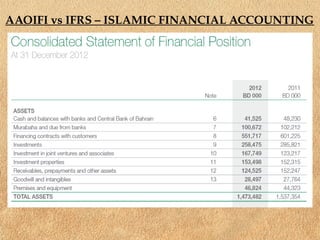
Presentations of Restricted and Unrestricted Investment Accounts in
the Financial Statements
AAOIFI vs IFRS – ISLAMIC FINANCIAL ACCOUNTING
4. Accounting Under IAS -17 VS FAS -10
One of the most common structures used in Islamic finance is the Ijara – a
form of leasing arrangement. The pure Ijara is essentially an operating lease
and there would appear to be little conflict in accounting for this (either for
the lessor or the lessee) under the requirements of IAS17.
Increasingly used forms of leasing by IFIs are the ijara muntahia bittamleek
(ijara MB) or ijara wa iqtina, which are similar to a hire purchase agreement
popular in conventional finance. This is essentially a form of financing
which, under IFRS, is treated as a finance lease because, as with a hire
purchase agreement, the risks and rewards associated with owning the asset
are in substance transferred to the lessee. Thus under IAS17 the asset would
be booked as such by the lessee, while the lessor (the financer) would book a
receivable for the rent and related interest receivable.
AAOIFI vs IFRS – ISLAMIC FINANCIAL ACCOUNTING
By contrast, under both IFAS2, Ijarah (as issued by the Institute of Chartered
Accountants of Pakistan) and AAOIFI’s FAS8, the legal form of the contract is
paramount, meaning that the ownership of the asset remains with the
lessor, until legal title is transferred at the end of the lease period. In this
case the IFI would remain the owner, and record the asset on its balance
sheet in the same way as an operating lease or operating Ijara.
AAOIFI’s FAS 8 Ijarah and Ijarah Muntahia Bittamleek, paragraph 22 on
‘Ijarah Muntahia Bittamleek in the financial statements of the Islamic bank
as a lessor’ states:
“Leased assets shall be presented in the lessor’s statement of financial
position under Ijarah Muntahia Bittamleek Assets and shall be measured at
their book value.”
Then depending on which of four recommended ways the underlying asset
is transferred to the lessee, the transfer would be accounted as follows:
AAOIFI vs IFRS – ISLAMIC FINANCIAL ACCOUNTING
Transfer through gift
“Leased assets shall be depreciated according to the lessor’s normal
depreciation policy for similar asset. However, no residual valued of leased
assets shall be subtracted in determining the depreciable cost of these assets
since they are to be transferred to the lessee as a gift.” [AAOIFI FAS 8,
paragraph 27]
Transfer through sale for a token consideration or other amount as
specified in the lease
“…The consideration for the transfer of title in a leased asset at the
conclusion of a lease (i.e., the asset’s residual value to the lessor) shall be
subtracted in determining the depreciable cost of these assets. “[AAOIFI FAS
8, paragraph 34].
AAOIFI vs IFRS – ISLAMIC FINANCIAL ACCOUNTING
Transfer through sale prior to the end of the lease term for a price
equivalent to the remaining Ijarah installments
“Legal title shall pass to the lessee when he buys the leased assets prior to
the end of the lease term for a price that is equivalent to the remaining
Ijarah installments and the lessor shall recognize any gain or loss resulting
from the difference between the selling price and the net book value.
[AAOIFI FAS 8, paragraph 44]
Transfer through gradual sale of the leased asset
“The book value of the sold portion of the asset shall be removed from the
leased assets account and the lessor shall recognise in its income statement
any gain or loss
resulting from the difference between the selling price and the net book
value.” [AAOIFI FAS 8, paragraph 49]
“Upon the full payment of both the Ijarah instalments and the price of the
purchased portion of the leased assets, all Ijarah related accounts shall be
closed.” [AAOIFI FAS 8,paragraph 52]
AAOIFI vs IFRS – ISLAMIC FINANCIAL ACCOUNTING
The recommended accounting treatment described above is in conflict with
IAS 17, paragraph 36 which would likely require such an arrangement to be
treated as a finance lease:
“Lessors shall recognize assets held under a finance lease in their statement
of financial position and present them as a receivable at an amount equal to
the net investment in the lease.”
AAOIFI vs IFRS – ISLAMIC FINANCIAL ACCOUNTING
Provisions and reserves
Profit-sharing reserves
The practice of setting aside income is reflected in AAOIFI FAS 11 Provisions
and Reserves. Paragraphs 16 and 17 provide the following descriptions of
PER and IRR:
“PROFIT EQUALISATION RESERVE”
This is the amount appropriated by the Islamic bank out of the mudaraba
income, before allocating the mudarib share, in order to maintain a certain
level of return on investment for investment account holders and increase
owners’ equity.
In profit equalisation reserves (PER), the reserves are set aside from profits
before applying the profit-sharing distribution. Typically, in such
arrangements the IFI gives up a part, or its entire share, of profits, in order
to match current market returns.
“INVESTMENT RISK RESERVE”
AAOIFI vs IFRS – ISLAMIC FINANCIAL ACCOUNTING
This is an amount appropriated by the Islamic bank out of the income of
investment account holders, after allocating the Mudarib share, in order to
cater against future losses for investment account holders.”
Under strict Shari’a rules if there is a loss from a mudaraba investment, it is
only the depositing customer who bears the full loss. In practice, in such
circumstances or when the overall profit levels are low, as was the case
during the recent financial crisis, IFIs have forgone their own share of
profits in favour of their customers.
The accounting for these reserves under IFRS would depend on whether the
IFI is deemed to have an obligation (either contractual or constructive) to
pay depositors from the reserve. A further issue is that in the case of PER in
particular, the IFI’s share of the profits is included, thereby effectively
creating an expected loss provision, currently not permitted under IAS39.
AAOIFI vs IFRS – ISLAMIC FINANCIAL ACCOUNTING
6. Qard: A loan. Or is it?
One of the hottest current issues in Islamic financial reporting does not
relate to banking, but to takaful. The issue is how to account for qard, an
interest-free loan that a takaful operator extends to its participants’ funds.
In takaful, individuals do not buy policies from an insurer. Instead, they
participate in a fund by pooling their monies and agreeing to mutually
indemnify each other should a specified event befall any one of them. The
fund is managed by a takaful operator, an entity that is usually licensed
under similar circumstances as an insurer. In many jurisdictions, a takaful
operator is required to extend qard if there is a deficit in the participants’
fund. In Malaysia, takaful entities have usually presented qard as a loan
measured at cost. This treatment was allowed by Bank Negara Malaysia
under the previous reporting regime, and hence was readily accepted by
stakeholders.
AAOIFI vs IFRS – ISLAMIC FINANCIAL ACCOUNTING
The changeover to IFRS, however, has put takaful entities in a quandary.
There is no such thing as a loan measured at cost under IFRS. At a glance,
qard appears to be a financial instrument subject to IAS 39, Financial
Instruments: Recognition and Measurement. But under IAS 39, a financial
instrument must be measured at either amortised cost or at fair value; there
is no allowance for measurement at cost. Moreover, qard does not fit any of
the definitions of the four categories of financial instruments.
Qard from a takaful operator to a participants’ fund often carry unique
terms that make it different from the financial instruments under IAS 39.
For example, in many jurisdictions, repayment of qard is subordinated to
other debts of the participants’ funds. Hence, it could be said that qard
represents a residual interest in the participants’ fund. This feature may
render qard more similar to equity rather than a financial asset to the
takaful operator. Thus, there is an alternative view that qard should be
classified similar to investment in a subsidiary under IAS 27, Consolidated
and Separate Financial Statements.
AAOIFI vs IFRS – ISLAMIC FINANCIAL ACCOUNTING
Relevant stakeholders are discussing the treatment of qard. Many
discussants indicate a preference for classification as investment in
subsidiary, which happily allows qard to continue to be measured at cost.
AAOIFI vs IFRS – ISLAMIC FINANCIAL ACCOUNTING
7. Treatment of Zaka FAS No.09
FAS No. 01 “Conceptual Framework for Financial Reporting by Islamic
Financial Institutions”
Objectives for Financial Reports - Para 3.2.3 requires that “Financial report
should provide information to assist in determination of ZAKA.
FAS No. 09 requires that zakah should be treated as expenses.
IAS 2 Inventories - Measurement of Inventories Requires that
“Inventories shall be measured at the lower of cost and net realisable
value”.
Zakat is computed based on the current (fair) values of an entity’s assets.
Under IAS 2, the fair value of inventories may not be disclosed to the user.
AAOIFI vs IFRS – ISLAMIC FINANCIAL ACCOUNTING
Accounting for Investment in Musharaka & Mudaraba & Sukuk
Some Islamic financial institutions may provide funding to an entity
through the use of a partnership contract, e.g. Mudaraba or Musharaka.
The structuring of Sukuk often involves the transfer of an asset by an
originator into a special purpose entity (“SPE”). In some circumstances, the
SPE may need to be consolidated with the originator. The contractual
arrangements may need to be examined to assess whether the IFI has
- Significant influence over the entity (IAS – 28 - Investments in Associates) or
- Joint control over the entity (IAS – 31 - Interests in Joint Ventures) or
- Control over the entity (IAS – 27 - Consolidated and Separate Financial
Statements), and consequently a subsidiary.
AAOIFI vs IFRS – ISLAMIC FINANCIAL ACCOUNTING
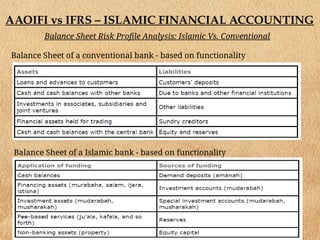
Balance Sheet Risk Profile Analysis: Islamic Vs. Conventional
Balance Sheet of a conventional bank - based on functionality
Balance Sheet of a Islamic bank - based on functionality
AAOIFI vs IFRS – ISLAMIC FINANCIAL ACCOUNTING
The funding structure of a bank directly affects its cost of operation and
therefore determines a bank's potential profit and level of risk. The
structure of a bank's liabilities also reflects its specific asset-liability and risk
management policies.
When compared with conventional banks, balance sheet risk profile of
Islamic banks is different. First, the foremost feature of an Islamic bank is
the 'pass-through' nature of the balance sheet. This feature removes the
typical asset- liability mismatch exposure of a conventional bank, as the
Islamic bank's depositors' return is linked to the return on the assets of the
bank. However, this feature also introduces some operational issues, such as
estimation and accrual of ex-post returns and the treatment of intra-period
withdrawal of deposits.
Second, the nature of assets of two institutions is different. Whereas a
conventional bank tends to stay with fixed income very low credit risk debt
securities, an Islamic bank's assets are concentrated on the asset-based
investments which has credit risk but are also backed by a real asset. As a
result, the lending capacity of the Islamic banking sector (at least for
commercial banks) is bound by the availability of real assets in the economy.
Thus, there is no leveraged credit creation.
AAOIFI vs IFRS – ISLAMIC FINANCIAL ACCOUNTING
Third, the assets of Islamic banks contain financing assets where tangible
goods and commodities are purchased and sold to the customers. This
practice creates distinct exposures. For example, in case of conventional
banking, the asset is financed by a loan from the bank to the customer
whereas in case of an Islamic bank, the asset and the financing are coupled
together. The bank is not limited to the exposure as a financier but can
develop additional exposures resulting from dealing with physical assets.
Another feature which distinguishes the risks of an Islamic bank from a
conventional bank is the general lack of liquid securities on the asset side.
This feature is not a design issue but is a temporal phenomenon until a well-
functioning securities market for Shari'a-compliant instruments is
developed.
AAOIFI vs IFRS – ISLAMIC FINANCIAL ACCOUNTING
Finally, due to prohibition of interest, Islamic banks cannot issue debt to
finance the assets which consequently discourages creation of leverage. Due
to the lack of leverage, Islamic banks can be considered less risky during a
time of financial crisis. The current financial crisis was precipitated by
excessive leverage and complexity in the financial system, which had
developed multiple layers of intermediaries. Hence, the financing - or the
claims on assets - became remote from the underlying assets. For Islamic
banks, the financial intermediary is closely associated with the asset and is
able to perform better monitoring of the asset as well as the obligor. These
features can enhance the stability of the banking system.
AAOIFI vs IFRS – ISLAMIC FINANCIAL ACCOUNTING
Risk Return Theory - Islamic Bank vs. Conventional Banks
Risk Return Theory states that “Higher the risk, higher the expected return”.
However, this assumption seems less valid when return of deposit holder of
Islamic banks are compared with similar conventional banks.
The risk of deposit holder (Investment Account Holder) of Islamic Bank is
much higher (where the principal and the profit is not guaranteed unless
the gross negligence of Islamic Bank as Mudarib) than the risk carried by
the deposit holder of conventional banks (where the principal and interest
are guaranteed by the bank).
Whereas the expected return of both the depositor of Islamic and
Conventional Banks are more or less the same. In Some countries like
Pakistan, the expected & actual return to deposit holder of Islamic banks
are far less than the expected & actual return to the deposit holder of
Conventional bank.
May Allah guide us all towards the right path, to the
path that pleases the Almighty and the one that
leads us to Jannah! Ameen

Differences AAOIFI & IFRS Sharia standards

  • 1.
  • 2.
    AAOIFI vs IFRS– ISLAMIC FINANCIAL ACCOUNTING INTRODUCTION Prohibition of interest in financial dealings is the primary reason why Islamic financial accounting methods and principles have to be carefully distinguished from their conventional counterparts Separate accounting treatment and disclosure requirement are now required by AAOIFI (Accounting and Auditing for Islamic Financial Institution) according to the nature of Shari’a compliant product in order to present true and fair view of the transactions to the stakeholders. Standards setting body, AAOIFI, has till now issued 26 Accounting Standards, 48 Shari’a Standards, 5 Auditing Standards, 7 Governance Standards & 2 Ethics Standards.
  • 3.
    AAOIFI vs IFRS– ISLAMIC FINANCIAL ACCOUNTING OBJECTIVES OF THE WORKSHOP This workshop is designed to provide the participants with an understanding of the followings: - Why there is need for Islamic Accounting Standards. - Composition & Structure Standards Setting Body – AAOIFI (Accounting and Auditing for Islamic Financial Institution). - Key Islamic Products Used by the Islamic banking Industry. - Difference between Framework of AAOIFI and IFRS. - Difference between Financial Accounting Standards Issued by AAOIFI and International Financial Reporting Standards issued by IASB (International Accounting Standards Board). - Differences between the Financial Accounting Standards Issued by AAOIFI & Islamic Financial Accounting Standards Issued by Institute of Chartered Accountants of Pakistan (ICAP). - Key Differences between the Financial Statements of Islamic Banks and Conventional Banks
  • 4.
    AAOIFI vs IFRS– ISLAMIC FINANCIAL ACCOUNTING WHY THERE IS NEED FOR ISLAMIC ACCOUNTING STANDARDS Prohibition of interest in financial dealings is the primary reason why Islamic financial accounting methods and principles have to be carefully distinguished from their conventional counterparts, but there are various other issues and fine details which make up for the case of Islamic financial accounting standards. Two most discussed Concerns are as follows : - Substance over form - Time Value of Money
  • 5.
    AAOIFI vs IFRS– ISLAMIC FINANCIAL ACCOUNTING Difference between Financial Accounting Standards Issued by AAOIFI and International Financial Reporting Standards issued by IASB (International Accounting Standards Board) 1. Different Objectives of Financial Reporting : The fundamental differences between IFRS and AAOIFI accounting standards arise from the different objectives of accounting, as seen by the two standard setting bodies. The objectives of IFRS : IFRS are published by the International Accounting Standards Board (IASB). In 2001 the IASB adopted its "Framework for the Preparation and Presentation of Financial Statements." Paragraph 12 states: "The objective of financial statements is to provide information about the financial position, performance and changes in financial position of an entity that is useful to a wide range of users in making economic decisions.”
  • 6.
    AAOIFI vs IFRS– ISLAMIC FINANCIAL ACCOUNTING In paragraph 33 and 34 the framework emphasizes the need to faithfully represent the transactions that have taken place: "To be reliable, information must represent faithfully the transactions and other events it either purports to represent or could reasonably be expected to represent. Thus, for example, a balance sheet should represent faithfully the transactions and other events that result in assets, liabilities and equity of the entity at the reporting date which meet the recognition criteria. Most financial information is subject to some risk of being less than a faithful representation of that which it purports to portray. This is not due to bias, but rather to inherent difficulties either in identifying the transactions and other events to be measured or in devising and applying measurement and presentation techniques that can convey messages that correspond with those transactions and events. In certain cases, the measurement of the financial effects of items could be so uncertain that entities generally would not recognise them in the financial statements; for example, although most entities generate goodwill internally over time, it is usually difficult to identify or measure that goodwill reliably. In other cases, however, it may be relevant to recognise items and to disclose the risk of error surrounding their recognition and measurement."
  • 7.
    AAOIFI vs IFRS– ISLAMIC FINANCIAL ACCOUNTING Paragraph 35 emphasises the importance of substance over form: "If information is to represent faithfully the transactions and other events that it purports to represent, it is necessary that they are accounted for and presented in accordance with their substance and economic reality and not merely their legal form. The substance of transactions or other events is not always consistent with that which is apparent from their legal or contrived form. For example, an entity may dispose of an asset to another party in such a way that the documentation purports to pass legal ownership to that party; nevertheless, agreements may exist that ensure that the entity continues to enjoy the future economic benefits embodied in the asset. In such circumstances, the reporting of a sale would not represent faithfully the transaction entered into (if indeed there was a transaction)."
  • 8.
    AAOIFI vs IFRS– ISLAMIC FINANCIAL ACCOUNTING The objective of AAOIFI Statement of Financial Accounting No. 1 “Conceptual Framework for Financial Reporting By Islamic Financial Institutions” Para 3.1 Objectives of Financial Accounting “To determine the rights and obligations of all interested parties, including those rights and obligations resulting from incomplete transactions and other events, in accordance with the principal of Islamic Sharia and its concept of fairness, clarity and compliance with ethical values.” “To contribute to the enhancement of the managerial and productive capabilities of IFI and encourage compliance with its established goals and policies and, above all, compliance with Sharia in all transactions and events”.
  • 9.
    AAOIFI vs IFRS– ISLAMIC FINANCIAL ACCOUNTING Para 3.2 Objectives of Financial Reports Financial reports provide the following information: “Information about the IFI’s Compliance with Islamic Sharia’ and its objectives and to establish such compliance; and information regarding the manner in which prohibited earnings, if any, were recorded and dealt with. Summary of the different objectives The above objectives can be summarized as follows: - IFRS focuses on reporting the economic substance of the transactions undertaken. - AAOIFI’s primary aim is that the IFI’s accounting should demonstrate its compliance with Shariah. Accordingly it should be no surprise if IFRS and AAOIFI standards give rise to different reporting when applied to the same transactions. Many examples can be found where IFRS and AAOIFI result in different accounting treatments for identical transactions
  • 10.
    AAOIFI vs IFRS– ISLAMIC FINANCIAL ACCOUNTING 2. Recognition of Revenue as per IAS-18 & FAS -02. AAOIFI has been less welcoming to two key concepts in IFRS: substance over form and time value of money. Accordingly, a financial statement prepared in accordance with AAOIFI standards can yield vastly different results from an IFRS-compliant one. Take, for example, the sale of a house by a bank to a customer. Let us say in 2001 a bank buys a house at $500,000 and sells it to the customer at $696,650. The customer will pay in monthly installments over a period of 10 years. If the overall economic objective was ignored and only the legal contract considered, it could be said that this is a sale of goods where the gross profit is $196,650. However, it would be most unusual for a bank to immediately report a $196,650 profit. AAOIFI appears to agree that recognition of profit is related to the repayment period, and under its Financial Accounting Standard (FAS) No. 2, Murabaha and Murabaha to the Purchase Orderer, the profit of $196,650 would either be recognised proportionately over the repayment period or, in a departure from the accruals concept, as and when installments are received.
  • 11.
    AAOIFI vs IFRS– ISLAMIC FINANCIAL ACCOUNTING The concept of time value of money is, conversely, central to IFRS requirements for recognition of a financing element. Under IAS 18, Revenue, (paragraphs 29 and 30) when there is a difference between the fair value (i.e. $ 500,000) and the nominal amount of consideration (i.e. $696,650) the difference (i.e. $196,650) is recognised as interest revenue (or ‘financing’ revenue, for the squeamish) using the effective interest method under IAS 39 (para 9, AG5- to AG8), Financial Instruments: Recognition & Measurement. The effective interest method amortises the cost of the financial asset (i.e. $500,000) and allocates the interest income (i.e. $196,650) over the relevant period (i.e. 10 years), based on the effective interest rate (which, using a calculator, comes to about 7%). The table below provides an example of how different the pattern of income recognition can be under AAOIFI and IFRS. To further illustrate how even within AAOFI standards there may be differing outcomes, the table shows both AAOIFI recognition based on proportionate allocation and recognition based on actual receipts, given the scenario that the customer misses an installment in 2003 but pays-up in 2004.
  • 12.
    AAOIFI vs IFRS– ISLAMIC FINANCIAL ACCOUNTING Although the financial accounting standards (FAS) of AAOIFI essentially refer to fair value as the ‘value agreed between the partners’ in a transaction, there is little reference to the measurement of this fair value in the absence of active markets – and whether the fair value could be derived by reference to net present value of future cash flows. Article 8/8 of AAOIFI Shari’a standard 13 on Mudaraba is, however, more explicit: ‘In measuring receivables, neither time value (interest rate) nor discount on current value for extension of period of payment shall be taken into consideration’. Crucially, AAOIFI does not seem to acknowledge that the profit represents a financing element that is related to a principal disbursement. AAOIFI’s requirement for proportionate allocation is often taken by stakeholders to mean a simple arithmetic division of total profit over the number of installments during the repayment period. This is because FAS 2 was prepared in accordance with AAOIFI’s original conceptual framework, which propounded that “money does not have a time-value”. Hence, AAOIFI does not require the pattern of profit recognition to be related to the amount of principal outstanding.
  • 13.
    AAOIFI vs IFRS– ISLAMIC FINANCIAL ACCOUNTING Recognition and measurement of income for Murabahah home financing In 2001, a bank buys a house at $500,000 and sells it to the customer at $696,650. The customer pays in monthly installments over a period of 10 years. In 2003, the customer misses an installment but pays the amount in 2004. Below are the possible ways that the bank could recognise and measure income over the 10 years.
  • 14.
    AAOIFI vs IFRS– ISLAMIC FINANCIAL ACCOUNTING 3. Deposits & Equity of Investment Account Holders Deposits of Conventional Banks are classified as “Liability” Under IFRS Whereas “Deposits” (other than Current Accounts) of Islamic Banks are categorized as “Equity of Investment Accounts and their Equivalents”. The term ‘equivalent’ accounts is used in the standards to allow for similar investments like Term Deposits Receipts, Certificate of Investment etc. issued by Islamic banks at face value and share in the bank’s profits. There are two major categories of investment Accounts Classified as under: Unrestricted investment accounts and their equivalents These are funds received by the Islamic bank from investors, whereby the Islamic bank is held free to invest those funds without prior restrictions, including the mixing of these funds with the bank’s own investment.
  • 15.
    AAOIFI vs IFRS– ISLAMIC FINANCIAL ACCOUNTING Restricted investments and their equivalents The Islamic bank acts only as manager - agent or non-participating Mudarib – it may not be authorized to mix its own funds with those of investors without prior permission of the investors. In additions there may be other restrictions which investment holders may impose. For Example, investment account holders may require the Islamic Bank not to invest their funds in certain industries. Under IFRS, these AAOIFI definitions and treatment would not apply. Firstly, IFRS only recognises three elements of the balance sheet – asset, liability, equity – it does not have an intermediary category between liability and equity. Secondly, IFRS does not attach much significance to how broad or narrow the investment mandate is. Instead, an investment account would be reported on balance sheet if it gives rise to a liability under IAS 37, Provisions, Contingent Liabilities and Contingent Assets, or a financial liability under IAS 32, Financial Instruments: Presentation.
  • 16.
    AAOIFI vs IFRS– ISLAMIC FINANCIAL ACCOUNTING If the investment account does not give rise to a liability for the bank, then the investment account may be reported in a separate financial statement. But the reporting bank must then consider whether it has control over the investment account, and must consolidate the investment account if it does. IAS 27, Consolidated and Separate Financial Statements, defines control as “the power to govern the financial and operating policies of an entity so as to obtain benefits from its activities”. From 1 January 2013, IFRS 10 Consolidated Financial Statements will replace IAS 27’s consolidation requirements. IFRS 10 provides much more detailed guidance on how to apply the principle of control.
  • 17.
    AAOIFI vs IFRS– ISLAMIC FINANCIAL ACCOUNTING
  • 18.
    AAOIFI vs IFRS– ISLAMIC FINANCIAL ACCOUNTING
  • 19.
    AAOIFI vs IFRS– ISLAMIC FINANCIAL ACCOUNTING
  • 20.
    AAOIFI vs IFRS– ISLAMIC FINANCIAL ACCOUNTING Presentations of Restricted and Unrestricted Investment Accounts in the Financial Statements
  • 21.
    AAOIFI vs IFRS– ISLAMIC FINANCIAL ACCOUNTING 4. Accounting Under IAS -17 VS FAS -10 One of the most common structures used in Islamic finance is the Ijara – a form of leasing arrangement. The pure Ijara is essentially an operating lease and there would appear to be little conflict in accounting for this (either for the lessor or the lessee) under the requirements of IAS17. Increasingly used forms of leasing by IFIs are the ijara muntahia bittamleek (ijara MB) or ijara wa iqtina, which are similar to a hire purchase agreement popular in conventional finance. This is essentially a form of financing which, under IFRS, is treated as a finance lease because, as with a hire purchase agreement, the risks and rewards associated with owning the asset are in substance transferred to the lessee. Thus under IAS17 the asset would be booked as such by the lessee, while the lessor (the financer) would book a receivable for the rent and related interest receivable.
  • 22.
    AAOIFI vs IFRS– ISLAMIC FINANCIAL ACCOUNTING By contrast, under both IFAS2, Ijarah (as issued by the Institute of Chartered Accountants of Pakistan) and AAOIFI’s FAS8, the legal form of the contract is paramount, meaning that the ownership of the asset remains with the lessor, until legal title is transferred at the end of the lease period. In this case the IFI would remain the owner, and record the asset on its balance sheet in the same way as an operating lease or operating Ijara. AAOIFI’s FAS 8 Ijarah and Ijarah Muntahia Bittamleek, paragraph 22 on ‘Ijarah Muntahia Bittamleek in the financial statements of the Islamic bank as a lessor’ states: “Leased assets shall be presented in the lessor’s statement of financial position under Ijarah Muntahia Bittamleek Assets and shall be measured at their book value.” Then depending on which of four recommended ways the underlying asset is transferred to the lessee, the transfer would be accounted as follows:
  • 23.
    AAOIFI vs IFRS– ISLAMIC FINANCIAL ACCOUNTING Transfer through gift “Leased assets shall be depreciated according to the lessor’s normal depreciation policy for similar asset. However, no residual valued of leased assets shall be subtracted in determining the depreciable cost of these assets since they are to be transferred to the lessee as a gift.” [AAOIFI FAS 8, paragraph 27] Transfer through sale for a token consideration or other amount as specified in the lease “…The consideration for the transfer of title in a leased asset at the conclusion of a lease (i.e., the asset’s residual value to the lessor) shall be subtracted in determining the depreciable cost of these assets. “[AAOIFI FAS 8, paragraph 34].
  • 24.
    AAOIFI vs IFRS– ISLAMIC FINANCIAL ACCOUNTING Transfer through sale prior to the end of the lease term for a price equivalent to the remaining Ijarah installments “Legal title shall pass to the lessee when he buys the leased assets prior to the end of the lease term for a price that is equivalent to the remaining Ijarah installments and the lessor shall recognize any gain or loss resulting from the difference between the selling price and the net book value. [AAOIFI FAS 8, paragraph 44] Transfer through gradual sale of the leased asset “The book value of the sold portion of the asset shall be removed from the leased assets account and the lessor shall recognise in its income statement any gain or loss resulting from the difference between the selling price and the net book value.” [AAOIFI FAS 8, paragraph 49] “Upon the full payment of both the Ijarah instalments and the price of the purchased portion of the leased assets, all Ijarah related accounts shall be closed.” [AAOIFI FAS 8,paragraph 52]
  • 25.
    AAOIFI vs IFRS– ISLAMIC FINANCIAL ACCOUNTING The recommended accounting treatment described above is in conflict with IAS 17, paragraph 36 which would likely require such an arrangement to be treated as a finance lease: “Lessors shall recognize assets held under a finance lease in their statement of financial position and present them as a receivable at an amount equal to the net investment in the lease.”
  • 26.
    AAOIFI vs IFRS– ISLAMIC FINANCIAL ACCOUNTING Provisions and reserves Profit-sharing reserves The practice of setting aside income is reflected in AAOIFI FAS 11 Provisions and Reserves. Paragraphs 16 and 17 provide the following descriptions of PER and IRR: “PROFIT EQUALISATION RESERVE” This is the amount appropriated by the Islamic bank out of the mudaraba income, before allocating the mudarib share, in order to maintain a certain level of return on investment for investment account holders and increase owners’ equity. In profit equalisation reserves (PER), the reserves are set aside from profits before applying the profit-sharing distribution. Typically, in such arrangements the IFI gives up a part, or its entire share, of profits, in order to match current market returns. “INVESTMENT RISK RESERVE”
  • 27.
    AAOIFI vs IFRS– ISLAMIC FINANCIAL ACCOUNTING This is an amount appropriated by the Islamic bank out of the income of investment account holders, after allocating the Mudarib share, in order to cater against future losses for investment account holders.” Under strict Shari’a rules if there is a loss from a mudaraba investment, it is only the depositing customer who bears the full loss. In practice, in such circumstances or when the overall profit levels are low, as was the case during the recent financial crisis, IFIs have forgone their own share of profits in favour of their customers. The accounting for these reserves under IFRS would depend on whether the IFI is deemed to have an obligation (either contractual or constructive) to pay depositors from the reserve. A further issue is that in the case of PER in particular, the IFI’s share of the profits is included, thereby effectively creating an expected loss provision, currently not permitted under IAS39.
  • 28.
    AAOIFI vs IFRS– ISLAMIC FINANCIAL ACCOUNTING 6. Qard: A loan. Or is it? One of the hottest current issues in Islamic financial reporting does not relate to banking, but to takaful. The issue is how to account for qard, an interest-free loan that a takaful operator extends to its participants’ funds. In takaful, individuals do not buy policies from an insurer. Instead, they participate in a fund by pooling their monies and agreeing to mutually indemnify each other should a specified event befall any one of them. The fund is managed by a takaful operator, an entity that is usually licensed under similar circumstances as an insurer. In many jurisdictions, a takaful operator is required to extend qard if there is a deficit in the participants’ fund. In Malaysia, takaful entities have usually presented qard as a loan measured at cost. This treatment was allowed by Bank Negara Malaysia under the previous reporting regime, and hence was readily accepted by stakeholders.
  • 29.
    AAOIFI vs IFRS– ISLAMIC FINANCIAL ACCOUNTING The changeover to IFRS, however, has put takaful entities in a quandary. There is no such thing as a loan measured at cost under IFRS. At a glance, qard appears to be a financial instrument subject to IAS 39, Financial Instruments: Recognition and Measurement. But under IAS 39, a financial instrument must be measured at either amortised cost or at fair value; there is no allowance for measurement at cost. Moreover, qard does not fit any of the definitions of the four categories of financial instruments. Qard from a takaful operator to a participants’ fund often carry unique terms that make it different from the financial instruments under IAS 39. For example, in many jurisdictions, repayment of qard is subordinated to other debts of the participants’ funds. Hence, it could be said that qard represents a residual interest in the participants’ fund. This feature may render qard more similar to equity rather than a financial asset to the takaful operator. Thus, there is an alternative view that qard should be classified similar to investment in a subsidiary under IAS 27, Consolidated and Separate Financial Statements.
  • 30.
    AAOIFI vs IFRS– ISLAMIC FINANCIAL ACCOUNTING Relevant stakeholders are discussing the treatment of qard. Many discussants indicate a preference for classification as investment in subsidiary, which happily allows qard to continue to be measured at cost.
  • 31.
    AAOIFI vs IFRS– ISLAMIC FINANCIAL ACCOUNTING 7. Treatment of Zaka FAS No.09 FAS No. 01 “Conceptual Framework for Financial Reporting by Islamic Financial Institutions” Objectives for Financial Reports - Para 3.2.3 requires that “Financial report should provide information to assist in determination of ZAKA. FAS No. 09 requires that zakah should be treated as expenses. IAS 2 Inventories - Measurement of Inventories Requires that “Inventories shall be measured at the lower of cost and net realisable value”. Zakat is computed based on the current (fair) values of an entity’s assets. Under IAS 2, the fair value of inventories may not be disclosed to the user.
  • 32.
    AAOIFI vs IFRS– ISLAMIC FINANCIAL ACCOUNTING Accounting for Investment in Musharaka & Mudaraba & Sukuk Some Islamic financial institutions may provide funding to an entity through the use of a partnership contract, e.g. Mudaraba or Musharaka. The structuring of Sukuk often involves the transfer of an asset by an originator into a special purpose entity (“SPE”). In some circumstances, the SPE may need to be consolidated with the originator. The contractual arrangements may need to be examined to assess whether the IFI has - Significant influence over the entity (IAS – 28 - Investments in Associates) or - Joint control over the entity (IAS – 31 - Interests in Joint Ventures) or - Control over the entity (IAS – 27 - Consolidated and Separate Financial Statements), and consequently a subsidiary.
  • 33.
    AAOIFI vs IFRS– ISLAMIC FINANCIAL ACCOUNTING Balance Sheet Risk Profile Analysis: Islamic Vs. Conventional Balance Sheet of a conventional bank - based on functionality Balance Sheet of a Islamic bank - based on functionality
  • 34.
    AAOIFI vs IFRS– ISLAMIC FINANCIAL ACCOUNTING The funding structure of a bank directly affects its cost of operation and therefore determines a bank's potential profit and level of risk. The structure of a bank's liabilities also reflects its specific asset-liability and risk management policies. When compared with conventional banks, balance sheet risk profile of Islamic banks is different. First, the foremost feature of an Islamic bank is the 'pass-through' nature of the balance sheet. This feature removes the typical asset- liability mismatch exposure of a conventional bank, as the Islamic bank's depositors' return is linked to the return on the assets of the bank. However, this feature also introduces some operational issues, such as estimation and accrual of ex-post returns and the treatment of intra-period withdrawal of deposits. Second, the nature of assets of two institutions is different. Whereas a conventional bank tends to stay with fixed income very low credit risk debt securities, an Islamic bank's assets are concentrated on the asset-based investments which has credit risk but are also backed by a real asset. As a result, the lending capacity of the Islamic banking sector (at least for commercial banks) is bound by the availability of real assets in the economy. Thus, there is no leveraged credit creation.
  • 35.
    AAOIFI vs IFRS– ISLAMIC FINANCIAL ACCOUNTING Third, the assets of Islamic banks contain financing assets where tangible goods and commodities are purchased and sold to the customers. This practice creates distinct exposures. For example, in case of conventional banking, the asset is financed by a loan from the bank to the customer whereas in case of an Islamic bank, the asset and the financing are coupled together. The bank is not limited to the exposure as a financier but can develop additional exposures resulting from dealing with physical assets. Another feature which distinguishes the risks of an Islamic bank from a conventional bank is the general lack of liquid securities on the asset side. This feature is not a design issue but is a temporal phenomenon until a well- functioning securities market for Shari'a-compliant instruments is developed.
  • 36.
    AAOIFI vs IFRS– ISLAMIC FINANCIAL ACCOUNTING Finally, due to prohibition of interest, Islamic banks cannot issue debt to finance the assets which consequently discourages creation of leverage. Due to the lack of leverage, Islamic banks can be considered less risky during a time of financial crisis. The current financial crisis was precipitated by excessive leverage and complexity in the financial system, which had developed multiple layers of intermediaries. Hence, the financing - or the claims on assets - became remote from the underlying assets. For Islamic banks, the financial intermediary is closely associated with the asset and is able to perform better monitoring of the asset as well as the obligor. These features can enhance the stability of the banking system.
  • 37.
    AAOIFI vs IFRS– ISLAMIC FINANCIAL ACCOUNTING Risk Return Theory - Islamic Bank vs. Conventional Banks Risk Return Theory states that “Higher the risk, higher the expected return”. However, this assumption seems less valid when return of deposit holder of Islamic banks are compared with similar conventional banks. The risk of deposit holder (Investment Account Holder) of Islamic Bank is much higher (where the principal and the profit is not guaranteed unless the gross negligence of Islamic Bank as Mudarib) than the risk carried by the deposit holder of conventional banks (where the principal and interest are guaranteed by the bank). Whereas the expected return of both the depositor of Islamic and Conventional Banks are more or less the same. In Some countries like Pakistan, the expected & actual return to deposit holder of Islamic banks are far less than the expected & actual return to the deposit holder of Conventional bank.
  • 38.
    May Allah guideus all towards the right path, to the path that pleases the Almighty and the one that leads us to Jannah! Ameen