DIARRHEA
CASE CONFERENCE
GROUP 5
Resplandor, Monedero, Taan
Reporters
OBJECTIVES
At the end of the session, the students will be
able to:
● Describe the sequence of metabolic changes
occurring during diarrhea
● Evaluate nutritional status of patients
● Evaluate the adequacy of the diet before and
during diarrhea
● List the important things to consider in advising
the parents of pediatric patients with diarrhea
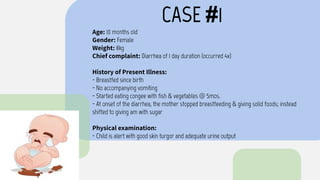
CASE #1
Age: 10 months old
Gender: Female
Weight: 8kg
Chief complaint: Diarrhea of 1 day duration (occurred 4x)
History of Present Illness:
- Breastfed since birth
- No accompanying vomiting
- Started eating congee with fish & vegetables @ 5mos.
- At onset of the diarrhea, the mother stopped breastfeeding & giving solid foods; instead
shifted to giving am with sugar
Physical examination:
- Child is alert with good skin turgor and adequate urine output
1. Describe the sequence of the various metabolic
changes observed in diarrhea and correlate these
to the clinical manifestations observed in the
patient (e.g. gastrointestinal function and motility,
alteration in fluid volume, composition, acid-base
balance, etc.)
What is it?
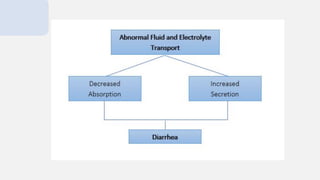
● Increase in frequency of bowel evacuation and water content in stool
● More than 3 bowel movements per day
● Loose and watery stools
● Causes the body to lose electrolytes and water
Diarrhea
● Osmotic Diarrhea
● Secretory Diarrhea
● Malabsorptive Diarrhea
Types of Diarrhea
- Gastrointestinal function and Motility
- Alteration in fluid volume
Metabolic changes in Diarrhea
● Metabolic Acidosis
○ Increase in bicarbonate loss
● Hypokalemia
○ Can cause muscle weakness, muscle
cramps and and cardiac arrhythmias
Acid-Base Balance
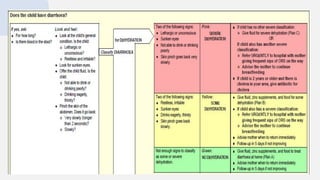
2. Evaluate the nutritional status and state of
hydration of the patient (use growth chart and
assessment of hydration table). Compute for the
ideal weight for age of the patient.
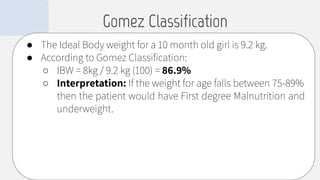
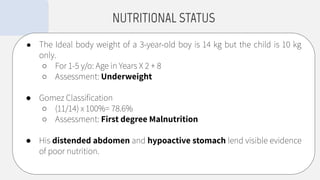
● The Ideal Body weight for a 10 month old girl is 9.2 kg.
● According to Gomez Classification:
○ IBW = 8kg / 9.2 kg (100) = 86.9%
○ Interpretation: If the weight for age falls between 75-89%
then the patient would have First degree Malnutrition and
underweight.
Gomez Classification
3. Determine the adequacy of the patient’s diet
before and during diarrhea; relate this to the cycle
of malnutrition and diarrhea.

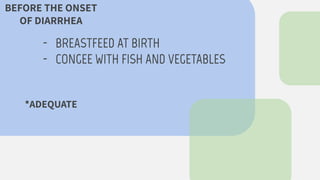
- BREASTFEED AT BIRTH
- CONGEE WITH FISH AND VEGETABLES
BEFORE THE ONSET
OF DIARRHEA
*ADEQUATE
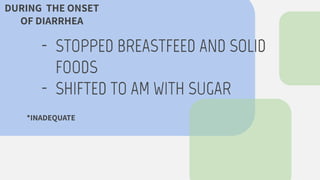
- STOPPED BREASTFEED AND SOLID
FOODS
- SHIFTED TO AM WITH SUGAR
DURING THE ONSET
OF DIARRHEA
*INADEQUATE
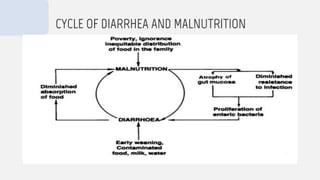
CYCLE OF DIARRHEA AND MALNUTRITION
4. What advice should be given to the patient’s
mother regarding breastfeeding, use of home
fluids or oral rehydration solutions, and other
nutritional support for the patient; describe their
advantages
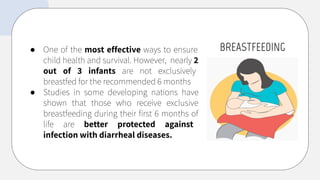
BREASTFEEDING
● One of the most effective ways to ensure
child health and survival. However, nearly 2
out of 3 infants are not exclusively
breastfed for the recommended 6 months
● Studies in some developing nations have
shown that those who receive exclusive
breastfeeding during their first 6 months of
life are better protected against
infection with diarrheal diseases.
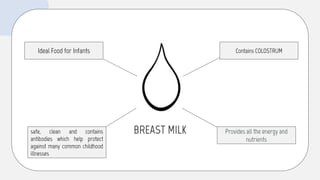
BREAST MILK
Ideal Food for Infants
safe, clean and contains
antibodies which help protect
against many common childhood
illnesses
Contains COLOSTRUM
Provides all the energy and
nutrients
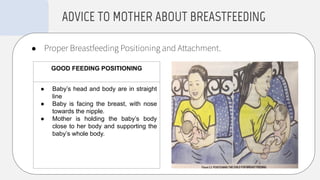
● Proper Breastfeeding Positioning and Attachment.
ADVICE TO MOTHER ABOUT BREASTFEEDING
GOOD FEEDING POSITIONING
● Baby’s head and body are in straight
line
● Baby is facing the breast, with nose
towards the nipple.
● Mother is holding the baby’s body
close to her body and supporting the
baby’s whole body.
ADVICE TO MOTHER ABOUT BREASTFEEDING
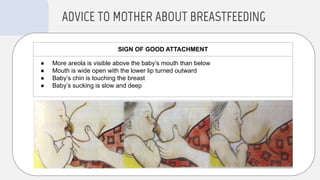
SIGN OF GOOD ATTACHMENT
● More areola is visible above the baby’s mouth than below
● Mouth is wide open with the lower lip turned outward
● Baby’s chin is touching the breast
● Baby’s sucking is slow and deep
● Give more frequent, longer breastfeeds, day and night.
● If taking other milk, replace with increased breastfeeding
● Advise the mother on the benefits of Breastfeeding to her.
○ Associated with a natural method of birth control
○ Reduces risks of breast and ovarian cancer, type II diabetes, and
postpartum depression
● Advise the mother on the benefits of Breastfeeding to her baby.
○ Decreases the risks of being overweight or obesity
○ Decreases the development of type II diabetes
ADVICE TO MOTHER ABOUT BREASTFEEDING
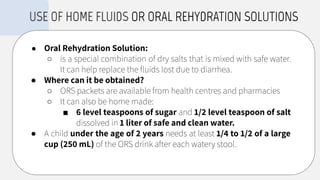
● Oral Rehydration Solution:
○ is a special combination of dry salts that is mixed with safe water.
It can help replace the fluids lost due to diarrhea.
● Where can it be obtained?
○ ORS packets are available from health centres and pharmacies
○ It can also be home made:
■ 6 level teaspoons of sugar and 1/2 level teaspoon of salt
dissolved in 1 liter of safe and clean water.
● A child under the age of 2 years needs at least 1/4 to 1/2 of a large
cup (250 mL) of the ORS drink after each watery stool.
USE OF HOME FLUIDS OR ORAL REHYDRATION SOLUTIONS
● COMPLEMENTARY FOOD: Must be timely introduced at 6 months of
age
○ Feed 3 times a day if breastfed; feed 5 times a day if not breastfed
○ Introduced one at a time for a week
■ Start with lugaw, mashed vegetables or beans, steamed
tokwa, flaked fish giving one to two teaspoons a day.
NUTRITIONAL SUPPORT FOR THE PATIENT
5. What biochemical significance if any, can be given
to the use of “am” with sugar in diarrheic patients?
● suspension of starch obtained by draining boiled rice or by
boiling rice until it completely dissolves into the water
● recognized as a good preventive measure against diarrheal
diseases based on the same scientific principle, where
absorption of salt and water in the intestines is linked to
absorption of glucose
RICE WATER or “AM”
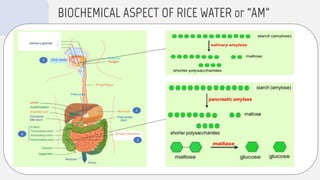
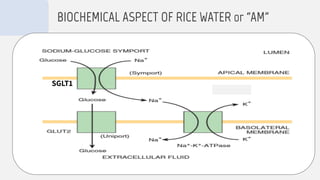
BIOCHEMICAL ASPECT OF RICE WATER or “AM”
SGLT1
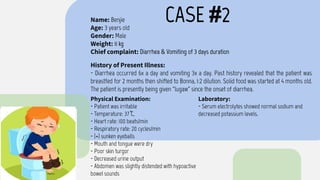
CASE #2
Name: Benjie
Age: 3 years old
Gender: Male
Weight: 11 kg
Chief complaint: Diarrhea & Vomiting of 3 days duration
History of Present Illness:
- Diarrhea occurred 6x a day and vomiting 3x a day. Past history revealed that the patient was
breastfed for 2 months then shifted to Bonna, 1:2 dilution. Solid food was started at 4 months old.
The patient is presently being given “lugaw” since the onset of diarrhea.
Physical Examination:
- Patient was irritable
- Temperature: 37 ͒C,
- Heart rate: 100 beats/min
- Respiratory rate: 20 cycles/min
- (+) sunken eyeballs
- Mouth and tongue were dry
- Poor skin turgor
- Decreased urine output
- Abdomen was slightly distended with hypoactive
bowel sounds
Laboratory:
- Serum electrolytes showed normal sodium and
decreased potassium levels.
1. Assess the nutritional status, electrolyte status,
and state of hydration of the patient.
● The Ideal body weight of a 3-year-old boy is 14 kg but the child is 10 kg
only.
○ For 1-5 y/o: Age in Years X 2 + 8
○ Assessment: Underweight
● Gomez Classification
○ (11/14) x 100%= 78.6%
○ Assessment: First degree Malnutrition
● His distended abdomen and hypoactive stomach lend visible evidence
of poor nutrition.
NUTRITIONAL STATUS
● Assessment: Hypokalemic due to diarrhea.
ELECTROLYTE STATUS
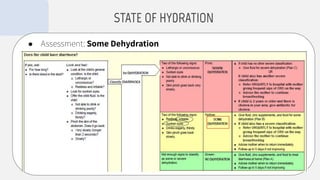
● Assessment: Some Dehydration
STATE OF HYDRATION
2. Discuss the sequence of events in diarrhea that
will lead to alterations in volume, electrolyte,
osmolality, and acid-base balance as shown in this
case.
● Due to excessive gastrointestinal fluid losses.
● The body tries to maintain the fluid loss by decreasing the
urine output with low fractional sodium excretion as
manifested by patient.
VOLUME & OSMOLALITY: Isotonic dehydration
● Large fecal losses → Potassium depletion
● Vomiting also contributes to potassium depletion
ELECTROLYTE: Hypokalemia
● Diarrhea → direct loss of Bicarbonates → Metabolic
Acidosis
ACID- BASE BALANCE: Metabolic Acidosis
3. What instructions will you give regarding fluid
replacement?
● Most infectious diarrhea is self-limiting, medical care is primarily
supportive. Oral rehydration (OR) is the mainstay of treatment for all
Children affected by diarrhea; never neglect OR,even in the absence of
overt dehydration, because maintaining hydration is necessary.
Consider intravenous rehydration only in the unlikely event that OR is
unsuccessful
● OR therapy is the cornerstone of treatment, especially for small-bowel
infections that produce a large volume of watery stool output.
● A 5-cc or 10-cc syringe without a needle is a very useful tool.
● OR is now universally recommended to be completed in an expedite way,
within 4 hours.
○ At completion of hydration, resumption of feeding is recommended
strongly. In fact, many studies convincingly demonstrate that early
refeeding hastens recovery.
4. Explain the role of glucose in oral rehydration
solutions.
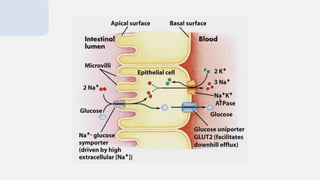
● Due to large amounts of sodium secreted into the intestinal lumen so quickly
very little sodium is reabsorbed, which can lead severe hyponatremia
● Sodium absorption via the intestine occurs in two stages.
● The first is at the outermost cells (intestinal epithelial cells) at the surface of
the intestinal lumen. Sodium passes into these outermost cells by cotransport
facilitated diffusion (symport diffusion) via the SGLT1 protein. From there,
sodium is pumped out of the cells (basal side) and into the extracellular space
by active transport via the sodium potassium pump.
ROLE OF GLUCOSE IN ORS
5. What recommendations will you give regarding
the nutritional management of the patient?
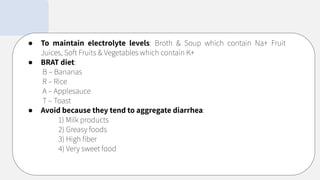
● To maintain electrolyte levels: Broth & Soup which contain Na+ Fruit
Juices, Soft Fruits & Vegetables which contain K+
● BRAT diet:
B – Bananas
R – Rice
A – Applesauce
T – Toast
● Avoid because they tend to aggregate diarrhea:
1) Milk products
2) Greasy foods
3) High fiber
4) Very sweet food
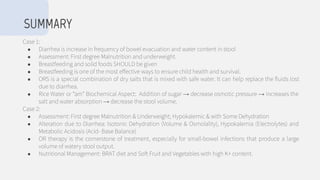
Case 1:
● Diarrhea is increase in frequency of bowel evacuation and water content in stool
● Assessment: First degree Malnutrition and underweight.
● Breastfeeding and solid foods SHOULD be given
● Breastfeeding is one of the most effective ways to ensure child health and survival.
● ORS is a special combination of dry salts that is mixed with safe water. It can help replace the fluids lost
due to diarrhea.
● Rice Water or “am” Biochemical Aspect: Addition of sugar → decrease osmotic pressure → increases the
salt and water absorption → decrease the stool volume.
Case 2:
● Assessment: First degree Malnutrition & Underweight; Hypokalemic & with Some Dehydration
● Alteration due to Diarrhea: Isotonic Dehydration (Volume & Osmolality), Hypokalemia (Electrolytes) and
Metabolic Acidosis (Acid- Base Balance)
● OR therapy is the cornerstone of treatment, especially for small-bowel infections that produce a large
volume of watery stool output.
● Nutritional Management: BRAT diet and Soft Fruit and Vegetables with high K+ content.
SUMMARY
● Murray, R. K. (2003). Harper's illustrated biochemistry. New York: McGraw-Hill.
● D.M. Vasudevan, Sreekumari S., Kannan Vaidyanathan. (2011). Textbook of biochemistry for medical
students (ed.6). New Delhi: Jaypee Bros. Medical Publishers,
● Integrated Management of Childhood Illnesses (2016) by WHO and UNICEF
● WHO. https://www.who.int/health-topics/breastfeeding#tab=tab_1
● ORS. https://rehydrate.org/solutions/homemade.html
● Loo, D. D., Zeuthen, T., Chandy, G., & Wright, E. M. (1996). Cotransport of water by the Na+/glucose
cotransporter. Proceedings of the National Academy of Sciences of the United States of America,
93(23), 13367–13370. https://doi.org/10.1073/pnas.93.23.13367
● Islam MS, Nishiyama A, Sakaguchi E. Rice gruel and rice starch reduce sorbitol-induced diarrhoea in
cecectomized rats. Digestion. 2005;72(1):13-21. doi: 10.1159/000087398. Epub 2005 Aug 10. PMID:
16103671.
● https://rehydrate.org/diarrhoea/tmsdd/2med.htm
● https://www.lecturio.com/magazine/dehydration
● https://media.lanecc.edu/users/powellt/FN225OER/Carbohydrates/FN225Carbohydrates4.html
REFERENCES:
Thank You
for
Listening!

DIARRHEA-GROUP-5-1.pdf

  • 1.
  • 2.
    OBJECTIVES At the endof the session, the students will be able to: ● Describe the sequence of metabolic changes occurring during diarrhea ● Evaluate nutritional status of patients ● Evaluate the adequacy of the diet before and during diarrhea ● List the important things to consider in advising the parents of pediatric patients with diarrhea
  • 3.
    CASE #1 Age: 10months old Gender: Female Weight: 8kg Chief complaint: Diarrhea of 1 day duration (occurred 4x) History of Present Illness: - Breastfed since birth - No accompanying vomiting - Started eating congee with fish & vegetables @ 5mos. - At onset of the diarrhea, the mother stopped breastfeeding & giving solid foods; instead shifted to giving am with sugar Physical examination: - Child is alert with good skin turgor and adequate urine output
  • 4.
    1. Describe thesequence of the various metabolic changes observed in diarrhea and correlate these to the clinical manifestations observed in the patient (e.g. gastrointestinal function and motility, alteration in fluid volume, composition, acid-base balance, etc.)
  • 5.
    What is it? ●Increase in frequency of bowel evacuation and water content in stool ● More than 3 bowel movements per day ● Loose and watery stools ● Causes the body to lose electrolytes and water Diarrhea
  • 6.
    ● Osmotic Diarrhea ●Secretory Diarrhea ● Malabsorptive Diarrhea Types of Diarrhea
  • 7.
    - Gastrointestinal functionand Motility - Alteration in fluid volume Metabolic changes in Diarrhea
  • 8.
    ● Metabolic Acidosis ○Increase in bicarbonate loss ● Hypokalemia ○ Can cause muscle weakness, muscle cramps and and cardiac arrhythmias Acid-Base Balance
  • 9.
    2. Evaluate thenutritional status and state of hydration of the patient (use growth chart and assessment of hydration table). Compute for the ideal weight for age of the patient.
  • 11.
    ● The IdealBody weight for a 10 month old girl is 9.2 kg. ● According to Gomez Classification: ○ IBW = 8kg / 9.2 kg (100) = 86.9% ○ Interpretation: If the weight for age falls between 75-89% then the patient would have First degree Malnutrition and underweight. Gomez Classification
  • 12.
    3. Determine theadequacy of the patient’s diet before and during diarrhea; relate this to the cycle of malnutrition and diarrhea.
  • 13.
    - BREASTFEED ATBIRTH - CONGEE WITH FISH AND VEGETABLES BEFORE THE ONSET OF DIARRHEA *ADEQUATE
  • 14.
    - STOPPED BREASTFEEDAND SOLID FOODS - SHIFTED TO AM WITH SUGAR DURING THE ONSET OF DIARRHEA *INADEQUATE
  • 15.
    CYCLE OF DIARRHEAAND MALNUTRITION
  • 16.
    4. What adviceshould be given to the patient’s mother regarding breastfeeding, use of home fluids or oral rehydration solutions, and other nutritional support for the patient; describe their advantages
  • 17.
    BREASTFEEDING ● One ofthe most effective ways to ensure child health and survival. However, nearly 2 out of 3 infants are not exclusively breastfed for the recommended 6 months ● Studies in some developing nations have shown that those who receive exclusive breastfeeding during their first 6 months of life are better protected against infection with diarrheal diseases.
  • 18.
    BREAST MILK Ideal Foodfor Infants safe, clean and contains antibodies which help protect against many common childhood illnesses Contains COLOSTRUM Provides all the energy and nutrients
  • 19.
    ● Proper BreastfeedingPositioning and Attachment. ADVICE TO MOTHER ABOUT BREASTFEEDING GOOD FEEDING POSITIONING ● Baby’s head and body are in straight line ● Baby is facing the breast, with nose towards the nipple. ● Mother is holding the baby’s body close to her body and supporting the baby’s whole body.
  • 20.
    ADVICE TO MOTHERABOUT BREASTFEEDING SIGN OF GOOD ATTACHMENT ● More areola is visible above the baby’s mouth than below ● Mouth is wide open with the lower lip turned outward ● Baby’s chin is touching the breast ● Baby’s sucking is slow and deep
  • 21.
    ● Give morefrequent, longer breastfeeds, day and night. ● If taking other milk, replace with increased breastfeeding ● Advise the mother on the benefits of Breastfeeding to her. ○ Associated with a natural method of birth control ○ Reduces risks of breast and ovarian cancer, type II diabetes, and postpartum depression ● Advise the mother on the benefits of Breastfeeding to her baby. ○ Decreases the risks of being overweight or obesity ○ Decreases the development of type II diabetes ADVICE TO MOTHER ABOUT BREASTFEEDING
  • 22.
    ● Oral RehydrationSolution: ○ is a special combination of dry salts that is mixed with safe water. It can help replace the fluids lost due to diarrhea. ● Where can it be obtained? ○ ORS packets are available from health centres and pharmacies ○ It can also be home made: ■ 6 level teaspoons of sugar and 1/2 level teaspoon of salt dissolved in 1 liter of safe and clean water. ● A child under the age of 2 years needs at least 1/4 to 1/2 of a large cup (250 mL) of the ORS drink after each watery stool. USE OF HOME FLUIDS OR ORAL REHYDRATION SOLUTIONS
  • 23.
    ● COMPLEMENTARY FOOD:Must be timely introduced at 6 months of age ○ Feed 3 times a day if breastfed; feed 5 times a day if not breastfed ○ Introduced one at a time for a week ■ Start with lugaw, mashed vegetables or beans, steamed tokwa, flaked fish giving one to two teaspoons a day. NUTRITIONAL SUPPORT FOR THE PATIENT
  • 24.
    5. What biochemicalsignificance if any, can be given to the use of “am” with sugar in diarrheic patients?
  • 25.
    ● suspension ofstarch obtained by draining boiled rice or by boiling rice until it completely dissolves into the water ● recognized as a good preventive measure against diarrheal diseases based on the same scientific principle, where absorption of salt and water in the intestines is linked to absorption of glucose RICE WATER or “AM”
  • 26.
    BIOCHEMICAL ASPECT OFRICE WATER or “AM”
  • 27.
    BIOCHEMICAL ASPECT OFRICE WATER or “AM” SGLT1
  • 28.
    CASE #2 Name: Benjie Age:3 years old Gender: Male Weight: 11 kg Chief complaint: Diarrhea & Vomiting of 3 days duration History of Present Illness: - Diarrhea occurred 6x a day and vomiting 3x a day. Past history revealed that the patient was breastfed for 2 months then shifted to Bonna, 1:2 dilution. Solid food was started at 4 months old. The patient is presently being given “lugaw” since the onset of diarrhea. Physical Examination: - Patient was irritable - Temperature: 37 ͒C, - Heart rate: 100 beats/min - Respiratory rate: 20 cycles/min - (+) sunken eyeballs - Mouth and tongue were dry - Poor skin turgor - Decreased urine output - Abdomen was slightly distended with hypoactive bowel sounds Laboratory: - Serum electrolytes showed normal sodium and decreased potassium levels.
  • 29.
    1. Assess thenutritional status, electrolyte status, and state of hydration of the patient.
  • 30.
    ● The Idealbody weight of a 3-year-old boy is 14 kg but the child is 10 kg only. ○ For 1-5 y/o: Age in Years X 2 + 8 ○ Assessment: Underweight ● Gomez Classification ○ (11/14) x 100%= 78.6% ○ Assessment: First degree Malnutrition ● His distended abdomen and hypoactive stomach lend visible evidence of poor nutrition. NUTRITIONAL STATUS
  • 31.
    ● Assessment: Hypokalemicdue to diarrhea. ELECTROLYTE STATUS
  • 32.
    ● Assessment: SomeDehydration STATE OF HYDRATION
  • 33.
    2. Discuss thesequence of events in diarrhea that will lead to alterations in volume, electrolyte, osmolality, and acid-base balance as shown in this case.
  • 35.
    ● Due toexcessive gastrointestinal fluid losses. ● The body tries to maintain the fluid loss by decreasing the urine output with low fractional sodium excretion as manifested by patient. VOLUME & OSMOLALITY: Isotonic dehydration
  • 36.
    ● Large fecallosses → Potassium depletion ● Vomiting also contributes to potassium depletion ELECTROLYTE: Hypokalemia
  • 37.
    ● Diarrhea →direct loss of Bicarbonates → Metabolic Acidosis ACID- BASE BALANCE: Metabolic Acidosis
  • 38.
    3. What instructionswill you give regarding fluid replacement?
  • 39.
    ● Most infectiousdiarrhea is self-limiting, medical care is primarily supportive. Oral rehydration (OR) is the mainstay of treatment for all Children affected by diarrhea; never neglect OR,even in the absence of overt dehydration, because maintaining hydration is necessary. Consider intravenous rehydration only in the unlikely event that OR is unsuccessful ● OR therapy is the cornerstone of treatment, especially for small-bowel infections that produce a large volume of watery stool output.
  • 40.
    ● A 5-ccor 10-cc syringe without a needle is a very useful tool. ● OR is now universally recommended to be completed in an expedite way, within 4 hours. ○ At completion of hydration, resumption of feeding is recommended strongly. In fact, many studies convincingly demonstrate that early refeeding hastens recovery.
  • 41.
    4. Explain therole of glucose in oral rehydration solutions.
  • 42.
    ● Due tolarge amounts of sodium secreted into the intestinal lumen so quickly very little sodium is reabsorbed, which can lead severe hyponatremia ● Sodium absorption via the intestine occurs in two stages. ● The first is at the outermost cells (intestinal epithelial cells) at the surface of the intestinal lumen. Sodium passes into these outermost cells by cotransport facilitated diffusion (symport diffusion) via the SGLT1 protein. From there, sodium is pumped out of the cells (basal side) and into the extracellular space by active transport via the sodium potassium pump. ROLE OF GLUCOSE IN ORS
  • 44.
    5. What recommendationswill you give regarding the nutritional management of the patient?
  • 45.
    ● To maintainelectrolyte levels: Broth & Soup which contain Na+ Fruit Juices, Soft Fruits & Vegetables which contain K+ ● BRAT diet: B – Bananas R – Rice A – Applesauce T – Toast ● Avoid because they tend to aggregate diarrhea: 1) Milk products 2) Greasy foods 3) High fiber 4) Very sweet food
  • 46.
    Case 1: ● Diarrheais increase in frequency of bowel evacuation and water content in stool ● Assessment: First degree Malnutrition and underweight. ● Breastfeeding and solid foods SHOULD be given ● Breastfeeding is one of the most effective ways to ensure child health and survival. ● ORS is a special combination of dry salts that is mixed with safe water. It can help replace the fluids lost due to diarrhea. ● Rice Water or “am” Biochemical Aspect: Addition of sugar → decrease osmotic pressure → increases the salt and water absorption → decrease the stool volume. Case 2: ● Assessment: First degree Malnutrition & Underweight; Hypokalemic & with Some Dehydration ● Alteration due to Diarrhea: Isotonic Dehydration (Volume & Osmolality), Hypokalemia (Electrolytes) and Metabolic Acidosis (Acid- Base Balance) ● OR therapy is the cornerstone of treatment, especially for small-bowel infections that produce a large volume of watery stool output. ● Nutritional Management: BRAT diet and Soft Fruit and Vegetables with high K+ content. SUMMARY
  • 47.
    ● Murray, R.K. (2003). Harper's illustrated biochemistry. New York: McGraw-Hill. ● D.M. Vasudevan, Sreekumari S., Kannan Vaidyanathan. (2011). Textbook of biochemistry for medical students (ed.6). New Delhi: Jaypee Bros. Medical Publishers, ● Integrated Management of Childhood Illnesses (2016) by WHO and UNICEF ● WHO. https://www.who.int/health-topics/breastfeeding#tab=tab_1 ● ORS. https://rehydrate.org/solutions/homemade.html ● Loo, D. D., Zeuthen, T., Chandy, G., & Wright, E. M. (1996). Cotransport of water by the Na+/glucose cotransporter. Proceedings of the National Academy of Sciences of the United States of America, 93(23), 13367–13370. https://doi.org/10.1073/pnas.93.23.13367 ● Islam MS, Nishiyama A, Sakaguchi E. Rice gruel and rice starch reduce sorbitol-induced diarrhoea in cecectomized rats. Digestion. 2005;72(1):13-21. doi: 10.1159/000087398. Epub 2005 Aug 10. PMID: 16103671. ● https://rehydrate.org/diarrhoea/tmsdd/2med.htm ● https://www.lecturio.com/magazine/dehydration ● https://media.lanecc.edu/users/powellt/FN225OER/Carbohydrates/FN225Carbohydrates4.html REFERENCES:
  • 48.