Diabetes: A survival guide
Joyce Lee, MD, MPH
Robert Kelch Professor of Pediatrics
University of Michigan
http://www.doctorasdesigner.com/
Twitter: @joyclee
This is not medical advice for patients with diabetes.
These are rules of thumb shared with residents who are
usually taking care of new onset patients who have the
right to call the endocrinology service anytime!
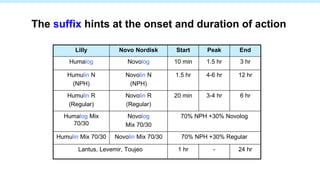
Lilly Novo Nordisk Start Peak End
Humalog Novolog 10 min 1.5 hr 3 hr
Humulin N
(NPH)
Novolin N
(NPH)
1.5 hr 4-6 hr 12 hr
Humulin R
(Regular)
Novolin R
(Regular)
20 min 3-4 hr 6 hr
Humalog Mix
70/30
Novolog
Mix 70/30
70% NPH +30% Novolog
Humulin Mix 70/30 Novolin Mix 70/30 70% NPH +30% Regular
Lantus, Levemir, Toujeo 1 hr - 24 hr
The suffix hints at the onset and duration of action
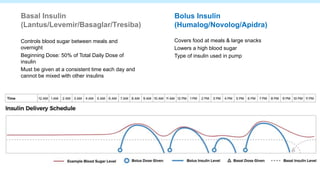
Basal Insulin
(Lantus/Levemir/Basaglar/Tresiba)
Controls blood sugar between meals and
overnight
Beginning Dose: 50% of Total Daily Dose of
insulin
Must be given at a consistent time each day and
cannot be mixed with other insulins
Bolus Insulin
(Humalog/Novolog/Apidra)
Covers food at meals & large snacks
Lowers a high blood sugar
Type of insulin used in pump
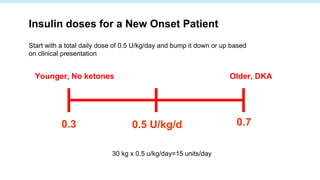
Start with a total daily dose of 0.5 U/kg/day and bump it down or up based
on clinical presentation
0.5 U/kg/d0.3 0.7
Younger, No ketones Older, DKA
Insulin doses for a New Onset Patient
30 kg x 0.5 u/kg/day=15 units/day
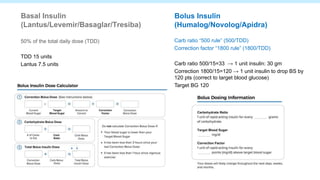
Basal Insulin
(Lantus/Levemir/Basaglar/Tresiba)
50% of the total daily dose (TDD)
TDD 15 units
Lantus 7.5 units
Bolus Insulin
(Humalog/Novolog/Apidra)
Carb ratio “500 rule” (500/TDD)
Correction factor “1800 rule” (1800/TDD)
Carb ratio 500/15=33 → 1 unit insulin: 30 gm
Correction 1800/15=120 → 1 unit insulin to drop BS by
120 pts (correct to target blood glucose)
Target BG 120
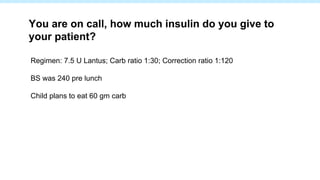
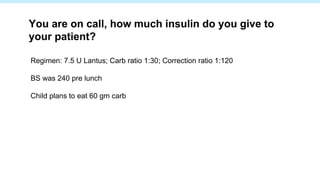
Regimen: 7.5 U Lantus; Carb ratio 1:30; Correction ratio 1:120
BS was 240 pre lunch
Child plans to eat 60 gm carb
You are on call, how much insulin do you give to
your patient?
Regimen: 7.5 U Lantus; Carb ratio 1:30; Correction ratio 1:120
BS was 240 pre lunch
Child plans to eat 60 gm carb
You are on call, how much insulin do you give to
your patient?
Regimen: 7.5 U Lantus; Carb ratio 1:30; Correction ratio 1:120
BS was 240 pre lunch
Child plans to eat 60 gm carb
You are on call, how much insulin do you give to
your patient?
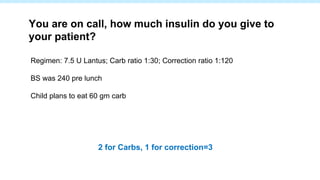
2 for Carbs, 1 for correction=3
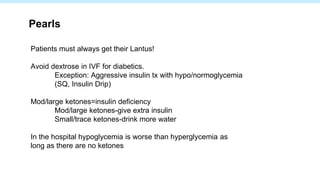
Patients must always get their Lantus!
Avoid dextrose in IVF for diabetics.
Exception: Aggressive insulin tx with hypo/normoglycemia
(SQ, Insulin Drip)
Mod/large ketones=insulin deficiency
Mod/large ketones-give extra insulin
Small/trace ketones-drink more water
In the hospital hypoglycemia is worse than hyperglycemia as
long as there are no ketones
Pearls
Regimen?
Ketones?
Last dose of insulin?
Last meal?
Things to think about when dosing insulin:
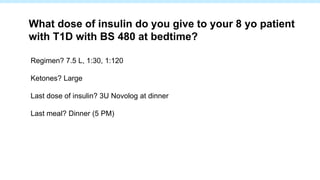
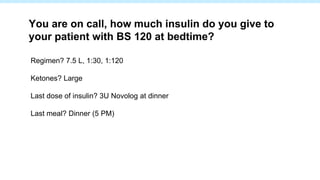
Regimen? 7.5 L, 1:30, 1:120
Ketones? Large
Last dose of insulin? 3U Novolog at dinner
Last meal? Dinner (5 PM)
What dose of insulin do you give to your 8 yo patient
with T1D with BS 480 at bedtime?
Regimen? 7.5 L, 1:30, 1:120
Ketones? Large
Last dose of insulin? 3U Novolog at dinner
Last meal? Dinner (5 PM)
What dose of insulin do you give to your 8 yo patient
with T1D with BS 480 at bedtime?
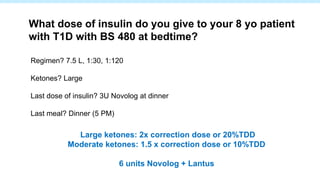
Large ketones: 2x correction dose or 20%TDD
Moderate ketones: 1.5 x correction dose or 10%TDD
6 units Novolog + Lantus
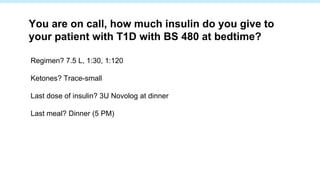
Regimen? 7.5 L, 1:30, 1:120
Ketones? Trace-small
Last dose of insulin? 3U Novolog at dinner
Last meal? Dinner (5 PM)
You are on call, how much insulin do you give to
your patient with T1D with BS 480 at bedtime?
Regimen? 7.5 L, 1:30, 1:120
Ketones? Trace-small
Last dose of insulin? 3U Novolog at dinner
Last meal? Dinner (5 PM)
You are on call, how much insulin do you give to
your patient with T1D with BS 480 at bedtime?
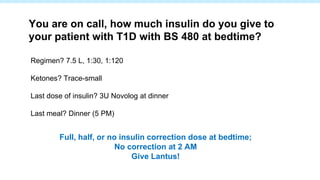
Full, half, or no insulin correction dose at bedtime;
No correction at 2 AM
Give Lantus!
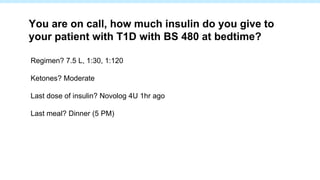
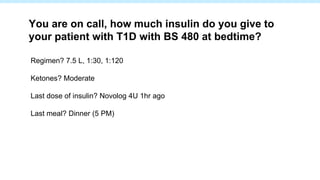
Regimen? 7.5 L, 1:30, 1:120
Ketones? Moderate
Last dose of insulin? Novolog 4U 1hr ago
Last meal? Dinner (5 PM)
You are on call, how much insulin do you give to
your patient with T1D with BS 480 at bedtime?
Regimen? 7.5 L, 1:30, 1:120
Ketones? Moderate
Last dose of insulin? Novolog 4U 1hr ago
Last meal? Dinner (5 PM)
You are on call, how much insulin do you give to
your patient with T1D with BS 480 at bedtime?
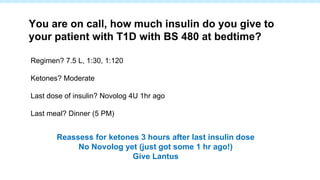
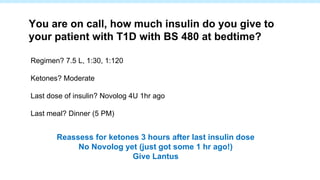
Reassess for ketones 3 hours after last insulin dose
No Novolog yet (just got some 1 hr ago!)
Give Lantus
Regimen? 7.5 L, 1:30, 1:120
Ketones? Moderate
Last dose of insulin? Novolog 4U 1hr ago
Last meal? Dinner (5 PM)
You are on call, how much insulin do you give to
your patient with T1D with BS 480 at bedtime?
Regimen? 7.5 L, 1:30, 1:120
Ketones? Moderate
Last dose of insulin? Novolog 4U 1hr ago
Last meal? Dinner (5 PM)
You are on call, how much insulin do you give to
your patient with T1D with BS 480 at bedtime?
Reassess for ketones 3 hours after last insulin dose
No Novolog yet (just got some 1 hr ago!)
Give Lantus
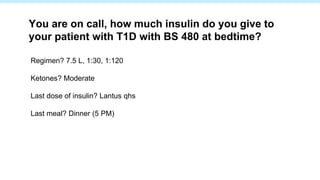
Regimen? 7.5 L, 1:30, 1:120
Ketones? Moderate
Last dose of insulin? Lantus qhs
Last meal? Dinner (5 PM)
You are on call, how much insulin do you give to
your patient with T1D with BS 480 at bedtime?
Regimen? 7.5 L, 1:30, 1:120
Ketones? Moderate
Last dose of insulin? Lantus qhs
Last meal? Dinner (5 PM)
You are on call, how much insulin do you give to
your patient with T1D with BS 480 at bedtime?
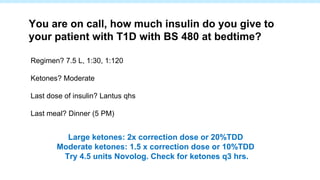
Large ketones: 2x correction dose or 20%TDD
Moderate ketones: 1.5 x correction dose or 10%TDD
Try 4.5 units Novolog. Check for ketones q3 hrs.
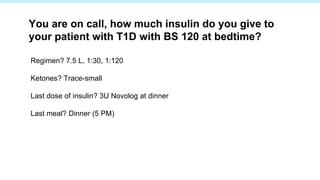
Regimen? 7.5 L, 1:30, 1:120
Ketones? Trace-small
Last dose of insulin? 3U Novolog at dinner
Last meal? Dinner (5 PM)
You are on call, how much insulin do you give to
your patient with T1D with BS 120 at bedtime?
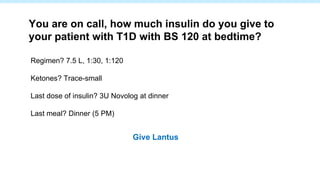
Regimen? 7.5 L, 1:30, 1:120
Ketones? Trace-small
Last dose of insulin? 3U Novolog at dinner
Last meal? Dinner (5 PM)
You are on call, how much insulin do you give to
your patient with T1D with BS 120 at bedtime?
Give Lantus
Regimen? 7.5 L, 1:30, 1:120
Ketones? Large
Last dose of insulin? 3U Novolog at dinner
Last meal? Dinner (5 PM)
You are on call, how much insulin do you give to
your patient with BS 120 at bedtime?
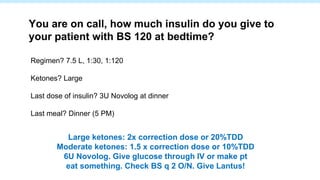
Regimen? 7.5 L, 1:30, 1:120
Ketones? Large
Last dose of insulin? 3U Novolog at dinner
Last meal? Dinner (5 PM)
You are on call, how much insulin do you give to
your patient with BS 120 at bedtime?
Large ketones: 2x correction dose or 20%TDD
Moderate ketones: 1.5 x correction dose or 10%TDD
6U Novolog. Give glucose through IV or make pt
eat something. Check BS q 2 O/N. Give Lantus!
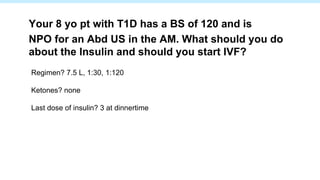
Regimen? 7.5 L, 1:30, 1:120
Ketones? none
Last dose of insulin? 3 at dinnertime
Your 8 yo pt with T1D has a BS of 120 and is
NPO for an Abd US in the AM. What should you do
about the Insulin and should you start IVF?
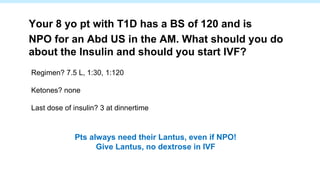
Regimen? 7.5 L, 1:30, 1:120
Ketones? none
Last dose of insulin? 3 at dinnertime
Your 8 yo pt with T1D has a BS of 120 and is
NPO for an Abd US in the AM. What should you do
about the Insulin and should you start IVF?
Pts always need their Lantus, even if NPO!
Give Lantus, no dextrose in IVF
Patients must always get their Lantus!
Avoid dextrose in IVF for diabetics.
Exception: Aggressive insulin tx with hypo/normoglycemia
(SQ, Insulin Drip)
Mod/large ketones=insulin deficiency
Mod/large ketones-give extra insulin
Small/trace ketones-drink more water
In the hospital hypoglycemia is worse than hyperglycemia as
long as there are no ketones
Pearls
Diabetes in Children and Adolescents
Joyce Lee, MD, MPH
Robert Kelch Professor of Pediatrics
University of Michigan
http://www.doctorasdesigner.com/
Twitter: @joyclee
15 year old male
CC: “polyuria”
HPI: Over the last month pt has been complaining of:
Drinking lots of water and urinating 20-30 x a day
Fatigue
Weight loss of 15 lb
No excess hunger
No abdominal pain, vomiting, diarrhea
Social History: 10th grade
Family History: Mom had gestational diabetes which became type 2 diabetes; 3
generations of type 2 diabetes in the family
Physical Exam
T 37.2, HR 77, RR 18, BP 141/70
Weight 90.4 kg, Ht 167 cm, BMI 32.2 (99%)
HEENT: PERRL, EOMI, sclera anicteric, MMM
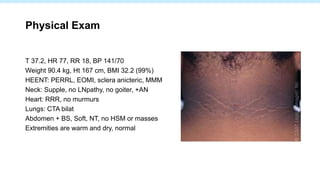
Neck: Supple, no LNpathy, no goiter, +AN
Heart: RRR, no murmurs
Lungs: CTA bilat
Abdomen + BS, Soft, NT, no HSM or masses
Extremities are warm and dry, normal
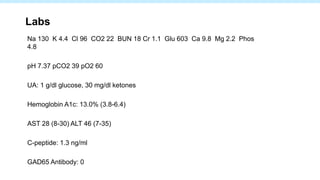
Labs
Na 130 K 4.4 Cl 96 CO2 22 BUN 18 Cr 1.1 Glu 603 Ca 9.8 Mg 2.2 Phos
4.8
pH 7.37 pCO2 39 pO2 60
UA: 1 g/dl glucose, 30 mg/dl ketones
Hemoglobin A1c: 13.0% (3.8-6.4)
AST 28 (8-30) ALT 46 (7-35)
C-peptide: 1.3 ng/ml
GAD65 Antibody: 0
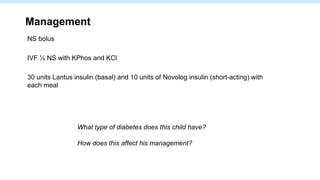
Management
NS bolus
IVF ½ NS with KPhos and KCl
30 units Lantus insulin (basal) and 10 units of Novolog insulin (short-acting) with
each meal
What type of diabetes does this child have?
How does this affect his management?
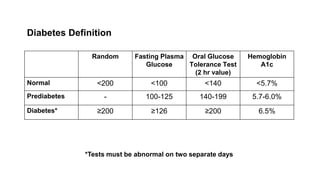
Random Fasting Plasma
Glucose
Oral Glucose
Tolerance Test
(2 hr value)
Hemoglobin
A1c
Normal <200 <100 <140 <5.7%
Prediabetes - 100-125 140-199 5.7-6.0%
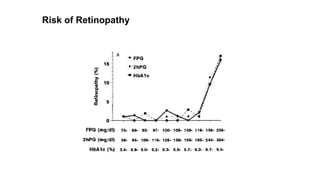
Diabetes* ≥200 ≥126 ≥200 6.5%
Diabetes Definition
*Tests must be abnormal on two separate days
Risk of Retinopathy
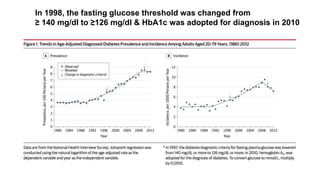
In 1998, the fasting glucose threshold was changed from
≥ 140 mg/dl to ≥126 mg/dl & HbA1c was adopted for diagnosis in 2010
CDC
3
10.7
9.9
1.6
3.6
2.1
0
2
4
6
8
10
12
Diagnosed
Undiagnosed
Age Group (yrs)
%withdiabetes
18-44 45-64 ≥65
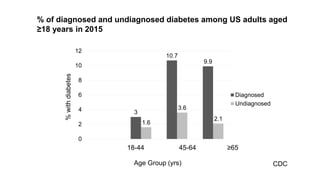
% of diagnosed and undiagnosed diabetes among US adults aged
≥18 years in 2015
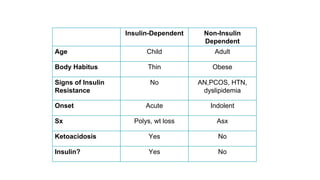
Insulin-Dependent Non-Insulin
Dependent
Age Child Adult
Body Habitus Thin Obese
Signs of Insulin
Resistance
No AN,PCOS, HTN,
dyslipidemia
Onset Acute Indolent
Sx Polys, wt loss Asx
Ketoacidosis Yes No
Insulin? Yes No
Spectrum of Diabetes
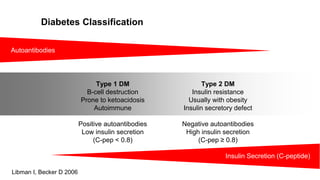
Autoantibodies
Insulin Secretion (C-peptide)
Type 2 DM
Insulin resistance
Usually with obesity
Insulin secretory defect
Negative autoantibodies
High insulin secretion
(C-pep ≥ 0.8)
Type 1 DM
B-cell destruction
Prone to ketoacidosis
Autoimmune
Positive autoantibodies
Low insulin secretion
(C-pep < 0.8)
Libman I, Becker D 2006
Diabetes Classification
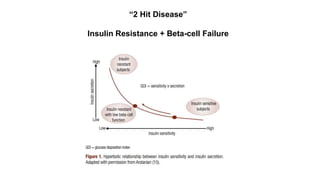
“2 Hit Disease”
Insulin Resistance + Beta-cell Failure
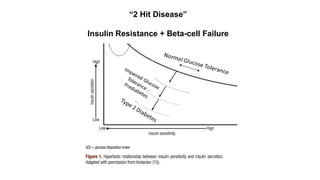
“2 Hit Disease”
Insulin Resistance + Beta-cell Failure
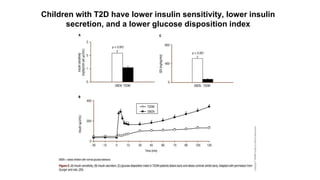
Children with T2D have lower insulin sensitivity, lower insulin
secretion, and a lower glucose disposition index
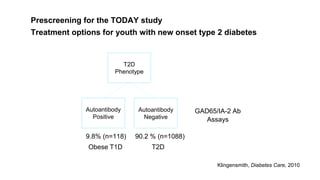
9.8% (n=118) 90.2 % (n=1088)
Klingensmith, Diabetes Care, 2010
Prescreening for the TODAY study
Treatment options for youth with new onset type 2 diabetes
GAD65/IA-2 Ab
Assays
T2D
Phenotype
Autoantibody
Positive
Autoantibody
Negative
Obese T1D T2D
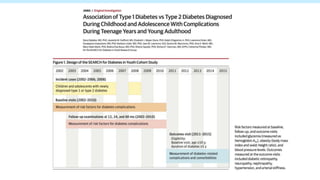
SEARCH
5 centers supported by CDC and NIDDK
– California (Kaiser Permanente Southern California, excluding San Diego
[7 counties])
– Colorado [14 counties, including Denver]
– Ohio [8 counties, including Cincinnati]
– South Carolina [4 counties, including Columbia]
– Washington state [5 counties, including Seattle]
Type 1a (Ab+, low c-pep(<0.6)); Type 1b (Ab-, low c-pep); type 2
The study population included youth younger than 20 years residing in the
geographic study areas or who were members of participating health plans in
2001 and 2009.
Dabelea, JAMA 2014
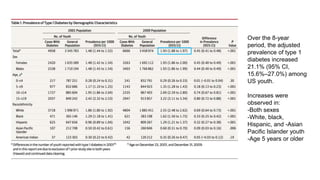
Over the 8-year
period, the adjusted
prevalence of type 1
diabetes increased
21.1% (95% CI,
15.6%–27.0%) among
US youth.
Increases were
observed in:
-Both sexes
-White, black,
Hispanic, and -Asian
Pacific Islander youth
-Age 5 years or older
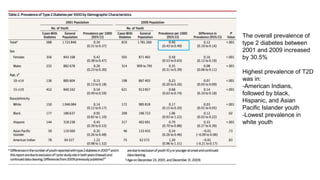
The overall prevalence of
type 2 diabetes between
2001 and 2009 increased
by 30.5%
Highest prevalence of T2D
was in:
-American Indians,
followed by black,
Hispanic, and Asian
Pacific Islander youth
-Lowest prevalence in
white youth
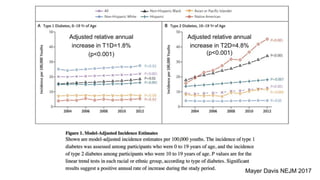
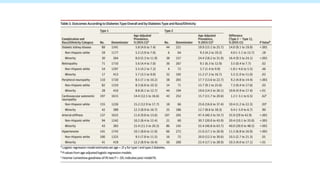
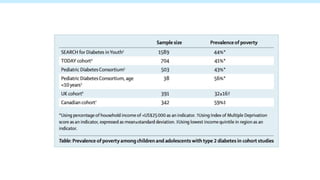
Mayer Davis NEJM 2017
Adjusted relative annual
increase in T1D=1.8%
(p<0.001)
Adjusted relative annual
increase in T2D=4.8%
(p<0.001)
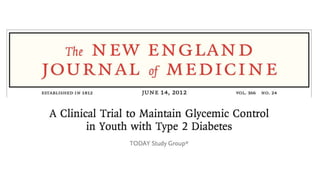
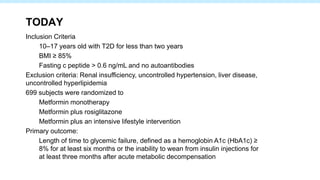
TODAY
Inclusion Criteria
10–17 years old with T2D for less than two years
BMI ≥ 85%
Fasting c peptide > 0.6 ng/mL and no autoantibodies
Exclusion criteria: Renal insufficiency, uncontrolled hypertension, liver disease,
uncontrolled hyperlipidemia
699 subjects were randomized to
Metformin monotherapy
Metformin plus rosiglitazone
Metformin plus an intensive lifestyle intervention
Primary outcome:
Length of time to glycemic failure, defined as a hemoglobin A1c (HbA1c) ≥
8% for at least six months or the inability to wean from insulin injections for
at least three months after acute metabolic decompensation
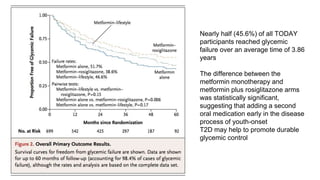
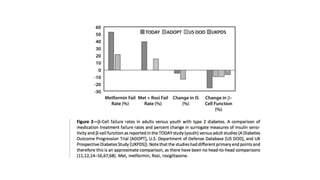
Nearly half (45.6%) of all TODAY
participants reached glycemic
failure over an average time of 3.86
years
The difference between the
metformin monotherapy and
metformin plus rosiglitazone arms
was statistically significant,
suggesting that adding a second
oral medication early in the disease
process of youth-onset
T2D may help to promote durable
glycemic control
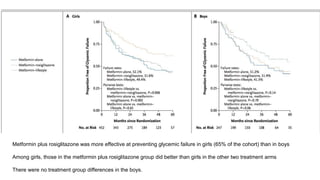
Metformin plus rosiglitazone was more effective at preventing glycemic failure in girls (65% of the cohort) than in boys
Among girls, those in the metformin plus rosiglitazone group did better than girls in the other two treatment arms
There were no treatment group differences in the boys.
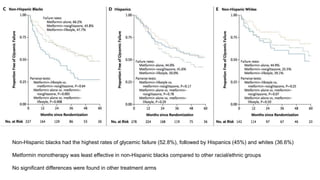
Non-Hispanic blacks had the highest rates of glycemic failure (52.8%), followed by Hispanics (45%) and whites (36.6%)
Metformin monotherapy was least effective in non-Hispanic blacks compared to other racial/ethnic groups
No significant differences were found in other treatment arms
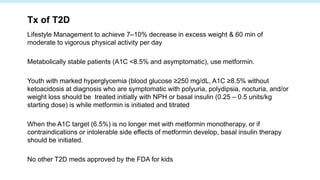
Tx of T2D
Lifestyle Management to achieve 7–10% decrease in excess weight & 60 min of
moderate to vigorous physical activity per day
Metabolically stable patients (A1C <8.5% and asymptomatic), use metformin.
Youth with marked hyperglycemia (blood glucose ≥250 mg/dL, A1C ≥8.5% without
ketoacidosis at diagnosis who are symptomatic with polyuria, polydipsia, nocturia, and/or
weight loss should be treated initially with NPH or basal insulin (0.25 – 0.5 units/kg
starting dose) is while metformin is initiated and titrated
When the A1C target (6.5%) is no longer met with metformin monotherapy, or if
contraindications or intolerable side effects of metformin develop, basal insulin therapy
should be initiated.
No other T2D meds approved by the FDA for kids
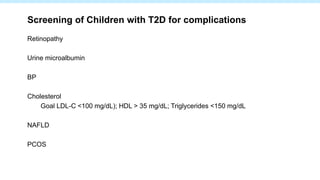
Screening of Children with T2D for complications
Retinopathy
Urine microalbumin
BP
Cholesterol
Goal LDL-C <100 mg/dL); HDL > 35 mg/dL; Triglycerides <150 mg/dL
NAFLD
PCOS

Diabetes Resident Lecture

  • 1.
    Diabetes: A survivalguide Joyce Lee, MD, MPH Robert Kelch Professor of Pediatrics University of Michigan http://www.doctorasdesigner.com/ Twitter: @joyclee
  • 2.
    This is notmedical advice for patients with diabetes. These are rules of thumb shared with residents who are usually taking care of new onset patients who have the right to call the endocrinology service anytime!
  • 3.
    Lilly Novo NordiskStart Peak End Humalog Novolog 10 min 1.5 hr 3 hr Humulin N (NPH) Novolin N (NPH) 1.5 hr 4-6 hr 12 hr Humulin R (Regular) Novolin R (Regular) 20 min 3-4 hr 6 hr Humalog Mix 70/30 Novolog Mix 70/30 70% NPH +30% Novolog Humulin Mix 70/30 Novolin Mix 70/30 70% NPH +30% Regular Lantus, Levemir, Toujeo 1 hr - 24 hr The suffix hints at the onset and duration of action
  • 4.
    Basal Insulin (Lantus/Levemir/Basaglar/Tresiba) Controls bloodsugar between meals and overnight Beginning Dose: 50% of Total Daily Dose of insulin Must be given at a consistent time each day and cannot be mixed with other insulins Bolus Insulin (Humalog/Novolog/Apidra) Covers food at meals & large snacks Lowers a high blood sugar Type of insulin used in pump
  • 5.
    Start with atotal daily dose of 0.5 U/kg/day and bump it down or up based on clinical presentation 0.5 U/kg/d0.3 0.7 Younger, No ketones Older, DKA Insulin doses for a New Onset Patient 30 kg x 0.5 u/kg/day=15 units/day
  • 6.
    Basal Insulin (Lantus/Levemir/Basaglar/Tresiba) 50% ofthe total daily dose (TDD) TDD 15 units Lantus 7.5 units Bolus Insulin (Humalog/Novolog/Apidra) Carb ratio “500 rule” (500/TDD) Correction factor “1800 rule” (1800/TDD) Carb ratio 500/15=33 → 1 unit insulin: 30 gm Correction 1800/15=120 → 1 unit insulin to drop BS by 120 pts (correct to target blood glucose) Target BG 120
  • 8.
    Regimen: 7.5 ULantus; Carb ratio 1:30; Correction ratio 1:120 BS was 240 pre lunch Child plans to eat 60 gm carb You are on call, how much insulin do you give to your patient?
  • 9.
    Regimen: 7.5 ULantus; Carb ratio 1:30; Correction ratio 1:120 BS was 240 pre lunch Child plans to eat 60 gm carb You are on call, how much insulin do you give to your patient?
  • 10.
    Regimen: 7.5 ULantus; Carb ratio 1:30; Correction ratio 1:120 BS was 240 pre lunch Child plans to eat 60 gm carb You are on call, how much insulin do you give to your patient? 2 for Carbs, 1 for correction=3
  • 11.
    Patients must alwaysget their Lantus! Avoid dextrose in IVF for diabetics. Exception: Aggressive insulin tx with hypo/normoglycemia (SQ, Insulin Drip) Mod/large ketones=insulin deficiency Mod/large ketones-give extra insulin Small/trace ketones-drink more water In the hospital hypoglycemia is worse than hyperglycemia as long as there are no ketones Pearls
  • 12.
    Regimen? Ketones? Last dose ofinsulin? Last meal? Things to think about when dosing insulin:
  • 13.
    Regimen? 7.5 L,1:30, 1:120 Ketones? Large Last dose of insulin? 3U Novolog at dinner Last meal? Dinner (5 PM) What dose of insulin do you give to your 8 yo patient with T1D with BS 480 at bedtime?
  • 14.
    Regimen? 7.5 L,1:30, 1:120 Ketones? Large Last dose of insulin? 3U Novolog at dinner Last meal? Dinner (5 PM) What dose of insulin do you give to your 8 yo patient with T1D with BS 480 at bedtime? Large ketones: 2x correction dose or 20%TDD Moderate ketones: 1.5 x correction dose or 10%TDD 6 units Novolog + Lantus
  • 15.
    Regimen? 7.5 L,1:30, 1:120 Ketones? Trace-small Last dose of insulin? 3U Novolog at dinner Last meal? Dinner (5 PM) You are on call, how much insulin do you give to your patient with T1D with BS 480 at bedtime?
  • 16.
    Regimen? 7.5 L,1:30, 1:120 Ketones? Trace-small Last dose of insulin? 3U Novolog at dinner Last meal? Dinner (5 PM) You are on call, how much insulin do you give to your patient with T1D with BS 480 at bedtime? Full, half, or no insulin correction dose at bedtime; No correction at 2 AM Give Lantus!
  • 17.
    Regimen? 7.5 L,1:30, 1:120 Ketones? Moderate Last dose of insulin? Novolog 4U 1hr ago Last meal? Dinner (5 PM) You are on call, how much insulin do you give to your patient with T1D with BS 480 at bedtime?
  • 18.
    Regimen? 7.5 L,1:30, 1:120 Ketones? Moderate Last dose of insulin? Novolog 4U 1hr ago Last meal? Dinner (5 PM) You are on call, how much insulin do you give to your patient with T1D with BS 480 at bedtime? Reassess for ketones 3 hours after last insulin dose No Novolog yet (just got some 1 hr ago!) Give Lantus
  • 19.
    Regimen? 7.5 L,1:30, 1:120 Ketones? Moderate Last dose of insulin? Novolog 4U 1hr ago Last meal? Dinner (5 PM) You are on call, how much insulin do you give to your patient with T1D with BS 480 at bedtime?
  • 20.
    Regimen? 7.5 L,1:30, 1:120 Ketones? Moderate Last dose of insulin? Novolog 4U 1hr ago Last meal? Dinner (5 PM) You are on call, how much insulin do you give to your patient with T1D with BS 480 at bedtime? Reassess for ketones 3 hours after last insulin dose No Novolog yet (just got some 1 hr ago!) Give Lantus
  • 21.
    Regimen? 7.5 L,1:30, 1:120 Ketones? Moderate Last dose of insulin? Lantus qhs Last meal? Dinner (5 PM) You are on call, how much insulin do you give to your patient with T1D with BS 480 at bedtime?
  • 22.
    Regimen? 7.5 L,1:30, 1:120 Ketones? Moderate Last dose of insulin? Lantus qhs Last meal? Dinner (5 PM) You are on call, how much insulin do you give to your patient with T1D with BS 480 at bedtime? Large ketones: 2x correction dose or 20%TDD Moderate ketones: 1.5 x correction dose or 10%TDD Try 4.5 units Novolog. Check for ketones q3 hrs.
  • 23.
    Regimen? 7.5 L,1:30, 1:120 Ketones? Trace-small Last dose of insulin? 3U Novolog at dinner Last meal? Dinner (5 PM) You are on call, how much insulin do you give to your patient with T1D with BS 120 at bedtime?
  • 24.
    Regimen? 7.5 L,1:30, 1:120 Ketones? Trace-small Last dose of insulin? 3U Novolog at dinner Last meal? Dinner (5 PM) You are on call, how much insulin do you give to your patient with T1D with BS 120 at bedtime? Give Lantus
  • 25.
    Regimen? 7.5 L,1:30, 1:120 Ketones? Large Last dose of insulin? 3U Novolog at dinner Last meal? Dinner (5 PM) You are on call, how much insulin do you give to your patient with BS 120 at bedtime?
  • 26.
    Regimen? 7.5 L,1:30, 1:120 Ketones? Large Last dose of insulin? 3U Novolog at dinner Last meal? Dinner (5 PM) You are on call, how much insulin do you give to your patient with BS 120 at bedtime? Large ketones: 2x correction dose or 20%TDD Moderate ketones: 1.5 x correction dose or 10%TDD 6U Novolog. Give glucose through IV or make pt eat something. Check BS q 2 O/N. Give Lantus!
  • 27.
    Regimen? 7.5 L,1:30, 1:120 Ketones? none Last dose of insulin? 3 at dinnertime Your 8 yo pt with T1D has a BS of 120 and is NPO for an Abd US in the AM. What should you do about the Insulin and should you start IVF?
  • 28.
    Regimen? 7.5 L,1:30, 1:120 Ketones? none Last dose of insulin? 3 at dinnertime Your 8 yo pt with T1D has a BS of 120 and is NPO for an Abd US in the AM. What should you do about the Insulin and should you start IVF? Pts always need their Lantus, even if NPO! Give Lantus, no dextrose in IVF
  • 29.
    Patients must alwaysget their Lantus! Avoid dextrose in IVF for diabetics. Exception: Aggressive insulin tx with hypo/normoglycemia (SQ, Insulin Drip) Mod/large ketones=insulin deficiency Mod/large ketones-give extra insulin Small/trace ketones-drink more water In the hospital hypoglycemia is worse than hyperglycemia as long as there are no ketones Pearls
  • 30.
    Diabetes in Childrenand Adolescents Joyce Lee, MD, MPH Robert Kelch Professor of Pediatrics University of Michigan http://www.doctorasdesigner.com/ Twitter: @joyclee
  • 32.
    15 year oldmale CC: “polyuria” HPI: Over the last month pt has been complaining of: Drinking lots of water and urinating 20-30 x a day Fatigue Weight loss of 15 lb No excess hunger No abdominal pain, vomiting, diarrhea Social History: 10th grade Family History: Mom had gestational diabetes which became type 2 diabetes; 3 generations of type 2 diabetes in the family
  • 33.
    Physical Exam T 37.2,HR 77, RR 18, BP 141/70 Weight 90.4 kg, Ht 167 cm, BMI 32.2 (99%) HEENT: PERRL, EOMI, sclera anicteric, MMM Neck: Supple, no LNpathy, no goiter, +AN Heart: RRR, no murmurs Lungs: CTA bilat Abdomen + BS, Soft, NT, no HSM or masses Extremities are warm and dry, normal
  • 34.
    Labs Na 130 K4.4 Cl 96 CO2 22 BUN 18 Cr 1.1 Glu 603 Ca 9.8 Mg 2.2 Phos 4.8 pH 7.37 pCO2 39 pO2 60 UA: 1 g/dl glucose, 30 mg/dl ketones Hemoglobin A1c: 13.0% (3.8-6.4) AST 28 (8-30) ALT 46 (7-35) C-peptide: 1.3 ng/ml GAD65 Antibody: 0
  • 35.
    Management NS bolus IVF ½NS with KPhos and KCl 30 units Lantus insulin (basal) and 10 units of Novolog insulin (short-acting) with each meal What type of diabetes does this child have? How does this affect his management?
  • 36.
    Random Fasting Plasma Glucose OralGlucose Tolerance Test (2 hr value) Hemoglobin A1c Normal <200 <100 <140 <5.7% Prediabetes - 100-125 140-199 5.7-6.0% Diabetes* ≥200 ≥126 ≥200 6.5% Diabetes Definition *Tests must be abnormal on two separate days
  • 37.
  • 38.
    In 1998, thefasting glucose threshold was changed from ≥ 140 mg/dl to ≥126 mg/dl & HbA1c was adopted for diagnosis in 2010
  • 39.
    CDC 3 10.7 9.9 1.6 3.6 2.1 0 2 4 6 8 10 12 Diagnosed Undiagnosed Age Group (yrs) %withdiabetes 18-4445-64 ≥65 % of diagnosed and undiagnosed diabetes among US adults aged ≥18 years in 2015
  • 40.
    Insulin-Dependent Non-Insulin Dependent Age ChildAdult Body Habitus Thin Obese Signs of Insulin Resistance No AN,PCOS, HTN, dyslipidemia Onset Acute Indolent Sx Polys, wt loss Asx Ketoacidosis Yes No Insulin? Yes No
  • 41.
    Spectrum of Diabetes Autoantibodies InsulinSecretion (C-peptide) Type 2 DM Insulin resistance Usually with obesity Insulin secretory defect Negative autoantibodies High insulin secretion (C-pep ≥ 0.8) Type 1 DM B-cell destruction Prone to ketoacidosis Autoimmune Positive autoantibodies Low insulin secretion (C-pep < 0.8) Libman I, Becker D 2006 Diabetes Classification
  • 42.
    “2 Hit Disease” InsulinResistance + Beta-cell Failure
  • 43.
    “2 Hit Disease” InsulinResistance + Beta-cell Failure
  • 44.
    Children with T2Dhave lower insulin sensitivity, lower insulin secretion, and a lower glucose disposition index
  • 45.
    9.8% (n=118) 90.2% (n=1088) Klingensmith, Diabetes Care, 2010 Prescreening for the TODAY study Treatment options for youth with new onset type 2 diabetes GAD65/IA-2 Ab Assays T2D Phenotype Autoantibody Positive Autoantibody Negative Obese T1D T2D
  • 46.
    SEARCH 5 centers supportedby CDC and NIDDK – California (Kaiser Permanente Southern California, excluding San Diego [7 counties]) – Colorado [14 counties, including Denver] – Ohio [8 counties, including Cincinnati] – South Carolina [4 counties, including Columbia] – Washington state [5 counties, including Seattle] Type 1a (Ab+, low c-pep(<0.6)); Type 1b (Ab-, low c-pep); type 2 The study population included youth younger than 20 years residing in the geographic study areas or who were members of participating health plans in 2001 and 2009. Dabelea, JAMA 2014
  • 47.
    Over the 8-year period,the adjusted prevalence of type 1 diabetes increased 21.1% (95% CI, 15.6%–27.0%) among US youth. Increases were observed in: -Both sexes -White, black, Hispanic, and -Asian Pacific Islander youth -Age 5 years or older
  • 48.
    The overall prevalenceof type 2 diabetes between 2001 and 2009 increased by 30.5% Highest prevalence of T2D was in: -American Indians, followed by black, Hispanic, and Asian Pacific Islander youth -Lowest prevalence in white youth
  • 49.
    Mayer Davis NEJM2017 Adjusted relative annual increase in T1D=1.8% (p<0.001) Adjusted relative annual increase in T2D=4.8% (p<0.001)
  • 51.
    TODAY Inclusion Criteria 10–17 yearsold with T2D for less than two years BMI ≥ 85% Fasting c peptide > 0.6 ng/mL and no autoantibodies Exclusion criteria: Renal insufficiency, uncontrolled hypertension, liver disease, uncontrolled hyperlipidemia 699 subjects were randomized to Metformin monotherapy Metformin plus rosiglitazone Metformin plus an intensive lifestyle intervention Primary outcome: Length of time to glycemic failure, defined as a hemoglobin A1c (HbA1c) ≥ 8% for at least six months or the inability to wean from insulin injections for at least three months after acute metabolic decompensation
  • 52.
    Nearly half (45.6%)of all TODAY participants reached glycemic failure over an average time of 3.86 years The difference between the metformin monotherapy and metformin plus rosiglitazone arms was statistically significant, suggesting that adding a second oral medication early in the disease process of youth-onset T2D may help to promote durable glycemic control
  • 53.
    Metformin plus rosiglitazonewas more effective at preventing glycemic failure in girls (65% of the cohort) than in boys Among girls, those in the metformin plus rosiglitazone group did better than girls in the other two treatment arms There were no treatment group differences in the boys.
  • 54.
    Non-Hispanic blacks hadthe highest rates of glycemic failure (52.8%), followed by Hispanics (45%) and whites (36.6%) Metformin monotherapy was least effective in non-Hispanic blacks compared to other racial/ethnic groups No significant differences were found in other treatment arms
  • 60.
    Tx of T2D LifestyleManagement to achieve 7–10% decrease in excess weight & 60 min of moderate to vigorous physical activity per day Metabolically stable patients (A1C <8.5% and asymptomatic), use metformin. Youth with marked hyperglycemia (blood glucose ≥250 mg/dL, A1C ≥8.5% without ketoacidosis at diagnosis who are symptomatic with polyuria, polydipsia, nocturia, and/or weight loss should be treated initially with NPH or basal insulin (0.25 – 0.5 units/kg starting dose) is while metformin is initiated and titrated When the A1C target (6.5%) is no longer met with metformin monotherapy, or if contraindications or intolerable side effects of metformin develop, basal insulin therapy should be initiated. No other T2D meds approved by the FDA for kids
  • 61.
    Screening of Childrenwith T2D for complications Retinopathy Urine microalbumin BP Cholesterol Goal LDL-C <100 mg/dL); HDL > 35 mg/dL; Triglycerides <150 mg/dL NAFLD PCOS