Devops in big companies
DEVOPS 
DevOps 
Agile Methodologies 
Business 
Developers 
DevOps started on interaction between developers and operations 
Operations 
While Development departments are usually driven by user needs for frequent delivery of new features, Operations departments focus more on availability, stability of IT services and IT cost efficiency. 
These two contradicting goals create a "gap" between Development and Operations, which slows down IT's delivery of business value. 
http://en.wikipedia.org/wiki/DevOps
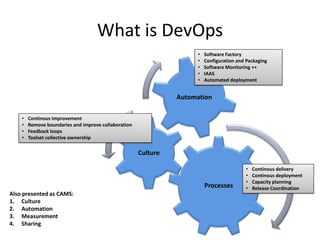
Processes 
Culture 
Automation 
•Continous delivery 
•Continous deployment 
•Capacity planning 
•Release Coordination 
•Software Factory 
•Configuration and Packaging 
•Software Monitoring ++ 
•IAAS 
•Automated deployment 
•Continous Improvement 
•Remove boundaries and improve collaboration 
•Feedback loops 
•Toolset collective ownership 
Also presented as CAMS: 
1.Culture 
2.Automation 
3.Measurement 
4.Sharing 
What is DevOps
Side to Side Comparison 
Big company 
•Revenue coming from different channels 
•Staff > 500 
•Matrix or Silo organisation 
•Geographically distributed teams 
•COTS tools culture for various areas: monitoring, scheduling, etc 
Web company 
•Revenue coming from web channel 
•Staff < 500 
•Hierarchical, silo organisation 
•Colocalized team 
•Open Source tools culture 
* COTS: commercial off the shelf
Why big companies are attracted by Devops 
•Buzz 
–Not really… 
•Efficiency / cost reduction 
–Improved automation means less resources 
–Lower CAPEX by leveraging cloud 
•Cycle time improvement 
–Server provisionning 
–SW deployment
What is slowing down the adoption 
•Operation/production isolation 
–Ivory tower with their own tools/teams 
–Internal SLA 
–Fear of change 
•Security 
–Data confidentiality 
–Public cloud is evil 
•Legal / Regulatory constraints 
–SOX, etc 
•Savings difficult to demonstrate 
•Complex transformation program
Transformation management 
Vision 
Skills 
Incentive 
Resources 
Action plan 
Change 
+ 
+ 
+ 
+
Usual transition paths (not exclusive) 
•Deploying Private Cloud 
–Achieve flexibility and hw savings objectives 
–Improved collaboration between dev and prod team 
– Environment standardization 
–Orchestration tool 
•Improve the cycle time using a *new* tool 
–Approval workflow 
–Multiplatform deployment 
–Service catalog 
•Cultural change similar to Agile adoption 
–Pilot 
–Transversal communities 
–Coach

Devops in bigcompanies

  • 1.
    Devops in bigcompanies
  • 2.
    DEVOPS DevOps AgileMethodologies Business Developers DevOps started on interaction between developers and operations Operations While Development departments are usually driven by user needs for frequent delivery of new features, Operations departments focus more on availability, stability of IT services and IT cost efficiency. These two contradicting goals create a "gap" between Development and Operations, which slows down IT's delivery of business value. http://en.wikipedia.org/wiki/DevOps
  • 3.
    Processes Culture Automation •Continous delivery •Continous deployment •Capacity planning •Release Coordination •Software Factory •Configuration and Packaging •Software Monitoring ++ •IAAS •Automated deployment •Continous Improvement •Remove boundaries and improve collaboration •Feedback loops •Toolset collective ownership Also presented as CAMS: 1.Culture 2.Automation 3.Measurement 4.Sharing What is DevOps
  • 4.
    Side to SideComparison Big company •Revenue coming from different channels •Staff > 500 •Matrix or Silo organisation •Geographically distributed teams •COTS tools culture for various areas: monitoring, scheduling, etc Web company •Revenue coming from web channel •Staff < 500 •Hierarchical, silo organisation •Colocalized team •Open Source tools culture * COTS: commercial off the shelf
  • 5.
    Why big companiesare attracted by Devops •Buzz –Not really… •Efficiency / cost reduction –Improved automation means less resources –Lower CAPEX by leveraging cloud •Cycle time improvement –Server provisionning –SW deployment
  • 6.
    What is slowingdown the adoption •Operation/production isolation –Ivory tower with their own tools/teams –Internal SLA –Fear of change •Security –Data confidentiality –Public cloud is evil •Legal / Regulatory constraints –SOX, etc •Savings difficult to demonstrate •Complex transformation program
  • 7.
    Transformation management Vision Skills Incentive Resources Action plan Change + + + +
  • 8.
    Usual transition paths(not exclusive) •Deploying Private Cloud –Achieve flexibility and hw savings objectives –Improved collaboration between dev and prod team – Environment standardization –Orchestration tool •Improve the cycle time using a *new* tool –Approval workflow –Multiplatform deployment –Service catalog •Cultural change similar to Agile adoption –Pilot –Transversal communities –Coach