Lead-in
1. Have youexperienced living in a new place? If the
answer is yes, please describe your feelings.
2. Why people may experience culture shock after moving
to a completely new environment?
3. What is intercultural communication competence?
4. How do communicative knowledge and skills work for
better competence?
5.
Lead-in
What is competence?
•Competence refers to the ability to do something effectively
and efficiently.
• It encompasses knowledge, skills, and attitudes required to
perform a task successfully in a particular context.
• Competence can be general (e.g., problem-solving skills) or
specific (e.g., technical expertise in a field).
6.
Lead-in
What is communicationcompetence?
• Refers to the ability to communicate effectively and appropriately in
various situations.
• It involves a strong command of language, an understanding of
social norms, and the ability to structure messages in a clear and
logical manner.
• A competent communicator must be able to use language correctly,
understand cultural and social expectations, structure ideas logically,
and employ strategies to overcome communication barriers.
7.
Lead-in
What is interculturalcommunication competence (ICC)?
• Refers to the ability to communicate effectively and appropriately
with people from different cultural backgrounds.
• It requires an understanding of cultural values, norms, and
communication styles, as well as the ability to interpret and
respond appropriately in intercultural interactions.
• Essential in today’s globalized world, where interactions across
cultures occur frequently in education, business, and social settings.
Pre-class work
1. Readthe Article
Sharing
Read the article “interactional competence in
intercultural contexts " on Pages 84-87 and
answer the questions:
Page 84-87
10.
Pre-class work
2. GroupDiscussion
Q 1 How does culture influence people’s perception
of communication competence?
Intercultural competence is actually a social and cultural
evaluation of one’s communication ability or behavior.
One communicative behavior judged competent in one
cultural context may be considered incompetent in
another.
Page 75
11.
Pre-class work
2. GroupDiscussion
Q 2 Give some examples in which something appropriate in one
culture is not evaluated as appropriate or effective in another?
It may be appropriate to call an elderly family member directly by first name
in some western cultures, but it is impolite to do so in many Asian countries,
such as South Korea, Vietnam or China.
In Chinese language, there are many different expressions used to
distinguish the status difference (e.g., 姨 (yí), 姑 (gū), 伯 (bó), and 叔
(shū)).
In China, a student is not supposed to call a professor by first name or by full
name to his/her face.
12.
Pre-class work
3 WorkOut
Sharing
Different cultural customs and traditions of
expressing affection and care:
Gather information about American and Chinese
ways of expressing affection and care during
holidays and in daily life and complete the table in
book on page 75 with more examples.
Page 75
13.
Pre-class work
3 WorkOut
Discussion on American ways of expressing affection & care
1) On Christmas Eve, family members send gifts to each other.
2) The whole family will be dressed up to attend some event or ceremony in which
one family member participates.
3) When asked for opinions, one will provide a view, not imposing it on his/her
friend.
4) When a daughter needs a car but cannot afford it, her parent may loan her
money to buy the car.
14.
Pre-class work
3 WorkOut
Discussion on Chinese ways of expressing affection & care
1) On Spring Festival, grand-parents, parents and relatives of older generation give
Lucky Money to children who are still attending school.
2) One parent or two will be dressed up to attend some event or ceremony in
which their family member participates.
3) When asked for opinions, one will provide a view and sometimes impose it on
his/her friend, believing that it’ll be good for the friend to follow.
4) When a daughter needs a car but cannot afford it, her parent may buy the car for
her generously.
15.
Pre-class work
4. CaseAnalysis:
First Offer– Refusal to accept the beer
Please discuss the case in groups and make a comment on it.
A Canadian colleague and I traveled to Guilin with our admirable
guide Li Lei in very hot weather. Sightseeing is a thirsty
business. We did not trust the water, and enjoyed excellent beer.
We politely offered some to Li Lei but he refused. We said
nothing and drank our beer, while poor Li Lei watched. On
second day, Li Lei quickly accepted our offer of beer.
16.
Pre-class work
First Offer–Refusal to accept the beer
1. Cultural Differences in Drinking Norms
Different cultures have varying attitudes toward alcohol. The
foreign travelers assumed that offering beer was a polite gesture,
while Li Lei initially refused, possibly due to personal beliefs, social
norms, or professional etiquette in China.
However, on the second day, he accepted, suggesting a shift in his
approach to the situation.
4. Case Analysis:
17.
Pre-class work
First Offer–Refusal to accept the beer
2. Adaptation and Flexibility
Li Lei’s change in response reflects adaptation, a key component of
ICC. He might have observed that refusing the beer made him feel
excluded or that sharing the drink would strengthen social bonds
with the travelers.
His decision to accept the beer shows his willingness to adjust to the
social norms of his foreign guests.
4. Case Analysis:
18.
Pre-class work
First Offer–Refusal to accept the beer
3. Nonverbal Communication and Silent Understanding
When Li Lei refused the beer on the first day, the travelers respected
his decision without questioning him. This demonstrates an
understanding of indirect communication, which is common in
many Asian cultures.
Instead of pressuring him, they simply continued drinking, allowing
him to make his own choice the next day.
4. Case Analysis:
19.
Pre-class work
First Offer–Refusal to accept the beer
4. The Role of Social Context in ICC
In some cultures, declining an offer once is a polite gesture, while
accepting later may indicate genuine interest. It is possible that Li
Lei initially refused out of politeness but later accepted to
strengthen connection with the group.
This highlights how context and relationship-building play an
essential role in intercultural interactions.
4. Case Analysis:
20.
Pre-class work
1. Whydo you think Li Lei initially refused the beer?
2. What does his decision to accept on the second day
suggest about intercultural adaptation?
3. How did the foreign travelers demonstrate cultural
sensitivity in their response to his initial refusal?
4. If you were in this situation, how would you navigate such
a cultural difference?
Discussion Questions for you!
4. Case Analysis:
21.
Pre-class work
Discussion Questionsfor you!
1. Why do you think Li Lei initially refused the beer?
A. He may have refused out of politeness, cultural norms, professional
etiquette, or personal beliefs.
2. What does his decision to accept on the second day suggest about
intercultural adaptation?
A. It shows he adjusted to the social context, prioritizing relationship-
building over initial hesitation.
4. Case Analysis:
22.
Pre-class work
Discussion Questionsfor you!
3. How did the foreign travelers demonstrate cultural sensitivity in their
response to his initial refusal?
A. They respected his decision without insisting, allowing him to make
his own choice.
4. If you were in this situation, how would you navigate such a cultural
difference?
A. Observe, respect local customs, and offer alternatives while ensuring
inclusivity in social interactions.
4. Case Analysis:
23.
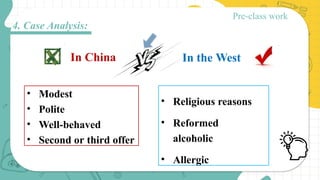
• Modest
• Polite
•Well-behaved
• Second or third offer
• Religious reasons
• Reformed
alcoholic
• Allergic
In China In the West
Pre-class work
4. Case Analysis:
24.
Pre-class work
Tell us!!
Inyour daily life, do you often accept first offer? If
YES, in what situation? If NO, in what situation?
4. Case Analysis:
1.1 Testing
1.Starting Point
Rate
Yourself
Chooseone number following each situation in the
book to indicate your anger level. The list consist of
10 different situations, so rate your anger level for
each one on a scale of 1 to 5 (1=not angry at all and 5
very angry).
Page 46
27.
1.1 Testing
1.Starting Point
Aftercompleting the ratings, calculate your total score.
Page 46
•If you score 40 or above, you are easily irritated or get angry
•If you score 20-39, you react normally
•If your score is below 20, you are not easily annoyed
Rating
Criteria
28.
1.2 Discuss thequestions
1.Starting Point
1) In the situations described, which one can make you lose
control of your temper most easily? Why? What are some
possible consequences caused by your anger? Use an
example to explain your point.
2) Share with your speaking partner the techniques of someone
you know who is skillful in anger control. Given such a
situation, what would this person possibly do or say?
29.
1.2 Discuss thequestions
1.Starting Point
Sample Answer 1:
The situation that would make me lose control of my temper
the most is #4 - when someone bumps into me and spills my
drink, ruining my shirt. This would make me very angry
(rating 4 or 5) because it's careless and inconsiderate
behavior that causes a mess and damages my belongings.
The consequences could be that I yell at the person or make
a scene, which would be an overreaction and could damage
the relationship. A better approach would be to calmly ask
the person to help clean it up.
30.
1.2 Discuss thequestions
1.Starting Point
Sample Answer 2:
My friend Sarah is very good at controlling her anger. When
she starts to feel upset, she takes some deep breaths to calm
down. She also tries to assume the other person didn't mean
to cause a problem, and speaks to them in a gentle,
understanding tone. If needed, she'll suggest taking a break
from the situation to cool off before continuing the
conversation. Her techniques help her stay in control of her
emotions and find a constructive solution, rather than
reacting angrily.
31.
1.3 Group Discussion
1.StartingPoint
1. Identify a range of feelings including anger
2. Identify the physical symptoms when you are angry
3. Identify aggressive acts shown by self and others
4. Identify potential consequences of your anger to others and
yourself…what can that mean for you?
5. Identify self-destructive behavior…How does that help or
hurt you?
32.
1.3 Group Discussion
1.StartingPoint
Identify a range of feelings including
anger:
Feeling Description
Hurt Emotional pain, often from perceived rejection or mistreatment
Fear Anxiety, worry, or apprehension about a perceived threat
Embarrassment Feeling self-conscious, foolish, or exposed
Insecurity Lacking confidence or feeling inadequate
Sadness Grief, sorrow, or melancholy
Frustration Feeling blocked from achieving a goal or desire
33.
1.3 Group Discussion
1.StartingPoint
Identify a range of
feelings including
anger:
• Disappointment
• Jealousy
• Envy
• Powerlessness
• Injustice
• Disrespect
• Invalidation
• Rejection
• Abandonment
34.
1.3 Group Discussion
1.StartingPoint
The concept of Anger Iceberg
The "anger iceberg" is a way to think about anger and the
emotions behind it.
Imagine an actual iceberg in the ocean. The part you can
see above the water is just the tip - there's a much larger
part hidden underneath.
The Visible Tip: Anger
•This is the angry behavior you can see, like yelling,
being aggressive, or acting sarcastic.
The Hidden Part: Deeper Emotions
•Underneath the anger, there are often other emotions
that are harder to see
35.
1.3 Group Discussion
1.StartingPoint
Identify the physical symptoms when you are
angry:
These physical reactions are part of
the body's "fight-or-flight" response
when faced with a perceived threat or
stressful situation.
36.
1.3 Group Discussion
1.StartingPoint
Identify aggressive acts shown by self and
others: • Throw something
• Kick someone or
something
• Get in someone’s face
• Shoving, grabbing, hitting
• Break something
• Call someone’s names
• Give someone a dirty look
• Silent treatment
• Get others to “gang up”
• Spread rumors
37.
1.3 Group Discussion
1.StartingPoint
Identify potential consequences of your anger to
others and yourself:
• Physical harm to someone or
self
• Destruction of property
• Loss of family/friends
• Loss of job
• Loss of social privileges
• Going to jail
• Getting a bad reputation
1.4 The effectsof Anger
1.Starting Point
Danger!! Danger!!
Danger!!
Failing to deal with your anger may
lead to:
Health Problems
Tension
Accidents
Interpersonal Problems
Uncontrolled Anger can be
DANGEROUS.
It may lead to:
CRIME-ABUSE-MORE VIOLENT
BEHAVIOR
40.
1.4 The effectsof Anger
1.Starting Point
Physical – ulcers, diarrheal, frequent colds and flus,
slower wound healing, heart attacks, headaches,
backaches, high blood pressure
Mental, emotional and spiritual – it separates you
from other people, keep feeling like a victim, impacts
your ability to be grateful and have a healthy spirit,
feeling inadequate, depression and anxiety
If you hold onto anger for a long time, it causes you problems?
2.1 Listen tothe story
2. Understanding problems in communication
It happened to me: I yelled and threw a chair
Page 47
Getting angry is not good, yet when emotion comes
some people are unable to control it.
Listen to Dalavi talking about himself.
43.
2.2 Group Discussion
2.Understanding problems in communication
How do you evaluate Dalavi's behavior in
anger? Analyze his behavior using what
you have learned from the article “Anger
management.’
Page 47
It happened to me: I yelled and threw a chair
44.
2.2 Group Discussion
2.Understanding problems in communication
Page 47
Dalavi’s behavior indicates that he has the problem of anger
disorder. He uses destructive ways to release negative
feelings, which as a matter of fact, leads to regret and bad
interpersonal relationships. Therefore, Dalavi failed to
control his anger properly.
45.
2.2 Group Discussion
2.Understanding problems in communication
Page 47
As a group, provide a list of
suggestions to help Dalavi better
handle anger and present to the
class
46.
2.3 Case Analysis
2.Understanding problems in communication
During the 2022 Academy
Awards, Will Smith slapped Chris
Rock. Watch the video and
analyze the situation.
Will Smith slapped Chris Rock
47.
2.3 Case Analysis
2.Understanding problems in communication
Rock made a joke about the hairstyle of Smith's wife Jada Pinkett
Smith that referenced the movie GI Jane in which actress Demi
Moore shaved her head. Pinkett Smith suffers from the hair loss
condition, alopecia. Smith, who later won best actor for 'King
Richard,' walked on stage and slapped Chris Rock and later when
Smith, back in his seat, shouted back, 'Keep my wife's name out of
your …….. mouth'
Step 1: Explain the Situation
48.
2.3 Case Analysis
2.Understanding problems in communication
Setting: 2022 Academy Awards
Participants: Will Smith (actor) and Chris Rock (comedian)
Channel: Face to Face
Message created: Joke made by Rock about the Hair style of Smith’s wife
Feedback: Smith slapped Rock and use rude language in response
Step 2: Explain the communication Process
49.
2.3 Case Analysis
2.Understanding problems in communication
1. What is the response of Smith and
the feedback of Rock?
2. How do you evaluate Smith's and
Rock’s behavior?
Step 3: Discuss the Questions in groups:
50.
2.3 Case Analysis
2.Understanding problems in communication
Responses and Feedback
Will Smith's Response
Smith slapped Chris Rock, and returned to his seat and yelled for Rock to
keep his wife's name out of his mouth.
Chris Rock's Feedback
Rock appeared stunned and momentarily paused his presentation after
being slapped. He handled the situation with calm, attempting to continue
with the show.
51.
2.3 Case Analysis
2.Understanding problems in communication
Smith and Rock Behavior
Will Smith's Behavior
The slap was an impulsive reaction to a perceived insult,
demonstrating a lack of control over emotions.
Chris Rock's Behavior
Rock maintained his professionalism during a highly
charged moment, quickly shifting back to the event.
52.
2.3 Case Analysis
2.Understanding problems in communication
Step 4: What was the Trigger and Emotions involved?
Trigger:
A joke made by Rock about
Jada Pinkett Smith's shaved
head.
Underlying Emotions: Anger,
hurt, and protectiveness over
his wife.
2. Understanding problemsin communication
Helpful Aspects
1.Motivation: Anger can inspire action to address problems
or injustices.
2.Self-Protection: It helps signal when something is wrong,
prompting self-defense or boundary-setting.
3.Emotional Release: Expressing anger in a healthy way can
provide relief and help process feelings.
4.Awareness: Anger can highlight unmet needs, guiding
necessary changes in life.
2.4 Helpful and Harmful Anger
55.
2. Understanding problemsin communication
Harmful Aspects
1.Destructive Behavior: Uncontrolled anger can lead to
aggression and damage relationships.
2.Chronic Stress: Managing anger poorly can cause ongoing
stress, affecting health.
3.Poor Decisions: Anger can cloud judgment, leading to
regrettable actions.
4.Escalated Conflict: It can intensify disputes, making
resolution harder.
2.4 Helpful and Harmful Anger
3.1 Discussion –AngerManagement
3. Solving problems in communication
Two students in pairs, discuss and share your
experiences and stories where anger control led to
positive consequences, as well as where failure to
control anger led to negative consequences and
how do you manage anger with the class. When
discussing experiences, pay special attention to
the accuracy of your language, and provide
feedback to each other on this.
After finishing the discussion, other fellow
students provide feedback on their techniques.
58.
3.2 Dealing withangry feelings effectively
3. Solving problems in communication
Identify stressors and learn
stress-management techniques
and relaxation skills.
Take steps to establish
real communication skills.
Identify the
emotional baggage
from childhood
issues.
Learn to recognize
your body’s
reactions to anger.
Learn to state your
true feelings.
Attempt to see things from
the other person’s
perspective.
59.
3.3 Anger Management
3.Solving problems in communication
Anger management does not involve
getting rid of all anger, but using
anger to enhance your life. We can
look at the purposes of anger in both a
positive and negative light.
60.
3.3 Anger Management
3.Solving problems in communication
Importance of ANGER
MANAGEMENT
The goal of Anger
Management is to reduce
both your emotional
feelings and the
physiological arousal that
anger causes.
You can't get rid of, or
avoid, the things or the
people that enrage you,
nor can you change them,
but you can learn to
control your reactions.
61.
When you areANGRY and UPSET
remember…
1-2-3 TURTLE
3.4 How to Manage Anger
3. Solving problems in communication
62.
1 – Goinside your shell
THINK before you ACT
Take a “Time Out”
3.4 How to Manage Anger
3. Solving problems in communication
63.
2 – Take3 Deep Breaths
Time to RELAX
Calm yourself down
3.4 How to Manage Anger
3. Solving problems in communication
64.
3–Walk Away
Think ofa good solution
3.4 How to Manage Anger
3. Solving problems in communication
65.
•Calm down
•Show mutualrespect
•Name the problem
•Find solutions
•Choose the best solution
•Congratulate yourself
•Review the solution that was picked
3.4 How to Manage Anger
3. Solving problems in communication
66.
Record a videothat performs the process of conflict which
includes the cause of angry, the ending (good or bad) in the
following situations:
Shopping center
Classroom
Working company
Dormitory
Train station
On the street
On the bus
At home
5 minutes with subtitle