ETHICAL
COMPETENCE
Developing the
of Public Officials
Engr. Kahlen Ze F. Montoya
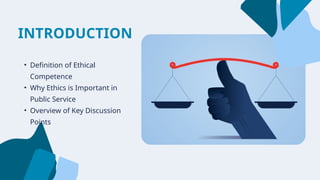
INTRODUCTION
• Definition of Ethical
Competence
• Why Ethics is Important in
Public Service
• Overview of Key Discussion
Points
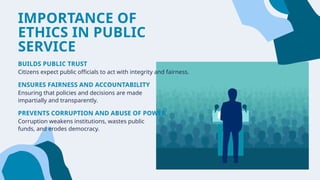
IMPORTANCE OF
ETHICS IN PUBLIC
SERVICE
BUILDS PUBLIC TRUST
Citizens expect public officials to act with integrity and fairness.
ENSURES FAIRNESS AND ACCOUNTABILITY
Ensuring that policies and decisions are made
impartially and transparently.
PREVENTS CORRUPTION AND ABUSE OF POWER
Corruption weakens institutions, wastes public
funds, and erodes democracy.
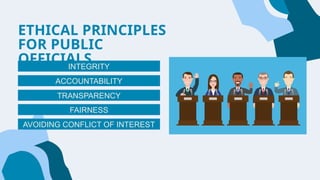
ETHICAL PRINCIPLES
FOR PUBLIC
OFFICIALS
INTEGRITY
ACCOUNTABILITY
AVOIDING CONFLICT OF INTEREST
TRANSPARENCY
FAIRNESS
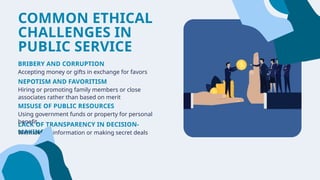
COMMON ETHICAL
CHALLENGES IN
PUBLIC SERVICE
BRIBERY AND CORRUPTION
Accepting money or gifts in exchange for favors
NEPOTISM AND FAVORITISM
Hiring or promoting family members or close
associates rather than based on merit
LACK OF TRANSPARENCY IN DECISION-
MAKING
Withholding information or making secret deals
MISUSE OF PUBLIC RESOURCES
Using government funds or property for personal
benefit.
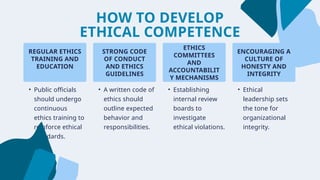
HOW TO DEVELOP
ETHICAL COMPETENCE
REGULAR ETHICS
TRAINING AND
EDUCATION
STRONG CODE
OF CONDUCT
AND ETHICS
GUIDELINES
ETHICS
COMMITTEES
AND
ACCOUNTABILIT
Y MECHANISMS
• Public officials
should undergo
continuous
ethics training to
reinforce ethical
standards.
• A written code of
ethics should
outline expected
behavior and
responsibilities.
• Establishing
internal review
boards to
investigate
ethical violations.
ENCOURAGING A
CULTURE OF
HONESTY AND
INTEGRITY
• Ethical
leadership sets
the tone for
organizational
integrity.
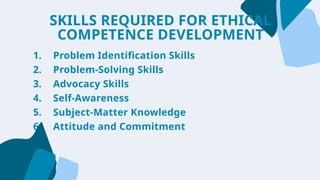
1. Problem Identification Skills
2. Problem-Solving Skills
3. Advocacy Skills
4. Self-Awareness
5. Subject-Matter Knowledge
6. Attitude and Commitment
SKILLS REQUIRED FOR ETHICAL
COMPETENCE DEVELOPMENT
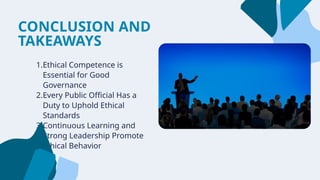
CONCLUSION AND
TAKEAWAYS
1.Ethical Competence is
Essential for Good
Governance
2.Every Public Official Has a
Duty to Uphold Ethical
Standards
3.Continuous Learning and
Strong Leadership Promote
Ethical Behavior
THANK YOU!

DEVELOPING ETHICAL COMPETENCE_PPT.pptx..

  • 1.
    ETHICAL COMPETENCE Developing the of PublicOfficials Engr. Kahlen Ze F. Montoya
  • 2.
    INTRODUCTION • Definition ofEthical Competence • Why Ethics is Important in Public Service • Overview of Key Discussion Points
  • 3.
    IMPORTANCE OF ETHICS INPUBLIC SERVICE BUILDS PUBLIC TRUST Citizens expect public officials to act with integrity and fairness. ENSURES FAIRNESS AND ACCOUNTABILITY Ensuring that policies and decisions are made impartially and transparently. PREVENTS CORRUPTION AND ABUSE OF POWER Corruption weakens institutions, wastes public funds, and erodes democracy.
  • 4.
  • 5.
    COMMON ETHICAL CHALLENGES IN PUBLICSERVICE BRIBERY AND CORRUPTION Accepting money or gifts in exchange for favors NEPOTISM AND FAVORITISM Hiring or promoting family members or close associates rather than based on merit LACK OF TRANSPARENCY IN DECISION- MAKING Withholding information or making secret deals MISUSE OF PUBLIC RESOURCES Using government funds or property for personal benefit.
  • 6.
    HOW TO DEVELOP ETHICALCOMPETENCE REGULAR ETHICS TRAINING AND EDUCATION STRONG CODE OF CONDUCT AND ETHICS GUIDELINES ETHICS COMMITTEES AND ACCOUNTABILIT Y MECHANISMS • Public officials should undergo continuous ethics training to reinforce ethical standards. • A written code of ethics should outline expected behavior and responsibilities. • Establishing internal review boards to investigate ethical violations. ENCOURAGING A CULTURE OF HONESTY AND INTEGRITY • Ethical leadership sets the tone for organizational integrity.
  • 7.
    1. Problem IdentificationSkills 2. Problem-Solving Skills 3. Advocacy Skills 4. Self-Awareness 5. Subject-Matter Knowledge 6. Attitude and Commitment SKILLS REQUIRED FOR ETHICAL COMPETENCE DEVELOPMENT
  • 9.
    CONCLUSION AND TAKEAWAYS 1.Ethical Competenceis Essential for Good Governance 2.Every Public Official Has a Duty to Uphold Ethical Standards 3.Continuous Learning and Strong Leadership Promote Ethical Behavior
  • 10.