© Agile Testing Framework. http://www.AgileTestingFramework.com/
DevOps from Within
The Art of Automated Testing
© Agile Testing Framework. http://www.AgileTestingFramework.com/www.AgileTestingFramew
Tom Gilmore (www.linkedin.com/in/gilmoretom) is a
coach who specializes in Agile/Automation/DevOps
coaching. Tom is able to help guide organizations
through all aspects of their journey to Agile
development, automated testing or DevOps.
With over 20 years of experience in quality assurance, Agile development and
automated testing. Tom is able to help organizations focus on developing
solutions to improve quality and decrease release time through DevOps, Agile
development and automated testing.
He has coached and trained a multitude of organizations. The short list includes,
Forever Living, Evaluate to Win, Able Engineering, Glynlyon, Choice Hotels
International, Discount Tire, Concord Servicing, First Solar, Edgenuity and
Agworks. Tom enjoys his work, and does everything to ensure he shares his
knowledge with others who seek it, by founding groups such as the Arizona
DevOps Selenium Group.
About Tom Gilmore
© Agile Testing Framework. http://www.AgileTestingFramework.com/
• Kaizen?
• Kanban?
• JIT (Just in Time)?
• Gemba?
• Value Stream Mapping?
• WIP (Work in Progress)?
• Jikoda?
• Pull Flow?
• Continual Improvement?
• Takt Time?
• Cycle Time?
• Andon Cord?
• Theory of Constraints?
• Heijunka?
• PDCA?
Do you Recognize These?
© Agile Testing Framework. http://www.AgileTestingFramework.com/
• W. Edward Deming is often referred to as the father of quality and his
ideas laid much of the groundwork for what is today called Six Sigma.
His unique fusion of science and human engineering have left a
profound impact on modern management.
• Deming’s theories about variation and behavior are absolutely
applicable to what DevOps in the software industry should look like
today and where it might be going in the future
• TQM is a management approach to long–term success through
customer satisfaction.
• In a TQM effort, all members of an organization participate in
improving processes, products, services, and the culture in which they
work.
Father of Quality and TQM
© Agile Testing Framework. http://www.AgileTestingFramework.com/
∙ Lean manufacturing - is a systematic method for the elimination of
waste ("Muda") within a manufacturing system. Lean also takes into
account waste created through overburden ("Muri") and waste created
through unevenness in work loads ("Mura").
∙ In order to understand the affect DevOps is having on the businesses,
we need to look at the Lean transformation to manufacturing
o Lean brought about a revolution to traditional manufacturing
o Toyota was at the forefront of this revolution
▪ 4 x the productivity with twice the output
▪ Lean brought about an unprecedented increase in worker
productivity, better delivery performance, reduced inventories
and higher customer satisfaction and employee happiness
Lean Manufacturing’s Importance
© Agile Testing Framework. http://www.AgileTestingFramework.com/
∙ To gain the DevOps benifits, organizations must change their culture
and practices. Seen as being to difficult in large complex organizations
∙ Lean revolution challenges
o Also extremely difficult
o Incentives changed, had to overcome work center silos, training/re-
skilling employees and focused on flows instead of units produced
o Organizations that did not adopt Lean became irrelevant
∙ DevOps could have a bigger impact on business value then the
manufacturing revolution
o IT has become the new factory floor
o Overwhelming majority of capital projects have an IT component
and half of all capital spending is technology related.
o IT is increasingly how businesses acquire new customer and
deliver value to them
Lean Manufacturing’s Importance
© Agile Testing Framework. http://www.AgileTestingFramework.com/
∙ DevOps in software development is even more difficult than the Lean
Manufacturing revolution
o Difficult determine WIP, since most IT work is invisible
o Today’s organizations have created low trust and control cultures
that thrive on fear. Fear kills experimentation and innovation
o IT has an “order taking” mentality due to this culture
o IT views does not view itself as critical part of system to deliver
value to customkers, instead it has come to view itself as a service
provider
o Looking at DevOps as simply solving technical problems puts the
organization at great risk
∙ Just like the Lean manufacturing revolution, there will be winners and
losers. Borrowing from Dr. W. Edwards Deming – “Learning is not
compulsory, but neither is survival”
Lean Manufacturing’s Importance
© Agile Testing Framework. http://www.AgileTestingFramework.com/
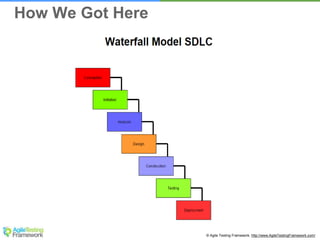
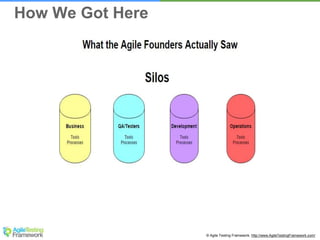
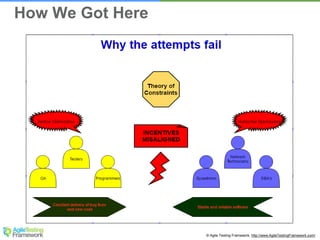
How We Got Here
© Agile Testing Framework. http://www.AgileTestingFramework.com/
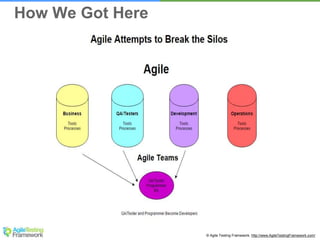
How We Got Here
© Agile Testing Framework. http://www.AgileTestingFramework.com/
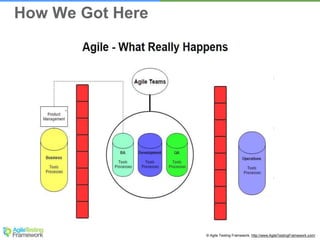
How We Got Here
© Agile Testing Framework. http://www.AgileTestingFramework.com/
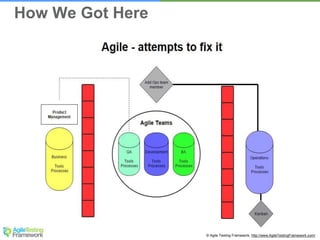
How We Got Here
© Agile Testing Framework. http://www.AgileTestingFramework.com/
How We Got Here
© Agile Testing Framework. http://www.AgileTestingFramework.com/
How We Got Here
© Agile Testing Framework. http://www.AgileTestingFramework.com/
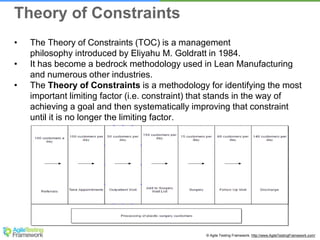
• The Theory of Constraints (TOC) is a management
philosophy introduced by Eliyahu M. Goldratt in 1984.
• It has become a bedrock methodology used in Lean Manufacturing
and numerous other industries.
• The Theory of Constraints is a methodology for identifying the most
important limiting factor (i.e. constraint) that stands in the way of
achieving a goal and then systematically improving that constraint
until it is no longer the limiting factor.
Theory of Constraints
© Agile Testing Framework. http://www.AgileTestingFramework.com/
2008 - Patrick Debois coins the term DevOps while organizing a
DevOpsDays conference in Belgium.
2009 - At the O’Reilly Velocity Conference, two Flickr employees—John
Allspaw, senior vice president of technical operations, and Paul
Hammond, director of engineering—deliver a seminal talk known as “10+
Deploys per Day: Dev and Ops Cooperation at Flickr.”
NOTE: It is important to remember that the term DevOps is widely used in
the IT industry these days, and many different types of connotations are
associated with it.
2015 DevOps survey found – 79% of companies in the US and 66% of
companies worldwide had plans to start adopting DevOps
practices!!!!!!
The reality is that about 1% of companies worldwide actually do DevOps.
DevOps History
© Agile Testing Framework. http://www.AgileTestingFramework.com/
DevOps is a methodology to close the gaps between development and
operations by aligning incentives, providing shared approaches for
processes and tools and identifying and resolving bottlenecks. DevOps
broadens the usage of Agile practices to operations in order to foster
collaboration and streamline the entire software delivery process in a
holistic way.
DevOps Is Not!
• DevOps is not a buzz term.
• DevOps is not a new department or silo.
• DevOps is also not a new role profile or a new job title.
• There are no one-size-fits-all solutions or DevOps by the book approaches
DevOps Is!
• Lightweight tools
• Bringing Agile approaches to the entire software delivery process
• DevOps does not necessarily introduce new tools.
• People and processes are more important than the tools.
DevOps?
© Agile Testing Framework. http://www.AgileTestingFramework.com/
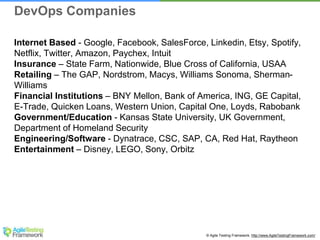
Internet Based - Google, Facebook, SalesForce, Linkedin, Etsy, Spotify,
Netflix, Twitter, Amazon, Paychex, Intuit
Insurance – State Farm, Nationwide, Blue Cross of California, USAA
Retailing – The GAP, Nordstrom, Macys, Williams Sonoma, Sherman-
Williams
Financial Institutions – BNY Mellon, Bank of America, ING, GE Capital,
E-Trade, Quicken Loans, Western Union, Capital One, Loyds, Rabobank
Government/Education - Kansas State University, UK Government,
Department of Homeland Security
Engineering/Software - Dynatrace, CSC, SAP, CA, Red Hat, Raytheon
Entertainment – Disney, LEGO, Sony, Orbitz
DevOps Companies
© Agile Testing Framework. http://www.AgileTestingFramework.com/
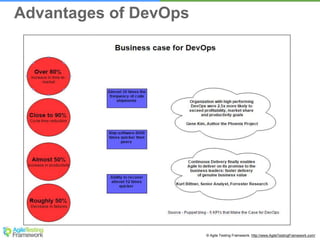
Advantages of DevOps
© Agile Testing Framework. http://www.AgileTestingFramework.com/
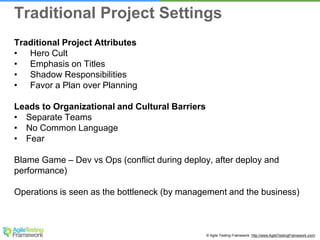
Traditional Project Attributes
• Hero Cult
• Emphasis on Titles
• Shadow Responsibilities
• Favor a Plan over Planning
Leads to Organizational and Cultural Barriers
• Separate Teams
• No Common Language
• Fear
Blame Game – Dev vs Ops (conflict during deploy, after deploy and
performance)
Operations is seen as the bottleneck (by management and the business)
Traditional Project Settings
© Agile Testing Framework. http://www.AgileTestingFramework.com/
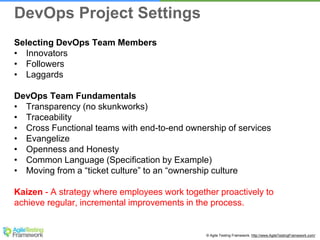
Selecting DevOps Team Members
• Innovators
• Followers
• Laggards
DevOps Team Fundamentals
• Transparency (no skunkworks)
• Traceability
• Cross Functional teams with end-to-end ownership of services
• Evangelize
• Openness and Honesty
• Common Language (Specification by Example)
• Moving from a “ticket culture” to an “ownership culture
Kaizen - A strategy where employees work together proactively to
achieve regular, incremental improvements in the process.
DevOps Project Settings
© Agile Testing Framework. http://www.AgileTestingFramework.com/
Starts Within
Successful DevOps transformations have shown a clear evolutionary
pattern, where most have started with essentially bottom-up movements
by individuals and teams, that have started with low hanging fruit such as
automation and tooling adoption. These bottom-up movements are now
shifting the focus to disseminating their learnings to the broader
organization in order to effectively scale DevOps.
• Local vs. Global Thinking
• Respect
• Trust
• No Victims
• The Smell Test
• Shaman
• Slaying the Dragon
• Fearless Behavior
• Piercing the IT Veil
• No Assholes
DevOps Kaizen Culture
© Agile Testing Framework. http://www.AgileTestingFramework.com/
Measurement and Metrics
• “Change” serves as a shared unit of measurement.
• Cycle Time
• Definition of Done
• SonarQube (Required to be part of CI, quality gates)
• Measure DevOps Progress (Specification by Example)
• Measure Cultural Change (surveys)
Improve and Accelerate Delivery
• Incremental releases
• Versioning and Baselines
• SCM Required
• Applies to App, DB and Infrastructure code
• By reducing batch size, we can deploy more frequently because
reducing batch size drives down cycle time.
Heijunka (Level Scheduling) - Reduces lead times (since each product
or variant is manufactured more frequently) and inventory (since batches
are smaller).
Building Blocks of DevOps
© Agile Testing Framework. http://www.AgileTestingFramework.com/
Automatic Releasing
• The key goal of automatic releasing is to reduce the risk of releasing.
• Should you automate everything? NO
Law of Marginal Costs
Noun/Verb Mistake.
Required to flip the testing pyramid
•
Jidoka - After Jidoka, workers can frequently monitor multiple stations
and many quality issues can be detected immediately (improving quality).
Building Blocks of DevOps
© Agile Testing Framework. http://www.AgileTestingFramework.com/
Apply Releases Incrementally and Iteratively
• Iterations can be looked at as a mini-project that may result in an
increment of the software. An iteration starts with an idea of what is
wanted, and then the code is refined to get the desired result. An
increment is a small unit of functionality.
• Upgrading all components in one big-bang release is the highest-risk
way of rolling out new functionality.
• A better method is to deploy components independently in a side-by
side configuration wherever possible.
Continuous Flow – Development process where work-in-process
smoothly flows through production with minimal (or no) buffers between
steps of the development process.
Building Blocks of DevOps
© Agile Testing Framework. http://www.AgileTestingFramework.com/
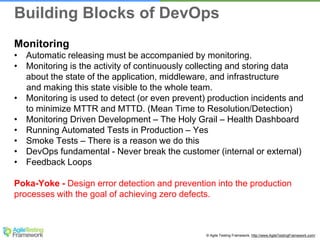
Monitoring
• Automatic releasing must be accompanied by monitoring.
• Monitoring is the activity of continuously collecting and storing data
about the state of the application, middleware, and infrastructure
and making this state visible to the whole team.
• Monitoring is used to detect (or even prevent) production incidents and
to minimize MTTR and MTTD. (Mean Time to Resolution/Detection)
• Monitoring Driven Development – The Holy Grail – Health Dashboard
• Running Automated Tests in Production – Yes
• Smoke Tests – There is a reason we do this
• DevOps fundamental - Never break the customer (internal or external)
• Feedback Loops
Poka-Yoke - Design error detection and prevention into the production
processes with the goal of achieving zero defects.
Building Blocks of DevOps
© Agile Testing Framework. http://www.AgileTestingFramework.com/
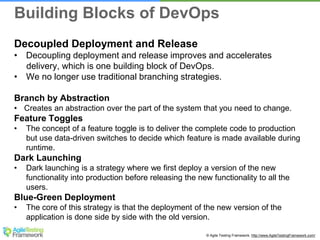
Decoupled Deployment and Release
• Decoupling deployment and release improves and accelerates
delivery, which is one building block of DevOps.
• We no longer use traditional branching strategies.
Branch by Abstraction
• Creates an abstraction over the part of the system that you need to change.
Feature Toggles
• The concept of a feature toggle is to deliver the complete code to production
but use data-driven switches to decide which feature is made available during
runtime.
Dark Launching
• Dark launching is a strategy where we first deploy a version of the new
functionality into production before releasing the new functionality to all the
users.
Blue-Green Deployment
• The core of this strategy is that the deployment of the new version of the
application is done side by side with the old version.
Building Blocks of DevOps
© Agile Testing Framework. http://www.AgileTestingFramework.com/
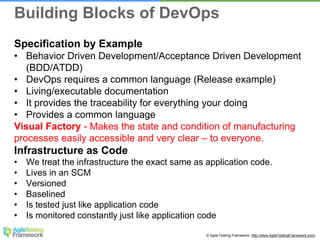
Specification by Example
• Behavior Driven Development/Acceptance Driven Development
(BDD/ATDD)
• DevOps requires a common language (Release example)
• Living/executable documentation
• It provides the traceability for everything your doing
• Provides a common language
Visual Factory - Makes the state and condition of manufacturing
processes easily accessible and very clear – to everyone.
Infrastructure as Code
• We treat the infrastructure the exact same as application code.
• Lives in an SCM
• Versioned
• Baselined
• Is tested just like application code
• Is monitored constantly just like application code
Building Blocks of DevOps
© Agile Testing Framework. http://www.AgileTestingFramework.com/
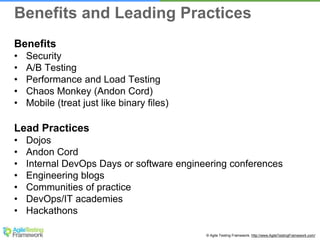
Benefits
• Security
• A/B Testing
• Performance and Load Testing
• Chaos Monkey (Andon Cord)
• Mobile (treat just like binary files)
Lead Practices
• Dojos
• Andon Cord
• Internal DevOps Days or software engineering conferences
• Engineering blogs
• Communities of practice
• DevOps/IT academies
• Hackathons
Benefits and Leading Practices
© Agile Testing Framework. http://www.AgileTestingFramework.com/
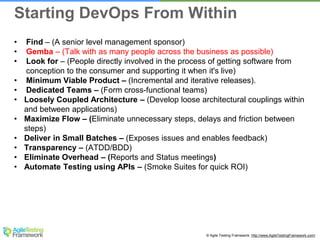
• Find – (A senior level management sponsor)
• Gemba – (Talk with as many people across the business as possible)
• Look for – (People directly involved in the process of getting software from
conception to the consumer and supporting it when it's live)
• Minimum Viable Product – (Incremental and iterative releases).
• Dedicated Teams – (Form cross-functional teams)
• Loosely Coupled Architecture – (Develop loose architectural couplings within
and between applications)
• Maximize Flow – (Eliminate unnecessary steps, delays and friction between
steps)
• Deliver in Small Batches – (Exposes issues and enables feedback)
• Transparency – (ATDD/BDD)
• Eliminate Overhead – (Reports and Status meetings)
• Automate Testing using APIs – (Smoke Suites for quick ROI)
Starting DevOps From Within
© Agile Testing Framework. http://www.AgileTestingFramework.com/
Learn more at www.torak.com
Learn more at www.AgileTestingFramework.com
Any questions...
© Agile Testing Framework. http://www.AgileTestingFramework.com/
This presentation was inspired by the work of many people and we have done our very best to
attribute all authors of texts and images, and recognize any copyrights. If you think that
anything in this presentation should be changed, added or removed, please contact us.
http://creativecommons.org/licenses/by-nc-nd/3.0/

Dev ops from within

  • 1.
    © Agile TestingFramework. http://www.AgileTestingFramework.com/ DevOps from Within The Art of Automated Testing
  • 2.
    © Agile TestingFramework. http://www.AgileTestingFramework.com/www.AgileTestingFramew Tom Gilmore (www.linkedin.com/in/gilmoretom) is a coach who specializes in Agile/Automation/DevOps coaching. Tom is able to help guide organizations through all aspects of their journey to Agile development, automated testing or DevOps. With over 20 years of experience in quality assurance, Agile development and automated testing. Tom is able to help organizations focus on developing solutions to improve quality and decrease release time through DevOps, Agile development and automated testing. He has coached and trained a multitude of organizations. The short list includes, Forever Living, Evaluate to Win, Able Engineering, Glynlyon, Choice Hotels International, Discount Tire, Concord Servicing, First Solar, Edgenuity and Agworks. Tom enjoys his work, and does everything to ensure he shares his knowledge with others who seek it, by founding groups such as the Arizona DevOps Selenium Group. About Tom Gilmore
  • 3.
    © Agile TestingFramework. http://www.AgileTestingFramework.com/ • Kaizen? • Kanban? • JIT (Just in Time)? • Gemba? • Value Stream Mapping? • WIP (Work in Progress)? • Jikoda? • Pull Flow? • Continual Improvement? • Takt Time? • Cycle Time? • Andon Cord? • Theory of Constraints? • Heijunka? • PDCA? Do you Recognize These?
  • 4.
    © Agile TestingFramework. http://www.AgileTestingFramework.com/ • W. Edward Deming is often referred to as the father of quality and his ideas laid much of the groundwork for what is today called Six Sigma. His unique fusion of science and human engineering have left a profound impact on modern management. • Deming’s theories about variation and behavior are absolutely applicable to what DevOps in the software industry should look like today and where it might be going in the future • TQM is a management approach to long–term success through customer satisfaction. • In a TQM effort, all members of an organization participate in improving processes, products, services, and the culture in which they work. Father of Quality and TQM
  • 5.
    © Agile TestingFramework. http://www.AgileTestingFramework.com/ ∙ Lean manufacturing - is a systematic method for the elimination of waste ("Muda") within a manufacturing system. Lean also takes into account waste created through overburden ("Muri") and waste created through unevenness in work loads ("Mura"). ∙ In order to understand the affect DevOps is having on the businesses, we need to look at the Lean transformation to manufacturing o Lean brought about a revolution to traditional manufacturing o Toyota was at the forefront of this revolution ▪ 4 x the productivity with twice the output ▪ Lean brought about an unprecedented increase in worker productivity, better delivery performance, reduced inventories and higher customer satisfaction and employee happiness Lean Manufacturing’s Importance
  • 6.
    © Agile TestingFramework. http://www.AgileTestingFramework.com/ ∙ To gain the DevOps benifits, organizations must change their culture and practices. Seen as being to difficult in large complex organizations ∙ Lean revolution challenges o Also extremely difficult o Incentives changed, had to overcome work center silos, training/re- skilling employees and focused on flows instead of units produced o Organizations that did not adopt Lean became irrelevant ∙ DevOps could have a bigger impact on business value then the manufacturing revolution o IT has become the new factory floor o Overwhelming majority of capital projects have an IT component and half of all capital spending is technology related. o IT is increasingly how businesses acquire new customer and deliver value to them Lean Manufacturing’s Importance
  • 7.
    © Agile TestingFramework. http://www.AgileTestingFramework.com/ ∙ DevOps in software development is even more difficult than the Lean Manufacturing revolution o Difficult determine WIP, since most IT work is invisible o Today’s organizations have created low trust and control cultures that thrive on fear. Fear kills experimentation and innovation o IT has an “order taking” mentality due to this culture o IT views does not view itself as critical part of system to deliver value to customkers, instead it has come to view itself as a service provider o Looking at DevOps as simply solving technical problems puts the organization at great risk ∙ Just like the Lean manufacturing revolution, there will be winners and losers. Borrowing from Dr. W. Edwards Deming – “Learning is not compulsory, but neither is survival” Lean Manufacturing’s Importance
  • 8.
    © Agile TestingFramework. http://www.AgileTestingFramework.com/ How We Got Here
  • 9.
    © Agile TestingFramework. http://www.AgileTestingFramework.com/ How We Got Here
  • 10.
    © Agile TestingFramework. http://www.AgileTestingFramework.com/ How We Got Here
  • 11.
    © Agile TestingFramework. http://www.AgileTestingFramework.com/ How We Got Here
  • 12.
    © Agile TestingFramework. http://www.AgileTestingFramework.com/ How We Got Here
  • 13.
    © Agile TestingFramework. http://www.AgileTestingFramework.com/ How We Got Here
  • 14.
    © Agile TestingFramework. http://www.AgileTestingFramework.com/ • The Theory of Constraints (TOC) is a management philosophy introduced by Eliyahu M. Goldratt in 1984. • It has become a bedrock methodology used in Lean Manufacturing and numerous other industries. • The Theory of Constraints is a methodology for identifying the most important limiting factor (i.e. constraint) that stands in the way of achieving a goal and then systematically improving that constraint until it is no longer the limiting factor. Theory of Constraints
  • 15.
    © Agile TestingFramework. http://www.AgileTestingFramework.com/ 2008 - Patrick Debois coins the term DevOps while organizing a DevOpsDays conference in Belgium. 2009 - At the O’Reilly Velocity Conference, two Flickr employees—John Allspaw, senior vice president of technical operations, and Paul Hammond, director of engineering—deliver a seminal talk known as “10+ Deploys per Day: Dev and Ops Cooperation at Flickr.” NOTE: It is important to remember that the term DevOps is widely used in the IT industry these days, and many different types of connotations are associated with it. 2015 DevOps survey found – 79% of companies in the US and 66% of companies worldwide had plans to start adopting DevOps practices!!!!!! The reality is that about 1% of companies worldwide actually do DevOps. DevOps History
  • 16.
    © Agile TestingFramework. http://www.AgileTestingFramework.com/ DevOps is a methodology to close the gaps between development and operations by aligning incentives, providing shared approaches for processes and tools and identifying and resolving bottlenecks. DevOps broadens the usage of Agile practices to operations in order to foster collaboration and streamline the entire software delivery process in a holistic way. DevOps Is Not! • DevOps is not a buzz term. • DevOps is not a new department or silo. • DevOps is also not a new role profile or a new job title. • There are no one-size-fits-all solutions or DevOps by the book approaches DevOps Is! • Lightweight tools • Bringing Agile approaches to the entire software delivery process • DevOps does not necessarily introduce new tools. • People and processes are more important than the tools. DevOps?
  • 17.
    © Agile TestingFramework. http://www.AgileTestingFramework.com/ Internet Based - Google, Facebook, SalesForce, Linkedin, Etsy, Spotify, Netflix, Twitter, Amazon, Paychex, Intuit Insurance – State Farm, Nationwide, Blue Cross of California, USAA Retailing – The GAP, Nordstrom, Macys, Williams Sonoma, Sherman- Williams Financial Institutions – BNY Mellon, Bank of America, ING, GE Capital, E-Trade, Quicken Loans, Western Union, Capital One, Loyds, Rabobank Government/Education - Kansas State University, UK Government, Department of Homeland Security Engineering/Software - Dynatrace, CSC, SAP, CA, Red Hat, Raytheon Entertainment – Disney, LEGO, Sony, Orbitz DevOps Companies
  • 18.
    © Agile TestingFramework. http://www.AgileTestingFramework.com/ Advantages of DevOps
  • 19.
    © Agile TestingFramework. http://www.AgileTestingFramework.com/ Traditional Project Attributes • Hero Cult • Emphasis on Titles • Shadow Responsibilities • Favor a Plan over Planning Leads to Organizational and Cultural Barriers • Separate Teams • No Common Language • Fear Blame Game – Dev vs Ops (conflict during deploy, after deploy and performance) Operations is seen as the bottleneck (by management and the business) Traditional Project Settings
  • 20.
    © Agile TestingFramework. http://www.AgileTestingFramework.com/ Selecting DevOps Team Members • Innovators • Followers • Laggards DevOps Team Fundamentals • Transparency (no skunkworks) • Traceability • Cross Functional teams with end-to-end ownership of services • Evangelize • Openness and Honesty • Common Language (Specification by Example) • Moving from a “ticket culture” to an “ownership culture Kaizen - A strategy where employees work together proactively to achieve regular, incremental improvements in the process. DevOps Project Settings
  • 21.
    © Agile TestingFramework. http://www.AgileTestingFramework.com/ Starts Within Successful DevOps transformations have shown a clear evolutionary pattern, where most have started with essentially bottom-up movements by individuals and teams, that have started with low hanging fruit such as automation and tooling adoption. These bottom-up movements are now shifting the focus to disseminating their learnings to the broader organization in order to effectively scale DevOps. • Local vs. Global Thinking • Respect • Trust • No Victims • The Smell Test • Shaman • Slaying the Dragon • Fearless Behavior • Piercing the IT Veil • No Assholes DevOps Kaizen Culture
  • 22.
    © Agile TestingFramework. http://www.AgileTestingFramework.com/ Measurement and Metrics • “Change” serves as a shared unit of measurement. • Cycle Time • Definition of Done • SonarQube (Required to be part of CI, quality gates) • Measure DevOps Progress (Specification by Example) • Measure Cultural Change (surveys) Improve and Accelerate Delivery • Incremental releases • Versioning and Baselines • SCM Required • Applies to App, DB and Infrastructure code • By reducing batch size, we can deploy more frequently because reducing batch size drives down cycle time. Heijunka (Level Scheduling) - Reduces lead times (since each product or variant is manufactured more frequently) and inventory (since batches are smaller). Building Blocks of DevOps
  • 23.
    © Agile TestingFramework. http://www.AgileTestingFramework.com/ Automatic Releasing • The key goal of automatic releasing is to reduce the risk of releasing. • Should you automate everything? NO Law of Marginal Costs Noun/Verb Mistake. Required to flip the testing pyramid • Jidoka - After Jidoka, workers can frequently monitor multiple stations and many quality issues can be detected immediately (improving quality). Building Blocks of DevOps
  • 24.
    © Agile TestingFramework. http://www.AgileTestingFramework.com/ Apply Releases Incrementally and Iteratively • Iterations can be looked at as a mini-project that may result in an increment of the software. An iteration starts with an idea of what is wanted, and then the code is refined to get the desired result. An increment is a small unit of functionality. • Upgrading all components in one big-bang release is the highest-risk way of rolling out new functionality. • A better method is to deploy components independently in a side-by side configuration wherever possible. Continuous Flow – Development process where work-in-process smoothly flows through production with minimal (or no) buffers between steps of the development process. Building Blocks of DevOps
  • 25.
    © Agile TestingFramework. http://www.AgileTestingFramework.com/ Monitoring • Automatic releasing must be accompanied by monitoring. • Monitoring is the activity of continuously collecting and storing data about the state of the application, middleware, and infrastructure and making this state visible to the whole team. • Monitoring is used to detect (or even prevent) production incidents and to minimize MTTR and MTTD. (Mean Time to Resolution/Detection) • Monitoring Driven Development – The Holy Grail – Health Dashboard • Running Automated Tests in Production – Yes • Smoke Tests – There is a reason we do this • DevOps fundamental - Never break the customer (internal or external) • Feedback Loops Poka-Yoke - Design error detection and prevention into the production processes with the goal of achieving zero defects. Building Blocks of DevOps
  • 26.
    © Agile TestingFramework. http://www.AgileTestingFramework.com/ Decoupled Deployment and Release • Decoupling deployment and release improves and accelerates delivery, which is one building block of DevOps. • We no longer use traditional branching strategies. Branch by Abstraction • Creates an abstraction over the part of the system that you need to change. Feature Toggles • The concept of a feature toggle is to deliver the complete code to production but use data-driven switches to decide which feature is made available during runtime. Dark Launching • Dark launching is a strategy where we first deploy a version of the new functionality into production before releasing the new functionality to all the users. Blue-Green Deployment • The core of this strategy is that the deployment of the new version of the application is done side by side with the old version. Building Blocks of DevOps
  • 27.
    © Agile TestingFramework. http://www.AgileTestingFramework.com/ Specification by Example • Behavior Driven Development/Acceptance Driven Development (BDD/ATDD) • DevOps requires a common language (Release example) • Living/executable documentation • It provides the traceability for everything your doing • Provides a common language Visual Factory - Makes the state and condition of manufacturing processes easily accessible and very clear – to everyone. Infrastructure as Code • We treat the infrastructure the exact same as application code. • Lives in an SCM • Versioned • Baselined • Is tested just like application code • Is monitored constantly just like application code Building Blocks of DevOps
  • 28.
    © Agile TestingFramework. http://www.AgileTestingFramework.com/ Benefits • Security • A/B Testing • Performance and Load Testing • Chaos Monkey (Andon Cord) • Mobile (treat just like binary files) Lead Practices • Dojos • Andon Cord • Internal DevOps Days or software engineering conferences • Engineering blogs • Communities of practice • DevOps/IT academies • Hackathons Benefits and Leading Practices
  • 29.
    © Agile TestingFramework. http://www.AgileTestingFramework.com/ • Find – (A senior level management sponsor) • Gemba – (Talk with as many people across the business as possible) • Look for – (People directly involved in the process of getting software from conception to the consumer and supporting it when it's live) • Minimum Viable Product – (Incremental and iterative releases). • Dedicated Teams – (Form cross-functional teams) • Loosely Coupled Architecture – (Develop loose architectural couplings within and between applications) • Maximize Flow – (Eliminate unnecessary steps, delays and friction between steps) • Deliver in Small Batches – (Exposes issues and enables feedback) • Transparency – (ATDD/BDD) • Eliminate Overhead – (Reports and Status meetings) • Automate Testing using APIs – (Smoke Suites for quick ROI) Starting DevOps From Within
  • 30.
    © Agile TestingFramework. http://www.AgileTestingFramework.com/ Learn more at www.torak.com Learn more at www.AgileTestingFramework.com Any questions...
  • 31.
    © Agile TestingFramework. http://www.AgileTestingFramework.com/ This presentation was inspired by the work of many people and we have done our very best to attribute all authors of texts and images, and recognize any copyrights. If you think that anything in this presentation should be changed, added or removed, please contact us. http://creativecommons.org/licenses/by-nc-nd/3.0/