DESTINATION EDUCATION REPORT
             MAURITIUS ISLAND
         THE ST. REGIS MAURITIUS RESORT


  LE MORNE PENINSULA, M AURITIUS   STREGIS.COM/ MAURITIUS
                                                            1
MAURITIUS ISLAND


“Mauritius, a sparkling crystal in the turquoise waters of the
Indian Ocean, will fascinate you. The contrast of colours,
cultures and tastes makes the island so charming that the scene
is set for an unforgettable holiday. Here, you have the
opportunity to experience unparalleled luxury: a level of
refinement that is head and shoulders above that on offer in
other tropical holiday destinations”.


          LE MORNE PENINSULA, M AURITIUS   STREGIS.COM/ MAURITIUS
                                                                    2
INDEX


ITEM

MAP ........................................................................................................................................................................ 4
TIME & PLACE .................................................................................................................................................... 5
OVERVIEW ........................................................................................................................................................... 5
NEAREST AIRPORT & AIRLINE INFORMATION ..................................................................................... 6
DIRECT FLIGHTS TO/FROM DESTINATION............................................................................................... 7
OTHER TRANSPORTATION OPTIONS ........................................................................................................ 8
WEATHER/SEASONS & AVERAGE TEMP..................................................................................................... 8
PASSPORT & VISA REQUIREMENTS AND OTHER SAFETY & SECURITY INFO ............................... 9
CURRENCY, CUSTOMS & EXCISE ................................................................................................................. 9
HISTORICAL & CURRENT FACTS ............................................................................................................... 10
WHEN TO GO .................................................................................................................................................... 15
THINGS TO DO.................................................................................................................................................. 15


                                         LE MORNE PENINSULA, M AURITIUS                       STREGIS.COM/ MAURITIUS
                                                                                                                                                                                 3
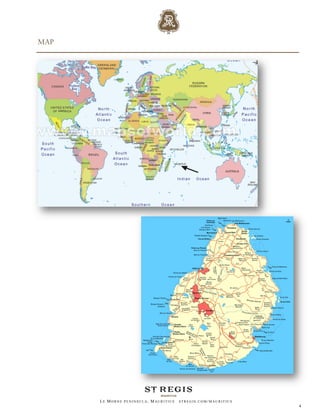
MAP


      LE MORNE PENINSULA, M AURITIUS   STREGIS.COM/ MAURITIUS
                                                                4
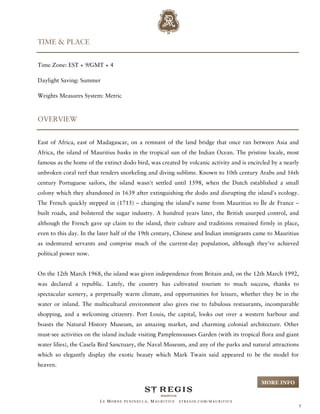
TIME & PLACE


Time Zone: EST + 9/GMT + 4

Daylight Saving: Summer

Weights Measures System: Metric


OVERVIEW


East of Africa, east of Madagascar, on a remnant of the land bridge that once ran between Asia and
Africa, the island of Mauritius basks in the tropical sun of the Indian Ocean. The pristine locale, most
famous as the home of the extinct dodo bird, was created by volcanic activity and is encircled by a nearly
unbroken coral reef that renders snorkeling and diving sublime. Known to 10th century Arabs and 16th
century Portuguese sailors, the island wasn't settled until 1598, when the Dutch established a small
colony which they abandoned in 1639 after extinguishing the dodo and disrupting the island's ecology.
The French quickly stepped in (1715) – changing the island's name from Mauritius to Île de France –
built roads, and bolstered the sugar industry. A hundred years later, the British usurped control, and
although the French gave up claim to the island, their culture and traditions remained firmly in place,
even to this day. In the later half of the 19th century, Chinese and Indian immigrants came to Mauritius
as indentured servants and comprise much of the current-day population, although they've achieved
political power now.


On the 12th March 1968, the island was given independence from Britain and, on the 12th March 1992,
was declared a republic. Lately, the country has cultivated tourism to much success, thanks to
spectacular scenery, a perpetually warm climate, and opportunities for leisure, whether they be in the
water or inland. The multicultural environment also gives rise to fabulous restaurants, incomparable
shopping, and a welcoming citizenry. Port Louis, the capital, looks out over a western harbour and
boasts the Natural History Museum, an amazing market, and charming colonial architecture. Other
must-see activities on the island include visiting Pamplemousses Garden (with its tropical flora and giant
water lilies), the Casela Bird Sanctuary, the Naval Museum, and any of the parks and natural attractions
which so elegantly display the exotic beauty which Mark Twain said appeared to be the model for
heaven.


                                                                                          MORE INFO


                         LE MORNE PENINSULA, M AURITIUS   STREGIS.COM/ MAURITIUS
                                                                                                             5
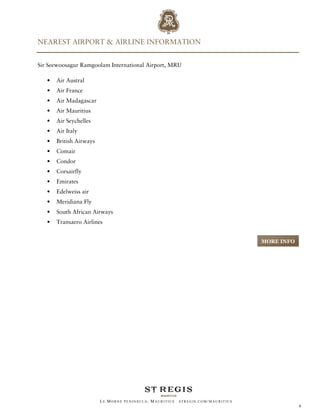
NEAREST AIRPORT & AIRLINE INFORMATION


Sir Seewoosagur Ramgoolam International Airport, MRU

   •   Air Austral
   •   Air France
   •   Air Madagascar
   •   Air Mauritius
   •   Air Seychelles
   •   Air Italy
   •   British Airways
   •   Comair
   •   Condor
   •   Corsairfly
   •   Emirates
   •   Edelweiss air
   •   Meridiana Fly
   •   South African Airways
   •   Transaero Airlines


                                                                                   MORE INFO


                         LE MORNE PENINSULA, M AURITIUS   STREGIS.COM/ MAURITIUS
                                                                                               6
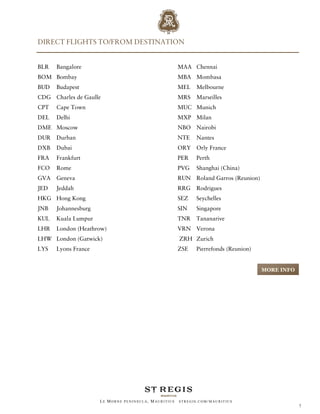
DIRECT FLIGHTS TO/FROM DESTINATION


BLR   Bangalore                                       MAA Chennai
BOM Bombay                                            MBA Mombasa
BUD   Budapest                                        MEL    Melbourne
CDG Charles de Gaulle                                 MRS    Marseilles
CPT   Cape Town                                       MUC Munich
DEL   Delhi                                           MXP Milan
DME Moscow                                            NBO Nairobi
DUR   Durban                                          NTE    Nantes
DXB   Dubai                                           ORY Orly France
FRA   Frankfurt                                       PER    Perth
FCO   Rome                                            PVG    Shanghai (China)
GVA   Geneva                                          RUN Roland Garros (Reunion)
JED   Jeddah                                          RRG    Rodrigues
HKG Hong Kong                                         SEZ    Seychelles
JNB   Johannesburg                                    SIN    Singapore
KUL   Kuala Lumpur                                    TNR    Tananarive
LHR   London (Heathrow)                               VRN Verona
LHW London (Gatwick)                                  ZRH Zurich
LYS   Lyons France                                    ZSE    Pierrefonds (Reunion)


                                                                                     MORE INFO


                     LE MORNE PENINSULA, M AURITIUS   STREGIS.COM/ MAURITIUS
                                                                                                 7
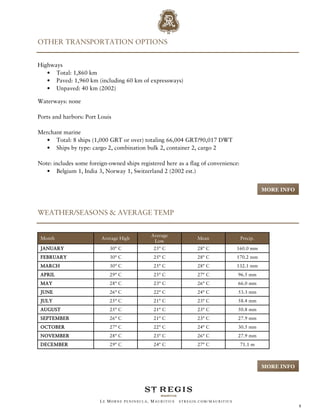
OTHER TRANSPORTATION OPTIONS


Highways
   • Total: 1,860 km
   • Paved: 1,960 km (including 60 km of expressways)
   • Unpaved: 40 km (2002)

Waterways: none

Ports and harbors: Port Louis

Merchant marine
  • Total: 8 ships (1,000 GRT or over) totaling 66,004 GRT/90,017 DWT
  • Ships by type: cargo 2, combination bulk 2, container 2, cargo 2

Note: includes some foreign-owned ships registered here as a flag of convenience:
   • Belgium 1, India 3, Norway 1, Switzerland 2 (2002 est.)


                                                                                              MORE INFO


WEATHER/SEASONS & AVERAGE TEMP


                                             Average
 Month                   Average High                            Mean               Precip.
                                              Low
 JANUARY                    30° C             25° C              28° C             160.0 mm
 FEBRUARY                   30° C             25° C              28° C             170.2 mm
 MARCH                      30° C             25° C              28° C             132.1 mm
 APRIL                      29° C             25° C              27° C             96.5 mm
 MAY                        28° C             23° C              26° C             66.0 mm
 JUNE                       26° C             22° C              24° C             53.3 mm
 JULY                       25° C             21° C              23° C             58.4 mm
 AUGUST                     25° C             21° C              23° C             50.8 mm
 SEPTEMBER                  26° C             21° C              23° C             27.9 mm
 OCTOBER                    27° C             22° C              24° C             30.5 mm
 NOVEMBER                   28° C             23° C              26° C             27.9 mm
 DECEMBER                   29° C             24° C              27° C              71.1 m


                                                                                              MORE INFO


                         LE MORNE PENINSULA, M AURITIUS   STREGIS.COM/ MAURITIUS
                                                                                                          8
PASSPORT & VISA REQUIREMENTS AND OTHER SAFETY & SECURITY INFO


Crossing Borders
No visa is required by nationals of most countries although they may be somewhat strict in enforcing
that you have a return/onward ticket and sufficient funds for your stay.
Nationals from Algeria, Iraq, Iran, Libya, Sudan, Democratic Republic of Congo, Nigeria, Yemen,
Afghanistan and Liberia must have a visa prior to arrival.


                                                                                         MORE INFO


Local Health Conditions
Compulsory vaccinations: None Recommended immunizations: None, however check travelers have up
to date tetanus & polio immunizations.


                                                                                         MORE INFO


CURRENCY, CUSTOMS & EXCISE


Currency: Mauritius Rupee (Rs)


Sample Price Guide (items found outside The St. Regis Mauritius Resort)
   •   Cup of coffee Rs 45.00
   •   Sandwich Rs 45.00
   •   Meal in cheap restaurant Rs 130.00
   •   Meal in expensive restaurant Rs 500.00
   •   Litre of bottled water Rs 12.00
   •   Small bottle of beer Rs 45.00
   •   Souvenir t-shirt Rs 200.00
   •   Street snack (dahl puris) Rs 10.00
   •   Scuba dive (including gear) Rs 1500.00


                                                                                         MORE INFO


                          LE MORNE PENINSULA, M AURITIUS   STREGIS.COM/ MAURITIUS
                                                                                                       9
HISTORICAL & CURRENT FACTS


Pre-20th-Century History
Arab traders knew of Mauritius as early as the 10th century but never stopped to settle it. Portuguese
naval explorers later stumbled upon the island in the wake of Vasco de Gama's voyage around the Cape
of Good Hope in 1498. Apart from introducing pesky monkeys (makak) and rats, the Portuguese did
little to influence the place. This was left to the next wave of immigrants, the Dutch. In 1598, Vice
Admiral Wybrandt van Warwyck came ashore and claimed the island for the Netherlands, christening it
after his ruler, Maurice, Prince of Orange and Count of Nassau. It was another 40 years before the
Dutch began to settle the country, preferring instead to use it as a supply base on the route to Java.


The colony never really flourished, and the Dutch departed for good in1639, leaving in their wake the
extinction of the dodo and the introduction of East African, Mozambican and Madagalasy slaves, Javan
deer, wild boar, pigeons, ducks, tobacco and sugar cane. Seventy- one years later, French captain
Guillaume Dufresne d'Arsel claimed the island, renamed it Île de France and gave it over to the French
East India Company to run as a trading base. Popular settlement began in 1721, and within 15 years the
first sugar mill had been built, along with a road network and hospital. During the second half of the
18th century, the island's capital, Port Louis, became a free trading base and haven for corsairs,
mercenary marines paid by a country to plunder the ships of its enemies. Tired of competing, the British
moved in on the corsairs (and on Mauritius) in 1810. After an initial defeat at the Battle of Vieux Grand
Port, the Brits landed at Cap Malheureux on the northern coast and took the island.


The 1814 Treaty of Paris ceded Île de France, Rodriguez and the Seychelles to the victors but allowed
Franco-Mauritians to retain their language, religion, and Napoleonic Code legal system and sugar
plantations. In 1835, the slaves were freed and the labor force was supplemented by workers brought in
from India and China.


                         LE MORNE PENINSULA, M AURITIUS   STREGIS.COM/ MAURITIUS
                                                                                                         10
Modern History
While Franco-Mauritian plantations supported some wealthy sugar barons (as they do today), Indian
workers continued to be indentured by the thousands. Through strength of numbers, Indians gradually
bolstered their say in the country's management, aided in 1901 by a visit from Mahatma Gandhi. In
1936, the Labour Party was founded to continue the struggle for laborers' rights. The following year,
their burden was lightened by a new constitution granting the vote to anyone over 21 who could sign
their name.


Under the direction of Dr Seewoosagur Ramgoolam (who was later knighted), membership swelled and
the party flourished. Mauritius was granted independence from Britain on 12 March 1968, and Sir
Ramgoolam was elected prime minister, a title he retained for the next 13 years. He was succeeded by a
coalition of the leftist Mouvement Militant Mauricien (MMM) and the Parti Socialiste Mauricien,
though tensions in the parties' upper ranks rattled the infrastructure throughout their reign. In 1986,
three Mauritian MPs were caught at Amsterdam's airport with heroin in their suitcases, and the resulting
inquiry implicated other politicians in drug money and led to several resignations. Mauritius officially
became a republic on March 1992.


Recent History
In 1999, tensions between the Creole population and the Indo-Mauritian majority exploded. Popular
reggae singer Joseph 'Kaya' Topize was arrested during a rally to legalize marijuana and died of a skull
fracture while in police custody. Riots broke out across the island, particularly in Port Louis. On the
political front, Paul Bérenger became the country's first non-Indian prime minister in 2003. It was short-
lived, however - Navinchandra Ramgoolam, son of Seewoosagur Ramgoolam, took over in July 2005.
With its traditional industries of sugar, tea, tobacco and textiles at the end of a long decline, Mauritius is
in the process of reorienting itself towards IT, banking and tourism to ensure its long-term economic
viability.


                          LE MORNE PENINSULA, M AURITIUS   STREGIS.COM/ MAURITIUS
                                                                                                             11
Culture
The cuisine of Mauritius is a blend of Indian Cuisine, Creole, Chinese and European. It is common for a
combination of cuisines to form part of the same meal. The "cari poule" or chicken curry, for example,
is a very popular dish. Other common Mauritian dishes include the "dholl puri" (a type of bread, made
from lentils) the "mine-frit" (Chinese fried noodle), and "niouk nien" (dumplings). A common
Mauritian drink is "alouda", a milk based drink containing basil seeds. The production of rum is
common throughout the island. Sugarcane was first introduced in 1639 some months before they left the
island (on the island when the Dutch colonised it in.) Even then, the propensity of making rum out of
sugarcane was strongly recognised.


Sugarcane was mainly cultivated for the production of "arrack" a strong drink made of the juice
extracted from the cane plant a precursor to rum. Only much later, after almost 81 years, the first proper
sugar was produced. However, it was during the French and English administration that sugar
production was fully exploited, which considerably contributed to the economical development of the
island. It was Pierre Charles François Harel who in 1850 initially proposed the concept of local
distillation of rum in Mauritius. In part due to his efforts, Mauritius today houses five distilleries (Grays,
Medine, L’aventure du sucre and St Aubin, Chamarel).


The sega is a local folklore music. Sega has African roots, and main traditional instruments for
producing the music are goat-skin percussion instruments called ravane and metallic clicks using metal
triangles. The songs usually describe the miseries of slavery, and have been adapted nowadays as social
satires to voice out inequalities as felt by the blacks. Men are usually at the instruments while women
perform an accompanying dance. Shows are regularly hosted in the coastal hotels.


                          LE MORNE PENINSULA, M AURITIUS   STREGIS.COM/ MAURITIUS
                                                                                                             12
In 1847, Mauritius became the fifth country in the world to issue postage stamps. The two types of
stamps issued then, known as the Red Penny and the Blue Penny are probably the most famous stamps
in the world, being very rare and considered to be the among the most valuable in the world. When
discovered, the island of Mauritius was home to a previously unknown species of bird, which the
Portuguese named the dodo (simpleton), as they appeared not too bright. However, by 1681, all dodos
had been killed by settlers, makak monkeys or their domesticated animals. An alternate theory suggests
that the imported wild boar destroyed the slow breeding dodo population. Nevertheless, the dodo is
prominently featured as a supporter of the national coat-of-arms.


The island has also given rise to a diversified literature, prominent in French, English, Creole and Indian
languages. Ancestry Mauritian society includes people from many different ethnic groups. A majority of
the republic's residents are the descendants of people from the Indian subcontinent. Mauritius also
contains substantial populations from continental Africa, Madagascar, France, Great Britain, and China,
among other places. The Indo-Mauritians (when the ethnic groups are combined) compose
approximately 60% of the total population, the remaining 40% being mostly Creoles. There are
approximately 30,000 Mauritians of Chinese descent, from the Hakka, Mandarin, and Cantonese
language groups. More than 90% of the Sino-Mauritian community is Roman Catholic, the remainder is
largely Buddhist. While there is a sizeable population of British citizens living in Mauritius, most of
whom have Mauritian nationality, few identify as being Mauritian. The term Anglo-Mauritian, a term
which may include Mauritians living in the UK, is used unofficially. Small groups of foreign students
from Europe or the Indian Ocean region are also present. Recent years have seen a steady flow of foreign
workers into the textile industry (primarily Chinese women), the construction industry (primarily Indian
workers), and harbour-related activities (primarily Taiwanese men). Immigration policy does not
provoke much debate in Mauritius, and the relative economic stability of the island serves to attract
foreign workers.


                         LE MORNE PENINSULA, M AURITIUS   STREGIS.COM/ MAURITIUS
                                                                                                          13
Language
The official language of Mauritius is English. All government administrative documents are therefore
drawn up in English. Together with English, French is also used in instruction in the educational system.
French, however, predominates in the media, both broadcast and printed as well as with business and in
corporate affairs. A majority of the population can speak French fluently. American and other English-
language movies and TV programmes shown in Mauritius are conventionally dubbed in French.


The most widely-spoken language of the country is Mauritian Creole, which has close ties with French
pronunciation, but with a few marked differences - Creole does not contain some of the deep and
rounded consonants that French does. Mauritian Creole is considered the native tongue of the country.
Creole was the language used by the African slaves to communicate with their French masters. Today,
Creole is used in everyday life by all Mauritians. When Franco-Mauritians engage in conversations with
Creole speakers, French is more commonly employed than Creole. Hindi and Urdu also have numerous
speakers in the country, although both are used mainly by the Indian community. Several other
languages, including Tamil, Telugu, Marathi, Bhojpuri, Gujarati, Punjabi and dialects of Chinese, such
as Cantonese, Hakka and Mandarin, are also spoken. The Indian languages are spoken by descendants
of the laborers brought from British India during the British rule. Arabic is taught in Mosques around
Mauritius.


Religion
The largest religions of the republic are Hindu (52%). Roman Catholicism (26%), Muslim (17%),
Buddhism (3%), Adventist Protestantism (2%) and Sikhism (0.3%).


                                                                                         MORE INFO


                         LE MORNE PENINSULA, M AURITIUS   STREGIS.COM/ MAURITIUS
                                                                                                        14
WHEN TO GO


Mauritius enjoys a typically tropical climate with year-round heat, although the southeast trade winds
help it to never feel too muggy. The best months to visit Mauritius are from mid September to early
December. January and February, the peak cyclone months, are best avoided by water-sports enthusiasts
and divers. Cyclones rarely hit Mauritius (but Rodrigues has suffered far more regularly than the
mainland). Hardly a week goes by in Mauritius without some celebration. On Rodrigues, the main
cultural event is the Festival Kréol, which takes place over three days at the end of October. Apart from
the Christmas-New Year peak, Mauritius doesn't really have high and low seasons.


THINGS TO DO


Water Sports
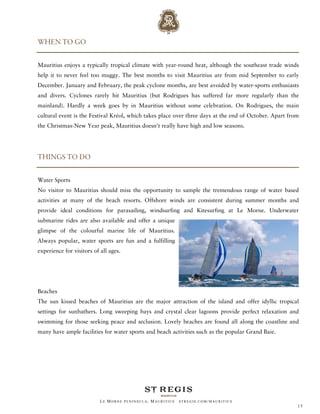
No visitor to Mauritius should miss the opportunity to sample the tremendous range of water based
activities at many of the beach resorts. Offshore winds are consistent during summer months and
provide ideal conditions for parasailing, windsurfing and Kitesurfing at Le Morne. Underwater
submarine rides are also available and offer a unique
glimpse of the colourful marine life of Mauritius.
Always popular, water sports are fun and a fulfilling
experience for visitors of all ages.


Beaches
The sun kissed beaches of Mauritius are the major attraction of the island and offer idyllic tropical
settings for sunbathers. Long sweeping bays and crystal clear lagoons provide perfect relaxation and
swimming for those seeking peace and seclusion. Lovely beaches are found all along the coastline and
many have ample facilities for water sports and beach activities such as the popular Grand Baie.


                           LE MORNE PENINSULA, M AURITIUS   STREGIS.COM/ MAURITIUS
                                                                                                        15
Golf
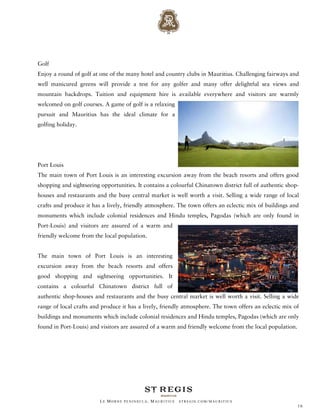
Enjoy a round of golf at one of the many hotel and country clubs in Mauritius. Challenging fairways and
well manicured greens will provide a test for any golfer and many offer delightful sea views and
mountain backdrops. Tuition and equipment hire is available everywhere and visitors are warmly
welcomed on golf courses. A game of golf is a relaxing
pursuit and Mauritius has the ideal climate for a
golfing holiday.


Port Louis
The main town of Port Louis is an interesting excursion away from the beach resorts and offers good
shopping and sightseeing opportunities. It contains a colourful Chinatown district full of authentic shop-
houses and restaurants and the busy central market is well worth a visit. Selling a wide range of local
crafts and produce it has a lively, friendly atmosphere. The town offers an eclectic mix of buildings and
monuments which include colonial residences and Hindu temples, Pagodas (which are only found in
Port-Louis) and visitors are assured of a warm and
friendly welcome from the local population.


The main town of Port Louis is an interesting
excursion away from the beach resorts and offers
good shopping and sightseeing opportunities. It
contains a colourful Chinatown district full of
authentic shop-houses and restaurants and the busy central market is well worth a visit. Selling a wide
range of local crafts and produce it has a lively, friendly atmosphere. The town offers an eclectic mix of
buildings and monuments which include colonial residences and Hindu temples, Pagodas (which are only
found in Port-Louis) and visitors are assured of a warm and friendly welcome from the local population.


                         LE MORNE PENINSULA, M AURITIUS   STREGIS.COM/ MAURITIUS
                                                                                                          16
Fishing Villages
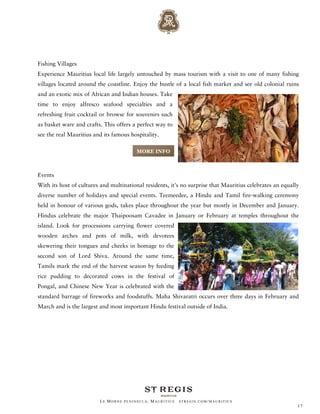
Experience Mauritius local life largely untouched by mass tourism with a visit to one of many fishing
villages located around the coastline. Enjoy the bustle of a local fish market and see old colonial ruins
and an exotic mix of African and Indian houses. Take
time to enjoy alfresco seafood specialties and a
refreshing fruit cocktail or browse for souvenirs such
as basket ware and crafts. This offers a perfect way to
see the real Mauritius and its famous hospitality.

                                        MORE INFO


Events
With its host of cultures and multinational residents, it's no surprise that Mauritius celebrates an equally
diverse number of holidays and special events. Teemeedee, a Hindu and Tamil fire-walking ceremony
held in honour of various gods, takes place throughout the year but mostly in December and January.
Hindus celebrate the major Thaipoosam Cavadee in January or February at temples throughout the
island. Look for processions carrying flower covered
wooden arches and pots of milk, with devotees
skewering their tongues and cheeks in homage to the
second son of Lord Shiva. Around the same time,
Tamils mark the end of the harvest season by feeding
rice pudding to decorated cows in the festival of
Pongal, and Chinese New Year is celebrated with the
standard barrage of fireworks and foodstuffs. Maha Shivaratri occurs over three days in February and
March and is the largest and most important Hindu festival outside of India.


                         LE MORNE PENINSULA, M AURITIUS   STREGIS.COM/ MAURITIUS
                                                                                                           17
Most of the island's Hindu population makes a pilgrimage in honour of Lord Shiva to the holy volcanic
lake Grand Bassin, where they make food sacrifices and stockpile vessels of the holy water. If you
happen upon a celebration of Holi, the Hindu festival of colours, count on a good soaking: exuberant
celebrants throw cupfuls of coloured powder and water on anyone in their path sometime in February or
March.


Independence Day (or Republic Day) is held on 12 March. Similar in intent to the Teemeedee
celebrations, Hindu and Tamil sword-climbing spectacles take place mostly between April and June, the
best demonstrations occur at Mont Choisy and the towns of Triolet and Solitude. Père Laval Feast Day
in September marks the anniversary of the Catholic convert-king's death, and pilgrims come from all
over the world to his shrine at Ste-Croix to pray for miracle cures. Muslims celebrate Eid-ur-Fitr to mark
the end of the fasting month of Ramadan, which is the ninth month of the lunar year. Eid-ur-Fitr is a
public holiday.


                                                                                          MORE INFO


                         LE MORNE PENINSULA, M AURITIUS   STREGIS.COM/ MAURITIUS
                                                                                                         18

Destination Education Report: Mauritius

  • 1.
    DESTINATION EDUCATION REPORT MAURITIUS ISLAND THE ST. REGIS MAURITIUS RESORT LE MORNE PENINSULA, M AURITIUS STREGIS.COM/ MAURITIUS 1
  • 2.
    MAURITIUS ISLAND “Mauritius, asparkling crystal in the turquoise waters of the Indian Ocean, will fascinate you. The contrast of colours, cultures and tastes makes the island so charming that the scene is set for an unforgettable holiday. Here, you have the opportunity to experience unparalleled luxury: a level of refinement that is head and shoulders above that on offer in other tropical holiday destinations”. LE MORNE PENINSULA, M AURITIUS STREGIS.COM/ MAURITIUS 2
  • 3.
    INDEX ITEM MAP ........................................................................................................................................................................ 4 TIME& PLACE .................................................................................................................................................... 5 OVERVIEW ........................................................................................................................................................... 5 NEAREST AIRPORT & AIRLINE INFORMATION ..................................................................................... 6 DIRECT FLIGHTS TO/FROM DESTINATION............................................................................................... 7 OTHER TRANSPORTATION OPTIONS ........................................................................................................ 8 WEATHER/SEASONS & AVERAGE TEMP..................................................................................................... 8 PASSPORT & VISA REQUIREMENTS AND OTHER SAFETY & SECURITY INFO ............................... 9 CURRENCY, CUSTOMS & EXCISE ................................................................................................................. 9 HISTORICAL & CURRENT FACTS ............................................................................................................... 10 WHEN TO GO .................................................................................................................................................... 15 THINGS TO DO.................................................................................................................................................. 15 LE MORNE PENINSULA, M AURITIUS STREGIS.COM/ MAURITIUS 3
  • 4.
    MAP LE MORNE PENINSULA, M AURITIUS STREGIS.COM/ MAURITIUS 4
  • 5.
    TIME & PLACE TimeZone: EST + 9/GMT + 4 Daylight Saving: Summer Weights Measures System: Metric OVERVIEW East of Africa, east of Madagascar, on a remnant of the land bridge that once ran between Asia and Africa, the island of Mauritius basks in the tropical sun of the Indian Ocean. The pristine locale, most famous as the home of the extinct dodo bird, was created by volcanic activity and is encircled by a nearly unbroken coral reef that renders snorkeling and diving sublime. Known to 10th century Arabs and 16th century Portuguese sailors, the island wasn't settled until 1598, when the Dutch established a small colony which they abandoned in 1639 after extinguishing the dodo and disrupting the island's ecology. The French quickly stepped in (1715) – changing the island's name from Mauritius to Île de France – built roads, and bolstered the sugar industry. A hundred years later, the British usurped control, and although the French gave up claim to the island, their culture and traditions remained firmly in place, even to this day. In the later half of the 19th century, Chinese and Indian immigrants came to Mauritius as indentured servants and comprise much of the current-day population, although they've achieved political power now. On the 12th March 1968, the island was given independence from Britain and, on the 12th March 1992, was declared a republic. Lately, the country has cultivated tourism to much success, thanks to spectacular scenery, a perpetually warm climate, and opportunities for leisure, whether they be in the water or inland. The multicultural environment also gives rise to fabulous restaurants, incomparable shopping, and a welcoming citizenry. Port Louis, the capital, looks out over a western harbour and boasts the Natural History Museum, an amazing market, and charming colonial architecture. Other must-see activities on the island include visiting Pamplemousses Garden (with its tropical flora and giant water lilies), the Casela Bird Sanctuary, the Naval Museum, and any of the parks and natural attractions which so elegantly display the exotic beauty which Mark Twain said appeared to be the model for heaven. MORE INFO LE MORNE PENINSULA, M AURITIUS STREGIS.COM/ MAURITIUS 5
  • 6.
    NEAREST AIRPORT &AIRLINE INFORMATION Sir Seewoosagur Ramgoolam International Airport, MRU • Air Austral • Air France • Air Madagascar • Air Mauritius • Air Seychelles • Air Italy • British Airways • Comair • Condor • Corsairfly • Emirates • Edelweiss air • Meridiana Fly • South African Airways • Transaero Airlines MORE INFO LE MORNE PENINSULA, M AURITIUS STREGIS.COM/ MAURITIUS 6
  • 7.
    DIRECT FLIGHTS TO/FROMDESTINATION BLR Bangalore MAA Chennai BOM Bombay MBA Mombasa BUD Budapest MEL Melbourne CDG Charles de Gaulle MRS Marseilles CPT Cape Town MUC Munich DEL Delhi MXP Milan DME Moscow NBO Nairobi DUR Durban NTE Nantes DXB Dubai ORY Orly France FRA Frankfurt PER Perth FCO Rome PVG Shanghai (China) GVA Geneva RUN Roland Garros (Reunion) JED Jeddah RRG Rodrigues HKG Hong Kong SEZ Seychelles JNB Johannesburg SIN Singapore KUL Kuala Lumpur TNR Tananarive LHR London (Heathrow) VRN Verona LHW London (Gatwick) ZRH Zurich LYS Lyons France ZSE Pierrefonds (Reunion) MORE INFO LE MORNE PENINSULA, M AURITIUS STREGIS.COM/ MAURITIUS 7
  • 8.
    OTHER TRANSPORTATION OPTIONS Highways • Total: 1,860 km • Paved: 1,960 km (including 60 km of expressways) • Unpaved: 40 km (2002) Waterways: none Ports and harbors: Port Louis Merchant marine • Total: 8 ships (1,000 GRT or over) totaling 66,004 GRT/90,017 DWT • Ships by type: cargo 2, combination bulk 2, container 2, cargo 2 Note: includes some foreign-owned ships registered here as a flag of convenience: • Belgium 1, India 3, Norway 1, Switzerland 2 (2002 est.) MORE INFO WEATHER/SEASONS & AVERAGE TEMP Average Month Average High Mean Precip. Low JANUARY 30° C 25° C 28° C 160.0 mm FEBRUARY 30° C 25° C 28° C 170.2 mm MARCH 30° C 25° C 28° C 132.1 mm APRIL 29° C 25° C 27° C 96.5 mm MAY 28° C 23° C 26° C 66.0 mm JUNE 26° C 22° C 24° C 53.3 mm JULY 25° C 21° C 23° C 58.4 mm AUGUST 25° C 21° C 23° C 50.8 mm SEPTEMBER 26° C 21° C 23° C 27.9 mm OCTOBER 27° C 22° C 24° C 30.5 mm NOVEMBER 28° C 23° C 26° C 27.9 mm DECEMBER 29° C 24° C 27° C 71.1 m MORE INFO LE MORNE PENINSULA, M AURITIUS STREGIS.COM/ MAURITIUS 8
  • 9.
    PASSPORT & VISAREQUIREMENTS AND OTHER SAFETY & SECURITY INFO Crossing Borders No visa is required by nationals of most countries although they may be somewhat strict in enforcing that you have a return/onward ticket and sufficient funds for your stay. Nationals from Algeria, Iraq, Iran, Libya, Sudan, Democratic Republic of Congo, Nigeria, Yemen, Afghanistan and Liberia must have a visa prior to arrival. MORE INFO Local Health Conditions Compulsory vaccinations: None Recommended immunizations: None, however check travelers have up to date tetanus & polio immunizations. MORE INFO CURRENCY, CUSTOMS & EXCISE Currency: Mauritius Rupee (Rs) Sample Price Guide (items found outside The St. Regis Mauritius Resort) • Cup of coffee Rs 45.00 • Sandwich Rs 45.00 • Meal in cheap restaurant Rs 130.00 • Meal in expensive restaurant Rs 500.00 • Litre of bottled water Rs 12.00 • Small bottle of beer Rs 45.00 • Souvenir t-shirt Rs 200.00 • Street snack (dahl puris) Rs 10.00 • Scuba dive (including gear) Rs 1500.00 MORE INFO LE MORNE PENINSULA, M AURITIUS STREGIS.COM/ MAURITIUS 9
  • 10.
    HISTORICAL & CURRENTFACTS Pre-20th-Century History Arab traders knew of Mauritius as early as the 10th century but never stopped to settle it. Portuguese naval explorers later stumbled upon the island in the wake of Vasco de Gama's voyage around the Cape of Good Hope in 1498. Apart from introducing pesky monkeys (makak) and rats, the Portuguese did little to influence the place. This was left to the next wave of immigrants, the Dutch. In 1598, Vice Admiral Wybrandt van Warwyck came ashore and claimed the island for the Netherlands, christening it after his ruler, Maurice, Prince of Orange and Count of Nassau. It was another 40 years before the Dutch began to settle the country, preferring instead to use it as a supply base on the route to Java. The colony never really flourished, and the Dutch departed for good in1639, leaving in their wake the extinction of the dodo and the introduction of East African, Mozambican and Madagalasy slaves, Javan deer, wild boar, pigeons, ducks, tobacco and sugar cane. Seventy- one years later, French captain Guillaume Dufresne d'Arsel claimed the island, renamed it Île de France and gave it over to the French East India Company to run as a trading base. Popular settlement began in 1721, and within 15 years the first sugar mill had been built, along with a road network and hospital. During the second half of the 18th century, the island's capital, Port Louis, became a free trading base and haven for corsairs, mercenary marines paid by a country to plunder the ships of its enemies. Tired of competing, the British moved in on the corsairs (and on Mauritius) in 1810. After an initial defeat at the Battle of Vieux Grand Port, the Brits landed at Cap Malheureux on the northern coast and took the island. The 1814 Treaty of Paris ceded Île de France, Rodriguez and the Seychelles to the victors but allowed Franco-Mauritians to retain their language, religion, and Napoleonic Code legal system and sugar plantations. In 1835, the slaves were freed and the labor force was supplemented by workers brought in from India and China. LE MORNE PENINSULA, M AURITIUS STREGIS.COM/ MAURITIUS 10
  • 11.
    Modern History While Franco-Mauritianplantations supported some wealthy sugar barons (as they do today), Indian workers continued to be indentured by the thousands. Through strength of numbers, Indians gradually bolstered their say in the country's management, aided in 1901 by a visit from Mahatma Gandhi. In 1936, the Labour Party was founded to continue the struggle for laborers' rights. The following year, their burden was lightened by a new constitution granting the vote to anyone over 21 who could sign their name. Under the direction of Dr Seewoosagur Ramgoolam (who was later knighted), membership swelled and the party flourished. Mauritius was granted independence from Britain on 12 March 1968, and Sir Ramgoolam was elected prime minister, a title he retained for the next 13 years. He was succeeded by a coalition of the leftist Mouvement Militant Mauricien (MMM) and the Parti Socialiste Mauricien, though tensions in the parties' upper ranks rattled the infrastructure throughout their reign. In 1986, three Mauritian MPs were caught at Amsterdam's airport with heroin in their suitcases, and the resulting inquiry implicated other politicians in drug money and led to several resignations. Mauritius officially became a republic on March 1992. Recent History In 1999, tensions between the Creole population and the Indo-Mauritian majority exploded. Popular reggae singer Joseph 'Kaya' Topize was arrested during a rally to legalize marijuana and died of a skull fracture while in police custody. Riots broke out across the island, particularly in Port Louis. On the political front, Paul Bérenger became the country's first non-Indian prime minister in 2003. It was short- lived, however - Navinchandra Ramgoolam, son of Seewoosagur Ramgoolam, took over in July 2005. With its traditional industries of sugar, tea, tobacco and textiles at the end of a long decline, Mauritius is in the process of reorienting itself towards IT, banking and tourism to ensure its long-term economic viability. LE MORNE PENINSULA, M AURITIUS STREGIS.COM/ MAURITIUS 11
  • 12.
    Culture The cuisine ofMauritius is a blend of Indian Cuisine, Creole, Chinese and European. It is common for a combination of cuisines to form part of the same meal. The "cari poule" or chicken curry, for example, is a very popular dish. Other common Mauritian dishes include the "dholl puri" (a type of bread, made from lentils) the "mine-frit" (Chinese fried noodle), and "niouk nien" (dumplings). A common Mauritian drink is "alouda", a milk based drink containing basil seeds. The production of rum is common throughout the island. Sugarcane was first introduced in 1639 some months before they left the island (on the island when the Dutch colonised it in.) Even then, the propensity of making rum out of sugarcane was strongly recognised. Sugarcane was mainly cultivated for the production of "arrack" a strong drink made of the juice extracted from the cane plant a precursor to rum. Only much later, after almost 81 years, the first proper sugar was produced. However, it was during the French and English administration that sugar production was fully exploited, which considerably contributed to the economical development of the island. It was Pierre Charles François Harel who in 1850 initially proposed the concept of local distillation of rum in Mauritius. In part due to his efforts, Mauritius today houses five distilleries (Grays, Medine, L’aventure du sucre and St Aubin, Chamarel). The sega is a local folklore music. Sega has African roots, and main traditional instruments for producing the music are goat-skin percussion instruments called ravane and metallic clicks using metal triangles. The songs usually describe the miseries of slavery, and have been adapted nowadays as social satires to voice out inequalities as felt by the blacks. Men are usually at the instruments while women perform an accompanying dance. Shows are regularly hosted in the coastal hotels. LE MORNE PENINSULA, M AURITIUS STREGIS.COM/ MAURITIUS 12
  • 13.
    In 1847, Mauritiusbecame the fifth country in the world to issue postage stamps. The two types of stamps issued then, known as the Red Penny and the Blue Penny are probably the most famous stamps in the world, being very rare and considered to be the among the most valuable in the world. When discovered, the island of Mauritius was home to a previously unknown species of bird, which the Portuguese named the dodo (simpleton), as they appeared not too bright. However, by 1681, all dodos had been killed by settlers, makak monkeys or their domesticated animals. An alternate theory suggests that the imported wild boar destroyed the slow breeding dodo population. Nevertheless, the dodo is prominently featured as a supporter of the national coat-of-arms. The island has also given rise to a diversified literature, prominent in French, English, Creole and Indian languages. Ancestry Mauritian society includes people from many different ethnic groups. A majority of the republic's residents are the descendants of people from the Indian subcontinent. Mauritius also contains substantial populations from continental Africa, Madagascar, France, Great Britain, and China, among other places. The Indo-Mauritians (when the ethnic groups are combined) compose approximately 60% of the total population, the remaining 40% being mostly Creoles. There are approximately 30,000 Mauritians of Chinese descent, from the Hakka, Mandarin, and Cantonese language groups. More than 90% of the Sino-Mauritian community is Roman Catholic, the remainder is largely Buddhist. While there is a sizeable population of British citizens living in Mauritius, most of whom have Mauritian nationality, few identify as being Mauritian. The term Anglo-Mauritian, a term which may include Mauritians living in the UK, is used unofficially. Small groups of foreign students from Europe or the Indian Ocean region are also present. Recent years have seen a steady flow of foreign workers into the textile industry (primarily Chinese women), the construction industry (primarily Indian workers), and harbour-related activities (primarily Taiwanese men). Immigration policy does not provoke much debate in Mauritius, and the relative economic stability of the island serves to attract foreign workers. LE MORNE PENINSULA, M AURITIUS STREGIS.COM/ MAURITIUS 13
  • 14.
    Language The official languageof Mauritius is English. All government administrative documents are therefore drawn up in English. Together with English, French is also used in instruction in the educational system. French, however, predominates in the media, both broadcast and printed as well as with business and in corporate affairs. A majority of the population can speak French fluently. American and other English- language movies and TV programmes shown in Mauritius are conventionally dubbed in French. The most widely-spoken language of the country is Mauritian Creole, which has close ties with French pronunciation, but with a few marked differences - Creole does not contain some of the deep and rounded consonants that French does. Mauritian Creole is considered the native tongue of the country. Creole was the language used by the African slaves to communicate with their French masters. Today, Creole is used in everyday life by all Mauritians. When Franco-Mauritians engage in conversations with Creole speakers, French is more commonly employed than Creole. Hindi and Urdu also have numerous speakers in the country, although both are used mainly by the Indian community. Several other languages, including Tamil, Telugu, Marathi, Bhojpuri, Gujarati, Punjabi and dialects of Chinese, such as Cantonese, Hakka and Mandarin, are also spoken. The Indian languages are spoken by descendants of the laborers brought from British India during the British rule. Arabic is taught in Mosques around Mauritius. Religion The largest religions of the republic are Hindu (52%). Roman Catholicism (26%), Muslim (17%), Buddhism (3%), Adventist Protestantism (2%) and Sikhism (0.3%). MORE INFO LE MORNE PENINSULA, M AURITIUS STREGIS.COM/ MAURITIUS 14
  • 15.
    WHEN TO GO Mauritiusenjoys a typically tropical climate with year-round heat, although the southeast trade winds help it to never feel too muggy. The best months to visit Mauritius are from mid September to early December. January and February, the peak cyclone months, are best avoided by water-sports enthusiasts and divers. Cyclones rarely hit Mauritius (but Rodrigues has suffered far more regularly than the mainland). Hardly a week goes by in Mauritius without some celebration. On Rodrigues, the main cultural event is the Festival Kréol, which takes place over three days at the end of October. Apart from the Christmas-New Year peak, Mauritius doesn't really have high and low seasons. THINGS TO DO Water Sports No visitor to Mauritius should miss the opportunity to sample the tremendous range of water based activities at many of the beach resorts. Offshore winds are consistent during summer months and provide ideal conditions for parasailing, windsurfing and Kitesurfing at Le Morne. Underwater submarine rides are also available and offer a unique glimpse of the colourful marine life of Mauritius. Always popular, water sports are fun and a fulfilling experience for visitors of all ages. Beaches The sun kissed beaches of Mauritius are the major attraction of the island and offer idyllic tropical settings for sunbathers. Long sweeping bays and crystal clear lagoons provide perfect relaxation and swimming for those seeking peace and seclusion. Lovely beaches are found all along the coastline and many have ample facilities for water sports and beach activities such as the popular Grand Baie. LE MORNE PENINSULA, M AURITIUS STREGIS.COM/ MAURITIUS 15
  • 16.
    Golf Enjoy a roundof golf at one of the many hotel and country clubs in Mauritius. Challenging fairways and well manicured greens will provide a test for any golfer and many offer delightful sea views and mountain backdrops. Tuition and equipment hire is available everywhere and visitors are warmly welcomed on golf courses. A game of golf is a relaxing pursuit and Mauritius has the ideal climate for a golfing holiday. Port Louis The main town of Port Louis is an interesting excursion away from the beach resorts and offers good shopping and sightseeing opportunities. It contains a colourful Chinatown district full of authentic shop- houses and restaurants and the busy central market is well worth a visit. Selling a wide range of local crafts and produce it has a lively, friendly atmosphere. The town offers an eclectic mix of buildings and monuments which include colonial residences and Hindu temples, Pagodas (which are only found in Port-Louis) and visitors are assured of a warm and friendly welcome from the local population. The main town of Port Louis is an interesting excursion away from the beach resorts and offers good shopping and sightseeing opportunities. It contains a colourful Chinatown district full of authentic shop-houses and restaurants and the busy central market is well worth a visit. Selling a wide range of local crafts and produce it has a lively, friendly atmosphere. The town offers an eclectic mix of buildings and monuments which include colonial residences and Hindu temples, Pagodas (which are only found in Port-Louis) and visitors are assured of a warm and friendly welcome from the local population. LE MORNE PENINSULA, M AURITIUS STREGIS.COM/ MAURITIUS 16
  • 17.
    Fishing Villages Experience Mauritiuslocal life largely untouched by mass tourism with a visit to one of many fishing villages located around the coastline. Enjoy the bustle of a local fish market and see old colonial ruins and an exotic mix of African and Indian houses. Take time to enjoy alfresco seafood specialties and a refreshing fruit cocktail or browse for souvenirs such as basket ware and crafts. This offers a perfect way to see the real Mauritius and its famous hospitality. MORE INFO Events With its host of cultures and multinational residents, it's no surprise that Mauritius celebrates an equally diverse number of holidays and special events. Teemeedee, a Hindu and Tamil fire-walking ceremony held in honour of various gods, takes place throughout the year but mostly in December and January. Hindus celebrate the major Thaipoosam Cavadee in January or February at temples throughout the island. Look for processions carrying flower covered wooden arches and pots of milk, with devotees skewering their tongues and cheeks in homage to the second son of Lord Shiva. Around the same time, Tamils mark the end of the harvest season by feeding rice pudding to decorated cows in the festival of Pongal, and Chinese New Year is celebrated with the standard barrage of fireworks and foodstuffs. Maha Shivaratri occurs over three days in February and March and is the largest and most important Hindu festival outside of India. LE MORNE PENINSULA, M AURITIUS STREGIS.COM/ MAURITIUS 17
  • 18.
    Most of theisland's Hindu population makes a pilgrimage in honour of Lord Shiva to the holy volcanic lake Grand Bassin, where they make food sacrifices and stockpile vessels of the holy water. If you happen upon a celebration of Holi, the Hindu festival of colours, count on a good soaking: exuberant celebrants throw cupfuls of coloured powder and water on anyone in their path sometime in February or March. Independence Day (or Republic Day) is held on 12 March. Similar in intent to the Teemeedee celebrations, Hindu and Tamil sword-climbing spectacles take place mostly between April and June, the best demonstrations occur at Mont Choisy and the towns of Triolet and Solitude. Père Laval Feast Day in September marks the anniversary of the Catholic convert-king's death, and pilgrims come from all over the world to his shrine at Ste-Croix to pray for miracle cures. Muslims celebrate Eid-ur-Fitr to mark the end of the fasting month of Ramadan, which is the ninth month of the lunar year. Eid-ur-Fitr is a public holiday. MORE INFO LE MORNE PENINSULA, M AURITIUS STREGIS.COM/ MAURITIUS 18