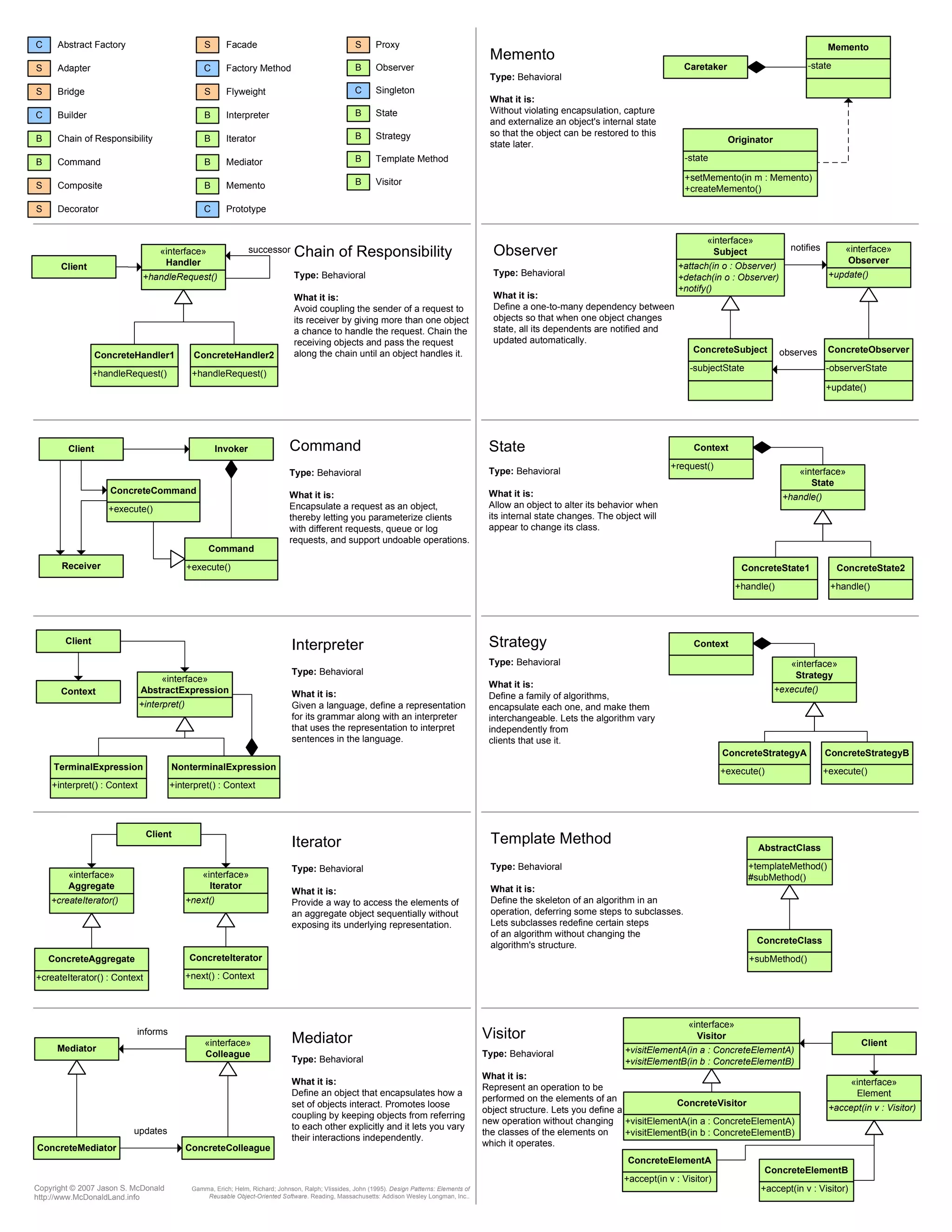
+visitElementA(in a : ConcreteElementA)
+visitElementB(in b : ConcreteElementB)
«interface»
Visitor
+visitElementA(in a : ConcreteElementA)
+visitElementB(in b : ConcreteElementB)
ConcreteVisitor +accept(in v : Visitor)
«interface»
Element
+accept(in v : Visitor)
ConcreteElementA
+accept(in v : Visitor)
ConcreteElementB
Client
Visitor
Type: Behavioral
What it is:
Represent an operation to be
performed on the elements of an
object structure. Lets you define a
new operation without changing
the classes of the elements on
which it operates.
+templateMethod()
#subMethod()
AbstractClass
+subMethod()
ConcreteClass
Template Method
Type: Behavioral
What it is:
Define the skeleton of an algorithm in an
operation, deferring some steps to subclasses.
Lets subclasses redefine certain steps
of an algorithm without changing the
algorithm's structure.
+execute()
ConcreteStrategyB
+execute()
«interface»
Strategy
Context
+execute()
ConcreteStrategyA
Strategy
Type: Behavioral
What it is:
Define a family of algorithms,
encapsulate each one, and make them
interchangeable. Lets the algorithm vary
independently from
clients that use it.
+handle()
ConcreteState1
+handle()
«interface»
State
+request()
Context
+handle()
ConcreteState2
State
Type: Behavioral
What it is:
Allow an object to alter its behavior when
its internal state changes. The object will
appear to change its class.
-subjectState
ConcreteSubject
+update()
-observerState
ConcreteObserver
+update()
«interface»
Observer
notifies
observes
+attach(in o : Observer)
+detach(in o : Observer)
+notify()
«interface»
Subject
Observer
Type: Behavioral
What it is:
Define a one-to-many dependency between
objects so that when one object changes
state, all its dependents are notified and
updated automatically.
-state
Memento
+setMemento(in m : Memento)
+createMemento()
-state
Originator
Caretaker
Memento
Type: Behavioral
What it is:
Without violating encapsulation, capture
and externalize an object's internal state
so that the object can be restored to this
state later.
Abstract Factory
C
Adapter
S
Bridge
S
Builder
C
Chain of Responsibility
B
Command
B
Composite
S
Decorator
S
Facade
S
Factory Method
C
Flyweight
S
Interpreter
B
Iterator
B
Mediator
B
Memento
B
Prototype
C
Proxy
S
Observer
B
Singleton
C
State
B
Strategy
B
Template Method
B
Visitor
B
Chain of Responsibility
+handleRequest()
«interface»
Handler
+handleRequest()
ConcreteHandler1
+handleRequest()
ConcreteHandler2
Client
successor
Type: Behavioral
What it is:
Avoid coupling the sender of a request to
its receiver by giving more than one object
a chance to handle the request. Chain the
receiving objects and pass the request
along the chain until an object handles it.
+execute()
ConcreteCommand
Client
Receiver
Invoker Command
Type: Behavioral
What it is:
Encapsulate a request as an object,
thereby letting you parameterize clients
with different requests, queue or log
requests, and support undoable operations.
+interpret()
«interface»
AbstractExpression
+interpret() : Context
TerminalExpression
Client
Context
+interpret() : Context
NonterminalExpression
Interpreter
Type: Behavioral
What it is:
Given a language, define a representation
for its grammar along with an interpreter
that uses the representation to interpret
sentences in the language.
+createIterator()
«interface»
Aggregate
+createIterator() : Context
ConcreteAggregate
+next()
«interface»
Iterator
+next() : Context
ConcreteIterator
Iterator
Type: Behavioral
What it is:
Provide a way to access the elements of
an aggregate object sequentially without
exposing its underlying representation.
Client
Mediator
ConcreteMediator ConcreteColleague
«interface»
Colleague
informs
updates
Mediator
Type: Behavioral
What it is:
Define an object that encapsulates how a
set of objects interact. Promotes loose
coupling by keeping objects from referring
to each other explicitly and it lets you vary
their interactions independently.
Copyright © 2007 Jason S. McDonald
http://www.McDonaldLand.info
Gamma, Erich; Helm, Richard; Johnson, Ralph; Vlissides, John (1995). Design Patterns: Elements of
Reusable Object-Oriented Software. Reading, Massachusetts: Addison Wesley Longman, Inc..
+execute()
Command
Facade
Complex system
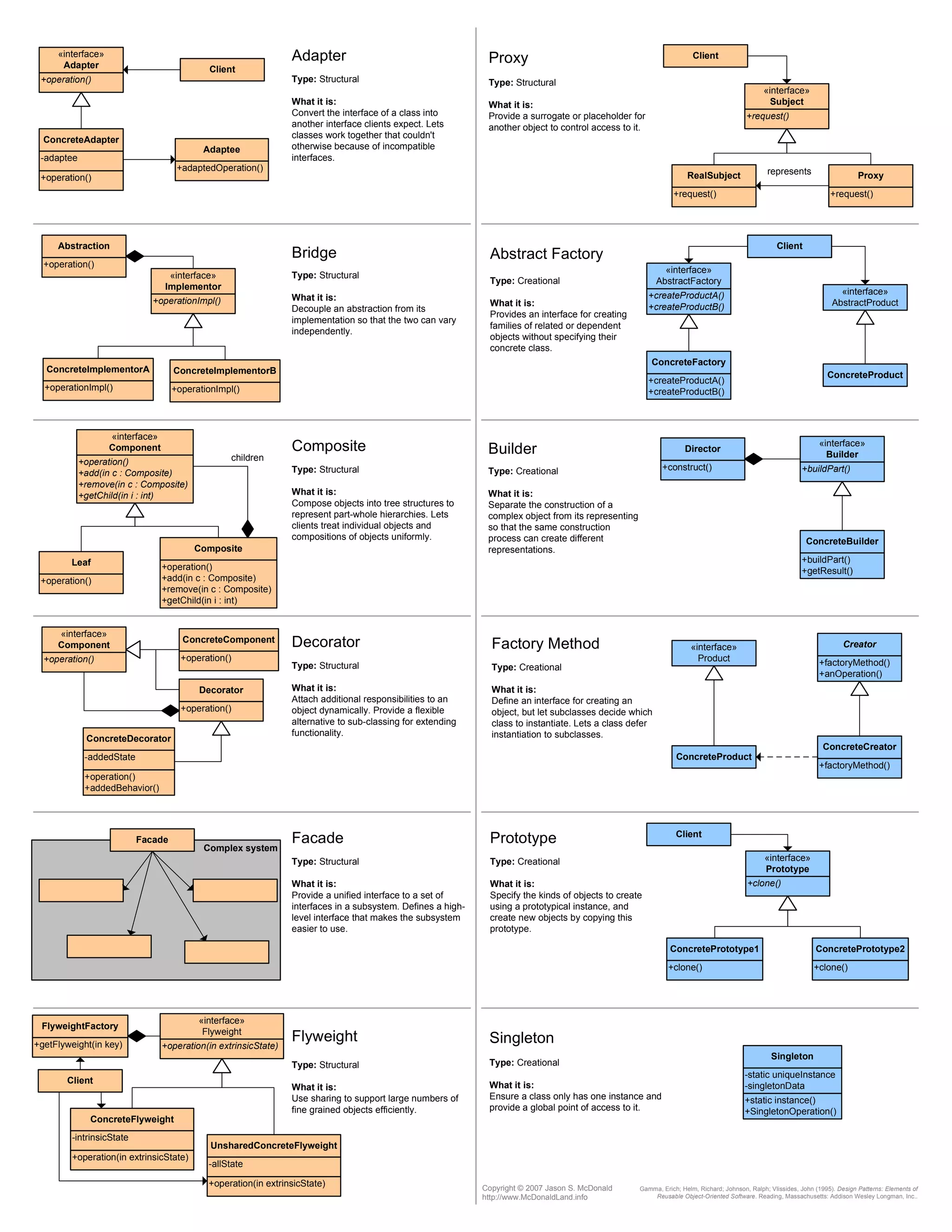
Adapter
Type: Structural
What it is:
Convert the interface of a class into
another interface clients expect. Lets
classes work together that couldn't
otherwise because of incompatible
interfaces.
+adaptedOperation()
Adaptee
+operation()
«interface»
Adapter
+operation()
-adaptee
ConcreteAdapter
Client
+operationImpl()
«interface»
Implementor
+operation()
Abstraction
+operationImpl()
ConcreteImplementorA
+operationImpl()
ConcreteImplementorB
Bridge
Type: Structural
What it is:
Decouple an abstraction from its
implementation so that the two can vary
independently.
+operation()
Leaf +operation()
+add(in c : Composite)
+remove(in c : Composite)
+getChild(in i : int)
Composite
+operation()
+add(in c : Composite)
+remove(in c : Composite)
+getChild(in i : int)
«interface»
Component
children
Composite
Type: Structural
What it is:
Compose objects into tree structures to
represent part-whole hierarchies. Lets
clients treat individual objects and
compositions of objects uniformly.
+operation()
ConcreteComponent
+operation()
Decorator
+operation()
«interface»
Component
+operation()
+addedBehavior()
-addedState
ConcreteDecorator
Decorator
Type: Structural
What it is:
Attach additional responsibilities to an
object dynamically. Provide a flexible
alternative to sub-classing for extending
functionality.
Facade
Type: Structural
What it is:
Provide a unified interface to a set of
interfaces in a subsystem. Defines a high-
level interface that makes the subsystem
easier to use.
Flyweight
Type: Structural
What it is:
Use sharing to support large numbers of
fine grained objects efficiently.
+request()
RealSubject
+request()
Proxy
+request()
«interface»
Subject
Client
represents
Proxy
Type: Structural
What it is:
Provide a surrogate or placeholder for
another object to control access to it.
+static instance()
+SingletonOperation()
-static uniqueInstance
-singletonData
Singleton
Singleton
Type: Creational
What it is:
Ensure a class only has one instance and
provide a global point of access to it.
+clone()
ConcretePrototype2
+clone()
«interface»
Prototype
Client
+clone()
ConcretePrototype1
Prototype
Type: Creational
What it is:
Specify the kinds of objects to create
using a prototypical instance, and
create new objects by copying this
prototype.
«interface»
Product
ConcreteProduct
+factoryMethod()
ConcreteCreator
+factoryMethod()
+anOperation()
Creator
Factory Method
Type: Creational
What it is:
Define an interface for creating an
object, but let subclasses decide which
class to instantiate. Lets a class defer
instantiation to subclasses.
+buildPart()
«interface»
Builder
+buildPart()
+getResult()
ConcreteBuilder
+construct()
Director
Builder
Type: Creational
What it is:
Separate the construction of a
complex object from its representing
so that the same construction
process can create different
representations.
«interface»
AbstractProduct
ConcreteProduct
+createProductA()
+createProductB()
«interface»
AbstractFactory
+createProductA()
+createProductB()
ConcreteFactory
Client
Abstract Factory
Type: Creational
What it is:
Provides an interface for creating
families of related or dependent
objects without specifying their
concrete class.
+operation(in extrinsicState)
-intrinsicState
ConcreteFlyweight
+operation(in extrinsicState)
-allState
UnsharedConcreteFlyweight
+operation(in extrinsicState)
«interface»
Flyweight
+getFlyweight(in key)
FlyweightFactory
Client
Copyright © 2007 Jason S. McDonald
http://www.McDonaldLand.info
Gamma, Erich; Helm, Richard; Johnson, Ralph; Vlissides, John (1995). Design Patterns: Elements of
Reusable Object-Oriented Software. Reading, Massachusetts: Addison Wesley Longman, Inc..

DesignPatternScard.pdf

  • 1.
    +visitElementA(in a :ConcreteElementA) +visitElementB(in b : ConcreteElementB) «interface» Visitor +visitElementA(in a : ConcreteElementA) +visitElementB(in b : ConcreteElementB) ConcreteVisitor +accept(in v : Visitor) «interface» Element +accept(in v : Visitor) ConcreteElementA +accept(in v : Visitor) ConcreteElementB Client Visitor Type: Behavioral What it is: Represent an operation to be performed on the elements of an object structure. Lets you define a new operation without changing the classes of the elements on which it operates. +templateMethod() #subMethod() AbstractClass +subMethod() ConcreteClass Template Method Type: Behavioral What it is: Define the skeleton of an algorithm in an operation, deferring some steps to subclasses. Lets subclasses redefine certain steps of an algorithm without changing the algorithm's structure. +execute() ConcreteStrategyB +execute() «interface» Strategy Context +execute() ConcreteStrategyA Strategy Type: Behavioral What it is: Define a family of algorithms, encapsulate each one, and make them interchangeable. Lets the algorithm vary independently from clients that use it. +handle() ConcreteState1 +handle() «interface» State +request() Context +handle() ConcreteState2 State Type: Behavioral What it is: Allow an object to alter its behavior when its internal state changes. The object will appear to change its class. -subjectState ConcreteSubject +update() -observerState ConcreteObserver +update() «interface» Observer notifies observes +attach(in o : Observer) +detach(in o : Observer) +notify() «interface» Subject Observer Type: Behavioral What it is: Define a one-to-many dependency between objects so that when one object changes state, all its dependents are notified and updated automatically. -state Memento +setMemento(in m : Memento) +createMemento() -state Originator Caretaker Memento Type: Behavioral What it is: Without violating encapsulation, capture and externalize an object's internal state so that the object can be restored to this state later. Abstract Factory C Adapter S Bridge S Builder C Chain of Responsibility B Command B Composite S Decorator S Facade S Factory Method C Flyweight S Interpreter B Iterator B Mediator B Memento B Prototype C Proxy S Observer B Singleton C State B Strategy B Template Method B Visitor B Chain of Responsibility +handleRequest() «interface» Handler +handleRequest() ConcreteHandler1 +handleRequest() ConcreteHandler2 Client successor Type: Behavioral What it is: Avoid coupling the sender of a request to its receiver by giving more than one object a chance to handle the request. Chain the receiving objects and pass the request along the chain until an object handles it. +execute() ConcreteCommand Client Receiver Invoker Command Type: Behavioral What it is: Encapsulate a request as an object, thereby letting you parameterize clients with different requests, queue or log requests, and support undoable operations. +interpret() «interface» AbstractExpression +interpret() : Context TerminalExpression Client Context +interpret() : Context NonterminalExpression Interpreter Type: Behavioral What it is: Given a language, define a representation for its grammar along with an interpreter that uses the representation to interpret sentences in the language. +createIterator() «interface» Aggregate +createIterator() : Context ConcreteAggregate +next() «interface» Iterator +next() : Context ConcreteIterator Iterator Type: Behavioral What it is: Provide a way to access the elements of an aggregate object sequentially without exposing its underlying representation. Client Mediator ConcreteMediator ConcreteColleague «interface» Colleague informs updates Mediator Type: Behavioral What it is: Define an object that encapsulates how a set of objects interact. Promotes loose coupling by keeping objects from referring to each other explicitly and it lets you vary their interactions independently. Copyright © 2007 Jason S. McDonald http://www.McDonaldLand.info Gamma, Erich; Helm, Richard; Johnson, Ralph; Vlissides, John (1995). Design Patterns: Elements of Reusable Object-Oriented Software. Reading, Massachusetts: Addison Wesley Longman, Inc.. +execute() Command
  • 2.
    Facade Complex system Adapter Type: Structural Whatit is: Convert the interface of a class into another interface clients expect. Lets classes work together that couldn't otherwise because of incompatible interfaces. +adaptedOperation() Adaptee +operation() «interface» Adapter +operation() -adaptee ConcreteAdapter Client +operationImpl() «interface» Implementor +operation() Abstraction +operationImpl() ConcreteImplementorA +operationImpl() ConcreteImplementorB Bridge Type: Structural What it is: Decouple an abstraction from its implementation so that the two can vary independently. +operation() Leaf +operation() +add(in c : Composite) +remove(in c : Composite) +getChild(in i : int) Composite +operation() +add(in c : Composite) +remove(in c : Composite) +getChild(in i : int) «interface» Component children Composite Type: Structural What it is: Compose objects into tree structures to represent part-whole hierarchies. Lets clients treat individual objects and compositions of objects uniformly. +operation() ConcreteComponent +operation() Decorator +operation() «interface» Component +operation() +addedBehavior() -addedState ConcreteDecorator Decorator Type: Structural What it is: Attach additional responsibilities to an object dynamically. Provide a flexible alternative to sub-classing for extending functionality. Facade Type: Structural What it is: Provide a unified interface to a set of interfaces in a subsystem. Defines a high- level interface that makes the subsystem easier to use. Flyweight Type: Structural What it is: Use sharing to support large numbers of fine grained objects efficiently. +request() RealSubject +request() Proxy +request() «interface» Subject Client represents Proxy Type: Structural What it is: Provide a surrogate or placeholder for another object to control access to it. +static instance() +SingletonOperation() -static uniqueInstance -singletonData Singleton Singleton Type: Creational What it is: Ensure a class only has one instance and provide a global point of access to it. +clone() ConcretePrototype2 +clone() «interface» Prototype Client +clone() ConcretePrototype1 Prototype Type: Creational What it is: Specify the kinds of objects to create using a prototypical instance, and create new objects by copying this prototype. «interface» Product ConcreteProduct +factoryMethod() ConcreteCreator +factoryMethod() +anOperation() Creator Factory Method Type: Creational What it is: Define an interface for creating an object, but let subclasses decide which class to instantiate. Lets a class defer instantiation to subclasses. +buildPart() «interface» Builder +buildPart() +getResult() ConcreteBuilder +construct() Director Builder Type: Creational What it is: Separate the construction of a complex object from its representing so that the same construction process can create different representations. «interface» AbstractProduct ConcreteProduct +createProductA() +createProductB() «interface» AbstractFactory +createProductA() +createProductB() ConcreteFactory Client Abstract Factory Type: Creational What it is: Provides an interface for creating families of related or dependent objects without specifying their concrete class. +operation(in extrinsicState) -intrinsicState ConcreteFlyweight +operation(in extrinsicState) -allState UnsharedConcreteFlyweight +operation(in extrinsicState) «interface» Flyweight +getFlyweight(in key) FlyweightFactory Client Copyright © 2007 Jason S. McDonald http://www.McDonaldLand.info Gamma, Erich; Helm, Richard; Johnson, Ralph; Vlissides, John (1995). Design Patterns: Elements of Reusable Object-Oriented Software. Reading, Massachusetts: Addison Wesley Longman, Inc..