Topic:The Design
Process
Biblical Relevance/Worldview:
Designing structures is carried out by engineers and technicians to
solve problems found in the immediate environment.
God gave individuals wisdom and skills and talents to build
structures like the temples and walls for self-defense.
CLASS RULES
• Mute your mics once you log into
the session.
• Enable your camera throughout the
lesson.
• Click the ‘raise hand’ icon, if you
have a question and not turn on your
mic except the teacher permits you.
• No chatting or playing while a class
is going on.
• Send a chat to the teacher when you
need to take a bathroom break.
• You will be called by your class no
or initials e.g Gracie Google - GG
Click to add
text
• Objectives (WALT)
• Describe the stages of the design process.
• Success Criteria (WILF)
• Ability to:
• State Identification of the problem
• Write a Design Brief.
• Carry out Research and analysis
• Keywords: primary and secondary research, problem
analysis, problem identification.
Introduction
Designing is a structured activity used to solve a problem found
in your immediate environment. You will have several chances
of coming up with a solution when you follow the design
process.
The Design Process in action
Now that you are familiar with the different stages of the design process, let
us work out a design activity. This activity will be based on designing and
making an artefact as well as producing a design folio to present the
different stages of the design process.
Identification of the problem
The first stage of the design process is to identify a problem from a design
situation. A situation is an occasion, an event or a daily routine activity that
the intended user has experienced. It is also important to mention the
intended user and the context within the situation.
NOTE:
• Intented user can be your family, your friend, you or any other person.
Other aspects related to the intended user can be age group, name of
company, gender (if needed).
• Context is the location or area within which the situation has been
described. Examples can be school, home, beach, public garden.
Problem Identified
ACTIVITY 1
• Identify a problem and write a situation.
Design Brief
• The design brief is a statement of intent showing what you are going
to do in the project as shown below.
DESIGN PROBLEM AND
BRIEF
• The Problem and Design Brief are
sometimes viewed as two different
sections of the design process.
However, they are very closely
related. Before you can start a design
project you must find a ‘problem’ to
solve. Sometimes this may be given
to you as a question set by the
teacher or the Examinations Board
and is usually a paragraph of writing.
The ‘design brief’ follows the ‘problem’
and states clearly how you intend to
solve the design problem.
DESIGN PROBLEM AND
BRIEF
DESIGN PROBLEMS
• A number of houses have been broken into on my street. It has been noticed that the number of strangers walking
down our street has increased lately and house holders are becoming concerned about the security of their houses.
The police have advised people to make their houses look as if they are occupied when they go away for a holiday or
even out for the evening. This may deter a potential thief from breaking into either the house or garage.
• The Neighborhood Watch scheme has also been introduced recently and this has helped people feel more secure.
However, even though neighbors will keep an eye on your property if you decide to go out and leave the house empty,
they cannot watch twenty four hours a day.
• Often even the police ignore house alarms when they are activated because of the high number of false alarms.
DESIGN BRIEF
• I am going to design and make a security device that will make my house look occupied when, in fact, it is empty.
Police statistics clearly show that houses are much more likely to be broken into when they are empty. Consequently, if
the house looks occupied it is likely to be safe.
• The device will be mobile so that it can be moved from room to room, easy to set up and control and also cheap to
make. It must not be powered by mains voltage and in this way it will be completely safe to be left ‘on’ for a long time
and will not be affected by power cuts. It will be activated by anyone approaching the hose from the front or back.
• It must deter even profession crooks from taking an interest in our house and even convince people in the street that
the house is occupied.
ACTIVITY 2
• Write down a design brief based on your
problem identified.
Research and analysis
In this section, you will analyze the design brief carefully and list the
important factors to be considered for the possible solutions required
for the design brief. A mind map will help you plan your research as
shown below.
ACTIVITY 3
Present a mind map with all the factors to be considered for your
research work based on the design brief of your problem identified.
Analysis of existing products
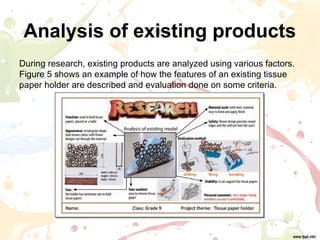
During research, existing products are analyzed using various factors.
Figure 5 shows an example of how the features of an existing tissue
paper holder are described and evaluation done on some criteria.
Consider the following factors to
describe the tissue paper holder
• What is the function of the tissue paper holder?
• In which sizes are the tissue paper holders available?
• Is the holder comfortable to use?
• What materials are used to make it?
• How is it appealing?
• What realisation methods have been used in making the tissue
paper holders?
• Is it safe to use?
• Is the tissue paper holder stable?
The following checklist can be considered to
evaluate the tissue paper holder.
• Does the tissue paper holder function well?
• Are the sizes of the tissue paper holders appropriate?
• Are the users able to take out tissue papers from the holder easily?
• Are the users able to handle the holder comfortably?
• Are the materials durable enough for the tissue paper holder to
function properly?
• Is the material safe to use? Is the material non-toxic?
• Does its colour or finish match with its environment?
• What cutting tools are used to cut the materials? What joining
methods are used?
• Does it have sharp edges or corners?
• Does the tissue paper holder stay standing in its upright position
when in use?
Peer Assessment for 15mins
•In groups of 5 students analyze this existing products using ACCESS
FM.
•For 10points: you analyze the product using the whole ACCESS FM
acronym.
•For 8points: you analyze the product using the 6 of the ACCESS FM
acronym.
•For 6points: you analyze the product using the 4 of the ACCESS FM
acronym.
Classwork
• Analyse two existing products.
ASSIGNMENT 1
ASSIGMENT 2
• Come up with a design brief through a
problem identification you carried out by
yourself.
Consolidate/Plenary
• Using exit ticket student write three things
they learnt from the lesson and one
question they seek answer.
• Objectives (WALT)
• Justify product design specifications.
• Generate of ideas via drawing.
• Select feasible ideas with reasons.
• Success Criteria (WILF)
• Ability to:
• Draw ideas using appropriate sketches.
• Justify selection of ideas with reasons.
• Keywords: primary and secondary research,
problem analysis, problem identification.
Specifications
Specification is a list of points that define the key features of the design
solution.
Example:
1. The tissue paper holder must hold tissue papers and is to be used
on a table where all family members can use it.
2. The size of tissue paper holder must not be greater 350 mm in width,
200 mm in height and 150 mm in depth or thickness.
3. It must be made with materials which can be assembled easily.
ACTIVITY 5
Relating to criteria considered as important,
present a list of specifications for your
design
Generation of ideas
Generation of ideas involves sketching a range of ideas as possible
solutions. An evaluation is also done to select the best idea. Figures 6,
7 and 8 show three possible solutions generated for a tissue paper
holder.
Generation of ideas
Generation of ideas
ACTIVITY
Propose 3 possible solutions for your
project.
Selection of idea
After generating ideas, you have to select one idea. Selecting an idea
means choosing one which satisfies most of the specifications criteria.
Analyzing generated ideas are useful in order to select an appropriate
idea.
The table below shows how to analyze and compare the ideas. A
written analysis has been used to evaluate each specification factor.
Based on the evaluation given, one idea can be selected as the best.
Your personal remarks may be essential to select the best idea.
Selection of idea
Selection of idea
• After analyzing and evaluating the three
ideas, Idea 1 has been selected.
Other ideas
Other ideas
Peer Assessment for 15mins
In groups of 5 students generate an idea to
solve an existing problem in the design and
technology lab storage room.
Classwork
Use your own ideas and specification
criteria to select the best one.
Give reasons for your selection.
Assignment
• Come up with 3 ideas from this design
brief..
• Note that after drawing your ideas
annotate properly.
Design brief:
I am going to design a portable cubicle to
hold at list 5 laptop with socket units for
charging.
Consolidate/Plenary:
• Using exit ticket student write three things
they learnt from the lesson and one
question they seek answer.

design-process-1.pptx DESIGN AND TECHNOLOGY

  • 1.
    Topic:The Design Process Biblical Relevance/Worldview: Designingstructures is carried out by engineers and technicians to solve problems found in the immediate environment. God gave individuals wisdom and skills and talents to build structures like the temples and walls for self-defense.
  • 2.
    CLASS RULES • Muteyour mics once you log into the session. • Enable your camera throughout the lesson. • Click the ‘raise hand’ icon, if you have a question and not turn on your mic except the teacher permits you. • No chatting or playing while a class is going on. • Send a chat to the teacher when you need to take a bathroom break. • You will be called by your class no or initials e.g Gracie Google - GG Click to add text
  • 4.
    • Objectives (WALT) •Describe the stages of the design process. • Success Criteria (WILF) • Ability to: • State Identification of the problem • Write a Design Brief. • Carry out Research and analysis • Keywords: primary and secondary research, problem analysis, problem identification.
  • 5.
    Introduction Designing is astructured activity used to solve a problem found in your immediate environment. You will have several chances of coming up with a solution when you follow the design process.
  • 6.
    The Design Processin action Now that you are familiar with the different stages of the design process, let us work out a design activity. This activity will be based on designing and making an artefact as well as producing a design folio to present the different stages of the design process. Identification of the problem The first stage of the design process is to identify a problem from a design situation. A situation is an occasion, an event or a daily routine activity that the intended user has experienced. It is also important to mention the intended user and the context within the situation. NOTE: • Intented user can be your family, your friend, you or any other person. Other aspects related to the intended user can be age group, name of company, gender (if needed). • Context is the location or area within which the situation has been described. Examples can be school, home, beach, public garden.
  • 7.
  • 8.
    ACTIVITY 1 • Identifya problem and write a situation.
  • 9.
    Design Brief • Thedesign brief is a statement of intent showing what you are going to do in the project as shown below.
  • 10.
    DESIGN PROBLEM AND BRIEF •The Problem and Design Brief are sometimes viewed as two different sections of the design process. However, they are very closely related. Before you can start a design project you must find a ‘problem’ to solve. Sometimes this may be given to you as a question set by the teacher or the Examinations Board and is usually a paragraph of writing. The ‘design brief’ follows the ‘problem’ and states clearly how you intend to solve the design problem.
  • 11.
    DESIGN PROBLEM AND BRIEF DESIGNPROBLEMS • A number of houses have been broken into on my street. It has been noticed that the number of strangers walking down our street has increased lately and house holders are becoming concerned about the security of their houses. The police have advised people to make their houses look as if they are occupied when they go away for a holiday or even out for the evening. This may deter a potential thief from breaking into either the house or garage. • The Neighborhood Watch scheme has also been introduced recently and this has helped people feel more secure. However, even though neighbors will keep an eye on your property if you decide to go out and leave the house empty, they cannot watch twenty four hours a day. • Often even the police ignore house alarms when they are activated because of the high number of false alarms. DESIGN BRIEF • I am going to design and make a security device that will make my house look occupied when, in fact, it is empty. Police statistics clearly show that houses are much more likely to be broken into when they are empty. Consequently, if the house looks occupied it is likely to be safe. • The device will be mobile so that it can be moved from room to room, easy to set up and control and also cheap to make. It must not be powered by mains voltage and in this way it will be completely safe to be left ‘on’ for a long time and will not be affected by power cuts. It will be activated by anyone approaching the hose from the front or back. • It must deter even profession crooks from taking an interest in our house and even convince people in the street that the house is occupied.
  • 12.
    ACTIVITY 2 • Writedown a design brief based on your problem identified.
  • 13.
    Research and analysis Inthis section, you will analyze the design brief carefully and list the important factors to be considered for the possible solutions required for the design brief. A mind map will help you plan your research as shown below.
  • 14.
    ACTIVITY 3 Present amind map with all the factors to be considered for your research work based on the design brief of your problem identified.
  • 15.
    Analysis of existingproducts During research, existing products are analyzed using various factors. Figure 5 shows an example of how the features of an existing tissue paper holder are described and evaluation done on some criteria.
  • 16.
    Consider the followingfactors to describe the tissue paper holder • What is the function of the tissue paper holder? • In which sizes are the tissue paper holders available? • Is the holder comfortable to use? • What materials are used to make it? • How is it appealing? • What realisation methods have been used in making the tissue paper holders? • Is it safe to use? • Is the tissue paper holder stable?
  • 17.
    The following checklistcan be considered to evaluate the tissue paper holder. • Does the tissue paper holder function well? • Are the sizes of the tissue paper holders appropriate? • Are the users able to take out tissue papers from the holder easily? • Are the users able to handle the holder comfortably? • Are the materials durable enough for the tissue paper holder to function properly? • Is the material safe to use? Is the material non-toxic? • Does its colour or finish match with its environment? • What cutting tools are used to cut the materials? What joining methods are used? • Does it have sharp edges or corners? • Does the tissue paper holder stay standing in its upright position when in use?
  • 18.
    Peer Assessment for15mins •In groups of 5 students analyze this existing products using ACCESS FM. •For 10points: you analyze the product using the whole ACCESS FM acronym. •For 8points: you analyze the product using the 6 of the ACCESS FM acronym. •For 6points: you analyze the product using the 4 of the ACCESS FM acronym.
  • 19.
    Classwork • Analyse twoexisting products.
  • 20.
  • 21.
    ASSIGMENT 2 • Comeup with a design brief through a problem identification you carried out by yourself.
  • 22.
    Consolidate/Plenary • Using exitticket student write three things they learnt from the lesson and one question they seek answer.
  • 23.
    • Objectives (WALT) •Justify product design specifications. • Generate of ideas via drawing. • Select feasible ideas with reasons. • Success Criteria (WILF) • Ability to: • Draw ideas using appropriate sketches. • Justify selection of ideas with reasons. • Keywords: primary and secondary research, problem analysis, problem identification.
  • 24.
    Specifications Specification is alist of points that define the key features of the design solution. Example: 1. The tissue paper holder must hold tissue papers and is to be used on a table where all family members can use it. 2. The size of tissue paper holder must not be greater 350 mm in width, 200 mm in height and 150 mm in depth or thickness. 3. It must be made with materials which can be assembled easily.
  • 25.
    ACTIVITY 5 Relating tocriteria considered as important, present a list of specifications for your design
  • 26.
    Generation of ideas Generationof ideas involves sketching a range of ideas as possible solutions. An evaluation is also done to select the best idea. Figures 6, 7 and 8 show three possible solutions generated for a tissue paper holder.
  • 27.
  • 28.
  • 29.
    ACTIVITY Propose 3 possiblesolutions for your project.
  • 30.
    Selection of idea Aftergenerating ideas, you have to select one idea. Selecting an idea means choosing one which satisfies most of the specifications criteria. Analyzing generated ideas are useful in order to select an appropriate idea. The table below shows how to analyze and compare the ideas. A written analysis has been used to evaluate each specification factor. Based on the evaluation given, one idea can be selected as the best. Your personal remarks may be essential to select the best idea.
  • 31.
  • 32.
    Selection of idea •After analyzing and evaluating the three ideas, Idea 1 has been selected.
  • 33.
  • 34.
  • 35.
    Peer Assessment for15mins In groups of 5 students generate an idea to solve an existing problem in the design and technology lab storage room.
  • 36.
    Classwork Use your ownideas and specification criteria to select the best one. Give reasons for your selection.
  • 37.
    Assignment • Come upwith 3 ideas from this design brief.. • Note that after drawing your ideas annotate properly. Design brief: I am going to design a portable cubicle to hold at list 5 laptop with socket units for charging.
  • 38.
    Consolidate/Plenary: • Using exitticket student write three things they learnt from the lesson and one question they seek answer.