DESIGNS LAW IN INDIA
 Definition of Design" (sec 2d of Designs Act
2000)
 Design means-
 features of shape
 pattern
 configuration
 ornament
 or composition of colors or lines
- which is applied in three dimensional or two
dimensional or in both the forms
- using any of the process whether manual,
chemical, mechanical, separate or combined
- which in the finished article appeal to or judged
wholly by the eye.
Essentials of Valid, Admissible
Design
 1. NOVELTY-
Novelty or newness is an essential requirement
of an admissible design .
 As per the Designs Act , a design is registered
only when it is new and original , and not
previously published .
 2. NO PRIOR PUBLICATION-
The design should not be published previously,
If a design is made available to the public or if
it has been shown or disclosed to a person
who is not bound to keep it secret , then it
constitutes publication of design
 . In Wimco Ltd , Bombay V Meena Match
Industries, Sivakasi , the court held that
publication , means the opposite of being kept
secret . It is considered published if a design is
no longer a secret .
 There is a publication if the design has
been disclosed to the public or if the public
is in possession of the design .
 Publication can occur in two ways . Publication
in prior document and Publication by prior user
.
 As per the law , the private or secret use or
experimental use of a design will not constitute
a publication .
 3. THE DESIGN MUST BE APPLIED TO A
PARTICULAR ARTICLE
A design is admissible if only it is incorporated in an
article.
 It can be either three-dimensional or two-dimensional.
 The design should relate to features of shape,
configuration, pattern or ornamentation applied or
applicable to an article.
 Hence, the industrial plan designs layouts and
installations cannot be taken as design under the
Act.
4. APPEAL TO EYES
 A design should be appeal solely by the eyes of the
consumer.
 This means a design in order to qualify, should be visible
DESIGNS ACT 2000
 The first Indian legislature to grant to grant
privileges and protection for designs was the
Patent and Designs Act , 1872 .
 Replaced by Patents and Designs Act 1911
 In 1970 , a separate Act called the Patent Act 1970
and thus the provisions relating to patent was
repealed , but the 1911 act continued to be the
major legislation for Industrial Design till 2000
 Finally new Designs Act of 2000 came into being.
 The Controller-General of Patents, Designs and
Trade Marks shall be the Controller of Designs for
the purposes of this Act.
 Sec 4. PROHIBITION OF REGISTRATION OF
CERTAIN DESIGNS.—
 A design which— (a) is not new or original;
 (b) has been disclosed to the public
anywhere in India or in any other country by
publication in tangible form or by use or in any
other way prior to the filing date, or where
applicable, the priority date of the application
for registration;
 or (c) is not significantly distinguishable
from known designs or combination of known
designs; or
 (d) comprises or contains scandalous or
obscene matter,
- shall not be registered.
 tems that cannot be registered as a design
under the act: Signs, emblems or flags of any
country.
 Size of any article, if changed.
 Structures and buildings.
 Integrated circuits' layout designs
 Trade variations.
 Any principle or mode of construction of any article
such as labels, tokens, cartoons, cards, etc.
 Books, calendars, certificates, jackets, forms-and
other documents, greeting cards, maps and plan
cards, postcards, leaflets, stamps, medals,
dressmaking patterns.
 A mechanical contrivance.
 5. Application for registration of designs.—
 (1) The Controller may, on the application of
any person claiming to be the proprietor of
any new or original design not previously
published in any country and which is not
contrary to public order or morality, register the
design under this Act:
 Provided that the Controller shall before such
registration refer the application for
examination, by an examiner as to whether
such design is capable of being registered
under this Act and the rules made there under
and consider the report of the examiner on
such reference.
 (2) Every application under sub-section (1)
shall be in the prescribed form and shall be
filed in the patent office in the prescribed
manner and shall be accompanied by the
prescribed fee.
 (3) A design may be registered in not more
than one class, and, in case of doubt as to the
class in which a design ought to be registered,
the Controller may decide the question.
 (4) The Controller may, if he thinks fit, refuse
to register any design presented to him for
registration; but any person aggrieved by any
such refusal may appeal to the High Court.
 (5) An application which, owing to any default
or neglect on the part of the applicant, has
not been completed so as to enable
registration to be effected within the prescribed
time shall be deemed to be abandoned.
 (6) A design when registered shall be
registered as of the date of the application for
registration.
 6. REGISTRATION TO BE IN RESPECT OF
PARTICULAR ARTICLE.—
 (1) A design may be registered in respect of any or
all of the articles comprised in a prescribed class
of articles.
 (2) Any question arising as to the class within
which any article falls shall be determined by the
Controller whose decision in the matter shall be
final.
 7. PUBLICATION OF PARTICULARS OF
REGISTERED DESIGNS.—The Controller shall,
as soon as may be after the registration of a
design, cause publication of the prescribed
particulars of the design to be published in such
manner as may be prescribed and thereafter the
design shall be open to public inspection
 SEC 9. CERTIFICATE OF REGISTRATION.—
 (1) The Controller shall grant a certificate of
registration to the proprietor of the design when
registered.
 SEC 10. REGISTER OF DESIGNS.—
 (1) There shall be kept at the patent office a book
called the register of designs, wherein shall be
entered the names and addresses of proprietors of
registered designs, notifications of assignments
and of transmissions of registered designs, and
such other matter as may be prescribed and such
register may be maintained wholly or partly on
computer, floppies or diskettes, subject to such
safeguards as may be prescribed.
 COPYRIGHT IN REGISTERED DESIGNS
 Sec 11. Copyright on registration.—
 (1) When a design is registered, the registered
proprietor of the design shall, subject to the
provisions of this Act, have copyright in the
design during Ten Years From The Date Of
Registration.
 (2) If, before the expiration of the said ten
years, application for the extension of the
period of copyright is made to the Controller in
the prescribed manner, the Controller shall, on
payment of the prescribed fee, extend the
period of copy-right for a second period of five
years from the expiration of the original period
of ten years
 SEC 19. CANCELLATION OF REGISTRATION.—
 (1) Any person interested may present a petition
for the cancellation of the registration of a design
at any time after the registration of the design, to
the Controller on any of the following grounds,
namely:— (a) that the design has been previously
registered in India; or
 (b) that it has been published in India or in any
other country prior to the date of registration; or
 (c) that the design is not a new or original design;
or
 (d) that the design is not registrable under this Act;
or
 (e) that it is not a design as defined under clause
(d) of section 2. (
 2) An appeal shall lie from any order of the
Controller under this section to the High Court,
and the Controller may at any time refer any
such petition to the High Court, and the High
Court shall decide any petition so referred.
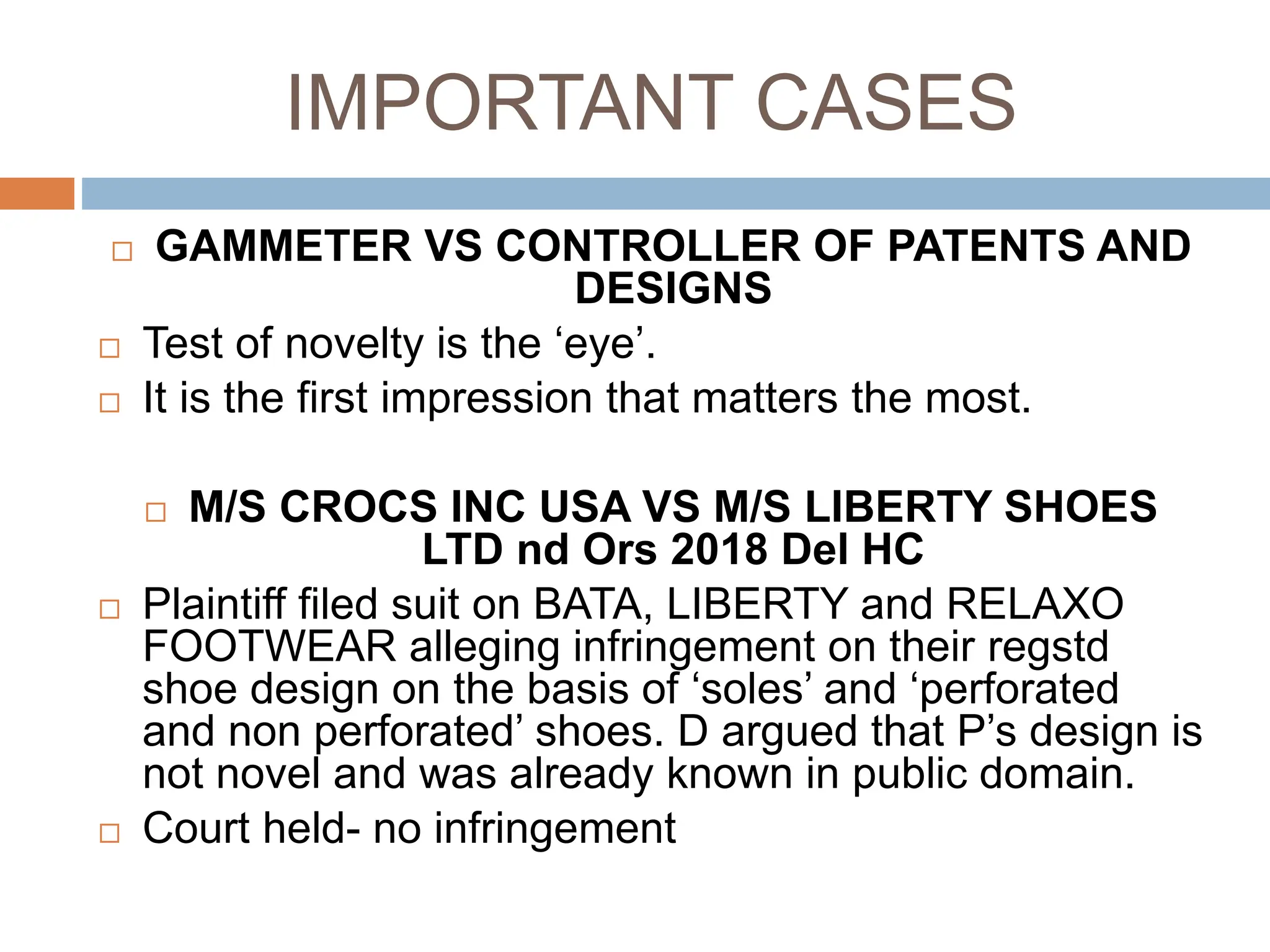
IMPORTANT CASES
 GAMMETER VS CONTROLLER OF PATENTS AND
DESIGNS
 Test of novelty is the ‘eye’.
 It is the first impression that matters the most.
 M/S CROCS INC USA VS M/S LIBERTY SHOES
LTD nd Ors 2018 Del HC
 Plaintiff filed suit on BATA, LIBERTY and RELAXO
FOOTWEAR alleging infringement on their regstd
shoe design on the basis of ‘soles’ and ‘perforated
and non perforated’ shoes. D argued that P’s design is
not novel and was already known in public domain.
 Court held- no infringement
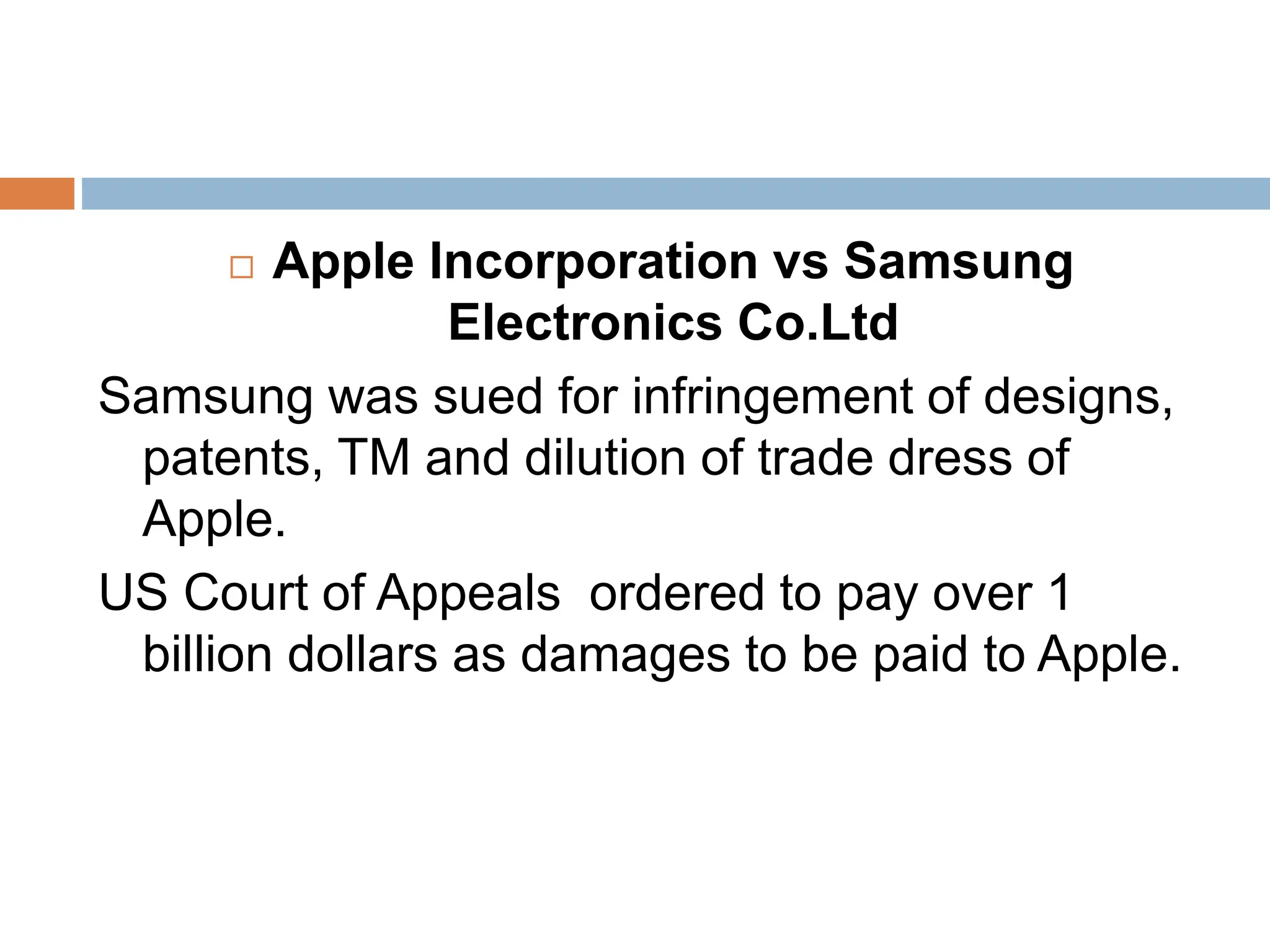
 Apple Incorporation vs Samsung
Electronics Co.Ltd
Samsung was sued for infringement of designs,
patents, TM and dilution of trade dress of
Apple.
US Court of Appeals ordered to pay over 1
billion dollars as damages to be paid to Apple.

design laws in india.pptx Presentation on Design laws

  • 1.
  • 2.
     Definition ofDesign" (sec 2d of Designs Act 2000)  Design means-  features of shape  pattern  configuration  ornament  or composition of colors or lines - which is applied in three dimensional or two dimensional or in both the forms - using any of the process whether manual, chemical, mechanical, separate or combined - which in the finished article appeal to or judged wholly by the eye.
  • 3.
    Essentials of Valid,Admissible Design  1. NOVELTY- Novelty or newness is an essential requirement of an admissible design .  As per the Designs Act , a design is registered only when it is new and original , and not previously published .  2. NO PRIOR PUBLICATION- The design should not be published previously, If a design is made available to the public or if it has been shown or disclosed to a person who is not bound to keep it secret , then it constitutes publication of design
  • 4.
     . InWimco Ltd , Bombay V Meena Match Industries, Sivakasi , the court held that publication , means the opposite of being kept secret . It is considered published if a design is no longer a secret .  There is a publication if the design has been disclosed to the public or if the public is in possession of the design .  Publication can occur in two ways . Publication in prior document and Publication by prior user .  As per the law , the private or secret use or experimental use of a design will not constitute a publication .
  • 5.
     3. THEDESIGN MUST BE APPLIED TO A PARTICULAR ARTICLE A design is admissible if only it is incorporated in an article.  It can be either three-dimensional or two-dimensional.  The design should relate to features of shape, configuration, pattern or ornamentation applied or applicable to an article.  Hence, the industrial plan designs layouts and installations cannot be taken as design under the Act. 4. APPEAL TO EYES  A design should be appeal solely by the eyes of the consumer.  This means a design in order to qualify, should be visible
  • 6.
    DESIGNS ACT 2000 The first Indian legislature to grant to grant privileges and protection for designs was the Patent and Designs Act , 1872 .  Replaced by Patents and Designs Act 1911  In 1970 , a separate Act called the Patent Act 1970 and thus the provisions relating to patent was repealed , but the 1911 act continued to be the major legislation for Industrial Design till 2000  Finally new Designs Act of 2000 came into being.  The Controller-General of Patents, Designs and Trade Marks shall be the Controller of Designs for the purposes of this Act.
  • 7.
     Sec 4.PROHIBITION OF REGISTRATION OF CERTAIN DESIGNS.—  A design which— (a) is not new or original;  (b) has been disclosed to the public anywhere in India or in any other country by publication in tangible form or by use or in any other way prior to the filing date, or where applicable, the priority date of the application for registration;  or (c) is not significantly distinguishable from known designs or combination of known designs; or  (d) comprises or contains scandalous or obscene matter, - shall not be registered.
  • 8.
     tems thatcannot be registered as a design under the act: Signs, emblems or flags of any country.  Size of any article, if changed.  Structures and buildings.  Integrated circuits' layout designs  Trade variations.  Any principle or mode of construction of any article such as labels, tokens, cartoons, cards, etc.  Books, calendars, certificates, jackets, forms-and other documents, greeting cards, maps and plan cards, postcards, leaflets, stamps, medals, dressmaking patterns.  A mechanical contrivance.
  • 9.
     5. Applicationfor registration of designs.—  (1) The Controller may, on the application of any person claiming to be the proprietor of any new or original design not previously published in any country and which is not contrary to public order or morality, register the design under this Act:  Provided that the Controller shall before such registration refer the application for examination, by an examiner as to whether such design is capable of being registered under this Act and the rules made there under and consider the report of the examiner on such reference.
  • 10.
     (2) Everyapplication under sub-section (1) shall be in the prescribed form and shall be filed in the patent office in the prescribed manner and shall be accompanied by the prescribed fee.  (3) A design may be registered in not more than one class, and, in case of doubt as to the class in which a design ought to be registered, the Controller may decide the question.
  • 11.
     (4) TheController may, if he thinks fit, refuse to register any design presented to him for registration; but any person aggrieved by any such refusal may appeal to the High Court.  (5) An application which, owing to any default or neglect on the part of the applicant, has not been completed so as to enable registration to be effected within the prescribed time shall be deemed to be abandoned.  (6) A design when registered shall be registered as of the date of the application for registration.
  • 12.
     6. REGISTRATIONTO BE IN RESPECT OF PARTICULAR ARTICLE.—  (1) A design may be registered in respect of any or all of the articles comprised in a prescribed class of articles.  (2) Any question arising as to the class within which any article falls shall be determined by the Controller whose decision in the matter shall be final.  7. PUBLICATION OF PARTICULARS OF REGISTERED DESIGNS.—The Controller shall, as soon as may be after the registration of a design, cause publication of the prescribed particulars of the design to be published in such manner as may be prescribed and thereafter the design shall be open to public inspection
  • 13.
     SEC 9.CERTIFICATE OF REGISTRATION.—  (1) The Controller shall grant a certificate of registration to the proprietor of the design when registered.  SEC 10. REGISTER OF DESIGNS.—  (1) There shall be kept at the patent office a book called the register of designs, wherein shall be entered the names and addresses of proprietors of registered designs, notifications of assignments and of transmissions of registered designs, and such other matter as may be prescribed and such register may be maintained wholly or partly on computer, floppies or diskettes, subject to such safeguards as may be prescribed.
  • 14.
     COPYRIGHT INREGISTERED DESIGNS  Sec 11. Copyright on registration.—  (1) When a design is registered, the registered proprietor of the design shall, subject to the provisions of this Act, have copyright in the design during Ten Years From The Date Of Registration.  (2) If, before the expiration of the said ten years, application for the extension of the period of copyright is made to the Controller in the prescribed manner, the Controller shall, on payment of the prescribed fee, extend the period of copy-right for a second period of five years from the expiration of the original period of ten years
  • 15.
     SEC 19.CANCELLATION OF REGISTRATION.—  (1) Any person interested may present a petition for the cancellation of the registration of a design at any time after the registration of the design, to the Controller on any of the following grounds, namely:— (a) that the design has been previously registered in India; or  (b) that it has been published in India or in any other country prior to the date of registration; or  (c) that the design is not a new or original design; or  (d) that the design is not registrable under this Act; or  (e) that it is not a design as defined under clause (d) of section 2. (
  • 16.
     2) Anappeal shall lie from any order of the Controller under this section to the High Court, and the Controller may at any time refer any such petition to the High Court, and the High Court shall decide any petition so referred.
  • 17.
    IMPORTANT CASES  GAMMETERVS CONTROLLER OF PATENTS AND DESIGNS  Test of novelty is the ‘eye’.  It is the first impression that matters the most.  M/S CROCS INC USA VS M/S LIBERTY SHOES LTD nd Ors 2018 Del HC  Plaintiff filed suit on BATA, LIBERTY and RELAXO FOOTWEAR alleging infringement on their regstd shoe design on the basis of ‘soles’ and ‘perforated and non perforated’ shoes. D argued that P’s design is not novel and was already known in public domain.  Court held- no infringement
  • 18.
     Apple Incorporationvs Samsung Electronics Co.Ltd Samsung was sued for infringement of designs, patents, TM and dilution of trade dress of Apple. US Court of Appeals ordered to pay over 1 billion dollars as damages to be paid to Apple.