DESIGNfrom IBSTOCK BRICK
WWiinntteerr 22001166//1177
–––––––––––––––––––––––––––
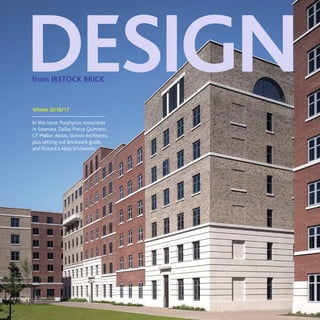
In this issue: Porphyrios Associates
in Swansea, Dallas Pierce Quintero,
CF Møller, Aedas, Sixtwo Architects,
plus setting out brickwork guide,
and Ibstock’s Atlas brickworks
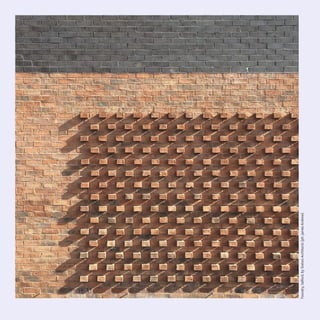
Foundry,Salford,bySixtwoArchitects(ph:JamesAndrew)
DESIGNfrom IBSTOCK BRICK
4 Winter 2016/17 – Ibstock Update
6 Elmfield Court is a fully-affordable apartment building
near London’s Battersea Park by CF Møller
12 The Courtyard House by Dallas Pierce Quintero exploits
the decorative effect of a brick wall inside and out
18 With its brick facade features, the Foundry in Salford, by
Sixtwo Architects, brings elegance to the industrial shed
24 Brick brings familiarity, variety and permanence to
Porphyrios Associates’ Swansea University Bay Campus
32 Aedas Architects’Two Smithfield in Stoke-on-Trent
resonates with its site’s brickmaking tradition
38 Technical guidance on Setting Out Brickwork
42 Ibstock’s Atlas factory profiled
46 Brick Response:Adrian James
Ibstock Brick Ltd
Leicester Road, Ibstock,
Leicestershire, LE67 6HS
t: 01530 261999
f: 01530 257457
e: enquiries@ibstock.co.uk
www.ibstock.com
Ibstock Sales Office:
0844 800 4575
Design & Technical Helpline:
0844 800 4576
Sample & Literature Hotline:
0844 800 4578
Special Shapes and Brickwork
Components Sales Office:
0844 736 0350
©Ibstock Brick 2017
Published by Ibstock Brick Ltd
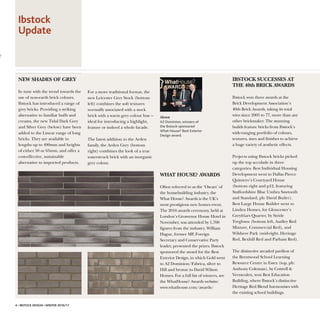
NEW SHADES OF GREY
In tune with the trend towards the
use of non-earth brick colours,
Ibstock has introduced a range of
grey bricks. Providing a striking
alternative to familiar buffs and
creams, the new Tidal Dark Grey
and Silver Grey (below) have been
added to the Linear range of long
bricks. They are available in
lengths up to 490mm and heights
of either 50 or 65mm, and offer a
cost-effective, sustainable
alternative to imported products.
For a more traditional format, the
new Leicester Grey Stock (bottom
left) combines the soft textures
normally associated with a stock
brick with a warm grey colour hue –
ideal for introducing a highlight,
feature or indeed a whole facade.
The latest addition to the Arden
family, the Arden Grey (bottom
right) combines the look of a true
waterstruck brick with an inorganic
grey colour.
IBSTOCK SUCCESSES AT
THE 40th BRICK AWARDS
Ibstock won three awards at the
Brick Development Association’s
40th Brick Awards, taking its total
wins since 2005 to 77, more than any
other brickmaker. The stunning
builds feature bricks from Ibstock’s
wide-ranging portfolio of colours,
textures, sizes and finishes to achieve
a huge variety of aesthetic effects.
Projects using Ibstock bricks picked
up the top accolade in three
categories. Best Individual Housing
Development went to Dallas Pierce
Quintero’s Courtyard House
(bottom right and p12, featuring
Staffordshire Blue Umbra Sawtooth
and Standard, ph: David Butler).
Best Large House Builder went to
Linden Homes, for Gloucester’s
Greyfriars Quarter, by Stride
Treglown (bottom left, Audley Red
Mixture, Commercial Red), and
Wilshere Park (mid-right, Heritage
Red, Bexhill Red and Parham Red).
The distinctive arcaded pavilion of
the Brentwood School Learning
Resource Centre in Essex (top, ph:
Anthony Coleman), by Cottrell &
Vermeulen, won Best Education
Building, where Ibstock’s distinctive
Heritage Red Blend harmonises with
the existing school buildings.
Ibstock
Update
4 • IBSTOCK DESIGN • WINTER 2016/17
AAbboovvee
A2 Dominion, winners of
the Ibstock-sponsored
What House? Best Exterior
Design award.
WHAT HOUSE? AWARDS
Often referred to as the ‘Oscars’ of
the housebuilding industry, the
What House? Awards is the UK’s
most prestigious new homes event.
The 2016 awards ceremony, held at
London’s Grosvenor House Hotel in
November, was attended by 1,700
figures from the industry. William
Hague, former MP, Foreign
Secretary and Conservative Party
leader, presented the prizes. Ibstock
sponsored the award for the Best
Exterior Design, in which Gold went
to A2 Dominion/Fabrica, silver to
Hill and bronze to David Wilson
Homes. For a full list of winners, see
the WhatHouse? Awards website:
www.whathouse.com/awards/
d!
IBSTOCK DESIGN • WINTER 2016/17 • 5
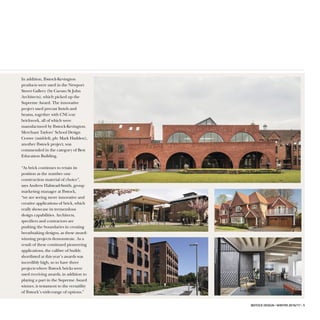
In addition, Ibstock-Kevington
products were used in the Newport
Street Gallery (by Caruso St John
Architects), which picked up the
Supreme Award. The innovative
project used precast lintels and
beams, together with CNC-cut
brickwork, all of which were
manufactured by Ibstock-Kevington.
Merchant Taylors’ School Design
Centre (mid-left, ph: Mark Hadden),
another Ibstock project, was
commended in the category of Best
Education Building.
“As brick continues to retain its
position as the number one
construction material of choice”,
says Andrew Halstead-Smith, group
marketing manager at Ibstock,
“we are seeing more innovative and
creative applications of brick, which
really showcase its tremendous
design capabilities. Architects,
specifiers and contractors are
pushing the boundaries in creating
breathtaking designs, as these award-
winning projects demonstrate. As a
result of these continued pioneering
applications, the calibre of builds
shortlisted at this year’s awards was
incredibly high, so to have three
projects where Ibstock bricks were
used receiving awards, in addition to
playing a part in the Supreme Award
winner, is testament to the versatility
of Ibstock’s wide-range of options.”
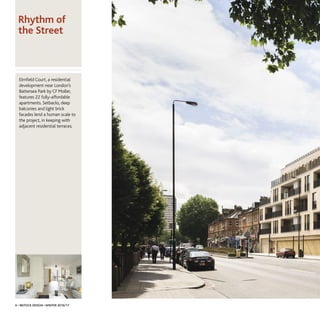
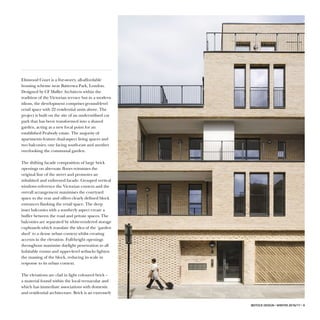
Elmfield Court, a residential
development near London’s
Battersea Park by CF Moller,
features 22 fully-affordable
apartments. Setbacks, deep
balconies and light brick
facades lend a human scale to
the project, in keeping with
adjacent residential terraces.
Rhythm of
the Street
6 • IBSTOCK DESIGN • WINTER 2016/17
IBSTOCK DESIGN • WINTER 2016/17 • 7
8 • IBSTOCK DESIGN • WINTER 2016/17
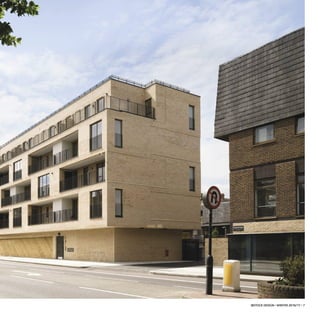
Elmwood Court is a five-storey, all-affordable
housing scheme near Battersea Park, London.
Designed by CF Møller Architects within the
tradition of the Victorian terrace but in a modern
idiom, the development comprises ground-level
retail space with 22 residential units above. The
project is built on the site of an underutilised car
park that has been transformed into a shared
garden, acting as a new focal point for an
established Peabody estate. The majority of
apartments feature dual-aspect living spaces and
two balconies, one facing south-east and another
overlooking the communal garden.
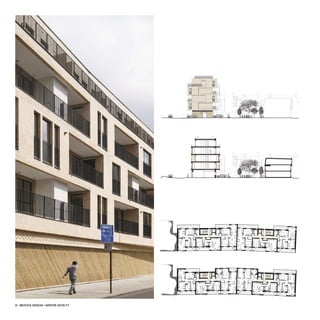
The shifting facade composition of large brick
openings on alternate floors reinstates the
original line of the street and promotes an
inhabited and enlivened facade. Grouped vertical
windows reference the Victorian context and the
overall arrangement maximises the courtyard
space to the rear and offers clearly defined block
entrances flanking the retail space. The deep
inset balconies with a southerly aspect create a
buffer between the road and private spaces. The
balconies are separated by white-rendered storage
cupboards which translate the idea of the ‘garden
shed’ to a dense urban context whilst creating
accents in the elevation. Full-height openings
throughout maximise daylight penetration to all
habitable rooms and upper-level setbacks lighten
the massing of the block, reducing its scale in
response to its urban context.
The elevations are clad in light coloured brick –
a material found within the local vernacular and
which has immediate associations with domestic
and residential architecture. Brick is an extremely
IBSTOCK DESIGN • WINTER 2016/17 • 9
10 • IBSTOCK DESIGN • WINTER 2016/17
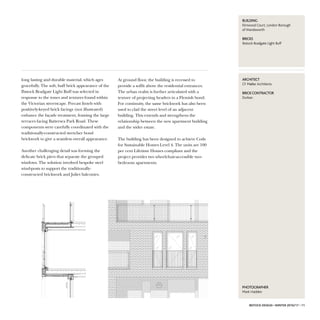
long lasting and durable material, which ages
gracefully. The soft, buff brick appearance of the
Ibstock Bradgate Light Buff was selected in
response to the tones and textures found within
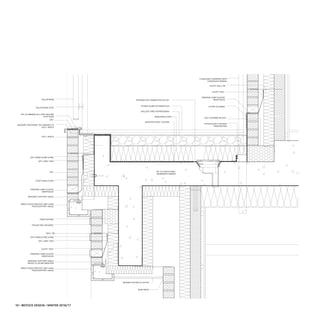
the Victorian streetscape. Precast lintels with
positively-keyed brick facings (not illustrated)
enhance the façade treatment, framing the large
terraces facing Battersea Park Road. These
components were carefully coordinated with the
traditionally-constructed stretcher bond
brickwork to give a seamless overall appearance.
Another challenging detail was forming the
delicate brick piers that separate the grouped
windows. The solution involved bespoke steel
wind-posts to support the traditionally-
constructed brickwork and Juliet balconies.
AARRCCHHIITTEECCTT
CF Møller Architects
BBRRIICCKKCCooNNTTRRAACCTTooRR
Durkan
PPHHooTTooGGRRAAPPHHEERR
Mark Hadden
BBUUIILLDDIINNGG
Elmwood Court, London Borough
ofWandsworth
BBRRIICCKKSS
Ibstock Bradgate Light Buff
IBSTOCK DESIGN • WINTER 2016/17 • 11
At ground floor, the building is recessed to
provide a soffit above the residential entrances.
The urban realm is further articulated with a
texture of projecting headers in a Flemish bond.
For continuity, the same brickwork has also been
used to clad the street level of an adjacent
building. This extends and strengthens the
relationship between the new apartment building
and the wider estate.
The building has been designed to achieve Code
for Sustainable Homes Level 4. The units are 100
per cent Lifetime Homes compliant and the
project provides two wheelchair-accessible two-
bedroom apartments.
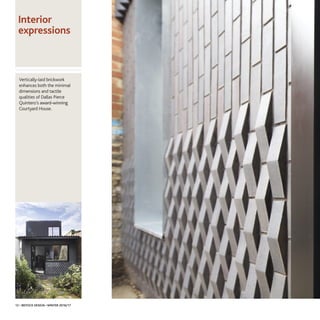
Vertically-laid brickwork
enhances both the minimal
dimensions and tactile
qualities of Dallas Pierce
Quintero’s award-winning
Courtyard House.
Interior
expressions
12 • IBSTOCK DESIGN • WINTER 2016/17
IBSTOCK DESIGN • WINTER 2016/17 • 13
14 • IBSTOCK DESIGN • WINTER 2016/17
IBSTOCK DESIGN • WINTER 2016/17 • 15
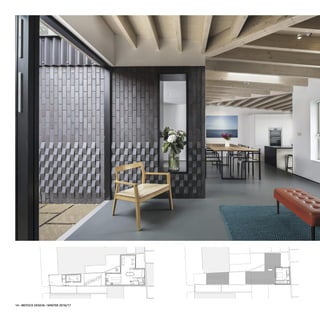
A series of small courtyards provides the main
source of daylight for this two-bedroom house,
built within the walls of an L-shaped infill site in
London. The challenge for architect Dallas
Pierce Quintero was to create a home without a
sense of overlooking, that nonetheless protected
the daylight enjoyed by neighbours. The four
courtyards open up sightlines through the
property, creating functional outdoor spaces for
passing through, dwelling in and looking into.
The client’s brief called for a home that was
modest. This drove the entire design, from the
overall massing through to the choice of the
materials. “Brick fitted this brief perfectly”, says
Dallas Pierce Quintero, “as an everyday material
that, with a bit of care and attention, can look
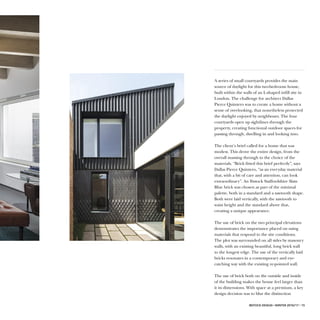
extraordinary”. An Ibstock Staffordshire Slate
Blue brick was chosen as part of the minimal
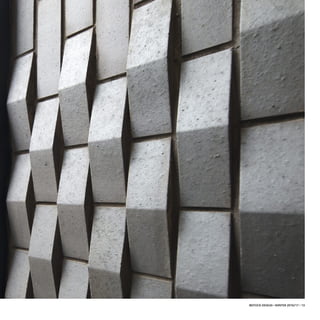
palette, both in a standard and a sawtooth shape.
Both were laid vertically, with the sawtooth to
waist height and the standard above that,
creating a unique appearance.
The use of brick on the two principal elevations
demonstrates the importance placed on using
materials that respond to the site conditions.
The plot was surrounded on all sides by masonry
walls, with an existing beautiful, long brick wall
to the longest edge. The use of the vertically laid
bricks resonates in a contemporary and eye-
catching way with the existing re-pointed wall.
The use of brick both on the outside and inside
of the building makes the house feel larger than
it its dimensions. With space at a premium, a key
design decision was to blur the distinction
between inside and outside by extending one of
the external brick walls into the house. “The
brick finish looks equally stunning inside and
out”, say the architects. “The natural variations
inherent in its colour, together with its
robustness, make it perfect as an internal finish.”
The use of a shaped brick, and the manner in
which it has been laid, has created a surface that
is unusually tactile and visually softens the
building. “When we show visitors around the
building”, say the architects, “we find that people
are drawn to the sawtooth brickwork, they watch
how light falls on the wall and stroke it. The
bricks look like a basket weave: both hard and
regular whilst also soft and undulating. The
result is a unique surface that’s appearance
constantly changes over the course of the day
and which champions the use of brick.”
The Courtyard House was recognised as the Best
Individual Housing Development in the 2016
Brick Awards. It also won a RIBA London award
in 2015, and was long-listed for the RIBA House
of the Year. The jury said that “the experience of
being in the house was extraordinarily light and
airy, with a subtle and sensitive sense of
connection between inside and outside spaces,
reinforced by details such as bringing the blue
brick wall from the courtyard into the house.”
16 • IBSTOCK DESIGN • WINTER 2016/17
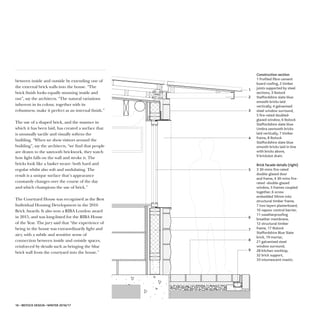
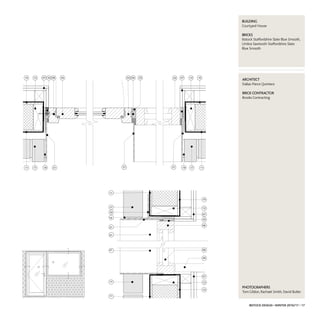
CCoonnssttrruuccttiioonn sseeccttiioonn
1 Profiled fibre cement
board roofing, 2 timber
joists supported by steel
sections, 3 Ibstock
Staffordshire slate blue
smooth bricks laid
vertically, 4 galvanised
steel window surround,
5 fire-rated doubled-
glazed window, 6 Ibstock
Staffordshire slate blue
Umbra sawtooth bricks
laid vertically, 7 timber
frame, 8 Ibstock
Staffordshire slate blue
smooth bricks laid in line
with bricks above,
9 brickslot drain.
BBrriicckk ffaaccaaddee ddeettaaiillss ((rriigghhtt))
3 30-mins fire-rated
double-glazed door
and frame, 4 30-mins fire-
rated -double-glazed
window, 5 frames coupled
together, 6 screw
embedded 50mm into
structural timber frame,
7 two layers plasterboard,
10 vapour control barrier,
11 weatherproofing
breather membrane,
12 structural timber
frame, 17 Ibstock
Staffordshire Blue Slate
brick, 19 mortar,
21 galvanised steel
window surround,
28 kitchen worktop,
32 brick support,
33 intumescent mastic.
11
22
33
44
55
66
77
88
99
AARRCCHHIITTEECCTT
Dallas Pierce Quintero
BBRRIICCKK CCOONNTTRRAACCTTOORR
Brooks Contracting
PPHHOOTTOOGGRRAAPPHHEERRSS
Tom Gildon, Rachael Smith, David Butler
IBSTOCK DESIGN • WINTER 2016/17 • 17
BBUUIILLDDIINNGG
Courtyard House
BBRRIICCKKSS
Ibstock Staffordshire Slate Blue Smooth,
Umbra Sawtooth Staffordshire Slate
Blue Smooth
04
03
17
07
11
12
06
19
17
21
10
32
21
33
07
11
12
06
17
10
21
28
03 0507
11
12 06
1917 2121
10 03
21 19 17 11
12 100733 33 33
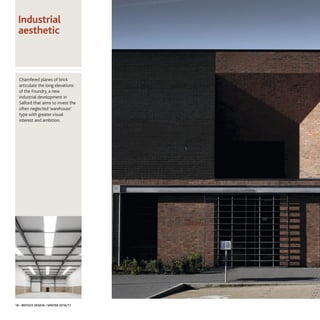
Chamfered planes of brick
articulate the long elevations
of the Foundry, a new
industrial development in
Salford that aims to invest the
often neglected ‘warehouse’
type with greater visual
interest and ambition.
Industrial
aesthetic
18 • IBSTOCK DESIGN • WINTER 2016/17
IBSTOCK DESIGN • WINTER 2016/17 • 19
20 • IBSTOCK DESIGN • WINTER 2016/17
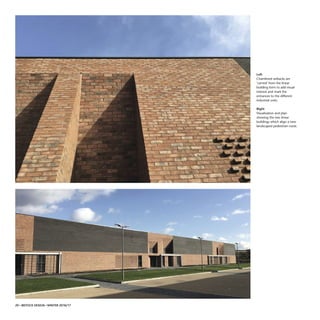
Left
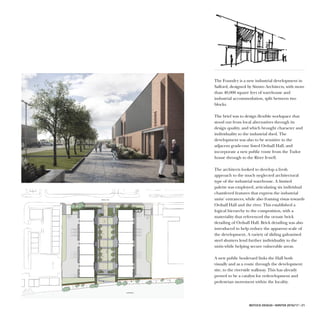
Chamfered setbacks are
‘carved’ from the linear
building form to add visual
interest and mark the
entrances to the different
industrial units.
Right
Visualisation and plan
showing the two linear
buildings which align a new
landscaped pedestrian route.
IBSTOCK DESIGN • WINTER 2016/17 • 21
The Foundry is a new industrial development in
Salford, designed by Sixtwo Architects, with more
than 40,000 square feet of warehouse and
industrial accommodation, split between two
blocks.
The brief was to design flexible workspace that
stood out from local alternatives through its
design quality, and which brought character and
individuality to the industrial shed. The
development was also to be sensitive to the
adjacent grade-one listed Ordsall Hall, and
incorporate a new public route from the Tudor
house through to the River Irwell.
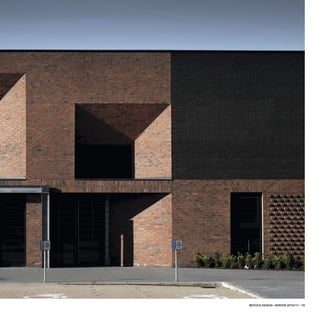
The architects looked to develop a fresh
approach to the much neglected architectural
type of the industrial warehouse. A limited
palette was employed, articulating six individual
chamfered features that express the industrial
units’ entrances, while also framing vistas towards
Ordsall Hall and the river. This established a
logical hierarchy to the composition, with a
materiality that referenced the ornate brick
detailing of Ordsall Hall. Brick detailing was also
introduced to help reduce the apparent scale of
the development. A variety of sliding galvanised
steel shutters lend further individuality to the
units while helping secure vulnerable areas.
A new public boulevard links the Hall both
visually and as a route through the development
site, to the riverside walkway. This has already
proved to be a catalyst for redevelopment and
pedestrian movement within the locality.
22 • IBSTOCK DESIGN • WINTER 2016/17
AARRCCHHIITTEECCTT
Sixtwo Architects
BBRRIICCKK CCOONNTTRRAACCTTOORR
WilliamsTarr
PPHHOOTTOOGGRRAAPPHHEERRSS
Ben Draguisky, James Andrews
IBSTOCK DESIGN • WINTER 2016/17 • 23
BBUUIILLDDIINNGG
Foundry, Salford
BBRRIICCKKSS
Ibstock Birtley Northern Buff
and others
LLeefftt//rriigghhtt
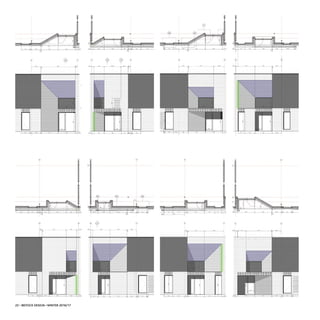
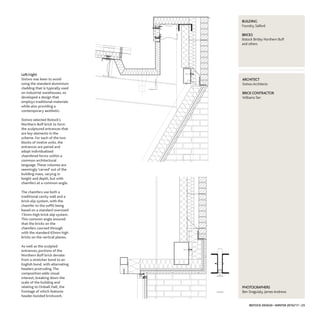
Sixtwo was keen to avoid
using the standard aluminium
cladding that is typically used
on industrial warehouses, so
developed a design that
employs traditional materials
while also providing a
contemporary aesthetic.
Sixtwo selected Ibstock’s
Northern Buff brick to form
the sculptured entrances that
are key elements in the
scheme. For each of the two
blocks of twelve units, the
entrances are paired and
adopt individualised
chamfered forms within a
common architectural
language.These volumes are
seemingly ‘carved’ out of the
building mass, varying in
height and depth, but with
chamfers at a common angle.
The chamfers use both a
traditional cavity wall and a
brick-slip system, with the
chamfer to the soffit being
based on a standard oversized
73mm-high brick-slip system.
This common angle ensured
that the bricks on the
chamfers coursed through
with the standard 65mm high
bricks on the vertical planes.
As well as the sculpted
entrances, portions of the
Northern Buff brick deviate
from a stretcher bond to an
English bond, with alternating
headers protruding.The
composition adds visual
interest, breaking down the
scale of the building and
relating to Ordsall Hall, the
frontage of which features
header-bonded brickwork.
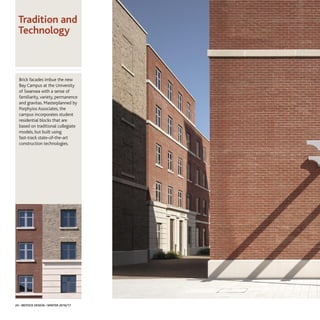
Brick facades imbue the new
Bay Campus at the University
of Swansea with a sense of
familiarity, variety, permanence
and gravitas. Masterplanned by
Porphyios Associates, the
campus incorporates student
residential blocks that are
based on traditional collegiate
models, but built using
fast-track state-of-the-art
construction technologies.
Tradition and
Technology
24 • IBSTOCK DESIGN • WINTER 2016/17
IBSTOCK DESIGN • WINTER 2016/17 • 25
26 • IBSTOCK DESIGN • WINTER 2016/17
J4
CRYMLYN BURR
SSSI
WORKS
ELBA CRESCENT
BALDWIN'S CRESCENT
BEACH
BUS STOP
COASTAL REVETMENT
BUS STOP
TENNANT
PLACE
GOWER
SQUARE
MARGAM SQUARE
CRYMLYNWAY
AFAN WAY
INDUSTRY / R&D
MULTI-STOREY CARPARK
UNIVERSITY RESIDENTIAL
UNIVERSITY ACADEMIC*
20.00.0 10.0 40.0 m8.06.04.02.0
N
Retail
Student
Services
RetailRetaillitaeR litaeR litaeR
0.0 6.04.2.0 20.010.08. 40.0 m
Student
Services
N
Swansea University’s new £450m Bay Campus, a
development by St Modwen in partnership with
the university, occupies a large coastal site three
miles to the east of the city centre, taking
advantage of the west-facing aspect across sand
dunes to the sea. The masterplan, by Porphyrios
Asoociates, is generated as much by a public
realm of interconnected urban spaces and green
areas as by urban blocks, lending an underlying
sense of structure, orientation and place. Within
this, character and diversity is a priority, and
contrasts of formal and intimate, lively and quiet,
hard and soft are sought wherever possible with
minimal means. In terms of its appearance, the
project employs traditional materials – primarily
brick and reconstituted stone – but it has been
built using fast-track construction techniques
that employ steel- and concrete framing.
Porphyrios Associates’ student residential blocks
are organised along principles of collegiate
models, with a strong urban edge that addresses
the public realm of the street, and inner
courtyards that address the private life of
students. The ‘megablocks’ of the masterplan are
reduced to smaller urban blocks by secondary
pedestrian streets, and permeability is achieved
by passages and openings between buildings.
Entrances to the courtyards vary in scale and
materials, while gates to the north protect privacy
while maintaining the porosity of the blocks.
Entrances to those residential buildings within
the collegiate courts are via the internal courts,
helping foster identity and activity.
The residential buildings provide a range of
accommodation – standard rooms, premium
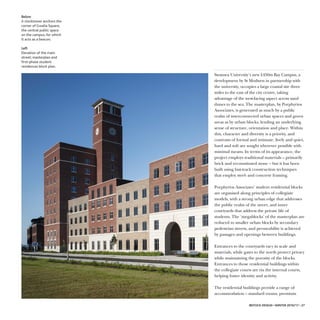
BBeellooww
A clocktower anchors the
corner of Gwalia Square,
the central public space
on the campus, for which
it acts as a beacon.
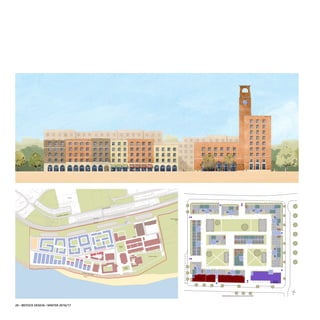
LLeefftt
Elevation of the main
street; masterplan and
first-phase student
residences block plan.
IBSTOCK DESIGN • WINTER 2016/17 • 27
28 • IBSTOCK DESIGN • WINTER 2016/17
rooms, twin rooms, wheelchair-accessible rooms,
one-bed flats and two-bed flats – and these are
distributed throughout the blocks. Some larger
flats for mature and family residents, however,
are concentrated in one block, close to common
facilities that cater for their particular needs.
All the student accommodation is organised in
private clusters, each with its own common room
with kitchen facilities. Large ‘community’
facilities are provided in the development zones
where residents can congregate and relax.
Student facilities located in the ground level of
the residential blocks facing Dylan Thomas Way
include the dining hall and bar, coffee shop,
laundrette, mini market and student services.
Taller residential buildings are located along
the northern edge of the campus and lower
buildings towards the south to maximise sea
views and take advantage of the orientation.
The massing is generally additive, and variation
is introduced by differentiating the buildings
though composition and colour, as well as by
means of setbacks and modulation of the skyline.
The residential buildings by Porphyrios
Associates are articulated laterally to achieve
animated elevations of variety and diversity.
Other student residences within the masterplan,
designed by Hopkins Architects (who also
designed a number of the departmental and
teaching buildings) are treated as a large
‘palazzo’, adding another variation of the
residential type to the campus.
The residential buildings by Porphyrios
Associates are finished in bonded brickwork with
IBSTOCK DESIGN • WINTER 2016/17 • 29
BBeellooww,, lleefftt
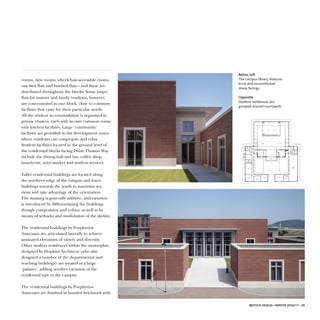
The campus library features
brick and reconstituted
stone facings.
OOppppoossiittee
Student residences are
grouped around courtyards.
ENTRANCE
HALL
SILENT
STUDY
SILENT
STUDY
SILENT
STUDY
PG PC RM
PG STUDY RM
BOOK STOCK
PC
ROOM
STUDY
SPACES
BOOK STOCKBOOK STOCKBOOK CKOTS BOOK CKOTS
ENTRANCE
LLAH
SILENT
STUDY
SILENT
STUDY
PC
MORO
SILENT
STUDY
PG CP RM
PG YDUTS RM
BOOK CKOTS
YDUTS
ACESSPSPACES
stone detailing and surface plane, all of which
adds interest and diversity to the elevations.
Windows and doors have flat brick arches and
are made in polyester powder-coated (PPC)
aluminium. Entrances are marked through
porches or door with surrounds, while the
rooftop plant rooms are screened by brick
parapet walls with ‘openings’ that are filled by a
metal mesh.
30 • IBSTOCK DESIGN • WINTER 2016/17
reconstituted stone to the bases, entrance
porches, window/door surrounds, trims, sills and
parapets. The brickwork to the residences has a
palette of three colours: red-orange, yellow and
red-brown, with the reconstituted stone
components matching natural Portland stone.
The blocks are articulated so as to suggest a
composition of smaller buildings using vertical
breaks, expressed by a change of brick colour,
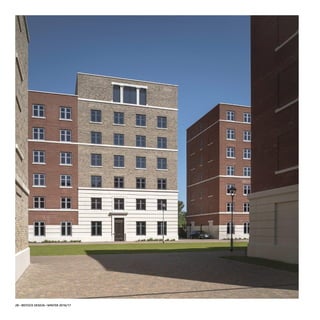
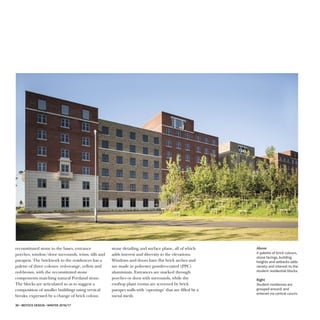
AAbboovvee
A palette of brick colours,
stone facings, building
heights and setbacks adds
variety and interest to the
student residential blocks.
RRiigghhtt
Student residences are
grouped around, and
entered via central courts.
IBSTOCK DESIGN • WINTER 2016/17 • 31
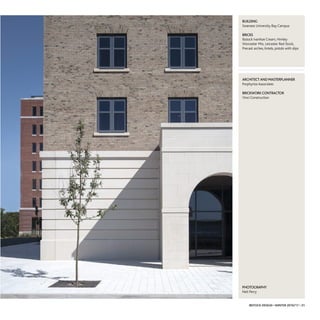
AARRCCHHIITTEECCTT AANNDD MMAASSTTEERRPPLLAANNNNEERR
Porphyrios Associates
BBRRIICCKKWWOORRKK CCOONNTTRRAACCTTOORR
Vinci Construction
PPHHOOTTOOGGRRAAPPHHYY
Neil Perry
BBUUIILLDDIINNGG
Swansea University Bay Campus
BBRRIICCKKSS
Ibstock Ivanhoe Cream, Himley
Worcester Mix, Leicester Red Stock,
Precast arches, lintels, pistols with slips
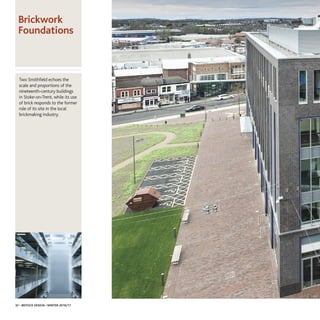
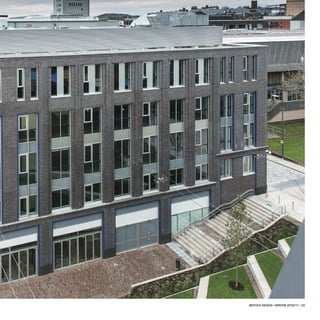
Two Smithfield echoes the
scale and proportions of the
nineteenth-century buildings
in Stoke-on-Trent, while its use
of brick responds to the former
role of its site in the local
brickmaking industry.
Brickwork
Foundations
32 • IBSTOCK DESIGN • WINTER 2016/17
IBSTOCK DESIGN • WINTER 2016/17 • 33
34 • IBSTOCK DESIGN • WINTER 2016/17
IBSTOCK DESIGN • WINTER 2016/17 • 35
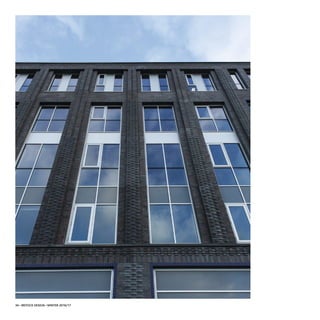
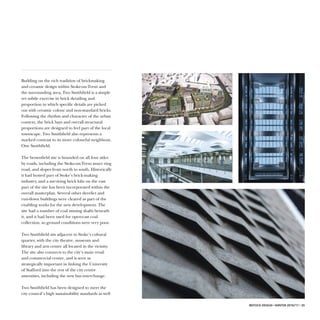
Building on the rich tradition of brickmaking
and ceramic design within Stoke-on-Trent and
the surrounding area, Two Smithfield is a simple
yet subtle exercise in brick detailing and
proportion in which specific details are picked
out with ceramic colour and non-standard bricks.
Following the rhythm and character of the urban
context, the brick bays and overall structural
proportions are designed to feel part of the local
townscape. Two Smithfield also represents a
marked contrast to its more colourful neighbour,
One Smithfield.
The brownfield site is bounded on all four sides
by roads, including the Stoke-on-Trent inner ring
road, and slopes from north to south. Historically
it had hosted part of Stoke’s brick-making
industry, and a surviving brick kiln on the east
part of the site has been incorporated within the
overall masterplan. Several other derelict and
run-down buildings were cleared as part of the
enabling works for the new development. The
site had a number of coal mining shafts beneath
it, and it had been used for open-cast coal
collection, so ground conditions were very poor.
Two Smithfield sits adjacent to Stoke’s cultural
quarter, with the city theatre, museum and
library and arts centre all located in the vicinity.
The site also connects to the city’s main retail
and commercial centre, and is seen as
strategically important in linking the University
of Stafford into the rest of the city centre
amenities, including the new bus interchange.
Two Smithfield has been designed to meet the
city council’s high sustainability standards as well
36 • IBSTOCK DESIGN • WINTER 2016/17
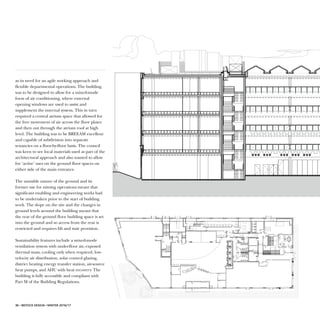
as its need for an agile working approach and
flexible departmental operations. The building
was to be designed to allow for a mixed-mode
form of air conditioning, where external
opening windows are used to assist and
supplement the internal system. This in turn
required a central atrium space that allowed for
the free movement of air across the floor plates
and then out through the atrium roof at high
level. The building was to be BREEAM excellent
and capable of subdivision into separate
tenancies on a floor-by-floor basis. The council
was keen to see local materials used as part of the
architectural approach and also wanted to allow
for ‘active’ uses on the ground floor spaces on
either side of the main entrance.
The unstable nature of the ground and its
former use for mining operations meant that
significant enabling and engineering works had
to be undertaken prior to the start of building
work. The slope on the site and the changes in
ground levels around the building meant that
the rear of the ground floor building space is set
into the ground and so access from the rear is
restricted and requires lift and stair provision.
Sustainability features include a mixed-mode
ventilation system with underfloor air, exposed
thermal mass, cooling only when required, low-
velocity air distribution, solar control glazing,
district heating energy transfer station, air-source
heat pumps, and AHU with heat recovery. The
building is fully accessible and compliant with
Part M of the Building Regulations.
AARRCCHHIITTEECCTT
Aedas
BBRRIICCKK CCOONNTTRRAACCTTOORR
Explore Manufacturing
PPHHOOTTOOGGRRAAPPHHEERR
LukeWhite
IBSTOCK DESIGN • WINTER 2016/17 • 37
BBUUIILLDDIINNGG
Two Smithfield, Stoke-on-Trent
BBRRIICCKKSS
Ibstock Staffordshire Slate Blue Smooth,
Ibstock Staffordshire Blue Brindle
Smooth, Ibstock Himley Ebony Black,
Ibstock Blue Glazed, Umbra Sawtooth
Natural Blue, Bat Boxes Cheddar Red,
Swift Boxes Natural Blue
Designing and setting out
brickwork correctly creates a
matching and balanced
appearance, particularly at reveals
on either side of door and
window openings and at the ends
of walls.
Setting out starts at the design
stage where the design of a
building, including openings,
should ideally be set out to brick
co-ordinating dimensions,
eliminating the requirement to
cut bricks on site.
In this briefing only stretcher
bond, also known as half-bond,
is considered, although the basic
principles will apply whatever
bond is used.
Technical:
Setting out
Brickwork
FFuurrtthheerr iinnffoorrmmaattiioonn
Comprehensive design and technical guidance for brickwork is available in the
Technical Information Sheets section of Ibstock’s website, under Design &
Specification,Application & Construction and Site Practice &Troubleshooting.
See: www.ibstock.com
For any help or advice, contact Ibstock Design &Technical: technical@ibstock.co.uk
38 • IBSTOCK DESIGN • WINTER 2016/17
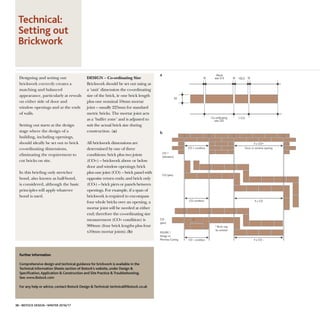
DESIGN – Co-ordinating Size
Brickwork should be set out using as
a ‘unit’ dimension the co-ordinating
size of the brick, ie one brick length
plus one nominal 10mm mortar
joint – usually 225mm for standard
metric bricks. The mortar joint acts
as a ‘buffer zone’ and is adjusted to
suit the actual brick size during
construction. (a)
All brickwork dimensions are
determined by one of three
conditions: brick plus two joints
(CO+) – brickwork above or below
door and window openings; brick
plus one joint (CO) – brick panel with
opposite return ends; and brick only
(CO-) – brick piers or panels between
openings. For example, if a span of
brickwork is required to encompass
four whole bricks over an opening, a
mortar joint will be needed at either
end; therefore the co-ordinating size
measurement (CO+ condition) is
900mm (four brick lengths plus four
x10mm mortar joints).(b)
Co-ordinating
size 225
C
10 102.5
65
10 10
Work
size 215
112.5
CO + condition
CO +
(elevation)
CO (plan)
CO-
(plan)
FIGURE 1
Design to
Minimise Cutting
CO condition
CO - condition
Door or window opening
4 x CO+
4 x CO
4 x CO -
* Brick may
be omitted
*
a
b
IBSTOCK DESIGN • WINTER 2016/17 • 39
890mm
The bricks should be spaced out to fit the co-ordinating space therefore the mortar
joints will be adjusted accordingly
Courses set-out with 10mm mortar joints
Start point Perpends gradually running over Result - overhang at end of course
Start point Perpends remaining central to
brick below
Result - neat finish at end of course
Courses set-out to a co-ordinating size with varying mortar joints
plumb every fourth
or fifth perpend
plumb every fourth
or fifth perpend
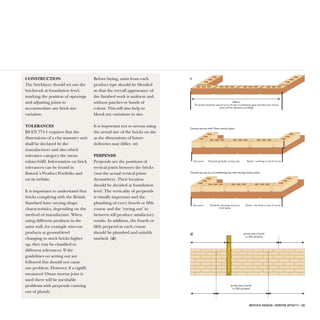
CONSTRUCTION
The bricklayer should set out the
brickwork at foundation level,
marking the position of openings
and adjusting joints to
accommodate any brick size
variation.
TOLERANCES
BS EN 771-1 requires that the
dimensions of a clay masonry unit
shall be declared by the
manufacturer and also which
tolerance category the mean
values fulfil. Information on brick
tolerances can be found in
Ibstock’s Product Portfolio and
on its website.
It is important to understand that
bricks complying with the British
Standard have varying shape
characteristics, depending on the
method of manufacture. When
using different products in the
same wall, for example wire-cut
products at ground-level
changing to stock bricks higher
up, they may be classified to
different tolerances. If the
guidelines on setting out are
followed this should not cause
any problem. However, if a rigidly
measured 10mm mortar joint is
used there will be inevitable
problems with perpends running
out of plumb.
Before laying, units from each
product type should be blended
so that the overall appearance of
the finished work is uniform and
without patches or bands of
colour. This will also help to
blend any variations in size.
It is important not to set-out using
the actual size of the bricks on site
as the dimensions of future
deliveries may differ. (c)
PERPENDS
Perpends are the positions of
vertical joints between the bricks
(not the actual vertical joints
themselves). Their location
should be decided at foundation
level. The verticality of perpends
is visually important and the
plumbing of every fourth or fifth
course and the ‘eyeing out’ in
between will produce satisfactory
results. In addition, the fourth or
fifth perpend in each course
should be plumbed and suitably
marked. (d)
d
c
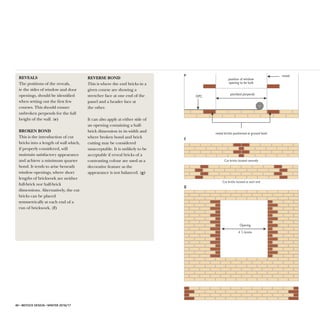
REVERSE BOND
This is where the end bricks in a
given course are showing a
stretcher face at one end of the
panel and a header face at
the other.
It can also apply at either side of
an opening containing a half-
brick dimension in its width and
where broken bond and brick
cutting may be considered
unacceptable. It is unlikely to be
acceptable if reveal bricks of a
contrasting colour are used as a
decorative feature as the
appearance is not balanced. (g)
40 • IBSTOCK DESIGN • WINTER 2016/17
REVEALS
The positions of the reveals,
ie the sides of window and door
openings, should be identified
when setting out the first few
courses. This should ensure
unbroken perpends for the full
height of the wall. (e)
BROKEN BOND
This is the introduction of cut
bricks into a length of wall which,
if properly considered, will
maintain satisfactory appearance
and achieve a minimum quarter
bond. It tends to arise beneath
window openings, where short
lengths of brickwork are neither
full-brick nor half-brick
dimensions. Alternatively, the cut
bricks can be placed
symmetrically at each end of a
run of brickwork. (f)
Opening
4 1
/2 bricks
Cut bricks located at each end
Cut bricks located centrally
position of window
opening to be built
reveal bricks positioned at ground level
plumbed perpends
reveal
DPC
e
f
g
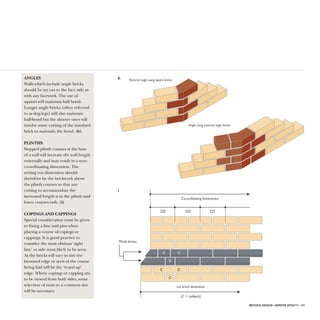
ANGLES
Walls which include angle bricks
should be set out to the face side as
with any facework. The use of
squints will maintain half bond.
Longer angle bricks (often referred
to as dog-legs) will also maintain
half-bond but the shorter ones will
involve some cutting of the standard
brick to maintain the bond. (h)
PLINTHS
Stepped plinth courses at the base
of a wall will increase the wall length
externally and may result in a non-
co-ordinating dimension. The
setting out dimension should
therefore be the brickwork above
the plinth courses so that any
cutting to accommodate the
increased length is in the plinth and
lower courses only. (i)
COPINGS AND CAPPINGS
Special consideration must be given
to fixing a line and pins when
placing a course of copings or
cappings. It is good practice to
consider the most obvious ‘sight
line’ or side most likely to be seen.
As the bricks will vary in size the
favoured edge or arris of the course
being laid will be the ‘trued up’
edge. Where copings or capping are
to be viewed from both sides, some
selection of units to a common size
will be necessary.
IBSTOCK DESIGN • WINTER 2016/17 • 41
External angle using squint bricks
Angle using external angle bricks
Co-ordinating dimensions
C C
C
CC
C
220 225 225
(C = cutback)
cut brick dimension
Plinth bricks
h
i
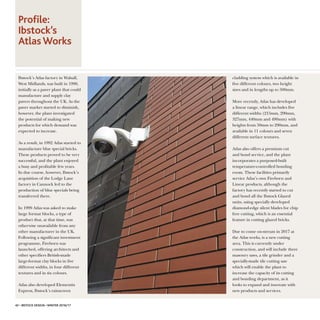
Ibstock’s Atlas factory in Walsall,
West Midlands, was built in 1990,
initially as a paver plant that could
manufacture and supply clay
pavers throughout the UK. As the
paver market started to diminish,
however, the plant investigated
the potential of making new
products for which demand was
expected to increase.
As a result, in 1992 Atlas started to
manufacture blue special bricks.
These products proved to be very
successful, and the plant enjoyed
a busy and profitable few years.
In due course, however, Ibstock’s
acquisition of the Lodge Lane
factory in Cannock led to the
production of blue specials being
transferred there.
In 1999 Atlas was asked to make
large format blocks, a type of
product that, at that time, was
otherwise unavailable from any
other manufacturer in the UK.
Following a significant investment
programme, Fireborn was
launched, offering architects and
other specifiers British-made
large-format clay blocks in five
different widths, in four different
textures and in six colours.
Atlas also developed Elementix
Express, Ibstock’s rainscreen
cladding system which is available in
five different colours, two height
sizes and in lengths up to 500mm.
More recently, Atlas has developed
a linear range, which includes five
different widths (215mm, 290mm,
327mm, 440mm and 490mm) with
heights from 50mm to 290mm, and
available in 11 colours and seven
different surface textures.
Atlas also offers a premium cut
and bond service, and the plant
incorporates a purposed-built
temperature-controlled bonding
room. These facilities primarily
service Atlas’s own Fireborn and
Linear products, although the
factory has recently started to cut
and bond all the Ibstock Glazed
units, using specially developed
diamond-edge silent blades for chip
free cutting, which is an essential
feature in cutting glazed bricks.
Due to come on-stream in 2017 at
the Atlas works, is a new cutting
area. This is currently under
construction, and will include three
masonry saws, a tile grinder and a
specially-made tile cutting saw
which will enable the plant to
increase the capacity of its cutting
and bonding department, as it
looks to expand and innovate with
new products and services.
Profile:
Ibstock’s
AtlasWorks
42 • IBSTOCK DESIGN • WINTER 2016/17
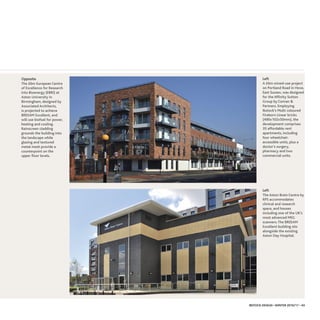
LLeefftt
The Aston Brain Centre by
RPS accommodates
clinical and research
space, and houses
including one of the UK’s
most advanced MEG
scanners.The BREEAM
Excellent building sits
alongside the existing
Aston Day Hospital.
OOppppoossiittee
The £6m European Centre
of Excellence for Research
into Bioenergy (EBRI) at
Aston University in
Birmingham, designed by
Associated Architects,
is projected to achieve
BREEAM Excellent, and
will use biofuel for power,
heating and cooling.
Rainscreen cladding
grounds the building into
the landscape while
glazing and textured
metal mesh provide a
counterpoint on the
upper floor levels.
IBSTOCK DESIGN • WINTER 2016/17 • 43
LLeefftt
A £6m mixed-use project
on Portland Road in Hove,
East Sussex, was designed
for the Affinity Sutton
Group by Conran &
Partners. Employing
Ibstock’s Multi coloured
Fireborn Linear bricks
(490x102x50mm), the
development comprises
35 affordable rent
apartments, including
four wheelchair-
accessible units, plus a
doctor’s surgery,
pharmacy and two
commercial units.
44 • IBSTOCK DESIGN • WINTER 2016/17
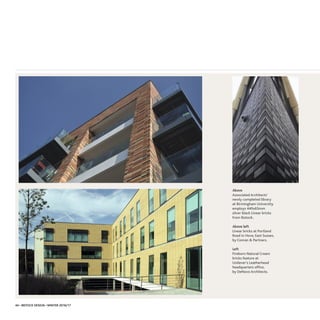
AAbboovvee
Associated Architects’
newly completed library
at Birmingham University
employs 440x65mm
silver black Linear bricks
from Ibstock.
AAbboovvee lleefftt
Linear bricks at Portland
Road in Hove, East Sussex,
by Conran & Partners.
LLeefftt
Fireborn Natural Cream
bricks feature at
Unilever’s Leatherhead
headquarters office,
by DeNovo Architects.
IBSTOCK DESIGN • WINTER 2016/17 • 45
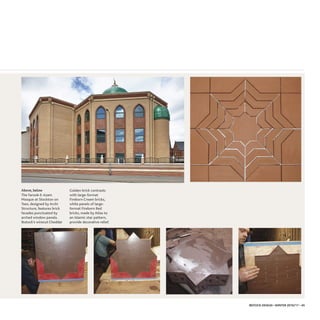
AAbboovvee,, bbeellooww
The Farook-E-Azam
Mosque at Stockton on
Tees, designed by Archi
Structure, features brick
facades punctuated by
arched window panels.
Ibstock’s wirecut Cheddar
Golden brick contrasts
with large-format
Fireborn Cream bricks,
while panels of large-
format Fireborn Red
bricks, made by Atlas to
an Islamic star pattern,
provide decorative relief.
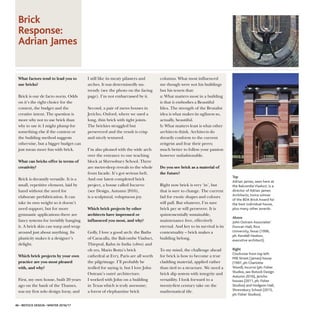
What factors tend to lead you to
use bricks?
Brick is our de facto norm. Odds
on it’s the right choice for the
context, the budget and the
creative intent. The question is
more why not to use brick than
why to use it: I might plump for
something else if the context or
the building method suggests
otherwise, but a bigger budget can
just mean more fun with brick.
What can bricks offer in terms of
creativity?
Brick is dreamily versatile. It is a
small, repetitive element, laid by
hand without the need for
elaborate prefabrication. It can
take its own weight so it doesn’t
need support, but for more
gymnastic applications there are
fancy systems for invisibly hanging
it. A brick skin can warp and wrap
around just about anything. Its
plasticity makes it a designer’s
delight.
Which brick projects by your own
practice are you most pleased
with, and why?
First, my own house, built 20 years
ago on the bank of the Thames,
was my first solo design foray, and
Brick
Response:
Adrian James
46 • IBSTOCK DESIGN • WINTER 2016/17
I still like its meaty pilasters and
arches. It was determinedly un-
trendy (see the photo on the facing
page). I’m not embarrassed by it.
Second, a pair of mews houses in
Jericho, Oxford, where we used a
long, thin brick with tight joints.
The brickies struggled but
persevered and the result is crisp
and nicely textured.
I’m also pleased with the wide arch
over the entrance to our teaching
block at Shrewsbury School. There
are metre-deep reveals to the whole
front facade. It’s got serious heft.
And our latest completed brick
project, a house called Incurvo
(see Design, Autumn 2016),
is a sculptural, voluptuous joy.
Which brick projects by other
architects have impressed or
influenced you most, and why?
Golly, I love a good arch: the Baths
of Caracalla, the Balcombe Viaduct,
Thiepval, Kahn in India (obvs) and
oh yes, Mario Botta’s brick
cathedral at Evry, Paris are all worth
the pilgrimage. I’ll probably be
trolled for saying it, but I love John
Outram’s outré architecture.
I worked with John on a building
in Texas which is truly awesome;
a forest of elephantine brick
columns. What most influenced
me though were not his buildings
but his tenets that:
a: What matters most in a building
is that it embodies a Beautiful
Idea. The strength of the Brutalist
idea is what makes its ugliness so,
actually, beautiful.
b: What matters least is what other
architects think. Architects do
drearily conform to the current
zeitgeist and fear their peers;
much better to follow your passion
however unfashionable.
Do you see brick as a material of
the future?
Right now brick is very ‘in’, but
that is sure to change. The current
fad for exotic shapes and colours
will pall. But whatever, I’m sure
brick per se will persevere. It is
quintessentially sustainable,
maintenance free, effectively
eternal. And key to its survival is its
contextuality – brick makes a
building belong.
To my mind, the challenge ahead
for brick is how to become a true
cladding material, applied rather
than tied to a structure. We need a
brick slip system with integrity and
versatility. I look forward to a
twenty-first century take on the
mathematical tile.
TToopp
Adrian James, seen here at
the BalcombeViaduct, is a
director of Adrian James
Architects, twice winner
of the BDA Brick Award for
the best individual house,
plus many other awards.
AAbboovvee
John Outram Associates’
Duncan Hall, Rice
University,Texas (1996,
ph: Kendall Heaton,
executive architect).
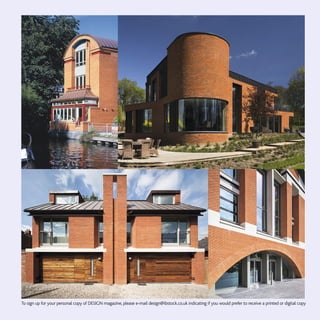
RRiigghhtt
Clockwise from top left:
Mill Street (James) house
(1997, ph:Charlotte
Wood), Incurvo (ph: Fisher
Studios, see Ibstock Design
Autumn 2016), Jericho
houses (2011, ph: Fisher
Studios) and Hodgson Hall,
Shrewsbury School (2015,
ph: Fisher Studios).
To sign up for your personal copy of DESIGN magazine, please e-mail design@ibstock.co.uk indicating if you would prefer to receive a printed or digital copy
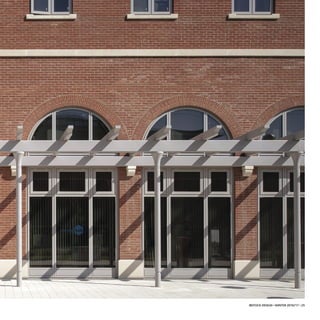
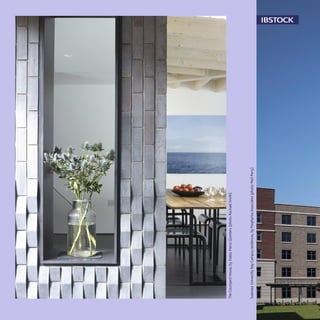
SwanseaUniversityBayCampusresidences,byPorphyriosAssociates(photo:NeilPerry)
TheCourtyardHouse,byDallasPierceQuintero(photo:RachaelSmith)

Design IBSTOCK BRICK Winter 16-17

  • 1.
    DESIGNfrom IBSTOCK BRICK WWiinntteerr22001166//1177 ––––––––––––––––––––––––––– In this issue: Porphyrios Associates in Swansea, Dallas Pierce Quintero, CF Møller, Aedas, Sixtwo Architects, plus setting out brickwork guide, and Ibstock’s Atlas brickworks
  • 2.
  • 3.
    DESIGNfrom IBSTOCK BRICK 4Winter 2016/17 – Ibstock Update 6 Elmfield Court is a fully-affordable apartment building near London’s Battersea Park by CF Møller 12 The Courtyard House by Dallas Pierce Quintero exploits the decorative effect of a brick wall inside and out 18 With its brick facade features, the Foundry in Salford, by Sixtwo Architects, brings elegance to the industrial shed 24 Brick brings familiarity, variety and permanence to Porphyrios Associates’ Swansea University Bay Campus 32 Aedas Architects’Two Smithfield in Stoke-on-Trent resonates with its site’s brickmaking tradition 38 Technical guidance on Setting Out Brickwork 42 Ibstock’s Atlas factory profiled 46 Brick Response:Adrian James Ibstock Brick Ltd Leicester Road, Ibstock, Leicestershire, LE67 6HS t: 01530 261999 f: 01530 257457 e: enquiries@ibstock.co.uk www.ibstock.com Ibstock Sales Office: 0844 800 4575 Design & Technical Helpline: 0844 800 4576 Sample & Literature Hotline: 0844 800 4578 Special Shapes and Brickwork Components Sales Office: 0844 736 0350 ©Ibstock Brick 2017 Published by Ibstock Brick Ltd
  • 4.
    NEW SHADES OFGREY In tune with the trend towards the use of non-earth brick colours, Ibstock has introduced a range of grey bricks. Providing a striking alternative to familiar buffs and creams, the new Tidal Dark Grey and Silver Grey (below) have been added to the Linear range of long bricks. They are available in lengths up to 490mm and heights of either 50 or 65mm, and offer a cost-effective, sustainable alternative to imported products. For a more traditional format, the new Leicester Grey Stock (bottom left) combines the soft textures normally associated with a stock brick with a warm grey colour hue – ideal for introducing a highlight, feature or indeed a whole facade. The latest addition to the Arden family, the Arden Grey (bottom right) combines the look of a true waterstruck brick with an inorganic grey colour. IBSTOCK SUCCESSES AT THE 40th BRICK AWARDS Ibstock won three awards at the Brick Development Association’s 40th Brick Awards, taking its total wins since 2005 to 77, more than any other brickmaker. The stunning builds feature bricks from Ibstock’s wide-ranging portfolio of colours, textures, sizes and finishes to achieve a huge variety of aesthetic effects. Projects using Ibstock bricks picked up the top accolade in three categories. Best Individual Housing Development went to Dallas Pierce Quintero’s Courtyard House (bottom right and p12, featuring Staffordshire Blue Umbra Sawtooth and Standard, ph: David Butler). Best Large House Builder went to Linden Homes, for Gloucester’s Greyfriars Quarter, by Stride Treglown (bottom left, Audley Red Mixture, Commercial Red), and Wilshere Park (mid-right, Heritage Red, Bexhill Red and Parham Red). The distinctive arcaded pavilion of the Brentwood School Learning Resource Centre in Essex (top, ph: Anthony Coleman), by Cottrell & Vermeulen, won Best Education Building, where Ibstock’s distinctive Heritage Red Blend harmonises with the existing school buildings. Ibstock Update 4 • IBSTOCK DESIGN • WINTER 2016/17 AAbboovvee A2 Dominion, winners of the Ibstock-sponsored What House? Best Exterior Design award. WHAT HOUSE? AWARDS Often referred to as the ‘Oscars’ of the housebuilding industry, the What House? Awards is the UK’s most prestigious new homes event. The 2016 awards ceremony, held at London’s Grosvenor House Hotel in November, was attended by 1,700 figures from the industry. William Hague, former MP, Foreign Secretary and Conservative Party leader, presented the prizes. Ibstock sponsored the award for the Best Exterior Design, in which Gold went to A2 Dominion/Fabrica, silver to Hill and bronze to David Wilson Homes. For a full list of winners, see the WhatHouse? Awards website: www.whathouse.com/awards/ d!
  • 5.
    IBSTOCK DESIGN •WINTER 2016/17 • 5 In addition, Ibstock-Kevington products were used in the Newport Street Gallery (by Caruso St John Architects), which picked up the Supreme Award. The innovative project used precast lintels and beams, together with CNC-cut brickwork, all of which were manufactured by Ibstock-Kevington. Merchant Taylors’ School Design Centre (mid-left, ph: Mark Hadden), another Ibstock project, was commended in the category of Best Education Building. “As brick continues to retain its position as the number one construction material of choice”, says Andrew Halstead-Smith, group marketing manager at Ibstock, “we are seeing more innovative and creative applications of brick, which really showcase its tremendous design capabilities. Architects, specifiers and contractors are pushing the boundaries in creating breathtaking designs, as these award- winning projects demonstrate. As a result of these continued pioneering applications, the calibre of builds shortlisted at this year’s awards was incredibly high, so to have three projects where Ibstock bricks were used receiving awards, in addition to playing a part in the Supreme Award winner, is testament to the versatility of Ibstock’s wide-range of options.”
  • 6.
    Elmfield Court, aresidential development near London’s Battersea Park by CF Moller, features 22 fully-affordable apartments. Setbacks, deep balconies and light brick facades lend a human scale to the project, in keeping with adjacent residential terraces. Rhythm of the Street 6 • IBSTOCK DESIGN • WINTER 2016/17
  • 7.
    IBSTOCK DESIGN •WINTER 2016/17 • 7
  • 8.
    8 • IBSTOCKDESIGN • WINTER 2016/17
  • 9.
    Elmwood Court isa five-storey, all-affordable housing scheme near Battersea Park, London. Designed by CF Møller Architects within the tradition of the Victorian terrace but in a modern idiom, the development comprises ground-level retail space with 22 residential units above. The project is built on the site of an underutilised car park that has been transformed into a shared garden, acting as a new focal point for an established Peabody estate. The majority of apartments feature dual-aspect living spaces and two balconies, one facing south-east and another overlooking the communal garden. The shifting facade composition of large brick openings on alternate floors reinstates the original line of the street and promotes an inhabited and enlivened facade. Grouped vertical windows reference the Victorian context and the overall arrangement maximises the courtyard space to the rear and offers clearly defined block entrances flanking the retail space. The deep inset balconies with a southerly aspect create a buffer between the road and private spaces. The balconies are separated by white-rendered storage cupboards which translate the idea of the ‘garden shed’ to a dense urban context whilst creating accents in the elevation. Full-height openings throughout maximise daylight penetration to all habitable rooms and upper-level setbacks lighten the massing of the block, reducing its scale in response to its urban context. The elevations are clad in light coloured brick – a material found within the local vernacular and which has immediate associations with domestic and residential architecture. Brick is an extremely IBSTOCK DESIGN • WINTER 2016/17 • 9
  • 10.
    10 • IBSTOCKDESIGN • WINTER 2016/17
  • 11.
    long lasting anddurable material, which ages gracefully. The soft, buff brick appearance of the Ibstock Bradgate Light Buff was selected in response to the tones and textures found within the Victorian streetscape. Precast lintels with positively-keyed brick facings (not illustrated) enhance the façade treatment, framing the large terraces facing Battersea Park Road. These components were carefully coordinated with the traditionally-constructed stretcher bond brickwork to give a seamless overall appearance. Another challenging detail was forming the delicate brick piers that separate the grouped windows. The solution involved bespoke steel wind-posts to support the traditionally- constructed brickwork and Juliet balconies. AARRCCHHIITTEECCTT CF Møller Architects BBRRIICCKKCCooNNTTRRAACCTTooRR Durkan PPHHooTTooGGRRAAPPHHEERR Mark Hadden BBUUIILLDDIINNGG Elmwood Court, London Borough ofWandsworth BBRRIICCKKSS Ibstock Bradgate Light Buff IBSTOCK DESIGN • WINTER 2016/17 • 11 At ground floor, the building is recessed to provide a soffit above the residential entrances. The urban realm is further articulated with a texture of projecting headers in a Flemish bond. For continuity, the same brickwork has also been used to clad the street level of an adjacent building. This extends and strengthens the relationship between the new apartment building and the wider estate. The building has been designed to achieve Code for Sustainable Homes Level 4. The units are 100 per cent Lifetime Homes compliant and the project provides two wheelchair-accessible two- bedroom apartments.
  • 12.
    Vertically-laid brickwork enhances boththe minimal dimensions and tactile qualities of Dallas Pierce Quintero’s award-winning Courtyard House. Interior expressions 12 • IBSTOCK DESIGN • WINTER 2016/17
  • 13.
    IBSTOCK DESIGN •WINTER 2016/17 • 13
  • 14.
    14 • IBSTOCKDESIGN • WINTER 2016/17
  • 15.
    IBSTOCK DESIGN •WINTER 2016/17 • 15 A series of small courtyards provides the main source of daylight for this two-bedroom house, built within the walls of an L-shaped infill site in London. The challenge for architect Dallas Pierce Quintero was to create a home without a sense of overlooking, that nonetheless protected the daylight enjoyed by neighbours. The four courtyards open up sightlines through the property, creating functional outdoor spaces for passing through, dwelling in and looking into. The client’s brief called for a home that was modest. This drove the entire design, from the overall massing through to the choice of the materials. “Brick fitted this brief perfectly”, says Dallas Pierce Quintero, “as an everyday material that, with a bit of care and attention, can look extraordinary”. An Ibstock Staffordshire Slate Blue brick was chosen as part of the minimal palette, both in a standard and a sawtooth shape. Both were laid vertically, with the sawtooth to waist height and the standard above that, creating a unique appearance. The use of brick on the two principal elevations demonstrates the importance placed on using materials that respond to the site conditions. The plot was surrounded on all sides by masonry walls, with an existing beautiful, long brick wall to the longest edge. The use of the vertically laid bricks resonates in a contemporary and eye- catching way with the existing re-pointed wall. The use of brick both on the outside and inside of the building makes the house feel larger than it its dimensions. With space at a premium, a key design decision was to blur the distinction
  • 16.
    between inside andoutside by extending one of the external brick walls into the house. “The brick finish looks equally stunning inside and out”, say the architects. “The natural variations inherent in its colour, together with its robustness, make it perfect as an internal finish.” The use of a shaped brick, and the manner in which it has been laid, has created a surface that is unusually tactile and visually softens the building. “When we show visitors around the building”, say the architects, “we find that people are drawn to the sawtooth brickwork, they watch how light falls on the wall and stroke it. The bricks look like a basket weave: both hard and regular whilst also soft and undulating. The result is a unique surface that’s appearance constantly changes over the course of the day and which champions the use of brick.” The Courtyard House was recognised as the Best Individual Housing Development in the 2016 Brick Awards. It also won a RIBA London award in 2015, and was long-listed for the RIBA House of the Year. The jury said that “the experience of being in the house was extraordinarily light and airy, with a subtle and sensitive sense of connection between inside and outside spaces, reinforced by details such as bringing the blue brick wall from the courtyard into the house.” 16 • IBSTOCK DESIGN • WINTER 2016/17 CCoonnssttrruuccttiioonn sseeccttiioonn 1 Profiled fibre cement board roofing, 2 timber joists supported by steel sections, 3 Ibstock Staffordshire slate blue smooth bricks laid vertically, 4 galvanised steel window surround, 5 fire-rated doubled- glazed window, 6 Ibstock Staffordshire slate blue Umbra sawtooth bricks laid vertically, 7 timber frame, 8 Ibstock Staffordshire slate blue smooth bricks laid in line with bricks above, 9 brickslot drain. BBrriicckk ffaaccaaddee ddeettaaiillss ((rriigghhtt)) 3 30-mins fire-rated double-glazed door and frame, 4 30-mins fire- rated -double-glazed window, 5 frames coupled together, 6 screw embedded 50mm into structural timber frame, 7 two layers plasterboard, 10 vapour control barrier, 11 weatherproofing breather membrane, 12 structural timber frame, 17 Ibstock Staffordshire Blue Slate brick, 19 mortar, 21 galvanised steel window surround, 28 kitchen worktop, 32 brick support, 33 intumescent mastic. 11 22 33 44 55 66 77 88 99
  • 17.
    AARRCCHHIITTEECCTT Dallas Pierce Quintero BBRRIICCKKCCOONNTTRRAACCTTOORR Brooks Contracting PPHHOOTTOOGGRRAAPPHHEERRSS Tom Gildon, Rachael Smith, David Butler IBSTOCK DESIGN • WINTER 2016/17 • 17 BBUUIILLDDIINNGG Courtyard House BBRRIICCKKSS Ibstock Staffordshire Slate Blue Smooth, Umbra Sawtooth Staffordshire Slate Blue Smooth 04 03 17 07 11 12 06 19 17 21 10 32 21 33 07 11 12 06 17 10 21 28 03 0507 11 12 06 1917 2121 10 03 21 19 17 11 12 100733 33 33
  • 18.
    Chamfered planes ofbrick articulate the long elevations of the Foundry, a new industrial development in Salford that aims to invest the often neglected ‘warehouse’ type with greater visual interest and ambition. Industrial aesthetic 18 • IBSTOCK DESIGN • WINTER 2016/17
  • 19.
    IBSTOCK DESIGN •WINTER 2016/17 • 19
  • 20.
    20 • IBSTOCKDESIGN • WINTER 2016/17 Left Chamfered setbacks are ‘carved’ from the linear building form to add visual interest and mark the entrances to the different industrial units. Right Visualisation and plan showing the two linear buildings which align a new landscaped pedestrian route.
  • 21.
    IBSTOCK DESIGN •WINTER 2016/17 • 21 The Foundry is a new industrial development in Salford, designed by Sixtwo Architects, with more than 40,000 square feet of warehouse and industrial accommodation, split between two blocks. The brief was to design flexible workspace that stood out from local alternatives through its design quality, and which brought character and individuality to the industrial shed. The development was also to be sensitive to the adjacent grade-one listed Ordsall Hall, and incorporate a new public route from the Tudor house through to the River Irwell. The architects looked to develop a fresh approach to the much neglected architectural type of the industrial warehouse. A limited palette was employed, articulating six individual chamfered features that express the industrial units’ entrances, while also framing vistas towards Ordsall Hall and the river. This established a logical hierarchy to the composition, with a materiality that referenced the ornate brick detailing of Ordsall Hall. Brick detailing was also introduced to help reduce the apparent scale of the development. A variety of sliding galvanised steel shutters lend further individuality to the units while helping secure vulnerable areas. A new public boulevard links the Hall both visually and as a route through the development site, to the riverside walkway. This has already proved to be a catalyst for redevelopment and pedestrian movement within the locality.
  • 22.
    22 • IBSTOCKDESIGN • WINTER 2016/17
  • 23.
    AARRCCHHIITTEECCTT Sixtwo Architects BBRRIICCKK CCOONNTTRRAACCTTOORR WilliamsTarr PPHHOOTTOOGGRRAAPPHHEERRSS BenDraguisky, James Andrews IBSTOCK DESIGN • WINTER 2016/17 • 23 BBUUIILLDDIINNGG Foundry, Salford BBRRIICCKKSS Ibstock Birtley Northern Buff and others LLeefftt//rriigghhtt Sixtwo was keen to avoid using the standard aluminium cladding that is typically used on industrial warehouses, so developed a design that employs traditional materials while also providing a contemporary aesthetic. Sixtwo selected Ibstock’s Northern Buff brick to form the sculptured entrances that are key elements in the scheme. For each of the two blocks of twelve units, the entrances are paired and adopt individualised chamfered forms within a common architectural language.These volumes are seemingly ‘carved’ out of the building mass, varying in height and depth, but with chamfers at a common angle. The chamfers use both a traditional cavity wall and a brick-slip system, with the chamfer to the soffit being based on a standard oversized 73mm-high brick-slip system. This common angle ensured that the bricks on the chamfers coursed through with the standard 65mm high bricks on the vertical planes. As well as the sculpted entrances, portions of the Northern Buff brick deviate from a stretcher bond to an English bond, with alternating headers protruding.The composition adds visual interest, breaking down the scale of the building and relating to Ordsall Hall, the frontage of which features header-bonded brickwork.
  • 24.
    Brick facades imbuethe new Bay Campus at the University of Swansea with a sense of familiarity, variety, permanence and gravitas. Masterplanned by Porphyios Associates, the campus incorporates student residential blocks that are based on traditional collegiate models, but built using fast-track state-of-the-art construction technologies. Tradition and Technology 24 • IBSTOCK DESIGN • WINTER 2016/17
  • 25.
    IBSTOCK DESIGN •WINTER 2016/17 • 25
  • 26.
    26 • IBSTOCKDESIGN • WINTER 2016/17 J4 CRYMLYN BURR SSSI WORKS ELBA CRESCENT BALDWIN'S CRESCENT BEACH BUS STOP COASTAL REVETMENT BUS STOP TENNANT PLACE GOWER SQUARE MARGAM SQUARE CRYMLYNWAY AFAN WAY INDUSTRY / R&D MULTI-STOREY CARPARK UNIVERSITY RESIDENTIAL UNIVERSITY ACADEMIC* 20.00.0 10.0 40.0 m8.06.04.02.0 N Retail Student Services RetailRetaillitaeR litaeR litaeR 0.0 6.04.2.0 20.010.08. 40.0 m Student Services N
  • 27.
    Swansea University’s new£450m Bay Campus, a development by St Modwen in partnership with the university, occupies a large coastal site three miles to the east of the city centre, taking advantage of the west-facing aspect across sand dunes to the sea. The masterplan, by Porphyrios Asoociates, is generated as much by a public realm of interconnected urban spaces and green areas as by urban blocks, lending an underlying sense of structure, orientation and place. Within this, character and diversity is a priority, and contrasts of formal and intimate, lively and quiet, hard and soft are sought wherever possible with minimal means. In terms of its appearance, the project employs traditional materials – primarily brick and reconstituted stone – but it has been built using fast-track construction techniques that employ steel- and concrete framing. Porphyrios Associates’ student residential blocks are organised along principles of collegiate models, with a strong urban edge that addresses the public realm of the street, and inner courtyards that address the private life of students. The ‘megablocks’ of the masterplan are reduced to smaller urban blocks by secondary pedestrian streets, and permeability is achieved by passages and openings between buildings. Entrances to the courtyards vary in scale and materials, while gates to the north protect privacy while maintaining the porosity of the blocks. Entrances to those residential buildings within the collegiate courts are via the internal courts, helping foster identity and activity. The residential buildings provide a range of accommodation – standard rooms, premium BBeellooww A clocktower anchors the corner of Gwalia Square, the central public space on the campus, for which it acts as a beacon. LLeefftt Elevation of the main street; masterplan and first-phase student residences block plan. IBSTOCK DESIGN • WINTER 2016/17 • 27
  • 28.
    28 • IBSTOCKDESIGN • WINTER 2016/17
  • 29.
    rooms, twin rooms,wheelchair-accessible rooms, one-bed flats and two-bed flats – and these are distributed throughout the blocks. Some larger flats for mature and family residents, however, are concentrated in one block, close to common facilities that cater for their particular needs. All the student accommodation is organised in private clusters, each with its own common room with kitchen facilities. Large ‘community’ facilities are provided in the development zones where residents can congregate and relax. Student facilities located in the ground level of the residential blocks facing Dylan Thomas Way include the dining hall and bar, coffee shop, laundrette, mini market and student services. Taller residential buildings are located along the northern edge of the campus and lower buildings towards the south to maximise sea views and take advantage of the orientation. The massing is generally additive, and variation is introduced by differentiating the buildings though composition and colour, as well as by means of setbacks and modulation of the skyline. The residential buildings by Porphyrios Associates are articulated laterally to achieve animated elevations of variety and diversity. Other student residences within the masterplan, designed by Hopkins Architects (who also designed a number of the departmental and teaching buildings) are treated as a large ‘palazzo’, adding another variation of the residential type to the campus. The residential buildings by Porphyrios Associates are finished in bonded brickwork with IBSTOCK DESIGN • WINTER 2016/17 • 29 BBeellooww,, lleefftt The campus library features brick and reconstituted stone facings. OOppppoossiittee Student residences are grouped around courtyards. ENTRANCE HALL SILENT STUDY SILENT STUDY SILENT STUDY PG PC RM PG STUDY RM BOOK STOCK PC ROOM STUDY SPACES BOOK STOCKBOOK STOCKBOOK CKOTS BOOK CKOTS ENTRANCE LLAH SILENT STUDY SILENT STUDY PC MORO SILENT STUDY PG CP RM PG YDUTS RM BOOK CKOTS YDUTS ACESSPSPACES
  • 30.
    stone detailing andsurface plane, all of which adds interest and diversity to the elevations. Windows and doors have flat brick arches and are made in polyester powder-coated (PPC) aluminium. Entrances are marked through porches or door with surrounds, while the rooftop plant rooms are screened by brick parapet walls with ‘openings’ that are filled by a metal mesh. 30 • IBSTOCK DESIGN • WINTER 2016/17 reconstituted stone to the bases, entrance porches, window/door surrounds, trims, sills and parapets. The brickwork to the residences has a palette of three colours: red-orange, yellow and red-brown, with the reconstituted stone components matching natural Portland stone. The blocks are articulated so as to suggest a composition of smaller buildings using vertical breaks, expressed by a change of brick colour, AAbboovvee A palette of brick colours, stone facings, building heights and setbacks adds variety and interest to the student residential blocks. RRiigghhtt Student residences are grouped around, and entered via central courts.
  • 31.
    IBSTOCK DESIGN •WINTER 2016/17 • 31 AARRCCHHIITTEECCTT AANNDD MMAASSTTEERRPPLLAANNNNEERR Porphyrios Associates BBRRIICCKKWWOORRKK CCOONNTTRRAACCTTOORR Vinci Construction PPHHOOTTOOGGRRAAPPHHYY Neil Perry BBUUIILLDDIINNGG Swansea University Bay Campus BBRRIICCKKSS Ibstock Ivanhoe Cream, Himley Worcester Mix, Leicester Red Stock, Precast arches, lintels, pistols with slips
  • 32.
    Two Smithfield echoesthe scale and proportions of the nineteenth-century buildings in Stoke-on-Trent, while its use of brick responds to the former role of its site in the local brickmaking industry. Brickwork Foundations 32 • IBSTOCK DESIGN • WINTER 2016/17
  • 33.
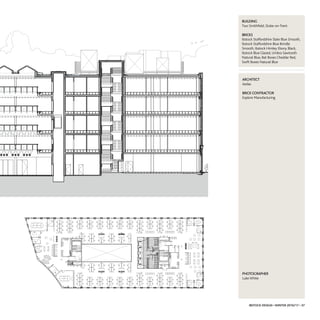
    IBSTOCK DESIGN •WINTER 2016/17 • 33
  • 34.
    34 • IBSTOCKDESIGN • WINTER 2016/17
  • 35.
    IBSTOCK DESIGN •WINTER 2016/17 • 35 Building on the rich tradition of brickmaking and ceramic design within Stoke-on-Trent and the surrounding area, Two Smithfield is a simple yet subtle exercise in brick detailing and proportion in which specific details are picked out with ceramic colour and non-standard bricks. Following the rhythm and character of the urban context, the brick bays and overall structural proportions are designed to feel part of the local townscape. Two Smithfield also represents a marked contrast to its more colourful neighbour, One Smithfield. The brownfield site is bounded on all four sides by roads, including the Stoke-on-Trent inner ring road, and slopes from north to south. Historically it had hosted part of Stoke’s brick-making industry, and a surviving brick kiln on the east part of the site has been incorporated within the overall masterplan. Several other derelict and run-down buildings were cleared as part of the enabling works for the new development. The site had a number of coal mining shafts beneath it, and it had been used for open-cast coal collection, so ground conditions were very poor. Two Smithfield sits adjacent to Stoke’s cultural quarter, with the city theatre, museum and library and arts centre all located in the vicinity. The site also connects to the city’s main retail and commercial centre, and is seen as strategically important in linking the University of Stafford into the rest of the city centre amenities, including the new bus interchange. Two Smithfield has been designed to meet the city council’s high sustainability standards as well
  • 36.
    36 • IBSTOCKDESIGN • WINTER 2016/17 as its need for an agile working approach and flexible departmental operations. The building was to be designed to allow for a mixed-mode form of air conditioning, where external opening windows are used to assist and supplement the internal system. This in turn required a central atrium space that allowed for the free movement of air across the floor plates and then out through the atrium roof at high level. The building was to be BREEAM excellent and capable of subdivision into separate tenancies on a floor-by-floor basis. The council was keen to see local materials used as part of the architectural approach and also wanted to allow for ‘active’ uses on the ground floor spaces on either side of the main entrance. The unstable nature of the ground and its former use for mining operations meant that significant enabling and engineering works had to be undertaken prior to the start of building work. The slope on the site and the changes in ground levels around the building meant that the rear of the ground floor building space is set into the ground and so access from the rear is restricted and requires lift and stair provision. Sustainability features include a mixed-mode ventilation system with underfloor air, exposed thermal mass, cooling only when required, low- velocity air distribution, solar control glazing, district heating energy transfer station, air-source heat pumps, and AHU with heat recovery. The building is fully accessible and compliant with Part M of the Building Regulations.
  • 37.
    AARRCCHHIITTEECCTT Aedas BBRRIICCKK CCOONNTTRRAACCTTOORR Explore Manufacturing PPHHOOTTOOGGRRAAPPHHEERR LukeWhite IBSTOCKDESIGN • WINTER 2016/17 • 37 BBUUIILLDDIINNGG Two Smithfield, Stoke-on-Trent BBRRIICCKKSS Ibstock Staffordshire Slate Blue Smooth, Ibstock Staffordshire Blue Brindle Smooth, Ibstock Himley Ebony Black, Ibstock Blue Glazed, Umbra Sawtooth Natural Blue, Bat Boxes Cheddar Red, Swift Boxes Natural Blue
  • 38.
    Designing and settingout brickwork correctly creates a matching and balanced appearance, particularly at reveals on either side of door and window openings and at the ends of walls. Setting out starts at the design stage where the design of a building, including openings, should ideally be set out to brick co-ordinating dimensions, eliminating the requirement to cut bricks on site. In this briefing only stretcher bond, also known as half-bond, is considered, although the basic principles will apply whatever bond is used. Technical: Setting out Brickwork FFuurrtthheerr iinnffoorrmmaattiioonn Comprehensive design and technical guidance for brickwork is available in the Technical Information Sheets section of Ibstock’s website, under Design & Specification,Application & Construction and Site Practice &Troubleshooting. See: www.ibstock.com For any help or advice, contact Ibstock Design &Technical: technical@ibstock.co.uk 38 • IBSTOCK DESIGN • WINTER 2016/17 DESIGN – Co-ordinating Size Brickwork should be set out using as a ‘unit’ dimension the co-ordinating size of the brick, ie one brick length plus one nominal 10mm mortar joint – usually 225mm for standard metric bricks. The mortar joint acts as a ‘buffer zone’ and is adjusted to suit the actual brick size during construction. (a) All brickwork dimensions are determined by one of three conditions: brick plus two joints (CO+) – brickwork above or below door and window openings; brick plus one joint (CO) – brick panel with opposite return ends; and brick only (CO-) – brick piers or panels between openings. For example, if a span of brickwork is required to encompass four whole bricks over an opening, a mortar joint will be needed at either end; therefore the co-ordinating size measurement (CO+ condition) is 900mm (four brick lengths plus four x10mm mortar joints).(b) Co-ordinating size 225 C 10 102.5 65 10 10 Work size 215 112.5 CO + condition CO + (elevation) CO (plan) CO- (plan) FIGURE 1 Design to Minimise Cutting CO condition CO - condition Door or window opening 4 x CO+ 4 x CO 4 x CO - * Brick may be omitted * a b
  • 39.
    IBSTOCK DESIGN •WINTER 2016/17 • 39 890mm The bricks should be spaced out to fit the co-ordinating space therefore the mortar joints will be adjusted accordingly Courses set-out with 10mm mortar joints Start point Perpends gradually running over Result - overhang at end of course Start point Perpends remaining central to brick below Result - neat finish at end of course Courses set-out to a co-ordinating size with varying mortar joints plumb every fourth or fifth perpend plumb every fourth or fifth perpend CONSTRUCTION The bricklayer should set out the brickwork at foundation level, marking the position of openings and adjusting joints to accommodate any brick size variation. TOLERANCES BS EN 771-1 requires that the dimensions of a clay masonry unit shall be declared by the manufacturer and also which tolerance category the mean values fulfil. Information on brick tolerances can be found in Ibstock’s Product Portfolio and on its website. It is important to understand that bricks complying with the British Standard have varying shape characteristics, depending on the method of manufacture. When using different products in the same wall, for example wire-cut products at ground-level changing to stock bricks higher up, they may be classified to different tolerances. If the guidelines on setting out are followed this should not cause any problem. However, if a rigidly measured 10mm mortar joint is used there will be inevitable problems with perpends running out of plumb. Before laying, units from each product type should be blended so that the overall appearance of the finished work is uniform and without patches or bands of colour. This will also help to blend any variations in size. It is important not to set-out using the actual size of the bricks on site as the dimensions of future deliveries may differ. (c) PERPENDS Perpends are the positions of vertical joints between the bricks (not the actual vertical joints themselves). Their location should be decided at foundation level. The verticality of perpends is visually important and the plumbing of every fourth or fifth course and the ‘eyeing out’ in between will produce satisfactory results. In addition, the fourth or fifth perpend in each course should be plumbed and suitably marked. (d) d c
  • 40.
    REVERSE BOND This iswhere the end bricks in a given course are showing a stretcher face at one end of the panel and a header face at the other. It can also apply at either side of an opening containing a half- brick dimension in its width and where broken bond and brick cutting may be considered unacceptable. It is unlikely to be acceptable if reveal bricks of a contrasting colour are used as a decorative feature as the appearance is not balanced. (g) 40 • IBSTOCK DESIGN • WINTER 2016/17 REVEALS The positions of the reveals, ie the sides of window and door openings, should be identified when setting out the first few courses. This should ensure unbroken perpends for the full height of the wall. (e) BROKEN BOND This is the introduction of cut bricks into a length of wall which, if properly considered, will maintain satisfactory appearance and achieve a minimum quarter bond. It tends to arise beneath window openings, where short lengths of brickwork are neither full-brick nor half-brick dimensions. Alternatively, the cut bricks can be placed symmetrically at each end of a run of brickwork. (f) Opening 4 1 /2 bricks Cut bricks located at each end Cut bricks located centrally position of window opening to be built reveal bricks positioned at ground level plumbed perpends reveal DPC e f g
  • 41.
    ANGLES Walls which includeangle bricks should be set out to the face side as with any facework. The use of squints will maintain half bond. Longer angle bricks (often referred to as dog-legs) will also maintain half-bond but the shorter ones will involve some cutting of the standard brick to maintain the bond. (h) PLINTHS Stepped plinth courses at the base of a wall will increase the wall length externally and may result in a non- co-ordinating dimension. The setting out dimension should therefore be the brickwork above the plinth courses so that any cutting to accommodate the increased length is in the plinth and lower courses only. (i) COPINGS AND CAPPINGS Special consideration must be given to fixing a line and pins when placing a course of copings or cappings. It is good practice to consider the most obvious ‘sight line’ or side most likely to be seen. As the bricks will vary in size the favoured edge or arris of the course being laid will be the ‘trued up’ edge. Where copings or capping are to be viewed from both sides, some selection of units to a common size will be necessary. IBSTOCK DESIGN • WINTER 2016/17 • 41 External angle using squint bricks Angle using external angle bricks Co-ordinating dimensions C C C CC C 220 225 225 (C = cutback) cut brick dimension Plinth bricks h i
  • 42.
    Ibstock’s Atlas factoryin Walsall, West Midlands, was built in 1990, initially as a paver plant that could manufacture and supply clay pavers throughout the UK. As the paver market started to diminish, however, the plant investigated the potential of making new products for which demand was expected to increase. As a result, in 1992 Atlas started to manufacture blue special bricks. These products proved to be very successful, and the plant enjoyed a busy and profitable few years. In due course, however, Ibstock’s acquisition of the Lodge Lane factory in Cannock led to the production of blue specials being transferred there. In 1999 Atlas was asked to make large format blocks, a type of product that, at that time, was otherwise unavailable from any other manufacturer in the UK. Following a significant investment programme, Fireborn was launched, offering architects and other specifiers British-made large-format clay blocks in five different widths, in four different textures and in six colours. Atlas also developed Elementix Express, Ibstock’s rainscreen cladding system which is available in five different colours, two height sizes and in lengths up to 500mm. More recently, Atlas has developed a linear range, which includes five different widths (215mm, 290mm, 327mm, 440mm and 490mm) with heights from 50mm to 290mm, and available in 11 colours and seven different surface textures. Atlas also offers a premium cut and bond service, and the plant incorporates a purposed-built temperature-controlled bonding room. These facilities primarily service Atlas’s own Fireborn and Linear products, although the factory has recently started to cut and bond all the Ibstock Glazed units, using specially developed diamond-edge silent blades for chip free cutting, which is an essential feature in cutting glazed bricks. Due to come on-stream in 2017 at the Atlas works, is a new cutting area. This is currently under construction, and will include three masonry saws, a tile grinder and a specially-made tile cutting saw which will enable the plant to increase the capacity of its cutting and bonding department, as it looks to expand and innovate with new products and services. Profile: Ibstock’s AtlasWorks 42 • IBSTOCK DESIGN • WINTER 2016/17
  • 43.
    LLeefftt The Aston BrainCentre by RPS accommodates clinical and research space, and houses including one of the UK’s most advanced MEG scanners.The BREEAM Excellent building sits alongside the existing Aston Day Hospital. OOppppoossiittee The £6m European Centre of Excellence for Research into Bioenergy (EBRI) at Aston University in Birmingham, designed by Associated Architects, is projected to achieve BREEAM Excellent, and will use biofuel for power, heating and cooling. Rainscreen cladding grounds the building into the landscape while glazing and textured metal mesh provide a counterpoint on the upper floor levels. IBSTOCK DESIGN • WINTER 2016/17 • 43 LLeefftt A £6m mixed-use project on Portland Road in Hove, East Sussex, was designed for the Affinity Sutton Group by Conran & Partners. Employing Ibstock’s Multi coloured Fireborn Linear bricks (490x102x50mm), the development comprises 35 affordable rent apartments, including four wheelchair- accessible units, plus a doctor’s surgery, pharmacy and two commercial units.
  • 44.
    44 • IBSTOCKDESIGN • WINTER 2016/17 AAbboovvee Associated Architects’ newly completed library at Birmingham University employs 440x65mm silver black Linear bricks from Ibstock. AAbboovvee lleefftt Linear bricks at Portland Road in Hove, East Sussex, by Conran & Partners. LLeefftt Fireborn Natural Cream bricks feature at Unilever’s Leatherhead headquarters office, by DeNovo Architects.
  • 45.
    IBSTOCK DESIGN •WINTER 2016/17 • 45 AAbboovvee,, bbeellooww The Farook-E-Azam Mosque at Stockton on Tees, designed by Archi Structure, features brick facades punctuated by arched window panels. Ibstock’s wirecut Cheddar Golden brick contrasts with large-format Fireborn Cream bricks, while panels of large- format Fireborn Red bricks, made by Atlas to an Islamic star pattern, provide decorative relief.
  • 46.
    What factors tendto lead you to use bricks? Brick is our de facto norm. Odds on it’s the right choice for the context, the budget and the creative intent. The question is more why not to use brick than why to use it: I might plump for something else if the context or the building method suggests otherwise, but a bigger budget can just mean more fun with brick. What can bricks offer in terms of creativity? Brick is dreamily versatile. It is a small, repetitive element, laid by hand without the need for elaborate prefabrication. It can take its own weight so it doesn’t need support, but for more gymnastic applications there are fancy systems for invisibly hanging it. A brick skin can warp and wrap around just about anything. Its plasticity makes it a designer’s delight. Which brick projects by your own practice are you most pleased with, and why? First, my own house, built 20 years ago on the bank of the Thames, was my first solo design foray, and Brick Response: Adrian James 46 • IBSTOCK DESIGN • WINTER 2016/17 I still like its meaty pilasters and arches. It was determinedly un- trendy (see the photo on the facing page). I’m not embarrassed by it. Second, a pair of mews houses in Jericho, Oxford, where we used a long, thin brick with tight joints. The brickies struggled but persevered and the result is crisp and nicely textured. I’m also pleased with the wide arch over the entrance to our teaching block at Shrewsbury School. There are metre-deep reveals to the whole front facade. It’s got serious heft. And our latest completed brick project, a house called Incurvo (see Design, Autumn 2016), is a sculptural, voluptuous joy. Which brick projects by other architects have impressed or influenced you most, and why? Golly, I love a good arch: the Baths of Caracalla, the Balcombe Viaduct, Thiepval, Kahn in India (obvs) and oh yes, Mario Botta’s brick cathedral at Evry, Paris are all worth the pilgrimage. I’ll probably be trolled for saying it, but I love John Outram’s outré architecture. I worked with John on a building in Texas which is truly awesome; a forest of elephantine brick columns. What most influenced me though were not his buildings but his tenets that: a: What matters most in a building is that it embodies a Beautiful Idea. The strength of the Brutalist idea is what makes its ugliness so, actually, beautiful. b: What matters least is what other architects think. Architects do drearily conform to the current zeitgeist and fear their peers; much better to follow your passion however unfashionable. Do you see brick as a material of the future? Right now brick is very ‘in’, but that is sure to change. The current fad for exotic shapes and colours will pall. But whatever, I’m sure brick per se will persevere. It is quintessentially sustainable, maintenance free, effectively eternal. And key to its survival is its contextuality – brick makes a building belong. To my mind, the challenge ahead for brick is how to become a true cladding material, applied rather than tied to a structure. We need a brick slip system with integrity and versatility. I look forward to a twenty-first century take on the mathematical tile. TToopp Adrian James, seen here at the BalcombeViaduct, is a director of Adrian James Architects, twice winner of the BDA Brick Award for the best individual house, plus many other awards. AAbboovvee John Outram Associates’ Duncan Hall, Rice University,Texas (1996, ph: Kendall Heaton, executive architect). RRiigghhtt Clockwise from top left: Mill Street (James) house (1997, ph:Charlotte Wood), Incurvo (ph: Fisher Studios, see Ibstock Design Autumn 2016), Jericho houses (2011, ph: Fisher Studios) and Hodgson Hall, Shrewsbury School (2015, ph: Fisher Studios).
  • 47.
    To sign upfor your personal copy of DESIGN magazine, please e-mail design@ibstock.co.uk indicating if you would prefer to receive a printed or digital copy
  • 48.