How do neuroeconomics, evolutionary psychology and the idea of massive modularity overlap?  Stuart WG Derbyshire, School of Psychology, University of Birmingham
I’m going to largely ignore that title..! I’m going to largely focus on the issue of transformation – understanding human beings as in a state of ‘becoming’ rather than a state of ‘being’ Understanding human being as ‘becoming’ addresses the limits of materialism
Honderich complains “ To linger a last time at this crux, real physicalism or materialism runs up against the most resilient proposition in the history of the philosophy of the mind. It is a simple one you know about, that the properties of conscious events aren’t neural ones, or aren’t only neural ones. Consciousness isn’t cells…  Think of another family of answers [to what it is  like  for you to be conscious]. What is it  like  for you to be conscious of this room now is for there to be a neural instantiation in your head of a computational or functional sequence. Or an electromagnetic field. Or, God help us, what your consciousness of the room seems to you to be is a generating in your head of macroscopic quantum coherence, with Bose  Einstein condensates combining and microtubules  microtubuling.”
Back to the ultimatum game Michael Shermer argued that we should never reject free money “… the moral emotion of “reciprocal altruism,” evolved over the Paleolithic eons to demand fairness on the part of our potential exchange partners…   The moral sense of fairness is hardwired into our brains and is an emotion shared by most people and primates tested for it”
Massive modularity The mind is essentially a Swiss army knife of cognitive modules that explain all thinking (or “How the Mind Works”) These modules were forged during the  Paleolithic  era and have not changed since Modules are domain specific, encapsulated, spontaneous and fast with limited outputs, limited accessibility and a fixed neural architecture A reflex is an extreme example
Reflex Noxious stimulation is captured by dedicated sensory fibres and relayed to a sensory neuron and then to a motor neuron causing withdrawal. The system fires entirely without computation or further information and either goes off completely or not at all
Problems with massive modularity Taken literally, it verges on incoherence Taken liberally, it lacks empirical plausibility Modules help keep things apart but how to bring them together again? And if everything comes together what are modules for..? Cognition is too broad a capacity, and makes contact with knowledge at too many places, to be considered anything like an encapsulated, impenetrable module Globality is, perhaps irremovably, a thorn in the flesh of massive modularity
Problems with EP It is peculiar to argue that we have developed minds capable of generating modernism but not minds capable of coping with modernism… It is not so much that EP is in principle always wrong (even though, in practice, it often is) so much as EP does violence to the distance travelled historically and culturally
Sex and War Potts and Hayden, for example, argue that chimps banging kerosene cans together is evidence of “technological  innovation and arms  development” – but is it?  Really?
Problems with EP EP wants to take away control and responsibility but then also wants to give it back This contradiction arises, in part, from our inability to resolve the tension between subject and object and our inability to understand what it means to be ‘transitory’ creatures
This is an old problem… Descartes Kant Hegel
Descartes’ famous statement of certainty Cogito ergo sum Or I think therefore I am Je pense, donc je suis Or 1596-1650 1596-1650 Descartes R.  Discourse on Method , 1637
All change! Artists and writers introduced character and personality Charles I lost his head This was all a response to the reformation
Descartes nuked certainty “ I wished to give myself entirely to the search after truth. I thought that it was necessary for me to take an apparently opposite course, and to reject as absolutely false everything as to which I could imagine the least ground of doubt, in order to see if afterwards there remained anything in my belief that was entirely certain.” Descartes R.  Discourse on the Method , 1637
A point of certainty in an (increasingly) uncertain world “ But I was persuaded that there was nothing in all the world, that there was no heaven, no earth, that there were no minds, nor any bodies: was I not then likewise persuaded that I did not exist? Not at all; of a surety I myself did exist since I persuaded myself of something (or merely because I thought of something). But there is some deceiver or other, very powerful and very cunning, who ever employs his ingenuity in deceiving me. Then without doubt I exist also if he deceives me, and let him deceive me as much as he will, he can never cause me to be nothing so long as I think I am something. So that after having reflected well and carefully examined all things, we must come to the definite conclusion that this proposition: I am, I exist, is necessarily true each time that I pronounce it, or that I mentally conceive it.” Descartes R.  Meditations on First Philosophy , 1641 Translated by Haldane and Ross, 1997
Why does this matter? In the  Second Meditation , Descartes explains that “perception is neither an act of vision, nor of touch... but only an intuition of the mind.”  The penetration of the body by physical stimulation exposes sensation to the reason of the mind. The mind is not subsumed (dazzled or drowned) by the senses.  Descartes R. Meditations on First Philosophy (1641). Translated by ES Haldane and GRT Ross.  Descartes Key Philosophical Writings . Wordsworth Classics, 1997, pp. 139-146.
Plastic sensory experience Sine wave sound  Clear sound Sine wave sound  Clear sound What is this? Ah, now I see The physical information does not change but the sensory experience does Remez et al. Speech perception without traditional speech cues.  Science  1981;212:947-9
Summary In the Medieval world, God, Life, Man, Nature, were things taken as given, unquestioned, appointed and appropriate The reformation meant these things could no longer be taken for granted and humanity began a new journey towards understanding Descartes responded to this by inverting classical philosophy and finding certainty in thought
Descartes’ humanism was fatally limited by his religious commitment Descartes’ philosophy is one of individuals who have “divine minds” We access the world through these divinely given faculties of reason
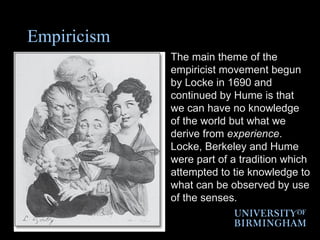
Empiricism The main theme of the empiricist movement begun by Locke in 1690 and continued by Hume is that we can have no knowledge of the world but what we derive from  experience . Locke, Berkeley and Hume were part of a tradition which attempted to tie knowledge to what can be observed by use of the senses.
British empiricists John Locke (1632-1704) Almost all knowledge is a function  of sensory experience ‘Tabula rasa’ Locke rejected innate or ‘divine’ knowledge as a barrier to the rational transformation of society David Hume (1711-1776) Rejected the idea of a “divine mind” An extreme scepticism towards  knowledge
Hume’s extreme scepticism There is no reason to believe that things will remain as they are Our percepts do not have a continued and distinct existence so our belief in continuity is irrational Knowledge degenerates into probability but the judgement of probability is itself uncertain and so…
This cannot amount to a theory of human being With only fleeting sense perceptions, that are themselves not necessarily bound together, how do we constitute a “self”? Hume had no answer… “ [Men are] nothing but a bundle or collection of different perceptions, which succeed each other with an inconceivable rapidity, and are in a perpetual flux and movement” Hume,  Treatise
Kant responds Kant (1724-1804) was appalled by Hume’s scepticism “ [According to Hume] all that we term metaphysical science is a mere delusion, arising from the fancied insight of reason into that which in truth is borrowed from experience, and to which habit has given the appearance of necessity. [This assertion is] destructive to all pure philosophy”  Critique of Pure Reason,  1781
Kantian priors Kant set out to resolve the tension between empiricism and reason with  priors Knowledge is drawn from sensibility, which is  posterior , and understanding, which is  prior “ Without the sensuous faculty no object would be given to us, and without the understanding no object would be thought. Thoughts without content are empty; intuitions without concepts are blind”.
The problem of the “thing in itself” Priors form a barrier between us and the world as it truly is “… objects are quite unknown to us in themselves, and what we call outward objects, are nothing else but mere representations of our sensibility, whose form is space, but whose real correlate, the thing in itself, is not known by means of these representations, nor ever can be ”. “ But these sources of knowledge being merely conditions of our sensibility, do therefore, and as such, strictly determine their own range and purpose, in that they do not and cannot present objects as things in themselves ”
Hegel responds Hegel (1770-1831) was immensely  impressed by Kant but not by his  rejection of us ever knowing the ‘thing in itself’ “… if cognition is the instrument for getting hold of absolute being, it is obvious that the use of an instrument on a thing certainly does not let it be what it is for itself, but rather sets out to reshape and alter it. If, on the other hand, cognition is not an instrument of our activity but a more or less passive medium through which the light of truth reaches us, then again we do not receive the truth as it is in itself, but only as it exists through and in this medium”  Phenomenology of Spirit , 1807
The nature of ‘the absolute’ Hegel sees the subject and object as different facets of the same thing “ [Kant’s insight] takes for granted certain ideas about cognition as an  instrument  and as a  medium , and assumes that there is a  difference between ourselves and this cognition . Above all, it presupposes that the Absolute stands on one side and cognition on the other, independent and separated from it, and yet is something real; or, in other words, it presupposes that cognition which, since it is excluded from the Absolute, is surely outside of the truth as well, is nevertheless true, an assumption whereby what calls itself fear of error reveals itself rather as fear of the truth”.
Coming to know the world is transformative Each transformation gets us closer to the thing in itself “… in fact, in the alteration of the knowledge, the object itself alters for it too, for the knowledge that was present was essentially a knowledge of the object: as the knowledge changes, so too does the object, for it essentially belonged to this knowledge… [we test knowledge out against the object and when we find it fails our test we find the  in itself  of the object was only an  in itself  for consciousness]… the testing is not only a testing of what we know, but also a testing of the criterion of what knowing is”.
Three relations of conscious subjectivity to its object Sense-certainty The starting point of all we know that takes itself to be genuine knowledge without doubt or question Perception Distinguishes properties or qualities of the immediately given Understanding Things are seen as fixed patterns of mutual interference and interaction behind their manifest, phenomenal surface
It is profoundly amazing (honest) Pure being, says Hegel, is pure indeterminateness and vacuity. Pure being has in it no object for thought to grasp. It is entirely empty. In fact, it is nothing. What appears to be immediate and simple is revealed as a movement towards something and away from nothing. From this breathtaking beginning the dialectic of the  Phenomenology  moves forward. The first thesis,  being , has turned into its antithesis,  nothing . Being and nothing are both opposites and the same; their truth, therefore, is this movement into and apart from each other – in other words, it is  becoming
Priors are cultural not innate “ The child… is born… into a living world… He does not even think of his separate self; he grows with his world, his mind fills and orders itself; and when he can separate himself from that world, and know himself apart from it, then by that time his self, the object of his self-consciousness, is penetrated, infected, characterized by the existence of others” FH Bradley, 1846-1924.
Mind is social Thought and experience cannot be adequately understood as long as their social origins are obscured You did not, all by yourself, generate the content or momentum of your conscious life Peter Hobson describes the development of social consciousness: “One might say that they were responding to the world according to someone else… The discovery is a discovery in action and feeling, rather than a discovery in thought”. And, later, “…her new-found grasp of symbols allows her to locate and anchor aspects of her interpersonal understanding. In a way, she can arrive at true concepts or thoughts about the mind… only when she can use words or other symbols to encompass those thoughts… Symbols, and especially words, help her to sort out and refine what she has gleaned from her engagement with others.”
Emotion and rationality are historical not neural  The substance of faith is something that can only be experienced argues Munzer whereas Luther examines the “ideas” which symbolize faith. Which one is  authentic ? This argument continued between Kant and Hume. Tallis’ example of Nurse Ryan illustrates that emotional reactions stretch out across human history
Conclusions Evolutionary psychologists and neuroscientists tend to make the same mistake as Kant They miss the transformative potential of consciousness and the possibilities for transitions in thought More simply, if we can change the way we think about things so that we produce different responses then the idea that we are being dictated to by modules programmed by evolution loses a lot of force

Neuroeconomics Critique Part 2

  • 1.
    How do neuroeconomics,evolutionary psychology and the idea of massive modularity overlap? Stuart WG Derbyshire, School of Psychology, University of Birmingham
  • 2.
    I’m going tolargely ignore that title..! I’m going to largely focus on the issue of transformation – understanding human beings as in a state of ‘becoming’ rather than a state of ‘being’ Understanding human being as ‘becoming’ addresses the limits of materialism
  • 3.
    Honderich complains “To linger a last time at this crux, real physicalism or materialism runs up against the most resilient proposition in the history of the philosophy of the mind. It is a simple one you know about, that the properties of conscious events aren’t neural ones, or aren’t only neural ones. Consciousness isn’t cells… Think of another family of answers [to what it is like for you to be conscious]. What is it like for you to be conscious of this room now is for there to be a neural instantiation in your head of a computational or functional sequence. Or an electromagnetic field. Or, God help us, what your consciousness of the room seems to you to be is a generating in your head of macroscopic quantum coherence, with Bose Einstein condensates combining and microtubules microtubuling.”
  • 4.
    Back to theultimatum game Michael Shermer argued that we should never reject free money “… the moral emotion of “reciprocal altruism,” evolved over the Paleolithic eons to demand fairness on the part of our potential exchange partners… The moral sense of fairness is hardwired into our brains and is an emotion shared by most people and primates tested for it”
  • 5.
    Massive modularity Themind is essentially a Swiss army knife of cognitive modules that explain all thinking (or “How the Mind Works”) These modules were forged during the Paleolithic era and have not changed since Modules are domain specific, encapsulated, spontaneous and fast with limited outputs, limited accessibility and a fixed neural architecture A reflex is an extreme example
  • 6.
    Reflex Noxious stimulationis captured by dedicated sensory fibres and relayed to a sensory neuron and then to a motor neuron causing withdrawal. The system fires entirely without computation or further information and either goes off completely or not at all
  • 7.
    Problems with massivemodularity Taken literally, it verges on incoherence Taken liberally, it lacks empirical plausibility Modules help keep things apart but how to bring them together again? And if everything comes together what are modules for..? Cognition is too broad a capacity, and makes contact with knowledge at too many places, to be considered anything like an encapsulated, impenetrable module Globality is, perhaps irremovably, a thorn in the flesh of massive modularity
  • 8.
    Problems with EPIt is peculiar to argue that we have developed minds capable of generating modernism but not minds capable of coping with modernism… It is not so much that EP is in principle always wrong (even though, in practice, it often is) so much as EP does violence to the distance travelled historically and culturally
  • 9.
    Sex and WarPotts and Hayden, for example, argue that chimps banging kerosene cans together is evidence of “technological innovation and arms development” – but is it? Really?
  • 10.
    Problems with EPEP wants to take away control and responsibility but then also wants to give it back This contradiction arises, in part, from our inability to resolve the tension between subject and object and our inability to understand what it means to be ‘transitory’ creatures
  • 11.
    This is anold problem… Descartes Kant Hegel
  • 12.
    Descartes’ famous statementof certainty Cogito ergo sum Or I think therefore I am Je pense, donc je suis Or 1596-1650 1596-1650 Descartes R. Discourse on Method , 1637
  • 13.
    All change! Artistsand writers introduced character and personality Charles I lost his head This was all a response to the reformation
  • 14.
    Descartes nuked certainty“ I wished to give myself entirely to the search after truth. I thought that it was necessary for me to take an apparently opposite course, and to reject as absolutely false everything as to which I could imagine the least ground of doubt, in order to see if afterwards there remained anything in my belief that was entirely certain.” Descartes R. Discourse on the Method , 1637
  • 15.
    A point ofcertainty in an (increasingly) uncertain world “ But I was persuaded that there was nothing in all the world, that there was no heaven, no earth, that there were no minds, nor any bodies: was I not then likewise persuaded that I did not exist? Not at all; of a surety I myself did exist since I persuaded myself of something (or merely because I thought of something). But there is some deceiver or other, very powerful and very cunning, who ever employs his ingenuity in deceiving me. Then without doubt I exist also if he deceives me, and let him deceive me as much as he will, he can never cause me to be nothing so long as I think I am something. So that after having reflected well and carefully examined all things, we must come to the definite conclusion that this proposition: I am, I exist, is necessarily true each time that I pronounce it, or that I mentally conceive it.” Descartes R. Meditations on First Philosophy , 1641 Translated by Haldane and Ross, 1997
  • 16.
    Why does thismatter? In the Second Meditation , Descartes explains that “perception is neither an act of vision, nor of touch... but only an intuition of the mind.” The penetration of the body by physical stimulation exposes sensation to the reason of the mind. The mind is not subsumed (dazzled or drowned) by the senses. Descartes R. Meditations on First Philosophy (1641). Translated by ES Haldane and GRT Ross. Descartes Key Philosophical Writings . Wordsworth Classics, 1997, pp. 139-146.
  • 17.
    Plastic sensory experienceSine wave sound Clear sound Sine wave sound Clear sound What is this? Ah, now I see The physical information does not change but the sensory experience does Remez et al. Speech perception without traditional speech cues. Science 1981;212:947-9
  • 18.
    Summary In theMedieval world, God, Life, Man, Nature, were things taken as given, unquestioned, appointed and appropriate The reformation meant these things could no longer be taken for granted and humanity began a new journey towards understanding Descartes responded to this by inverting classical philosophy and finding certainty in thought
  • 19.
    Descartes’ humanism wasfatally limited by his religious commitment Descartes’ philosophy is one of individuals who have “divine minds” We access the world through these divinely given faculties of reason
  • 20.
    Empiricism The maintheme of the empiricist movement begun by Locke in 1690 and continued by Hume is that we can have no knowledge of the world but what we derive from experience . Locke, Berkeley and Hume were part of a tradition which attempted to tie knowledge to what can be observed by use of the senses.
  • 21.
    British empiricists JohnLocke (1632-1704) Almost all knowledge is a function of sensory experience ‘Tabula rasa’ Locke rejected innate or ‘divine’ knowledge as a barrier to the rational transformation of society David Hume (1711-1776) Rejected the idea of a “divine mind” An extreme scepticism towards knowledge
  • 22.
    Hume’s extreme scepticismThere is no reason to believe that things will remain as they are Our percepts do not have a continued and distinct existence so our belief in continuity is irrational Knowledge degenerates into probability but the judgement of probability is itself uncertain and so…
  • 23.
    This cannot amountto a theory of human being With only fleeting sense perceptions, that are themselves not necessarily bound together, how do we constitute a “self”? Hume had no answer… “ [Men are] nothing but a bundle or collection of different perceptions, which succeed each other with an inconceivable rapidity, and are in a perpetual flux and movement” Hume, Treatise
  • 24.
    Kant responds Kant(1724-1804) was appalled by Hume’s scepticism “ [According to Hume] all that we term metaphysical science is a mere delusion, arising from the fancied insight of reason into that which in truth is borrowed from experience, and to which habit has given the appearance of necessity. [This assertion is] destructive to all pure philosophy” Critique of Pure Reason, 1781
  • 25.
    Kantian priors Kantset out to resolve the tension between empiricism and reason with priors Knowledge is drawn from sensibility, which is posterior , and understanding, which is prior “ Without the sensuous faculty no object would be given to us, and without the understanding no object would be thought. Thoughts without content are empty; intuitions without concepts are blind”.
  • 26.
    The problem ofthe “thing in itself” Priors form a barrier between us and the world as it truly is “… objects are quite unknown to us in themselves, and what we call outward objects, are nothing else but mere representations of our sensibility, whose form is space, but whose real correlate, the thing in itself, is not known by means of these representations, nor ever can be ”. “ But these sources of knowledge being merely conditions of our sensibility, do therefore, and as such, strictly determine their own range and purpose, in that they do not and cannot present objects as things in themselves ”
  • 27.
    Hegel responds Hegel(1770-1831) was immensely impressed by Kant but not by his rejection of us ever knowing the ‘thing in itself’ “… if cognition is the instrument for getting hold of absolute being, it is obvious that the use of an instrument on a thing certainly does not let it be what it is for itself, but rather sets out to reshape and alter it. If, on the other hand, cognition is not an instrument of our activity but a more or less passive medium through which the light of truth reaches us, then again we do not receive the truth as it is in itself, but only as it exists through and in this medium” Phenomenology of Spirit , 1807
  • 28.
    The nature of‘the absolute’ Hegel sees the subject and object as different facets of the same thing “ [Kant’s insight] takes for granted certain ideas about cognition as an instrument and as a medium , and assumes that there is a difference between ourselves and this cognition . Above all, it presupposes that the Absolute stands on one side and cognition on the other, independent and separated from it, and yet is something real; or, in other words, it presupposes that cognition which, since it is excluded from the Absolute, is surely outside of the truth as well, is nevertheless true, an assumption whereby what calls itself fear of error reveals itself rather as fear of the truth”.
  • 29.
    Coming to knowthe world is transformative Each transformation gets us closer to the thing in itself “… in fact, in the alteration of the knowledge, the object itself alters for it too, for the knowledge that was present was essentially a knowledge of the object: as the knowledge changes, so too does the object, for it essentially belonged to this knowledge… [we test knowledge out against the object and when we find it fails our test we find the in itself of the object was only an in itself for consciousness]… the testing is not only a testing of what we know, but also a testing of the criterion of what knowing is”.
  • 30.
    Three relations ofconscious subjectivity to its object Sense-certainty The starting point of all we know that takes itself to be genuine knowledge without doubt or question Perception Distinguishes properties or qualities of the immediately given Understanding Things are seen as fixed patterns of mutual interference and interaction behind their manifest, phenomenal surface
  • 31.
    It is profoundlyamazing (honest) Pure being, says Hegel, is pure indeterminateness and vacuity. Pure being has in it no object for thought to grasp. It is entirely empty. In fact, it is nothing. What appears to be immediate and simple is revealed as a movement towards something and away from nothing. From this breathtaking beginning the dialectic of the Phenomenology moves forward. The first thesis, being , has turned into its antithesis, nothing . Being and nothing are both opposites and the same; their truth, therefore, is this movement into and apart from each other – in other words, it is becoming
  • 32.
    Priors are culturalnot innate “ The child… is born… into a living world… He does not even think of his separate self; he grows with his world, his mind fills and orders itself; and when he can separate himself from that world, and know himself apart from it, then by that time his self, the object of his self-consciousness, is penetrated, infected, characterized by the existence of others” FH Bradley, 1846-1924.
  • 33.
    Mind is socialThought and experience cannot be adequately understood as long as their social origins are obscured You did not, all by yourself, generate the content or momentum of your conscious life Peter Hobson describes the development of social consciousness: “One might say that they were responding to the world according to someone else… The discovery is a discovery in action and feeling, rather than a discovery in thought”. And, later, “…her new-found grasp of symbols allows her to locate and anchor aspects of her interpersonal understanding. In a way, she can arrive at true concepts or thoughts about the mind… only when she can use words or other symbols to encompass those thoughts… Symbols, and especially words, help her to sort out and refine what she has gleaned from her engagement with others.”
  • 34.
    Emotion and rationalityare historical not neural The substance of faith is something that can only be experienced argues Munzer whereas Luther examines the “ideas” which symbolize faith. Which one is authentic ? This argument continued between Kant and Hume. Tallis’ example of Nurse Ryan illustrates that emotional reactions stretch out across human history
  • 35.
    Conclusions Evolutionary psychologistsand neuroscientists tend to make the same mistake as Kant They miss the transformative potential of consciousness and the possibilities for transitions in thought More simply, if we can change the way we think about things so that we produce different responses then the idea that we are being dictated to by modules programmed by evolution loses a lot of force

Editor's Notes

  • #4 Conscious experience is always about something – it has content – and for human beings that content is largely about people, objects and language. These things are, in the first instance, outside us and so they must be brought inside. If they are brought inside then conscious experience is dependent on more than just neural activity; it is also dependent on, at least, stuff that is outside and our relationship with it.
  • #6 Domain Specific: specialised to certain types of input Encapsulated: Isolated from other psychological systems Spontaneous: obligatory firing
  • #18 The plasticity is founded in knowledge, what we know, not in our nature (in our brains)
  • #19 We are both a part of nature and apart from nature. This contradiction is the essence of the human project, perhaps.
  • #20 We are both a part of nature and apart from nature. This contradiction is the essence of the human project, perhaps.
  • #21 Locke (1690): “Let us then suppose the mind to be, as we say, white paper, void of all characters, without any ideas:- How comes it to be furnished? Whence comes it by that vast store which the busy and boundless fancy of man has painted on it with an almost endless variety? Whence has it all the materials of reason and knowledge? To this I answer, in one word, from EXPERIENCE. “An Essay Concerning Human Understanding.
  • #22 Locke believed that ideas of innate knowledge all too easily became an excuse to maintain the status quo. Locke does not, however, reject the idea that we are born with faculties to receive and process information (the senses, memory, an ability to use language &c). For Locke arguments about judgement should be based on reason that follows observation of what happens. This protects us from faith based decisions or irrational judgements but Hume points out that we are forced to make irrational decisions because our senses are always woefully incomplete.
  • #23 There could be no necessary connection between distinct events – we do not experience cause and effect, such things are just suppositions based on one thing following another. All that remains, then, is a series of fleeting ‘perceptions’ with no external object, no enduring subject to whom they could belong, and not themselves even bound to one another.
  • #30 We think we are on a journey to understand the world but we realise we are on a journey that is constructing the world.
  • #31 In the flux of experience given by sense-certainty one quality is constantly yielding place to another, and it is impossible to seize what is individual by pointing gestures or demonstrative words such as “This”, “Here”, “Now”, “I”, etc., which are all irremediably general in meaning. Perception, likewise, is dialectically flawed by its incapacity to integrate the separate characters it picks out with the unified individuality of the object to which it seeks to attribute them. Both lead on to Understanding.
  • #34 The principal idea is that modes of thought and experience cannot be adequately understood as long as their social origins are obscured. All the ideas and sentiments which motivate an individual do not have their origin in him alone, and cannot be adequately explained solely on the basis of his individual life-experience. I imagine that is fairly obvious and uncontroversial when it is directed towards something like our attitudes towards terrorism or our contemplation of meaning but it is clearly more difficult and troublesome when it is directed towards something like the experience of pain. There is a major difficulty in translating across from what can be considered basic sentient experiences and the more complex reflection on those experiences.
  • #35 When Luther nailed his 95 theses to the Castle Church door in 1517 he was wrestling control from the church and the papacy, demanding that everyone can interpret scripture for themselves using their own reason. He began the reformation and the Renaissance ideal of man as the measure of all things (even though it was Protagoras from Ancient Greece who first coined the idea). Anyway, the point is, ordinary people were expected to feel not understand, understanding was the job of the priesthood. But Luther examined the ‘ideas’ of faith, which is right? Is it more authentic to think or to feel? Kant believed the road to morality was paved with reason; you have to think deeply and subject every corner of your mind to reason in order to wrestle the right course of action from it. That is what makes a moral being. Hume argued that if you need to go through that much effort then maybe you just aren’t very moral… Is it more right to reason or more right to feel? Nurse Ryan was describing a patient during a meeting to discuss moving patients out of H1 ward that was about to be painted: ‘In front of the assembled team, Charge Nurse Ryan referred to the second ward as ‘ h aitch 2’ ward. The superfluous meta-aitch ignited a blush that spread to the roots of his hair.’ Why this sudden charge of blood to the face from a simple misplaced ‘h’? Tallis’ answer begins with speech, which first emerged anywhere between 40,000 and several hundred thousand years ago. Nurse Ryan’s mistake would be impossible without speech. He then moves on to the habit of reporting speech and thus assigning meaning to other beings and introducing the possibility of mistaken meanings. The next step is writing, which is a mere 9,000 years old. Writing is a second-order language that captures meaning in a system of conventional signs that gradually took the form of alphabetisation from about 3,000 years ago. Alphabets mean that spellings will follow a convention and letters will be spelled out loud to indicate that convention. A given letter will have a sound distinct from the sound the letter might make in a word (think of the different way you say ‘t’ in ‘tune’ and ‘the’). Now we are almost there. ‘H’ becomes ‘aitch’ because of the confluence of two naming conventions: the Latin ‘aha’ and the Middle English ‘ache’ were merged by, ironically, dropping the ‘h’ itself and leaving ‘aitch’. The final step before Nurse Ryan’s blush is the snobbery of ‘h’. Missing an ‘aitch’ off a word reveals a working-class background and an inability to cope with the fineries of language and life. Nurse Ryan inserted an aberrant ‘h’ at the start of ‘aitch’, thus betraying his anxiety at dropping an ‘h’ and his true background. His redundant ‘h’ revealed his deceit of trying to be something he wasn’t and his cheeks flushed red at the prospective shame of being caught out as a wannabe, a great pretender. That blush is a glass-bottomed boat opening up to the long history of human development. Millions of years and millions of heads were necessary to generate Nurse Ryan’s glowing red face; he simply couldn’t have generated that crimson colour all by himself, and it simply isn’t the kind of thing you can record with an fMRI scanner.