Fall 2015
Course Syllabus
Instructor: Sergiu Dascalu
Department of Computer Science and Engineering
August 25, 2015
1
 The Instructor
 The Students
 The Course
 The Texts
 Initial Pointers
 Grading Scheme
 Policies
 A Look Ahead
 Tentative Schedule
2
 Instructor: Sergiu Dascalu
• Room LEG-212
• E-mail dascalus@cse.unr.edu
• Web-site www.cse.unr.edu/~dascalus
• Office hours:
THU 4:00 pm – 5:30 pm or by appointment or chance
 Teaching Assistant: Ben Brown
• Room ECC
• E-mail abenyoucantrust@gmail.com
• Office hours:
• TBD
3
Registration as of today:
70 students
Prerequisites:
ENG 102; CH 201/202/or 203; CS 446; and Junior or
Senior standing
4
 Catalog description:
Lecture + Lab: 3 + 0; Credit(s): 3
Software processes, project management, software
requirements, system models, architectural design,
detailed design, user interface design, implementation,
integration, verification, validation, testing, evolution,
rapid development, software tools. (Major capstone
course.)
 Outline:
This course covers the software development process,
from requirements elicitation and analysis, through
specification and design, to implementation,
integration, testing, and evolution (maintenance).
[continued on next page]
5
 Outline [cont’d]: A variety of concepts, principles,
techniques, and tools are presented, covering topics such
as software processes, project management, people
management, software requirements, system models,
architectural and detailed design, user interface design,
programming practices, verification and validation, and
software evolution.
Although the emphasis will be on modern, object-
oriented approaches some more traditional, structured
software engineering techniques will also be discussed.
6
 Textbook:
[SE-10] Ian Sommerville, Software Engineering,
10th
Edition, Addison-Wesley, 2015.
ISBN: 978-0133943030
 Lecture notes:
• Presentations by the instructor
• Notes you take in the classroom
• Additional material as indicated later by the
instructor
7
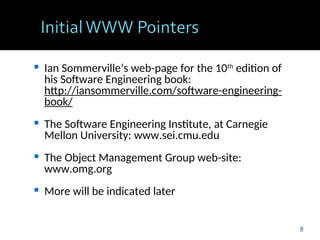
 Ian Sommerville’s web-page for the 10th
edition of
his Software Engineering book:
http://iansommerville.com/software-engineering-
book/
 The Software Engineering Institute, at Carnegie
Mellon University: www.sei.cmu.edu
 The Object Management Group web-site:
www.omg.org
 More will be indicated later
8
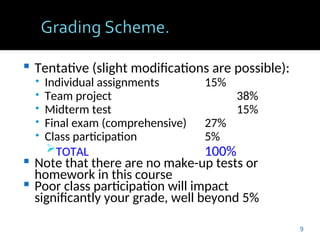
 Tentative (slight modifications are possible):
• Individual assignments 15%
• Team project 38%
• Midterm test 15%
• Final exam (comprehensive) 27%
• Class participation 5%
TOTAL 100%
 Note that there are no make-up tests or
homework in this course
 Poor class participation will impact
significantly your grade, well beyond 5%
9
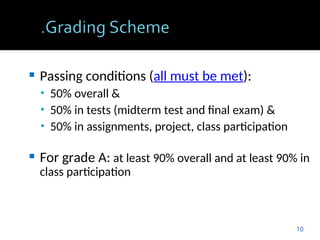
 Passing conditions (all must be met):
• 50% overall &
• 50% in tests (midterm test and final exam) &
• 50% in assignments, project, class participation
 For grade A: at least 90% overall and at least 90% in
class participation
10
 Numerical-letter grade correspondence
• A 90 -100 [maximum 100]
• A- 87 - 89
• B+ 83 - 86
• B 78 - 82
• B- 74 - 77
• C+ 70 - 73
• C 65 - 69
• C- 61 - 64
• D+ 57 - 60
• D 54 - 56
• D- 50 - 53
• F < 50
11
 If you have a disability for which you need
to request accommodations, please
contact as soon as possible the instructor
or the Disability Resource Center
(Thompson Student Services - 107).
12
 Academic Success Services: Your student fees cover usage of the Math
Center (784-4433 or www.unr.edu/mathcenter/), Tutoring Center (784-
6801 or www.unr.edu/tutoring/), and University Writing Center (784-
6030 or http://www.unr.edu/writing_center/.
 These centers support your classroom learning; it is your responsibility
to take advantage of their services. Keep in mind that seeking help
outside of class is the sign of a responsible and successful student.
13
 Statement on Audio and Video Recording:
“Surreptitious or covert video-taping of class or unauthorized audio recording of
class is prohibited by law and by Board of Regents policy. This class may be
videotaped or audio recorded only with the written permission of the
instructor. In order to accommodate students with disabilities, some students
may be given permission to record class lectures and discussions. Therefore,
students should understand that their comments during class may be recorded.”
14
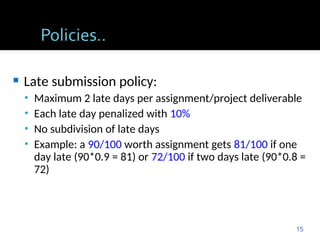
 Late submission policy:
• Maximum 2 late days per assignment/project deliverable
• Each late day penalized with 10%
• No subdivision of late days
• Example: a 90/100 worth assignment gets 81/100 if one
day late (90*0.9 = 81) or 72/100 if two days late (90*0.8 =
72)
15
 Legal notices on the world-wide web:
Read and comply with accompanying
legal notices of downloadable material
 Specify references used in assignments
and project
 Do not plagiarize (see next slide)
16
 Plagiarism and cheating: Will not be
tolerated. Please read the policies
of University of Nevada, Reno
regarding academic dishonesty:
www.unr.edu/stsv/acdispol.html
17
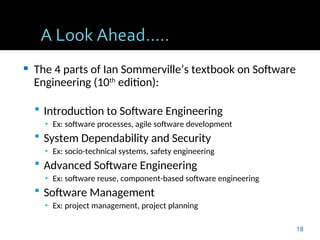
 The 4 parts of Ian Sommerville’s textbook on Software
Engineering (10th
edition):
 Introduction to Software Engineering
▪ Ex: software processes, agile software development
 System Dependability and Security
▪ Ex: socio-technical systems, safety engineering
 Advanced Software Engineering
▪ Ex: software reuse, component-based software engineering
 Software Management
▪ Ex: project management, project planning
18
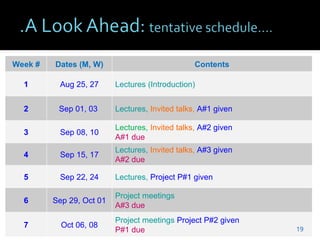
Week # Dates (M, W) Contents
1 Aug 25, 27 Lectures (Introduction)
2 Sep 01, 03 Lectures, Invited talks, A#1 given
3 Sep 08, 10
Lectures, Invited talks, A#2 given
A#1 due
4 Sep 15, 17
Lectures, Invited talks, A#3 given
A#2 due
5 Sep 22, 24 Lectures, Project P#1 given
6 Sep 29, Oct 01
Project meetings
A#3 due
7 Oct 06, 08
Project meetings Project P#2 given
P#1 due 19
8 Oct 13, 15 Lectures
9 Oct 20, 22
Lecture, Project P#3 given
Project P#2 due
10 Oct 27, 29
Midterm [10/27]
Lecture
11 Nov 03, 05 Lectures, Project P#4 given
12 Nov 10, 12
Lectures
Project P#3 due
13 Nov 17, 19 Lectures
14 Nov 24, - Lecture
15 Dec 01, 03 Lectures
16 Dec 08, -
Project P#4 due, Demos (12/07 & 08 & 09)
Final EXAM
20
 Summary of course objectives:
• Comprehensive study of software engineering
concepts, principles, and techniques
• Coverage of the software process
• Study of several advanced software engineering topics
• Practical software development work within the
framework of integrated development environments
21
 Our intentions/expectations:
• Provide guidance in the complex software
engineering spectrum
• Help you be better prepared for practical
software development work
• Open perspectives on software engineering
• Hope that you will both work hard and enjoy
the work in this course
22
 Your intentions/expectations?
• In what ways do you think this course could help
your professional development?
• What topics are you most interested in?
• What suggestions do you have for the
instructors and the course?
23
 Thursday Aug 27:
• Students’ introduction (be prepared to talk 1
minute about yourself)
• Class on the need for software engineering &
short SE videos
24

department os computer science and engineering

  • 1.
    Fall 2015 Course Syllabus Instructor:Sergiu Dascalu Department of Computer Science and Engineering August 25, 2015 1
  • 2.
     The Instructor The Students  The Course  The Texts  Initial Pointers  Grading Scheme  Policies  A Look Ahead  Tentative Schedule 2
  • 3.
     Instructor: SergiuDascalu • Room LEG-212 • E-mail dascalus@cse.unr.edu • Web-site www.cse.unr.edu/~dascalus • Office hours: THU 4:00 pm – 5:30 pm or by appointment or chance  Teaching Assistant: Ben Brown • Room ECC • E-mail abenyoucantrust@gmail.com • Office hours: • TBD 3
  • 4.
    Registration as oftoday: 70 students Prerequisites: ENG 102; CH 201/202/or 203; CS 446; and Junior or Senior standing 4
  • 5.
     Catalog description: Lecture+ Lab: 3 + 0; Credit(s): 3 Software processes, project management, software requirements, system models, architectural design, detailed design, user interface design, implementation, integration, verification, validation, testing, evolution, rapid development, software tools. (Major capstone course.)  Outline: This course covers the software development process, from requirements elicitation and analysis, through specification and design, to implementation, integration, testing, and evolution (maintenance). [continued on next page] 5
  • 6.
     Outline [cont’d]:A variety of concepts, principles, techniques, and tools are presented, covering topics such as software processes, project management, people management, software requirements, system models, architectural and detailed design, user interface design, programming practices, verification and validation, and software evolution. Although the emphasis will be on modern, object- oriented approaches some more traditional, structured software engineering techniques will also be discussed. 6
  • 7.
     Textbook: [SE-10] IanSommerville, Software Engineering, 10th Edition, Addison-Wesley, 2015. ISBN: 978-0133943030  Lecture notes: • Presentations by the instructor • Notes you take in the classroom • Additional material as indicated later by the instructor 7
  • 8.
     Ian Sommerville’sweb-page for the 10th edition of his Software Engineering book: http://iansommerville.com/software-engineering- book/  The Software Engineering Institute, at Carnegie Mellon University: www.sei.cmu.edu  The Object Management Group web-site: www.omg.org  More will be indicated later 8
  • 9.
     Tentative (slightmodifications are possible): • Individual assignments 15% • Team project 38% • Midterm test 15% • Final exam (comprehensive) 27% • Class participation 5% TOTAL 100%  Note that there are no make-up tests or homework in this course  Poor class participation will impact significantly your grade, well beyond 5% 9
  • 10.
     Passing conditions(all must be met): • 50% overall & • 50% in tests (midterm test and final exam) & • 50% in assignments, project, class participation  For grade A: at least 90% overall and at least 90% in class participation 10
  • 11.
     Numerical-letter gradecorrespondence • A 90 -100 [maximum 100] • A- 87 - 89 • B+ 83 - 86 • B 78 - 82 • B- 74 - 77 • C+ 70 - 73 • C 65 - 69 • C- 61 - 64 • D+ 57 - 60 • D 54 - 56 • D- 50 - 53 • F < 50 11
  • 12.
     If youhave a disability for which you need to request accommodations, please contact as soon as possible the instructor or the Disability Resource Center (Thompson Student Services - 107). 12
  • 13.
     Academic SuccessServices: Your student fees cover usage of the Math Center (784-4433 or www.unr.edu/mathcenter/), Tutoring Center (784- 6801 or www.unr.edu/tutoring/), and University Writing Center (784- 6030 or http://www.unr.edu/writing_center/.  These centers support your classroom learning; it is your responsibility to take advantage of their services. Keep in mind that seeking help outside of class is the sign of a responsible and successful student. 13
  • 14.
     Statement onAudio and Video Recording: “Surreptitious or covert video-taping of class or unauthorized audio recording of class is prohibited by law and by Board of Regents policy. This class may be videotaped or audio recorded only with the written permission of the instructor. In order to accommodate students with disabilities, some students may be given permission to record class lectures and discussions. Therefore, students should understand that their comments during class may be recorded.” 14
  • 15.
     Late submissionpolicy: • Maximum 2 late days per assignment/project deliverable • Each late day penalized with 10% • No subdivision of late days • Example: a 90/100 worth assignment gets 81/100 if one day late (90*0.9 = 81) or 72/100 if two days late (90*0.8 = 72) 15
  • 16.
     Legal noticeson the world-wide web: Read and comply with accompanying legal notices of downloadable material  Specify references used in assignments and project  Do not plagiarize (see next slide) 16
  • 17.
     Plagiarism andcheating: Will not be tolerated. Please read the policies of University of Nevada, Reno regarding academic dishonesty: www.unr.edu/stsv/acdispol.html 17
  • 18.
     The 4parts of Ian Sommerville’s textbook on Software Engineering (10th edition):  Introduction to Software Engineering ▪ Ex: software processes, agile software development  System Dependability and Security ▪ Ex: socio-technical systems, safety engineering  Advanced Software Engineering ▪ Ex: software reuse, component-based software engineering  Software Management ▪ Ex: project management, project planning 18
  • 19.
    Week # Dates(M, W) Contents 1 Aug 25, 27 Lectures (Introduction) 2 Sep 01, 03 Lectures, Invited talks, A#1 given 3 Sep 08, 10 Lectures, Invited talks, A#2 given A#1 due 4 Sep 15, 17 Lectures, Invited talks, A#3 given A#2 due 5 Sep 22, 24 Lectures, Project P#1 given 6 Sep 29, Oct 01 Project meetings A#3 due 7 Oct 06, 08 Project meetings Project P#2 given P#1 due 19
  • 20.
    8 Oct 13,15 Lectures 9 Oct 20, 22 Lecture, Project P#3 given Project P#2 due 10 Oct 27, 29 Midterm [10/27] Lecture 11 Nov 03, 05 Lectures, Project P#4 given 12 Nov 10, 12 Lectures Project P#3 due 13 Nov 17, 19 Lectures 14 Nov 24, - Lecture 15 Dec 01, 03 Lectures 16 Dec 08, - Project P#4 due, Demos (12/07 & 08 & 09) Final EXAM 20
  • 21.
     Summary ofcourse objectives: • Comprehensive study of software engineering concepts, principles, and techniques • Coverage of the software process • Study of several advanced software engineering topics • Practical software development work within the framework of integrated development environments 21
  • 22.
     Our intentions/expectations: •Provide guidance in the complex software engineering spectrum • Help you be better prepared for practical software development work • Open perspectives on software engineering • Hope that you will both work hard and enjoy the work in this course 22
  • 23.
     Your intentions/expectations? •In what ways do you think this course could help your professional development? • What topics are you most interested in? • What suggestions do you have for the instructors and the course? 23
  • 24.
     Thursday Aug27: • Students’ introduction (be prepared to talk 1 minute about yourself) • Class on the need for software engineering & short SE videos 24