















GOLD PARTNERS
POWERED BY
FOREWORD 04
EXECUTIVE SUMMARY 10
CHAPTER 1. THE INDIAN ADVERTISING INDUSTRY 12
CHAPTER 2. THE INDIAN DIGITAL ADVERTISING INDUSTRY 32
CHAPTER 3. EMBRACING THE FLUX OF TODAY AND TOMORROW 54
RESEARCH METHODOLOGY 85
Table
of Contents
GOLD PARTNERS
POWERED BY
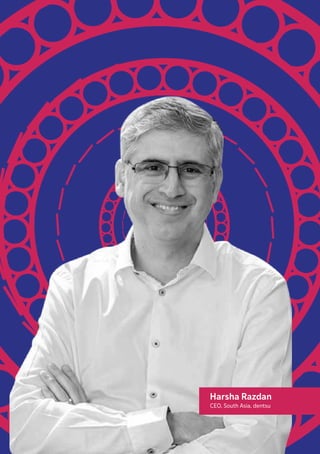
Harsha Razdan
CEO, South Asia, dentsu
FOREWORD
There’s something fascinating about how we experience the world. The same moment can
look entirely different depending on where we stand, how we feel, or what we choose to focus
on. It’s like holding a prism to the light - turn it one way, and you see one colour; turn it another,
and an entirely new spectrum emerges.
The digital world works much the same way. It’s not static; it’s dynamic, multifaceted, and
alive with possibilities, offering new patterns every time you shift your perspective. This
year’s dentsu e4m Digital Report - ‘Looking Through the Kaleidoscope’ - invites us to embrace
that fluidity. It urges us to look beyond straight lines and fixed trajectories, to see the
digital landscape for what it truly is: a complex, vibrant interplay of ideas, technology, and
human connection.
We live in a time when it’s tempting to always look ahead - to chase the next trend, the next
breakthrough. But here’s the truth: the present is where everything happens. The decisions we
make today don’t just prepare us for tomorrow - they actively shape it. Right now, AI is
rewriting the rules of creativity and personalization. The rise of hybrid experiences is
redefining how we connect in physical and digital spaces. And consumers are no longer
passive participants; they’re co-creators, demanding authenticity and experiences that
resonate on a deeper level.
What stands out to me, though, is that even in a world powered by algorithms and automation,
the human element remains irreplaceable. The best ideas - the ones that truly transform
industries - don’t emerge from data alone. They come from a deep understanding of people:
their hopes, fears, and desires. This is what makes the digital world so powerful. It’s not just
about technology; it’s about using that technology to create moments that matter.
This report isn’t a forecast or a prediction. It’s a celebration of the here and now. It’s a guide to
navigating the complexity of our times with clarity and purpose. Because much like that prism
in the light, the digital world offers endless possibilities - it all depends on how you choose to
see it.
The question is: are you ready to embrace the present?
04
Dr. Annurag Batra
Chairman and Editor in Chief, BW BusinessWorld
Founder, exchange4media Group
The latest Dentsu e4m Digital Report 2025 puts forth a fascinating picture of how the Indian
advertising industry is evolving, largely driven by digital transformation, changing consumer
habits and the unstoppable rise of technology.
Over the past year, digital has firmly established itself as the powerhouse of advertising,
reshaping everything from media consumption to brand storytelling. Traditional channels like
TV and print still hold their ground but the momentum is clearly shifting towards social media,
online video and programmatic advertising—all fuelled by data-driven strategies and an
ever-growing digital-first audience.
One of the biggest takeaways from this year’s report is the changing face of engagement.
Digital media isn’t just about visibility anymore; it’s about connection. Brands aren’t just
talking to consumers—they are crafting immersive, hyper-personalized experiences powered
by AI and real-time insights. The rise of retail media and unified commerce is making this even
more seamless, blending online and offline touchpoints to create frictionless brand journeys.
While FMCG continues to dominate ad spends, we are seeing some exciting shifts. The travel
sector is making a big comeback, driven by a surge in domestic tourism campaigns, while
telecom and e-commerce brands are doubling down on digital, allocating a huge chunk of
their budgets to online platforms. Short-form video is quickly becoming the go-to format,
capturing audiences with snackable, engaging content that merges entertainment with
commerce.
Another fascinating trend the report highlights is the evolving tone of advertising. Humour,
which has long been a staple of Indian advertising, is now making room for mindfulness-driven
storytelling, especially for Millennial and Gen Z audiences. These consumers want brands to
be more than just sellers—they expect them to reflect their values, create meaningful
conversations, and foster community-driven engagement.
And then there’s AI. No longer just a behind-the-scenes player, generative AI is now actively
shaping creativity, streamlining decision-making and helping brands produce smarter, more
emotionally resonant campaigns. The phygital revolution—where physical and digital retail
experiences merge—is also ensuring that brands stay connected with consumers across urban
and rural landscapes, offering accessibility like never before.
At the heart of all this change, one thing is clear: the advertising industry is at an inflection
point. We’re in a kaleidoscopic state of flux, where technology and creativity, data and
storytelling, commerce and culture are all merging to redefine what effective marketing looks
like.
The Dentsu e4m Digital Report 2025 captures this shift in all its complexity, offering a glimpse
into the future of advertising—a world where innovation, personalization and engagement will
define success.
FOREWORD
06
Nawal Ahuja
Co-Founder, exchange4media
The past year marked a transformative chapter in digital advertising and marketing, both in
India and globally. As we enter 2025, reflecting on past trends while anticipating future
trajectories becomes crucial for industry understanding.
India's expanding internet user base positions the nation at the forefront of the digital
revolution. The previous year saw increased focus on personalization, driven by advanced data
analytics and artificial intelligence. Brands evolved from mass communication to engaging
individuals with tailored, resonant messages.
The country's digital ecosystem is uniquely positioned at the crossroads of rapid technological
adoption and a diverse, digitally savvy population.
Digital advertising emerged as the industry's dominant force, claiming the largest share of
advertising spend. Artificial intelligence played a central role in this digital narrative,
reshaping marketing approaches to creativity and efficiency through chatbots and generative
content creation. This advancement brought responsibilities, particularly regarding consumer
trust and data transparency. AI is no longer just a buzzword; it has become the backbone of
hyper-personalized marketing strategies.
Predictive commerce became fundamental, enabling precise anticipation of consumer
behaviour while enhancing customer journeys. Video content maintained its supreme position
in engagement metrics, with online video leading digital media spending and projected as the
fastest-growing channel. From short-form content on social platforms to long-form
storytelling on OTT services, video marketing proved essential for deeper audience
connections.
Influencer marketing saw remarkable growth, expanding beyond celebrity endorsements to
include niche domain experts, bringing authenticity to brand campaigns. Omnichannel
marketing gained unprecedented momentum as consumers moved seamlessly between
digital and physical worlds, demanding consistent brand presence across all touchpoints.
Despite economic challenges, innovation thrived, particularly in programmatic advertising,
which contributed significantly to digital ad spending. Sustainability emerged as a crucial
theme, with consumers increasingly supporting brands aligned with environmental values.
Looking ahead, digital advertising stands on the cusp of transformation. Advanced
technologies, evolving consumer behaviours, and personalization are reshaping
brand-audience connections. AI-powered tools have become essential for hyper-personalized
marketing strategies, while voice search and conversational AI are revolutionizing SEO
approaches.
Augmented and Virtual Reality are offering immersive experiences, bridging online-offline
interactions. The social media landscape continues evolving, with emerging platforms gaining
traction alongside established networks. Mobile-first strategies remain crucial, especially
with advancing technology infrastructure.
Content marketing is adapting to audience preferences, shifting from humour-driven
engagement to mindfulness-focused strategies for younger generations. Vernacular content
gains importance in India's diverse linguistic landscape. Success in this evolving digital
landscape requires agility, responsible data usage, and culturally resonant storytelling.
FOREWORD
08
Executive Summary
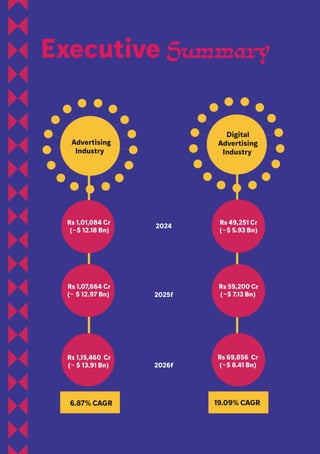
Rs 49,251 Cr
(~$ 5.93 Bn)
Rs 59,200 Cr
(~$ 7.13 Bn)
Rs 69,856 Cr
(~$ 8.41 Bn)
Digital
Advertising
Industry
19.09% CAGR
Rs 1,01,084 Cr
(~$ 12.18 Bn)
2024
2025f
2026f
Rs 1,07,664 Cr
(~ $ 12.97 Bn)
Rs 1,15,460 Cr
(~ $ 13.91 Bn)
Advertising
Industry
6.87% CAGR
The digital landscape isn’t just changing - it’s in perpetual motion, powered by real-time
advances in data, technology, and shifting consumer behaviour. As AI, immersive experiences,
decentralized technologies, and hyper-personalization evolve, they converge to ignite growth,
disruption, and transformation. The digital world is no longer a bridge to the future; it is the
future unfolding in real time. In this dynamic arena, industries are being redefined, and
opportunities are being unlocked at an unprecedented pace. To thrive, we must embrace the
now, leveraging the momentum of today’s innovations to stay ahead in a constantly evolving
ecosystem.
The Indian advertising industry grew by 6.3% in the last year, reaching a market size of Rs
1,01,084 crore by the end of 2024. By 2026, it is projected to grow at a compounded annual
rate (CAGR) of 6.87%, reaching Rs 1,15,460 crore. The digital advertising sector witnessed a
growth of 21.1%, closing 2024 at a market size of Rs 49,251 crore. It is expected to reach Rs
69,856 crore by 2026, with a CAGR of 19.09%.
By the end of 2024, digital media accounted for the largest share of advertising spend at 49%,
followed by television at 28% and print at 17%. By 2026, digital media is projected to
contribute 61% of India’s total advertising spend. The telecom sector leads the way, allocating
66% of its media budget to digital, with e-commerce, pharmaceuticals, and FMCG segments
following closely behind.
Social media and online video lead digital media spending, with social media contributing 29%
(Rs 14,480 crore) and online video close behind at 28% (Rs 13,756 crore). Advertising spends
on e-retail platforms contribute to 22.93% of all digital media spends. The FMCG and
e-commerce sectors are the largest contributors to India’s digital media industry. Within digital
media, FMCG directs 44% of its budget to online video, while e-commerce prioritizes paid
search (39%) and social media (31%).
The next chapter of customer experience is being shaped by the fusion of generative AI and
human creativity, transforming how brands connect with their audiences. Generative AI speeds
up content creation across text, visuals, and music, automating repetitive tasks and freeing up
creators to craft richer, more personalized stories that truly resonate. However, as
AI-generated content becomes widespread, maintaining authenticity and emotional depth is
vital. While AI delivers hyper-personalized content with unmatched speed, human creativity
ensures cultural relevance and emotional impact. Brands that master the balance between AI
efficiency and human insight will foster deeper, more meaningful connections.
In India’s fast-changing retail media landscape, a new era of customer engagement is
unfolding, powered by real-time shopping data. Retail media enables regional businesses to
compete with larger players by tailoring campaigns to individual preferences. This shift is
helping brands create more personalized, impactful, and purpose-driven relationships with
their consumers.
10
1
1
1
1
1
1
1
1
1111111
1
1
1
1
1
1
1
11
1
1
1
1
1
1
1
1
1
1
1111111
1
1
1
1
1
1
1
1
1
1
1
1
1
1
1
1
1
1
1
1
1
1
1
1
1111111111111
1
1
1
1
1
1
1
1
1
1
1
1
1
1
1
1
1
1
1
1
1
1
1
1
1
1
1
1
1
CHAPTER
12
The
Indian
Advertising
Industry
T
h
e
I
n
d
i
a
n
A
d
v
e
r
t
i
s
i
n
g
I
n
d
u
s
t
r
y
14
51,851
56,471
62,564 72,603
85,812
95,087
1,07,664
1,15,460
2016
2018
2019
2020
2021
2022
2023
2024a
2025f
2026f
2017
8.9%
10.8%
10.8%
9.4%
-12.9%
18.2%
21.8%
6.3%
6.5% 7.2%
The Indian advertising industry grew by 6.3% in the previous year, closing 2024 with a market
size of Rs 1,01,084 crore. This growth was primarily driven by the general and assembly
elections, which triggered a significant surge in ad spending. Looking ahead, the Indian
advertising landscape is poised for modest growth, with major sporting events such as IPL
2025, the ICC Champions Trophy, and the Asia Cup 2025, along with other cricketing events,
expected to be key growth drivers this year. These events will offer significant opportunities
for brands to engage with diverse audiences, ensuring the industry’s continued upward
momentum.
68,475
1,01,084
Growth of Indian Advertising Industry (Rs crore)
AD INDUSTRY
GROWTH
51,851
59,619
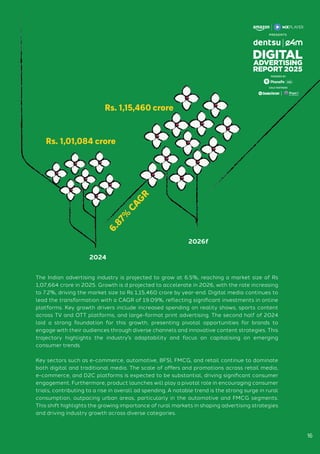
The Indian advertising industry is projected to grow at 6.5%, reaching a market size of Rs
1,07,664 crore in 2025. Growth is d projected to accelerate in 2026, with the rate increasing
to 7.2%, driving the market size to Rs 1,15,460 crore by year-end. Digital media continues to
lead the transformation with a CAGR of 19.09%, reflecting significant investments in online
platforms. Key growth drivers include increased spending on reality shows, sports content
across TV and OTT platforms, and large-format print advertising. The second half of 2024
laid a strong foundation for this growth, presenting pivotal opportunities for brands to
engage with their audiences through diverse channels and innovative content strategies. This
trajectory highlights the industry's adaptability and focus on capitalising on emerging
consumer trends.
Key sectors such as e-commerce, automotive, BFSI, FMCG, and retail continue to dominate
both digital and traditional media. The scale of offers and promotions across retail media,
e-commerce, and D2C platforms is expected to be substantial, driving significant consumer
engagement. Furthermore, product launches will play a pivotal role in encouraging consumer
trials, contributing to a rise in overall ad spending. A notable trend is the strong surge in rural
consumption, outpacing urban areas, particularly in the automotive and FMCG segments.
This shift highlights the growing importance of rural markets in shaping advertising strategies
and driving industry growth across diverse categories.
2024
Rs. 1,01,084 crore
Rs. 1,15,460 crore
6
.
8
7
%
C
A
G
R
2026f
GOLD PARTNERS
POWERED BY
16
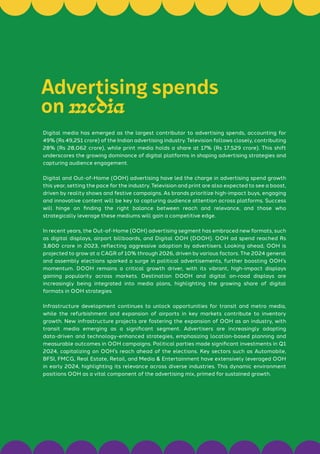
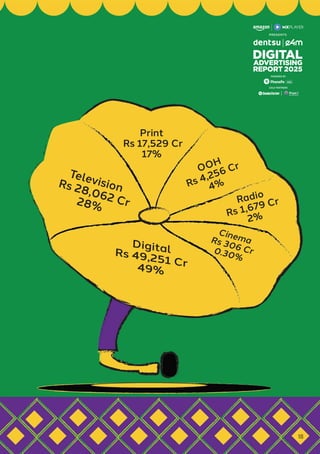
Digital media has emerged as the largest contributor to advertising spends, accounting for
49% (Rs 49,251 crore) of the Indian advertising industry. Television follows closely, contributing
28% (Rs 28,062 crore), while print media holds a share at 17% (Rs 17,529 crore). This shift
underscores the growing dominance of digital platforms in shaping advertising strategies and
capturing audience engagement.
Digital and Out-of-Home (OOH) advertising have led the charge in advertising spend growth
this year, setting the pace for the industry. Television and print are also expected to see a boost,
driven by reality shows and festive campaigns. As brands prioritize high-impact buys, engaging
and innovative content will be key to capturing audience attention across platforms. Success
will hinge on finding the right balance between reach and relevance, and those who
strategically leverage these mediums will gain a competitive edge.
In recent years, the Out-of-Home (OOH) advertising segment has embraced new formats, such
as digital displays, airport billboards, and Digital OOH (DOOH). OOH ad spend reached Rs
3,800 crore in 2023, reflecting aggressive adoption by advertisers. Looking ahead, OOH is
projected to grow at a CAGR of 10% through 2026, driven by various factors. The 2024 general
and assembly elections sparked a surge in political advertisements, further boosting OOH’s
momentum. DOOH remains a critical growth driver, with its vibrant, high-impact displays
gaining popularity across markets. Destination DOOH and digital on-road displays are
increasingly being integrated into media plans, highlighting the growing share of digital
formats in OOH strategies.
Infrastructure development continues to unlock opportunities for transit and metro media,
while the refurbishment and expansion of airports in key markets contribute to inventory
growth. New infrastructure projects are fostering the expansion of OOH as an industry, with
transit media emerging as a significant segment. Advertisers are increasingly adopting
data-driven and technology-enhanced strategies, emphasizing location-based planning and
measurable outcomes in OOH campaigns. Political parties made significant investments in Q1
2024, capitalizing on OOH’s reach ahead of the elections. Key sectors such as Automobile,
BFSI, FMCG, Real Estate, Retail, and Media & Entertainment have extensively leveraged OOH
in early 2024, highlighting its relevance across diverse industries. This dynamic environment
positions OOH as a vital component of the advertising mix, primed for sustained growth.
Advertising spends
on media
Television
Rs 28,062 Cr
28% Radio
Rs 1,679 Cr
2%
OOH
Rs 4,256 Cr
4%
Cinema
Rs 306 Cr
0.30%
Digital
Rs 49,251 Cr
49%
Print
Rs 17,529 Cr
17%
18
GOLD PARTNERS
POWERED BY
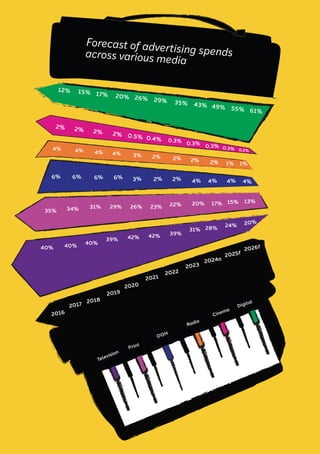
Forecast of advertising spends
across various media
12% 15% 17% 20% 26% 29% 35% 43% 49% 55% 61%
2% 2% 2% 2% 0.5% 0.4% 0.3% 0.3% 0.3% 0.3% 0.2%
40% 40% 40%
39% 42% 42% 39%
31% 28% 24% 20%
34%
35%
31% 29% 26% 23% 22% 20% 17% 15% 13%
6% 6% 6% 6% 3% 2% 2% 4% 4% 4% 4%
4%
4%
4% 4% 3% 2% 2% 2% 2% 1% 1%
2016
2017 2018
2019
2020
2021
2022
2023
2024a
2025f
2026f
Television
Print
Radio
OOH
Cinema
Digital
Digital and OOH are the only media segments with a positive growth outlook until 2026,
reflecting the Indian advertising industry's shift toward platforms offering greater engagement
and flexibility. In contrast, traditional media—Television, Print, Radio, and Cinema—are
projected to witness a decline over the same period.
Between 2023 and 2024, television's share declined from 31% to 28% and is expected to drop
further to 24% in 2025. Print media followed a similar trend, decreasing from 20% to 17% by
the end of 2024, with projections suggesting a further decline to 15% by 2025. Radio, which
maintained a steady share of 2% in 2024, is expected to decline to 1% by the end of 2025,
reflecting the shifting dynamics of the advertising landscape.
These trends highlight the challenges traditional advertising channels face amid digital
disruption and evolving audience habits. Structural changes demand innovative strategies,
including digital integration and niche targeting, to regain relevance and adapt to the shifting
media landscape.
Cinema's performance remains highly variable, indicating that external factors play a
significant role in its viability as an advertising medium. In 2024, it saw modest growth, likely
driven by blockbuster releases and a post-pandemic resurgence in theatre attendance.
However, a significant decline is expected in 2025, due to market-dependent factors such as
inconsistent movie releases, increased competition from streaming platforms, and changing
consumer behaviour. This volatility underscores the challenges cinema faces in maintaining
consistent advertising value.
OOH continues to show consistent growth, although the pace has slightly slowed from 12% in
2024 to 10% in 2025. This reflects OOH's successful adoption of new technologies and the rise
in foot traffic as consumer behaviour rebounds post-pandemic, reinforcing its sustained
relevance as an advertising channel.
Digital media remains the fastest-growing channel, though its growth has slightly slowed. This
trend underscores the continued shift towards digital advertising, driven by its effectiveness,
broad reach, and measurable impact. Brands are increasingly focusing on interactive and
data-driven platforms to optimize audience engagement and campaign performance.
20
GOLD PARTNERS
POWERED BY
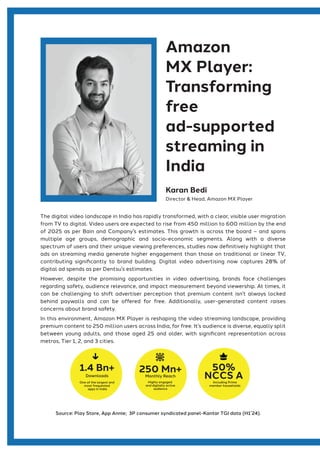
The digital video landscape in India has rapidly transformed, with a clear, visible user migration
from TV to digital. Video users are expected to rise from 450 million to 600 million by the end
of 2025 as per Bain and Company’s estimates. This growth is across the board – and spans
multiple age groups, demographic and socio-economic segments. Along with a diverse
spectrum of users and their unique viewing preferences, studies now definitively highlight that
ads on streaming media generate higher engagement than those on traditional or linear TV,
contributing significantly to brand building. Digital video advertising now captures 28% of
digital ad spends as per Dentsu’s estimates.
However, despite the promising opportunities in video advertising, brands face challenges
regarding safety, audience relevance, and impact measurement beyond viewership. At times, it
can be challenging to shift advertiser perception that premium content isn’t always locked
behind paywalls and can be offered for free. Additionally, user-generated content raises
concerns about brand safety.
In this environment, Amazon MX Player is reshaping the video streaming landscape, providing
premium content to 250 million users across India, for free. It’s audience is diverse, equally split
between young adults, and those aged 25 and older, with significant representation across
metros, Tier 1, 2, and 3 cities.
Source: Play Store, App Annie; 3P consumer syndicated panel-Kantar TGI data (H1’24).
Amazon
MX Player:
Transforming
free
ad-supported
streaming in
India
Karan Bedi
Director & Head, Amazon MX Player
1.4 Bn+
Downloads
One of the largest and
most frequented
apps in India
250 Mn+
Monthly Reach
Highly engaged
and digitally active
audience
50%
NCCS A
Including Prime
member households
A major advantage of the service is its seamless integration with Amazon. Users can access
content through India's largest shopping app - Amazon.in, as well as Prime Video, Fire TV, and
our own app on mobile and connected TVs. This integration allows us to leverage trillions of
first-party shopping signals from Amazon, providing a competitive edge in ad targeting.
Utilizing Amazon’s advertising technology, Amazon MX Player offers interactive and shoppable
ad formats, including in-stream shoppable ads that allow viewers to browse products during ad
breaks, and even single click to buy. Such innovative ad formats foster viewer interaction rates
that are 3-4 times higher than industry averages. The insights offered into audience shopping
patterns is unmatched, allowing brands—even those not directly selling on Amazon—to
connect with engaged customers through its premium content. Amazon MX Player is dedicated
to entertaining India for free while providing significant, differentiated opportunities for
advertisers to connect with a vast and engaged audience.
Amazon MX Player is home to some of the nation’s most popular and
award-winning shows, including Aashram, Jamnapaar, Campus Diaries, and
more. Our curated content flywheel, based on strong consumer insights,
consistently appears in top ‘must-watch’ lists in leading publications. With
scripted original series, reality shows, and a vast library of movies, we also
feature the largest selection of international content dubbed in local
languages like Hindi, Tamil and Telugu, through MX Vdesi. In 2025, Amazon
MX player will launch over 100 new shows!
INDUSTRY-FIRST
SHOPPABLE
AD INNOVATION
2%-3% CTR
85-95% VCR
22
GOLD PARTNERS
POWERED BY
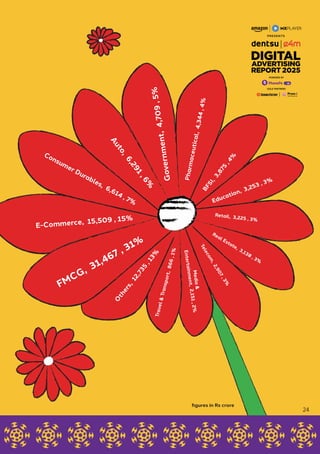
The FMCG segment continues to dominate the Indian advertising space, contributing 31% (Rs
31,467 crore), followed by e-commerce and quick commerce brands that capitalize on impulse
buying. The e-commerce segment accounts for 15% (Rs 15,509 crore), while the consumer
durables category contributes 7% to the overall advertising industry. This reflects the diverse
and dynamic nature of market spending.
In 2024, the travel and transport sector saw the highest advertising expenditure growth, rising
by 33.4% compared to 2023. This growth was driven by the successful ‘Chalo India’ campaign
aimed at attracting global tourists, the Maha Kumbh Mela 2025, and various local campaigns
promoting India’s diverse landscape and cultural heritage. The e-commerce sector experienced
a 21.1% increase in advertising spend, while the automotive segment grew by 20.4%. Continued
growth in the automotive sector is expected, with two-wheeler brands making a strong
comeback, particularly as electric vehicles (EVs) gain momentum in the market.
Other sectors experiencing growth in advertising spend include telecom (19.8%), consumer
durables (19.4%), and government and social organizations (18%). Brands are increasingly
focusing on building deeper, more meaningful connections with consumers, reflecting a
strategic shift toward long-term engagement and personalized marketing efforts.
Media spends across
industry verticals
FMCG, 31,467 , 31%
A
u
t
o
,
6
,
2
9
1
,
6
%
G
o
v
e
r
n
m
e
n
t
,
4
,
7
0
9
,
5
%
P
h
a
r
m
a
c
e
u
t
i
c
a
l
,
4
,
3
4
4
,
4
%
B
F
S
I
,
3
,
8
7
5
,
4
%
Education, 3,253 , 3%
Retail, 3,225 , 3%
Real Estate, 3,138 , 3%
T
e
l
e
c
o
m
,
2
,
9
0
7
,
3
%
M
e
d
ia
&
E
n
t
e
r
t
a
in
m
e
n
t
,
2
,1
5
1
,
2
%
T
r
a
v
e
l
&
T
r
a
n
s
p
o
r
t
,
8
6
6
,
1
%
Consumer Durables, 6,614 , 7%
E-Commerce, 15,509 , 15%
O
t
h
e
r
s
,
1
2
,
7
3
5
,
1
3
%
figures in Rs crore
24
GOLD PARTNERS
POWERED BY
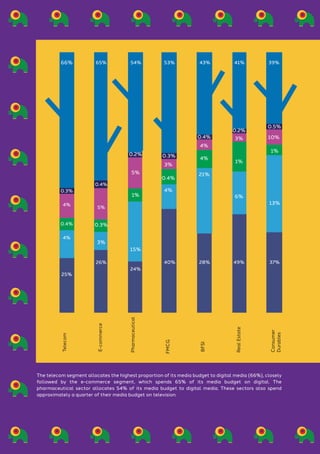
The telecom segment allocates the highest proportion of its media budget to digital media (66%), closely
followed by the e-commerce segment, which spends 65% of its media budget on digital. The
pharmaceutical sector allocates 54% of its media budget to digital media. These sectors also spend
approximately a quarter of their media budget on television.
25%
26% 40% 28% 49% 37%
4%
0.3%
0.4%
3%
4%
3% 10%
4%
3%
0.4%
0.3%
15%
1%
0.2%
4%
0.4%
0.3%
21%
4%
0.4%
6%
1%
0.2%
13%
0.5%
1%
Telecom
E-commerce
Pharmaceutical
FMCG
BFSI
Real
Estate
Consumer
Durables
5%
24%
5%
39%
41%
43%
53%
54%
65%
66%
29% 33% 28%
7% 5% 13%
25% 23% 17% 55%
Television Print Radio OOH Cinema Digital
28%
2%
5%
1%
0.2%
0.4%
4%
4%
2%
7% 5%
5%
3%
0.4%
6%
0.2%
73%
52%
60%
35%
51%
4%
0.1%
3%
3%
25%
14%
4%
2%
0.1%
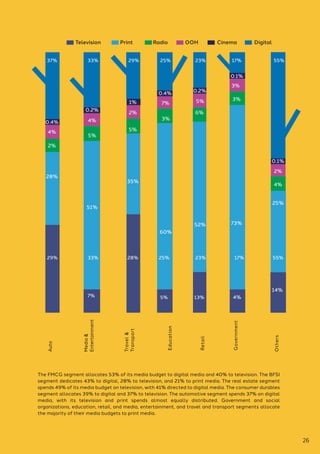
The FMCG segment allocates 53% of its media budget to digital media and 40% to television. The BFSI
segment dedicates 43% to digital, 28% to television, and 21% to print media. The real estate segment
spends 49% of its media budget on television, with 41% directed to digital media. The consumer durables
segment allocates 39% to digital and 37% to television. The automotive segment spends 37% on digital
media, with its television and print spends almost equally distributed. Government and social
organizations, education, retail, and media, entertainment, and travel and transport segments allocate
the majority of their media budgets to print media.
Media
&
Entertainment
Travel
&
Transport
Education
Education
Retail
Government
Others
Auto
37% 33% 29% 25% 23% 17% 55%
26
President & Chief Strategy Officer, South Asia, dentsu
The sustainability of business
depends on the business of
sustainability
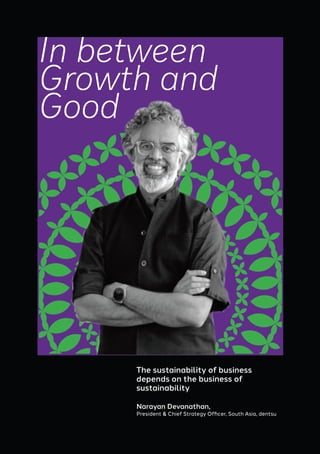
Narayan Devanathan,
In between
Growth and
Good
In the late 1700s, the scientist-inventor-educator-politician-statesman Benjamin Franklin famously said,
“Do well by doing good.”
While this was meant to apply equally to individuals and institutions, the private sector picked it up with
more-than-usual enthusiasm in the first two decades of this century to tout their good deeds, cloaked
under the name of CSR or Corporate Social Responsibility.
A lot of reputation laundering, rather than cleaning up inequalities in the world, resulted.
A few years back, in his book Trailblazer: The Power of Business as the Greatest Platform for Change,
Marc Bennioff wrote, “Doing well by doing good is no longer just a competitive advantage. It’s becoming
a business imperative.”
But, as Anand Giridhardas, author of Winners Take All: The Elite Charade of Changing the World said,
“Asking businesses to solve the world’s problems is like asking an arsonist to put out a fire. They both have
an intimate knowledge of the problem because they cause it but that doesn’t make them the right experts
to call to the scene.”
So, what’s a business to do, caught in between causing problems and being asked to solve them?
There is perhaps a hint in Marc Benioff’s quote but there’s an even further evolution that is possible—nay,
necessary.
At first, businesses saw doing good as an afterthought, a P.S. to relentlessly driving growth. An evolution
happened from there to a place where doing good was seen on an equal footing with doing good.
Benioff’s quote indicates it is sufficient to mandate doing good in order to do well. And there are clues all
around to the solidity of this as a foundation for business: that growth comes from doing good. It isn’t
merely a matter of saving the planet and reducing inequalities. It’s also good business because consumers
(not just the much-maligned Gen Z) around the world are preferring to do business with those that do
good.
There is a subtext though that asks businesses to raise the bar even higher. It is no longer sufficient to do
good. The higher—and more difficult—bar is to do right.
But how does a business go about the business of growing sustainably if they have already been indicted
as guilty until proven innocent?
At Dentsu, we have a simple philosophy-framework called Sanpo-yoshi. It means that business growth
must be an outcome of benefiting three stakeholders: customers, business and society. It guides us in
practical ways to do this.
When doing right is not by accident but by design, sustainable growth will also become part of the design.
Don’t make sustainability the job of an individual or a department. It must be baked into every role
in the company. DEI is not a job, it’s a way of being. Bridging the Digital Divide is not a campaign, it’s
a business strategy. Achieving plastic positivity is not an ESG goal, it’s building innovation across the
value chain.
Don’t see profit and purpose as being at loggerheads with each other. A business’ purpose is to
innovatively expand the pie and provide opportunities for all people to access aspiration and
succeed. There’s no lie in that, nor is there a contradiction.
Don’t leave sustainability to intent, act on it. Often, the simplest way to create sustainable growth
for all is to bridge gaps between awareness, intent, action and impact.
28
3P’s Formula
Performance, People, and Planet
The Challenge of Misaligned Content
"Maximizing ROI with Conscious
Advertising: Aligning Content, Efficiency
and Values"
"Misaligned content isn’t just a
mismatch—it’s wasted media."
Channel Factory’s Conscious
Advertising Program
At Channel Factory, we believe in the
transformative power of conscious
advertising. Our mission is to foster a better
digital ecosystem by doing good business
while doing good, focusing on inclusion
instead of exclusion. Through our
proprietary tools and insights, we help
brands connect with the right audiences
while supporting positive societal evolution.
This dual commitment to performance and
responsibility defines our Conscious
Advertising Program.
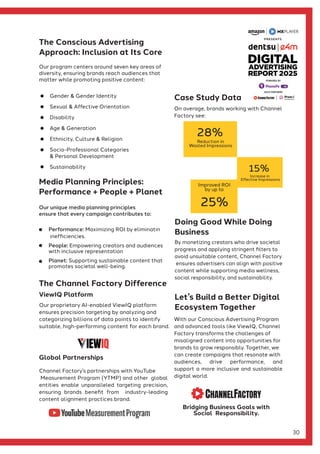
With over 17,000 years' worth of content on
YouTube, ensuring that advertising aligns
with a brand's values and audience can be
daunting. According to Channel Factory’s
data, an average of 28% of media
impressions run against misaligned or
unsuitable content, leading to wasted
resources and reduced campaign efficiency.
CPM (Cost per 1000 Impressions): $100
Total Impressions: 1000
Misaligned & Unsuitable Impressions:
28% (280 impressions)
Effective Impressions: 72% (720 impressions)
Quality CPM (qCPM): $138
By avoiding unsuitable content and
aligning with positive, impactful
creators, brands can significantly
improve campaign efficiency and
lower their qCPM.
Impact of Misaligned
Content on Campaign
Efficiency
Conscious
Advertising
Doing Good While Driving
Business Growth
28%
72%
28% of media impressions are delivered on
misaligned content, diminishing campaign
efficiency.
Misaligned content
Effective Impressions
Misaligned vs Aligned content, Impact on qCPM
Comparing CPM to Quality CPM (qCPM = 138)
after removing misaligned impressions.
qCPM
(138)
CPM
(100)
The Conscious Advertising
Approach: Inclusion at Its Core
The Channel Factory Difference
Our program centers around seven key areas of
diversity, ensuring brands reach audiences that
matter while promoting positive content:
ViewIQ Platform
On average, brands working with Channel
Factory see:
Doing Good While Doing
Business
By monetizing creators who drive societal
progress and applying stringent filters to
avoid unsuitable content, Channel Factory
ensures advertisers can align with positive
content while supporting media wellness,
social responsibility, and sustainability.
Let’s Build a Better Digital
Ecosystem Together
.
Our unique media planning principles
ensure that every campaign contributes to:
Media Planning Principles:
Performance + People + Planet
Performance: Maximizing ROI by eliminatin
inefficiencies.
People: Empowering creators and audiences
with inclusive representation
Planet: Supporting sustainable content that
promotes societal well-being.
Global Partnerships
Reduction in
Wasted Impressions
28%
Increase in
Effective Impressions
15%
Improved ROI
by up to
25%
Gender & Gender Identity
Sexual & Affective Orientation
Disability
Age & Generation
Ethnicity, Culture & Religion
Socio-Professional Categories
& Personal Development
Sustainability
With our Conscious Advertising Program
and advanced tools like ViewIQ, Channel
Factory transforms the challenges of
misaligned content into opportunities for
brands to grow responsibly. Together, we
can create campaigns that resonate with
audiences, drive performance, and
support a more inclusive and sustainable
digital world.
Our proprietary AI-enabled ViewIQ platform
ensures precision targeting by analyzing and
categorizing billions of data points to identify
suitable, high-performing content for each brand.
Channel Factory’s partnerships with YouTube
Measurement Program (YTMP) and other global
entities enable unparalleled targeting precision,
ensuring brands benefit from industry-leading
content alignment practices brand.
Bridging Business Goals with
Social Responsibility.
Case Study Data
30
GOLD PARTNERS
POWERED BY
32
2
CHAPTER
The
Indian
Digital
Advertising
Industry
T
h
e
I
n
d
i
a
n
D
i
g
i
t
a
l
A
d
v
e
r
t
i
s
i
n
g
I
n
d
u
s
t
r
y
34
31.7%
32.4%
26%
15.3%
35.3%
39.5% 36.6%
21.1%
20.2%
18%
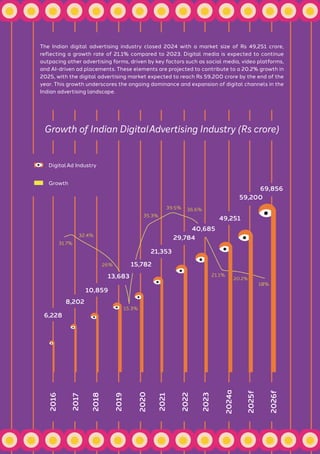
The Indian digital advertising industry closed 2024 with a market size of Rs 49,251 crore,
reflecting a growth rate of 21.1% compared to 2023. Digital media is expected to continue
outpacing other advertising forms, driven by key factors such as social media, video platforms,
and AI-driven ad placements. These elements are projected to contribute to a 20.2% growth in
2025, with the digital advertising market expected to reach Rs 59,200 crore by the end of the
year. This growth underscores the ongoing dominance and expansion of digital channels in the
Indian advertising landscape.
2016
2018
2019
2020
2021
2022
2023
2024a
2025f
2026f
2017
6,228
8,202
10,859
13,683
15,782
21,353
29,784
40,685
49,251
59,200
69,856
DigitalAd Industry
Growth
Growth of Indian DigitalAdvertising Industry (Rs crore)
We are at a unique juncture where progress and tradition coexist in harmony. As generative AI
surges, traditional crafts are also gaining prominence. Retail Media 2.0 and unified commerce
are transforming retail trends, while generational values are increasingly shaping brand
engagement. This phase blends digital and traditional approaches, creating a dynamic
landscape for businesses to engage with consumers in meaningful and innovative ways.
Amid these developments, digital media is not only increasing its revenue share but also
seamlessly integrating with traditional media, creating a harmonious blend of phygital
(physical and digital) experiences. Going forward, we expect digital media to grow at a
compounded annual growth rate of 19.09%, reaching a market size of Rs 69,856 crore by the
end of 2026. By that time, digital media will contribute 61% of the total advertising spend in
the Indian industry.
19.09% CAGR
Rs
49,251
crore
Rs
69,856
crore
2024
2026f
36
GOLD PARTNERS
POWERED BY
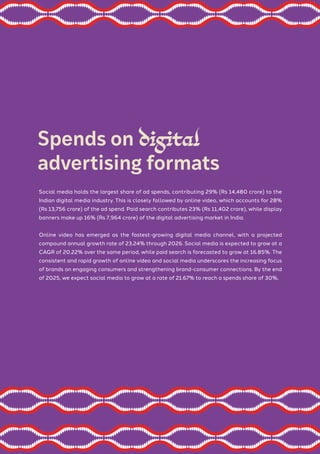
Social media holds the largest share of ad spends, contributing 29% (Rs 14,480 crore) to the
Indian digital media industry. This is closely followed by online video, which accounts for 28%
(Rs 13,756 crore) of the ad spend. Paid search contributes 23% (Rs 11,402 crore), while display
banners make up 16% (Rs 7,964 crore) of the digital advertising market in India.
Online video has emerged as the fastest-growing digital media channel, with a projected
compound annual growth rate of 23.24% through 2026. Social media is expected to grow at a
CAGR of 20.22% over the same period, while paid search is forecasted to grow at 16.85%. The
consistent and rapid growth of online video and social media underscores the increasing focus
of brands on engaging consumers and strengthening brand-consumer connections. By the end
of 2025, we expect social media to grow at a rate of 21.67% to reach a spends share of 30%.
Spends on digital
advertising formats
Online Video
Rs 13,756 Cr
28%
Social Media
Rs 14,480 Cr
29%
Paid Search
Rs 11,402 Cr
23%
Other incl. Classified
Rs 1,649 Cr
3%
Display Banners
Rs 7,964 Cr
16%
38
GOLD PARTNERS
POWERED BY
2016 2017 2018 2019 2020 2021 2022 2023 2024a 2025f 2026f
Social Media Online Video Paid Search Display Banners Other incl. Classified
Forecast of advertising
spends across
Digital media
formats
7% 6% 5% 4% 4% 4% 3% 3% 3% 3% 2%
28% 28%
29% 28% 29% 29% 29% 29% 29% 30% 30%
27% 26%
25% 25% 24% 24%
23% 23% 23%
22% 22%
20%
21% 21% 20%
16% 16% 16%
16%
16% 15%
15%
18% 19% 21%
22%
28% 28% 28% 28% 28%
30% 30%
GOLD PARTNERS
POWERED BY
Online video is expected to grow at a rate of 27.60%, reaching a 30% share of advertising
spend by the end of 2025, on par with social media. This growth is driven by the increased
consumption of live and interactive videos, as well as the widespread usage of short video
formats
While paid search will see a growth of 15.93% in 2025, its revenue share is expected to
decline. By the end of 2025, the share of paid search is projected to be 22%, down from the
current 23%. During this period, the share of display banners will decrease from the current
16% to 15%, despite growing at a rate of 15.15% over 2024.
40
Beyond
the
Horizon
Navigating the Brave
New World of OTT Advertising
The digital advertising landscape in India is undergoing a significant transformation as
Over-The-Top (OTT) streaming platforms emerge as formidable competitors to established
digital channels. This shift represents a fundamental change in both content consumption
patterns and brand-consumer engagement strategies, warranting a detailed analysis of three
key factors driving this evolution in India's digital marketing ecosystem.
Digital Reach Expansion
The dominance of traditional digital platforms in India is facing unprecedented competition
from the growth of OTT services. Driven by widespread smartphone adoption and competitive
data pricing, streaming services have achieved significant market penetration across both urban
and rural demographics. Om Jha, Head of Media and Partnerships, PepsiCo India, believes,
“Consumer centricity is at the heart of all our brand campaigns, with ‘reach’ being the most
important and non-negotiable KPI given the scale of our brands. We started moving our media
investments towards Digital a few years back and with the increasing penetration of internet
and high-quality content being produced by streaming services, digital outreach and
engagement continues to be a top focus area in in our media strategy. Urban and Rural
audiences are over-indexing on Digital alike, we met young students in hinterlands of UP talk of
their favourite shows and stars from the streaming services. Cricket, of course, remains a
religion in India.”
Current market data indicates that OTT platforms now reach over 70% of India's internet users,
matching traditional digital platforms' reach. This expansion presents strategic opportunities
for advertisers to engage audiences who may be less active on conventional social media
platforms. Additionally, OTT platforms' diverse content portfolio, encompassing both regional
and international programming, enables precise market segmentation and targeted
demographic reach that surpasses traditional digital channels.
The inherent nature of OTT content consumption, characterized by specific genre preferences
and viewing patterns, facilitates sophisticated contextual advertising implementation. This
enables seamless brand integration that enhances rather than interrupts the viewing
experience. The extended engagement time with streaming content strengthens brand
associations compared to short-form video formats, allowing organizations to establish
deeper connections with their target audiences.
Premium Content Integration
OTT platforms offer superior brand integration opportunities within high-production-value
environments. Unlike user-generated content platforms, OTT services provide controlled,
premium contexts for brand presence. Anuja Mishra, CMO and EVP, Honasa Consumer Pvt. Ltd.
believes, “Streaming services (OTT) offer innovative active and passive brand integration
opportunities and show partnerships, other than in-stream video ads. These collaborations
enable brands to create narratives that traditional ads can't match. The key is aligning the
show's values with the brand's target audience and seamlessly incorporating the product into
the storyline. Successful integrations focus on meaningful, relevant content that resonates
with the target cohort, enhancing the viewing experience while effectively reaching the
intended audience. For example, Mamaearth partnered with Amazon MX Player to advertise its
rice water range in Korean dramas, capitalizing on the K-beauty trend. Similarly, our Gen
Z-focused brand Aqualogica found a perfect fit with Amazon MX Players’ young audience
cohorts. Content integrations should aim to build audience affinity rather than short-term
gains. Success is measured through brand awareness lifts and increased searches, focusing on
top-of-funnel metrics. Clarity on objectives and KPIs is crucial, and consistent, relevant
integrations can elevate consumer experiences to ultimately impact bottom-funnel metrics.“
Strategic Implications
Effective OTT advertising strategies require careful consideration of content integration,
targeting implementation, and performance measurement. Organizations must align their
content partnerships with brand values while maintaining consistent measurement of key
performance indicators. The focus should remain on developing long-term engagement
strategies rather than pursuing short-term gains.
Future Outlook
As we approach 2025, OTT platforms are positioned to potentially supersede traditional
digital advertising channels in engagement effectiveness. The combination of extensive reach,
sophisticated targeting capabilities, and premium content environments presents a compelling
value proposition for strategic marketing investment. Success will depend on clear objective
setting, strategic content alignment, sophisticated targeting implementation, and
comprehensive performance measurement frameworks.
Data-Driven Targeting Enhancement
The integration of retail media intelligence with OTT platforms has
revolutionized targeting capabilities. Platforms with e-commerce
integration can leverage purchase history and browsing behaviour to
deliver highly targeted advertising solutions. This approach transcends
conventional demographic targeting, enabling real-time consumer
engagement at critical purchasing decision points.
42
GOLD PARTNERS
POWERED BY
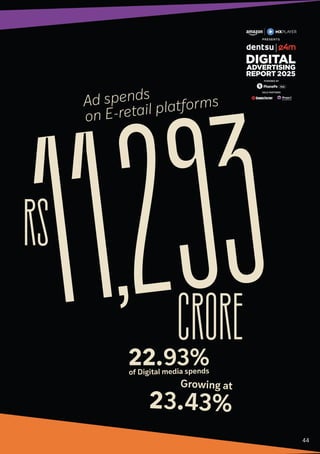
Retail media has become a major disruptor in the digital advertising landscape in recent years.
By the end of 2024, advertising on e-retail platforms reached a market size of Rs 11,293 crore,
accounting for 22.93% of total digital media spends. This reflects a growth rate of 23.43%
over 2023, highlighting its rapid ascent and influence.
The e-commerce boom in India has propelled Retail media into prominence as a powerful
advertising platform. Leveraging rich first-party data, it offers precise targeting of high-intent
consumers, surpassing traditional digital media platforms. Retail media has transformed from
a performance-driven channel to a robust branding medium, now providing analytics,
measurement, and audience engagement within a unified platform. This evolution has also
fuelled the growth of non-endemic advertising, enabling brands to effectively target niche
audiences by utilizing retailer data, further solidifying retail media’s role in modern
advertising strategies.
Brands are leveraging omnichannel strategies to seamlessly connect online and offline
campaigns, reaching consumers across multiple touchpoints. This integration enhances
engagement and creates opportunities for effective lower-funnel targeting, driving improved
conversion rates and maximizing advertising impact.
The advent of Retail Media 2.0, particularly with the integration of video into the retail media
mix, has expanded its scope beyond performance objectives to include robust branding
solutions, enhancing upper and mid-funnel strategies. Currently, FMCG and consumer
durables, including electronics, dominate e-retail advertising expenditure. As the sector
evolves, more categories are expected to capitalize on the opportunities offered by e-retail
platform advertising, driving broader adoption and diversified growth within this dynamic
channel.
Growth of E-retail
platform advertising
11293
Ad spends
on E-retail platforms
of Digital media spends
22.93%
Growing at
23.43%
crore
Rs
GOLD PARTNERS
POWERED BY
44
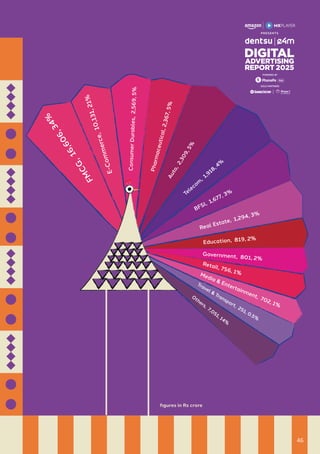
The FMCG segment holds the largest share of 34% (Rs 16,606 crore) in the Indian digital
media industry, with its digital media budget growing by 13% compared to 2023. The
e-commerce category follows closely with a 21% contribution (Rs 10,131 crore), while other
key sectors, including consumer durables, pharmaceuticals, and automotive, also play
significant roles in shaping the digital advertising landscape.
In 2024, the travel and transport sector saw the highest growth in digital media expenditures,
rising by 48%. Notable campaigns such as ‘Chalo India’, ‘Dekho Apna Desh’, and ‘Bharat Parv’,
aimed at attracting both global and Indian tourists while boosting footfalls at tourism
hotspots across India, were key drivers of this growth. This was followed by a 45% increase in
digital media spends by the consumer durables segment compared to 2023, and a 42% growth
from government and social organizations. Other sectors, including retail, e-commerce, and
automotive, also saw a rise in digital media expenditure. The growing scale of offers and
promotions in retail media, e-commerce, and D2C platforms has been a significant factor in
driving this growth.
Digital Media spends
across industry verticals
F
M
C
G
,
1
6
,
6
0
6
,
3
4
%
Travel & Transport, 251, 0.5%
Media & Entertainment, 702, 1%
A
u
t
o
,
2
,
3
0
9
,
5
%
Telecom
, 1,918, 4%
P
h
a
r
m
a
c
e
u
t
i
c
a
l
,
2
,
3
6
7
,
5
%
O
thers, 7,051, 14%
Co
nsu
me
r
Du
rab
les
,
2,5
69
,
5%
Real Estate, 1,294, 3%
E
-
C
o
m
m
e
r
c
e
,
1
0
,
1
3
1
,
2
1
%
Retail, 756, 1%
BFSI, 1,677, 3%
Government, 801, 2%
Education, 819, 2%
figures in Rs crore
GOLD PARTNERS
POWERED BY
46
Telecom
E-Commerce
Pharmaceutical
FMCG
BFSI
Real
Estate
Consumer
Durables
0.3% 3% 4%
Auto
Media
&
Entertainment
Travel
&
Transport
Education
Retail
Government
Others
29%
31%
28%
30%
21%
26%
30%
25%
32%
33%
28%
25%
20%
29%
16%
17%
44%
15%
17%
12%
37%
26% 24%
36%
11%
29%
21%
23%
39%
43%
8%
36%
31%
29% 26%
19%
28%
22%
26%
18%
23%
19%
12% 12% 16%
27%
18% 21% 16%
17% 14% 16% 20%
19%
20%
Social Media Online video Paid search Display Banners Other incl. Classified
1% 2% 2%
9% 14%
11%
4%
40%
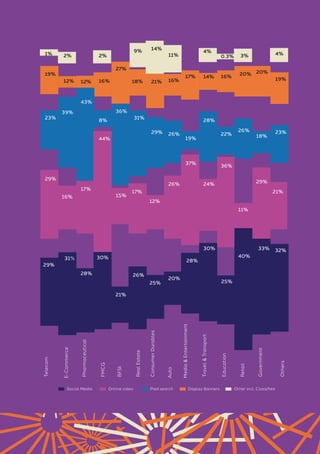
The telecom sector allocates the highest share of 66% of its overall media budget to digital
media. Within this digital media budget, 29% is equally distributed between online video and
social media, with 23% allocated to paid search. This reflects the sector's strategic emphasis
on digital engagement.
E-commerce segment allocates 65% of its media budget to digital media, of which, it spends
39% on paid search and 31% on social media. Similarly, pharmaceutical segment spends 54%
on digital media with 43% of this being allocated to paid search, followed by 28% on social
media.
FMCG segment spends 44% of its digital media budget on online video, followed by 30% on
social media. BFSI segment spends 36% on pair search and 27% on display banners. Real
estate sector spends 31% of its digital media budget on paid search followed by 26% on
social media. Consumer durables segment spends 29% on paid search, 25% on social media
and 21% on display banners. The automotive segment spends the majority of its digital media
budget equally across paid search and social media (26% respectively). Media and
entertainment segment spends 37% on online video and 28% on social media. Travel and
transport segment spends 30% on social media, 28% on paid search and 24% on online video.
Education sector spends mostly on online video, followed by social media and paid search.
Retail segment spends a large proportion of its digital media budget on social media,
followed by paid search. Government and social organization segments spend majority of
their digital media budgets on social media and online video.
Premium brands are significantly increasing their ad spends, with a notable rise of 8-10%.
Luxury consumers often make purchases based on personal discretion, but curated offers and
exclusive events, particularly during festivals, provide the right incentive. While digital
remains the preferred medium, premium brands are also targeting sports enthusiasts,
especially during major events like the IPL and the Olympics, to connect with the next
generation of luxury consumers and strengthen brand engagement.
Advertising spends by
industry verticals across
Digital Media Formats
GOLD PARTNERS
POWERED BY
48
Often considered price sensitive, Indian consumers are ditching affordable products for
premium, primarily driven by an aspirational lifestyle, exposure to global products and GenZ's
influence in household purchases.
More Indian consumers are opting for higher-quality, often more premium versions of
everyday products—things like soap, snacks, beverages and cars. In response, brands are
launching premium products aimed at customers willing to pay extra for that added touch of
quality or exclusivity.
Brands are embracing premiumization in their own ways, let us take a closer look at how the
premiumization trend is playing out across the biggest advertising verticals:
Consumer brands are launching premium products aimed at health-conscious
customers; the premium segment is growing 30% faster than regular products
Automobiles: 60% of new cars registered in 2024 were SUVs or high-end vehicles
Powerful bikes and premium electric scooters drove strong growth in the
two-wheeler industry, with rural demand exceeding urban demand
Luxury real estate saw robust growth, outpacing demand for low-cost housing across
India's metros and beyond
BFSI industry is benefiting from India's increasing HNIs and a paradigm shift to
investing in financial assets, leading to a record growth in demat accounts & SIPs in
mutual funds
Helping brands ride the
premiumization wave in India
The shift in consumer preferences
Premiumization in consumption across verticals:
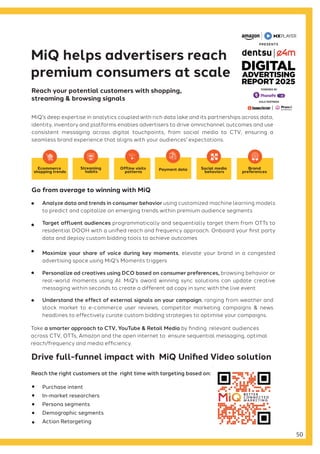
MiQ's deep expertise in analytics coupled with rich data lake and its partnerships across data,
identity, inventory and platforms enables advertisers to drive omnichannel outcomes and use
consistent messaging across digital touchpoints, from social media to CTV, ensuring a
seamless brand experience that aligns with your audiences' expectations.
Purchase intent
In-market researchers
Persona segments
Demographic segments
Action Retargeting
MiQ helps advertisers reach
premium consumers at scale
Drive full-funnel impact with MiQ Unified Video solution
Take a smarter approach to CTV, YouTube & Retail Media by finding relevant audiences
across CTV, OTTs, Amazon and the open internet to ensure sequential messaging, optimal
reach/frequency and media efficiency.
Reach your potential customers with shopping,
streaming & browsing signals
Reach the right customers at the right time with targeting based on:
Go from average to winning with MiQ
Analyze data and trends in consumer behavior using customized machine learning models
to predict and capitalize on emerging trends within premium audience segments
Target affluent audiences programmatically and sequentially target them from OTTs to
residential DOOH with a unified reach and frequency approach. Onboard your first party
data and deploy custom bidding tools to achieve outcomes
Maximize your share of voice during key moments, elevate your brand in a congested
advertising space using MiQ's Moments triggers
Personalize ad creatives using DCO based on consumer preferences, browsing behavior or
real-world moments using AI. MiQ's award winning sync solutions can update creative
messaging within seconds to create a different ad copy in sync with the live event
Understand the effect of external signals on your campaign, ranging from weather and
stock market to e-commerce user reviews, competitor marketing campaigns & news
headlines to effectively curate custom bidding strategies to optimise your campaigns.
Streaming
habits
Offline visits
patterns
Payment data Social media
behaviors
Brand
preferences
Ecommerce
shopping trends
50
GOLD PARTNERS
POWERED BY
50
90%
85%
82%
75%
62%
60%
58% 58% 58%
57% 56%
2016 2017 2018 2019 2020 2021 2022 2023 2024a 2025f 2026f
10%
15%
18%
25%
38%
40%
42% 42% 42% 43% 44%
Technological advancements in marketing technologies and AI are opening new avenues for
targeted and personalized advertising, enabling brands to build deeper connections and
engage more effectively with consumers. These developments are playing a critical role in
digital media buying. By the end of 2024, programmatic buying is projected to contribute 42%
(Rs 20,686 crore) to the digital media industry, reflecting a growth rate of 21% compared to
2023. Looking ahead, this segment is expected to grow at a compound annual growth rate
(CAGR) of 21.24%, reaching 44% (Rs 30,405 crore) by the end of 2026, further underscoring
the increasing shift toward programmatic and data-driven advertising strategies
Trends in Digital
media buying
Direct
Programmatic
52
GOLD PARTNERS
POWERED BY
3
CHAPTER
54
Embracing
the flux
of today and
tomorrow
E
m
b
r
a
c
i
n
g
t
h
e
fl
u
x
o
f
t
o
d
a
y
a
n
d
t
o
m
o
r
r
o
w
56
The digital landscape today is not a linear path but a dynamic network of interconnected
opportunities and challenges. It demands a focus on the present - the intersection where
innovation, creativity, and evolving consumer experiences converge to shape the digital future.
Instead of solely pursuing what lies ahead, it’s crucial to recognize and leverage the
opportunities unfolding in real-time.
In this rapidly changing ecosystem, data, technology, and consumer behaviour evolve
simultaneously, creating an environment where multiple truths and possibilities coexist. Each
perspective provides a partial understanding of the bigger picture, highlighting the importance
of embracing the fluidity of today’s digital platforms and experiences. Doing so allows
businesses to harness the full potential of this dynamic era.
The digital revolution is not merely about predicting the next trend. It is about understanding
the transformative shifts happening now - such as the rise of artificial intelligence, immersive
technologies, decentralized systems, and the growing demand for personalized, human-centric
solutions. These forces are already driving disruption, reshaping industries, and creating
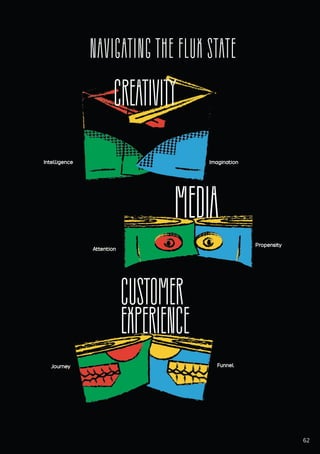
innovative ways for businesses to engage with their audiences. This is akin to a flux state, where
apparent opposites co-exist in a common reality, with different set of strategies being the key
to unlock these seemingly different scenarios. This kaleidoscopic flux state exists in three major
paradigms: Intelligence and Imagination (Creativity paradigm), Attention and Propensity
(Media paradigm), and Journey and Funnel (Customer experience Management paradigm).
AI has emerged as a powerful force, unlocking unprecedented potential across sectors. From
enhancing customer service with generative AI tools to revolutionizing decision-making
through predictive analytics, it’s reshaping how businesses operate. Simultaneously, immersive
technologies such as augmented and virtual reality are redefining the way consumers interact
with brands, creating more engaging and memorable experiences.
Decentralized technologies, including blockchain, are introducing transparency and
accountability into systems, empowering users and challenging traditional power structures.
Meanwhile, personalization has become a fundamental expectation. Consumers demand
tailored solutions that cater to their unique preferences and needs, driving companies to adopt
advanced data analytics and machine learning algorithms to deliver customized experiences.
These shifts highlight the importance of recognizing the present as a powerful driver of change.
Transformation isn’t a future event; it’s happening now. Industries are being redefined, creativity
is blending seamlessly with technology, and businesses are innovating to meet the evolving
needs of their customers.
The present moment offers unparalleled opportunities to understand and act upon the patterns
shaping the digital ecosystem. By focusing on the here and now, businesses can position
themselves to thrive in an increasingly interconnected and dynamic world, ready to adapt to
whatever the future brings.
Understanding the present is not just about staying relevant; it’s about leading the charge in a
world where change is constant. Whether it’s leveraging AI to enhance decision-making, using
immersive technologies to create deeper connections with consumers, or adopting
decentralized systems to foster trust, the digital landscape is a vibrant mosaic of possibilities.
By embracing the diversity of the present and aligning with the innovations defining today,
businesses can navigate the complexities of the digital age with confidence, ensuring they are
not only prepared for the future but actively shaping it.
58
In between
the Now and
the Next
EVP & Head of Strategy & Solutions, Dentsu BX India
The Future needs Next Practices,
not merely Best Practices
Vishal Nicholas
The Karachi Test in the 1982-83 India vs Pakistan series was an unremarkable one at the time. It was
one-sided and Pakistan won comfortably by an innings and 87 runs. However, from history’s vantage
point, it is a very significant Test match. India has seen comfortably seen off the new ball in the second
innings and were coasting at 102-1 when Imran Khan was handed a semi-old ball. In the words of Sambit
Bal at espncricinfo.com, Imran went on to give “the most fearsome exhibition of the art which was yet to
acquire a name.”
Reverse swing as we all know it today. Imran went on to take 8 wickets in the second innings as the
batsmen were at sea in the face of this new innovation or as we at Dentsu call it, the Next Practice. It
was Sarfraz Nawaz who was credited with being the father of this Next Practice who passed it down to
Imran who then passed it down to perhaps it’s most destructive exponents, Waqar Younis and Wasim
Akram. The world of fast bowling and cricket was the never the same again because one man thought of
doing away with the Best Practice at the time – making the ball swing away from the direction in which
it was shining, and persistently chasing the possibility of the Next Practice by defying– making the ball
swing in the direction in which it was shining.
Best Practices are practices that have worked time and again in a category and that’s exactly why they
are valuable – because they are proven. There is no risk, and a certain return is guaranteed. Best
practices are no-brainers in many ways. However, they are ‘best’, because someone else made them so.
Therefore, when you adopt a best practice, you are doing what someone else has already done. You are
merely catching up to them. Your internal benchmarks show an improvement but to the customer there
is no real new differentiation. Therefore, you haven’t done enough to create trial for your
product/service, merely made it at par with the rest. Which is useful if your product/service was terrible
to begin with! Following Best Practices ensures you have a good product but is no guarantee you have a
good enough product. In fact, in hyper-competitive categories, following Best Practices will ensure you
merely have a Minimum Viable Product.
Whereas Next Practices are about the never-before. They are about those innovative leaps of faith that
no one else could think of. They are what led to Airbnb, Tesla, Pep Guardiola’s style of play and of course,
reverse swing. They don’t just help you catch up to competition but often give you an edge that is very
difficult to replicate. An ICE vehicle claiming a mileage of X km per litre because it is the category
benchmark makes no difference to the consumer even though it may be the Best Practice. However, it
takes a Next Practice like the hybrid engine or an EV to make for mileage claims that truly jolt the
customer out of his inertia and consider the product. Next Practices require imagination &
customer-centricity in the first place and then the sheer power of execution.
Is this a rant on Best Practices? Not at all. The truth as they say is always in the middle. One needs both
– Best Practices & Next Practices. Each have a different role, and one needs to know when to harness
each. Best practices are usually about the most efficient way to do things whereas Next Practices are
about the most effective way to do things. One last thing, as Andy Grove said, only the paranoid survive
and so we must be cognizant of the fact that over time Next Practices become Best Practices and we
have to disrupt our own Next Practices then. Much like fast bowling which is waiting for its new Next
Practice.
60
throughthe
Kaleidoscope
Looking
Customer
Experience
Intelligence
Attention
Journey
Imagination
Propensity
Funnel
Media
Navigating the flux state
Creativity
62
The next evolution in customer experience lies in the seamless integration of generative AI
with human creativity - a shift redefining how brands connect with audiences at every stage
of their journey. Generative AI has emerged as a transformative force, revolutionizing content
creation across text, visuals, and even music. By automating repetitive tasks, it empowers
creators to focus on building richer narratives and delivering truly personalized experiences.
However, as AI-generated content gets increasingly efficient, authenticity and emotional
resonance remain critical. While AI excels at hyper-personalization and speed, the human
touch is vital to infuse storytelling with cultural relevance and emotional depth. Brands that
can balance efficiency with human-centred creativity are better positioned to connect with
audiences in a meaningful way. This evolution is pushing the traditional customer journey into
uncharted territory - beyond broad segmentation toward highly targeted micro-communities,
or ’interest clans’.
These passion-driven groups, bonded by shared values and beliefs, are redefining consumer
identities and cultural trends. By actively engaging with these communities, brands can foster
belonging and loyalty, creating moments of connection that resonate beyond the purchase
funnel. Generative AI, in this context, is not a replacement for human creativity but a partner,
enabling brands to build relationships with purpose-driven audiences at scale.
Enhancing Creativity
Merging Generative AI with Human Ingenuity
As the world transitions out of the pandemic era, hunger for immersive, real-world
experiences has reached unprecedented levels. Consumers are eager to connect beyond
digital screens, flocking to concerts, festivals, and live events by artists such as Diljit Dosanjh,
Ed Sheeran, AP Dhillon, and Coldplay. These events represent a golden opportunity for brands
to move closer to their audiences, fostering meaningful and memorable connections.
Forward-thinking brands are no longer content with just being sponsors or passive
participants. They are designing proprietary experiences that seamlessly blend their products
and ethos into the fabric of these events. Whether through creative collaborations,
interactive installations, or standalone events, the key lies in ensuring authenticity.
Experiences that feel natural and aligned with the brand's identity leave lasting impressions,
forging genuine emotional connections.
Immersive Experiences
Redefining Engagement Beyond Screens
GOLD PARTNERS
POWERED BY
64
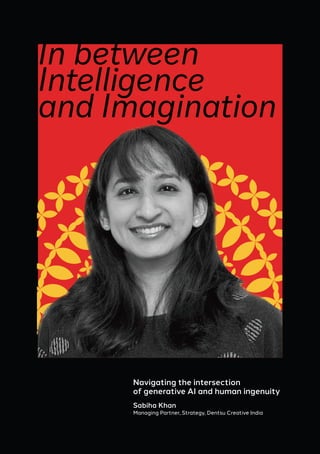
In between
Intelligence
and Imagination
Managing Partner, Strategy, Dentsu Creative India
Navigating the intersection
of generative AI and human ingenuity
Sabiha Khan
Which is smarter: the machine that creates or the human who dreams?
It’s a question that has sparked debates worldwide, and if you're reading this report, you’ve likely
asked it yourself too at some time. After all, this isn’t a speculative Black Mirror episode—this is the
reality we live in.
Generative AI is stepping into spaces once thought to be the exclusive domain of human creativity.
Designed to collaborate, unfortunately it’s often perceived as a competitor.
But the real question isn’t about superiority. It’s about what happens when the two “I’s”—(artificial)
intelligence and (human) imagination—collide, creating possibilities neither could achieve alone.
Generative AI excels in precision and efficiency, transforming what’s possible at lightning speed.
ChatGPT conjures coherent narratives in seconds. Claude offers human-like insights from complex
arguments. DALL·E and MidJourney produce visual masterpieces from mere prompts. These tools
process vast amounts of data, producing results that feel almost magical. But as we know, magic is
often just a clever illusion.
AI’s brilliance lies in execution, not origination. It reconfigures the known, offering flawless logic and
structure —but it lacks the unpredictable spark that makes a song unforgettable.
Then, there’s us—messy, imaginative, and gloriously imperfect humans. We’re not confined by what
is; we live in the realm of what could be. It’s why Einstein could see beyond numbers to unlock
relativity and why a train ride sparked the world of Harry Potter. Our imagination is our superpower,
free from algorithms and datasets. But let’s be honest: imagination, left unchecked, is all sparks and
no fire. It needs structure, guidance, and focus.
Now imagine what happens when these two forces meet.
One of my friends, who is a CEO, has programmed Claude to be an extension of his mind. It’s not just
a tool; it’s a mini-clone of his brain, trained to understand his decision-making process, capture
nuances, and articulate feedback in his voice. As a result, he can navigate complex decisions in
minutes—what once took hours or even days. Mind-boggling isn’t’ it?
But before you start questioning the ethics of this, let’s pause. The real issue isn’t about what AI can
do, but about who wields it and how. My friend uses Gen AI as an assistant to amplify his cognitive
capacity, ensuring his decisions are precise, free from fatigue, and unaffected by mental fog—critical
for someone in his role. It’s not just an advantage; it’s a highly responsible approach to leadership.
Imagine how much stress all CEOs could reduce in a day if they all programmed themselves an AI
assistant for their brain!
I believe, this intersection of intelligence and imagination is where true innovation lies. Generative AI
isn’t replacing human ingenuity—it’s amplifying it. Don’t think of it as a competition—treat it like a
partnership where you can reframe what’s possible. Imagine a world where humans focus on the wild,
the wonderful, and the impossible, while AI handles the groundwork. Like musicians use AIVA and
Amper Music to blend soul with precision. Designers craft videos with Runway in minutes. Architects
dream bolder with AI’s math and film-makers storyboard faster with the support of generative tools.
Like a kaleidoscope, beauty emerges from tension—from opposites working in harmony.
The magic lies not in the shards or the light. It’s in how we choose to turn the lens.
66
India’s dynamic retail media landscape is shaping the future of customer engagement. By
seamlessly blending e-commerce insights with advertising strategies, retail media is
bridging the gap between the upper and lower funnel, creating a cohesive, data-driven
ecosystem. Fuelled by affordable smartphones, high-speed internet, and an accelerated
shift to digital post-pandemic, retail media is transforming moments of consumer intent into
powerful, meaningful connections. Unlike traditional demographic-based targeting, retail
media relies on real-time shopping behaviours, enabling hyper-personalized campaigns
tailored to individual needs and preferences. This approach not only improves the relevance
of customer interactions but also levels the playing field, giving regional and small
businesses the ability to compete with larger national players.
Quick commerce (Q-commerce) platforms and Connected TV (CTV) networks further enrich
this ecosystem by leveraging first-party data to create seamless, omnichannel experiences.
For brands, this shift unlocks the potential of underserved markets in tier 2 and tier 3 cities,
driving both digital inclusion and economic growth.
As the boundaries between shopping and advertising blur, retail media is redefining how
brands interact with consumers along their journey. For India’s diverse market, this
transformation is about more than just efficiency — it’s a way to connect meaningfully with
customers by understanding their intent in real time and delivering value where it matters
most.
By embracing the next evolution of customer experience, brands can move beyond
traditional funnels to build deeper, purpose-driven connections. Whether through the
creative empowerment of AI or the data-centric innovation of retail media, the future
belongs to those who can merge personalization, creativity, and strategy to meet customers
wherever they are on their journey.
Retail Media 2.0
Transforming the Customer Journey
in India’s Digital Economy
68
GOLD PARTNERS
POWERED BY
The lines between physical and digital retail have nearly vanished, paving the way for unified
commerce to emerge as the foundation for seamless customer experiences. Unlike
multichannel or omnichannel strategies, unified commerce connects every touchpoint—be
it online platforms, brick-and-mortar stores, mobile apps, or social media—into a cohesive
and interconnected ecosystem. This approach is driven by the modern consumer’s demand
for convenience, consistency, and fluidity in their interactions with brands.
Unified commerce ensures that whether a customer begins their journey on a website,
completes it at a physical store, or transitions from in-store browsing to online ordering, the
experience feels natural, personalized, and frictionless. By consolidating data from all
channels—purchase history, in-app searches, in-store behaviour, and social
engagement—into a unified customer view, brands can provide tailored recommendations,
targeted promotions, and seamless transitions between online and offline environments.
This integration not only enhances satisfaction but also deepens customer loyalty. Unified
commerce enables brands to anticipate consumer needs, meet them where they are, and
foster long-term relationships by ensuring that every interaction feels relevant and
meaningful. As the customer journey becomes less linear and more dynamic, mastering this
interconnected approach will define the next era of customer engagement.
The Power of Unified
Commerce
Redefining Customer Engagement
70
In between
attention and
propensity
Senior Vice President – Product & Technology,
Media, dentsu India
How are Retail Media 2.0 and Unified
Commerce reshaping omni-channel
strategies?
Abhinay Bhasin
The Indian retail sector has been vibrant and ever evolving. Fuelled by the pandemic, this sector globally
as well as in the country has gone through significant transformations owing to shifts in consumer
behaviour, the boom in online payments and purchases as well as technological advancements and ever
evolving market dynamics.
As India continues on its path to being the 3rd largest consumer market, the fusion of Retail Media 2.0
and Unified Commerce is setting the stage for a paradigm shift in omni-channel strategies, powering this
rapid growth in the sector. This transformation revolves around balancing attention and
propensity—capturing consumer interest while seamlessly converting it into actionable outcomes
across channels in a market that is value focused and highly competitive.
Retail Media 2.0: The New Frontier
Retail Media has evolved from simple banner ads on e-commerce platforms to sophisticated ecosystems
leveraging first-party data, AI-driven targeting, and immersive ad formats. The next decade is likely to
see significant shifts in the sector powered by m new business models and improved customer
experience to growing digitalisation across the value chain supported by new technology.
Retail Media 2.0 empowers brands to connect with consumers at pivotal moments in their purchase
journey, delivering personalized experiences that align with intent. By integrating media with commerce,
retailers can monetize their platforms while providing advertisers with robust, measurable ROI.
Unlike its predecessor, Retail Media 2.0 prioritizes content relevance and contextual alignment.
Advanced analytics tools now enable brands to predict consumer needs, ensuring campaigns resonate
more deeply. Moreover, the integration of programmatic technologies has streamlined ad delivery
across touchpoints, making it easier to engage audiences at scale without compromising
personalization.
The focus on new commerce (D2C, social commerce, quick commerce, and live commerce) is predicted
to be a significant contributor to sectoral growth to roughly 8 times over the coming decade.
Unified Commerce: Bridging the Divide
Unified Commerce takes omni-channel to the next level by integrating all customer interactions into a
single, cohesive platform. It eliminates silos between online and offline channels, creating a seamless
shopping experience regardless of where the interaction begins or ends. This approach doesn’t just
improve operational efficiency; it also allows businesses to understand customer behaviour holistically,
paving the way for hyper-personalized engagements.
For instance, leveraging data from both in-store visits and online browsing history enables tailored
recommendations that drive conversions. Platforms like the Dentsu Marketing Cloud, will enable brands
to better understand their consumer behavioural habits across brand assets to derive unified consumer
intelligence for seamless experiences.
Unified Commerce also supports innovations like curbside pickup, mobile wallets, and real-time
inventory updates, further enhancing the customer experience.
Brands are expected to invest in new-age technologies, such as (AR/VR/MR, IoT, generative AI, etc.) and
build a comprehensive tech stack to deliver an omnichannel customer experience and streamline
operations.
The Intersection of Attention and Propensity
The convergence of Retail Media 2.0 and Unified Commerce underscores the importance of managing
the interplay between attention and propensity. Retailers must capture attention through engaging
content while using data insights to predict and fulfil consumer needs effectively. This balance ensures
that brands not only attract but also retain and convert customers, fostering loyalty and long-term
growth. This again will be fuelled by novel consumer intelligence technology to better understand
consumer behaviour and interactions for enhanced understanding and providing seamless experiences.
Retail Media 2.0 and Unified Commerce are no longer optional in omni-channel strategies. Together,
they represent a blueprint for the future of retail—one where attention meets propensity, and
experience drives engagement. To succeed in this evolving industry, profitability must take centre stage,
with retailers strategically managing costs and maximising revenue streams. As brands navigate this
dynamic landscape, those who embrace these innovations will be well-positioned to thrive in a highly
competitive marketplace.
72
As consumer attention spans continue to shrink, brands are facing unprecedented challenges
in capturing and retaining interest. The lifespan of advertising campaigns has been drastically
compressed—what used to resonate for months or years now lasts only weeks or days. In this
landscape, traditional repetitive messaging is ineffective. Instead, success lies in capturing
"micro-moments"—those brief but impactful windows when consumers are most receptive to
engagement.
These fleeting interactions, often occurring during critical decision-making or discovery
phases, require brands to be precise, relevant, and timely. New-age companies and
Q-commerce brands have excelled in leveraging micro-moments, ensuring they are present
and compelling during these crucial touchpoints. By doing so, they remain in consumers'
consideration sets despite the constant influx of competing content.
In 2025 and beyond, mastering micro-moments will dominate marketing strategies. To thrive,
brands must focus on delivering highly personalized, context-driven interactions at just the
right time. This involves leveraging real-time data, predictive analytics, and AI to anticipate
consumer intent and craft messages that resonate instantly.
By integrating the power of unified commerce and the precision of micro-moments, brands
can bridge the gap between the funnel and the journey, delivering experiences that are not
only seamless but also meaningful. The next evolution in customer experience will prioritize
connection over transaction, blending technology, data, and creativity to ensure that every
interaction strengthens the relationship between brands and customers. As these trends
shape the future, the brands that succeed will be those that embrace fluidity, relevance, and
personalization at every step of the journey.
Mastering
Micro-Moments
The New Currency of Attention
In today’s dynamic digital landscape, brands are discovering innovative ways to connect with
audiences by embracing generational shifts in values. One compelling trend is the evolution
from humour-driven engagement, particularly memes, to more introspective,
mindfulness-focused strategies. This transformation highlights the changing preferences of
Millennials and Gen Z—two generations shaping the future of brand interactions.
Memes have become the internet's universal language, effortlessly transcending borders and
cultures. They offer brands a unique opportunity to connect with younger audiences through
relatability, quick wit, and shareability. At the same time, mindfulness has been gaining
significant awareness with people increasingly prioritizing mental health and well-being
amidst rising global challenges viz. global crises and uncertainties. People today, especially
the younger audiences are more open to discussing mental health and exploring tools and
content to navigate the emotional and psychological stress.
The challenge for modern brands lies in seamlessly integrating these seemingly opposing
trends. Success comes from striking a balance: using humour to grab attention and fostering
mindfulness to deepen engagement. For instance, a brand might capture interest with a witty
meme campaign before transitioning to promoting self-care practices or mental health
initiatives, creating a meaningful and multifaceted connection.
Memes to Mindfulness
Bridging Generational Preferences
GOLD PARTNERS
POWERED BY
74
Generations at a Glance
Shivani Srivastava
Head of Ads, PhonePe
“The way we spend speaks
volumes about who we
are—and in Bharat, every
generation has a unique
story to tell”
PhonePe’s Generational
Insights Set to
Transform Advertising
Strategies & Consumer
Engagement
Across Bharat
Gen Z and Millennials epitomize a tech-savvy, convenience-seeking audience, drawn to the
personalization of digital transactions. They are frequent spenders, focusing on food, beverages, and
retail indulgences. In contrast, Gen X approaches spending purposefully, prioritizing practical
investments in healthcare, financial services, and agriculture.
Bharat today is a dynamic blend of tradition and innovation, its vibrant digital economy driven by
aspirations across generations. As Indians move from cash toward seamless digital payments, their
transaction habits reveal distinct generational nuances that marketers can no longer ignore. At
PhonePe Ads, we’ve observed firsthand how Gen Z, Millennials (Gen Y), and Gen X approach the digital
economy, offering profound insights into what drives their spending behaviours.
Diverse Spending Habits
Gen Z displays a frequent spending habit, with males in metros transacting 37% more than females.
They spend significantly on food, beverages, and retail but show a 45% higher spending value online.
Their indulgent preferences make them ideal for personalized, gamified campaigns.
Millennials (Gen Y) showcase balanced behaviour, transacting 12% more offline but spending 52%
more online. With males transacting 27% more frequently than females, their diverse spending spans
entertainment, commuting, and financial services..
Gen X, despite lower transaction frequency, spends 56% more online, emphasizing investments in
healthcare, agriculture, and financial services. Their preferences align with trust-driven, high-value
campaigns.
Understanding these unique traits helps advertisers move beyond broad demographics to create
campaigns that resonate with specific behaviours, values, and aspirations.
Let’s decode Bharat together—because smarter insights lead to smarter advertising.
‘The Bharatiya Consumer: A Generational Study’ by PhonePe is more than just a report—it’s a gateway
to understanding Bharat’s diverse and evolving consumer landscape. This resource provides marketers
with a detailed breakdown of how Gen Z, Millennials, and Gen X approach spending, highlighting their
preferences, priorities, and aspirations.
The report offers a nuanced look at generational behaviour across categories such as food, retail,
financial services, healthcare, and more. It examines how urban and rural divides shape transaction
patterns, providing insights into regional and gender-based variations in spending.
Our study also uncovers vital insights into how gender and location influence spending. Urban
consumers show higher online transaction volumes, while rural audiences maintain significant offline
activity. Women in metros are emerging as strong spenders in wellness and retail, while men dominate
commuting and tech categories. For marketers, these insights underscore the importance of tailoring
messages to match the audience’s context.
The Role of Gender and Geography
A Must-Have Resource for Advertisers
Each generation’s unique priorities—from Gen Z’s craving for instant gratification to
Gen X’s stability-focused mindset—provide a roadmap for targeted advertising
strategies.
For advertisers, these insights translate into actionable strategies:
Design Campaigns That Resonate: Develop messaging and creatives that speak directly to
generational values and lifestyle
Tailor Regional Strategies: Leverage insights into spending habits across metros, small towns,
and rural areas to localize campaigns effectively.
Engage With Precision: Understand how gender dynamics influence purchasing decisions,
allowing for more personalized and impactful advertising.
With exclusive access to Bharat’s digital economy across 99% of postal codes in the country, PhonePe
Ads provides unmatched opportunities for brands to engage with high-intent audiences. Our offerings,
from In-App Display Ads to Sponsored Links, and Deals & Rewards, enable precise targeting and
measurable impact
Ready to transform your advertising strategies? Explore The Bharatiya Consumer: A Generational Study
at pulse.phonepe.com or contact us at ads@phonepe.com to unlock the potential of Bharat’s vibrant
digital economy.
Whether you’re building awareness, driving engagement, or boosting conversions, this study is an
indispensable tool for creating campaigns that leave a lasting impact.
76
GOLD PARTNERS
POWERED BY
India stands at the forefront of marketing evolution, seamlessly blending its rich traditions
with rapid digital transformation. With a diverse population and varying levels of digital
penetration across urban and rural areas, Indian brands are excelling at integrating digital and
traditional marketing strategies to craft inclusive, impactful campaigns. This fusion is not
merely a necessity - it is a game-changer in a market as vast and dynamic as India.
The country’s hybrid consumer journey reflects the duality of its cultural fabric. While rural
audiences still rely heavily on traditional mediums like television, radio, and print for
information, urban consumers are driven by digital-first experiences, leveraging e-commerce
apps, social media, and influencers. Recognizing this, Indian brands are crafting campaigns that
cater to both worlds. For instance, television ads often include WhatsApp call-to-actions,
enabling rural consumers to engage directly, while digital campaigns leverage regional
influencers to create locally resonant content.
Blending Digital
and Traditional
India's Hybrid Marketing Revolution
In India, where emotional storytelling has long been the cornerstone of advertising, the blend
of traditional and digital marketing enables brands to craft messages that are both
personalized and universally relatable. Modern campaigns no longer depend solely on mass
appeal; instead, they leverage India’s rich linguistic and cultural diversity to create
hyper-targeted, resonant connections.
For example, an ad campaign for a festive season sale might use a single core message but
tailor its execution across platforms. On television, it could feature a heartwarming story in
Hindi or regional languages, while digital ads leverage AI to deliver hyper-personalized offers
based on consumer behaviour and location. This blending of emotional storytelling with
data-driven precision ensures deeper resonance and stronger impact.
In a country where Kirana stores and shopping malls coexist, the rise of "phygital" marketing
has reshaped the retail experience. In urban India, shopping malls are evolving into
tech-enabled spaces, with AR-powered displays, self-checkout kiosks, and app-based loyalty
programs creating a bridge between physical and digital commerce. For rural India, however,
the story is different but equally impactful as brands integrate physical touchpoints like haat
(local markets) with digital payment systems and regional digital campaigns to reach
audiences where they are.
Even sectors like agriculture and healthcare, which traditionally relied on physical
interactions, are leveraging digital tools. For instance, companies are using SMS marketing
combined with in-person field activations to educate farmers about products, while
telemedicine platforms amplify awareness campaigns run through rural radio stations. These
phygital solutions ensure that brands remain accessible across India’s diverse socio-economic
landscape.
Phygital Experiences
Bridging Urban and Rural Markets
Data-Driven Narratives
with an Emotional Core
78
GOLD PARTNERS
POWERED BY
Advertising has always thrived when it evolves alongside consumer behaviour. As we step into
2025, one such medium that has undergone a reformative transformation is the connected
media landscape. The rise of Connected TV (CTV), mobile video, and digital out-of-home
(DOOH) advertising is not just a ‘trend’ anymore but an omnichannel medium that is here to
stay and transform how audiences engage with brands — bridging the much-needed gap
between online and offline experiences.
As audiences increasingly favour the big screen for its immersive experience — watching their
favourite shows, streaming live events, or passing by impactful brand messaging at high-traffic
locations, the connected ecosystem offers unparalleled targeting for advertisers in an
environment that feels personal but not intrusive.
For marketers, this evolution brings significant opportunities to drive comprehensive awareness
and engagement and refine strategies to unlock the full potential of their marketing efforts.
With an estimation that India would have 60 million CTV households by the end of 2025 and
internet users spending an average of 90 minutes daily as an outcome of affordable internet
services and Smart TVs, it is apparent that the connected ecosystem is where audiences like to
spend most of their time on the open internet.
Bridging the Gap Between
Online and Offline
Ishank Joshi,
MD & CEO, Mobavenue Media
To enable brands to make the most of this
omnichannel medium, PrsmX by Mobavenue
is a unified brand awareness and omnichannel
programmatic engagement platform
positioned at the intersection of online
and offline advertising. We aim to redefine
how marketers approach today's
complex media environment.
Today, around 732 million Indians spend time on OTT platforms (audio and video). The majority
of users are from rural regions, followed by small towns, megacities, and metros. With a surging
user base, brands can now utilise precision targeting and personalisation through data-driven
strategies that help them amplify, reach, and grow.
Summarising this shift: "PrsmX represents a significant step forward in achieving true cohesion
between online and offline advertising. It transforms the entire spectrum of consumer
awareness and engagement into one seamless, measurable ecosystem.” adds Saurabh Golani,
Head of Business, PrsmX.
The connected ecosystem, especially CTV, not only caters to brand awareness but also acts as
a catalyst for conversion with its interactive ad formats, such as branded QR and non-skippable
ads. Whenever a brand ad appears on an audience’s screen, it can seamlessly translate into an
experience outside — a purchase, an event visit, or footfall at a retail store.
The real power of PrsmX lies in its ability to converge a fragmented ecosystem into one
connected, measurable, and impactful strategy. What is more imperative is how audiences
interact with brands in the real and virtual worlds. This is when marketing strategies truly align
with meaningful outcomes, and the future of brand impact takes shape.
By bridging the expansive gap between the online and offline worlds, PrsmX has set the
foundation for a more unified, seamless approach to consumer awareness and engagement.
This transformation is about redefining the mechanism of how we connect, communicate, and
create impact.
As India expects to reach 900 million internet users by 2025, the lines between media
channels will blur, and the true power of advertising will lie in its ability to resonate
authentically, delivering value for both brands and audiences in a dynamic, interconnected
world.
PrsmX is purpose-built to address the complex maze of challenges in the connected media
landscape that includes fragmented supply chains that silo creative resources, duplicate reach
interfering with accurate campaign targeting, advertiser’s trust and transparency, and the
escalating cost of unique customer reach.
80
GOLD PARTNERS
POWERED BY
In between
the funnel and
the journey
Chief Strategy Office, Dentsu CXM India
How will the Next Evolution in Media
connect brands and customers
more meaningfully?
Meera Raman
The marketing world loves its metaphors. We've spent years perfecting our funnels, crafting them into
precision instruments that guide customers from awareness to purchase with mathematical certainty.
Then we fell in love with customer journeys – those flowing, narrative paths that capture the organic way
people interact with brands. But here's what's fascinating: the most meaningful brand connections are
happening in the spaces where these two worlds collide.
Think about how you last interacted with a brand you love. Maybe you started with a specific purchase in
mind, following that familiar funnel path. But somewhere along the way, you found yourself on their
community page, engaging with content that had nothing to do with your original intent. Or perhaps you
were casually scrolling through social media, engaging with a brand's content for months before making
your first purchase – simultaneously a prospect and a micro-advocate.
This is the new reality of customer experience – a kaleidoscopic space where structured pathways and
organic interactions create unexpected patterns of engagement. It's where a customer can exist in
multiple stages simultaneously: researching one product while advocating for another, seeking support
while exploring new purchases, building community connections even while moving through transaction
funnels.
The challenge – and opportunity really – for brands lies in mastering this space between the funnel and
the journey. Evolution is reshaping customer experience in this era of consumerism in a myriad ways. I’ll
try and talk about just a few of them here.
New Skills for a New Reality
This evolution demands new capabilities from marketing teams. We need strategists who can think in
both structured and organic terms, creators who can develop content that works across multiple
contexts, and analysts who can make sense of complex, non-linear customer behaviours. Most
importantly, we need teams that understand the art of being present in these in-between spaces – ready
to engage whether a customer is in transaction mode or relationship mode.
The future belongs to brands that can maintain this delicate balance – using the precision of funnels
while embracing the fluidity of journeys. It's about creating systems and experiences that are
simultaneously efficient and human, structured and organic, purposeful and adaptable.
In short, success isn't about choosing between methodologies – it's about mastering the spaces
between them. It's about recognizing that every customer interaction – regardless of whether it fits
neatly into our models or not. It is an opportunity to build stronger, more meaningful connections. After
all, just as a kaleidoscope creates beauty from the interaction of different elements, the most powerful
customer experiences emerge when we embrace both the science and art of engagement, allowing
them to create patterns that are both purposeful and surprising.
The Rise of Hybrid Touchpoints
Modern touchpoints serve multiple purposes simultaneously. A product review video might be
awareness content for new customers, consideration material for active prospects, and validation for
recent purchasers. Smart brands are creating content and experiences that flex to serve different needs
at different moments, all while maintaining consistency in their message.
Data With a Human Touch
While we still need the structural integrity of funnels to measure and optimize, we must also capture the
qualitative richness of customer journeys. This means evolving our metrics to understand not just where
customers are in their journey, but how they're moving between different states of engagement. It's
about combining traditional conversion metrics with newer indicators of relationship strength –
engagement patterns, community participation, content interaction depth.
Technology as the Great Connector
The role of technology in this space isn't just about automation or personalization – it's about building
bridges. Modern MarTech stacks need to be flexible enough to recognize and respond to customers who
don't follow linear paths. When a customer moves from reading buying guides to viewing user-generated
content to checking pricing – all within minutes – our systems should see this as a unique engagement
pattern, not three separate funnel stages.
82
The future of digital marketing is set to be defined by the rise of short-form videos, such as
Instagram Reels and YouTube Shorts, which have garnered immense viewership in recent years.
These platforms enable brands to merge entertainment with commerce, engaging a
fast-paced audience through bite-sized content. As attention spans shrink and consumers
seek quicker, more engaging experiences, short-form videos emerge as a powerful medium for
brands to boost visibility and drive business growth in an increasingly digital-first world.
India's digital advertising landscape is rapidly evolving, fuelled by a new generation of digitally
savvy consumers who are shifting towards the open internet for premium content, especially
on OTT and CTV platforms. These platforms are now viewed as more premium and trustworthy
compared to traditional social media, prompting brands to adapt by exploring new, scalable
strategies with better measurement and transparency. As advertisers move away from the
low-cost reach approach of social media, they are increasingly embracing programmatic,
audience-first strategies that leverage AI to deliver personalized, high-quality ads in premium
environments.
AI is rapidly transforming digital marketing, particularly through search engines and customer
service solutions. Generative AI, incorporated into platforms like iOS, Google and Bing, is
enhancing user experience by delivering more accurate and context-driven results.
Additionally, AI-driven chatbots are revolutionizing customer service by mimicking human
interaction, reducing costs, and enabling scalability for global businesses. This shift toward
AI-powered solutions offers businesses the ability to engage more efficiently with customers
across diverse languages and markets.
Looking ahead, voice search and voice commerce are poised to gain substantial traction, with
smart speakers and voice assistants becoming integral to consumers' daily routines. As the
adoption of voice-activated technology accelerates, brands must optimize their content for
conversational search and integrate seamless voice commerce capabilities. Simultaneously,
hyper-personalization will redefine marketing strategies, leveraging machine learning
algorithms to deliver highly tailored content that fosters deeper consumer connections. In this
evolving landscape, businesses will need to embrace innovation and adaptability to remain
competitive in an increasingly AI-driven and personalized world.
Future-Ready
Marketing
Current trends defining the Next era
84
PRIMARY RESEARCH
Interviews were conducted with advertisers and stakeholders across industry verticals, media
agencies, online publishers, and ad networks to understand their advertising investments
across media, along with other focus areas in digital media.
SECONDARY RESEARCH
Interviews were conducted with advertisers and stakeholders across industry verticals, media
agencies, online publishers, and ad networks to understand their advertising investments
across media, along with other focus areas in digital media.
DESIGN SYNOPSIS
Inspired by the coexistence of multiple realities—like a shifting kaleidoscope—this report's
design language reflects its findings through vibrant, contrasting patterns. These seemingly
contradictory elements are deliberately juxtaposed to evoke complexity and fluidity.
Hand-drawn artwork reinforces a key insight: human creativity and ingenuity endure,
celebrating the wild, the wonderful, and the impossible.
Research Methodology
The findings presented in the report
have been arrived through primary and
secondary research.
Harsha Razdan
Kartik Iyer
Narayan Devanathan
Simi Sabhaney
Amit Wadhwa
Anubhav Sonthalia
Santosh Gannavarapu
Sujit Vaidya
Unmesh Pawar
Shalinee Kulshreshtha
Manavendra Davar
Vinod Thadani
Jose Leon
Sanchayeeta Verma
Imtiyaz Vilatara
Abhirup Dutta
Saagar Sethi
Sujata Dwibedy
Meera Raman
Muddassar Memon
Ujjwal Anand
Sabiha Khan
Nikhil Kumar
Abhinay Bhasin
Vinita Pachisia
Vishal Nicholas
Amita Srivastava
Pravin Agarwal
Krishnakumar Naidu
Abheek Biswas
Prabhupreet Singh Ahuja
Nikhil Narayanan
Sachin Sadanandan
Anindita Sarkar
Lubna Surti
Alifiya Hirani
Prerna Sagvekar
Archie Kothari
Special thanks to
Research and report compilation
Report design
Report editing
and communications
86
GOLD PARTNERS
POWERED BY
Dentsu-e4m-DigitalReport-2025dentsu1.pdf

Dentsu-e4m-DigitalReport-2025dentsu1.pdf

  • 1.
  • 3.
    FOREWORD 04 EXECUTIVE SUMMARY10 CHAPTER 1. THE INDIAN ADVERTISING INDUSTRY 12 CHAPTER 2. THE INDIAN DIGITAL ADVERTISING INDUSTRY 32 CHAPTER 3. EMBRACING THE FLUX OF TODAY AND TOMORROW 54 RESEARCH METHODOLOGY 85 Table of Contents GOLD PARTNERS POWERED BY
  • 4.
  • 5.
    FOREWORD There’s something fascinatingabout how we experience the world. The same moment can look entirely different depending on where we stand, how we feel, or what we choose to focus on. It’s like holding a prism to the light - turn it one way, and you see one colour; turn it another, and an entirely new spectrum emerges. The digital world works much the same way. It’s not static; it’s dynamic, multifaceted, and alive with possibilities, offering new patterns every time you shift your perspective. This year’s dentsu e4m Digital Report - ‘Looking Through the Kaleidoscope’ - invites us to embrace that fluidity. It urges us to look beyond straight lines and fixed trajectories, to see the digital landscape for what it truly is: a complex, vibrant interplay of ideas, technology, and human connection. We live in a time when it’s tempting to always look ahead - to chase the next trend, the next breakthrough. But here’s the truth: the present is where everything happens. The decisions we make today don’t just prepare us for tomorrow - they actively shape it. Right now, AI is rewriting the rules of creativity and personalization. The rise of hybrid experiences is redefining how we connect in physical and digital spaces. And consumers are no longer passive participants; they’re co-creators, demanding authenticity and experiences that resonate on a deeper level. What stands out to me, though, is that even in a world powered by algorithms and automation, the human element remains irreplaceable. The best ideas - the ones that truly transform industries - don’t emerge from data alone. They come from a deep understanding of people: their hopes, fears, and desires. This is what makes the digital world so powerful. It’s not just about technology; it’s about using that technology to create moments that matter. This report isn’t a forecast or a prediction. It’s a celebration of the here and now. It’s a guide to navigating the complexity of our times with clarity and purpose. Because much like that prism in the light, the digital world offers endless possibilities - it all depends on how you choose to see it. The question is: are you ready to embrace the present? 04
  • 6.
    Dr. Annurag Batra Chairmanand Editor in Chief, BW BusinessWorld Founder, exchange4media Group
  • 7.
    The latest Dentsue4m Digital Report 2025 puts forth a fascinating picture of how the Indian advertising industry is evolving, largely driven by digital transformation, changing consumer habits and the unstoppable rise of technology. Over the past year, digital has firmly established itself as the powerhouse of advertising, reshaping everything from media consumption to brand storytelling. Traditional channels like TV and print still hold their ground but the momentum is clearly shifting towards social media, online video and programmatic advertising—all fuelled by data-driven strategies and an ever-growing digital-first audience. One of the biggest takeaways from this year’s report is the changing face of engagement. Digital media isn’t just about visibility anymore; it’s about connection. Brands aren’t just talking to consumers—they are crafting immersive, hyper-personalized experiences powered by AI and real-time insights. The rise of retail media and unified commerce is making this even more seamless, blending online and offline touchpoints to create frictionless brand journeys. While FMCG continues to dominate ad spends, we are seeing some exciting shifts. The travel sector is making a big comeback, driven by a surge in domestic tourism campaigns, while telecom and e-commerce brands are doubling down on digital, allocating a huge chunk of their budgets to online platforms. Short-form video is quickly becoming the go-to format, capturing audiences with snackable, engaging content that merges entertainment with commerce. Another fascinating trend the report highlights is the evolving tone of advertising. Humour, which has long been a staple of Indian advertising, is now making room for mindfulness-driven storytelling, especially for Millennial and Gen Z audiences. These consumers want brands to be more than just sellers—they expect them to reflect their values, create meaningful conversations, and foster community-driven engagement. And then there’s AI. No longer just a behind-the-scenes player, generative AI is now actively shaping creativity, streamlining decision-making and helping brands produce smarter, more emotionally resonant campaigns. The phygital revolution—where physical and digital retail experiences merge—is also ensuring that brands stay connected with consumers across urban and rural landscapes, offering accessibility like never before. At the heart of all this change, one thing is clear: the advertising industry is at an inflection point. We’re in a kaleidoscopic state of flux, where technology and creativity, data and storytelling, commerce and culture are all merging to redefine what effective marketing looks like. The Dentsu e4m Digital Report 2025 captures this shift in all its complexity, offering a glimpse into the future of advertising—a world where innovation, personalization and engagement will define success. FOREWORD 06
  • 8.
  • 9.
    The past yearmarked a transformative chapter in digital advertising and marketing, both in India and globally. As we enter 2025, reflecting on past trends while anticipating future trajectories becomes crucial for industry understanding. India's expanding internet user base positions the nation at the forefront of the digital revolution. The previous year saw increased focus on personalization, driven by advanced data analytics and artificial intelligence. Brands evolved from mass communication to engaging individuals with tailored, resonant messages. The country's digital ecosystem is uniquely positioned at the crossroads of rapid technological adoption and a diverse, digitally savvy population. Digital advertising emerged as the industry's dominant force, claiming the largest share of advertising spend. Artificial intelligence played a central role in this digital narrative, reshaping marketing approaches to creativity and efficiency through chatbots and generative content creation. This advancement brought responsibilities, particularly regarding consumer trust and data transparency. AI is no longer just a buzzword; it has become the backbone of hyper-personalized marketing strategies. Predictive commerce became fundamental, enabling precise anticipation of consumer behaviour while enhancing customer journeys. Video content maintained its supreme position in engagement metrics, with online video leading digital media spending and projected as the fastest-growing channel. From short-form content on social platforms to long-form storytelling on OTT services, video marketing proved essential for deeper audience connections. Influencer marketing saw remarkable growth, expanding beyond celebrity endorsements to include niche domain experts, bringing authenticity to brand campaigns. Omnichannel marketing gained unprecedented momentum as consumers moved seamlessly between digital and physical worlds, demanding consistent brand presence across all touchpoints. Despite economic challenges, innovation thrived, particularly in programmatic advertising, which contributed significantly to digital ad spending. Sustainability emerged as a crucial theme, with consumers increasingly supporting brands aligned with environmental values. Looking ahead, digital advertising stands on the cusp of transformation. Advanced technologies, evolving consumer behaviours, and personalization are reshaping brand-audience connections. AI-powered tools have become essential for hyper-personalized marketing strategies, while voice search and conversational AI are revolutionizing SEO approaches. Augmented and Virtual Reality are offering immersive experiences, bridging online-offline interactions. The social media landscape continues evolving, with emerging platforms gaining traction alongside established networks. Mobile-first strategies remain crucial, especially with advancing technology infrastructure. Content marketing is adapting to audience preferences, shifting from humour-driven engagement to mindfulness-focused strategies for younger generations. Vernacular content gains importance in India's diverse linguistic landscape. Success in this evolving digital landscape requires agility, responsible data usage, and culturally resonant storytelling. FOREWORD 08
  • 10.
    Executive Summary Rs 49,251Cr (~$ 5.93 Bn) Rs 59,200 Cr (~$ 7.13 Bn) Rs 69,856 Cr (~$ 8.41 Bn) Digital Advertising Industry 19.09% CAGR Rs 1,01,084 Cr (~$ 12.18 Bn) 2024 2025f 2026f Rs 1,07,664 Cr (~ $ 12.97 Bn) Rs 1,15,460 Cr (~ $ 13.91 Bn) Advertising Industry 6.87% CAGR
  • 11.
    The digital landscapeisn’t just changing - it’s in perpetual motion, powered by real-time advances in data, technology, and shifting consumer behaviour. As AI, immersive experiences, decentralized technologies, and hyper-personalization evolve, they converge to ignite growth, disruption, and transformation. The digital world is no longer a bridge to the future; it is the future unfolding in real time. In this dynamic arena, industries are being redefined, and opportunities are being unlocked at an unprecedented pace. To thrive, we must embrace the now, leveraging the momentum of today’s innovations to stay ahead in a constantly evolving ecosystem. The Indian advertising industry grew by 6.3% in the last year, reaching a market size of Rs 1,01,084 crore by the end of 2024. By 2026, it is projected to grow at a compounded annual rate (CAGR) of 6.87%, reaching Rs 1,15,460 crore. The digital advertising sector witnessed a growth of 21.1%, closing 2024 at a market size of Rs 49,251 crore. It is expected to reach Rs 69,856 crore by 2026, with a CAGR of 19.09%. By the end of 2024, digital media accounted for the largest share of advertising spend at 49%, followed by television at 28% and print at 17%. By 2026, digital media is projected to contribute 61% of India’s total advertising spend. The telecom sector leads the way, allocating 66% of its media budget to digital, with e-commerce, pharmaceuticals, and FMCG segments following closely behind. Social media and online video lead digital media spending, with social media contributing 29% (Rs 14,480 crore) and online video close behind at 28% (Rs 13,756 crore). Advertising spends on e-retail platforms contribute to 22.93% of all digital media spends. The FMCG and e-commerce sectors are the largest contributors to India’s digital media industry. Within digital media, FMCG directs 44% of its budget to online video, while e-commerce prioritizes paid search (39%) and social media (31%). The next chapter of customer experience is being shaped by the fusion of generative AI and human creativity, transforming how brands connect with their audiences. Generative AI speeds up content creation across text, visuals, and music, automating repetitive tasks and freeing up creators to craft richer, more personalized stories that truly resonate. However, as AI-generated content becomes widespread, maintaining authenticity and emotional depth is vital. While AI delivers hyper-personalized content with unmatched speed, human creativity ensures cultural relevance and emotional impact. Brands that master the balance between AI efficiency and human insight will foster deeper, more meaningful connections. In India’s fast-changing retail media landscape, a new era of customer engagement is unfolding, powered by real-time shopping data. Retail media enables regional businesses to compete with larger players by tailoring campaigns to individual preferences. This shift is helping brands create more personalized, impactful, and purpose-driven relationships with their consumers. 10
  • 13.
  • 14.
  • 15.
  • 16.
    51,851 56,471 62,564 72,603 85,812 95,087 1,07,664 1,15,460 2016 2018 2019 2020 2021 2022 2023 2024a 2025f 2026f 2017 8.9% 10.8% 10.8% 9.4% -12.9% 18.2% 21.8% 6.3% 6.5% 7.2% TheIndian advertising industry grew by 6.3% in the previous year, closing 2024 with a market size of Rs 1,01,084 crore. This growth was primarily driven by the general and assembly elections, which triggered a significant surge in ad spending. Looking ahead, the Indian advertising landscape is poised for modest growth, with major sporting events such as IPL 2025, the ICC Champions Trophy, and the Asia Cup 2025, along with other cricketing events, expected to be key growth drivers this year. These events will offer significant opportunities for brands to engage with diverse audiences, ensuring the industry’s continued upward momentum. 68,475 1,01,084 Growth of Indian Advertising Industry (Rs crore) AD INDUSTRY GROWTH 51,851 59,619
  • 17.
    The Indian advertisingindustry is projected to grow at 6.5%, reaching a market size of Rs 1,07,664 crore in 2025. Growth is d projected to accelerate in 2026, with the rate increasing to 7.2%, driving the market size to Rs 1,15,460 crore by year-end. Digital media continues to lead the transformation with a CAGR of 19.09%, reflecting significant investments in online platforms. Key growth drivers include increased spending on reality shows, sports content across TV and OTT platforms, and large-format print advertising. The second half of 2024 laid a strong foundation for this growth, presenting pivotal opportunities for brands to engage with their audiences through diverse channels and innovative content strategies. This trajectory highlights the industry's adaptability and focus on capitalising on emerging consumer trends. Key sectors such as e-commerce, automotive, BFSI, FMCG, and retail continue to dominate both digital and traditional media. The scale of offers and promotions across retail media, e-commerce, and D2C platforms is expected to be substantial, driving significant consumer engagement. Furthermore, product launches will play a pivotal role in encouraging consumer trials, contributing to a rise in overall ad spending. A notable trend is the strong surge in rural consumption, outpacing urban areas, particularly in the automotive and FMCG segments. This shift highlights the growing importance of rural markets in shaping advertising strategies and driving industry growth across diverse categories. 2024 Rs. 1,01,084 crore Rs. 1,15,460 crore 6 . 8 7 % C A G R 2026f GOLD PARTNERS POWERED BY 16
  • 18.
    Digital media hasemerged as the largest contributor to advertising spends, accounting for 49% (Rs 49,251 crore) of the Indian advertising industry. Television follows closely, contributing 28% (Rs 28,062 crore), while print media holds a share at 17% (Rs 17,529 crore). This shift underscores the growing dominance of digital platforms in shaping advertising strategies and capturing audience engagement. Digital and Out-of-Home (OOH) advertising have led the charge in advertising spend growth this year, setting the pace for the industry. Television and print are also expected to see a boost, driven by reality shows and festive campaigns. As brands prioritize high-impact buys, engaging and innovative content will be key to capturing audience attention across platforms. Success will hinge on finding the right balance between reach and relevance, and those who strategically leverage these mediums will gain a competitive edge. In recent years, the Out-of-Home (OOH) advertising segment has embraced new formats, such as digital displays, airport billboards, and Digital OOH (DOOH). OOH ad spend reached Rs 3,800 crore in 2023, reflecting aggressive adoption by advertisers. Looking ahead, OOH is projected to grow at a CAGR of 10% through 2026, driven by various factors. The 2024 general and assembly elections sparked a surge in political advertisements, further boosting OOH’s momentum. DOOH remains a critical growth driver, with its vibrant, high-impact displays gaining popularity across markets. Destination DOOH and digital on-road displays are increasingly being integrated into media plans, highlighting the growing share of digital formats in OOH strategies. Infrastructure development continues to unlock opportunities for transit and metro media, while the refurbishment and expansion of airports in key markets contribute to inventory growth. New infrastructure projects are fostering the expansion of OOH as an industry, with transit media emerging as a significant segment. Advertisers are increasingly adopting data-driven and technology-enhanced strategies, emphasizing location-based planning and measurable outcomes in OOH campaigns. Political parties made significant investments in Q1 2024, capitalizing on OOH’s reach ahead of the elections. Key sectors such as Automobile, BFSI, FMCG, Real Estate, Retail, and Media & Entertainment have extensively leveraged OOH in early 2024, highlighting its relevance across diverse industries. This dynamic environment positions OOH as a vital component of the advertising mix, primed for sustained growth. Advertising spends on media
  • 19.
    Television Rs 28,062 Cr 28%Radio Rs 1,679 Cr 2% OOH Rs 4,256 Cr 4% Cinema Rs 306 Cr 0.30% Digital Rs 49,251 Cr 49% Print Rs 17,529 Cr 17% 18 GOLD PARTNERS POWERED BY
  • 20.
    Forecast of advertisingspends across various media 12% 15% 17% 20% 26% 29% 35% 43% 49% 55% 61% 2% 2% 2% 2% 0.5% 0.4% 0.3% 0.3% 0.3% 0.3% 0.2% 40% 40% 40% 39% 42% 42% 39% 31% 28% 24% 20% 34% 35% 31% 29% 26% 23% 22% 20% 17% 15% 13% 6% 6% 6% 6% 3% 2% 2% 4% 4% 4% 4% 4% 4% 4% 4% 3% 2% 2% 2% 2% 1% 1% 2016 2017 2018 2019 2020 2021 2022 2023 2024a 2025f 2026f Television Print Radio OOH Cinema Digital
  • 21.
    Digital and OOHare the only media segments with a positive growth outlook until 2026, reflecting the Indian advertising industry's shift toward platforms offering greater engagement and flexibility. In contrast, traditional media—Television, Print, Radio, and Cinema—are projected to witness a decline over the same period. Between 2023 and 2024, television's share declined from 31% to 28% and is expected to drop further to 24% in 2025. Print media followed a similar trend, decreasing from 20% to 17% by the end of 2024, with projections suggesting a further decline to 15% by 2025. Radio, which maintained a steady share of 2% in 2024, is expected to decline to 1% by the end of 2025, reflecting the shifting dynamics of the advertising landscape. These trends highlight the challenges traditional advertising channels face amid digital disruption and evolving audience habits. Structural changes demand innovative strategies, including digital integration and niche targeting, to regain relevance and adapt to the shifting media landscape. Cinema's performance remains highly variable, indicating that external factors play a significant role in its viability as an advertising medium. In 2024, it saw modest growth, likely driven by blockbuster releases and a post-pandemic resurgence in theatre attendance. However, a significant decline is expected in 2025, due to market-dependent factors such as inconsistent movie releases, increased competition from streaming platforms, and changing consumer behaviour. This volatility underscores the challenges cinema faces in maintaining consistent advertising value. OOH continues to show consistent growth, although the pace has slightly slowed from 12% in 2024 to 10% in 2025. This reflects OOH's successful adoption of new technologies and the rise in foot traffic as consumer behaviour rebounds post-pandemic, reinforcing its sustained relevance as an advertising channel. Digital media remains the fastest-growing channel, though its growth has slightly slowed. This trend underscores the continued shift towards digital advertising, driven by its effectiveness, broad reach, and measurable impact. Brands are increasingly focusing on interactive and data-driven platforms to optimize audience engagement and campaign performance. 20 GOLD PARTNERS POWERED BY
  • 22.
    The digital videolandscape in India has rapidly transformed, with a clear, visible user migration from TV to digital. Video users are expected to rise from 450 million to 600 million by the end of 2025 as per Bain and Company’s estimates. This growth is across the board – and spans multiple age groups, demographic and socio-economic segments. Along with a diverse spectrum of users and their unique viewing preferences, studies now definitively highlight that ads on streaming media generate higher engagement than those on traditional or linear TV, contributing significantly to brand building. Digital video advertising now captures 28% of digital ad spends as per Dentsu’s estimates. However, despite the promising opportunities in video advertising, brands face challenges regarding safety, audience relevance, and impact measurement beyond viewership. At times, it can be challenging to shift advertiser perception that premium content isn’t always locked behind paywalls and can be offered for free. Additionally, user-generated content raises concerns about brand safety. In this environment, Amazon MX Player is reshaping the video streaming landscape, providing premium content to 250 million users across India, for free. It’s audience is diverse, equally split between young adults, and those aged 25 and older, with significant representation across metros, Tier 1, 2, and 3 cities. Source: Play Store, App Annie; 3P consumer syndicated panel-Kantar TGI data (H1’24). Amazon MX Player: Transforming free ad-supported streaming in India Karan Bedi Director & Head, Amazon MX Player 1.4 Bn+ Downloads One of the largest and most frequented apps in India 250 Mn+ Monthly Reach Highly engaged and digitally active audience 50% NCCS A Including Prime member households
  • 23.
    A major advantageof the service is its seamless integration with Amazon. Users can access content through India's largest shopping app - Amazon.in, as well as Prime Video, Fire TV, and our own app on mobile and connected TVs. This integration allows us to leverage trillions of first-party shopping signals from Amazon, providing a competitive edge in ad targeting. Utilizing Amazon’s advertising technology, Amazon MX Player offers interactive and shoppable ad formats, including in-stream shoppable ads that allow viewers to browse products during ad breaks, and even single click to buy. Such innovative ad formats foster viewer interaction rates that are 3-4 times higher than industry averages. The insights offered into audience shopping patterns is unmatched, allowing brands—even those not directly selling on Amazon—to connect with engaged customers through its premium content. Amazon MX Player is dedicated to entertaining India for free while providing significant, differentiated opportunities for advertisers to connect with a vast and engaged audience. Amazon MX Player is home to some of the nation’s most popular and award-winning shows, including Aashram, Jamnapaar, Campus Diaries, and more. Our curated content flywheel, based on strong consumer insights, consistently appears in top ‘must-watch’ lists in leading publications. With scripted original series, reality shows, and a vast library of movies, we also feature the largest selection of international content dubbed in local languages like Hindi, Tamil and Telugu, through MX Vdesi. In 2025, Amazon MX player will launch over 100 new shows! INDUSTRY-FIRST SHOPPABLE AD INNOVATION 2%-3% CTR 85-95% VCR 22 GOLD PARTNERS POWERED BY
  • 24.
    The FMCG segmentcontinues to dominate the Indian advertising space, contributing 31% (Rs 31,467 crore), followed by e-commerce and quick commerce brands that capitalize on impulse buying. The e-commerce segment accounts for 15% (Rs 15,509 crore), while the consumer durables category contributes 7% to the overall advertising industry. This reflects the diverse and dynamic nature of market spending. In 2024, the travel and transport sector saw the highest advertising expenditure growth, rising by 33.4% compared to 2023. This growth was driven by the successful ‘Chalo India’ campaign aimed at attracting global tourists, the Maha Kumbh Mela 2025, and various local campaigns promoting India’s diverse landscape and cultural heritage. The e-commerce sector experienced a 21.1% increase in advertising spend, while the automotive segment grew by 20.4%. Continued growth in the automotive sector is expected, with two-wheeler brands making a strong comeback, particularly as electric vehicles (EVs) gain momentum in the market. Other sectors experiencing growth in advertising spend include telecom (19.8%), consumer durables (19.4%), and government and social organizations (18%). Brands are increasingly focusing on building deeper, more meaningful connections with consumers, reflecting a strategic shift toward long-term engagement and personalized marketing efforts. Media spends across industry verticals
  • 25.
    FMCG, 31,467 ,31% A u t o , 6 , 2 9 1 , 6 % G o v e r n m e n t , 4 , 7 0 9 , 5 % P h a r m a c e u t i c a l , 4 , 3 4 4 , 4 % B F S I , 3 , 8 7 5 , 4 % Education, 3,253 , 3% Retail, 3,225 , 3% Real Estate, 3,138 , 3% T e l e c o m , 2 , 9 0 7 , 3 % M e d ia & E n t e r t a in m e n t , 2 ,1 5 1 , 2 % T r a v e l & T r a n s p o r t , 8 6 6 , 1 % Consumer Durables, 6,614 , 7% E-Commerce, 15,509 , 15% O t h e r s , 1 2 , 7 3 5 , 1 3 % figures in Rs crore 24 GOLD PARTNERS POWERED BY
  • 26.
    The telecom segmentallocates the highest proportion of its media budget to digital media (66%), closely followed by the e-commerce segment, which spends 65% of its media budget on digital. The pharmaceutical sector allocates 54% of its media budget to digital media. These sectors also spend approximately a quarter of their media budget on television. 25% 26% 40% 28% 49% 37% 4% 0.3% 0.4% 3% 4% 3% 10% 4% 3% 0.4% 0.3% 15% 1% 0.2% 4% 0.4% 0.3% 21% 4% 0.4% 6% 1% 0.2% 13% 0.5% 1% Telecom E-commerce Pharmaceutical FMCG BFSI Real Estate Consumer Durables 5% 24% 5% 39% 41% 43% 53% 54% 65% 66%
  • 27.
    29% 33% 28% 7%5% 13% 25% 23% 17% 55% Television Print Radio OOH Cinema Digital 28% 2% 5% 1% 0.2% 0.4% 4% 4% 2% 7% 5% 5% 3% 0.4% 6% 0.2% 73% 52% 60% 35% 51% 4% 0.1% 3% 3% 25% 14% 4% 2% 0.1% The FMCG segment allocates 53% of its media budget to digital media and 40% to television. The BFSI segment dedicates 43% to digital, 28% to television, and 21% to print media. The real estate segment spends 49% of its media budget on television, with 41% directed to digital media. The consumer durables segment allocates 39% to digital and 37% to television. The automotive segment spends 37% on digital media, with its television and print spends almost equally distributed. Government and social organizations, education, retail, and media, entertainment, and travel and transport segments allocate the majority of their media budgets to print media. Media & Entertainment Travel & Transport Education Education Retail Government Others Auto 37% 33% 29% 25% 23% 17% 55% 26
  • 28.
    President & ChiefStrategy Officer, South Asia, dentsu The sustainability of business depends on the business of sustainability Narayan Devanathan, In between Growth and Good
  • 29.
    In the late1700s, the scientist-inventor-educator-politician-statesman Benjamin Franklin famously said, “Do well by doing good.” While this was meant to apply equally to individuals and institutions, the private sector picked it up with more-than-usual enthusiasm in the first two decades of this century to tout their good deeds, cloaked under the name of CSR or Corporate Social Responsibility. A lot of reputation laundering, rather than cleaning up inequalities in the world, resulted. A few years back, in his book Trailblazer: The Power of Business as the Greatest Platform for Change, Marc Bennioff wrote, “Doing well by doing good is no longer just a competitive advantage. It’s becoming a business imperative.” But, as Anand Giridhardas, author of Winners Take All: The Elite Charade of Changing the World said, “Asking businesses to solve the world’s problems is like asking an arsonist to put out a fire. They both have an intimate knowledge of the problem because they cause it but that doesn’t make them the right experts to call to the scene.” So, what’s a business to do, caught in between causing problems and being asked to solve them? There is perhaps a hint in Marc Benioff’s quote but there’s an even further evolution that is possible—nay, necessary. At first, businesses saw doing good as an afterthought, a P.S. to relentlessly driving growth. An evolution happened from there to a place where doing good was seen on an equal footing with doing good. Benioff’s quote indicates it is sufficient to mandate doing good in order to do well. And there are clues all around to the solidity of this as a foundation for business: that growth comes from doing good. It isn’t merely a matter of saving the planet and reducing inequalities. It’s also good business because consumers (not just the much-maligned Gen Z) around the world are preferring to do business with those that do good. There is a subtext though that asks businesses to raise the bar even higher. It is no longer sufficient to do good. The higher—and more difficult—bar is to do right. But how does a business go about the business of growing sustainably if they have already been indicted as guilty until proven innocent? At Dentsu, we have a simple philosophy-framework called Sanpo-yoshi. It means that business growth must be an outcome of benefiting three stakeholders: customers, business and society. It guides us in practical ways to do this. When doing right is not by accident but by design, sustainable growth will also become part of the design. Don’t make sustainability the job of an individual or a department. It must be baked into every role in the company. DEI is not a job, it’s a way of being. Bridging the Digital Divide is not a campaign, it’s a business strategy. Achieving plastic positivity is not an ESG goal, it’s building innovation across the value chain. Don’t see profit and purpose as being at loggerheads with each other. A business’ purpose is to innovatively expand the pie and provide opportunities for all people to access aspiration and succeed. There’s no lie in that, nor is there a contradiction. Don’t leave sustainability to intent, act on it. Often, the simplest way to create sustainable growth for all is to bridge gaps between awareness, intent, action and impact. 28
  • 30.
    3P’s Formula Performance, People,and Planet The Challenge of Misaligned Content "Maximizing ROI with Conscious Advertising: Aligning Content, Efficiency and Values" "Misaligned content isn’t just a mismatch—it’s wasted media." Channel Factory’s Conscious Advertising Program At Channel Factory, we believe in the transformative power of conscious advertising. Our mission is to foster a better digital ecosystem by doing good business while doing good, focusing on inclusion instead of exclusion. Through our proprietary tools and insights, we help brands connect with the right audiences while supporting positive societal evolution. This dual commitment to performance and responsibility defines our Conscious Advertising Program. With over 17,000 years' worth of content on YouTube, ensuring that advertising aligns with a brand's values and audience can be daunting. According to Channel Factory’s data, an average of 28% of media impressions run against misaligned or unsuitable content, leading to wasted resources and reduced campaign efficiency. CPM (Cost per 1000 Impressions): $100 Total Impressions: 1000 Misaligned & Unsuitable Impressions: 28% (280 impressions) Effective Impressions: 72% (720 impressions) Quality CPM (qCPM): $138 By avoiding unsuitable content and aligning with positive, impactful creators, brands can significantly improve campaign efficiency and lower their qCPM. Impact of Misaligned Content on Campaign Efficiency Conscious Advertising Doing Good While Driving Business Growth 28% 72% 28% of media impressions are delivered on misaligned content, diminishing campaign efficiency. Misaligned content Effective Impressions Misaligned vs Aligned content, Impact on qCPM Comparing CPM to Quality CPM (qCPM = 138) after removing misaligned impressions. qCPM (138) CPM (100)
  • 31.
    The Conscious Advertising Approach:Inclusion at Its Core The Channel Factory Difference Our program centers around seven key areas of diversity, ensuring brands reach audiences that matter while promoting positive content: ViewIQ Platform On average, brands working with Channel Factory see: Doing Good While Doing Business By monetizing creators who drive societal progress and applying stringent filters to avoid unsuitable content, Channel Factory ensures advertisers can align with positive content while supporting media wellness, social responsibility, and sustainability. Let’s Build a Better Digital Ecosystem Together . Our unique media planning principles ensure that every campaign contributes to: Media Planning Principles: Performance + People + Planet Performance: Maximizing ROI by eliminatin inefficiencies. People: Empowering creators and audiences with inclusive representation Planet: Supporting sustainable content that promotes societal well-being. Global Partnerships Reduction in Wasted Impressions 28% Increase in Effective Impressions 15% Improved ROI by up to 25% Gender & Gender Identity Sexual & Affective Orientation Disability Age & Generation Ethnicity, Culture & Religion Socio-Professional Categories & Personal Development Sustainability With our Conscious Advertising Program and advanced tools like ViewIQ, Channel Factory transforms the challenges of misaligned content into opportunities for brands to grow responsibly. Together, we can create campaigns that resonate with audiences, drive performance, and support a more inclusive and sustainable digital world. Our proprietary AI-enabled ViewIQ platform ensures precision targeting by analyzing and categorizing billions of data points to identify suitable, high-performing content for each brand. Channel Factory’s partnerships with YouTube Measurement Program (YTMP) and other global entities enable unparalleled targeting precision, ensuring brands benefit from industry-leading content alignment practices brand. Bridging Business Goals with Social Responsibility. Case Study Data 30 GOLD PARTNERS POWERED BY
  • 33.
  • 34.
  • 35.
  • 36.
    31.7% 32.4% 26% 15.3% 35.3% 39.5% 36.6% 21.1% 20.2% 18% The Indiandigital advertising industry closed 2024 with a market size of Rs 49,251 crore, reflecting a growth rate of 21.1% compared to 2023. Digital media is expected to continue outpacing other advertising forms, driven by key factors such as social media, video platforms, and AI-driven ad placements. These elements are projected to contribute to a 20.2% growth in 2025, with the digital advertising market expected to reach Rs 59,200 crore by the end of the year. This growth underscores the ongoing dominance and expansion of digital channels in the Indian advertising landscape. 2016 2018 2019 2020 2021 2022 2023 2024a 2025f 2026f 2017 6,228 8,202 10,859 13,683 15,782 21,353 29,784 40,685 49,251 59,200 69,856 DigitalAd Industry Growth Growth of Indian DigitalAdvertising Industry (Rs crore)
  • 37.
    We are ata unique juncture where progress and tradition coexist in harmony. As generative AI surges, traditional crafts are also gaining prominence. Retail Media 2.0 and unified commerce are transforming retail trends, while generational values are increasingly shaping brand engagement. This phase blends digital and traditional approaches, creating a dynamic landscape for businesses to engage with consumers in meaningful and innovative ways. Amid these developments, digital media is not only increasing its revenue share but also seamlessly integrating with traditional media, creating a harmonious blend of phygital (physical and digital) experiences. Going forward, we expect digital media to grow at a compounded annual growth rate of 19.09%, reaching a market size of Rs 69,856 crore by the end of 2026. By that time, digital media will contribute 61% of the total advertising spend in the Indian industry. 19.09% CAGR Rs 49,251 crore Rs 69,856 crore 2024 2026f 36 GOLD PARTNERS POWERED BY
  • 38.
    Social media holdsthe largest share of ad spends, contributing 29% (Rs 14,480 crore) to the Indian digital media industry. This is closely followed by online video, which accounts for 28% (Rs 13,756 crore) of the ad spend. Paid search contributes 23% (Rs 11,402 crore), while display banners make up 16% (Rs 7,964 crore) of the digital advertising market in India. Online video has emerged as the fastest-growing digital media channel, with a projected compound annual growth rate of 23.24% through 2026. Social media is expected to grow at a CAGR of 20.22% over the same period, while paid search is forecasted to grow at 16.85%. The consistent and rapid growth of online video and social media underscores the increasing focus of brands on engaging consumers and strengthening brand-consumer connections. By the end of 2025, we expect social media to grow at a rate of 21.67% to reach a spends share of 30%. Spends on digital advertising formats
  • 39.
    Online Video Rs 13,756Cr 28% Social Media Rs 14,480 Cr 29% Paid Search Rs 11,402 Cr 23% Other incl. Classified Rs 1,649 Cr 3% Display Banners Rs 7,964 Cr 16% 38 GOLD PARTNERS POWERED BY
  • 40.
    2016 2017 20182019 2020 2021 2022 2023 2024a 2025f 2026f Social Media Online Video Paid Search Display Banners Other incl. Classified Forecast of advertising spends across Digital media formats 7% 6% 5% 4% 4% 4% 3% 3% 3% 3% 2% 28% 28% 29% 28% 29% 29% 29% 29% 29% 30% 30% 27% 26% 25% 25% 24% 24% 23% 23% 23% 22% 22% 20% 21% 21% 20% 16% 16% 16% 16% 16% 15% 15% 18% 19% 21% 22% 28% 28% 28% 28% 28% 30% 30%
  • 41.
    GOLD PARTNERS POWERED BY Onlinevideo is expected to grow at a rate of 27.60%, reaching a 30% share of advertising spend by the end of 2025, on par with social media. This growth is driven by the increased consumption of live and interactive videos, as well as the widespread usage of short video formats While paid search will see a growth of 15.93% in 2025, its revenue share is expected to decline. By the end of 2025, the share of paid search is projected to be 22%, down from the current 23%. During this period, the share of display banners will decrease from the current 16% to 15%, despite growing at a rate of 15.15% over 2024. 40
  • 42.
    Beyond the Horizon Navigating the Brave NewWorld of OTT Advertising The digital advertising landscape in India is undergoing a significant transformation as Over-The-Top (OTT) streaming platforms emerge as formidable competitors to established digital channels. This shift represents a fundamental change in both content consumption patterns and brand-consumer engagement strategies, warranting a detailed analysis of three key factors driving this evolution in India's digital marketing ecosystem. Digital Reach Expansion The dominance of traditional digital platforms in India is facing unprecedented competition from the growth of OTT services. Driven by widespread smartphone adoption and competitive data pricing, streaming services have achieved significant market penetration across both urban and rural demographics. Om Jha, Head of Media and Partnerships, PepsiCo India, believes, “Consumer centricity is at the heart of all our brand campaigns, with ‘reach’ being the most important and non-negotiable KPI given the scale of our brands. We started moving our media investments towards Digital a few years back and with the increasing penetration of internet and high-quality content being produced by streaming services, digital outreach and engagement continues to be a top focus area in in our media strategy. Urban and Rural audiences are over-indexing on Digital alike, we met young students in hinterlands of UP talk of their favourite shows and stars from the streaming services. Cricket, of course, remains a religion in India.” Current market data indicates that OTT platforms now reach over 70% of India's internet users, matching traditional digital platforms' reach. This expansion presents strategic opportunities for advertisers to engage audiences who may be less active on conventional social media platforms. Additionally, OTT platforms' diverse content portfolio, encompassing both regional and international programming, enables precise market segmentation and targeted demographic reach that surpasses traditional digital channels.
  • 43.
    The inherent natureof OTT content consumption, characterized by specific genre preferences and viewing patterns, facilitates sophisticated contextual advertising implementation. This enables seamless brand integration that enhances rather than interrupts the viewing experience. The extended engagement time with streaming content strengthens brand associations compared to short-form video formats, allowing organizations to establish deeper connections with their target audiences. Premium Content Integration OTT platforms offer superior brand integration opportunities within high-production-value environments. Unlike user-generated content platforms, OTT services provide controlled, premium contexts for brand presence. Anuja Mishra, CMO and EVP, Honasa Consumer Pvt. Ltd. believes, “Streaming services (OTT) offer innovative active and passive brand integration opportunities and show partnerships, other than in-stream video ads. These collaborations enable brands to create narratives that traditional ads can't match. The key is aligning the show's values with the brand's target audience and seamlessly incorporating the product into the storyline. Successful integrations focus on meaningful, relevant content that resonates with the target cohort, enhancing the viewing experience while effectively reaching the intended audience. For example, Mamaearth partnered with Amazon MX Player to advertise its rice water range in Korean dramas, capitalizing on the K-beauty trend. Similarly, our Gen Z-focused brand Aqualogica found a perfect fit with Amazon MX Players’ young audience cohorts. Content integrations should aim to build audience affinity rather than short-term gains. Success is measured through brand awareness lifts and increased searches, focusing on top-of-funnel metrics. Clarity on objectives and KPIs is crucial, and consistent, relevant integrations can elevate consumer experiences to ultimately impact bottom-funnel metrics.“ Strategic Implications Effective OTT advertising strategies require careful consideration of content integration, targeting implementation, and performance measurement. Organizations must align their content partnerships with brand values while maintaining consistent measurement of key performance indicators. The focus should remain on developing long-term engagement strategies rather than pursuing short-term gains. Future Outlook As we approach 2025, OTT platforms are positioned to potentially supersede traditional digital advertising channels in engagement effectiveness. The combination of extensive reach, sophisticated targeting capabilities, and premium content environments presents a compelling value proposition for strategic marketing investment. Success will depend on clear objective setting, strategic content alignment, sophisticated targeting implementation, and comprehensive performance measurement frameworks. Data-Driven Targeting Enhancement The integration of retail media intelligence with OTT platforms has revolutionized targeting capabilities. Platforms with e-commerce integration can leverage purchase history and browsing behaviour to deliver highly targeted advertising solutions. This approach transcends conventional demographic targeting, enabling real-time consumer engagement at critical purchasing decision points. 42 GOLD PARTNERS POWERED BY
  • 44.
    Retail media hasbecome a major disruptor in the digital advertising landscape in recent years. By the end of 2024, advertising on e-retail platforms reached a market size of Rs 11,293 crore, accounting for 22.93% of total digital media spends. This reflects a growth rate of 23.43% over 2023, highlighting its rapid ascent and influence. The e-commerce boom in India has propelled Retail media into prominence as a powerful advertising platform. Leveraging rich first-party data, it offers precise targeting of high-intent consumers, surpassing traditional digital media platforms. Retail media has transformed from a performance-driven channel to a robust branding medium, now providing analytics, measurement, and audience engagement within a unified platform. This evolution has also fuelled the growth of non-endemic advertising, enabling brands to effectively target niche audiences by utilizing retailer data, further solidifying retail media’s role in modern advertising strategies. Brands are leveraging omnichannel strategies to seamlessly connect online and offline campaigns, reaching consumers across multiple touchpoints. This integration enhances engagement and creates opportunities for effective lower-funnel targeting, driving improved conversion rates and maximizing advertising impact. The advent of Retail Media 2.0, particularly with the integration of video into the retail media mix, has expanded its scope beyond performance objectives to include robust branding solutions, enhancing upper and mid-funnel strategies. Currently, FMCG and consumer durables, including electronics, dominate e-retail advertising expenditure. As the sector evolves, more categories are expected to capitalize on the opportunities offered by e-retail platform advertising, driving broader adoption and diversified growth within this dynamic channel. Growth of E-retail platform advertising
  • 45.
    11293 Ad spends on E-retailplatforms of Digital media spends 22.93% Growing at 23.43% crore Rs GOLD PARTNERS POWERED BY 44
  • 46.
    The FMCG segmentholds the largest share of 34% (Rs 16,606 crore) in the Indian digital media industry, with its digital media budget growing by 13% compared to 2023. The e-commerce category follows closely with a 21% contribution (Rs 10,131 crore), while other key sectors, including consumer durables, pharmaceuticals, and automotive, also play significant roles in shaping the digital advertising landscape. In 2024, the travel and transport sector saw the highest growth in digital media expenditures, rising by 48%. Notable campaigns such as ‘Chalo India’, ‘Dekho Apna Desh’, and ‘Bharat Parv’, aimed at attracting both global and Indian tourists while boosting footfalls at tourism hotspots across India, were key drivers of this growth. This was followed by a 45% increase in digital media spends by the consumer durables segment compared to 2023, and a 42% growth from government and social organizations. Other sectors, including retail, e-commerce, and automotive, also saw a rise in digital media expenditure. The growing scale of offers and promotions in retail media, e-commerce, and D2C platforms has been a significant factor in driving this growth. Digital Media spends across industry verticals
  • 47.
    F M C G , 1 6 , 6 0 6 , 3 4 % Travel & Transport,251, 0.5% Media & Entertainment, 702, 1% A u t o , 2 , 3 0 9 , 5 % Telecom , 1,918, 4% P h a r m a c e u t i c a l , 2 , 3 6 7 , 5 % O thers, 7,051, 14% Co nsu me r Du rab les , 2,5 69 , 5% Real Estate, 1,294, 3% E - C o m m e r c e , 1 0 , 1 3 1 , 2 1 % Retail, 756, 1% BFSI, 1,677, 3% Government, 801, 2% Education, 819, 2% figures in Rs crore GOLD PARTNERS POWERED BY 46
  • 48.
    Telecom E-Commerce Pharmaceutical FMCG BFSI Real Estate Consumer Durables 0.3% 3% 4% Auto Media & Entertainment Travel & Transport Education Retail Government Others 29% 31% 28% 30% 21% 26% 30% 25% 32% 33% 28% 25% 20% 29% 16% 17% 44% 15% 17% 12% 37% 26%24% 36% 11% 29% 21% 23% 39% 43% 8% 36% 31% 29% 26% 19% 28% 22% 26% 18% 23% 19% 12% 12% 16% 27% 18% 21% 16% 17% 14% 16% 20% 19% 20% Social Media Online video Paid search Display Banners Other incl. Classified 1% 2% 2% 9% 14% 11% 4% 40%
  • 49.
    The telecom sectorallocates the highest share of 66% of its overall media budget to digital media. Within this digital media budget, 29% is equally distributed between online video and social media, with 23% allocated to paid search. This reflects the sector's strategic emphasis on digital engagement. E-commerce segment allocates 65% of its media budget to digital media, of which, it spends 39% on paid search and 31% on social media. Similarly, pharmaceutical segment spends 54% on digital media with 43% of this being allocated to paid search, followed by 28% on social media. FMCG segment spends 44% of its digital media budget on online video, followed by 30% on social media. BFSI segment spends 36% on pair search and 27% on display banners. Real estate sector spends 31% of its digital media budget on paid search followed by 26% on social media. Consumer durables segment spends 29% on paid search, 25% on social media and 21% on display banners. The automotive segment spends the majority of its digital media budget equally across paid search and social media (26% respectively). Media and entertainment segment spends 37% on online video and 28% on social media. Travel and transport segment spends 30% on social media, 28% on paid search and 24% on online video. Education sector spends mostly on online video, followed by social media and paid search. Retail segment spends a large proportion of its digital media budget on social media, followed by paid search. Government and social organization segments spend majority of their digital media budgets on social media and online video. Premium brands are significantly increasing their ad spends, with a notable rise of 8-10%. Luxury consumers often make purchases based on personal discretion, but curated offers and exclusive events, particularly during festivals, provide the right incentive. While digital remains the preferred medium, premium brands are also targeting sports enthusiasts, especially during major events like the IPL and the Olympics, to connect with the next generation of luxury consumers and strengthen brand engagement. Advertising spends by industry verticals across Digital Media Formats GOLD PARTNERS POWERED BY 48
  • 50.
    Often considered pricesensitive, Indian consumers are ditching affordable products for premium, primarily driven by an aspirational lifestyle, exposure to global products and GenZ's influence in household purchases. More Indian consumers are opting for higher-quality, often more premium versions of everyday products—things like soap, snacks, beverages and cars. In response, brands are launching premium products aimed at customers willing to pay extra for that added touch of quality or exclusivity. Brands are embracing premiumization in their own ways, let us take a closer look at how the premiumization trend is playing out across the biggest advertising verticals: Consumer brands are launching premium products aimed at health-conscious customers; the premium segment is growing 30% faster than regular products Automobiles: 60% of new cars registered in 2024 were SUVs or high-end vehicles Powerful bikes and premium electric scooters drove strong growth in the two-wheeler industry, with rural demand exceeding urban demand Luxury real estate saw robust growth, outpacing demand for low-cost housing across India's metros and beyond BFSI industry is benefiting from India's increasing HNIs and a paradigm shift to investing in financial assets, leading to a record growth in demat accounts & SIPs in mutual funds Helping brands ride the premiumization wave in India The shift in consumer preferences Premiumization in consumption across verticals:
  • 51.
    MiQ's deep expertisein analytics coupled with rich data lake and its partnerships across data, identity, inventory and platforms enables advertisers to drive omnichannel outcomes and use consistent messaging across digital touchpoints, from social media to CTV, ensuring a seamless brand experience that aligns with your audiences' expectations. Purchase intent In-market researchers Persona segments Demographic segments Action Retargeting MiQ helps advertisers reach premium consumers at scale Drive full-funnel impact with MiQ Unified Video solution Take a smarter approach to CTV, YouTube & Retail Media by finding relevant audiences across CTV, OTTs, Amazon and the open internet to ensure sequential messaging, optimal reach/frequency and media efficiency. Reach your potential customers with shopping, streaming & browsing signals Reach the right customers at the right time with targeting based on: Go from average to winning with MiQ Analyze data and trends in consumer behavior using customized machine learning models to predict and capitalize on emerging trends within premium audience segments Target affluent audiences programmatically and sequentially target them from OTTs to residential DOOH with a unified reach and frequency approach. Onboard your first party data and deploy custom bidding tools to achieve outcomes Maximize your share of voice during key moments, elevate your brand in a congested advertising space using MiQ's Moments triggers Personalize ad creatives using DCO based on consumer preferences, browsing behavior or real-world moments using AI. MiQ's award winning sync solutions can update creative messaging within seconds to create a different ad copy in sync with the live event Understand the effect of external signals on your campaign, ranging from weather and stock market to e-commerce user reviews, competitor marketing campaigns & news headlines to effectively curate custom bidding strategies to optimise your campaigns. Streaming habits Offline visits patterns Payment data Social media behaviors Brand preferences Ecommerce shopping trends 50 GOLD PARTNERS POWERED BY
  • 52.
  • 53.
    90% 85% 82% 75% 62% 60% 58% 58% 58% 57%56% 2016 2017 2018 2019 2020 2021 2022 2023 2024a 2025f 2026f 10% 15% 18% 25% 38% 40% 42% 42% 42% 43% 44% Technological advancements in marketing technologies and AI are opening new avenues for targeted and personalized advertising, enabling brands to build deeper connections and engage more effectively with consumers. These developments are playing a critical role in digital media buying. By the end of 2024, programmatic buying is projected to contribute 42% (Rs 20,686 crore) to the digital media industry, reflecting a growth rate of 21% compared to 2023. Looking ahead, this segment is expected to grow at a compound annual growth rate (CAGR) of 21.24%, reaching 44% (Rs 30,405 crore) by the end of 2026, further underscoring the increasing shift toward programmatic and data-driven advertising strategies Trends in Digital media buying Direct Programmatic 52 GOLD PARTNERS POWERED BY
  • 55.
  • 56.
    Embracing the flux of todayand tomorrow E m b r a c i n g t h e fl u x o f t o d a y a n d t o m o r r o w
  • 57.
  • 59.
    The digital landscapetoday is not a linear path but a dynamic network of interconnected opportunities and challenges. It demands a focus on the present - the intersection where innovation, creativity, and evolving consumer experiences converge to shape the digital future. Instead of solely pursuing what lies ahead, it’s crucial to recognize and leverage the opportunities unfolding in real-time. In this rapidly changing ecosystem, data, technology, and consumer behaviour evolve simultaneously, creating an environment where multiple truths and possibilities coexist. Each perspective provides a partial understanding of the bigger picture, highlighting the importance of embracing the fluidity of today’s digital platforms and experiences. Doing so allows businesses to harness the full potential of this dynamic era. The digital revolution is not merely about predicting the next trend. It is about understanding the transformative shifts happening now - such as the rise of artificial intelligence, immersive technologies, decentralized systems, and the growing demand for personalized, human-centric solutions. These forces are already driving disruption, reshaping industries, and creating innovative ways for businesses to engage with their audiences. This is akin to a flux state, where apparent opposites co-exist in a common reality, with different set of strategies being the key to unlock these seemingly different scenarios. This kaleidoscopic flux state exists in three major paradigms: Intelligence and Imagination (Creativity paradigm), Attention and Propensity (Media paradigm), and Journey and Funnel (Customer experience Management paradigm). AI has emerged as a powerful force, unlocking unprecedented potential across sectors. From enhancing customer service with generative AI tools to revolutionizing decision-making through predictive analytics, it’s reshaping how businesses operate. Simultaneously, immersive technologies such as augmented and virtual reality are redefining the way consumers interact with brands, creating more engaging and memorable experiences. Decentralized technologies, including blockchain, are introducing transparency and accountability into systems, empowering users and challenging traditional power structures. Meanwhile, personalization has become a fundamental expectation. Consumers demand tailored solutions that cater to their unique preferences and needs, driving companies to adopt advanced data analytics and machine learning algorithms to deliver customized experiences. These shifts highlight the importance of recognizing the present as a powerful driver of change. Transformation isn’t a future event; it’s happening now. Industries are being redefined, creativity is blending seamlessly with technology, and businesses are innovating to meet the evolving needs of their customers. The present moment offers unparalleled opportunities to understand and act upon the patterns shaping the digital ecosystem. By focusing on the here and now, businesses can position themselves to thrive in an increasingly interconnected and dynamic world, ready to adapt to whatever the future brings. Understanding the present is not just about staying relevant; it’s about leading the charge in a world where change is constant. Whether it’s leveraging AI to enhance decision-making, using immersive technologies to create deeper connections with consumers, or adopting decentralized systems to foster trust, the digital landscape is a vibrant mosaic of possibilities. By embracing the diversity of the present and aligning with the innovations defining today, businesses can navigate the complexities of the digital age with confidence, ensuring they are not only prepared for the future but actively shaping it. 58
  • 60.
    In between the Nowand the Next EVP & Head of Strategy & Solutions, Dentsu BX India The Future needs Next Practices, not merely Best Practices Vishal Nicholas
  • 61.
    The Karachi Testin the 1982-83 India vs Pakistan series was an unremarkable one at the time. It was one-sided and Pakistan won comfortably by an innings and 87 runs. However, from history’s vantage point, it is a very significant Test match. India has seen comfortably seen off the new ball in the second innings and were coasting at 102-1 when Imran Khan was handed a semi-old ball. In the words of Sambit Bal at espncricinfo.com, Imran went on to give “the most fearsome exhibition of the art which was yet to acquire a name.” Reverse swing as we all know it today. Imran went on to take 8 wickets in the second innings as the batsmen were at sea in the face of this new innovation or as we at Dentsu call it, the Next Practice. It was Sarfraz Nawaz who was credited with being the father of this Next Practice who passed it down to Imran who then passed it down to perhaps it’s most destructive exponents, Waqar Younis and Wasim Akram. The world of fast bowling and cricket was the never the same again because one man thought of doing away with the Best Practice at the time – making the ball swing away from the direction in which it was shining, and persistently chasing the possibility of the Next Practice by defying– making the ball swing in the direction in which it was shining. Best Practices are practices that have worked time and again in a category and that’s exactly why they are valuable – because they are proven. There is no risk, and a certain return is guaranteed. Best practices are no-brainers in many ways. However, they are ‘best’, because someone else made them so. Therefore, when you adopt a best practice, you are doing what someone else has already done. You are merely catching up to them. Your internal benchmarks show an improvement but to the customer there is no real new differentiation. Therefore, you haven’t done enough to create trial for your product/service, merely made it at par with the rest. Which is useful if your product/service was terrible to begin with! Following Best Practices ensures you have a good product but is no guarantee you have a good enough product. In fact, in hyper-competitive categories, following Best Practices will ensure you merely have a Minimum Viable Product. Whereas Next Practices are about the never-before. They are about those innovative leaps of faith that no one else could think of. They are what led to Airbnb, Tesla, Pep Guardiola’s style of play and of course, reverse swing. They don’t just help you catch up to competition but often give you an edge that is very difficult to replicate. An ICE vehicle claiming a mileage of X km per litre because it is the category benchmark makes no difference to the consumer even though it may be the Best Practice. However, it takes a Next Practice like the hybrid engine or an EV to make for mileage claims that truly jolt the customer out of his inertia and consider the product. Next Practices require imagination & customer-centricity in the first place and then the sheer power of execution. Is this a rant on Best Practices? Not at all. The truth as they say is always in the middle. One needs both – Best Practices & Next Practices. Each have a different role, and one needs to know when to harness each. Best practices are usually about the most efficient way to do things whereas Next Practices are about the most effective way to do things. One last thing, as Andy Grove said, only the paranoid survive and so we must be cognizant of the fact that over time Next Practices become Best Practices and we have to disrupt our own Next Practices then. Much like fast bowling which is waiting for its new Next Practice. 60
  • 62.
  • 63.
  • 64.
    The next evolutionin customer experience lies in the seamless integration of generative AI with human creativity - a shift redefining how brands connect with audiences at every stage of their journey. Generative AI has emerged as a transformative force, revolutionizing content creation across text, visuals, and even music. By automating repetitive tasks, it empowers creators to focus on building richer narratives and delivering truly personalized experiences. However, as AI-generated content gets increasingly efficient, authenticity and emotional resonance remain critical. While AI excels at hyper-personalization and speed, the human touch is vital to infuse storytelling with cultural relevance and emotional depth. Brands that can balance efficiency with human-centred creativity are better positioned to connect with audiences in a meaningful way. This evolution is pushing the traditional customer journey into uncharted territory - beyond broad segmentation toward highly targeted micro-communities, or ’interest clans’. These passion-driven groups, bonded by shared values and beliefs, are redefining consumer identities and cultural trends. By actively engaging with these communities, brands can foster belonging and loyalty, creating moments of connection that resonate beyond the purchase funnel. Generative AI, in this context, is not a replacement for human creativity but a partner, enabling brands to build relationships with purpose-driven audiences at scale. Enhancing Creativity Merging Generative AI with Human Ingenuity
  • 65.
    As the worldtransitions out of the pandemic era, hunger for immersive, real-world experiences has reached unprecedented levels. Consumers are eager to connect beyond digital screens, flocking to concerts, festivals, and live events by artists such as Diljit Dosanjh, Ed Sheeran, AP Dhillon, and Coldplay. These events represent a golden opportunity for brands to move closer to their audiences, fostering meaningful and memorable connections. Forward-thinking brands are no longer content with just being sponsors or passive participants. They are designing proprietary experiences that seamlessly blend their products and ethos into the fabric of these events. Whether through creative collaborations, interactive installations, or standalone events, the key lies in ensuring authenticity. Experiences that feel natural and aligned with the brand's identity leave lasting impressions, forging genuine emotional connections. Immersive Experiences Redefining Engagement Beyond Screens GOLD PARTNERS POWERED BY 64
  • 66.
    In between Intelligence and Imagination ManagingPartner, Strategy, Dentsu Creative India Navigating the intersection of generative AI and human ingenuity Sabiha Khan
  • 67.
    Which is smarter:the machine that creates or the human who dreams? It’s a question that has sparked debates worldwide, and if you're reading this report, you’ve likely asked it yourself too at some time. After all, this isn’t a speculative Black Mirror episode—this is the reality we live in. Generative AI is stepping into spaces once thought to be the exclusive domain of human creativity. Designed to collaborate, unfortunately it’s often perceived as a competitor. But the real question isn’t about superiority. It’s about what happens when the two “I’s”—(artificial) intelligence and (human) imagination—collide, creating possibilities neither could achieve alone. Generative AI excels in precision and efficiency, transforming what’s possible at lightning speed. ChatGPT conjures coherent narratives in seconds. Claude offers human-like insights from complex arguments. DALL·E and MidJourney produce visual masterpieces from mere prompts. These tools process vast amounts of data, producing results that feel almost magical. But as we know, magic is often just a clever illusion. AI’s brilliance lies in execution, not origination. It reconfigures the known, offering flawless logic and structure —but it lacks the unpredictable spark that makes a song unforgettable. Then, there’s us—messy, imaginative, and gloriously imperfect humans. We’re not confined by what is; we live in the realm of what could be. It’s why Einstein could see beyond numbers to unlock relativity and why a train ride sparked the world of Harry Potter. Our imagination is our superpower, free from algorithms and datasets. But let’s be honest: imagination, left unchecked, is all sparks and no fire. It needs structure, guidance, and focus. Now imagine what happens when these two forces meet. One of my friends, who is a CEO, has programmed Claude to be an extension of his mind. It’s not just a tool; it’s a mini-clone of his brain, trained to understand his decision-making process, capture nuances, and articulate feedback in his voice. As a result, he can navigate complex decisions in minutes—what once took hours or even days. Mind-boggling isn’t’ it? But before you start questioning the ethics of this, let’s pause. The real issue isn’t about what AI can do, but about who wields it and how. My friend uses Gen AI as an assistant to amplify his cognitive capacity, ensuring his decisions are precise, free from fatigue, and unaffected by mental fog—critical for someone in his role. It’s not just an advantage; it’s a highly responsible approach to leadership. Imagine how much stress all CEOs could reduce in a day if they all programmed themselves an AI assistant for their brain! I believe, this intersection of intelligence and imagination is where true innovation lies. Generative AI isn’t replacing human ingenuity—it’s amplifying it. Don’t think of it as a competition—treat it like a partnership where you can reframe what’s possible. Imagine a world where humans focus on the wild, the wonderful, and the impossible, while AI handles the groundwork. Like musicians use AIVA and Amper Music to blend soul with precision. Designers craft videos with Runway in minutes. Architects dream bolder with AI’s math and film-makers storyboard faster with the support of generative tools. Like a kaleidoscope, beauty emerges from tension—from opposites working in harmony. The magic lies not in the shards or the light. It’s in how we choose to turn the lens. 66
  • 69.
    India’s dynamic retailmedia landscape is shaping the future of customer engagement. By seamlessly blending e-commerce insights with advertising strategies, retail media is bridging the gap between the upper and lower funnel, creating a cohesive, data-driven ecosystem. Fuelled by affordable smartphones, high-speed internet, and an accelerated shift to digital post-pandemic, retail media is transforming moments of consumer intent into powerful, meaningful connections. Unlike traditional demographic-based targeting, retail media relies on real-time shopping behaviours, enabling hyper-personalized campaigns tailored to individual needs and preferences. This approach not only improves the relevance of customer interactions but also levels the playing field, giving regional and small businesses the ability to compete with larger national players. Quick commerce (Q-commerce) platforms and Connected TV (CTV) networks further enrich this ecosystem by leveraging first-party data to create seamless, omnichannel experiences. For brands, this shift unlocks the potential of underserved markets in tier 2 and tier 3 cities, driving both digital inclusion and economic growth. As the boundaries between shopping and advertising blur, retail media is redefining how brands interact with consumers along their journey. For India’s diverse market, this transformation is about more than just efficiency — it’s a way to connect meaningfully with customers by understanding their intent in real time and delivering value where it matters most. By embracing the next evolution of customer experience, brands can move beyond traditional funnels to build deeper, purpose-driven connections. Whether through the creative empowerment of AI or the data-centric innovation of retail media, the future belongs to those who can merge personalization, creativity, and strategy to meet customers wherever they are on their journey. Retail Media 2.0 Transforming the Customer Journey in India’s Digital Economy 68 GOLD PARTNERS POWERED BY
  • 70.
    The lines betweenphysical and digital retail have nearly vanished, paving the way for unified commerce to emerge as the foundation for seamless customer experiences. Unlike multichannel or omnichannel strategies, unified commerce connects every touchpoint—be it online platforms, brick-and-mortar stores, mobile apps, or social media—into a cohesive and interconnected ecosystem. This approach is driven by the modern consumer’s demand for convenience, consistency, and fluidity in their interactions with brands. Unified commerce ensures that whether a customer begins their journey on a website, completes it at a physical store, or transitions from in-store browsing to online ordering, the experience feels natural, personalized, and frictionless. By consolidating data from all channels—purchase history, in-app searches, in-store behaviour, and social engagement—into a unified customer view, brands can provide tailored recommendations, targeted promotions, and seamless transitions between online and offline environments. This integration not only enhances satisfaction but also deepens customer loyalty. Unified commerce enables brands to anticipate consumer needs, meet them where they are, and foster long-term relationships by ensuring that every interaction feels relevant and meaningful. As the customer journey becomes less linear and more dynamic, mastering this interconnected approach will define the next era of customer engagement. The Power of Unified Commerce Redefining Customer Engagement
  • 71.
  • 72.
    In between attention and propensity SeniorVice President – Product & Technology, Media, dentsu India How are Retail Media 2.0 and Unified Commerce reshaping omni-channel strategies? Abhinay Bhasin
  • 73.
    The Indian retailsector has been vibrant and ever evolving. Fuelled by the pandemic, this sector globally as well as in the country has gone through significant transformations owing to shifts in consumer behaviour, the boom in online payments and purchases as well as technological advancements and ever evolving market dynamics. As India continues on its path to being the 3rd largest consumer market, the fusion of Retail Media 2.0 and Unified Commerce is setting the stage for a paradigm shift in omni-channel strategies, powering this rapid growth in the sector. This transformation revolves around balancing attention and propensity—capturing consumer interest while seamlessly converting it into actionable outcomes across channels in a market that is value focused and highly competitive. Retail Media 2.0: The New Frontier Retail Media has evolved from simple banner ads on e-commerce platforms to sophisticated ecosystems leveraging first-party data, AI-driven targeting, and immersive ad formats. The next decade is likely to see significant shifts in the sector powered by m new business models and improved customer experience to growing digitalisation across the value chain supported by new technology. Retail Media 2.0 empowers brands to connect with consumers at pivotal moments in their purchase journey, delivering personalized experiences that align with intent. By integrating media with commerce, retailers can monetize their platforms while providing advertisers with robust, measurable ROI. Unlike its predecessor, Retail Media 2.0 prioritizes content relevance and contextual alignment. Advanced analytics tools now enable brands to predict consumer needs, ensuring campaigns resonate more deeply. Moreover, the integration of programmatic technologies has streamlined ad delivery across touchpoints, making it easier to engage audiences at scale without compromising personalization. The focus on new commerce (D2C, social commerce, quick commerce, and live commerce) is predicted to be a significant contributor to sectoral growth to roughly 8 times over the coming decade. Unified Commerce: Bridging the Divide Unified Commerce takes omni-channel to the next level by integrating all customer interactions into a single, cohesive platform. It eliminates silos between online and offline channels, creating a seamless shopping experience regardless of where the interaction begins or ends. This approach doesn’t just improve operational efficiency; it also allows businesses to understand customer behaviour holistically, paving the way for hyper-personalized engagements. For instance, leveraging data from both in-store visits and online browsing history enables tailored recommendations that drive conversions. Platforms like the Dentsu Marketing Cloud, will enable brands to better understand their consumer behavioural habits across brand assets to derive unified consumer intelligence for seamless experiences. Unified Commerce also supports innovations like curbside pickup, mobile wallets, and real-time inventory updates, further enhancing the customer experience. Brands are expected to invest in new-age technologies, such as (AR/VR/MR, IoT, generative AI, etc.) and build a comprehensive tech stack to deliver an omnichannel customer experience and streamline operations. The Intersection of Attention and Propensity The convergence of Retail Media 2.0 and Unified Commerce underscores the importance of managing the interplay between attention and propensity. Retailers must capture attention through engaging content while using data insights to predict and fulfil consumer needs effectively. This balance ensures that brands not only attract but also retain and convert customers, fostering loyalty and long-term growth. This again will be fuelled by novel consumer intelligence technology to better understand consumer behaviour and interactions for enhanced understanding and providing seamless experiences. Retail Media 2.0 and Unified Commerce are no longer optional in omni-channel strategies. Together, they represent a blueprint for the future of retail—one where attention meets propensity, and experience drives engagement. To succeed in this evolving industry, profitability must take centre stage, with retailers strategically managing costs and maximising revenue streams. As brands navigate this dynamic landscape, those who embrace these innovations will be well-positioned to thrive in a highly competitive marketplace. 72
  • 74.
    As consumer attentionspans continue to shrink, brands are facing unprecedented challenges in capturing and retaining interest. The lifespan of advertising campaigns has been drastically compressed—what used to resonate for months or years now lasts only weeks or days. In this landscape, traditional repetitive messaging is ineffective. Instead, success lies in capturing "micro-moments"—those brief but impactful windows when consumers are most receptive to engagement. These fleeting interactions, often occurring during critical decision-making or discovery phases, require brands to be precise, relevant, and timely. New-age companies and Q-commerce brands have excelled in leveraging micro-moments, ensuring they are present and compelling during these crucial touchpoints. By doing so, they remain in consumers' consideration sets despite the constant influx of competing content. In 2025 and beyond, mastering micro-moments will dominate marketing strategies. To thrive, brands must focus on delivering highly personalized, context-driven interactions at just the right time. This involves leveraging real-time data, predictive analytics, and AI to anticipate consumer intent and craft messages that resonate instantly. By integrating the power of unified commerce and the precision of micro-moments, brands can bridge the gap between the funnel and the journey, delivering experiences that are not only seamless but also meaningful. The next evolution in customer experience will prioritize connection over transaction, blending technology, data, and creativity to ensure that every interaction strengthens the relationship between brands and customers. As these trends shape the future, the brands that succeed will be those that embrace fluidity, relevance, and personalization at every step of the journey. Mastering Micro-Moments The New Currency of Attention
  • 75.
    In today’s dynamicdigital landscape, brands are discovering innovative ways to connect with audiences by embracing generational shifts in values. One compelling trend is the evolution from humour-driven engagement, particularly memes, to more introspective, mindfulness-focused strategies. This transformation highlights the changing preferences of Millennials and Gen Z—two generations shaping the future of brand interactions. Memes have become the internet's universal language, effortlessly transcending borders and cultures. They offer brands a unique opportunity to connect with younger audiences through relatability, quick wit, and shareability. At the same time, mindfulness has been gaining significant awareness with people increasingly prioritizing mental health and well-being amidst rising global challenges viz. global crises and uncertainties. People today, especially the younger audiences are more open to discussing mental health and exploring tools and content to navigate the emotional and psychological stress. The challenge for modern brands lies in seamlessly integrating these seemingly opposing trends. Success comes from striking a balance: using humour to grab attention and fostering mindfulness to deepen engagement. For instance, a brand might capture interest with a witty meme campaign before transitioning to promoting self-care practices or mental health initiatives, creating a meaningful and multifaceted connection. Memes to Mindfulness Bridging Generational Preferences GOLD PARTNERS POWERED BY 74
  • 76.
    Generations at aGlance Shivani Srivastava Head of Ads, PhonePe “The way we spend speaks volumes about who we are—and in Bharat, every generation has a unique story to tell” PhonePe’s Generational Insights Set to Transform Advertising Strategies & Consumer Engagement Across Bharat Gen Z and Millennials epitomize a tech-savvy, convenience-seeking audience, drawn to the personalization of digital transactions. They are frequent spenders, focusing on food, beverages, and retail indulgences. In contrast, Gen X approaches spending purposefully, prioritizing practical investments in healthcare, financial services, and agriculture. Bharat today is a dynamic blend of tradition and innovation, its vibrant digital economy driven by aspirations across generations. As Indians move from cash toward seamless digital payments, their transaction habits reveal distinct generational nuances that marketers can no longer ignore. At PhonePe Ads, we’ve observed firsthand how Gen Z, Millennials (Gen Y), and Gen X approach the digital economy, offering profound insights into what drives their spending behaviours. Diverse Spending Habits Gen Z displays a frequent spending habit, with males in metros transacting 37% more than females. They spend significantly on food, beverages, and retail but show a 45% higher spending value online. Their indulgent preferences make them ideal for personalized, gamified campaigns. Millennials (Gen Y) showcase balanced behaviour, transacting 12% more offline but spending 52% more online. With males transacting 27% more frequently than females, their diverse spending spans entertainment, commuting, and financial services.. Gen X, despite lower transaction frequency, spends 56% more online, emphasizing investments in healthcare, agriculture, and financial services. Their preferences align with trust-driven, high-value campaigns. Understanding these unique traits helps advertisers move beyond broad demographics to create campaigns that resonate with specific behaviours, values, and aspirations.
  • 77.
    Let’s decode Bharattogether—because smarter insights lead to smarter advertising. ‘The Bharatiya Consumer: A Generational Study’ by PhonePe is more than just a report—it’s a gateway to understanding Bharat’s diverse and evolving consumer landscape. This resource provides marketers with a detailed breakdown of how Gen Z, Millennials, and Gen X approach spending, highlighting their preferences, priorities, and aspirations. The report offers a nuanced look at generational behaviour across categories such as food, retail, financial services, healthcare, and more. It examines how urban and rural divides shape transaction patterns, providing insights into regional and gender-based variations in spending. Our study also uncovers vital insights into how gender and location influence spending. Urban consumers show higher online transaction volumes, while rural audiences maintain significant offline activity. Women in metros are emerging as strong spenders in wellness and retail, while men dominate commuting and tech categories. For marketers, these insights underscore the importance of tailoring messages to match the audience’s context. The Role of Gender and Geography A Must-Have Resource for Advertisers Each generation’s unique priorities—from Gen Z’s craving for instant gratification to Gen X’s stability-focused mindset—provide a roadmap for targeted advertising strategies. For advertisers, these insights translate into actionable strategies: Design Campaigns That Resonate: Develop messaging and creatives that speak directly to generational values and lifestyle Tailor Regional Strategies: Leverage insights into spending habits across metros, small towns, and rural areas to localize campaigns effectively. Engage With Precision: Understand how gender dynamics influence purchasing decisions, allowing for more personalized and impactful advertising. With exclusive access to Bharat’s digital economy across 99% of postal codes in the country, PhonePe Ads provides unmatched opportunities for brands to engage with high-intent audiences. Our offerings, from In-App Display Ads to Sponsored Links, and Deals & Rewards, enable precise targeting and measurable impact Ready to transform your advertising strategies? Explore The Bharatiya Consumer: A Generational Study at pulse.phonepe.com or contact us at ads@phonepe.com to unlock the potential of Bharat’s vibrant digital economy. Whether you’re building awareness, driving engagement, or boosting conversions, this study is an indispensable tool for creating campaigns that leave a lasting impact. 76 GOLD PARTNERS POWERED BY
  • 78.
    India stands atthe forefront of marketing evolution, seamlessly blending its rich traditions with rapid digital transformation. With a diverse population and varying levels of digital penetration across urban and rural areas, Indian brands are excelling at integrating digital and traditional marketing strategies to craft inclusive, impactful campaigns. This fusion is not merely a necessity - it is a game-changer in a market as vast and dynamic as India. The country’s hybrid consumer journey reflects the duality of its cultural fabric. While rural audiences still rely heavily on traditional mediums like television, radio, and print for information, urban consumers are driven by digital-first experiences, leveraging e-commerce apps, social media, and influencers. Recognizing this, Indian brands are crafting campaigns that cater to both worlds. For instance, television ads often include WhatsApp call-to-actions, enabling rural consumers to engage directly, while digital campaigns leverage regional influencers to create locally resonant content. Blending Digital and Traditional India's Hybrid Marketing Revolution
  • 79.
    In India, whereemotional storytelling has long been the cornerstone of advertising, the blend of traditional and digital marketing enables brands to craft messages that are both personalized and universally relatable. Modern campaigns no longer depend solely on mass appeal; instead, they leverage India’s rich linguistic and cultural diversity to create hyper-targeted, resonant connections. For example, an ad campaign for a festive season sale might use a single core message but tailor its execution across platforms. On television, it could feature a heartwarming story in Hindi or regional languages, while digital ads leverage AI to deliver hyper-personalized offers based on consumer behaviour and location. This blending of emotional storytelling with data-driven precision ensures deeper resonance and stronger impact. In a country where Kirana stores and shopping malls coexist, the rise of "phygital" marketing has reshaped the retail experience. In urban India, shopping malls are evolving into tech-enabled spaces, with AR-powered displays, self-checkout kiosks, and app-based loyalty programs creating a bridge between physical and digital commerce. For rural India, however, the story is different but equally impactful as brands integrate physical touchpoints like haat (local markets) with digital payment systems and regional digital campaigns to reach audiences where they are. Even sectors like agriculture and healthcare, which traditionally relied on physical interactions, are leveraging digital tools. For instance, companies are using SMS marketing combined with in-person field activations to educate farmers about products, while telemedicine platforms amplify awareness campaigns run through rural radio stations. These phygital solutions ensure that brands remain accessible across India’s diverse socio-economic landscape. Phygital Experiences Bridging Urban and Rural Markets Data-Driven Narratives with an Emotional Core 78 GOLD PARTNERS POWERED BY
  • 80.
    Advertising has alwaysthrived when it evolves alongside consumer behaviour. As we step into 2025, one such medium that has undergone a reformative transformation is the connected media landscape. The rise of Connected TV (CTV), mobile video, and digital out-of-home (DOOH) advertising is not just a ‘trend’ anymore but an omnichannel medium that is here to stay and transform how audiences engage with brands — bridging the much-needed gap between online and offline experiences. As audiences increasingly favour the big screen for its immersive experience — watching their favourite shows, streaming live events, or passing by impactful brand messaging at high-traffic locations, the connected ecosystem offers unparalleled targeting for advertisers in an environment that feels personal but not intrusive. For marketers, this evolution brings significant opportunities to drive comprehensive awareness and engagement and refine strategies to unlock the full potential of their marketing efforts. With an estimation that India would have 60 million CTV households by the end of 2025 and internet users spending an average of 90 minutes daily as an outcome of affordable internet services and Smart TVs, it is apparent that the connected ecosystem is where audiences like to spend most of their time on the open internet. Bridging the Gap Between Online and Offline Ishank Joshi, MD & CEO, Mobavenue Media To enable brands to make the most of this omnichannel medium, PrsmX by Mobavenue is a unified brand awareness and omnichannel programmatic engagement platform positioned at the intersection of online and offline advertising. We aim to redefine how marketers approach today's complex media environment.
  • 81.
    Today, around 732million Indians spend time on OTT platforms (audio and video). The majority of users are from rural regions, followed by small towns, megacities, and metros. With a surging user base, brands can now utilise precision targeting and personalisation through data-driven strategies that help them amplify, reach, and grow. Summarising this shift: "PrsmX represents a significant step forward in achieving true cohesion between online and offline advertising. It transforms the entire spectrum of consumer awareness and engagement into one seamless, measurable ecosystem.” adds Saurabh Golani, Head of Business, PrsmX. The connected ecosystem, especially CTV, not only caters to brand awareness but also acts as a catalyst for conversion with its interactive ad formats, such as branded QR and non-skippable ads. Whenever a brand ad appears on an audience’s screen, it can seamlessly translate into an experience outside — a purchase, an event visit, or footfall at a retail store. The real power of PrsmX lies in its ability to converge a fragmented ecosystem into one connected, measurable, and impactful strategy. What is more imperative is how audiences interact with brands in the real and virtual worlds. This is when marketing strategies truly align with meaningful outcomes, and the future of brand impact takes shape. By bridging the expansive gap between the online and offline worlds, PrsmX has set the foundation for a more unified, seamless approach to consumer awareness and engagement. This transformation is about redefining the mechanism of how we connect, communicate, and create impact. As India expects to reach 900 million internet users by 2025, the lines between media channels will blur, and the true power of advertising will lie in its ability to resonate authentically, delivering value for both brands and audiences in a dynamic, interconnected world. PrsmX is purpose-built to address the complex maze of challenges in the connected media landscape that includes fragmented supply chains that silo creative resources, duplicate reach interfering with accurate campaign targeting, advertiser’s trust and transparency, and the escalating cost of unique customer reach. 80 GOLD PARTNERS POWERED BY
  • 82.
    In between the funneland the journey Chief Strategy Office, Dentsu CXM India How will the Next Evolution in Media connect brands and customers more meaningfully? Meera Raman
  • 83.
    The marketing worldloves its metaphors. We've spent years perfecting our funnels, crafting them into precision instruments that guide customers from awareness to purchase with mathematical certainty. Then we fell in love with customer journeys – those flowing, narrative paths that capture the organic way people interact with brands. But here's what's fascinating: the most meaningful brand connections are happening in the spaces where these two worlds collide. Think about how you last interacted with a brand you love. Maybe you started with a specific purchase in mind, following that familiar funnel path. But somewhere along the way, you found yourself on their community page, engaging with content that had nothing to do with your original intent. Or perhaps you were casually scrolling through social media, engaging with a brand's content for months before making your first purchase – simultaneously a prospect and a micro-advocate. This is the new reality of customer experience – a kaleidoscopic space where structured pathways and organic interactions create unexpected patterns of engagement. It's where a customer can exist in multiple stages simultaneously: researching one product while advocating for another, seeking support while exploring new purchases, building community connections even while moving through transaction funnels. The challenge – and opportunity really – for brands lies in mastering this space between the funnel and the journey. Evolution is reshaping customer experience in this era of consumerism in a myriad ways. I’ll try and talk about just a few of them here. New Skills for a New Reality This evolution demands new capabilities from marketing teams. We need strategists who can think in both structured and organic terms, creators who can develop content that works across multiple contexts, and analysts who can make sense of complex, non-linear customer behaviours. Most importantly, we need teams that understand the art of being present in these in-between spaces – ready to engage whether a customer is in transaction mode or relationship mode. The future belongs to brands that can maintain this delicate balance – using the precision of funnels while embracing the fluidity of journeys. It's about creating systems and experiences that are simultaneously efficient and human, structured and organic, purposeful and adaptable. In short, success isn't about choosing between methodologies – it's about mastering the spaces between them. It's about recognizing that every customer interaction – regardless of whether it fits neatly into our models or not. It is an opportunity to build stronger, more meaningful connections. After all, just as a kaleidoscope creates beauty from the interaction of different elements, the most powerful customer experiences emerge when we embrace both the science and art of engagement, allowing them to create patterns that are both purposeful and surprising. The Rise of Hybrid Touchpoints Modern touchpoints serve multiple purposes simultaneously. A product review video might be awareness content for new customers, consideration material for active prospects, and validation for recent purchasers. Smart brands are creating content and experiences that flex to serve different needs at different moments, all while maintaining consistency in their message. Data With a Human Touch While we still need the structural integrity of funnels to measure and optimize, we must also capture the qualitative richness of customer journeys. This means evolving our metrics to understand not just where customers are in their journey, but how they're moving between different states of engagement. It's about combining traditional conversion metrics with newer indicators of relationship strength – engagement patterns, community participation, content interaction depth. Technology as the Great Connector The role of technology in this space isn't just about automation or personalization – it's about building bridges. Modern MarTech stacks need to be flexible enough to recognize and respond to customers who don't follow linear paths. When a customer moves from reading buying guides to viewing user-generated content to checking pricing – all within minutes – our systems should see this as a unique engagement pattern, not three separate funnel stages. 82
  • 84.
    The future ofdigital marketing is set to be defined by the rise of short-form videos, such as Instagram Reels and YouTube Shorts, which have garnered immense viewership in recent years. These platforms enable brands to merge entertainment with commerce, engaging a fast-paced audience through bite-sized content. As attention spans shrink and consumers seek quicker, more engaging experiences, short-form videos emerge as a powerful medium for brands to boost visibility and drive business growth in an increasingly digital-first world. India's digital advertising landscape is rapidly evolving, fuelled by a new generation of digitally savvy consumers who are shifting towards the open internet for premium content, especially on OTT and CTV platforms. These platforms are now viewed as more premium and trustworthy compared to traditional social media, prompting brands to adapt by exploring new, scalable strategies with better measurement and transparency. As advertisers move away from the low-cost reach approach of social media, they are increasingly embracing programmatic, audience-first strategies that leverage AI to deliver personalized, high-quality ads in premium environments. AI is rapidly transforming digital marketing, particularly through search engines and customer service solutions. Generative AI, incorporated into platforms like iOS, Google and Bing, is enhancing user experience by delivering more accurate and context-driven results. Additionally, AI-driven chatbots are revolutionizing customer service by mimicking human interaction, reducing costs, and enabling scalability for global businesses. This shift toward AI-powered solutions offers businesses the ability to engage more efficiently with customers across diverse languages and markets. Looking ahead, voice search and voice commerce are poised to gain substantial traction, with smart speakers and voice assistants becoming integral to consumers' daily routines. As the adoption of voice-activated technology accelerates, brands must optimize their content for conversational search and integrate seamless voice commerce capabilities. Simultaneously, hyper-personalization will redefine marketing strategies, leveraging machine learning algorithms to deliver highly tailored content that fosters deeper consumer connections. In this evolving landscape, businesses will need to embrace innovation and adaptability to remain competitive in an increasingly AI-driven and personalized world. Future-Ready Marketing Current trends defining the Next era
  • 85.
  • 86.
    PRIMARY RESEARCH Interviews wereconducted with advertisers and stakeholders across industry verticals, media agencies, online publishers, and ad networks to understand their advertising investments across media, along with other focus areas in digital media. SECONDARY RESEARCH Interviews were conducted with advertisers and stakeholders across industry verticals, media agencies, online publishers, and ad networks to understand their advertising investments across media, along with other focus areas in digital media. DESIGN SYNOPSIS Inspired by the coexistence of multiple realities—like a shifting kaleidoscope—this report's design language reflects its findings through vibrant, contrasting patterns. These seemingly contradictory elements are deliberately juxtaposed to evoke complexity and fluidity. Hand-drawn artwork reinforces a key insight: human creativity and ingenuity endure, celebrating the wild, the wonderful, and the impossible. Research Methodology The findings presented in the report have been arrived through primary and secondary research.
  • 87.
    Harsha Razdan Kartik Iyer NarayanDevanathan Simi Sabhaney Amit Wadhwa Anubhav Sonthalia Santosh Gannavarapu Sujit Vaidya Unmesh Pawar Shalinee Kulshreshtha Manavendra Davar Vinod Thadani Jose Leon Sanchayeeta Verma Imtiyaz Vilatara Abhirup Dutta Saagar Sethi Sujata Dwibedy Meera Raman Muddassar Memon Ujjwal Anand Sabiha Khan Nikhil Kumar Abhinay Bhasin Vinita Pachisia Vishal Nicholas Amita Srivastava Pravin Agarwal Krishnakumar Naidu Abheek Biswas Prabhupreet Singh Ahuja Nikhil Narayanan Sachin Sadanandan Anindita Sarkar Lubna Surti Alifiya Hirani Prerna Sagvekar Archie Kothari Special thanks to Research and report compilation Report design Report editing and communications 86 GOLD PARTNERS POWERED BY