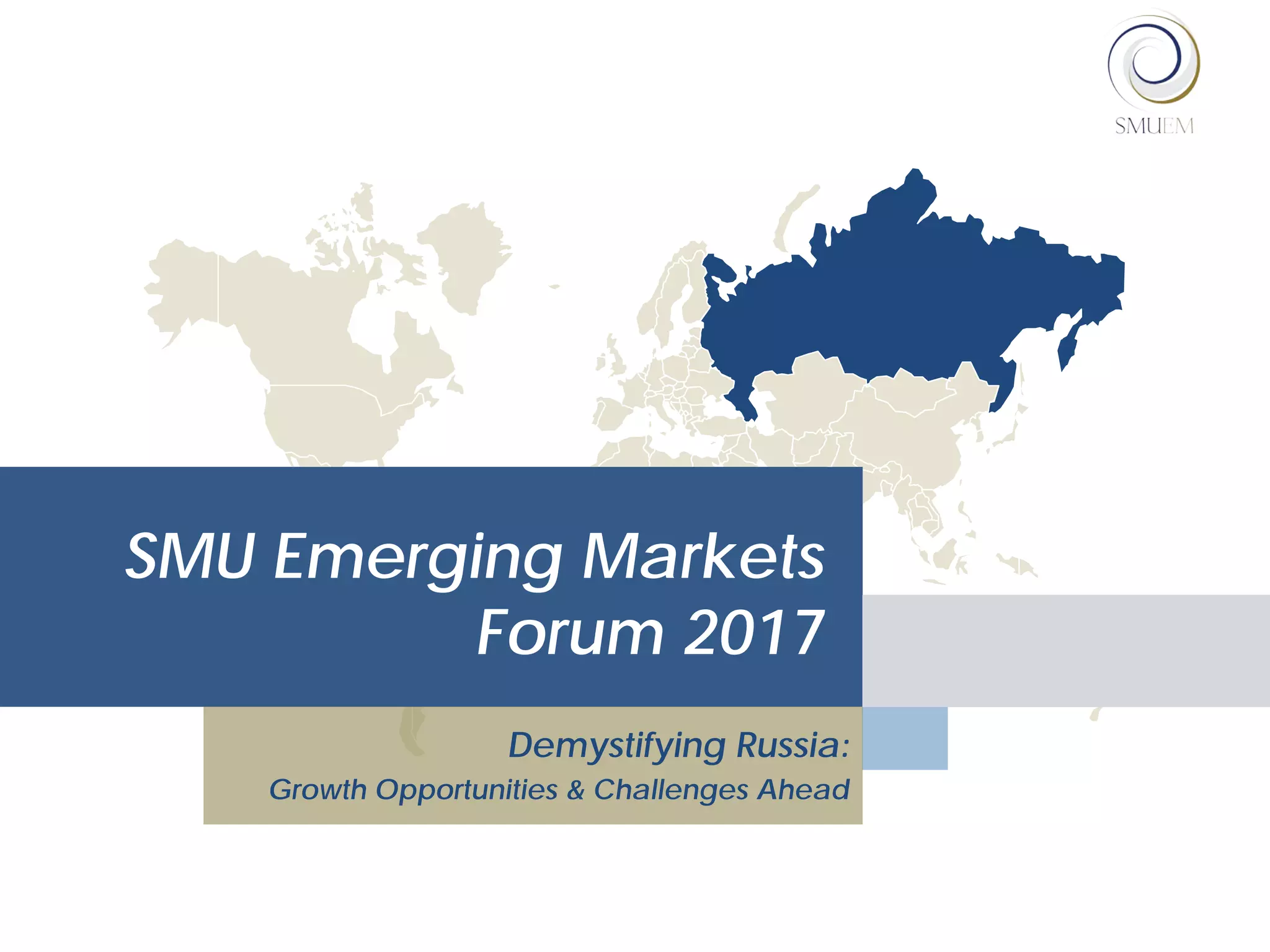
SMU Emerging Markets
Forum 2017
Demystifying Russia:
Growth Opportunities & Challenges Ahead
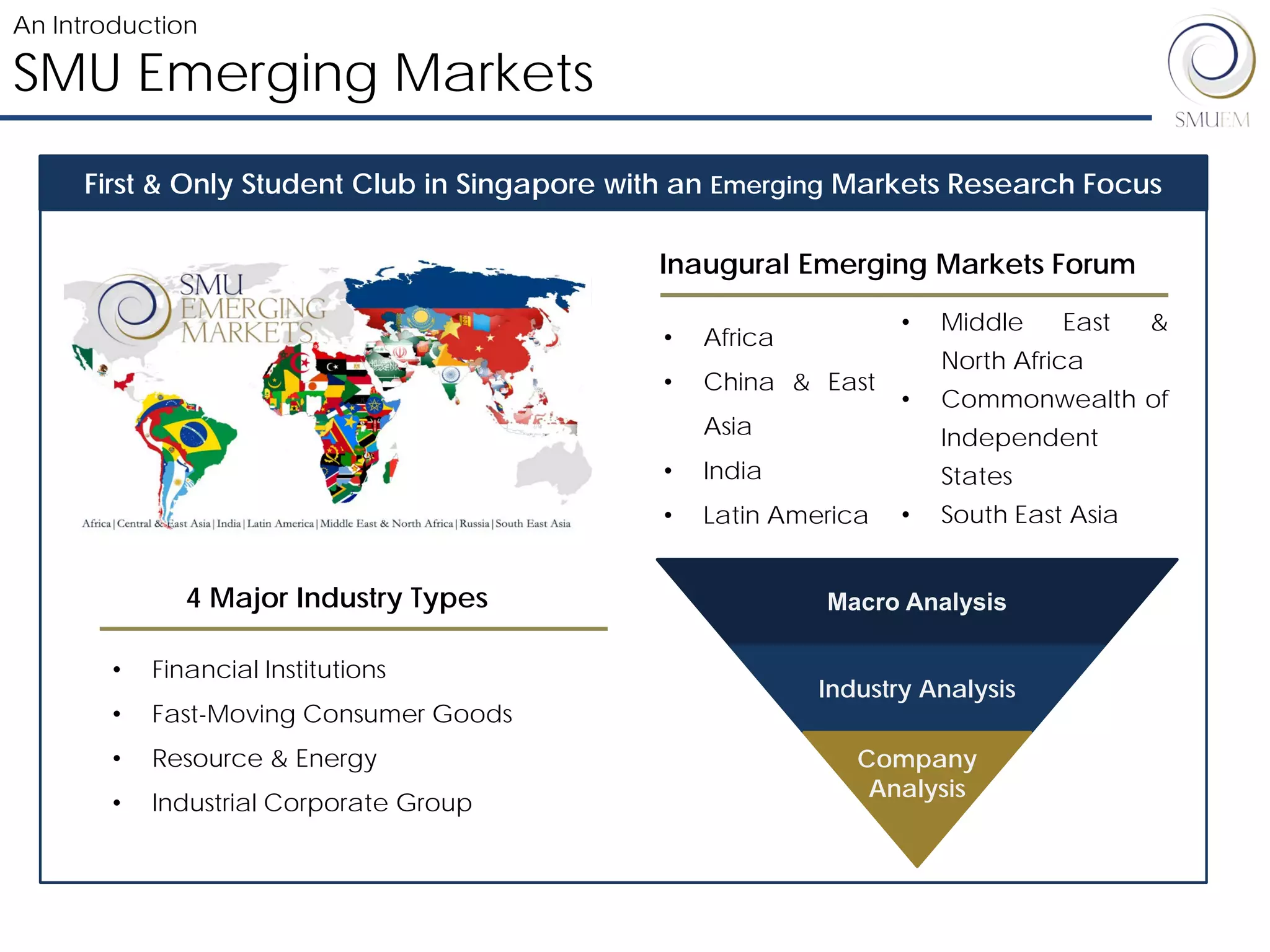
SMU Emerging Markets
An Introduction
First & Only Student Club in Singapore with an Emerging Markets Research Focus
Inaugural Emerging Markets Forum
• Africa
• China & East
Asia
• India
• Latin America
• Middle East &
North Africa
• Commonwealth of
Independent
States
• South East Asia
Macro Analysis
Industry Analysis
Company
Analysis
4 Major Industry Types
• Financial Institutions
• Fast-Moving Consumer Goods
• Resource & Energy
• Industrial Corporate Group
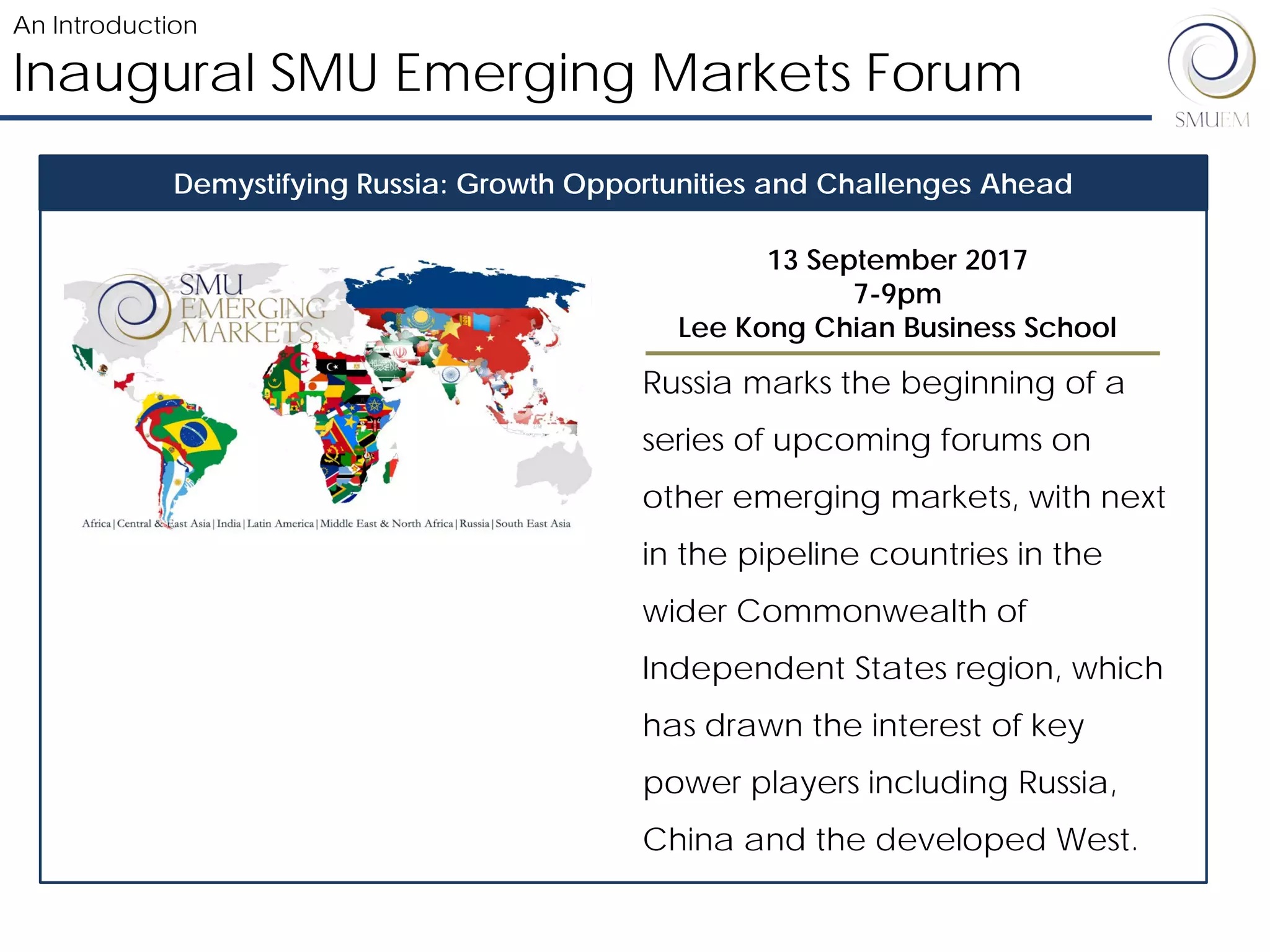
Russia marks the beginning of a
series of upcoming forums on
other emerging markets, with next
in the pipeline countries in the
wider Commonwealth of
Independent States region, which
has drawn the interest of key
power players including Russia,
China and the developed West.
Inaugural SMU Emerging Markets Forum
An Introduction
Demystifying Russia: Growth Opportunities and Challenges Ahead
13 September 2017
7-9pm
Lee Kong Chian Business School
Inaugural Emerging Markets Forum 2017
DEMYSTIFYING :
Growth Opportunities and
Challenges Ahead
13 September 2017
by Gwyneth Tan
Legal statements
While all reasonable care and good faith had been exercised to the best of the reasonable ability and
experience of the author in the preparation of the materials contained in this presentation, the intended
audience contemplated for receipt of these materials are assumed to possess reasonable experience and
ability in interpreting economic, political and business news, information and trends.
All sources quoted in these materials have been given due citations and acknowledgements where they
appear. The author neither makes nor purports to make nor implies any claim of any kind of property or
influence to any part of these sources and is not responsible for the accuracy, veracity or reliability of
any part of these sources. All interpretation of these sources belong to the author who makes these
interpretations under the best reasonable exercise of ability, experience, effort and care based on the
extent of the knowledge and exposure of the author to the subject matter and are independent of and not
the property of the sources quoted. All parts of these materials which are not the property of any source
are the intellectual property of the author and shall not be reproduced or quoted or disseminated without
her prior approval.
The author neither makes nor purports to make nor implies any representation or warranty of any kind in
any way as to the accuracy, veracity or reliability of any part of these materials. Recipients of these
materials are strongly advised to conduct their independent research, checks, verifications,
investigations or due diligence and/or engage proper professional advice whether legal or not, prior to
acting on any part of these materials. No recipient shall in turn make, purport to make or imply any
representation or warranty of any kind in any way to any party as to the accuracy, veracity or reliability of
any part of these materials.
The author shall not be liable for any claim or damage of any kind suffered by any party demanding such
on grounds of reliance on any part of these materials. All rights are reserved by the author without
prejudice to any legal or equitable right or recourse available to the author under the fullest extent of the
applicable law or equity.
About the speaker
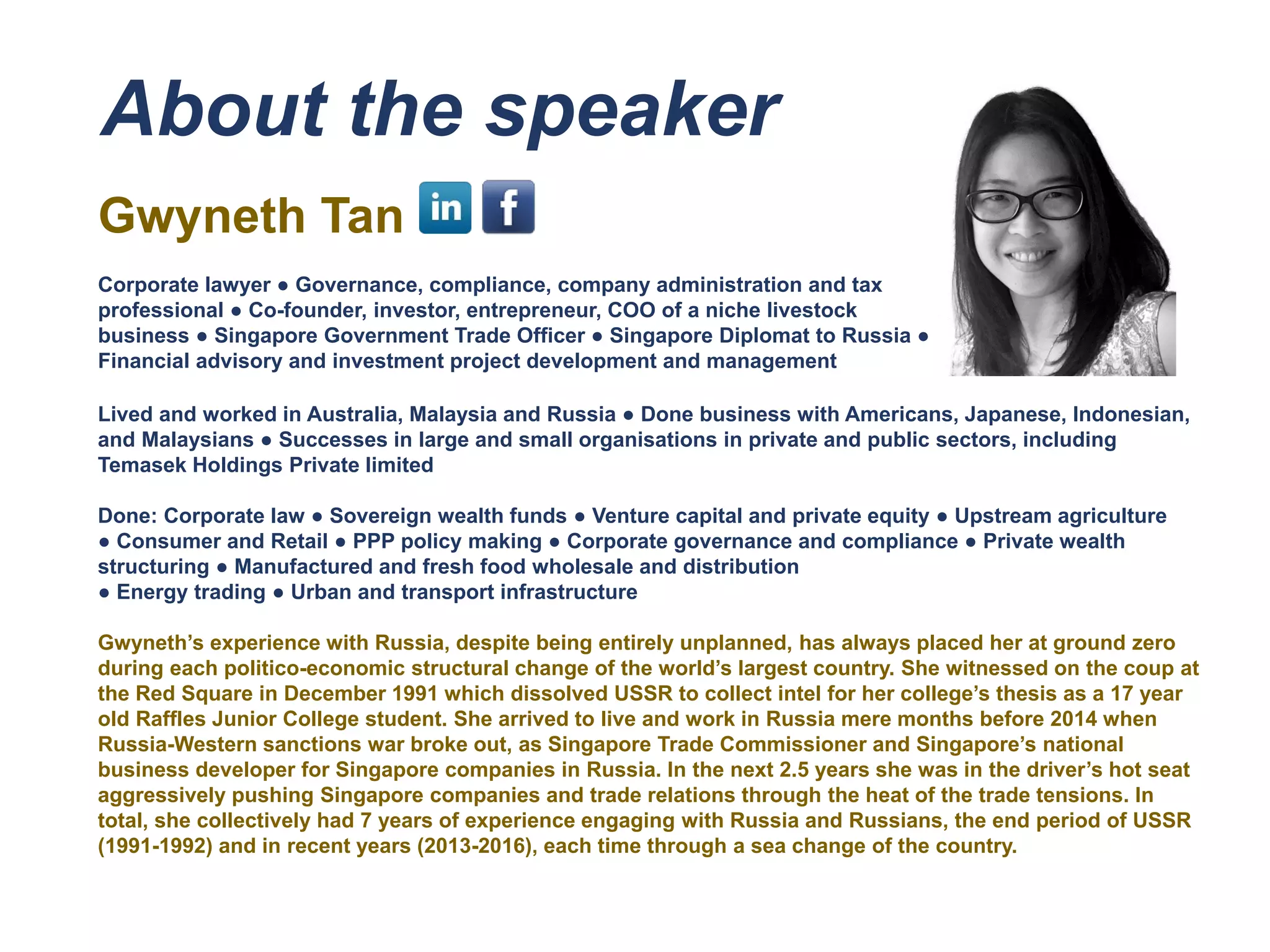
Gwyneth Tan
Corporate lawyer ● Governance, compliance, company administration and tax
professional ● Co-founder, investor, entrepreneur, COO of a niche livestock
business ● Singapore Government Trade Officer ● Singapore Diplomat to Russia ●
Financial advisory and investment project development and management
Lived and worked in Australia, Malaysia and Russia ● Done business with Americans, Japanese, Indonesian,
and Malaysians ● Successes in large and small organisations in private and public sectors, including
Temasek Holdings Private limited
Done: Corporate law ● Sovereign wealth funds ● Venture capital and private equity ● Upstream agriculture
● Consumer and Retail ● PPP policy making ● Corporate governance and compliance ● Private wealth
structuring ● Manufactured and fresh food wholesale and distribution
● Energy trading ● Urban and transport infrastructure
Gwyneth’s experience with Russia, despite being entirely unplanned, has always placed her at ground zero
during each politico-economic structural change of the world’s largest country. She witnessed on the coup at
the Red Square in December 1991 which dissolved USSR to collect intel for her college’s thesis as a 17 year
old Raffles Junior College student. She arrived to live and work in Russia mere months before 2014 when
Russia-Western sanctions war broke out, as Singapore Trade Commissioner and Singapore’s national
business developer for Singapore companies in Russia. In the next 2.5 years she was in the driver’s hot seat
aggressively pushing Singapore companies and trade relations through the heat of the trade tensions. In
total, she collectively had 7 years of experience engaging with Russia and Russians, the end period of USSR
(1991-1992) and in recent years (2013-2016), each time through a sea change of the country.
About the panellists
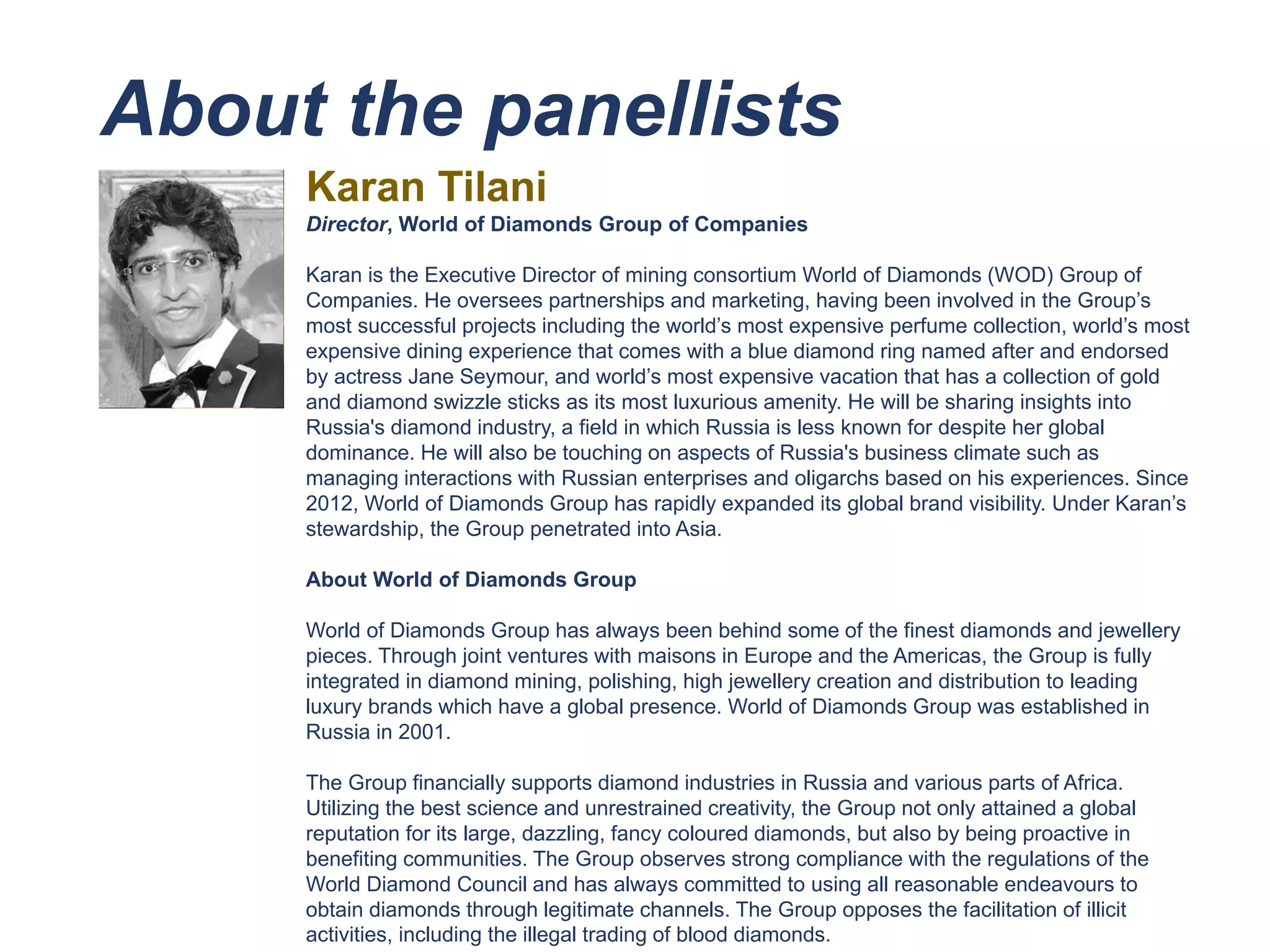
Karan Tilani
Director, World of Diamonds Group of Companies
Karan is the Executive Director of mining consortium World of Diamonds (WOD) Group of
Companies. He oversees partnerships and marketing, having been involved in the Group’s
most successful projects including the world’s most expensive perfume collection, world’s most
expensive dining experience that comes with a blue diamond ring named after and endorsed
by actress Jane Seymour, and world’s most expensive vacation that has a collection of gold
and diamond swizzle sticks as its most luxurious amenity. He will be sharing insights into
Russia's diamond industry, a field in which Russia is less known for despite her global
dominance. He will also be touching on aspects of Russia's business climate such as
managing interactions with Russian enterprises and oligarchs based on his experiences. Since
2012, World of Diamonds Group has rapidly expanded its global brand visibility. Under Karan’s
stewardship, the Group penetrated into Asia.
About World of Diamonds Group
World of Diamonds Group has always been behind some of the finest diamonds and jewellery
pieces. Through joint ventures with maisons in Europe and the Americas, the Group is fully
integrated in diamond mining, polishing, high jewellery creation and distribution to leading
luxury brands which have a global presence. World of Diamonds Group was established in
Russia in 2001.
The Group financially supports diamond industries in Russia and various parts of Africa.
Utilizing the best science and unrestrained creativity, the Group not only attained a global
reputation for its large, dazzling, fancy coloured diamonds, but also by being proactive in
benefiting communities. The Group observes strong compliance with the regulations of the
World Diamond Council and has always committed to using all reasonable endeavours to
obtain diamonds through legitimate channels. The Group opposes the facilitation of illicit
activities, including the illegal trading of blood diamonds.
About the panellists
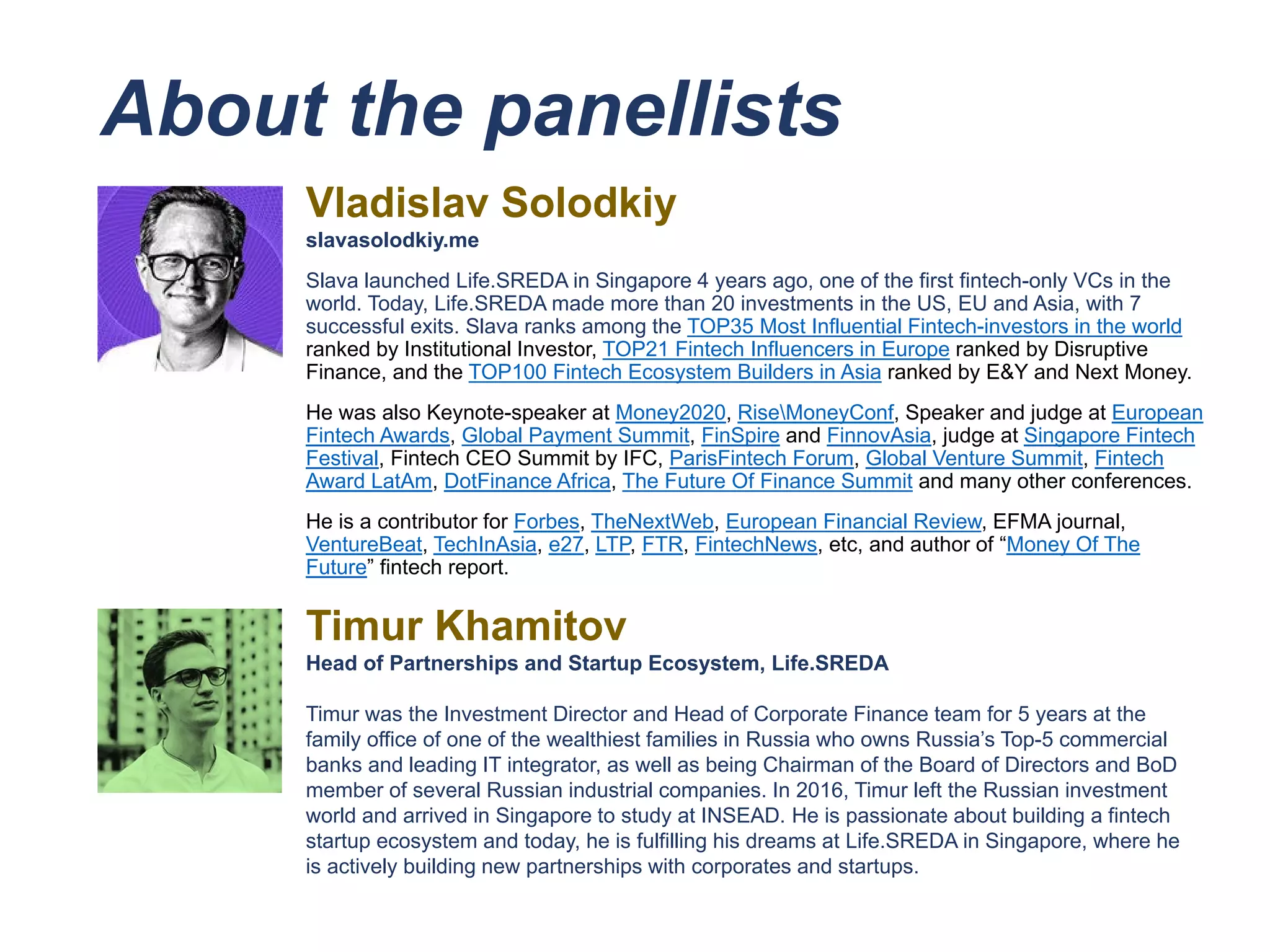
Vladislav Solodkiy
slavasolodkiy.me
Slava launched Life.SREDA in Singapore 4 years ago, one of the first fintech-only VCs in the
world. Today, Life.SREDA made more than 20 investments in the US, EU and Asia, with 7
successful exits. Slava ranks among the TOP35 Most Influential Fintech-investors in the world
ranked by Institutional Investor, TOP21 Fintech Influencers in Europe ranked by Disruptive
Finance, and the TOP100 Fintech Ecosystem Builders in Asia ranked by E&Y and Next Money.
He was also Keynote-speaker at Money2020, RiseMoneyConf, Speaker and judge at European
Fintech Awards, Global Payment Summit, FinSpire and FinnovAsia, judge at Singapore Fintech
Festival, Fintech CEO Summit by IFC, ParisFintech Forum, Global Venture Summit, Fintech
Award LatAm, DotFinance Africa, The Future Of Finance Summit and many other conferences.
He is a contributor for Forbes, TheNextWeb, European Financial Review, EFMA journal,
VentureBeat, TechInAsia, e27, LTP, FTR, FintechNews, etc, and author of “Money Of The
Future” fintech report.
Timur Khamitov
Head of Partnerships and Startup Ecosystem, Life.SREDA
Timur was the Investment Director and Head of Corporate Finance team for 5 years at the
family office of one of the wealthiest families in Russia who owns Russia’s Top-5 commercial
banks and leading IT integrator, as well as being Chairman of the Board of Directors and BoD
member of several Russian industrial companies. In 2016, Timur left the Russian investment
world and arrived in Singapore to study at INSEAD. He is passionate about building a fintech
startup ecosystem and today, he is fulfilling his dreams at Life.SREDA in Singapore, where he
is actively building new partnerships with corporates and startups.
Acknowledgement
The speaker thanks the following individuals whose publications were
consulted during the preparation of these materials:
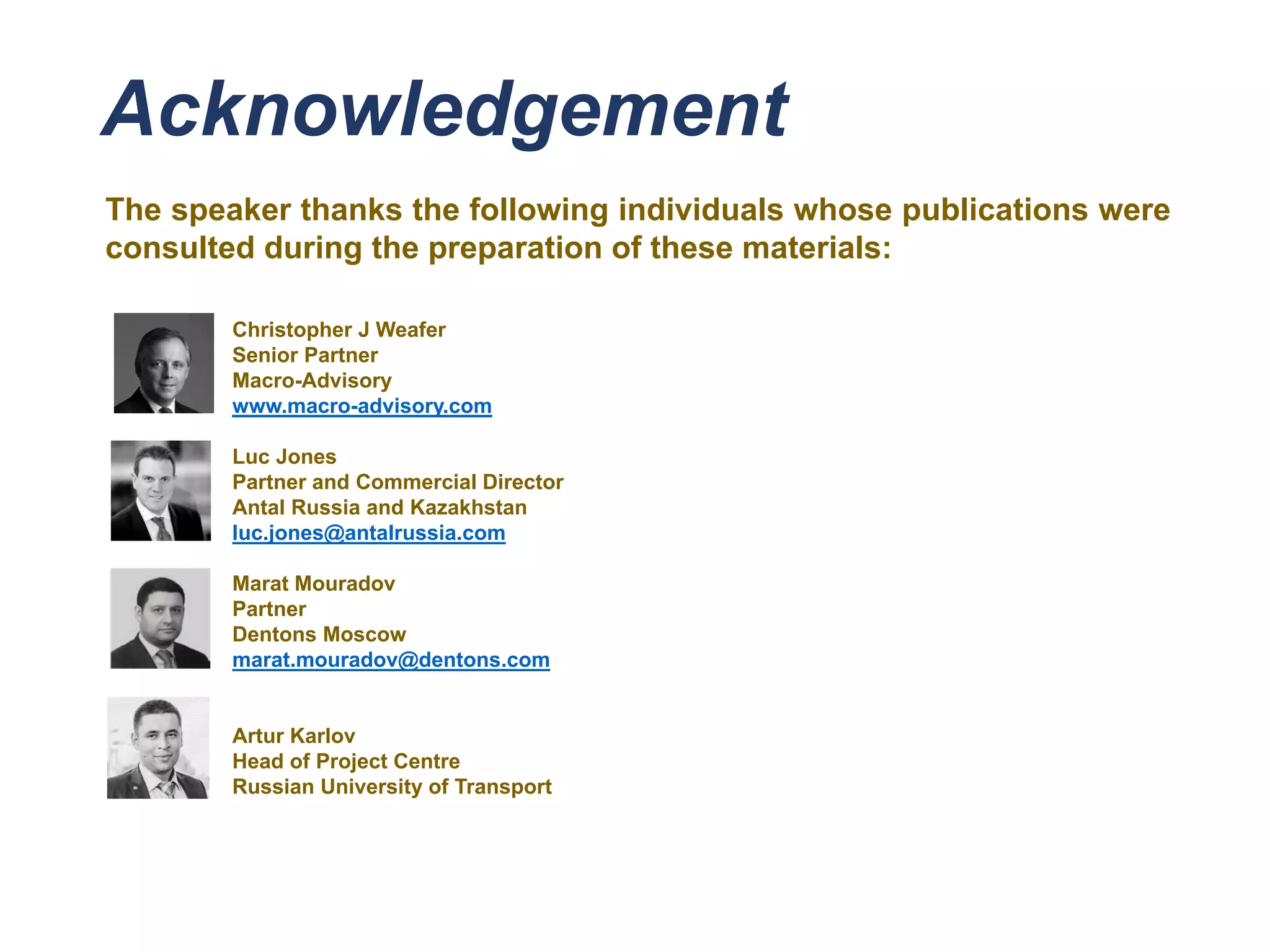
Christopher J Weafer
Senior Partner
Macro-Advisory
www.macro-advisory.com
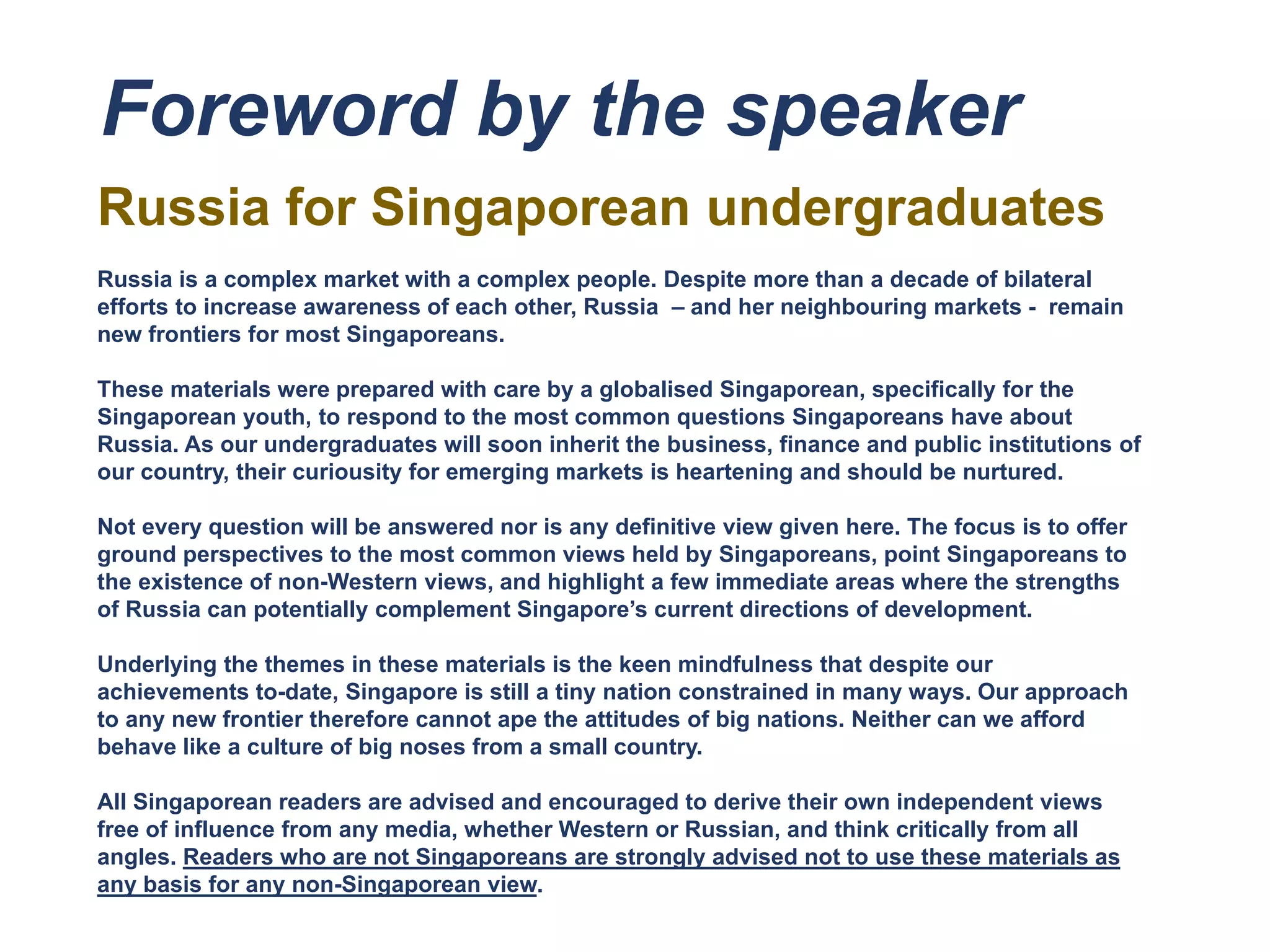
Luc Jones
Partner and Commercial Director
Antal Russia and Kazakhstan
luc.jones@antalrussia.com
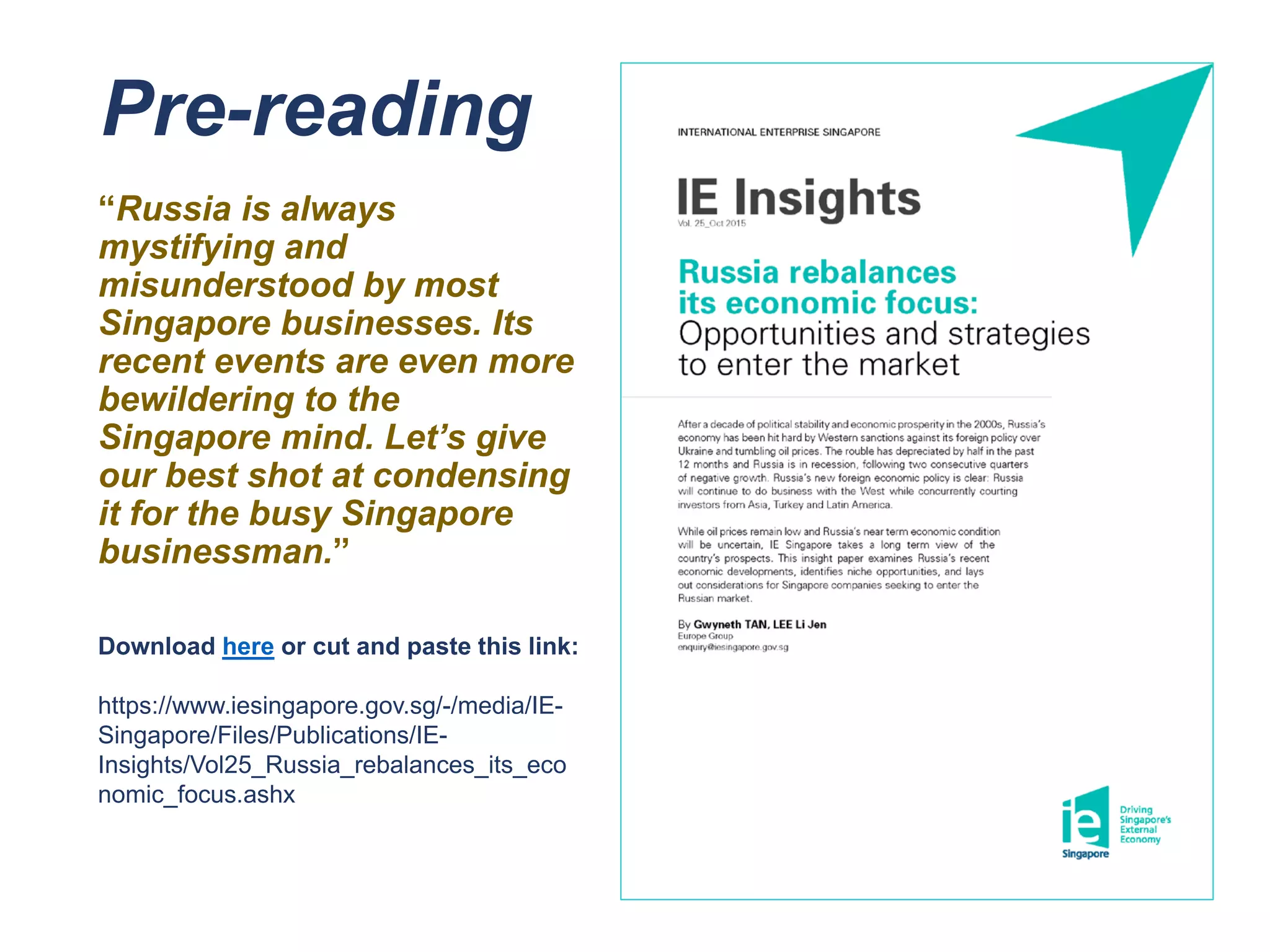
Marat Mouradov
Partner
Dentons Moscow
marat.mouradov@dentons.com
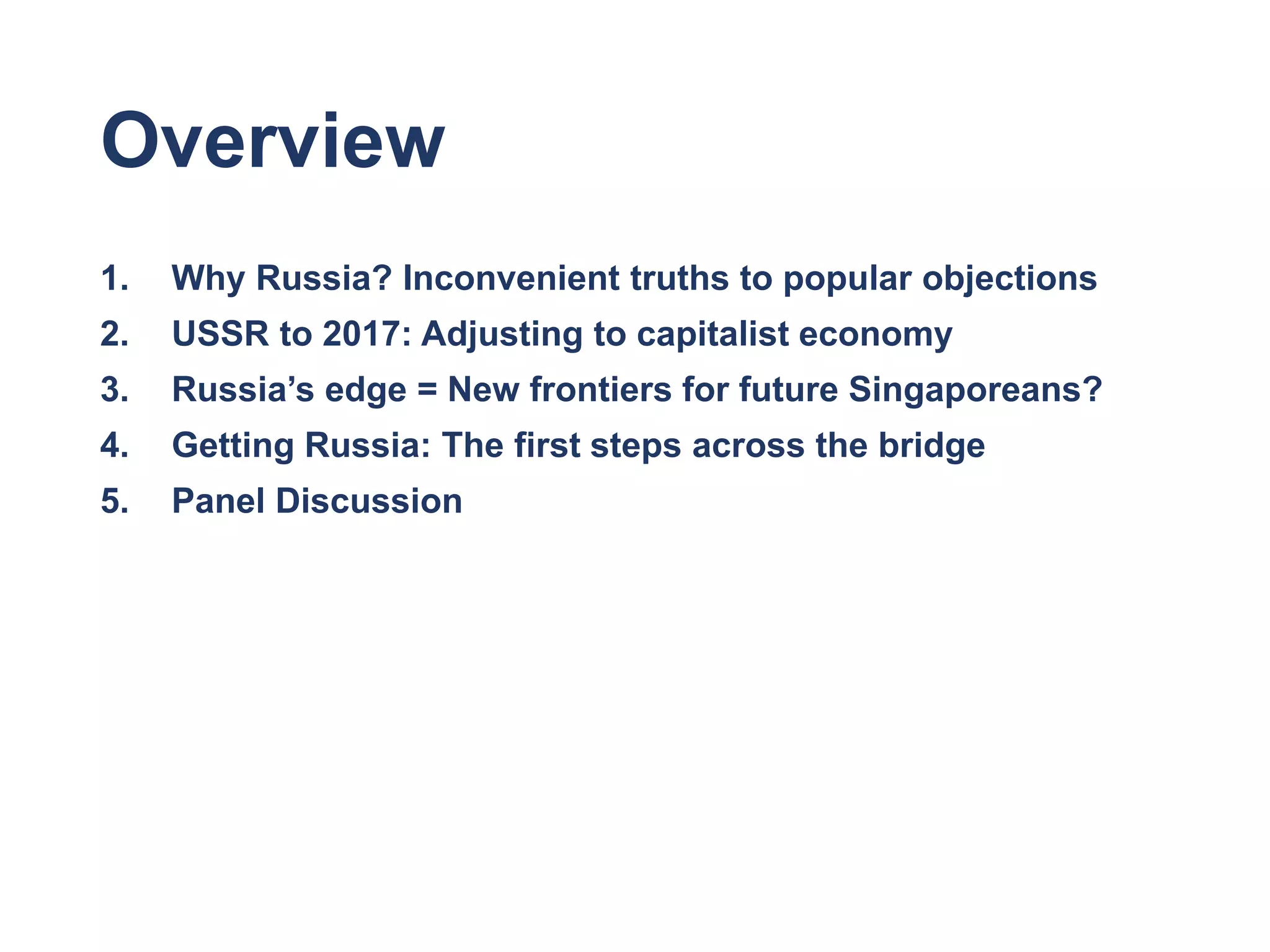
Artur Karlov
Head of Project Centre
Russian University of Transport
Foreword by the speaker
Russia for Singaporean undergraduates
Russia is a complex market with a complex people. Despite more than a decade of bilateral
efforts to increase awareness of each other, Russia – and her neighbouring markets - remain
new frontiers for most Singaporeans.
These materials were prepared with care by a globalised Singaporean, specifically for the
Singaporean youth, to respond to the most common questions Singaporeans have about
Russia. As our undergraduates will soon inherit the business, finance and public institutions of
our country, their curiousity for emerging markets is heartening and should be nurtured.
Not every question will be answered nor is any definitive view given here. The focus is to offer
ground perspectives to the most common views held by Singaporeans, point Singaporeans to
the existence of non-Western views, and highlight a few immediate areas where the strengths
of Russia can potentially complement Singapore’s current directions of development.
Underlying the themes in these materials is the keen mindfulness that despite our
achievements to-date, Singapore is still a tiny nation constrained in many ways. Our approach
to any new frontier therefore cannot ape the attitudes of big nations. Neither can we afford
behave like a culture of big noses from a small country.
All Singaporean readers are advised and encouraged to derive their own independent views
free of influence from any media, whether Western or Russian, and think critically from all
angles. Readers who are not Singaporeans are strongly advised not to use these materials as
any basis for any non-Singaporean view.
Pre-reading
“Russia is always
mystifying and
misunderstood by most
Singapore businesses. Its
recent events are even more
bewildering to the
Singapore mind. Let’s give
our best shot at condensing
it for the busy Singapore
businessman.”
Download here or cut and paste this link:
https://www.iesingapore.gov.sg/-/media/IE-
Singapore/Files/Publications/IE-
Insights/Vol25_Russia_rebalances_its_eco
nomic_focus.ashx
Overview
1. Why Russia? Inconvenient truths to popular objections
2. USSR to 2017: Adjusting to capitalist economy
3. Russia’s edge = New frontiers for future Singaporeans?
4. Getting Russia: The first steps across the bridge
5. Panel Discussion
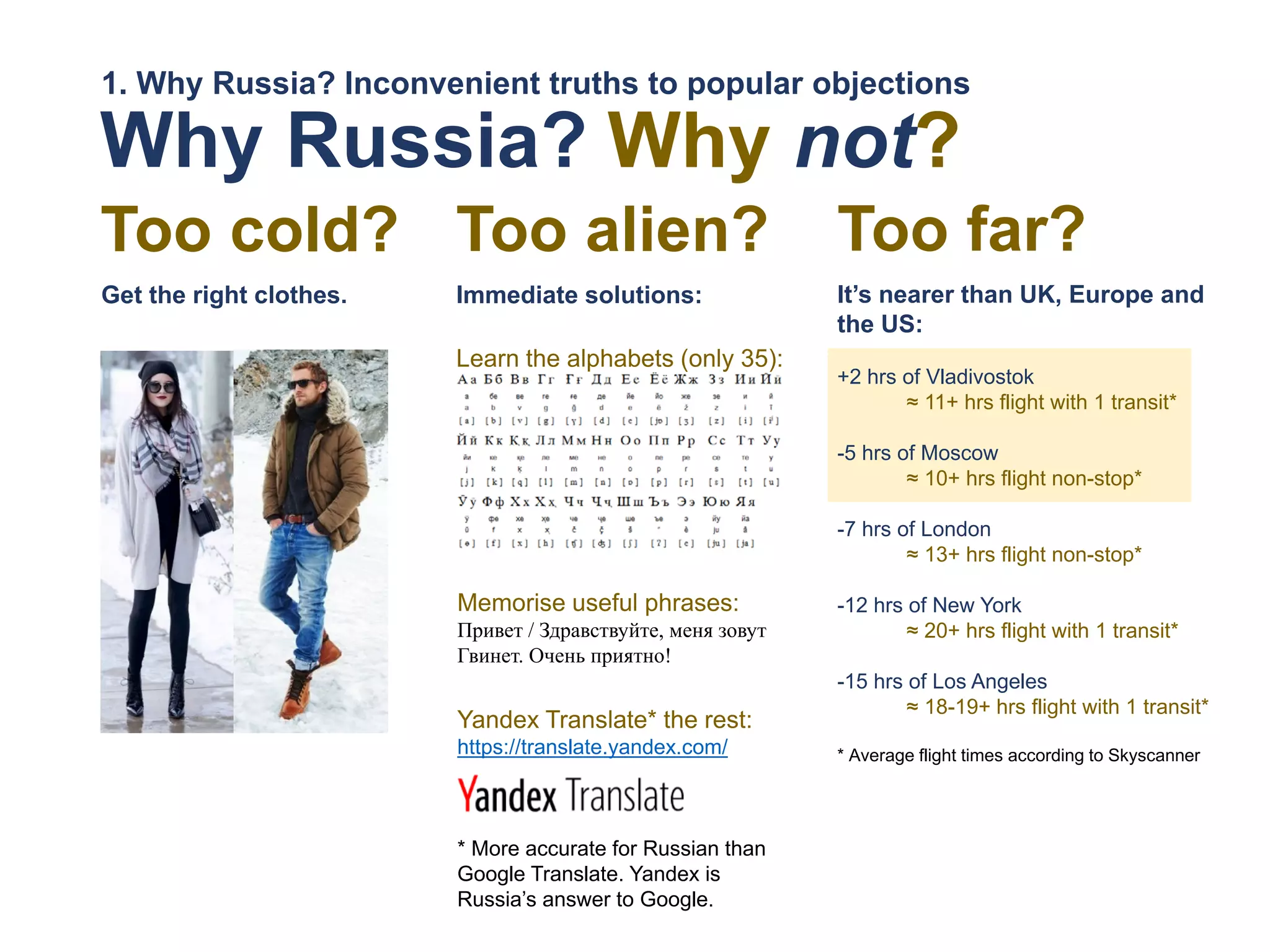
It’s nearer than UK, Europe and
the US:
+2 hrs of Vladivostok
≈ 11+ hrs flight with 1 transit*
-5 hrs of Moscow
≈ 10+ hrs flight non-stop*
-7 hrs of London
≈ 13+ hrs flight non-stop*
-12 hrs of New York
≈ 20+ hrs flight with 1 transit*
-15 hrs of Los Angeles
≈ 18-19+ hrs flight with 1 transit*
* Average flight times according to Skyscanner
Yandex Translate* the rest:
https://translate.yandex.com/
* More accurate for Russian than
Google Translate. Yandex is
Russia’s answer to Google.
Memorise useful phrases:
Привет / Здравствуйте, меня зовут
Гвинет. Очень приятно!
Immediate solutions:
Learn the alphabets (only 35):
Get the right clothes.
Why Russia?
Too cold? Too alien? Too far?
Why not?
1. Why Russia? Inconvenient truths to popular objections
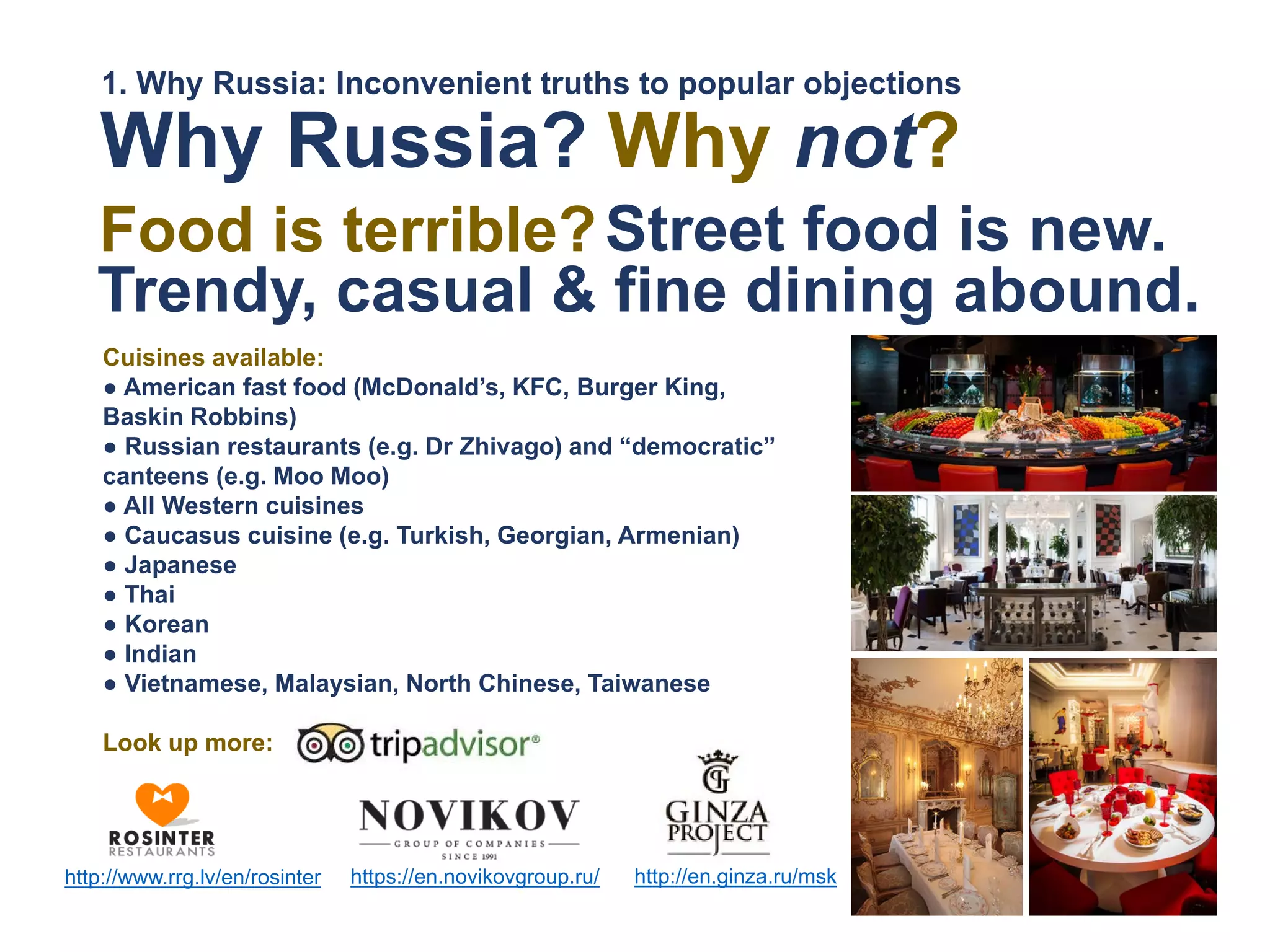
Cuisines available:
● American fast food (McDonald’s, KFC, Burger King,
Baskin Robbins)
● Russian restaurants (e.g. Dr Zhivago) and “democratic”
canteens (e.g. Moo Moo)
● All Western cuisines
● Caucasus cuisine (e.g. Turkish, Georgian, Armenian)
● Japanese
● Thai
● Korean
● Indian
● Vietnamese, Malaysian, North Chinese, Taiwanese
Look up more:
https://en.novikovgroup.ru/http://www.rrg.lv/en/rosinter http://en.ginza.ru/msk
Street food is new.
Trendy, casual & fine dining abound.
Why Russia?
Food is terrible?
Why not?
1. Why Russia: Inconvenient truths to popular objections
Why Russia? Why not?
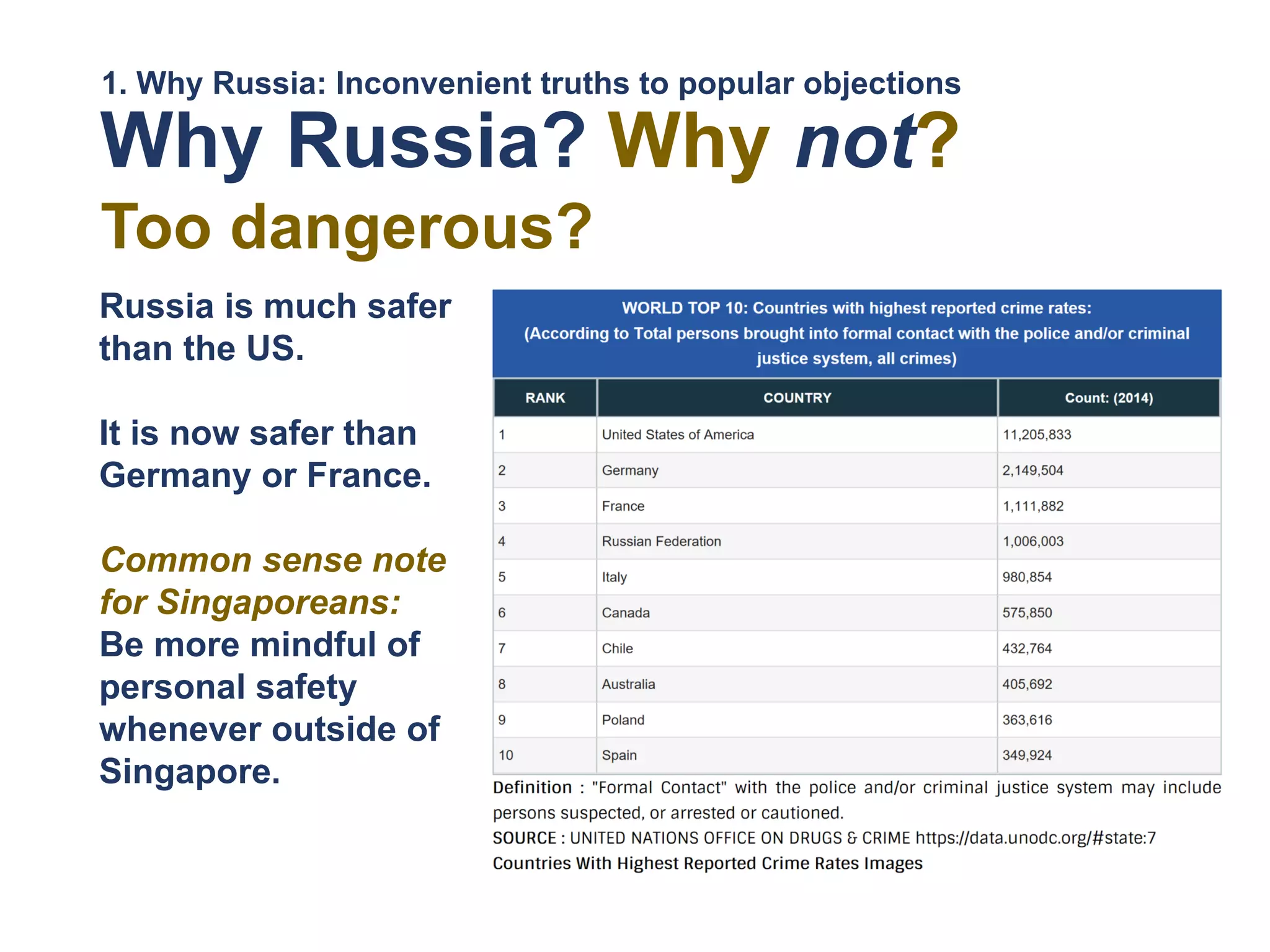
Russia is much safer
than the US.
It is now safer than
Germany or France.
Common sense note
for Singaporeans:
Be more mindful of
personal safety
whenever outside of
Singapore.
Too dangerous?
1. Why Russia: Inconvenient truths to popular objections
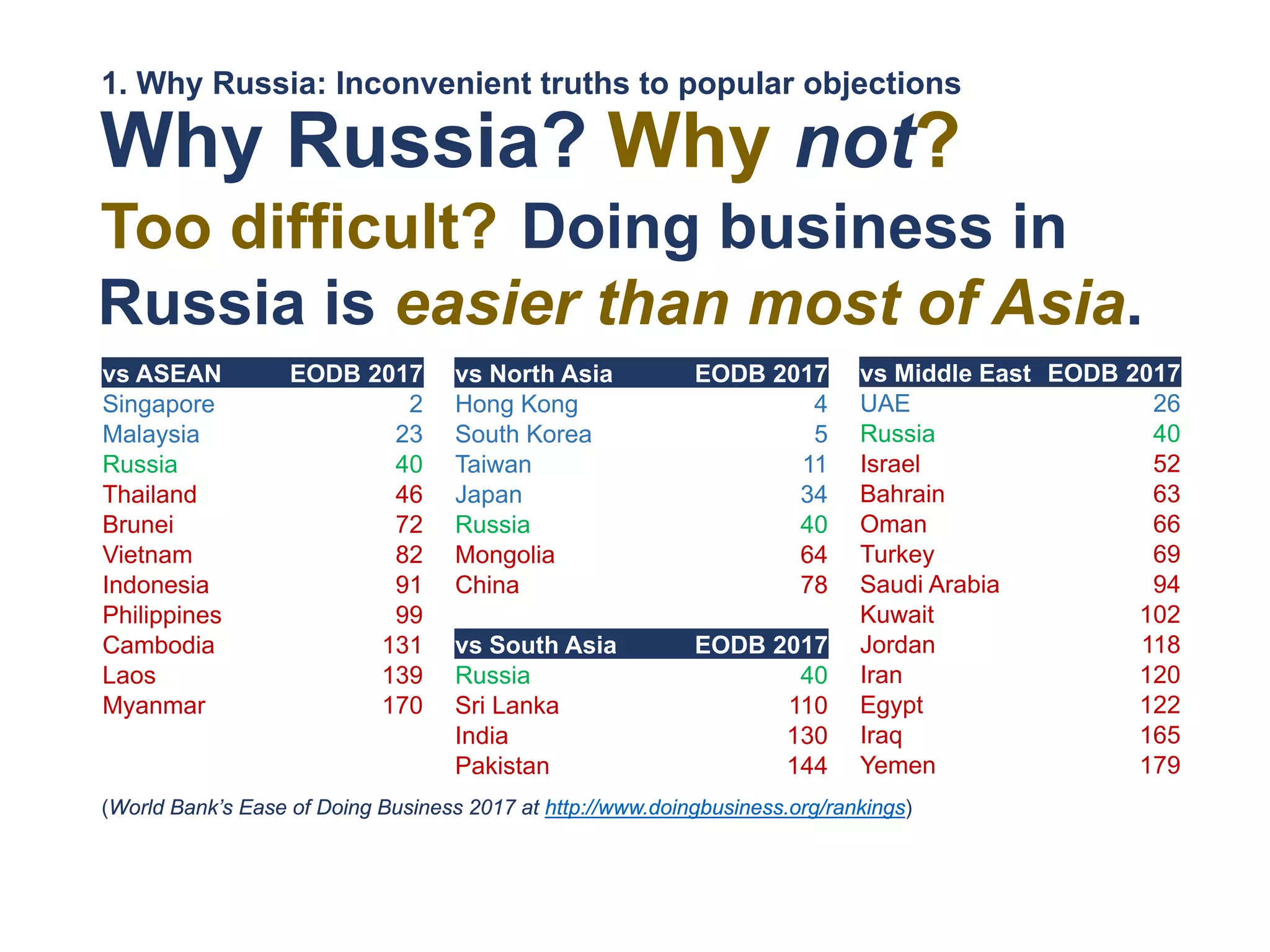
Doing business in
Russia is easier than most of Asia.
Why Russia?
Too difficult?
vs ASEAN EODB 2017
Singapore 2
Malaysia 23
Russia 40
Thailand 46
Brunei 72
Vietnam 82
Indonesia 91
Philippines 99
Cambodia 131
Laos 139
Myanmar 170
vs North Asia EODB 2017
Hong Kong 4
South Korea 5
Taiwan 11
Japan 34
Russia 40
Mongolia 64
China 78
vs South Asia EODB 2017
Russia 40
Sri Lanka 110
India 130
Pakistan 144
vs Middle East EODB 2017
UAE 26
Russia 40
Israel 52
Bahrain 63
Oman 66
Turkey 69
Saudi Arabia 94
Kuwait 102
Jordan 118
Iran 120
Egypt 122
Iraq 165
Yemen 179
(World Bank’s Ease of Doing Business 2017 at http://www.doingbusiness.org/rankings)
Why not?
1. Why Russia: Inconvenient truths to popular objections
Why Russia?
1. Why Russia: Inconvenient truths to popular objections
Why not?
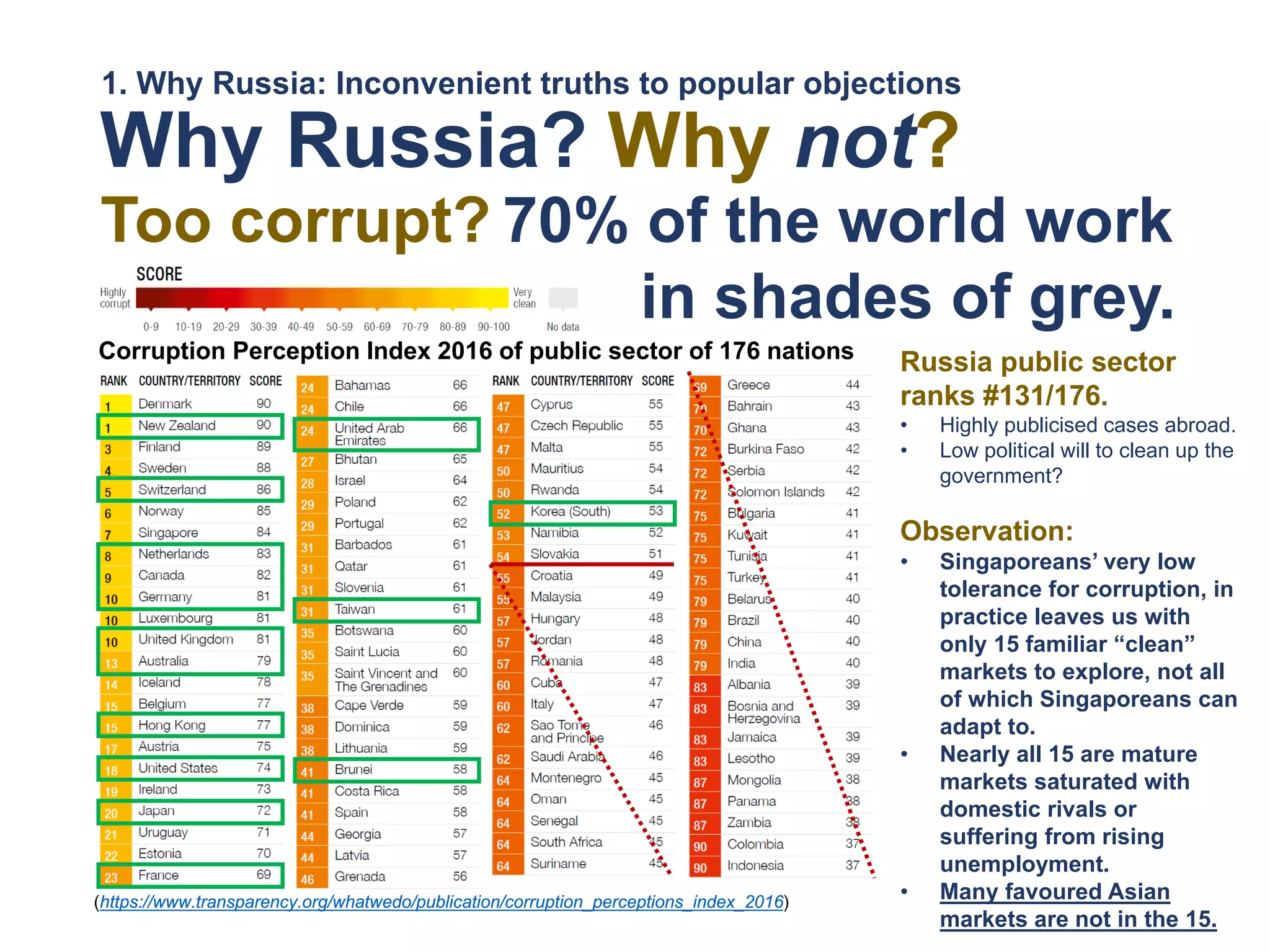
Russia public sector
ranks #131/176.
• Highly publicised cases abroad.
• Low political will to clean up the
government?
Observation:
• Singaporeans’ very low
tolerance for corruption, in
practice leaves us with
only 15 familiar “clean”
markets to explore, not all
of which Singaporeans can
adapt to.
• Nearly all 15 are mature
markets saturated with
domestic rivals or
suffering from rising
unemployment.
• Many favoured Asian
markets are not in the 15.
Corruption Perception Index 2016 of public sector of 176 nations
(https://www.transparency.org/whatwedo/publication/corruption_perceptions_index_2016)
Too corrupt? 70% of the world work
in shades of grey.
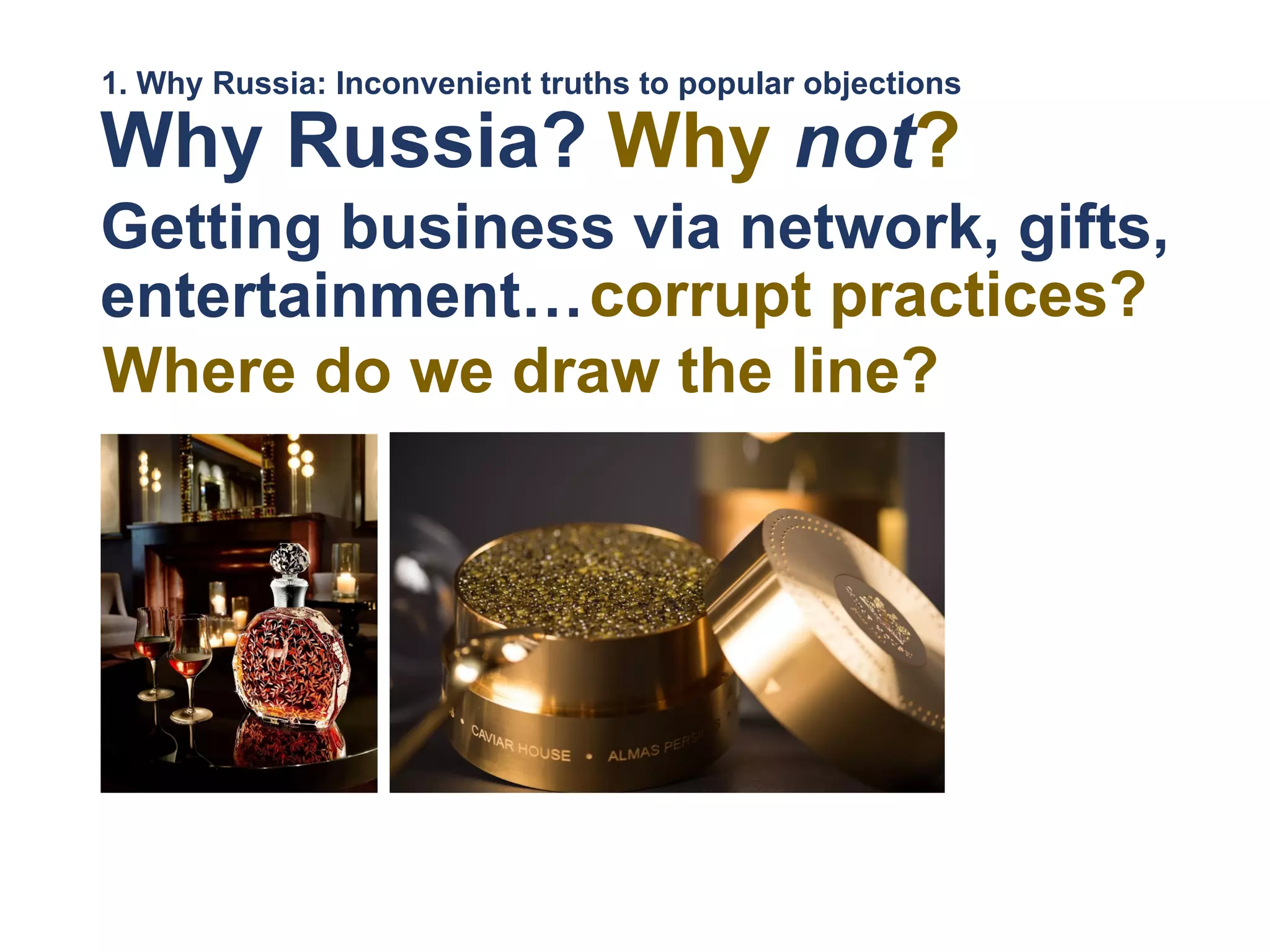
Getting business via network, gifts,
entertainment…
Why Russia?
1. Why Russia: Inconvenient truths to popular objections
Why not?
corrupt practices?
Where do we draw the line?
Why Russia?
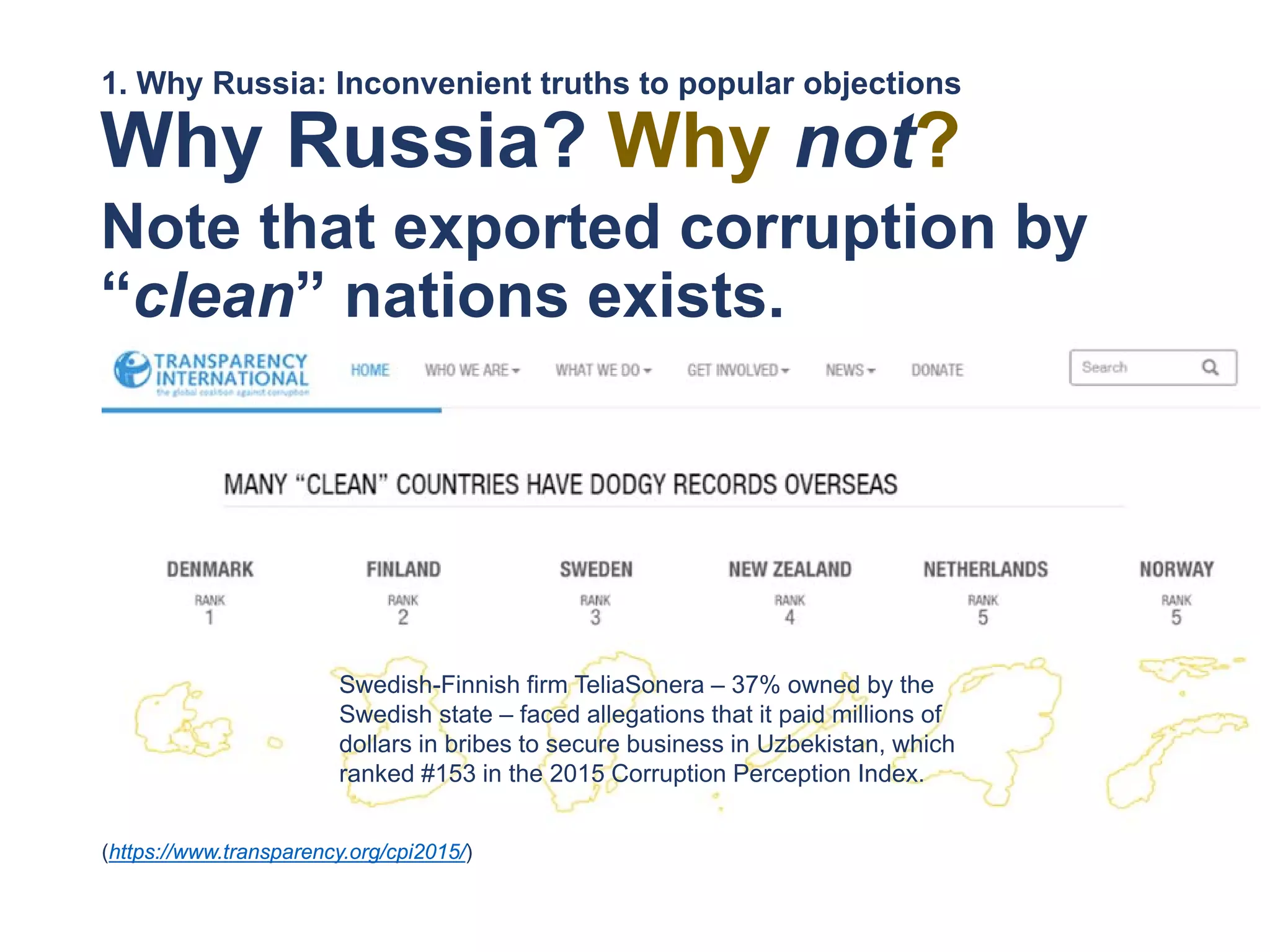
Note that exported corruption by
“clean” nations exists.
1. Why Russia: Inconvenient truths to popular objections
(https://www.transparency.org/cpi2015/)
Swedish-Finnish firm TeliaSonera – 37% owned by the
Swedish state – faced allegations that it paid millions of
dollars in bribes to secure business in Uzbekistan, which
ranked #153 in the 2015 Corruption Perception Index.
Why not?
In a nutshell…
1. Do more hype exist than facts?
2. Human nature fears the unknown.
3. Singapore’s economic, political and military
engagements with and in Russia are too small to
worry Russia’s rulers.
4. Do popular Western sentiments and opinions
about Russia align with Singaporeans’ identity as
a tiny, neutral nation of tolerant and pragmatic
people?
5. Corruption is inevitable when going global. How
sensitive or desensitised should Singaporeans be
to this reality?
1. Why Russia: Inconvenient truths to popular objections
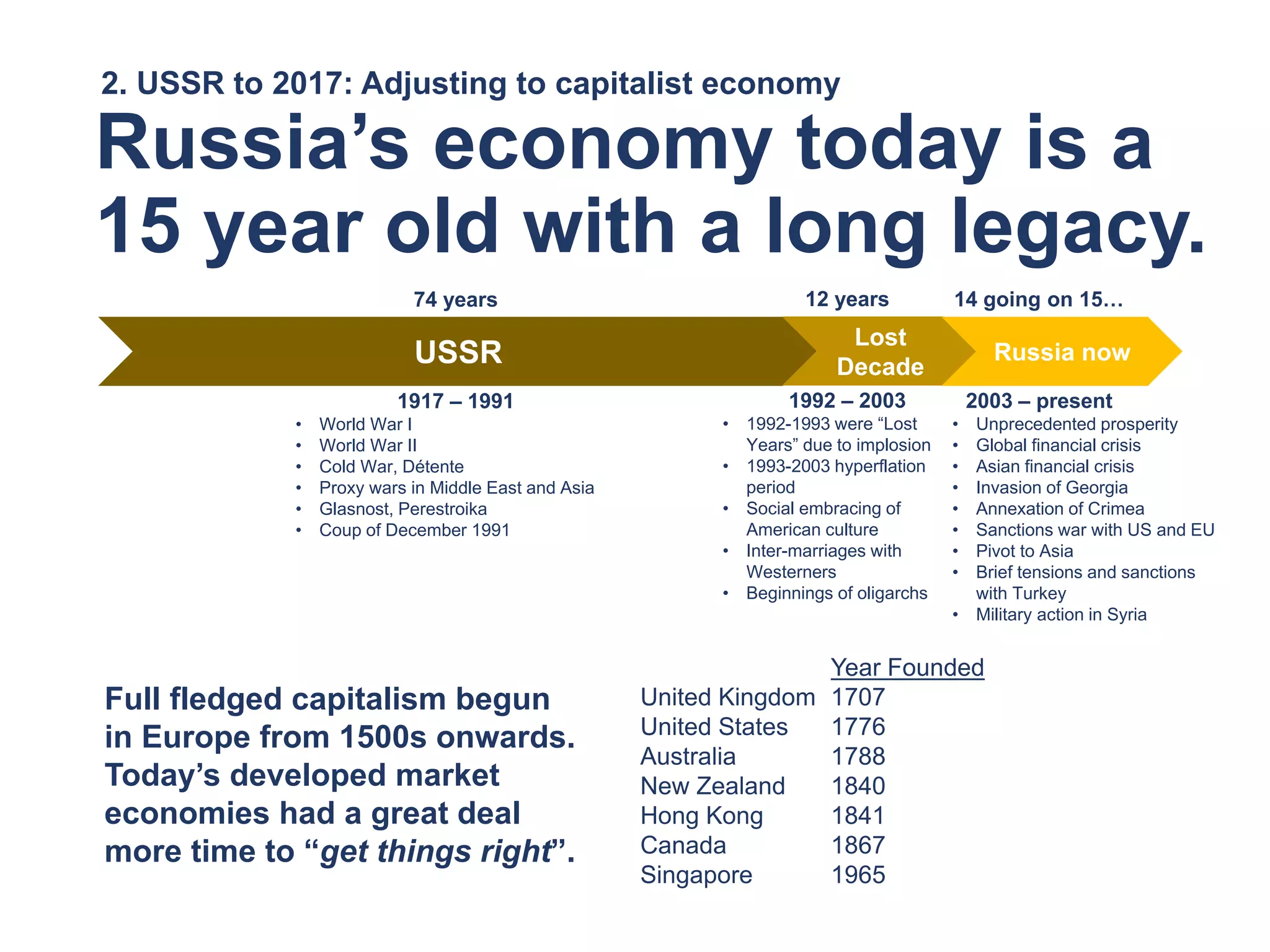
Russia’s economy today is a
15 year old with a long legacy.
2. USSR to 2017: Adjusting to capitalist economy
74 years
1917 – 1991
• World War I
• World War II
• Cold War, Détente
• Proxy wars in Middle East and Asia
• Glasnost, Perestroika
• Coup of December 1991
12 years
1992 – 2003
• 1992-1993 were “Lost
Years” due to implosion
• 1993-2003 hyperflation
period
• Social embracing of
American culture
• Inter-marriages with
Westerners
• Beginnings of oligarchs
14 going on 15…
2003 – present
• Unprecedented prosperity
• Global financial crisis
• Asian financial crisis
• Invasion of Georgia
• Annexation of Crimea
• Sanctions war with US and EU
• Pivot to Asia
• Brief tensions and sanctions
with Turkey
• Military action in Syria
USSR
Lost
Decade
Russia now
Full fledged capitalism begun
in Europe from 1500s onwards.
Today’s developed market
economies had a great deal
more time to “get things right”.
Year Founded
United Kingdom 1707
United States 1776
Australia 1788
New Zealand 1840
Hong Kong 1841
Canada 1867
Singapore 1965
2. USSR to 2017: Adjusting to capitalist economy
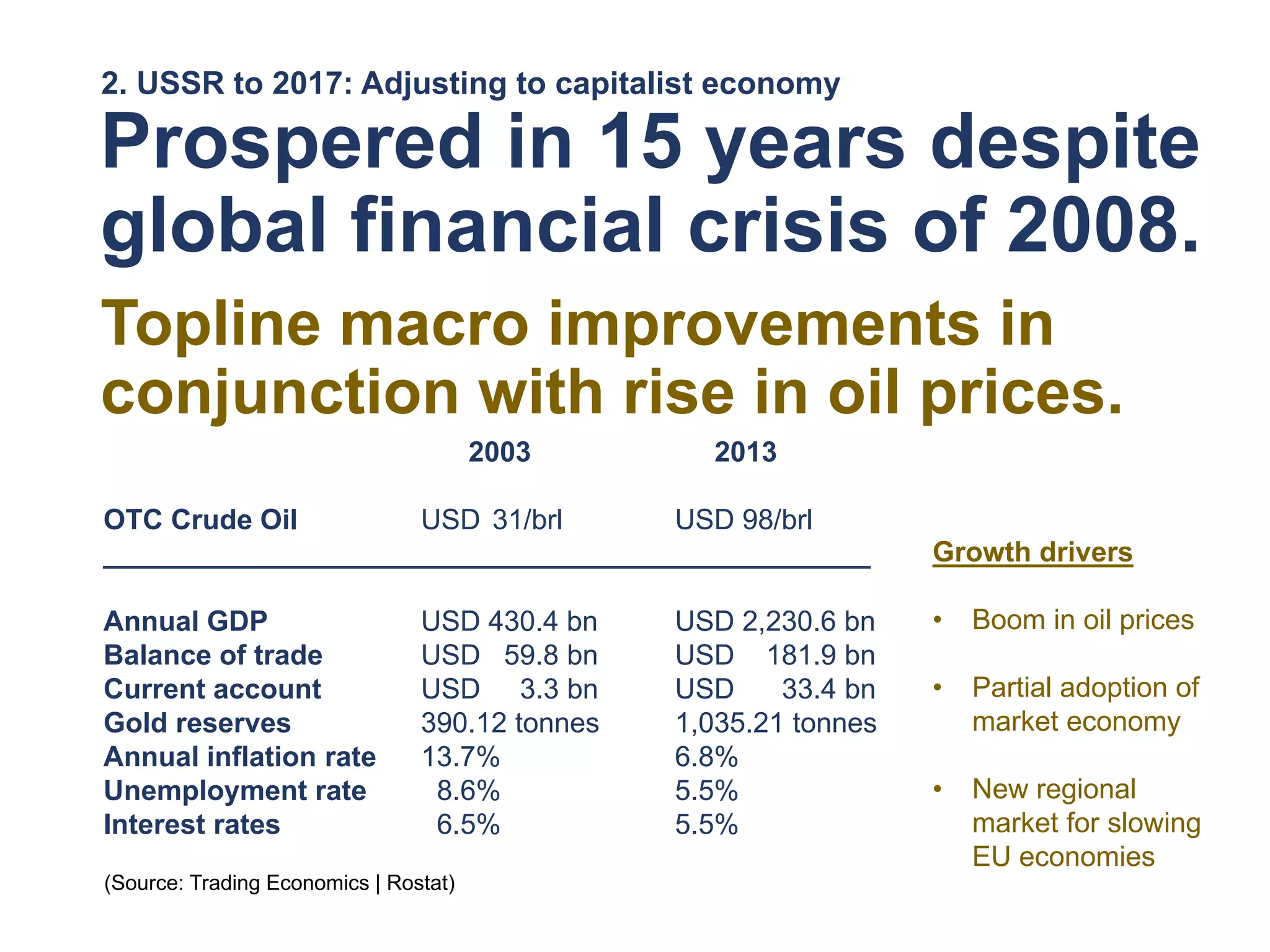
Prospered in 15 years despite
global financial crisis of 2008.
Topline macro improvements in
conjunction with rise in oil prices.
2003 2013
OTC Crude Oil USD 31/brl USD 98/brl
_________________________________________________
Annual GDP USD 430.4 bn USD 2,230.6 bn
Balance of trade USD 59.8 bn USD 181.9 bn
Current account USD 3.3 bn USD 33.4 bn
Gold reserves 390.12 tonnes 1,035.21 tonnes
Annual inflation rate 13.7% 6.8%
Unemployment rate 8.6% 5.5%
Interest rates 6.5% 5.5%
Growth drivers
• Boom in oil prices
• Partial adoption of
market economy
• New regional
market for slowing
EU economies
(Source: Trading Economics | Rostat)
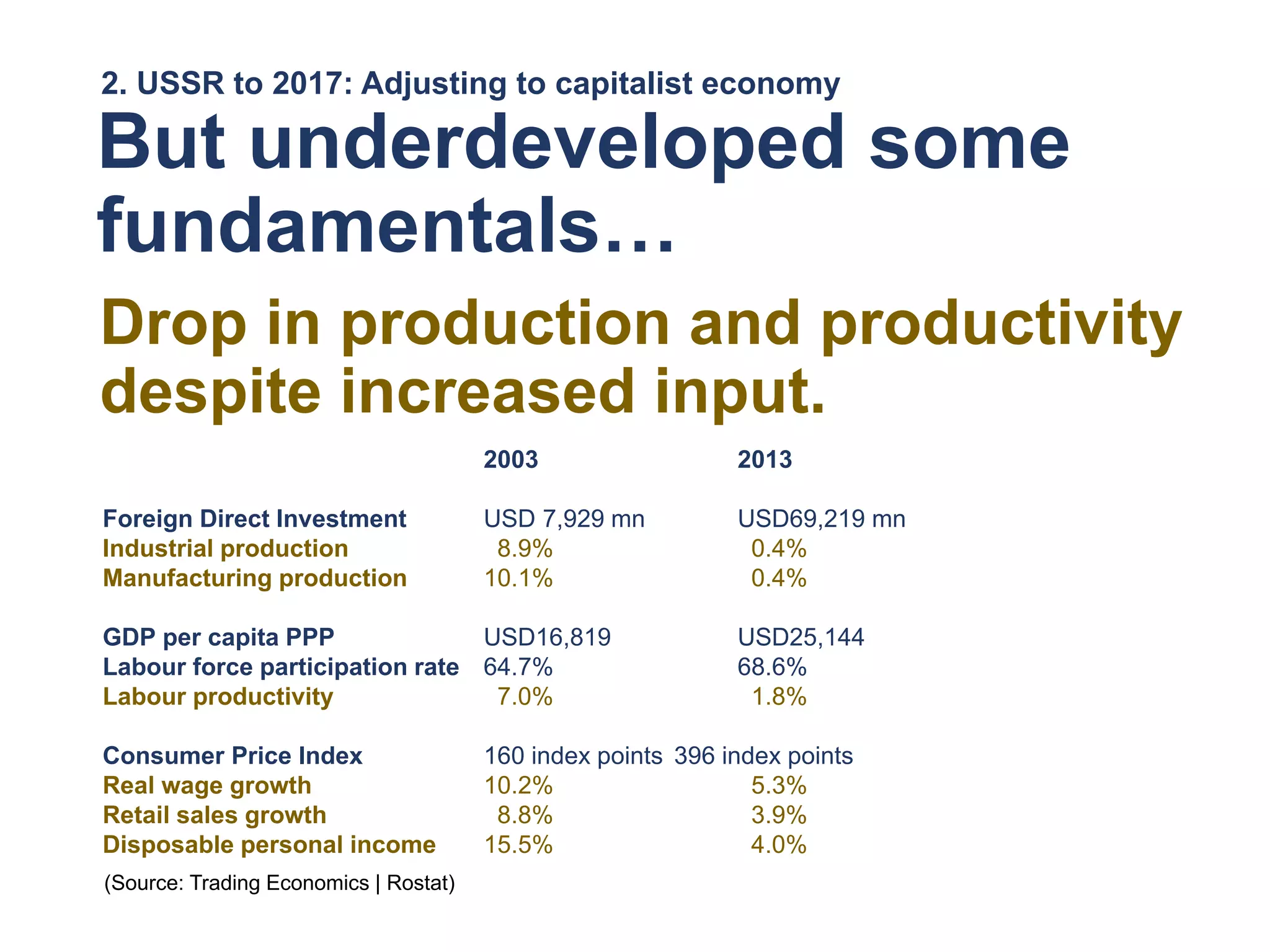
2003 2013
Foreign Direct Investment USD 7,929 mn USD69,219 mn
Industrial production 8.9% 0.4%
Manufacturing production 10.1% 0.4%
GDP per capita PPP USD16,819 USD25,144
Labour force participation rate 64.7% 68.6%
Labour productivity 7.0% 1.8%
Consumer Price Index 160 index points 396 index points
Real wage growth 10.2% 5.3%
Retail sales growth 8.8% 3.9%
Disposable personal income 15.5% 4.0%
Drop in production and productivity
despite increased input.
2. USSR to 2017: Adjusting to capitalist economy
But underdeveloped some
fundamentals…
(Source: Trading Economics | Rostat)
2. USSR to 2017: Adjusting to capitalist economy
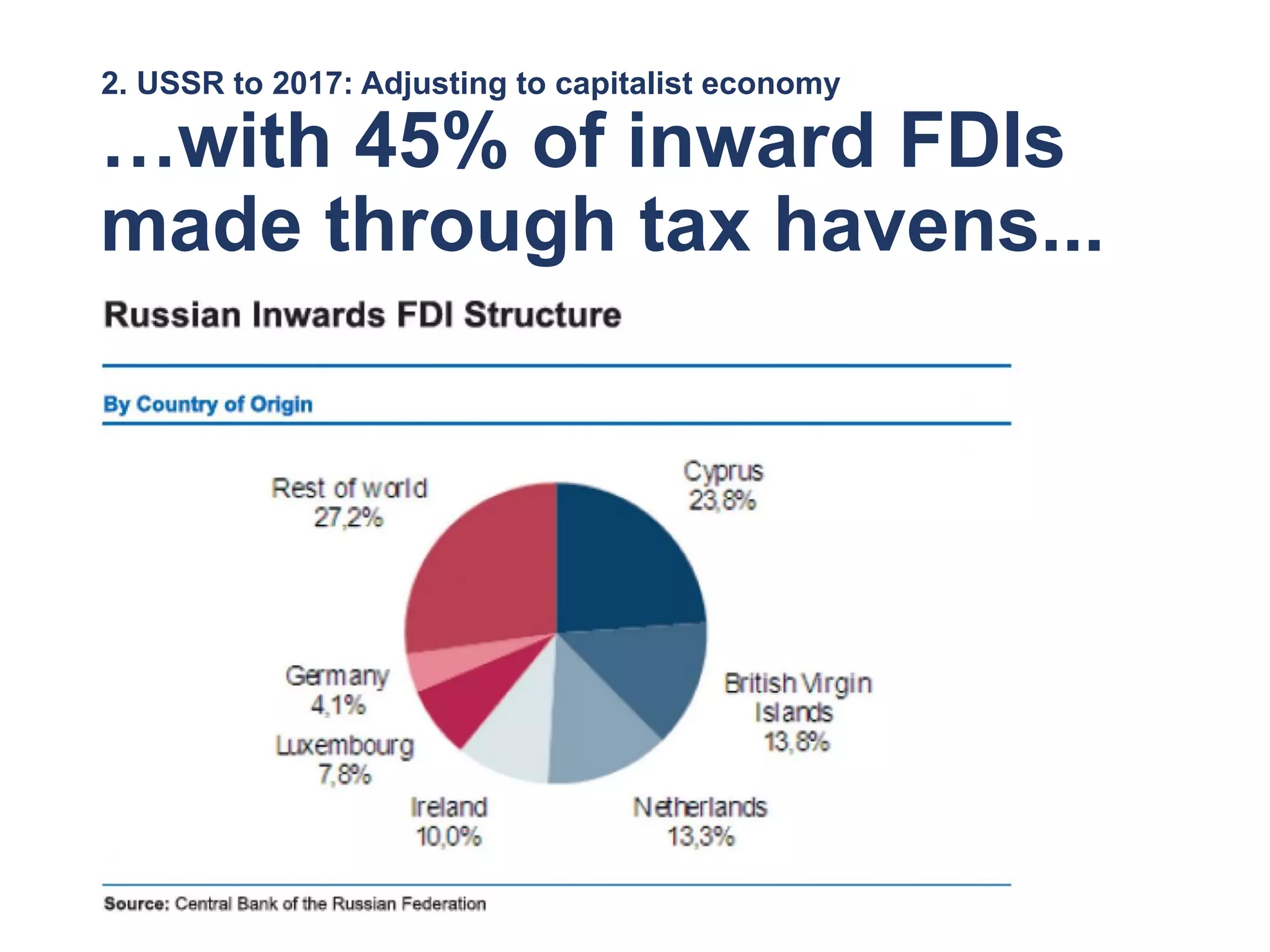
…with 45% of inward FDIs
made through tax havens...
2. USSR to 2017: Adjusting to capitalist economy
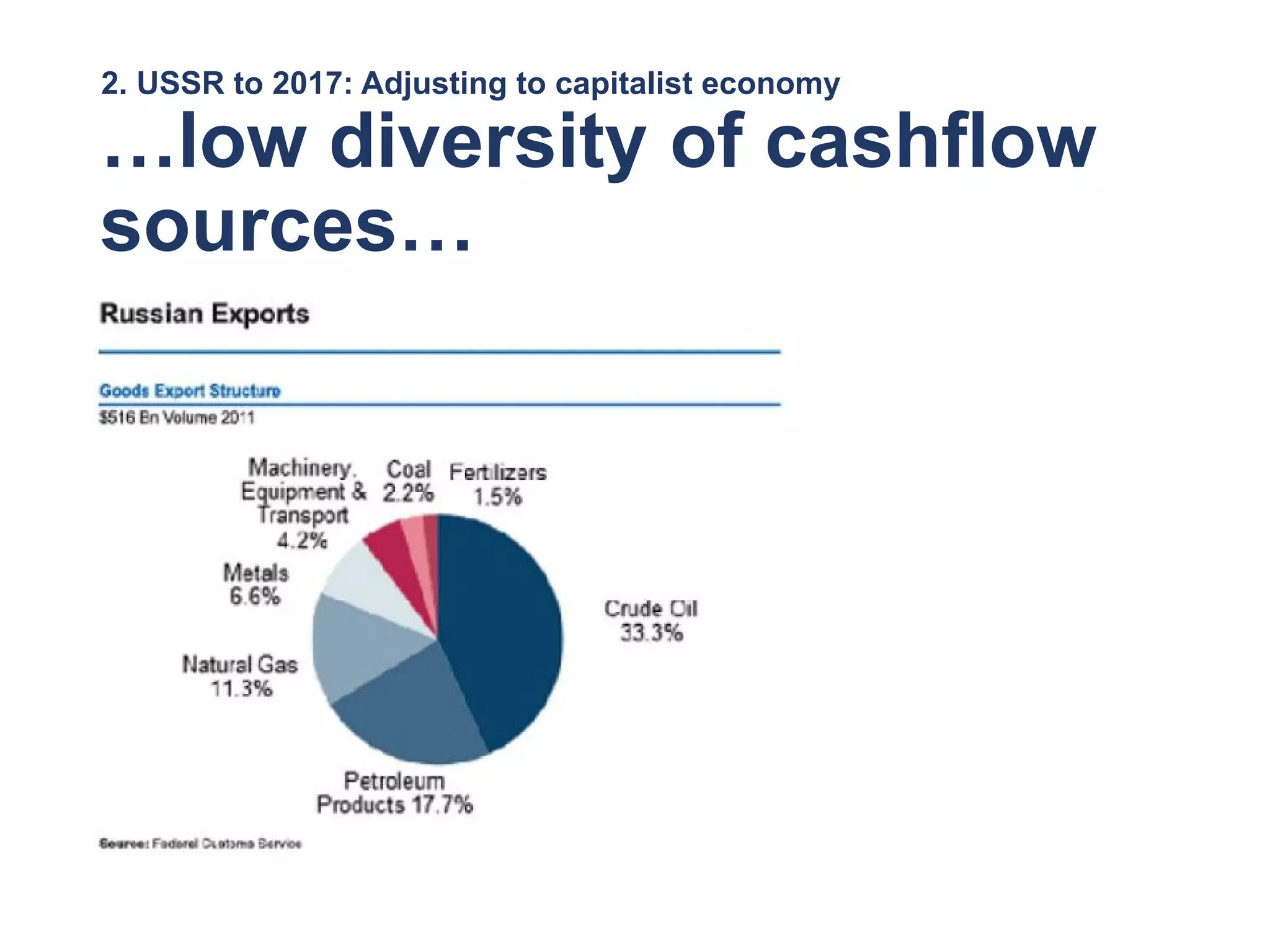
…low diversity of cashflow
sources…
2. USSR to 2017: Adjusting to capitalist economy
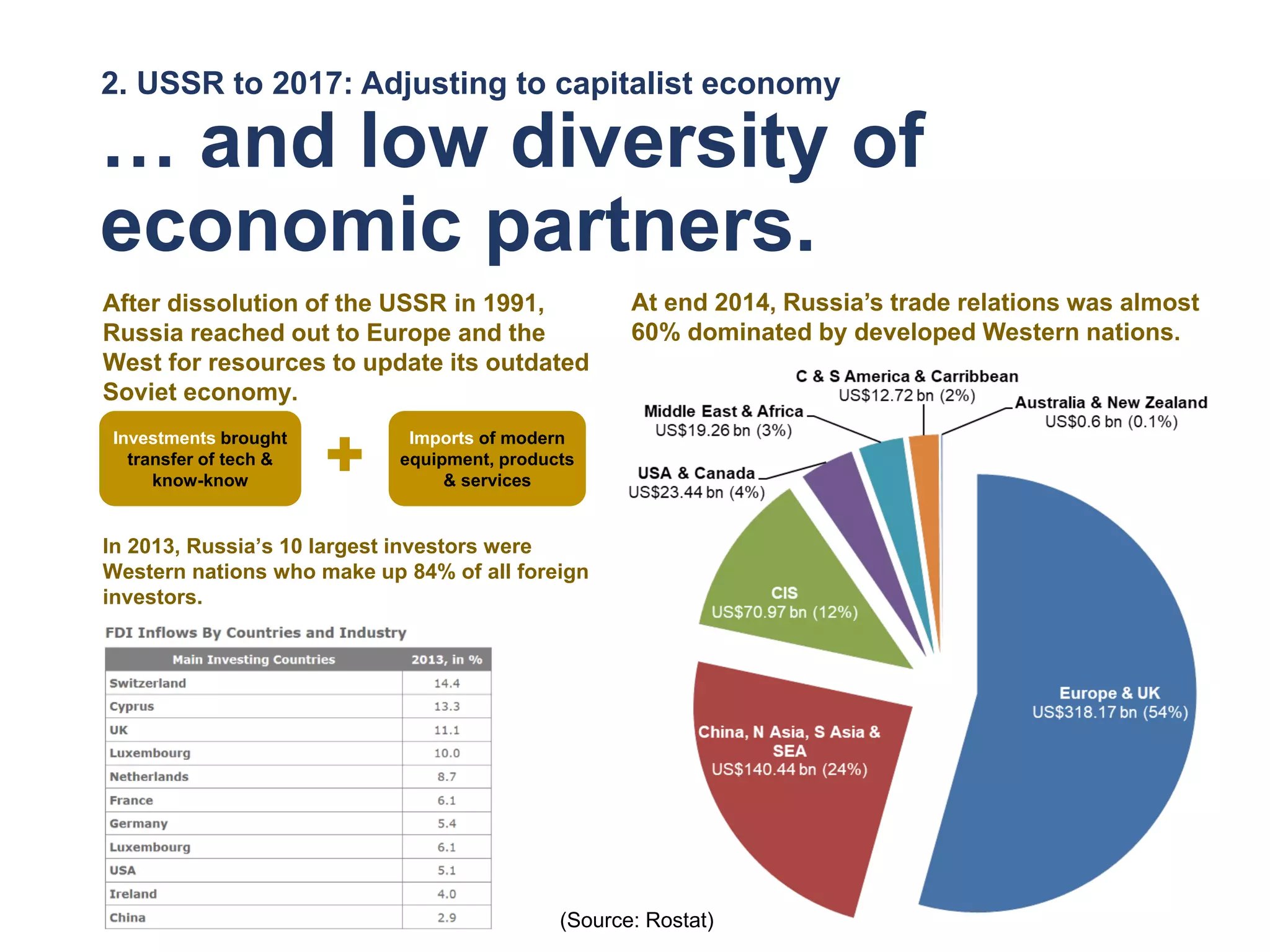
… and low diversity of
economic partners.
After dissolution of the USSR in 1991,
Russia reached out to Europe and the
West for resources to update its outdated
Soviet economy.
In 2013, Russia’s 10 largest investors were
Western nations who make up 84% of all foreign
investors.
Imports of modern
equipment, products
& services
Investments brought
transfer of tech &
know-know
+
At end 2014, Russia’s trade relations was almost
60% dominated by developed Western nations.
(Source: Rostat)
2. USSR to 2017: Adjusting to capitalist economy
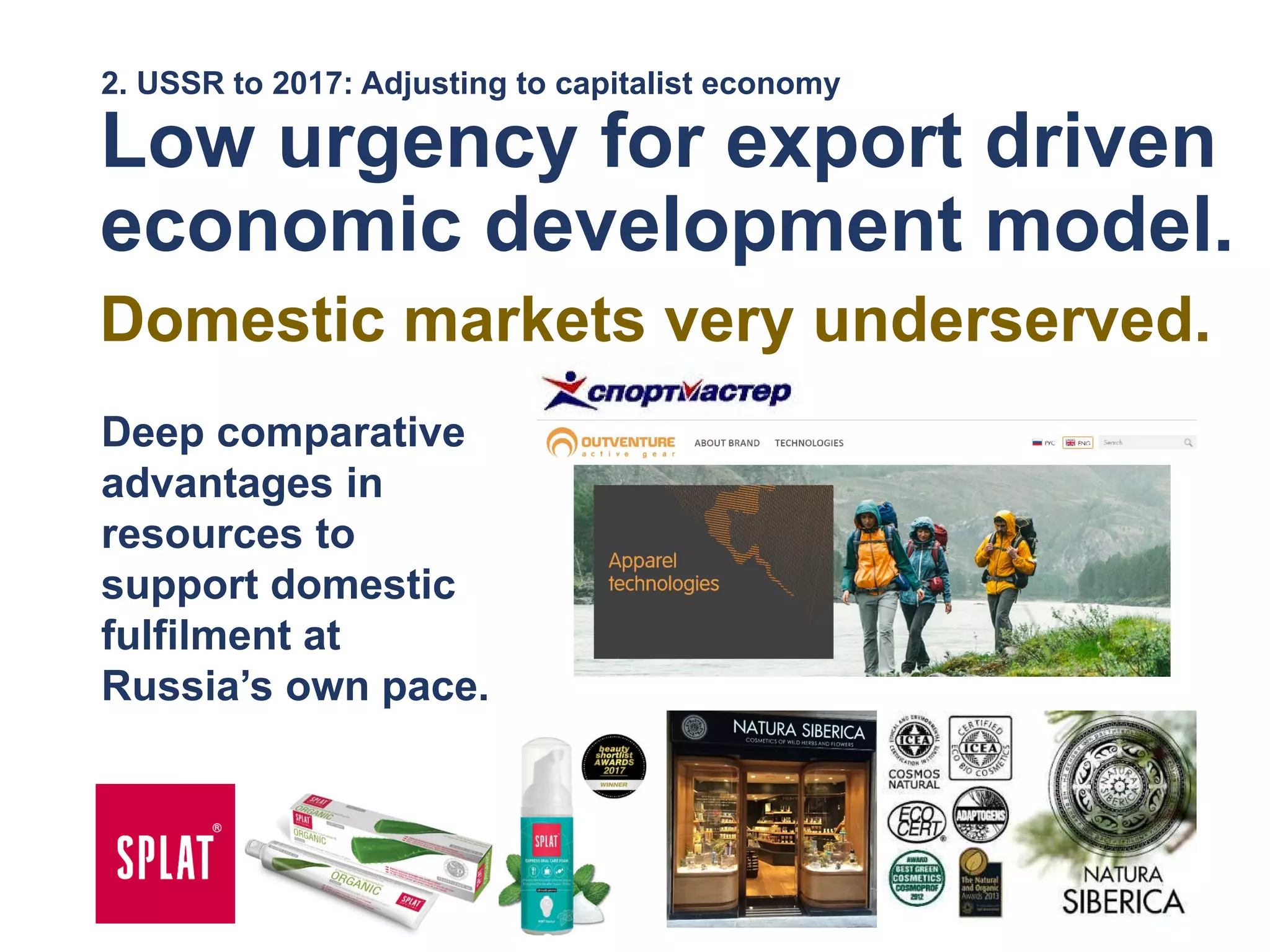
Low urgency for export driven
economic development model.
Deep comparative
advantages in
resources to
support domestic
fulfilment at
Russia’s own pace.
Domestic markets very underserved.
2. USSR to 2017: Adjusting to capitalist economy
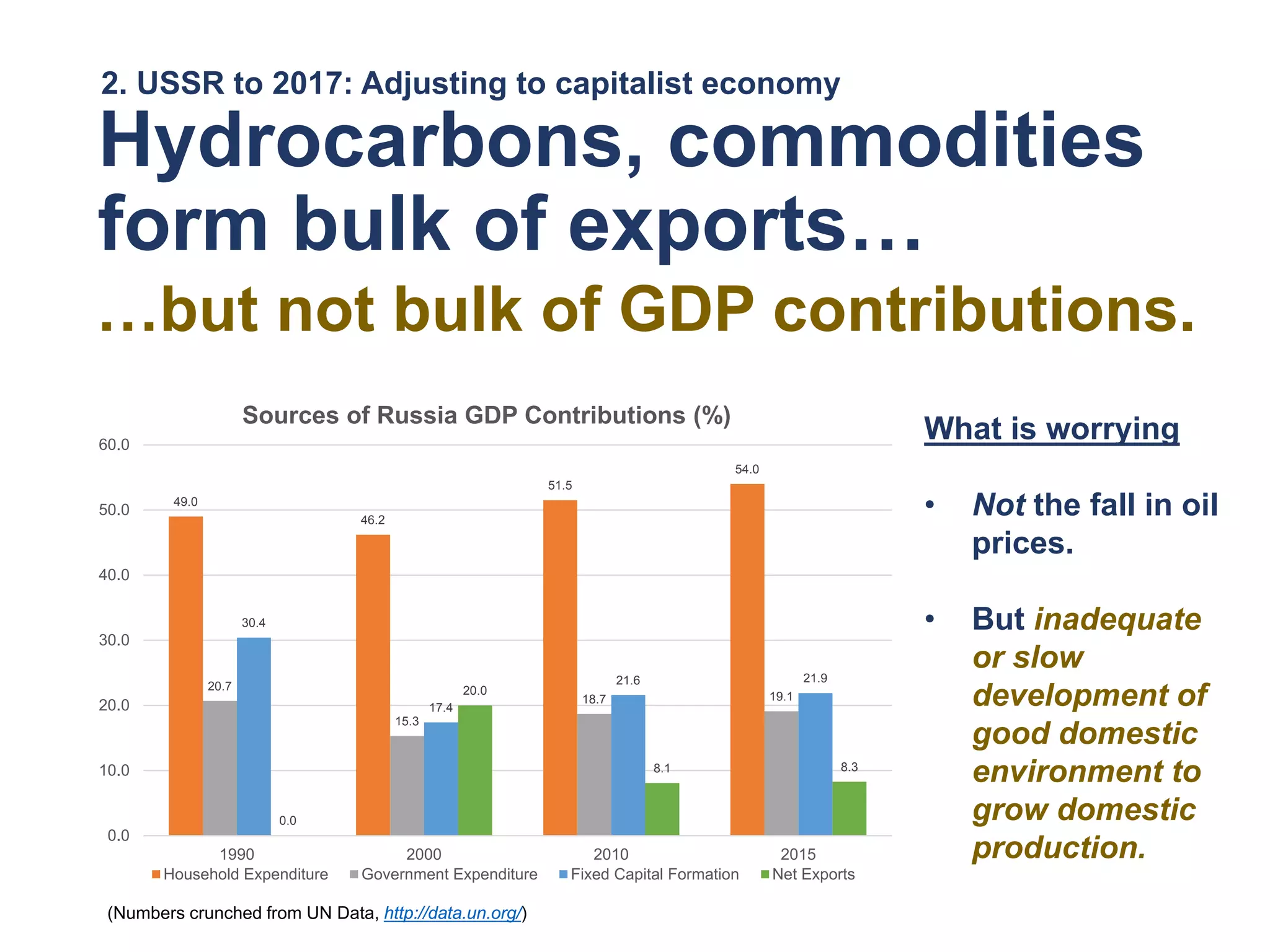
Hydrocarbons, commodities
form bulk of exports…
What is worrying
• Not the fall in oil
prices.
• But inadequate
or slow
development of
good domestic
environment to
grow domestic
production.
49.0
46.2
51.5
54.0
20.7
15.3
18.7 19.1
30.4
17.4
21.6 21.9
0.0
20.0
8.1 8.3
0.0
10.0
20.0
30.0
40.0
50.0
60.0
1990 2000 2010 2015
Sources of Russia GDP Contributions (%)
Household Expenditure Government Expenditure Fixed Capital Formation Net Exports
…but not bulk of GDP contributions.
(Numbers crunched from UN Data, http://data.un.org/)
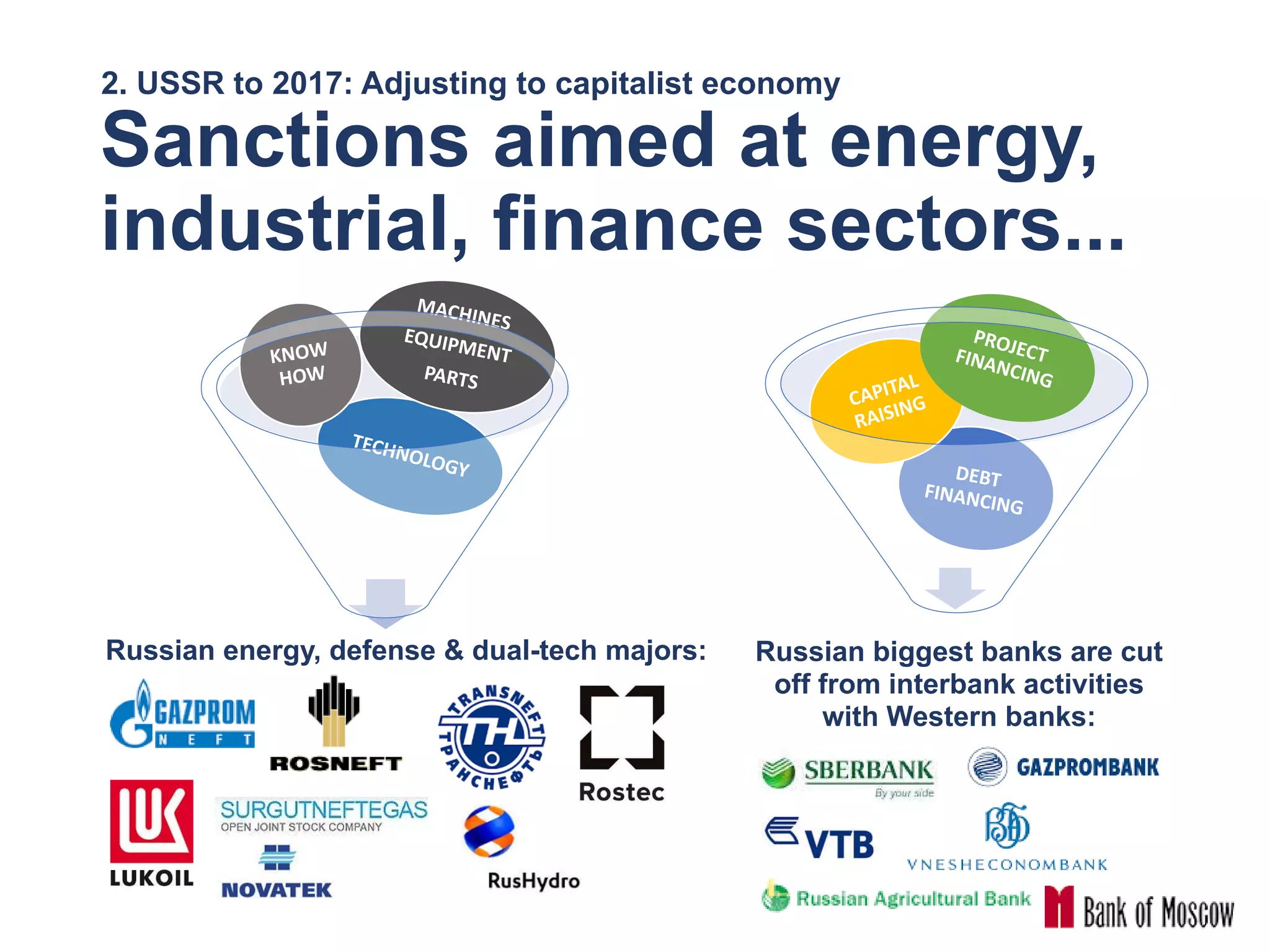
Russian biggest banks are cut
off from interbank activities
with Western banks:
Russian energy, defense & dual-tech majors:
2. USSR to 2017: Adjusting to capitalist economy
Sanctions aimed at energy,
industrial, finance sectors...
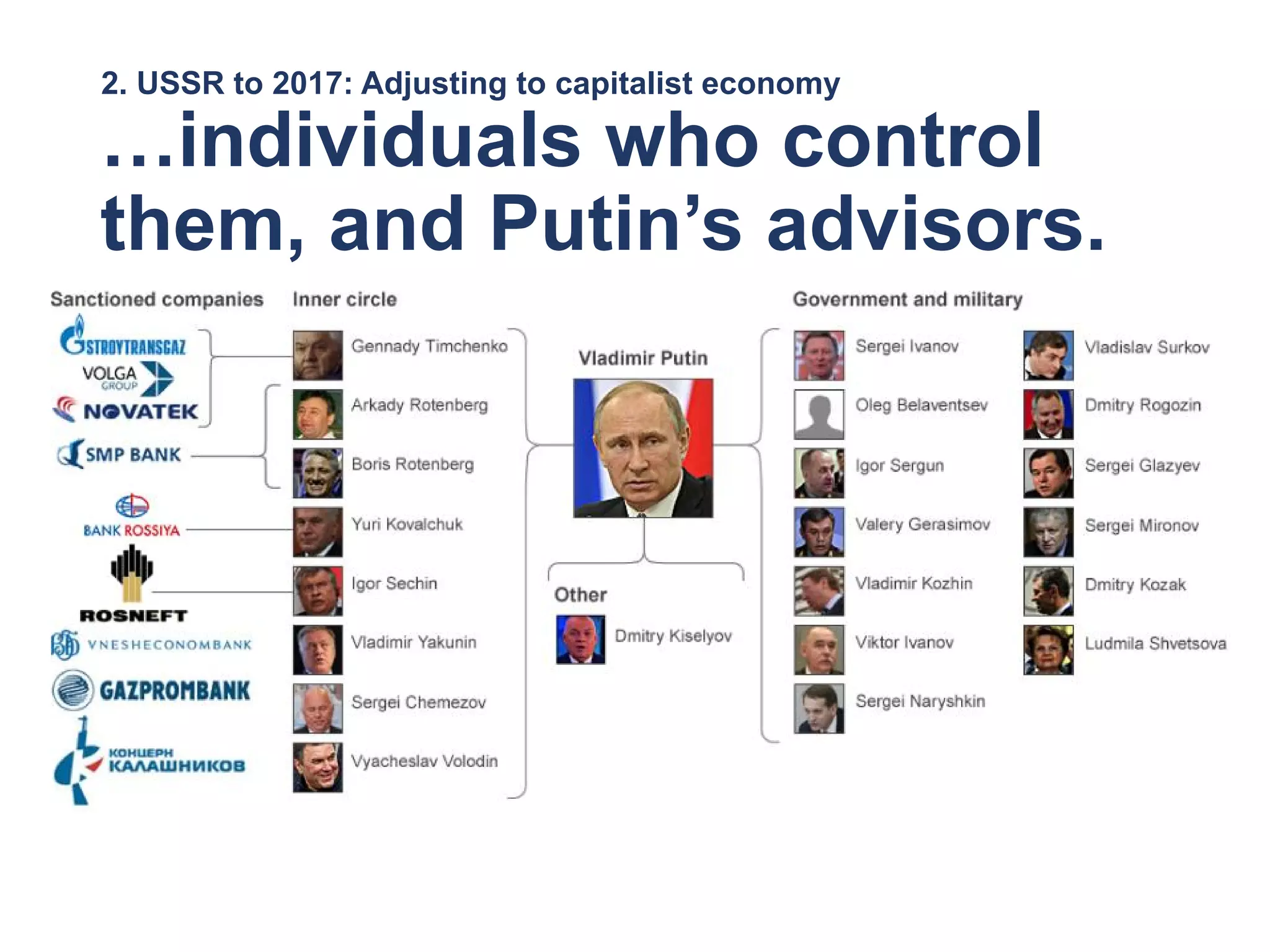
2. USSR to 2017: Adjusting to capitalist economy
…individuals who control
them, and Putin’s advisors.
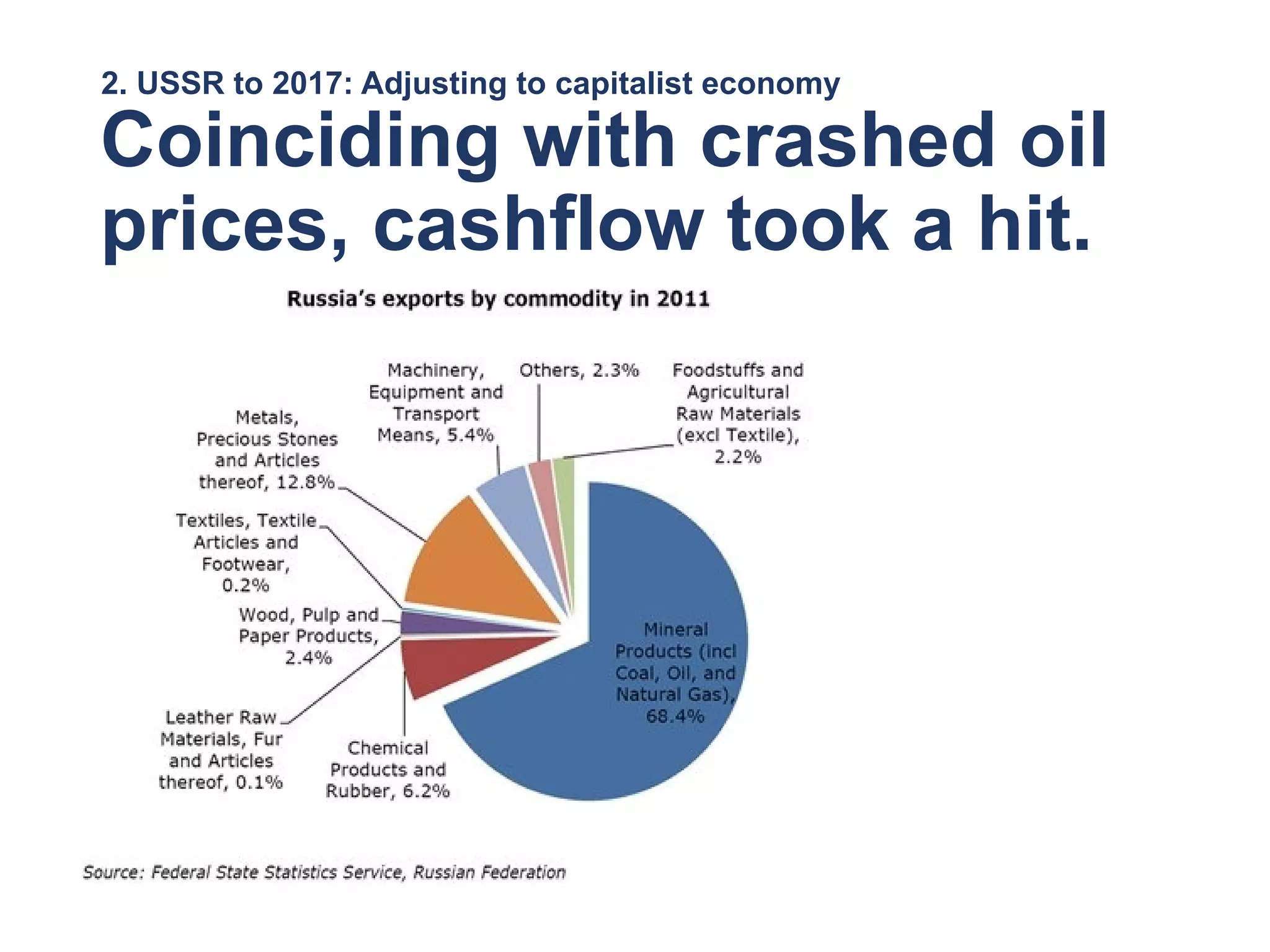
2. USSR to 2017: Adjusting to capitalist economy
Coinciding with crashed oil
prices, cashflow took a hit.
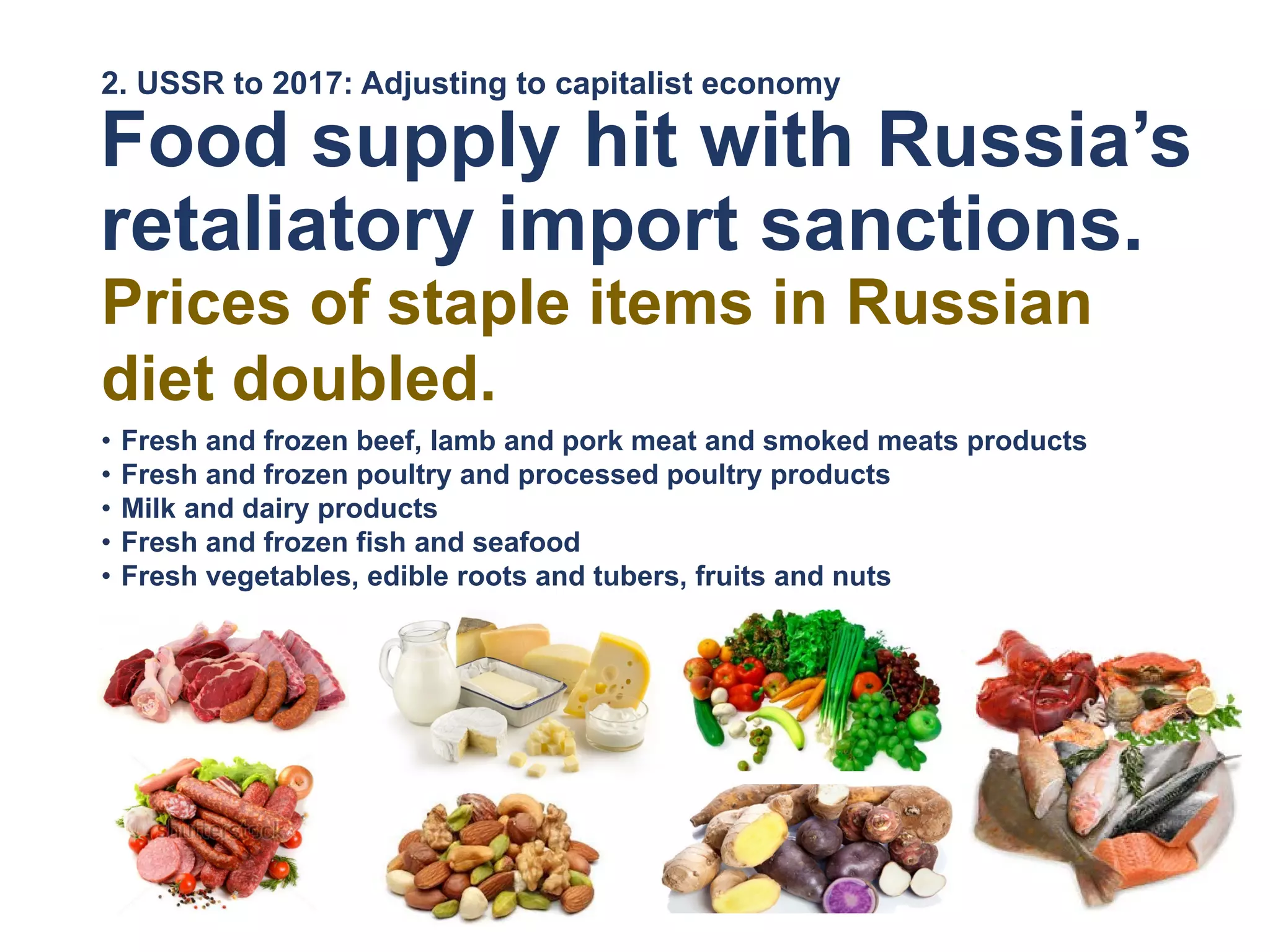
2. USSR to 2017: Adjusting to capitalist economy
Food supply hit with Russia’s
retaliatory import sanctions.
Prices of staple items in Russian
diet doubled.
• Fresh and frozen beef, lamb and pork meat and smoked meats products
• Fresh and frozen poultry and processed poultry products
• Milk and dairy products
• Fresh and frozen fish and seafood
• Fresh vegetables, edible roots and tubers, fruits and nuts
2. USSR to 2017: Adjusting to capitalist economy
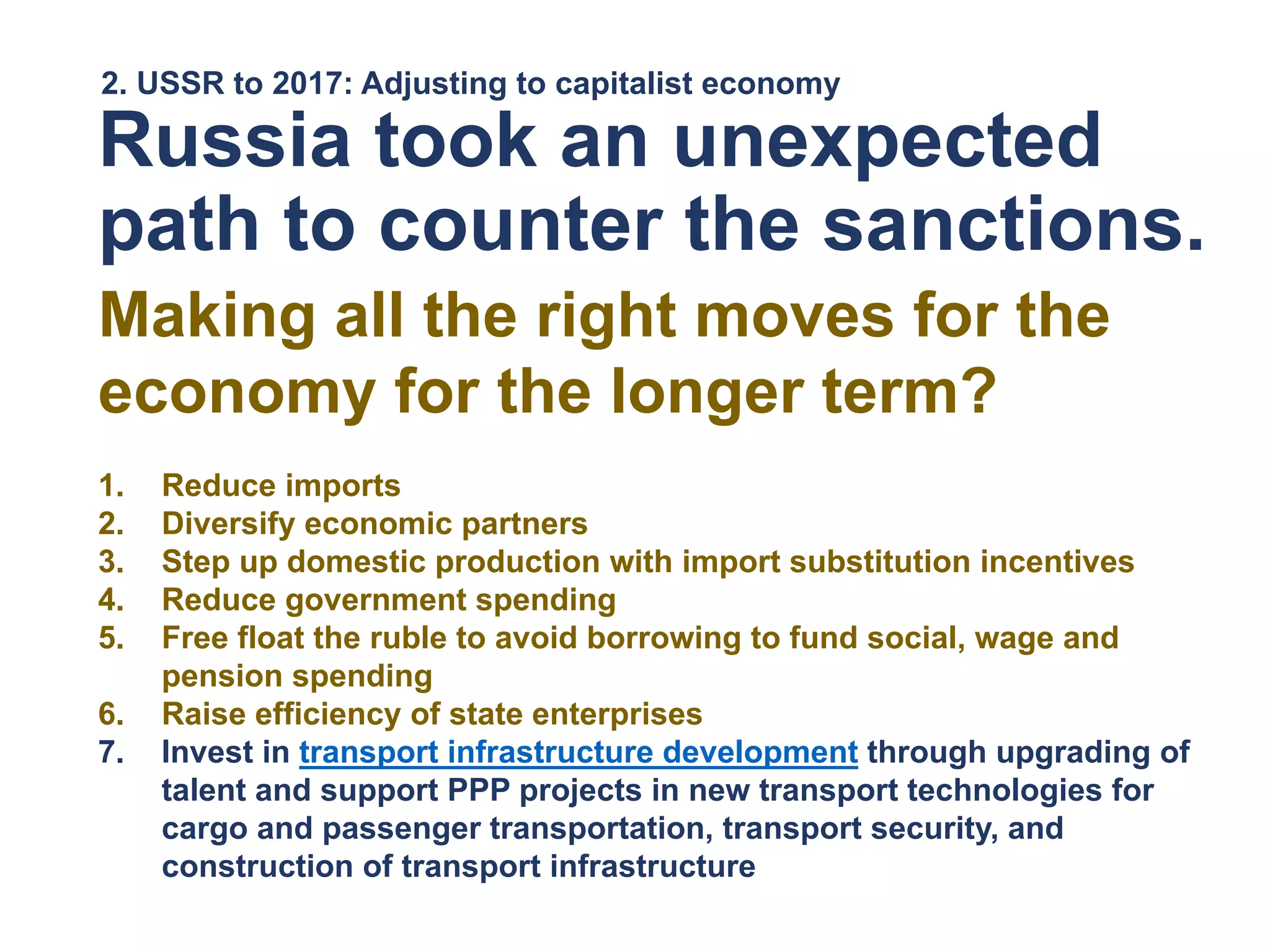
Russia took an unexpected
path to counter the sanctions.
Making all the right moves for the
economy for the longer term?
1. Reduce imports
2. Diversify economic partners
3. Step up domestic production with import substitution incentives
4. Reduce government spending
5. Free float the ruble to avoid borrowing to fund social, wage and
pension spending
6. Raise efficiency of state enterprises
7. Invest in transport infrastructure development through upgrading of
talent and support PPP projects in new transport technologies for
cargo and passenger transportation, transport security, and
construction of transport infrastructure
2. USSR to 2017: Adjusting to capitalist economy
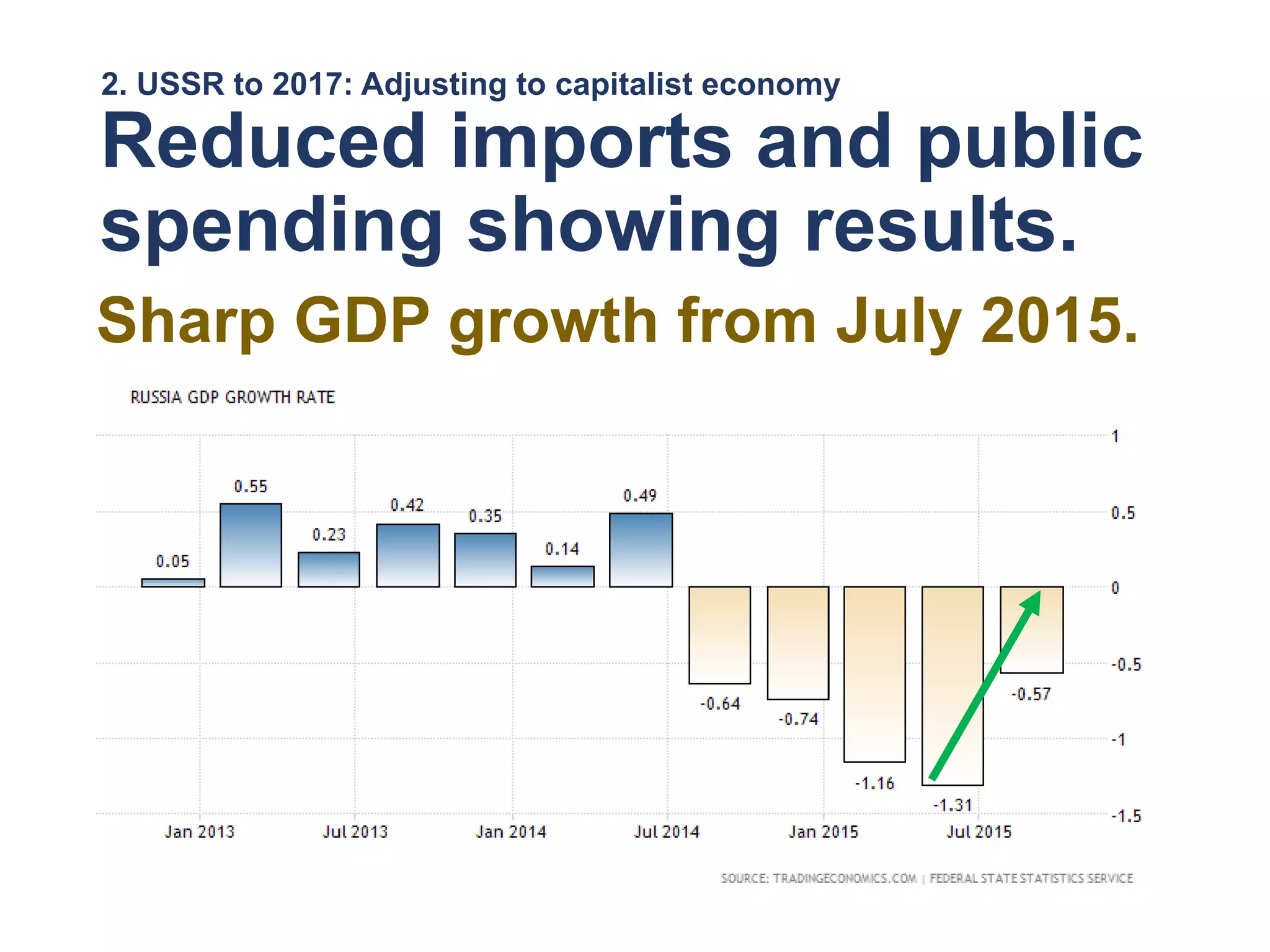
Reduced imports and public
spending showing results.
Sharp GDP growth from July 2015.
2. USSR to 2017: Adjusting to capitalist economy
Increased trade balances with
Asia since 2014.
Trade balance with Europe declines.
-50000000
0
50000000
100000000
150000000
200000000
2007 2008 2009 2010 2011 2012 2013 2014 2015 2016
Russia's 10-Year Trade Balance with Europe, N. Americas and Asia
Continental Europe (including UK)
North Americas (US, Canada, Mexico)
Asia (North, South, East, Central and Southeast Asias, and Middle East)
‘000 USD
Source: UN COMTRADE
2. USSR to 2017: Adjusting to capitalist economy
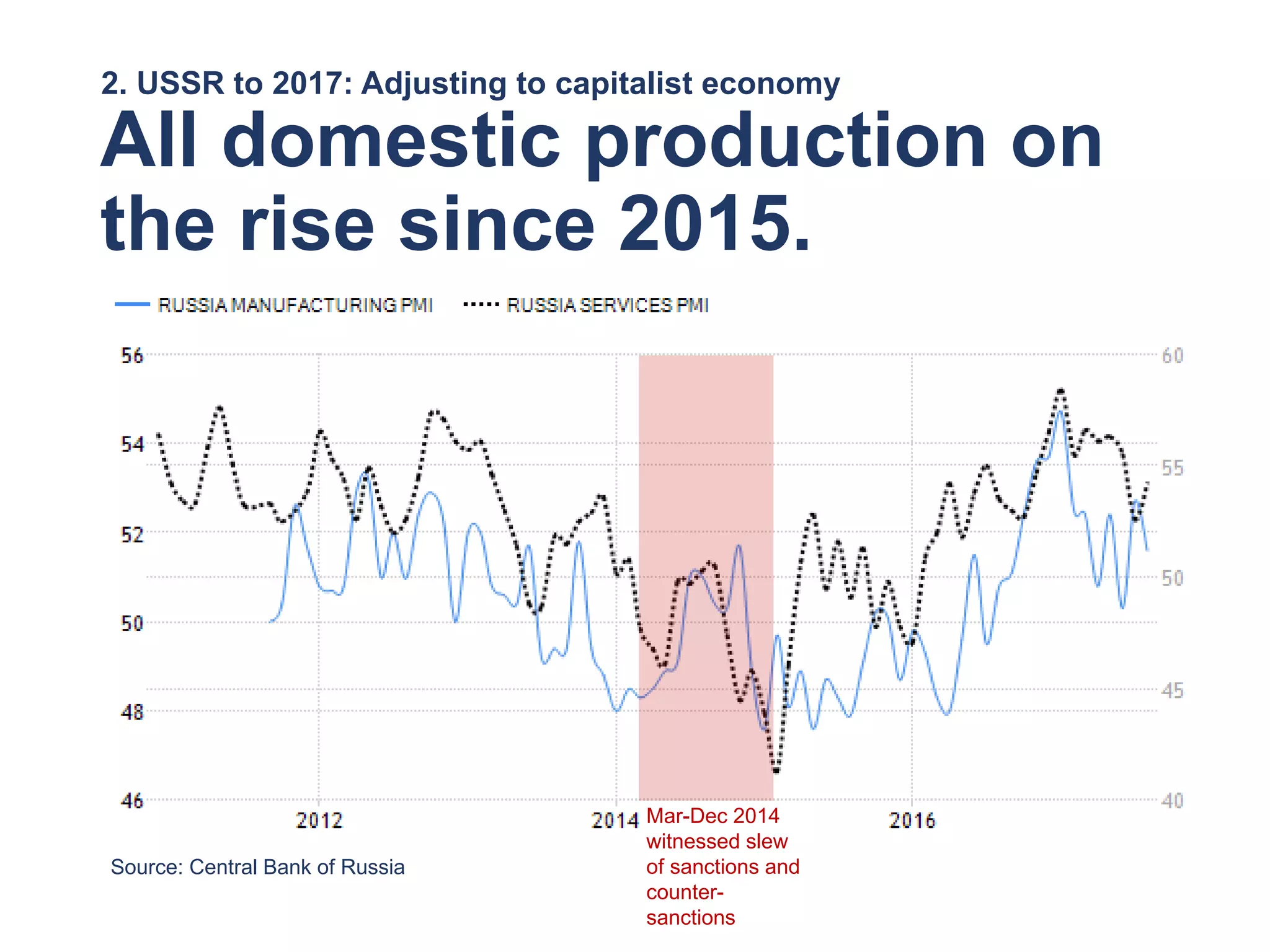
All domestic production on
the rise since 2015.
Source: Central Bank of Russia
Mar-Dec 2014
witnessed slew
of sanctions and
counter-
sanctions
2. USSR to 2017: Adjusting to capitalist economy
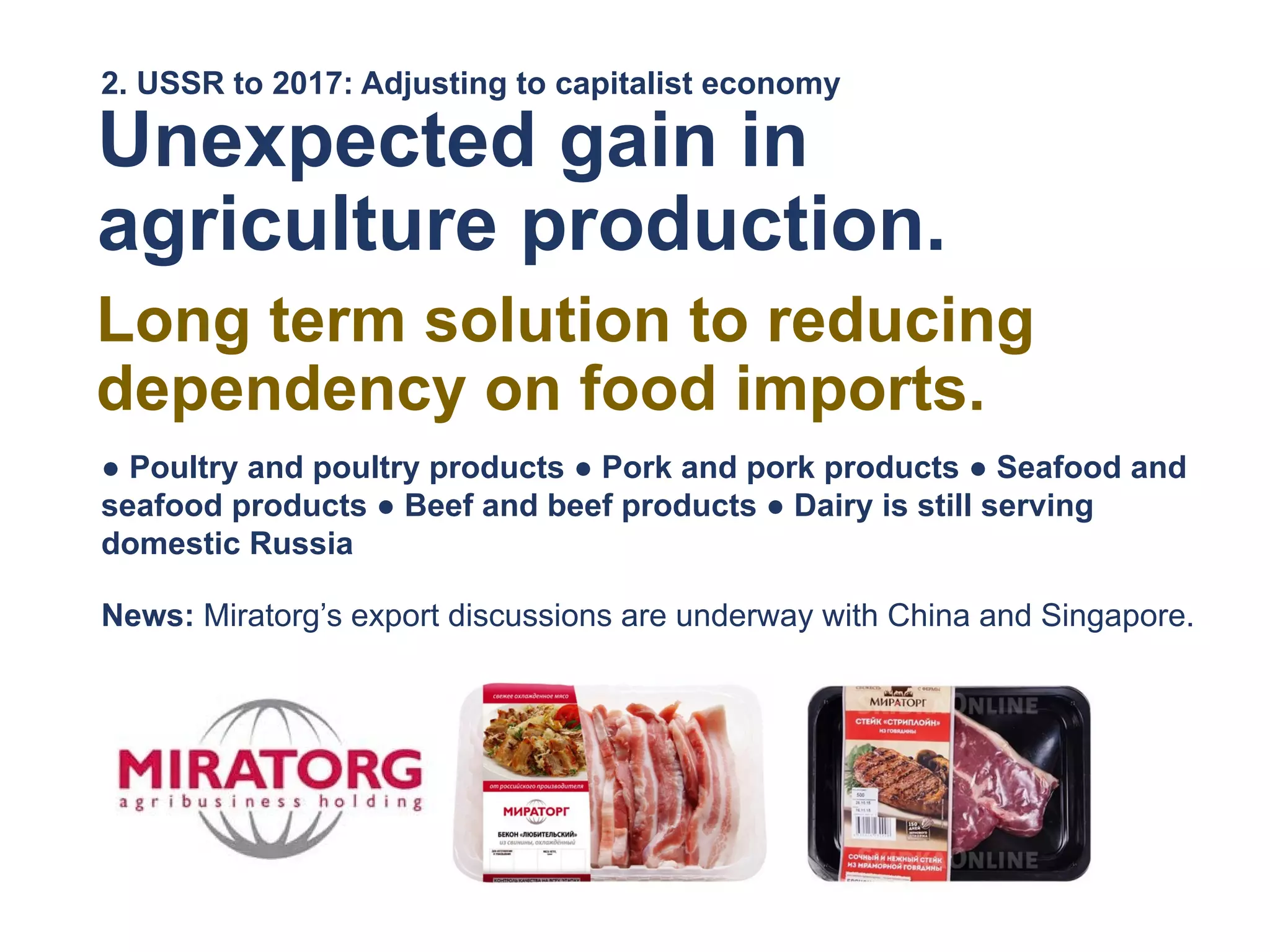
Unexpected gain in
agriculture production.
Long term solution to reducing
dependency on food imports.
● Poultry and poultry products ● Pork and pork products ● Seafood and
seafood products ● Beef and beef products ● Dairy is still serving
domestic Russia
News: Miratorg’s export discussions are underway with China and Singapore.
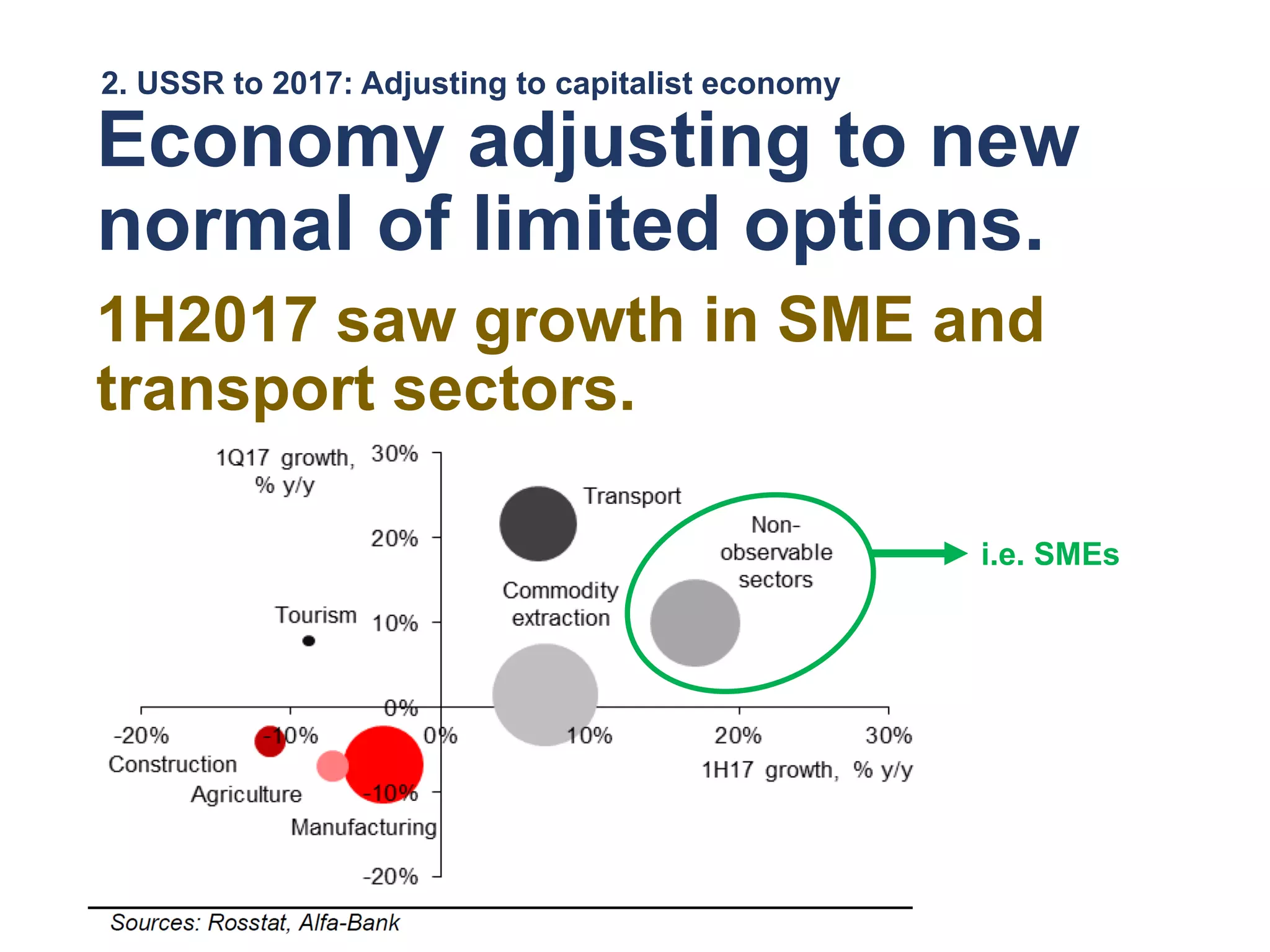
1H2017 saw growth in SME and
transport sectors.
2. USSR to 2017: Adjusting to capitalist economy
Economy adjusting to new
normal of limited options.
i.e. SMEs
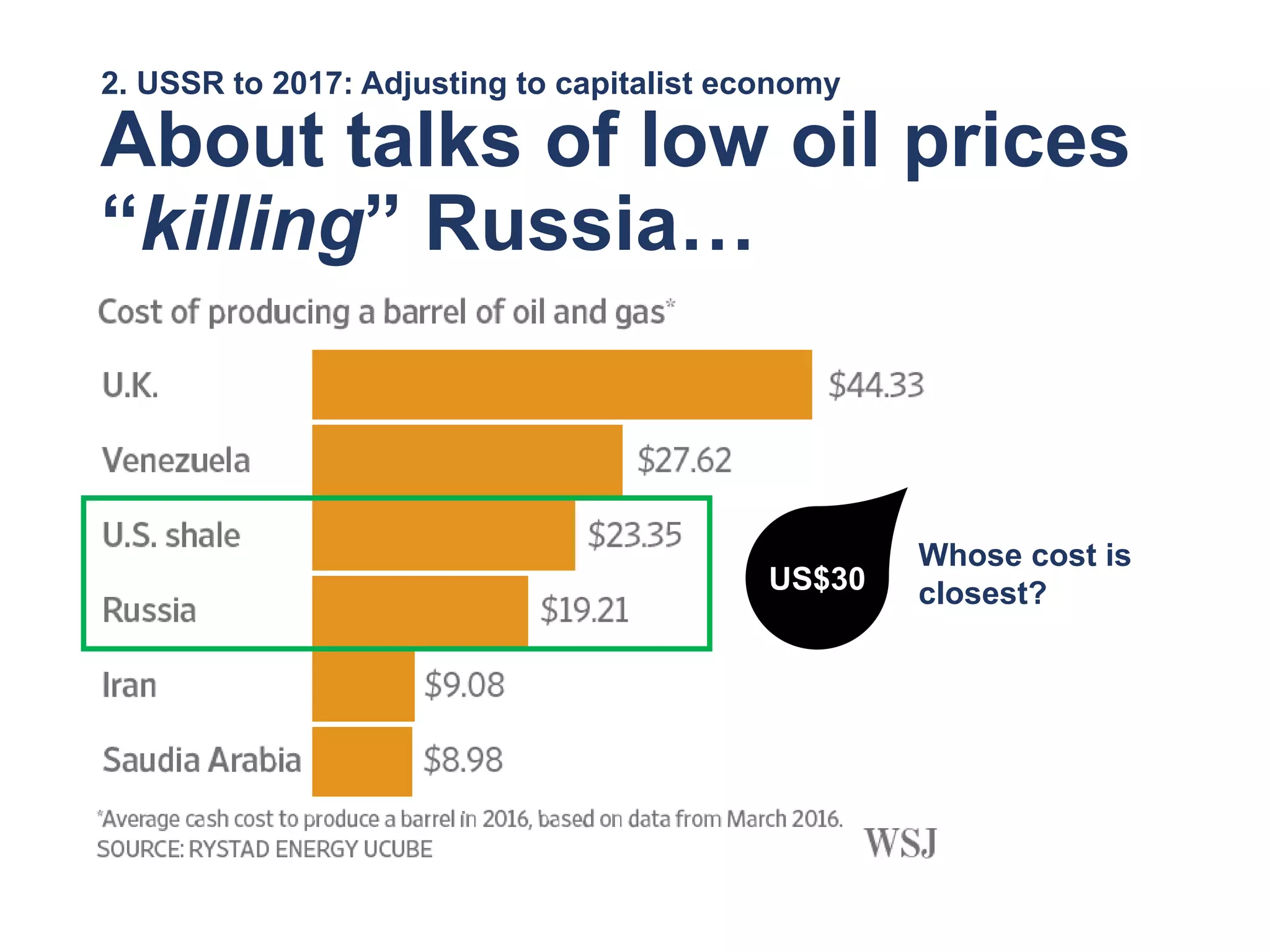
US$30
Whose cost is
closest?
2. USSR to 2017: Adjusting to capitalist economy
About talks of low oil prices
“killing” Russia…
In a nutshell…
1. Events of 2014 a much needed catalyst
to resolve some long standing
structural issues
2. Reports of sanctions and low oil prices
“killing” Russia likely exaggerated
3. Today’s Russia is a young person with
an old soul. Plenty more growth to be
expected.
2. USSR to 2017: Adjusting to capitalist economy
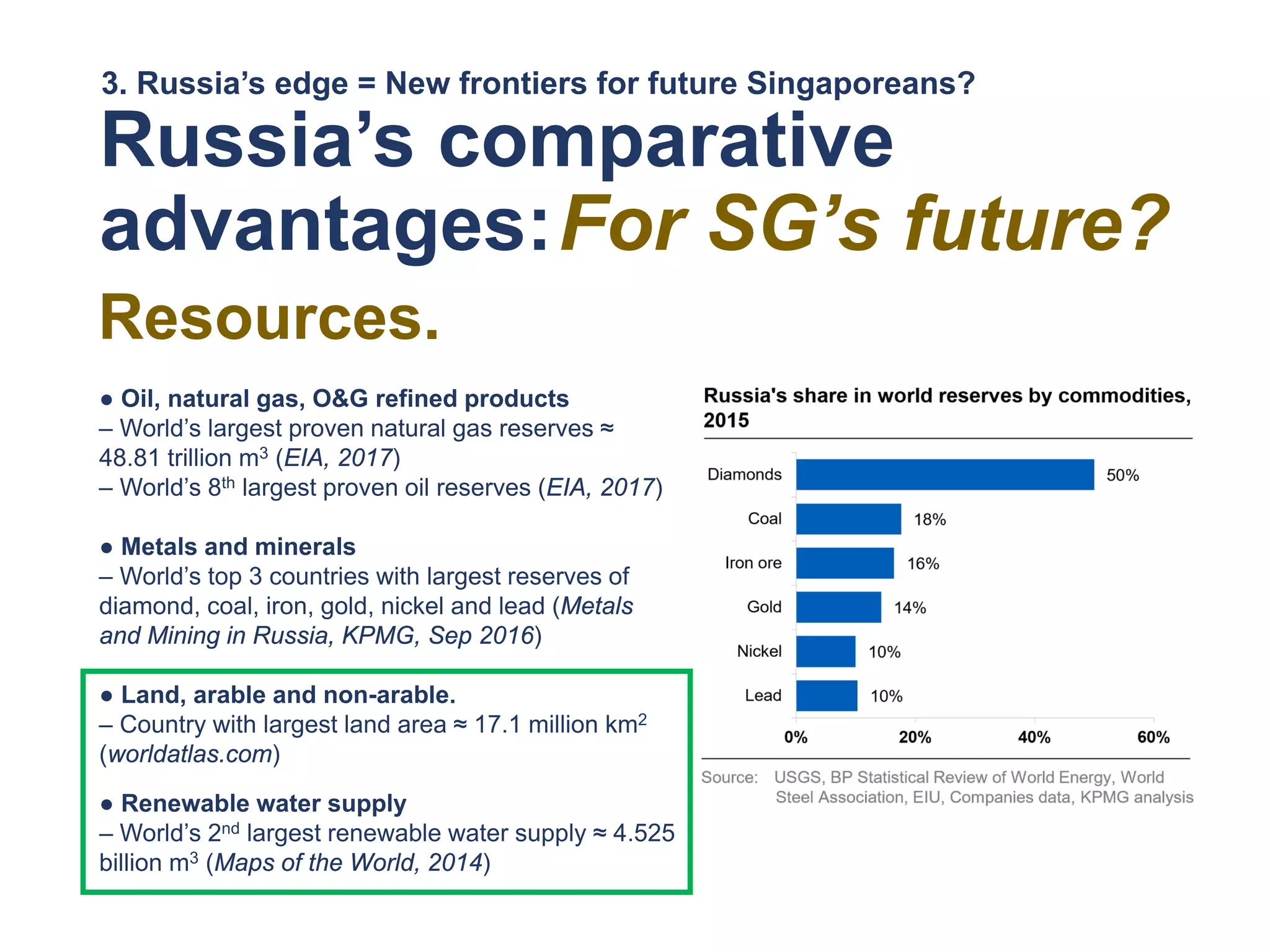
Russia’s comparative
advantages:
Resources.
● Oil, natural gas, O&G refined products
– World’s largest proven natural gas reserves ≈
48.81 trillion m3 (EIA, 2017)
– World’s 8th largest proven oil reserves (EIA, 2017)
● Metals and minerals
– World’s top 3 countries with largest reserves of
diamond, coal, iron, gold, nickel and lead (Metals
and Mining in Russia, KPMG, Sep 2016)
● Land, arable and non-arable.
– Country with largest land area ≈ 17.1 million km2
(worldatlas.com)
● Renewable water supply
– World’s 2nd largest renewable water supply ≈ 4.525
billion m3 (Maps of the World, 2014)
3. Russia’s edge = New frontiers for future Singaporeans?
For SG’s future?
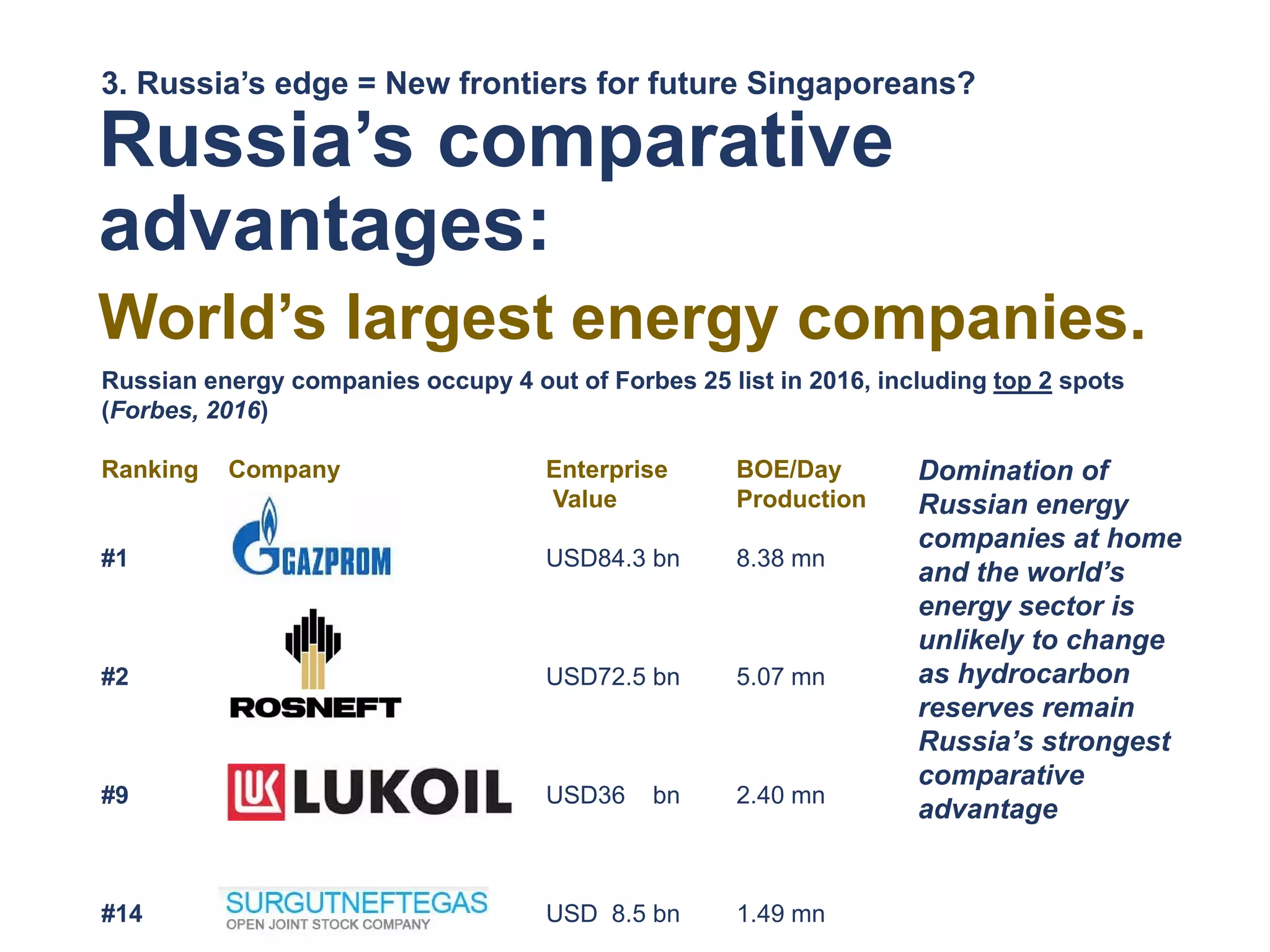
Russian energy companies occupy 4 out of Forbes 25 list in 2016, including top 2 spots
(Forbes, 2016)
Ranking Company Enterprise BOE/Day
Value Production
#10 USD84.3 bn 8.38 mn
#20 USD72.5 bn 5.07 mn
#90 USD36.0 bn 2.40 mn
#14 USD08.5 bn 1.49 mn
Russia’s comparative
advantages:
World’s largest energy companies.
3. Russia’s edge = New frontiers for future Singaporeans?
Domination of
Russian energy
companies at home
and the world’s
energy sector is
unlikely to change
as hydrocarbon
reserves remain
Russia’s strongest
comparative
advantage
Russia’s comparative
advantages:
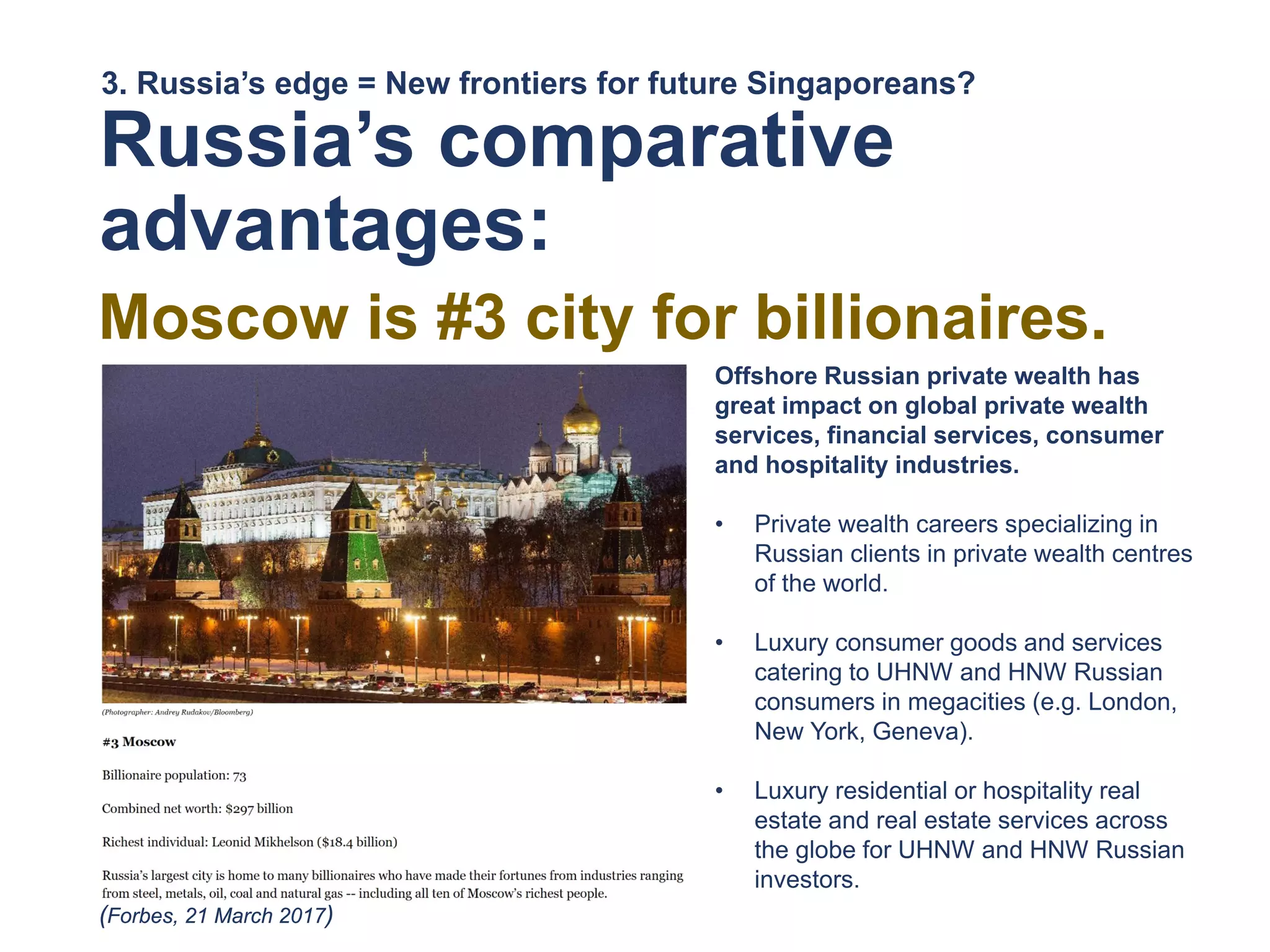
Moscow is #3 city for billionaires.
3. Russia’s edge = New frontiers for future Singaporeans?
(Forbes, 21 March 2017)
Offshore Russian private wealth has
great impact on global private wealth
services, financial services, consumer
and hospitality industries.
• Private wealth careers specializing in
Russian clients in private wealth centres
of the world.
• Luxury consumer goods and services
catering to UHNW and HNW Russian
consumers in megacities (e.g. London,
New York, Geneva).
• Luxury residential or hospitality real
estate and real estate services across
the globe for UHNW and HNW Russian
investors.
Russia’s comparative
advantages:
World #2 in programming talents.
3. Russia’s edge = New frontiers for future Singaporeans?
World’s 4th largest antivirus
software vendors by revenue.
Of the 26 finalists of the 2017
Code Jam finalists, 13 were
Russian, with Russians taking
2nd, 3rd and 4th places in the end.
For SG now?
Russia’s comparative
advantages
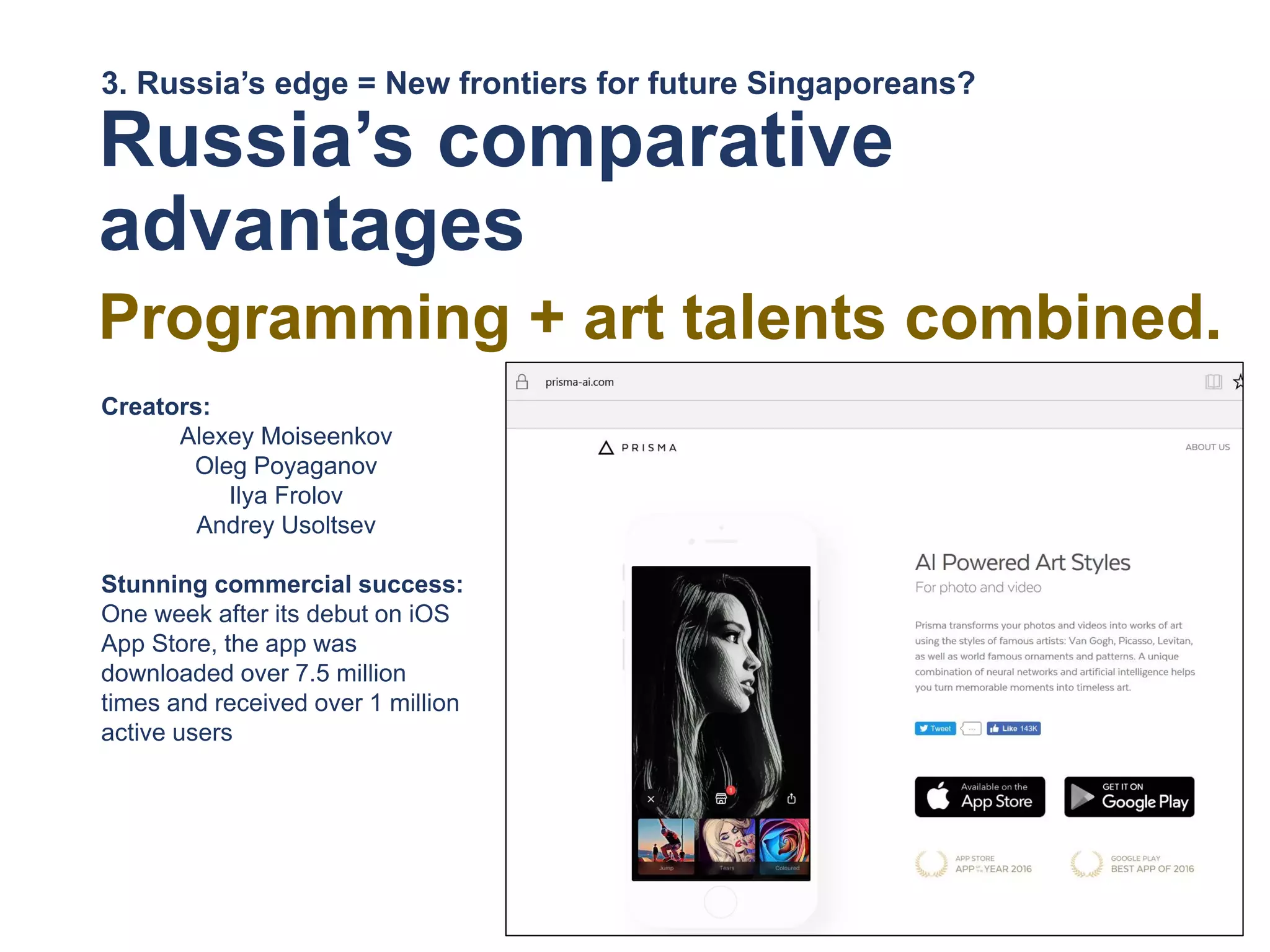
Programming + art talents combined.
3. Russia’s edge = New frontiers for future Singaporeans?
Creators:
Alexey Moiseenkov
Oleg Poyaganov
Ilya Frolov
Andrey Usoltsev
Stunning commercial success:
One week after its debut on iOS
App Store, the app was
downloaded over 7.5 million
times and received over 1 million
active users
Russia’s comparative
advantages
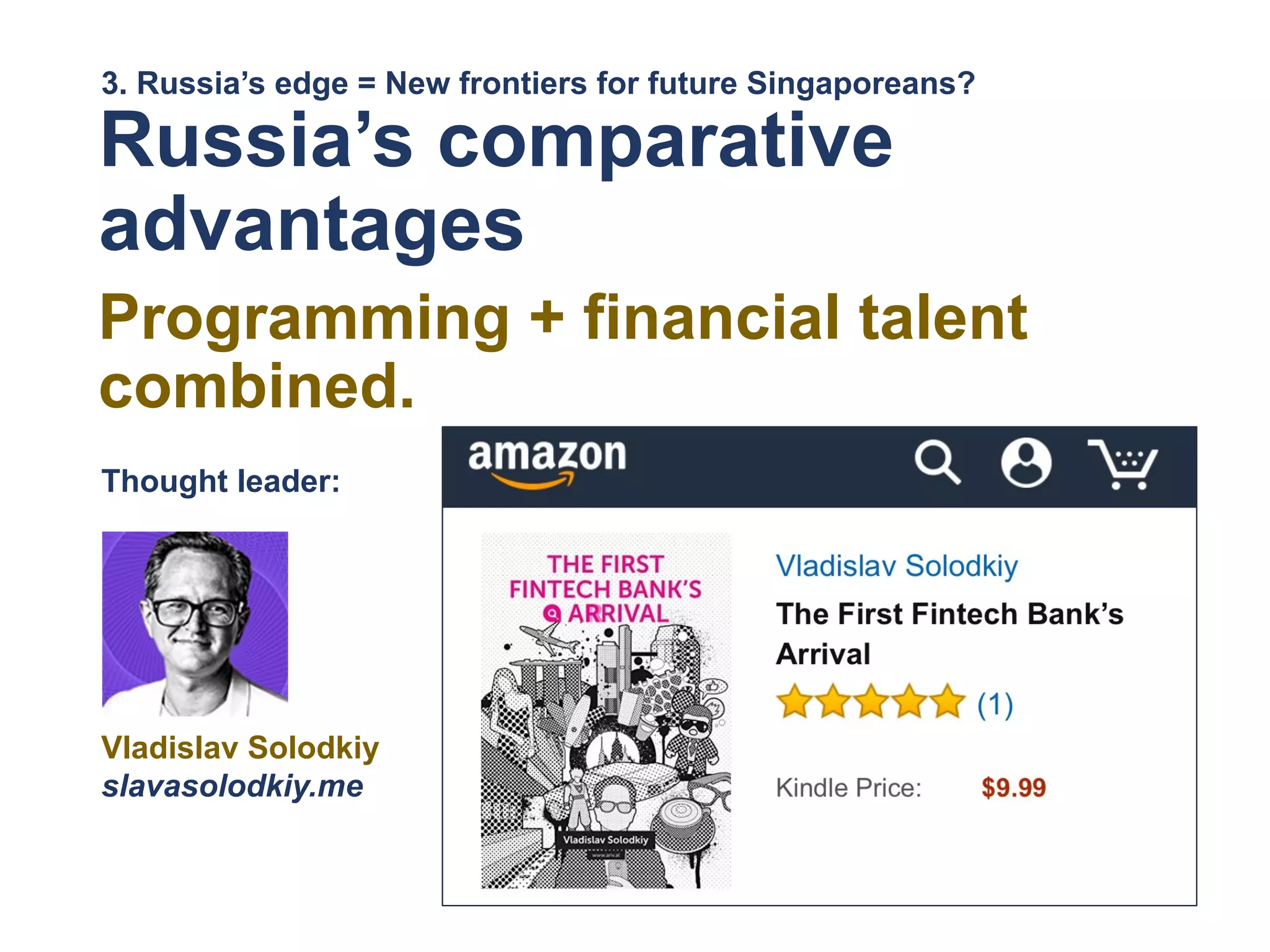
Programming + financial talent
combined.
3. Russia’s edge = New frontiers for future Singaporeans?
Thought leader:
Vladislav Solodkiy
slavasolodkiy.me
In a nutshell…
1. Russia offers what Singapore lacks?
2. Potential for Singapore to tap on
Russia’s programming talents
3. Russia’s resources of all kinds will
always be a key complement to
resource poor Singapore
3. Russia’s edge = New frontiers for future Singaporeans?
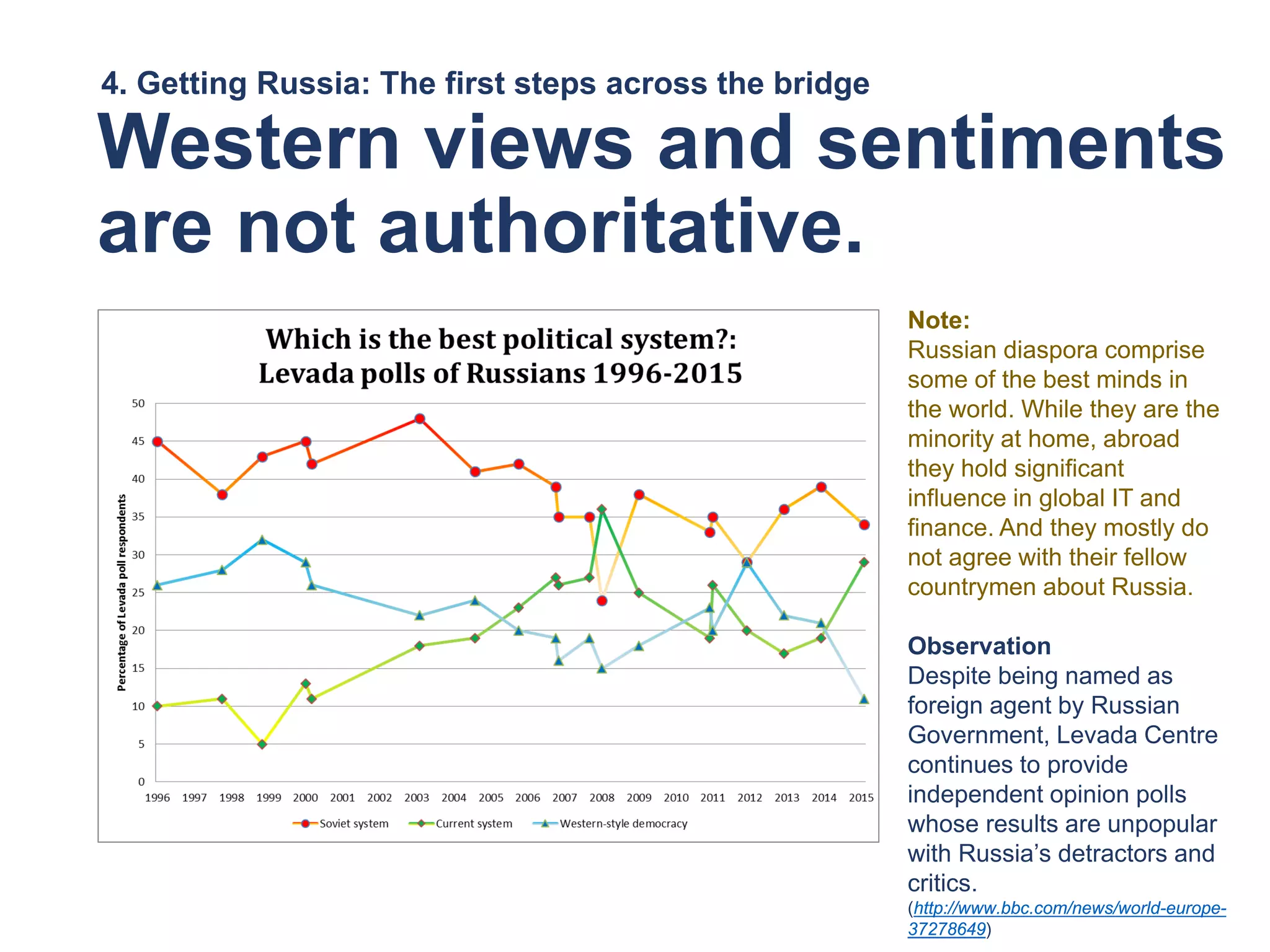
Western views and sentiments
are not authoritative.
4. Getting Russia: The first steps across the bridge
Note:
Russian diaspora comprise
some of the best minds in
the world. While they are the
minority at home, abroad
they hold significant
influence in global IT and
finance. And they mostly do
not agree with their fellow
countrymen about Russia.
Observation
Despite being named as
foreign agent by Russian
Government, Levada Centre
continues to provide
independent opinion polls
whose results are unpopular
with Russia’s detractors and
critics.
(http://www.bbc.com/news/world-europe-
37278649)
4. Getting Russia: The first steps across the bridge
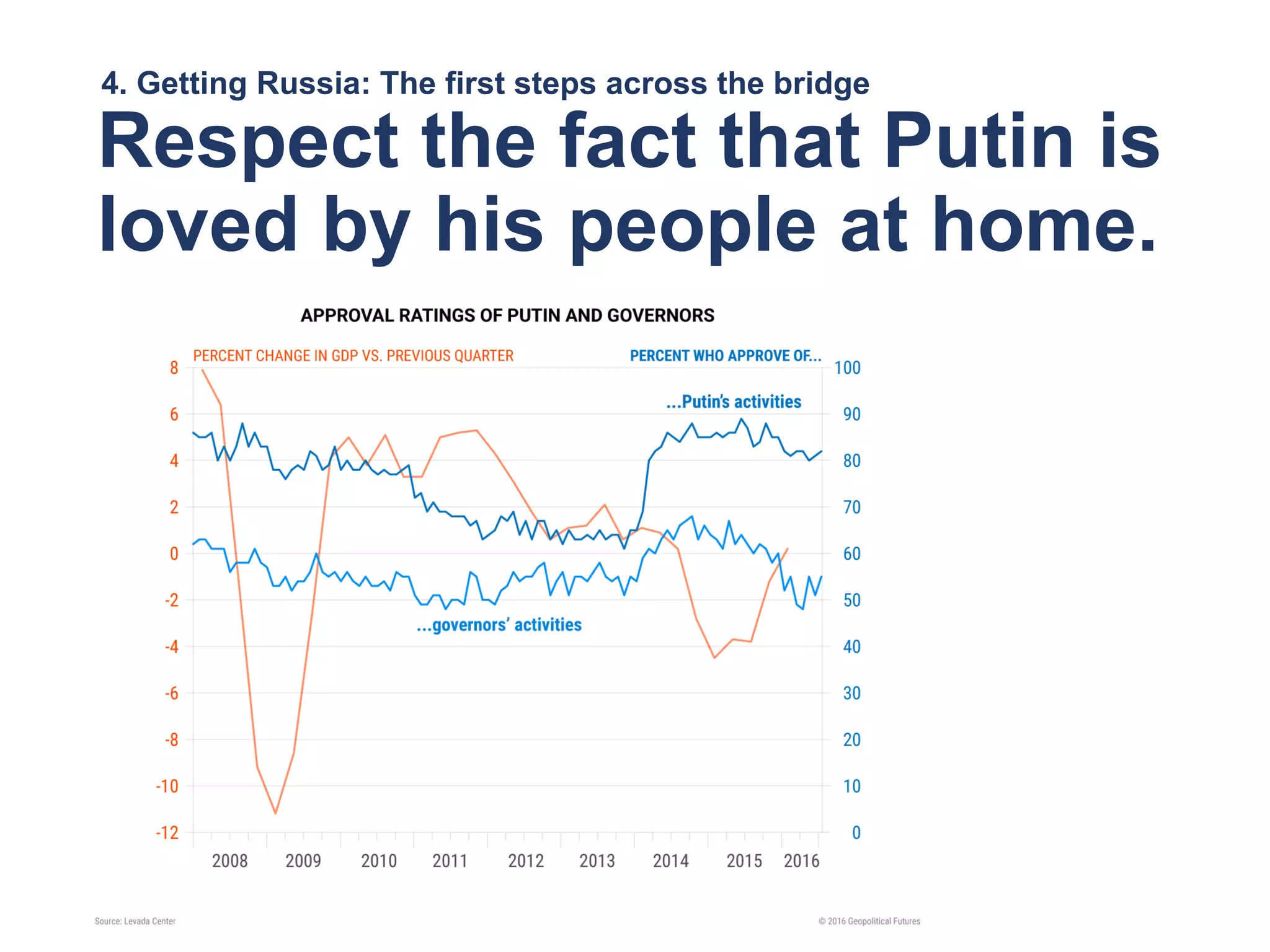
Respect the fact that Putin is
loved by his people at home.
4. Getting Russia: The first steps across the bridge
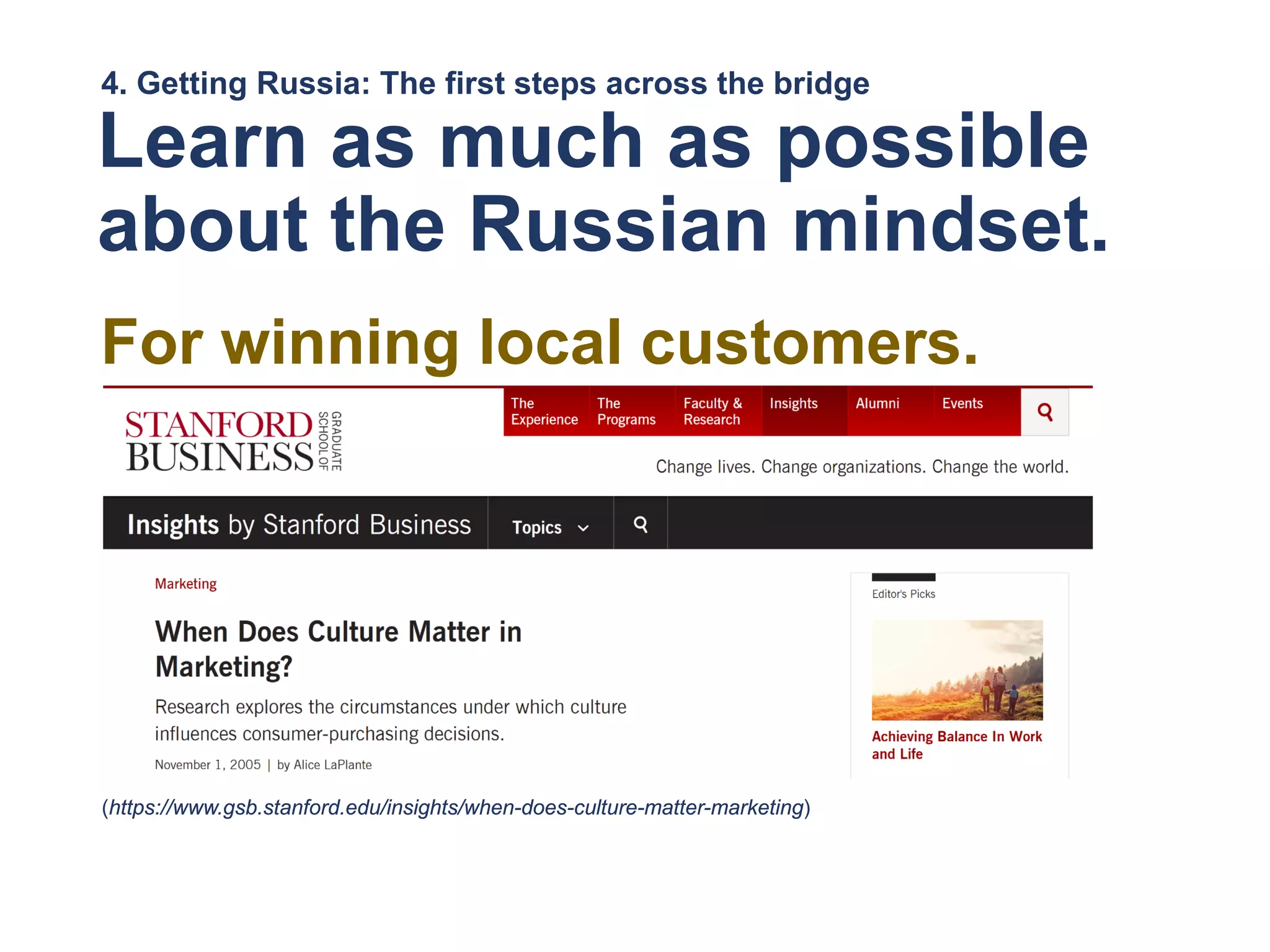
Learn as much as possible
about the Russian mindset.
For winning local customers.
(https://www.gsb.stanford.edu/insights/when-does-culture-matter-marketing)
4. Getting Russia: The first steps across the bridge
Learn as much as possible
about the Russian mindset.
Most non-Anglo Saxon cultures and
emerging markets only deal with people they
like.
If they like you, they are likely to trust you.
If they don’t like you, you won’t get beyond
the first introduction.
For building trust.
4. Getting Russia: The first steps across the bridge
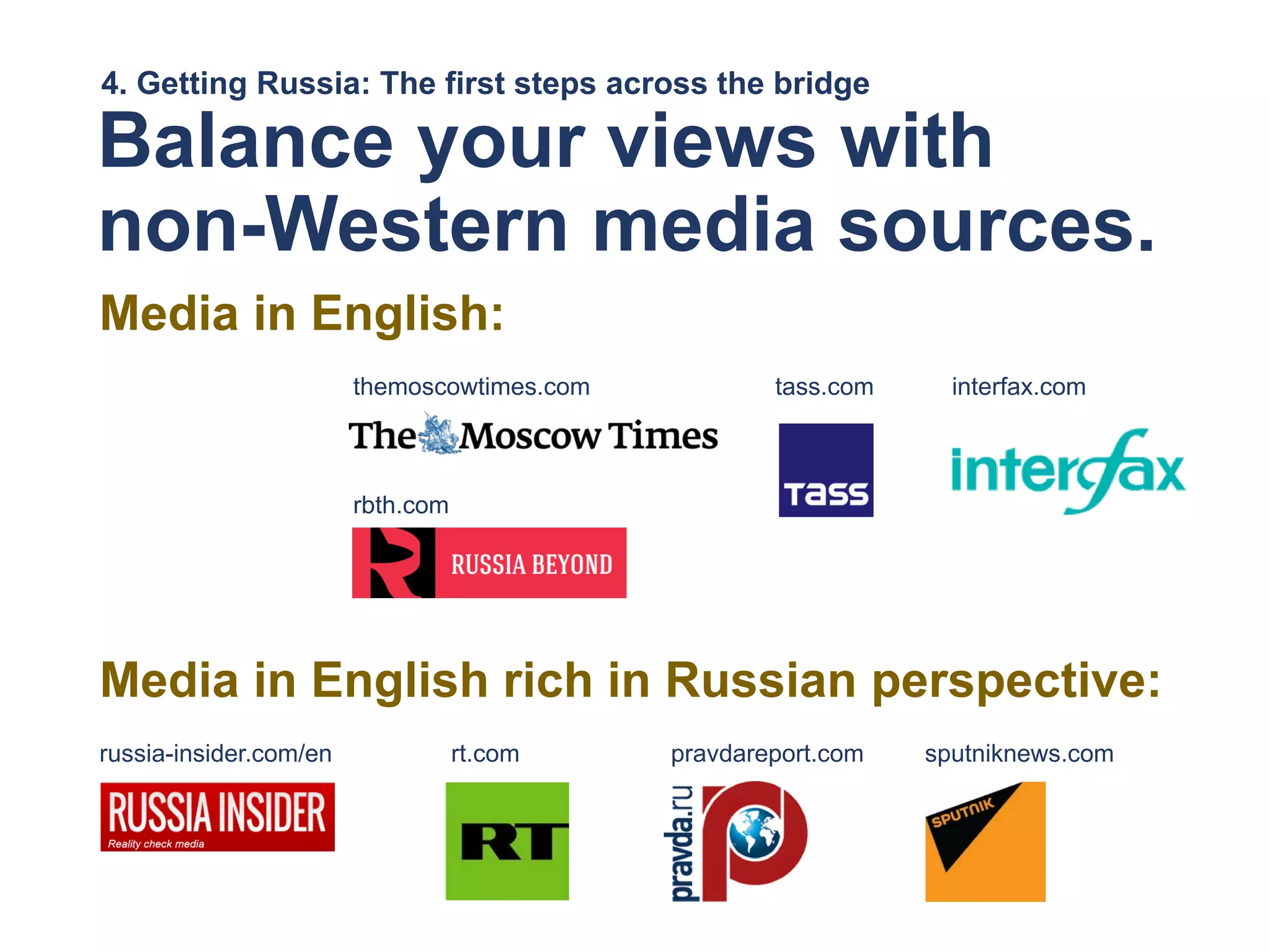
Balance your views with
non-Western media sources.
Media in English:
themoscowtimes.com tass.com interfax.com
rbth.com
Media in English rich in Russian perspective:
russia-insider.com/en rt.com pravdareport.com sputniknews.com
4. Getting Russia: The first steps across the bridge
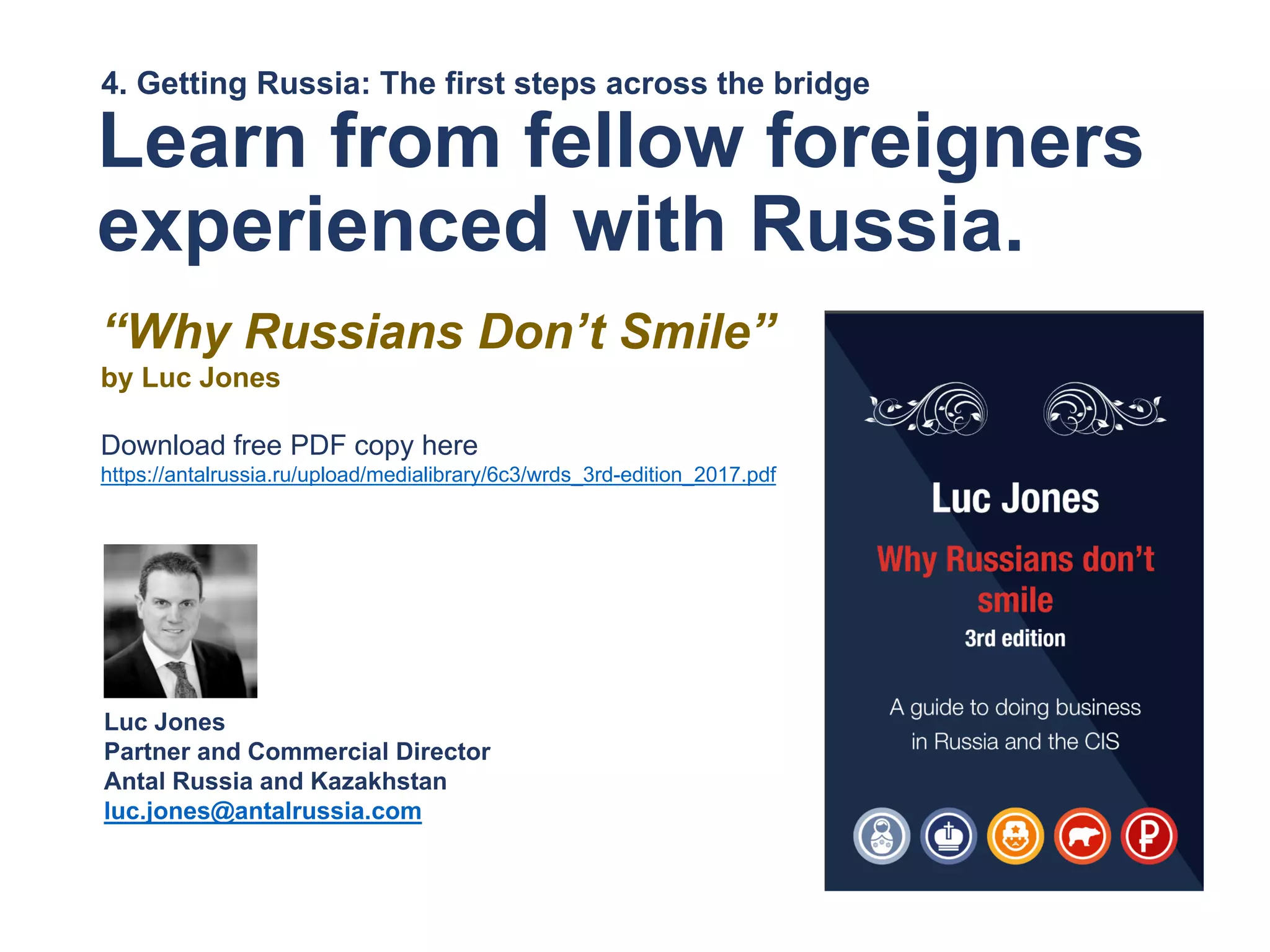
Learn from fellow foreigners
experienced with Russia.
“Why Russians Don’t Smile”
by Luc Jones
Download free PDF copy here
https://antalrussia.ru/upload/medialibrary/6c3/wrds_3rd-edition_2017.pdf
Luc Jones
Partner and Commercial Director
Antal Russia and Kazakhstan
luc.jones@antalrussia.com
4. Getting Russia: The first steps across the bridge
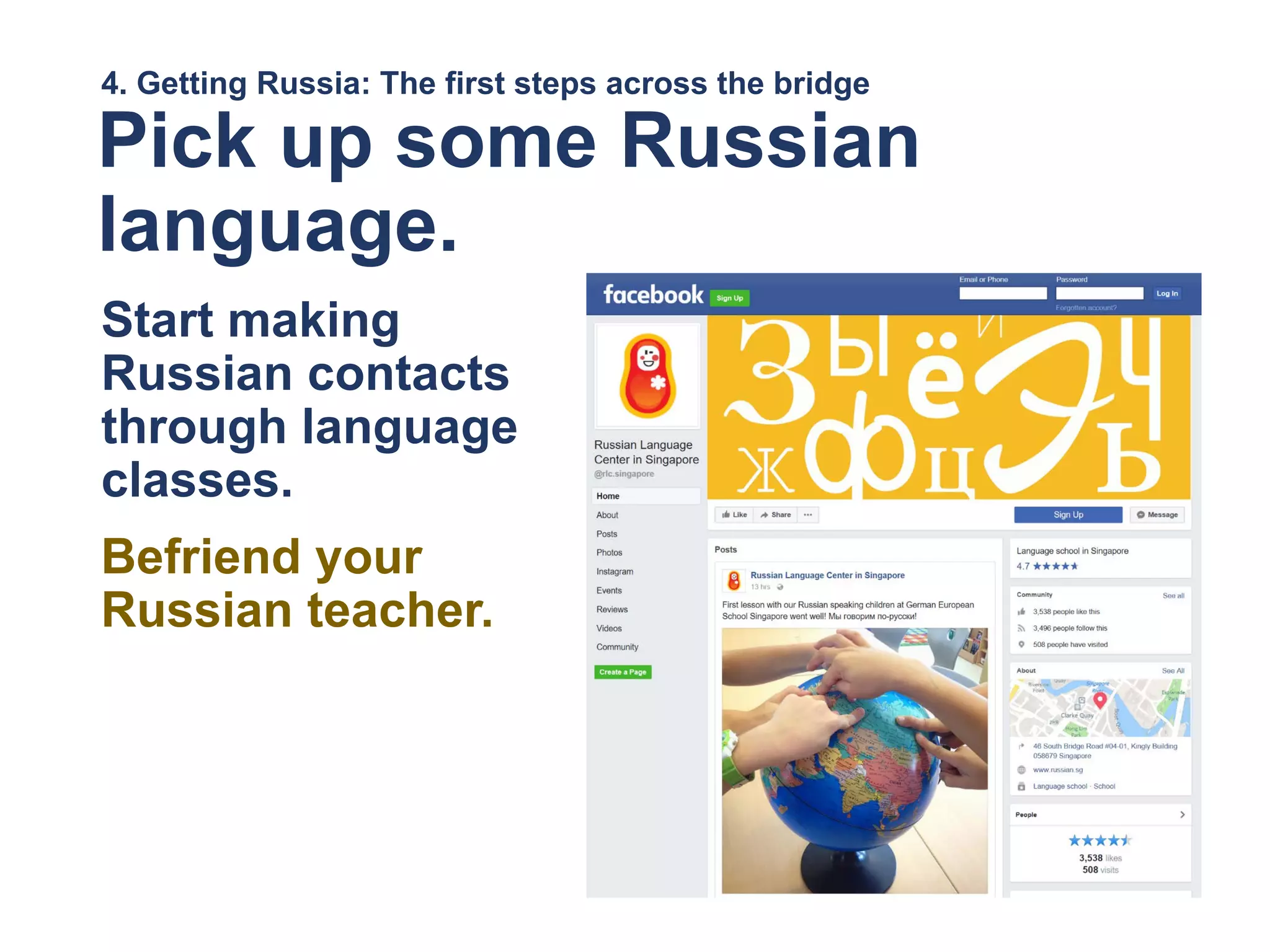
Pick up some Russian
language.
Start making
Russian contacts
through language
classes.
Befriend your
Russian teacher.
Take up internship or student
exchange with Russia.
Great higher education in arts,
humanities and sciences.
4. Getting Russia: The first steps across the bridge
People’s Friendship
University of Russia
http://studyinrussia.ru/en/http://5top100.com/universities/
More information:
4. Getting Russia: The first steps across the bridge
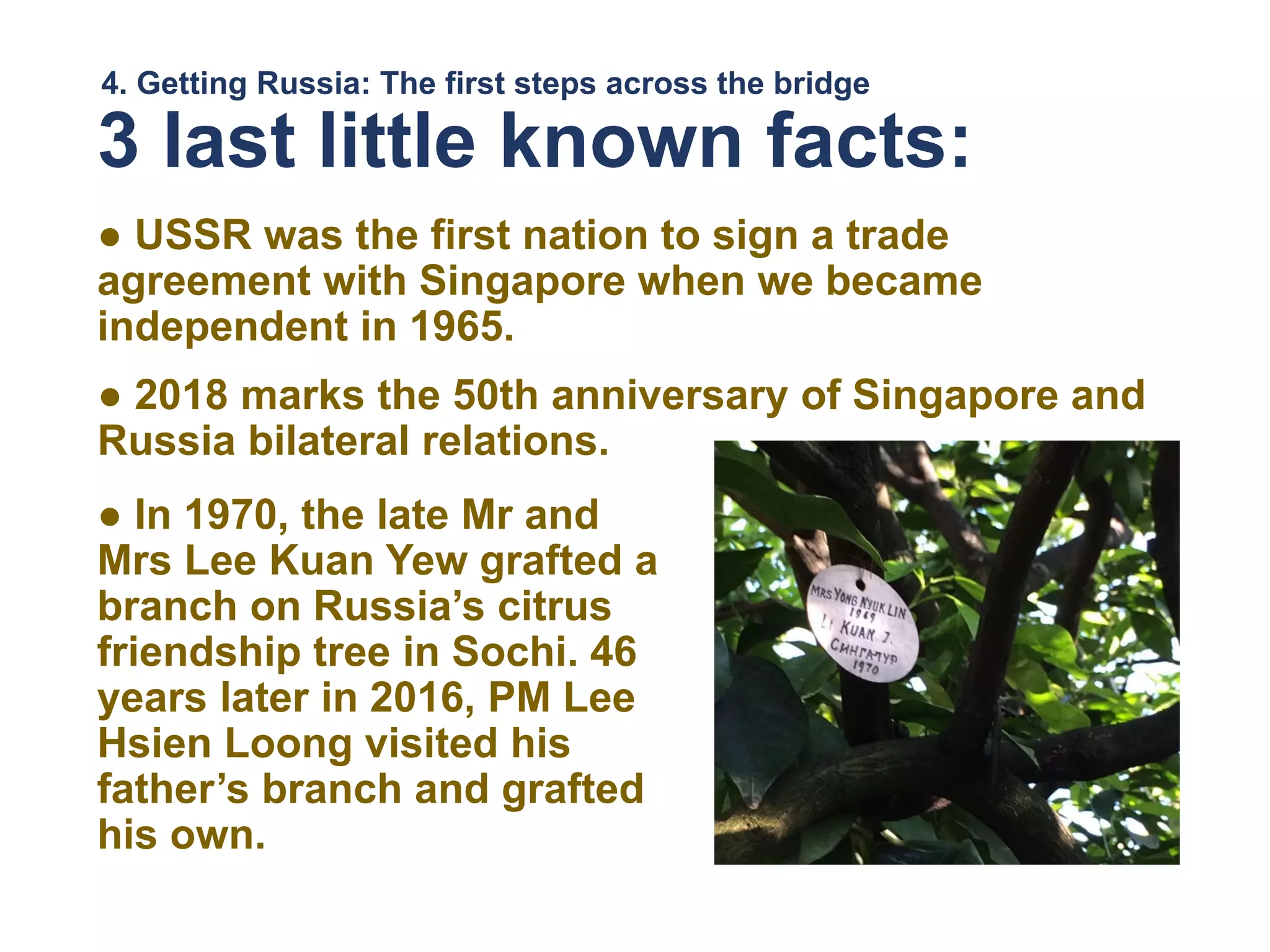
3 last little known facts:
● USSR was the first nation to sign a trade
agreement with Singapore when we became
independent in 1965.
● In 1970, the late Mr and
Mrs Lee Kuan Yew grafted a
branch on Russia’s citrus
friendship tree in Sochi. 46
years later in 2016, PM Lee
Hsien Loong visited his
father’s branch and grafted
his own.
● 2018 marks the 50th anniversary of Singapore and
Russia bilateral relations.
Connect with Gwyneth Tan @ and
© 14 September 2017 Gwyneth Tan except where copyrighted to others. No reproduction or
dissemination of any part hereof allowed unless with prior written permission.
Thank you

Demystifying Russia for Singapore university undergraduates

  • 1.
    SMU Emerging Markets Forum2017 Demystifying Russia: Growth Opportunities & Challenges Ahead
  • 2.
    SMU Emerging Markets AnIntroduction First & Only Student Club in Singapore with an Emerging Markets Research Focus Inaugural Emerging Markets Forum • Africa • China & East Asia • India • Latin America • Middle East & North Africa • Commonwealth of Independent States • South East Asia Macro Analysis Industry Analysis Company Analysis 4 Major Industry Types • Financial Institutions • Fast-Moving Consumer Goods • Resource & Energy • Industrial Corporate Group
  • 3.
    Russia marks thebeginning of a series of upcoming forums on other emerging markets, with next in the pipeline countries in the wider Commonwealth of Independent States region, which has drawn the interest of key power players including Russia, China and the developed West. Inaugural SMU Emerging Markets Forum An Introduction Demystifying Russia: Growth Opportunities and Challenges Ahead 13 September 2017 7-9pm Lee Kong Chian Business School
  • 4.
    Inaugural Emerging MarketsForum 2017 DEMYSTIFYING : Growth Opportunities and Challenges Ahead 13 September 2017 by Gwyneth Tan
  • 5.
    Legal statements While allreasonable care and good faith had been exercised to the best of the reasonable ability and experience of the author in the preparation of the materials contained in this presentation, the intended audience contemplated for receipt of these materials are assumed to possess reasonable experience and ability in interpreting economic, political and business news, information and trends. All sources quoted in these materials have been given due citations and acknowledgements where they appear. The author neither makes nor purports to make nor implies any claim of any kind of property or influence to any part of these sources and is not responsible for the accuracy, veracity or reliability of any part of these sources. All interpretation of these sources belong to the author who makes these interpretations under the best reasonable exercise of ability, experience, effort and care based on the extent of the knowledge and exposure of the author to the subject matter and are independent of and not the property of the sources quoted. All parts of these materials which are not the property of any source are the intellectual property of the author and shall not be reproduced or quoted or disseminated without her prior approval. The author neither makes nor purports to make nor implies any representation or warranty of any kind in any way as to the accuracy, veracity or reliability of any part of these materials. Recipients of these materials are strongly advised to conduct their independent research, checks, verifications, investigations or due diligence and/or engage proper professional advice whether legal or not, prior to acting on any part of these materials. No recipient shall in turn make, purport to make or imply any representation or warranty of any kind in any way to any party as to the accuracy, veracity or reliability of any part of these materials. The author shall not be liable for any claim or damage of any kind suffered by any party demanding such on grounds of reliance on any part of these materials. All rights are reserved by the author without prejudice to any legal or equitable right or recourse available to the author under the fullest extent of the applicable law or equity.
  • 6.
    About the speaker GwynethTan Corporate lawyer ● Governance, compliance, company administration and tax professional ● Co-founder, investor, entrepreneur, COO of a niche livestock business ● Singapore Government Trade Officer ● Singapore Diplomat to Russia ● Financial advisory and investment project development and management Lived and worked in Australia, Malaysia and Russia ● Done business with Americans, Japanese, Indonesian, and Malaysians ● Successes in large and small organisations in private and public sectors, including Temasek Holdings Private limited Done: Corporate law ● Sovereign wealth funds ● Venture capital and private equity ● Upstream agriculture ● Consumer and Retail ● PPP policy making ● Corporate governance and compliance ● Private wealth structuring ● Manufactured and fresh food wholesale and distribution ● Energy trading ● Urban and transport infrastructure Gwyneth’s experience with Russia, despite being entirely unplanned, has always placed her at ground zero during each politico-economic structural change of the world’s largest country. She witnessed on the coup at the Red Square in December 1991 which dissolved USSR to collect intel for her college’s thesis as a 17 year old Raffles Junior College student. She arrived to live and work in Russia mere months before 2014 when Russia-Western sanctions war broke out, as Singapore Trade Commissioner and Singapore’s national business developer for Singapore companies in Russia. In the next 2.5 years she was in the driver’s hot seat aggressively pushing Singapore companies and trade relations through the heat of the trade tensions. In total, she collectively had 7 years of experience engaging with Russia and Russians, the end period of USSR (1991-1992) and in recent years (2013-2016), each time through a sea change of the country.
  • 7.
    About the panellists KaranTilani Director, World of Diamonds Group of Companies Karan is the Executive Director of mining consortium World of Diamonds (WOD) Group of Companies. He oversees partnerships and marketing, having been involved in the Group’s most successful projects including the world’s most expensive perfume collection, world’s most expensive dining experience that comes with a blue diamond ring named after and endorsed by actress Jane Seymour, and world’s most expensive vacation that has a collection of gold and diamond swizzle sticks as its most luxurious amenity. He will be sharing insights into Russia's diamond industry, a field in which Russia is less known for despite her global dominance. He will also be touching on aspects of Russia's business climate such as managing interactions with Russian enterprises and oligarchs based on his experiences. Since 2012, World of Diamonds Group has rapidly expanded its global brand visibility. Under Karan’s stewardship, the Group penetrated into Asia. About World of Diamonds Group World of Diamonds Group has always been behind some of the finest diamonds and jewellery pieces. Through joint ventures with maisons in Europe and the Americas, the Group is fully integrated in diamond mining, polishing, high jewellery creation and distribution to leading luxury brands which have a global presence. World of Diamonds Group was established in Russia in 2001. The Group financially supports diamond industries in Russia and various parts of Africa. Utilizing the best science and unrestrained creativity, the Group not only attained a global reputation for its large, dazzling, fancy coloured diamonds, but also by being proactive in benefiting communities. The Group observes strong compliance with the regulations of the World Diamond Council and has always committed to using all reasonable endeavours to obtain diamonds through legitimate channels. The Group opposes the facilitation of illicit activities, including the illegal trading of blood diamonds.
  • 8.
    About the panellists VladislavSolodkiy slavasolodkiy.me Slava launched Life.SREDA in Singapore 4 years ago, one of the first fintech-only VCs in the world. Today, Life.SREDA made more than 20 investments in the US, EU and Asia, with 7 successful exits. Slava ranks among the TOP35 Most Influential Fintech-investors in the world ranked by Institutional Investor, TOP21 Fintech Influencers in Europe ranked by Disruptive Finance, and the TOP100 Fintech Ecosystem Builders in Asia ranked by E&Y and Next Money. He was also Keynote-speaker at Money2020, RiseMoneyConf, Speaker and judge at European Fintech Awards, Global Payment Summit, FinSpire and FinnovAsia, judge at Singapore Fintech Festival, Fintech CEO Summit by IFC, ParisFintech Forum, Global Venture Summit, Fintech Award LatAm, DotFinance Africa, The Future Of Finance Summit and many other conferences. He is a contributor for Forbes, TheNextWeb, European Financial Review, EFMA journal, VentureBeat, TechInAsia, e27, LTP, FTR, FintechNews, etc, and author of “Money Of The Future” fintech report. Timur Khamitov Head of Partnerships and Startup Ecosystem, Life.SREDA Timur was the Investment Director and Head of Corporate Finance team for 5 years at the family office of one of the wealthiest families in Russia who owns Russia’s Top-5 commercial banks and leading IT integrator, as well as being Chairman of the Board of Directors and BoD member of several Russian industrial companies. In 2016, Timur left the Russian investment world and arrived in Singapore to study at INSEAD. He is passionate about building a fintech startup ecosystem and today, he is fulfilling his dreams at Life.SREDA in Singapore, where he is actively building new partnerships with corporates and startups.
  • 9.
    Acknowledgement The speaker thanksthe following individuals whose publications were consulted during the preparation of these materials: Christopher J Weafer Senior Partner Macro-Advisory www.macro-advisory.com Luc Jones Partner and Commercial Director Antal Russia and Kazakhstan luc.jones@antalrussia.com Marat Mouradov Partner Dentons Moscow marat.mouradov@dentons.com Artur Karlov Head of Project Centre Russian University of Transport
  • 10.
    Foreword by thespeaker Russia for Singaporean undergraduates Russia is a complex market with a complex people. Despite more than a decade of bilateral efforts to increase awareness of each other, Russia – and her neighbouring markets - remain new frontiers for most Singaporeans. These materials were prepared with care by a globalised Singaporean, specifically for the Singaporean youth, to respond to the most common questions Singaporeans have about Russia. As our undergraduates will soon inherit the business, finance and public institutions of our country, their curiousity for emerging markets is heartening and should be nurtured. Not every question will be answered nor is any definitive view given here. The focus is to offer ground perspectives to the most common views held by Singaporeans, point Singaporeans to the existence of non-Western views, and highlight a few immediate areas where the strengths of Russia can potentially complement Singapore’s current directions of development. Underlying the themes in these materials is the keen mindfulness that despite our achievements to-date, Singapore is still a tiny nation constrained in many ways. Our approach to any new frontier therefore cannot ape the attitudes of big nations. Neither can we afford behave like a culture of big noses from a small country. All Singaporean readers are advised and encouraged to derive their own independent views free of influence from any media, whether Western or Russian, and think critically from all angles. Readers who are not Singaporeans are strongly advised not to use these materials as any basis for any non-Singaporean view.
  • 11.
    Pre-reading “Russia is always mystifyingand misunderstood by most Singapore businesses. Its recent events are even more bewildering to the Singapore mind. Let’s give our best shot at condensing it for the busy Singapore businessman.” Download here or cut and paste this link: https://www.iesingapore.gov.sg/-/media/IE- Singapore/Files/Publications/IE- Insights/Vol25_Russia_rebalances_its_eco nomic_focus.ashx
  • 12.
    Overview 1. Why Russia?Inconvenient truths to popular objections 2. USSR to 2017: Adjusting to capitalist economy 3. Russia’s edge = New frontiers for future Singaporeans? 4. Getting Russia: The first steps across the bridge 5. Panel Discussion
  • 13.
    It’s nearer thanUK, Europe and the US: +2 hrs of Vladivostok ≈ 11+ hrs flight with 1 transit* -5 hrs of Moscow ≈ 10+ hrs flight non-stop* -7 hrs of London ≈ 13+ hrs flight non-stop* -12 hrs of New York ≈ 20+ hrs flight with 1 transit* -15 hrs of Los Angeles ≈ 18-19+ hrs flight with 1 transit* * Average flight times according to Skyscanner Yandex Translate* the rest: https://translate.yandex.com/ * More accurate for Russian than Google Translate. Yandex is Russia’s answer to Google. Memorise useful phrases: Привет / Здравствуйте, меня зовут Гвинет. Очень приятно! Immediate solutions: Learn the alphabets (only 35): Get the right clothes. Why Russia? Too cold? Too alien? Too far? Why not? 1. Why Russia? Inconvenient truths to popular objections
  • 14.
    Cuisines available: ● Americanfast food (McDonald’s, KFC, Burger King, Baskin Robbins) ● Russian restaurants (e.g. Dr Zhivago) and “democratic” canteens (e.g. Moo Moo) ● All Western cuisines ● Caucasus cuisine (e.g. Turkish, Georgian, Armenian) ● Japanese ● Thai ● Korean ● Indian ● Vietnamese, Malaysian, North Chinese, Taiwanese Look up more: https://en.novikovgroup.ru/http://www.rrg.lv/en/rosinter http://en.ginza.ru/msk Street food is new. Trendy, casual & fine dining abound. Why Russia? Food is terrible? Why not? 1. Why Russia: Inconvenient truths to popular objections
  • 15.
    Why Russia? Whynot? Russia is much safer than the US. It is now safer than Germany or France. Common sense note for Singaporeans: Be more mindful of personal safety whenever outside of Singapore. Too dangerous? 1. Why Russia: Inconvenient truths to popular objections
  • 16.
    Doing business in Russiais easier than most of Asia. Why Russia? Too difficult? vs ASEAN EODB 2017 Singapore 2 Malaysia 23 Russia 40 Thailand 46 Brunei 72 Vietnam 82 Indonesia 91 Philippines 99 Cambodia 131 Laos 139 Myanmar 170 vs North Asia EODB 2017 Hong Kong 4 South Korea 5 Taiwan 11 Japan 34 Russia 40 Mongolia 64 China 78 vs South Asia EODB 2017 Russia 40 Sri Lanka 110 India 130 Pakistan 144 vs Middle East EODB 2017 UAE 26 Russia 40 Israel 52 Bahrain 63 Oman 66 Turkey 69 Saudi Arabia 94 Kuwait 102 Jordan 118 Iran 120 Egypt 122 Iraq 165 Yemen 179 (World Bank’s Ease of Doing Business 2017 at http://www.doingbusiness.org/rankings) Why not? 1. Why Russia: Inconvenient truths to popular objections
  • 17.
    Why Russia? 1. WhyRussia: Inconvenient truths to popular objections Why not? Russia public sector ranks #131/176. • Highly publicised cases abroad. • Low political will to clean up the government? Observation: • Singaporeans’ very low tolerance for corruption, in practice leaves us with only 15 familiar “clean” markets to explore, not all of which Singaporeans can adapt to. • Nearly all 15 are mature markets saturated with domestic rivals or suffering from rising unemployment. • Many favoured Asian markets are not in the 15. Corruption Perception Index 2016 of public sector of 176 nations (https://www.transparency.org/whatwedo/publication/corruption_perceptions_index_2016) Too corrupt? 70% of the world work in shades of grey.
  • 18.
    Getting business vianetwork, gifts, entertainment… Why Russia? 1. Why Russia: Inconvenient truths to popular objections Why not? corrupt practices? Where do we draw the line?
  • 19.
    Why Russia? Note thatexported corruption by “clean” nations exists. 1. Why Russia: Inconvenient truths to popular objections (https://www.transparency.org/cpi2015/) Swedish-Finnish firm TeliaSonera – 37% owned by the Swedish state – faced allegations that it paid millions of dollars in bribes to secure business in Uzbekistan, which ranked #153 in the 2015 Corruption Perception Index. Why not?
  • 20.
    In a nutshell… 1.Do more hype exist than facts? 2. Human nature fears the unknown. 3. Singapore’s economic, political and military engagements with and in Russia are too small to worry Russia’s rulers. 4. Do popular Western sentiments and opinions about Russia align with Singaporeans’ identity as a tiny, neutral nation of tolerant and pragmatic people? 5. Corruption is inevitable when going global. How sensitive or desensitised should Singaporeans be to this reality? 1. Why Russia: Inconvenient truths to popular objections
  • 21.
    Russia’s economy todayis a 15 year old with a long legacy. 2. USSR to 2017: Adjusting to capitalist economy 74 years 1917 – 1991 • World War I • World War II • Cold War, Détente • Proxy wars in Middle East and Asia • Glasnost, Perestroika • Coup of December 1991 12 years 1992 – 2003 • 1992-1993 were “Lost Years” due to implosion • 1993-2003 hyperflation period • Social embracing of American culture • Inter-marriages with Westerners • Beginnings of oligarchs 14 going on 15… 2003 – present • Unprecedented prosperity • Global financial crisis • Asian financial crisis • Invasion of Georgia • Annexation of Crimea • Sanctions war with US and EU • Pivot to Asia • Brief tensions and sanctions with Turkey • Military action in Syria USSR Lost Decade Russia now Full fledged capitalism begun in Europe from 1500s onwards. Today’s developed market economies had a great deal more time to “get things right”. Year Founded United Kingdom 1707 United States 1776 Australia 1788 New Zealand 1840 Hong Kong 1841 Canada 1867 Singapore 1965
  • 22.
    2. USSR to2017: Adjusting to capitalist economy Prospered in 15 years despite global financial crisis of 2008. Topline macro improvements in conjunction with rise in oil prices. 2003 2013 OTC Crude Oil USD 31/brl USD 98/brl _________________________________________________ Annual GDP USD 430.4 bn USD 2,230.6 bn Balance of trade USD 59.8 bn USD 181.9 bn Current account USD 3.3 bn USD 33.4 bn Gold reserves 390.12 tonnes 1,035.21 tonnes Annual inflation rate 13.7% 6.8% Unemployment rate 8.6% 5.5% Interest rates 6.5% 5.5% Growth drivers • Boom in oil prices • Partial adoption of market economy • New regional market for slowing EU economies (Source: Trading Economics | Rostat)
  • 23.
    2003 2013 Foreign DirectInvestment USD 7,929 mn USD69,219 mn Industrial production 8.9% 0.4% Manufacturing production 10.1% 0.4% GDP per capita PPP USD16,819 USD25,144 Labour force participation rate 64.7% 68.6% Labour productivity 7.0% 1.8% Consumer Price Index 160 index points 396 index points Real wage growth 10.2% 5.3% Retail sales growth 8.8% 3.9% Disposable personal income 15.5% 4.0% Drop in production and productivity despite increased input. 2. USSR to 2017: Adjusting to capitalist economy But underdeveloped some fundamentals… (Source: Trading Economics | Rostat)
  • 24.
    2. USSR to2017: Adjusting to capitalist economy …with 45% of inward FDIs made through tax havens...
  • 25.
    2. USSR to2017: Adjusting to capitalist economy …low diversity of cashflow sources…
  • 26.
    2. USSR to2017: Adjusting to capitalist economy … and low diversity of economic partners. After dissolution of the USSR in 1991, Russia reached out to Europe and the West for resources to update its outdated Soviet economy. In 2013, Russia’s 10 largest investors were Western nations who make up 84% of all foreign investors. Imports of modern equipment, products & services Investments brought transfer of tech & know-know + At end 2014, Russia’s trade relations was almost 60% dominated by developed Western nations. (Source: Rostat)
  • 27.
    2. USSR to2017: Adjusting to capitalist economy Low urgency for export driven economic development model. Deep comparative advantages in resources to support domestic fulfilment at Russia’s own pace. Domestic markets very underserved.
  • 28.
    2. USSR to2017: Adjusting to capitalist economy Hydrocarbons, commodities form bulk of exports… What is worrying • Not the fall in oil prices. • But inadequate or slow development of good domestic environment to grow domestic production. 49.0 46.2 51.5 54.0 20.7 15.3 18.7 19.1 30.4 17.4 21.6 21.9 0.0 20.0 8.1 8.3 0.0 10.0 20.0 30.0 40.0 50.0 60.0 1990 2000 2010 2015 Sources of Russia GDP Contributions (%) Household Expenditure Government Expenditure Fixed Capital Formation Net Exports …but not bulk of GDP contributions. (Numbers crunched from UN Data, http://data.un.org/)
  • 29.
    Russian biggest banksare cut off from interbank activities with Western banks: Russian energy, defense & dual-tech majors: 2. USSR to 2017: Adjusting to capitalist economy Sanctions aimed at energy, industrial, finance sectors...
  • 30.
    2. USSR to2017: Adjusting to capitalist economy …individuals who control them, and Putin’s advisors.
  • 31.
    2. USSR to2017: Adjusting to capitalist economy Coinciding with crashed oil prices, cashflow took a hit.
  • 32.
    2. USSR to2017: Adjusting to capitalist economy Food supply hit with Russia’s retaliatory import sanctions. Prices of staple items in Russian diet doubled. • Fresh and frozen beef, lamb and pork meat and smoked meats products • Fresh and frozen poultry and processed poultry products • Milk and dairy products • Fresh and frozen fish and seafood • Fresh vegetables, edible roots and tubers, fruits and nuts
  • 33.
    2. USSR to2017: Adjusting to capitalist economy Russia took an unexpected path to counter the sanctions. Making all the right moves for the economy for the longer term? 1. Reduce imports 2. Diversify economic partners 3. Step up domestic production with import substitution incentives 4. Reduce government spending 5. Free float the ruble to avoid borrowing to fund social, wage and pension spending 6. Raise efficiency of state enterprises 7. Invest in transport infrastructure development through upgrading of talent and support PPP projects in new transport technologies for cargo and passenger transportation, transport security, and construction of transport infrastructure
  • 34.
    2. USSR to2017: Adjusting to capitalist economy Reduced imports and public spending showing results. Sharp GDP growth from July 2015.
  • 35.
    2. USSR to2017: Adjusting to capitalist economy Increased trade balances with Asia since 2014. Trade balance with Europe declines. -50000000 0 50000000 100000000 150000000 200000000 2007 2008 2009 2010 2011 2012 2013 2014 2015 2016 Russia's 10-Year Trade Balance with Europe, N. Americas and Asia Continental Europe (including UK) North Americas (US, Canada, Mexico) Asia (North, South, East, Central and Southeast Asias, and Middle East) ‘000 USD Source: UN COMTRADE
  • 36.
    2. USSR to2017: Adjusting to capitalist economy All domestic production on the rise since 2015. Source: Central Bank of Russia Mar-Dec 2014 witnessed slew of sanctions and counter- sanctions
  • 37.
    2. USSR to2017: Adjusting to capitalist economy Unexpected gain in agriculture production. Long term solution to reducing dependency on food imports. ● Poultry and poultry products ● Pork and pork products ● Seafood and seafood products ● Beef and beef products ● Dairy is still serving domestic Russia News: Miratorg’s export discussions are underway with China and Singapore.
  • 38.
    1H2017 saw growthin SME and transport sectors. 2. USSR to 2017: Adjusting to capitalist economy Economy adjusting to new normal of limited options. i.e. SMEs
  • 39.
    US$30 Whose cost is closest? 2.USSR to 2017: Adjusting to capitalist economy About talks of low oil prices “killing” Russia…
  • 40.
    In a nutshell… 1.Events of 2014 a much needed catalyst to resolve some long standing structural issues 2. Reports of sanctions and low oil prices “killing” Russia likely exaggerated 3. Today’s Russia is a young person with an old soul. Plenty more growth to be expected. 2. USSR to 2017: Adjusting to capitalist economy
  • 41.
    Russia’s comparative advantages: Resources. ● Oil,natural gas, O&G refined products – World’s largest proven natural gas reserves ≈ 48.81 trillion m3 (EIA, 2017) – World’s 8th largest proven oil reserves (EIA, 2017) ● Metals and minerals – World’s top 3 countries with largest reserves of diamond, coal, iron, gold, nickel and lead (Metals and Mining in Russia, KPMG, Sep 2016) ● Land, arable and non-arable. – Country with largest land area ≈ 17.1 million km2 (worldatlas.com) ● Renewable water supply – World’s 2nd largest renewable water supply ≈ 4.525 billion m3 (Maps of the World, 2014) 3. Russia’s edge = New frontiers for future Singaporeans? For SG’s future?
  • 42.
    Russian energy companiesoccupy 4 out of Forbes 25 list in 2016, including top 2 spots (Forbes, 2016) Ranking Company Enterprise BOE/Day Value Production #10 USD84.3 bn 8.38 mn #20 USD72.5 bn 5.07 mn #90 USD36.0 bn 2.40 mn #14 USD08.5 bn 1.49 mn Russia’s comparative advantages: World’s largest energy companies. 3. Russia’s edge = New frontiers for future Singaporeans? Domination of Russian energy companies at home and the world’s energy sector is unlikely to change as hydrocarbon reserves remain Russia’s strongest comparative advantage
  • 43.
    Russia’s comparative advantages: Moscow is#3 city for billionaires. 3. Russia’s edge = New frontiers for future Singaporeans? (Forbes, 21 March 2017) Offshore Russian private wealth has great impact on global private wealth services, financial services, consumer and hospitality industries. • Private wealth careers specializing in Russian clients in private wealth centres of the world. • Luxury consumer goods and services catering to UHNW and HNW Russian consumers in megacities (e.g. London, New York, Geneva). • Luxury residential or hospitality real estate and real estate services across the globe for UHNW and HNW Russian investors.
  • 44.
    Russia’s comparative advantages: World #2in programming talents. 3. Russia’s edge = New frontiers for future Singaporeans? World’s 4th largest antivirus software vendors by revenue. Of the 26 finalists of the 2017 Code Jam finalists, 13 were Russian, with Russians taking 2nd, 3rd and 4th places in the end. For SG now?
  • 45.
    Russia’s comparative advantages Programming +art talents combined. 3. Russia’s edge = New frontiers for future Singaporeans? Creators: Alexey Moiseenkov Oleg Poyaganov Ilya Frolov Andrey Usoltsev Stunning commercial success: One week after its debut on iOS App Store, the app was downloaded over 7.5 million times and received over 1 million active users
  • 46.
    Russia’s comparative advantages Programming +financial talent combined. 3. Russia’s edge = New frontiers for future Singaporeans? Thought leader: Vladislav Solodkiy slavasolodkiy.me
  • 47.
    In a nutshell… 1.Russia offers what Singapore lacks? 2. Potential for Singapore to tap on Russia’s programming talents 3. Russia’s resources of all kinds will always be a key complement to resource poor Singapore 3. Russia’s edge = New frontiers for future Singaporeans?
  • 48.
    Western views andsentiments are not authoritative. 4. Getting Russia: The first steps across the bridge Note: Russian diaspora comprise some of the best minds in the world. While they are the minority at home, abroad they hold significant influence in global IT and finance. And they mostly do not agree with their fellow countrymen about Russia. Observation Despite being named as foreign agent by Russian Government, Levada Centre continues to provide independent opinion polls whose results are unpopular with Russia’s detractors and critics. (http://www.bbc.com/news/world-europe- 37278649)
  • 49.
    4. Getting Russia:The first steps across the bridge Respect the fact that Putin is loved by his people at home.
  • 50.
    4. Getting Russia:The first steps across the bridge Learn as much as possible about the Russian mindset. For winning local customers. (https://www.gsb.stanford.edu/insights/when-does-culture-matter-marketing)
  • 51.
    4. Getting Russia:The first steps across the bridge Learn as much as possible about the Russian mindset. Most non-Anglo Saxon cultures and emerging markets only deal with people they like. If they like you, they are likely to trust you. If they don’t like you, you won’t get beyond the first introduction. For building trust.
  • 52.
    4. Getting Russia:The first steps across the bridge Balance your views with non-Western media sources. Media in English: themoscowtimes.com tass.com interfax.com rbth.com Media in English rich in Russian perspective: russia-insider.com/en rt.com pravdareport.com sputniknews.com
  • 53.
    4. Getting Russia:The first steps across the bridge Learn from fellow foreigners experienced with Russia. “Why Russians Don’t Smile” by Luc Jones Download free PDF copy here https://antalrussia.ru/upload/medialibrary/6c3/wrds_3rd-edition_2017.pdf Luc Jones Partner and Commercial Director Antal Russia and Kazakhstan luc.jones@antalrussia.com
  • 54.
    4. Getting Russia:The first steps across the bridge Pick up some Russian language. Start making Russian contacts through language classes. Befriend your Russian teacher.
  • 55.
    Take up internshipor student exchange with Russia. Great higher education in arts, humanities and sciences. 4. Getting Russia: The first steps across the bridge People’s Friendship University of Russia http://studyinrussia.ru/en/http://5top100.com/universities/ More information:
  • 56.
    4. Getting Russia:The first steps across the bridge 3 last little known facts: ● USSR was the first nation to sign a trade agreement with Singapore when we became independent in 1965. ● In 1970, the late Mr and Mrs Lee Kuan Yew grafted a branch on Russia’s citrus friendship tree in Sochi. 46 years later in 2016, PM Lee Hsien Loong visited his father’s branch and grafted his own. ● 2018 marks the 50th anniversary of Singapore and Russia bilateral relations.
  • 57.
    Connect with GwynethTan @ and © 14 September 2017 Gwyneth Tan except where copyrighted to others. No reproduction or dissemination of any part hereof allowed unless with prior written permission.
  • 58.