RESEARCH POSTER PRESENTATION DESIGN © 2012
www.PosterPresentations.com
• Name: Renuka Deshmukh
• Background:
– Degree: Master of Science, Indiana
University, Bloomington
– Interest Areas: Application Development,
Data Science, Productivity Tools,
CodeJams
• Role@Cisco: Data Analysis and Application
Development
• I also like Reading, Hiking, Music and Playing
Mobile Games
• Mentors – Rahul Kalra, Shreyas Chandrashekar,
Mana Palai, CB Dasgupta
INTRODUCTION
• Extensive and cumbersome debugging process.
• Large turn around time for identifying and fixing
issues.
• Difficult to duplicate corner-case scenarios.
• Need to compile code every time
a change is made.
• Adding traces is time consuming.
PROBLEMS ADDRESSED
• CINT – C Interpreter
– An interpreter for C and C++ code.
– Written in C++ and covers most of ANSI C.
– CINT offers a GDB like debugging environment for interpreted programs.
– Reduces the compile and link cycle drastically facilitating rapid development.
– Portability – CINT is portable with a vast number of OS including Linux, Windows, MacOS and
Solaris. All standard compilers including gcc, Cygwin-gcc, Borland-gcc, MS Visual C++, etc. are
supported by CINT.
WORK FLOW
USE CASES
LEARNING
• Unix/Linux Environment
• C Language
• CINT Interpreter
• Makefile workings
• GCC environment
• Python
• Hackathon
CONCLUSIONS
• Earlier:
Identifying, Debugging, Isolating and Fixing a
bug takes days.
• Now:
CINT provides a simple and easy
to use debugging framework.
• Embedded script can directly call
functions from the pre-compiled
library.
• No need to compile the entire code after
making changes to the CINT script.
• Minimal changes required in code to get
dump of data structures.
• Easy to manipulate data structures and follow
code execution path.
• Debugging time will be reduced to hours
instead of days.
ACKNOWLEDGEMENTS
I would like to thank my team for helping me
with my project. I would especially like to
thank my manager Vibin P Thomas, and all my
mentors for guiding me all the way to the
completion of my project.
ROSG – Router and Optical Switching Group
Renuka Deshmukh
Integrating XR Framework with CINT
• Dump of data structures:- By writing a simple function to return pointer to a data structure in the pre-
compiled code, CINT can be used to get a dump of the data structure.
• Runtime debugging of process:- CINT can be used to directly call functions of the pre-compiled library
by passing custom values, thus providing the ability of live debugging.
• Change data structure values:- Given pointer to a data structure, CINT can then be used to change values
at run-time and study its impact on other values of data structure.
• Execute mini task in process context:- As CINT can directly call functions from the pre-compiled library, it
can also be used to execute mini process, thus proving the facility of localizing the issue and working on
it.
• No Compilation Required:- Changes to the CINT script does not require compiling the code, enabling in
saving considerable time.
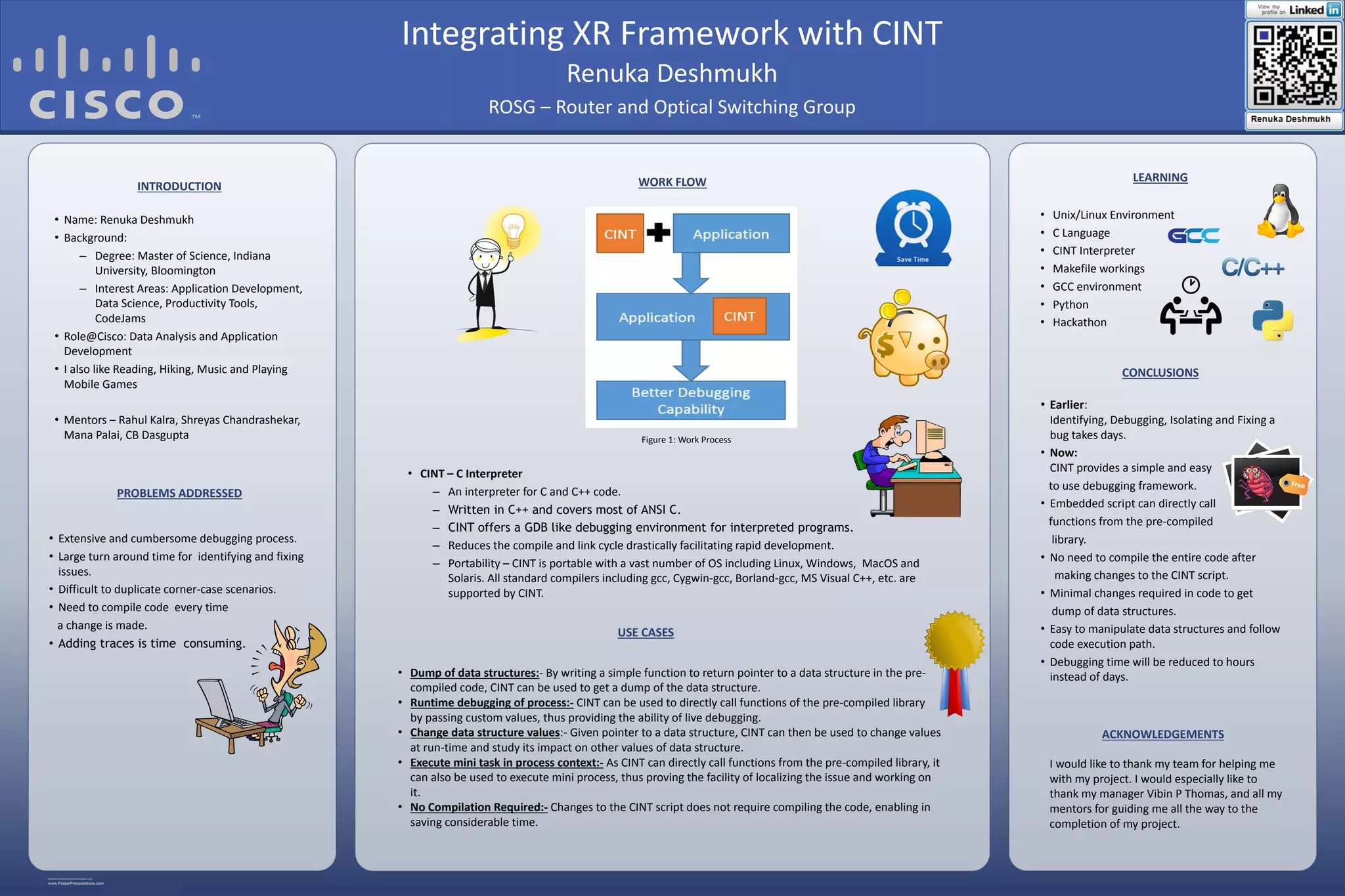
Figure 1: Work Process

Demo Poster_Renuka

  • 1.
    RESEARCH POSTER PRESENTATIONDESIGN © 2012 www.PosterPresentations.com • Name: Renuka Deshmukh • Background: – Degree: Master of Science, Indiana University, Bloomington – Interest Areas: Application Development, Data Science, Productivity Tools, CodeJams • Role@Cisco: Data Analysis and Application Development • I also like Reading, Hiking, Music and Playing Mobile Games • Mentors – Rahul Kalra, Shreyas Chandrashekar, Mana Palai, CB Dasgupta INTRODUCTION • Extensive and cumbersome debugging process. • Large turn around time for identifying and fixing issues. • Difficult to duplicate corner-case scenarios. • Need to compile code every time a change is made. • Adding traces is time consuming. PROBLEMS ADDRESSED • CINT – C Interpreter – An interpreter for C and C++ code. – Written in C++ and covers most of ANSI C. – CINT offers a GDB like debugging environment for interpreted programs. – Reduces the compile and link cycle drastically facilitating rapid development. – Portability – CINT is portable with a vast number of OS including Linux, Windows, MacOS and Solaris. All standard compilers including gcc, Cygwin-gcc, Borland-gcc, MS Visual C++, etc. are supported by CINT. WORK FLOW USE CASES LEARNING • Unix/Linux Environment • C Language • CINT Interpreter • Makefile workings • GCC environment • Python • Hackathon CONCLUSIONS • Earlier: Identifying, Debugging, Isolating and Fixing a bug takes days. • Now: CINT provides a simple and easy to use debugging framework. • Embedded script can directly call functions from the pre-compiled library. • No need to compile the entire code after making changes to the CINT script. • Minimal changes required in code to get dump of data structures. • Easy to manipulate data structures and follow code execution path. • Debugging time will be reduced to hours instead of days. ACKNOWLEDGEMENTS I would like to thank my team for helping me with my project. I would especially like to thank my manager Vibin P Thomas, and all my mentors for guiding me all the way to the completion of my project. ROSG – Router and Optical Switching Group Renuka Deshmukh Integrating XR Framework with CINT • Dump of data structures:- By writing a simple function to return pointer to a data structure in the pre- compiled code, CINT can be used to get a dump of the data structure. • Runtime debugging of process:- CINT can be used to directly call functions of the pre-compiled library by passing custom values, thus providing the ability of live debugging. • Change data structure values:- Given pointer to a data structure, CINT can then be used to change values at run-time and study its impact on other values of data structure. • Execute mini task in process context:- As CINT can directly call functions from the pre-compiled library, it can also be used to execute mini process, thus proving the facility of localizing the issue and working on it. • No Compilation Required:- Changes to the CINT script does not require compiling the code, enabling in saving considerable time. Figure 1: Work Process