August 27th, 2013 plan4demand
DEMAND PLANNING LEADERSHIP EXCHANGE
PRESENTS:
The web event will begin momentarily with your hosts:
&
Proven Supply Chain Partner
 More than 500 successful SCP engagements
in the past decade.
 We’re known for driving measurable results
in tools that are adopted across our client
organizations.
 Our experts have a minimum of 10 years
supply chain experience.
 Our team is deep in both technology and
supply chain planning expertise; have
managed multiple implementations; have a
functional specialty.
“Plan4Demand has consistently put
in extra effort to ensure our Griffin
plant consolidation and demand
planning projects were successful.”
-Scott Strickland, VP Information Systems
Black & Decker
 A dynamic techno-functional
supply chain professional with 10
years of experience in food,
beverage, CPG and medical
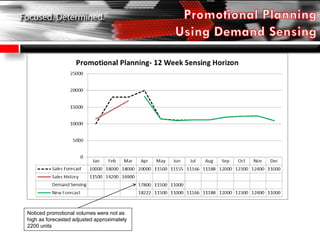
device industries.
 Extensive knowledge of Demand
Planning, Production Planning,
Purchasing and S&OP across
SAP, JDA and i2 technologies.
 Supply Chain Management
consultant and statistician with
over 20 years of process
improvement experience with a
focus in demand planning,
business intelligence and
technology experience across
multiple platforms, including SAP
APO, JDA, and Oracle.
Joel Argo,
Manager
Gary Griffith ,
Senior Manager
 Understand demand sensing key concepts & capabilities
 Understand the integration between the mid to long term
forecast (i.e. the operational forecast) with the short term
forecast (using demand sensing)
 Technology considerations and change management impacts on
organization; demand planning maturity curve assessment
 Walk away with an improved, objective view of the fit of
demand sensing within their organization
4
1. Demand Sensing Overview
 Review Current Demand Planning Challenges
 Define Demand Sensing - Value of Demand Sensing
 Applicability of Demand Sensing
2. How Demand Sensing works
 Input Variables - Forecast Horizons - Integrating with Statistical Forecast
 Integration with Major Demand Planning Systems
3. Demand Sensing Examples
 Net Change in Sales (Over/Under) - Net Change in Shipments (Over/Under)
 Promotional Planning
4. Data Elements & Modeling Techniques
5. Change Management
6. Key Take-A-Ways
7. Q&A
5
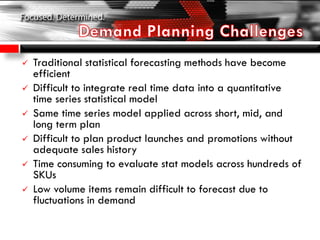
 Traditional statistical forecasting methods have become
efficient
 Difficult to integrate real time data into a quantitative
time series statistical model
 Same time series model applied across short, mid, and
long term plan
 Difficult to plan product launches and promotions without
adequate sales history
 Time consuming to evaluate stat models across hundreds of
SKUs
 Low volume items remain difficult to forecast due to
fluctuations in demand
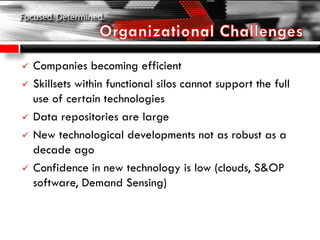
 Companies becoming efficient
 Skillsets within functional silos cannot support the full
use of certain technologies
 Data repositories are large
 New technological developments not as robust as a
decade ago
 Confidence in new technology is low (clouds, S&OP
software, Demand Sensing)
Demand Management Demand Sensing Business Benefit / Risk
Primary
Purpose
Long term strategy and sales
forecast, Better manufacturing
planning
Short term, tactical forecast, Better
replenishment planning to one, or a
few, key retail customers
Improved inventory
positioning; reduce
out-of-stocks
Most Granular
Data Used
Shipments from manufacturer’s
DCs to customer’s DC
POS and in store inventory data Minimize the “Bull Whip”
Effect
Completeness
of Data
Across all customers Across one, or a few, key retail
customers
Limited focus but with
higher/targeted results
Rolling Forecast
Time Horizon
Rolling monthly forecasts
over a year
Rolling daily forecasts
over the next 4-12 weeks
Better placement of inventory
with daily forecast updates
Key Forecast
by Time Period
Consensus demand plan for
+18 months horizon
Next week’s or month’s replenishment
plan to the DCs
Improved deployment
planning; reduce
transportation costs
Key Drawback Susceptible to Bullwhip Effects in
operations, causing increase in
the cost of time, money and
resources
Many retailers lack sufficient in store
inventory accuracy to make this
feasible but “Big Box” retailers are
ready
Data completeness and
accuracy, a risk;
Collaboration, a necessity
8
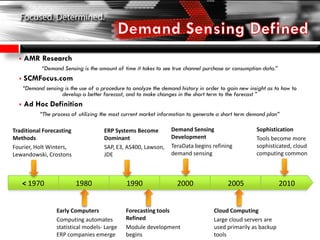
 AMR Research
“Demand Sensing is the amount of time it takes to see true channel purchase or consumption data.”
 SCMFocus.com
“Demand sensing is the use of a procedure to analyze the demand history in order to gain new insight as to how to
develop a better forecast, and to make changes in the short term to the forecast ”
 Ad Hoc Definition
“The process of utilizing the most current market information to generate a short term demand plan”
1980 1990 2000 2005< 1970 2010
Traditional Forecasting
Methods
Fourier, Holt Winters,
Lewandowski, Crostons
ERP Systems Become
Dominant
SAP, E3, AS400, Lawson,
JDE
Demand Sensing
Development
TeraData begins refining
demand sensing
Early Computers
Computing automates
statistical models- Large
ERP companies emerge
Forecasting tools
Refined
Module development
begins
Cloud Computing
Large cloud servers are
used primarily as backup
tools
Sophistication
Tools become more
sophisticated, cloud
computing common
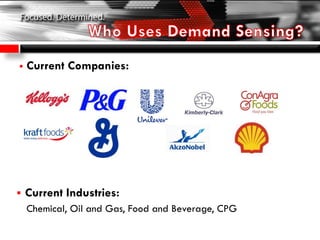
 Current Companies:
 Current Industries:
Chemical, Oil and Gas, Food and Beverage, CPG
 Factors to be considered prior to DS implementation:
 Lead Time (Cycle Time)
 Order UOM vs. Forecast UOM
 Maturity of Demand Planning Processes
 Maturity of S&OP Processes
 Level Demand Planners Skillset
 System Compatibility
 Goal of Demand Planning Group
 Demand sensing initially adopted by CPG companies (quick production cycle time)
 Demand sensing short term tool (4-16 weeks)
 Not a replacement for statistical forecasting
 Distributor may use lead time as short term
 Potentially not applicable for items where lead time exceeds more than 16 weeks
P 1 P 2 P 3 P 4 P 5 P 6 P 7 P 8 P 9 P 10 P 11
Short Term Mid Term Long Term
• Demand Sensing Horizon
• Lead time or production cycle
time for product
• Generally 4-16 weeks
• Raw material planning zone
• Potential increase safety stock
of raw material
• Directly affected by Sensing
• Financial Planning Zone
• Statistical forecast efficient
todays news = old news
• Not affected by Sensing
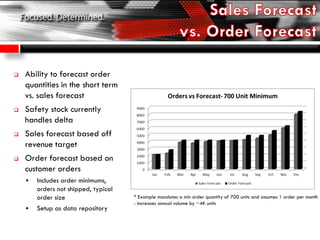
 Ability to forecast order
quantities in the short term
vs. sales forecast
 Safety stock currently
handles delta
 Sales forecast based off
revenue target
 Order forecast based on
customer orders
 Includes order minimums,
orders not shipped, typical
order size
 Setup as data repository
* Example mandates a min order quantity of 700 units and assumes 1 order per month
- Increases annual volume by ~4K units
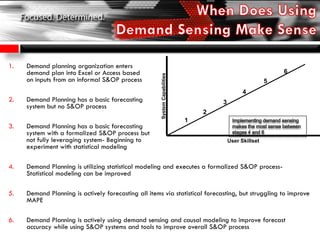
1. Demand planning organization enters
demand plan into Excel or Access based
on inputs from an informal S&OP process
2. Demand Planning has a basic forecasting
system but no S&OP process
3. Demand Planning has a basic forecasting
system with a formalized S&OP process but
not fully leveraging system- Beginning to
experiment with statistical modeling
4. Demand Planning is utilizing statistical modeling and executes a formalized S&OP process-
Statistical modeling can be improved
5. Demand Planning is actively forecasting all items via statistical forecasting, but struggling to improve
MAPE
6. Demand Planning is actively using demand sensing and causal modeling to improve forecast
accuracy while using S&OP systems and tools to improve overall S&OP process
1
2
3
4
5
User Skillset
6
SystemCapabilities
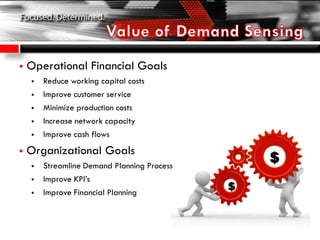
 Operational Financial Goals
 Reduce working capital costs
 Improve customer service
 Minimize production costs
 Increase network capacity
 Improve cash flows
 Organizational Goals
 Streamline Demand Planning Process
 Improve KPI’s
 Improve Financial Planning
$
$
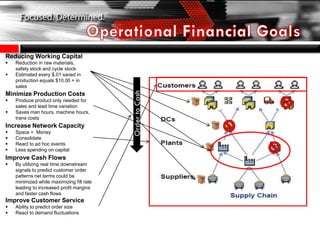
Reducing Working Capital
 Reduction in raw materials,
safety stock and cycle stock
 Estimated every $.01 saved in
production equals $10.00 + in
sales
Minimize Production Costs
 Produce product only needed for
sales and lead time variation
 Saves man hours, machine hours,
trans costs
Increase Network Capacity
 Space = Money
 Consolidate
 React to ad hoc events
 Less spending on capital
Improve Cash Flows
 By utilizing real time downstream
signals to predict customer order
patterns net terms could be
minimized while maximizing fill rate
leading to increased profit margins
and faster cash flows
Improve Customer Service
 Ability to predict order size
 React to demand fluctuations
OrdertoCash
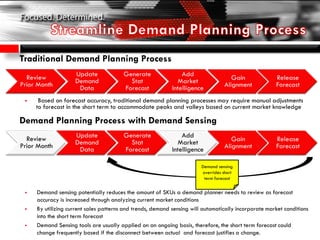
Traditional Demand Planning Process
 Based on forecast accuracy, traditional demand planning processes may require manual adjustments
to forecast in the short term to accommodate peaks and valleys based on current market knowledge
Demand Planning Process with Demand Sensing
 Demand sensing potentially reduces the amount of SKUs a demand planner needs to review as forecast
accuracy is increased through analyzing current market conditions
 By utilizing current sales patterns and trends, demand sensing will automatically incorporate market conditions
into the short term forecast
 Demand Sensing tools are usually applied on an ongoing basis, therefore, the short term forecast could
change frequently based if the disconnect between actual and forecast justifies a change.
Demand sensing
overrides short
term forecast
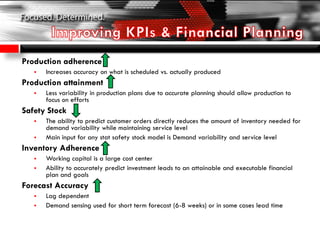
Production adherence
 Increases accuracy on what is scheduled vs. actually produced
Production attainment
 Less variability in production plans due to accurate planning should allow production to
focus on efforts
Safety Stock
 The ability to predict customer orders directly reduces the amount of inventory needed for
demand variability while maintaining service level
 Main input for any stat safety stock model is Demand variability and service level
Inventory Adherence
 Working capital is a large cost center
 Ability to accurately predict investment leads to an attainable and executable financial
plan and goals
Forecast Accuracy
 Lag dependent
 Demand sensing used for short term forecast (6-8 weeks) or in some cases lead time
1. Demand Sensing Overview
 Review Current Demand Planning Challenges
 Define Demand Sensing - Value of Demand Sensing
 Applicability of Demand Sensing
2. How Demand Sensing works
 Input Variables - Forecast Horizons - Integrating with Statistical Forecast
 Integration with Major Demand Planning Systems
3. Demand Sensing Examples
 Net Change in Sales (Over/Under) - Net Change in Shipments (Over/Under)
 Promotional Planning
4. Data Elements & Modeling Techniques
5. Change Management
6. Key Take-A-Ways
7. Q&A
19
DownstreamData
Shipments
• Daily shipments
• Helps recalculate forecast on
projected order multiples
Orders
• Daily orders to DC
• Includes orders that do not ship
• Order multiples
VMI Customers
• Auto replenishment history
• Similar to orders
Point of Sale Data
• Daily sales data
• Detects variation in forecast from
actual sales
 Demand sensing vendors claim independent variables such as
economic and weather conditions can be incorporated into
demand sensing programs
 Net changes in weather or markets would impact output
 Data repository would need to be setup for variables
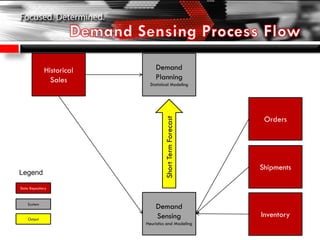
Historical
Sales
Shipments
Inventory
Demand
Planning
Statistical Modeling
Demand
Sensing
Heuristics and Modeling
Orders
ShortTermForecast
Data Repository
System
Output
Legend
Demand
Planning
System
(APO,JDA)
Demand
Sensing
Tool
Data
Repository
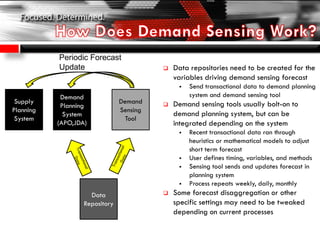
Periodic Forecast
Update  Data repositories need to be created for the
variables driving demand sensing forecast
 Send transactional data to demand planning
system and demand sensing tool
 Demand sensing tools usually bolt-on to
demand planning system, but can be
integrated depending on the system
 Recent transactional data ran through
heuristics or mathematical models to adjust
short term forecast
 User defines timing, variables, and methods
 Sensing tool sends and updates forecast in
planning system
 Process repeats weekly, daily, monthly
 Some forecast disaggregation or other
specific settings may need to be tweaked
depending on current processes
Supply
Planning
System
1. Demand Sensing Overview
 Review Current Demand Planning Challenges
 Define Demand Sensing - Value of Demand Sensing
 Applicability of Demand Sensing
2. How Demand Sensing works
 Input Variables - Forecast Horizons - Integrating with Statistical Forecast
 Integration with Major Demand Planning Systems
3. Demand Sensing Examples
 Net Change in Sales (Over/Under) - Net Change in Shipments (Over/Under)
 Promotional Planning
4. Data Elements & Modeling Techniques
5. Change Management
6. Key Take-A-Ways
7. Q&A
24
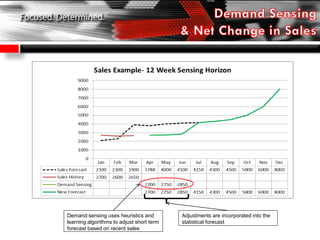
Demand sensing uses heuristics and
learning algorithms to adjust short term
forecast based on recent sales
Adjustments are incorporated into the
statistical forecast
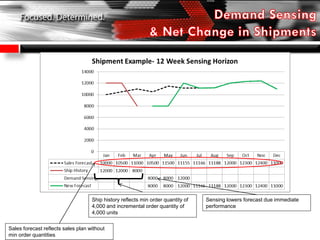
Sales forecast reflects sales plan without
min order quantities
Ship history reflects min order quantity of
4,000 and incremental order quantity of
4,000 units
Sensing lowers forecast due immediate
performance
Noticed promotional volumes were not as
high as forecasted adjusted approximately
2200 units
1. Demand Sensing Overview
 Review Current Demand Planning Challenges
 Define Demand Sensing - Value of Demand Sensing
 Applicability of Demand Sensing
2. How Demand Sensing works
 Input Variables - Forecast Horizons - Integrating with Statistical Forecast
 Integration with Major Demand Planning Systems
3. Demand Sensing Examples
 Net Change in Sales (Over/Under) - Net Change in Shipments (Over/Under)
 Promotional Planning
4. Data Elements & Modeling Techniques
5. Change Management
6. Key Take-A-Ways
7. Q&A
28
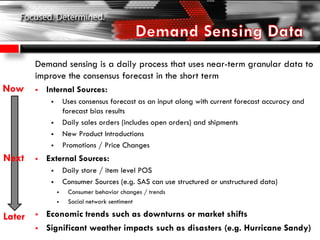
Demand sensing is a daily process that uses near-term granular data to
improve the consensus forecast in the short term
 Internal Sources:
 Uses consensus forecast as an input along with current forecast accuracy and
forecast bias results
 Daily sales orders (includes open orders) and shipments
 New Product Introductions
 Promotions / Price Changes
 External Sources:
 Daily store / item level POS
 Consumer Sources (e.g. SAS can use structured or unstructured data)
 Consumer behavior changes / trends
 Social network sentiment
 Economic trends such as downturns or market shifts
 Significant weather impacts such as disasters (e.g. Hurricane Sandy)
Now
Next
Later
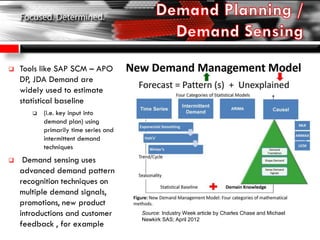
 Tools like SAP SCM – APO
DP, JDA Demand are
widely used to estimate
statistical baseline
 (i.e. key input into
demand plan) using
primarily time series and
intermittent demand
techniques
 Demand sensing uses
advanced demand pattern
recognition techniques on
multiple demand signals,
promotions, new product
introductions and customer
feedback , for example
Source: Industry Week article by Charles Chase and Michael
Newkirk SAS; April 2012
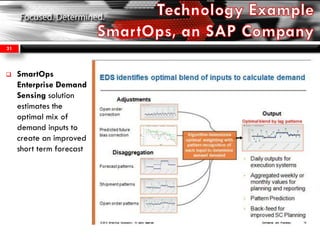
 SmartOps
Enterprise Demand
Sensing solution
estimates the
optimal mix of
demand inputs to
create an improved
short term forecast
31
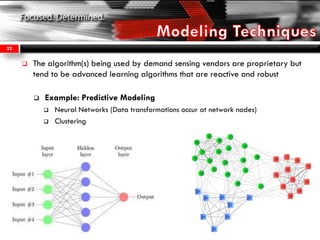
 The algorithm(s) being used by demand sensing vendors are proprietary but
tend to be advanced learning algorithms that are reactive and robust
 Example: Predictive Modeling
 Neural Networks (Data transformations occur at network nodes)
 Clustering
32
1. Demand Sensing Overview
 Review Current Demand Planning Challenges
 Define Demand Sensing - Value of Demand Sensing
 Applicability of Demand Sensing
2. How Demand Sensing works
 Input Variables - Forecast Horizons - Integrating with Statistical Forecast
 Integration with Major Demand Planning Systems
3. Demand Sensing Examples
 Net Change in Sales (Over/Under) - Net Change in Shipments (Over/Under)
 Promotional Planning
4. Data Elements & Modeling Techniques
5. Change Management
6. Key Take-A-Ways
7. Q&A
33
 It is important that your organization is ready for
demand sensing as it is more sophisticated then the
advanced planning systems such as SAP, JDA and
Oracle Demantra that are often present their own set
of change management challenges
 Think about piloting with a segment of the business
and one of your SuperUsers  Proceed with caution
 Assess where you are on the demand planning
maturity curve
34
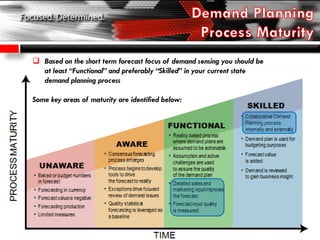
 Based on the short term forecast focus of demand sensing you should be
at least “Functional” and preferably “Skilled” in your current state
demand planning process
Some key areas of maturity are identified below:
1. Demand Sensing Overview
 Review Current Demand Planning Challenges
 Define Demand Sensing - Value of Demand Sensing
 Applicability of Demand Sensing
2. How Demand Sensing works
 Input Variables - Forecast Horizons - Integrating with Statistical Forecast
 Integration with Major Demand Planning Systems
3. Demand Sensing Examples
 Net Change in Sales (Over/Under) - Net Change in Shipments (Over/Under)
 Promotional Planning
4. Data Elements & Modeling Techniques
5. Change Management
6. Key Take-A-Ways
7. Q&A
36
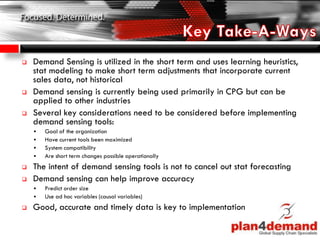
 Demand Sensing is utilized in the short term and uses learning heuristics,
stat modeling to make short term adjustments that incorporate current
sales data, not historical
 Demand sensing is currently being used primarily in CPG but can be
applied to other industries
 Several key considerations need to be considered before implementing
demand sensing tools:
 Goal of the organization
 Have current tools been maximized
 System compatibility
 Are short term changes possible operationally
 The intent of demand sensing tools is not to cancel out stat forecasting
 Demand sensing can help improve accuracy
 Predict order size
 Use ad hoc variables (causal variables)
 Good, accurate and timely data is key to implementation
For Additional Session Information,
a PDF Copy,
or to Schedule a One-on-One…
Contact
Jaime Reints
866-P4D-INFO
info@plan4demand.com
SAP, R/3, mySAP, mySAP.com, SAP NetWeaver®, Duet®,
PartnerEdge, and other SAP products and services
mentioned herein as well as their respective logos are
trademarks or registered trademarks of SAP AG in
Germany and in several other countries all over the
world. All other product and service names mentioned
are the trademarks of their respective companies.
Plan4Demand is neither owned nor controlled by SAP.
Page 40

Demand Planning Leadership Exchange: Demand Sensing - Are You Ready?

  • 1.
    August 27th, 2013plan4demand DEMAND PLANNING LEADERSHIP EXCHANGE PRESENTS: The web event will begin momentarily with your hosts: &
  • 2.
    Proven Supply ChainPartner  More than 500 successful SCP engagements in the past decade.  We’re known for driving measurable results in tools that are adopted across our client organizations.  Our experts have a minimum of 10 years supply chain experience.  Our team is deep in both technology and supply chain planning expertise; have managed multiple implementations; have a functional specialty. “Plan4Demand has consistently put in extra effort to ensure our Griffin plant consolidation and demand planning projects were successful.” -Scott Strickland, VP Information Systems Black & Decker
  • 3.
     A dynamictechno-functional supply chain professional with 10 years of experience in food, beverage, CPG and medical device industries.  Extensive knowledge of Demand Planning, Production Planning, Purchasing and S&OP across SAP, JDA and i2 technologies.  Supply Chain Management consultant and statistician with over 20 years of process improvement experience with a focus in demand planning, business intelligence and technology experience across multiple platforms, including SAP APO, JDA, and Oracle. Joel Argo, Manager Gary Griffith , Senior Manager
  • 4.
     Understand demandsensing key concepts & capabilities  Understand the integration between the mid to long term forecast (i.e. the operational forecast) with the short term forecast (using demand sensing)  Technology considerations and change management impacts on organization; demand planning maturity curve assessment  Walk away with an improved, objective view of the fit of demand sensing within their organization 4
  • 5.
    1. Demand SensingOverview  Review Current Demand Planning Challenges  Define Demand Sensing - Value of Demand Sensing  Applicability of Demand Sensing 2. How Demand Sensing works  Input Variables - Forecast Horizons - Integrating with Statistical Forecast  Integration with Major Demand Planning Systems 3. Demand Sensing Examples  Net Change in Sales (Over/Under) - Net Change in Shipments (Over/Under)  Promotional Planning 4. Data Elements & Modeling Techniques 5. Change Management 6. Key Take-A-Ways 7. Q&A 5
  • 6.
     Traditional statisticalforecasting methods have become efficient  Difficult to integrate real time data into a quantitative time series statistical model  Same time series model applied across short, mid, and long term plan  Difficult to plan product launches and promotions without adequate sales history  Time consuming to evaluate stat models across hundreds of SKUs  Low volume items remain difficult to forecast due to fluctuations in demand
  • 7.
     Companies becomingefficient  Skillsets within functional silos cannot support the full use of certain technologies  Data repositories are large  New technological developments not as robust as a decade ago  Confidence in new technology is low (clouds, S&OP software, Demand Sensing)
  • 8.
    Demand Management DemandSensing Business Benefit / Risk Primary Purpose Long term strategy and sales forecast, Better manufacturing planning Short term, tactical forecast, Better replenishment planning to one, or a few, key retail customers Improved inventory positioning; reduce out-of-stocks Most Granular Data Used Shipments from manufacturer’s DCs to customer’s DC POS and in store inventory data Minimize the “Bull Whip” Effect Completeness of Data Across all customers Across one, or a few, key retail customers Limited focus but with higher/targeted results Rolling Forecast Time Horizon Rolling monthly forecasts over a year Rolling daily forecasts over the next 4-12 weeks Better placement of inventory with daily forecast updates Key Forecast by Time Period Consensus demand plan for +18 months horizon Next week’s or month’s replenishment plan to the DCs Improved deployment planning; reduce transportation costs Key Drawback Susceptible to Bullwhip Effects in operations, causing increase in the cost of time, money and resources Many retailers lack sufficient in store inventory accuracy to make this feasible but “Big Box” retailers are ready Data completeness and accuracy, a risk; Collaboration, a necessity 8
  • 9.
     AMR Research “DemandSensing is the amount of time it takes to see true channel purchase or consumption data.”  SCMFocus.com “Demand sensing is the use of a procedure to analyze the demand history in order to gain new insight as to how to develop a better forecast, and to make changes in the short term to the forecast ”  Ad Hoc Definition “The process of utilizing the most current market information to generate a short term demand plan” 1980 1990 2000 2005< 1970 2010 Traditional Forecasting Methods Fourier, Holt Winters, Lewandowski, Crostons ERP Systems Become Dominant SAP, E3, AS400, Lawson, JDE Demand Sensing Development TeraData begins refining demand sensing Early Computers Computing automates statistical models- Large ERP companies emerge Forecasting tools Refined Module development begins Cloud Computing Large cloud servers are used primarily as backup tools Sophistication Tools become more sophisticated, cloud computing common
  • 10.
     Current Companies: Current Industries: Chemical, Oil and Gas, Food and Beverage, CPG
  • 11.
     Factors tobe considered prior to DS implementation:  Lead Time (Cycle Time)  Order UOM vs. Forecast UOM  Maturity of Demand Planning Processes  Maturity of S&OP Processes  Level Demand Planners Skillset  System Compatibility  Goal of Demand Planning Group
  • 12.
     Demand sensinginitially adopted by CPG companies (quick production cycle time)  Demand sensing short term tool (4-16 weeks)  Not a replacement for statistical forecasting  Distributor may use lead time as short term  Potentially not applicable for items where lead time exceeds more than 16 weeks P 1 P 2 P 3 P 4 P 5 P 6 P 7 P 8 P 9 P 10 P 11 Short Term Mid Term Long Term • Demand Sensing Horizon • Lead time or production cycle time for product • Generally 4-16 weeks • Raw material planning zone • Potential increase safety stock of raw material • Directly affected by Sensing • Financial Planning Zone • Statistical forecast efficient todays news = old news • Not affected by Sensing
  • 13.
     Ability toforecast order quantities in the short term vs. sales forecast  Safety stock currently handles delta  Sales forecast based off revenue target  Order forecast based on customer orders  Includes order minimums, orders not shipped, typical order size  Setup as data repository * Example mandates a min order quantity of 700 units and assumes 1 order per month - Increases annual volume by ~4K units
  • 14.
    1. Demand planningorganization enters demand plan into Excel or Access based on inputs from an informal S&OP process 2. Demand Planning has a basic forecasting system but no S&OP process 3. Demand Planning has a basic forecasting system with a formalized S&OP process but not fully leveraging system- Beginning to experiment with statistical modeling 4. Demand Planning is utilizing statistical modeling and executes a formalized S&OP process- Statistical modeling can be improved 5. Demand Planning is actively forecasting all items via statistical forecasting, but struggling to improve MAPE 6. Demand Planning is actively using demand sensing and causal modeling to improve forecast accuracy while using S&OP systems and tools to improve overall S&OP process 1 2 3 4 5 User Skillset 6 SystemCapabilities
  • 15.
     Operational FinancialGoals  Reduce working capital costs  Improve customer service  Minimize production costs  Increase network capacity  Improve cash flows  Organizational Goals  Streamline Demand Planning Process  Improve KPI’s  Improve Financial Planning $ $
  • 16.
    Reducing Working Capital Reduction in raw materials, safety stock and cycle stock  Estimated every $.01 saved in production equals $10.00 + in sales Minimize Production Costs  Produce product only needed for sales and lead time variation  Saves man hours, machine hours, trans costs Increase Network Capacity  Space = Money  Consolidate  React to ad hoc events  Less spending on capital Improve Cash Flows  By utilizing real time downstream signals to predict customer order patterns net terms could be minimized while maximizing fill rate leading to increased profit margins and faster cash flows Improve Customer Service  Ability to predict order size  React to demand fluctuations OrdertoCash
  • 17.
    Traditional Demand PlanningProcess  Based on forecast accuracy, traditional demand planning processes may require manual adjustments to forecast in the short term to accommodate peaks and valleys based on current market knowledge Demand Planning Process with Demand Sensing  Demand sensing potentially reduces the amount of SKUs a demand planner needs to review as forecast accuracy is increased through analyzing current market conditions  By utilizing current sales patterns and trends, demand sensing will automatically incorporate market conditions into the short term forecast  Demand Sensing tools are usually applied on an ongoing basis, therefore, the short term forecast could change frequently based if the disconnect between actual and forecast justifies a change. Demand sensing overrides short term forecast
  • 18.
    Production adherence  Increasesaccuracy on what is scheduled vs. actually produced Production attainment  Less variability in production plans due to accurate planning should allow production to focus on efforts Safety Stock  The ability to predict customer orders directly reduces the amount of inventory needed for demand variability while maintaining service level  Main input for any stat safety stock model is Demand variability and service level Inventory Adherence  Working capital is a large cost center  Ability to accurately predict investment leads to an attainable and executable financial plan and goals Forecast Accuracy  Lag dependent  Demand sensing used for short term forecast (6-8 weeks) or in some cases lead time
  • 19.
    1. Demand SensingOverview  Review Current Demand Planning Challenges  Define Demand Sensing - Value of Demand Sensing  Applicability of Demand Sensing 2. How Demand Sensing works  Input Variables - Forecast Horizons - Integrating with Statistical Forecast  Integration with Major Demand Planning Systems 3. Demand Sensing Examples  Net Change in Sales (Over/Under) - Net Change in Shipments (Over/Under)  Promotional Planning 4. Data Elements & Modeling Techniques 5. Change Management 6. Key Take-A-Ways 7. Q&A 19
  • 20.
    DownstreamData Shipments • Daily shipments •Helps recalculate forecast on projected order multiples Orders • Daily orders to DC • Includes orders that do not ship • Order multiples VMI Customers • Auto replenishment history • Similar to orders Point of Sale Data • Daily sales data • Detects variation in forecast from actual sales
  • 21.
     Demand sensingvendors claim independent variables such as economic and weather conditions can be incorporated into demand sensing programs  Net changes in weather or markets would impact output  Data repository would need to be setup for variables
  • 22.
    Historical Sales Shipments Inventory Demand Planning Statistical Modeling Demand Sensing Heuristics andModeling Orders ShortTermForecast Data Repository System Output Legend
  • 23.
    Demand Planning System (APO,JDA) Demand Sensing Tool Data Repository Periodic Forecast Update Data repositories need to be created for the variables driving demand sensing forecast  Send transactional data to demand planning system and demand sensing tool  Demand sensing tools usually bolt-on to demand planning system, but can be integrated depending on the system  Recent transactional data ran through heuristics or mathematical models to adjust short term forecast  User defines timing, variables, and methods  Sensing tool sends and updates forecast in planning system  Process repeats weekly, daily, monthly  Some forecast disaggregation or other specific settings may need to be tweaked depending on current processes Supply Planning System
  • 24.
    1. Demand SensingOverview  Review Current Demand Planning Challenges  Define Demand Sensing - Value of Demand Sensing  Applicability of Demand Sensing 2. How Demand Sensing works  Input Variables - Forecast Horizons - Integrating with Statistical Forecast  Integration with Major Demand Planning Systems 3. Demand Sensing Examples  Net Change in Sales (Over/Under) - Net Change in Shipments (Over/Under)  Promotional Planning 4. Data Elements & Modeling Techniques 5. Change Management 6. Key Take-A-Ways 7. Q&A 24
  • 25.
    Demand sensing usesheuristics and learning algorithms to adjust short term forecast based on recent sales Adjustments are incorporated into the statistical forecast
  • 26.
    Sales forecast reflectssales plan without min order quantities Ship history reflects min order quantity of 4,000 and incremental order quantity of 4,000 units Sensing lowers forecast due immediate performance
  • 27.
    Noticed promotional volumeswere not as high as forecasted adjusted approximately 2200 units
  • 28.
    1. Demand SensingOverview  Review Current Demand Planning Challenges  Define Demand Sensing - Value of Demand Sensing  Applicability of Demand Sensing 2. How Demand Sensing works  Input Variables - Forecast Horizons - Integrating with Statistical Forecast  Integration with Major Demand Planning Systems 3. Demand Sensing Examples  Net Change in Sales (Over/Under) - Net Change in Shipments (Over/Under)  Promotional Planning 4. Data Elements & Modeling Techniques 5. Change Management 6. Key Take-A-Ways 7. Q&A 28
  • 29.
    Demand sensing isa daily process that uses near-term granular data to improve the consensus forecast in the short term  Internal Sources:  Uses consensus forecast as an input along with current forecast accuracy and forecast bias results  Daily sales orders (includes open orders) and shipments  New Product Introductions  Promotions / Price Changes  External Sources:  Daily store / item level POS  Consumer Sources (e.g. SAS can use structured or unstructured data)  Consumer behavior changes / trends  Social network sentiment  Economic trends such as downturns or market shifts  Significant weather impacts such as disasters (e.g. Hurricane Sandy) Now Next Later
  • 30.
     Tools likeSAP SCM – APO DP, JDA Demand are widely used to estimate statistical baseline  (i.e. key input into demand plan) using primarily time series and intermittent demand techniques  Demand sensing uses advanced demand pattern recognition techniques on multiple demand signals, promotions, new product introductions and customer feedback , for example Source: Industry Week article by Charles Chase and Michael Newkirk SAS; April 2012
  • 31.
     SmartOps Enterprise Demand Sensingsolution estimates the optimal mix of demand inputs to create an improved short term forecast 31
  • 32.
     The algorithm(s)being used by demand sensing vendors are proprietary but tend to be advanced learning algorithms that are reactive and robust  Example: Predictive Modeling  Neural Networks (Data transformations occur at network nodes)  Clustering 32
  • 33.
    1. Demand SensingOverview  Review Current Demand Planning Challenges  Define Demand Sensing - Value of Demand Sensing  Applicability of Demand Sensing 2. How Demand Sensing works  Input Variables - Forecast Horizons - Integrating with Statistical Forecast  Integration with Major Demand Planning Systems 3. Demand Sensing Examples  Net Change in Sales (Over/Under) - Net Change in Shipments (Over/Under)  Promotional Planning 4. Data Elements & Modeling Techniques 5. Change Management 6. Key Take-A-Ways 7. Q&A 33
  • 34.
     It isimportant that your organization is ready for demand sensing as it is more sophisticated then the advanced planning systems such as SAP, JDA and Oracle Demantra that are often present their own set of change management challenges  Think about piloting with a segment of the business and one of your SuperUsers  Proceed with caution  Assess where you are on the demand planning maturity curve 34
  • 35.
     Based onthe short term forecast focus of demand sensing you should be at least “Functional” and preferably “Skilled” in your current state demand planning process Some key areas of maturity are identified below:
  • 36.
    1. Demand SensingOverview  Review Current Demand Planning Challenges  Define Demand Sensing - Value of Demand Sensing  Applicability of Demand Sensing 2. How Demand Sensing works  Input Variables - Forecast Horizons - Integrating with Statistical Forecast  Integration with Major Demand Planning Systems 3. Demand Sensing Examples  Net Change in Sales (Over/Under) - Net Change in Shipments (Over/Under)  Promotional Planning 4. Data Elements & Modeling Techniques 5. Change Management 6. Key Take-A-Ways 7. Q&A 36
  • 37.
     Demand Sensingis utilized in the short term and uses learning heuristics, stat modeling to make short term adjustments that incorporate current sales data, not historical  Demand sensing is currently being used primarily in CPG but can be applied to other industries  Several key considerations need to be considered before implementing demand sensing tools:  Goal of the organization  Have current tools been maximized  System compatibility  Are short term changes possible operationally  The intent of demand sensing tools is not to cancel out stat forecasting  Demand sensing can help improve accuracy  Predict order size  Use ad hoc variables (causal variables)  Good, accurate and timely data is key to implementation
  • 39.
    For Additional SessionInformation, a PDF Copy, or to Schedule a One-on-One… Contact Jaime Reints 866-P4D-INFO info@plan4demand.com
  • 40.
    SAP, R/3, mySAP,mySAP.com, SAP NetWeaver®, Duet®, PartnerEdge, and other SAP products and services mentioned herein as well as their respective logos are trademarks or registered trademarks of SAP AG in Germany and in several other countries all over the world. All other product and service names mentioned are the trademarks of their respective companies. Plan4Demand is neither owned nor controlled by SAP. Page 40