
Demand Forecasting
Vincent 10/8/2010
Stock vs. Non-stock
• Ranking products based percentage of total
activity (number of hits)
• Non stock items
– Low activity and high value items
• Stock items
– High activity and low value items
Demand Forecasts and Usage
• Products with sporadic usage
– Maintain the stock based on multiple of the
typical sales or usage quantity.
– Roll up the usage to the central warehouse
– Or set up as non-stock items?
• Products with recurring usage
Forecast for items with recurring usage
• Past usage
• Internal trends
• External trends
– Weather, economy
• Collaborative forecasts
– Sales input
– Special promotion
• Forecast horizon
Past usage
• Direct or drop shipments
– Direct shipments should not be included.
• Shipping an order from an alternate warehouse instead
of the designated one
– Usage should be recorded with the designated one.
• Usage and substitute products
• Record usage when a customer wanted the product
– Required date vs. actual ship date?
• Usage and transfers
– Treating other warehouses as customers?
Utilizing Usage to Forecast Demand
• Seasonal products
– Consider usage from the last year
– Adjusting usage for unusual usage
– Weighed average
• 3x same month LY +2x next month + 1 following month
– Use seasonal index
– Applying trend factors
• compare last year’s usage with this year’s usage
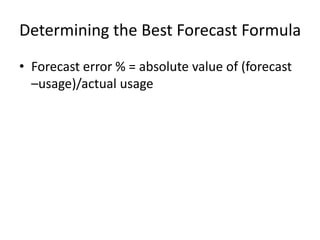
Determining the Best Forecast Formula
• Forecast error % = absolute value of (forecast
–usage)/actual usage
Questions?

Demand forecasting

  • 1.
  • 2.
    Stock vs. Non-stock •Ranking products based percentage of total activity (number of hits) • Non stock items – Low activity and high value items • Stock items – High activity and low value items
  • 3.
    Demand Forecasts andUsage • Products with sporadic usage – Maintain the stock based on multiple of the typical sales or usage quantity. – Roll up the usage to the central warehouse – Or set up as non-stock items? • Products with recurring usage
  • 4.
    Forecast for itemswith recurring usage • Past usage • Internal trends • External trends – Weather, economy • Collaborative forecasts – Sales input – Special promotion • Forecast horizon
  • 5.
    Past usage • Director drop shipments – Direct shipments should not be included. • Shipping an order from an alternate warehouse instead of the designated one – Usage should be recorded with the designated one. • Usage and substitute products • Record usage when a customer wanted the product – Required date vs. actual ship date? • Usage and transfers – Treating other warehouses as customers?
  • 6.
    Utilizing Usage toForecast Demand • Seasonal products – Consider usage from the last year – Adjusting usage for unusual usage – Weighed average • 3x same month LY +2x next month + 1 following month – Use seasonal index – Applying trend factors • compare last year’s usage with this year’s usage
  • 7.
    Determining the BestForecast Formula • Forecast error % = absolute value of (forecast –usage)/actual usage
  • 8.