DEFUZZIFICATION
By.
S.Subha Thilagam
M.sc(cs)
Defuzzification:
 Defuzzification is the process of producing a quantifiable result in Crisp
logic, given fuzzy sets and corresponding membership degrees.
 It is the process that maps a fuzzy set to a crisp set. It is typically needed
in fuzzy control systems.
 For example, rules designed to decide how much pressure to apply might
result in "Decrease Pressure (15%), Maintain Pressure (34%), Increase
Pressure (72%)". Defuzzification is interpreting the membership degrees
of the fuzzy sets into a specific decision or real value.
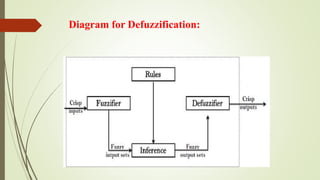
Diagram for Defuzzification:
Methods of Defuzzification:
 Center of Area (CoA)
 Modified Center of Area (mCoA)
 Center of Maximum (CoM)
 Mean of Maximum (MoM)
 Center of Sums (CoS)
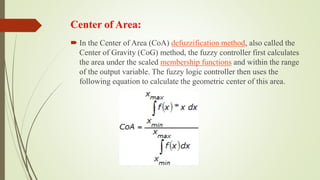
Center of Area:
 In the Center of Area (CoA) defuzzification method, also called the
Center of Gravity (CoG) method, the fuzzy controller first calculates
the area under the scaled membership functions and within the range
of the output variable. The fuzzy logic controller then uses the
following equation to calculate the geometric center of this area.
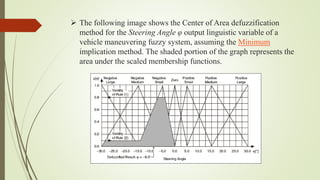
 The following image shows the Center of Area defuzzification
method for the Steering Angle φ output linguistic variable of a
vehicle maneuvering fuzzy system, assuming the Minimum
implication method. The shaded portion of the graph represents the
area under the scaled membership functions.
Modified Center of Area (mCoA):
 Center of Area (CoA) defuzzification method evaluates the area
under the scaled membership functions only within the range of the
output linguistic variable, the resulting crisp output values cannot
span the full range. To solve this problem, use the modified Center
of Area defuzzification method.
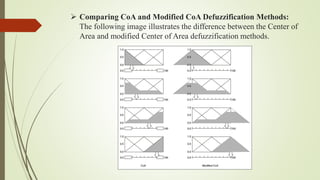
 Comparing CoA and Modified CoA Defuzzification Methods:
The following image illustrates the difference between the Center of
Area and modified Center of Area defuzzification methods.
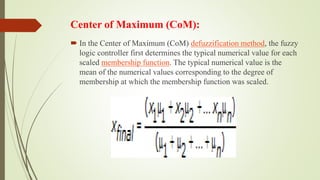
Center of Maximum (CoM):
 In the Center of Maximum (CoM) defuzzification method, the fuzzy
logic controller first determines the typical numerical value for each
scaled membership function. The typical numerical value is the
mean of the numerical values corresponding to the degree of
membership at which the membership function was scaled.
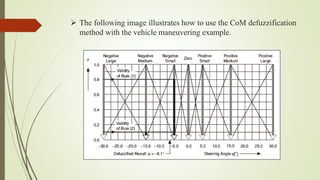
 The following image illustrates how to use the CoM defuzzification
method with the vehicle maneuvering example.
Center of Sums (CoS):
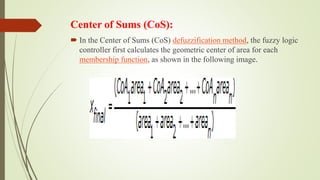
 In the Center of Sums (CoS) defuzzification method, the fuzzy logic
controller first calculates the geometric center of area for each
membership function, as shown in the following image.
 The following image illustrates how to use the CoS defuzzification
method
Defuzzification

Defuzzification

  • 1.
  • 2.
    Defuzzification:  Defuzzification isthe process of producing a quantifiable result in Crisp logic, given fuzzy sets and corresponding membership degrees.  It is the process that maps a fuzzy set to a crisp set. It is typically needed in fuzzy control systems.  For example, rules designed to decide how much pressure to apply might result in "Decrease Pressure (15%), Maintain Pressure (34%), Increase Pressure (72%)". Defuzzification is interpreting the membership degrees of the fuzzy sets into a specific decision or real value.
  • 3.
  • 4.
    Methods of Defuzzification: Center of Area (CoA)  Modified Center of Area (mCoA)  Center of Maximum (CoM)  Mean of Maximum (MoM)  Center of Sums (CoS)
  • 5.
    Center of Area: In the Center of Area (CoA) defuzzification method, also called the Center of Gravity (CoG) method, the fuzzy controller first calculates the area under the scaled membership functions and within the range of the output variable. The fuzzy logic controller then uses the following equation to calculate the geometric center of this area.
  • 6.
     The followingimage shows the Center of Area defuzzification method for the Steering Angle φ output linguistic variable of a vehicle maneuvering fuzzy system, assuming the Minimum implication method. The shaded portion of the graph represents the area under the scaled membership functions.
  • 7.
    Modified Center ofArea (mCoA):  Center of Area (CoA) defuzzification method evaluates the area under the scaled membership functions only within the range of the output linguistic variable, the resulting crisp output values cannot span the full range. To solve this problem, use the modified Center of Area defuzzification method.
  • 8.
     Comparing CoAand Modified CoA Defuzzification Methods: The following image illustrates the difference between the Center of Area and modified Center of Area defuzzification methods.
  • 9.
    Center of Maximum(CoM):  In the Center of Maximum (CoM) defuzzification method, the fuzzy logic controller first determines the typical numerical value for each scaled membership function. The typical numerical value is the mean of the numerical values corresponding to the degree of membership at which the membership function was scaled.
  • 10.
     The followingimage illustrates how to use the CoM defuzzification method with the vehicle maneuvering example.
  • 11.
    Center of Sums(CoS):  In the Center of Sums (CoS) defuzzification method, the fuzzy logic controller first calculates the geometric center of area for each membership function, as shown in the following image.
  • 12.
     The followingimage illustrates how to use the CoS defuzzification method