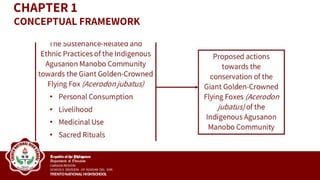
The Sustenance-Related and Ethnic Practices of the Indigenous
Agusanon Manobo Community towards the Giant
Golden-Crowned Flying Foxes (Acerodon jubatus)
at Barangay Novele, Rosario, Agusan del Sur
using a Concurrent Triangulation Approach
ALEXI B. DINAMPO
KYLE IRAH G. MACATOL
ALEXIS MAE L. PAJO
CLHOE ATHENA V. MILAR
CHAPTER 1
Generally, in ecosystems, bats are among the most important species. From
fertilization and pest control to pollination and seed distribution, they are
essential to preserving the vital equilibrium of the natural world.
One of the rare bat species, the Philippine-endemic and International Union for
Conservation of Nature (IUCN) Red-Listed as “Endangered” namely the Giant
Golden-Crowned Flying Fox (Acerodon jubatus) locally known as “Kabog,” thrives
in Agusan del Sur (Agusan Marsh Wildlife Sanctuary Protected Areas Management,
2020) and can be found in one of the highly protected wildlife sanctuaries in the
Philippines namely the Agusan Marsh Wildlife Sanctuary (AMWS).
BACKGROUND OF THE STUDY
CHAPTER 1
The hunting of wildlife species—especially bat species—by Indigenous
People in the Philippines (Tanalgo, 2017).
Bats are exploited for various purposes such as bushmeat
consumption, medicinal use, trade, livelihood, recreation, and for the
decorative value of their distinct body parts (i.e., their teeth) (Aziz et
al., 2021).
As a result, 20% of the 79 bat species in the country are considered
‘Threatened’ based on IUCN standards (Tanalgo & Hughes, 2019).
BACKGROUND OF THE STUDY
CHAPTER 1
State of the Kabog at AMWS
Community Environment and Natural Resources Office (CENRO)
and Protected Areas Management Office (PAMO) have attested the
Indigenous Agusanon Manobo settlers near identified Kabog nests
in Barangay Novele, Rosario, Agusan del Sur and the dependence
of said community towards the Kabog population in the area.
There are little to no further records of human direct dependence
towards the Kabog population in the area.
BACKGROUND OF THE STUDY
CHAPTER 1
Consultation visit at CENRO and PAMO Bunawan, Agusan del Sur.
Their affirmation of the lack of records with regards to
human direct dependence towards the endangered Kabog
bat species in the area is linked to the sensitivity of the
activity, being an illegal practice by law pursuant to the
Republic Act No. 9147 of 2001 or the Wildlife Resources
Conservation and Protection Act.
BACKGROUND OF THE STUDY
CHAPTER 1
The general objective of this study is to assess the dependent and direct
practices of the Indigenous Agusanon Manobo Community towards the Giant
Golden-Crowned Flying Foxes (Acerodon jubatus) at Barangay Novele,
Rosario, Agusan del Sur using the Concurrent Triangulation Approach.
Specifically, this study aims to:
investigate the direct practices of the Indigenous Agusanon Manobo
households at Barangay Novele towards the Giant Golden-Crowned
Flying Foxes (Acerodon jubatus) in terms of sustenance (i.e.,
livelihood and personal consumption) and ethnic practices (i.e.,
medicinal use and sacred rituals), or the existence thereof;
RESEARCH OBJECTIVES
CHAPTER 1
explore the lived experiences of the Indigenous Agusanon Manobo at
Barangay Novele whom bears firsthand knowledge regarding the hunting
of the Giant Golden-Crowned Flying Foxes (Acerodon jubatus) for
sustenance and ethnic practice purposes, or the existence thereof; and
determine the appropriate recommendations towards the conservation
of the Giant Golden-Crowned Flying Foxes (Acerodon jubatus) at
Barangay Novele, Rosario, Agusan del Sur supplemented by the data to
be gathered from the research objectives one and two.
RESEARCH OBJECTIVES
CHAPTER 1
CONCEPTUAL FRAMEWORK
CHAPTER 1
Biodiversity Conservation. This study is useful in shaping conservation
strategies for the concerned species, and furthermore is culturally friendly
and more likely to be successful due to the inclusion of local communities.
Cultural Preservation. By obtaining an in-depth understanding of the
traditional wildlife dependence and practices of the concerned indigenous
community, this study may offer alternative perspectives on species
protection while also allowing the consideration of the preservation of
indigenous traditions.
SIGNIFICANCE OF THE STUDY
CHAPTER 1
Environmental Organizations. This study may help the Environmental and
Wildlife agencies in gathering data that can be used to develop policies or
programs aiming to protect the concerned endangered species while at the
same time respecting indigenous rights.
Future Researchers and Academics. This study can contribute to the
understanding of the human direct dependence on wildlife in the area, thus,
encouraging further researches in this field. Data gathered from this study
will also aid in future researches related to this venture, especially since
there had been little to none at present.
SIGNIFICANCE OF THE STUDY
THE CONCURRENT TRIANGULATION MIXED-METHODS APPROACH
This method allows the researchers to collect both quantitative and
qualitative data at the same time. Due to this simultaneity, data collected in
one phase will result in their equal weight during analysis, allowing the
comparison and contrast of both types of data for the validation of results,
and ultimately the explanation of quantitative results with qualitative data
and vice versa. In line with such, the utilization of this design is deemed
most efficient in accomplishing the research objectives of this study.
CHAPTER 2
RESEARCH DESIGN
CHAPTER 2
RESEARCH DESIGN
Research Locale
Barangay Novele, Rosario, Agusan del Sur is located at approximately (8.3513 N &
125.9769 E). One of its inhabitants are the Indigenous Agusanon Manobo. This area
will be surveyed and examined for the hunting practices towards the Giant Golden-
Crowned Flying Foxes (Acerodon jubatus). Barangay Novele is situated at an
elevation of about 24.8 meters or 81.4 feet above sea level and is recognized to be a
biodiversity hotspot, being rich in endemic and threatened flora and fauna. Given
the abundance of both fauna and flora species in this area, the hunting of ‘Kabog’
consequently emerges as a pivotal facet of the Agusanon Manobo Tribe.
CHAPTER 2
RESEARCH PROCEDURES
Research Instruments
Quantitative data gathering: adopted and revised survey questionnaire
(see Appendix B) from the various research of Tanalgo et al. (2017), Loke et
al. (2018), and Kendie et al. (2019).
Qualitative data gathering: voice recorder and semi structured interview
guide (see Appendix C) containing adopted and revised questions from the
various research of Maturbongs et al. (2024), Pattiselanno et al. (2024),
Kendie et al. (2018), and Suwanarong et al. (2020).
CHAPTER 2
RESEARCH PROCEDURES
Research Sampling
For the Quantitative sampling, strata selection is as follows: areas with population having
60-90% residing Indigenous Manobo households. Sample size selection from each stratum:
80% from its total Agusanon Manobo household population.
For the Qualitative sampling, opportunistic sampling technique will be utilized. Selection
specifications would be: a) should be an Indigenous Agusanon Manobo that has lived
firsthand experiences regarding the hunting of Kabog bat species for ethnic and sustenance
purposes, and b) six maximum respondents would be the established limit of the
researchers, three of which must have personal experience with hunting of the said species,
and the other three must have witnessed the act firsthand.
CHAPTER 2
RESEARCH PROCEDURES
Data Analysis
Quantitative data analysis: Descriptive Statistical Methods will be
employed, specifically the Measures of Central Tendency and Percentile
Values of the Frequency Analysis technique.
Qualitative data analysis: Thematic Analysis will be utilized, employing a
hybrid approach integrating both deductive and inductive methods.
CHAPTER 2
RESEARCH PROCEDURES
Ethical Considerations
For ethical considerations, prior to the administering of the research instruments of
this study to the respondents, they will receive a detailed briefing and key
information about the study's purpose. To ensure that the respondents’ partaking
of the study is of utmost willingness, informed consent is applied. All the
information will be held and handled with the utmost confidentiality in accordance
with RA 1073, generally known as the Data Privacy act. Moreover, the respondents
will be assured that in contrast to common presumptions of data gathering on this
topic, they will not be directly subjected to legal consequences.
CHAPTER 2
RESEARCH PROCEDURES
Mixed Methods Triangulated Data Analysis and Interpretation
To ensure the validity and reliability of the findings, this study will employ the triangulation
method to assess concordance between the quantitative and qualitative data results. Had
there been inconsistency of data detected, such findings will be reexamined to explicate the
results.
Species Conservation
Subsequent to all the processes the study must undergo to fulfill its mixed-methods
framework, conservation recommendations will be produced for the concerned bat species
which will be reflective to the data interpretations of this study.
CHAPTER 2
RESEARCH PROCEDURES
Mixed Methods Triangulated Data Analysis and Interpretation
To ensure the validity and reliability of the findings, this study will employ
the triangulation method to assess concordance between the quantitative
and qualitative data results. Had there been inconsistency of data detected,
such findings will be reexamined to explicate the results.
Species Conservation
Subsequent to all the processes the study must undergo to fulfill its mixed-
methods framework, conservation recommendations will be produced for
the concerned bat species which will be reflective to the data
interpretations of this study.
REFERENCES

Defense-Theme.pptx_20250114_104637_0000.pdf

  • 1.
    The Sustenance-Related andEthnic Practices of the Indigenous Agusanon Manobo Community towards the Giant Golden-Crowned Flying Foxes (Acerodon jubatus) at Barangay Novele, Rosario, Agusan del Sur using a Concurrent Triangulation Approach ALEXI B. DINAMPO KYLE IRAH G. MACATOL ALEXIS MAE L. PAJO CLHOE ATHENA V. MILAR
  • 2.
    CHAPTER 1 Generally, inecosystems, bats are among the most important species. From fertilization and pest control to pollination and seed distribution, they are essential to preserving the vital equilibrium of the natural world. One of the rare bat species, the Philippine-endemic and International Union for Conservation of Nature (IUCN) Red-Listed as “Endangered” namely the Giant Golden-Crowned Flying Fox (Acerodon jubatus) locally known as “Kabog,” thrives in Agusan del Sur (Agusan Marsh Wildlife Sanctuary Protected Areas Management, 2020) and can be found in one of the highly protected wildlife sanctuaries in the Philippines namely the Agusan Marsh Wildlife Sanctuary (AMWS). BACKGROUND OF THE STUDY
  • 3.
    CHAPTER 1 The huntingof wildlife species—especially bat species—by Indigenous People in the Philippines (Tanalgo, 2017). Bats are exploited for various purposes such as bushmeat consumption, medicinal use, trade, livelihood, recreation, and for the decorative value of their distinct body parts (i.e., their teeth) (Aziz et al., 2021). As a result, 20% of the 79 bat species in the country are considered ‘Threatened’ based on IUCN standards (Tanalgo & Hughes, 2019). BACKGROUND OF THE STUDY
  • 4.
    CHAPTER 1 State ofthe Kabog at AMWS Community Environment and Natural Resources Office (CENRO) and Protected Areas Management Office (PAMO) have attested the Indigenous Agusanon Manobo settlers near identified Kabog nests in Barangay Novele, Rosario, Agusan del Sur and the dependence of said community towards the Kabog population in the area. There are little to no further records of human direct dependence towards the Kabog population in the area. BACKGROUND OF THE STUDY
  • 5.
    CHAPTER 1 Consultation visitat CENRO and PAMO Bunawan, Agusan del Sur. Their affirmation of the lack of records with regards to human direct dependence towards the endangered Kabog bat species in the area is linked to the sensitivity of the activity, being an illegal practice by law pursuant to the Republic Act No. 9147 of 2001 or the Wildlife Resources Conservation and Protection Act. BACKGROUND OF THE STUDY
  • 6.
    CHAPTER 1 The generalobjective of this study is to assess the dependent and direct practices of the Indigenous Agusanon Manobo Community towards the Giant Golden-Crowned Flying Foxes (Acerodon jubatus) at Barangay Novele, Rosario, Agusan del Sur using the Concurrent Triangulation Approach. Specifically, this study aims to: investigate the direct practices of the Indigenous Agusanon Manobo households at Barangay Novele towards the Giant Golden-Crowned Flying Foxes (Acerodon jubatus) in terms of sustenance (i.e., livelihood and personal consumption) and ethnic practices (i.e., medicinal use and sacred rituals), or the existence thereof; RESEARCH OBJECTIVES
  • 7.
    CHAPTER 1 explore thelived experiences of the Indigenous Agusanon Manobo at Barangay Novele whom bears firsthand knowledge regarding the hunting of the Giant Golden-Crowned Flying Foxes (Acerodon jubatus) for sustenance and ethnic practice purposes, or the existence thereof; and determine the appropriate recommendations towards the conservation of the Giant Golden-Crowned Flying Foxes (Acerodon jubatus) at Barangay Novele, Rosario, Agusan del Sur supplemented by the data to be gathered from the research objectives one and two. RESEARCH OBJECTIVES
  • 8.
  • 9.
    CHAPTER 1 Biodiversity Conservation.This study is useful in shaping conservation strategies for the concerned species, and furthermore is culturally friendly and more likely to be successful due to the inclusion of local communities. Cultural Preservation. By obtaining an in-depth understanding of the traditional wildlife dependence and practices of the concerned indigenous community, this study may offer alternative perspectives on species protection while also allowing the consideration of the preservation of indigenous traditions. SIGNIFICANCE OF THE STUDY
  • 10.
    CHAPTER 1 Environmental Organizations.This study may help the Environmental and Wildlife agencies in gathering data that can be used to develop policies or programs aiming to protect the concerned endangered species while at the same time respecting indigenous rights. Future Researchers and Academics. This study can contribute to the understanding of the human direct dependence on wildlife in the area, thus, encouraging further researches in this field. Data gathered from this study will also aid in future researches related to this venture, especially since there had been little to none at present. SIGNIFICANCE OF THE STUDY
  • 11.
    THE CONCURRENT TRIANGULATIONMIXED-METHODS APPROACH This method allows the researchers to collect both quantitative and qualitative data at the same time. Due to this simultaneity, data collected in one phase will result in their equal weight during analysis, allowing the comparison and contrast of both types of data for the validation of results, and ultimately the explanation of quantitative results with qualitative data and vice versa. In line with such, the utilization of this design is deemed most efficient in accomplishing the research objectives of this study. CHAPTER 2 RESEARCH DESIGN
  • 12.
  • 13.
    Research Locale Barangay Novele,Rosario, Agusan del Sur is located at approximately (8.3513 N & 125.9769 E). One of its inhabitants are the Indigenous Agusanon Manobo. This area will be surveyed and examined for the hunting practices towards the Giant Golden- Crowned Flying Foxes (Acerodon jubatus). Barangay Novele is situated at an elevation of about 24.8 meters or 81.4 feet above sea level and is recognized to be a biodiversity hotspot, being rich in endemic and threatened flora and fauna. Given the abundance of both fauna and flora species in this area, the hunting of ‘Kabog’ consequently emerges as a pivotal facet of the Agusanon Manobo Tribe. CHAPTER 2 RESEARCH PROCEDURES
  • 14.
    Research Instruments Quantitative datagathering: adopted and revised survey questionnaire (see Appendix B) from the various research of Tanalgo et al. (2017), Loke et al. (2018), and Kendie et al. (2019). Qualitative data gathering: voice recorder and semi structured interview guide (see Appendix C) containing adopted and revised questions from the various research of Maturbongs et al. (2024), Pattiselanno et al. (2024), Kendie et al. (2018), and Suwanarong et al. (2020). CHAPTER 2 RESEARCH PROCEDURES
  • 15.
    Research Sampling For theQuantitative sampling, strata selection is as follows: areas with population having 60-90% residing Indigenous Manobo households. Sample size selection from each stratum: 80% from its total Agusanon Manobo household population. For the Qualitative sampling, opportunistic sampling technique will be utilized. Selection specifications would be: a) should be an Indigenous Agusanon Manobo that has lived firsthand experiences regarding the hunting of Kabog bat species for ethnic and sustenance purposes, and b) six maximum respondents would be the established limit of the researchers, three of which must have personal experience with hunting of the said species, and the other three must have witnessed the act firsthand. CHAPTER 2 RESEARCH PROCEDURES
  • 16.
    Data Analysis Quantitative dataanalysis: Descriptive Statistical Methods will be employed, specifically the Measures of Central Tendency and Percentile Values of the Frequency Analysis technique. Qualitative data analysis: Thematic Analysis will be utilized, employing a hybrid approach integrating both deductive and inductive methods. CHAPTER 2 RESEARCH PROCEDURES
  • 17.
    Ethical Considerations For ethicalconsiderations, prior to the administering of the research instruments of this study to the respondents, they will receive a detailed briefing and key information about the study's purpose. To ensure that the respondents’ partaking of the study is of utmost willingness, informed consent is applied. All the information will be held and handled with the utmost confidentiality in accordance with RA 1073, generally known as the Data Privacy act. Moreover, the respondents will be assured that in contrast to common presumptions of data gathering on this topic, they will not be directly subjected to legal consequences. CHAPTER 2 RESEARCH PROCEDURES
  • 18.
    Mixed Methods TriangulatedData Analysis and Interpretation To ensure the validity and reliability of the findings, this study will employ the triangulation method to assess concordance between the quantitative and qualitative data results. Had there been inconsistency of data detected, such findings will be reexamined to explicate the results. Species Conservation Subsequent to all the processes the study must undergo to fulfill its mixed-methods framework, conservation recommendations will be produced for the concerned bat species which will be reflective to the data interpretations of this study. CHAPTER 2 RESEARCH PROCEDURES
  • 19.
    Mixed Methods TriangulatedData Analysis and Interpretation To ensure the validity and reliability of the findings, this study will employ the triangulation method to assess concordance between the quantitative and qualitative data results. Had there been inconsistency of data detected, such findings will be reexamined to explicate the results. Species Conservation Subsequent to all the processes the study must undergo to fulfill its mixed- methods framework, conservation recommendations will be produced for the concerned bat species which will be reflective to the data interpretations of this study. REFERENCES