Deepak Daya
Sagar Pathak
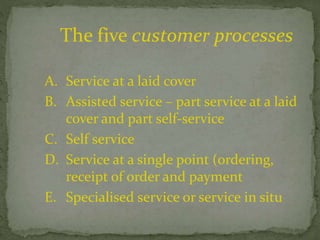
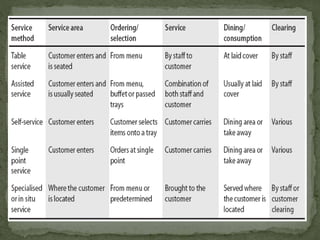
The five customer processes
A. Service at a laid cover
B. Assisted service – part service at a laid
cover and part self-service
C. Self service
D. Service at a single point (ordering,
receipt of order and payment
E. Specialised service or service in situ
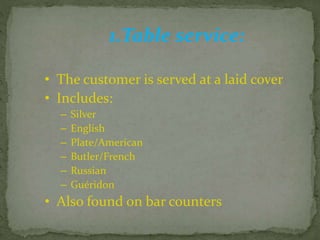
1.Table service:
• The customer is served at a laid cover
• Includes:
– Silver
– English
– Plate/American
– Butler/French
– Russian
– Guéridon
• Also found on bar counters
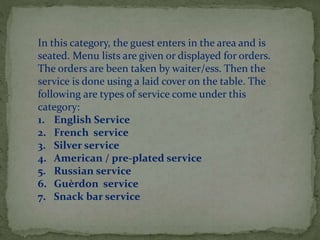
In this category, the guest enters in the area and is
seated. Menu lists are given or displayed for orders.
The orders are been taken by waiter/ess. Then the
service is done using a laid cover on the table. The
following are types of service come under this
category:
1. English Service
2. French service
3. Silver service
4. American / pre-plated service
5. Russian service
6. Guèrdon service
7. Snack bar service
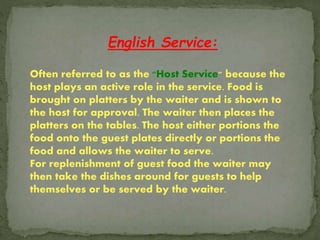
English Service:
Often referred to as the "Host Service" because the
host plays an active role in the service. Food is
brought on platters by the waiter and is shown to
the host for approval. The waiter then places the
platters on the tables. The host either portions the
food onto the guest plates directly or portions the
food and allows the waiter to serve.
For replenishment of guest food the waiter may
then take the dishes around for guests to help
themselves or be served by the waiter.
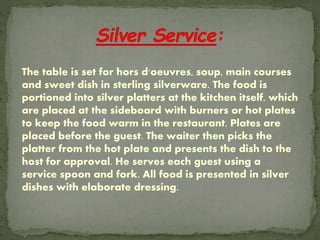
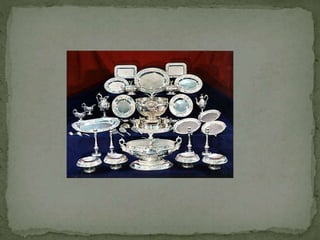
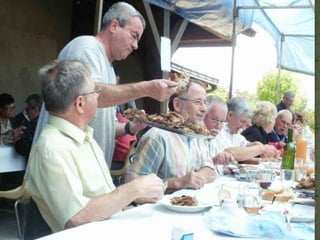
The table is set for hors d'oeuvres, soup, main courses
and sweet dish in sterling silverware. The food is
portioned into silver platters at the kitchen itself, which
are placed at the sideboard with burners or hot plates
to keep the food warm in the restaurant. Plates are
placed before the guest. The waiter then picks the
platter from the hot plate and presents the dish to the
host for approval. He serves each guest using a
service spoon and fork. All food is presented in silver
dishes with elaborate dressing.
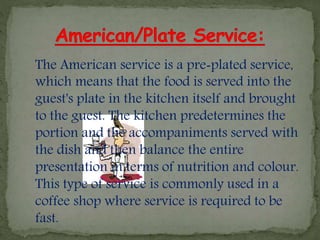
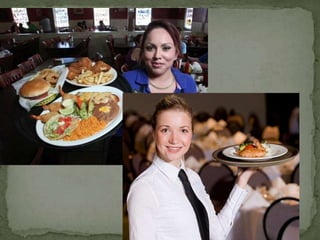
The American service is a pre‐plated service,
which means that the food is served into the
guest's plate in the kitchen itself and brought
to the guest. The kitchen predetermines the
portion and the accompaniments served with
the dish and then balance the entire
presentation in terms of nutrition and colour.
This type of service is commonly used in a
coffee shop where service is required to be
fast.
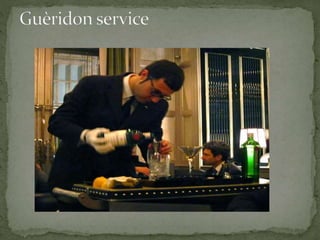
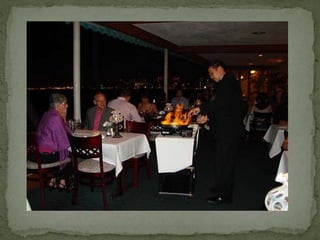
This is a service where a dish comes partiallyprepared fromthe kitchento be
completed in the restaurant by the waiter or, when a complete meal is cooked at
the tableside in the restaurant. The cooking is done on a gueridon trolley, which
is a mobile trolley with a gas cylinder and
burners. The waiter plays a prominent part, as he is required to fillet, carve,
flambé and prepare the food with showmanship. The waiter has to have
considerable dexterity and skill.
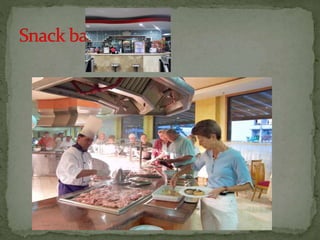
Tall stools are placed along a counter so
that the guest may eat the food at the
counter itself. In better establishments,
the covers are laid out on the counter
itself. Food is either displayed behind the
counter for the guests to choose from, or
is listed on a menu card or simple black
board.
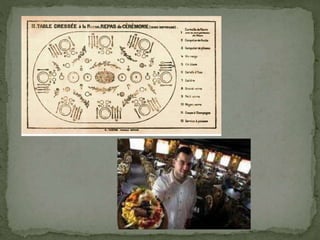
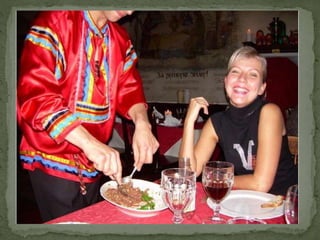
An elaborate silver service thought to be the
foundation of French service except that the food
is portioned and carved by the waiter at the
guèridon trolley in the restaurant in full view of
the guests.
Display and theatrical presentation are a major
part of this service. The principle involved is to
have whole joints, poultry, game and fish
elaborately dressed and garnished, presented to
guests and carved and portioned by the waiter.
It is a very personalised service. Food
is brought from the kitchen in dishes
and salvers, which are placed directly
on the table. The plates are kept near
the dish and the guests help
themselves.
2.Assisted service:
Customer served part of the meal at a table
and is required to obtain part through
self-service (for example in a carvery-type
operation)
A carvery is a restaurant where cooked meat is freshly sliced to order
for customers, sometimes offering unlimited servings for a fixed
price. The term is most commonly used in the U.K. Ireland and
australia , but it is also found in the U.S.
Assisted Service
In this type of category, the guest
enters in the dining area and helps
himself to the food, either from a
buffet counter or he may get served
partly at table by waiter/ess and he
collects any extras he needs
from the counter. Eating may be done
on either at table, standing or in
lounge area/ banquet hall.
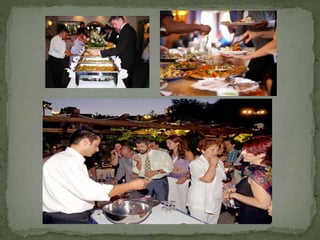
Buffet Service:
A self‐service, where food is displayed on tables.
The guest takes his plate from a stack at
the end of each table or requests the waiter behind
the buffet table to serve him. For sit‐down buffet
service, tables are laid with crockery and cutlery as
in a restaurant. The guest may serve himself at the
buffet table and return to eat at the guest table laid
out. The waiter may serve a few courses like the
appetiser and soup at the table.
3.Self-service:
• The customer is required to help him or
herself from a buffet or counter
• Counters can be:
– Straight line counter with payment point at end
– Free-flow - customers move at will to random
service points
– Echelon – series of counters at angles to save space
– Supermarket - Island service points within a free-
flow area
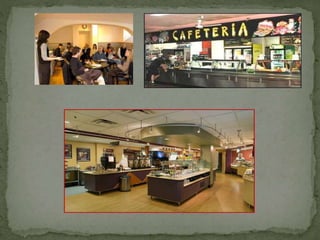
Cafeteria Service:
This service exists normally in
industrial canteens, colleges,
hospitals or hotel
cafeterias. To facilitate quick service,
the menu is fixed and is displayed on
large boards. The guest may
have to buy coupons in advance,
present them to the counter waiter who
then serves the desired item.
4.Single point service:
• The customer orders, pays and receives
the food and beverages at a counter:
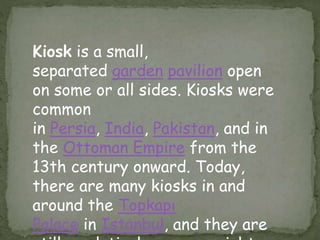
– At take away; fast food; drive thru; kiosk;
food court, vending machine
– At a bar in licensed premises
Single Point Service
In this category, the guest orders, pays
for his order and gets served all at a
single point. There may be
may not be any dinning area or seats.
The different types are:
1. Take away service
2. Vending
3. Kiosk
4. Food court
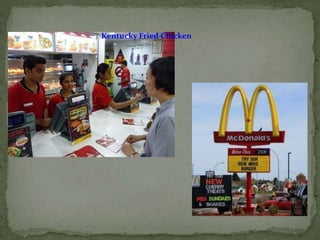
Kentucky Fried Chicken
Take Away: Customer orders and is served from single
point, at counter, hatch or snack stand; customer
consumes off the premises.
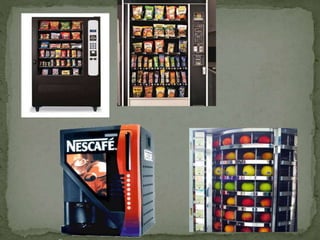
Vending: Provision of food service and beverage service
by means of automatic retailing.
Food Court: series of autonomous counters where
customers may either order and eat or buy from a
number of counters and eat in separate eating area, or
take‐away.
Kiosks: Outstation to provide service for peak demand
or in specific location (may be open for
customers to order or used for dispensing only)
Kiosk is a small,
separated garden pavilion open
on some or all sides. Kiosks were
common
in Persia, India, Pakistan, and in
the Ottoman Empire from the
13th century onward. Today,
there are many kiosks in and
around the Topkapı
Palace in Istanbul, and they are
5.Specialised service
(or service in situ):
• The food and beverage is taken to where the
customer is.
• Includes: tray service in hospitals, hotels or
aircraft, trolley service, home delivery,
lounge service, room service and drive-in
A) Grill Room Service: In this form of service
various meats are grilled in front of the guest.
The meats may be displayed behind a glass
partition or well decorated counter so that the guest
can select his exact cut of meat. The food comes
pre‐plated.
B) Tray service: Method of service of whole or
part of meal on tray to customer in situ, e.g.
hospitals aircraft or railway catering.
C) Trolley service: Method of service of food and
beverages form trolley, away from dining areas,
e.g. for
office workers, in aircraft or on trains.
D) Home‐ Delivery: Food delivered to customer’s
home or place of work, e.g. Pizza home delivery
or Meal on wheels etc.
E) Lounge Service: Service of variety of foods &
beverages in lounge area.
F) Room Service: It implies serving of
food and beverage in guest rooms of
hotels. Small orders are served in trays.
Major meals are taken to the room on
trolleys. The guest places his order with
the room service order taker. There are
3(three) types of Room service:
1. Centralized room service
2.De-centralized room service
3.Mobile room service
Centralized room service: Here all the
food orders are processed from the main
kitchen and sent to the rooms by a
common team of waiters.
Decentralized room service: Each floor or
a set of floor may have separate pantries
to service them. Orders are taken at a
central point by order‐takers who in turn
convey the order to the respective pantry.
Mobile Pantries/ room service: Some hotels have
pantries installed in service elevators. Orders are
received by a central point that convey it to the
mobile pantry. The pantry has to just switch on
the floor and give instant service. For the sake of
information, in countries, which have a shortage
of manpower, large hotels install mechanized
dispensing units in rooms. The guest inserts the
necessary value of coins into the machine, which
will eject pre-prepared food and beverages for
guest consumption.
 Silver serve food from the left
 Serve plater to plate from left
 Serve plated foods from the right
 Serve all beverages from the right
 Clear from the right
 Use trays
 Separate tasks of:
 serving at table
 food/drink collection
 sideboard/workstation clearing
 Use checklists for tasks required for clearing after service
Deepak Daya Sagar Pathak
9235732256

Deepak daya sagar pathak

  • 1.
  • 2.
    The five customerprocesses A. Service at a laid cover B. Assisted service – part service at a laid cover and part self-service C. Self service D. Service at a single point (ordering, receipt of order and payment E. Specialised service or service in situ
  • 5.
    1.Table service: • Thecustomer is served at a laid cover • Includes: – Silver – English – Plate/American – Butler/French – Russian – Guéridon • Also found on bar counters
  • 6.
    In this category,the guest enters in the area and is seated. Menu lists are given or displayed for orders. The orders are been taken by waiter/ess. Then the service is done using a laid cover on the table. The following are types of service come under this category: 1. English Service 2. French service 3. Silver service 4. American / pre-plated service 5. Russian service 6. Guèrdon service 7. Snack bar service
  • 7.
    English Service: Often referredto as the "Host Service" because the host plays an active role in the service. Food is brought on platters by the waiter and is shown to the host for approval. The waiter then places the platters on the tables. The host either portions the food onto the guest plates directly or portions the food and allows the waiter to serve. For replenishment of guest food the waiter may then take the dishes around for guests to help themselves or be served by the waiter.
  • 8.
    The table isset for hors d'oeuvres, soup, main courses and sweet dish in sterling silverware. The food is portioned into silver platters at the kitchen itself, which are placed at the sideboard with burners or hot plates to keep the food warm in the restaurant. Plates are placed before the guest. The waiter then picks the platter from the hot plate and presents the dish to the host for approval. He serves each guest using a service spoon and fork. All food is presented in silver dishes with elaborate dressing.
  • 11.
    The American serviceis a pre‐plated service, which means that the food is served into the guest's plate in the kitchen itself and brought to the guest. The kitchen predetermines the portion and the accompaniments served with the dish and then balance the entire presentation in terms of nutrition and colour. This type of service is commonly used in a coffee shop where service is required to be fast.
  • 14.
    This is aservice where a dish comes partiallyprepared fromthe kitchento be completed in the restaurant by the waiter or, when a complete meal is cooked at the tableside in the restaurant. The cooking is done on a gueridon trolley, which is a mobile trolley with a gas cylinder and burners. The waiter plays a prominent part, as he is required to fillet, carve, flambé and prepare the food with showmanship. The waiter has to have considerable dexterity and skill.
  • 17.
    Tall stools areplaced along a counter so that the guest may eat the food at the counter itself. In better establishments, the covers are laid out on the counter itself. Food is either displayed behind the counter for the guests to choose from, or is listed on a menu card or simple black board.
  • 18.
    An elaborate silverservice thought to be the foundation of French service except that the food is portioned and carved by the waiter at the guèridon trolley in the restaurant in full view of the guests. Display and theatrical presentation are a major part of this service. The principle involved is to have whole joints, poultry, game and fish elaborately dressed and garnished, presented to guests and carved and portioned by the waiter.
  • 21.
    It is avery personalised service. Food is brought from the kitchen in dishes and salvers, which are placed directly on the table. The plates are kept near the dish and the guests help themselves.
  • 23.
    2.Assisted service: Customer servedpart of the meal at a table and is required to obtain part through self-service (for example in a carvery-type operation) A carvery is a restaurant where cooked meat is freshly sliced to order for customers, sometimes offering unlimited servings for a fixed price. The term is most commonly used in the U.K. Ireland and australia , but it is also found in the U.S.
  • 24.
    Assisted Service In thistype of category, the guest enters in the dining area and helps himself to the food, either from a buffet counter or he may get served partly at table by waiter/ess and he collects any extras he needs from the counter. Eating may be done on either at table, standing or in lounge area/ banquet hall.
  • 25.
    Buffet Service: A self‐service,where food is displayed on tables. The guest takes his plate from a stack at the end of each table or requests the waiter behind the buffet table to serve him. For sit‐down buffet service, tables are laid with crockery and cutlery as in a restaurant. The guest may serve himself at the buffet table and return to eat at the guest table laid out. The waiter may serve a few courses like the appetiser and soup at the table.
  • 27.
    3.Self-service: • The customeris required to help him or herself from a buffet or counter • Counters can be: – Straight line counter with payment point at end – Free-flow - customers move at will to random service points – Echelon – series of counters at angles to save space – Supermarket - Island service points within a free- flow area
  • 28.
    Cafeteria Service: This serviceexists normally in industrial canteens, colleges, hospitals or hotel cafeterias. To facilitate quick service, the menu is fixed and is displayed on large boards. The guest may have to buy coupons in advance, present them to the counter waiter who then serves the desired item.
  • 30.
    4.Single point service: •The customer orders, pays and receives the food and beverages at a counter: – At take away; fast food; drive thru; kiosk; food court, vending machine – At a bar in licensed premises
  • 31.
    Single Point Service Inthis category, the guest orders, pays for his order and gets served all at a single point. There may be may not be any dinning area or seats. The different types are: 1. Take away service 2. Vending 3. Kiosk 4. Food court
  • 32.
  • 33.
    Take Away: Customerorders and is served from single point, at counter, hatch or snack stand; customer consumes off the premises. Vending: Provision of food service and beverage service by means of automatic retailing. Food Court: series of autonomous counters where customers may either order and eat or buy from a number of counters and eat in separate eating area, or take‐away. Kiosks: Outstation to provide service for peak demand or in specific location (may be open for customers to order or used for dispensing only)
  • 36.
    Kiosk is asmall, separated garden pavilion open on some or all sides. Kiosks were common in Persia, India, Pakistan, and in the Ottoman Empire from the 13th century onward. Today, there are many kiosks in and around the Topkapı Palace in Istanbul, and they are
  • 37.
    5.Specialised service (or servicein situ): • The food and beverage is taken to where the customer is. • Includes: tray service in hospitals, hotels or aircraft, trolley service, home delivery, lounge service, room service and drive-in
  • 38.
    A) Grill RoomService: In this form of service various meats are grilled in front of the guest. The meats may be displayed behind a glass partition or well decorated counter so that the guest can select his exact cut of meat. The food comes pre‐plated. B) Tray service: Method of service of whole or part of meal on tray to customer in situ, e.g. hospitals aircraft or railway catering.
  • 39.
    C) Trolley service:Method of service of food and beverages form trolley, away from dining areas, e.g. for office workers, in aircraft or on trains. D) Home‐ Delivery: Food delivered to customer’s home or place of work, e.g. Pizza home delivery or Meal on wheels etc. E) Lounge Service: Service of variety of foods & beverages in lounge area.
  • 40.
    F) Room Service:It implies serving of food and beverage in guest rooms of hotels. Small orders are served in trays. Major meals are taken to the room on trolleys. The guest places his order with the room service order taker. There are 3(three) types of Room service: 1. Centralized room service 2.De-centralized room service 3.Mobile room service
  • 41.
    Centralized room service:Here all the food orders are processed from the main kitchen and sent to the rooms by a common team of waiters. Decentralized room service: Each floor or a set of floor may have separate pantries to service them. Orders are taken at a central point by order‐takers who in turn convey the order to the respective pantry.
  • 42.
    Mobile Pantries/ roomservice: Some hotels have pantries installed in service elevators. Orders are received by a central point that convey it to the mobile pantry. The pantry has to just switch on the floor and give instant service. For the sake of information, in countries, which have a shortage of manpower, large hotels install mechanized dispensing units in rooms. The guest inserts the necessary value of coins into the machine, which will eject pre-prepared food and beverages for guest consumption.
  • 43.
     Silver servefood from the left  Serve plater to plate from left  Serve plated foods from the right  Serve all beverages from the right  Clear from the right
  • 44.
     Use trays Separate tasks of:  serving at table  food/drink collection  sideboard/workstation clearing  Use checklists for tasks required for clearing after service
  • 45.
    Deepak Daya SagarPathak 9235732256