1
Deep Learning Application
for Industry
Afif A. Iskandar
2
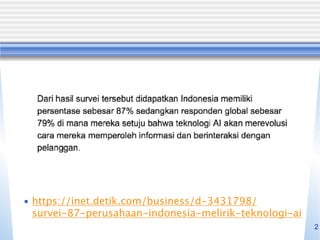
▪ https://inet.detik.com/business/d-3431798/
survei-87-perusahaan-indonesia-melirik-teknologi-ai
3
▪ http://tekno.liputan6.com/read/
2998802/kecerdasan-buatan-akan-
gantikan-peran-ahli-onkologi
▪ http://tekno.kompas.com/read/
2017/06/17/17170007/
facebook.pakai.kecerdasan.buatan.unt
uk.perangi.terorisme
4
What is Deep Learning ?
So, 1. what exactly is deep learning ?
And, 2. why is it generally better than other methods
on image, speech and certain other types of data?
5
So, 1. what exactly is deep learning ?
And, 2. why is it generally better than other methods on image,
speech and certain other types of data?
The short answers
1. ‘Deep Learning’ means using a neural network
with several layers of nodes between input and output
2. the series of layers between input & output do
feature identification and processing in a series of stages,
just as our brains seem to.
6
hmmm… OK, but:
3. multilayer neural networks have been around for
25 years. What’s actually new?
7
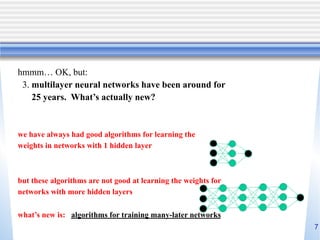
hmmm… OK, but:
3. multilayer neural networks have been around for
25 years. What’s actually new?
we have always had good algorithms for learning the
weights in networks with 1 hidden layer
but these algorithms are not good at learning the weights for
networks with more hidden layers
what’s new is: algorithms for training many-later networks
8
Longer Answer
1. reminder/quick-explanation of how neural
network weights are learned;
2. the idea of unsupervised feature learning
(why ‘intermediate features’ are important for
difficult classification tasks, and how NNs
seem to naturally learn them)
3. The ‘breakthrough’ – the simple trick for
training Deep neural networks
9
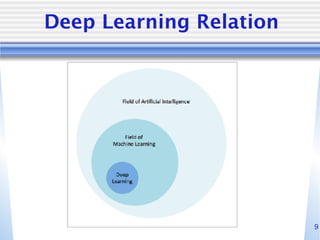
Deep Learning Relation
10
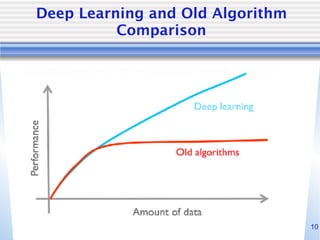
Deep Learning and Old Algorithm
Comparison
11
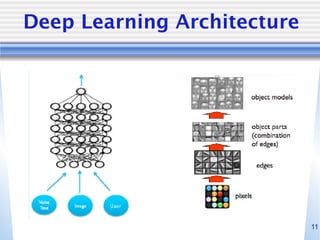
Deep Learning Architecture
12
Why do we need learning?
• Computers need functions that map highly variable
data:
⬥ Speech recognition: Audio signal -> words
⬥ Image analysis: Video signal -> objects
⬥ Bio-Informatics: Micro-array Images -> gene function
⬥ Data Mining: Transaction logs -> customer classification
• For accuracy, functions must be tuned to fit the data
source.
• For real-time processing, function computation has
to be very fast.
13
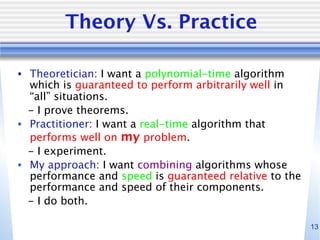
Theory Vs. Practice
• Theoretician: I want a polynomial-time algorithm
which is guaranteed to perform arbitrarily well in
“all” situations.
- I prove theorems.
• Practitioner: I want a real-time algorithm that
performs well on my problem.
- I experiment.
• My approach: I want combining algorithms whose
performance and speed is guaranteed relative to the
performance and speed of their components.
- I do both.
14
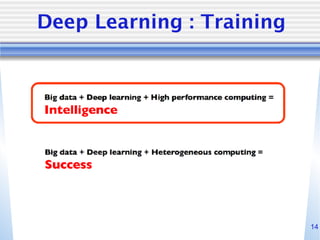
Deep Learning : Training
15
(Some) Deep Learning
Application Examples
16
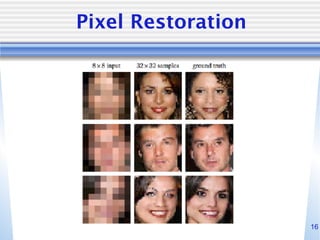
Pixel Restoration
17
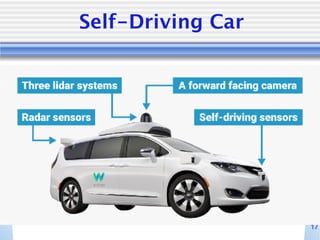
Self-Driving Car
18
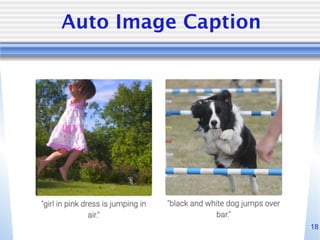
Auto Image Caption
19
Challenge
▪ Resources (Deep Learning Engineer)
▪ Investment (Time and Money for Deep
Learning Research)
20
Interested about Deep Learning ?
▪ Siraj Raval Channel
▪ http://deeplearning.net/
▪ Udemy Courses

Deep Learning for Industry