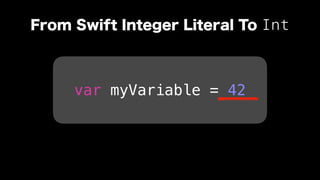
Int
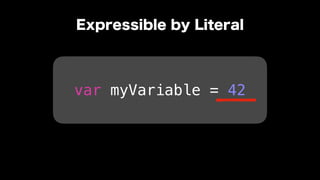
var myVariable = 42
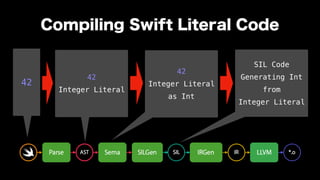
42
42
Integer Literal
42
Integer Literal
as Int
SIL Code
Generating Int
from
Integer Literal
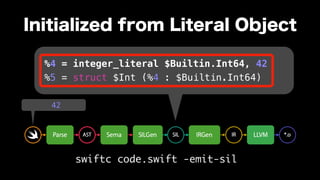
42
%4 = integer_literal $Builtin.Int64, 42
%5 = struct $Int (%4 : $Builtin.Int64)
swiftc code.swift -emit-sil
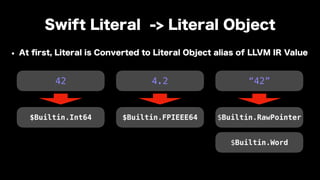
42
$Builtin.Int64
4.2
$Builtin.FPIEEE64
“42”
$Builtin.RawPointer
$Builtin.Word
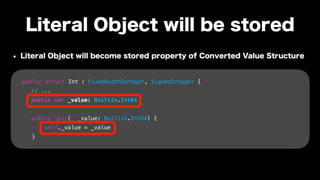
public struct Int : FixedWidthInteger, SignedInteger {
// ...
public var _value: Builtin.Int64
public init(_ _value: Builtin.Int64) {
self._value = _value
}
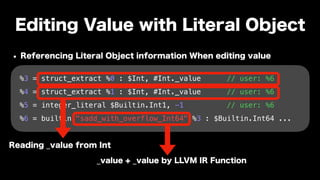
%3 = struct_extract %0 : $Int, #Int._value // user: %6
%4 = struct_extract %1 : $Int, #Int._value // user: %6
%5 = integer_literal $Builtin.Int1, -1 // user: %6
%6 = builtin "sadd_with_overflow_Int64"(%3 : $Builtin.Int64 ...
var myVariable = 42
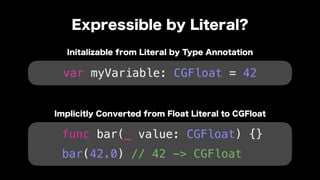
var myVariable: CGFloat = 42
func bar(_ value: CGFloat) {}
bar(42.0) // 42 -> CGFloat


var myVariable = 42
var myVariable = 42.0
var myVariable = true
var myVariable = ”try!”
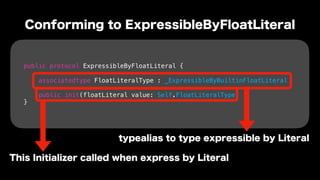
public protocol ExpressibleByFloatLiteral {
associatedtype FloatLiteralType : _ExpressibleByBuiltinFloatLiteral
public init(floatLiteral value: Self.FloatLiteralType)
}
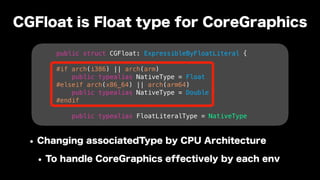
public struct CGFloat: ExpressibleByFloatLiteral {
#if arch(i386) || arch(arm)
public typealias NativeType = Float
#elseif arch(x86_64) || arch(arm64)
public typealias NativeType = Double
#endif
public typealias FloatLiteralType = NativeType


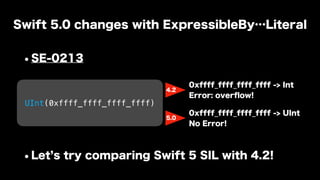
UInt(0xffff_ffff_ffff_ffff)


Deep Dive into Swift Literal

Deep Dive into Swift Literal