Developing a highly dynamic web 
application for a large bank using 
rules-based technology
• Part 1: Requirements and zooming in on a solution 
• Part 2: Design and development 
• Part 3: Conclusion and lessons learned
• Requirements & Reference Architecture 
• Changing directions 
• Product / Vendor Options 
• Selected Product and Reasons Why
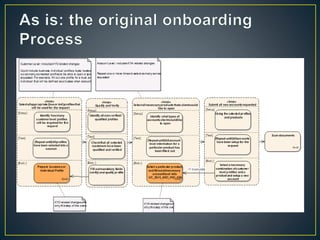
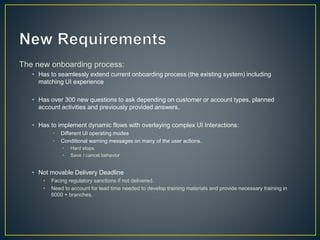
The new onboarding process: 
• Has to seamlessly extend current onboarding process (the existing system) including 
matching UI experience 
• Has over 300 new questions to ask depending on customer or account types, planned 
account activities and previously provided answers. 
• Has to implement dynamic flows with overlaying complex UI Interactions: 
• Different UI operating modes 
• Conditional warning messages on many of the user actions. 
• Hard stops 
• Save / cancel behavior 
• Not movable Delivery Deadline 
• Facing regulatory sanctions if not delivered. 
• Need to account for lead time needed to develop training materials and provide necessary training in 
6000 + branches.
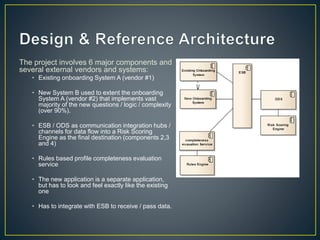
The project involves 6 major components and 
several external vendors and systems: 
• Existing onboarding System A (vendor #1) 
• New System B used to extent the onboarding 
System A (vendor #2) that implements vast 
majority of the new questions / logic / complexity 
(over 90%). 
• ESB / ODS as communication integration hubs / 
channels for data flow into a Risk Scoring 
Engine as the final destination (components 2,3 
and 4) 
• Rules based profile completeness evaluation 
service 
• The new application is a separate application, 
but has to look and feel exactly like the existing 
one 
• Has to integrate with ESB to receive / pass data.
Upon finalizing design, cost and schedule and 3 Months before delivery 
date - a major set back from vendor #2: 
• Some of the “must have” requirements cannot be met. 
• Overall cost and schedule is longer than originally estimated 
Need to find a solution that will: 
 Implement functionality AND Meet all of the must have requirements that the current vendor cannot 
meet 
 Return project back to original cost and schedule
Based on: 
• cheer amount of logic required for the dynamic application to function 
• Short project timeline left 
• Requirements to use rules engine as one of the components anyways 
The call is made to use rules driven UI framework to try to build the new application. 
Go/No Go Decision: 
• Quick POC to prove that it might be a viable approach: 
• Must have requirements to be implemented as part of the POC 
• Most complex section of the dynamic forms must be implemented as part of the POC 
Other Major (must have requirements) for the framework for the Go/No Go decision. 
• Robust Rules Management UI – to many to manage otherwise (over a thousand that needs to be built within a few 
months) 
• Cost - there are more than 6000 thousand regular users, so seat licenses or any other complex licensing requirements 
may impair the project progress 
• Dependency on other components, availability of ready to start resources, or inflexible development lifecycle is a MAJOR 
risk– only 2 months to deliver. 
The rules based web frameworks considered: 
• Appian 
• IBM ILOG 
• OpenRules ORD.
OpenRules Framework was selected based on combination of all 
factors: 
• Cost and Schedule 
• A competed POC to prove the ability to meet business the business 
requirements 
• Excel based UI for entering rules 
• Simple rules configuration logic 
• Simple licensing requirements 
• Positive reference checks
TOC: 
• Section A: Running OOTB solution based on templates as a starting point 
for new application development and structure of typical apps 
• Section B: Summary of framework and support provided by OpenRules to 
build the dynamic web applications 
• ORD Templates 
• Data Binding and Special Tags 
• Section C: Design and Development to specific requirements: 
• Rules based web forms design 
• UI Look and Feel 
• Back End Integration 
• Any Other Customizations
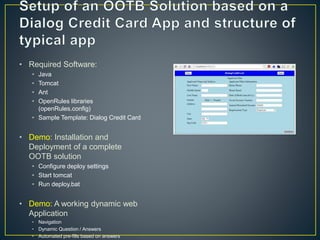
• Required Software: 
• Java 
• Tomcat 
• Ant 
• OpenRules libraries 
(openRules.config) 
• Sample Template: Dialog Credit Card 
• Demo: Installation and 
Deployment of a complete 
OOTB solution 
• Configure deploy settings 
• Start tomcat 
• Run deploy.bat 
• Demo: A working dynamic web 
Application 
• Navigation 
• Dynamic Question / Answers 
• Automated pre-fills based on answers
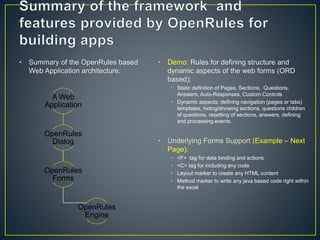
• Summary of the OpenRules based 
Web Application architecture. 
A Web 
Application 
OpenRules 
Dialog 
OpenRules 
Forms 
OpenRules 
Engine 
• Demo: Rules for defining structure and 
dynamic aspects of the web forms (ORD 
based): 
• Static definition of Pages, Sections, Questions, 
Answers, Auto-Responses, Custom Controls 
• Dynamic aspects: defining navigation (pages or tabs) 
templates, hiding/showing sections, questions children 
of questions, resetting of sections, answers, defining 
and processing events. 
• Underlying Forms Support (Example – Next 
Page): 
• <F> tag for data binding and actions 
• <C> tag for including any code 
• Layout marker to create any HTML content 
• Method marker to write any java based code right within 
the excel
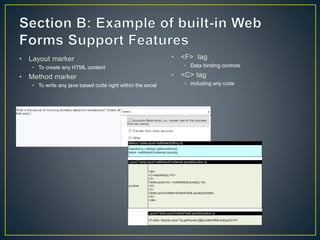
• <F> tag 
• Data binding controls 
• <C> tag 
• including any code 
• Layout marker 
• To create any HTML content 
• Method marker 
• To write any java based code right within the excel
TOC: 
• Extending User Interface: Using HTML / JavaScript / CSS, and OpenRules 
templates to create reach user interface 
• Using / Modifying default look and feel using css and page, section, question templates 
• Extending existing or building new Question/Answer Templates 
• Adding reach GUI elements and interactions 
• Back end integration activities and customizations: building connectors into 
external systems. 
• Integration with Vendor A 
• Integration with Enterprise Service Bus (ESB) 
• Extending default capabilities of ORD. 
• Support for multiple questionnaires in a session 
• Support for ability to copy a portion of answers from another questionnaire in the session 
• Support for tabs rather than pages 
• Adding client / server side logic as per requirements to control conditional actions, modes, hard stops
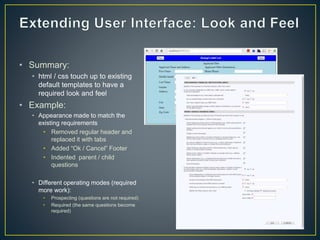
• Summary: 
• html / css touch up to existing 
default templates to have a 
required look and feel 
• Example: 
• Appearance made to match the 
existing requirements 
• Removed regular header and 
replaced it with tabs 
• Added “Ok / Cancel” Footer 
• Indented parent / child 
questions 
• Different operating modes (required 
more work): 
• Prospecting (questions are not required) 
• Required (the same questions become 
required)
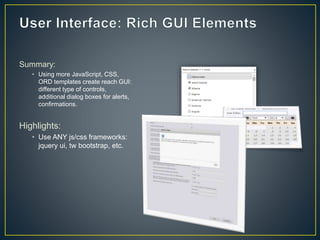
Summary: 
• Using more JavaScript, CSS, 
ORD templates create reach GUI: 
different type of controls, 
additional dialog boxes for alerts, 
confirmations. 
Highlights: 
• Use ANY js/css frameworks: 
jquery ui, tw bootstrap, etc.
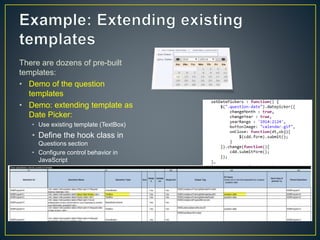
There are dozens of pre-built 
templates: 
• Demo of the question 
templates 
• Demo: extending template as 
Date Picker: 
• Use existing template (TextBox) 
• Define the hook class in 
Questions section 
• Configure control behavior in 
JavaScript
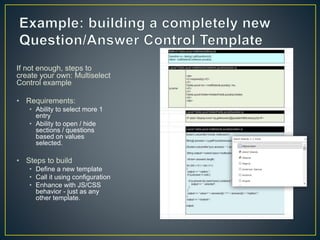
If not enough, steps to 
create your own: Multiselect 
Control example 
• Requirements: 
• Ability to select more 1 
entry 
• Ability to open / hide 
sections / questions 
based on values 
selected. 
• Steps to build 
• Define a new template 
• Call it using configuration 
• Enhance with JS/CSS 
behavior - just as any 
other template.
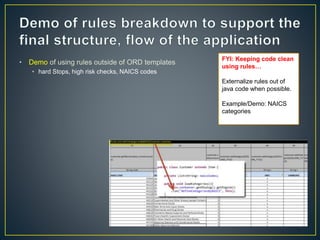
• Demo of using rules outside of ORD templates 
• hard Stops, high risk checks, NAICS codes 
FYI: Keeping code clean 
using rules… 
Externalize rules out of 
java code when possible. 
Example/Demo: NAICS 
categories
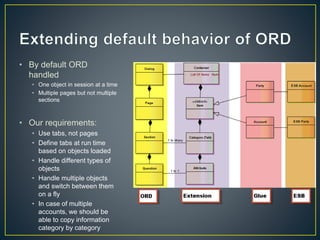
• By default ORD 
handled 
• One object in session at a time 
• Multiple pages but not multiple 
sections 
• Our requirements: 
• Use tabs, not pages 
• Define tabs at run time 
based on objects loaded 
• Handle different types of 
objects 
• Handle multiple objects 
and switch between them 
on a fly 
• In case of multiple 
accounts, we should be 
able to copy information 
category by category
Conclusion: 
• Very powerful yet intuitive rules and template architecture 
• Short run / test cycles of building web forms using rules dramatically reduce 
SDLC 
• All rules defined declaratively, externalized out of the application code 
Suggestions: 
• Consider splitting work into separate but parallel tracks using the OOTB 
template and independently working on UI, back end integration, structure of 
the web forms 
• Building your rules: 
• Rules become as simple as they look ONLY for minds that are analytical in nature. 
• Have people with analytical mind to understand business requirements and 
translate them into rules.
TOC: 
• Demo: building forms for entering more than one row 
• Demo: dealing with auto-responses.

Decision CAMP 2014 - Erik Marutian - Using rules-based gui framework to power dynamic financial applications

  • 1.
    Developing a highlydynamic web application for a large bank using rules-based technology
  • 2.
    • Part 1:Requirements and zooming in on a solution • Part 2: Design and development • Part 3: Conclusion and lessons learned
  • 3.
    • Requirements &Reference Architecture • Changing directions • Product / Vendor Options • Selected Product and Reasons Why
  • 5.
    The new onboardingprocess: • Has to seamlessly extend current onboarding process (the existing system) including matching UI experience • Has over 300 new questions to ask depending on customer or account types, planned account activities and previously provided answers. • Has to implement dynamic flows with overlaying complex UI Interactions: • Different UI operating modes • Conditional warning messages on many of the user actions. • Hard stops • Save / cancel behavior • Not movable Delivery Deadline • Facing regulatory sanctions if not delivered. • Need to account for lead time needed to develop training materials and provide necessary training in 6000 + branches.
  • 6.
    The project involves6 major components and several external vendors and systems: • Existing onboarding System A (vendor #1) • New System B used to extent the onboarding System A (vendor #2) that implements vast majority of the new questions / logic / complexity (over 90%). • ESB / ODS as communication integration hubs / channels for data flow into a Risk Scoring Engine as the final destination (components 2,3 and 4) • Rules based profile completeness evaluation service • The new application is a separate application, but has to look and feel exactly like the existing one • Has to integrate with ESB to receive / pass data.
  • 7.
    Upon finalizing design,cost and schedule and 3 Months before delivery date - a major set back from vendor #2: • Some of the “must have” requirements cannot be met. • Overall cost and schedule is longer than originally estimated Need to find a solution that will:  Implement functionality AND Meet all of the must have requirements that the current vendor cannot meet  Return project back to original cost and schedule
  • 8.
    Based on: •cheer amount of logic required for the dynamic application to function • Short project timeline left • Requirements to use rules engine as one of the components anyways The call is made to use rules driven UI framework to try to build the new application. Go/No Go Decision: • Quick POC to prove that it might be a viable approach: • Must have requirements to be implemented as part of the POC • Most complex section of the dynamic forms must be implemented as part of the POC Other Major (must have requirements) for the framework for the Go/No Go decision. • Robust Rules Management UI – to many to manage otherwise (over a thousand that needs to be built within a few months) • Cost - there are more than 6000 thousand regular users, so seat licenses or any other complex licensing requirements may impair the project progress • Dependency on other components, availability of ready to start resources, or inflexible development lifecycle is a MAJOR risk– only 2 months to deliver. The rules based web frameworks considered: • Appian • IBM ILOG • OpenRules ORD.
  • 9.
    OpenRules Framework wasselected based on combination of all factors: • Cost and Schedule • A competed POC to prove the ability to meet business the business requirements • Excel based UI for entering rules • Simple rules configuration logic • Simple licensing requirements • Positive reference checks
  • 10.
    TOC: • SectionA: Running OOTB solution based on templates as a starting point for new application development and structure of typical apps • Section B: Summary of framework and support provided by OpenRules to build the dynamic web applications • ORD Templates • Data Binding and Special Tags • Section C: Design and Development to specific requirements: • Rules based web forms design • UI Look and Feel • Back End Integration • Any Other Customizations
  • 12.
    • Required Software: • Java • Tomcat • Ant • OpenRules libraries (openRules.config) • Sample Template: Dialog Credit Card • Demo: Installation and Deployment of a complete OOTB solution • Configure deploy settings • Start tomcat • Run deploy.bat • Demo: A working dynamic web Application • Navigation • Dynamic Question / Answers • Automated pre-fills based on answers
  • 14.
    • Summary ofthe OpenRules based Web Application architecture. A Web Application OpenRules Dialog OpenRules Forms OpenRules Engine • Demo: Rules for defining structure and dynamic aspects of the web forms (ORD based): • Static definition of Pages, Sections, Questions, Answers, Auto-Responses, Custom Controls • Dynamic aspects: defining navigation (pages or tabs) templates, hiding/showing sections, questions children of questions, resetting of sections, answers, defining and processing events. • Underlying Forms Support (Example – Next Page): • <F> tag for data binding and actions • <C> tag for including any code • Layout marker to create any HTML content • Method marker to write any java based code right within the excel
  • 15.
    • <F> tag • Data binding controls • <C> tag • including any code • Layout marker • To create any HTML content • Method marker • To write any java based code right within the excel
  • 17.
    TOC: • ExtendingUser Interface: Using HTML / JavaScript / CSS, and OpenRules templates to create reach user interface • Using / Modifying default look and feel using css and page, section, question templates • Extending existing or building new Question/Answer Templates • Adding reach GUI elements and interactions • Back end integration activities and customizations: building connectors into external systems. • Integration with Vendor A • Integration with Enterprise Service Bus (ESB) • Extending default capabilities of ORD. • Support for multiple questionnaires in a session • Support for ability to copy a portion of answers from another questionnaire in the session • Support for tabs rather than pages • Adding client / server side logic as per requirements to control conditional actions, modes, hard stops
  • 18.
    • Summary: •html / css touch up to existing default templates to have a required look and feel • Example: • Appearance made to match the existing requirements • Removed regular header and replaced it with tabs • Added “Ok / Cancel” Footer • Indented parent / child questions • Different operating modes (required more work): • Prospecting (questions are not required) • Required (the same questions become required)
  • 19.
    Summary: • Usingmore JavaScript, CSS, ORD templates create reach GUI: different type of controls, additional dialog boxes for alerts, confirmations. Highlights: • Use ANY js/css frameworks: jquery ui, tw bootstrap, etc.
  • 20.
    There are dozensof pre-built templates: • Demo of the question templates • Demo: extending template as Date Picker: • Use existing template (TextBox) • Define the hook class in Questions section • Configure control behavior in JavaScript
  • 21.
    If not enough,steps to create your own: Multiselect Control example • Requirements: • Ability to select more 1 entry • Ability to open / hide sections / questions based on values selected. • Steps to build • Define a new template • Call it using configuration • Enhance with JS/CSS behavior - just as any other template.
  • 22.
    • Demo ofusing rules outside of ORD templates • hard Stops, high risk checks, NAICS codes FYI: Keeping code clean using rules… Externalize rules out of java code when possible. Example/Demo: NAICS categories
  • 23.
    • By defaultORD handled • One object in session at a time • Multiple pages but not multiple sections • Our requirements: • Use tabs, not pages • Define tabs at run time based on objects loaded • Handle different types of objects • Handle multiple objects and switch between them on a fly • In case of multiple accounts, we should be able to copy information category by category
  • 24.
    Conclusion: • Verypowerful yet intuitive rules and template architecture • Short run / test cycles of building web forms using rules dramatically reduce SDLC • All rules defined declaratively, externalized out of the application code Suggestions: • Consider splitting work into separate but parallel tracks using the OOTB template and independently working on UI, back end integration, structure of the web forms • Building your rules: • Rules become as simple as they look ONLY for minds that are analytical in nature. • Have people with analytical mind to understand business requirements and translate them into rules.
  • 25.
    TOC: • Demo:building forms for entering more than one row • Demo: dealing with auto-responses.

Editor's Notes

  • #11 TODO: Section C: Each work stream works on their own using the template, then results are put together into a final “master” solution