Product Handbook
Indorama Ventures Oxides Australia Pty Limited
> Empowering potential.
Integrated Oxides & Derivatives
VISION: TO BE A WORLD-CLASS CHEMICAL COMPANY MAKING GREAT PRODUCTS FOR SOCIETY.
Proudly manufacturing in Australia since 1964
Indorama Ventures is a manufacturer of ethylene oxide, ethylene oxide derivatives and other differentiated chemicals,
operating in Australia for over 50 years. Our long history of supplying quality products into key industries including agricul-
ture, automotive, home care, cleaning, coatings, energy and mining chemicals has made us a trusted chemical supplier in
the Australian, Asia Pacific and Global market.
In Australia, our manufacturing facility is located in Botany, NSW and leads the Asia Pacific region for production of
ethylene oxide and derivatives. Indorama Ventures is the only manufacturer of ethylene oxide in Australia. Ethylene
oxide is reacted with a variety of locally and globally sourced materials resulting in over 250 specialised products, namely
surfactants, glycols and glycol ethers, that remain pivotal to the function of both Australian industries and those abroad.
We are committed to sustainably providing quality products and services that meet our customer needs by ensuring we
operate safely and in accordance with applicable statutory, regulatory and environmental requirements. We strive to
provide consistent and flexible supply options, and as a local manufacturer, maintain the benefit of being responsive to
the dynamic needs of industry.
Our Australian commercial, R&D and production teams harness their combined experience to provide both passionate
and dedicated service and support, whilst continuing to innovate by developing new products and applications, improving
existing product lines and finding new and improved ways to service our customers’ needs.
Indorama Ventures is ISO9001 and Roundtable on Sustainable Palm Oil (RSPO) accredited.
Indorama Ventures
1
INDORAMA VENTURES
SUSTAINABILITY
Most ethylene oxide derivatives, including surfactants, are hygroscopic. If moisture
content is critical to the end-use application, then silica gel or alumina traps should
be attached to tank breathers or drum vents.
All alkylene oxide derivatives are ultimately susceptible to oxidative degradation.
Such degradation is accelerated by aeration, UV light and heat, and will result in
discolouration, a decrease in pH, an increase in acidity and possibly the devel-
opment of a faintly aldehydic odour. Although, in general, this does not change the
bulk properties of the surfactant, oxidative degradation may well cause the product
to drift outside of pH, acidity or colour specifications.
Alkylphenol ethoxylates are the least susceptible to oxidative degradation, followed
by the fatty alcohol ethoxylates. Block copolymer surfactants and polyethylene
glycols are relatively sensitive, particularly to excessive heat. Polyoxyethylene fatty
acid derivatives are complex equilibrium mixtures of esters and polyglycols. It is
possible for subtle compositional changes to occur over time, particularly when
the product is stored above its melting point to facilitate ease of handling. Usually
an assay of acid value, saponification value and hydroxyl value will indicate if
significant change has occurred.
Indorama Ventures recommends the following storage and handling practices
to maximize effective storage life:
n Store products indoors and away from local heat sources.
n Partial use of solid products by melting and re-melting is discouraged because
it will hasten oxidative breakdown and may lead to ‘zone refining’ of the product.
Dividing material into smaller lots proportional to the application’s batch size will
reduce the need to repeatedly reheat it.
n Partially used bags of flaked goods should be resealed or transferred to sealed
containers in order to reduce moisture absorption and oxidation.
n It is advised to store solid products above their melting point for extended
periods, unless the tank is well padded with nitrogen.
It is also recommended that solid products are melted and then mixed thoroughly
prior to their use to ensure product homogeneity.
Indorama Ventures cannot control the storage and use conditions of its products,
making it difficult to prescribe absolute shelf-life values. Shelf life is affected by
storage and handling conditions. Surfactant and polyol products are chemically
stable provided the product is stored in the original unopened airtight container
(steel drums or IBCs that are impermeable to oxygen), out of the direct sunlight
and under shelter from the weather. Under these conditions surfactant and
polyol products will remain useable for at least two years. After this time, it is
recommended that product should be retested for conformance against the
published specification.
Product Integrity
2
INDORAMA VENTURES
SUSTAINABILITY
A comprehensive Safety Data Sheet (SDS) is available on request from Indorama
Ventures sales offices. The SDS, which conform to the requirements of the
Globally Harmonized System of Classification and Labelling of Chemicals (GHS)
are frequently reviewed and updated. It is strongly recommended that the SDS is
reviewed prior to the use of any surfactant product. Suitable protective clothing,
including gloves and appropriate eye protection must be worn when handling
these materials.
Indorama Ventures SDS also indicate a products dangerous goods classification for
road and rail, shipping and air transportation. Some products have been assigned
Class 9, UN 3082, Environmentally Hazardous Substance, Liquid, N.O.S.
classification based on their potential adverse effect on marine life.
There are two properties of a surfactant which are of prime importance in assessing
the environmental impact of a surfactant - its biodegradability and its toxicity.
The surface active properties of a surfactant, such as foaming, wetting and
interfacial tension depression are what makes it useful in its domestic or industrial
application. These very same properties are highly undesirable when the surfactant
enters the aquatic environment. The interfacial tension depression effects and
wetting effects are probably the prime cause of the significant aquatic toxicity of sur-
factants. Such toxicity is a function of both concentration and chemical composition.
Concentration can be controlled by effluent management, but chemical composition
has a broader significance. Surfactants which are very rapidly biodegraded can be
claimed to be toxic only for a short time and therefore show minimal environmental
impact, whereas surfactants which degrade slowly and retain a high percentage of
their surface activity over time will have a net negative impact on the environment.
Primary, or functional, biodegradability is defined as the initial breakdown of the
surfactant, which results in the loss of its surface active properties. Ultimate biode-
gradability or mineralisation is defined as the breakdown of the product to carbon
dioxide, methane, water and mineral salts within a defined time period. The current
Australian Standard, AS 4351.1 - AS 4351.8, is a series of ultimate biodegradation
tests which closely follow well developed ISO Standards and their corresponding
OECD protocols. Biodegradability data in Indorama Ventures literature, including the
Australian Safety Data Sheets, is referenced back to these standards. Surfactants
can be classified as inherently biodegradable if there is clear evidence of primary or
ultimate biodegradation in any test. To be classified as readily biodegradable, the
Safety in Use Environmental Impact and Sustainability
3
INDORAMA VENTURES
SUSTAINABILITY
surfactant must pass rigorous biodegradation test criteria which indicated that it will
rapidly and completely degrade in an aquatic environment under aerobic conditions.
The relative biodegradability of nonionic surfactants is governed primarily by the
structure of the hydrophobe and secondarily to the amount and type of alkylene
oxide in the molecule. A general ranking below, based on hydrophobe types,
illustrates the gradient towards readily biodegradable nonionic surfactants.
n Branched chain alkylphenol ethoxylates.
n Linear alkylphenol ethoxylates.
n Branched chain fatty alcohol ethoxylates.
n Oxo hybrid fatty alcohol ethoxylates.
n Linear fatty alcohol ethoxylates.
n Fatty acid esters.
There is ample evidence to show that biodegradation of a surfactant leads to a com-
plete loss of any toxic effects. However, incomplete biodegradation or the formation
of recalcitrant metabolites as a co-product of partial degradation must be regarded
as potentially hazardous to the environment in the longer term. Surfactants which
degrade slowly, but do ultimately degrade, and which have inherently low aquatic
and mammalian toxicity represent an alternative route to minimal environmental
impact, especially in specialty applications such as surface coatings and agricultural
chemicals.
Both branched and linear chain alkylphenols, and their one and two mole ethoxy-
lates have shown to possess the ability to mimic natural oestrogen hormones. This
is often referred to as the endocrine disruptor effect. Potential adverse health impli-
cations in both humans and wildlife exposed to endocrine disruptor chemicals have
been demonstrated and reported in the literature. Regulatory agencies worldwide
have conducted extensive reviews of alkylphenols and alkylphenol ethoxylates due
to concerns on their environmental impact. Some countries and authorities have
introduced regulations that severely restrict their use.
The broader environmental impacts of surfactants can also be examined, where
sustainability of raw material sourcing, production, carbon footprint and ‘life cycle’
analyses are key considerations. In general, whilst surfactants are manufactured
industrially and often using petrochemical feedstocks, all efforts are made to ensure
that products are based upon and manufactured using the best available and
socially acceptable raw materials and manufacturing processes. These are in
accordance with applicable regulatory and environmental compliance and using
best manufacturing practices. In most cases, consideration is given to raw material
feedstocks which demonstrate heightened awareness for sustainability such as in
the case of RSPO certified fatty raw materials.
4
INDORAMA VENTURES
Surfactants
Alkanolamines
Oxygenated Solvents
Polyglycols and Alkoxy-Polyethers
Chemistry of Nonionic Surfactants........................................................................6
Nonionic Surfactants Range..................................................................................7
Chemistry of Ionic Surfactants ..............................................................................8
Ionic Surfactants Range........................................................................................8
Nomenclature System for TERIC®
Surfactants ....................................................9
Typical Properties and Solution Properties..........................................................11
Solubility Characteristics of Nonionic Surfactants ..............................................13
Indorama Ventures Product Data Sheets............................................................14
Detergent Alcohol Ethoxylates ......................................................................15
Tridecanol Ethoxylates ..................................................................................16
Cetyl-Oleyl Alcohol Ethoxylates ....................................................................16
Specialty Alcohol Ethoxylates ........................................................................17
Specialty Alcohol Alkoxylates ........................................................................18
Specialty Alcohol Alkoxylates – HYDRAPOL®
Series ....................................18
Octylphenol Ethoxylates ................................................................................19
Nonylphenol Ethoxylates................................................................................20
Block Copolymer Surfactants ........................................................................21
Alkylamine Ethoxylates ..................................................................................22
Oleo Surfactants ............................................................................................22
Biodegradable Detergent, Emulsifier and ......................................................23
Solubiliser – Methyl Ester Ethoxylates
Low Foam Nonionic Wetting Agents and Detergents ....................................23
Specialty Surfactants for Agrochemicals........................................................24
Anionic Emulsifiers
Ethoxylated Castor Oil ..................................................................................24
Tristyrylphenol Ethoxylates ............................................................................25
Alcohol Alkoxylates Emulsifiers......................................................................25
Formulated Emulsifiers ..................................................................................26
Solvents ........................................................................................................26
Dispersants ....................................................................................................27
General Wetting Agents and Tank-Added Adjuvants......................................28
Herbicide Wetting Agents and Adjuvants ......................................................29
Tank-mix Additives ........................................................................................30
Specialty Surfactants for Cleaning – Blended Concentrates ........................30
Specialty Surfactants for Paints and Coatings ..............................................31
Specialty Products for Mining and Mineral Processing..................................32
Specialty Surfactants for Industrial Processes ..............................................34
Specialty Surfactants for Industrial & ............................................................34
Institutional Cleaning Formulations
Specialty Surfactants for Textile and Fibre Processing..................................35
Alkyl Polysaccharide Surfactants ..................................................................36
Anionic Surfactants ........................................................................................37
Alkyl Dimethyl Amine Oxides ........................................................................37
Applications Guide ..............................................................................................38
INCI Names for Some Indorama Ventures Surfactants ......................................42
HLB Values for Some Indorama Ventures Surfactants ......................................43
Handling and Storage..........................................................................................44
Surfactants
5
SURFACTANTS
“Without surfactants we would be
completely helpless in facing 90%
of industry’s problems.”
PIERRE GILLES DE GENNES
Nobel Prize winner for Physics
Indorama Ventures surfactants (surface active agents) are used in household and
institutional cleaning products such as laundry powders and liquids, auto and
manual dishwash, hard surface cleaners and disinfectants; personal care products
such as those for skin and hair shampoos, shower gels and bath products;
crop care products in agriculture; emulsion polymerisation processes for paints,
coatings and adhesives; rheology control and aeration agents for concrete and
plasterboard; flocculants, dispersants and flotation aids in mineral extraction
processes; metalworking lubricants and related engineering process aids;
foundry sands and pharmaceuticals.
CHEMISTRY OF NONIONIC SURFACTANTS
Nonionic surfactants are usually the reaction product of an alkylene oxide, typically
ethylene oxide, with an alcohol, alkylphenol, alkylamine, fatty acid or other appropri-
ate compound having at least one active hydrogen atom. For most practical surfac-
tants the most common alcohols, amines and acids have a carbon chain length
in the range C8 - C18 and the most common alkylphenols are nonylphenol and
octylphenol. Products for specialised applications may include propylene oxide in
addition to ethylene oxide. A great many other nonionic surfactants can be formed
by reaction of ethylene oxide with natural vegetable oils or esters of multifunctional
compounds such as sorbitol.
Ethoxylation of alcohols and alkylphenols is achieved by the base catalysed addition
of ethylene oxide under strictly controlled conditions of temperature and pressure.
Simplistically, the reaction is a two-stage process involving the formation of an
alkoxide anion which facilitates nucleophilic attack at the oxirane ring carbon atom
to form an oxyethylated alkoxide anion, which in turn undergoes rapid reaction with
additional ethylene oxide. In most reactions a long polyether chain is formed with
repeating oxyethylene units. The relative reactivity of the alkoxide anion and the
oxyethylated alkoxide anion is such that an alcohol ethoxylate produced by base
catalysis may well contain unreacted alcohol, whereas an alkylphenol ethoxylate
made under the same conditions will not contain unreacted initiator. Initiators in
which the reactive site is sterically hindered will also tend to contain unreacted initi-
ator. All nonionic surfactants contain a distribution of species with different molecular
weights, due to different numbers of oxyethylene units in the polyether chains. Use
of specialised, proprietary, catalysts can reduce or eliminate the amount of unre-
acted initiator and narrow the distribution of molecular weights. Increasing pressure
and/or temperature increases the rate of polymerisation. Excessive temperature can
induce depolymerisation, degradation and monomer isomerisation reactions.
The mole ratio of initiator or “hydrophobe” to ethylene oxide and the molecular
weight and structure of the hydrophobe are the key factors which govern the
performance characteristics of a nonionic surfactant.
The ability to control these structural elements during design and manufacture,
provides the scope for performance optimisation with nonionic surfactants which
is simply not attainable with common anionic and cationic surfactants.
The terminal hydroxyl group of the polyether chain is reactive and exhibits most of
the conventional chemical characteristics of an alcohol. Accordingly, it is possible
to make derivatives of nonionic surfactants by reacting them with higher alkylene
oxides, or by sulphating, phosphorylating or carboxylating them. Ethoxylates or pro-
poxylates of fatty amines can be quaternised to produce novel cationic surfactants.
The reaction products of ethylene oxide with fatty acids require separate discussion.
They can be produced either by the direct reaction of the fatty acid with ethylene
oxide using an alkaline catalyst, or by the esterification of the fatty acid with polyeth-
ylene glycol using an acidic catalyst. Both processes involve a number of ester
interchange reactions, but ultimately produce similar products. Polyglycol mono-
esters, polyglycol diesters and unreacted polyethylene glycol coexist in a ratio of
approximately 2:1:1. Special processing techniques or the use of other catalysts can
influence this ratio to some extent. Indorama Ventures oleoesters are produced by
the direct ethoxylation route.
Alkylpolysaccharides are nonionic surfactants which do not contain ethylene oxide.
They are formed by the condensation of an alcohol with D-glucose, in the presence
of a catalyst. Both the alkoxy group chain length and number of glucose units
influence the solution properties of alkylpolysaccharide surfactants.
6
SURFACTANTS
NONIONIC SURFACTANTS RANGE
ALKADET®
series Alkyl polysaccharides for high caustic concentration cleaners and
cleaning of dairy and food processing equipment
BIONIC®
Biodegradable nonionic detergent specifically optimised for high
efficiency scouring and processing of natural textiles and raw fibres
COOL-RAD™ Formulated automotive engine coolants for general purpose applications
DI-GLYSOLV®
Glycol ether (di-ether of the parent alcohol)
ECOTERIC®
E series Emollients for use in personal care formulations
ECOTERIC®
T series Sorbitan ester ethoxylates or polysorbates
ETHOXINOL®
Formulated brake fluids of glycols, corrosion inhibitors and antioxidants
For general purpose applications
GLYSOLV®
Solvent having applications within the surface coatings industry, in hard
surface cleaners and agrochemical applications
GLYCOOL®
Formulated automotive engine coolants to suit specific OEMs as well as
general purpose requirements
HBF™ Formulated brake fluids of glycols, corrosion inhibitors and antioxidants
for specific OEMs and general purpose applications
HYDRAPOL®
Textile industry processing aids, including a diverse range of woolscouring
detergents, carding combing and spinning lubricants, carbonising
assistants, antistatic agents and specialty low foam wetting agents
Also includes the RP series of high performance surfactants for all
industrial processes involving spreading, penetrating, wetting and
cleaning applications
POLYFROTH®
Flotation frothers developed for use in mineral beneficiation processes
POLYMAX®
Dispersants and depressants specifically developed for use in minerals
beneficiation processes
POLYSIL®
Coagulants for use in mining and related industries for the coagulation of
silica and other fine particles
OXAMIN®
Alkyl dimethyl amine oxides, for domestic and industrial cleaning
formulations
RADIHIB™ Fully formulated water-based corrosion inhibitor concentrate
RBF™ High performance racing brake fluid specifically designed for motor sport
SURFONIC®
Specialty wetting agents, emulsifiers and dispersants from Indorama
Ventures North American nonionic surfactants range
SURFONIC®
AG Specialty solvents for agrochemical applications
TERIC®
The core range of commodity and specialty nonionic surfactants,
comprising a series of ethoxylates of alcohols, fatty acids, fatty amines,
alkylphenols, EO/PO block copolymers
TERMIX®
Specialty tank-added adjuvants and compatibilisers for agrochemical
applications
TERMUL®
Specialty emulsifiers for industrial and agrochemical use
The range includes both single component and formulated specialties
TERSPERSE®
Monomeric and polymeric dispersants, anionic and nonionic, for use
in agricultural chemicals, surface coatings, pigment systems, ceramics,
minerals processing and other industrial processes
TERWET®
Specialty wetting agents, including both single component and formulated
specialties for agrochemical, textile and general industrial applications
TRI-GLYSOLV®
Glycol ether (tri-ether of the parent alcohol)
UNIDRI®
Dewatering aid for mineral processing applications
UNIFROTH®
Blend of butyl ethers of polyethylene glycols for use in frother formulations
for mineral processing applications
Trademark Brand Description Trademark Brand Description
Indorama Ventures surfactant products carry several different Tradenames which, in general, identify them with the major market sectors for which they were developed.
The core range is the TERIC®
product group, and its naming scheme will be detailed later in this section. Other Tradenames, used for the effect chemicals and specialty
surfactants, are listed below.
7
SURFACTANTS
CHEMISTRY OF IONIC SURFACTANTS IONIC SURFACTANTS RANGE
The Indorama Ventures range of anionic surfactants is composed of alkyl ether
and alkylphenol ether sulphates and phosphates.
The hydrophobic portion of most anionic surfactants is typically a carbon chain
with length in the range C8-C18. The counter-ion has a significant influence on
the solubility of the compound and on its physical form.
Although sodium and potassium are most commonly used, other common counter-
ions include those derived from ammonia, diethanolamine and triethanolamine.
Alkyl ether sulphates can be produced by the reaction of sulphamic acid with an
alkyl ether compound.
Alkyl and alkyl ether phosphates are produced by reacting polyphosphoric acid or
phosphorus pentoxide with an alcohol or an alkyl ether compound. The choice of
phosphating agent employed, ratio of reactants and reaction conditions, will afford
products of different chemical composition and hence physical solution properties.
Most commercial phosphates are mixtures of mono-esters, di-esters, residual
unreacted nonionic surfactant or parent hydrophobe and free phosphoric acid. As
a generalisation, phosphorus pentoxide is capable of generating products with a
higher di-ester content relative to the polyphosphoric acid route.
In addition to the large and diverse range of nonionic surfactants, Indorama Ven-
tures supplies a selected range of ionic surface-active agents. This range includes
conventional formulation auxiliaries for detergent and emulsion system development
as well as more specialised derivatised alkoxylates targeting niche applications in
resins, coatings and emulsions systems. A general description of these products is
given below.
Anionic Surfactants
ALKANATE®
P series A range of alkyl phosphate esters, alkylphenol ether phosphate esters
and alkyl ether esters, some in free acid form and some in the form of
their sodium, potassium or ammonium salts
ALKANATE®
W series A range of alkylphenoxy ether sulphates, in sodium salt or ammonium
salt form, at various active levels These products are the sulphate esters
of the higher ethoxylates, typically used in surface coatings formulations
and for emulsion polymerisation
TERMUL®
AIS series Anionic surfactants for agrochemical applications
Trademark Brand Description
8
SURFACTANTS
NOMENCLATURE SYSTEM FOR TERIC®
SURFACTANTS
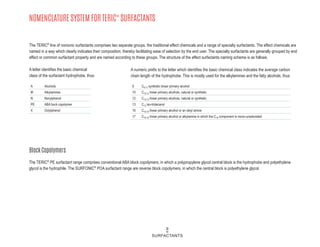
The TERIC®
line of nonionic surfactants comprises two separate groups, the traditional effect chemicals and a range of specialty surfactants. The effect chemicals are
named in a way which clearly indicates their composition, thereby facilitating ease of selection by the end user. The specialty surfactants are generally grouped by end
effect or common surfactant property and are named according to these groups. The structure of the effect surfactants naming scheme is as follows.
A letter identifies the basic chemical
class of the surfactant hydrophobe, thus:
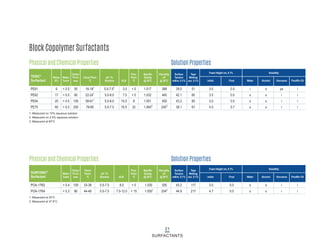
Block Copolymers
The TERIC®
PE surfactant range comprises conventional ABA block copolymers, in which a polypropylene glycol central block is the hydrophobe and polyethylene
glycol is the hydrophile. The SURFONIC®
POA surfactant range are reverse block copolymers, in which the central block is polyethylene glycol.
A Alcohols
M Alkylamines
N Nonylphenol
PE ABA bock copolymer
X Octylphenol
9 C9-11 synthetic linear primary alcohol
10 C10-12 linear primary alcohols, natural or synthetic
12 C12-14 linear primary alcohols, natural or synthetic
13 C13 iso-tridecanol
16 C16-18 linear primary alcohol or an oleyl amine
17 C16-18 linear primary alcohol or alkylamine in which the C18 component is mono-unsaturated
A numeric prefix to the letter which identifies the basic chemical class indicates the average carbon
chain length of the hydrophobe. This is mostly used for the alkylamines and the fatty alcohols, thus:
9
SURFACTANTS
NOMENCLATURE SYSTEM FOR TERIC®
SURFACTANTS
TERIC
®
Specialty Surfactants
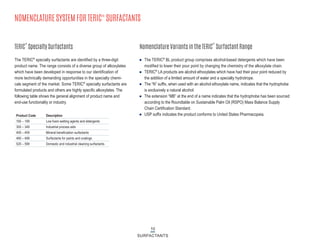
The TERIC®
specialty surfactants are identified by a three-digit
product name. The range consists of a diverse group of alkoxylates
which have been developed in response to our identification of
more technically demanding opportunities in the specialty chemi-
cals segment of the market. Some TERIC®
specialty surfactants are
formulated products and others are highly specific alkoxylates. The
following table shows the general alignment of product name and
end-use functionality or industry.
Nomenclature Variants in the TERIC
®
Surfactant Range
n The TERIC®
BL product group comprises alcohol-based detergents which have been
modified to lower their pour point by changing the chemistry of the alkoxylate chain.
n TERIC®
LA products are alcohol ethoxylates which have had their pour point reduced by
the addition of a limited amount of water and a specialty hydrotrope.
n The “N” suffix, when used with an alcohol ethoxylate name, indicates that the hydrophobe
is exclusively a natural alcohol.
n The extension “MB” at the end of a name indicates that the hydrophobe has been sourced
according to the Roundtable on Sustainable Palm Oil (RSPO) Mass Balance Supply
Chain Certification Standard.
n USP suffix indicates the product conforms to United States Pharmacopeia.
Product Code Description
160 – 199 Low foam wetting agents and detergents
300 – 349 Industrial process aids
400 – 459 Mineral beneficiation surfactants
460 – 499 Surfactants for paints and coatings
520 – 599 Domestic and industrial cleaning surfactants
10
SURFACTANTS
TYPICAL PROPERTIES AND SOLUTION PROPERTIES
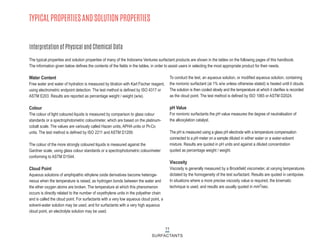
Interpretation of Physical and Chemical Data
Water Content
Free water and water of hydration is measured by titration with Karl Fischer reagent,
using electrometric endpoint detection. The test method is defined by ISO 4317 or
ASTM E203. Results are reported as percentage weight / weight (w/w).
Colour
The colour of light coloured liquids is measured by comparison to glass colour
standards or a spectrophotometric colourimeter, which are based on the platinum-
cobalt scale. The values are variously called Hazen units, APHA units or Pt-Co
units. The test method is defined by ISO 2211 and ASTM D1209.
The colour of the more strongly coloured liquids is measured against the
Gardner scale, using glass colour standards or a spectrophotometric colourimeter
conforming to ASTM D1544.
Cloud Point
Aqueous solutions of amphipathic ethylene oxide derivatives become heteroge-
neous when the temperature is raised, as hydrogen bonds between the water and
the ether oxygen atoms are broken. The temperature at which this phenomenon
occurs is directly related to the number of oxyethylene units in the polyether chain
and is called the cloud point. For surfactants with a very low aqueous cloud point, a
solvent-water solution may be used, and for surfactants with a very high aqueous
cloud point, an electrolyte solution may be used.
To conduct the test, an aqueous solution, or modified aqueous solution, containing
the nonionic surfactant (at 1% w/w unless otherwise stated) is heated until it clouds.
The solution is then cooled slowly and the temperature at which it clarifies is recorded
as the cloud point. The test method is defined by ISO 1065 or ASTM D2024.
pH Value
For nonionic surfactants the pH value measures the degree of neutralisation of
the alkoxylation catalyst.
The pH is measured using a glass pH electrode with a temperature compensation
connected to a pH meter on a sample diluted in either water or a water-solvent
mixture. Results are quoted in pH units and against a diluted concentration
quoted as percentage weight / weight.
Viscosity
Viscosity is generally measured by a Brookfield viscometer, at varying temperatures
dictated by the homogeneity of the test surfactant. Results are quoted in centipoise.
In situations where a more precise viscosity value is required, the kinematic
technique is used, and results are usually quoted in mm2
/sec.
The typical properties and solution properties of many of the Indorama Ventures surfactant products are shown in the tables on the following pages of this handbook.
The information given below defines the contents of the fields in the tables, in order to assist users in selecting the most appropriate product for their needs.
11
SURFACTANTS
TYPICAL PROPERTIES AND SOLUTION PROPERTIES
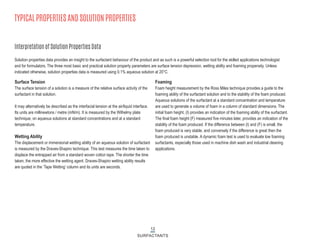
Interpretation of Solution Properties Data
Surface Tension
The surface tension of a solution is a measure of the relative surface activity of the
surfactant in that solution.
It may alternatively be described as the interfacial tension at the air/liquid interface.
Its units are millinewtons / metre (mN/m). It is measured by the Wilhelmy plate
technique, on aqueous solutions at standard concentrations and at a standard
temperature.
Wetting Ability
The displacement or immersional wetting ability of an aqueous solution of surfactant
is measured by the Draves-Shapiro technique. This test measures the time taken to
displace the entrapped air from a standard woven cotton tape. The shorter the time
taken, the more effective the wetting agent. Draves-Shapiro wetting ability results
are quoted in the ‘Tape Wetting’ column and its units are seconds.
Foaming
Foam height measurement by the Ross Miles technique provides a guide to the
foaming ability of the surfactant solution and to the stability of the foam produced.
Aqueous solutions of the surfactant at a standard concentration and temperature
are used to generate a volume of foam in a column of standard dimensions. The
initial foam height, (I) provides an indication of the foaming ability of the surfactant.
The final foam height (F) measured five minutes later, provides an indication of the
stability of the foam produced. If the difference between (I) and (F) is small, the
foam produced is very stable, and conversely if the difference is great then the
foam produced is unstable. A dynamic foam test is used to evaluate low foaming
surfactants, especially those used in machine dish wash and industrial cleaning
applications.
Solution properties data provides an insight to the surfactant behaviour of the product and as such is a powerful selection tool for the skilled applications technologist
and for formulators. The three most basic and practical solution property parameters are surface tension depression, wetting ability and foaming propensity. Unless
indicated otherwise, solution properties data is measured using 0.1% aqueous solution at 20°C.
12
SURFACTANTS
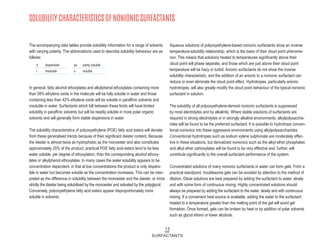
SOLUBILITY CHARACTERISTICS OF NONIONIC SURFACTANTS
The accompanying data tables provide solubility information for a range of solvents
with varying polarity. The abbreviations used to describe solubility behaviour are as
follows:
In general, fatty alcohol ethoxylates and alkylphenol ethoxylates containing more
than 58% ethylene oxide in the molecule will be fully soluble in water and those
containing less than 42% ethylene oxide will be soluble in paraffinic solvents and
insoluble in water. Surfactants which fall between these limits will have limited
solubility in paraffinic solvents but will be readily soluble in more polar organic
solvents and will generally form stable dispersions in water.
The solubility characteristics of polyoxyethylene (POE) fatty acid esters will deviate
from these generalised trends because of their significant diester content. Because
the diester is almost twice as hydrophobic as the monoester and also constitutes
approximately 25% of the product, practical POE fatty acid esters tend to be less
water soluble, per degree of ethoxylation, than the corresponding alcohol ethoxy-
lates or alkylphenol ethoxylates. In many cases the water solubility appears to be
concentration dependent, in that at low concentrations the product is only dispers-
ible in water but becomes soluble as the concentration increases. This can be inter-
preted as the difference in solubility between the monoester and the diester, or more
strictly the diester being solubilised by the monoester and solvated by the polyglycol.
Conversely, polyoxyethylene fatty acid esters appear disproportionately more
soluble in solvents.
Aqueous solutions of polyoxyethylene-based nonionic surfactants show an inverse
temperature-solubility relationship, which is the basis of their cloud point phenome-
non. This means that solutions heated to temperatures significantly above their
cloud point will phase separate, and those which are just above their cloud point
temperature will be hazy or turbid. Anionic surfactants do not show the inverse
solubility characteristic, and the addition of an anionic to a nonionic surfactant can
reduce or even eliminate the cloud point effect. Hydrotropes, particularly anionic
hydrotropes, will also greatly modify the cloud point behaviour of the typical nonionic
surfactant in solution.
The solubility of all polyoxyethylene-derived nonionic surfactants is suppressed
by most electrolytes and by alkalinity. Where stable solutions of surfactants are
required in strong electrolytes or in strongly alkaline environments, alkylpolysaccha-
rides will be found to be the preferred surfactant. It is possible to hydrotrope conven-
tional nonionics into these aggressive environments using alkylpolysaccharides.
Conventional hydrotropes such as sodium xylene sulphonate are moderately effec-
tive in these situations, but derivatized nonionics such as the alkyl ether phosphates
and alkyl ether carboxylates will be found to be very effective and, further, will
contribute significantly to the overall surfactant performance of the system.
Concentrated solutions of many nonionic surfactants in water can form gels. From a
practical standpoint, troublesome gels can be avoided by attention to the method of
dilution. Dilute solutions are best prepared by adding the surfactant to water, slowly
and with some form of continuous mixing. Highly concentrated solutions should
always be prepared by adding the surfactant to the water, slowly and with continuous
mixing. If a convenient heat source is available, adding the water to the surfactant
heated to a temperature greater than the melting point of the gel will avoid gel
formation. Once formed, gels can be broken by heat or by addition of polar solvents
such as glycol ethers or lower alcohols.
d dispersible
i insoluble
ps partly soluble
s soluble
13
SURFACTANTS
14
SURFACTANTS
INDORAMA VENTURES PRODUCT DATA SHEETS
Indorama Ventures product data sheets list both sales specification parameters as
well as typical properties of individual products.
Specifications
By definition, a specification is any parameter which is measured quantitatively
during the manufacturing process and is directly controllable by that process.
Current specifications are not shown in this brochure, but some of the common
specification parameters are listed. A current specification may be obtained by
contacting the Indorama Ventures sales offices, listed on the back page of this
handbook.
Product specifications are controlled documents meeting the audited requirements
of ISO 9001.
Note: The chemical, physical and solution property values presented in this
handbook do not constitute specifications. Refer to the individual Product Data
Sheets for the current product specifications.
Typical Properties
Common physical properties which are reasonably constant and usually character-
istic of each individual product. They are not used to control manufacture and are
not measured on a batch to batch basis. They do not constitute specification.
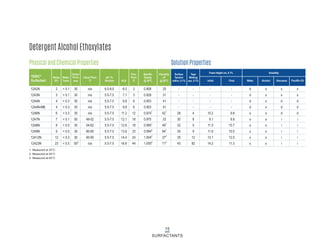
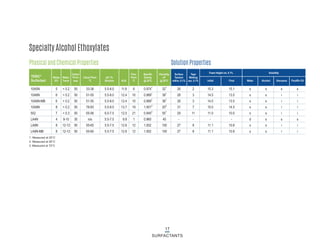
Detergent Alcohol Ethoxylates
Physical and Chemical Properties
12A2N 2 < 0.1 30 n/a 6.0-8.0 6.0 2 0.908 25 - - - - d s s s
12A3N 3 < 0.1 30 n/a 5.5-7.5 7.1 3 0.928 31 - - - - d s s s
12A4N 4 < 0.3 30 n/a 5.5-7.5 9.8 6 0.953 41 - - - - d s d d
12A4N-MB 4 < 0.3 30 n/a 5.5-7.5 9.8 6 0.953 41 - - - - d s d d
12A6N 6 < 0.3 30 n/a 5.5-7.5 11.2 12 0.9741
421
28 4 10.2 9.8 s s d d
12A7N 7 < 0.1 50 49-52 5.5-7.5 12.1 18 0.975 33 30 8 9.1 8.8 s s i i
12A8N 8 < 0.5 30 54-62 5.5-7.5 12.6 18 0.9851
491
32 5 11.5 10.7 s s i i
12A9N 9 < 0.5 30 80-85 5.5-7.5 13.6 23 0.9942
641
35 9 11.6 10.5 s s i i
12A12N 12 < 0.3 30 90-95 5.5-7.5 14.4 24 1.0042
272
35 12 13.1 12.0 s s i i
12A23N 23 < 0.5 503
n/a 5.5-7.5 16.6 44 1.0552
712
43 82 14.2 11.3 s s i i
TERIC®
Surfactant
Moles
EO
Water
%w/w
Colour
Pt-Co
max
Cloud Point
°C
pH 1%
Solution HLB
Pour
Point
°C
Specific
Gravity
@ 20°C
Viscosity
cP
@ 20°C
15
SURFACTANTS
1. Measured at 25°C
2. Measured at 50°C
3. Measured at 60°C
Solution Properties
Surface
Tension
mN/m, 0.1%
Tape
Wetting
sec, 0.1% Initial Final Water Alcohol Kerosene
Solubility
Foam Height cm, 0.1%
Paraffin Oil
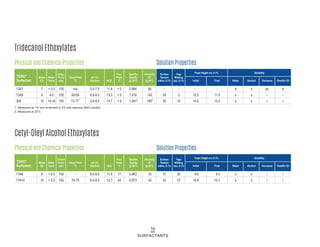
Tridecanol Ethoxylates
Physical and Chemical Properties
13A7 7 < 0.3 100 n/a 5.5-7.5 11.8 < 0 0.984 80 - - - - d s ps d
13A9 9 4-5 100 60-65 6.0-8.0 13.3 < 0 1.018 142 28 2 12.5 11.0 s s i i
309 12 14-16 100 73-771
5.0-8.0 14.7 < 0 1.0412
1802
30 10 14.5 12.5 s s i i
TERIC®
Surfactant
Moles
EO
Water
%w/w
Colour
Pt-Co
max
Cloud Point
°C
pH 1%
Solution HLB
Pour
Point
°C
Specific
Gravity
@ 20°C
Viscosity
cP
@ 20°C
16
SURFACTANTS
1. Measured as 1% w/w surfactant in 5% w/w aqueous NaCl solution
2. Measured at 25°C
Solution Properties
Surface
Tension
mN/m, 0.1%
Tape
Wetting
sec, 0.1% Initial Final Water Alcohol Kerosene
Solubility
Foam Height cm, 0.1%
Paraffin Oil
Cetyl-Oleyl Alcohol Ethoxylates
Physical and Chemical Properties
17A8 8 < 0.5 150 - 6.0-8.0 11.6 17 0.963 35 31 25 9.6 8.5 s s i i
17A10 10 < 0.5 150 70-75 6.0-8.0 12.7 24 0.973 43 33 27 10.8 10.1 s s i i
TERIC®
Surfactant
Moles
EO
Water
%w/w
Colour
Pt-Co
max
Cloud Point
°C
pH 1%
Solution HLB
Pour
Point
°C
Specific
Gravity
@ 50°C
Viscosity
cP
@ 50°C
Solution Properties
Surface
Tension
mN/m, 0.1%
Tape
Wetting
sec, 0.1% Initial Final Water Alcohol Kerosene
Solubility
Foam Height cm, 0.1%
Paraffin Oil
Specialty Alcohol Ethoxylates
Physical and Chemical Properties
10A5N 5 < 0.2 50 33-38 5.5-8.0 11.6 6 0.9741
321
26 2 15.3 15.1 s s s s
10A6N 6 < 0.2 50 51-55 5.5-8.0 12.4 10 0.9891
381
28 3 14.5 13.5 s s i i
10A6N-MB 6 < 0.2 50 51-55 5.5-8.0 12.4 10 0.9891
381
28 3 14.5 13.5 s s i i
10A8N 8 < 0.2 50 78-83 5.5-8.0 13.7 19 1.0012
202
31 7 15.0 14.5 s s i i
552 7 < 0.3 50 55-56 6.0-7.5 12.0 21 0.9453
551
29 11 11.0 10.0 s s i i
LA4N 4 9-10 30 n/a 5.5-7.5 9.8 1 0.960 45 - - - - d s s s
LA8N 8 12-13 50 55-65 5.5-7.5 12.6 12 1.002 100 27 8 11.1 10.8 s s i i
LA8N-MB 8 12-13 50 55-65 5.5-7.5 12.6 12 1.002 100 27 8 11.1 10.8 s s i i
TERIC®
Surfactant
Moles
EO
Water
%w/w
Colour
Pt-Co
max
Cloud Point
°C
pH 1%
Solution HLB
Pour
Point
°C
Specific
Gravity
@ 20°C
Viscosity
cP
@ 20°C
17
SURFACTANTS
1. Measured at 25°C
2. Measured at 50°C
3. Measured at 70°C
Solution Properties
Surface
Tension
mN/m, 0.1%
Tape
Wetting
sec, 0.1% Initial Final Water Alcohol Kerosene
Solubility
Foam Height cm, 0.1%
Paraffin Oil
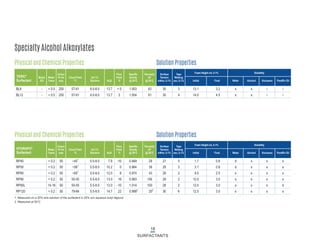
Specialty Alcohol Alkoxylates
Physical and Chemical Properties
BL8 - < 0.5 250 57-61 6.0-8.0 13.7 < 0 1.003 63 30 3 13.1 3.2 s s i i
BL12 - < 0.5 250 57-61 6.0-8.0 13.7 3 1.004 61 30 4 14.0 4.5 s s i i
TERIC®
Surfactant
Moles
EO
Water
%w/w
Colour
Pt-Co
max
Cloud Point
°C
pH 1%
Solution HLB
Pour
Point
°C
Specific
Gravity
@ 20°C
Viscosity
cP
@ 20°C
Solution Properties
Surface
Tension
mN/m, 0.1%
Tape
Wetting
sec, 0.1% Initial Final Water Alcohol Kerosene
Solubility
Foam Height cm, 0.1%
Paraffin Oil
Physical and Chemical Properties
RP40 < 0.2 50 ~451
5.5-8.0 7.8 -10 0.949 29 27 5 1.7 0.8 d s s s
RP50 < 0.2 50 ~561
5.5-8.0 10.2 0 0.964 38 28 3 3.1 0.8 d s s s
RP80 < 0.2 50 ~651
5.5-8.0 12.0 8 0.974 43 28 2 9.5 2.5 s s s s
RP90 < 0.2 50 50-55 5.5-8.0 13.0 16 0.993 156 28 2 12.0 3.0 s s s s
RP90L 14-16 50 50-55 5.5-8.0 13.0 -10 1.014 100 28 2 12.0 3.0 s s s d
RP120 < 0.2 50 79-84 5.5-8.0 14.7 22 0.9862
202
30 6 12.5 3.0 s s s s
HYDRAPO®
Surfactant
Water
%w/w
Colour
Pt-Co
max
Cloud Point
°C
pH 1%
Solution HLB
Pour
Point
°C
Specific
Gravity
@ 20°C
Viscosity
cP
@ 20°C
1. Measured on a 20% w/w solution of the surfactant in 25% w/v aqueous butyl diglycol
2. Measured at 50°C
Solution Properties
Surface
Tension
mN/m, 0.1%
Tape
Wetting
sec, 0.1% Initial Final Water Alcohol Kerosene
Solubility
Foam Height cm, 0.1%
Paraffin Oil
18
SURFACTANTS
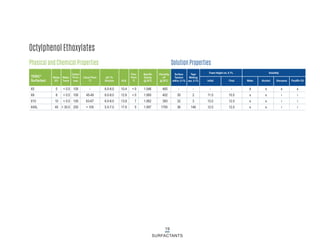
Octylphenol Ethoxylates
Physical and Chemical Properties
X5 5 < 0.5 100 - 6.0-8.0 10.4 < 0 1.046 465 - - - - d s s s
X8 8 < 0.5 100 45-49 6.0-8.0 12.6 < 0 1.060 402 30 2 11.0 10.5 s s i i
X10 10 < 0.5 100 63-67 6.0-8.0 13.6 7 1.062 393 32 3 13.0 12.0 s s i i
X40L 40 < 30.0 250 > 100 5.5-7.0 17.6 5 1.097 1750 36 146 12.0 12.0 s s i i
TERIC®
Surfactant
Moles
EO
Water
%w/w
Colour
Pt-Co
max
Cloud Point
°C
pH 1%
Solution HLB
Pour
Point
°C
Specific
Gravity
@ 20°C
Viscosity
cP
@ 20°C
Solution Properties
Surface
Tension
mN/m, 0.1%
Tape
Wetting
sec, 0.1% Initial Final Water Alcohol Kerosene
Solubility
Foam Height cm, 0.1%
Paraffin Oil
19
SURFACTANTS
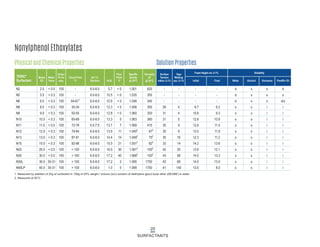
Nonylphenol Ethoxylates
Physical and Chemical Properties
N2 2.0 < 0.5 100 - 6.0-8.0 5.7 < 0 1.001 620 - - - - d s s d
N5 5.5 < 0.3 100 - 6.0-8.0 10.5 < 0 1.035 355 - - - - d s s s
N6 6.5 < 0.3 150 64-671
6.0-8.0 10.9 < 0 1.046 340 - - - - d s s d/s
N8 8.5 < 0.3 100 30-34 6.0-8.0 12.3 < 0 1.056 350 29 4 6.7 6.2 s s i i
N9 9.0 < 0.3 100 50-55 6.0-8.0 12.8 < 0 1.060 330 31 4 10.6 9.3 s s i i
N10 10.0 < 0.3 100 65-69 6.0-8.0 13.3 5 1.063 360 31 5 12.6 10.8 s s i i
N11 11.0 < 0.5 100 72-76 5.5-7.5 13.7 7 1.069 410 35 9 12.6 11.5 s s i i
N12 12.0 < 0.3 100 79-84 6.0-8.0 13.9 11 1.0452
672
35 9 13.0 11.9 s s i i
N13 13.0 < 0.3 100 87-91 6.0-8.0 14.4 14 1.0492
752
35 16 12.3 11.2 s s i i
N15 15.0 < 0.3 100 92-96 6.0-8.0 15.0 21 1.0512
822
33 14 14.2 13.6 s s i i
N20 20.0 < 0.5 100 > 100 6.0-8.0 16.0 30 1.0612
1002
42 25 13.9 12.1 s s i i
N30 30.0 < 0.5 150 > 100 6.0-8.0 17.2 40 1.0662
1502
43 69 14.0 13.3 s s i i
N30L 30.0 30-31 100 > 100 6.0-8.0 17.2 2 1.095 1750 43 69 14.0 13.0 s s i i
N40LP 40.0 30-31 100 > 100 6.0-8.0 1.0 5 1.099 1750 41 140 13.0 8.0 s s i i
TERIC®
Surfactant
Moles
EO
Water
%w/w
Colour
Pt-Co
max
Cloud Point
°C
pH 1%
Solution HLB
Pour
Point
°C
Specific
Gravity
@ 20°C
Viscosity
cP
@ 20°C
Solution Properties
Surface
Tension
mN/m, 0.1%
Tape
Wetting
sec, 0.1% Initial Final Water Alcohol Kerosene
Solubility
Foam Height cm, 0.1%
Paraffin Oil
1. Measured by addition of 20g of surfactant in 100g of 25% weight / volume (w/v) solution of diethylene glycol butyl ether (DEGBE) in water
2. Measured at 50°C
20
SURFACTANTS
Block Copolymer Surfactants
Physical and Chemical Properties
PE61 6 < 0.5 50 16-181
5.0-7.52
3.0 < 0 1.017 388 39.0 51 3.0 0.0 i s ps i
PE62 17 < 0.5 80 22-241
5.0-8.0 7.0 < 0 1.032 440 42.1 60 3.5 0.0 s s i i
PE64 25 < 0.5 100 58-611
5.0-8.0 15.0 8 1.051 450 43.2 85 3.0 0.0 s s i i
PE75 60 < 0.5 250 79-85 5.0-7.5 16.5 32 1.0603
2403
38.1 67 4.5 0.7 s s i i
TERIC®
Surfactant
Moles
EO
Water
%w/w
Colour
Pt-Co
max
Cloud Point
°C
pH 1%
Solution HLB
Pour
Point
°C
Specific
Gravity
@ 20°C
Viscosity
cP
@ 20°C
Solution Properties
Surface
Tension
mN/m, 0.1%
Tape
Wetting
sec, 0.1% Initial Final Water Alcohol Kerosene
Solubility
Foam Height cm, 0.1%
Paraffin Oil
1. Measured on 10% aqueous solution
2. Measured on 2.5% aqueous solution
3. Measured at 60°C
Physical and Chemical Properties
POA-17R2 < 0.4 100 33-38 5.5-7.5 8.0 < 0 1.030 205 43.2 117 3.0 0.0 s s i i
POA-17R4 < 0.3 80 44-48 5.5-7.5 7.0-12.0 < 15 1.0501
2542
44.9 217 4.7 0.0 s s i i
SURFONIC®
Surfactant
Water
%w/w
Colour
Pt-Co
max
Cloud
Point
°C
pH 1%
Solution HLB
Pour
Point
°C
Specific
Gravity
@ 20°C
Viscosity
cP
@ 20°C
Solution Properties
Surface
Tension
mN/m, 0.1%
Tape
Wetting
sec, 0.1% Initial Final Water Alcohol Kerosene
Solubility
Foam Height cm, 0.1%
Paraffin Oil
1. Measured at 25°C
2. Measured at 37.8°C
21
SURFACTANTS
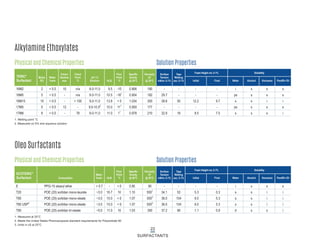
Oleo Surfactants
Physical and Chemical Properties
E PPG-15 stearyl ether < 0.7 - < 0 0.95 90 - - - - i s s s
T20 POE (20) sorbitan mono-laurate ~3.0 16.7 10 1.10 5501
34.1 53 5.3 0.3 s s i i
T80 POE (20) sorbitan mono-oleate ~3.0 15.0 < 0 1.07 5503
36.0 104 6.0 5.3 s s i i
T80 USP2
POE (20) sorbitan mono-oleate ~3.0 15.0 < 0 1.07 5503
36.0 104 6.0 5.3 s s i i
T85 POE (20) sorbitan tri-oleate ~5.0 11.0 10 1.03 350 37.2 90 1.1 0.9 d s s i
ECOTERIC®
Surfactant Composition
Water
%w/w HLB
Pour
Point
°C
Specific
Gravity
@ 50°C
Viscosity
cP
@ 25°C
Solution Properties
Surface
Tension
mN/m, 0.1%
Tape
Wetting
sec, 0.1% Initial Final Water Alcohol Kerosene
Solubility
Foam Height cm, 0.1%
Paraffin Oil
1. Measured at 20°C
2. Meets the United States Pharmacopoeia standard requirements for Polysorbate 80
3. Units in cS at 25°C
Alkylamine Ethoxylates
Physical and Chemical Properties
16M2 2 < 0.5 10 n/a 8.0-11.0 9.5 -15 0.906 190 - - - - i s s s
16M5 5 < 0.5 - n/a 9.0-11.0 10.5 -161
0.954 182 29.7 - - - ps s s s
16M15 15 < 0.5 - > 100 9.0-11.0 13.8 < 5 1.034 300 38.8 50 12.2 9.7 s s i i
17M5 5 < 0.5 12 - 9.0-10.52
10.0 111
0.950 177 - - - - ps s s s
17M8 8 < 0.5 - 78 9.0-11.0 11.0 11
0.978 210 32.9 18 8.5 7.5 s s s i
TERIC®
Surfactant
Moles
EO
Water
%w/w
Colour
Gardner
max
Cloud
Point
°C
pH 1%
Solution HLB
Pour
Point
°C
Specific
Gravity
@ 20°C
Viscosity
cP
@ 20°C
Solution Properties
Surface
Tension
mN/m, 0.1%
Tape
Wetting
sec, 0.1% Initial Final Water Alcohol Kerosene
Solubility
Foam Height cm, 0.1%
Paraffin Oil
1. Melting point °C
2. Measured on 5% w/w aqueous solution
22
SURFACTANTS
23
SURFACTANTS
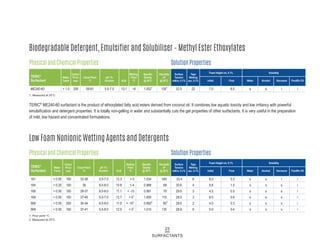
Biodegradable Detergent, Emulsifier and Solubiliser – Methyl Ester Ethoxylates
Physical and Chemical Properties
ME240-60 < 1.0 200 56-61 5.0-7.0 13.1 ~9 1.0521
1001
32.5 22 7.5 6.5 s s i i
TERIC®
Surfactant
Water
%w/w
Colour
Pt-Co
max
Cloud Point
°C
pH 1%
Solution HLB
Melting
Point
°C
Specific
Gravity
@ 20°C
Viscosity
cP
@ 20°C
Solution Properties
Surface
Tension
mN/m, 0.1%
Tape
Wetting
sec, 0.1% Initial Final Water Alcohol Kerosene
Solubility
Foam Height cm, 0.1%
Paraffin Oil
1. Measured at 25°C
Low Foam Nonionic Wetting Agents and Detergents
Physical and Chemical Properties
161 < 0.50 100 33-36 5.5-7.5 12.3 < 0 1.034 340 33.4 6 8.0 0.3 s s i i
164 < 0.25 100 39 6.0-8.0 10.8 1-4 0.988 68 30.6 4 9.8 1.5 s s s i
168 < 0.50 100 28-37 6.0-8.0 11.1 < -10 0.991 70 29.0 3 4.5 0.5 s s s i
169 < 0.50 100 37-45 5.0-7.0 12.7 < 01
1.000 115 28.0 3 8.5 0.6 s s s i
568 < 0.50 200 30-34 6.0-8.0 11.0 < -101
0.9922
652
29.0 2 4.0 0.3 s s s i
569 < 0.50 100 37-41 5.5-8.0 12.0 < 01
1.010 135 28.9 6 5.0 0.4 s s s i
TERIC®
Surfactant
Water
%w/w
Colour
Pt-Co
max
Cloud Point
°C
pH 1%
Solution HLB
Melting
Point
°C
Specific
Gravity
@ 20°C
Viscosity
cP
@ 20°C
Solution Properties
Surface
Tension
mN/m, 0.1%
Tape
Wetting
sec, 0.1% Initial Final Water Alcohol Kerosene
Solubility
Foam Height cm, 0.1%
Paraffin Oil
1. Pour point °C
2. Measured at 25°C
TERIC®
ME240-60 surfactant is the product of ethoxylated fatty acid esters derived from coconut oil. It combines low aquatic toxicity and low irritancy with powerful
emulsification and detergent properties. It is totally non-gelling in water and substantially cuts the gel properties of other surfactants. It is very useful in the preparation
of mild, low hazard and concentrated formulations.
24
SURFACTANTS
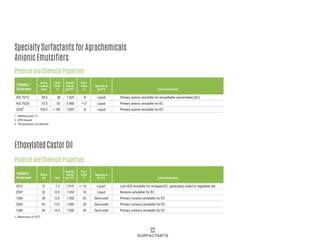
Specialty Surfactants for Agrochemicals
Anionic Emulsifiers
Physical and Chemical Properties
AIS 70/13 69.5 38 1.020 -6 Liquid Primary anionic emulsifier for emulsifiable concentrates (EC)
AIS 70/2E 57.0 63 0.990 < 01
Liquid Primary anionic emulsifier for EC
32302
100.0 > 100 1.0503
-8 Liquid Primary anionic emulsifier for EC
TERMUL®
Surfactant
Active
Content
%w/w
Flash
Point
°C
Specific
Gravity
@ 25°C
Pour
Point
°C
Appearance
@ 25°C Typical Application
1. Melting point °C
2. APE-based
3. Temperature not defined
EthoxylatedCastorOil
Physical and Chemical Properties
3512 12 7.3 1.0101
< -10 Liquid1
Low HLB emulsifier for oil-based EC, particularly suited to vegetable oils
2507 32 12.0 1.050 16 Liquid Nonionic emulsifier for EC
1284 36 12.6 1.050 20 Semi-solid Primary nonionic emulsifier for EC
3540 40 13.0 1.060 28 Semi-solid Primary nonionic emulsifier for EC
1285 54 14.4 1.050 36 Semi-solid Primary nonionic emulsifier for EC
TERMUL®
Surfactant
Moles
EO HLB
Specific
Gravity
@ 25°C
Pour
Point
°C
Appearance
@ 25°C Typical Application
1. Measured at 20°C
25
SURFACTANTS
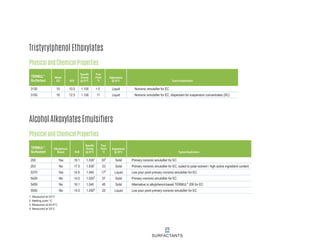
Tristyrylphenol Ethoxylates
AlcoholAlkoxylatesEmulsifiers
Physical and Chemical Properties
200 Yes 16.1 1.0301
302
Solid Primary nonionic emulsifier for EC
203 No 17.5 1.0301
33 Solid Primary nonionic emulsifier for EC, suited to polar solvent / high active ingredient content
5370 Yes 14.5 1.040 172
Liquid Low pour point primary nonionic emulsifier for EC
5429 No 14.5 1.0203
37 Solid Primary nonionic emulsifier for EC
5459 No 16.1 1.040 45 Solid Alternative to alkylphenol-based TERMUL®
200 for EC
5500 No 14.5 1.0504
20 Liquid Low pour point primary nonionic emulsifier for EC
TERMUL®
Surfactant
Alkylphenol-
Based HLB
Specific
Gravity
@ 25°C
Pour
Point
°C
Appearance
@ 25°C Typical Application
1. Measured at 50°C
2. Melting point °C
3. Measured at 65.6°C
4. Measured at 20°C
Physical and Chemical Properties
3130 10 10.5 1.100 < 0 Liquid Nonionic emulsifier for EC
3150 16 12.5 1.100 11 Liquid Nonionic emulsifier for EC, dispersant for suspension concentrates (SC)
TERMUL®
Surfactant
Moles
EO HLB
Specific
Gravity
@ 25°C
Pour
Point
°C
Appearance
@ 25°C Typical Application
26
SURFACTANTS
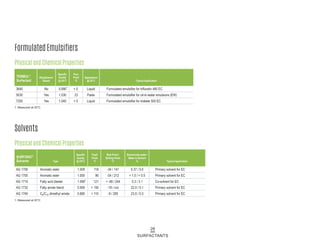
FormulatedEmulsifiers
Physical and Chemical Properties
3640 No 0.9901
< 0 Liquid Formulated emulsifier for trifluralin 480 EC
5030 Yes 1.030 23 Paste Formulated emulsifier for oil-in-water emulsions (EW)
7250 Yes 1.040 < 0 Liquid Formulated emulsifier for triallate 500 EC
TERMUL®
Surfactant
Alkylphenol-
Based
Specific
Gravity
@ 25°C
Pour
Point
°C
Appearance
@ 25°C Typical Application
1. Measured at 20°C
Solvents
Physical and Chemical Properties
AG 1700 Aromatic ester 1.000 118 -34 / 141 0.37 / 0.0 Primary solvent for EC
AG 1705 Aromatic ester 1.050 90 -54 / 212 < 1.0 / < 0.5 Primary solvent for EC
AG 1710 Fatty acid diester 1.0901
121 < -48 / 244 5.3 / 3.1 Co-solvent for EC
AG 1732 Fatty amide blend 0.900 > 150 -18 / n/a 22.0 / 0.1 Primary solvent for EC
AG 1740 C8/C10 dimethyl amide 0.880 > 110 -9 / 285 23.0 / 0.3 Primary solvent for EC
SURFONIC®
Solvents Type
Specific
Gravity
@ 25°C
Flash
Point
°C
Melt Point /
Boiling Point
°C
Solvent-into-water /
Water in Solvent
% Typical Application
1. Measured at 20°C
27
SURFACTANTS
Dispersants
Physical and Chemical Properties
2020 Alkyl-NSF Condensate, Na Salt n/a 0.4001
n/a Tan powder Dispersant for suspension concentrate (SC), water dispersible
granule (WG) and wettable powder (WP) formulations
2202 Ethoxylated TSP Phosphate, TEA Salt 100 1.1302
10 Liquid3
Ionic dispersant for SC
2218 Ethoxylated TSP Sulphate, NH4 Salt 100 1.170 16 Liquid Ionic dispersant for SC, anionic emulsifier for EC
2280 Formulated surfactant n/a 1.0502
< 0 Liquid Formulated surfactant for suspoemulsions (SE)
2288 Formulated nonionic-ionic dispersant / wetter n/a 1.070 4 Liquid Formulated dispersant / wetter for SC
2500 Acrylic graft co-polymer 32 1.070 < 0 Liquid Industry benchmark polymeric dispersant for high loading SC
2510 Fatty acid, PEG ester 100 0.940 454
Solid Dispersant for oil dispersions (OD), emulsifier for EW
2612 Styrene-maleic graft co-polymer 50 1.030 -10 Liquid Polymeric dispersant for troublesome SC, particularly those
challenged by Ostwald ripening
2700 Anionic co-polymer n/a 0.2501
n/a White powder Polymeric dispersant for WG, dispersant for SC
4894 Formulated nonionic dispersant / wetter n/a 1.0003
7 Liquid Formulated dispersant / wetter package for SC
TERSPERSE®
Dispersant Type
Specific
Gravity
@ 25°C
Active
Content
% w/w
Pour
Point
°C
Appearance
@ 25°C Typical Application
1. Bulk density g/ml
2. Measured at 40°C
3. Measured at 20°C
4. Melting point °C
28
SURFACTANTS
General Wetting Agents and Tank-Added Adjuvants
Physical and Chemical Properties
245 Alcohol alkoxylate 1.000 < 0 liquid High performance tank-added adjuvant
260 Alcohol alkoxylate 0.990 16 liquid High performance tank-added adjuvant
1004 Anionic surfactant 0.4001
n/a powder Wetting agent for WG, WP and SC
1300 Polyalkylene glycol 1.090 < 0 liquid Soil wetting agent
3001 C8/C10 alkyl polysaccharides 1.1502
< 0 liquid Adjuvant
TERWET®
Surfactant Type
Specific
Gravity
@ 25°C
Pour
Point
°C
Appearance
@ 25°C Typical Application
1. Bulk density g/ml
2. Measured at 25°C
29
SURFACTANTS
Herbicide Wetting Agents and Adjuvants
Physical and Chemical Properties
107 Anionic / nonionic blend 1.070 11 Liquid Wetter / adjuvant for bipyridyl-based herbicide soluble liquid (SL) formulations
436 Formulated nonionic 1.140 < 0 Liquid Low aquatic toxicity adjuvant for herbicide SL
1170 Ethylene diamine alkoxylate 1.090 < 0 Liquid Low aquatic toxicity wetting agent for glyphosate SL
1215 Formulated nonionic surfactant blend 1.140 < 0 Liquid Low aquatic toxicity adjuvant / wetter for glyphosate IPA 360 SL
1221 Ethylene diamine alkoxylate 1.070 50 Solid Low aquatic toxicity adjuvant for dry glyphosate (SG) formulations
1253 Formulated ethoxylated tallow amine phosphate / APS 1.080 < -10 Liquid Adjuvant for high-load glyphosate
1255 Ethoxylated tallow amine 0.978 11
Liquid Adjuvant for glyphosate MEA
1256 Formulated ethoxylated alkyl amine 0.982 < 0 Liquid Adjuvant for high-load glyphosate K SL
3777 Formulated ethoxylated tallow amine 1.000 5 Liquid Adjuvant for high-load glyphosate K SL
3780 Formulated ethoxylated tallow amine 1.0502
< 0 Liquid Industry standard adjuvant for glyphosate IPA SL
3784 Ethoxylated tallow amine 1.0103
0 Liquid Herbicide adjuvant
TERWET®
Surfactant Type
Specific
Gravity
@ 20°C
Pour
Point
°C
Appearance
@ 25°C Typical Application
1. Melting point °C
2. Measured at 25°C
3. Measured at 50°C
30
SURFACTANTS
Tank-mix Additives
Physical and Chemical Properties
4110 Non-ammoniated water conditioner 1.2601
-30 Liquid Water conditioner
5920 Alcohol alkoxylate 0.930 -10 Liquid Spray drift reduction agent
6010 Alkylamine alkoxylate 0.990 < -10 Liquid Compatibility agent, adjuvant
AIS 4000 Non-ammoniated water conditioner 1.290 < -50 Liquid Water conditioner
TERMIX®
Surfactant Type
Specific
Gravity
@ 20°C
Pour
Point
°C
Appearance
@ 25°C Typical Application
1. Measured at 25°C
Specialty Surfactants for Cleaning – Blended Concentrates
Physical and Chemical Properties
LDC90 An anionic / nonionic detergent concentrate 90 1.024 1300 18 Manufacture of high performance liquid laundry detergents, manual dishwashing liquids,
hard surface and general purpose cleaners
CC40 An anionic / nonionic detergent concentrate 42 1.200 360 23 Multipurpose detergent concentrate with outstanding grease cutting properties
VBS-D10 Vegetable oil derived solvent and nonionic 100 0.973 33 20 Powerful non-alkaline degreasing agent, stain remover and industrial strength
surfactant, with added anionic component multi-purpose cleaning
ALKANATE®
Surfactant Type
Concentration
% w/w
Density
g/cm3
@ 25°C
Viscosity
cP @
25°C
Anionic
Content
% w/w Typical Application
31
SURFACTANTS
Specialty Surfactants for Paints and Coatings
Physical and Chemical Properties
ALKANATE®
PG30 77.0 - < 0 1.040 < 10001
ALKANATE®
PL50 50.0 - < 0 1.1001
13001
ALKANATE®
WC60 22.5 - - - 100
TERIC®
161 < 0.5 12.3 < 0 1.034 340 Pigment wetter, dispersant synergist
TERIC®
164 < 0.25 10.8 2 0.988 68
TERIC®
168 < 0.5 11.1 < -10 0.991 70
TERIC®
305 < 4.0 ~14.0 15 1.1452
18002
Emulsion polymerisation
TERIC®
320 20.0 14.9 20 1.0213
2001
Rubber latex coagulant
TERIC®
324 - - < -5 1.0281
621
Rubber latex coagulant
TERIC®
340 12.0 13.0 20 1.0101
1031
Dispersant and wetter for rubber latex coagulant bath
TERIC®
460 35.0 17.1 - 1.0722
310 Stabiliser for use in the manufacture of acrylic latex
TERIC®
461 20.0 14.9 < 5 1.050 200
TERIC®
462 30.0 17.5 < 10 1.080 650
TERIC®
463 30.0 18.1 10 1.0901
5901
TERIC®
528 21.0 14.4 8 1.028 220 Wetter and stabiliser for coatings
TERIC®
BL8 < 0.5 13.7 < 0 1.003 63
TERIC®
LA8N 12.5 12.6 12 1.002 100
TERIC®
N30L 30.0 17.2 2 1.095 1750
TERIC®
N40LP 30.0 18.0 5 1.099 1750
TERIC®
X40L 30.0 17.6 5 1.097 1750
Trademark
Product
Code HLB
Water
% w/w
Pour
Point
°C
Specific
Gravity
@ 20°C
Viscosity
cP @
20°C Typical Application
1. Measured at 25°C
2. Measured at 50°C
3. Measured at 30°C
Emulsion polymerisation
Low foaming wetting agents
Emulsion polymerisation APE alternative
Wetter and dispersant for water-based paints
Emulsion polymerisation
Wetting agents
Specialty Products for Mining and Mineral Processing
Physical and Chemical Properties
POLYFROTH®
H15 1.194 146
POLYFROTH®
H19 1.123 > 100
POLYFROTH®
W160 0.995 70.5
POLYFROTH®
H185 1.162 170
POLYFROTH®
W22 0.923 79
POLYFROTH®
W22C 0.960 79
POLYFROTH®
W24 1.026 179
POLYFROTH®
H27 0.960 > 112
POLYFROTH®
H206 1.085 63
POLYFROTH®
W290 0.992 > 100
POLYFROTH®
H30 1.080 108
POLYFROTH®
W31 0.980 105
POLYFROTH®
W34 1.020 211
POLYFROTH®
H368 1.080 > 100
POLYFROTH®
W53 0.980 155
POLYFROTH®
W55 1.015 160
POLYFROTH®
H57 0.936 101
Trademark
Product
Code
Specific
Gravity
@ 20°C
Flash
Point
20°C Typical Application
32
SURFACTANTS
POLYFROTH®
10 Series frothers are weak frothers and are used for fine particle flotation or where a high degree of selectivity is required
POLYFROTH®
20 Series frothers are low-medium strength frothers with good selectivity
POLYFROTH®
30 Series frothers are intermediate strength frothers that produce a more stable froth that can be used for coarser particle flotation
POLYFROTH®
50 Series frothers are the strongest in our range and can be used for coarse particle flotation
Specialty Products for Mining and Mineral Processing(continued)
Physical and Chemical Properties
UNIFROTH®
BPG 30 0.932 71
UNIFROTH®
BTG 35 1.006 > 114
UNIMAX®
SD Series Dispersants - -
POLYMAX®
T Series Dispersants - -
POLYMAX®
G Series Dispersants - -
POLYMAX®
K Series Dispersants - -
POLYMAX®
EW920 1.020 -
POLYSIL®
RM1250 1.090 -
POLYSIL®
RM2050 1.050 -
UNIDRI®
F47 1.032 -
Trademark Product Code
Specific
Gravity
@ 20°C
Flash
Point
20°C Typical Application
33
SURFACTANTS
Glycol feedstocks typically blended with alcohol or other streams to formulate frothers
Iron sulphide depressants (e.g. pyrite, pyrrhotite) used in the flotation separation of base metal sulphides
Aqueous solutions of a high molecular weight poly (oxyalkylene) glycol
They are low foam dispersants, effective for fine gangue particles (dolomites, etc.) and clays
They can also modify froths to reduce entrainment
They are useful in improving metal recovery (and MgO rejection) in sulphide flotation
Depressant used in gold leaching processes (CIP / CIL) to prevent “preg-robbing” by carbonaceous or graphitic gangue
Versatile dispersants used to facilitate the rejection of clays, fibrous minerals and hydrophobic gangue typically found in sulphide ores
Acid mist suppressant for use in electrowinning cells
Liquid polymeric coagulants for the treatment of fine particles in aqueous suspension
The POLYSIL®
Coagulants range is designed to be effective against colloidal silica across a broad pH range
Dewatering aid for sulphides, iron, and coal concentrates
34
SURFACTANTS
Specialty Surfactants for Industrial Processes
Physical and Chemical Properties
304 < 1.5 - < 0 1.0441
400 Demulsifier, antistatic agent
305 < 4.0 14.0 15 1.1452
18002
Emulsifier, alkali-soluble wetting agent, dispersant
306 < 1.5 n/a 10 1.400 5000 Hydrotrope, low foam wetting agent in alkaline media
Water
% w/w
Specific
Gravity
@ 20°C
HLB
Viscosity
cP @
20°C
Pour
Point
°C Typical Application
1. Measured at 25°C
2. Measured at 50°C
TERIC®
Surfactant
Specialty Surfactants for Industrial & Institutional Cleaning Formulations
Physical and Chemical Properties
ALKANATE®
PK100 < 1.5 - < 0 1.070 500 Hydrotrope and dry-cleaning detergent
TERIC®
305 < 4.0 ~14.0 15 1.1451
18001
Hydrotrope and detergent
TERIC®
306 < 1.5 n/a 10 1.400 5000 Hydrotrope
TERIC®
528 21.0 14.5 8 1.023 350 Solubiliser and detergent synergist
TERIC®
534 10.0 12.6 10 1.000 170 Biodegradable nonionic detergent in liquid form
Trademark
Product
Code HLB
Water
% w/w
Pour
Point
°C
Specific
Gravity
@ 20°C
Viscosity
cP @
20°C Typical Application
1. Measured at 50°C
35
SURFACTANTS
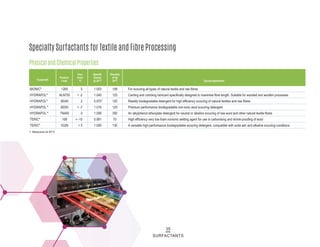
Specialty Surfactants for Textile and Fibre Processing
Physical and Chemical Properties
BIONIC®
1265 5 1.003 108 For scouring all types of natural textile and raw fibres
HYDRAPOL®
ALN755 < -2 1.040 125 Carding and combing lubricant specifically designed to maximise fibre length. Suitable for worsted and woollen processes
HYDRAPOL®
BD40 2 0.9701
120 Readily biodegradable detergent for high efficiency scouring of natural textiles and raw fibres
HYDRAPOL ®
BD50 < -7 1.016 125 Premium performance biodegradable non-ionic wool scouring detergent
HYDRAPOL ®
TN450 0 1.056 350 An alkylphenol ethoxylate detergent for neutral or alkaline scouring of raw wool and other natural textile fibres
TERIC®
168 < -10 0.991 70 High efficiency very low foam nonionic wetting agent for use in carbonising and shrink-proofing of wool
TERIC®
532N < 5 1.005 130 A versatile high-performance biodegradable scouring detergent, compatible with soda ash and alkaline scouring conditions
Trademark
Product
Code
Pour
Point
°C
Specific
Gravity
@ 20°C
Viscosity
cP @
20°C Typical Application
1. Measured at 50°C
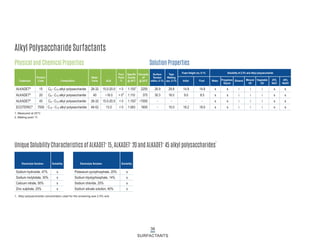
Alkyl Polysaccharide Surfactants
Physical and Chemical Properties
ALKADET®
15 C8 - C10 alkyl polysaccharide 28-32 15.0-20.0 < 0 1.1501
2250 26.9 29.8 14.8 14.8 s s i i i s s
ALKADET®
20 C8 - C10 alkyl polysaccharide 40 ~16.0 < 02
1.110 375 30.3 16.0 9.0 8.5 s s i i i s s
ALKADET®
45 C8 - C10 alkyl polysaccharide 28-32 15.0-20.0 < 0 1.1501
~7000 - - - - s s i i i s s
ECOTERIC®
7500 C10 - C12 alkyl polysaccharide 48-52 13.0 < 0 1.083 1600 - 10.0 18.2 18.0 s s i i i s s
Water
%w/w
Composition HLB
Pour
Point
°C
Specific
Gravity
@ 20°C
Viscosity
cP
@ 20°C
Solution Properties
Surface
Tension
mN/m, 0.1%
Tape
Wetting
sec, 0.1% Initial Final Water Propylene
Glycol
Mineral
Oil
Vegetable
Oil
25%
NaCl
40%
NaOH
Ethanol
Solubility of 2.5% w/w Alkyl polysaccharide
Foam Height cm, 0.1%
1. Measured at 25°C
2. Melting point °C
36
SURFACTANTS
Trademark
Product
Code
Unique Solubility Characteristics of ALKADET®
15, ALKADET®
20 and ALKADET®
45 alkyl polysaccharides
1
Sodium hydroxide, 47% s
Sodium molybdate, 30% s
Calcium nitrate, 50% s
Zinc sulphate, 25% s
1. Alkyl polysaccharide concentration used for the screening was 2.5% w/w
Electrolyte Solution Solubility
Potassium pyrophosphate, 20% s
Sodium tripolyphosphate, 14% s
Sodium chloride, 25% s
Sodium silicate solution, 40% s
Electrolyte Solution Solubility
1. Measured at 25°C
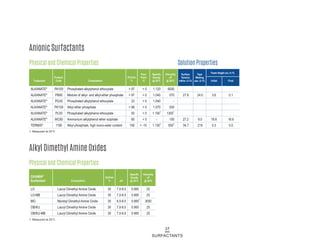
Anionic Surfactants
Physical and Chemical Properties
ALKANATE®
PA100 Phosphated alkylphenol ethoxylate > 97 < 0 1.120 6000
ALKANATE®
PB95 Mixture of alkyl- and alkyl-ether phosphate > 97 < 0 1.040 570 27.8 24.0 3.6 0.1
ALKANATE®
PG30 Phosphated alkylphenol ethoxylate 23 < 0 1.040 -
ALKANATE®
PK100 Alkyl ether phosphate > 98 < 0 1.070 500
ALKANATE®
PL50 Phosphated alkylphenol ethoxylate 50 < 0 1.1001
13001
ALKANATE®
WC60 Ammonium alkylphenol ether sulphate 60 < 0 - 100 27.2 9.0 16.6 16.6
TERMIX®
1190 Alkyl phosphate, high mono-ester content 100 < -15 1.1301
5001
34.7 219 0.3 0.0
Composition
Actives
%
Pour
Point
°C
Specific
Gravity
@ 20°C
Viscosity
cP
@ 20°C
Solution Properties
Surface
Tension
mN/m, 0.1%
Tape
Wetting
sec, 0.1% Initial Final
Foam Height cm, 0.1%
37
SURFACTANTS
Trademark
Product
Code
1. Measured at 25°C
Alkyl Dimethyl Amine Oxides
Physical and Chemical Properties
LO Lauryl Dimethyl Amine Oxide 30 7.0-8.0 0.965 25
LO-MB Lauryl Dimethyl Amine Oxide 30 7.0-8.0 0.965 25
MO Myristyl Dimethyl Amine Oxide 30 6.0-8.0 0.9651
3000
OB/KU Lauryl Dimethyl Amine Oxide 30 7.0-8.0 0.965 25
OB/KU-MB Lauryl Dimethyl Amine Oxide 30 7.0-8.0 0.965 25
Composition
Actives
% pH
Specific
Gravity
@ 20°C
Viscosity
cP
@ 20°C
OXAMIN®
Surfactant
38
SURFACTANTS
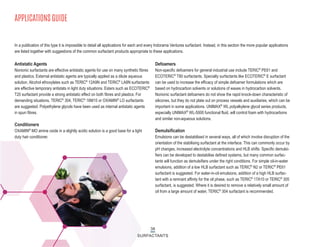
APPLICATIONS GUIDE
Antistatic Agents
Nonionic surfactants are effective antistatic agents for use on many synthetic fibres
and plastics. External antistatic agents are typically applied as a dilute aqueous
solution. Alcohol ethoxylates such as TERIC®
12A9N and TERIC®
LA8N surfactants
are effective temporary antistats in light duty situations. Esters such as ECOTERIC®
T20 surfactant provide a strong antistatic effect on both fibres and plastics. For
demanding situations, TERIC®
304, TERIC®
16M15 or OXAMIN®
LO surfactants
are suggested. Polyethylene glycols have been used as internal antistatic agents
in spun fibres.
Conditioners
OXAMIN®
MO amine oxide in a slightly acidic solution is a good base for a light
duty hair conditioner.
Defoamers
Non-specific defoamers for general industrial use include TERIC®
PE61 and
ECOTERIC®
T80 surfactants. Specialty surfactants like ECOTERIC®
E surfactant
can be used to increase the efficacy of simple defoamer formulations which are
based on hydrocarbon solvents or solutions of waxes in hydrocarbon solvents.
Nonionic surfactant defoamers do not show the rapid knock-down characteristic of
silicones, but they do not plate out on process vessels and auxiliaries, which can be
important in some applications. UNIMAX®
WL polyalkylene glycol series products,
especially UNIMAX®
WL-5000 functional fluid, will control foam with hydrocarbons
and similar non-aqueous solutions.
Demulsification
Emulsions can be destabilised in several ways, all of which involve disruption of the
orientation of the stabilising surfactant at the interface. This can commonly occur by
pH changes, increased electrolyte concentrations and HLB shifts. Specific demulsi-
fiers can be developed to destabilise defined systems, but many common surfac-
tants will function as demulsifiers under the right conditions. For simple oil-in-water
emulsions, addition of a low HLB surfactant such as TERIC®
N2 or TERIC®
PE61
surfactant is suggested. For water-in-oil emulsions, addition of a high HLB surfac-
tant with a remnant affinity for the oil phase, such as TERIC®
17A10 or TERIC®
305
surfactant, is suggested. Where it is desired to remove a relatively small amount of
oil from a large amount of water, TERIC®
304 surfactant is recommended.
In a publication of this type it is impossible to detail all applications for each and every Indorama Ventures surfactant. Instead, in this section the more popular applications
are listed together with suggestions of the common surfactant products appropriate to these applications.
39
SURFACTANTS
Detergents
Where a single component general purpose detergent is required, TERIC®
N8,
TERIC®
N9 or TERIC®
N10 surfactants are recommended. Where ready biodegrad-
ability is required, TERIC®
BL8, TERIC®
LA8N, TERIC®
12A8N, TERIC®
BL12 and
TERIC®
552 surfactants are suggested. ECOTERIC®
7500 alkyl polysaccharide is
suggested if a non-ethoxylate is required. Where low foaming and good wetting,
combined with good detergency is required, then the TERIC®
160 surfactant group
is recommended. TERIC®
164 low foam wetting agent also has good detergency
properties.
Blends of nonionic surfactants will show improved detergency under some specific
use conditions. For oily soils on synthetic fibres, TERIC®
12A3N plus TERIC®
12A6N or TERIC®
12A4N plus TERIC®
12A8N surfactants are suggested. To
improve the performance of alkylbenzene sulphonate-based detergents in hard
or saline waters, addition of TERIC®
12A8N or TERIC®
12A12N surfactants are
suggested. If additional stability is required without the use of hydrotropes,
TERIC®
N15 or TERIC®
12A23N surfactants will be found to be effective.
The foaming ability of ether sulphates based detergent formulations will be
enhanced by addition of OXAMIN®
LO or OXAMIN®
MO alkyl dimethyl amine
oxides. Alkyl polysaccharides such as ECOTERIC®
7500 surfactant can improve
the foaming ability of detergent formulations based on linear alkylbenzene
sulphonate (LABS).
HYDRAPOL®
BD40 and HYDRAPOL®
TN450 detergents are specific to many
aspects of textile processing, including wool scouring.
Dispersants
Nonionic surfactants have limited application as dispersants but work well in con-
junction with poly-anionic dispersants. Highly ethoxylated nonionic surfactants such
as TERIC®
N30 and TERIC®
X40L surfactant provide excellent steric stabilisation
in dispersed systems. Alkyl ether phosphates, including ALKANATE®
PA100 and
TERIC®
305 surfactant, particularly as their amine salts, are suggested as disper-
sants for iron oxide pigments. Similarly, tristyrylphenol ether phosphates and
sulphates including TERSPERSE®
2202 and TERSPERSE®
2218 dispersants
are broad utility ionic dispersants useful for dispersion of organic pigments and
stabilization of agrochemical aqueous suspension concentrates (SC).
For simplified development and ease-of use in less-demanding agrochemical SC
applications, formulated dispersant / wetter offerings such as TERSPERSE®
4894
and TERSPERSE®
2288 dispersants provide reliable utility.
The TERSPERSE®
polymeric dispersant range, especially TERSPERSE®
2500
and TERSPERSE®
2700 dispersants are designed for high-performance in
more demanding paint, pigment and particularly agrochemical applications.
For agrochemical SC, TERSPERSE®
2500 dispersant is typically recommended
for use with TERSPERSE®
4894 or TERSPERSE®
2288 dispersants. For
agrochemical water dispersible granules (WG), TERSPERSE®
2700 dispersant
is typically used with TERWET®
1004 wetting agent, and TERSPERSE®
2020
as a co-dispersant in very demanding applications.
TERSPERSE®
2612 dispersant is a new, patented technology designed for
particularly demanding agrochemical SC applications challenged by stability
deficiencies associated with Ostwald ripening.
APPLICATIONS GUIDE
Emulsifiers
Emulsification is the most diverse and potentially most complex application for
surfactants. In a publication of this type it is possible to cover only the general
aspects of the technology. A separate publication, ‘The HLB Concept and
Emulsification’ is a recommended as a source of further information and can
be requested from the listed Indorama Ventures sales offices.
For most emulsion systems a pair of surfactants is preferable to a single surfactant,
and an anionic / nonionic pair is generally preferable to an all nonionic system.
Appropriate anionic surfactants are the TERMUL®
AIS alkylbenzene sulphonate
series and the ALKANATE®
P ether phosphate range.
There are several systems used to assist formulators in the selection and
optimisation of emulsion systems, including Hydrophilic – Lipophilic Balance (HLB),
Phase Inversion Temperature (PIT), and the Winsor R-Rule. Used intelligently, all
will aid the process of selection and optimisation, but none will eliminate the need
for systematic experimentation. A list of HLB values of common Indorama Ventures
emulsifiers is included further on in this publication.
Foam Boosters
The OXAMIN®
alkyl amine oxide range, and particularly OXAMIN®
LO amine
oxides are specifically recommended as foam boosters for formulations based
on alkyl ether sulphates, alcohol sulphates and alpha olefin sulphonates. Alkyl
polysaccharides can be used as foam boosters for formulations based on
alkylbenzene sulphonates.
In detergent systems, foaming under heavy soil load will be improved by including
a nonionic surfactant such as TERIC®
12A12N, TERIC®
N13 or TERIC®
528
surfactant in the formulation.
Froth Flotation
The POLYFROTH®
frother series products have been specifically designed for use
in flotation processes. POLYFROTH®
H57 frother is among the strongest, most
hydrophobic in the series. POLYFROTH®
W55 and POLYFROTH®
W53 frothers are
strong frothers, but less selective in use. POLYFROTH®
W55, POLYFROTH®
W34
and POLYFROTH®
W31 frothers have low to moderate hydrophobicity. Intermediate
froth strengths are afforded by POLYFROTH®
W34 and POLYFROTH®
W31 frothers.
POLYFROTH®
W22 and POLYFROTH®
H20 frothers are lower strength, highly
selective frothers and comparable to methyl isobutyl carbinol (MIBC). They have
been specifically designed as high flash point alternatives to MIBC, which gives
them an improved safety profile.
Hydrotropes
ALKADET®
15 and ECOTERIC®
7500 alkyl polysaccharides are excellent for
coupling conventional nonionic surfactants into aggressive environments such
as strongly alkaline solutions or concentrated electrolyte solutions. TERIC®
306
surfactant will hydrotrope both anionic and nonionic surfactants into solutions of
relatively high ionic strength. The ALKANATE®
P alkyl ether phosphates series
all show the hydrotropic effect, as is characteristic of their class.
Low Foam Surfactants
The TERIC®
160 surfactant group comprises both low foam wetting agents and
detergents. TERIC®
161 surfactant is an alkylphenol based, general purpose wetter
and detergent. TERIC®
164 surfactant is a fatty alcohol based low foam wetter and
detergent, well suited to most domestic and industrial cleaning products formulation.
TERIC®
168, TERIC®
169 and TERIC®
569 nonionic surfactants provide excellent
wetting and very low foam in dynamic situations, which makes them ideal for modern
machine dishwash, laundry and industrial cleaning applications. TERIC®
PE62 and
TERIC®
PE64 surfactants are very low foam wetting agents which also facilitate
rewetting.
40
SURFACTANTS
APPLICATIONS GUIDE
41
SURFACTANTS
Lubricants and Release Agents
Aqueous solutions of fatty alcohol based nonionic surfactants such as TERIC®
12A8N or TERIC®
BL8 surfactants can act as assembly lubricants for rubbers and
synthetic elastomers. The UNIMAX®
WL polyalkylene glycol range of lubricants are
specifically recommended as water-soluble broad-spectrum lubricants and release
agents. Lower molecular weight polyethylene glycols, for example PEG 200, are
effective light duty lubricants alone or as aqueous solutions. If aqueous solutions
of surfactants are used as lubricants in contact with ferrous metals, then inclusion
of a corrosion inhibitor should be considered.
Solubilisers
ECOTERIC®
T20, ECOTERIC®
T80 and TERIC®
ME240-60 surfactants are
excellent solubilisers for most essential oils. TERIC®
X10 surfactant will effectively
solubilise pine oil and eucalyptus oil, whilst TERIC®
12A12N and TERIC®
ME240-60
surfactants are suggested for melaleuca oil. Alkylamine ethoxylates, particularly the
TERIC®
16M surfactant range, are effective at solubilising water or low molecular
weight glycols in hydrocarbon fuels and solvents.
Textile Auxiliaries
Wetting agents, detergents or scouring agents, dispersants and dye levelling agents
are commonly used in formulated textile auxiliaries. The TERIC®
160 surfactant
group are appropriate wetting agents for inclusion in dyeing processes. Formulated
spin finishes based on ECOTERIC®
T80 surfactant and UNIMAX®
WL polyalkylene
glycol series work well on polypropylene fibres and yarns. TERIC®
161 surfactant
provides very low foam wetting in jet dyeing. The alkylamine ethoxylates are
suggested as the starting point for formulated levelling agents.
Wetting Agents
TERIC®
X8 and TERIC®
N8 wetting agents are conventional broad spectrum
nonionic wetting agents with wide ranging applications potential. TERIC®
161,
TERIC®
164, TERIC®
168, TERIC®
169 and TERIC®
569 wetting agents are low
foam general purpose wetting agents. ALKADET®
20 alkyl polysaccharide also
shows temperature-dependent low foam properties and is soluble in strongly
alkaline solutions. Where a good penetrative wetting is required and low foaming
properties are unimportant, TERIC®
10A6N, TERIC®
BL8, or TERIC®
BL12,
HYDRAPOL®
RP40 and HYDRAPOL®
RP50 surfactants are recommended.
ALKADET®
15 and ECOTERIC®
7500 alkyl polysaccharides are high foaming
general purpose wetting agents which are soluble in strongly alkaline solutions
and in concentrated solutions of inorganic salts.
TERIC®
PE61, TERIC®
PE62 and TERIC®
PE64 surfactants or mixtures thereof
are very low foam wetting agents with excellent rewetting ability and are suggested
for use in situations where surfaces or substrates are required to be alternately dry
and wet.
Wool Scouring and Finishing
Scouring of raw wool is possibly the most demanding detergency-related industrial
process.
HYDRAPOL®
TN450 and HYDRAPOL®
BD40 surfactants are industry-proven
high-performance wool scouring agents.
HYDRAPOL®
ALN-755 auxiliary surfactant is non-oil-based carding and combing
lubricant with outstanding antistatic performance, applicable to wool types from
carpet wools to superfine apparel wools.
APPLICATIONS GUIDE
42
SURFACTANTS
The designation of an International Nomenclature of
Cosmetic Ingredients (INCI) name for a cosmetic ingredient
is an essential part of ingredient identification; however, it
does not mean that the ingredient has been approved for
use in cosmetics. The assignment of an INCI name to an
ingredient does not imply that the ingredient is safe, has
been certified, or that its use complies with the laws and
regulations of any country or global region. The safety and
appropriate use of an ingredient, along with regulatory
considerations, should be carefully evaluated before use.
INCI NAMES FOR SOME INDORAMA VENTURES SURFACTANTS
TERIC®
Sufactant
10A5N Deceth-5
10A6N Deceth-6
10A8N Deceth-8
12A2N Laureth-2
12A3N Laureth-3
12A4N Laureth-4
LA4N Laureth-4
12A6N Laureth-6
12A7N Laureth-7
12A8N Laureth-8
LA8N Laureth-8
12A9N Laureth-9
12A12N Laureth-12
12A23N Laureth-23
13A7 Trideceth-7
13A9 Trideceth-9
PE61 Poloxamer 181
PE62 Poloxamer 182
PE64 Poloxamer 184
ME240-60 Methoxy PEG-10 Cocoate,
PEG-20 Glyceryl Cocoate
INCI Name
Product Code
PEG Sufactant
PEG 200 PEG-4
PEG 300 PEG-6
PEG 400 PEG-8
ECOTERIC®
Sufactant
E PPG-15 Stearyl Ether
T20 Polysorbate 20
T80 Polysorbate 80
T85 Polysorbate 85
7500 C10-16 Alkyl Glucoside
ALKADET®
15 Caprylyl / Capryl Glucoside
OXAMINE®
Sufactant
LO Lauramine Oxide
MO Myristamine Oxide
OB/KU Lauramine Oxide
ALKANATE®
Sufactant
PK100 Deceth-4 Phosphate
INCI Name
Product Code
43
SURFACTANTS
HLB VALUES FOR SOME INDORAMA VENTURES SURFACTANTS
TERIC®
Sufactant
10A5N 11.6
10A6N 12.4
10A8N 13.7
12A2N 6.0
12A3N 7.1
12A4N 9.8
12A6N 11.2
12A7N 12.1
12A8N 12.6
12A9N 13.6
12A12N 14.4
12A23N 16.6
LA4N 9.8
LA8N 12.6
13A7 11.8
13A9 13.3
309 14.7
17A8 11.6
17A10 12.7
PE61 3.0
PE62 7.0
HLB
Product Code
PE64 15.0
BL8 13.7
BL12 13.7
ME240-60 13.1
161 12.3
164 10.8
168 11.1
169 12.7
569 12.0
305 ~14.0
320 14.9
340 13.0
460 17.1
461 14.9
462 17.5
463 18.1
528 14.4
534 12.6
552 12.0
16M2 9.5
16M5 10.5
HLB
Product Code
16M15 13.8
17M5 ~10.0
17M8 11.0
X5 10.4
X8 12.6
X10 13.6
X40L 17.6
N2 5.7
N5 10.5
N6 10.9
N8 12.3
N9 12.8
N10 13.3
N11 13.7
N12 13.9
N13 14.4
N15 15.0
N20 16.0
N30 17.2
N40LP 18.0
HLB
Product Code
ECOTERIC®
Sufactant
T20 16.7
T80 15.0
T85 11.0
TERMUL®
Sufactant
200 16.1
203 17.5
1284 13.1
1285 14.4
3150 12.5
3512 7.3
5370 14.5
5429 15.3
5030 13.6
HYDRAPOL®
Sufactant
RP40 7.8
RP50 10.2
RP80 12.0
RP90 13.0
RP120 14.7
HLB
Product Code
44
SURFACTANTS
HANDLING AND STORAGE
Most nonionic surfactants are almost anhydrous, and as such they are not corrosive to most common metals. However, aqueous solutions of virtually all nonionic surfactants
will show some degree of corrosivity toward common ferrous metals such as black iron, mild steel, forged steel and cast iron. Virtually all grades of stainless steel are
impervious to attack by surfactant solutions. Aluminium and its alloys are generally resistant to attack by anhydrous surfactant and to attack by aqueous solutions at
ambient temperature.
Prolonged storage of diluted surfactant solutions' at elevated temperatures, in aluminium, is not recommended. Some staining may occur on copper or brass, particularly
with dilute solutions, but corrosive attack is minimal. Ferrous metals may be protected against corrosive attack by use of appropriate polyester or epoxy resin linings.
Plastics
Both plasticised and unplasticised polyvinyl chloride (PVC) show good resistance to
attack by both concentrated and dilute surfactant solutions, as does polypropylene,
nylon 6/6 and fibre reinforced epoxy resins. Cellulose acetate butyrate, polycarbonate,
high density polyethylene and methacrylate-based resins show fair resistance to
attack but should be used with care. Low density polyethylene and polystyrene are
not recommended for surfactant storage. Surfactants in general and alkylphenol
ethoxylates in particular can induce environmental stress cracking in some grades of
polyethylene and PVC. Oriented polyolefin plastics, however, are quite acceptable
materials for handling and storing surfactants.
Hoses
Wire reinforced polypropylene is the preferred material for hoses. For gasketting in
pipework, CAF is the preferred material and the preferred elastomers for seals are
nitrile, silicone, VITON™ elastomer. TEFLON™ fluoropolymer is quite impervious to
surfactant solutions and is recommended for seats and seals in valves.
Pumps
Centrifugal pumps are widely used throughout the chemical industry and are quite
suitable for handling low viscosity liquids. If a centrifugal pump is selected, Indorama
Ventures recommends the following general requirements:
n Pump to be single stage, back pull-out, of cast iron construction.
n Impeller preferably to be of the closed type.
n Provided with a single mechanical seal fitted with silicon carbide/carbon faces
and TEFLON™ fluoropolymer O-rings.
n Fitted with a direct coupled electric motor of a suitable hazard rating for the area,
via a flexible coupling.
n Pump and motor to be mounted on a rigid baseplate.
Positive displacement pumps are preferred for higher viscosity products. Tri-lobe
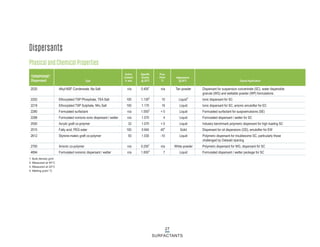
pumps and gear pumps are suitable. An air operated double diaphragm pump is
recommended as the preferred positive displacement pump. These pumps offer
the following benefits:
n Ease and simplicity of operation n Can self-prime if necessary
n Can be run dry n No mechanical seals
n Can be “dead headed” n Low cost and easy installation
Surfactants
Alkanolamines
Oxygenated Solvents
Polyglycols and Alkoxy-Polyethers
Chemistry of Alkanolamines ....................................................................................................46
Product Nomenclature and Range ..........................................................................................46
Alkanolamine Typical Properties..............................................................................................47
Applications Guide ..................................................................................................................48
Safety in Use............................................................................................................................48
Monoethanolamine, diethanolamine, and triethanolamine are alkanolamines
or amino alcohols and have been prepared industrially since the early 1930’s
and on a significant scale after 1945. They find diverse industrial application
where world alkanolamines capacity was roughly 1.09 x 10⁶
tonnes per
annum by 1999.
Alkanolamines
45
ALKANOLAMINES
46
ALKANOLAMINES
CHEMISTRY OF ALKANOLAMINES PRODUCT NOMENCLATURE AND RANGE
Alkanolamines are commercially produced by reacting ethylene oxide
with ammonia yielding a mixture. Monoethanolamine, diethanolamine
and triethanolamine are obtained through fractionation.
Alkanolamines are characterised by the presence of a basic nitrogen
atom and at least one hydroxyl group and therefore capable of undergoing
reactions typical of both amines and alcohols.
Monoethanolamine and diethanolamine can undergo reactions leading to the
formation of various nitrogen heterocycles, for example diethanolamine can
be dehydrated to yield morpholine. Alkanolamines readily form salts with
inorganic and organic acids.
Monoethanolamine, diethanolamine and triethanolamine are available as
99% minimum concentration products. Triethanolamine 85 contains a minimum of
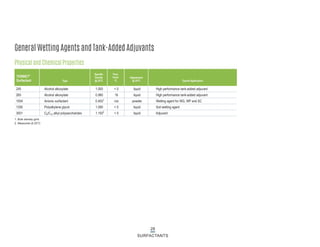
85% w/w triethanolamine with the balance being predominately diethanolamine.
Triethanolamine LFG-85% Grade
This is an aqueous solution which typically contains 15% water and exhibits
a lower freezing point in comparison to the 99% concentration product.
Monoethanolamine (MEA)
Diethanolamine (DEA)
Triethanolamine 85
Triethanolamine-99% (TEA)
Mixture of triethanolamine and diethanolamine
H2N CH2CH2OH
CH2CH2OH
CH2CH2OH
HN
CH2CH2OH
CH2CH2OH
HOCH2CH2 N
47
ALKANOLAMINES
ALKANOLAMINE TYPICAL PROPERTIES
Typical Properties
Physically, these compounds are clear, viscous liquids at room temperature and white crystalline solids when frozen.
Diethanolamine has the highest freezing point of the group, 28°C, and monoethanolamine the lowest, 10.5°C.
Alkanolamines have comparatively high boiling points, although subject to decomposition at elevated temperatures,
particularly diethanolamine.
Alkanolamines are ammoniacal in odour, hygroscopic and miscible with water, most alcohols, and polyols.
Alkanolamines and their aqueous solutions are alkaline in pH.
1. Decomposes
2. Specific gravity 30°C / 20°C
3. Measured at 25°C
4. Measured at 40°C
Physical and Chemical Properties
Monoethanolamine Clear liquid 171 11 96 1.0179 - - 11.8 61
Diethanolamine Clear liquid 2691
28 154 1.09192
< 0.0013 321 11.5 105
Triethanolamine-85% Clear liquid 355 12 190 1.1230 - - 10.5 149
Triethanolamine-99% Clear liquid 360 21 202 1.1255 < 0.0013 5273
11.0 149
Triethanolamine LFG-85% Grade Clear liquid 100 -5 - 1.1230 - 754
10.8 149
Appearance
@ 30°C
Product
Melting
Point
°C
Boiling
Point
°C
Flash Point
PMCC
°C
Specific
Gravity
20/20 °C
Vapour
Pressure
kPa @ 20°C
Viscosity
cS @ 30°C
Molecular
Weight
g/mol
pH
48
ALKANOLAMINES
APPLICATIONS GUIDE SAFETY IN USE
Monoethanolamine
A chemical intermediate in the manufacture of cosmetics, surface active agents,
emulsifiers and plasticising agents. A gas-scrubbing agent for removal of hydrogen
sulphide (H2S) and carbon dioxide (CO2) from refinery and natural gas streams and
CO2 from ammonia manufacturing. Also finds application as a corrosion inhibitor in
metal working fluids.
Diethanolamine
An intermediate in the manufacture of cosmetics, surface-active agents used in
household detergents and textiles specialties, insecticides, herbicides and petroleum
demulsifiers. A gas scrubber in refinery and natural gas operations. Other applications
include waxes, polishes, coatings emulsifiers, soluble oils, metal working fluids
applications.
Triethanolamine
An intermediate in the manufacture of surface-active agents used in textile demulsi-
fiers, toiletry formulations, cement additives, cutting oils and photographic-film devel-
opers. Dispersant for dyes, casein, shellac and rubber latex. Also has applications as
a corrosion inhibitor, sequestering agent and as a rubber chemical intermediate.
As most alkanolamines exhibit corrosive properties, precautions need to be taken to
prevent contact with the skin and eyes. Persons handling concentrated solutions
of these materials should be provided with:
n Rubber gloves
n Appropriate safety footwear
n Chemical goggles
n Protective coveralls
If the water content of the ethanolamine is to be minimised, a dry inert gas pad, such
as nitrogen should be used on storage tanks. Similarly, a gas pad should be used if
low color is important since absorbed atmospheric oxygen will cause all ethanolamines
to develop color.
Ethanolamines should not be used in tanks made from zinc, galvanized steel or
copper and its alloys since ethanolamines react with copper to form complex salts.
Carbon steel storage tanks constructed according to a recognized code are generally
satisfactory. In cases where low color or low iron content is important, aluminum or
stainless steel is preferred. Aluminum will react with the ethanolamines at elevated
temperatures or in the presence of water. Therefore, it should not be used to store
aqueous blends or in the construction of steam coils.
Comprehensive SDS are available upon request from Indorama Ventures Customer
Service Centres. These provide further guidance on the toxicity and safe handling
of these products. It is essential that the SDS is reviewed prior to the use of any
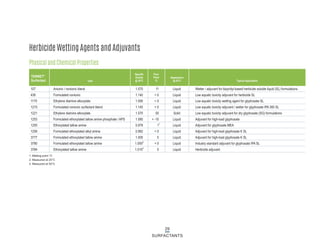
Indorama Ventures alkanolamine products.
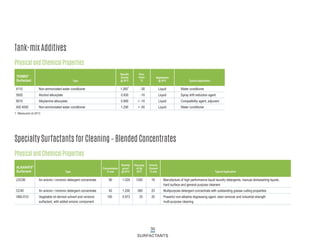
Surfactants
Alkanolamines
Oxygenated Solvents
Polyglycols and Alkoxy-Polyethers
Chemistry of Glycols................................................................................................................50
Product Range and Nomenclature ..........................................................................................50
Applications Guide ..................................................................................................................52
Safety in Use............................................................................................................................53
Chemistry of Glycol Ethers ......................................................................................................54
Product Range and Nomenclature ..........................................................................................54
Applications Guide ..................................................................................................................56
Safety in Use............................................................................................................................59
Chemistry of Formulated Glycol Coolants ..............................................................................61
Product Range and Nomenclature ..........................................................................................63
Safety in Use............................................................................................................................64
Automotive Brake Fluids..........................................................................................................64
Product Range and Nomenclature ..........................................................................................65
Packaging and Handling..........................................................................................................66
49
OXYGENATED SOLVENTS
The oxygenated solvents produced by Indorama Ventures include glycols and
glycol ethers. They are used in a diverse range of industries and applications.
Oxygenated Solvents
HO CH2CH2 O CH2CH2 OH
50
OXYGENATED SOLVENTS
CHEMISTRY OF GLYCOLS PRODUCT RANGE AND NOMENCLATURE
Ethylene glycols are straight chain aliphatic compounds terminated on both ends
with a hydroxyl group. Monoethylene glycol, diethylene glycol and triethylene
glycol have the following structures:
Monoethylene glycol is manufactured by the hydration of ethylene oxide. Diethylene
glycol and triethylene glycol are prepared by the reaction of monoethylene glycol with
ethylene oxide. A statistical distribution of ethylene glycols is formed which are easily
separated into the various components through distillation.
The ethylene glycols are characterised by their water solubility, hygroscopicity,
freezing point depression of water and low corrosiveness. They are used as
plasticisers and in a wide number of applications such as coolants / antifreeze,
polyesters and solvent extraction.
Monoethylene Glycol
Diethylene Glycol
Triethylene Glycol
HO CH2CH2 OH
HO CH2CH2 O CH2CH2 O CH2CH2 OH
Monoethylene glycol Ethylene glycol; MEG 107-21-1
Diethylene glycol DEG 111-46-6
Triethylene glycol TEG 112-27-6
Alternative Name(s)
Product Name CAS Number
51
OXYGENATED SOLVENTS
PRODUCT RANGE AND NOMENCLATURE
Physical and Chemical Properties
Acidity (as acetic acid) %w/w 0.002 max 0.005 max 0.01 max
Colour, Pt-Co 10 max 10 max 25 max
Water, %w/w 0.2 max 0.2 max 0.25 max
Diethylene glycol, %w/w 0.2 max 99.0 min 2 max
Chloride, (as NaCl) % < 0.200 0.005 0.009
Sulphate Not detectable Not detectable Not detectable
Flash point, closed cup, °C 110 143 172
Molecular weight, g/mol 62 106 150
Refractive index @ 20°C 1.4316 1.4475 1.4559
Specific gravity @ 20/20°C 1.114 – 1.116 1.117 – 1.120 1.123 – 1.128
Specific heat, J/g/°C @ 20°C, 2.35 2.31 2.20
Surface tension, mN/m @ 20°C 48 48 45
Viscosity, cP @ 20°C 21 38 49
Vapour pressure, kPa @ 20°C 0.008 0.001 0.001
Distillation range, 5 - 95%, °C 196 – 198.5 - -
Melting point, °C -13 -6 -5
Boiling point, °C 197 245 285
Relative vapour density 2.2 3.7 5.17
Flammability limit, lower, % 3.2 1.7 0.9
Flammability limit, upper % 12.8 10.5 9.2
Ignition temperature, °C 412 229 360
Coefficient of expansion @ 20°C 0.00062 0.00064 -
Electrical conductivity, S @ 25°C 1.07 x 10⁻⁶ - -
Heat of vaporisation, J/g 800 628 749
Ethylene Glycol
Parameter Diethylene Glycol Triethylene Glycol
Solubility
Monoethylene glycol, diethylene glycol and triethylene glycol are all com-
pletely miscible with water. They are also soluble in lower aliphatic acids,
alcohols, aldehydes, amines and ketones. Aromatic compounds in general
have appreciable solubility in monoethylene glycol, diethylene glycol and
triethylene glycol. Moving up the series from monoethylene glycol to
triethylene glycol the solubility of hydrocarbons in the glycols increases.
Vegetable oils are only very slightly soluble in monoethylene glycol,
diethylene glycol and triethylene glycol.
52
OXYGENATED SOLVENTS
APPLICATIONS GUIDE
Coolants / Antifreeze
Monoethylene glycol has low volatility and in aqueous solutions depresses the
freezing point and elevates the boiling point of water. These properties have
resulted in its widespread use as an automotive engine coolant. When coupled
with corrosion inhibition systems it forms the basis of most commercial automo-
tive engine coolants. Corrosion inhibited monoethylene glycol based automotive
engine coolants do not affect automobile finishes, rubber hoses, gaskets or other
engine components.
Monoethylene glycol is also used as a basis for heat transfer fluids in other indus-
tries, where use temperatures are unlikely to exceed 150°C. The freezing point
depression of inhibited aqueous glycol solutions enables it to be used as an alter-
native for the more corrosive salt brines. The higher flash point of monoethylene
glycol allows it to be a replacement for ethanol based solutions in appropriate
applications. However, it is not recommended for use in systems where incidental
contact with food could occur. Uninhibited aqueous glycol solutions are corrosive
towards ferrous metals, aluminium, magnesium, solders and to a lesser extent
brass. Heat transfer fluids based on monoethylene glycol must contain a
formulated corrosion inhibitor pack.
The following table shows the freezing point depression as a function of
concentration of monoethylene glycol over the practical concentration range.
Polyesters
Monoethylene glycol, diethylene glycol and triethylene glycol are all used in the
manufacture of polyester resins. Polyester resins are the product of reaction
between dibasic acids and diols, usually glycols. The choice of the glycol portion
of the polyester resin is dictated by the required properties of the final product,
such as the flexibility, water sensitivity and crystallinity.
Plasticisers
Diethylene glycol and triethylene glycol may be used as plasticisers for laminated
safety glass, vinyls and nitrocellulose. They can also be used as plasticisers for
cellulose sponges, cork, synthetic rubber, vinyl floor tiles, and paper.
Solvent Extraction
Glycols can be used as processing aids to separate aromatic hydrocarbons from
aliphatic hydrocarbons in mixtures that are not easily separated via distillation. The
solvent may be a single glycol, such as diethylene glycol, or a mixture of glycols.
Humectants and Dehydrating Agents
Monoethylene glycol, diethylene glycol and triethylene glycol are efficient
hygroscopic agents. These humectant properties are of value in their application
as dehydrating agents for natural gas and in air conditioning systems where they
are used to remove water from the air without cooling. Gas dehydration involves
the use of a liquid desiccant to remove water vapour from the gas.
Monoethylene Glycol
Concentration, % by Volume 10 15 20 25 30 35 40 50
Freezing Point, °C -4 -7 -9 -13 -17 -21 -26 -49
53
OXYGENATED SOLVENTS
APPLICATIONS GUIDE SAFETY IN USE
Although many liquids possess the ability to absorb water from gas, the liquid that
is most desirable to use for commercial dehydration purposes should possess the
following properties:
1. High absorption efficiency
2. Easy and economic regeneration
3. Non-corrosive and non-toxic
4. No operational problems when used in high concentrations
5. No interaction with the hydrocarbon portion of the gas, and no contamination
by acid gases
The glycols, particularly monoethylene glycol (MEG), diethylene glycol (DEG),
triethylene glycol (TEG), come closest to satisfying these criteria to varying
degrees. Water and the glycols show complete mutual solubility in the liquid
phase due to hydrogen-oxygen bonds, and their water vapor pressures are
very low.
Indorama Ventures has the capability to blend specialised MEG, DEG and
TEG mixtures with specific water content, pH, alkalinity and other properties
as required by our customers for use in gas dehydration applications.
Chemical Intermediates
Esterification of ethylene glycols with fatty acids produces a mixture of mono
and diesters. These very hydrophobic surfactants find application as defoamers,
lubricants and emulsifiers.
Exposure from either ingestion or inhalation of vapours of monoethylene glycol
can lead to adverse reactions, and in some cases death. Therefore, the use of
monoethylene glycol in smoke machines and similar public entertainment devices
is not recommended. Triethylene glycol or polyethylene glycols are recommended
for these applications.
Monoethylene, diethylene and triethylene glycols are not classified as dangerous
goods by either road, rail, sea or air transport.
Comprehensive SDS are available for all Indorama Ventures glycol products.
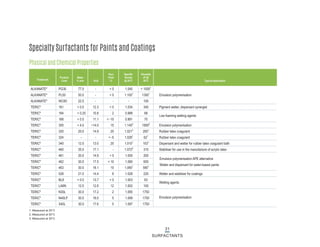
They can be requested from the Indorama Ventures sales offices
54
OXYGENATED SOLVENTS
CHEMISTRY OF GLYCOL ETHERS
Glycol ethers are a range of solvents that find application in a wide range of
industries. Their solvency, coupling ability and evaporation control are some of
the features that have led to the use of these materials in industries such as
surface coatings, inks, industrial cleaning and as intermediates in the production
of other materials.
The Indorama Ventures range of GLYSOLV® glycol ether solvents contain
both ethylene glycol ethers and propylene glycol ethers. These products are
manufactured by alkoxylation of the parent alcohols in high pressure tubular
reactors. The reaction products are separated and purified by distillation. The
degree of polymerisation of the alkylene oxide and the structure of the parent
alcohol determines the properties of these solvents.
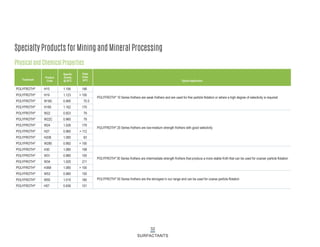
The structure of an ethylene glycol ether is shown below.
The Indorama Ventures range of GLYSOLV® glycol ethers are named to clearly
indicate their composition. With the core products the parent alcohol is identified
by its common name. The GLYSOLV® trademark indicates that the product is the
mono-ether of the parent alcohol, whilst the DI-GLYSOLV® trademark indicates
the diether and the TRI-GLYSOLV® trademark indicates a tri-ether. Indorama
Ventures sells propylene and ethoxyphenol based glycol ethers which also use
the GLYSOLV® tradename together with an acronym to indicate structure.
GLYSOLV® EPH is an aromatic ether that is phenol substituted on oxygen by a
2-hydroxyethyl group, that is 2-phenoxyethanol. It is a germicidal and germistatic
glycol ether and has a role as an anti-infective agent.
Ethylene Glycol Ether
R O (CH2CH2)n OH Methyl DI-GLYSOLV®
Diethylene glycol monomethyl ether DEGME 111-77-3
Methyl TRI-GLYSOLV®
Mixture of triethylene and tetraethylene TEGME 112-35-6 and
glycol monomethyl ethers 23783-42-8
Butyl GLYSOLV®
Monoethylene glycol monobutyl ether MEGBE 111-76-2
Butyl DI-GLYSOLV®
Diethylene glycol monobutyl ether DEGBE 112-34-5
GLYSOLV®
EPH 2-Phenoxyethanol EPH 122-99-6
Composition
Trademark Name Acronym CAS Number
Glycol Ether
PRODUCT RANGE AND NOMENCLATURE
Where n = 1, 2 or 3 and R = Alkyl
55
OXYGENATED SOLVENTS
PRODUCT RANGE AND NOMENCLATURE
(cc) - Pensky-Martens closed cup (oc) - Cleveland open cup
Physical and Chemical Properties
Methyl DI-GLYSOLV®
0.01 15 0.2 1.022 93 (cc) 3.9 0.010 1.426 2.15 190 0.02 34.8 0.78 10.7 13.4 1.91
Methyl TRI-GLYSOLV ®
n.a n.a 0.3 1.058 > 118 7.5 < 0.010 n/a n/a 265 << 0.01 39.1 0.60 10.5 11.0 -
Butyl GLYSOLV®
0.01 10 0.1 0.902 68 (cc) 6.4 0.080 1.419 2.44 166 0.06 27.4 0.17 9.8 15.5 1.80
Butyl DI-GLYSOLV®
0.01 20 0.1 0.955 114 (oc) 6.5 0.003 1.431 2.29 224 < 0.01 30.0 0.19 9.5 13.5 2.05
GLYSOLV®
EPH 0.20 20 0.3 1.110 121 (cc) 20.0 0.004 n/a n/a 245 n/a n/a n/a n/a n/a n/a
Colour
Pt-Co
max
Water %
w/w
Flash
Point
°C
Specific
Gravity
20/20 °C
Vapour
Pressure
kPa @ 20°C
Refractive
Index
Specific
Heat
J/g/°C
Boiling
Point
°C
Viscosity
cP
@ 20°C
Solvent Properties
Surface
Tension
mN/m @ 25°C
Evaporation
Rate Butyl
acetate =1
Solubility
Parameter
Conductivity
S
Dipole
Moment
Debye
Hydrogen
Bonding
Parameter
Trademark
Acidity
Acetic Acid
%w/w, max
Numeric values indicate approximate order of solubility in millilitres per 100 millilitres
Acetone s s s
Cyclohexane 64 s s
Dibutyl Phthalate s s s
Ethyl Lactate s s s
Ethylene Glycol s s s
Hexane 21 s s
Hydrochloric Acid s s s
Methyl
DI-GLYSOLV®
glycol ether
Butyl
GLYSOLV®
glycol ether
Butyl
DI-GLYSOLV®
glycol ether
Kerosene 3 s s
Methyl Ethyl Ketone s s s
Olive Oil i s s
Phosphoric Acid s s s
Polyethylene Glycol s s s
Propylene Glycol s s s
Safflower Oil i s s
Methyl
DI-GLYSOLV®
glycol ether
Butyl
GLYSOLV®
glycol ether
Butyl
DI-GLYSOLV®
glycol ether
Tall Oil s s s
Triethanolamine s s s
Tung Oil i s s
Turpentine 55 s s
Water s s s
Methyl
DI-GLYSOLV®
glycol ether
Butyl
GLYSOLV®
glycol ether
Butyl
DI-GLYSOLV®
glycol ether
Solubility
Methyl DI-GLYSOLV® glycol ether can be supplied in conformance with DEF (UK) 68-252/Issue 3 (issued September 2005) and MIL-DTL-85470B (issued June 1999)
for use in fuels supplied to Australian and foreign defense authorities. In these cases, the product is designated as Methyl DI-GLYSOLV®FSII glycol ether. Laboratory
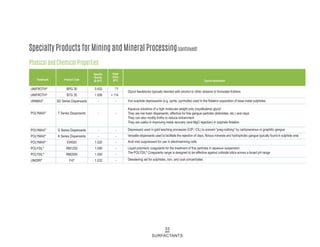
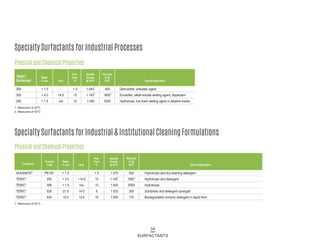
standards for measuring compliance with this specification are audited by Lloyds Register.
The solubilities of some common industrial solvents in GLYSOLV® glycol ethers are tabulated below:
56
OXYGENATED SOLVENTS
APPLICATIONS GUIDE
Lacquers
The GLYSOLV® glycol ethers are surface active solvents characterised by high
dilution ratios, low evaporation rates and wide solubility ranges. They are used to
eliminate resin blush, reduce moisture blush, eliminate orange peel and promote
the release of latent solvents. The high solvency of the GLYSOLV® glycol ethers
helps eliminate resin blush by ensuring that formulation components remain in
solution. The surface tension reduction effects of the glycol ethers help eliminate
orange peel effects, and the slow evaporation rates help prevent surface
evaporative cooling which is one of the prime causes of moisture blush.
Enamels
GLYSOLV® glycol ethers cause dramatic viscosity reduction allowing higher
pigment loading and higher resin solids in premium quality enamel coatings.
Flow-out, levelling and wet edge control are also improved due to the surface-active
nature of glycol ether solvents.
Inks
Glycol ethers are widely used in flexography, screen printing and gravure printing,
with minor uses in other printing processes such as lithography. Glycol ethers are
active solvents which promote resin solubility and compatibility, control viscosity
and surface tension, increase penetration and promote adhesion.
Water-Based Coatings
In most water-based coating systems, water is not an active solvent but rather a
latent solvent usually used in conjunction with small amounts of organic active
solvents. Glycol ethers are cost effective active solvents in these formulations
because of their high dilution ratios in water. They also control evaporation rates,
aid coalescence and increase adhesion to the substrate.
Textile Printing and Dyeing
Glycol ethers aid in the solubilisation of dyes, as well as the penetration and
wetting of fabric and leather, resulting in more effective and efficient colouring.
In textile printing, glycol ethers facilitate evaporation control, promote more even
distribution of colour and help prevent printing pastes from drying out on plates
and cylinders. Glycol ethers can be added to the solvents used to clean printing
machinery after a run. Addition of the glycol ether enhances ink removal and
inhibits the evaporation of more volatile solvents.
Glycol ethers are primarily solvents, and as such their possible applications are almost infinite. Major uses are in surface coatings, printing inks, textile auxiliaries,
domestic and industrial cleaning products and agricultural chemicals. Glycol ethers are also used as chemical intermediates, fuel additives and as components of
some grades of automotive hydraulic brake fluids.
Surface Coatings
57
OXYGENATED SOLVENTS
APPLICATIONS GUIDE
Domestic Detergents and Cleaners
The physical properties and solubility characteristics of glycol ethers make them an
obvious choice when formulating cleaning products. They contribute to penetrative
and spreading wetting due to their surface active properties; they can act as coupling
solvents to increase the stability of more concentrated high quality formulations; they
can act as hydrotropes to stabilise organic components in the presence of inorganic
builders; and they can enhance greasy soil removal in both pre-spotting agents and
hard surface cleaners. Glycol ethers enhance greasy soil removal by their ability to
penetrate and soften facilitating roll up of the greasy soils.
Butyl DI-GLYSOLV® glycol ether is typically recommended for cleaning formulations.
Due to toxicity concerns, Butyl GLYSOLV® glycol ether is rarely used in cleaning
products while monoethylene glycol ethers and any methyl-based glycol ethers
are not recommended for use in domestic cleaning applications.
Industrial and Janitorial Cleaning Products
Janitorial products are generally similar in formulation style to domestic cleaning
products, and accordingly, the benefits of the glycol ethers are similar. The key
product areas are hard surface cleaners such as floor wax strippers, glass
cleaners, oven cleaners, bathroom and toilet cleaners and ceramic cleaners.
Butyl DI-GLYSOLV® glycol ether is recommended for use in these applications.
In highly built alkaline cleaners, glycol ethers can provide solvency to improve
grease cutting ability and a measure of hydrotropic effect to stabilise non-ionic
and anionic surfactants in the formulation.
Sophisticated formulations of this type will use ALKADET® 15 or ECOTERIC®
7500 alkyl polysaccharide surfactants as a combined detergent / hydrotrope,
thereby allowing high levels of glycol ethers to be used to maximum effect.
Acidic cleaners can also be formulated with glycol ethers. Solvent-based acidic
cleaners using a hydrocarbon solvent such as kerosene along with phosphoric
acid, a glycol ether such as butyl DI-GLYSOLV® glycol ether and a specialty
surfactant such as TERIC® 305 phosphate ester are but one example of this style.
Glycol ethers should not be used with strong oxidising agents, including nitric
acid, because of the risk of chemical reaction. The possibility of reaction also
exists with sulphuric acid and phosphoric acid, but the reaction products are
both stable and functional, therefore minimising risks.
Cleaning Products
Methyl DI-GLYSOLV® FSII glycol ether is specifically used as an anti-icing and
antimicrobial / fungicide additive in aviation turbine fuels. This application is
largely confined to military aircraft and some specialist private aircraft.
The antimicrobial / fungal property of glycol ethers is particularly applicable to
diesel fuels which are stored under adverse conditions, especially marine and
farm use. Fungal / microbial growth occurs at the fuel-water interface in fuel tanks
and storage tanks, causing line blockages and filter plugging, which in turn
reduces the reliability and introduces safety hazards. Glycol ethers can solubilise
small amounts of water into diesel fuels, thereby removing the interface at which
the microbes/fungi grow.
More significantly, glycol ethers strongly inhibit the growth of the bacteria and
fungi, thereby removing the problem at its source. Although Methyl DI-GLYSOLV®
glycol ether is likely the most effective, its mammalian toxicity restricts its use.
Butyl GLYSOLV® glycol ether can be freely used in this application, either
alone, diluted with distillate, or combined with other approved fuel additives.
Approximately 0.15% by volume of the fuel is the suggested concentration for
this application.
n Aluminium cleaners
n Aluminium brighteners
n Automotive cleaners
n Carbon removers
n Chrome plate cleaners
n Degreasers
n Rust removers
n Hard surface cleaners
n Laundry pre-spotters
n Liquid soaps
n Magnesium wheel
cleaners
n Oven cleaners
n Paint strippers
n Graffiti removers
n Engine degreasers
n Rug cleaners
n Steam cleaners
n Floor strippers
n Glass cleaners
n Hand cleaners
n Window cleaners
Cleaning products where maximum solvent effect is required can also benefit
from the use of glycol ethers. Aside from being excellent solvents, they can also
be used as coupling agents to stabilise two otherwise immiscible solvents, each
of which is required in the formulation. Examples are paint strippers, graffiti
removers, solvent-based degreasers and decarbonisers.
To summarise, typical applications for glycol ether-based formulations in the
industrial and janitorial cleaning products market are:
Glycol Ethers as Fuel Additives
Glycol Ethers as Chemical Intermediates
APPLICATIONS GUIDE
58
OXYGENATED SOLVENTS
Glycol ethers behave as low molecular weight alcohols in chemical reactions.
They are easily esterified and they can be further alkoxylated. The acetate esters
of ethyl and butyl ethers as well as of the propylene glycol ethers are very
common components of lacquer thinners and of solvent based adhesives.
The reaction products with phthalic anhydride are common specialty plasticisers,
and the higher fatty acid esters are used as specialty defoamers.
SAFETY IN USE
Handling and Storage
GLYSOLV® glycol ethers can be satisfactorily stored and handled in stainless
steel or mild steel containers. Aluminium or alloys containing aluminium must
not be used for the storage of glycol ethers, due to the possibility of alcoholate
formation with the consequent formation of hydrogen. Copper and some copper
rich alloys will react with glycol ethers to form strongly coloured complexes.
If maximum product quality is to be maintained in bulk storage, glycol ethers
should be stored under dry nitrogen. Over time, the reaction with atmospheric
oxygen will generate peroxides which in turn will lead to the formation of aldehydic
and acidic contaminants. The net result of this process is a decrease in pH an
increase in acid value and the development of a yellow-brown discolouration.
Polypropylene is satisfactory for hoses and flexible couplings. Butyl elastomers
are satisfactory for gaskets and seals. Natural rubbers can be used with the
methyl and ethyl ethers, but not the butyl ethers. Neoprene™ elastomer can
be used only with the methyl ethers. PTFE is recommended for valve seats.
Pumps are a matter of choice. Cast iron centrifugal pumps with simple slip-ring
seals are satisfactory. The nature of the casting will be governed by the pressure
rating of the system.
Wherever possible the glycol ether itself should be used as the lubricant. Mineral
oils and greases will be dissolved by the glycol ether, with resultant contamination.
Graphite and molybdenum disulphide are recommended for use in situations
where a greater degree of lubricity is required.
Transfer and handling equipment should be electrically bonded to one another
and all components of the system should be taken to a common ground. This is
necessary to prevent the accumulation of static electricity charges.
All glycol ethers on the Indorama Ventures range classified as non-dangerous
goods for storage and transport.
Toxicity of Glycol Ethers
Toxicity is the response of biological tissue after exposure to a chemical or physi-
cal agent. Any agent may give rise to a number of responses depending on which
tissue is affected and the duration of the exposure. However, all toxic responses
obey two fundamental laws:
The No Observed Effect Dose (NOED) or the No Observed Effect Level (NOEL)
which states that if a toxic agent is sufficiently diluted it will reach a dose at which
the toxic effect does not occur.
The dose-response relationship, which states that above the no effect dose, the
toxic response increases in proportion to the dose.
The dose-response rule gives rise to the conclusion that all chemicals will exert a
toxic effect if the dose is high enough. Toxic effects are generally divided between
short term single exposure effects and long term or chronic exposure effects.
A study of the toxicity of glycol ethers has shown that there are great differences
between the individual glycol ethers. It must be recognised that the lethality of
their mode of toxicity varies from one species of animal to another and could well
be different in humans. These considerations are particularly relevant to the butyl
ethers. Monoethylene glycol butyl ether (MEGBE or 2-butoxy ethanol) has long
been known to cause haemolysis, or rupture of the red blood cells, in rats and
rabbits following exposure to the chemical. However, there is clear evidence that
humans are far less sensitive to these harmful toxic effects after exposure to
MEGBE either by oral routes, inhalation or skin adsorption. Also, there is no
evidence of the reprotoxic effects shown by the lower alkyl ethers.
Butyl GLYSOLV® glycol ether, or 2-butoxy ethanol, has been exhaustively
reviewed by the Australian regulator, the Australian Industrial Chemicals
Introduction Scheme (AICIS) and found to represent minimal risk to public health.
59
OXYGENATED SOLVENTS
Exposure Standards
The exposure standards for various glycol ethers, published by national regulatory
authorities, are shown in Indorama Ventures material safety data sheets. TWA is
the time weighted average airborne concentration over an eight-hour working day,
for a five-day working week over an entire working life. Because glycol ethers can
be absorbed by the skin, most TWA values have a “skin” annotation that means
that skin exposure invalidates the inhalation exposure for that day. Also shown
is the Short-Term Exposure Limit (STEL) value. STEL is the average airborne
concentration over a 15-minute period which should not be exceeded at any
time over a normal eight-hour working day.
The exposure standards are a guide to be used in the control of occupational
health hazards. All atmospheric contamination should be kept to as low a level
as is workable. Exposure standards should not be used as fine dividing lines
between safe and dangerous concentrations of chemicals. They are not a
measure of relative toxicity.
Indorama Ventures recommends that all users consult the SDS for the individual
glycol ether products for further safety information. These are readily available
through the Indorama Ventures sales offices.
SAFETY IN USE
60
OXYGENATED SOLVENTS
CHEMISTRY OF FORMULATED GLYCOL COOLANTS
The technology behind automotive engine coolants (antifreezes) has evolved
considerably over recent decades as engines have advanced to become smaller
and more powerful. Indorama Ventures manufactures a range of quality glycol
engine coolants under the GLYCOOL® and COOL-RAD® brands to suit specific
OEMs as well as general purpose requirements. These products are manufac-
tured to the highest Australian and International Standards and maintain a proven
track record over many decades in the Australian and export markets.
Products from Indorama Ventures GLYCOOL® and COOL-RAD® coolant
range conform to the following national and international standards:
n AS2108-2004 Australian Standard for Engine Coolants (Type A, Type B).
n ASTM D 3306 (American Standard Specification for Ethylene Glycol Base
Engine Coolants for Automotive and Light Duty Service).
n BS 6580 (British Standard Specification for Corrosion Inhibiting,
Engine Coolant Concentrate (Antifreeze).
n JIS K 2234 Japanese Industrial Standard – Engine Antifreeze Coolants.
New vehicles are factory filled with ethylene glycol engine coolant for
several reasons:
n Anti-boil protection. Ethylene glycol-based engine coolant solutions have a
higher boiling point than water alone. Many new vehicles are designed to
have a normal coolant operating temperature above 100°C to improve engine
efficiency.
n Anti-freeze protection. Ethylene glycol-based engine coolant solutions have
a much lower freezing point than water alone. If the coolant in the vehicle
freezes in cold weather, serious engine damage can occur when the car is
started due to poor heat transfer from the engine.
n Corrosion protection. Engine coolant contains corrosion inhibitors to protect
the metal components of the cooling system from corroding. Using water
alone in the cooling system will quickly corrode the alloys of a modern engine.
n Promotion of nucleate boiling. The lower surface tension of ethylene glycol-
based engine coolant solutions aids nucleate boiling by reducing the tendency
for bubbles to coalesce before leaving the metal surface.
Water on the other hand boils at a lower temperature and owing to its higher
surface tension, is likely to undergo uncontrolled boiling above its boiling point.
This can lead to bubbles coalescing on the surface of the metal, creating large
areas of hot metal and vapour where corrosion can occur.
Why use an Ethylene Glycol Based Coolant?
61
OXYGENATED SOLVENTS
Currently there are 3 types of engine coolant products available in the
Australian automotive market:
n Conventional Additive Technology (CAT) based on inorganic additives such
as nitrates, phosphates, amines, silicates etc CAT based coolants are also
known as IAT (Inorganic Additive Technology)
n Organic Additive Technology (OAT) based on mixed systems of salts of
various organic acids such as benzoic acid, sebacic acid etc
n Hybrid Additive Technology (HAT) based on a mixed system of organic
and Inorganic Additives HAT based coolants are also known as HOAT
(Hybrid / Organic Additive Technology)
Recent formulations have trended toward the OAT and HAT style for the
following reasons:
CAT Formulations contain inorganics which are:
n Generally non-biodegradable and some (but not all) are harmful to the
environment or potentially toxic to people and animals
n Generally quick to deplete resulting in shorter life products - typically 1 to
2 years
n Often reactive with hard water to form deposits and scales which can cause
blockages and reduce the effectiveness of heat transfer in cooling systems
OAT Formulations contain organics which are:
n Generally biodegradable and less harmful to the environment
n Very slow to deplete resulting in longer service life products - up to 5 years
n Less impact on engine componentry (and less reactive with hard water)
resulting in fewer deposits and scales and improved heat transfer
Indorama Ventures manufactures two OAT style products, GLYCOOL® 660 and
COOL-RAD® 680 for in warranty servicing of vehicles which were initially filled
with OAT and where the vehicle service handbook requires the use of this style
of product.
HAT Formulations contain inhibitor systems which combine the best
characteristics of OATs and CATs resulting in:
n More robust application in a wide range of cooling systems
n Longer life products with superior general corrosion protection
n Products without the environmental / toxicological issues associated with CATs
n Products without the issues of cooling circuit design associated with OATs
The HAT type products manufactured by Indorama Ventures are compatible with
both CATs and OATs and can be retrofitted with a simple water flush to either
system.
Why use an Ethylene Glycol Based Coolant?
CHEMISTRY OF FORMULATED GLYCOL COOLANTS
62
OXYGENATED SOLVENTS
Indorama Ventures manufactures CAT, OAT and HAT based coolant at our manufacturing plant in Botany, NSW. Listed below are all the engine coolants available, and
the additive technology employed.
PRODUCT RANGE AND NOMENCLATURE
Physical and Application Properties
RADIHIB®
SC Green OAT General purpose, AS2108.1 Type B
coolant 2 yrs/40,000 km water based
super concentrate
GLYCOOL®
350 Green CAT General purpose, AS 2108.1 Type A, ASTM D 3306, ASTM D 4656, BS 6580, JIS K 2234, SAE J 1034
coolant 2 yrs/40,000 km conventional coolant
GLYCOOL®
583 Green HAT General purpose, Automotive: AS 2108-2004 Type A , ASTM D 3306, BS 6580, JIS K 2234, SAE J 1034, General Motors GM 1825M,
coolant 4 yrs/120,000 km hybrid technology GM 1899M, GME L1301, Holden HN 2217, HN2043, Ford WSS-M97B51-A1, Ford ESE-M97B44-A, Mazda MES MN 1210,
Volvo (UK), BMW (UK), Saab FSD 8704, Heavy Duty: ASTM D 4985 (heavy duty engines), Ford ESE-FM97B18-C,
Caterpillar 1 EO 535 (performance), Nissan NES 5059 LLC, Detroit Diesel Allison 7SE298, MWN Diesel D234 2/15
COOL-RAD®
600 Green HAT General purpose, AS 2108.1 Type A, ASTM D 3306, General Motors GM 1825M, ASTM D 3306, General Motors GM 1899M, SAE J20,
coolant 5 yrs/250,000 km old and new vehicles HN2043/GM6043M (performance), SAE J1941, Ford WSS-M97B51-A1 (passenger car), Ford ESE-M97B44-A
GLYCOOL®
690 Green HAT Heavy Duty Trucks, ASTM D 6210, GM1899M, GM1825, Ford ESE-M97B44-A (automotive), Ford ESE-M97B18-C, Detroit Diesel
coolant 2 yrs/240,000 km Mining, Off-road, etc. Allison 75E298, Type P (Renault), Saab FCD 8704, Cummins 92T8-9, MWN Diesel 234 2/15, Nissan NES 5059 LLC,
Mazda MES MN 121D, Caterpillar 1EO 535 (performance standards only), TMC RP329 “Type A”
GLYCOOL®
660 Orange OAT General purpose, ASTM D3306 (automotive), ASTM D6210, ASTM D4945 (heavy duty), SAE J1304, AS 2108 Type A (Australia),
coolant 5 yrs/250,000 km orange OAT JIS K2234, JASO M325 (Japan), KSM 2142 (Korea), BS 6580 (British), NFR 15-601 (French)
GLYCOOL®
663 Green OAT General purpose, GM 6277M (GMW 3420), TSK 2601G, AS 2108: Type A or ASTM D3306
coolant 5 yrs/250,000 km green OAT
COOL-RAD®
680 Red OAT General purpose, AS 2108 Type A (Glycol) GMW 3420, ASTM D 3306, Ford WSS-M97B44-D, ASTM D6210
coolant 5 yrs/250,000 km red OAT
GLYCOOL®
415 Red OAT Heavy Duty Trucks, ASTM D3306, ASTM D6210, ASTM D7583, SAE J1034, SAE J1941, ASTM D4985, Chrysler MS9769, Cummins 90T8-4,
coolant 500,000 km on-road Mining, Off-road, etc. Detroit Diesel 7SE298, Navistar SEMS B1, Ford WSS-M97B44-D, GMW 3420/GM 6277M, GSAA-A-52624A, Mack Truck,
3 yrs/6,000 hrs TMC RP329, Volvo VCS
off-road
Technology Application Specifications
Product Colour
63
OXYGENATED SOLVENTS
What Coolant Concentration Should Be Used?
The optimum concentration for ethylene glycol-based engine coolants is between
33-50%, however manufacturer recommendations should always take precedence.
A concentration between 33-50% gives the optimum balance of anti-boil,
anti-freeze, and corrosion protection. Concentrations under 33% will significantly
reduce anti-boil, anti-freeze and corrosion protection. Coolant concentrations
above 60% should never be used as the ability of ethylene glycol to remove heat
from the engine is reduced at high glycol concentrations.
Mixing Coolants
Different coolant products should never be mixed in a cooling system, even if the
products are made by the same manufacturer. Corrosion inhibitor chemistries are
sometimes physically incompatible between two different coolants resulting in
corrosion inhibitors precipitating from solution. This precipitation in a cooling
system can cause corrosion problems due to the created imbalance of corrosion
inhibitors, as well as plugging or erosion of cooling system components.
Coolant Toxicity
Ethylene glycol is recognised as “Harmful if Swallowed” in Australia. An average
lethal dose is approximately 1.6 grams per kilogram of bodyweight, and for this
reason, Indorama Ventures adds bittering agents to all coolants to protect against
accidental ingestion.
SAFETY IN USE
64
OXYGENATED SOLVENTS
The main function of a brake fluid is to transmit the pressure applied to the
foot pedal via the piston in the master cylinder to the drum or disc brakes.
In order to do this the brake fluid must:
1. Be incompressible
2. Be compatible with the braking system hardware (metals, rubber, plastic)
3. Be resistant to short term deterioration caused by ingress of contaminants
(eg. water)
4. Possess the correct fluid characteristics (viscosity, lubricity)
5. Have a high enough boiling point to resist vapour lock under severe
braking conditions
Indorama Ventures brake fluid technology has consistently evolved in accordance
with changing braking system hardware design. Brake fluids of today must be
able to exhibit the required performance characteristics in a variety of systems
which include drum, disc and ABS systems.
The performance and other quality related properties are measured and
controlled by standards that have evolved and have become more stringent as
demands on the fluids have increased. Our brake fluids were developed with an
aim to widely exceed the Australian Standard, AS/NZS 1960.1, the basis of which
are the international standards FMVSS 116, SAE J1703, SAE1704 and ISO 4925.
Indorama Ventures range of brake fluids are based on glycols, glycol ethers and
borate esters covering three main FMVSS 116 categories: DOT 3, DOT 4 and
DOT 5.1
AUTOMOTIVE BRAKE FLUIDS
65
OXYGENATED SOLVENTS
Boiling Point
Fluid must have a high enough boiling point to resist vapour lock under severe
braking conditions. Grades of brake fluids with boiling points exceeding 260°C,
270°C and 280°C are available from Indorama Ventures.
Viscosity
Brake fluid must possess the required viscosity over a wide temperature range.
It must be sufficiently mobile at low temperature to respond rapidly to pedal
pressure and be viscous enough at high temperatures to maintain good lubricating
properties.
Corrosion and Oxidation
Inhibitors are added to the brake fluid formulation to reduce corrosion of the many
alloys and metals that may be used in a braking system. Oxidation inhibitors are
also used to prevent oxidation of the fluid itself, which may otherwise occur
because of heat, and the catalytic effects of metals in the system.
Compatibility with Elastomers and Lubricity
The brake fluid should not have an adverse effect on the physical properties of
the rubber cups used in the master and wheel cylinders, i.e. excessive swelling,
shrinkage or softening. Indorama Ventures brake fluids consist of appropriate
components in order to obtain a good seal and provide required lubricity.
PRODUCT RANGE AND NOMENCLATURE
HBF 1/260 DOT 3 268 149 1165 FMVSS116 DOT 3, SAE J1703, AS1960.1 Grade 1, ISO 4925
HBF 2/260 DOT 4, low viscosity 269 162 663 FMVSS116 DOT 4, SAE J1703, SAE 1704, AS1960.1 Grade 2, ISO 4925
HBF 3/280 Super DOT 4 285 183 1261 FMVSS116 DOT 4, SAE J1703, SAE 1704, AS1960.1 Grade 3, ISO 4925
RBF®
600 fluid Racing brake fluid 317 218 2550 FMVSS116 DOT 4, SAE 1704
ETHOXINOL®
D3 fluid DOT 3 269 150 1238 FMVSS116 DOT 3, SAE J1703, AS1960.1 Grade 1, ISO 4925
ETHOXINOL®
D4 fluid DOT 4 277 166 1280 FMVSS116 DOT 4, SAE J1703, SAE 1704, AS1960.1 Grade 2, ISO 4925
ETHOXINOL®
SD4 fluid Super DOT 4 282 180 1294 FMVSS116 DOT 4, SAE J1703, SAE 1704, AS1960.1 Grade 3, ISO 4925
ETHOXINOL®
DOT 5.1 fluid DOT 5.1 271 184 840 FMVSS116 DOT 5.1, SAE J1703, SAE 1704, AS1960.1 Grade 3, ISO 4925
Boiling Point
(ERBP)1
°C
Wet Boiling
Point (WERBP)2
°C
Low Temperature
Viscosity
mm2/s Specifications
Product Application
1. ERBP is Equilibrium Reflux Boiling Point
2. WERBP is Wet Equilibrium Reflux Boiling Point
Indorama Ventures Automotive brake fluids meet all major brake fluid specifications and are quality certified.
Brake Fluid Requirements
Brake fluid, which generally can be described as a balanced blend of stable organic components is required to exhibit the following main properties.
66
OXYGENATED SOLVENTS
Packaging
Indorama Ventures Automotive brake fluids are supplied in 20 metric tonne
ISO tanks or in smaller packs from our local distributors.
Containers should remain closed since water absorbed from the atmosphere
will lower the boiling point (ERBP) of the fluid.
Safety Aspects
Contact with most Indorama Ventures automotive brake fluids is practically
non-harmful. Each brake fluid is supplied with an Australian SDS.
Contamination
Avoid any contamination with mineral oil as small amounts can cause accelerated
swelling of seals within the master cylinder.
Equipment such as air operated dispensing equipment is a potential source of
contamination due to the risk of carryover of mineral compressor oil.
Ideally, filling operations should be designed to minimise contamination and
contact of the fluid with the atmosphere.
Spillage
Brake fluids can damage automotive paints. It is best removed by thoroughly
washing with water.
Transport / Storage
Indorama Ventures Brake Fluids should have open cup flash points varying from
about 140°C to about 160°C. For the purposes of transport and storage, all are
considered non-flammable.
For Further Information
Contact your nearest Indorama Ventures Sales Office or agent for further
information about Indorama Ventures automotive brake fluids.
PACKAGING AND HANDLING
Surfactants
Alkanolamines
Oxygenated Solvents
Polyglycols and Alkoxy-Polyethers
Chemistry of Polyglycols..........................................................................................................68
Product Range and Nomenclature ..........................................................................................69
Solubility and Solvent Characteristics of PEGs ......................................................................70
Applications Guide ..................................................................................................................72
Chemistry of PPG ....................................................................................................................73
Safety in Use............................................................................................................................74
Chemistry and Range of Alkoxy-Polyethers ............................................................................75
Applications Guide ..................................................................................................................76
Safety in Use............................................................................................................................76
67
POLYGLYCOLS AND ALKOXY-POLYETHERS
The polyglycols highlighted in this brochure compromise the polyethylene glycols
and polypropylene glycols made by Indorama Ventures. Polyethylene glycols are
composed of a number of linked oxyethylene groups terminated by hydroxyl
groups. The polypropylene glycols consist of polyoxypropylene groups, similarly
terminated, although the hydroxyl functionality in this case may be primary or
secondary. Polyalkylene glycols or PAGs and methoxy polyethylene glycols are
special sub-groups of polyglycols and chemically they are alkoxy-polyethers.
Polyglycols and
Alkoxy-Polyethers
68
POLYGLYCOLS AND ALKOXY-POLYETHERS
CHEMISTRY OF POLYGLYCOLS
Polycondensation products such as polyethylene glycols and polypropylene
glycols are polydispersed, i.e. they are consistent mixtures of homologues rather than
specific chemical molecules. The distribution of these homologues is a function of
the reaction kinetics. For commercial polyethylene glycols derived from processes in
which sodium, potassium or lithium salts are used as the catalyst, the distribution is
essentially Poisson.
Homologue distribution in polypropylene glycols is somewhat broader and more
variable due to the marked difference in the reactivity between primary and
secondary hydroxyl groups.
The various polyethylene glycols are not pure chemical compounds with a precisely
defined molecular weight, they are polymers with a molecular weight distribution.
Their mean molecular weights (Mw) can be calculated from the analytical measure-
ment of their hydroxyl values (expressed in the units mg KOH/g). This measurement
is particularly useful when the polyglycols are used for chemical synthesis.
The terminal primary hydroxyl groups allow polyethylene glycols to undergo most
conventional reactions such as esterification. Additionally, polyethylene glycols may
form complexes or addition compounds due to the high electron density at the ether
oxygen atoms. Their ability to act as electron donors or proton acceptors explains
their tendency to form addition compounds with acids, salts, phenols and heteropoly
acids. The electron pairs on the ether oxygen atoms are also directly responsible for
the fact that polyethylene glycols in solution usually act as cationic flocculants and
give rise to some aspects of their behaviour as lubricants and antistatic agents.
Polypropylene glycols physical and chemical properties arise due to the co-occur-
rence of both primary and secondary hydroxyl groups during the polymerisation,
and the multiplicity of methyl side chains on the polymer. Polypropylene glycols
of all molecular weights are viscous liquids which show an inverse temperature-
solubility relationship, along with a rapid decrease in water solubility as the molecular
weight increases. The terminal hydroxyl groups undergo reactions typical of a
secondary alcohol, including esterification or etherification by way of an alkyl halide.
Mw = 56,100 x 2 (number of hydroxyl groups per molecule) / measured hydroxyl value
HO CH2CH2 OH + (n) x HO CH2CH2 O (CH2CH2)nOH
H2C CH2
There are two possible routes to manufacture polyglycols. One route would be to react the appropriate alkylene oxide with water in the presence of a suitable catalyst.
However, they are more commonly manufactured from the corresponding mono glycols or di-glycols as this route affords greater control of the reaction environment, and
accordingly a superior quality product. The following equation shows the reaction of mono ethylene glycol (MEG) with ethylene oxide to produce a polyethylene glycol (PEG).
O
69
POLYGLYCOLS AND ALKOXY-POLYETHERS
PRODUCT RANGE AND NOMENCLATURE
Polyglycols are named by reference to their average molecular weight. Polyethylene
glycols are prefixed by PEG and polypropylene glycols by PPG. Thus, PEG 200 is a
polyethylene glycol with an average molecular weight of 200. Alternatively, within the
personal care industry PEGs are named according to the International Nomenclature
of Cosmetic Ingredients (INCI) system. In this system PEG 200 is called PEG-4,
referring to an average of 4 ethylene oxide units in the molecule.
Polyethylene Glycols
HO (CH2CH2O)n H
CAS Registry No. 25322-68-3
Polypropylene Glycols
HO (CH2CHCH2O)n H
CAS Registry No. 25322-69-4
Pharmaceutical Grades
PEGs are non-toxic. They are versatile solvents, diluents and excipients, and
accordingly find application throughout the pharmaceuticals industry. Although the
basic chemical is unchanged the United States Pharmacopeia (USP) grades are
subject to additional detailed analysis. These grades have the PEG descriptor
followed by a suffix USP.
Requirements for USP compliance are provided on the certificate of analysis:
n Appearance at 25°C
n Average molecular weight
n Heavy metals content
n Completeness and colour of solution
n pH of a 5% aqueous solution
n Mono- and di-ethylene glycol content
n Residue on ignition
n Residual ethylene oxide content
n Viscosity @ 98.9°C
n 1, 4 dioxane content
Indorama Ventures has the capability to manufacture higher molecular weight
(up to 10,000 Mw) PEGs.
n PEG 200
n PEG 300
n PEG 400
n PEG 400 USP
n PEG 600
n PEG 600 USP
n PPG 500
70
POLYGLYCOLS AND ALKOXY-POLYETHERS
SOLUBILITY AND SOLVENT CHARACTERISTICS OF PEGS
All PEGs are readily soluble in water. PEGs from molecular weight 200 to molecular weight 600 are miscible in all proportions with water. The water solubility of the PEG’s
decreases as the molecular weight increases towards 6000. However, the water solubility of the PEGs never falls below 50%. Addition of water to solid PEGs will reduce
the pour point, making it possible to prepare concentrated liquids from the higher molecular weight solids.
PEGs are soluble in most polar solvents but solubility decreases markedly as PEG molecular weight increases. They are insoluble in non-polar solvents such as aliphatic
hydrocarbons. Common organic liquids which are miscible / soluble or insoluble in all proportions with the lower molecular weight PEGs are tabulated below.
Acetaldehyde s
Acetic acid s
Acetic anhydride s
Acetone s
Acrylic acid s
Acrylonitrile s
Alkanolamines s
Allyl alcohol s
Amyl alcohol s
Benzaldehyde s
Benzene s
Benzyl alcohol s
Butanol s
Butyl acetate s
Butyl diglycol s
Butyl glycol s
Butyraldehyde i
Canauba wax i
Solubility
Solvent
Castor oil i
Chlorobenzene s
Chloroform s
Cottonseed oil i
Cyclohexane i
Cyclohexanol s
Cyclohexanone s
Diacetone alcohol s
Dibutyl sebacate i
Dichloroacetic acid s
Diethanolamine s
Diethylene glycol s
Diethylene glycol s
dimethyl ether
Dimethyl formamide s
Dimethyl phthalate s
Dipropylene glycol s
Dodecan-1-ol s
Solubility
Solvent
Dioctyl phthalate i
Ethanol s
Ethyl acetate s
Ethylene diglycol s
Ethylene glycol s
2-Ethyl hexanol s
Formamide s
Furfural s
Gasoline i
Glycerol s
Glycerol triacetate s
Gum Arabic i
Isobutyl alcohol s
Isodecyl alcohol s
Isophorane s
Isopropyl alcohol s
Isotridecyl alcohol s
Kerosene i
Solubility
Solvent
Lactic acid s
Lemon oil i
Methanol s
Methoxybutyl acetate s
Methylene chloride s
Methyl diglycol s
Methyl ethyl ketone s
Methyl glycol s
Methyl isobutyl carbinol i
Methyl laurate i
Methyl methacrylate s
Methyl salicylate s
Mineral oil i
Morpholine s
Octanol s
Oleic acid s
Orange oil i
Paraffin oil i
Solubility
Solvent
Phosphoric acid 85% s
Polypropylene glycol s
Propan-1-ol s
1,2-Propylene glycol s
Ricinoleic acid i
Safflower oil i
Soya oil i
Styrene s
Styrene oxide s
Tetrahydrofuran s
Triacetin s
Triethanolamine s
Triethylene glycol s
Tripropylene glycol s
Vegetable oils i
Xylenol s
Xylenes s
Solubility
Solvent
Solubility
71
POLYGLYCOLS AND ALKOXY-POLYETHERS
SOLUBILITY AND SOLVENT CHARACTERISTICS OF PEGS
Lower molecular weight PEGs are also solvents for quite a range of organic solids
and even some inorganic salts. For example, the following solids are soluble to at
least 10%w/w in PEG 400 at 20°C and form stable solutions. In many cases molten
higher molecular weight PEGs will show similar solvent characteristics.
Some organic solids that are soluble to at least 10%w/w in PEG 400:
Hydrates of calcium chloride, cobalt chloride, ferric chloride, magnesium chloride
and zinc chloride form solutions in low molecular weight PEGs at about 100°C,
and these solutions remain stable at ambient temperatures.
n Benzoic acid
n Camphor
n Citric acid
n Paraldehyde
n Phenol
n Phenothiazine
n Phenyl salicylate
n Resorcinol
n Salicylic acid
n Thiourea
n Thymol
n Vanillin
Hygroscopicity of PEGs
PEGs are distinctly hygroscopic, where hygroscopicity decreases in a non-linear
fashion as the molecular weight increases. When exposed to air, all PEGs will take
up water until an equilibrium point is reached. This property is useful for creating
environments of reasonably standard humidity, for retaining a certain level of
moisture in an environment, or for removing moisture from an environment.
At 20°C and 65% relative humidity, PEG 200 will absorb approximately 25% of its
weight as water, PEG 400 approximately 16% and PEG 600 approximately 10%.
72
POLYGLYCOLS AND ALKOXY-POLYETHERS
APPLICATIONS GUIDE
PEGs are used in a wide range of applications which are summarised in the
following tables:
Agriculture
Anti-dusting agents X
Pesticide vehicle X X X X
Ceramics & Glass
Binders for glazes X X
Colour stabilisers for ceramics manufacture X
Lubricant / coating in glass cleaners X X
Chemicals Manufacture
PEG ester surfactants X X X X
Complexing agents X X
Methacrylate resin component X
Cork & Wood
Plasticiser X X X
Dimensional stabiliser X X X
End check control X
Cosmetics & Personal Care
Antiseptic dental creams X
Base for skin creams X
Deodorant sticks and roll-ons X X
Hairdressing preparations X
High stain lipsticks X
PEG
200
PEG
300
PEG
400
PEG
600
Industry and Application
Moisturisers X
Shaving creams X
Skin lotions X X X
Soaps X X X
Tooth pastes, mouthwashes X X
Metals Working
Electro polishing X X
Brazing and soldering fluxes X X
Brightener in electroplating X
Lubricants X X X X
Paper & Film
Adhesive plasticisers X X X X
Antistatic agent X
Cellophane plasticisers X X
Coating of box board X
Lubricants X
Softeners X X X
Paints & Latex
Dispersant in water based coatings X X
Humectant, dye carrier X
Pharmaceuticals
Capsule and pill binders X X X
Emulsion stabilizer in lubricants and veterinary products X
Liquid preparations X X
Pathology specimens preservation X
PEG
200
PEG
300
PEG
400
PEG
600
Industry and Application
Applications
73
POLYGLYCOLS AND ALKOXY-POLYETHERS
CHEMISTRY OF PPG
Suppository bases X X
Viscosity modifier in preparations and ointments X
Plastics
Mould release agents X
Plasticisers
Screen print viscosity control X X X
Printing & Inks
Ball point pen inks X
Base for stamp pad inks X X
Fluidised-bed dyeing of fabrics X
Humectant for steam-set inks X X
Softener in fibre-dye formulations X
Rubber Processing Aids
Heat transfer agents – latex X X
Mould release agents X X
Textiles Treatment
Antistatic agents X
Emulsifiers X X
Finishing aids X X X
Latex coatings X
Spinning lubricant component X X
PEG
200
PEG
300
PEG
400
PEG
600
Industry and Application
Physical and Chemical Properties
PPG 500 100 0.05 4.5-8.0 480-510 -30 102 > 166 1.01
Colour
Pt-Co
max
Specific
Gravity @
25°C
Pour
Point
°C
pH 1
Flash
Point
PMCC, °C
Viscosity
cP
@ 25°C
Product Name
Acidity
Acetic Acid
%w/w, max
Molecular
Weight
1. (10g in 60ml of 10:1 MeOH:H20)
PPG 500 is readily soluble in water, glycol ethers, simple esters, alcohols and most
aromatics. It has limited solubility in mineral oils and is partially soluble in kerosene
and white spirit.
74
POLYGLYCOLS AND ALKOXY-POLYETHERS
Handling and Storage
Polyglycols are anhydrous and as such they are not corrosive to most common
metals. In the case of copper and copper alloys some slight discolouration may
occur if PEGs are stored in contact for prolonged periods.
Aqueous solutions of polyglycols are mildly corrosive towards ferrous metals and
should be stored and handled in aluminium, stainless steel, plastic or resin lined
equipment. Resin linings must be absolutely free of pinholes and other defects.
Most synthetic elastomers, including nitrile, silicone, Viton™ brand elastomer,
butyl and Neoprene™ elastomer are suitable for gaskets and seals.
Removal of solid or paste-like PEGs from drums will require the use of heat. Note
that high skin temperatures will cause deterioration of the product. It is strongly
recommended that skin temperatures in excess of 80°C be avoided. The use of
warm water or controlled electrical heating is to be preferred.
Note also that repeated re-melting of high molecular weight PEGs can result in
some stratification; therefore, the melt should be well mixed before use.
Polyethylene, polypropylene, polystyrene, PTFE and melamine are resistant to
PEGs even at elevated temperatures. Polyamide and phenol-formaldehyde
resins are marginally resistant to PEGs and their use at elevated temperatures
is not recommended. Polyvinyl chloride (PVC) is not recommended due to rapid
plasticiser leaching.
PEGs and PPGs are susceptible to oxidative degradation. Storage at high tem-
peratures in the presence of air should be avoided. If products must be stored as
a melt, then nitrogen padding is strongly recommended. Contact with iron oxides
will catalyse oxidative degradation, particularly at elevated temperatures, hence
stainless steel is the preferred material of construction for bulk storage tanks used
to hold PEGs at higher temperatures.
Safety Data Sheets
Comprehensive (SDS) are available on request from the Indorama Ventures
sales offices and provide further health and safety information on the individual
polyglycol products.
SAFETY IN USE
75
POLYGLYCOLS AND ALKOXY-POLYETHERS
CHEMISTRY AND RANGE OF ALKOXY-POLYETHERS
Alkoxy-polyethers are produced by reacting either propylene oxide, ethylene oxide
or a mixture of ethylene oxide and propylene oxide with a low molecular weight
alcohol. Indorama Ventures Oxides Australia uses the UNIMAX® functional fluid
brand name for its range of polyalkylene glycols.
UNIMAX®
Functional Fluid Range
The WL-660, WL-2100 and WL-5000 products are random ethylene oxide /
propylene oxide copolymers based on butanol. The UNIMAX® functional fluids are
distinguished by a number which relates to the Saybolt viscosity of the product.
Physical and Chemical Properties
WL-660 Butanol EO:PO copolymer to MW approximately 2200 < 0.3 100 5.0-8.0 135-175 230 -34 1.051 246 (cc) 285 (oc)
WL-2100 Butanol EO:PO copolymer to MW approximately 4100 < 0.3 50 5.0-8.0 420-5001
- < -42 1.060 257 (oc) -
WL-5000 Butanol EO:PO copolymer to MW approximately 8500 < 0.3 100 4.5-7.5 1000-1300 280 -28 1.063 180 (cc) 282 (oc)
Functional Fluid Composition
Water %
w/w
Colour
Pt-Co
max
pH 10%
Solution
Viscosity
Index
Pour
Point
°C
Specific
Gravity
@ 20°C
Flash
Point
°C
Fire
Point
°C
Viscosity
cS @ 38°C
UNIMAX®
Surfactant
1. Measured at 40°C
(cc) - Pensky-Martens closed cup (oc) - Cleveland open cup
Alcohols s
Benzene s
Butyl methacrylate polymer ps
Castor oil s
Chlorinated solvents s
Coconut oil s
Solubility
Solvent
Diethylene glycol s
Esters s
Ethylene glycol i
Gasoline ps
Gum rosin s
Glycerol i
Solubility
Solvent
Glycol ethers s
Kerosene i
Ketones s
Lanolin i
Mineral oil i
Morpholine s
Solubility
Solvent
Palm oil s
Peanut oil i
Pine oil s
PEG 400 s
PEG 4000 i
Polystyrene ps
Solubility
Solvent
Propylene glycol s
Rapeseed oil i
Tall oil s
Toluene s
Triethanolamine i
Water s
Solubility
Solvent
Solubility Characteristics of some UNIMAX
®
Functional Fluids
The compatibility of UNIMAX® WL-660 and UNIMAX® WL-5000 fluids with various common solvents is shown in the above table. Aqueous solutions of these products can
show an inverse temperature-solubility relationship like that shown by most nonionic surfactants.
APPLICATIONS GUIDE SAFETY IN USE
Handling, Storage and Safety in Use
The UNIMAX® functional fluids are not classified as dangerous goods for storage
and transport. It is recommended that they are stored away from strong oxidising
agents.
Comprehensive health, handling and safety information is provided in Indorama
safety data sheets, available from the Indorama sales offices.
Ceramics
Lubricant X X
Electronics
Solder reflow baths - printed circuit board manufacture X X X
Gas Production
Defoamer X
General Industrial
Power transfer fluids X X X
Metal Working
Coolant X X X
Lubricant X X X
Plastics
Mill and calender lubricant X X
Extruder heating fluid X X X
Vacuum forming processes X X X
Paper
Lubricant X
Rubber / Elastomers
Assembly lubricant X X X
Textile Processing
Spin finishes X X X
Lubricant / Antistatic X X X
Wire Drawing
Lubricant X X
UNIMAX®
WL-660 Fluid
UNIMAX®
WL-2100 Fluid
UNIMAX®
WL-5000 Fluid
Industry and Application
76
POLYGLYCOLS AND ALKOXY-POLYETHERS
Indorama Ventures is a world-class chemical company and a global integrated leader in
PET and fibers serving major customers in diversified end-use markets. Following our core
strategies, we develop innovative products for customer needs and to make great products
for society. Headquartered in Bangkok, Thailand, Indorama Ventures has operating sites in
31 countries on five continents – in Africa, Americas, Asia, Europe & Eurasia.
Integrated Oxides & Derivatives
Indorama Ventures Oxides & Derivatives is a leading chemical intermediates and surfactants
producer with a diverse range of products in growth markets such as home & personal
care, agrochemicals, oilfield technologies, fuel & lube additives and more. In January 2020,
Indorama Ventures Public Company Limited completed its acquisition of Huntsman’s world-
class integrated oxides and derivatives business, including:
n Surfactants: Integrated producer of a wide range of products for home and personal
care, oilfield technologies, agriculture and process industries.
n Ethylene and Derivatives: Highly integrated manufacturer of ethylene, ethylene oxide,
ethylene glycol, ethanolamines and other derivatives.
n Propylene Oxide & Derivatives: Highly competitive technology offerings in propylene
glycol, methyl tertiary butyl ether (MTBE) and other derivatives.
Our operating sites include a large flagship site on the US Gulf Coast (USGC) at Port
Neches, as well as Chocolate Bayou, Dayton and Clear Lake in Texas, Lake Charles,
Louisiana, Ankleshwar, India and Botany, Australia.
About Indorama
Australia
Indorama Ventures Oxides
IVL Brooklyn, Victoria
61 Market Road
Brooklyn VIC 3025
Australia
+61-3-9933-6696
Europe
Indorama Ventures Oxides
IVL Everberg
Everslaan 45
3078 Everberg
Belgium
+32-2-758-9544
Brazil
Indorama Ventures Oxides
IVL Santo Amaro
Av. Das Nações Unidas,
12,551 – 8th floor
Brooklin Novo
Sao Paulo- SP
04578-903
Brazil
+11-2111-1683
Disclaimer
IndoramaVenturesOxidesLLCwarrantsonlythatitsproductsmeetthespecifications
stated herein, if any.Typical properties, where stated, are to be considered as repre-
sentative of current production and should not be treated as specifications. While all
the information presented in this document is believed to be reliable and to represent
the best available data on these products, INDORAMA MAKES NO WARRANTY
OR GUARANTEE OFANYKIND, EXPRESS OR IMPLIED, INCLUDING BUTNOT
LIMITEDTOANYWARRANTYOFMERCHANTABILITYORFITNESSFORAPAR-
TICULAR PURPOSE, NON-INFRINGEMENT OF ANY INTELLECTUAL PROP-
ERTY RIGHT OF ANY THIRD PARTY, OR WARRANTIES AS TO QUALITY OR
CORRESPONDENCE WITH PRIOR DESCRIPTION OR SAMPLE, AND ANY
USEROFPRODUCTSDESCRIBEDHEREINSHOULDCONDUCTASUFFICIENT
INVESTIGATIONTO ESTABLISHTHE SUITABILITYOFANYPRODUCTFOR ITS
INTENDED USE AND ASSUMES ALL RISK AND LIABILITY WHATSOEVER RE-
SULTING FROM THE USE OF SUCH PRODUCT, WHETHER USED SINGLY OR
IN COMBINATION WITH OTHER SUBSTANCES. Product(s) described in this pub-
lication may be hazardous and/or toxic and require special precautions in handling.
For all product(s) described herein, the user should obtain from Indorama detailed
information on hazards and/or toxicity, together with proper shipping, handling, and
storage procedures, and should comply with all applicable safety and environmental
standards. The behavior, hazards and/or toxicity of the product(s) referred to in this
publication in manufacturing processes and their suitability in any given end-use en-
vironment are dependent upon various conditions such as chemical compatibility,
temperature, and other variables, which may not be known to Indorama. It is the sole
responsibility of the user of such product(s) to evaluate the manufacturing circum-
stancesandthefinalproduct(s)underactualend-userequirementsandtoadequately
advise and warn future purchasers and users thereof.
ALKADET, ALKANATE, BIONIC, DI-GLYSOLV, ECOTERIC, ETHOXINOL, GLY-
COOL, GLYSOLV, HYDRAPOL, OXAMIN, POLYFROTH, POLYMAX, POLYSIL,
SURFONIC, TERIC, TERMIX, TERMUL, TERSPERSE, TERWET, TRI-GLYSOLV,
UNIDRI, UNIFROTH and UNIMAX are registered trademarks of Indorama Ventures
OxidesAustralia Pty Limited or an affiliate thereof, in one or more, but not all, coun-
tries. COOL-RAD, HBF, RBF, and RADIHIB are trademarks of Indorama Ventures
Oxides Australia Limited.
Neoprene, Teflon and Viton are trademarks of DuPont.
Copyright © 2020 Indorama Ventures Oxides LLC or an affiliate thereof. All rights
reserved. Issue Date: January 2021
India
Indorama Ventures Oxides
IVL Ankleshwar
Plot No 321,
GIDC - Panoli, Ankleshwar
Gujarat - 394116
India
+022-42875100
Mexico
Indorama Ventures Oxides
IVL Mexico City
Av. Prolongación Paseo de la Reforma
No. 1015 Torre A piso 2
Santa Fe Cuajimalpa
Delegación Cuajimalpa de Morelos
Indorama Ventures Oxides
05348 Mexico City, CMX
Mexico
+52-55-9177-5700
Global Headquarters
Indorama Ventures Oxides IVL
24 Waterway Ave., Suite 1100
The Woodlands, TX 77380
United States of America
+1-888-674-9009
Integrated Oxides & Derivatives
www.indoramaventures.com

Deceth series HLB value for hard surface cleaner applications.pdf

  • 1.
    Product Handbook Indorama VenturesOxides Australia Pty Limited > Empowering potential. Integrated Oxides & Derivatives
  • 2.
    VISION: TO BEA WORLD-CLASS CHEMICAL COMPANY MAKING GREAT PRODUCTS FOR SOCIETY.
  • 3.
    Proudly manufacturing inAustralia since 1964 Indorama Ventures is a manufacturer of ethylene oxide, ethylene oxide derivatives and other differentiated chemicals, operating in Australia for over 50 years. Our long history of supplying quality products into key industries including agricul- ture, automotive, home care, cleaning, coatings, energy and mining chemicals has made us a trusted chemical supplier in the Australian, Asia Pacific and Global market. In Australia, our manufacturing facility is located in Botany, NSW and leads the Asia Pacific region for production of ethylene oxide and derivatives. Indorama Ventures is the only manufacturer of ethylene oxide in Australia. Ethylene oxide is reacted with a variety of locally and globally sourced materials resulting in over 250 specialised products, namely surfactants, glycols and glycol ethers, that remain pivotal to the function of both Australian industries and those abroad. We are committed to sustainably providing quality products and services that meet our customer needs by ensuring we operate safely and in accordance with applicable statutory, regulatory and environmental requirements. We strive to provide consistent and flexible supply options, and as a local manufacturer, maintain the benefit of being responsive to the dynamic needs of industry. Our Australian commercial, R&D and production teams harness their combined experience to provide both passionate and dedicated service and support, whilst continuing to innovate by developing new products and applications, improving existing product lines and finding new and improved ways to service our customers’ needs. Indorama Ventures is ISO9001 and Roundtable on Sustainable Palm Oil (RSPO) accredited. Indorama Ventures 1 INDORAMA VENTURES
  • 4.
    SUSTAINABILITY Most ethylene oxidederivatives, including surfactants, are hygroscopic. If moisture content is critical to the end-use application, then silica gel or alumina traps should be attached to tank breathers or drum vents. All alkylene oxide derivatives are ultimately susceptible to oxidative degradation. Such degradation is accelerated by aeration, UV light and heat, and will result in discolouration, a decrease in pH, an increase in acidity and possibly the devel- opment of a faintly aldehydic odour. Although, in general, this does not change the bulk properties of the surfactant, oxidative degradation may well cause the product to drift outside of pH, acidity or colour specifications. Alkylphenol ethoxylates are the least susceptible to oxidative degradation, followed by the fatty alcohol ethoxylates. Block copolymer surfactants and polyethylene glycols are relatively sensitive, particularly to excessive heat. Polyoxyethylene fatty acid derivatives are complex equilibrium mixtures of esters and polyglycols. It is possible for subtle compositional changes to occur over time, particularly when the product is stored above its melting point to facilitate ease of handling. Usually an assay of acid value, saponification value and hydroxyl value will indicate if significant change has occurred. Indorama Ventures recommends the following storage and handling practices to maximize effective storage life: n Store products indoors and away from local heat sources. n Partial use of solid products by melting and re-melting is discouraged because it will hasten oxidative breakdown and may lead to ‘zone refining’ of the product. Dividing material into smaller lots proportional to the application’s batch size will reduce the need to repeatedly reheat it. n Partially used bags of flaked goods should be resealed or transferred to sealed containers in order to reduce moisture absorption and oxidation. n It is advised to store solid products above their melting point for extended periods, unless the tank is well padded with nitrogen. It is also recommended that solid products are melted and then mixed thoroughly prior to their use to ensure product homogeneity. Indorama Ventures cannot control the storage and use conditions of its products, making it difficult to prescribe absolute shelf-life values. Shelf life is affected by storage and handling conditions. Surfactant and polyol products are chemically stable provided the product is stored in the original unopened airtight container (steel drums or IBCs that are impermeable to oxygen), out of the direct sunlight and under shelter from the weather. Under these conditions surfactant and polyol products will remain useable for at least two years. After this time, it is recommended that product should be retested for conformance against the published specification. Product Integrity 2 INDORAMA VENTURES
  • 5.
    SUSTAINABILITY A comprehensive SafetyData Sheet (SDS) is available on request from Indorama Ventures sales offices. The SDS, which conform to the requirements of the Globally Harmonized System of Classification and Labelling of Chemicals (GHS) are frequently reviewed and updated. It is strongly recommended that the SDS is reviewed prior to the use of any surfactant product. Suitable protective clothing, including gloves and appropriate eye protection must be worn when handling these materials. Indorama Ventures SDS also indicate a products dangerous goods classification for road and rail, shipping and air transportation. Some products have been assigned Class 9, UN 3082, Environmentally Hazardous Substance, Liquid, N.O.S. classification based on their potential adverse effect on marine life. There are two properties of a surfactant which are of prime importance in assessing the environmental impact of a surfactant - its biodegradability and its toxicity. The surface active properties of a surfactant, such as foaming, wetting and interfacial tension depression are what makes it useful in its domestic or industrial application. These very same properties are highly undesirable when the surfactant enters the aquatic environment. The interfacial tension depression effects and wetting effects are probably the prime cause of the significant aquatic toxicity of sur- factants. Such toxicity is a function of both concentration and chemical composition. Concentration can be controlled by effluent management, but chemical composition has a broader significance. Surfactants which are very rapidly biodegraded can be claimed to be toxic only for a short time and therefore show minimal environmental impact, whereas surfactants which degrade slowly and retain a high percentage of their surface activity over time will have a net negative impact on the environment. Primary, or functional, biodegradability is defined as the initial breakdown of the surfactant, which results in the loss of its surface active properties. Ultimate biode- gradability or mineralisation is defined as the breakdown of the product to carbon dioxide, methane, water and mineral salts within a defined time period. The current Australian Standard, AS 4351.1 - AS 4351.8, is a series of ultimate biodegradation tests which closely follow well developed ISO Standards and their corresponding OECD protocols. Biodegradability data in Indorama Ventures literature, including the Australian Safety Data Sheets, is referenced back to these standards. Surfactants can be classified as inherently biodegradable if there is clear evidence of primary or ultimate biodegradation in any test. To be classified as readily biodegradable, the Safety in Use Environmental Impact and Sustainability 3 INDORAMA VENTURES
  • 6.
    SUSTAINABILITY surfactant must passrigorous biodegradation test criteria which indicated that it will rapidly and completely degrade in an aquatic environment under aerobic conditions. The relative biodegradability of nonionic surfactants is governed primarily by the structure of the hydrophobe and secondarily to the amount and type of alkylene oxide in the molecule. A general ranking below, based on hydrophobe types, illustrates the gradient towards readily biodegradable nonionic surfactants. n Branched chain alkylphenol ethoxylates. n Linear alkylphenol ethoxylates. n Branched chain fatty alcohol ethoxylates. n Oxo hybrid fatty alcohol ethoxylates. n Linear fatty alcohol ethoxylates. n Fatty acid esters. There is ample evidence to show that biodegradation of a surfactant leads to a com- plete loss of any toxic effects. However, incomplete biodegradation or the formation of recalcitrant metabolites as a co-product of partial degradation must be regarded as potentially hazardous to the environment in the longer term. Surfactants which degrade slowly, but do ultimately degrade, and which have inherently low aquatic and mammalian toxicity represent an alternative route to minimal environmental impact, especially in specialty applications such as surface coatings and agricultural chemicals. Both branched and linear chain alkylphenols, and their one and two mole ethoxy- lates have shown to possess the ability to mimic natural oestrogen hormones. This is often referred to as the endocrine disruptor effect. Potential adverse health impli- cations in both humans and wildlife exposed to endocrine disruptor chemicals have been demonstrated and reported in the literature. Regulatory agencies worldwide have conducted extensive reviews of alkylphenols and alkylphenol ethoxylates due to concerns on their environmental impact. Some countries and authorities have introduced regulations that severely restrict their use. The broader environmental impacts of surfactants can also be examined, where sustainability of raw material sourcing, production, carbon footprint and ‘life cycle’ analyses are key considerations. In general, whilst surfactants are manufactured industrially and often using petrochemical feedstocks, all efforts are made to ensure that products are based upon and manufactured using the best available and socially acceptable raw materials and manufacturing processes. These are in accordance with applicable regulatory and environmental compliance and using best manufacturing practices. In most cases, consideration is given to raw material feedstocks which demonstrate heightened awareness for sustainability such as in the case of RSPO certified fatty raw materials. 4 INDORAMA VENTURES
  • 7.
  • 8.
    Chemistry of NonionicSurfactants........................................................................6 Nonionic Surfactants Range..................................................................................7 Chemistry of Ionic Surfactants ..............................................................................8 Ionic Surfactants Range........................................................................................8 Nomenclature System for TERIC® Surfactants ....................................................9 Typical Properties and Solution Properties..........................................................11 Solubility Characteristics of Nonionic Surfactants ..............................................13 Indorama Ventures Product Data Sheets............................................................14 Detergent Alcohol Ethoxylates ......................................................................15 Tridecanol Ethoxylates ..................................................................................16 Cetyl-Oleyl Alcohol Ethoxylates ....................................................................16 Specialty Alcohol Ethoxylates ........................................................................17 Specialty Alcohol Alkoxylates ........................................................................18 Specialty Alcohol Alkoxylates – HYDRAPOL® Series ....................................18 Octylphenol Ethoxylates ................................................................................19 Nonylphenol Ethoxylates................................................................................20 Block Copolymer Surfactants ........................................................................21 Alkylamine Ethoxylates ..................................................................................22 Oleo Surfactants ............................................................................................22 Biodegradable Detergent, Emulsifier and ......................................................23 Solubiliser – Methyl Ester Ethoxylates Low Foam Nonionic Wetting Agents and Detergents ....................................23 Specialty Surfactants for Agrochemicals........................................................24 Anionic Emulsifiers Ethoxylated Castor Oil ..................................................................................24 Tristyrylphenol Ethoxylates ............................................................................25 Alcohol Alkoxylates Emulsifiers......................................................................25 Formulated Emulsifiers ..................................................................................26 Solvents ........................................................................................................26 Dispersants ....................................................................................................27 General Wetting Agents and Tank-Added Adjuvants......................................28 Herbicide Wetting Agents and Adjuvants ......................................................29 Tank-mix Additives ........................................................................................30 Specialty Surfactants for Cleaning – Blended Concentrates ........................30 Specialty Surfactants for Paints and Coatings ..............................................31 Specialty Products for Mining and Mineral Processing..................................32 Specialty Surfactants for Industrial Processes ..............................................34 Specialty Surfactants for Industrial & ............................................................34 Institutional Cleaning Formulations Specialty Surfactants for Textile and Fibre Processing..................................35 Alkyl Polysaccharide Surfactants ..................................................................36 Anionic Surfactants ........................................................................................37 Alkyl Dimethyl Amine Oxides ........................................................................37 Applications Guide ..............................................................................................38 INCI Names for Some Indorama Ventures Surfactants ......................................42 HLB Values for Some Indorama Ventures Surfactants ......................................43 Handling and Storage..........................................................................................44
  • 9.
    Surfactants 5 SURFACTANTS “Without surfactants wewould be completely helpless in facing 90% of industry’s problems.” PIERRE GILLES DE GENNES Nobel Prize winner for Physics Indorama Ventures surfactants (surface active agents) are used in household and institutional cleaning products such as laundry powders and liquids, auto and manual dishwash, hard surface cleaners and disinfectants; personal care products such as those for skin and hair shampoos, shower gels and bath products; crop care products in agriculture; emulsion polymerisation processes for paints, coatings and adhesives; rheology control and aeration agents for concrete and plasterboard; flocculants, dispersants and flotation aids in mineral extraction processes; metalworking lubricants and related engineering process aids; foundry sands and pharmaceuticals.
  • 10.
    CHEMISTRY OF NONIONICSURFACTANTS Nonionic surfactants are usually the reaction product of an alkylene oxide, typically ethylene oxide, with an alcohol, alkylphenol, alkylamine, fatty acid or other appropri- ate compound having at least one active hydrogen atom. For most practical surfac- tants the most common alcohols, amines and acids have a carbon chain length in the range C8 - C18 and the most common alkylphenols are nonylphenol and octylphenol. Products for specialised applications may include propylene oxide in addition to ethylene oxide. A great many other nonionic surfactants can be formed by reaction of ethylene oxide with natural vegetable oils or esters of multifunctional compounds such as sorbitol. Ethoxylation of alcohols and alkylphenols is achieved by the base catalysed addition of ethylene oxide under strictly controlled conditions of temperature and pressure. Simplistically, the reaction is a two-stage process involving the formation of an alkoxide anion which facilitates nucleophilic attack at the oxirane ring carbon atom to form an oxyethylated alkoxide anion, which in turn undergoes rapid reaction with additional ethylene oxide. In most reactions a long polyether chain is formed with repeating oxyethylene units. The relative reactivity of the alkoxide anion and the oxyethylated alkoxide anion is such that an alcohol ethoxylate produced by base catalysis may well contain unreacted alcohol, whereas an alkylphenol ethoxylate made under the same conditions will not contain unreacted initiator. Initiators in which the reactive site is sterically hindered will also tend to contain unreacted initi- ator. All nonionic surfactants contain a distribution of species with different molecular weights, due to different numbers of oxyethylene units in the polyether chains. Use of specialised, proprietary, catalysts can reduce or eliminate the amount of unre- acted initiator and narrow the distribution of molecular weights. Increasing pressure and/or temperature increases the rate of polymerisation. Excessive temperature can induce depolymerisation, degradation and monomer isomerisation reactions. The mole ratio of initiator or “hydrophobe” to ethylene oxide and the molecular weight and structure of the hydrophobe are the key factors which govern the performance characteristics of a nonionic surfactant. The ability to control these structural elements during design and manufacture, provides the scope for performance optimisation with nonionic surfactants which is simply not attainable with common anionic and cationic surfactants. The terminal hydroxyl group of the polyether chain is reactive and exhibits most of the conventional chemical characteristics of an alcohol. Accordingly, it is possible to make derivatives of nonionic surfactants by reacting them with higher alkylene oxides, or by sulphating, phosphorylating or carboxylating them. Ethoxylates or pro- poxylates of fatty amines can be quaternised to produce novel cationic surfactants. The reaction products of ethylene oxide with fatty acids require separate discussion. They can be produced either by the direct reaction of the fatty acid with ethylene oxide using an alkaline catalyst, or by the esterification of the fatty acid with polyeth- ylene glycol using an acidic catalyst. Both processes involve a number of ester interchange reactions, but ultimately produce similar products. Polyglycol mono- esters, polyglycol diesters and unreacted polyethylene glycol coexist in a ratio of approximately 2:1:1. Special processing techniques or the use of other catalysts can influence this ratio to some extent. Indorama Ventures oleoesters are produced by the direct ethoxylation route. Alkylpolysaccharides are nonionic surfactants which do not contain ethylene oxide. They are formed by the condensation of an alcohol with D-glucose, in the presence of a catalyst. Both the alkoxy group chain length and number of glucose units influence the solution properties of alkylpolysaccharide surfactants. 6 SURFACTANTS
  • 11.
    NONIONIC SURFACTANTS RANGE ALKADET® seriesAlkyl polysaccharides for high caustic concentration cleaners and cleaning of dairy and food processing equipment BIONIC® Biodegradable nonionic detergent specifically optimised for high efficiency scouring and processing of natural textiles and raw fibres COOL-RAD™ Formulated automotive engine coolants for general purpose applications DI-GLYSOLV® Glycol ether (di-ether of the parent alcohol) ECOTERIC® E series Emollients for use in personal care formulations ECOTERIC® T series Sorbitan ester ethoxylates or polysorbates ETHOXINOL® Formulated brake fluids of glycols, corrosion inhibitors and antioxidants For general purpose applications GLYSOLV® Solvent having applications within the surface coatings industry, in hard surface cleaners and agrochemical applications GLYCOOL® Formulated automotive engine coolants to suit specific OEMs as well as general purpose requirements HBF™ Formulated brake fluids of glycols, corrosion inhibitors and antioxidants for specific OEMs and general purpose applications HYDRAPOL® Textile industry processing aids, including a diverse range of woolscouring detergents, carding combing and spinning lubricants, carbonising assistants, antistatic agents and specialty low foam wetting agents Also includes the RP series of high performance surfactants for all industrial processes involving spreading, penetrating, wetting and cleaning applications POLYFROTH® Flotation frothers developed for use in mineral beneficiation processes POLYMAX® Dispersants and depressants specifically developed for use in minerals beneficiation processes POLYSIL® Coagulants for use in mining and related industries for the coagulation of silica and other fine particles OXAMIN® Alkyl dimethyl amine oxides, for domestic and industrial cleaning formulations RADIHIB™ Fully formulated water-based corrosion inhibitor concentrate RBF™ High performance racing brake fluid specifically designed for motor sport SURFONIC® Specialty wetting agents, emulsifiers and dispersants from Indorama Ventures North American nonionic surfactants range SURFONIC® AG Specialty solvents for agrochemical applications TERIC® The core range of commodity and specialty nonionic surfactants, comprising a series of ethoxylates of alcohols, fatty acids, fatty amines, alkylphenols, EO/PO block copolymers TERMIX® Specialty tank-added adjuvants and compatibilisers for agrochemical applications TERMUL® Specialty emulsifiers for industrial and agrochemical use The range includes both single component and formulated specialties TERSPERSE® Monomeric and polymeric dispersants, anionic and nonionic, for use in agricultural chemicals, surface coatings, pigment systems, ceramics, minerals processing and other industrial processes TERWET® Specialty wetting agents, including both single component and formulated specialties for agrochemical, textile and general industrial applications TRI-GLYSOLV® Glycol ether (tri-ether of the parent alcohol) UNIDRI® Dewatering aid for mineral processing applications UNIFROTH® Blend of butyl ethers of polyethylene glycols for use in frother formulations for mineral processing applications Trademark Brand Description Trademark Brand Description Indorama Ventures surfactant products carry several different Tradenames which, in general, identify them with the major market sectors for which they were developed. The core range is the TERIC® product group, and its naming scheme will be detailed later in this section. Other Tradenames, used for the effect chemicals and specialty surfactants, are listed below. 7 SURFACTANTS
  • 12.
    CHEMISTRY OF IONICSURFACTANTS IONIC SURFACTANTS RANGE The Indorama Ventures range of anionic surfactants is composed of alkyl ether and alkylphenol ether sulphates and phosphates. The hydrophobic portion of most anionic surfactants is typically a carbon chain with length in the range C8-C18. The counter-ion has a significant influence on the solubility of the compound and on its physical form. Although sodium and potassium are most commonly used, other common counter- ions include those derived from ammonia, diethanolamine and triethanolamine. Alkyl ether sulphates can be produced by the reaction of sulphamic acid with an alkyl ether compound. Alkyl and alkyl ether phosphates are produced by reacting polyphosphoric acid or phosphorus pentoxide with an alcohol or an alkyl ether compound. The choice of phosphating agent employed, ratio of reactants and reaction conditions, will afford products of different chemical composition and hence physical solution properties. Most commercial phosphates are mixtures of mono-esters, di-esters, residual unreacted nonionic surfactant or parent hydrophobe and free phosphoric acid. As a generalisation, phosphorus pentoxide is capable of generating products with a higher di-ester content relative to the polyphosphoric acid route. In addition to the large and diverse range of nonionic surfactants, Indorama Ven- tures supplies a selected range of ionic surface-active agents. This range includes conventional formulation auxiliaries for detergent and emulsion system development as well as more specialised derivatised alkoxylates targeting niche applications in resins, coatings and emulsions systems. A general description of these products is given below. Anionic Surfactants ALKANATE® P series A range of alkyl phosphate esters, alkylphenol ether phosphate esters and alkyl ether esters, some in free acid form and some in the form of their sodium, potassium or ammonium salts ALKANATE® W series A range of alkylphenoxy ether sulphates, in sodium salt or ammonium salt form, at various active levels These products are the sulphate esters of the higher ethoxylates, typically used in surface coatings formulations and for emulsion polymerisation TERMUL® AIS series Anionic surfactants for agrochemical applications Trademark Brand Description 8 SURFACTANTS
  • 13.
    NOMENCLATURE SYSTEM FORTERIC® SURFACTANTS The TERIC® line of nonionic surfactants comprises two separate groups, the traditional effect chemicals and a range of specialty surfactants. The effect chemicals are named in a way which clearly indicates their composition, thereby facilitating ease of selection by the end user. The specialty surfactants are generally grouped by end effect or common surfactant property and are named according to these groups. The structure of the effect surfactants naming scheme is as follows. A letter identifies the basic chemical class of the surfactant hydrophobe, thus: Block Copolymers The TERIC® PE surfactant range comprises conventional ABA block copolymers, in which a polypropylene glycol central block is the hydrophobe and polyethylene glycol is the hydrophile. The SURFONIC® POA surfactant range are reverse block copolymers, in which the central block is polyethylene glycol. A Alcohols M Alkylamines N Nonylphenol PE ABA bock copolymer X Octylphenol 9 C9-11 synthetic linear primary alcohol 10 C10-12 linear primary alcohols, natural or synthetic 12 C12-14 linear primary alcohols, natural or synthetic 13 C13 iso-tridecanol 16 C16-18 linear primary alcohol or an oleyl amine 17 C16-18 linear primary alcohol or alkylamine in which the C18 component is mono-unsaturated A numeric prefix to the letter which identifies the basic chemical class indicates the average carbon chain length of the hydrophobe. This is mostly used for the alkylamines and the fatty alcohols, thus: 9 SURFACTANTS
  • 14.
    NOMENCLATURE SYSTEM FORTERIC® SURFACTANTS TERIC ® Specialty Surfactants The TERIC® specialty surfactants are identified by a three-digit product name. The range consists of a diverse group of alkoxylates which have been developed in response to our identification of more technically demanding opportunities in the specialty chemi- cals segment of the market. Some TERIC® specialty surfactants are formulated products and others are highly specific alkoxylates. The following table shows the general alignment of product name and end-use functionality or industry. Nomenclature Variants in the TERIC ® Surfactant Range n The TERIC® BL product group comprises alcohol-based detergents which have been modified to lower their pour point by changing the chemistry of the alkoxylate chain. n TERIC® LA products are alcohol ethoxylates which have had their pour point reduced by the addition of a limited amount of water and a specialty hydrotrope. n The “N” suffix, when used with an alcohol ethoxylate name, indicates that the hydrophobe is exclusively a natural alcohol. n The extension “MB” at the end of a name indicates that the hydrophobe has been sourced according to the Roundtable on Sustainable Palm Oil (RSPO) Mass Balance Supply Chain Certification Standard. n USP suffix indicates the product conforms to United States Pharmacopeia. Product Code Description 160 – 199 Low foam wetting agents and detergents 300 – 349 Industrial process aids 400 – 459 Mineral beneficiation surfactants 460 – 499 Surfactants for paints and coatings 520 – 599 Domestic and industrial cleaning surfactants 10 SURFACTANTS
  • 15.
    TYPICAL PROPERTIES ANDSOLUTION PROPERTIES Interpretation of Physical and Chemical Data Water Content Free water and water of hydration is measured by titration with Karl Fischer reagent, using electrometric endpoint detection. The test method is defined by ISO 4317 or ASTM E203. Results are reported as percentage weight / weight (w/w). Colour The colour of light coloured liquids is measured by comparison to glass colour standards or a spectrophotometric colourimeter, which are based on the platinum- cobalt scale. The values are variously called Hazen units, APHA units or Pt-Co units. The test method is defined by ISO 2211 and ASTM D1209. The colour of the more strongly coloured liquids is measured against the Gardner scale, using glass colour standards or a spectrophotometric colourimeter conforming to ASTM D1544. Cloud Point Aqueous solutions of amphipathic ethylene oxide derivatives become heteroge- neous when the temperature is raised, as hydrogen bonds between the water and the ether oxygen atoms are broken. The temperature at which this phenomenon occurs is directly related to the number of oxyethylene units in the polyether chain and is called the cloud point. For surfactants with a very low aqueous cloud point, a solvent-water solution may be used, and for surfactants with a very high aqueous cloud point, an electrolyte solution may be used. To conduct the test, an aqueous solution, or modified aqueous solution, containing the nonionic surfactant (at 1% w/w unless otherwise stated) is heated until it clouds. The solution is then cooled slowly and the temperature at which it clarifies is recorded as the cloud point. The test method is defined by ISO 1065 or ASTM D2024. pH Value For nonionic surfactants the pH value measures the degree of neutralisation of the alkoxylation catalyst. The pH is measured using a glass pH electrode with a temperature compensation connected to a pH meter on a sample diluted in either water or a water-solvent mixture. Results are quoted in pH units and against a diluted concentration quoted as percentage weight / weight. Viscosity Viscosity is generally measured by a Brookfield viscometer, at varying temperatures dictated by the homogeneity of the test surfactant. Results are quoted in centipoise. In situations where a more precise viscosity value is required, the kinematic technique is used, and results are usually quoted in mm2 /sec. The typical properties and solution properties of many of the Indorama Ventures surfactant products are shown in the tables on the following pages of this handbook. The information given below defines the contents of the fields in the tables, in order to assist users in selecting the most appropriate product for their needs. 11 SURFACTANTS
  • 16.
    TYPICAL PROPERTIES ANDSOLUTION PROPERTIES Interpretation of Solution Properties Data Surface Tension The surface tension of a solution is a measure of the relative surface activity of the surfactant in that solution. It may alternatively be described as the interfacial tension at the air/liquid interface. Its units are millinewtons / metre (mN/m). It is measured by the Wilhelmy plate technique, on aqueous solutions at standard concentrations and at a standard temperature. Wetting Ability The displacement or immersional wetting ability of an aqueous solution of surfactant is measured by the Draves-Shapiro technique. This test measures the time taken to displace the entrapped air from a standard woven cotton tape. The shorter the time taken, the more effective the wetting agent. Draves-Shapiro wetting ability results are quoted in the ‘Tape Wetting’ column and its units are seconds. Foaming Foam height measurement by the Ross Miles technique provides a guide to the foaming ability of the surfactant solution and to the stability of the foam produced. Aqueous solutions of the surfactant at a standard concentration and temperature are used to generate a volume of foam in a column of standard dimensions. The initial foam height, (I) provides an indication of the foaming ability of the surfactant. The final foam height (F) measured five minutes later, provides an indication of the stability of the foam produced. If the difference between (I) and (F) is small, the foam produced is very stable, and conversely if the difference is great then the foam produced is unstable. A dynamic foam test is used to evaluate low foaming surfactants, especially those used in machine dish wash and industrial cleaning applications. Solution properties data provides an insight to the surfactant behaviour of the product and as such is a powerful selection tool for the skilled applications technologist and for formulators. The three most basic and practical solution property parameters are surface tension depression, wetting ability and foaming propensity. Unless indicated otherwise, solution properties data is measured using 0.1% aqueous solution at 20°C. 12 SURFACTANTS
  • 17.
    SOLUBILITY CHARACTERISTICS OFNONIONIC SURFACTANTS The accompanying data tables provide solubility information for a range of solvents with varying polarity. The abbreviations used to describe solubility behaviour are as follows: In general, fatty alcohol ethoxylates and alkylphenol ethoxylates containing more than 58% ethylene oxide in the molecule will be fully soluble in water and those containing less than 42% ethylene oxide will be soluble in paraffinic solvents and insoluble in water. Surfactants which fall between these limits will have limited solubility in paraffinic solvents but will be readily soluble in more polar organic solvents and will generally form stable dispersions in water. The solubility characteristics of polyoxyethylene (POE) fatty acid esters will deviate from these generalised trends because of their significant diester content. Because the diester is almost twice as hydrophobic as the monoester and also constitutes approximately 25% of the product, practical POE fatty acid esters tend to be less water soluble, per degree of ethoxylation, than the corresponding alcohol ethoxy- lates or alkylphenol ethoxylates. In many cases the water solubility appears to be concentration dependent, in that at low concentrations the product is only dispers- ible in water but becomes soluble as the concentration increases. This can be inter- preted as the difference in solubility between the monoester and the diester, or more strictly the diester being solubilised by the monoester and solvated by the polyglycol. Conversely, polyoxyethylene fatty acid esters appear disproportionately more soluble in solvents. Aqueous solutions of polyoxyethylene-based nonionic surfactants show an inverse temperature-solubility relationship, which is the basis of their cloud point phenome- non. This means that solutions heated to temperatures significantly above their cloud point will phase separate, and those which are just above their cloud point temperature will be hazy or turbid. Anionic surfactants do not show the inverse solubility characteristic, and the addition of an anionic to a nonionic surfactant can reduce or even eliminate the cloud point effect. Hydrotropes, particularly anionic hydrotropes, will also greatly modify the cloud point behaviour of the typical nonionic surfactant in solution. The solubility of all polyoxyethylene-derived nonionic surfactants is suppressed by most electrolytes and by alkalinity. Where stable solutions of surfactants are required in strong electrolytes or in strongly alkaline environments, alkylpolysaccha- rides will be found to be the preferred surfactant. It is possible to hydrotrope conven- tional nonionics into these aggressive environments using alkylpolysaccharides. Conventional hydrotropes such as sodium xylene sulphonate are moderately effec- tive in these situations, but derivatized nonionics such as the alkyl ether phosphates and alkyl ether carboxylates will be found to be very effective and, further, will contribute significantly to the overall surfactant performance of the system. Concentrated solutions of many nonionic surfactants in water can form gels. From a practical standpoint, troublesome gels can be avoided by attention to the method of dilution. Dilute solutions are best prepared by adding the surfactant to water, slowly and with some form of continuous mixing. Highly concentrated solutions should always be prepared by adding the surfactant to the water, slowly and with continuous mixing. If a convenient heat source is available, adding the water to the surfactant heated to a temperature greater than the melting point of the gel will avoid gel formation. Once formed, gels can be broken by heat or by addition of polar solvents such as glycol ethers or lower alcohols. d dispersible i insoluble ps partly soluble s soluble 13 SURFACTANTS
  • 18.
    14 SURFACTANTS INDORAMA VENTURES PRODUCTDATA SHEETS Indorama Ventures product data sheets list both sales specification parameters as well as typical properties of individual products. Specifications By definition, a specification is any parameter which is measured quantitatively during the manufacturing process and is directly controllable by that process. Current specifications are not shown in this brochure, but some of the common specification parameters are listed. A current specification may be obtained by contacting the Indorama Ventures sales offices, listed on the back page of this handbook. Product specifications are controlled documents meeting the audited requirements of ISO 9001. Note: The chemical, physical and solution property values presented in this handbook do not constitute specifications. Refer to the individual Product Data Sheets for the current product specifications. Typical Properties Common physical properties which are reasonably constant and usually character- istic of each individual product. They are not used to control manufacture and are not measured on a batch to batch basis. They do not constitute specification.
  • 19.
    Detergent Alcohol Ethoxylates Physicaland Chemical Properties 12A2N 2 < 0.1 30 n/a 6.0-8.0 6.0 2 0.908 25 - - - - d s s s 12A3N 3 < 0.1 30 n/a 5.5-7.5 7.1 3 0.928 31 - - - - d s s s 12A4N 4 < 0.3 30 n/a 5.5-7.5 9.8 6 0.953 41 - - - - d s d d 12A4N-MB 4 < 0.3 30 n/a 5.5-7.5 9.8 6 0.953 41 - - - - d s d d 12A6N 6 < 0.3 30 n/a 5.5-7.5 11.2 12 0.9741 421 28 4 10.2 9.8 s s d d 12A7N 7 < 0.1 50 49-52 5.5-7.5 12.1 18 0.975 33 30 8 9.1 8.8 s s i i 12A8N 8 < 0.5 30 54-62 5.5-7.5 12.6 18 0.9851 491 32 5 11.5 10.7 s s i i 12A9N 9 < 0.5 30 80-85 5.5-7.5 13.6 23 0.9942 641 35 9 11.6 10.5 s s i i 12A12N 12 < 0.3 30 90-95 5.5-7.5 14.4 24 1.0042 272 35 12 13.1 12.0 s s i i 12A23N 23 < 0.5 503 n/a 5.5-7.5 16.6 44 1.0552 712 43 82 14.2 11.3 s s i i TERIC® Surfactant Moles EO Water %w/w Colour Pt-Co max Cloud Point °C pH 1% Solution HLB Pour Point °C Specific Gravity @ 20°C Viscosity cP @ 20°C 15 SURFACTANTS 1. Measured at 25°C 2. Measured at 50°C 3. Measured at 60°C Solution Properties Surface Tension mN/m, 0.1% Tape Wetting sec, 0.1% Initial Final Water Alcohol Kerosene Solubility Foam Height cm, 0.1% Paraffin Oil
  • 20.
    Tridecanol Ethoxylates Physical andChemical Properties 13A7 7 < 0.3 100 n/a 5.5-7.5 11.8 < 0 0.984 80 - - - - d s ps d 13A9 9 4-5 100 60-65 6.0-8.0 13.3 < 0 1.018 142 28 2 12.5 11.0 s s i i 309 12 14-16 100 73-771 5.0-8.0 14.7 < 0 1.0412 1802 30 10 14.5 12.5 s s i i TERIC® Surfactant Moles EO Water %w/w Colour Pt-Co max Cloud Point °C pH 1% Solution HLB Pour Point °C Specific Gravity @ 20°C Viscosity cP @ 20°C 16 SURFACTANTS 1. Measured as 1% w/w surfactant in 5% w/w aqueous NaCl solution 2. Measured at 25°C Solution Properties Surface Tension mN/m, 0.1% Tape Wetting sec, 0.1% Initial Final Water Alcohol Kerosene Solubility Foam Height cm, 0.1% Paraffin Oil Cetyl-Oleyl Alcohol Ethoxylates Physical and Chemical Properties 17A8 8 < 0.5 150 - 6.0-8.0 11.6 17 0.963 35 31 25 9.6 8.5 s s i i 17A10 10 < 0.5 150 70-75 6.0-8.0 12.7 24 0.973 43 33 27 10.8 10.1 s s i i TERIC® Surfactant Moles EO Water %w/w Colour Pt-Co max Cloud Point °C pH 1% Solution HLB Pour Point °C Specific Gravity @ 50°C Viscosity cP @ 50°C Solution Properties Surface Tension mN/m, 0.1% Tape Wetting sec, 0.1% Initial Final Water Alcohol Kerosene Solubility Foam Height cm, 0.1% Paraffin Oil
  • 21.
    Specialty Alcohol Ethoxylates Physicaland Chemical Properties 10A5N 5 < 0.2 50 33-38 5.5-8.0 11.6 6 0.9741 321 26 2 15.3 15.1 s s s s 10A6N 6 < 0.2 50 51-55 5.5-8.0 12.4 10 0.9891 381 28 3 14.5 13.5 s s i i 10A6N-MB 6 < 0.2 50 51-55 5.5-8.0 12.4 10 0.9891 381 28 3 14.5 13.5 s s i i 10A8N 8 < 0.2 50 78-83 5.5-8.0 13.7 19 1.0012 202 31 7 15.0 14.5 s s i i 552 7 < 0.3 50 55-56 6.0-7.5 12.0 21 0.9453 551 29 11 11.0 10.0 s s i i LA4N 4 9-10 30 n/a 5.5-7.5 9.8 1 0.960 45 - - - - d s s s LA8N 8 12-13 50 55-65 5.5-7.5 12.6 12 1.002 100 27 8 11.1 10.8 s s i i LA8N-MB 8 12-13 50 55-65 5.5-7.5 12.6 12 1.002 100 27 8 11.1 10.8 s s i i TERIC® Surfactant Moles EO Water %w/w Colour Pt-Co max Cloud Point °C pH 1% Solution HLB Pour Point °C Specific Gravity @ 20°C Viscosity cP @ 20°C 17 SURFACTANTS 1. Measured at 25°C 2. Measured at 50°C 3. Measured at 70°C Solution Properties Surface Tension mN/m, 0.1% Tape Wetting sec, 0.1% Initial Final Water Alcohol Kerosene Solubility Foam Height cm, 0.1% Paraffin Oil
  • 22.
    Specialty Alcohol Alkoxylates Physicaland Chemical Properties BL8 - < 0.5 250 57-61 6.0-8.0 13.7 < 0 1.003 63 30 3 13.1 3.2 s s i i BL12 - < 0.5 250 57-61 6.0-8.0 13.7 3 1.004 61 30 4 14.0 4.5 s s i i TERIC® Surfactant Moles EO Water %w/w Colour Pt-Co max Cloud Point °C pH 1% Solution HLB Pour Point °C Specific Gravity @ 20°C Viscosity cP @ 20°C Solution Properties Surface Tension mN/m, 0.1% Tape Wetting sec, 0.1% Initial Final Water Alcohol Kerosene Solubility Foam Height cm, 0.1% Paraffin Oil Physical and Chemical Properties RP40 < 0.2 50 ~451 5.5-8.0 7.8 -10 0.949 29 27 5 1.7 0.8 d s s s RP50 < 0.2 50 ~561 5.5-8.0 10.2 0 0.964 38 28 3 3.1 0.8 d s s s RP80 < 0.2 50 ~651 5.5-8.0 12.0 8 0.974 43 28 2 9.5 2.5 s s s s RP90 < 0.2 50 50-55 5.5-8.0 13.0 16 0.993 156 28 2 12.0 3.0 s s s s RP90L 14-16 50 50-55 5.5-8.0 13.0 -10 1.014 100 28 2 12.0 3.0 s s s d RP120 < 0.2 50 79-84 5.5-8.0 14.7 22 0.9862 202 30 6 12.5 3.0 s s s s HYDRAPO® Surfactant Water %w/w Colour Pt-Co max Cloud Point °C pH 1% Solution HLB Pour Point °C Specific Gravity @ 20°C Viscosity cP @ 20°C 1. Measured on a 20% w/w solution of the surfactant in 25% w/v aqueous butyl diglycol 2. Measured at 50°C Solution Properties Surface Tension mN/m, 0.1% Tape Wetting sec, 0.1% Initial Final Water Alcohol Kerosene Solubility Foam Height cm, 0.1% Paraffin Oil 18 SURFACTANTS
  • 23.
    Octylphenol Ethoxylates Physical andChemical Properties X5 5 < 0.5 100 - 6.0-8.0 10.4 < 0 1.046 465 - - - - d s s s X8 8 < 0.5 100 45-49 6.0-8.0 12.6 < 0 1.060 402 30 2 11.0 10.5 s s i i X10 10 < 0.5 100 63-67 6.0-8.0 13.6 7 1.062 393 32 3 13.0 12.0 s s i i X40L 40 < 30.0 250 > 100 5.5-7.0 17.6 5 1.097 1750 36 146 12.0 12.0 s s i i TERIC® Surfactant Moles EO Water %w/w Colour Pt-Co max Cloud Point °C pH 1% Solution HLB Pour Point °C Specific Gravity @ 20°C Viscosity cP @ 20°C Solution Properties Surface Tension mN/m, 0.1% Tape Wetting sec, 0.1% Initial Final Water Alcohol Kerosene Solubility Foam Height cm, 0.1% Paraffin Oil 19 SURFACTANTS
  • 24.
    Nonylphenol Ethoxylates Physical andChemical Properties N2 2.0 < 0.5 100 - 6.0-8.0 5.7 < 0 1.001 620 - - - - d s s d N5 5.5 < 0.3 100 - 6.0-8.0 10.5 < 0 1.035 355 - - - - d s s s N6 6.5 < 0.3 150 64-671 6.0-8.0 10.9 < 0 1.046 340 - - - - d s s d/s N8 8.5 < 0.3 100 30-34 6.0-8.0 12.3 < 0 1.056 350 29 4 6.7 6.2 s s i i N9 9.0 < 0.3 100 50-55 6.0-8.0 12.8 < 0 1.060 330 31 4 10.6 9.3 s s i i N10 10.0 < 0.3 100 65-69 6.0-8.0 13.3 5 1.063 360 31 5 12.6 10.8 s s i i N11 11.0 < 0.5 100 72-76 5.5-7.5 13.7 7 1.069 410 35 9 12.6 11.5 s s i i N12 12.0 < 0.3 100 79-84 6.0-8.0 13.9 11 1.0452 672 35 9 13.0 11.9 s s i i N13 13.0 < 0.3 100 87-91 6.0-8.0 14.4 14 1.0492 752 35 16 12.3 11.2 s s i i N15 15.0 < 0.3 100 92-96 6.0-8.0 15.0 21 1.0512 822 33 14 14.2 13.6 s s i i N20 20.0 < 0.5 100 > 100 6.0-8.0 16.0 30 1.0612 1002 42 25 13.9 12.1 s s i i N30 30.0 < 0.5 150 > 100 6.0-8.0 17.2 40 1.0662 1502 43 69 14.0 13.3 s s i i N30L 30.0 30-31 100 > 100 6.0-8.0 17.2 2 1.095 1750 43 69 14.0 13.0 s s i i N40LP 40.0 30-31 100 > 100 6.0-8.0 1.0 5 1.099 1750 41 140 13.0 8.0 s s i i TERIC® Surfactant Moles EO Water %w/w Colour Pt-Co max Cloud Point °C pH 1% Solution HLB Pour Point °C Specific Gravity @ 20°C Viscosity cP @ 20°C Solution Properties Surface Tension mN/m, 0.1% Tape Wetting sec, 0.1% Initial Final Water Alcohol Kerosene Solubility Foam Height cm, 0.1% Paraffin Oil 1. Measured by addition of 20g of surfactant in 100g of 25% weight / volume (w/v) solution of diethylene glycol butyl ether (DEGBE) in water 2. Measured at 50°C 20 SURFACTANTS
  • 25.
    Block Copolymer Surfactants Physicaland Chemical Properties PE61 6 < 0.5 50 16-181 5.0-7.52 3.0 < 0 1.017 388 39.0 51 3.0 0.0 i s ps i PE62 17 < 0.5 80 22-241 5.0-8.0 7.0 < 0 1.032 440 42.1 60 3.5 0.0 s s i i PE64 25 < 0.5 100 58-611 5.0-8.0 15.0 8 1.051 450 43.2 85 3.0 0.0 s s i i PE75 60 < 0.5 250 79-85 5.0-7.5 16.5 32 1.0603 2403 38.1 67 4.5 0.7 s s i i TERIC® Surfactant Moles EO Water %w/w Colour Pt-Co max Cloud Point °C pH 1% Solution HLB Pour Point °C Specific Gravity @ 20°C Viscosity cP @ 20°C Solution Properties Surface Tension mN/m, 0.1% Tape Wetting sec, 0.1% Initial Final Water Alcohol Kerosene Solubility Foam Height cm, 0.1% Paraffin Oil 1. Measured on 10% aqueous solution 2. Measured on 2.5% aqueous solution 3. Measured at 60°C Physical and Chemical Properties POA-17R2 < 0.4 100 33-38 5.5-7.5 8.0 < 0 1.030 205 43.2 117 3.0 0.0 s s i i POA-17R4 < 0.3 80 44-48 5.5-7.5 7.0-12.0 < 15 1.0501 2542 44.9 217 4.7 0.0 s s i i SURFONIC® Surfactant Water %w/w Colour Pt-Co max Cloud Point °C pH 1% Solution HLB Pour Point °C Specific Gravity @ 20°C Viscosity cP @ 20°C Solution Properties Surface Tension mN/m, 0.1% Tape Wetting sec, 0.1% Initial Final Water Alcohol Kerosene Solubility Foam Height cm, 0.1% Paraffin Oil 1. Measured at 25°C 2. Measured at 37.8°C 21 SURFACTANTS
  • 26.
    Oleo Surfactants Physical andChemical Properties E PPG-15 stearyl ether < 0.7 - < 0 0.95 90 - - - - i s s s T20 POE (20) sorbitan mono-laurate ~3.0 16.7 10 1.10 5501 34.1 53 5.3 0.3 s s i i T80 POE (20) sorbitan mono-oleate ~3.0 15.0 < 0 1.07 5503 36.0 104 6.0 5.3 s s i i T80 USP2 POE (20) sorbitan mono-oleate ~3.0 15.0 < 0 1.07 5503 36.0 104 6.0 5.3 s s i i T85 POE (20) sorbitan tri-oleate ~5.0 11.0 10 1.03 350 37.2 90 1.1 0.9 d s s i ECOTERIC® Surfactant Composition Water %w/w HLB Pour Point °C Specific Gravity @ 50°C Viscosity cP @ 25°C Solution Properties Surface Tension mN/m, 0.1% Tape Wetting sec, 0.1% Initial Final Water Alcohol Kerosene Solubility Foam Height cm, 0.1% Paraffin Oil 1. Measured at 20°C 2. Meets the United States Pharmacopoeia standard requirements for Polysorbate 80 3. Units in cS at 25°C Alkylamine Ethoxylates Physical and Chemical Properties 16M2 2 < 0.5 10 n/a 8.0-11.0 9.5 -15 0.906 190 - - - - i s s s 16M5 5 < 0.5 - n/a 9.0-11.0 10.5 -161 0.954 182 29.7 - - - ps s s s 16M15 15 < 0.5 - > 100 9.0-11.0 13.8 < 5 1.034 300 38.8 50 12.2 9.7 s s i i 17M5 5 < 0.5 12 - 9.0-10.52 10.0 111 0.950 177 - - - - ps s s s 17M8 8 < 0.5 - 78 9.0-11.0 11.0 11 0.978 210 32.9 18 8.5 7.5 s s s i TERIC® Surfactant Moles EO Water %w/w Colour Gardner max Cloud Point °C pH 1% Solution HLB Pour Point °C Specific Gravity @ 20°C Viscosity cP @ 20°C Solution Properties Surface Tension mN/m, 0.1% Tape Wetting sec, 0.1% Initial Final Water Alcohol Kerosene Solubility Foam Height cm, 0.1% Paraffin Oil 1. Melting point °C 2. Measured on 5% w/w aqueous solution 22 SURFACTANTS
  • 27.
    23 SURFACTANTS Biodegradable Detergent, Emulsifierand Solubiliser – Methyl Ester Ethoxylates Physical and Chemical Properties ME240-60 < 1.0 200 56-61 5.0-7.0 13.1 ~9 1.0521 1001 32.5 22 7.5 6.5 s s i i TERIC® Surfactant Water %w/w Colour Pt-Co max Cloud Point °C pH 1% Solution HLB Melting Point °C Specific Gravity @ 20°C Viscosity cP @ 20°C Solution Properties Surface Tension mN/m, 0.1% Tape Wetting sec, 0.1% Initial Final Water Alcohol Kerosene Solubility Foam Height cm, 0.1% Paraffin Oil 1. Measured at 25°C Low Foam Nonionic Wetting Agents and Detergents Physical and Chemical Properties 161 < 0.50 100 33-36 5.5-7.5 12.3 < 0 1.034 340 33.4 6 8.0 0.3 s s i i 164 < 0.25 100 39 6.0-8.0 10.8 1-4 0.988 68 30.6 4 9.8 1.5 s s s i 168 < 0.50 100 28-37 6.0-8.0 11.1 < -10 0.991 70 29.0 3 4.5 0.5 s s s i 169 < 0.50 100 37-45 5.0-7.0 12.7 < 01 1.000 115 28.0 3 8.5 0.6 s s s i 568 < 0.50 200 30-34 6.0-8.0 11.0 < -101 0.9922 652 29.0 2 4.0 0.3 s s s i 569 < 0.50 100 37-41 5.5-8.0 12.0 < 01 1.010 135 28.9 6 5.0 0.4 s s s i TERIC® Surfactant Water %w/w Colour Pt-Co max Cloud Point °C pH 1% Solution HLB Melting Point °C Specific Gravity @ 20°C Viscosity cP @ 20°C Solution Properties Surface Tension mN/m, 0.1% Tape Wetting sec, 0.1% Initial Final Water Alcohol Kerosene Solubility Foam Height cm, 0.1% Paraffin Oil 1. Pour point °C 2. Measured at 25°C TERIC® ME240-60 surfactant is the product of ethoxylated fatty acid esters derived from coconut oil. It combines low aquatic toxicity and low irritancy with powerful emulsification and detergent properties. It is totally non-gelling in water and substantially cuts the gel properties of other surfactants. It is very useful in the preparation of mild, low hazard and concentrated formulations.
  • 28.
    24 SURFACTANTS Specialty Surfactants forAgrochemicals Anionic Emulsifiers Physical and Chemical Properties AIS 70/13 69.5 38 1.020 -6 Liquid Primary anionic emulsifier for emulsifiable concentrates (EC) AIS 70/2E 57.0 63 0.990 < 01 Liquid Primary anionic emulsifier for EC 32302 100.0 > 100 1.0503 -8 Liquid Primary anionic emulsifier for EC TERMUL® Surfactant Active Content %w/w Flash Point °C Specific Gravity @ 25°C Pour Point °C Appearance @ 25°C Typical Application 1. Melting point °C 2. APE-based 3. Temperature not defined EthoxylatedCastorOil Physical and Chemical Properties 3512 12 7.3 1.0101 < -10 Liquid1 Low HLB emulsifier for oil-based EC, particularly suited to vegetable oils 2507 32 12.0 1.050 16 Liquid Nonionic emulsifier for EC 1284 36 12.6 1.050 20 Semi-solid Primary nonionic emulsifier for EC 3540 40 13.0 1.060 28 Semi-solid Primary nonionic emulsifier for EC 1285 54 14.4 1.050 36 Semi-solid Primary nonionic emulsifier for EC TERMUL® Surfactant Moles EO HLB Specific Gravity @ 25°C Pour Point °C Appearance @ 25°C Typical Application 1. Measured at 20°C
  • 29.
    25 SURFACTANTS Tristyrylphenol Ethoxylates AlcoholAlkoxylatesEmulsifiers Physical andChemical Properties 200 Yes 16.1 1.0301 302 Solid Primary nonionic emulsifier for EC 203 No 17.5 1.0301 33 Solid Primary nonionic emulsifier for EC, suited to polar solvent / high active ingredient content 5370 Yes 14.5 1.040 172 Liquid Low pour point primary nonionic emulsifier for EC 5429 No 14.5 1.0203 37 Solid Primary nonionic emulsifier for EC 5459 No 16.1 1.040 45 Solid Alternative to alkylphenol-based TERMUL® 200 for EC 5500 No 14.5 1.0504 20 Liquid Low pour point primary nonionic emulsifier for EC TERMUL® Surfactant Alkylphenol- Based HLB Specific Gravity @ 25°C Pour Point °C Appearance @ 25°C Typical Application 1. Measured at 50°C 2. Melting point °C 3. Measured at 65.6°C 4. Measured at 20°C Physical and Chemical Properties 3130 10 10.5 1.100 < 0 Liquid Nonionic emulsifier for EC 3150 16 12.5 1.100 11 Liquid Nonionic emulsifier for EC, dispersant for suspension concentrates (SC) TERMUL® Surfactant Moles EO HLB Specific Gravity @ 25°C Pour Point °C Appearance @ 25°C Typical Application
  • 30.
    26 SURFACTANTS FormulatedEmulsifiers Physical and ChemicalProperties 3640 No 0.9901 < 0 Liquid Formulated emulsifier for trifluralin 480 EC 5030 Yes 1.030 23 Paste Formulated emulsifier for oil-in-water emulsions (EW) 7250 Yes 1.040 < 0 Liquid Formulated emulsifier for triallate 500 EC TERMUL® Surfactant Alkylphenol- Based Specific Gravity @ 25°C Pour Point °C Appearance @ 25°C Typical Application 1. Measured at 20°C Solvents Physical and Chemical Properties AG 1700 Aromatic ester 1.000 118 -34 / 141 0.37 / 0.0 Primary solvent for EC AG 1705 Aromatic ester 1.050 90 -54 / 212 < 1.0 / < 0.5 Primary solvent for EC AG 1710 Fatty acid diester 1.0901 121 < -48 / 244 5.3 / 3.1 Co-solvent for EC AG 1732 Fatty amide blend 0.900 > 150 -18 / n/a 22.0 / 0.1 Primary solvent for EC AG 1740 C8/C10 dimethyl amide 0.880 > 110 -9 / 285 23.0 / 0.3 Primary solvent for EC SURFONIC® Solvents Type Specific Gravity @ 25°C Flash Point °C Melt Point / Boiling Point °C Solvent-into-water / Water in Solvent % Typical Application 1. Measured at 20°C
  • 31.
    27 SURFACTANTS Dispersants Physical and ChemicalProperties 2020 Alkyl-NSF Condensate, Na Salt n/a 0.4001 n/a Tan powder Dispersant for suspension concentrate (SC), water dispersible granule (WG) and wettable powder (WP) formulations 2202 Ethoxylated TSP Phosphate, TEA Salt 100 1.1302 10 Liquid3 Ionic dispersant for SC 2218 Ethoxylated TSP Sulphate, NH4 Salt 100 1.170 16 Liquid Ionic dispersant for SC, anionic emulsifier for EC 2280 Formulated surfactant n/a 1.0502 < 0 Liquid Formulated surfactant for suspoemulsions (SE) 2288 Formulated nonionic-ionic dispersant / wetter n/a 1.070 4 Liquid Formulated dispersant / wetter for SC 2500 Acrylic graft co-polymer 32 1.070 < 0 Liquid Industry benchmark polymeric dispersant for high loading SC 2510 Fatty acid, PEG ester 100 0.940 454 Solid Dispersant for oil dispersions (OD), emulsifier for EW 2612 Styrene-maleic graft co-polymer 50 1.030 -10 Liquid Polymeric dispersant for troublesome SC, particularly those challenged by Ostwald ripening 2700 Anionic co-polymer n/a 0.2501 n/a White powder Polymeric dispersant for WG, dispersant for SC 4894 Formulated nonionic dispersant / wetter n/a 1.0003 7 Liquid Formulated dispersant / wetter package for SC TERSPERSE® Dispersant Type Specific Gravity @ 25°C Active Content % w/w Pour Point °C Appearance @ 25°C Typical Application 1. Bulk density g/ml 2. Measured at 40°C 3. Measured at 20°C 4. Melting point °C
  • 32.
    28 SURFACTANTS General Wetting Agentsand Tank-Added Adjuvants Physical and Chemical Properties 245 Alcohol alkoxylate 1.000 < 0 liquid High performance tank-added adjuvant 260 Alcohol alkoxylate 0.990 16 liquid High performance tank-added adjuvant 1004 Anionic surfactant 0.4001 n/a powder Wetting agent for WG, WP and SC 1300 Polyalkylene glycol 1.090 < 0 liquid Soil wetting agent 3001 C8/C10 alkyl polysaccharides 1.1502 < 0 liquid Adjuvant TERWET® Surfactant Type Specific Gravity @ 25°C Pour Point °C Appearance @ 25°C Typical Application 1. Bulk density g/ml 2. Measured at 25°C
  • 33.
    29 SURFACTANTS Herbicide Wetting Agentsand Adjuvants Physical and Chemical Properties 107 Anionic / nonionic blend 1.070 11 Liquid Wetter / adjuvant for bipyridyl-based herbicide soluble liquid (SL) formulations 436 Formulated nonionic 1.140 < 0 Liquid Low aquatic toxicity adjuvant for herbicide SL 1170 Ethylene diamine alkoxylate 1.090 < 0 Liquid Low aquatic toxicity wetting agent for glyphosate SL 1215 Formulated nonionic surfactant blend 1.140 < 0 Liquid Low aquatic toxicity adjuvant / wetter for glyphosate IPA 360 SL 1221 Ethylene diamine alkoxylate 1.070 50 Solid Low aquatic toxicity adjuvant for dry glyphosate (SG) formulations 1253 Formulated ethoxylated tallow amine phosphate / APS 1.080 < -10 Liquid Adjuvant for high-load glyphosate 1255 Ethoxylated tallow amine 0.978 11 Liquid Adjuvant for glyphosate MEA 1256 Formulated ethoxylated alkyl amine 0.982 < 0 Liquid Adjuvant for high-load glyphosate K SL 3777 Formulated ethoxylated tallow amine 1.000 5 Liquid Adjuvant for high-load glyphosate K SL 3780 Formulated ethoxylated tallow amine 1.0502 < 0 Liquid Industry standard adjuvant for glyphosate IPA SL 3784 Ethoxylated tallow amine 1.0103 0 Liquid Herbicide adjuvant TERWET® Surfactant Type Specific Gravity @ 20°C Pour Point °C Appearance @ 25°C Typical Application 1. Melting point °C 2. Measured at 25°C 3. Measured at 50°C
  • 34.
    30 SURFACTANTS Tank-mix Additives Physical andChemical Properties 4110 Non-ammoniated water conditioner 1.2601 -30 Liquid Water conditioner 5920 Alcohol alkoxylate 0.930 -10 Liquid Spray drift reduction agent 6010 Alkylamine alkoxylate 0.990 < -10 Liquid Compatibility agent, adjuvant AIS 4000 Non-ammoniated water conditioner 1.290 < -50 Liquid Water conditioner TERMIX® Surfactant Type Specific Gravity @ 20°C Pour Point °C Appearance @ 25°C Typical Application 1. Measured at 25°C Specialty Surfactants for Cleaning – Blended Concentrates Physical and Chemical Properties LDC90 An anionic / nonionic detergent concentrate 90 1.024 1300 18 Manufacture of high performance liquid laundry detergents, manual dishwashing liquids, hard surface and general purpose cleaners CC40 An anionic / nonionic detergent concentrate 42 1.200 360 23 Multipurpose detergent concentrate with outstanding grease cutting properties VBS-D10 Vegetable oil derived solvent and nonionic 100 0.973 33 20 Powerful non-alkaline degreasing agent, stain remover and industrial strength surfactant, with added anionic component multi-purpose cleaning ALKANATE® Surfactant Type Concentration % w/w Density g/cm3 @ 25°C Viscosity cP @ 25°C Anionic Content % w/w Typical Application
  • 35.
    31 SURFACTANTS Specialty Surfactants forPaints and Coatings Physical and Chemical Properties ALKANATE® PG30 77.0 - < 0 1.040 < 10001 ALKANATE® PL50 50.0 - < 0 1.1001 13001 ALKANATE® WC60 22.5 - - - 100 TERIC® 161 < 0.5 12.3 < 0 1.034 340 Pigment wetter, dispersant synergist TERIC® 164 < 0.25 10.8 2 0.988 68 TERIC® 168 < 0.5 11.1 < -10 0.991 70 TERIC® 305 < 4.0 ~14.0 15 1.1452 18002 Emulsion polymerisation TERIC® 320 20.0 14.9 20 1.0213 2001 Rubber latex coagulant TERIC® 324 - - < -5 1.0281 621 Rubber latex coagulant TERIC® 340 12.0 13.0 20 1.0101 1031 Dispersant and wetter for rubber latex coagulant bath TERIC® 460 35.0 17.1 - 1.0722 310 Stabiliser for use in the manufacture of acrylic latex TERIC® 461 20.0 14.9 < 5 1.050 200 TERIC® 462 30.0 17.5 < 10 1.080 650 TERIC® 463 30.0 18.1 10 1.0901 5901 TERIC® 528 21.0 14.4 8 1.028 220 Wetter and stabiliser for coatings TERIC® BL8 < 0.5 13.7 < 0 1.003 63 TERIC® LA8N 12.5 12.6 12 1.002 100 TERIC® N30L 30.0 17.2 2 1.095 1750 TERIC® N40LP 30.0 18.0 5 1.099 1750 TERIC® X40L 30.0 17.6 5 1.097 1750 Trademark Product Code HLB Water % w/w Pour Point °C Specific Gravity @ 20°C Viscosity cP @ 20°C Typical Application 1. Measured at 25°C 2. Measured at 50°C 3. Measured at 30°C Emulsion polymerisation Low foaming wetting agents Emulsion polymerisation APE alternative Wetter and dispersant for water-based paints Emulsion polymerisation Wetting agents
  • 36.
    Specialty Products forMining and Mineral Processing Physical and Chemical Properties POLYFROTH® H15 1.194 146 POLYFROTH® H19 1.123 > 100 POLYFROTH® W160 0.995 70.5 POLYFROTH® H185 1.162 170 POLYFROTH® W22 0.923 79 POLYFROTH® W22C 0.960 79 POLYFROTH® W24 1.026 179 POLYFROTH® H27 0.960 > 112 POLYFROTH® H206 1.085 63 POLYFROTH® W290 0.992 > 100 POLYFROTH® H30 1.080 108 POLYFROTH® W31 0.980 105 POLYFROTH® W34 1.020 211 POLYFROTH® H368 1.080 > 100 POLYFROTH® W53 0.980 155 POLYFROTH® W55 1.015 160 POLYFROTH® H57 0.936 101 Trademark Product Code Specific Gravity @ 20°C Flash Point 20°C Typical Application 32 SURFACTANTS POLYFROTH® 10 Series frothers are weak frothers and are used for fine particle flotation or where a high degree of selectivity is required POLYFROTH® 20 Series frothers are low-medium strength frothers with good selectivity POLYFROTH® 30 Series frothers are intermediate strength frothers that produce a more stable froth that can be used for coarser particle flotation POLYFROTH® 50 Series frothers are the strongest in our range and can be used for coarse particle flotation
  • 37.
    Specialty Products forMining and Mineral Processing(continued) Physical and Chemical Properties UNIFROTH® BPG 30 0.932 71 UNIFROTH® BTG 35 1.006 > 114 UNIMAX® SD Series Dispersants - - POLYMAX® T Series Dispersants - - POLYMAX® G Series Dispersants - - POLYMAX® K Series Dispersants - - POLYMAX® EW920 1.020 - POLYSIL® RM1250 1.090 - POLYSIL® RM2050 1.050 - UNIDRI® F47 1.032 - Trademark Product Code Specific Gravity @ 20°C Flash Point 20°C Typical Application 33 SURFACTANTS Glycol feedstocks typically blended with alcohol or other streams to formulate frothers Iron sulphide depressants (e.g. pyrite, pyrrhotite) used in the flotation separation of base metal sulphides Aqueous solutions of a high molecular weight poly (oxyalkylene) glycol They are low foam dispersants, effective for fine gangue particles (dolomites, etc.) and clays They can also modify froths to reduce entrainment They are useful in improving metal recovery (and MgO rejection) in sulphide flotation Depressant used in gold leaching processes (CIP / CIL) to prevent “preg-robbing” by carbonaceous or graphitic gangue Versatile dispersants used to facilitate the rejection of clays, fibrous minerals and hydrophobic gangue typically found in sulphide ores Acid mist suppressant for use in electrowinning cells Liquid polymeric coagulants for the treatment of fine particles in aqueous suspension The POLYSIL® Coagulants range is designed to be effective against colloidal silica across a broad pH range Dewatering aid for sulphides, iron, and coal concentrates
  • 38.
    34 SURFACTANTS Specialty Surfactants forIndustrial Processes Physical and Chemical Properties 304 < 1.5 - < 0 1.0441 400 Demulsifier, antistatic agent 305 < 4.0 14.0 15 1.1452 18002 Emulsifier, alkali-soluble wetting agent, dispersant 306 < 1.5 n/a 10 1.400 5000 Hydrotrope, low foam wetting agent in alkaline media Water % w/w Specific Gravity @ 20°C HLB Viscosity cP @ 20°C Pour Point °C Typical Application 1. Measured at 25°C 2. Measured at 50°C TERIC® Surfactant Specialty Surfactants for Industrial & Institutional Cleaning Formulations Physical and Chemical Properties ALKANATE® PK100 < 1.5 - < 0 1.070 500 Hydrotrope and dry-cleaning detergent TERIC® 305 < 4.0 ~14.0 15 1.1451 18001 Hydrotrope and detergent TERIC® 306 < 1.5 n/a 10 1.400 5000 Hydrotrope TERIC® 528 21.0 14.5 8 1.023 350 Solubiliser and detergent synergist TERIC® 534 10.0 12.6 10 1.000 170 Biodegradable nonionic detergent in liquid form Trademark Product Code HLB Water % w/w Pour Point °C Specific Gravity @ 20°C Viscosity cP @ 20°C Typical Application 1. Measured at 50°C
  • 39.
    35 SURFACTANTS Specialty Surfactants forTextile and Fibre Processing Physical and Chemical Properties BIONIC® 1265 5 1.003 108 For scouring all types of natural textile and raw fibres HYDRAPOL® ALN755 < -2 1.040 125 Carding and combing lubricant specifically designed to maximise fibre length. Suitable for worsted and woollen processes HYDRAPOL® BD40 2 0.9701 120 Readily biodegradable detergent for high efficiency scouring of natural textiles and raw fibres HYDRAPOL ® BD50 < -7 1.016 125 Premium performance biodegradable non-ionic wool scouring detergent HYDRAPOL ® TN450 0 1.056 350 An alkylphenol ethoxylate detergent for neutral or alkaline scouring of raw wool and other natural textile fibres TERIC® 168 < -10 0.991 70 High efficiency very low foam nonionic wetting agent for use in carbonising and shrink-proofing of wool TERIC® 532N < 5 1.005 130 A versatile high-performance biodegradable scouring detergent, compatible with soda ash and alkaline scouring conditions Trademark Product Code Pour Point °C Specific Gravity @ 20°C Viscosity cP @ 20°C Typical Application 1. Measured at 50°C
  • 40.
    Alkyl Polysaccharide Surfactants Physicaland Chemical Properties ALKADET® 15 C8 - C10 alkyl polysaccharide 28-32 15.0-20.0 < 0 1.1501 2250 26.9 29.8 14.8 14.8 s s i i i s s ALKADET® 20 C8 - C10 alkyl polysaccharide 40 ~16.0 < 02 1.110 375 30.3 16.0 9.0 8.5 s s i i i s s ALKADET® 45 C8 - C10 alkyl polysaccharide 28-32 15.0-20.0 < 0 1.1501 ~7000 - - - - s s i i i s s ECOTERIC® 7500 C10 - C12 alkyl polysaccharide 48-52 13.0 < 0 1.083 1600 - 10.0 18.2 18.0 s s i i i s s Water %w/w Composition HLB Pour Point °C Specific Gravity @ 20°C Viscosity cP @ 20°C Solution Properties Surface Tension mN/m, 0.1% Tape Wetting sec, 0.1% Initial Final Water Propylene Glycol Mineral Oil Vegetable Oil 25% NaCl 40% NaOH Ethanol Solubility of 2.5% w/w Alkyl polysaccharide Foam Height cm, 0.1% 1. Measured at 25°C 2. Melting point °C 36 SURFACTANTS Trademark Product Code Unique Solubility Characteristics of ALKADET® 15, ALKADET® 20 and ALKADET® 45 alkyl polysaccharides 1 Sodium hydroxide, 47% s Sodium molybdate, 30% s Calcium nitrate, 50% s Zinc sulphate, 25% s 1. Alkyl polysaccharide concentration used for the screening was 2.5% w/w Electrolyte Solution Solubility Potassium pyrophosphate, 20% s Sodium tripolyphosphate, 14% s Sodium chloride, 25% s Sodium silicate solution, 40% s Electrolyte Solution Solubility
  • 41.
    1. Measured at25°C Anionic Surfactants Physical and Chemical Properties ALKANATE® PA100 Phosphated alkylphenol ethoxylate > 97 < 0 1.120 6000 ALKANATE® PB95 Mixture of alkyl- and alkyl-ether phosphate > 97 < 0 1.040 570 27.8 24.0 3.6 0.1 ALKANATE® PG30 Phosphated alkylphenol ethoxylate 23 < 0 1.040 - ALKANATE® PK100 Alkyl ether phosphate > 98 < 0 1.070 500 ALKANATE® PL50 Phosphated alkylphenol ethoxylate 50 < 0 1.1001 13001 ALKANATE® WC60 Ammonium alkylphenol ether sulphate 60 < 0 - 100 27.2 9.0 16.6 16.6 TERMIX® 1190 Alkyl phosphate, high mono-ester content 100 < -15 1.1301 5001 34.7 219 0.3 0.0 Composition Actives % Pour Point °C Specific Gravity @ 20°C Viscosity cP @ 20°C Solution Properties Surface Tension mN/m, 0.1% Tape Wetting sec, 0.1% Initial Final Foam Height cm, 0.1% 37 SURFACTANTS Trademark Product Code 1. Measured at 25°C Alkyl Dimethyl Amine Oxides Physical and Chemical Properties LO Lauryl Dimethyl Amine Oxide 30 7.0-8.0 0.965 25 LO-MB Lauryl Dimethyl Amine Oxide 30 7.0-8.0 0.965 25 MO Myristyl Dimethyl Amine Oxide 30 6.0-8.0 0.9651 3000 OB/KU Lauryl Dimethyl Amine Oxide 30 7.0-8.0 0.965 25 OB/KU-MB Lauryl Dimethyl Amine Oxide 30 7.0-8.0 0.965 25 Composition Actives % pH Specific Gravity @ 20°C Viscosity cP @ 20°C OXAMIN® Surfactant
  • 42.
    38 SURFACTANTS APPLICATIONS GUIDE Antistatic Agents Nonionicsurfactants are effective antistatic agents for use on many synthetic fibres and plastics. External antistatic agents are typically applied as a dilute aqueous solution. Alcohol ethoxylates such as TERIC® 12A9N and TERIC® LA8N surfactants are effective temporary antistats in light duty situations. Esters such as ECOTERIC® T20 surfactant provide a strong antistatic effect on both fibres and plastics. For demanding situations, TERIC® 304, TERIC® 16M15 or OXAMIN® LO surfactants are suggested. Polyethylene glycols have been used as internal antistatic agents in spun fibres. Conditioners OXAMIN® MO amine oxide in a slightly acidic solution is a good base for a light duty hair conditioner. Defoamers Non-specific defoamers for general industrial use include TERIC® PE61 and ECOTERIC® T80 surfactants. Specialty surfactants like ECOTERIC® E surfactant can be used to increase the efficacy of simple defoamer formulations which are based on hydrocarbon solvents or solutions of waxes in hydrocarbon solvents. Nonionic surfactant defoamers do not show the rapid knock-down characteristic of silicones, but they do not plate out on process vessels and auxiliaries, which can be important in some applications. UNIMAX® WL polyalkylene glycol series products, especially UNIMAX® WL-5000 functional fluid, will control foam with hydrocarbons and similar non-aqueous solutions. Demulsification Emulsions can be destabilised in several ways, all of which involve disruption of the orientation of the stabilising surfactant at the interface. This can commonly occur by pH changes, increased electrolyte concentrations and HLB shifts. Specific demulsi- fiers can be developed to destabilise defined systems, but many common surfac- tants will function as demulsifiers under the right conditions. For simple oil-in-water emulsions, addition of a low HLB surfactant such as TERIC® N2 or TERIC® PE61 surfactant is suggested. For water-in-oil emulsions, addition of a high HLB surfac- tant with a remnant affinity for the oil phase, such as TERIC® 17A10 or TERIC® 305 surfactant, is suggested. Where it is desired to remove a relatively small amount of oil from a large amount of water, TERIC® 304 surfactant is recommended. In a publication of this type it is impossible to detail all applications for each and every Indorama Ventures surfactant. Instead, in this section the more popular applications are listed together with suggestions of the common surfactant products appropriate to these applications.
  • 43.
    39 SURFACTANTS Detergents Where a singlecomponent general purpose detergent is required, TERIC® N8, TERIC® N9 or TERIC® N10 surfactants are recommended. Where ready biodegrad- ability is required, TERIC® BL8, TERIC® LA8N, TERIC® 12A8N, TERIC® BL12 and TERIC® 552 surfactants are suggested. ECOTERIC® 7500 alkyl polysaccharide is suggested if a non-ethoxylate is required. Where low foaming and good wetting, combined with good detergency is required, then the TERIC® 160 surfactant group is recommended. TERIC® 164 low foam wetting agent also has good detergency properties. Blends of nonionic surfactants will show improved detergency under some specific use conditions. For oily soils on synthetic fibres, TERIC® 12A3N plus TERIC® 12A6N or TERIC® 12A4N plus TERIC® 12A8N surfactants are suggested. To improve the performance of alkylbenzene sulphonate-based detergents in hard or saline waters, addition of TERIC® 12A8N or TERIC® 12A12N surfactants are suggested. If additional stability is required without the use of hydrotropes, TERIC® N15 or TERIC® 12A23N surfactants will be found to be effective. The foaming ability of ether sulphates based detergent formulations will be enhanced by addition of OXAMIN® LO or OXAMIN® MO alkyl dimethyl amine oxides. Alkyl polysaccharides such as ECOTERIC® 7500 surfactant can improve the foaming ability of detergent formulations based on linear alkylbenzene sulphonate (LABS). HYDRAPOL® BD40 and HYDRAPOL® TN450 detergents are specific to many aspects of textile processing, including wool scouring. Dispersants Nonionic surfactants have limited application as dispersants but work well in con- junction with poly-anionic dispersants. Highly ethoxylated nonionic surfactants such as TERIC® N30 and TERIC® X40L surfactant provide excellent steric stabilisation in dispersed systems. Alkyl ether phosphates, including ALKANATE® PA100 and TERIC® 305 surfactant, particularly as their amine salts, are suggested as disper- sants for iron oxide pigments. Similarly, tristyrylphenol ether phosphates and sulphates including TERSPERSE® 2202 and TERSPERSE® 2218 dispersants are broad utility ionic dispersants useful for dispersion of organic pigments and stabilization of agrochemical aqueous suspension concentrates (SC). For simplified development and ease-of use in less-demanding agrochemical SC applications, formulated dispersant / wetter offerings such as TERSPERSE® 4894 and TERSPERSE® 2288 dispersants provide reliable utility. The TERSPERSE® polymeric dispersant range, especially TERSPERSE® 2500 and TERSPERSE® 2700 dispersants are designed for high-performance in more demanding paint, pigment and particularly agrochemical applications. For agrochemical SC, TERSPERSE® 2500 dispersant is typically recommended for use with TERSPERSE® 4894 or TERSPERSE® 2288 dispersants. For agrochemical water dispersible granules (WG), TERSPERSE® 2700 dispersant is typically used with TERWET® 1004 wetting agent, and TERSPERSE® 2020 as a co-dispersant in very demanding applications. TERSPERSE® 2612 dispersant is a new, patented technology designed for particularly demanding agrochemical SC applications challenged by stability deficiencies associated with Ostwald ripening. APPLICATIONS GUIDE
  • 44.
    Emulsifiers Emulsification is themost diverse and potentially most complex application for surfactants. In a publication of this type it is possible to cover only the general aspects of the technology. A separate publication, ‘The HLB Concept and Emulsification’ is a recommended as a source of further information and can be requested from the listed Indorama Ventures sales offices. For most emulsion systems a pair of surfactants is preferable to a single surfactant, and an anionic / nonionic pair is generally preferable to an all nonionic system. Appropriate anionic surfactants are the TERMUL® AIS alkylbenzene sulphonate series and the ALKANATE® P ether phosphate range. There are several systems used to assist formulators in the selection and optimisation of emulsion systems, including Hydrophilic – Lipophilic Balance (HLB), Phase Inversion Temperature (PIT), and the Winsor R-Rule. Used intelligently, all will aid the process of selection and optimisation, but none will eliminate the need for systematic experimentation. A list of HLB values of common Indorama Ventures emulsifiers is included further on in this publication. Foam Boosters The OXAMIN® alkyl amine oxide range, and particularly OXAMIN® LO amine oxides are specifically recommended as foam boosters for formulations based on alkyl ether sulphates, alcohol sulphates and alpha olefin sulphonates. Alkyl polysaccharides can be used as foam boosters for formulations based on alkylbenzene sulphonates. In detergent systems, foaming under heavy soil load will be improved by including a nonionic surfactant such as TERIC® 12A12N, TERIC® N13 or TERIC® 528 surfactant in the formulation. Froth Flotation The POLYFROTH® frother series products have been specifically designed for use in flotation processes. POLYFROTH® H57 frother is among the strongest, most hydrophobic in the series. POLYFROTH® W55 and POLYFROTH® W53 frothers are strong frothers, but less selective in use. POLYFROTH® W55, POLYFROTH® W34 and POLYFROTH® W31 frothers have low to moderate hydrophobicity. Intermediate froth strengths are afforded by POLYFROTH® W34 and POLYFROTH® W31 frothers. POLYFROTH® W22 and POLYFROTH® H20 frothers are lower strength, highly selective frothers and comparable to methyl isobutyl carbinol (MIBC). They have been specifically designed as high flash point alternatives to MIBC, which gives them an improved safety profile. Hydrotropes ALKADET® 15 and ECOTERIC® 7500 alkyl polysaccharides are excellent for coupling conventional nonionic surfactants into aggressive environments such as strongly alkaline solutions or concentrated electrolyte solutions. TERIC® 306 surfactant will hydrotrope both anionic and nonionic surfactants into solutions of relatively high ionic strength. The ALKANATE® P alkyl ether phosphates series all show the hydrotropic effect, as is characteristic of their class. Low Foam Surfactants The TERIC® 160 surfactant group comprises both low foam wetting agents and detergents. TERIC® 161 surfactant is an alkylphenol based, general purpose wetter and detergent. TERIC® 164 surfactant is a fatty alcohol based low foam wetter and detergent, well suited to most domestic and industrial cleaning products formulation. TERIC® 168, TERIC® 169 and TERIC® 569 nonionic surfactants provide excellent wetting and very low foam in dynamic situations, which makes them ideal for modern machine dishwash, laundry and industrial cleaning applications. TERIC® PE62 and TERIC® PE64 surfactants are very low foam wetting agents which also facilitate rewetting. 40 SURFACTANTS APPLICATIONS GUIDE
  • 45.
    41 SURFACTANTS Lubricants and ReleaseAgents Aqueous solutions of fatty alcohol based nonionic surfactants such as TERIC® 12A8N or TERIC® BL8 surfactants can act as assembly lubricants for rubbers and synthetic elastomers. The UNIMAX® WL polyalkylene glycol range of lubricants are specifically recommended as water-soluble broad-spectrum lubricants and release agents. Lower molecular weight polyethylene glycols, for example PEG 200, are effective light duty lubricants alone or as aqueous solutions. If aqueous solutions of surfactants are used as lubricants in contact with ferrous metals, then inclusion of a corrosion inhibitor should be considered. Solubilisers ECOTERIC® T20, ECOTERIC® T80 and TERIC® ME240-60 surfactants are excellent solubilisers for most essential oils. TERIC® X10 surfactant will effectively solubilise pine oil and eucalyptus oil, whilst TERIC® 12A12N and TERIC® ME240-60 surfactants are suggested for melaleuca oil. Alkylamine ethoxylates, particularly the TERIC® 16M surfactant range, are effective at solubilising water or low molecular weight glycols in hydrocarbon fuels and solvents. Textile Auxiliaries Wetting agents, detergents or scouring agents, dispersants and dye levelling agents are commonly used in formulated textile auxiliaries. The TERIC® 160 surfactant group are appropriate wetting agents for inclusion in dyeing processes. Formulated spin finishes based on ECOTERIC® T80 surfactant and UNIMAX® WL polyalkylene glycol series work well on polypropylene fibres and yarns. TERIC® 161 surfactant provides very low foam wetting in jet dyeing. The alkylamine ethoxylates are suggested as the starting point for formulated levelling agents. Wetting Agents TERIC® X8 and TERIC® N8 wetting agents are conventional broad spectrum nonionic wetting agents with wide ranging applications potential. TERIC® 161, TERIC® 164, TERIC® 168, TERIC® 169 and TERIC® 569 wetting agents are low foam general purpose wetting agents. ALKADET® 20 alkyl polysaccharide also shows temperature-dependent low foam properties and is soluble in strongly alkaline solutions. Where a good penetrative wetting is required and low foaming properties are unimportant, TERIC® 10A6N, TERIC® BL8, or TERIC® BL12, HYDRAPOL® RP40 and HYDRAPOL® RP50 surfactants are recommended. ALKADET® 15 and ECOTERIC® 7500 alkyl polysaccharides are high foaming general purpose wetting agents which are soluble in strongly alkaline solutions and in concentrated solutions of inorganic salts. TERIC® PE61, TERIC® PE62 and TERIC® PE64 surfactants or mixtures thereof are very low foam wetting agents with excellent rewetting ability and are suggested for use in situations where surfaces or substrates are required to be alternately dry and wet. Wool Scouring and Finishing Scouring of raw wool is possibly the most demanding detergency-related industrial process. HYDRAPOL® TN450 and HYDRAPOL® BD40 surfactants are industry-proven high-performance wool scouring agents. HYDRAPOL® ALN-755 auxiliary surfactant is non-oil-based carding and combing lubricant with outstanding antistatic performance, applicable to wool types from carpet wools to superfine apparel wools. APPLICATIONS GUIDE
  • 46.
    42 SURFACTANTS The designation ofan International Nomenclature of Cosmetic Ingredients (INCI) name for a cosmetic ingredient is an essential part of ingredient identification; however, it does not mean that the ingredient has been approved for use in cosmetics. The assignment of an INCI name to an ingredient does not imply that the ingredient is safe, has been certified, or that its use complies with the laws and regulations of any country or global region. The safety and appropriate use of an ingredient, along with regulatory considerations, should be carefully evaluated before use. INCI NAMES FOR SOME INDORAMA VENTURES SURFACTANTS TERIC® Sufactant 10A5N Deceth-5 10A6N Deceth-6 10A8N Deceth-8 12A2N Laureth-2 12A3N Laureth-3 12A4N Laureth-4 LA4N Laureth-4 12A6N Laureth-6 12A7N Laureth-7 12A8N Laureth-8 LA8N Laureth-8 12A9N Laureth-9 12A12N Laureth-12 12A23N Laureth-23 13A7 Trideceth-7 13A9 Trideceth-9 PE61 Poloxamer 181 PE62 Poloxamer 182 PE64 Poloxamer 184 ME240-60 Methoxy PEG-10 Cocoate, PEG-20 Glyceryl Cocoate INCI Name Product Code PEG Sufactant PEG 200 PEG-4 PEG 300 PEG-6 PEG 400 PEG-8 ECOTERIC® Sufactant E PPG-15 Stearyl Ether T20 Polysorbate 20 T80 Polysorbate 80 T85 Polysorbate 85 7500 C10-16 Alkyl Glucoside ALKADET® 15 Caprylyl / Capryl Glucoside OXAMINE® Sufactant LO Lauramine Oxide MO Myristamine Oxide OB/KU Lauramine Oxide ALKANATE® Sufactant PK100 Deceth-4 Phosphate INCI Name Product Code
  • 47.
    43 SURFACTANTS HLB VALUES FORSOME INDORAMA VENTURES SURFACTANTS TERIC® Sufactant 10A5N 11.6 10A6N 12.4 10A8N 13.7 12A2N 6.0 12A3N 7.1 12A4N 9.8 12A6N 11.2 12A7N 12.1 12A8N 12.6 12A9N 13.6 12A12N 14.4 12A23N 16.6 LA4N 9.8 LA8N 12.6 13A7 11.8 13A9 13.3 309 14.7 17A8 11.6 17A10 12.7 PE61 3.0 PE62 7.0 HLB Product Code PE64 15.0 BL8 13.7 BL12 13.7 ME240-60 13.1 161 12.3 164 10.8 168 11.1 169 12.7 569 12.0 305 ~14.0 320 14.9 340 13.0 460 17.1 461 14.9 462 17.5 463 18.1 528 14.4 534 12.6 552 12.0 16M2 9.5 16M5 10.5 HLB Product Code 16M15 13.8 17M5 ~10.0 17M8 11.0 X5 10.4 X8 12.6 X10 13.6 X40L 17.6 N2 5.7 N5 10.5 N6 10.9 N8 12.3 N9 12.8 N10 13.3 N11 13.7 N12 13.9 N13 14.4 N15 15.0 N20 16.0 N30 17.2 N40LP 18.0 HLB Product Code ECOTERIC® Sufactant T20 16.7 T80 15.0 T85 11.0 TERMUL® Sufactant 200 16.1 203 17.5 1284 13.1 1285 14.4 3150 12.5 3512 7.3 5370 14.5 5429 15.3 5030 13.6 HYDRAPOL® Sufactant RP40 7.8 RP50 10.2 RP80 12.0 RP90 13.0 RP120 14.7 HLB Product Code
  • 48.
    44 SURFACTANTS HANDLING AND STORAGE Mostnonionic surfactants are almost anhydrous, and as such they are not corrosive to most common metals. However, aqueous solutions of virtually all nonionic surfactants will show some degree of corrosivity toward common ferrous metals such as black iron, mild steel, forged steel and cast iron. Virtually all grades of stainless steel are impervious to attack by surfactant solutions. Aluminium and its alloys are generally resistant to attack by anhydrous surfactant and to attack by aqueous solutions at ambient temperature. Prolonged storage of diluted surfactant solutions' at elevated temperatures, in aluminium, is not recommended. Some staining may occur on copper or brass, particularly with dilute solutions, but corrosive attack is minimal. Ferrous metals may be protected against corrosive attack by use of appropriate polyester or epoxy resin linings. Plastics Both plasticised and unplasticised polyvinyl chloride (PVC) show good resistance to attack by both concentrated and dilute surfactant solutions, as does polypropylene, nylon 6/6 and fibre reinforced epoxy resins. Cellulose acetate butyrate, polycarbonate, high density polyethylene and methacrylate-based resins show fair resistance to attack but should be used with care. Low density polyethylene and polystyrene are not recommended for surfactant storage. Surfactants in general and alkylphenol ethoxylates in particular can induce environmental stress cracking in some grades of polyethylene and PVC. Oriented polyolefin plastics, however, are quite acceptable materials for handling and storing surfactants. Hoses Wire reinforced polypropylene is the preferred material for hoses. For gasketting in pipework, CAF is the preferred material and the preferred elastomers for seals are nitrile, silicone, VITON™ elastomer. TEFLON™ fluoropolymer is quite impervious to surfactant solutions and is recommended for seats and seals in valves. Pumps Centrifugal pumps are widely used throughout the chemical industry and are quite suitable for handling low viscosity liquids. If a centrifugal pump is selected, Indorama Ventures recommends the following general requirements: n Pump to be single stage, back pull-out, of cast iron construction. n Impeller preferably to be of the closed type. n Provided with a single mechanical seal fitted with silicon carbide/carbon faces and TEFLON™ fluoropolymer O-rings. n Fitted with a direct coupled electric motor of a suitable hazard rating for the area, via a flexible coupling. n Pump and motor to be mounted on a rigid baseplate. Positive displacement pumps are preferred for higher viscosity products. Tri-lobe pumps and gear pumps are suitable. An air operated double diaphragm pump is recommended as the preferred positive displacement pump. These pumps offer the following benefits: n Ease and simplicity of operation n Can self-prime if necessary n Can be run dry n No mechanical seals n Can be “dead headed” n Low cost and easy installation
  • 49.
  • 50.
    Chemistry of Alkanolamines....................................................................................................46 Product Nomenclature and Range ..........................................................................................46 Alkanolamine Typical Properties..............................................................................................47 Applications Guide ..................................................................................................................48 Safety in Use............................................................................................................................48
  • 51.
    Monoethanolamine, diethanolamine, andtriethanolamine are alkanolamines or amino alcohols and have been prepared industrially since the early 1930’s and on a significant scale after 1945. They find diverse industrial application where world alkanolamines capacity was roughly 1.09 x 10⁶ tonnes per annum by 1999. Alkanolamines 45 ALKANOLAMINES
  • 52.
    46 ALKANOLAMINES CHEMISTRY OF ALKANOLAMINESPRODUCT NOMENCLATURE AND RANGE Alkanolamines are commercially produced by reacting ethylene oxide with ammonia yielding a mixture. Monoethanolamine, diethanolamine and triethanolamine are obtained through fractionation. Alkanolamines are characterised by the presence of a basic nitrogen atom and at least one hydroxyl group and therefore capable of undergoing reactions typical of both amines and alcohols. Monoethanolamine and diethanolamine can undergo reactions leading to the formation of various nitrogen heterocycles, for example diethanolamine can be dehydrated to yield morpholine. Alkanolamines readily form salts with inorganic and organic acids. Monoethanolamine, diethanolamine and triethanolamine are available as 99% minimum concentration products. Triethanolamine 85 contains a minimum of 85% w/w triethanolamine with the balance being predominately diethanolamine. Triethanolamine LFG-85% Grade This is an aqueous solution which typically contains 15% water and exhibits a lower freezing point in comparison to the 99% concentration product. Monoethanolamine (MEA) Diethanolamine (DEA) Triethanolamine 85 Triethanolamine-99% (TEA) Mixture of triethanolamine and diethanolamine H2N CH2CH2OH CH2CH2OH CH2CH2OH HN CH2CH2OH CH2CH2OH HOCH2CH2 N
  • 53.
    47 ALKANOLAMINES ALKANOLAMINE TYPICAL PROPERTIES TypicalProperties Physically, these compounds are clear, viscous liquids at room temperature and white crystalline solids when frozen. Diethanolamine has the highest freezing point of the group, 28°C, and monoethanolamine the lowest, 10.5°C. Alkanolamines have comparatively high boiling points, although subject to decomposition at elevated temperatures, particularly diethanolamine. Alkanolamines are ammoniacal in odour, hygroscopic and miscible with water, most alcohols, and polyols. Alkanolamines and their aqueous solutions are alkaline in pH. 1. Decomposes 2. Specific gravity 30°C / 20°C 3. Measured at 25°C 4. Measured at 40°C Physical and Chemical Properties Monoethanolamine Clear liquid 171 11 96 1.0179 - - 11.8 61 Diethanolamine Clear liquid 2691 28 154 1.09192 < 0.0013 321 11.5 105 Triethanolamine-85% Clear liquid 355 12 190 1.1230 - - 10.5 149 Triethanolamine-99% Clear liquid 360 21 202 1.1255 < 0.0013 5273 11.0 149 Triethanolamine LFG-85% Grade Clear liquid 100 -5 - 1.1230 - 754 10.8 149 Appearance @ 30°C Product Melting Point °C Boiling Point °C Flash Point PMCC °C Specific Gravity 20/20 °C Vapour Pressure kPa @ 20°C Viscosity cS @ 30°C Molecular Weight g/mol pH
  • 54.
    48 ALKANOLAMINES APPLICATIONS GUIDE SAFETYIN USE Monoethanolamine A chemical intermediate in the manufacture of cosmetics, surface active agents, emulsifiers and plasticising agents. A gas-scrubbing agent for removal of hydrogen sulphide (H2S) and carbon dioxide (CO2) from refinery and natural gas streams and CO2 from ammonia manufacturing. Also finds application as a corrosion inhibitor in metal working fluids. Diethanolamine An intermediate in the manufacture of cosmetics, surface-active agents used in household detergents and textiles specialties, insecticides, herbicides and petroleum demulsifiers. A gas scrubber in refinery and natural gas operations. Other applications include waxes, polishes, coatings emulsifiers, soluble oils, metal working fluids applications. Triethanolamine An intermediate in the manufacture of surface-active agents used in textile demulsi- fiers, toiletry formulations, cement additives, cutting oils and photographic-film devel- opers. Dispersant for dyes, casein, shellac and rubber latex. Also has applications as a corrosion inhibitor, sequestering agent and as a rubber chemical intermediate. As most alkanolamines exhibit corrosive properties, precautions need to be taken to prevent contact with the skin and eyes. Persons handling concentrated solutions of these materials should be provided with: n Rubber gloves n Appropriate safety footwear n Chemical goggles n Protective coveralls If the water content of the ethanolamine is to be minimised, a dry inert gas pad, such as nitrogen should be used on storage tanks. Similarly, a gas pad should be used if low color is important since absorbed atmospheric oxygen will cause all ethanolamines to develop color. Ethanolamines should not be used in tanks made from zinc, galvanized steel or copper and its alloys since ethanolamines react with copper to form complex salts. Carbon steel storage tanks constructed according to a recognized code are generally satisfactory. In cases where low color or low iron content is important, aluminum or stainless steel is preferred. Aluminum will react with the ethanolamines at elevated temperatures or in the presence of water. Therefore, it should not be used to store aqueous blends or in the construction of steam coils. Comprehensive SDS are available upon request from Indorama Ventures Customer Service Centres. These provide further guidance on the toxicity and safe handling of these products. It is essential that the SDS is reviewed prior to the use of any Indorama Ventures alkanolamine products.
  • 55.
  • 56.
    Chemistry of Glycols................................................................................................................50 ProductRange and Nomenclature ..........................................................................................50 Applications Guide ..................................................................................................................52 Safety in Use............................................................................................................................53 Chemistry of Glycol Ethers ......................................................................................................54 Product Range and Nomenclature ..........................................................................................54 Applications Guide ..................................................................................................................56 Safety in Use............................................................................................................................59 Chemistry of Formulated Glycol Coolants ..............................................................................61 Product Range and Nomenclature ..........................................................................................63 Safety in Use............................................................................................................................64 Automotive Brake Fluids..........................................................................................................64 Product Range and Nomenclature ..........................................................................................65 Packaging and Handling..........................................................................................................66
  • 57.
    49 OXYGENATED SOLVENTS The oxygenatedsolvents produced by Indorama Ventures include glycols and glycol ethers. They are used in a diverse range of industries and applications. Oxygenated Solvents
  • 58.
    HO CH2CH2 OCH2CH2 OH 50 OXYGENATED SOLVENTS CHEMISTRY OF GLYCOLS PRODUCT RANGE AND NOMENCLATURE Ethylene glycols are straight chain aliphatic compounds terminated on both ends with a hydroxyl group. Monoethylene glycol, diethylene glycol and triethylene glycol have the following structures: Monoethylene glycol is manufactured by the hydration of ethylene oxide. Diethylene glycol and triethylene glycol are prepared by the reaction of monoethylene glycol with ethylene oxide. A statistical distribution of ethylene glycols is formed which are easily separated into the various components through distillation. The ethylene glycols are characterised by their water solubility, hygroscopicity, freezing point depression of water and low corrosiveness. They are used as plasticisers and in a wide number of applications such as coolants / antifreeze, polyesters and solvent extraction. Monoethylene Glycol Diethylene Glycol Triethylene Glycol HO CH2CH2 OH HO CH2CH2 O CH2CH2 O CH2CH2 OH Monoethylene glycol Ethylene glycol; MEG 107-21-1 Diethylene glycol DEG 111-46-6 Triethylene glycol TEG 112-27-6 Alternative Name(s) Product Name CAS Number
  • 59.
    51 OXYGENATED SOLVENTS PRODUCT RANGEAND NOMENCLATURE Physical and Chemical Properties Acidity (as acetic acid) %w/w 0.002 max 0.005 max 0.01 max Colour, Pt-Co 10 max 10 max 25 max Water, %w/w 0.2 max 0.2 max 0.25 max Diethylene glycol, %w/w 0.2 max 99.0 min 2 max Chloride, (as NaCl) % < 0.200 0.005 0.009 Sulphate Not detectable Not detectable Not detectable Flash point, closed cup, °C 110 143 172 Molecular weight, g/mol 62 106 150 Refractive index @ 20°C 1.4316 1.4475 1.4559 Specific gravity @ 20/20°C 1.114 – 1.116 1.117 – 1.120 1.123 – 1.128 Specific heat, J/g/°C @ 20°C, 2.35 2.31 2.20 Surface tension, mN/m @ 20°C 48 48 45 Viscosity, cP @ 20°C 21 38 49 Vapour pressure, kPa @ 20°C 0.008 0.001 0.001 Distillation range, 5 - 95%, °C 196 – 198.5 - - Melting point, °C -13 -6 -5 Boiling point, °C 197 245 285 Relative vapour density 2.2 3.7 5.17 Flammability limit, lower, % 3.2 1.7 0.9 Flammability limit, upper % 12.8 10.5 9.2 Ignition temperature, °C 412 229 360 Coefficient of expansion @ 20°C 0.00062 0.00064 - Electrical conductivity, S @ 25°C 1.07 x 10⁻⁶ - - Heat of vaporisation, J/g 800 628 749 Ethylene Glycol Parameter Diethylene Glycol Triethylene Glycol Solubility Monoethylene glycol, diethylene glycol and triethylene glycol are all com- pletely miscible with water. They are also soluble in lower aliphatic acids, alcohols, aldehydes, amines and ketones. Aromatic compounds in general have appreciable solubility in monoethylene glycol, diethylene glycol and triethylene glycol. Moving up the series from monoethylene glycol to triethylene glycol the solubility of hydrocarbons in the glycols increases. Vegetable oils are only very slightly soluble in monoethylene glycol, diethylene glycol and triethylene glycol.
  • 60.
    52 OXYGENATED SOLVENTS APPLICATIONS GUIDE Coolants/ Antifreeze Monoethylene glycol has low volatility and in aqueous solutions depresses the freezing point and elevates the boiling point of water. These properties have resulted in its widespread use as an automotive engine coolant. When coupled with corrosion inhibition systems it forms the basis of most commercial automo- tive engine coolants. Corrosion inhibited monoethylene glycol based automotive engine coolants do not affect automobile finishes, rubber hoses, gaskets or other engine components. Monoethylene glycol is also used as a basis for heat transfer fluids in other indus- tries, where use temperatures are unlikely to exceed 150°C. The freezing point depression of inhibited aqueous glycol solutions enables it to be used as an alter- native for the more corrosive salt brines. The higher flash point of monoethylene glycol allows it to be a replacement for ethanol based solutions in appropriate applications. However, it is not recommended for use in systems where incidental contact with food could occur. Uninhibited aqueous glycol solutions are corrosive towards ferrous metals, aluminium, magnesium, solders and to a lesser extent brass. Heat transfer fluids based on monoethylene glycol must contain a formulated corrosion inhibitor pack. The following table shows the freezing point depression as a function of concentration of monoethylene glycol over the practical concentration range. Polyesters Monoethylene glycol, diethylene glycol and triethylene glycol are all used in the manufacture of polyester resins. Polyester resins are the product of reaction between dibasic acids and diols, usually glycols. The choice of the glycol portion of the polyester resin is dictated by the required properties of the final product, such as the flexibility, water sensitivity and crystallinity. Plasticisers Diethylene glycol and triethylene glycol may be used as plasticisers for laminated safety glass, vinyls and nitrocellulose. They can also be used as plasticisers for cellulose sponges, cork, synthetic rubber, vinyl floor tiles, and paper. Solvent Extraction Glycols can be used as processing aids to separate aromatic hydrocarbons from aliphatic hydrocarbons in mixtures that are not easily separated via distillation. The solvent may be a single glycol, such as diethylene glycol, or a mixture of glycols. Humectants and Dehydrating Agents Monoethylene glycol, diethylene glycol and triethylene glycol are efficient hygroscopic agents. These humectant properties are of value in their application as dehydrating agents for natural gas and in air conditioning systems where they are used to remove water from the air without cooling. Gas dehydration involves the use of a liquid desiccant to remove water vapour from the gas. Monoethylene Glycol Concentration, % by Volume 10 15 20 25 30 35 40 50 Freezing Point, °C -4 -7 -9 -13 -17 -21 -26 -49
  • 61.
    53 OXYGENATED SOLVENTS APPLICATIONS GUIDESAFETY IN USE Although many liquids possess the ability to absorb water from gas, the liquid that is most desirable to use for commercial dehydration purposes should possess the following properties: 1. High absorption efficiency 2. Easy and economic regeneration 3. Non-corrosive and non-toxic 4. No operational problems when used in high concentrations 5. No interaction with the hydrocarbon portion of the gas, and no contamination by acid gases The glycols, particularly monoethylene glycol (MEG), diethylene glycol (DEG), triethylene glycol (TEG), come closest to satisfying these criteria to varying degrees. Water and the glycols show complete mutual solubility in the liquid phase due to hydrogen-oxygen bonds, and their water vapor pressures are very low. Indorama Ventures has the capability to blend specialised MEG, DEG and TEG mixtures with specific water content, pH, alkalinity and other properties as required by our customers for use in gas dehydration applications. Chemical Intermediates Esterification of ethylene glycols with fatty acids produces a mixture of mono and diesters. These very hydrophobic surfactants find application as defoamers, lubricants and emulsifiers. Exposure from either ingestion or inhalation of vapours of monoethylene glycol can lead to adverse reactions, and in some cases death. Therefore, the use of monoethylene glycol in smoke machines and similar public entertainment devices is not recommended. Triethylene glycol or polyethylene glycols are recommended for these applications. Monoethylene, diethylene and triethylene glycols are not classified as dangerous goods by either road, rail, sea or air transport. Comprehensive SDS are available for all Indorama Ventures glycol products. They can be requested from the Indorama Ventures sales offices
  • 62.
    54 OXYGENATED SOLVENTS CHEMISTRY OFGLYCOL ETHERS Glycol ethers are a range of solvents that find application in a wide range of industries. Their solvency, coupling ability and evaporation control are some of the features that have led to the use of these materials in industries such as surface coatings, inks, industrial cleaning and as intermediates in the production of other materials. The Indorama Ventures range of GLYSOLV® glycol ether solvents contain both ethylene glycol ethers and propylene glycol ethers. These products are manufactured by alkoxylation of the parent alcohols in high pressure tubular reactors. The reaction products are separated and purified by distillation. The degree of polymerisation of the alkylene oxide and the structure of the parent alcohol determines the properties of these solvents. The structure of an ethylene glycol ether is shown below. The Indorama Ventures range of GLYSOLV® glycol ethers are named to clearly indicate their composition. With the core products the parent alcohol is identified by its common name. The GLYSOLV® trademark indicates that the product is the mono-ether of the parent alcohol, whilst the DI-GLYSOLV® trademark indicates the diether and the TRI-GLYSOLV® trademark indicates a tri-ether. Indorama Ventures sells propylene and ethoxyphenol based glycol ethers which also use the GLYSOLV® tradename together with an acronym to indicate structure. GLYSOLV® EPH is an aromatic ether that is phenol substituted on oxygen by a 2-hydroxyethyl group, that is 2-phenoxyethanol. It is a germicidal and germistatic glycol ether and has a role as an anti-infective agent. Ethylene Glycol Ether R O (CH2CH2)n OH Methyl DI-GLYSOLV® Diethylene glycol monomethyl ether DEGME 111-77-3 Methyl TRI-GLYSOLV® Mixture of triethylene and tetraethylene TEGME 112-35-6 and glycol monomethyl ethers 23783-42-8 Butyl GLYSOLV® Monoethylene glycol monobutyl ether MEGBE 111-76-2 Butyl DI-GLYSOLV® Diethylene glycol monobutyl ether DEGBE 112-34-5 GLYSOLV® EPH 2-Phenoxyethanol EPH 122-99-6 Composition Trademark Name Acronym CAS Number Glycol Ether PRODUCT RANGE AND NOMENCLATURE Where n = 1, 2 or 3 and R = Alkyl
  • 63.
    55 OXYGENATED SOLVENTS PRODUCT RANGEAND NOMENCLATURE (cc) - Pensky-Martens closed cup (oc) - Cleveland open cup Physical and Chemical Properties Methyl DI-GLYSOLV® 0.01 15 0.2 1.022 93 (cc) 3.9 0.010 1.426 2.15 190 0.02 34.8 0.78 10.7 13.4 1.91 Methyl TRI-GLYSOLV ® n.a n.a 0.3 1.058 > 118 7.5 < 0.010 n/a n/a 265 << 0.01 39.1 0.60 10.5 11.0 - Butyl GLYSOLV® 0.01 10 0.1 0.902 68 (cc) 6.4 0.080 1.419 2.44 166 0.06 27.4 0.17 9.8 15.5 1.80 Butyl DI-GLYSOLV® 0.01 20 0.1 0.955 114 (oc) 6.5 0.003 1.431 2.29 224 < 0.01 30.0 0.19 9.5 13.5 2.05 GLYSOLV® EPH 0.20 20 0.3 1.110 121 (cc) 20.0 0.004 n/a n/a 245 n/a n/a n/a n/a n/a n/a Colour Pt-Co max Water % w/w Flash Point °C Specific Gravity 20/20 °C Vapour Pressure kPa @ 20°C Refractive Index Specific Heat J/g/°C Boiling Point °C Viscosity cP @ 20°C Solvent Properties Surface Tension mN/m @ 25°C Evaporation Rate Butyl acetate =1 Solubility Parameter Conductivity S Dipole Moment Debye Hydrogen Bonding Parameter Trademark Acidity Acetic Acid %w/w, max Numeric values indicate approximate order of solubility in millilitres per 100 millilitres Acetone s s s Cyclohexane 64 s s Dibutyl Phthalate s s s Ethyl Lactate s s s Ethylene Glycol s s s Hexane 21 s s Hydrochloric Acid s s s Methyl DI-GLYSOLV® glycol ether Butyl GLYSOLV® glycol ether Butyl DI-GLYSOLV® glycol ether Kerosene 3 s s Methyl Ethyl Ketone s s s Olive Oil i s s Phosphoric Acid s s s Polyethylene Glycol s s s Propylene Glycol s s s Safflower Oil i s s Methyl DI-GLYSOLV® glycol ether Butyl GLYSOLV® glycol ether Butyl DI-GLYSOLV® glycol ether Tall Oil s s s Triethanolamine s s s Tung Oil i s s Turpentine 55 s s Water s s s Methyl DI-GLYSOLV® glycol ether Butyl GLYSOLV® glycol ether Butyl DI-GLYSOLV® glycol ether Solubility Methyl DI-GLYSOLV® glycol ether can be supplied in conformance with DEF (UK) 68-252/Issue 3 (issued September 2005) and MIL-DTL-85470B (issued June 1999) for use in fuels supplied to Australian and foreign defense authorities. In these cases, the product is designated as Methyl DI-GLYSOLV®FSII glycol ether. Laboratory standards for measuring compliance with this specification are audited by Lloyds Register. The solubilities of some common industrial solvents in GLYSOLV® glycol ethers are tabulated below:
  • 64.
    56 OXYGENATED SOLVENTS APPLICATIONS GUIDE Lacquers TheGLYSOLV® glycol ethers are surface active solvents characterised by high dilution ratios, low evaporation rates and wide solubility ranges. They are used to eliminate resin blush, reduce moisture blush, eliminate orange peel and promote the release of latent solvents. The high solvency of the GLYSOLV® glycol ethers helps eliminate resin blush by ensuring that formulation components remain in solution. The surface tension reduction effects of the glycol ethers help eliminate orange peel effects, and the slow evaporation rates help prevent surface evaporative cooling which is one of the prime causes of moisture blush. Enamels GLYSOLV® glycol ethers cause dramatic viscosity reduction allowing higher pigment loading and higher resin solids in premium quality enamel coatings. Flow-out, levelling and wet edge control are also improved due to the surface-active nature of glycol ether solvents. Inks Glycol ethers are widely used in flexography, screen printing and gravure printing, with minor uses in other printing processes such as lithography. Glycol ethers are active solvents which promote resin solubility and compatibility, control viscosity and surface tension, increase penetration and promote adhesion. Water-Based Coatings In most water-based coating systems, water is not an active solvent but rather a latent solvent usually used in conjunction with small amounts of organic active solvents. Glycol ethers are cost effective active solvents in these formulations because of their high dilution ratios in water. They also control evaporation rates, aid coalescence and increase adhesion to the substrate. Textile Printing and Dyeing Glycol ethers aid in the solubilisation of dyes, as well as the penetration and wetting of fabric and leather, resulting in more effective and efficient colouring. In textile printing, glycol ethers facilitate evaporation control, promote more even distribution of colour and help prevent printing pastes from drying out on plates and cylinders. Glycol ethers can be added to the solvents used to clean printing machinery after a run. Addition of the glycol ether enhances ink removal and inhibits the evaporation of more volatile solvents. Glycol ethers are primarily solvents, and as such their possible applications are almost infinite. Major uses are in surface coatings, printing inks, textile auxiliaries, domestic and industrial cleaning products and agricultural chemicals. Glycol ethers are also used as chemical intermediates, fuel additives and as components of some grades of automotive hydraulic brake fluids. Surface Coatings
  • 65.
    57 OXYGENATED SOLVENTS APPLICATIONS GUIDE DomesticDetergents and Cleaners The physical properties and solubility characteristics of glycol ethers make them an obvious choice when formulating cleaning products. They contribute to penetrative and spreading wetting due to their surface active properties; they can act as coupling solvents to increase the stability of more concentrated high quality formulations; they can act as hydrotropes to stabilise organic components in the presence of inorganic builders; and they can enhance greasy soil removal in both pre-spotting agents and hard surface cleaners. Glycol ethers enhance greasy soil removal by their ability to penetrate and soften facilitating roll up of the greasy soils. Butyl DI-GLYSOLV® glycol ether is typically recommended for cleaning formulations. Due to toxicity concerns, Butyl GLYSOLV® glycol ether is rarely used in cleaning products while monoethylene glycol ethers and any methyl-based glycol ethers are not recommended for use in domestic cleaning applications. Industrial and Janitorial Cleaning Products Janitorial products are generally similar in formulation style to domestic cleaning products, and accordingly, the benefits of the glycol ethers are similar. The key product areas are hard surface cleaners such as floor wax strippers, glass cleaners, oven cleaners, bathroom and toilet cleaners and ceramic cleaners. Butyl DI-GLYSOLV® glycol ether is recommended for use in these applications. In highly built alkaline cleaners, glycol ethers can provide solvency to improve grease cutting ability and a measure of hydrotropic effect to stabilise non-ionic and anionic surfactants in the formulation. Sophisticated formulations of this type will use ALKADET® 15 or ECOTERIC® 7500 alkyl polysaccharide surfactants as a combined detergent / hydrotrope, thereby allowing high levels of glycol ethers to be used to maximum effect. Acidic cleaners can also be formulated with glycol ethers. Solvent-based acidic cleaners using a hydrocarbon solvent such as kerosene along with phosphoric acid, a glycol ether such as butyl DI-GLYSOLV® glycol ether and a specialty surfactant such as TERIC® 305 phosphate ester are but one example of this style. Glycol ethers should not be used with strong oxidising agents, including nitric acid, because of the risk of chemical reaction. The possibility of reaction also exists with sulphuric acid and phosphoric acid, but the reaction products are both stable and functional, therefore minimising risks. Cleaning Products
  • 66.
    Methyl DI-GLYSOLV® FSIIglycol ether is specifically used as an anti-icing and antimicrobial / fungicide additive in aviation turbine fuels. This application is largely confined to military aircraft and some specialist private aircraft. The antimicrobial / fungal property of glycol ethers is particularly applicable to diesel fuels which are stored under adverse conditions, especially marine and farm use. Fungal / microbial growth occurs at the fuel-water interface in fuel tanks and storage tanks, causing line blockages and filter plugging, which in turn reduces the reliability and introduces safety hazards. Glycol ethers can solubilise small amounts of water into diesel fuels, thereby removing the interface at which the microbes/fungi grow. More significantly, glycol ethers strongly inhibit the growth of the bacteria and fungi, thereby removing the problem at its source. Although Methyl DI-GLYSOLV® glycol ether is likely the most effective, its mammalian toxicity restricts its use. Butyl GLYSOLV® glycol ether can be freely used in this application, either alone, diluted with distillate, or combined with other approved fuel additives. Approximately 0.15% by volume of the fuel is the suggested concentration for this application. n Aluminium cleaners n Aluminium brighteners n Automotive cleaners n Carbon removers n Chrome plate cleaners n Degreasers n Rust removers n Hard surface cleaners n Laundry pre-spotters n Liquid soaps n Magnesium wheel cleaners n Oven cleaners n Paint strippers n Graffiti removers n Engine degreasers n Rug cleaners n Steam cleaners n Floor strippers n Glass cleaners n Hand cleaners n Window cleaners Cleaning products where maximum solvent effect is required can also benefit from the use of glycol ethers. Aside from being excellent solvents, they can also be used as coupling agents to stabilise two otherwise immiscible solvents, each of which is required in the formulation. Examples are paint strippers, graffiti removers, solvent-based degreasers and decarbonisers. To summarise, typical applications for glycol ether-based formulations in the industrial and janitorial cleaning products market are: Glycol Ethers as Fuel Additives Glycol Ethers as Chemical Intermediates APPLICATIONS GUIDE 58 OXYGENATED SOLVENTS Glycol ethers behave as low molecular weight alcohols in chemical reactions. They are easily esterified and they can be further alkoxylated. The acetate esters of ethyl and butyl ethers as well as of the propylene glycol ethers are very common components of lacquer thinners and of solvent based adhesives. The reaction products with phthalic anhydride are common specialty plasticisers, and the higher fatty acid esters are used as specialty defoamers.
  • 67.
    SAFETY IN USE Handlingand Storage GLYSOLV® glycol ethers can be satisfactorily stored and handled in stainless steel or mild steel containers. Aluminium or alloys containing aluminium must not be used for the storage of glycol ethers, due to the possibility of alcoholate formation with the consequent formation of hydrogen. Copper and some copper rich alloys will react with glycol ethers to form strongly coloured complexes. If maximum product quality is to be maintained in bulk storage, glycol ethers should be stored under dry nitrogen. Over time, the reaction with atmospheric oxygen will generate peroxides which in turn will lead to the formation of aldehydic and acidic contaminants. The net result of this process is a decrease in pH an increase in acid value and the development of a yellow-brown discolouration. Polypropylene is satisfactory for hoses and flexible couplings. Butyl elastomers are satisfactory for gaskets and seals. Natural rubbers can be used with the methyl and ethyl ethers, but not the butyl ethers. Neoprene™ elastomer can be used only with the methyl ethers. PTFE is recommended for valve seats. Pumps are a matter of choice. Cast iron centrifugal pumps with simple slip-ring seals are satisfactory. The nature of the casting will be governed by the pressure rating of the system. Wherever possible the glycol ether itself should be used as the lubricant. Mineral oils and greases will be dissolved by the glycol ether, with resultant contamination. Graphite and molybdenum disulphide are recommended for use in situations where a greater degree of lubricity is required. Transfer and handling equipment should be electrically bonded to one another and all components of the system should be taken to a common ground. This is necessary to prevent the accumulation of static electricity charges. All glycol ethers on the Indorama Ventures range classified as non-dangerous goods for storage and transport. Toxicity of Glycol Ethers Toxicity is the response of biological tissue after exposure to a chemical or physi- cal agent. Any agent may give rise to a number of responses depending on which tissue is affected and the duration of the exposure. However, all toxic responses obey two fundamental laws: The No Observed Effect Dose (NOED) or the No Observed Effect Level (NOEL) which states that if a toxic agent is sufficiently diluted it will reach a dose at which the toxic effect does not occur. The dose-response relationship, which states that above the no effect dose, the toxic response increases in proportion to the dose. The dose-response rule gives rise to the conclusion that all chemicals will exert a toxic effect if the dose is high enough. Toxic effects are generally divided between short term single exposure effects and long term or chronic exposure effects. A study of the toxicity of glycol ethers has shown that there are great differences between the individual glycol ethers. It must be recognised that the lethality of their mode of toxicity varies from one species of animal to another and could well be different in humans. These considerations are particularly relevant to the butyl ethers. Monoethylene glycol butyl ether (MEGBE or 2-butoxy ethanol) has long been known to cause haemolysis, or rupture of the red blood cells, in rats and rabbits following exposure to the chemical. However, there is clear evidence that humans are far less sensitive to these harmful toxic effects after exposure to MEGBE either by oral routes, inhalation or skin adsorption. Also, there is no evidence of the reprotoxic effects shown by the lower alkyl ethers. Butyl GLYSOLV® glycol ether, or 2-butoxy ethanol, has been exhaustively reviewed by the Australian regulator, the Australian Industrial Chemicals Introduction Scheme (AICIS) and found to represent minimal risk to public health. 59 OXYGENATED SOLVENTS
  • 68.
    Exposure Standards The exposurestandards for various glycol ethers, published by national regulatory authorities, are shown in Indorama Ventures material safety data sheets. TWA is the time weighted average airborne concentration over an eight-hour working day, for a five-day working week over an entire working life. Because glycol ethers can be absorbed by the skin, most TWA values have a “skin” annotation that means that skin exposure invalidates the inhalation exposure for that day. Also shown is the Short-Term Exposure Limit (STEL) value. STEL is the average airborne concentration over a 15-minute period which should not be exceeded at any time over a normal eight-hour working day. The exposure standards are a guide to be used in the control of occupational health hazards. All atmospheric contamination should be kept to as low a level as is workable. Exposure standards should not be used as fine dividing lines between safe and dangerous concentrations of chemicals. They are not a measure of relative toxicity. Indorama Ventures recommends that all users consult the SDS for the individual glycol ether products for further safety information. These are readily available through the Indorama Ventures sales offices. SAFETY IN USE 60 OXYGENATED SOLVENTS
  • 69.
    CHEMISTRY OF FORMULATEDGLYCOL COOLANTS The technology behind automotive engine coolants (antifreezes) has evolved considerably over recent decades as engines have advanced to become smaller and more powerful. Indorama Ventures manufactures a range of quality glycol engine coolants under the GLYCOOL® and COOL-RAD® brands to suit specific OEMs as well as general purpose requirements. These products are manufac- tured to the highest Australian and International Standards and maintain a proven track record over many decades in the Australian and export markets. Products from Indorama Ventures GLYCOOL® and COOL-RAD® coolant range conform to the following national and international standards: n AS2108-2004 Australian Standard for Engine Coolants (Type A, Type B). n ASTM D 3306 (American Standard Specification for Ethylene Glycol Base Engine Coolants for Automotive and Light Duty Service). n BS 6580 (British Standard Specification for Corrosion Inhibiting, Engine Coolant Concentrate (Antifreeze). n JIS K 2234 Japanese Industrial Standard – Engine Antifreeze Coolants. New vehicles are factory filled with ethylene glycol engine coolant for several reasons: n Anti-boil protection. Ethylene glycol-based engine coolant solutions have a higher boiling point than water alone. Many new vehicles are designed to have a normal coolant operating temperature above 100°C to improve engine efficiency. n Anti-freeze protection. Ethylene glycol-based engine coolant solutions have a much lower freezing point than water alone. If the coolant in the vehicle freezes in cold weather, serious engine damage can occur when the car is started due to poor heat transfer from the engine. n Corrosion protection. Engine coolant contains corrosion inhibitors to protect the metal components of the cooling system from corroding. Using water alone in the cooling system will quickly corrode the alloys of a modern engine. n Promotion of nucleate boiling. The lower surface tension of ethylene glycol- based engine coolant solutions aids nucleate boiling by reducing the tendency for bubbles to coalesce before leaving the metal surface. Water on the other hand boils at a lower temperature and owing to its higher surface tension, is likely to undergo uncontrolled boiling above its boiling point. This can lead to bubbles coalescing on the surface of the metal, creating large areas of hot metal and vapour where corrosion can occur. Why use an Ethylene Glycol Based Coolant? 61 OXYGENATED SOLVENTS
  • 70.
    Currently there are3 types of engine coolant products available in the Australian automotive market: n Conventional Additive Technology (CAT) based on inorganic additives such as nitrates, phosphates, amines, silicates etc CAT based coolants are also known as IAT (Inorganic Additive Technology) n Organic Additive Technology (OAT) based on mixed systems of salts of various organic acids such as benzoic acid, sebacic acid etc n Hybrid Additive Technology (HAT) based on a mixed system of organic and Inorganic Additives HAT based coolants are also known as HOAT (Hybrid / Organic Additive Technology) Recent formulations have trended toward the OAT and HAT style for the following reasons: CAT Formulations contain inorganics which are: n Generally non-biodegradable and some (but not all) are harmful to the environment or potentially toxic to people and animals n Generally quick to deplete resulting in shorter life products - typically 1 to 2 years n Often reactive with hard water to form deposits and scales which can cause blockages and reduce the effectiveness of heat transfer in cooling systems OAT Formulations contain organics which are: n Generally biodegradable and less harmful to the environment n Very slow to deplete resulting in longer service life products - up to 5 years n Less impact on engine componentry (and less reactive with hard water) resulting in fewer deposits and scales and improved heat transfer Indorama Ventures manufactures two OAT style products, GLYCOOL® 660 and COOL-RAD® 680 for in warranty servicing of vehicles which were initially filled with OAT and where the vehicle service handbook requires the use of this style of product. HAT Formulations contain inhibitor systems which combine the best characteristics of OATs and CATs resulting in: n More robust application in a wide range of cooling systems n Longer life products with superior general corrosion protection n Products without the environmental / toxicological issues associated with CATs n Products without the issues of cooling circuit design associated with OATs The HAT type products manufactured by Indorama Ventures are compatible with both CATs and OATs and can be retrofitted with a simple water flush to either system. Why use an Ethylene Glycol Based Coolant? CHEMISTRY OF FORMULATED GLYCOL COOLANTS 62 OXYGENATED SOLVENTS
  • 71.
    Indorama Ventures manufacturesCAT, OAT and HAT based coolant at our manufacturing plant in Botany, NSW. Listed below are all the engine coolants available, and the additive technology employed. PRODUCT RANGE AND NOMENCLATURE Physical and Application Properties RADIHIB® SC Green OAT General purpose, AS2108.1 Type B coolant 2 yrs/40,000 km water based super concentrate GLYCOOL® 350 Green CAT General purpose, AS 2108.1 Type A, ASTM D 3306, ASTM D 4656, BS 6580, JIS K 2234, SAE J 1034 coolant 2 yrs/40,000 km conventional coolant GLYCOOL® 583 Green HAT General purpose, Automotive: AS 2108-2004 Type A , ASTM D 3306, BS 6580, JIS K 2234, SAE J 1034, General Motors GM 1825M, coolant 4 yrs/120,000 km hybrid technology GM 1899M, GME L1301, Holden HN 2217, HN2043, Ford WSS-M97B51-A1, Ford ESE-M97B44-A, Mazda MES MN 1210, Volvo (UK), BMW (UK), Saab FSD 8704, Heavy Duty: ASTM D 4985 (heavy duty engines), Ford ESE-FM97B18-C, Caterpillar 1 EO 535 (performance), Nissan NES 5059 LLC, Detroit Diesel Allison 7SE298, MWN Diesel D234 2/15 COOL-RAD® 600 Green HAT General purpose, AS 2108.1 Type A, ASTM D 3306, General Motors GM 1825M, ASTM D 3306, General Motors GM 1899M, SAE J20, coolant 5 yrs/250,000 km old and new vehicles HN2043/GM6043M (performance), SAE J1941, Ford WSS-M97B51-A1 (passenger car), Ford ESE-M97B44-A GLYCOOL® 690 Green HAT Heavy Duty Trucks, ASTM D 6210, GM1899M, GM1825, Ford ESE-M97B44-A (automotive), Ford ESE-M97B18-C, Detroit Diesel coolant 2 yrs/240,000 km Mining, Off-road, etc. Allison 75E298, Type P (Renault), Saab FCD 8704, Cummins 92T8-9, MWN Diesel 234 2/15, Nissan NES 5059 LLC, Mazda MES MN 121D, Caterpillar 1EO 535 (performance standards only), TMC RP329 “Type A” GLYCOOL® 660 Orange OAT General purpose, ASTM D3306 (automotive), ASTM D6210, ASTM D4945 (heavy duty), SAE J1304, AS 2108 Type A (Australia), coolant 5 yrs/250,000 km orange OAT JIS K2234, JASO M325 (Japan), KSM 2142 (Korea), BS 6580 (British), NFR 15-601 (French) GLYCOOL® 663 Green OAT General purpose, GM 6277M (GMW 3420), TSK 2601G, AS 2108: Type A or ASTM D3306 coolant 5 yrs/250,000 km green OAT COOL-RAD® 680 Red OAT General purpose, AS 2108 Type A (Glycol) GMW 3420, ASTM D 3306, Ford WSS-M97B44-D, ASTM D6210 coolant 5 yrs/250,000 km red OAT GLYCOOL® 415 Red OAT Heavy Duty Trucks, ASTM D3306, ASTM D6210, ASTM D7583, SAE J1034, SAE J1941, ASTM D4985, Chrysler MS9769, Cummins 90T8-4, coolant 500,000 km on-road Mining, Off-road, etc. Detroit Diesel 7SE298, Navistar SEMS B1, Ford WSS-M97B44-D, GMW 3420/GM 6277M, GSAA-A-52624A, Mack Truck, 3 yrs/6,000 hrs TMC RP329, Volvo VCS off-road Technology Application Specifications Product Colour 63 OXYGENATED SOLVENTS
  • 72.
    What Coolant ConcentrationShould Be Used? The optimum concentration for ethylene glycol-based engine coolants is between 33-50%, however manufacturer recommendations should always take precedence. A concentration between 33-50% gives the optimum balance of anti-boil, anti-freeze, and corrosion protection. Concentrations under 33% will significantly reduce anti-boil, anti-freeze and corrosion protection. Coolant concentrations above 60% should never be used as the ability of ethylene glycol to remove heat from the engine is reduced at high glycol concentrations. Mixing Coolants Different coolant products should never be mixed in a cooling system, even if the products are made by the same manufacturer. Corrosion inhibitor chemistries are sometimes physically incompatible between two different coolants resulting in corrosion inhibitors precipitating from solution. This precipitation in a cooling system can cause corrosion problems due to the created imbalance of corrosion inhibitors, as well as plugging or erosion of cooling system components. Coolant Toxicity Ethylene glycol is recognised as “Harmful if Swallowed” in Australia. An average lethal dose is approximately 1.6 grams per kilogram of bodyweight, and for this reason, Indorama Ventures adds bittering agents to all coolants to protect against accidental ingestion. SAFETY IN USE 64 OXYGENATED SOLVENTS The main function of a brake fluid is to transmit the pressure applied to the foot pedal via the piston in the master cylinder to the drum or disc brakes. In order to do this the brake fluid must: 1. Be incompressible 2. Be compatible with the braking system hardware (metals, rubber, plastic) 3. Be resistant to short term deterioration caused by ingress of contaminants (eg. water) 4. Possess the correct fluid characteristics (viscosity, lubricity) 5. Have a high enough boiling point to resist vapour lock under severe braking conditions Indorama Ventures brake fluid technology has consistently evolved in accordance with changing braking system hardware design. Brake fluids of today must be able to exhibit the required performance characteristics in a variety of systems which include drum, disc and ABS systems. The performance and other quality related properties are measured and controlled by standards that have evolved and have become more stringent as demands on the fluids have increased. Our brake fluids were developed with an aim to widely exceed the Australian Standard, AS/NZS 1960.1, the basis of which are the international standards FMVSS 116, SAE J1703, SAE1704 and ISO 4925. Indorama Ventures range of brake fluids are based on glycols, glycol ethers and borate esters covering three main FMVSS 116 categories: DOT 3, DOT 4 and DOT 5.1 AUTOMOTIVE BRAKE FLUIDS
  • 73.
    65 OXYGENATED SOLVENTS Boiling Point Fluidmust have a high enough boiling point to resist vapour lock under severe braking conditions. Grades of brake fluids with boiling points exceeding 260°C, 270°C and 280°C are available from Indorama Ventures. Viscosity Brake fluid must possess the required viscosity over a wide temperature range. It must be sufficiently mobile at low temperature to respond rapidly to pedal pressure and be viscous enough at high temperatures to maintain good lubricating properties. Corrosion and Oxidation Inhibitors are added to the brake fluid formulation to reduce corrosion of the many alloys and metals that may be used in a braking system. Oxidation inhibitors are also used to prevent oxidation of the fluid itself, which may otherwise occur because of heat, and the catalytic effects of metals in the system. Compatibility with Elastomers and Lubricity The brake fluid should not have an adverse effect on the physical properties of the rubber cups used in the master and wheel cylinders, i.e. excessive swelling, shrinkage or softening. Indorama Ventures brake fluids consist of appropriate components in order to obtain a good seal and provide required lubricity. PRODUCT RANGE AND NOMENCLATURE HBF 1/260 DOT 3 268 149 1165 FMVSS116 DOT 3, SAE J1703, AS1960.1 Grade 1, ISO 4925 HBF 2/260 DOT 4, low viscosity 269 162 663 FMVSS116 DOT 4, SAE J1703, SAE 1704, AS1960.1 Grade 2, ISO 4925 HBF 3/280 Super DOT 4 285 183 1261 FMVSS116 DOT 4, SAE J1703, SAE 1704, AS1960.1 Grade 3, ISO 4925 RBF® 600 fluid Racing brake fluid 317 218 2550 FMVSS116 DOT 4, SAE 1704 ETHOXINOL® D3 fluid DOT 3 269 150 1238 FMVSS116 DOT 3, SAE J1703, AS1960.1 Grade 1, ISO 4925 ETHOXINOL® D4 fluid DOT 4 277 166 1280 FMVSS116 DOT 4, SAE J1703, SAE 1704, AS1960.1 Grade 2, ISO 4925 ETHOXINOL® SD4 fluid Super DOT 4 282 180 1294 FMVSS116 DOT 4, SAE J1703, SAE 1704, AS1960.1 Grade 3, ISO 4925 ETHOXINOL® DOT 5.1 fluid DOT 5.1 271 184 840 FMVSS116 DOT 5.1, SAE J1703, SAE 1704, AS1960.1 Grade 3, ISO 4925 Boiling Point (ERBP)1 °C Wet Boiling Point (WERBP)2 °C Low Temperature Viscosity mm2/s Specifications Product Application 1. ERBP is Equilibrium Reflux Boiling Point 2. WERBP is Wet Equilibrium Reflux Boiling Point Indorama Ventures Automotive brake fluids meet all major brake fluid specifications and are quality certified. Brake Fluid Requirements Brake fluid, which generally can be described as a balanced blend of stable organic components is required to exhibit the following main properties.
  • 74.
    66 OXYGENATED SOLVENTS Packaging Indorama VenturesAutomotive brake fluids are supplied in 20 metric tonne ISO tanks or in smaller packs from our local distributors. Containers should remain closed since water absorbed from the atmosphere will lower the boiling point (ERBP) of the fluid. Safety Aspects Contact with most Indorama Ventures automotive brake fluids is practically non-harmful. Each brake fluid is supplied with an Australian SDS. Contamination Avoid any contamination with mineral oil as small amounts can cause accelerated swelling of seals within the master cylinder. Equipment such as air operated dispensing equipment is a potential source of contamination due to the risk of carryover of mineral compressor oil. Ideally, filling operations should be designed to minimise contamination and contact of the fluid with the atmosphere. Spillage Brake fluids can damage automotive paints. It is best removed by thoroughly washing with water. Transport / Storage Indorama Ventures Brake Fluids should have open cup flash points varying from about 140°C to about 160°C. For the purposes of transport and storage, all are considered non-flammable. For Further Information Contact your nearest Indorama Ventures Sales Office or agent for further information about Indorama Ventures automotive brake fluids. PACKAGING AND HANDLING
  • 75.
  • 76.
    Chemistry of Polyglycols..........................................................................................................68 ProductRange and Nomenclature ..........................................................................................69 Solubility and Solvent Characteristics of PEGs ......................................................................70 Applications Guide ..................................................................................................................72 Chemistry of PPG ....................................................................................................................73 Safety in Use............................................................................................................................74 Chemistry and Range of Alkoxy-Polyethers ............................................................................75 Applications Guide ..................................................................................................................76 Safety in Use............................................................................................................................76
  • 77.
    67 POLYGLYCOLS AND ALKOXY-POLYETHERS Thepolyglycols highlighted in this brochure compromise the polyethylene glycols and polypropylene glycols made by Indorama Ventures. Polyethylene glycols are composed of a number of linked oxyethylene groups terminated by hydroxyl groups. The polypropylene glycols consist of polyoxypropylene groups, similarly terminated, although the hydroxyl functionality in this case may be primary or secondary. Polyalkylene glycols or PAGs and methoxy polyethylene glycols are special sub-groups of polyglycols and chemically they are alkoxy-polyethers. Polyglycols and Alkoxy-Polyethers
  • 78.
    68 POLYGLYCOLS AND ALKOXY-POLYETHERS CHEMISTRYOF POLYGLYCOLS Polycondensation products such as polyethylene glycols and polypropylene glycols are polydispersed, i.e. they are consistent mixtures of homologues rather than specific chemical molecules. The distribution of these homologues is a function of the reaction kinetics. For commercial polyethylene glycols derived from processes in which sodium, potassium or lithium salts are used as the catalyst, the distribution is essentially Poisson. Homologue distribution in polypropylene glycols is somewhat broader and more variable due to the marked difference in the reactivity between primary and secondary hydroxyl groups. The various polyethylene glycols are not pure chemical compounds with a precisely defined molecular weight, they are polymers with a molecular weight distribution. Their mean molecular weights (Mw) can be calculated from the analytical measure- ment of their hydroxyl values (expressed in the units mg KOH/g). This measurement is particularly useful when the polyglycols are used for chemical synthesis. The terminal primary hydroxyl groups allow polyethylene glycols to undergo most conventional reactions such as esterification. Additionally, polyethylene glycols may form complexes or addition compounds due to the high electron density at the ether oxygen atoms. Their ability to act as electron donors or proton acceptors explains their tendency to form addition compounds with acids, salts, phenols and heteropoly acids. The electron pairs on the ether oxygen atoms are also directly responsible for the fact that polyethylene glycols in solution usually act as cationic flocculants and give rise to some aspects of their behaviour as lubricants and antistatic agents. Polypropylene glycols physical and chemical properties arise due to the co-occur- rence of both primary and secondary hydroxyl groups during the polymerisation, and the multiplicity of methyl side chains on the polymer. Polypropylene glycols of all molecular weights are viscous liquids which show an inverse temperature- solubility relationship, along with a rapid decrease in water solubility as the molecular weight increases. The terminal hydroxyl groups undergo reactions typical of a secondary alcohol, including esterification or etherification by way of an alkyl halide. Mw = 56,100 x 2 (number of hydroxyl groups per molecule) / measured hydroxyl value HO CH2CH2 OH + (n) x HO CH2CH2 O (CH2CH2)nOH H2C CH2 There are two possible routes to manufacture polyglycols. One route would be to react the appropriate alkylene oxide with water in the presence of a suitable catalyst. However, they are more commonly manufactured from the corresponding mono glycols or di-glycols as this route affords greater control of the reaction environment, and accordingly a superior quality product. The following equation shows the reaction of mono ethylene glycol (MEG) with ethylene oxide to produce a polyethylene glycol (PEG). O
  • 79.
    69 POLYGLYCOLS AND ALKOXY-POLYETHERS PRODUCTRANGE AND NOMENCLATURE Polyglycols are named by reference to their average molecular weight. Polyethylene glycols are prefixed by PEG and polypropylene glycols by PPG. Thus, PEG 200 is a polyethylene glycol with an average molecular weight of 200. Alternatively, within the personal care industry PEGs are named according to the International Nomenclature of Cosmetic Ingredients (INCI) system. In this system PEG 200 is called PEG-4, referring to an average of 4 ethylene oxide units in the molecule. Polyethylene Glycols HO (CH2CH2O)n H CAS Registry No. 25322-68-3 Polypropylene Glycols HO (CH2CHCH2O)n H CAS Registry No. 25322-69-4 Pharmaceutical Grades PEGs are non-toxic. They are versatile solvents, diluents and excipients, and accordingly find application throughout the pharmaceuticals industry. Although the basic chemical is unchanged the United States Pharmacopeia (USP) grades are subject to additional detailed analysis. These grades have the PEG descriptor followed by a suffix USP. Requirements for USP compliance are provided on the certificate of analysis: n Appearance at 25°C n Average molecular weight n Heavy metals content n Completeness and colour of solution n pH of a 5% aqueous solution n Mono- and di-ethylene glycol content n Residue on ignition n Residual ethylene oxide content n Viscosity @ 98.9°C n 1, 4 dioxane content Indorama Ventures has the capability to manufacture higher molecular weight (up to 10,000 Mw) PEGs. n PEG 200 n PEG 300 n PEG 400 n PEG 400 USP n PEG 600 n PEG 600 USP n PPG 500
  • 80.
    70 POLYGLYCOLS AND ALKOXY-POLYETHERS SOLUBILITYAND SOLVENT CHARACTERISTICS OF PEGS All PEGs are readily soluble in water. PEGs from molecular weight 200 to molecular weight 600 are miscible in all proportions with water. The water solubility of the PEG’s decreases as the molecular weight increases towards 6000. However, the water solubility of the PEGs never falls below 50%. Addition of water to solid PEGs will reduce the pour point, making it possible to prepare concentrated liquids from the higher molecular weight solids. PEGs are soluble in most polar solvents but solubility decreases markedly as PEG molecular weight increases. They are insoluble in non-polar solvents such as aliphatic hydrocarbons. Common organic liquids which are miscible / soluble or insoluble in all proportions with the lower molecular weight PEGs are tabulated below. Acetaldehyde s Acetic acid s Acetic anhydride s Acetone s Acrylic acid s Acrylonitrile s Alkanolamines s Allyl alcohol s Amyl alcohol s Benzaldehyde s Benzene s Benzyl alcohol s Butanol s Butyl acetate s Butyl diglycol s Butyl glycol s Butyraldehyde i Canauba wax i Solubility Solvent Castor oil i Chlorobenzene s Chloroform s Cottonseed oil i Cyclohexane i Cyclohexanol s Cyclohexanone s Diacetone alcohol s Dibutyl sebacate i Dichloroacetic acid s Diethanolamine s Diethylene glycol s Diethylene glycol s dimethyl ether Dimethyl formamide s Dimethyl phthalate s Dipropylene glycol s Dodecan-1-ol s Solubility Solvent Dioctyl phthalate i Ethanol s Ethyl acetate s Ethylene diglycol s Ethylene glycol s 2-Ethyl hexanol s Formamide s Furfural s Gasoline i Glycerol s Glycerol triacetate s Gum Arabic i Isobutyl alcohol s Isodecyl alcohol s Isophorane s Isopropyl alcohol s Isotridecyl alcohol s Kerosene i Solubility Solvent Lactic acid s Lemon oil i Methanol s Methoxybutyl acetate s Methylene chloride s Methyl diglycol s Methyl ethyl ketone s Methyl glycol s Methyl isobutyl carbinol i Methyl laurate i Methyl methacrylate s Methyl salicylate s Mineral oil i Morpholine s Octanol s Oleic acid s Orange oil i Paraffin oil i Solubility Solvent Phosphoric acid 85% s Polypropylene glycol s Propan-1-ol s 1,2-Propylene glycol s Ricinoleic acid i Safflower oil i Soya oil i Styrene s Styrene oxide s Tetrahydrofuran s Triacetin s Triethanolamine s Triethylene glycol s Tripropylene glycol s Vegetable oils i Xylenol s Xylenes s Solubility Solvent Solubility
  • 81.
    71 POLYGLYCOLS AND ALKOXY-POLYETHERS SOLUBILITYAND SOLVENT CHARACTERISTICS OF PEGS Lower molecular weight PEGs are also solvents for quite a range of organic solids and even some inorganic salts. For example, the following solids are soluble to at least 10%w/w in PEG 400 at 20°C and form stable solutions. In many cases molten higher molecular weight PEGs will show similar solvent characteristics. Some organic solids that are soluble to at least 10%w/w in PEG 400: Hydrates of calcium chloride, cobalt chloride, ferric chloride, magnesium chloride and zinc chloride form solutions in low molecular weight PEGs at about 100°C, and these solutions remain stable at ambient temperatures. n Benzoic acid n Camphor n Citric acid n Paraldehyde n Phenol n Phenothiazine n Phenyl salicylate n Resorcinol n Salicylic acid n Thiourea n Thymol n Vanillin Hygroscopicity of PEGs PEGs are distinctly hygroscopic, where hygroscopicity decreases in a non-linear fashion as the molecular weight increases. When exposed to air, all PEGs will take up water until an equilibrium point is reached. This property is useful for creating environments of reasonably standard humidity, for retaining a certain level of moisture in an environment, or for removing moisture from an environment. At 20°C and 65% relative humidity, PEG 200 will absorb approximately 25% of its weight as water, PEG 400 approximately 16% and PEG 600 approximately 10%.
  • 82.
    72 POLYGLYCOLS AND ALKOXY-POLYETHERS APPLICATIONSGUIDE PEGs are used in a wide range of applications which are summarised in the following tables: Agriculture Anti-dusting agents X Pesticide vehicle X X X X Ceramics & Glass Binders for glazes X X Colour stabilisers for ceramics manufacture X Lubricant / coating in glass cleaners X X Chemicals Manufacture PEG ester surfactants X X X X Complexing agents X X Methacrylate resin component X Cork & Wood Plasticiser X X X Dimensional stabiliser X X X End check control X Cosmetics & Personal Care Antiseptic dental creams X Base for skin creams X Deodorant sticks and roll-ons X X Hairdressing preparations X High stain lipsticks X PEG 200 PEG 300 PEG 400 PEG 600 Industry and Application Moisturisers X Shaving creams X Skin lotions X X X Soaps X X X Tooth pastes, mouthwashes X X Metals Working Electro polishing X X Brazing and soldering fluxes X X Brightener in electroplating X Lubricants X X X X Paper & Film Adhesive plasticisers X X X X Antistatic agent X Cellophane plasticisers X X Coating of box board X Lubricants X Softeners X X X Paints & Latex Dispersant in water based coatings X X Humectant, dye carrier X Pharmaceuticals Capsule and pill binders X X X Emulsion stabilizer in lubricants and veterinary products X Liquid preparations X X Pathology specimens preservation X PEG 200 PEG 300 PEG 400 PEG 600 Industry and Application Applications
  • 83.
    73 POLYGLYCOLS AND ALKOXY-POLYETHERS CHEMISTRYOF PPG Suppository bases X X Viscosity modifier in preparations and ointments X Plastics Mould release agents X Plasticisers Screen print viscosity control X X X Printing & Inks Ball point pen inks X Base for stamp pad inks X X Fluidised-bed dyeing of fabrics X Humectant for steam-set inks X X Softener in fibre-dye formulations X Rubber Processing Aids Heat transfer agents – latex X X Mould release agents X X Textiles Treatment Antistatic agents X Emulsifiers X X Finishing aids X X X Latex coatings X Spinning lubricant component X X PEG 200 PEG 300 PEG 400 PEG 600 Industry and Application Physical and Chemical Properties PPG 500 100 0.05 4.5-8.0 480-510 -30 102 > 166 1.01 Colour Pt-Co max Specific Gravity @ 25°C Pour Point °C pH 1 Flash Point PMCC, °C Viscosity cP @ 25°C Product Name Acidity Acetic Acid %w/w, max Molecular Weight 1. (10g in 60ml of 10:1 MeOH:H20) PPG 500 is readily soluble in water, glycol ethers, simple esters, alcohols and most aromatics. It has limited solubility in mineral oils and is partially soluble in kerosene and white spirit.
  • 84.
    74 POLYGLYCOLS AND ALKOXY-POLYETHERS Handlingand Storage Polyglycols are anhydrous and as such they are not corrosive to most common metals. In the case of copper and copper alloys some slight discolouration may occur if PEGs are stored in contact for prolonged periods. Aqueous solutions of polyglycols are mildly corrosive towards ferrous metals and should be stored and handled in aluminium, stainless steel, plastic or resin lined equipment. Resin linings must be absolutely free of pinholes and other defects. Most synthetic elastomers, including nitrile, silicone, Viton™ brand elastomer, butyl and Neoprene™ elastomer are suitable for gaskets and seals. Removal of solid or paste-like PEGs from drums will require the use of heat. Note that high skin temperatures will cause deterioration of the product. It is strongly recommended that skin temperatures in excess of 80°C be avoided. The use of warm water or controlled electrical heating is to be preferred. Note also that repeated re-melting of high molecular weight PEGs can result in some stratification; therefore, the melt should be well mixed before use. Polyethylene, polypropylene, polystyrene, PTFE and melamine are resistant to PEGs even at elevated temperatures. Polyamide and phenol-formaldehyde resins are marginally resistant to PEGs and their use at elevated temperatures is not recommended. Polyvinyl chloride (PVC) is not recommended due to rapid plasticiser leaching. PEGs and PPGs are susceptible to oxidative degradation. Storage at high tem- peratures in the presence of air should be avoided. If products must be stored as a melt, then nitrogen padding is strongly recommended. Contact with iron oxides will catalyse oxidative degradation, particularly at elevated temperatures, hence stainless steel is the preferred material of construction for bulk storage tanks used to hold PEGs at higher temperatures. Safety Data Sheets Comprehensive (SDS) are available on request from the Indorama Ventures sales offices and provide further health and safety information on the individual polyglycol products. SAFETY IN USE
  • 85.
    75 POLYGLYCOLS AND ALKOXY-POLYETHERS CHEMISTRYAND RANGE OF ALKOXY-POLYETHERS Alkoxy-polyethers are produced by reacting either propylene oxide, ethylene oxide or a mixture of ethylene oxide and propylene oxide with a low molecular weight alcohol. Indorama Ventures Oxides Australia uses the UNIMAX® functional fluid brand name for its range of polyalkylene glycols. UNIMAX® Functional Fluid Range The WL-660, WL-2100 and WL-5000 products are random ethylene oxide / propylene oxide copolymers based on butanol. The UNIMAX® functional fluids are distinguished by a number which relates to the Saybolt viscosity of the product. Physical and Chemical Properties WL-660 Butanol EO:PO copolymer to MW approximately 2200 < 0.3 100 5.0-8.0 135-175 230 -34 1.051 246 (cc) 285 (oc) WL-2100 Butanol EO:PO copolymer to MW approximately 4100 < 0.3 50 5.0-8.0 420-5001 - < -42 1.060 257 (oc) - WL-5000 Butanol EO:PO copolymer to MW approximately 8500 < 0.3 100 4.5-7.5 1000-1300 280 -28 1.063 180 (cc) 282 (oc) Functional Fluid Composition Water % w/w Colour Pt-Co max pH 10% Solution Viscosity Index Pour Point °C Specific Gravity @ 20°C Flash Point °C Fire Point °C Viscosity cS @ 38°C UNIMAX® Surfactant 1. Measured at 40°C (cc) - Pensky-Martens closed cup (oc) - Cleveland open cup Alcohols s Benzene s Butyl methacrylate polymer ps Castor oil s Chlorinated solvents s Coconut oil s Solubility Solvent Diethylene glycol s Esters s Ethylene glycol i Gasoline ps Gum rosin s Glycerol i Solubility Solvent Glycol ethers s Kerosene i Ketones s Lanolin i Mineral oil i Morpholine s Solubility Solvent Palm oil s Peanut oil i Pine oil s PEG 400 s PEG 4000 i Polystyrene ps Solubility Solvent Propylene glycol s Rapeseed oil i Tall oil s Toluene s Triethanolamine i Water s Solubility Solvent Solubility Characteristics of some UNIMAX ® Functional Fluids The compatibility of UNIMAX® WL-660 and UNIMAX® WL-5000 fluids with various common solvents is shown in the above table. Aqueous solutions of these products can show an inverse temperature-solubility relationship like that shown by most nonionic surfactants.
  • 86.
    APPLICATIONS GUIDE SAFETYIN USE Handling, Storage and Safety in Use The UNIMAX® functional fluids are not classified as dangerous goods for storage and transport. It is recommended that they are stored away from strong oxidising agents. Comprehensive health, handling and safety information is provided in Indorama safety data sheets, available from the Indorama sales offices. Ceramics Lubricant X X Electronics Solder reflow baths - printed circuit board manufacture X X X Gas Production Defoamer X General Industrial Power transfer fluids X X X Metal Working Coolant X X X Lubricant X X X Plastics Mill and calender lubricant X X Extruder heating fluid X X X Vacuum forming processes X X X Paper Lubricant X Rubber / Elastomers Assembly lubricant X X X Textile Processing Spin finishes X X X Lubricant / Antistatic X X X Wire Drawing Lubricant X X UNIMAX® WL-660 Fluid UNIMAX® WL-2100 Fluid UNIMAX® WL-5000 Fluid Industry and Application 76 POLYGLYCOLS AND ALKOXY-POLYETHERS
  • 87.
    Indorama Ventures isa world-class chemical company and a global integrated leader in PET and fibers serving major customers in diversified end-use markets. Following our core strategies, we develop innovative products for customer needs and to make great products for society. Headquartered in Bangkok, Thailand, Indorama Ventures has operating sites in 31 countries on five continents – in Africa, Americas, Asia, Europe & Eurasia. Integrated Oxides & Derivatives Indorama Ventures Oxides & Derivatives is a leading chemical intermediates and surfactants producer with a diverse range of products in growth markets such as home & personal care, agrochemicals, oilfield technologies, fuel & lube additives and more. In January 2020, Indorama Ventures Public Company Limited completed its acquisition of Huntsman’s world- class integrated oxides and derivatives business, including: n Surfactants: Integrated producer of a wide range of products for home and personal care, oilfield technologies, agriculture and process industries. n Ethylene and Derivatives: Highly integrated manufacturer of ethylene, ethylene oxide, ethylene glycol, ethanolamines and other derivatives. n Propylene Oxide & Derivatives: Highly competitive technology offerings in propylene glycol, methyl tertiary butyl ether (MTBE) and other derivatives. Our operating sites include a large flagship site on the US Gulf Coast (USGC) at Port Neches, as well as Chocolate Bayou, Dayton and Clear Lake in Texas, Lake Charles, Louisiana, Ankleshwar, India and Botany, Australia. About Indorama
  • 88.
    Australia Indorama Ventures Oxides IVLBrooklyn, Victoria 61 Market Road Brooklyn VIC 3025 Australia +61-3-9933-6696 Europe Indorama Ventures Oxides IVL Everberg Everslaan 45 3078 Everberg Belgium +32-2-758-9544 Brazil Indorama Ventures Oxides IVL Santo Amaro Av. Das Nações Unidas, 12,551 – 8th floor Brooklin Novo Sao Paulo- SP 04578-903 Brazil +11-2111-1683 Disclaimer IndoramaVenturesOxidesLLCwarrantsonlythatitsproductsmeetthespecifications stated herein, if any.Typical properties, where stated, are to be considered as repre- sentative of current production and should not be treated as specifications. While all the information presented in this document is believed to be reliable and to represent the best available data on these products, INDORAMA MAKES NO WARRANTY OR GUARANTEE OFANYKIND, EXPRESS OR IMPLIED, INCLUDING BUTNOT LIMITEDTOANYWARRANTYOFMERCHANTABILITYORFITNESSFORAPAR- TICULAR PURPOSE, NON-INFRINGEMENT OF ANY INTELLECTUAL PROP- ERTY RIGHT OF ANY THIRD PARTY, OR WARRANTIES AS TO QUALITY OR CORRESPONDENCE WITH PRIOR DESCRIPTION OR SAMPLE, AND ANY USEROFPRODUCTSDESCRIBEDHEREINSHOULDCONDUCTASUFFICIENT INVESTIGATIONTO ESTABLISHTHE SUITABILITYOFANYPRODUCTFOR ITS INTENDED USE AND ASSUMES ALL RISK AND LIABILITY WHATSOEVER RE- SULTING FROM THE USE OF SUCH PRODUCT, WHETHER USED SINGLY OR IN COMBINATION WITH OTHER SUBSTANCES. Product(s) described in this pub- lication may be hazardous and/or toxic and require special precautions in handling. For all product(s) described herein, the user should obtain from Indorama detailed information on hazards and/or toxicity, together with proper shipping, handling, and storage procedures, and should comply with all applicable safety and environmental standards. The behavior, hazards and/or toxicity of the product(s) referred to in this publication in manufacturing processes and their suitability in any given end-use en- vironment are dependent upon various conditions such as chemical compatibility, temperature, and other variables, which may not be known to Indorama. It is the sole responsibility of the user of such product(s) to evaluate the manufacturing circum- stancesandthefinalproduct(s)underactualend-userequirementsandtoadequately advise and warn future purchasers and users thereof. ALKADET, ALKANATE, BIONIC, DI-GLYSOLV, ECOTERIC, ETHOXINOL, GLY- COOL, GLYSOLV, HYDRAPOL, OXAMIN, POLYFROTH, POLYMAX, POLYSIL, SURFONIC, TERIC, TERMIX, TERMUL, TERSPERSE, TERWET, TRI-GLYSOLV, UNIDRI, UNIFROTH and UNIMAX are registered trademarks of Indorama Ventures OxidesAustralia Pty Limited or an affiliate thereof, in one or more, but not all, coun- tries. COOL-RAD, HBF, RBF, and RADIHIB are trademarks of Indorama Ventures Oxides Australia Limited. Neoprene, Teflon and Viton are trademarks of DuPont. Copyright © 2020 Indorama Ventures Oxides LLC or an affiliate thereof. All rights reserved. Issue Date: January 2021 India Indorama Ventures Oxides IVL Ankleshwar Plot No 321, GIDC - Panoli, Ankleshwar Gujarat - 394116 India +022-42875100 Mexico Indorama Ventures Oxides IVL Mexico City Av. Prolongación Paseo de la Reforma No. 1015 Torre A piso 2 Santa Fe Cuajimalpa Delegación Cuajimalpa de Morelos Indorama Ventures Oxides 05348 Mexico City, CMX Mexico +52-55-9177-5700 Global Headquarters Indorama Ventures Oxides IVL 24 Waterway Ave., Suite 1100 The Woodlands, TX 77380 United States of America +1-888-674-9009 Integrated Oxides & Derivatives www.indoramaventures.com