PRESENTED BY
SAYOOJYA K S
S5 CT 2022
OVER VIEW
Intoduction
Blockchain Technology
Smart Contracts
Dapp Development
Dapps and Its feautures
Type of DApps
Traditional Apps VS Dapps
Drawbacks Of DApps
Future Prospects
Conclusion
Introduction into
DApps
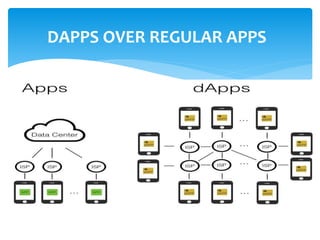
WHAT IS A DAPP?
A DApp or Decentralized
Application has its backend code
running on a decentralized peer to
peer network.
Contrast with an app where the
backend code is running on
centralized servers.
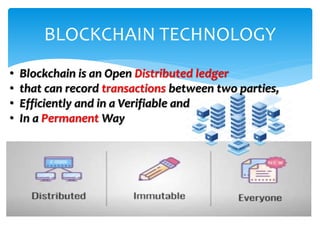
BLOCKCHAIN TECHNOLOGY
• Blockchain is an Open Distributed ledger
• that can record transactions between two parties,
• Efficiently and in a Verifiable and
• In a Permanent Way
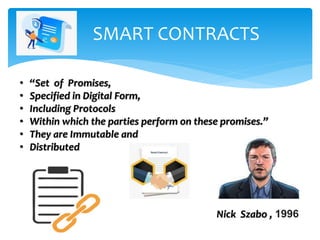
SMART CONTRACTS
• “Set of Promises,
• Specified in Digital Form,
• Including Protocols
• Within which the parties perform on these promises.”
• They are Immutable and
• Distributed
Nick Szabo , 1996
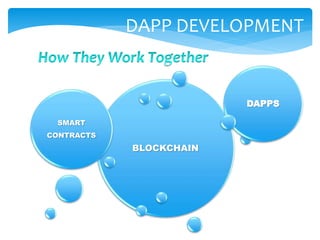
BLOCKCHAIN
SMART
CONTRACTS
DAPPS
DAPP DEVELOPMENT
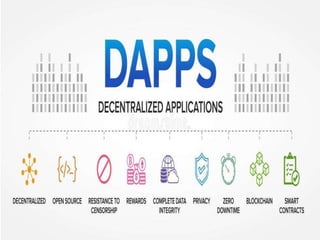
 Decentralized : dapps operate on Ethereum, an open public
decentralized platform where no one person or group has
control.
 Open Source : Source code of the DApp is available to all.
 Resistance to Censorship: No single entity on the network
can block users from submitting transactions, deploying
dapps, or reading data from the blockchain.
 Rewards: Reward system allows decentralized messaging
app users to earn crypto.
 Complete Data Integrity: Data stored on the blockchain is
immutable and indisputable, thanks to cryptographic
primitives. Malicious actors cannot forge transactions or
other data that has already been made public.
 Privacy: You don’t need to provide real-world identity to
deploy or interact with a dapp.
 Zero downtime – Once the smart contract is deployed on
the blockchain, the network as a whole will always be able
to serve clients looking to interact with the contract.
Malicious actors, therefore, cannot launch denial-of-service
attacks targeted towards individual dapps.
 Blockchain and Smart Contracts
DAPPS OVER REGULAR APPS
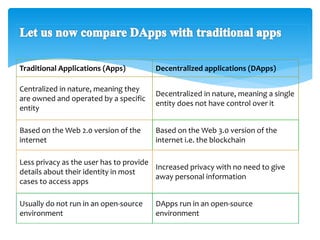
Traditional Applications (Apps) Decentralized applications (DApps)
Centralized in nature, meaning they
are owned and operated by a specific
entity
Decentralized in nature, meaning a single
entity does not have control over it
Based on the Web 2.0 version of the
internet
Based on the Web 3.0 version of the
internet i.e. the blockchain
Less privacy as the user has to provide
details about their identity in most
cases to access apps
Increased privacy with no need to give
away personal information
Usually do not run in an open-source
environment
DApps run in an open-source
environment
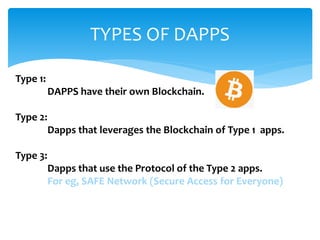
TYPES OF DAPPS
Type 1:
DAPPS have their own Blockchain.
Type 2:
Dapps that leverages the Blockchain of Type 1 apps.
Type 3:
Dapps that use the Protocol of the Type 2 apps.
For eg, SAFE Network (Secure Access for Everyone)
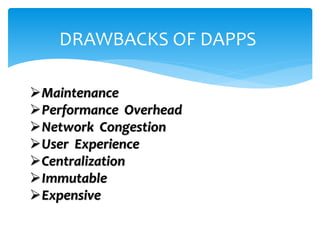
DRAWBACKS OF DAPPS
Maintenance
Performance Overhead
Network Congestion
User Experience
Centralization
Immutable
Expensive
EXAMPLES
Following are a few of the application examples of dApps:
 Augur: A decentralized prediction marketplace based on Ethereum
 Uniswap : US based DApp on Ethereum blockchain. It allows users to
swap and trade ERC-20 tokens.
 Aave: most popular DApp in DeFi world. Its an open source liquidity
protocol.
 Bit Torrent: A decentralized file-sharing application
 Golem: A decentralized marketplace for renting computational power
and resources
 Cryptokitties: A decentralized game application
 Minds: A decentralized social media platform between content creators
and consumers
FEAUTURES PROSPECTS AND
CONCLUSION
This has led us to the end of the discussion, and from the above discussion, it is
clear that dApps outstands when compared to regular mobile apps in terms of
transparency, reliability, flexibility, and scalability, and these factors are
stimulating the global DApps Market.
If we look at the statistics, it was estimated that the market size of dApps was
valued at USD 10.52 Billion in 2019 and is expected to reach USD 368.25 Billion
by the year 2027 at a CAGR of 56.1%. The rising demand for fast transaction
processes and the advantages of DApps in terms of transparency, reliability,
flexibility, and scalability are spurring the global dApps market.
Since dapps are new innovative technologies, learning how to build dApps on
Ethereum can bring tremendous career opportunities in the Blockchain space.
DECENTRALIZED APPLICATIONS USING BLOCKCHAING TECHNOLOGY.pptx

DECENTRALIZED APPLICATIONS USING BLOCKCHAING TECHNOLOGY.pptx

  • 1.
  • 2.
    OVER VIEW Intoduction Blockchain Technology SmartContracts Dapp Development Dapps and Its feautures Type of DApps Traditional Apps VS Dapps Drawbacks Of DApps Future Prospects Conclusion
  • 3.
    Introduction into DApps WHAT ISA DAPP? A DApp or Decentralized Application has its backend code running on a decentralized peer to peer network. Contrast with an app where the backend code is running on centralized servers.
  • 4.
    BLOCKCHAIN TECHNOLOGY • Blockchainis an Open Distributed ledger • that can record transactions between two parties, • Efficiently and in a Verifiable and • In a Permanent Way
  • 6.
    SMART CONTRACTS • “Setof Promises, • Specified in Digital Form, • Including Protocols • Within which the parties perform on these promises.” • They are Immutable and • Distributed Nick Szabo , 1996
  • 7.
  • 9.
     Decentralized :dapps operate on Ethereum, an open public decentralized platform where no one person or group has control.  Open Source : Source code of the DApp is available to all.  Resistance to Censorship: No single entity on the network can block users from submitting transactions, deploying dapps, or reading data from the blockchain.  Rewards: Reward system allows decentralized messaging app users to earn crypto.  Complete Data Integrity: Data stored on the blockchain is immutable and indisputable, thanks to cryptographic primitives. Malicious actors cannot forge transactions or other data that has already been made public.  Privacy: You don’t need to provide real-world identity to deploy or interact with a dapp.  Zero downtime – Once the smart contract is deployed on the blockchain, the network as a whole will always be able to serve clients looking to interact with the contract. Malicious actors, therefore, cannot launch denial-of-service attacks targeted towards individual dapps.  Blockchain and Smart Contracts
  • 10.
  • 11.
    Traditional Applications (Apps)Decentralized applications (DApps) Centralized in nature, meaning they are owned and operated by a specific entity Decentralized in nature, meaning a single entity does not have control over it Based on the Web 2.0 version of the internet Based on the Web 3.0 version of the internet i.e. the blockchain Less privacy as the user has to provide details about their identity in most cases to access apps Increased privacy with no need to give away personal information Usually do not run in an open-source environment DApps run in an open-source environment
  • 12.
    TYPES OF DAPPS Type1: DAPPS have their own Blockchain. Type 2: Dapps that leverages the Blockchain of Type 1 apps. Type 3: Dapps that use the Protocol of the Type 2 apps. For eg, SAFE Network (Secure Access for Everyone)
  • 13.
    DRAWBACKS OF DAPPS Maintenance PerformanceOverhead Network Congestion User Experience Centralization Immutable Expensive
  • 14.
    EXAMPLES Following are afew of the application examples of dApps:  Augur: A decentralized prediction marketplace based on Ethereum  Uniswap : US based DApp on Ethereum blockchain. It allows users to swap and trade ERC-20 tokens.  Aave: most popular DApp in DeFi world. Its an open source liquidity protocol.  Bit Torrent: A decentralized file-sharing application  Golem: A decentralized marketplace for renting computational power and resources  Cryptokitties: A decentralized game application  Minds: A decentralized social media platform between content creators and consumers
  • 15.
    FEAUTURES PROSPECTS AND CONCLUSION Thishas led us to the end of the discussion, and from the above discussion, it is clear that dApps outstands when compared to regular mobile apps in terms of transparency, reliability, flexibility, and scalability, and these factors are stimulating the global DApps Market. If we look at the statistics, it was estimated that the market size of dApps was valued at USD 10.52 Billion in 2019 and is expected to reach USD 368.25 Billion by the year 2027 at a CAGR of 56.1%. The rising demand for fast transaction processes and the advantages of DApps in terms of transparency, reliability, flexibility, and scalability are spurring the global dApps market. Since dapps are new innovative technologies, learning how to build dApps on Ethereum can bring tremendous career opportunities in the Blockchain space.