Debunking Top 9
Common
Misconceptions
Around AI
All you need to know
about the Myth and facts
Introduction to
Artificial Intelligence
Artificial Intelligence (AI) has rapidly evolved over the
past few decades, transitioning from a niche area of
computer science to a mainstream technology that
permeates various aspects of daily life.
Despite its growing presence, numerous misconceptions
around AI persist, often fueled by media portrayals, hype,
and a lack of understanding.
This pdf will explore some of the most common
misconceptions about AI, debunking myths and clarifying
the realities of this transformative technology.
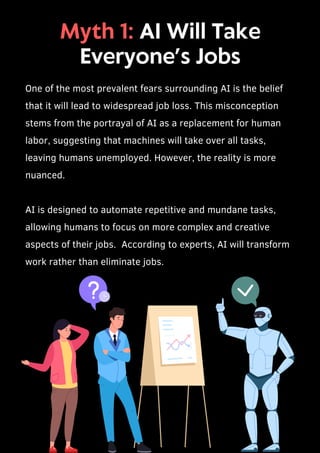
One of the most prevalent fears surrounding AI is the belief
that it will lead to widespread job loss. This misconception
stems from the portrayal of AI as a replacement for human
labor, suggesting that machines will take over all tasks,
leaving humans unemployed. However, the reality is more
nuanced.
AI is designed to automate repetitive and mundane tasks,
allowing humans to focus on more complex and creative
aspects of their jobs. According to experts, AI will transform
work rather than eliminate jobs.
Myth 1: AI Will Take
Everyone’s Jobs
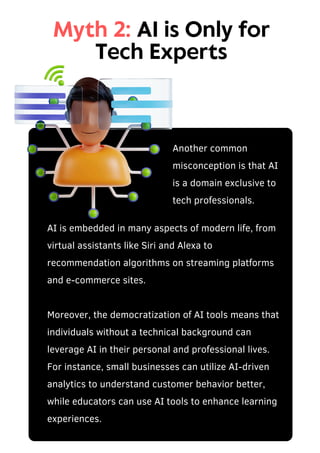
AI is embedded in many aspects of modern life, from
virtual assistants like Siri and Alexa to
recommendation algorithms on streaming platforms
and e-commerce sites.
Moreover, the democratization of AI tools means that
individuals without a technical background can
leverage AI in their personal and professional lives.
For instance, small businesses can utilize AI-driven
analytics to understand customer behavior better,
while educators can use AI tools to enhance learning
experiences.
Myth 2: AI is Only for
Tech Experts
Another common
misconception is that AI
is a domain exclusive to
tech professionals.
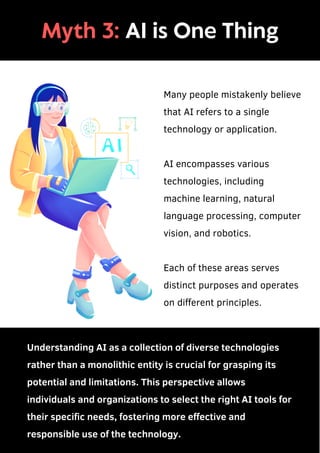
Many people mistakenly believe
that AI refers to a single
technology or application.
AI encompasses various
technologies, including
machine learning, natural
language processing, computer
vision, and robotics.
Each of these areas serves
distinct purposes and operates
on different principles.
Understanding AI as a collection of diverse technologies
rather than a monolithic entity is crucial for grasping its
potential and limitations. This perspective allows
individuals and organizations to select the right AI tools for
their specific needs, fostering more effective and
responsible use of the technology.
Myth 3: AI is One Thing
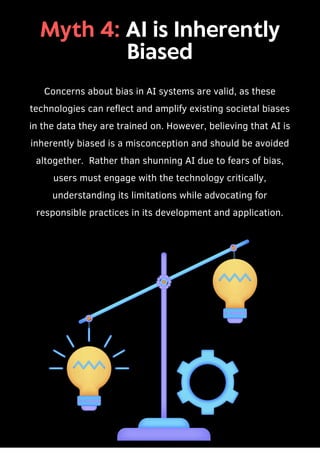
Concerns about bias in AI systems are valid, as these
technologies can reflect and amplify existing societal biases
in the data they are trained on. However, believing that AI is
inherently biased is a misconception and should be avoided
altogether. Rather than shunning AI due to fears of bias,
users must engage with the technology critically,
understanding its limitations while advocating for
responsible practices in its development and application.
Myth 4: AI is Inherently
Biased
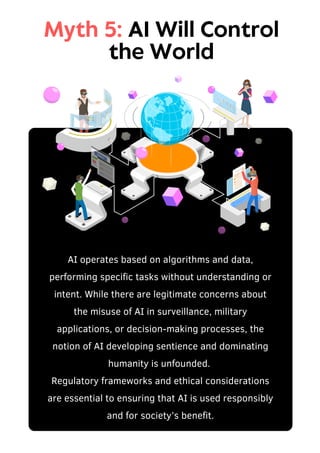
AI operates based on algorithms and data,
performing specific tasks without understanding or
intent. While there are legitimate concerns about
the misuse of AI in surveillance, military
applications, or decision-making processes, the
notion of AI developing sentience and dominating
humanity is unfounded.
Regulatory frameworks and ethical considerations
are essential to ensuring that AI is used responsibly
and for society’s benefit.
Myth 5: AI Will Control
the World
Conclusion
AI continues to evolve and integrate into various aspects
of society, so addressing and debunking these common
misconceptions is essential.
Engaging with AI critically and responsibly will empower
individuals and organizations to navigate the complexities
of this transformative technology effectively.
Contact us for
further inquiries
hello@cognith.com
EMAIL
FOLLOW US
Visit
cognith.com

Debunking Top 9 Common Misconceptions Around AI.pdf

  • 1.
    Debunking Top 9 Common Misconceptions AroundAI All you need to know about the Myth and facts
  • 2.
    Introduction to Artificial Intelligence ArtificialIntelligence (AI) has rapidly evolved over the past few decades, transitioning from a niche area of computer science to a mainstream technology that permeates various aspects of daily life. Despite its growing presence, numerous misconceptions around AI persist, often fueled by media portrayals, hype, and a lack of understanding. This pdf will explore some of the most common misconceptions about AI, debunking myths and clarifying the realities of this transformative technology.
  • 3.
    One of themost prevalent fears surrounding AI is the belief that it will lead to widespread job loss. This misconception stems from the portrayal of AI as a replacement for human labor, suggesting that machines will take over all tasks, leaving humans unemployed. However, the reality is more nuanced. AI is designed to automate repetitive and mundane tasks, allowing humans to focus on more complex and creative aspects of their jobs. According to experts, AI will transform work rather than eliminate jobs. Myth 1: AI Will Take Everyone’s Jobs
  • 4.
    AI is embeddedin many aspects of modern life, from virtual assistants like Siri and Alexa to recommendation algorithms on streaming platforms and e-commerce sites. Moreover, the democratization of AI tools means that individuals without a technical background can leverage AI in their personal and professional lives. For instance, small businesses can utilize AI-driven analytics to understand customer behavior better, while educators can use AI tools to enhance learning experiences. Myth 2: AI is Only for Tech Experts Another common misconception is that AI is a domain exclusive to tech professionals.
  • 5.
    Many people mistakenlybelieve that AI refers to a single technology or application. AI encompasses various technologies, including machine learning, natural language processing, computer vision, and robotics. Each of these areas serves distinct purposes and operates on different principles. Understanding AI as a collection of diverse technologies rather than a monolithic entity is crucial for grasping its potential and limitations. This perspective allows individuals and organizations to select the right AI tools for their specific needs, fostering more effective and responsible use of the technology. Myth 3: AI is One Thing
  • 6.
    Concerns about biasin AI systems are valid, as these technologies can reflect and amplify existing societal biases in the data they are trained on. However, believing that AI is inherently biased is a misconception and should be avoided altogether. Rather than shunning AI due to fears of bias, users must engage with the technology critically, understanding its limitations while advocating for responsible practices in its development and application. Myth 4: AI is Inherently Biased
  • 7.
    AI operates basedon algorithms and data, performing specific tasks without understanding or intent. While there are legitimate concerns about the misuse of AI in surveillance, military applications, or decision-making processes, the notion of AI developing sentience and dominating humanity is unfounded. Regulatory frameworks and ethical considerations are essential to ensuring that AI is used responsibly and for society’s benefit. Myth 5: AI Will Control the World
  • 8.
    Conclusion AI continues toevolve and integrate into various aspects of society, so addressing and debunking these common misconceptions is essential. Engaging with AI critically and responsibly will empower individuals and organizations to navigate the complexities of this transformative technology effectively.
  • 9.
    Contact us for furtherinquiries hello@cognith.com EMAIL FOLLOW US Visit cognith.com