Good afternoon
Difficult Debtors:
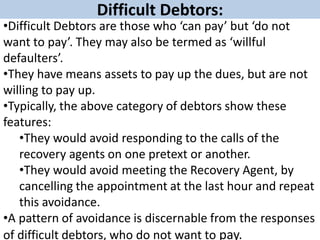
•Difficult Debtors are those who ‘can pay’ but ‘do not
want to pay’. They may also be termed as ‘willful
defaulters’.
•They have means assets to pay up the dues, but are not
willing to pay up.
•Typically, the above category of debtors show these
features:
•They would avoid responding to the calls of the
recovery agents on one pretext or another.
•They would avoid meeting the Recovery Agent, by
cancelling the appointment at the last hour and repeat
this avoidance.
•A pattern of avoidance is discernable from the responses
of difficult debtors, who do not want to pay.
Difficult Debtors contd…..
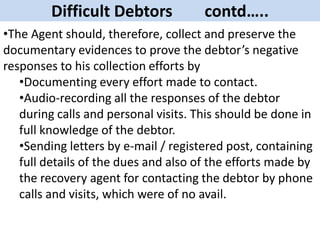
•The Agent should, therefore, collect and preserve the
documentary evidences to prove the debtor’s negative
responses to his collection efforts by
•Documenting every effort made to contact.
•Audio-recording all the responses of the debtor
during calls and personal visits. This should be done in
full knowledge of the debtor.
•Sending letters by e-mail / registered post, containing
full details of the dues and also of the efforts made by
the recovery agent for contacting the debtor by phone
calls and visits, which were of no avail.
Difficult Debtors contd…..
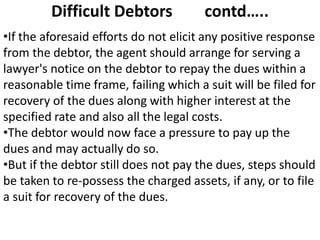
•If the aforesaid efforts do not elicit any positive response
from the debtor, the agent should arrange for serving a
lawyer's notice on the debtor to repay the dues within a
reasonable time frame, failing which a suit will be filed for
recovery of the dues along with higher interest at the
specified rate and also all the legal costs.
•The debtor would now face a pressure to pay up the
dues and may actually do so.
•But if the debtor still does not pay the dues, steps should
be taken to re-possess the charged assets, if any, or to file
a suit for recovery of the dues.
Case Study
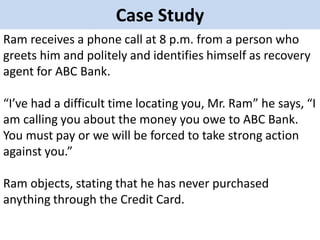
Ram receives a phone call at 8 p.m. from a person who
greets him and politely and identifies himself as recovery
agent for ABC Bank.
“I’ve had a difficult time locating you, Mr. Ram” he says, “I
am calling you about the money you owe to ABC Bank.
You must pay or we will be forced to take strong action
against you.”
Ram objects, stating that he has never purchased
anything through the Credit Card.
Case Study
In the case of ICICI Bank Ltd. v. Prakash Kaur and
Ors.(2007), a loan was taken by the Petitioner in
order to purchase a car and certain defaults were
committed by him in repayment. As a consequence
of this, the vehicle with the Petitioner was taken
away from the Petitioner by force through
employing musclemen. The Court, in this case,
gave the ruling that neither force can be utilized
nor musclemen or hooligans can be hired by a
private or nationalized bank in order to recover the
amount of a loan.
Case Study
Case Study 1: HDFC Bank Recovery
Mr.Kaushik Agarwal, about 18 months back had purchased 1 Tata
Indigo, financed by HDFC bank. His EMI for this month (May’08)
was bounced due to some reasons.
The recovery person called him on the 22nd May for the payment
of the same. He was out of town at that moment so Mr.Kaushik
had asked him to send someone to his office on the 24th to
collect cash.
Now on 24th it slipped out of Kaushik’s mind that he had to pay
cash to HDFC Bank and hence he did not withdraw any cash from
the bank. As it was a Saturday so when the person came for
collection, he requested him to come on Monday, as the bank was
already closed for the day.
.
Contd…
On this the person, who had called Kaushik earlier on the
22nd, called him again and started shouting at him and
speaking in a very bad language. The person told Mr. Kaushik
that they know his Residence addresses, so if he don’t pay
them today they will come to his house and will insult him in
neighborhood. The person also passed threat on him that if
Kaushik don’t pay within 5 minutes it would be very bad for
him. The person kept using foul words and shouting at him,
until he disconnected the phone.
After this Kaushik had no option to go to his local police
station and lodge a complaint against that person, and Mr.
Kaushik have also decided to put a case against that person
and HDFC bank in consumer court as well as civil court.
Kaushik has also posted a complaint with HDFC Grievance
cell, docket no. TF22534017. Kaushik requests the concerned
authority to take some action on this
how to recover dues from a difficult debtor
Out-of-court options
One of the fastest and most economical ways of
recovering money is to opt for an out-of-court
settlement, such as arbitration or conciliation,
provided that the other party is also willing to settle in
this manner.
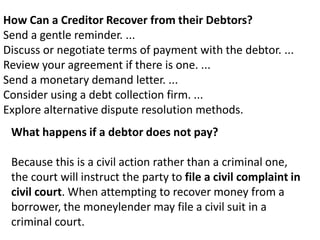
How Can a Creditor Recover from their Debtors?
Send a gentle reminder. ...
Discuss or negotiate terms of payment with the debtor. ...
Review your agreement if there is one. ...
Send a monetary demand letter. ...
Consider using a debt collection firm. ...
Explore alternative dispute resolution methods.
What happens if a debtor does not pay?
Because this is a civil action rather than a criminal one,
the court will instruct the party to file a civil complaint in
civil court. When attempting to recover money from a
borrower, the moneylender may file a civil suit in a
criminal court.
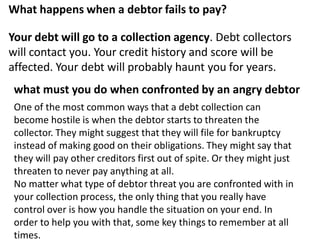
What happens when a debtor fails to pay?
Your debt will go to a collection agency. Debt collectors
will contact you. Your credit history and score will be
affected. Your debt will probably haunt you for years.
what must you do when confronted by an angry debtor
One of the most common ways that a debt collection can
become hostile is when the debtor starts to threaten the
collector. They might suggest that they will file for bankruptcy
instead of making good on their obligations. They might say that
they will pay other creditors first out of spite. Or they might just
threaten to never pay anything at all.
No matter what type of debtor threat you are confronted with in
your collection process, the only thing that you really have
control over is how you handle the situation on your end. In
order to help you with that, some key things to remember at all
times.
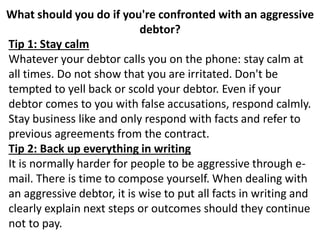
What should you do if you're confronted with an aggressive
debtor?
Tip 1: Stay calm
Whatever your debtor calls you on the phone: stay calm at
all times. Do not show that you are irritated. Don't be
tempted to yell back or scold your debtor. Even if your
debtor comes to you with false accusations, respond calmly.
Stay business like and only respond with facts and refer to
previous agreements from the contract.
Tip 2: Back up everything in writing
It is normally harder for people to be aggressive through e-
mail. There is time to compose yourself. When dealing with
an aggressive debtor, it is wise to put all facts in writing and
clearly explain next steps or outcomes should they continue
not to pay.
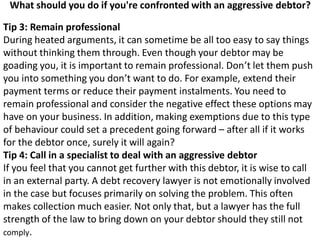
What should you do if you're confronted with an aggressive debtor?
Tip 3: Remain professional
During heated arguments, it can sometime be all too easy to say things
without thinking them through. Even though your debtor may be
goading you, it is important to remain professional. Don’t let them push
you into something you don’t want to do. For example, extend their
payment terms or reduce their payment instalments. You need to
remain professional and consider the negative effect these options may
have on your business. In addition, making exemptions due to this type
of behaviour could set a precedent going forward – after all if it works
for the debtor once, surely it will again?
Tip 4: Call in a specialist to deal with an aggressive debtor
If you feel that you cannot get further with this debtor, it is wise to call
in an external party. A debt recovery lawyer is not emotionally involved
in the case but focuses primarily on solving the problem. This often
makes collection much easier. Not only that, but a lawyer has the full
strength of the law to bring down on your debtor should they still not
comply.
How to Respond to Threats From Debtors
No matter what type of debtor threat you are confronted with in your collection process,
the only thing that you really have control over is how you handle the situation on your
end. In order to help you with that, we have put together six key things to remember at all
times.
1.Stay Aggressive
It means…..
Understand assertiveness
Keep your communication style in the line
Understand and accept difference
Speak simply and directly
Exercise the power of “I”
Stay calm
Set boundaries
How to Respond to Threats From Debtors
2vStick to Your Plan
Rather than allowing a debtor to slow you down, make sure
that you stick to your written debt collection strategy. You
put that plan in place for a reason, and the more hostile a
collection becomes, the more important that plan will be.
3. Focus on the Facts
Because most types of debtor threats come from an
emotional place, one of the best ways that you can respond
to them is by dealing with the facts of the case. In all of
your communications with a hostile debtor, make sure that
you avoid any type of speculation and simply state the facts
related to the account.
How to Respond to Threats From Debtors
4. Respect All Regulations
It is also important that you make sure to follow the letter of the
law in all collection scenarios. No matter what a hostile debtors
says or does, you must always be sure to stay inside the lines
defined by the Fair Debt Collection Practices Act and any similar
legislation in your area.
5. Always Remain Calm
How you respond to a debtor’s threats will always impact where
the situation goes from there. If you allow the debtor to get you
into an emotional state of mind, they will likely take advantage of
that and attempt to do it again in the future. However, if you are
able to remain calm despite their threats, you will establish a
moral high ground that is more likely to be respected in the future.
How to Respond to Threats From Debtors
6. Avoid Waiting and Hoping
Debtors who make threats to their creditors are usually
attempting to buy time for themselves. If you give them
more time on account of those threats, you put yourself in
a position where you are going to be waiting and hoping to
receive payment at some point.
Instead of waiting and hoping, you should be actively
pursuing what is rightfully yours. In many cases, the best
way to do exactly that is to partner with a commercial debt
collection agency that has experience dealing with hostile
debtors and getting results despite those hostilities.

Dealing with Difficult Borrowers (1).pdf

  • 1.
  • 2.
    Difficult Debtors: •Difficult Debtorsare those who ‘can pay’ but ‘do not want to pay’. They may also be termed as ‘willful defaulters’. •They have means assets to pay up the dues, but are not willing to pay up. •Typically, the above category of debtors show these features: •They would avoid responding to the calls of the recovery agents on one pretext or another. •They would avoid meeting the Recovery Agent, by cancelling the appointment at the last hour and repeat this avoidance. •A pattern of avoidance is discernable from the responses of difficult debtors, who do not want to pay.
  • 3.
    Difficult Debtors contd….. •TheAgent should, therefore, collect and preserve the documentary evidences to prove the debtor’s negative responses to his collection efforts by •Documenting every effort made to contact. •Audio-recording all the responses of the debtor during calls and personal visits. This should be done in full knowledge of the debtor. •Sending letters by e-mail / registered post, containing full details of the dues and also of the efforts made by the recovery agent for contacting the debtor by phone calls and visits, which were of no avail.
  • 4.
    Difficult Debtors contd….. •Ifthe aforesaid efforts do not elicit any positive response from the debtor, the agent should arrange for serving a lawyer's notice on the debtor to repay the dues within a reasonable time frame, failing which a suit will be filed for recovery of the dues along with higher interest at the specified rate and also all the legal costs. •The debtor would now face a pressure to pay up the dues and may actually do so. •But if the debtor still does not pay the dues, steps should be taken to re-possess the charged assets, if any, or to file a suit for recovery of the dues.
  • 5.
    Case Study Ram receivesa phone call at 8 p.m. from a person who greets him and politely and identifies himself as recovery agent for ABC Bank. “I’ve had a difficult time locating you, Mr. Ram” he says, “I am calling you about the money you owe to ABC Bank. You must pay or we will be forced to take strong action against you.” Ram objects, stating that he has never purchased anything through the Credit Card.
  • 6.
    Case Study In thecase of ICICI Bank Ltd. v. Prakash Kaur and Ors.(2007), a loan was taken by the Petitioner in order to purchase a car and certain defaults were committed by him in repayment. As a consequence of this, the vehicle with the Petitioner was taken away from the Petitioner by force through employing musclemen. The Court, in this case, gave the ruling that neither force can be utilized nor musclemen or hooligans can be hired by a private or nationalized bank in order to recover the amount of a loan.
  • 7.
    Case Study Case Study1: HDFC Bank Recovery Mr.Kaushik Agarwal, about 18 months back had purchased 1 Tata Indigo, financed by HDFC bank. His EMI for this month (May’08) was bounced due to some reasons. The recovery person called him on the 22nd May for the payment of the same. He was out of town at that moment so Mr.Kaushik had asked him to send someone to his office on the 24th to collect cash. Now on 24th it slipped out of Kaushik’s mind that he had to pay cash to HDFC Bank and hence he did not withdraw any cash from the bank. As it was a Saturday so when the person came for collection, he requested him to come on Monday, as the bank was already closed for the day. .
  • 8.
    Contd… On this theperson, who had called Kaushik earlier on the 22nd, called him again and started shouting at him and speaking in a very bad language. The person told Mr. Kaushik that they know his Residence addresses, so if he don’t pay them today they will come to his house and will insult him in neighborhood. The person also passed threat on him that if Kaushik don’t pay within 5 minutes it would be very bad for him. The person kept using foul words and shouting at him, until he disconnected the phone. After this Kaushik had no option to go to his local police station and lodge a complaint against that person, and Mr. Kaushik have also decided to put a case against that person and HDFC bank in consumer court as well as civil court. Kaushik has also posted a complaint with HDFC Grievance cell, docket no. TF22534017. Kaushik requests the concerned authority to take some action on this
  • 9.
    how to recoverdues from a difficult debtor Out-of-court options One of the fastest and most economical ways of recovering money is to opt for an out-of-court settlement, such as arbitration or conciliation, provided that the other party is also willing to settle in this manner.
  • 10.
    How Can aCreditor Recover from their Debtors? Send a gentle reminder. ... Discuss or negotiate terms of payment with the debtor. ... Review your agreement if there is one. ... Send a monetary demand letter. ... Consider using a debt collection firm. ... Explore alternative dispute resolution methods. What happens if a debtor does not pay? Because this is a civil action rather than a criminal one, the court will instruct the party to file a civil complaint in civil court. When attempting to recover money from a borrower, the moneylender may file a civil suit in a criminal court.
  • 11.
    What happens whena debtor fails to pay? Your debt will go to a collection agency. Debt collectors will contact you. Your credit history and score will be affected. Your debt will probably haunt you for years. what must you do when confronted by an angry debtor One of the most common ways that a debt collection can become hostile is when the debtor starts to threaten the collector. They might suggest that they will file for bankruptcy instead of making good on their obligations. They might say that they will pay other creditors first out of spite. Or they might just threaten to never pay anything at all. No matter what type of debtor threat you are confronted with in your collection process, the only thing that you really have control over is how you handle the situation on your end. In order to help you with that, some key things to remember at all times.
  • 12.
    What should youdo if you're confronted with an aggressive debtor? Tip 1: Stay calm Whatever your debtor calls you on the phone: stay calm at all times. Do not show that you are irritated. Don't be tempted to yell back or scold your debtor. Even if your debtor comes to you with false accusations, respond calmly. Stay business like and only respond with facts and refer to previous agreements from the contract. Tip 2: Back up everything in writing It is normally harder for people to be aggressive through e- mail. There is time to compose yourself. When dealing with an aggressive debtor, it is wise to put all facts in writing and clearly explain next steps or outcomes should they continue not to pay.
  • 13.
    What should youdo if you're confronted with an aggressive debtor? Tip 3: Remain professional During heated arguments, it can sometime be all too easy to say things without thinking them through. Even though your debtor may be goading you, it is important to remain professional. Don’t let them push you into something you don’t want to do. For example, extend their payment terms or reduce their payment instalments. You need to remain professional and consider the negative effect these options may have on your business. In addition, making exemptions due to this type of behaviour could set a precedent going forward – after all if it works for the debtor once, surely it will again? Tip 4: Call in a specialist to deal with an aggressive debtor If you feel that you cannot get further with this debtor, it is wise to call in an external party. A debt recovery lawyer is not emotionally involved in the case but focuses primarily on solving the problem. This often makes collection much easier. Not only that, but a lawyer has the full strength of the law to bring down on your debtor should they still not comply.
  • 14.
    How to Respondto Threats From Debtors No matter what type of debtor threat you are confronted with in your collection process, the only thing that you really have control over is how you handle the situation on your end. In order to help you with that, we have put together six key things to remember at all times. 1.Stay Aggressive It means….. Understand assertiveness Keep your communication style in the line Understand and accept difference Speak simply and directly Exercise the power of “I” Stay calm Set boundaries
  • 15.
    How to Respondto Threats From Debtors 2vStick to Your Plan Rather than allowing a debtor to slow you down, make sure that you stick to your written debt collection strategy. You put that plan in place for a reason, and the more hostile a collection becomes, the more important that plan will be. 3. Focus on the Facts Because most types of debtor threats come from an emotional place, one of the best ways that you can respond to them is by dealing with the facts of the case. In all of your communications with a hostile debtor, make sure that you avoid any type of speculation and simply state the facts related to the account.
  • 16.
    How to Respondto Threats From Debtors 4. Respect All Regulations It is also important that you make sure to follow the letter of the law in all collection scenarios. No matter what a hostile debtors says or does, you must always be sure to stay inside the lines defined by the Fair Debt Collection Practices Act and any similar legislation in your area. 5. Always Remain Calm How you respond to a debtor’s threats will always impact where the situation goes from there. If you allow the debtor to get you into an emotional state of mind, they will likely take advantage of that and attempt to do it again in the future. However, if you are able to remain calm despite their threats, you will establish a moral high ground that is more likely to be respected in the future.
  • 17.
    How to Respondto Threats From Debtors 6. Avoid Waiting and Hoping Debtors who make threats to their creditors are usually attempting to buy time for themselves. If you give them more time on account of those threats, you put yourself in a position where you are going to be waiting and hoping to receive payment at some point. Instead of waiting and hoping, you should be actively pursuing what is rightfully yours. In many cases, the best way to do exactly that is to partner with a commercial debt collection agency that has experience dealing with hostile debtors and getting results despite those hostilities.