Presented by-
Divyanshi Dayalani
Harsh Chugh
Naivedya Lamba
Pushkar Shail
Rahman
1
2
SAMSUNG
• Founded : 1938
• Primarily into business of export of dried fish, veg and fruits
• Samsung electronics commenced its operations in India in 1995
• Market leader in LED TVs, Slim TVs and Smartphone Markets
• Largest IT company measured by 2015 revenue.
• World’s top smartphone maker with 78.7 million shipment worldwide.
• No. of employees : 5,23,000
3
L.G
• Founded : 1947 (seoul, South Korea)
• Primarily into business of plastic and household products
• It was formed by the merger of two companies : Lucky and Goldstar and
named as Lucky-Goldstar
• Market leadership in Refrigerator, Washing Machines & Microwave
ovens
• L.G electronics India emerged as Most trusted brand of 2015
• L.G was ranked no. 1 brand in India as per study done by Trust research
advisory
• No. of employees : 2,89,000
4
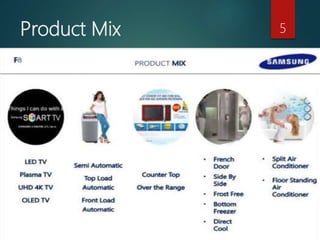
Product Mix 5
Product Mix 6
Distribution channel system 7
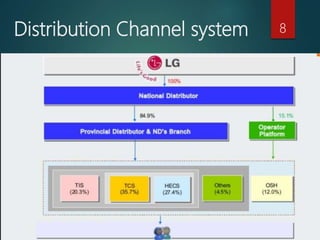
Distribution Channel system 8
Financial Aspects
SAMSUNG
• Brand Value : 66 billion US$
• Global Revenue: 174.05 billion US$
• Global Net Income : 19.6 billion US$
L.G
• Global Revenue : 143 billion US$
• Global Net Income: 10.3 billion US$
9
Key Findings in the channel
• Dealer Selection : Bidding System
• Incentives : Through certification & recognition
• Credit policy : Zero credit policy, however
Distributor  Retailer ( 7 Days)
• Offers: Goods free with other goods (push sales)
• Promotion : scratch cards & free gifts
10
Key Findings in the channel
• Dealer selection : Bidding & Exhibition system
• Incentives : Through Equity incentive plan, Health care plans bonuses
• L.G divide dealers into gold, silver category to know the performance of the
dealers
• LG is going to launch some other products in the market. The company is
trying to use latest technology in the manufacturing of its products especially
in its handsets
• Promotions : scratch cards, gifts, Free trips
11
Methodology
• Purpose: The primary objective of this survey is to determine customer
satisfaction levels and also to determine parameters which cause satisfaction
or dissatisfaction so that changes can be made where required.
• Sample size: The sample size of this research is 40 and the respondent are
located in Okhla, Indrapurum, Noida, Kailash colony and few other parts of
Delhi
• Sampling technique: We use convenience sampling technique.
12
Methodology
• Research type: Exploratory research
• Data collection method: The primary data is collected with the help of
personal interview and well drafted questionnaire are used as the tool.
• Analysis: Statistical tool and excel
13
Channel Satisfaction Index
Parameters-
• Product Quality
• Promotions
• Company Support
• Service Quality
• Commercial Terms
14
SAMSUNG 15
LG 16
17
Findings & Suggestions
L.G
• Reversal in product strategy.
• Hardware issues in products.
• Product designing issues.
• Lack of uniformity in product strategy.
Samsung
• Lack its own O.S and software.
• Focus on too many products.
• Too low profit margins.
• Tough competion from Chinese products
18
Distributor’s Visit 19
20

Dcm

  • 1.
    Presented by- Divyanshi Dayalani HarshChugh Naivedya Lamba Pushkar Shail Rahman 1
  • 2.
  • 3.
    SAMSUNG • Founded :1938 • Primarily into business of export of dried fish, veg and fruits • Samsung electronics commenced its operations in India in 1995 • Market leader in LED TVs, Slim TVs and Smartphone Markets • Largest IT company measured by 2015 revenue. • World’s top smartphone maker with 78.7 million shipment worldwide. • No. of employees : 5,23,000 3
  • 4.
    L.G • Founded :1947 (seoul, South Korea) • Primarily into business of plastic and household products • It was formed by the merger of two companies : Lucky and Goldstar and named as Lucky-Goldstar • Market leadership in Refrigerator, Washing Machines & Microwave ovens • L.G electronics India emerged as Most trusted brand of 2015 • L.G was ranked no. 1 brand in India as per study done by Trust research advisory • No. of employees : 2,89,000 4
  • 5.
  • 6.
  • 7.
  • 8.
  • 9.
    Financial Aspects SAMSUNG • BrandValue : 66 billion US$ • Global Revenue: 174.05 billion US$ • Global Net Income : 19.6 billion US$ L.G • Global Revenue : 143 billion US$ • Global Net Income: 10.3 billion US$ 9
  • 10.
    Key Findings inthe channel • Dealer Selection : Bidding System • Incentives : Through certification & recognition • Credit policy : Zero credit policy, however Distributor  Retailer ( 7 Days) • Offers: Goods free with other goods (push sales) • Promotion : scratch cards & free gifts 10
  • 11.
    Key Findings inthe channel • Dealer selection : Bidding & Exhibition system • Incentives : Through Equity incentive plan, Health care plans bonuses • L.G divide dealers into gold, silver category to know the performance of the dealers • LG is going to launch some other products in the market. The company is trying to use latest technology in the manufacturing of its products especially in its handsets • Promotions : scratch cards, gifts, Free trips 11
  • 12.
    Methodology • Purpose: Theprimary objective of this survey is to determine customer satisfaction levels and also to determine parameters which cause satisfaction or dissatisfaction so that changes can be made where required. • Sample size: The sample size of this research is 40 and the respondent are located in Okhla, Indrapurum, Noida, Kailash colony and few other parts of Delhi • Sampling technique: We use convenience sampling technique. 12
  • 13.
    Methodology • Research type:Exploratory research • Data collection method: The primary data is collected with the help of personal interview and well drafted questionnaire are used as the tool. • Analysis: Statistical tool and excel 13
  • 14.
    Channel Satisfaction Index Parameters- •Product Quality • Promotions • Company Support • Service Quality • Commercial Terms 14
  • 15.
  • 16.
  • 17.
  • 18.
    Findings & Suggestions L.G •Reversal in product strategy. • Hardware issues in products. • Product designing issues. • Lack of uniformity in product strategy. Samsung • Lack its own O.S and software. • Focus on too many products. • Too low profit margins. • Tough competion from Chinese products 18
  • 19.
  • 20.