EPILEPSY AND SEIZUE
CLASSIFICATION
Giuliano Avanzini
Istituto Neurologico C. Besta
Milano. Italy
21° San Servolo Advanced Epilepsy Course July 21-August 1 San Ser and new volo ,
Venice Italy
Bridging basic with Clinical Epileptology (8)
Contribution of non neuronal cells to epilepsy and new therapautic strategies
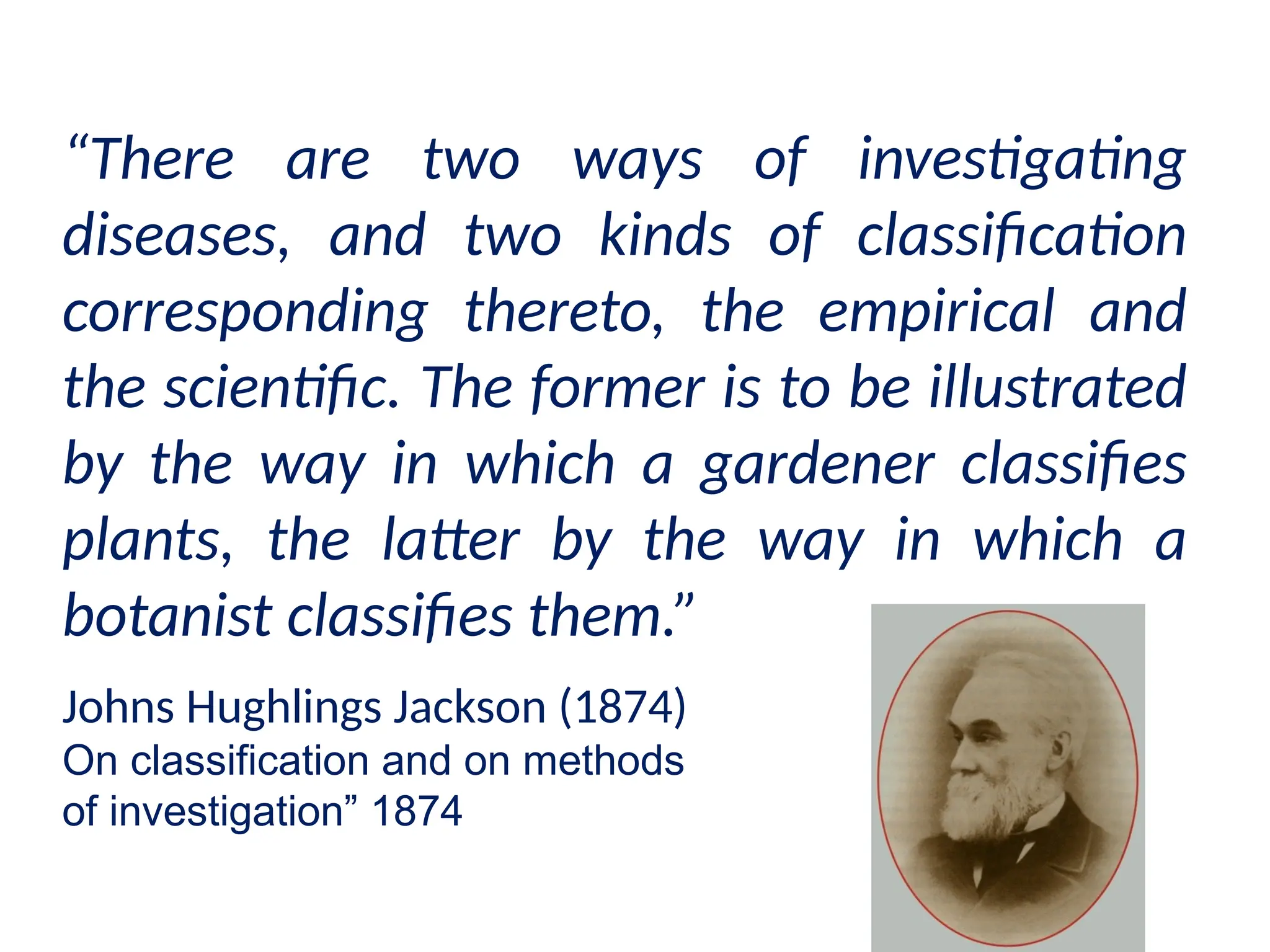
“There are two ways of investigating
diseases, and two kinds of classification
corresponding thereto, the empirical and
the scientific. The former is to be illustrated
by the way in which a gardener classifies
plants, the latter by the way in which a
botanist classifies them.”
Johns Hughlings Jackson (1874)
On classification and on methods
of investigation” 1874
The gardener arranges his plants as they
are fit for food, for ornament
etc. His object is the direct application of
knowledge The botanist classification (the
classification properly so-called) is rather
for the better organisation of existing
knowledge and for discovering the
relations of new facts, it is also of
utilitarian value, but not directly
Classifications reflect the state of
knowledge in a scientific field.
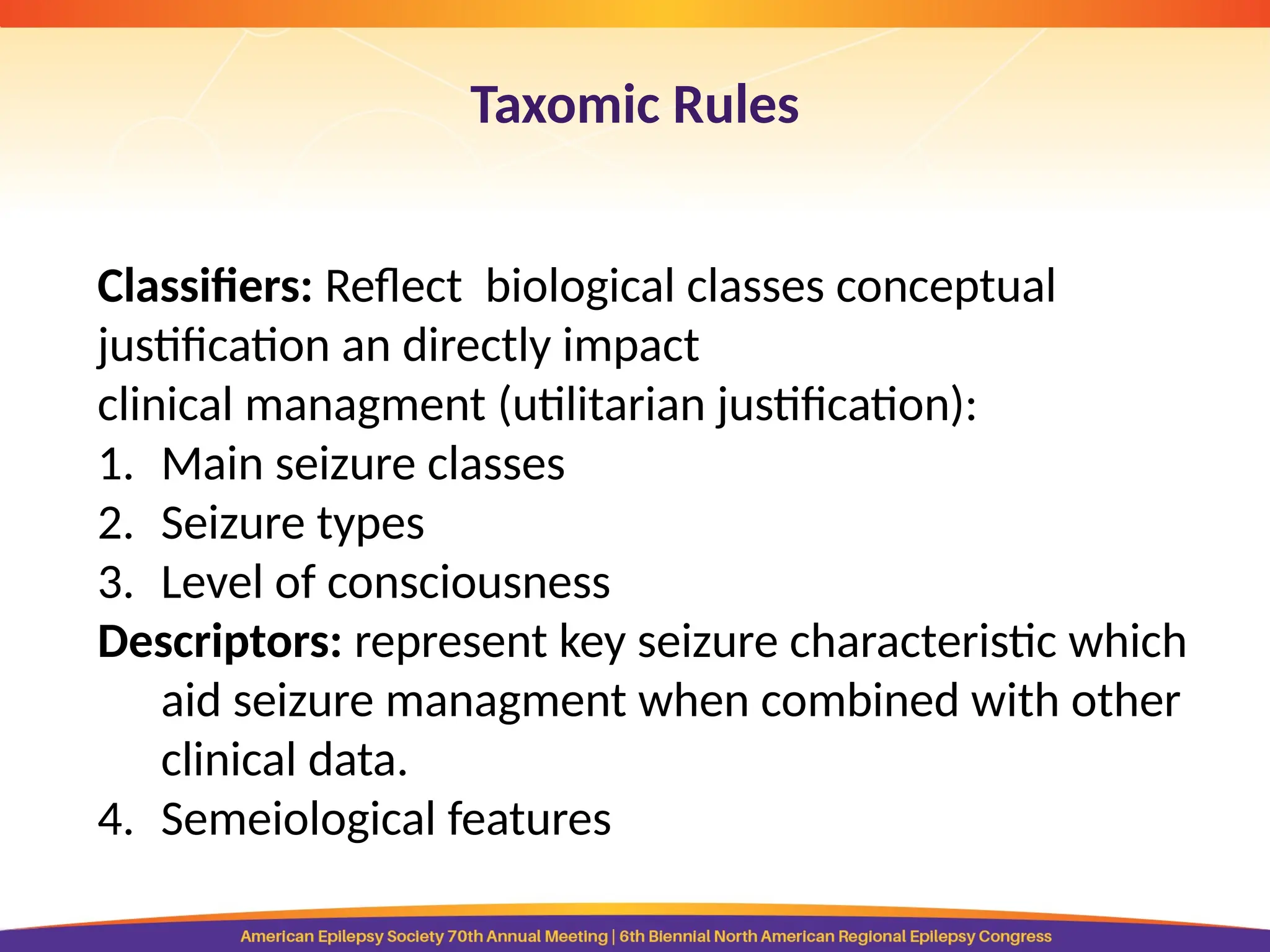
Taxomic Rules
Classifiers: Reflect biological classes conceptual
justification an directly impact
clinical managment (utilitarian justification):
1. Main seizure classes
2. Seizure types
3. Level of consciousness
Descriptors: represent key seizure characteristic which
aid seizure managment when combined with other
clinical data.
4. Semeiological features
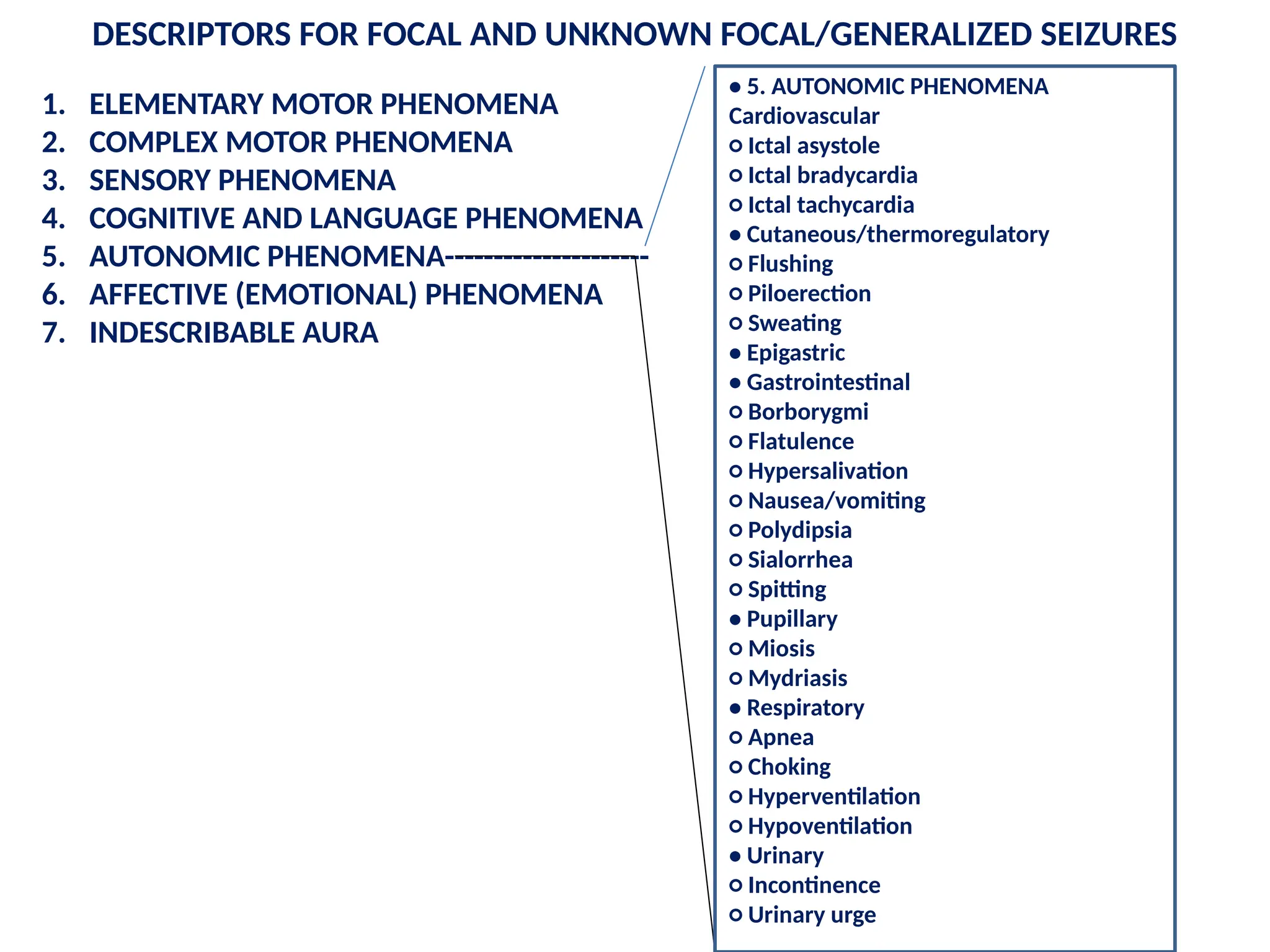
DESCRIPTORS FOR FOCAL AND UNKNOWN FOCAL/GENERALIZED SEIZURES
1. ELEMENTARY MOTOR PHENOMENA
2. COMPLEX MOTOR PHENOMENA
3. SENSORY PHENOMENA
4. COGNITIVE AND LANGUAGE PHENOMENA
5. AUTONOMIC PHENOMENA---------------------
6. AFFECTIVE (EMOTIONAL) PHENOMENA
7. INDESCRIBABLE AURA
• 5. AUTONOMIC PHENOMENA
Cardiovascular
○ Ictal asystole
○ Ictal bradycardia
○ Ictal tachycardia
• Cutaneous/thermoregulatory
○ Flushing
○ Piloerection
○ Sweating
• Epigastric
• Gastrointestinal
○ Borborygmi
○ Flatulence
○ Hypersalivation
○ Nausea/vomiting
○ Polydipsia
○ Sialorrhea
○ Spitting
• Pupillary
○ Miosis
○ Mydriasis
• Respiratory
○ Apnea
○ Choking
○ Hyperventilation
○ Hypoventilation
• Urinary
○ Incontinence
○ Urinary urge
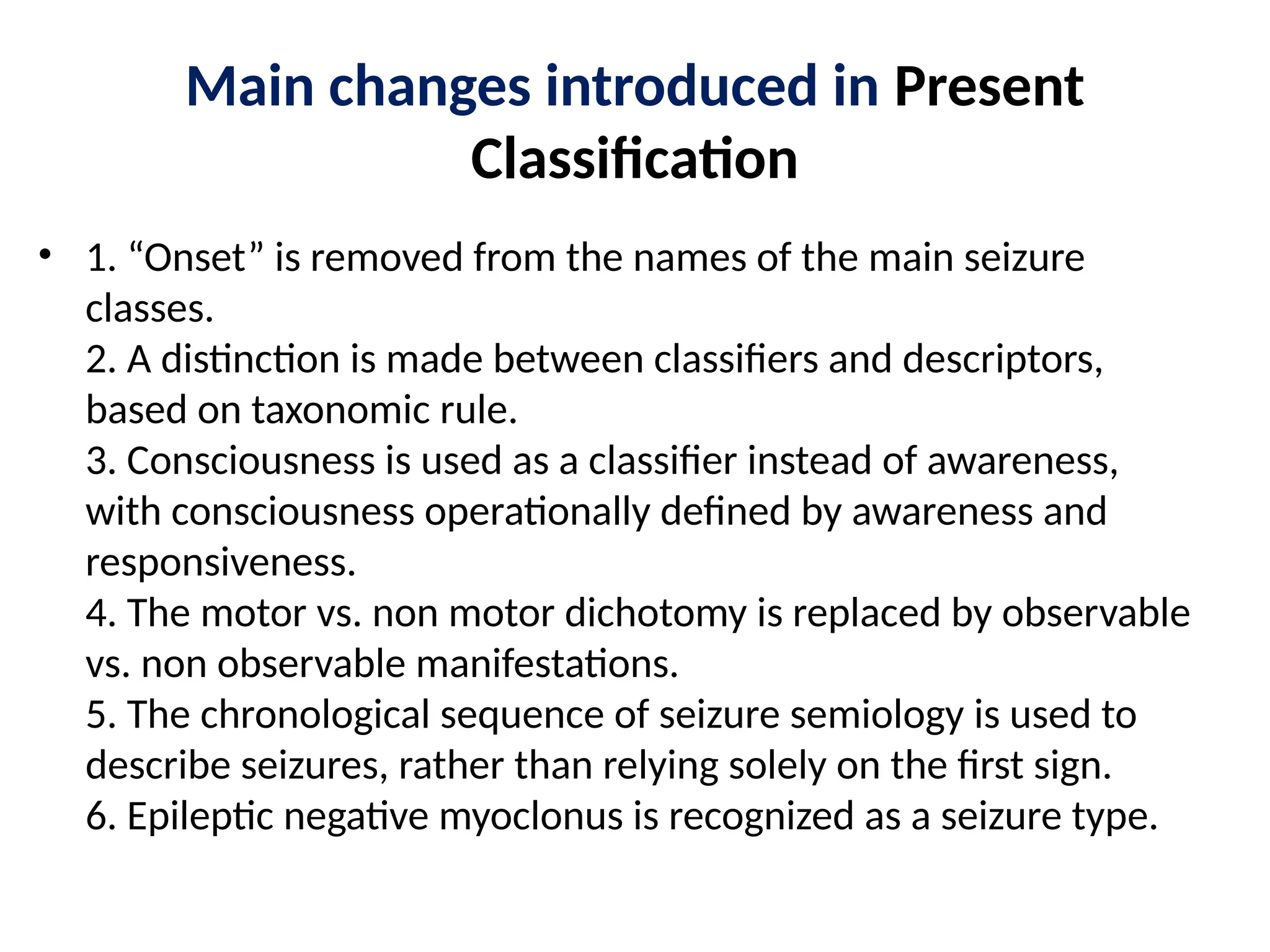
Main changes introduced in Present
Classification
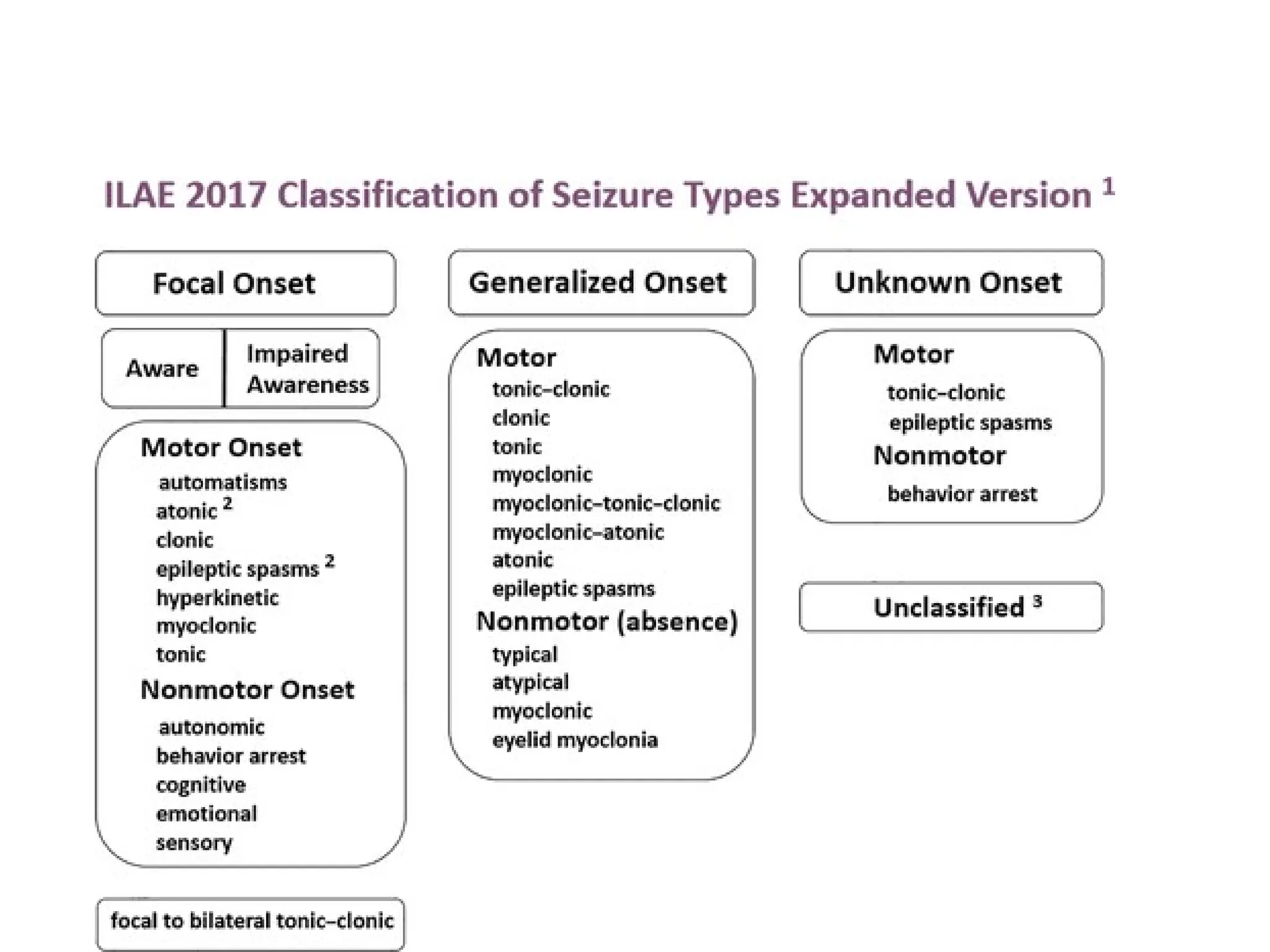
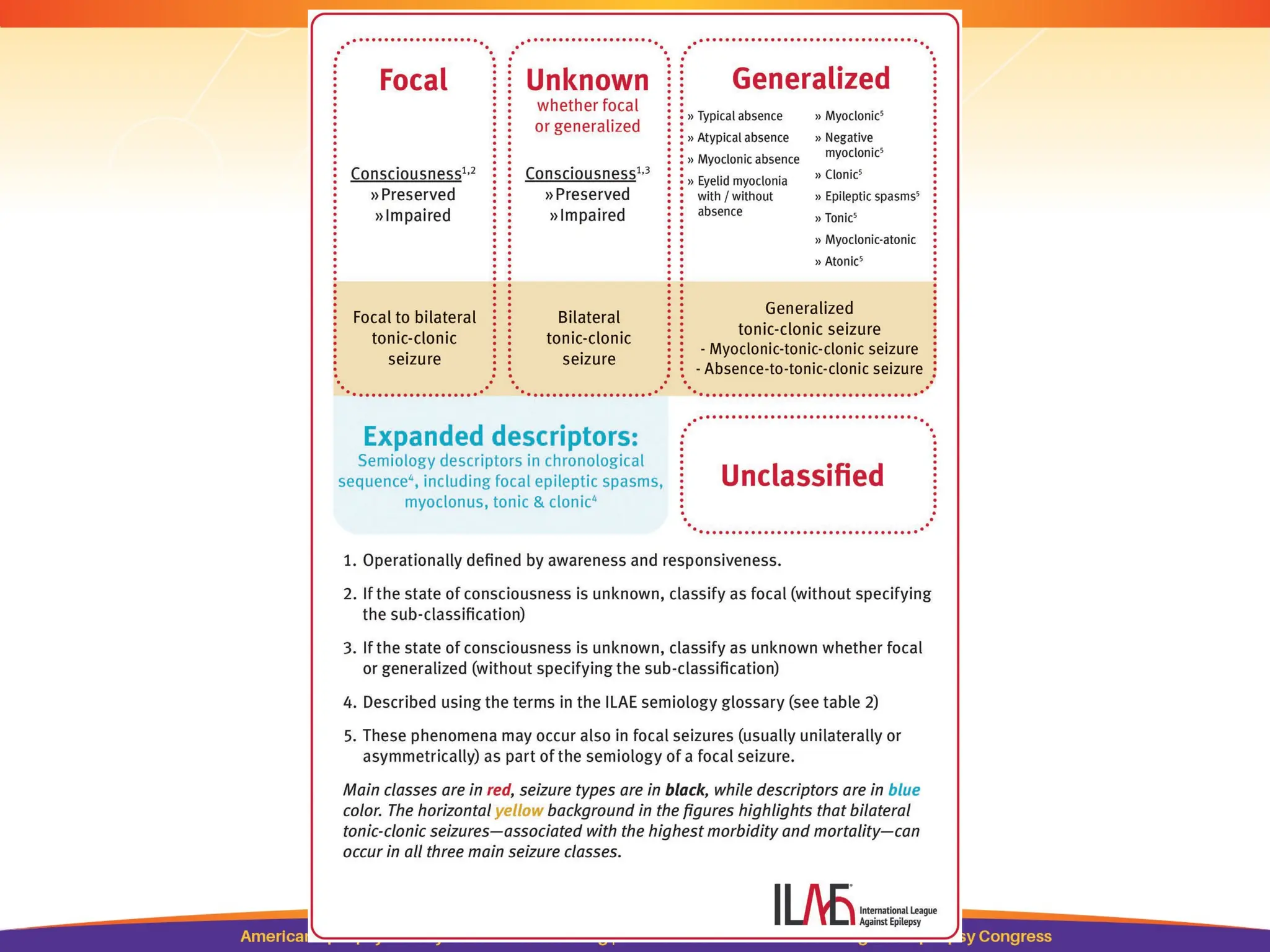
• 1. “Onset” is removed from the names of the main seizure
classes.
2. A distinction is made between classifiers and descriptors,
based on taxonomic rule.
3. Consciousness is used as a classifier instead of awareness,
with consciousness operationally defined by awareness and
responsiveness.
4. The motor vs. non motor dichotomy is replaced by observable
vs. non observable manifestations.
5. The chronological sequence of seizure semiology is used to
describe seizures, rather than relying solely on the first sign.
6. Epileptic negative myoclonus is recognized as a seizure type.
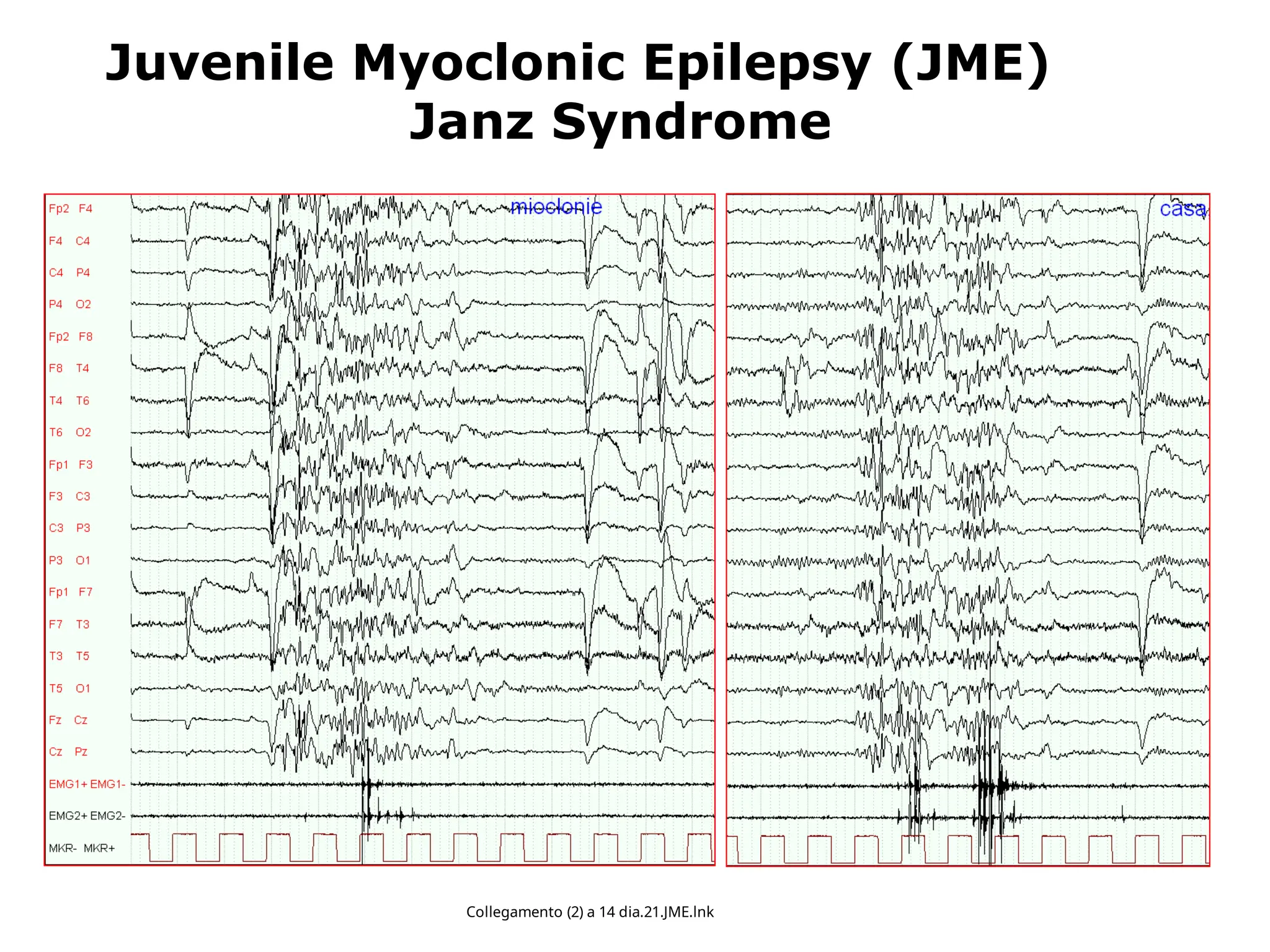
Juvenile Myoclonic Epilepsy (JME)
Janz Syndrome
Collegamento (2) a 14 dia.21.JME.lnk
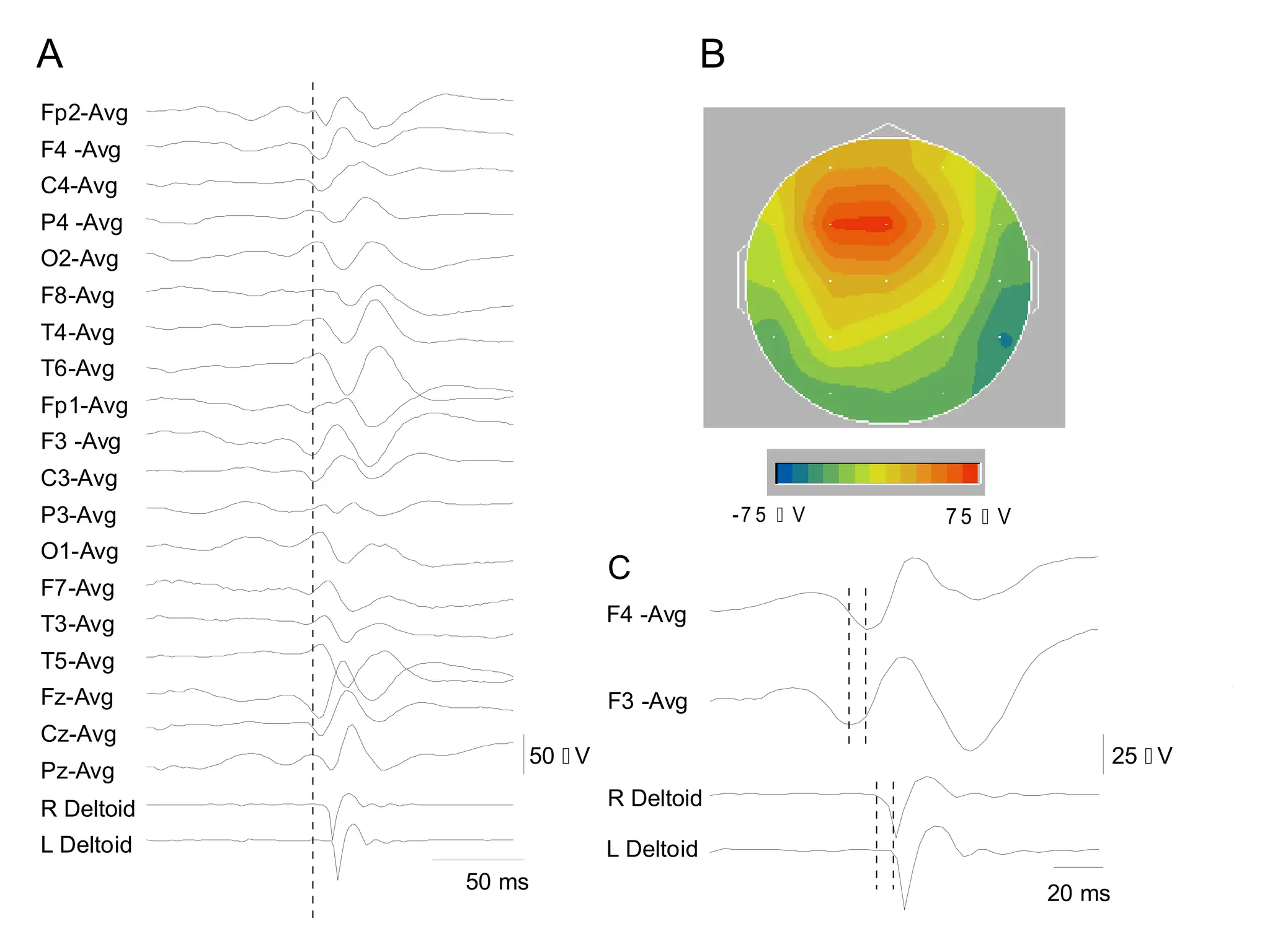
Fp2-Avg
P4 -Avg
F4 -Avg
C4-Avg
T6-Avg
F8-Avg
T4-Avg
O2-Avg
Fp1-Avg
P3-Avg
F3 -Avg
C3-Avg
T5-Avg
F7-Avg
T3-Avg
O1-Avg
Fz-Avg
Cz-Avg
Pz-Avg
50  V
R Deltoid
L Deltoid
50 ms
F4 -Avg
F3 -Avg
R Deltoid
L Deltoid
20 ms
-7 5  V 7 5  V
C
25  V
B
A
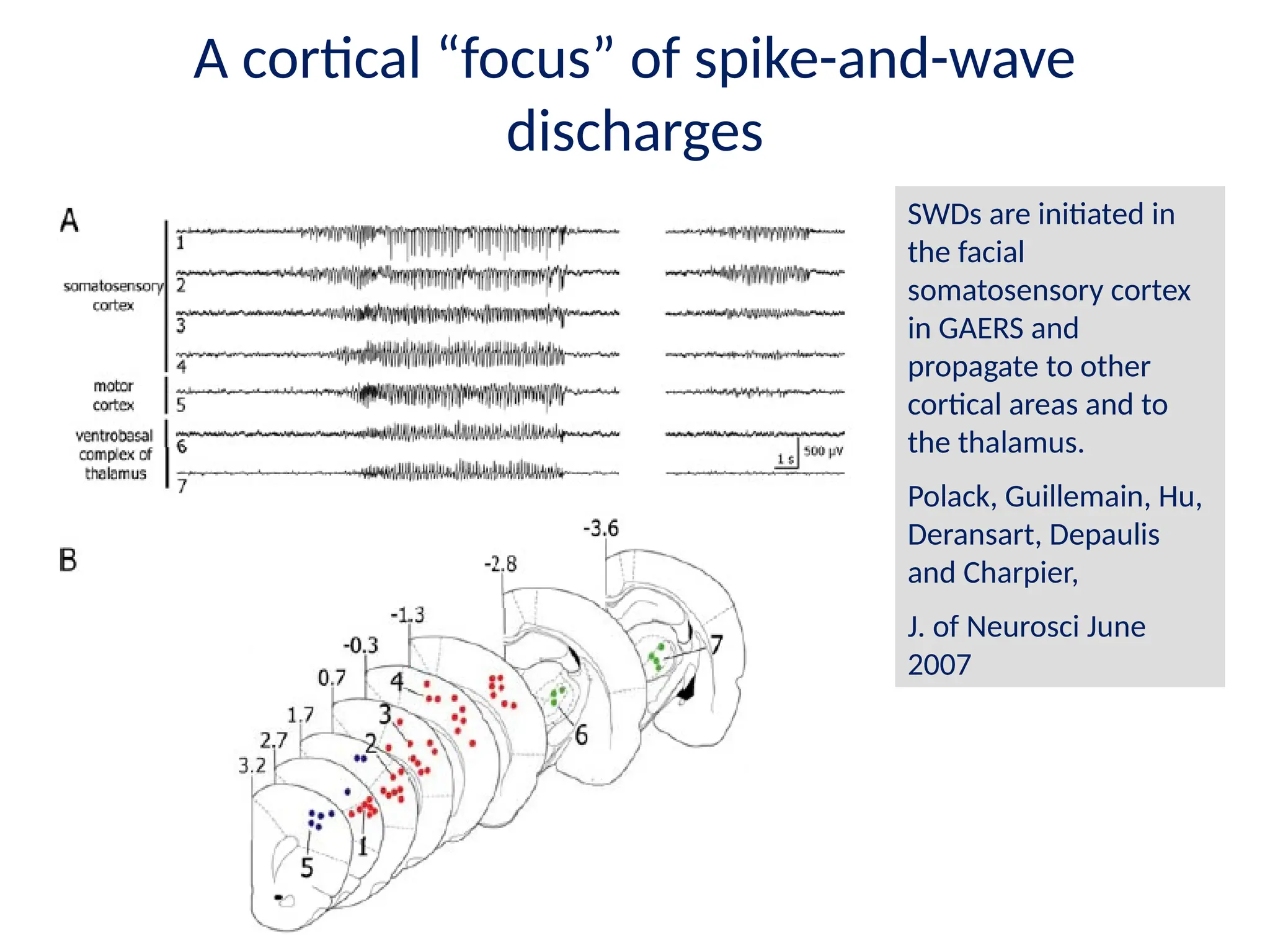
A cortical “focus” of spike-and-wave
discharges
SWDs are initiated in
the facial
somatosensory cortex
in GAERS and
propagate to other
cortical areas and to
the thalamus.
Polack, Guillemain, Hu,
Deransart, Depaulis
and Charpier,
J. of Neurosci June
2007
VPM VPL
18.4
8.8
29.3
3.1
9.9
Hindpaw
UpperLip Nose
“FOCUS”
SmI
Thalamus
B. whole seizure
4.9
A. first 500 msec
VPM
2.9
8.1
11.7
30.0
4.3
6.1
VPL
UpperLip
Nose
“FOCUS”
SmI
Thalamus
Hindpaw
20-30
40-50
30-40
70-80
50-60
60-70
Association (%)
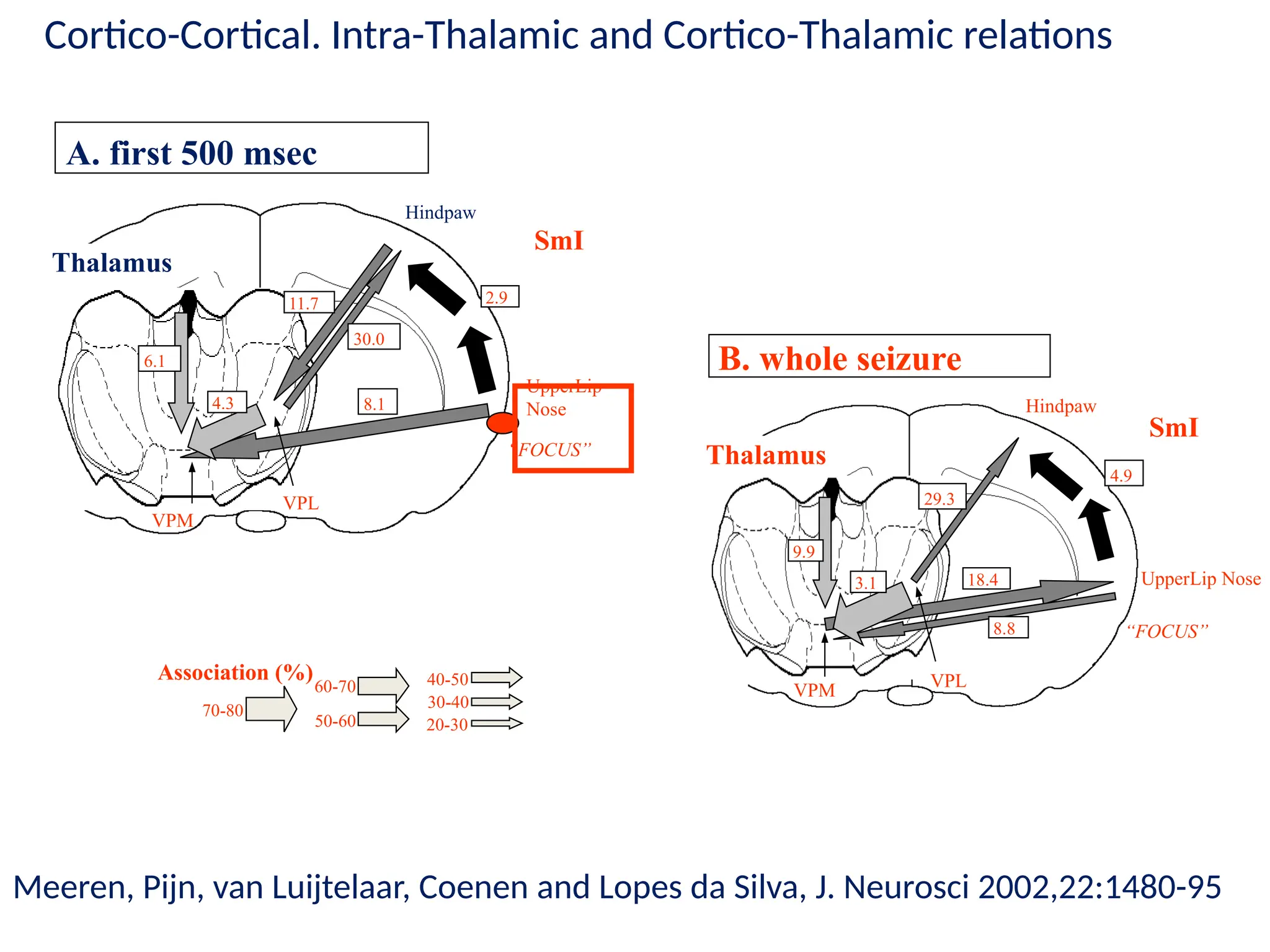
Meeren, Pijn, van Luijtelaar, Coenen and Lopes da Silva, J. Neurosci 2002,22:1480-95
Cortico-Cortical. Intra-Thalamic and Cortico-Thalamic relations
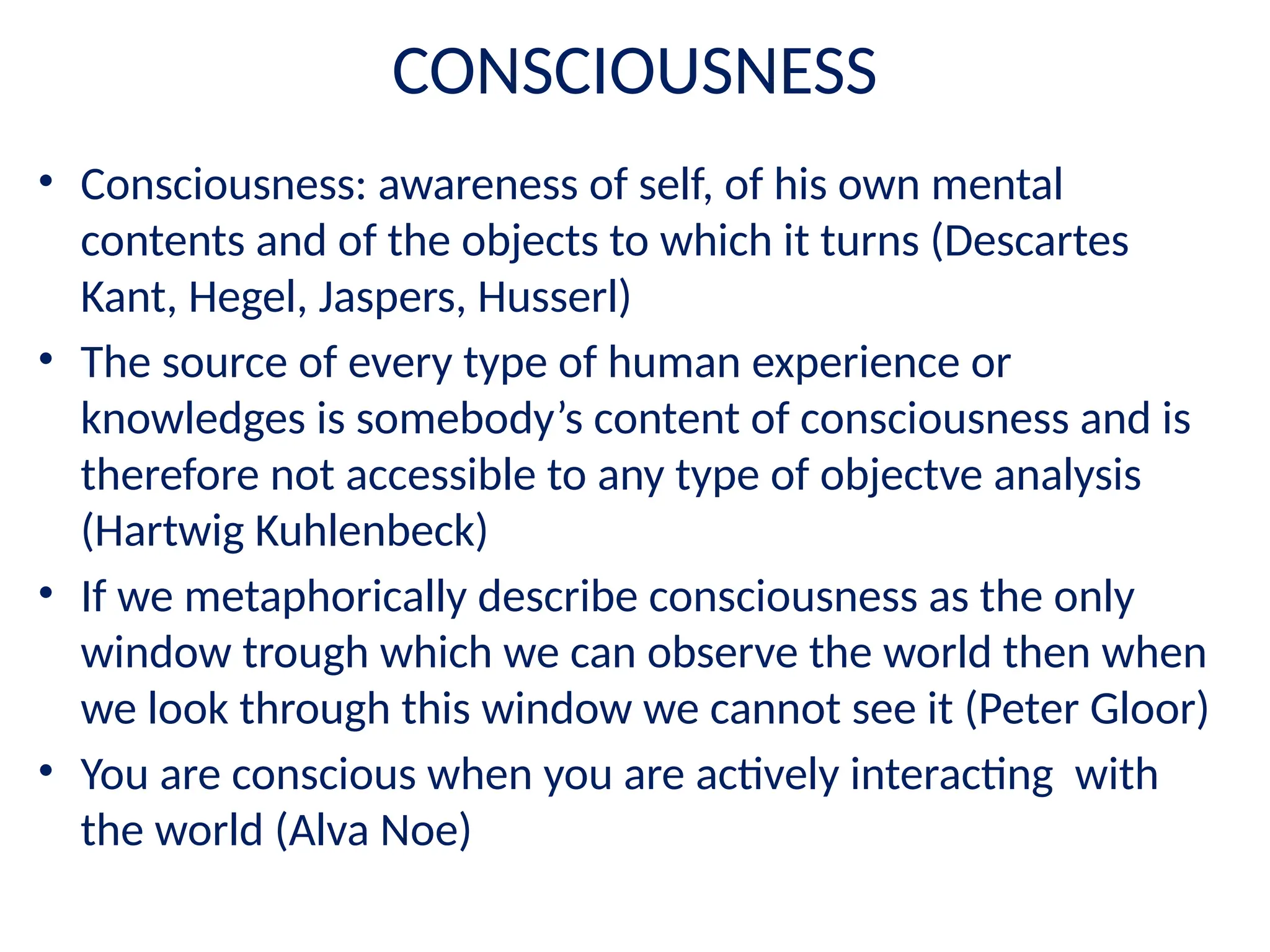
CONSCIOUSNESS
• Consciousness: awareness of self, of his own mental
contents and of the objects to which it turns (Descartes
Kant, Hegel, Jaspers, Husserl)
• The source of every type of human experience or
knowledges is somebody’s content of consciousness and is
therefore not accessible to any type of objectve analysis
(Hartwig Kuhlenbeck)
• If we metaphorically describe consciousness as the only
window trough which we can observe the world then when
we look through this window we cannot see it (Peter Gloor)
• You are conscious when you are actively interacting with
the world (Alva Noe)
EPILEPTIC SEIZURES & EPILEPSIES
• An epileptic seizure is a transient occurrence of
signs and/or symptoms due to abnormal
excessive or synchronous neuronal activity in
the brain.
• Epilepsy is a chronic condition of the brain
characterized by an enduring propensity to
generate epileptic seizures, and by the
neurobiological, cognitive, psychological, and
social consequences of this condition.
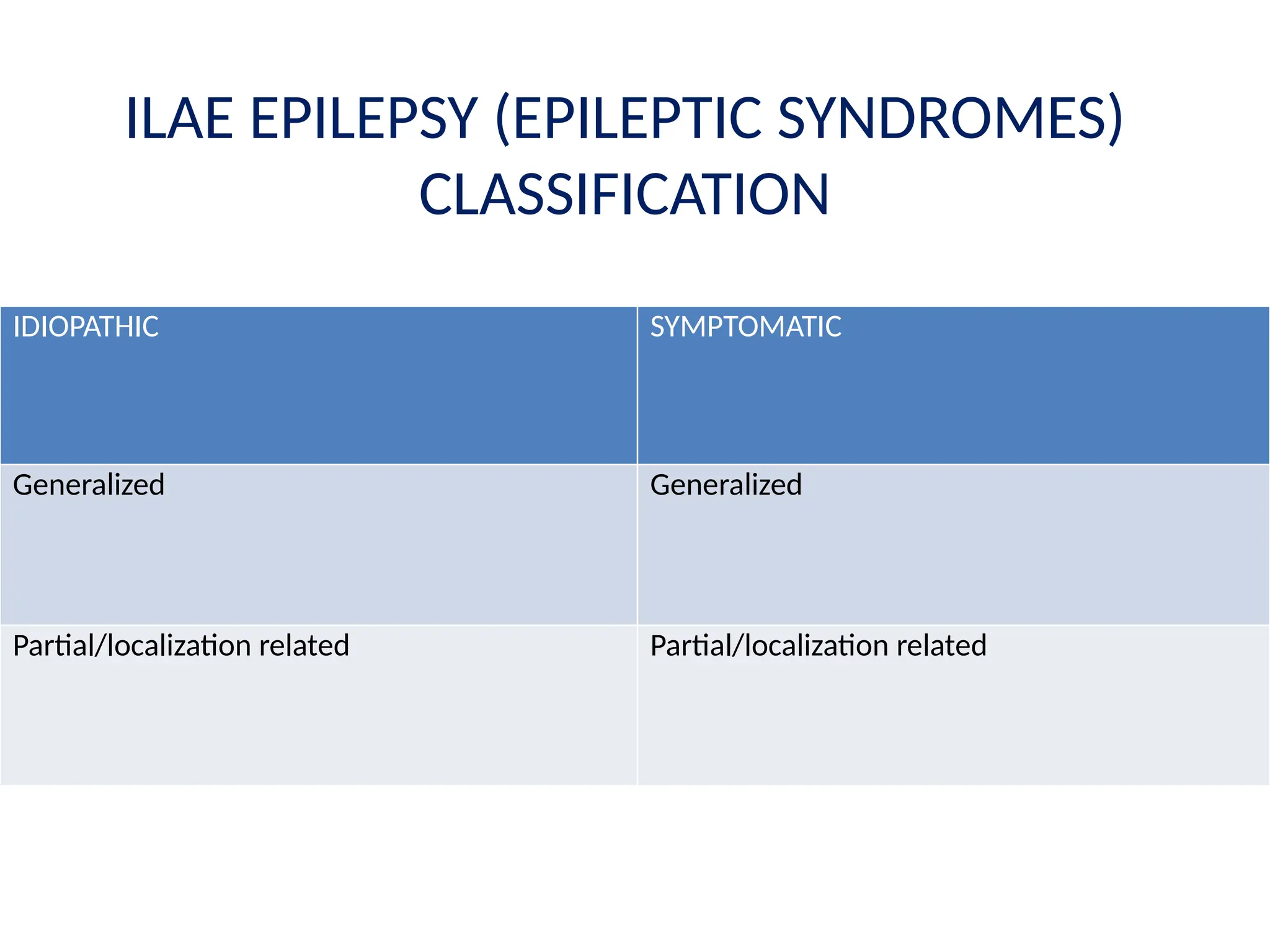
ILAE EPILEPSY (EPILEPTIC SYNDROMES)
CLASSIFICATION
IDIOPATHIC SYMPTOMATIC
Generalized Generalized
Partial/localization related Partial/localization related
IDIOPATHIC PARTIAL EPILEPSIES
• The concept of benign partial epilepsies (BPE) that
emerged in the late fifties and early sixties (Bancaud et al
1958, Nayrac and Beaussard 1958, Faure and Loiseau
1960, Lombroso 1967) introduced a novel view in the
pathophysiological concepts founded by John Hughlings
Jackson.
• Besides epilepsies due to focal epileptogenic lesions and
“functional” epilepsies due to a dysfunction of diffusely
projecting “centrencephalic” structures a new category of
epilepsies due to a dysfunction affecting a cortical area in
which no evidence of lesion was demonstrable was then
established.
These localization-related epilepsies could
not be attributed to an epileptic focus in
an anatomic sense but rather to an age-
related hyperexcitable condition of a given
cortical region, most frequently the
sensory-motor and visual ones, with no
detectable structural alteration.
EPILEPSY SYNDROME
A complex of signs and symptoms that
define a unique epilepsy condition
with different etiologies. This must
involve more than just the seizure
type; thus frontal lobe seizures per se,
for instance, do not constitute a
syndrome.
Idiopathic epilepsy syndrome: A syndrome that
is only epilepsy, with no underlying structural
brain lesion or other neurologic signs or
symptoms. These are presumed to be genetic
and are usually age dependent.
Symptomatic epilepsy syndrome: A syndrome
in which the epileptic seizures are the result of
one or more identifiable structural lesions of the
brain.
Probably symptomatic or cryptogenic epilepsy
syndrome: syndromes that are believed to be
symptomatic, but no etiology has been
identified.
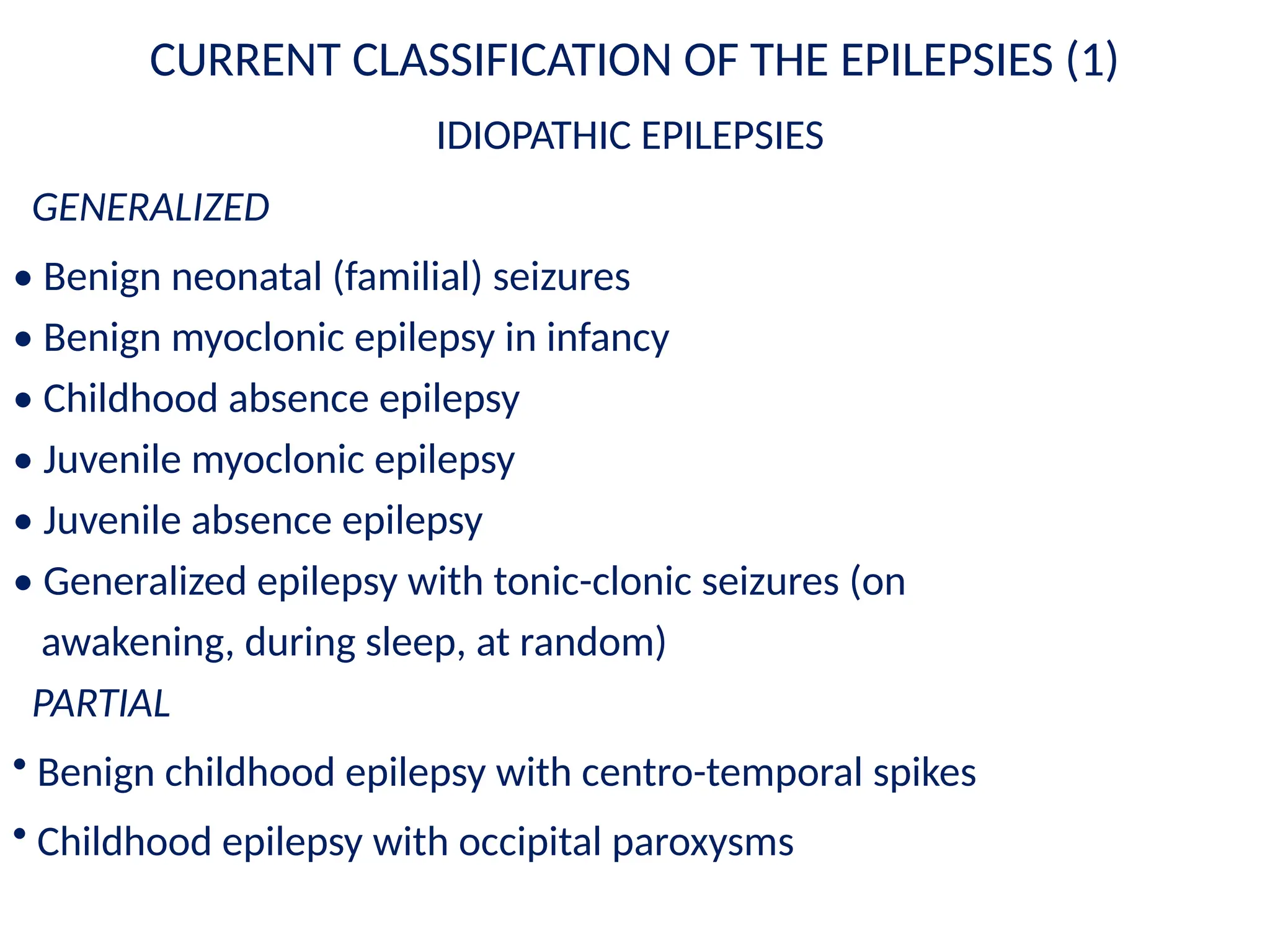
CURRENT CLASSIFICATION OF THE EPILEPSIES (1)
IDIOPATHIC EPILEPSIES
GENERALIZED
• Benign neonatal (familial) seizures
• Benign myoclonic epilepsy in infancy
• Childhood absence epilepsy
• Juvenile myoclonic epilepsy
• Juvenile absence epilepsy
• Generalized epilepsy with tonic-clonic seizures (on
awakening, during sleep, at random)
PARTIAL
• Benign childhood epilepsy with centro-temporal spikes
• Childhood epilepsy with occipital paroxysms
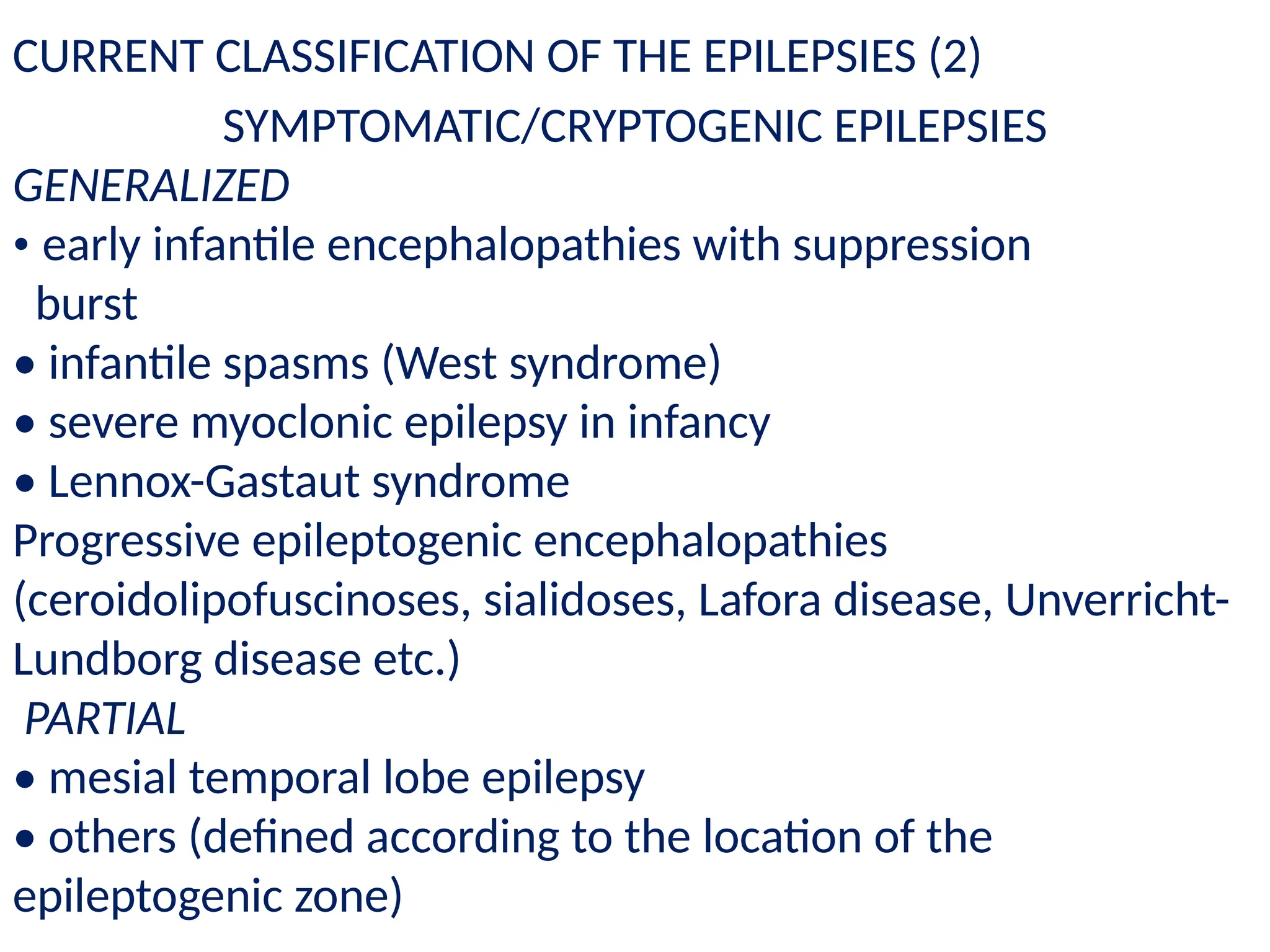
SYMPTOMATIC/CRYPTOGENIC EPILEPSIES
GENERALIZED
• early infantile encephalopathies with suppression
burst
• infantile spasms (West syndrome)
• severe myoclonic epilepsy in infancy
• Lennox-Gastaut syndrome
Progressive epileptogenic encephalopathies
(ceroidolipofuscinoses, sialidoses, Lafora disease, Unverricht-
Lundborg disease etc.)
PARTIAL
• mesial temporal lobe epilepsy
• others (defined according to the location of the
epileptogenic zone)
CURRENT CLASSIFICATION OF THE EPILEPSIES (2)
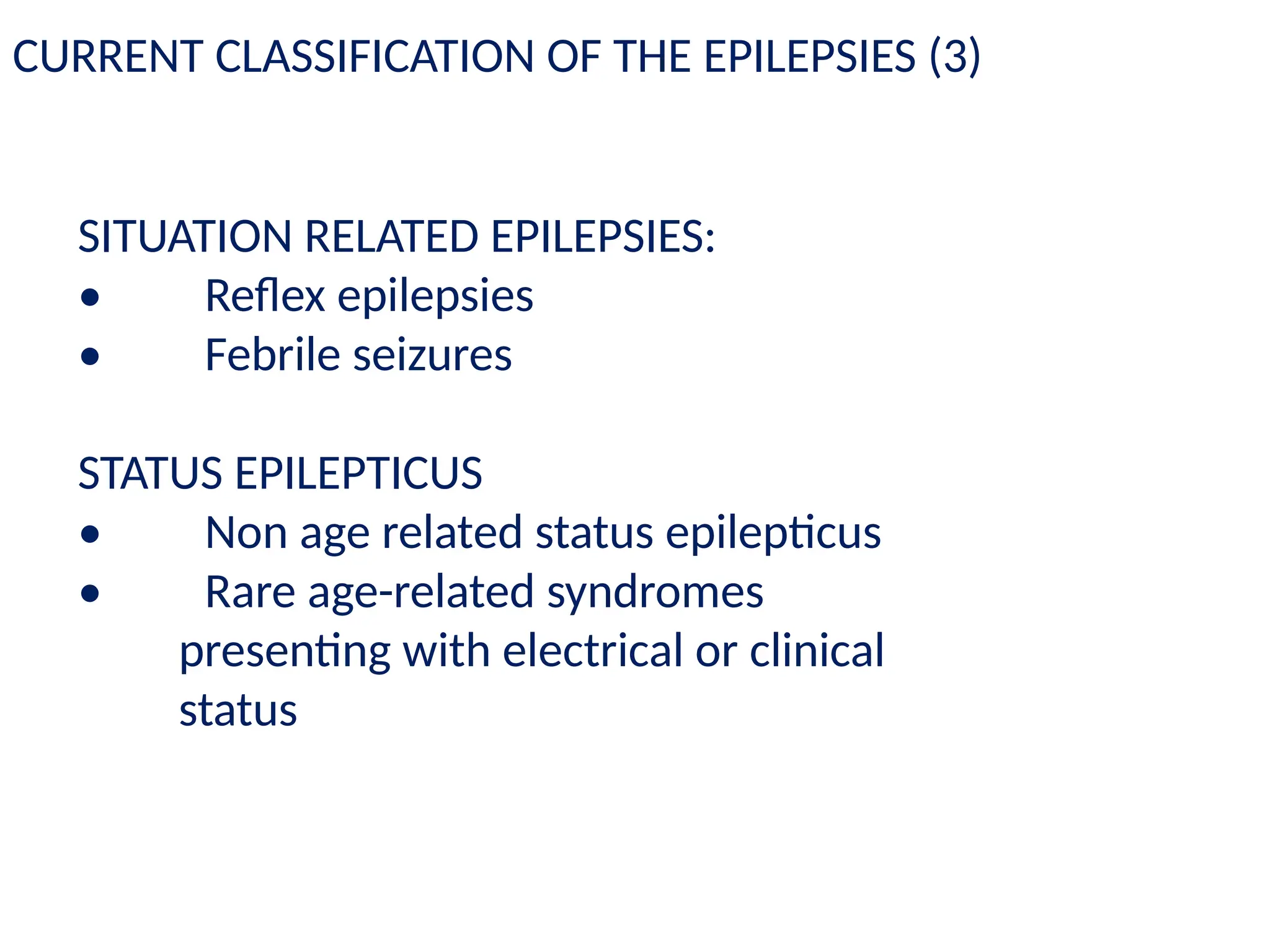
SITUATION RELATED EPILEPSIES:
• Reflex epilepsies
• Febrile seizures
STATUS EPILEPTICUS
• Non age related status epilepticus
• Rare age-related syndromes
presenting with electrical or clinical
status
CURRENT CLASSIFICATION OF THE EPILEPSIES (3)
Day 1_Avanzini -Epilepsy Seizure and Classification.pptx

  • 1.
    EPILEPSY AND SEIZUE CLASSIFICATION GiulianoAvanzini Istituto Neurologico C. Besta Milano. Italy 21° San Servolo Advanced Epilepsy Course July 21-August 1 San Ser and new volo , Venice Italy Bridging basic with Clinical Epileptology (8) Contribution of non neuronal cells to epilepsy and new therapautic strategies
  • 2.
    “There are twoways of investigating diseases, and two kinds of classification corresponding thereto, the empirical and the scientific. The former is to be illustrated by the way in which a gardener classifies plants, the latter by the way in which a botanist classifies them.” Johns Hughlings Jackson (1874) On classification and on methods of investigation” 1874
  • 3.
    The gardener arrangeshis plants as they are fit for food, for ornament etc. His object is the direct application of knowledge The botanist classification (the classification properly so-called) is rather for the better organisation of existing knowledge and for discovering the relations of new facts, it is also of utilitarian value, but not directly Classifications reflect the state of knowledge in a scientific field.
  • 6.
    Taxomic Rules Classifiers: Reflectbiological classes conceptual justification an directly impact clinical managment (utilitarian justification): 1. Main seizure classes 2. Seizure types 3. Level of consciousness Descriptors: represent key seizure characteristic which aid seizure managment when combined with other clinical data. 4. Semeiological features
  • 7.
    DESCRIPTORS FOR FOCALAND UNKNOWN FOCAL/GENERALIZED SEIZURES 1. ELEMENTARY MOTOR PHENOMENA 2. COMPLEX MOTOR PHENOMENA 3. SENSORY PHENOMENA 4. COGNITIVE AND LANGUAGE PHENOMENA 5. AUTONOMIC PHENOMENA--------------------- 6. AFFECTIVE (EMOTIONAL) PHENOMENA 7. INDESCRIBABLE AURA • 5. AUTONOMIC PHENOMENA Cardiovascular ○ Ictal asystole ○ Ictal bradycardia ○ Ictal tachycardia • Cutaneous/thermoregulatory ○ Flushing ○ Piloerection ○ Sweating • Epigastric • Gastrointestinal ○ Borborygmi ○ Flatulence ○ Hypersalivation ○ Nausea/vomiting ○ Polydipsia ○ Sialorrhea ○ Spitting • Pupillary ○ Miosis ○ Mydriasis • Respiratory ○ Apnea ○ Choking ○ Hyperventilation ○ Hypoventilation • Urinary ○ Incontinence ○ Urinary urge
  • 8.
    Main changes introducedin Present Classification • 1. “Onset” is removed from the names of the main seizure classes. 2. A distinction is made between classifiers and descriptors, based on taxonomic rule. 3. Consciousness is used as a classifier instead of awareness, with consciousness operationally defined by awareness and responsiveness. 4. The motor vs. non motor dichotomy is replaced by observable vs. non observable manifestations. 5. The chronological sequence of seizure semiology is used to describe seizures, rather than relying solely on the first sign. 6. Epileptic negative myoclonus is recognized as a seizure type.
  • 9.
    Juvenile Myoclonic Epilepsy(JME) Janz Syndrome Collegamento (2) a 14 dia.21.JME.lnk
  • 10.
    Fp2-Avg P4 -Avg F4 -Avg C4-Avg T6-Avg F8-Avg T4-Avg O2-Avg Fp1-Avg P3-Avg F3-Avg C3-Avg T5-Avg F7-Avg T3-Avg O1-Avg Fz-Avg Cz-Avg Pz-Avg 50  V R Deltoid L Deltoid 50 ms F4 -Avg F3 -Avg R Deltoid L Deltoid 20 ms -7 5  V 7 5  V C 25  V B A
  • 11.
    A cortical “focus”of spike-and-wave discharges SWDs are initiated in the facial somatosensory cortex in GAERS and propagate to other cortical areas and to the thalamus. Polack, Guillemain, Hu, Deransart, Depaulis and Charpier, J. of Neurosci June 2007
  • 12.
    VPM VPL 18.4 8.8 29.3 3.1 9.9 Hindpaw UpperLip Nose “FOCUS” SmI Thalamus B.whole seizure 4.9 A. first 500 msec VPM 2.9 8.1 11.7 30.0 4.3 6.1 VPL UpperLip Nose “FOCUS” SmI Thalamus Hindpaw 20-30 40-50 30-40 70-80 50-60 60-70 Association (%) Meeren, Pijn, van Luijtelaar, Coenen and Lopes da Silva, J. Neurosci 2002,22:1480-95 Cortico-Cortical. Intra-Thalamic and Cortico-Thalamic relations
  • 13.
    CONSCIOUSNESS • Consciousness: awarenessof self, of his own mental contents and of the objects to which it turns (Descartes Kant, Hegel, Jaspers, Husserl) • The source of every type of human experience or knowledges is somebody’s content of consciousness and is therefore not accessible to any type of objectve analysis (Hartwig Kuhlenbeck) • If we metaphorically describe consciousness as the only window trough which we can observe the world then when we look through this window we cannot see it (Peter Gloor) • You are conscious when you are actively interacting with the world (Alva Noe)
  • 14.
    EPILEPTIC SEIZURES &EPILEPSIES • An epileptic seizure is a transient occurrence of signs and/or symptoms due to abnormal excessive or synchronous neuronal activity in the brain. • Epilepsy is a chronic condition of the brain characterized by an enduring propensity to generate epileptic seizures, and by the neurobiological, cognitive, psychological, and social consequences of this condition.
  • 15.
    ILAE EPILEPSY (EPILEPTICSYNDROMES) CLASSIFICATION IDIOPATHIC SYMPTOMATIC Generalized Generalized Partial/localization related Partial/localization related
  • 16.
    IDIOPATHIC PARTIAL EPILEPSIES •The concept of benign partial epilepsies (BPE) that emerged in the late fifties and early sixties (Bancaud et al 1958, Nayrac and Beaussard 1958, Faure and Loiseau 1960, Lombroso 1967) introduced a novel view in the pathophysiological concepts founded by John Hughlings Jackson. • Besides epilepsies due to focal epileptogenic lesions and “functional” epilepsies due to a dysfunction of diffusely projecting “centrencephalic” structures a new category of epilepsies due to a dysfunction affecting a cortical area in which no evidence of lesion was demonstrable was then established.
  • 17.
    These localization-related epilepsiescould not be attributed to an epileptic focus in an anatomic sense but rather to an age- related hyperexcitable condition of a given cortical region, most frequently the sensory-motor and visual ones, with no detectable structural alteration.
  • 18.
    EPILEPSY SYNDROME A complexof signs and symptoms that define a unique epilepsy condition with different etiologies. This must involve more than just the seizure type; thus frontal lobe seizures per se, for instance, do not constitute a syndrome.
  • 19.
    Idiopathic epilepsy syndrome:A syndrome that is only epilepsy, with no underlying structural brain lesion or other neurologic signs or symptoms. These are presumed to be genetic and are usually age dependent. Symptomatic epilepsy syndrome: A syndrome in which the epileptic seizures are the result of one or more identifiable structural lesions of the brain. Probably symptomatic or cryptogenic epilepsy syndrome: syndromes that are believed to be symptomatic, but no etiology has been identified.
  • 20.
    CURRENT CLASSIFICATION OFTHE EPILEPSIES (1) IDIOPATHIC EPILEPSIES GENERALIZED • Benign neonatal (familial) seizures • Benign myoclonic epilepsy in infancy • Childhood absence epilepsy • Juvenile myoclonic epilepsy • Juvenile absence epilepsy • Generalized epilepsy with tonic-clonic seizures (on awakening, during sleep, at random) PARTIAL • Benign childhood epilepsy with centro-temporal spikes • Childhood epilepsy with occipital paroxysms
  • 21.
    SYMPTOMATIC/CRYPTOGENIC EPILEPSIES GENERALIZED • earlyinfantile encephalopathies with suppression burst • infantile spasms (West syndrome) • severe myoclonic epilepsy in infancy • Lennox-Gastaut syndrome Progressive epileptogenic encephalopathies (ceroidolipofuscinoses, sialidoses, Lafora disease, Unverricht- Lundborg disease etc.) PARTIAL • mesial temporal lobe epilepsy • others (defined according to the location of the epileptogenic zone) CURRENT CLASSIFICATION OF THE EPILEPSIES (2)
  • 22.
    SITUATION RELATED EPILEPSIES: •Reflex epilepsies • Febrile seizures STATUS EPILEPTICUS • Non age related status epilepticus • Rare age-related syndromes presenting with electrical or clinical status CURRENT CLASSIFICATION OF THE EPILEPSIES (3)