Policy Orientation for
DepEd Order No. 005, s.
2024 Rationalization of Teachers’
Workload in Public Schools and
Payment of Teaching Overload
RO and SDO
June 17-21, 2024 | Diamond Suites and Residences, Cebu
Program
Overview
& Schedule
Objective
1. To discuss the key provisions of the DepEd Order;
2. To provide direction on the implementation strategies particularly
on the duties and responsibilities of the Field Offices; and
3. To clarify common concerns and solicit feedback.
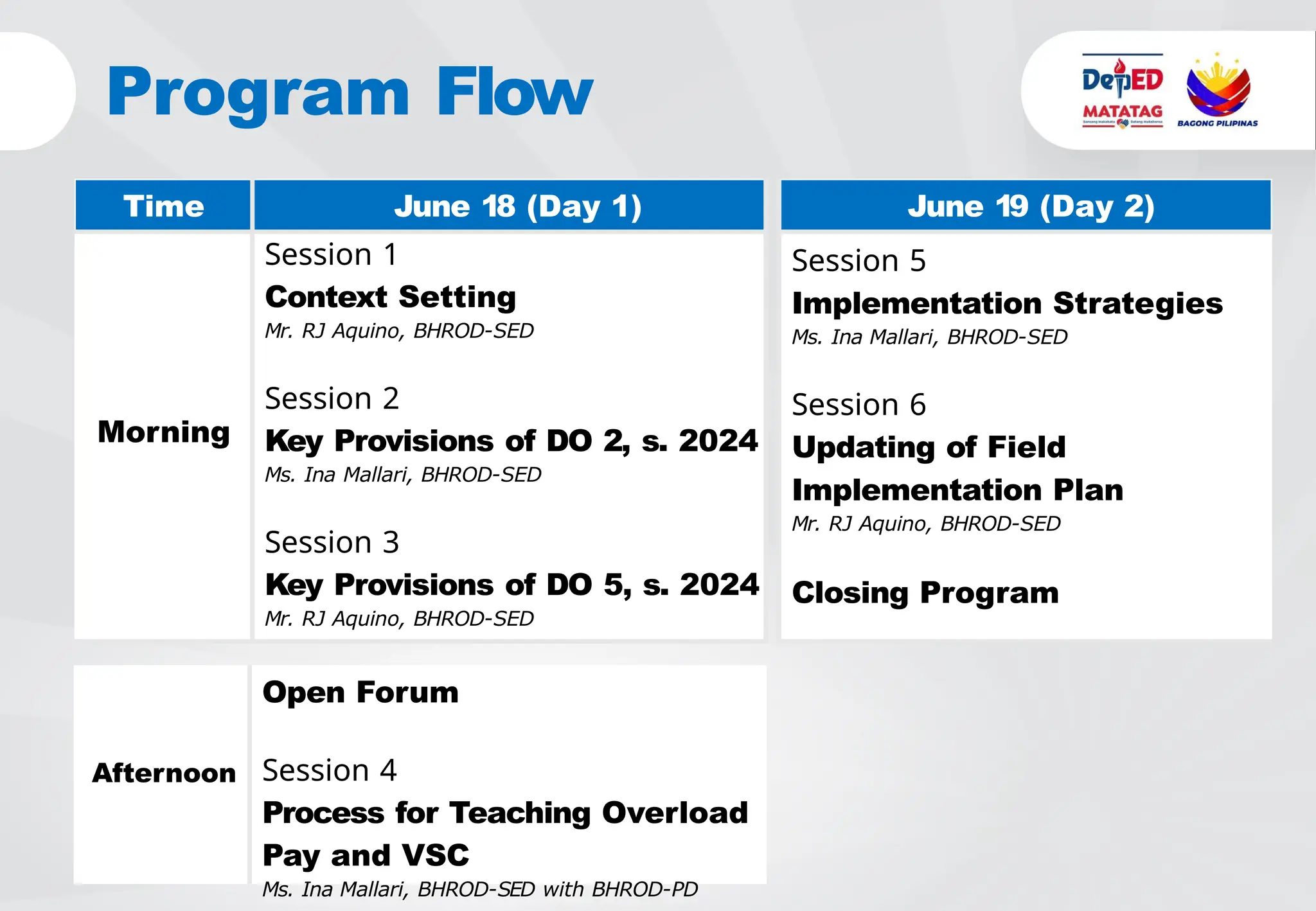
Program Flow
Afternoon
Open Forum
Session 4
Process for Teaching Overload
Pay and VSC
Ms. Ina Mallari, BHROD-SED with BHROD-PD
Time June 18 (Day 1) June 19 (Day 2)
Morning
Session 1
Context Setting
Mr. RJ Aquino, BHROD-SED
Session 2
Key Provisions of DO 2, s. 2024
Ms. Ina Mallari, BHROD-SED
Session 3
Key Provisions of DO 5, s. 2024
Mr. RJ Aquino, BHROD-SED
Session 5
Implementation Strategies
Ms. Ina Mallari, BHROD-SED
Session 6
Updating of Field
Implementation Plan
Mr. RJ Aquino, BHROD-SED
Closing Program
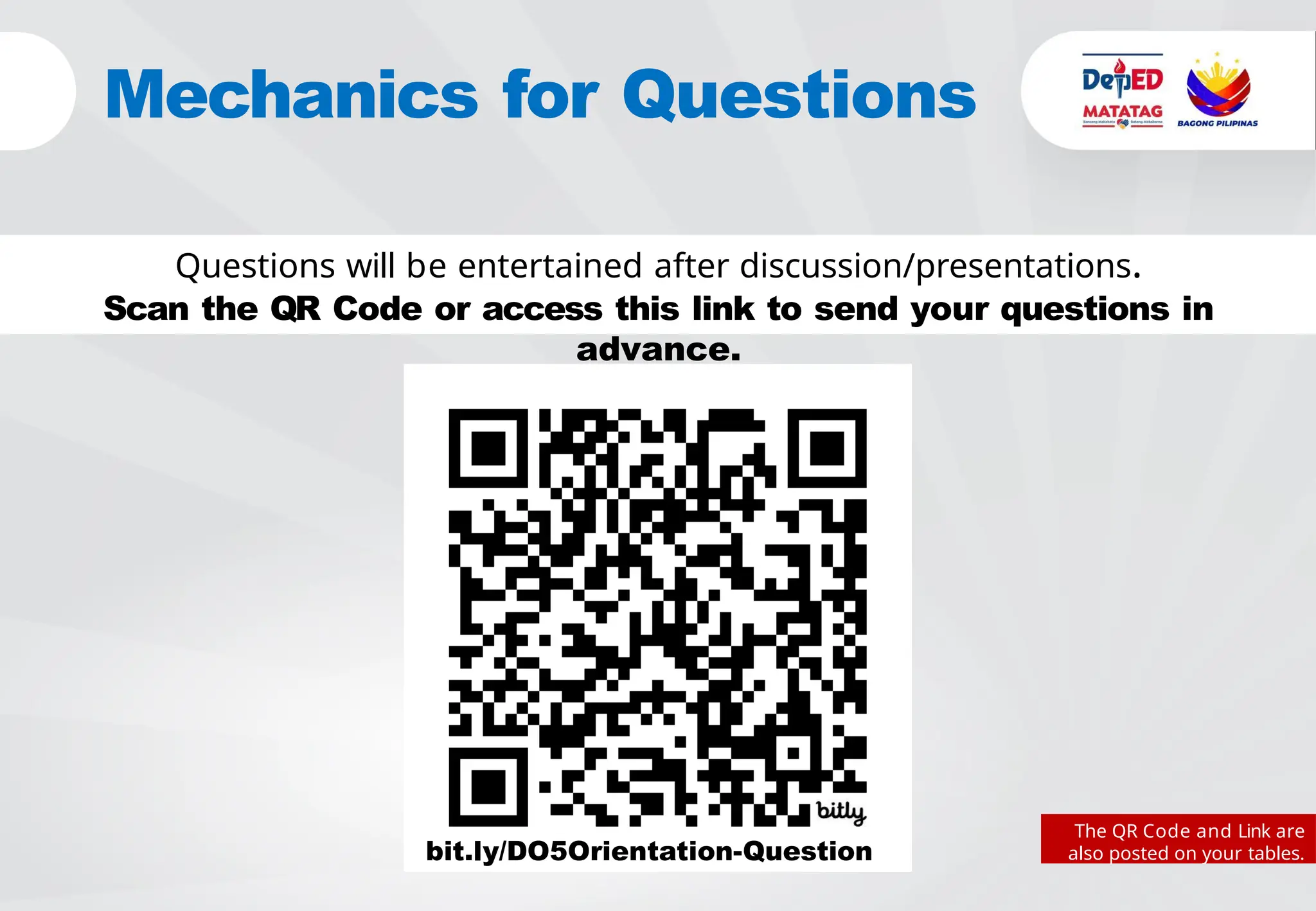
Questions will be entertained after discussion/presentations.
Scan the QR Code or access this link to send your questions in
advance.
Mechanics for Questions
bit.ly/DO5Orientation-Question
The QR Code and Link are
also posted on your tables.
Other Reminders
• Participants will be provided with a copy of the presentation
material, together with the consolidated questions and
responses from the open forum.
• Please refrain from circulating or sending out portions of
the
slides to avoid any misinterpretation of the contents.
bit.ly/DO5-Materials
Access your Materials here!
Session 1:
Context Setting
Priming
Question
Think of an
anecdote of a
teachers’
workload
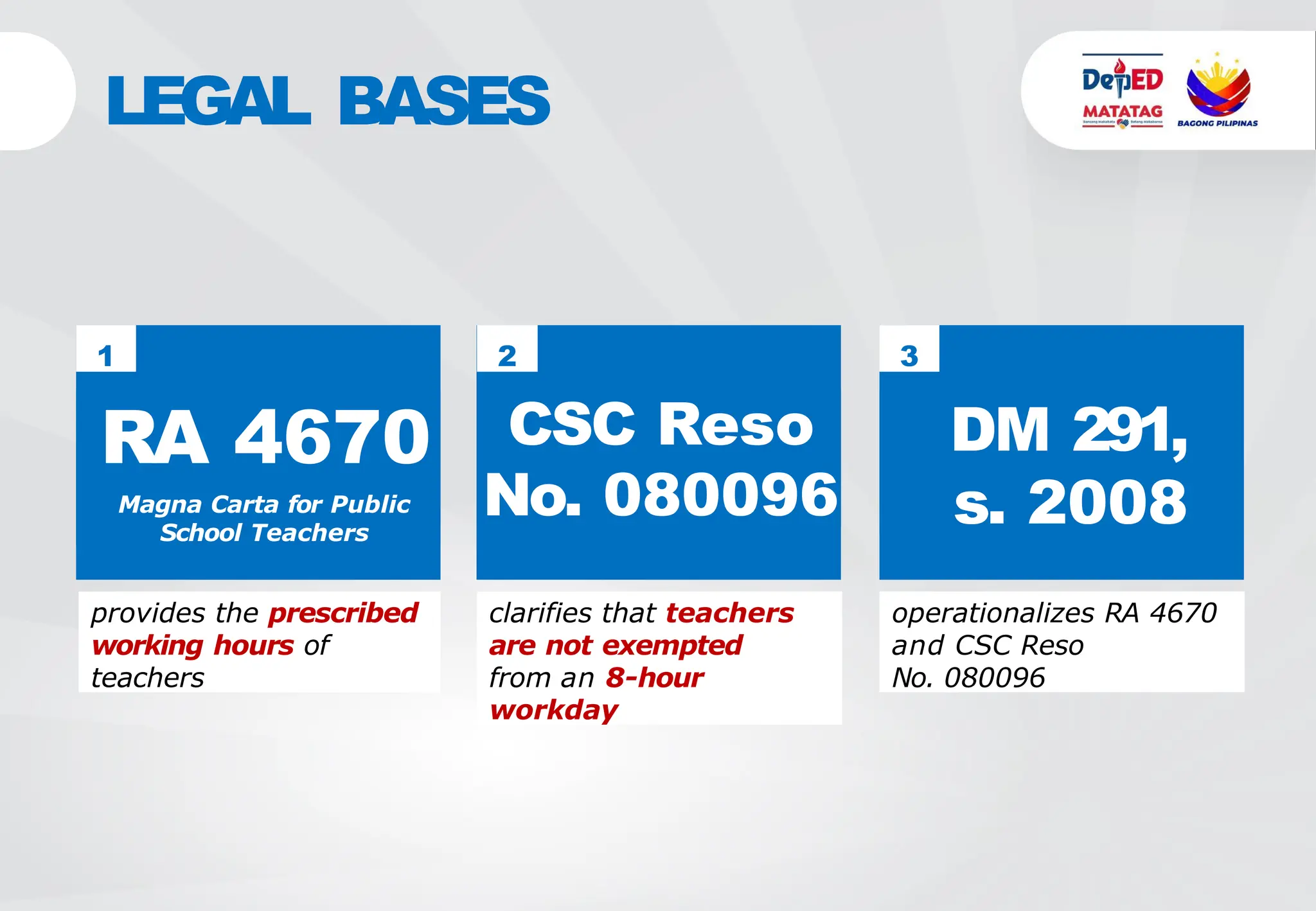
LEGAL BASES
RA 4670
Magna Carta for Public
School Teachers
1 2 3
DM 291,
s. 2008
CSC Reso
No. 080096
provides the prescribed
working hours of
teachers
clarifies that teachers
are not exempted
from an 8-hour
workday
operationalizes RA 4670
and CSC Reso
No. 080096
Teacher Working Hours
And Workload (DM 291, s.
2008)
Teacher Working
Hours
8 HOURS
2
HOURS
Shall be devoted to
teaching-related duties
6 HOURS
shall be devoted to actual classroom
teaching, advisorship, and/or special
assignments
lesson plan Instructional
materials
Checking of exercises
Recording of
Action plan
Seminar
Workshop
Research
Coaching
academic performance
Coordination activities
Maintenance of
school facilities
Maintenance of equipment
Home visits
actual classroom
teaching
Advisorship
Special
Assignments
Reality of a
Public School
Teacher
 The workload of a teacher is not
only limited to teaching but also
includes non-teaching
tasks
 Actual teaching is increasingly
being sidelined
 Teachers want to spend more time
with students
(PIDS, 2018)
50 Most Common Ancillary
Tasks
Based on the 2018 Teacher Workload Study
Our
Hope
We will give support to teachers to teach
better.
We will remove the non-teaching tasks and
provide administrative officers in Schools. We will
provide adequate manpower complement in
Schools, manage teacher’s workload, and
compensate for unique school challenges.
Sara Z. Duterte-Carpio
Vice-President of the Republic of the Philippines
Secretary of the Department of Education
Note: This presentation material is not for general or public use.
Photos from DepEd Philippines Facebook Page
THE GOAL OF THE
MATATAG
AGENDA
We aim for Teacher Quality and
Teacher Welfare as we firmly
believe that the core of quality
basic education is a vibrant and
quality teaching workforce.
Teacher at the
Forefront of the
MATATAG Agenda
Teachers will be given more time for teaching
Administrative tasks will be removed from teachers’ workload
Teachers will be compensated in actual classroom teaching
rendered more than 6 hours
Teachers will be compensated in teaching-related assignments
designated to them
Our
Response
The Teacher
Workload Policies
18
What problem does the policy
solve?
1. Teachers are overworked.
The Department has been receiving numerous
concerns surrounding the workload of teachers and
that they are increasingly burdened because of non-
teaching tasks.
2. Teachers play numerous
roles outside their core
mandate.
Studies have shown that the workload of teachers is
not only limited to teaching but also to many other
non-teaching tasks.
3. Teachers are not
properly compensated for excess
workload
There are no existing policies that guide the teachers in
processing their benefits for work rendered beyond the
eight-hour workday.
How does the policy address the
problem?
It protects Teacher Work Hours.
The policies enable teachers to devote their time to
teaching.
It defines Teacher Workload.
The policies clearly define the responsibilities of School
Heads, teachers, and non-teaching personnel. Specifically for
teachers, the policies provide the following:
What should be: Tasks mandated to be performed by teachers
What should not be: Tasks that should not be performed by
teachers
What can be: Tasks that can be performed by teachers, but are
not mandatory
It provides guidelines and processes
for the payment of teaching
overload.
The policy establishes the procedures, roles of Offices,
and documentary requirements for the payment of
teaching overload.
The Teacher Workload
Policies
OUR
ASPIRATION
MATATAG na
Kaguruan, Lakas ng
Kagawaran
Cultivating a more conducive work environment that
Key Provisions of
DepEd Order No. 002, s.
2024
Immediate Removal of Administrative Tasks of Public School
Teachers
Session
2:
Priming Question
Think of an emoji that
would best describe
your initial reaction
when DO 2 was issued
in Jan 2024?
Session Objective
Session
Outline
1 Defining Admin Tasks
2 Responsible for Admin Tasks
3 Personnel & Workload Delineation
4 Tool for School Heads
5 Implementation Strategies
This session aims to provide the participants with a detailed discussion on the
key provisions and implementation strategies of DepEd Order No. 002,
s. 2024.
What are Administrative Tasks?
These are tasks related to the effective and efficient
operations of schools or programs, projects, and
services which are not directly related to teaching
and academic learning.
What are considered Administrative Tasks?
Administrative Tasks include the following:
a. Personnel Administration;
b. Property/Physical Facilities Custodianship;
c. General Administrative Support;
d. Financial Management;
e. Records Management; and
f. Program Management.
1 Defining Admin
Tasks
Who are responsible to
perform the Administrative
Tasks?
School Heads and non-teaching
personnel have the responsibility to perform
administrative tasks in schools.
2 Responsible for Admin
Tasks
Implementation Strategies:
Our Perspective
STARTING
POINT
CALL TO RECALIBRATE
PROCESSES
SHARED
RESPONSIBILITY
 It changes the status
quo. For the first time, a
firm policy is
implemented to bring
teachers back to the
classroom.
 It marks the start of
efforts to continuously
streamline processes,
reportorial
requirements,
implementation
 It challenges both the
Central and Field offices
to rethink and
recalibrate how
processes/tasks are
executed from one
governance level to
another.
 It requires the
compliance and
collaboration of
various offices to
ensure success of the
policy.
5
1 2 3 4
Request for
additional MOOE
for schools without
non-teaching
personnel
Request for
creation and
deployment of
school-based
non-teaching
personnel
Rationalization of
Teacher Workload
Establishment
of School
Organizational
Structure and
Staffing
Standards
Implementation Strategies:
HROD Strand
5
1
Request for
additional MOOE for
schools without
non- teaching
personnel
• Schools that cannot be provided services by existing
non-teaching personnel, even with the clustering
strategy, shall be given additional MOOE
• Additional MOOE shall be used solely for the hiring of
personnel under COS to support the School Head in
performing admin tasks
>> Status
Downloaded additional MOOE to hire 7,062 COS.
Implementation Strategies:
HROD Strand
5
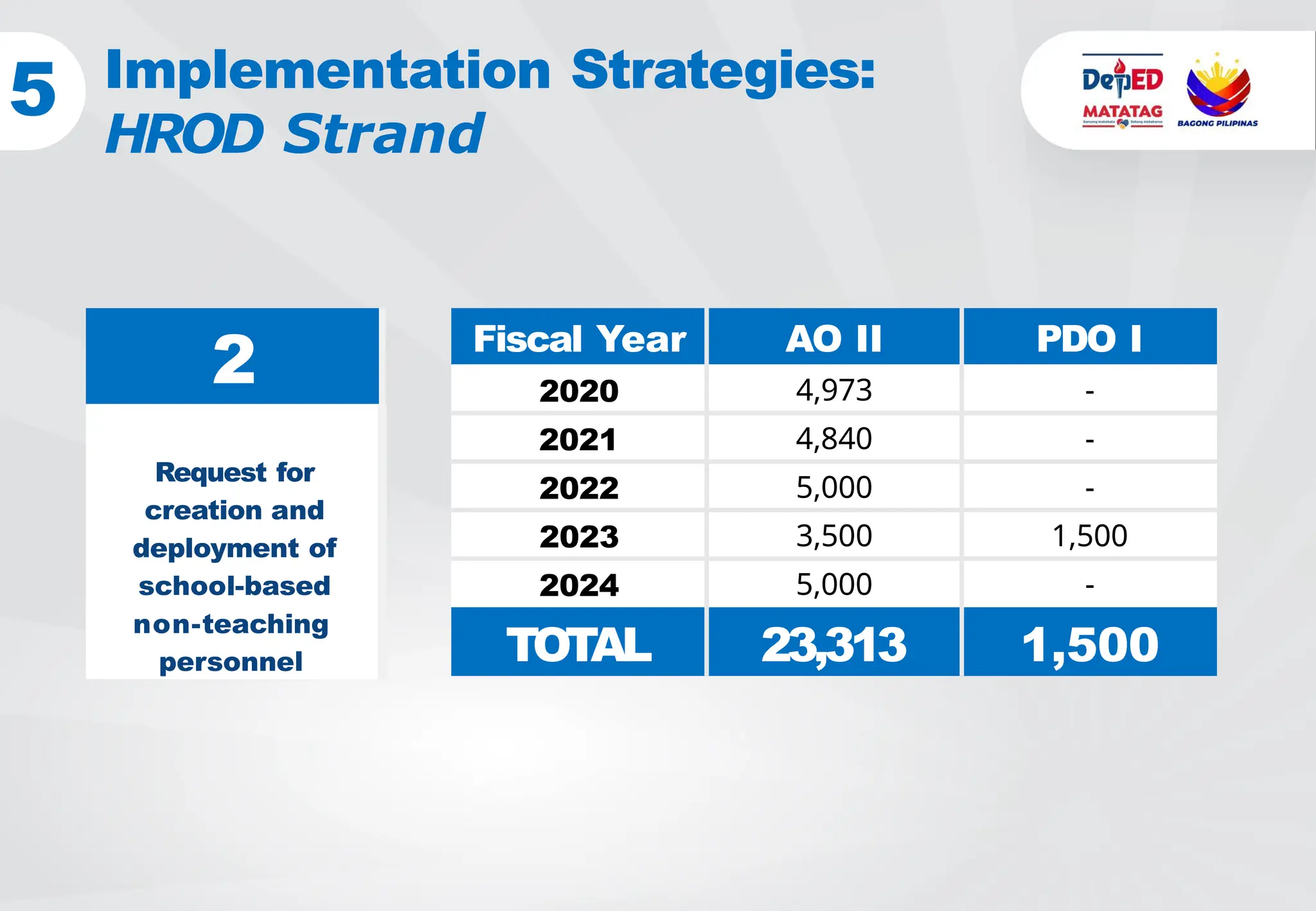
2
Request for
creation and
deployment of
school-based
non-teaching
personnel
Fiscal Year AO II PDO I
2020 4,973 -
2021 4,840 -
2022 5,000 -
2023 3,500 1,500
2024 5,000 -
TOTAL 23,313 1,500
Implementation Strategies:
HROD Strand
5
Clustering Strategy
Parameters:
• The schools that will form as a cluster should be geographically
adjacent and located within the same school district;
• Schools without existing non-teaching personnel based on the latest
Personal Services Itemization and Plantilla of Personnel (PSIPOP) shall
be prioritized in the clustering/re-clustering of schools, however,
proximity of schools shall still be the primary consideration; and
• SDOs are reminded to ensure equitable distribution of schools (with
3 schools at maximum) per cluster.
SDOs shall be responsible in the clustering of schools.
FILLING-UP STATUS | SCHOOL-BASED AO II (FYs 2020-2023)
Based on Quick Count Monitoring Tool as of June 15, 2024
REGION
TOTAL
AUTHORIZED
2020 2021 2022 2023 TOTAL
FILLED
TOTAL
UNFILLED
FILLING UP
PERCENTAGE
FILLED UNFILLED FILLED UNFILLED FILLED UNFILLED FILLED UNFILLED
CAR 839 46 - 80 - 591 - 122 - 839 - 100.00%
NCR 515 469 1
1 33 - - - 1 1 503 12 97.67%
REGION I 1,424 186 1 315 4 807 9 102 - 1,410 14 99.02%
REGION II 1,265 110 - 222 1 809 - 123 - 1,264 1 99.92%
REGION III 2,217 730 8 593 6 791 15 73 1 2,187 30 98.65%
REGION IV-A 1,563 859 1
1 477 10 - - 177 26 1,516 47 96.99%
REGION IV-
B
842 124 - 275 - - - 443 - 842 - 100.00%
REGION V 1,127 295 16 388 8 - - 364 53 1,050 77 93.17%
REGION VI 1,161 409 2 456 2 - - 281 1
1 1,146 15 98.71%
REGION VII 1,139 410 - 374 - - - 347 1 1,138 1 99.91%
REGION VIII 839 182 - 260 - - - 397 - 839 - 100.00%
REGION IX 1,383 165 - 178 - 825 - 215 - 1,383 - 100.00%
REGION X 891 264 - 337 - - - 290 - 891 - 100.00%
REGION XI 788 302 1 293 2 - - 166 24 761 27 96.57%
REGION XII 1,268 230 - 344 4 539 1 149 1 1,262 6 99.53%
REGION XIII 1,052 142 - 175 - 613 - 122 - 1,052 - 100.00%
TOTAL 18,313 4,923 50 4,800 37 4,975 25 3,372 1
1
8 18,083 230 98.74%
98.74% Filling Up Rate
FILLING-UP STATUS | SCHOOL-BASED PDO I (FY
2023)
Based on Quick Count Monitoring Tool as of June 15, 2024
REGION
TOTAL
AUTHORIZED
TOTAL
FILLE
D
TOTAL
UNFILLE
D
FILLING UP
PERCENTAGE
CAR 67 67 - 100.00%
NCR 66 60 6 90.91%
REGION I 126 1
2
1 5 96.03%
REGION II 87 86 1 98.85%
REGION III 213 213 - 100.00%
REGION IV-A 176 166 10 94.32%
REGION IV-B 50 50 - 100.00%
REGION V 1
1
7 103 14 88.03%
REGION VI 87 86 1 98.85%
REGION VII 1
1
1 109 2 98.20%
REGION VIII 73 73 - 100.00%
REGION IX 64 64 - 100.00%
REGION X 66 66 - 100.00%
REGION XI 49 43 6 87.76%
REGION XII 57 55 2 96.49%
REGION XIII 91 91 - 100.00%
TOTAL 1,500 1,453 47 96.87%
96.87% Filling Up Rate
3
Rationalization of
Teacher Workload
• Streamlines teacher workload
• Clarifies the ancillary tasks of teachers as work
incidental to their normal teaching duties
• Provides the allowed teaching-related
assignments
• Provides compensation for excess teaching hours
Implementation Strategies:
HROD Strand
5
4
Establishment of
School Organizational
Structure and
Staffing Standards
• Mapping of school processes, tasks and activities vis-à- vis
required knowledge, skills and attitudes of staffing
complement
• Provides the School Structure and Staffing Standards
• Considers typology of schools, number of teachers,
curricular offering, etc.
Implementation Strategies:
HROD Strand
5
1 2 3 4
Streamline
Processes
Streamline
Reportorial
Requirements
Provide
Technical
Assistance
Explore
Partnerships
Implementation Strategies:
Support Strategies
5
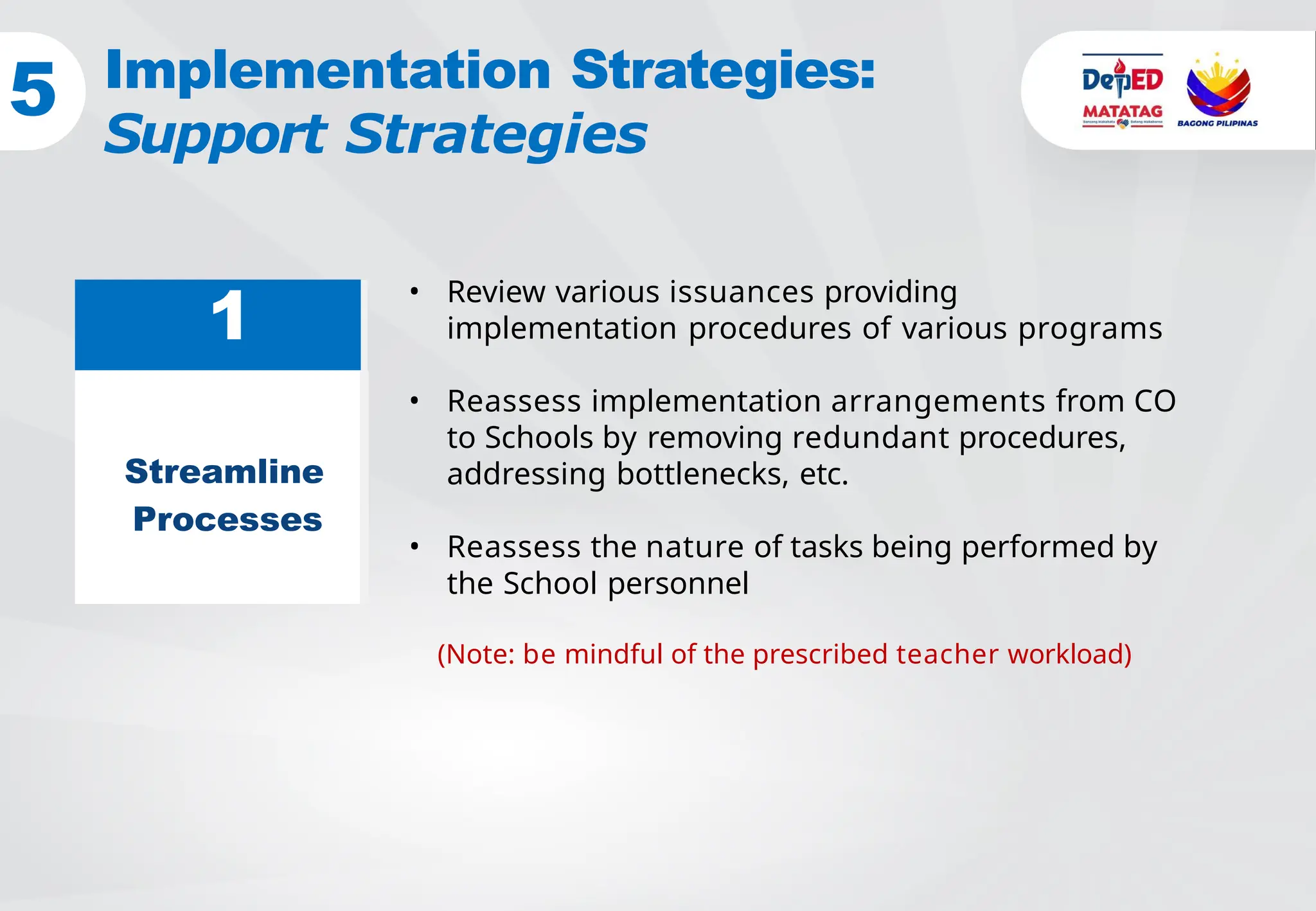
• Review various issuances providing
implementation procedures of various programs
• Reassess implementation arrangements from CO
to Schools by removing redundant procedures,
addressing bottlenecks, etc.
• Reassess the nature of tasks being performed by
the School personnel
(Note: be mindful of the prescribed teacher workload)
1
Streamline
Processes
Implementation Strategies:
Support Strategies
5
• DepEd issuances must clearly state the reports that need to be
submitted
• Provide templates and clear instructions on how to accomplish
the forms/reports
• Automate the reports and mechanism for submission, if possible
• Limit the reportorial requirements
• No duplication of datasets
• Repository of available data to avoid multiple requests
• Avoid short-notice requests for data
2
Streamline
Reportorial
Requirements
Implementation Strategies:
Support Strategies
5
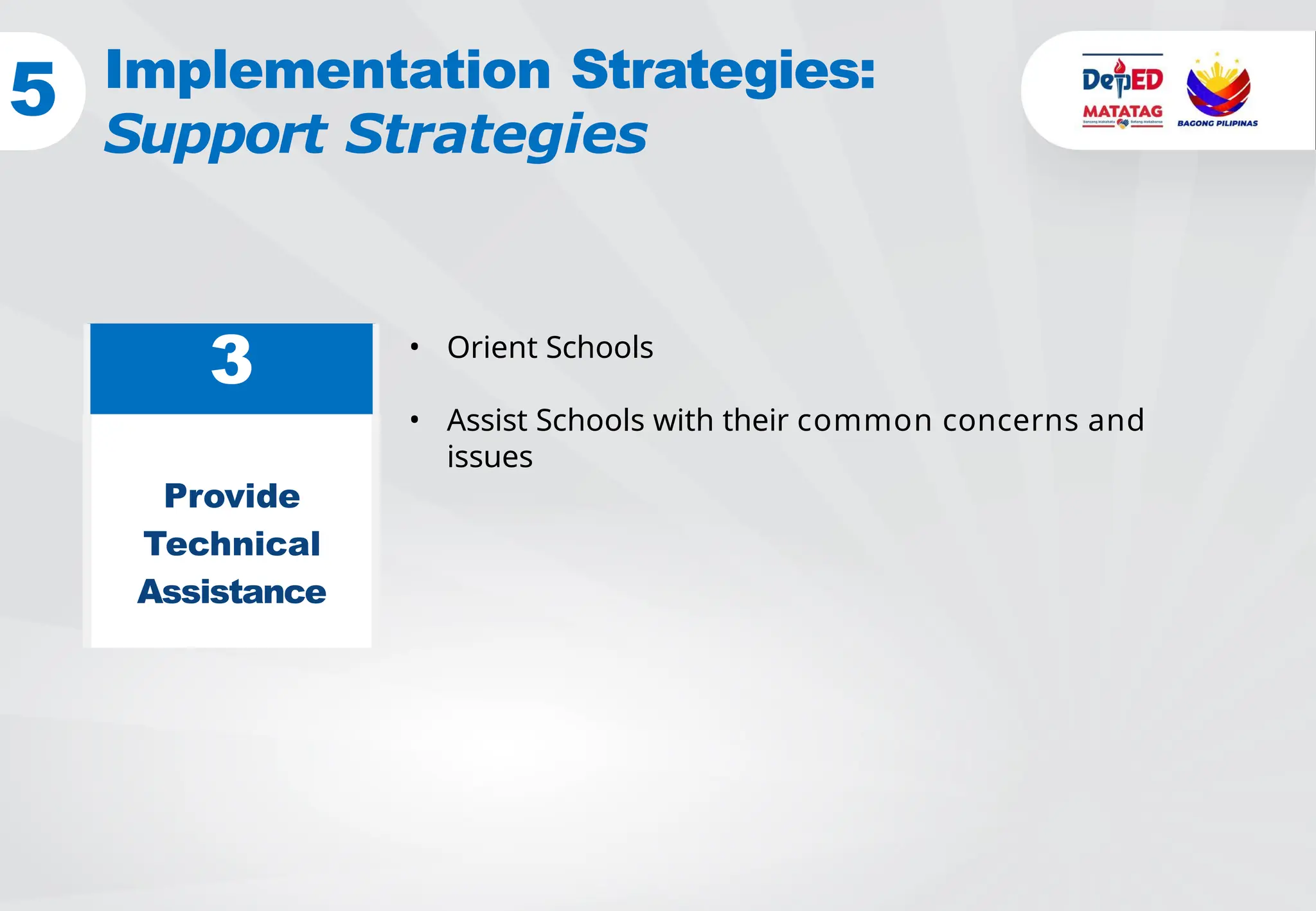
• Orient Schools
• Assist Schools with their common concerns and
issues
3
Provide
Technical
Assistance
Implementation Strategies:
Support Strategies
5
• Provide opportunities to collaborate with
private groups and individuals, civil society
organizations, and other groups, as may be
applicable, and subject to applicable DepEd
issuances.
4
Explore
Partnerships
Implementation Strategies:
Support Strategies
5
STARTING
POINT
CALL TO RECALIBRATE
PROCESSES
SHARED
RESPONSIBILITY
 It changes the status quo.
For the first time, a firm
policy is implemented to
bring teachers back to
the classroom.
 It challenges both the
Central and Field offices to
rethink and recalibrate
how processes/tasks are
executed from one
governance level to another.
 It requires the compliance
and collaboration of
various offices to ensure
success of the policy.
ASSESS ALIGN ADOPT
 Assess the implications of
the policies
 Streamline processes
 Reduce reportorial
requirements
 Make it easier for the
schools to implement
without sacrificing outputs
and outcomes
 Adopt recalibrated
processes
• Provide technical assistance
to schools
Implementation Strategies:
Ways Forward
5
Key Provisions of
DepEd Order No. 005, s.
2024
Rationalization of Teachers’ Workload in Public Schools and
Payment of Teaching Overload
Session
3:
Session Objective
Session
Outline
1 Teacher Work Hours
2 Teacher Workload
• Teaching Load
• Teacher Ancillary Tasks
• Teaching-Related Assignments
3 Teaching Overload
This session aims to provide the participants with a detailed discussion on the
key provisions of DepEd Order No. 005, s. 2024 including the
parameters and standards.
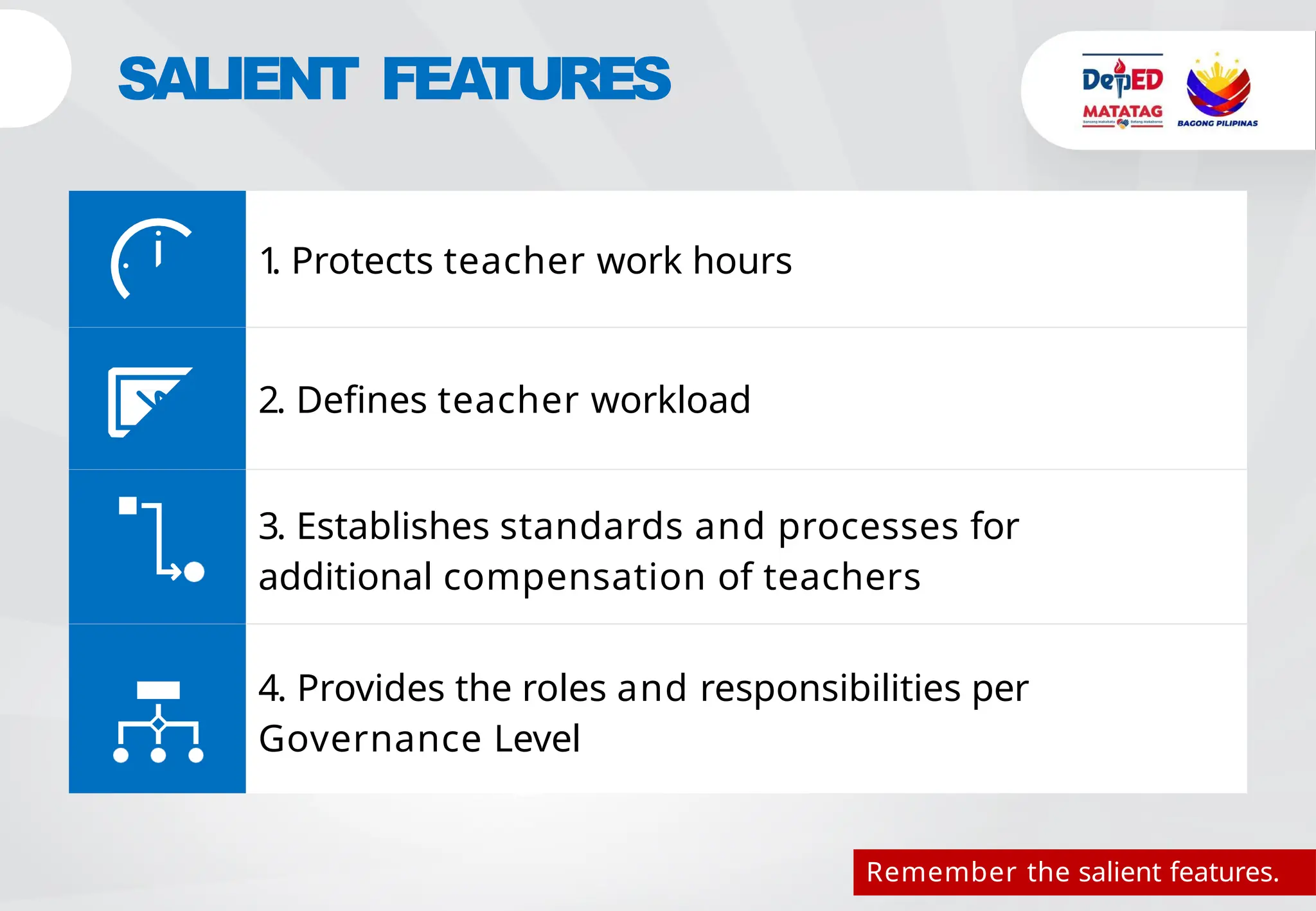
SALIENT FEATURES
1
. Protects teacher work hours
2. Defines teacher workload
3. Establishes standards and processes for
additional compensation of teachers
4. Provides the roles and responsibilities per
Governance Level
Remember the salient features.
SALIENT
FEATURES
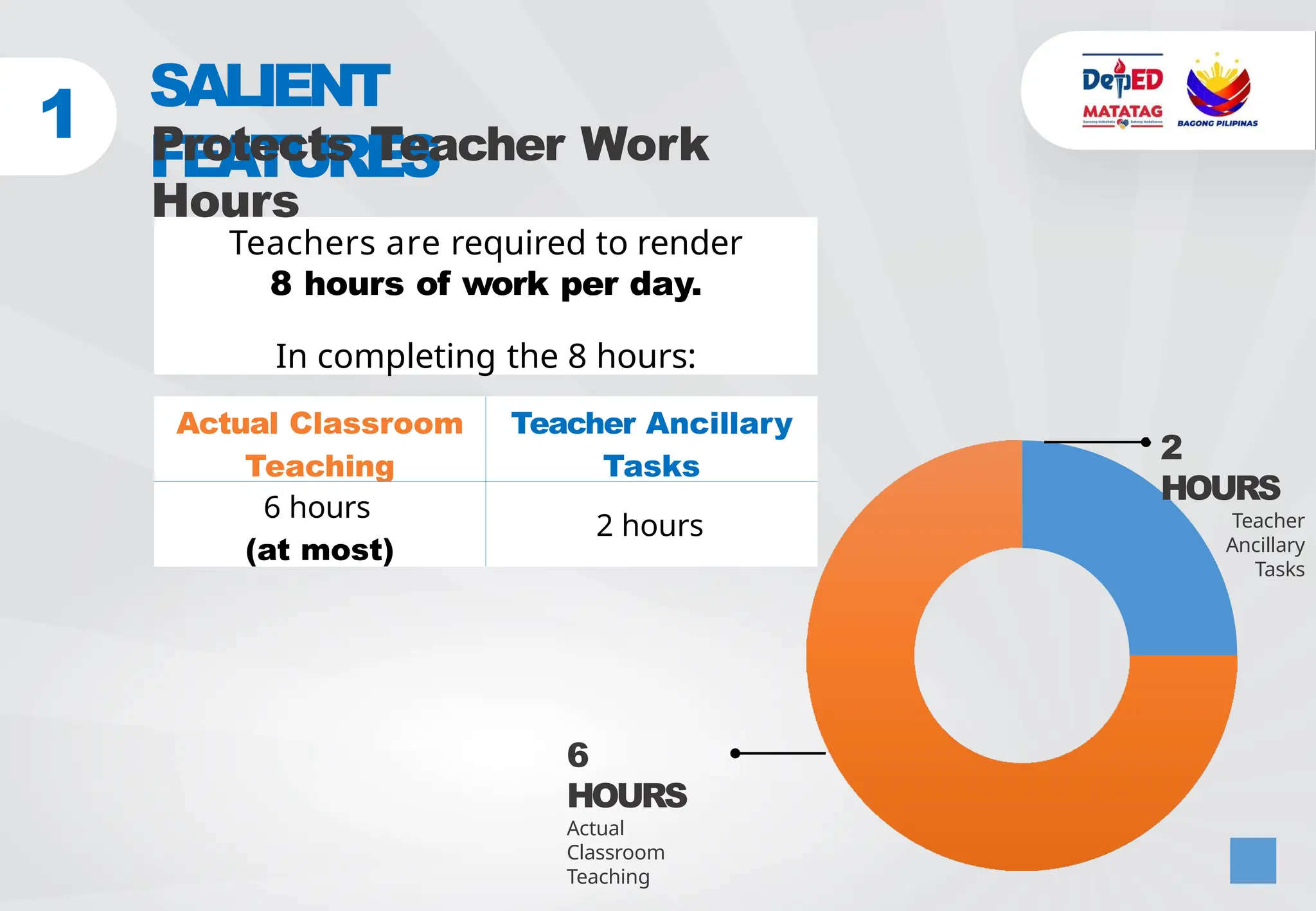
6
HOURS
Actual
Classroom
Teaching
2
HOURS
Teacher
Ancillary
Tasks
Teachers are required to render
8 hours of work per day.
In completing the 8 hours:
Actual Classroom
Teaching
Teacher Ancillary
Tasks
6 hours
(at most)
2 hours
Protects Teacher Work
Hours
1
Legal Bases
Section 13, RA 4670
CSC Reso No. 080096
A. Teaching
Load
B. Teacher
Ancillary
Task
C. Teaching-
Related
Assignments
 actual classroom
teaching hours or
minutes rendered by a
teacher.
 work incidental to
the teachers’ normal
teaching duties such as:
preparation of
lesson plans, checking of
exercises and summative
tests, etc.
 tasks related to
teaching and academic
learning which support
learner development.
SALIENT FEATURES
Defines Teacher
Workload
2
A. Teaching
Load
Teaching Load refers to the actual
classroom teaching hours or minutes
rendered by a teacher.
THEN
• Teaching Load is commonly interpreted
as the number of learning areas or
sections/classes that a teacher handles
NOW
• Teaching load shall be based on minutes
or hours of actual classroom
teaching rendered by a teacher.
PURPOSE OF REDEFINING
To ensure consistency in the Magna Carta, we need to specify
that teaching load is measured in minutes or hours.
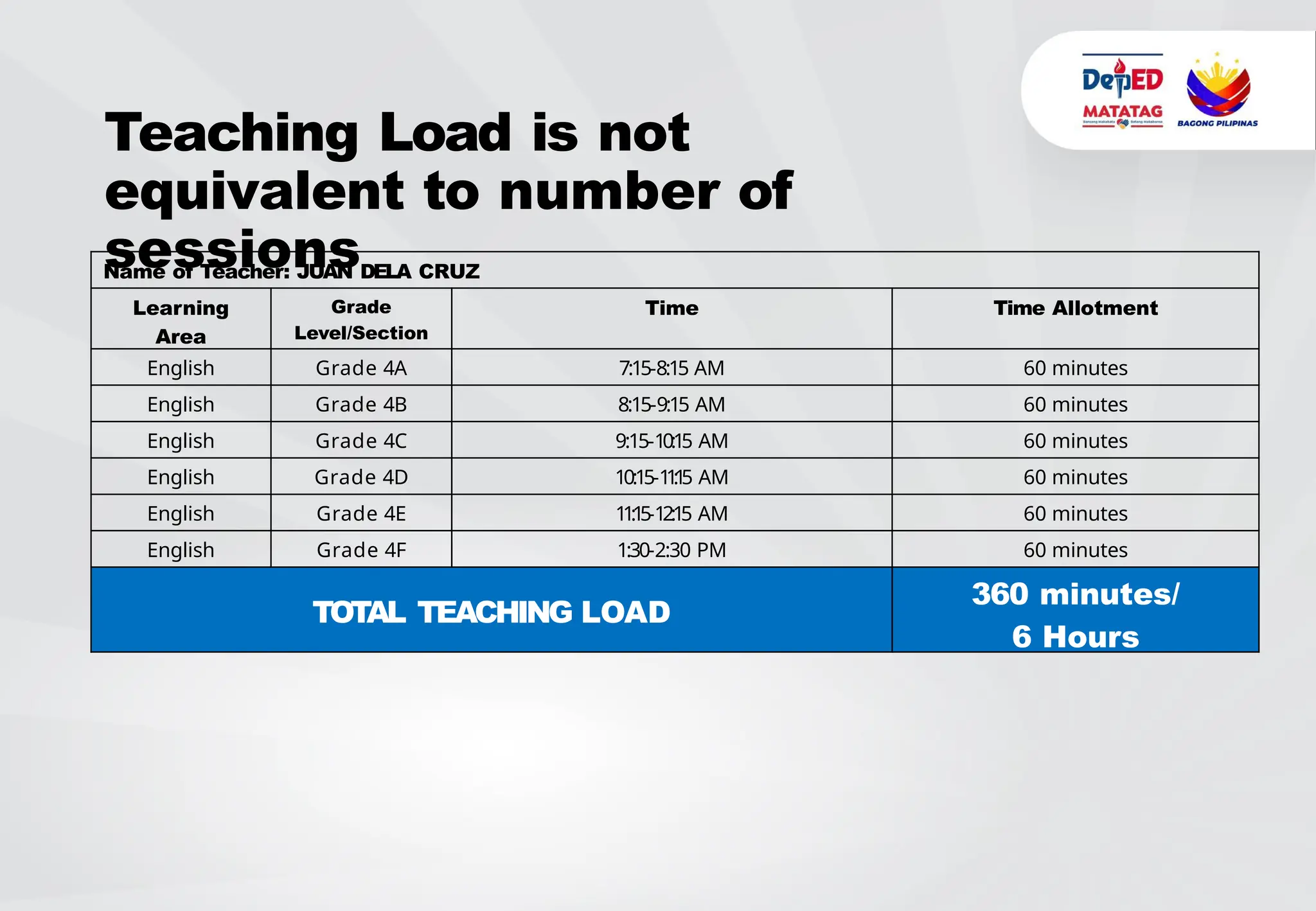
Teaching Load is not
equivalent to number of
sessions
Name of Teacher: JUAN DELA CRUZ
Learning
Area
Grade
Level/Section
Time Time Allotment
English Grade 4A 7:15-8:15 AM 60 minutes
English Grade 4B 8:15-9:15 AM 60 minutes
English Grade 4C 9:15-10:15 AM 60 minutes
English Grade 4D 10:15-1
1
:
1
5 AM 60 minutes
English Grade 4E 11:15-12:15 AM 60 minutes
English Grade 4F 1:30-2:30 PM 60 minutes
TOTAL TEACHING LOAD
360 minutes/
6 Hours
Teaching Load is not
equivalent to number of
sessions
Name of Teacher: Maria Santos
Learning
Area
Grade
Level/Section
Time Time Allotment
Values Ed Grade 6A 7:30-8:00 AM 30 minutes
Values Ed Grade 6B 8:00-8:30 AM 30 minutes
Values Ed Grade 6C 8:30-9:00 AM 30 minutes
Values Ed Grade 6D 9:30-10:00 AM 30 minutes
Values Ed Grade 6E 10:00-10:30 AM 30 minutes
Values Ed Grade 6F 10:30-11:00 AM 30 minutes
Values Ed Grade 6G 11:00-11:30 AM 30 minutes
Values Ed Grade 6H 1:00-1:30 PM 30 minutes
Values Ed Grade 6I 1:30-2:00 PM 30 minutes
TOTAL TEACHING LOAD
270 minutes/
4Hrs30Mins
Teaching Load is not
equivalent to number of
sessions
Name of Teacher: JUAN DELA CRUZ
Learning
Area
Grade
Level/Section
Time Time Allotment
English Grade 4A 7:15-8:00 AM 45 minutes
English Grade 4B 8:00-8:45 AM 45 minutes
English Grade 4C 8:45-9:30 AM 45 minutes
English Grade 4D 9:45-10:30 AM 45 minutes
English Grade 4E 10:30-1
1
:
1
5 AM 45 minutes
English Grade 4F 11:15-12:00 NN 45 minutes
NRP Grade 2A 1:00-1:30 PM 30 minutes
HGP/Class
Advisory
Grade 4A 60 minutes
TOTAL TEACHING LOAD
A. Teaching
Load
What are considered part of teaching
load?
 Actual classroom teaching rendered
per learning area
 Class Advising duty - equivalent to 5
Hours per week.
 Remedial or enhancement classes
Teaching Load refers to the actual
classroom teaching hours or minutes
rendered by a teacher.
6
HOURS
Actual
Classroom
2
HOURS
Teacher
Ancillary
Tasks
Teaching Load is not
equivalent to number of
sessions
Name of Teacher: JUAN DELA CRUZ
Learning
Area
Grade
Level/Section
Time Time Allotment
English Grade 4A 7:15-8:00 AM 45 minutes
English Grade 4B 8:00-8:45 AM 45 minutes
English Grade 4C 8:45-9:30 AM 45 minutes
English Grade 4D 9:45-10:30 AM 45 minutes
English Grade 4E 10:30-1
1
:
1
5 AM 45 minutes
English Grade 4F 11:15-12:00 NN 45 minutes
NRP Grade 2A 1:00-1:30 PM 30 minutes
HGP/Class
Advisory
Grade 4A 60 minutes
TOTAL TEACHING LOAD 360 minutes / 6 Hrs
Important
• 6 Hours Teaching Load is the MAXIMUM (Sec 13, RA 4670).
• In circumstances where a teacher may not be able to maximize
the six (6) hours of teaching load, they may be designated to
teaching-related assignments (Sec. V.A.4.2, DO5).
• In exigency of service where a teacher needs to render more
than six (6) hours, this shall be considered teaching overload.
(Sec 13, RA 4670).
In Assigning
Teaching
Load
REMEMBER
• Teachers are expected to work for
8 hours each day, of which they'll
spend maximum of 6 hours for
teaching.
CONSIDER
• Enrollment, Classroom Availability,
Teacher Specialization
PREPARE
• eSF7 (School Personnel Assignment
List and Basic Profile)
A. Teaching
Load
B. Teacher
Ancillary Task
C. Teaching-
Related
Assignments
 actual classroom
teaching hours or
minutes rendered by a
teacher.
 work incidental to
the teachers’ normal
teaching duties such as:
preparation of
lesson plans, checking of
exercises and summative
tests, etc.
 tasks related to
teaching and academic
learning which support
learner development.
SALIENT FEATURES
Defines Teacher
Workload
2
B. Teacher Ancillary Tasks
THEN
• There is no clear definition of an ancillary
task of a teacher.
• Commonly interpreted as
anything outside teaching.
NOW
• Teacher-ancillary tasks centers around
activities which support the teaching and
learning process. Further, these are done in
the remaining two (2) hours of the required
eight-hour workday and are not considered
as teaching load.
PURPOSE OF REDEFINING
To streamline teachers’ tasks that are considered incidental
and must be performed within the 2 hours.
B. Teacher Ancillary Tasks
Definition
Teacher Ancillary Tasks refer to work incidental to teachers’
normal teaching duties.
 These tasks support the teaching and learning process
 Considered as tasks applicable to all teachers
B. Teacher Ancillary
Tasks
iii.
i. Curriculum Planning
• Preparation of lesson plans/daily lesson logs
• Action research
• Attendance to Learning Action Cells (LAC) Sessions
ii. Curriculum Delivery and Pedagogy
• Preparation of instructional aids and materials
• Checking and recording learners’ attendance and participation
• Classroom management
Assessment of Learner’s Progress
• Checking of exercises and summative test
• Recording of academic performance result
• Grading learners’ performance or achievement
iv. Homeroom Guidance and Management
• Class advising duties
• Periodic reporting of attendance
• Preparation and submission of report card and other school forms
• Conference with parents and home visits when necessary
Coaching and mentoring duties of Master Teachers are considered as ancillary
task.
B. Teacher Ancillary Tasks
Work Hours
Ancillary Tasks must be performed within the 2 HOURS
that complete their 8-Hour Workday
 It can be done within and outside school premises.
 No documents/MOV shall be required when ancillary tasks are
performed outside school premises.
B. Teacher Ancillary Tasks
Additional Compensation
ONLY Home Visitation and Coaching/Mentoring duties of
Master Teachers performed outside the regular work hours
shall be compensated through VSC.
Process for the grant of VSC shall be discussed separately.
In Accomplishing
Teacher Ancillary
Tasks
REMEMBE
R
CONSIDE
R
PREP
ARE
• Teachers are expected to work for 8 hours
each day, of which they'll spend 2 hours
for teacher ancillary tasks.
• These can be performed within or outside
school premises.
• Class Program of Teachers should be
scheduled in a way that teachers
have ample time for teacher ancillary
tasks.
• Logbook/Locator Slip, if necessary
A. Teaching
Load
B. Teacher
Ancillary Task
C. Teaching-
Related
Assignments
 actual classroom
teaching hours or
minutes rendered by a
teacher.
 work incidental to
the teachers’ normal
teaching duties such as:
preparation of
lesson plans, checking of
exercises and summativ
tests, etc.
e
 tasks related to
teaching and academic
learning which support
learner development.
SALIENT FEATURES
Defines Teacher
Workload
2
C. Teaching-
Related
Assignments
• Teachers are
commonly assigned/designated to
different roles with varying nature of
tasks.
THE
N
NOW
• Teaching-related assignments shall be
limited to those that are related to
teaching and academic learning which
support learner development.
PURPOSE OF REDEFINING
To streamline tasks that can be assigned to teachers to
continuously protect their work hours and workload.
Definition
Teaching-related assignments refer to tasks related to teaching
and academic learning which support learner development.
These tasks are performed by teachers in consideration of their
professional expertise and experience.
 These Assignments should be anchored in the
School
Improvement Plan (SIP).
 Designation of teachers must be enabled by a
designation order duly signed by the SDS.
C. Teaching-
Related
Assignments
C. Teaching-
Related
Assignments
A. SCHOOL
COORDINATOR
B. TRAINER/ADVISER C. CHAIRMANSHIP
i. Reading/Literacy and
Numeracy
ii. Research
iii. Special Needs Education
(SNED)
iv. Information,
Communication, and
Technology
v. Guidance and
Advocacy
vi. Inclusive Education (as may
be applicable)
i. School Paper
ii. Sports Development
Programs
iii. Supreme Elementary
Learner Government
(SELG)/Supreme
Secondary Learner
Government (SSLG)
i. Grade level
ii. Learning Area
Work Hours
As a general rule, performed on top of the teacher ancillary tasks.
C. Teaching-
Related
Assignments
Additional Compensation
Shall be compensated through VSC when performed outside the
regular work hours
Process for the grant of VSC shall be discussed separately.
1. Identify the teaching-related assignments based on the SIP and AIP
2. Define the scope of work of each teaching-related assignment
3. Designate teachers to these teaching-related assignments
In Designating
Teaching-Related
Assignments
REMEMBER
CONSIDER
PREPARE
 Specialization of Teachers
 Workload of Teachers
 Requirements of DepEd as provided in other policies
 Designation Order
Teaching
Overload
3
THEN
• Teaching Overload is usually
misinterpreted and often confused with
overtime.
NOW
• Teaching Overload shall refer to the excess
in the prescribed six (6) hours of
actual classroom teaching rendered
by the teacher.
PURPOSE OF
REDEFINING
To ensure consistency in the Magna Carta.
Teaching
Overload
6
HOURS
Actual
Classroom
2
HOURS
Teacher
Ancillary
Tasks
MAX OF
2
HOURS
Teaching
Overload
Hours rendered as actual classroom
teaching in excess of the
prescribed six (6) hours in a day
shall be counted as teaching
overload and shall be paid by
teaching overload pay.
3
Teaching Overload
PARAMETERS
 Should be in excess of the prescribed six (6) hours of actual
classroom teaching in a day
 Maximum of 2 hours of teaching overload per day
 Only actual classroom teaching, class advising duty, and
remediation/enhancement classes are paid by teaching overload
 As a general rule, schools with shortage are eligible for teaching
overload pay. However, tasks requiring actual classroom
teaching duties whether in-person, distance, or blended,
including relieving duties for other teachers, which are beyond
the normal teaching hours and affecting vacant periods
shall also be considered teaching overload
Process for the
Payment of Teaching
Overload and Grant of
VSC
Session
4:
Session Objective
Session
Outline
1 Teaching Overload Pay
• Parameters
• Formula
• Templates
2 Vacation Service Credits
This session aims to provide the participants with a detailed discussion on the
processes for the payment of teaching overload and grant of VSC,
including the templates to be used.
SALIENT
FEATURES
1. Protects teacher work hours
2. Defines teacher workload
3. Establishes standards and processes for
additional compensation of teachers
4.Provides the roles and responsibilities per
Governance Level
Let’s Review the Salient Features!
3
A.
Teaching
Overload
Pay
• Granted ONLY for teaching load
in excess of the prescribed six (6)
hours per day
SALIENT
FEATURES
Establishes Standards and
Processes for Additional
Compensation
Forms of Additional Compensation
B.
Vacation
Service
Credits
• Granted for ancillary tasks
(home visitations and coaching
& mentoring) and teaching-
related assignments performed
beyond the regular work hours
A
.
Teaching Overload
Pay
1 2 3
Parameters Formula Process Flow
Provides important notes on the payment
of teaching overload
Provides the details on how to compute
for teaching overload and sample
computation
Provides the general and detailed
processes in the payment of teaching
overload
A
.
Teaching Overload
Pay
Parameters:
 Shall be at least twenty-five percent (25%) of a teacher’s regular
remuneration
 Payment of teaching overload shall be made on a quarterly basis
 Shall be sourced from the General Appropriations Act
(GAA) specifically for the purpose of Teaching Overload pay
 In the event of insufficiency of funds, teaching overload hours shall
be converted to earned VSC
A
.
Teaching Overload
Pay
To determine the Total Teaching Overload Hour/s for the Month, the
teaching overload hour/s per week shall be added. See example below:
7
Week 1
+ 10
Week 2
+ 5
Week 3
+ 0.75
Week 4
=
22.75
Teaching
Overload
Hours
In computing for the payment of Teaching Overload, the formula below
shall be used:
Teaching
Overload
Pay
=
Total
Teaching
Overload
Hours
x
PHTR
Prime Hourly Teaching
Rate
A
.
Teaching Overload
Pay
Where,
AR = Annual salary rate of each teacher proposed to be paid overload
W = Total teaching hours (This is computed at 40 hours/week multiplied by 40 weeks or 1,600 hours.)
T = 1.25 or 125% of the teacher’s remuneration for services in excess of 6 hours actual teaching per day
but not more than 2 hours.
A
R
PHTR = X
W
T
=
AR
X
1600
1.2
5
= 0.000781 X AR
To determine the PHTR, the formula below shall be applied:
A
.
Teaching Overload
Pay
AR =
Monthly
Basic Salary
x 12
months
= Php 27,000 x 12 months
Php 324,000.00
The AR of the teacher shall first be computed as follows:
PHTR = 0.000781 x AR
= 0.000781 x Php 324
000.00
Php 253.04
The PHTR shall be computed as follows:
A
.
Teaching Overload
Pay
Teaching
Overload
Payment
=
Total Teaching
Overload
Hours/s for
the Month
x PHTR
= 22.75 hours x Php
253.044
Php 5,756.75
Finally, for the amount that shall be paid to the teacher, the formula
shall be applied:
The total teaching overload pay of a public school teacher shall
not exceed 50% of his/her basic salary for the year.
B
.
Vacation Service Credits
Parameters:
 The following are eligible for Vacation Service Credits (VSC) under
DO 5, s. 2024, provided that these are performed outside the
regular work hours of teachers, which is eight (8) hours per day:
a. Home Visitations of Teachers
b. Coaching & Mentoring duties of a Master Teacher
c. Teachers designated to teaching-related assignments
 Eight (8) hours of services = 1.25 VSC
 Teachers are required to seek an authority from the School Head
before rendering work beyond regular work hours.
 Teachers must submit an individual accomplishment report.
C
.
For Clarifications:
The teacher
assigned as Asst.
School Head
C
.
For Clarifications:
The monitoring load
of the Master
Teacher is
equivalent to 1 load
C
.
For Clarifications:
Waiver, relative 2
hours outside the
school
C
.
For Clarifications:
A process on
designation Order:
a. VAWC
b. Brigada Skwela
c. Child Protection
C
.
For Clarifications:
Relieving Teachers
of Unplanned Leave
of Teachers
Reminders
for Day 2
Reminders
• Dinner will be served as early as 5:30 PM, Session Hall
• Breakfast at 6:30 AM, Session Hall
• Session starts at 8:30 AM
• Regional FTAD will be asked to share quick updates on their field
implementation plan for DO 5 as last activity for the orientation.
bit.ly/DO5-Materials
Access your Materials here!

Day-1-DO5-Orientation about education in teaching loads.

  • 1.
    Policy Orientation for DepEdOrder No. 005, s. 2024 Rationalization of Teachers’ Workload in Public Schools and Payment of Teaching Overload RO and SDO June 17-21, 2024 | Diamond Suites and Residences, Cebu
  • 2.
  • 3.
    Objective 1. To discussthe key provisions of the DepEd Order; 2. To provide direction on the implementation strategies particularly on the duties and responsibilities of the Field Offices; and 3. To clarify common concerns and solicit feedback.
  • 4.
    Program Flow Afternoon Open Forum Session4 Process for Teaching Overload Pay and VSC Ms. Ina Mallari, BHROD-SED with BHROD-PD Time June 18 (Day 1) June 19 (Day 2) Morning Session 1 Context Setting Mr. RJ Aquino, BHROD-SED Session 2 Key Provisions of DO 2, s. 2024 Ms. Ina Mallari, BHROD-SED Session 3 Key Provisions of DO 5, s. 2024 Mr. RJ Aquino, BHROD-SED Session 5 Implementation Strategies Ms. Ina Mallari, BHROD-SED Session 6 Updating of Field Implementation Plan Mr. RJ Aquino, BHROD-SED Closing Program
  • 5.
    Questions will beentertained after discussion/presentations. Scan the QR Code or access this link to send your questions in advance. Mechanics for Questions bit.ly/DO5Orientation-Question The QR Code and Link are also posted on your tables.
  • 6.
    Other Reminders • Participantswill be provided with a copy of the presentation material, together with the consolidated questions and responses from the open forum. • Please refrain from circulating or sending out portions of the slides to avoid any misinterpretation of the contents. bit.ly/DO5-Materials Access your Materials here!
  • 7.
    Session 1: Context Setting Priming Question Thinkof an anecdote of a teachers’ workload
  • 8.
    LEGAL BASES RA 4670 MagnaCarta for Public School Teachers 1 2 3 DM 291, s. 2008 CSC Reso No. 080096 provides the prescribed working hours of teachers clarifies that teachers are not exempted from an 8-hour workday operationalizes RA 4670 and CSC Reso No. 080096
  • 9.
    Teacher Working Hours AndWorkload (DM 291, s. 2008) Teacher Working Hours 8 HOURS 2 HOURS Shall be devoted to teaching-related duties 6 HOURS shall be devoted to actual classroom teaching, advisorship, and/or special assignments lesson plan Instructional materials Checking of exercises Recording of Action plan Seminar Workshop Research Coaching academic performance Coordination activities Maintenance of school facilities Maintenance of equipment Home visits actual classroom teaching Advisorship Special Assignments
  • 10.
    Reality of a PublicSchool Teacher  The workload of a teacher is not only limited to teaching but also includes non-teaching tasks  Actual teaching is increasingly being sidelined  Teachers want to spend more time with students (PIDS, 2018)
  • 11.
    50 Most CommonAncillary Tasks Based on the 2018 Teacher Workload Study
  • 12.
  • 13.
    We will givesupport to teachers to teach better. We will remove the non-teaching tasks and provide administrative officers in Schools. We will provide adequate manpower complement in Schools, manage teacher’s workload, and compensate for unique school challenges. Sara Z. Duterte-Carpio Vice-President of the Republic of the Philippines Secretary of the Department of Education Note: This presentation material is not for general or public use.
  • 14.
    Photos from DepEdPhilippines Facebook Page THE GOAL OF THE MATATAG AGENDA We aim for Teacher Quality and Teacher Welfare as we firmly believe that the core of quality basic education is a vibrant and quality teaching workforce.
  • 15.
    Teacher at the Forefrontof the MATATAG Agenda Teachers will be given more time for teaching Administrative tasks will be removed from teachers’ workload Teachers will be compensated in actual classroom teaching rendered more than 6 hours Teachers will be compensated in teaching-related assignments designated to them
  • 16.
  • 17.
  • 18.
    18 What problem doesthe policy solve? 1. Teachers are overworked. The Department has been receiving numerous concerns surrounding the workload of teachers and that they are increasingly burdened because of non- teaching tasks. 2. Teachers play numerous roles outside their core mandate. Studies have shown that the workload of teachers is not only limited to teaching but also to many other non-teaching tasks. 3. Teachers are not properly compensated for excess workload There are no existing policies that guide the teachers in processing their benefits for work rendered beyond the eight-hour workday. How does the policy address the problem? It protects Teacher Work Hours. The policies enable teachers to devote their time to teaching. It defines Teacher Workload. The policies clearly define the responsibilities of School Heads, teachers, and non-teaching personnel. Specifically for teachers, the policies provide the following: What should be: Tasks mandated to be performed by teachers What should not be: Tasks that should not be performed by teachers What can be: Tasks that can be performed by teachers, but are not mandatory It provides guidelines and processes for the payment of teaching overload. The policy establishes the procedures, roles of Offices, and documentary requirements for the payment of teaching overload. The Teacher Workload Policies
  • 19.
    OUR ASPIRATION MATATAG na Kaguruan, Lakasng Kagawaran Cultivating a more conducive work environment that
  • 20.
    Key Provisions of DepEdOrder No. 002, s. 2024 Immediate Removal of Administrative Tasks of Public School Teachers Session 2: Priming Question Think of an emoji that would best describe your initial reaction when DO 2 was issued in Jan 2024?
  • 21.
    Session Objective Session Outline 1 DefiningAdmin Tasks 2 Responsible for Admin Tasks 3 Personnel & Workload Delineation 4 Tool for School Heads 5 Implementation Strategies This session aims to provide the participants with a detailed discussion on the key provisions and implementation strategies of DepEd Order No. 002, s. 2024.
  • 22.
    What are AdministrativeTasks? These are tasks related to the effective and efficient operations of schools or programs, projects, and services which are not directly related to teaching and academic learning. What are considered Administrative Tasks? Administrative Tasks include the following: a. Personnel Administration; b. Property/Physical Facilities Custodianship; c. General Administrative Support; d. Financial Management; e. Records Management; and f. Program Management. 1 Defining Admin Tasks
  • 23.
    Who are responsibleto perform the Administrative Tasks? School Heads and non-teaching personnel have the responsibility to perform administrative tasks in schools. 2 Responsible for Admin Tasks
  • 24.
    Implementation Strategies: Our Perspective STARTING POINT CALLTO RECALIBRATE PROCESSES SHARED RESPONSIBILITY  It changes the status quo. For the first time, a firm policy is implemented to bring teachers back to the classroom.  It marks the start of efforts to continuously streamline processes, reportorial requirements, implementation  It challenges both the Central and Field offices to rethink and recalibrate how processes/tasks are executed from one governance level to another.  It requires the compliance and collaboration of various offices to ensure success of the policy. 5
  • 25.
    1 2 34 Request for additional MOOE for schools without non-teaching personnel Request for creation and deployment of school-based non-teaching personnel Rationalization of Teacher Workload Establishment of School Organizational Structure and Staffing Standards Implementation Strategies: HROD Strand 5
  • 26.
    1 Request for additional MOOEfor schools without non- teaching personnel • Schools that cannot be provided services by existing non-teaching personnel, even with the clustering strategy, shall be given additional MOOE • Additional MOOE shall be used solely for the hiring of personnel under COS to support the School Head in performing admin tasks >> Status Downloaded additional MOOE to hire 7,062 COS. Implementation Strategies: HROD Strand 5
  • 27.
    2 Request for creation and deploymentof school-based non-teaching personnel Fiscal Year AO II PDO I 2020 4,973 - 2021 4,840 - 2022 5,000 - 2023 3,500 1,500 2024 5,000 - TOTAL 23,313 1,500 Implementation Strategies: HROD Strand 5
  • 28.
    Clustering Strategy Parameters: • Theschools that will form as a cluster should be geographically adjacent and located within the same school district; • Schools without existing non-teaching personnel based on the latest Personal Services Itemization and Plantilla of Personnel (PSIPOP) shall be prioritized in the clustering/re-clustering of schools, however, proximity of schools shall still be the primary consideration; and • SDOs are reminded to ensure equitable distribution of schools (with 3 schools at maximum) per cluster. SDOs shall be responsible in the clustering of schools.
  • 29.
    FILLING-UP STATUS |SCHOOL-BASED AO II (FYs 2020-2023) Based on Quick Count Monitoring Tool as of June 15, 2024 REGION TOTAL AUTHORIZED 2020 2021 2022 2023 TOTAL FILLED TOTAL UNFILLED FILLING UP PERCENTAGE FILLED UNFILLED FILLED UNFILLED FILLED UNFILLED FILLED UNFILLED CAR 839 46 - 80 - 591 - 122 - 839 - 100.00% NCR 515 469 1 1 33 - - - 1 1 503 12 97.67% REGION I 1,424 186 1 315 4 807 9 102 - 1,410 14 99.02% REGION II 1,265 110 - 222 1 809 - 123 - 1,264 1 99.92% REGION III 2,217 730 8 593 6 791 15 73 1 2,187 30 98.65% REGION IV-A 1,563 859 1 1 477 10 - - 177 26 1,516 47 96.99% REGION IV- B 842 124 - 275 - - - 443 - 842 - 100.00% REGION V 1,127 295 16 388 8 - - 364 53 1,050 77 93.17% REGION VI 1,161 409 2 456 2 - - 281 1 1 1,146 15 98.71% REGION VII 1,139 410 - 374 - - - 347 1 1,138 1 99.91% REGION VIII 839 182 - 260 - - - 397 - 839 - 100.00% REGION IX 1,383 165 - 178 - 825 - 215 - 1,383 - 100.00% REGION X 891 264 - 337 - - - 290 - 891 - 100.00% REGION XI 788 302 1 293 2 - - 166 24 761 27 96.57% REGION XII 1,268 230 - 344 4 539 1 149 1 1,262 6 99.53% REGION XIII 1,052 142 - 175 - 613 - 122 - 1,052 - 100.00% TOTAL 18,313 4,923 50 4,800 37 4,975 25 3,372 1 1 8 18,083 230 98.74% 98.74% Filling Up Rate
  • 30.
    FILLING-UP STATUS |SCHOOL-BASED PDO I (FY 2023) Based on Quick Count Monitoring Tool as of June 15, 2024 REGION TOTAL AUTHORIZED TOTAL FILLE D TOTAL UNFILLE D FILLING UP PERCENTAGE CAR 67 67 - 100.00% NCR 66 60 6 90.91% REGION I 126 1 2 1 5 96.03% REGION II 87 86 1 98.85% REGION III 213 213 - 100.00% REGION IV-A 176 166 10 94.32% REGION IV-B 50 50 - 100.00% REGION V 1 1 7 103 14 88.03% REGION VI 87 86 1 98.85% REGION VII 1 1 1 109 2 98.20% REGION VIII 73 73 - 100.00% REGION IX 64 64 - 100.00% REGION X 66 66 - 100.00% REGION XI 49 43 6 87.76% REGION XII 57 55 2 96.49% REGION XIII 91 91 - 100.00% TOTAL 1,500 1,453 47 96.87% 96.87% Filling Up Rate
  • 31.
    3 Rationalization of Teacher Workload •Streamlines teacher workload • Clarifies the ancillary tasks of teachers as work incidental to their normal teaching duties • Provides the allowed teaching-related assignments • Provides compensation for excess teaching hours Implementation Strategies: HROD Strand 5
  • 32.
    4 Establishment of School Organizational Structureand Staffing Standards • Mapping of school processes, tasks and activities vis-à- vis required knowledge, skills and attitudes of staffing complement • Provides the School Structure and Staffing Standards • Considers typology of schools, number of teachers, curricular offering, etc. Implementation Strategies: HROD Strand 5
  • 33.
    1 2 34 Streamline Processes Streamline Reportorial Requirements Provide Technical Assistance Explore Partnerships Implementation Strategies: Support Strategies 5
  • 34.
    • Review variousissuances providing implementation procedures of various programs • Reassess implementation arrangements from CO to Schools by removing redundant procedures, addressing bottlenecks, etc. • Reassess the nature of tasks being performed by the School personnel (Note: be mindful of the prescribed teacher workload) 1 Streamline Processes Implementation Strategies: Support Strategies 5
  • 35.
    • DepEd issuancesmust clearly state the reports that need to be submitted • Provide templates and clear instructions on how to accomplish the forms/reports • Automate the reports and mechanism for submission, if possible • Limit the reportorial requirements • No duplication of datasets • Repository of available data to avoid multiple requests • Avoid short-notice requests for data 2 Streamline Reportorial Requirements Implementation Strategies: Support Strategies 5
  • 36.
    • Orient Schools •Assist Schools with their common concerns and issues 3 Provide Technical Assistance Implementation Strategies: Support Strategies 5
  • 37.
    • Provide opportunitiesto collaborate with private groups and individuals, civil society organizations, and other groups, as may be applicable, and subject to applicable DepEd issuances. 4 Explore Partnerships Implementation Strategies: Support Strategies 5
  • 38.
    STARTING POINT CALL TO RECALIBRATE PROCESSES SHARED RESPONSIBILITY It changes the status quo. For the first time, a firm policy is implemented to bring teachers back to the classroom.  It challenges both the Central and Field offices to rethink and recalibrate how processes/tasks are executed from one governance level to another.  It requires the compliance and collaboration of various offices to ensure success of the policy. ASSESS ALIGN ADOPT  Assess the implications of the policies  Streamline processes  Reduce reportorial requirements  Make it easier for the schools to implement without sacrificing outputs and outcomes  Adopt recalibrated processes • Provide technical assistance to schools Implementation Strategies: Ways Forward 5
  • 39.
    Key Provisions of DepEdOrder No. 005, s. 2024 Rationalization of Teachers’ Workload in Public Schools and Payment of Teaching Overload Session 3:
  • 40.
    Session Objective Session Outline 1 TeacherWork Hours 2 Teacher Workload • Teaching Load • Teacher Ancillary Tasks • Teaching-Related Assignments 3 Teaching Overload This session aims to provide the participants with a detailed discussion on the key provisions of DepEd Order No. 005, s. 2024 including the parameters and standards.
  • 41.
    SALIENT FEATURES 1 . Protectsteacher work hours 2. Defines teacher workload 3. Establishes standards and processes for additional compensation of teachers 4. Provides the roles and responsibilities per Governance Level Remember the salient features.
  • 42.
    SALIENT FEATURES 6 HOURS Actual Classroom Teaching 2 HOURS Teacher Ancillary Tasks Teachers are requiredto render 8 hours of work per day. In completing the 8 hours: Actual Classroom Teaching Teacher Ancillary Tasks 6 hours (at most) 2 hours Protects Teacher Work Hours 1
  • 43.
    Legal Bases Section 13,RA 4670 CSC Reso No. 080096
  • 44.
    A. Teaching Load B. Teacher Ancillary Task C.Teaching- Related Assignments  actual classroom teaching hours or minutes rendered by a teacher.  work incidental to the teachers’ normal teaching duties such as: preparation of lesson plans, checking of exercises and summative tests, etc.  tasks related to teaching and academic learning which support learner development. SALIENT FEATURES Defines Teacher Workload 2
  • 45.
    A. Teaching Load Teaching Loadrefers to the actual classroom teaching hours or minutes rendered by a teacher. THEN • Teaching Load is commonly interpreted as the number of learning areas or sections/classes that a teacher handles NOW • Teaching load shall be based on minutes or hours of actual classroom teaching rendered by a teacher. PURPOSE OF REDEFINING To ensure consistency in the Magna Carta, we need to specify that teaching load is measured in minutes or hours.
  • 46.
    Teaching Load isnot equivalent to number of sessions Name of Teacher: JUAN DELA CRUZ Learning Area Grade Level/Section Time Time Allotment English Grade 4A 7:15-8:15 AM 60 minutes English Grade 4B 8:15-9:15 AM 60 minutes English Grade 4C 9:15-10:15 AM 60 minutes English Grade 4D 10:15-1 1 : 1 5 AM 60 minutes English Grade 4E 11:15-12:15 AM 60 minutes English Grade 4F 1:30-2:30 PM 60 minutes TOTAL TEACHING LOAD 360 minutes/ 6 Hours
  • 47.
    Teaching Load isnot equivalent to number of sessions Name of Teacher: Maria Santos Learning Area Grade Level/Section Time Time Allotment Values Ed Grade 6A 7:30-8:00 AM 30 minutes Values Ed Grade 6B 8:00-8:30 AM 30 minutes Values Ed Grade 6C 8:30-9:00 AM 30 minutes Values Ed Grade 6D 9:30-10:00 AM 30 minutes Values Ed Grade 6E 10:00-10:30 AM 30 minutes Values Ed Grade 6F 10:30-11:00 AM 30 minutes Values Ed Grade 6G 11:00-11:30 AM 30 minutes Values Ed Grade 6H 1:00-1:30 PM 30 minutes Values Ed Grade 6I 1:30-2:00 PM 30 minutes TOTAL TEACHING LOAD 270 minutes/ 4Hrs30Mins
  • 48.
    Teaching Load isnot equivalent to number of sessions Name of Teacher: JUAN DELA CRUZ Learning Area Grade Level/Section Time Time Allotment English Grade 4A 7:15-8:00 AM 45 minutes English Grade 4B 8:00-8:45 AM 45 minutes English Grade 4C 8:45-9:30 AM 45 minutes English Grade 4D 9:45-10:30 AM 45 minutes English Grade 4E 10:30-1 1 : 1 5 AM 45 minutes English Grade 4F 11:15-12:00 NN 45 minutes NRP Grade 2A 1:00-1:30 PM 30 minutes HGP/Class Advisory Grade 4A 60 minutes TOTAL TEACHING LOAD
  • 49.
    A. Teaching Load What areconsidered part of teaching load?  Actual classroom teaching rendered per learning area  Class Advising duty - equivalent to 5 Hours per week.  Remedial or enhancement classes Teaching Load refers to the actual classroom teaching hours or minutes rendered by a teacher. 6 HOURS Actual Classroom 2 HOURS Teacher Ancillary Tasks
  • 50.
    Teaching Load isnot equivalent to number of sessions Name of Teacher: JUAN DELA CRUZ Learning Area Grade Level/Section Time Time Allotment English Grade 4A 7:15-8:00 AM 45 minutes English Grade 4B 8:00-8:45 AM 45 minutes English Grade 4C 8:45-9:30 AM 45 minutes English Grade 4D 9:45-10:30 AM 45 minutes English Grade 4E 10:30-1 1 : 1 5 AM 45 minutes English Grade 4F 11:15-12:00 NN 45 minutes NRP Grade 2A 1:00-1:30 PM 30 minutes HGP/Class Advisory Grade 4A 60 minutes TOTAL TEACHING LOAD 360 minutes / 6 Hrs
  • 51.
    Important • 6 HoursTeaching Load is the MAXIMUM (Sec 13, RA 4670). • In circumstances where a teacher may not be able to maximize the six (6) hours of teaching load, they may be designated to teaching-related assignments (Sec. V.A.4.2, DO5). • In exigency of service where a teacher needs to render more than six (6) hours, this shall be considered teaching overload. (Sec 13, RA 4670).
  • 52.
    In Assigning Teaching Load REMEMBER • Teachersare expected to work for 8 hours each day, of which they'll spend maximum of 6 hours for teaching. CONSIDER • Enrollment, Classroom Availability, Teacher Specialization PREPARE • eSF7 (School Personnel Assignment List and Basic Profile)
  • 53.
    A. Teaching Load B. Teacher AncillaryTask C. Teaching- Related Assignments  actual classroom teaching hours or minutes rendered by a teacher.  work incidental to the teachers’ normal teaching duties such as: preparation of lesson plans, checking of exercises and summative tests, etc.  tasks related to teaching and academic learning which support learner development. SALIENT FEATURES Defines Teacher Workload 2
  • 54.
    B. Teacher AncillaryTasks THEN • There is no clear definition of an ancillary task of a teacher. • Commonly interpreted as anything outside teaching. NOW • Teacher-ancillary tasks centers around activities which support the teaching and learning process. Further, these are done in the remaining two (2) hours of the required eight-hour workday and are not considered as teaching load. PURPOSE OF REDEFINING To streamline teachers’ tasks that are considered incidental and must be performed within the 2 hours.
  • 55.
    B. Teacher AncillaryTasks Definition Teacher Ancillary Tasks refer to work incidental to teachers’ normal teaching duties.  These tasks support the teaching and learning process  Considered as tasks applicable to all teachers
  • 56.
    B. Teacher Ancillary Tasks iii. i.Curriculum Planning • Preparation of lesson plans/daily lesson logs • Action research • Attendance to Learning Action Cells (LAC) Sessions ii. Curriculum Delivery and Pedagogy • Preparation of instructional aids and materials • Checking and recording learners’ attendance and participation • Classroom management Assessment of Learner’s Progress • Checking of exercises and summative test • Recording of academic performance result • Grading learners’ performance or achievement iv. Homeroom Guidance and Management • Class advising duties • Periodic reporting of attendance • Preparation and submission of report card and other school forms • Conference with parents and home visits when necessary Coaching and mentoring duties of Master Teachers are considered as ancillary task.
  • 57.
    B. Teacher AncillaryTasks Work Hours Ancillary Tasks must be performed within the 2 HOURS that complete their 8-Hour Workday  It can be done within and outside school premises.  No documents/MOV shall be required when ancillary tasks are performed outside school premises.
  • 58.
    B. Teacher AncillaryTasks Additional Compensation ONLY Home Visitation and Coaching/Mentoring duties of Master Teachers performed outside the regular work hours shall be compensated through VSC. Process for the grant of VSC shall be discussed separately.
  • 59.
    In Accomplishing Teacher Ancillary Tasks REMEMBE R CONSIDE R PREP ARE •Teachers are expected to work for 8 hours each day, of which they'll spend 2 hours for teacher ancillary tasks. • These can be performed within or outside school premises. • Class Program of Teachers should be scheduled in a way that teachers have ample time for teacher ancillary tasks. • Logbook/Locator Slip, if necessary
  • 60.
    A. Teaching Load B. Teacher AncillaryTask C. Teaching- Related Assignments  actual classroom teaching hours or minutes rendered by a teacher.  work incidental to the teachers’ normal teaching duties such as: preparation of lesson plans, checking of exercises and summativ tests, etc. e  tasks related to teaching and academic learning which support learner development. SALIENT FEATURES Defines Teacher Workload 2
  • 61.
    C. Teaching- Related Assignments • Teachersare commonly assigned/designated to different roles with varying nature of tasks. THE N NOW • Teaching-related assignments shall be limited to those that are related to teaching and academic learning which support learner development. PURPOSE OF REDEFINING To streamline tasks that can be assigned to teachers to continuously protect their work hours and workload.
  • 62.
    Definition Teaching-related assignments referto tasks related to teaching and academic learning which support learner development. These tasks are performed by teachers in consideration of their professional expertise and experience.  These Assignments should be anchored in the School Improvement Plan (SIP).  Designation of teachers must be enabled by a designation order duly signed by the SDS. C. Teaching- Related Assignments
  • 63.
    C. Teaching- Related Assignments A. SCHOOL COORDINATOR B.TRAINER/ADVISER C. CHAIRMANSHIP i. Reading/Literacy and Numeracy ii. Research iii. Special Needs Education (SNED) iv. Information, Communication, and Technology v. Guidance and Advocacy vi. Inclusive Education (as may be applicable) i. School Paper ii. Sports Development Programs iii. Supreme Elementary Learner Government (SELG)/Supreme Secondary Learner Government (SSLG) i. Grade level ii. Learning Area
  • 64.
    Work Hours As ageneral rule, performed on top of the teacher ancillary tasks. C. Teaching- Related Assignments Additional Compensation Shall be compensated through VSC when performed outside the regular work hours Process for the grant of VSC shall be discussed separately.
  • 65.
    1. Identify theteaching-related assignments based on the SIP and AIP 2. Define the scope of work of each teaching-related assignment 3. Designate teachers to these teaching-related assignments In Designating Teaching-Related Assignments REMEMBER CONSIDER PREPARE  Specialization of Teachers  Workload of Teachers  Requirements of DepEd as provided in other policies  Designation Order
  • 66.
    Teaching Overload 3 THEN • Teaching Overloadis usually misinterpreted and often confused with overtime. NOW • Teaching Overload shall refer to the excess in the prescribed six (6) hours of actual classroom teaching rendered by the teacher. PURPOSE OF REDEFINING To ensure consistency in the Magna Carta.
  • 67.
    Teaching Overload 6 HOURS Actual Classroom 2 HOURS Teacher Ancillary Tasks MAX OF 2 HOURS Teaching Overload Hours renderedas actual classroom teaching in excess of the prescribed six (6) hours in a day shall be counted as teaching overload and shall be paid by teaching overload pay. 3
  • 68.
    Teaching Overload PARAMETERS  Shouldbe in excess of the prescribed six (6) hours of actual classroom teaching in a day  Maximum of 2 hours of teaching overload per day  Only actual classroom teaching, class advising duty, and remediation/enhancement classes are paid by teaching overload  As a general rule, schools with shortage are eligible for teaching overload pay. However, tasks requiring actual classroom teaching duties whether in-person, distance, or blended, including relieving duties for other teachers, which are beyond the normal teaching hours and affecting vacant periods shall also be considered teaching overload
  • 69.
    Process for the Paymentof Teaching Overload and Grant of VSC Session 4:
  • 70.
    Session Objective Session Outline 1 TeachingOverload Pay • Parameters • Formula • Templates 2 Vacation Service Credits This session aims to provide the participants with a detailed discussion on the processes for the payment of teaching overload and grant of VSC, including the templates to be used.
  • 71.
    SALIENT FEATURES 1. Protects teacherwork hours 2. Defines teacher workload 3. Establishes standards and processes for additional compensation of teachers 4.Provides the roles and responsibilities per Governance Level Let’s Review the Salient Features!
  • 72.
    3 A. Teaching Overload Pay • Granted ONLYfor teaching load in excess of the prescribed six (6) hours per day SALIENT FEATURES Establishes Standards and Processes for Additional Compensation Forms of Additional Compensation B. Vacation Service Credits • Granted for ancillary tasks (home visitations and coaching & mentoring) and teaching- related assignments performed beyond the regular work hours
  • 73.
    A . Teaching Overload Pay 1 23 Parameters Formula Process Flow Provides important notes on the payment of teaching overload Provides the details on how to compute for teaching overload and sample computation Provides the general and detailed processes in the payment of teaching overload
  • 74.
    A . Teaching Overload Pay Parameters:  Shallbe at least twenty-five percent (25%) of a teacher’s regular remuneration  Payment of teaching overload shall be made on a quarterly basis  Shall be sourced from the General Appropriations Act (GAA) specifically for the purpose of Teaching Overload pay  In the event of insufficiency of funds, teaching overload hours shall be converted to earned VSC
  • 75.
    A . Teaching Overload Pay To determinethe Total Teaching Overload Hour/s for the Month, the teaching overload hour/s per week shall be added. See example below: 7 Week 1 + 10 Week 2 + 5 Week 3 + 0.75 Week 4 = 22.75 Teaching Overload Hours In computing for the payment of Teaching Overload, the formula below shall be used: Teaching Overload Pay = Total Teaching Overload Hours x PHTR Prime Hourly Teaching Rate
  • 76.
    A . Teaching Overload Pay Where, AR =Annual salary rate of each teacher proposed to be paid overload W = Total teaching hours (This is computed at 40 hours/week multiplied by 40 weeks or 1,600 hours.) T = 1.25 or 125% of the teacher’s remuneration for services in excess of 6 hours actual teaching per day but not more than 2 hours. A R PHTR = X W T = AR X 1600 1.2 5 = 0.000781 X AR To determine the PHTR, the formula below shall be applied:
  • 77.
    A . Teaching Overload Pay AR = Monthly BasicSalary x 12 months = Php 27,000 x 12 months Php 324,000.00 The AR of the teacher shall first be computed as follows: PHTR = 0.000781 x AR = 0.000781 x Php 324 000.00 Php 253.04 The PHTR shall be computed as follows:
  • 78.
    A . Teaching Overload Pay Teaching Overload Payment = Total Teaching Overload Hours/sfor the Month x PHTR = 22.75 hours x Php 253.044 Php 5,756.75 Finally, for the amount that shall be paid to the teacher, the formula shall be applied: The total teaching overload pay of a public school teacher shall not exceed 50% of his/her basic salary for the year.
  • 79.
    B . Vacation Service Credits Parameters: The following are eligible for Vacation Service Credits (VSC) under DO 5, s. 2024, provided that these are performed outside the regular work hours of teachers, which is eight (8) hours per day: a. Home Visitations of Teachers b. Coaching & Mentoring duties of a Master Teacher c. Teachers designated to teaching-related assignments  Eight (8) hours of services = 1.25 VSC  Teachers are required to seek an authority from the School Head before rendering work beyond regular work hours.  Teachers must submit an individual accomplishment report.
  • 80.
  • 81.
    C . For Clarifications: The monitoringload of the Master Teacher is equivalent to 1 load
  • 82.
    C . For Clarifications: Waiver, relative2 hours outside the school
  • 83.
    C . For Clarifications: A processon designation Order: a. VAWC b. Brigada Skwela c. Child Protection
  • 84.
  • 85.
  • 86.
    Reminders • Dinner willbe served as early as 5:30 PM, Session Hall • Breakfast at 6:30 AM, Session Hall • Session starts at 8:30 AM • Regional FTAD will be asked to share quick updates on their field implementation plan for DO 5 as last activity for the orientation. bit.ly/DO5-Materials Access your Materials here!