Citizenship at National,
Regional and International
Level: Approaches, Studies
and Debates
27th March 2015
Citizenship Learning
Seminar
Santiago de Chile
David Kerr
Senior Teaching Fellow
University of Bristol
Director of Education
Citizenship Foundation
Visiting Professor of Citizenship
Birkbeck College
University of London
david.kerr@citizenshipfoundation.org.uk
Aims of this presentation…
To answer some key questions:
Democratic Citizenship, Human Rights
and Intercultural Dialogue
1.  Why now?
2.  What do we know?
3.  For whom - who benefits?
4.  What are the challenges and debates?
5.  What helpful developments are there?
Democratic Citizenship,
Human Rights and
Intercultural Dialogue – Why
now?
‘..the new challenge of how to
prepare young people for
democracy in contexts that are
quite different from those that
have been known in the past.’
Kerry Kennedy
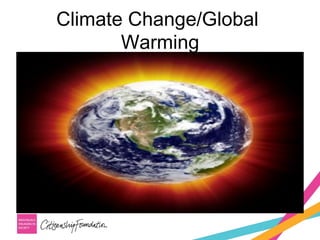
Climate Change/Global
Warming
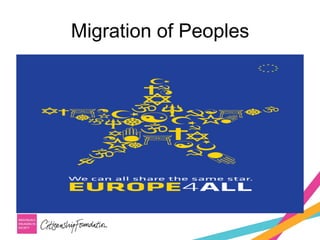
Migration of Peoples
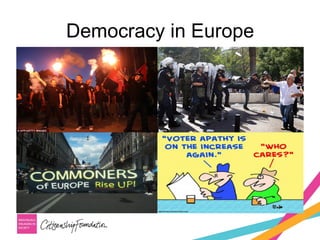
Democracy in Europe
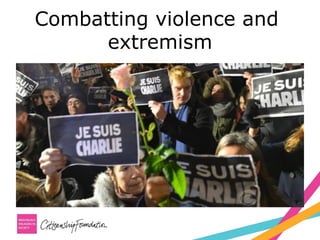
Combatting violence and
extremism
Global Capitalism and Jobs
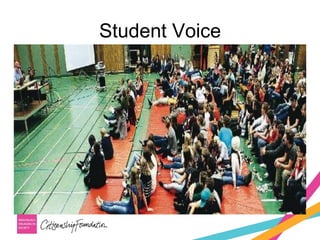
Student Voice
New and Unknown
Challenges
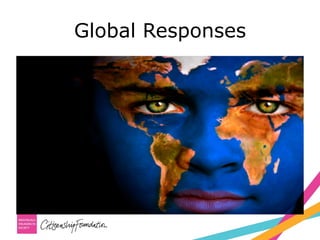
Global Responses
Democratic Citizenship,
Human Rights and
Intercultural Dialogue –
What do we know?
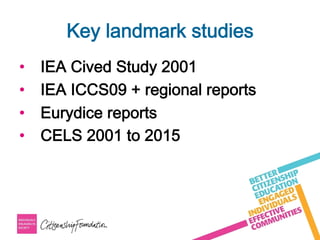
Key landmark studies
•  IEA Cived Study 2001
•  IEA ICCS09 + regional reports
•  Eurydice reports
•  CELS 2001 to 2015
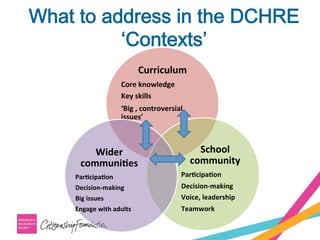
What to address in the DCHRE
‘Contexts’
Curriculum	
  
Core	
  knowledge	
  
Key	
  skills	
  
‘Big	
  ,	
  controversial	
  
issues’	
  
School	
  
community	
  
Par=cipa=on	
  
Decision-­‐making	
  
Voice,	
  leadership	
  
Teamwork	
  
Wider	
  
communi=es	
  
Par=cipa=on	
  
Decision-­‐making	
  
Big	
  issues	
  
Engage	
  with	
  adults	
  
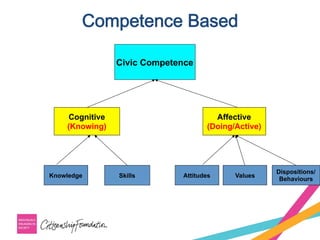
Competence Based
Civic Competence
Dispositions/
Behaviours
Affective
(Doing/Active)
Cognitive
(Knowing)
Knowledge Skills Attitudes Values
Democratic Citizenship,
Human Rights and
Intercultural Dialogue – who
benefits?
6 Key Sets of Actors and
beneficiaries…
1.  Pupils/students
2.  Teachers and support staff
3.  School leaders and senior staff
4.  Parents and community
representatives
5.  Wider society
Democratic Citizenship,
Human Rights and
Intercultural Dialogue – what
are the challenges and
debates?
Some key challenges
1.  Definition
2.  Coherence
3.  Status
4.  Policy will
5.  Bridging the ‘implementation gap’
6.  Evidence base - monitoring and
review
7.  Promote outcomes and benefits
Key debates…
1.  Perspective
2.  Measurement
3.  Methodology
4.  Interpretation and reach
5.  Costs and benefits
6.  Gaps
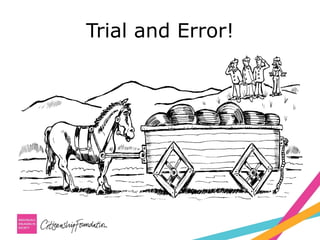
Trial and Error!
Democratic Citizenship,
Human Rights and
Intercultural Dialogue – what
are helpful developments?
Further studies and evidence to
come…
•  IEA ICCS16
•  CoE Charter review
•  CoE Competence Framework
•  CELS further waves
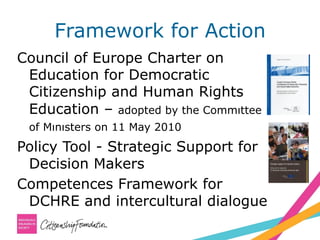
Framework for Action
Council of Europe Charter on
Education for Democratic
Citizenship and Human Rights
Education – adopted by the Commıttee
of Mınısters on 11 May 2010
Policy Tool - Strategic Support for
Decision Makers
Competences Framework for
DCHRE and intercultural dialogue
“Democracy Generation”
EDC/HRE Joint Project in Turkey
Turkey	
  Celebrate	
  
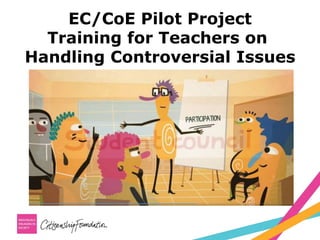
EC/CoE Pilot Project
Training for Teachers on
Handling Controversial Issues
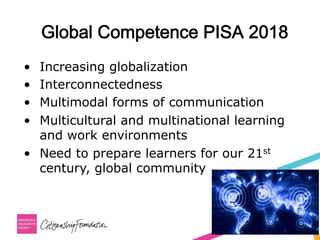
Global Competence PISA 2018
•  Increasing globalization
•  Interconnectedness
•  Multimodal forms of communication
•  Multicultural and multinational learning
and work environments
•  Need to prepare learners for our 21st
century, global community
What kind of education
system do we need?
What kind of society do we
want?
Chilean writer
Thank you
And good luck
Citizenship Foundation
First Floor, 50 Featherstone Street, London EC1Y 8RT
tel: +44 (0) 20 7566 4141
fax: +44 (0) 20 7566 4131
www.citizenshipfoundation.org.uk

David Kerr