Trends in Data Modeling 
Presented by Steven MacLauchlan and Peter Aiken, Ph.D. 
Click to Add Presented By Text
Welcome: Trends in Data Modeling 
2 
Copyright 2014 by Data Blueprint 
Businesses cannot compete without data. Every organization produces and 
consumes it. Data trends are hitting the mainstream and businesses are adopting 
buzzwords such as Big data, Data Vault, Data Scientist, etc., to seek solutions to 
their fundamental data issues. Few realize that the importance of any solution, 
regardless of platform or technology relies on the data model supporting it. Data 
modeling is not an optional task for an organization’s data remediation effort. 
Instead, it is a vital activity that supports the solution driving your business. ! 
This webinar will address emerging trends around data model application 
technology, as well as trends around the practice of data modeling itself. We will 
discuss abstract models and entity frameworks, as well as the general shift from 
data modeling being segmented to becoming more integrated with business 
practices.! 
Takeaways:! 
• NoSQL, data vault, etc., different and when should I apply them?! 
• How Data Modeling relates to business process! 
• Application development (data first, code first, object first?) 
Date: October 14, 2014 
Time: 2:00 PM ET 
Presented by: Peter Aiken, PhD/ 
Steven MacLauchlan
Get Social With Us! 
Like Us on Facebook 
www.facebook.com/ 
datablueprint 
Post questions and comments 
Find industry news, insightful 
content 
and event updates. 
Join the Group 
Data Management & 
Business Intelligence 
Ask questions, gain insights 
and collaborate with fellow 
data management 
professionals 
3 
Copyright 2014 by Data Blueprint 
Live Twitter Feed 
Join the conversation! 
Follow us: 
@datablueprint 
@paiken 
@SJMacLauchlan 
Ask questions and submit your comments: #dataed
MONETIZING 
DATA MANAGEMENT 
Unlocking the Value in Your Organization’s 
Most Important Asset. 
PETER AIKEN WITH JUANITA BILLINGS 
FOREWORD BY JOHN BOTTEGA 
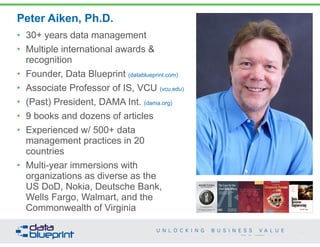
Peter Aiken, Ph.D. 
4 
Copyright 2014 by Data Blueprint 
• 30+ years data management 
• Multiple international awards & 
recognition 
• Founder, Data Blueprint (datablueprint.com) 
• Associate Professor of IS, VCU (vcu.edu) 
• (Past) President, DAMA Int. (dama.org) 
• 9 books and dozens of articles 
• Experienced w/ 500+ data 
management practices in 20 
countries 
• Multi-year immersions with 
organizations as diverse as the 
US DoD, Nokia, Deutsche Bank, 
Wells Fargo, Walmart, and the 
Commonwealth of Virginia 
The Case for the 
Chief Data Officer 
Recasting the C-Suite to Leverage 
Your Most Valuable Asset 
Peter Aiken and 
Michael Gorman
Steven MacLauchlan 
• 10 years of experience in Application 
Development and Data Modeling with a focus 
on Healthcare solutions. 
• Head of Marketing, and PR. Helped revamp 
the game playtesting process from the 
ground up with a data-centric approach 
which improved confidence in the final rules 
• Delivers tailored data management solutions 
that provide focus on data’s business value 
while enhancing clients’ overall capability to 
manage data 
• Certified Data Management Professional 
(CDMP) 
• Computer Science degree from Virginia 
Commonwealth University 
• Most recent focus: Understanding emerging 
data modeling trends and how these can 
best be leveraged for the Enterprise. 
5 
Copyright 2014 by Data Blueprint
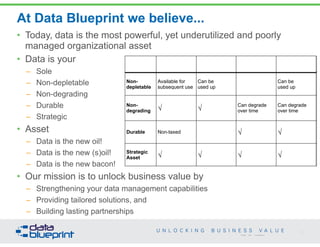
At Data Blueprint we believe... 
• Today, data is the most powerful, yet underutilized and poorly 
managed organizational asset 
• Data is your 
Data 
Financial 
Real 
– Sole 
Assets 
Assets 
Estate Assets 
– Non-depletable 
– Non-degrading 
– Durable 
– Strategic 
• Asset 
– Data is the new oil! 
– Data is the new (s)oil! 
– Data is the new bacon! 
• Our mission is to unlock business value by 
– Strengthening your data management capabilities 
– Providing tailored solutions, and 
– Building lasting partnerships 
Inventory 
Assets 
Non-depletable 
Available for 
subsequent use 
Can be 
used up 
Can be 
used up 
Non-degrading 
√ √ Can degrade 
over time 
Can degrade 
over time 
Durable Non-taxed √ √ 
Strategic 
Asset √ √ √ √ 
6 
Copyright 2014 by Data Blueprint
Trends in Data Modeling 
7 
Copyright 2014 by Data Blueprint 
• Business to Data: the Relationship 
• What is a Data Model? 
• Conceptual, Logical, Physical 
• What issues can poor data modeling 
introduce? 
• Different Models, Different Uses 
• 3NF, Star Schema, Data Vault 
• Key-Value/Document 
• Other NoSQL Technologies 
• How is it changing 
• Patterns and Reuse 
• Abstraction for application 
• Data Sharing World (The API’s) 
• Scaling Out not up
What is a Data Model*? 
*According to ANSI. 
8 
Copyright 2014 by Data Blueprint 
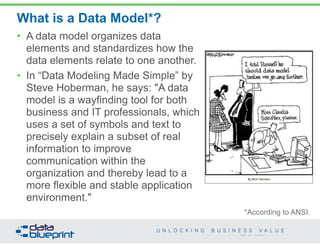
• A data model organizes data 
elements and standardizes how the 
data elements relate to one another. 
• In “Data Modeling Made Simple” by 
Steve Hoberman, he says: "A data 
model is a wayfinding tool for both 
business and IT professionals, which 
uses a set of symbols and text to 
precisely explain a subset of real 
information to improve 
communication within the 
organization and thereby lead to a 
more flexible and stable application 
environment."
How are Data Models Expressed as Architectures? 
9 
Copyright 2014 by Data Blueprint 
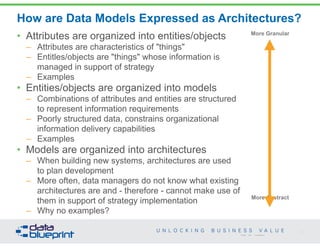
• Attributes are organized into entities/objects 
– Attributes are characteristics of "things" 
– Entitles/objects are "things" whose information is 
managed in support of strategy 
– Examples 
• Entities/objects are organized into models 
– Combinations of attributes and entities are structured 
to represent information requirements 
– Poorly structured data, constrains organizational 
information delivery capabilities 
– Examples 
• Models are organized into architectures 
– When building new systems, architectures are used 
to plan development 
– More often, data managers do not know what existing 
architectures are and - therefore - cannot make use of 
them in support of strategy implementation 
– Why no examples? 
More Granular 
More Abstract
The Conceptual Data Model 
10 
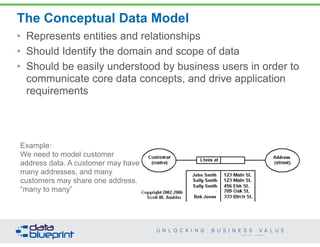
• Represents entities and relationships 
• Should Identify the domain and scope of data 
• Should be easily understood by business users in order to 
communicate core data concepts, and drive application 
requirements 
Copyright 2014 by Data Blueprint 
Example: 
We need to model customer 
address data. A customer may have 
many addresses, and many 
customers may share one address. 
“many to many”
11 
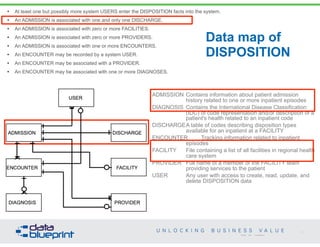
DISPOSITION Data Map 
11 
Copyright 2014 by Data Blueprint
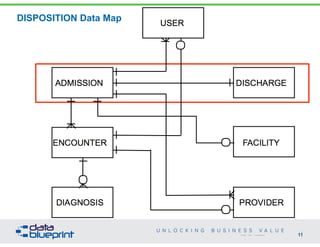
• At least one but possibly more system USERS enter the DISPOSITION facts into the system. 
• An ADMISSION is associated with one and only one DISCHARGE. 
• An ADMISSION is associated with zero or more FACILITIES. 
• An ADMISSION is associated with zero or more PROVIDERS. 
• An ADMISSION is associated with one or more ENCOUNTERS. 
• An ENCOUNTER may be recorded by a system USER. 
• An ENCOUNTER may be associated with a PROVIDER. 
• An ENCOUNTER may be associated with one or more DIAGNOSES. 
Data map of 
DISPOSITION 
history related to one or more inpatient episodes 
DIAGNOSIS! Contains the International Disease Classification 
(IDC) of code representation and/or description of a 
patient's health related to an inpatient code 
12 
ADMISSION!Contains information about patient admission 
DISCHARGE!A table of codes describing disposition types 
available for an inpatient at a FACILITY 
ENCOUNTER! Tracking information related to inpatient 
Copyright 2014 by Data Blueprint 
episodes 
FACILITY! File containing a list of all facilities in regional health 
care system 
PROVIDER! Full name of a member of the FACILITY team 
providing services to the patient 
USER! Any user with access to create, read, update, and 
delete DISPOSITION data
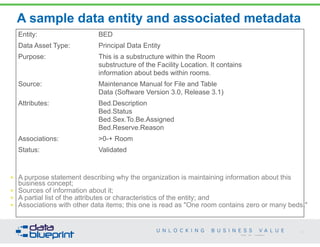
A sample data entity and associated metadata 
• A purpose statement describing why the organization is maintaining information about this 
business concept; 
• Sources of information about it; 
• A partial list of the attributes or characteristics of the entity; and 
• Associations with other data items; this one is read as "One room contains zero or many beds." 
13 
Copyright 2014 by Data Blueprint 
Entity: BED 
Data Asset Type: Principal Data Entity 
Purpose: This is a substructure within the Room 
substructure of the Facility Location. It contains 
information about beds within rooms. 
Source: Maintenance Manual for File and Table 
Data (Software Version 3.0, Release 3.1) 
Attributes: Bed.Description 
Bed.Status 
Bed.Sex.To.Be.Assigned 
Bed.Reserve.Reason 
Associations: >0-+ Room 
Status: Validated
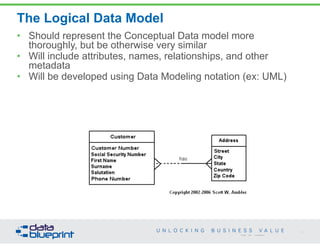
The Logical Data Model 
14 
• Should represent the Conceptual Data model more 
thoroughly, but be otherwise very similar 
• Will include attributes, names, relationships, and other 
metadata 
• Will be developed using Data Modeling notation (ex: UML) 
Copyright 2014 by Data Blueprint
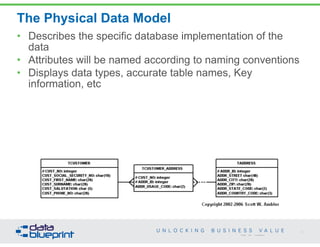
The Physical Data Model 
15 
• Describes the specific database implementation of the 
data 
• Attributes will be named according to naming conventions 
• Displays data types, accurate table names, Key 
information, etc 
Copyright 2014 by Data Blueprint
Consequences of Poor Data Modeling 
• Poor data modeling up front can cause Data Quality issues 
“downstream” 
• If the model isn’t a true representation of the business concepts, this will 
impact confidence in the data 
• Potential for poor DB/Application performance for reads/writes. 
Example: Over-normalization 
• Lack of flexibility can cause difficulty aligning with evolving business 
requirements 
• Difficulty integrating data in the future 
• Constrains business agility 
• Creates operational inefficiencies 
• Limits workflow transparency 
• Inhibit business insights and 
innovation 
• Proliferates system work-arounds, 
including shadow systems developed by end users 
16 
Copyright 2014 by Data Blueprint
Trends in Data Modeling 
17 
Copyright 2014 by Data Blueprint 
* 
• Business to Data: the Relationship 
• What is a Data Model? 
• Conceptual, Logical, Physical 
• What issues can poor data modeling 
introduce? 
• Different Models, Different Uses 
• 3NF, Star Schema, Data Vault 
• Key-Value/Document 
• Other NoSQL Technologies 
• How is it changing 
• Patterns and Reuse 
• Abstraction for application 
• Data Sharing World (The API’s) 
• Scaling Out not up
Normalization Rules Overview 
18 
Copyright 2014 by Data Blueprint 
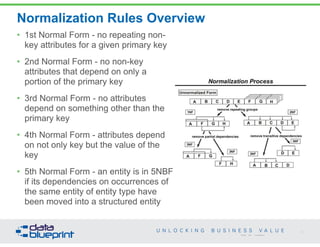
• 1st Normal Form - no repeating non-key 
attributes for a given primary key 
• 2nd Normal Form - no non-key 
attributes that depend on only a 
portion of the primary key 
• 3rd Normal Form - no attributes 
depend on something other than the 
primary key 
• 4th Normal Form - attributes depend 
on not only key but the value of the 
key 
• 5th Normal Form - an entity is in 5NBF 
if its dependencies on occurrences of 
the same entity of entity type have 
been moved into a structured entity
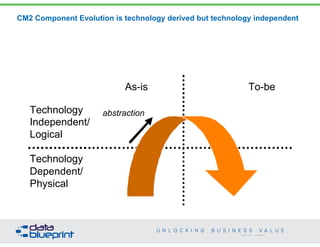
CM2 Component Evolution is technology derived but technology independent 
19 
As-is To-be 
Copyright 2014 by Data Blueprint 
Technology 
Independent/ 
Logical 
Technology 
Dependent/ 
Physical 
abstraction
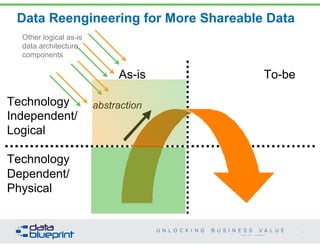
Data Reengineering for More Shareable Data 
20 
As-is To-be 
Copyright 2014 by Data Blueprint 
Technology 
Independent/ 
Logical 
Technology 
Dependent/ 
Physical 
abstraction 
Other logical as-is 
data architecture 
components
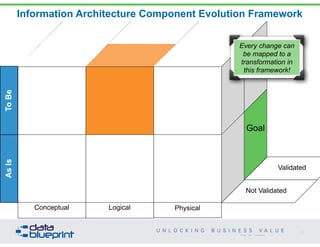
Information Architecture Component Evolution Framework 
Conceptual Logical Physical 
Every change can 
be mapped to a 
transformation in 
this framework! 
Goal 
Validated 
Not Validated 
21 
Copyright 2014 by Data Blueprint
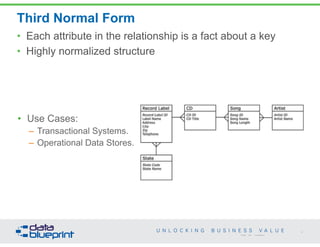
Third Normal Form 
22 
• Each attribute in the relationship is a fact about a key 
• Highly normalized structure 
Copyright 2014 by Data Blueprint 
• Use Cases: 
– Transactional Systems. 
– Operational Data Stores. 
! 
!
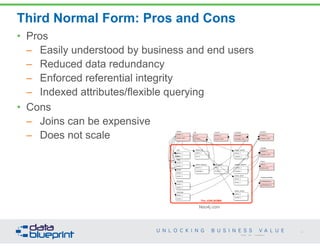
Third Normal Form: Pros and Cons 
23 
• Pros 
– Easily understood by business and end users 
– Reduced data redundancy 
– Enforced referential integrity 
– Indexed attributes/flexible querying 
• Cons 
– Joins can be expensive 
– Does not scale 
Copyright 2014 by Data Blueprint 
Neo4j.com
Star Schema 
24 
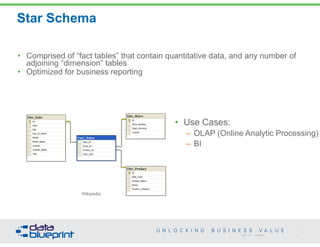
• Comprised of “fact tables” that contain quantitative data, and any number of 
adjoining “dimension” tables 
• Optimized for business reporting 
Copyright 2014 by Data Blueprint 
! 
! 
• Use Cases: 
– OLAP (Online Analytic Processing) 
– BI 
! 
! 
Wikipedia
Star Schema 
Pros and Cons 
25 
Copyright 2014 by Data Blueprint 
• Pros 
– Simple Design 
– Fast Queries 
– Most major DBMS are 
optimized for Star 
Schema Designs 
• Cons 
– Questions must be built 
into the design 
– Data marts are often 
centralized on one fact 
table
Data Vault 
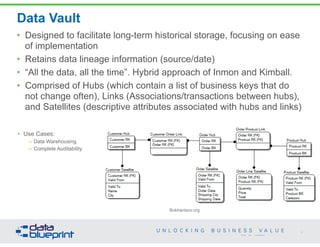
• Designed to facilitate long-term historical storage, focusing on ease 
of implementation 
• Retains data lineage information (source/date) 
• “All the data, all the time”. Hybrid approach of Inmon and Kimball. 
• Comprised of Hubs (which contain a list of business keys that do 
not change often), Links (Associations/transactions between hubs), 
and Satellites (descriptive attributes associated with hubs and links) 
26 
Copyright 2014 by Data Blueprint 
• Use Cases: 
– Data Warehousing 
– Complete Auditability 
! 
! 
! 
! 
Bukhantsov.org
Data Vault Pros 
and Cons 
27 
Copyright 2014 by Data Blueprint 
• Pros 
– Simple integration 
– Houses immense 
amounts of data with 
excellent performance 
– Full data lineage 
captured 
• Cons 
– Complication is pushed 
to the “back end” 
– Can be difficult to setup 
for many data workers 
– No widespread support 
for ETL tools yet
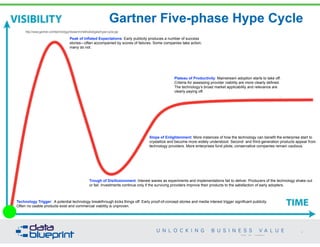
Gartner Five-phase Hype Cycle 
Peak of Inflated Expectations: Early publicity produces a number of success 
stories—often accompanied by scores of failures. Some companies take action; 
many do not. 
Plateau of Productivity: Mainstream adoption starts to take off. 
Criteria for assessing provider viability are more clearly defined. 
The technology’s broad market applicability and relevance are 
clearly paying off. 
Slope of Enlightenment: More instances of how the technology can benefit the enterprise start to 
crystallize and become more widely understood. Second- and third-generation products appear from 
technology providers. More enterprises fund pilots; conservative companies remain cautious. 
Trough of Disillusionment: Interest wanes as experiments and implementations fail to deliver. Producers of the technology shake out 
or fail. Investments continue only if the surviving providers improve their products to the satisfaction of early adopters. 
28 
Copyright 2014 by Data Blueprint 
http://www.gartner.com/technology/research/methodologies/hype-cycle.jsp 
Technology Trigger: A potential technology breakthrough kicks things off. Early proof-of-concept stories and media interest trigger significant publicity. 
Often no usable products exist and commercial viability is unproven.
Gartner Hype Cycle 
29 
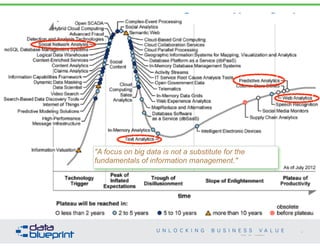
"A focus on big data is not a substitute for the 
fundamentals of information management." 
Copyright 2014 by Data Blueprint
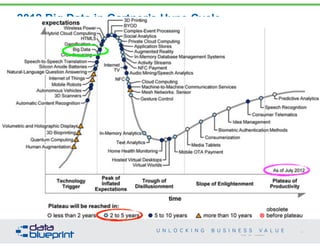
2012 Big Data in Gartner’s Hype Cycle 
30 
Copyright 2014 by Data Blueprint
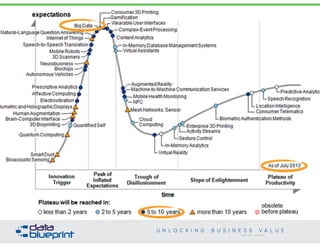
2013 Big Data in Gartner’s Hype Cycle 
31 
Copyright 2014 by Data Blueprint
Document/Key Value* 
32 
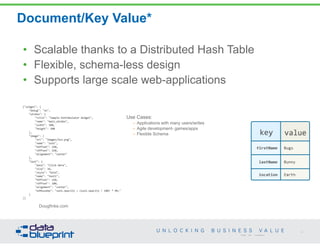
• Scalable thanks to a Distributed Hash Table 
• Flexible, schema-less design 
• Supports large scale web-applications 
Copyright 2014 by Data Blueprint 
! 
• Use Cases: 
– Applications with many users/writes 
– Agile development- games/apps 
– Flexible Schema 
! 
! 
! 
! 
! 
Kirupa.com 
Dougfinke.com
Document/Key 
Value Pros and 
Cons 
33 
Copyright 2014 by Data Blueprint 
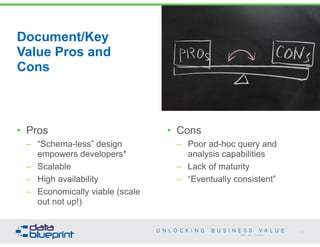
• Pros 
– “Schema-less” design 
empowers developers* 
– Scalable 
– High availability 
– Economically viable (scale 
out not up!) 
• Cons 
– Poor ad-hoc query and 
analysis capabilities 
– Lack of maturity 
– “Eventually consistent”
Other NoSQL Solutions* 
*not exhaustive! 
34 
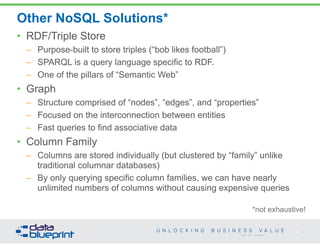
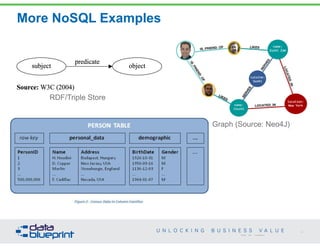
• RDF/Triple Store 
– Purpose-built to store triples (“bob likes football”) 
– SPARQL is a query language specific to RDF. 
– One of the pillars of “Semantic Web” 
• Graph 
– Structure comprised of “nodes”, “edges”, and “properties” 
– Focused on the interconnection between entities 
– Fast queries to find associative data 
• Column Family 
– Columns are stored individually (but clustered by “family” unlike 
traditional columnar databases) 
– By only querying specific column families, we can have nearly 
unlimited numbers of columns without causing expensive queries 
Copyright 2014 by Data Blueprint
More NoSQL Examples 
35 
Copyright 2014 by Data Blueprint 
RDF/Triple Store 
Graph (Source: Neo4J)
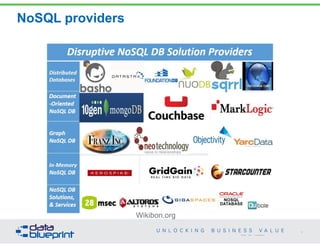
NoSQL providers 
36 
Copyright 2014 by Data Blueprint 
Wikibon.org
Trends in Data Modeling 
37 
Copyright 2014 by Data Blueprint 
• Business to Data: the Relationship 
• What is a Data Model? 
• Conceptual, Logical, Physical 
• What issues can poor data modeling 
introduce? 
• Different Models, Different Uses 
• 3NF, Star Schema, Data Vault 
• Key-Value/Document 
• Other NoSQL Technologies 
• How is it changing 
• Patterns and Reuse 
• Abstraction for application 
• Data Sharing World (The API’s) 
• Scaling Out not up
Design Patterns 
38 
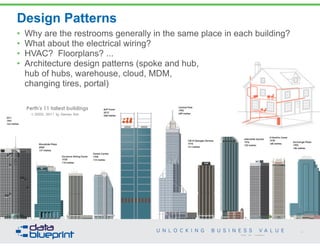
• Why are the restrooms generally in the same place in each building? 
• What about the electrical wiring? 
• HVAC? Floorplans? ... 
• Architecture design patterns (spoke and hub, 
hub of hubs, warehouse, cloud, MDM, 
changing tires, portal) 
Copyright 2014 by Data Blueprint
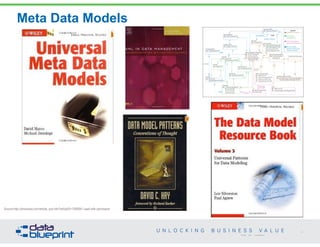
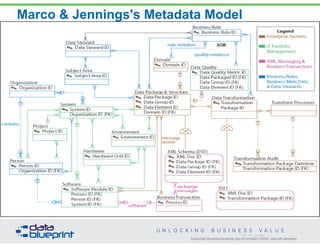
Meta Data Models 
Source:http://dmreview.com/article_sub.cfm?articleID=1000941 used with permission 
39 
Copyright 2014 by Data Blueprint
Marco & Jennings's Metadata Model 
Source:http://dmreview.com/article_sub.cfm?articleID=1000941 used with permission 
40 
Copyright 2014 by Data Blueprint
Patterns and Reuse 
41 
Copyright 2014 by Data Blueprint 
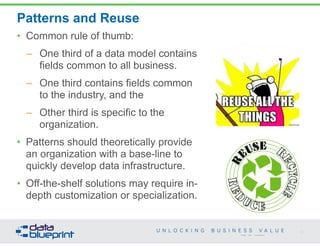
• Common rule of thumb: 
– One third of a data model contains 
fields common to all business. 
– One third contains fields common 
to the industry, and the 
– Other third is specific to the 
organization. 
• Patterns should theoretically provide 
an organization with a base-line to 
quickly develop data infrastructure. 
• Off-the-shelf solutions may require in-depth 
customization or specialization.
Data as a Service 
42 
Copyright 2014 by Data Blueprint 
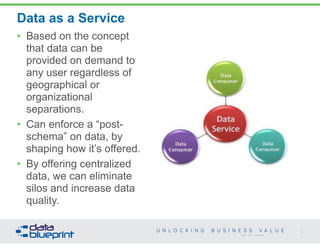
• Based on the concept 
that data can be 
provided on demand to 
any user regardless of 
geographical or 
organizational 
separations. 
• Can enforce a “post-schema” 
on data, by 
shaping how it’s offered. 
• By offering centralized 
data, we can eliminate 
silos and increase data 
quality.
Data Sharing World 
43 
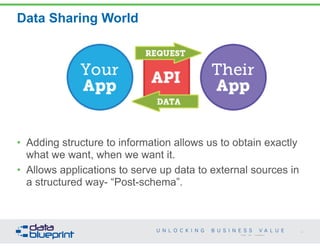
• Adding structure to information allows us to obtain exactly 
what we want, when we want it. 
• Allows applications to serve up data to external sources in 
a structured way- “Post-schema”. 
Copyright 2014 by Data Blueprint
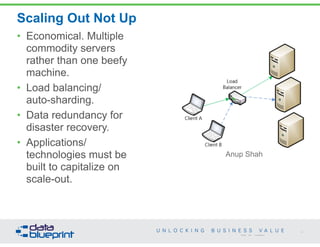
Scaling Out Not Up 
44 
Anup Shah 
Copyright 2014 by Data Blueprint 
• Economical. Multiple 
commodity servers 
rather than one beefy 
machine. 
• Load balancing/ 
auto-sharding. 
• Data redundancy for 
disaster recovery. 
• Applications/ 
technologies must be 
built to capitalize on 
scale-out.
Trends in Data Modeling 
45 
Copyright 2014 by Data Blueprint 
• Business to Data: the Relationship 
• What is a Data Model? 
• Conceptual, Logical, Physical 
• What issues can poor data modeling 
introduce? 
• Different Models, Different Uses 
• 3NF, Star Schema, Data Vault 
• Key-Value/Document 
• Other NoSQL Technologies 
• How is it changing 
• Patterns and Reuse 
• Abstraction for application 
• Data Sharing World (The API’s) 
• Scaling Out not up
Conclusions 
• Data Modeling is 
important to get right. 
• Getting it “right” is 
hugely dependent on 
the business case, 
maturity of the 
organization, flexibility 
for future growth, and 
so much more. 
• There are many 
technologies and 
ideas available to help 
solve a number of 
problems. 
• Don't try any of this 
without considering 
the various 
architectures involved 
46 
Copyright 2014 by Data Blueprint
Questions? 
47 
Copyright 2014 by Data Blueprint 
It’s your turn! 
Use the chat feature or Twitter (#dataed) to submit 
your questions to Peter and Steven now.
Upcoming Events 
48 
Copyright 2014 by Data Blueprint 
Metadata Strategies 
November 11, 2014 
@ 2:00 PM ET/11:00 AM PT 
! 
Data Warehouse Strategies 
December 9, 2014 @ 2:00 PM ET/11:00 AM PT 
! 
Sign up here: 
• www.datablueprint.com/webinar-schedule 
• or www.dataversity.net
Sources 
49 
• Data model. (2014, October 7). In Wikipedia, The Free 
Encyclopedia. Retrieved October 7, 2014, from http:// 
en.wikipedia.org/w/index.php? 
title=Data_model&oldid=628639882 
• Data Modeling 101. (2006). In Agile Data. Retrieved 
October 7, 2014, from http://www.agiledata.org/essays/ 
dataModeling101.html 
Copyright 2014 by Data Blueprint
Click to Add Presented By Text

Data-Ed: Trends in Data Modeling

  • 1.
    Trends in DataModeling Presented by Steven MacLauchlan and Peter Aiken, Ph.D. Click to Add Presented By Text
  • 2.
    Welcome: Trends inData Modeling 2 Copyright 2014 by Data Blueprint Businesses cannot compete without data. Every organization produces and consumes it. Data trends are hitting the mainstream and businesses are adopting buzzwords such as Big data, Data Vault, Data Scientist, etc., to seek solutions to their fundamental data issues. Few realize that the importance of any solution, regardless of platform or technology relies on the data model supporting it. Data modeling is not an optional task for an organization’s data remediation effort. Instead, it is a vital activity that supports the solution driving your business. ! This webinar will address emerging trends around data model application technology, as well as trends around the practice of data modeling itself. We will discuss abstract models and entity frameworks, as well as the general shift from data modeling being segmented to becoming more integrated with business practices.! Takeaways:! • NoSQL, data vault, etc., different and when should I apply them?! • How Data Modeling relates to business process! • Application development (data first, code first, object first?) Date: October 14, 2014 Time: 2:00 PM ET Presented by: Peter Aiken, PhD/ Steven MacLauchlan
  • 3.
    Get Social WithUs! Like Us on Facebook www.facebook.com/ datablueprint Post questions and comments Find industry news, insightful content and event updates. Join the Group Data Management & Business Intelligence Ask questions, gain insights and collaborate with fellow data management professionals 3 Copyright 2014 by Data Blueprint Live Twitter Feed Join the conversation! Follow us: @datablueprint @paiken @SJMacLauchlan Ask questions and submit your comments: #dataed
  • 4.
    MONETIZING DATA MANAGEMENT Unlocking the Value in Your Organization’s Most Important Asset. PETER AIKEN WITH JUANITA BILLINGS FOREWORD BY JOHN BOTTEGA Peter Aiken, Ph.D. 4 Copyright 2014 by Data Blueprint • 30+ years data management • Multiple international awards & recognition • Founder, Data Blueprint (datablueprint.com) • Associate Professor of IS, VCU (vcu.edu) • (Past) President, DAMA Int. (dama.org) • 9 books and dozens of articles • Experienced w/ 500+ data management practices in 20 countries • Multi-year immersions with organizations as diverse as the US DoD, Nokia, Deutsche Bank, Wells Fargo, Walmart, and the Commonwealth of Virginia The Case for the Chief Data Officer Recasting the C-Suite to Leverage Your Most Valuable Asset Peter Aiken and Michael Gorman
  • 5.
    Steven MacLauchlan •10 years of experience in Application Development and Data Modeling with a focus on Healthcare solutions. • Head of Marketing, and PR. Helped revamp the game playtesting process from the ground up with a data-centric approach which improved confidence in the final rules • Delivers tailored data management solutions that provide focus on data’s business value while enhancing clients’ overall capability to manage data • Certified Data Management Professional (CDMP) • Computer Science degree from Virginia Commonwealth University • Most recent focus: Understanding emerging data modeling trends and how these can best be leveraged for the Enterprise. 5 Copyright 2014 by Data Blueprint
  • 6.
    At Data Blueprintwe believe... • Today, data is the most powerful, yet underutilized and poorly managed organizational asset • Data is your Data Financial Real – Sole Assets Assets Estate Assets – Non-depletable – Non-degrading – Durable – Strategic • Asset – Data is the new oil! – Data is the new (s)oil! – Data is the new bacon! • Our mission is to unlock business value by – Strengthening your data management capabilities – Providing tailored solutions, and – Building lasting partnerships Inventory Assets Non-depletable Available for subsequent use Can be used up Can be used up Non-degrading √ √ Can degrade over time Can degrade over time Durable Non-taxed √ √ Strategic Asset √ √ √ √ 6 Copyright 2014 by Data Blueprint
  • 7.
    Trends in DataModeling 7 Copyright 2014 by Data Blueprint • Business to Data: the Relationship • What is a Data Model? • Conceptual, Logical, Physical • What issues can poor data modeling introduce? • Different Models, Different Uses • 3NF, Star Schema, Data Vault • Key-Value/Document • Other NoSQL Technologies • How is it changing • Patterns and Reuse • Abstraction for application • Data Sharing World (The API’s) • Scaling Out not up
  • 8.
    What is aData Model*? *According to ANSI. 8 Copyright 2014 by Data Blueprint • A data model organizes data elements and standardizes how the data elements relate to one another. • In “Data Modeling Made Simple” by Steve Hoberman, he says: "A data model is a wayfinding tool for both business and IT professionals, which uses a set of symbols and text to precisely explain a subset of real information to improve communication within the organization and thereby lead to a more flexible and stable application environment."
  • 9.
    How are DataModels Expressed as Architectures? 9 Copyright 2014 by Data Blueprint • Attributes are organized into entities/objects – Attributes are characteristics of "things" – Entitles/objects are "things" whose information is managed in support of strategy – Examples • Entities/objects are organized into models – Combinations of attributes and entities are structured to represent information requirements – Poorly structured data, constrains organizational information delivery capabilities – Examples • Models are organized into architectures – When building new systems, architectures are used to plan development – More often, data managers do not know what existing architectures are and - therefore - cannot make use of them in support of strategy implementation – Why no examples? More Granular More Abstract
  • 10.
    The Conceptual DataModel 10 • Represents entities and relationships • Should Identify the domain and scope of data • Should be easily understood by business users in order to communicate core data concepts, and drive application requirements Copyright 2014 by Data Blueprint Example: We need to model customer address data. A customer may have many addresses, and many customers may share one address. “many to many”
  • 11.
    11 DISPOSITION DataMap 11 Copyright 2014 by Data Blueprint
  • 12.
    • At leastone but possibly more system USERS enter the DISPOSITION facts into the system. • An ADMISSION is associated with one and only one DISCHARGE. • An ADMISSION is associated with zero or more FACILITIES. • An ADMISSION is associated with zero or more PROVIDERS. • An ADMISSION is associated with one or more ENCOUNTERS. • An ENCOUNTER may be recorded by a system USER. • An ENCOUNTER may be associated with a PROVIDER. • An ENCOUNTER may be associated with one or more DIAGNOSES. Data map of DISPOSITION history related to one or more inpatient episodes DIAGNOSIS! Contains the International Disease Classification (IDC) of code representation and/or description of a patient's health related to an inpatient code 12 ADMISSION!Contains information about patient admission DISCHARGE!A table of codes describing disposition types available for an inpatient at a FACILITY ENCOUNTER! Tracking information related to inpatient Copyright 2014 by Data Blueprint episodes FACILITY! File containing a list of all facilities in regional health care system PROVIDER! Full name of a member of the FACILITY team providing services to the patient USER! Any user with access to create, read, update, and delete DISPOSITION data
  • 13.
    A sample dataentity and associated metadata • A purpose statement describing why the organization is maintaining information about this business concept; • Sources of information about it; • A partial list of the attributes or characteristics of the entity; and • Associations with other data items; this one is read as "One room contains zero or many beds." 13 Copyright 2014 by Data Blueprint Entity: BED Data Asset Type: Principal Data Entity Purpose: This is a substructure within the Room substructure of the Facility Location. It contains information about beds within rooms. Source: Maintenance Manual for File and Table Data (Software Version 3.0, Release 3.1) Attributes: Bed.Description Bed.Status Bed.Sex.To.Be.Assigned Bed.Reserve.Reason Associations: >0-+ Room Status: Validated
  • 14.
    The Logical DataModel 14 • Should represent the Conceptual Data model more thoroughly, but be otherwise very similar • Will include attributes, names, relationships, and other metadata • Will be developed using Data Modeling notation (ex: UML) Copyright 2014 by Data Blueprint
  • 15.
    The Physical DataModel 15 • Describes the specific database implementation of the data • Attributes will be named according to naming conventions • Displays data types, accurate table names, Key information, etc Copyright 2014 by Data Blueprint
  • 16.
    Consequences of PoorData Modeling • Poor data modeling up front can cause Data Quality issues “downstream” • If the model isn’t a true representation of the business concepts, this will impact confidence in the data • Potential for poor DB/Application performance for reads/writes. Example: Over-normalization • Lack of flexibility can cause difficulty aligning with evolving business requirements • Difficulty integrating data in the future • Constrains business agility • Creates operational inefficiencies • Limits workflow transparency • Inhibit business insights and innovation • Proliferates system work-arounds, including shadow systems developed by end users 16 Copyright 2014 by Data Blueprint
  • 17.
    Trends in DataModeling 17 Copyright 2014 by Data Blueprint * • Business to Data: the Relationship • What is a Data Model? • Conceptual, Logical, Physical • What issues can poor data modeling introduce? • Different Models, Different Uses • 3NF, Star Schema, Data Vault • Key-Value/Document • Other NoSQL Technologies • How is it changing • Patterns and Reuse • Abstraction for application • Data Sharing World (The API’s) • Scaling Out not up
  • 18.
    Normalization Rules Overview 18 Copyright 2014 by Data Blueprint • 1st Normal Form - no repeating non-key attributes for a given primary key • 2nd Normal Form - no non-key attributes that depend on only a portion of the primary key • 3rd Normal Form - no attributes depend on something other than the primary key • 4th Normal Form - attributes depend on not only key but the value of the key • 5th Normal Form - an entity is in 5NBF if its dependencies on occurrences of the same entity of entity type have been moved into a structured entity
  • 19.
    CM2 Component Evolutionis technology derived but technology independent 19 As-is To-be Copyright 2014 by Data Blueprint Technology Independent/ Logical Technology Dependent/ Physical abstraction
  • 20.
    Data Reengineering forMore Shareable Data 20 As-is To-be Copyright 2014 by Data Blueprint Technology Independent/ Logical Technology Dependent/ Physical abstraction Other logical as-is data architecture components
  • 21.
    Information Architecture ComponentEvolution Framework Conceptual Logical Physical Every change can be mapped to a transformation in this framework! Goal Validated Not Validated 21 Copyright 2014 by Data Blueprint
  • 22.
    Third Normal Form 22 • Each attribute in the relationship is a fact about a key • Highly normalized structure Copyright 2014 by Data Blueprint • Use Cases: – Transactional Systems. – Operational Data Stores. ! !
  • 23.
    Third Normal Form:Pros and Cons 23 • Pros – Easily understood by business and end users – Reduced data redundancy – Enforced referential integrity – Indexed attributes/flexible querying • Cons – Joins can be expensive – Does not scale Copyright 2014 by Data Blueprint Neo4j.com
  • 24.
    Star Schema 24 • Comprised of “fact tables” that contain quantitative data, and any number of adjoining “dimension” tables • Optimized for business reporting Copyright 2014 by Data Blueprint ! ! • Use Cases: – OLAP (Online Analytic Processing) – BI ! ! Wikipedia
  • 25.
    Star Schema Prosand Cons 25 Copyright 2014 by Data Blueprint • Pros – Simple Design – Fast Queries – Most major DBMS are optimized for Star Schema Designs • Cons – Questions must be built into the design – Data marts are often centralized on one fact table
  • 26.
    Data Vault •Designed to facilitate long-term historical storage, focusing on ease of implementation • Retains data lineage information (source/date) • “All the data, all the time”. Hybrid approach of Inmon and Kimball. • Comprised of Hubs (which contain a list of business keys that do not change often), Links (Associations/transactions between hubs), and Satellites (descriptive attributes associated with hubs and links) 26 Copyright 2014 by Data Blueprint • Use Cases: – Data Warehousing – Complete Auditability ! ! ! ! Bukhantsov.org
  • 27.
    Data Vault Pros and Cons 27 Copyright 2014 by Data Blueprint • Pros – Simple integration – Houses immense amounts of data with excellent performance – Full data lineage captured • Cons – Complication is pushed to the “back end” – Can be difficult to setup for many data workers – No widespread support for ETL tools yet
  • 28.
    Gartner Five-phase HypeCycle Peak of Inflated Expectations: Early publicity produces a number of success stories—often accompanied by scores of failures. Some companies take action; many do not. Plateau of Productivity: Mainstream adoption starts to take off. Criteria for assessing provider viability are more clearly defined. The technology’s broad market applicability and relevance are clearly paying off. Slope of Enlightenment: More instances of how the technology can benefit the enterprise start to crystallize and become more widely understood. Second- and third-generation products appear from technology providers. More enterprises fund pilots; conservative companies remain cautious. Trough of Disillusionment: Interest wanes as experiments and implementations fail to deliver. Producers of the technology shake out or fail. Investments continue only if the surviving providers improve their products to the satisfaction of early adopters. 28 Copyright 2014 by Data Blueprint http://www.gartner.com/technology/research/methodologies/hype-cycle.jsp Technology Trigger: A potential technology breakthrough kicks things off. Early proof-of-concept stories and media interest trigger significant publicity. Often no usable products exist and commercial viability is unproven.
  • 29.
    Gartner Hype Cycle 29 "A focus on big data is not a substitute for the fundamentals of information management." Copyright 2014 by Data Blueprint
  • 30.
    2012 Big Datain Gartner’s Hype Cycle 30 Copyright 2014 by Data Blueprint
  • 31.
    2013 Big Datain Gartner’s Hype Cycle 31 Copyright 2014 by Data Blueprint
  • 32.
    Document/Key Value* 32 • Scalable thanks to a Distributed Hash Table • Flexible, schema-less design • Supports large scale web-applications Copyright 2014 by Data Blueprint ! • Use Cases: – Applications with many users/writes – Agile development- games/apps – Flexible Schema ! ! ! ! ! Kirupa.com Dougfinke.com
  • 33.
    Document/Key Value Prosand Cons 33 Copyright 2014 by Data Blueprint • Pros – “Schema-less” design empowers developers* – Scalable – High availability – Economically viable (scale out not up!) • Cons – Poor ad-hoc query and analysis capabilities – Lack of maturity – “Eventually consistent”
  • 34.
    Other NoSQL Solutions* *not exhaustive! 34 • RDF/Triple Store – Purpose-built to store triples (“bob likes football”) – SPARQL is a query language specific to RDF. – One of the pillars of “Semantic Web” • Graph – Structure comprised of “nodes”, “edges”, and “properties” – Focused on the interconnection between entities – Fast queries to find associative data • Column Family – Columns are stored individually (but clustered by “family” unlike traditional columnar databases) – By only querying specific column families, we can have nearly unlimited numbers of columns without causing expensive queries Copyright 2014 by Data Blueprint
  • 35.
    More NoSQL Examples 35 Copyright 2014 by Data Blueprint RDF/Triple Store Graph (Source: Neo4J)
  • 36.
    NoSQL providers 36 Copyright 2014 by Data Blueprint Wikibon.org
  • 37.
    Trends in DataModeling 37 Copyright 2014 by Data Blueprint • Business to Data: the Relationship • What is a Data Model? • Conceptual, Logical, Physical • What issues can poor data modeling introduce? • Different Models, Different Uses • 3NF, Star Schema, Data Vault • Key-Value/Document • Other NoSQL Technologies • How is it changing • Patterns and Reuse • Abstraction for application • Data Sharing World (The API’s) • Scaling Out not up
  • 38.
    Design Patterns 38 • Why are the restrooms generally in the same place in each building? • What about the electrical wiring? • HVAC? Floorplans? ... • Architecture design patterns (spoke and hub, hub of hubs, warehouse, cloud, MDM, changing tires, portal) Copyright 2014 by Data Blueprint
  • 39.
    Meta Data Models Source:http://dmreview.com/article_sub.cfm?articleID=1000941 used with permission 39 Copyright 2014 by Data Blueprint
  • 40.
    Marco & Jennings'sMetadata Model Source:http://dmreview.com/article_sub.cfm?articleID=1000941 used with permission 40 Copyright 2014 by Data Blueprint
  • 41.
    Patterns and Reuse 41 Copyright 2014 by Data Blueprint • Common rule of thumb: – One third of a data model contains fields common to all business. – One third contains fields common to the industry, and the – Other third is specific to the organization. • Patterns should theoretically provide an organization with a base-line to quickly develop data infrastructure. • Off-the-shelf solutions may require in-depth customization or specialization.
  • 42.
    Data as aService 42 Copyright 2014 by Data Blueprint • Based on the concept that data can be provided on demand to any user regardless of geographical or organizational separations. • Can enforce a “post-schema” on data, by shaping how it’s offered. • By offering centralized data, we can eliminate silos and increase data quality.
  • 43.
    Data Sharing World 43 • Adding structure to information allows us to obtain exactly what we want, when we want it. • Allows applications to serve up data to external sources in a structured way- “Post-schema”. Copyright 2014 by Data Blueprint
  • 44.
    Scaling Out NotUp 44 Anup Shah Copyright 2014 by Data Blueprint • Economical. Multiple commodity servers rather than one beefy machine. • Load balancing/ auto-sharding. • Data redundancy for disaster recovery. • Applications/ technologies must be built to capitalize on scale-out.
  • 45.
    Trends in DataModeling 45 Copyright 2014 by Data Blueprint • Business to Data: the Relationship • What is a Data Model? • Conceptual, Logical, Physical • What issues can poor data modeling introduce? • Different Models, Different Uses • 3NF, Star Schema, Data Vault • Key-Value/Document • Other NoSQL Technologies • How is it changing • Patterns and Reuse • Abstraction for application • Data Sharing World (The API’s) • Scaling Out not up
  • 46.
    Conclusions • DataModeling is important to get right. • Getting it “right” is hugely dependent on the business case, maturity of the organization, flexibility for future growth, and so much more. • There are many technologies and ideas available to help solve a number of problems. • Don't try any of this without considering the various architectures involved 46 Copyright 2014 by Data Blueprint
  • 47.
    Questions? 47 Copyright2014 by Data Blueprint It’s your turn! Use the chat feature or Twitter (#dataed) to submit your questions to Peter and Steven now.
  • 48.
    Upcoming Events 48 Copyright 2014 by Data Blueprint Metadata Strategies November 11, 2014 @ 2:00 PM ET/11:00 AM PT ! Data Warehouse Strategies December 9, 2014 @ 2:00 PM ET/11:00 AM PT ! Sign up here: • www.datablueprint.com/webinar-schedule • or www.dataversity.net
  • 49.
    Sources 49 •Data model. (2014, October 7). In Wikipedia, The Free Encyclopedia. Retrieved October 7, 2014, from http:// en.wikipedia.org/w/index.php? title=Data_model&oldid=628639882 • Data Modeling 101. (2006). In Agile Data. Retrieved October 7, 2014, from http://www.agiledata.org/essays/ dataModeling101.html Copyright 2014 by Data Blueprint
  • 50.
    Click to AddPresented By Text