DON‘T TRUST THE NUMBERS!
Data-driven Trajectory Prediction & Spatial Variability of Prediction
Performance in Maritime Location Based Services
Anita Graser, Johanna Schmidt, Melitta Dragaschnig & Peter Widhalm
@underdarkGIS
Increasing shipping traffic & data collection (AIS)
 Information overload for port operators
MOTIVATION
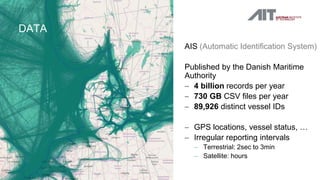
AIS (Automatic Identification System)
Published by the Danish Maritime
Authority
 4 billion records per year
 730 GB CSV files per year
 89,926 distinct vessel IDs
 GPS locations, vessel status, …
 Irregular reporting intervals
 Terrestrial: 2sec to 3min
 Satellite: hours
DATA
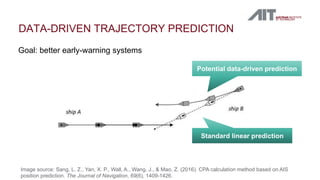
Goal: better early-warning systems
DATA-DRIVEN TRAJECTORY PREDICTION
Image source: Sang, L. Z., Yan, X. P., Wall, A., Wang, J., & Mao, Z. (2016). CPA calculation method based on AIS
position prediction. The Journal of Navigation, 69(6), 1409-1426.
Standard linear prediction
Potential data-driven prediction
DATA-DRIVEN TRAJECTORY PREDICTION
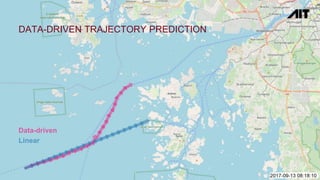
Data-driven
Linear
THIS TALK IS NOT ABOUT
YET ANOTHER PREDICTION METHOD!
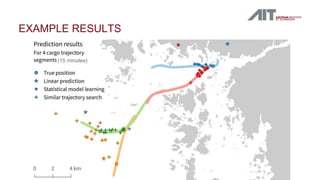
EXAMPLE RESULTS
(15 minutes)
… BUT HOW CAN WE EVALUATE THEIR
PERFORMANCE?
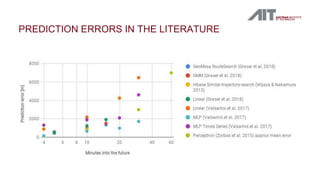
PREDICTION ERRORS IN THE LITERATURE
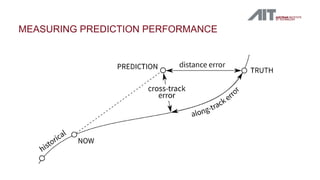
MEASURING PREDICTION PERFORMANCE
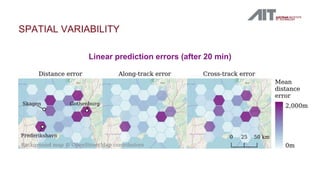
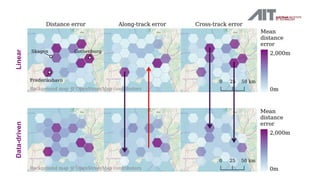
Linear prediction errors (after 20 min)
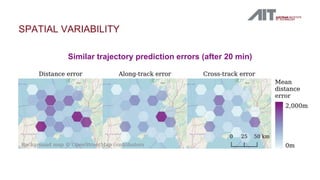
SPATIAL VARIABILITY
Similar trajectory prediction errors (after 20 min)
SPATIAL VARIABILITY
LinearData-driven
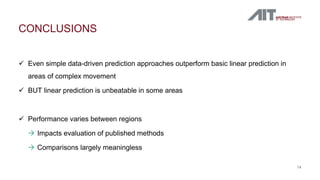
 Even simple data-driven prediction approaches outperform basic linear prediction in
areas of complex movement
 BUT linear prediction is unbeatable in some areas
 Performance varies between regions
 Impacts evaluation of published methods
 Comparisons largely meaningless
CONCLUSIONS
14
anita.graser@ait.ac.at
@underdarkGIS
anitagraser.com
ANITA GRASER

Data-driven Trajectory Prediction in Maritime LBS

Editor's Notes

  • #2 Prepare your presentation to be 20 minutes maximum to leave 5 minutes time for questions and discussion.   Bring your presentation on a USB drive and upload it onto the presentation computer at the beginning of the day. If you are using your computer for presentation, please test it prior to your session to make sure it connects to the projector. Please contact Martin Tomko (tomkom@unimelb.edu.au) for technical and on-site questions.
  • #8 Predicted future locations after 15 minutes for two incoming (red and blue) and two outgoing (orange and green) cargo vessel trajectories.