Database Systems Design Implementation and
Management 11th Edition Coronel Solutions Manual

download
https://testbankfan.com/product/database-systems-design-
implementation-and-management-11th-edition-coronel-solutions-
manual/
Explore and download more test bank or solution manual
at testbankfan.com
Here are some recommended products for you. Click the link to
download, or explore more at testbankfan.com
Database Systems Design Implementation and Management 11th
Edition Coronel Test Bank
https://testbankfan.com/product/database-systems-design-
implementation-and-management-11th-edition-coronel-test-bank/
Database Systems Design Implementation and Management 12th
Edition Coronel Solutions Manual
https://testbankfan.com/product/database-systems-design-
implementation-and-management-12th-edition-coronel-solutions-manual/
Database Systems Design Implementation And Management 13th
Edition Coronel Solutions Manual
https://testbankfan.com/product/database-systems-design-
implementation-and-management-13th-edition-coronel-solutions-manual/
Business Law in Canada Canadian Edition Canadian 10th
Edition Yates Test Bank
https://testbankfan.com/product/business-law-in-canada-canadian-
edition-canadian-10th-edition-yates-test-bank/
Modern Advanced Accounting in Canada Canadian 7th Edition
Hilton Solutions Manual
https://testbankfan.com/product/modern-advanced-accounting-in-canada-
canadian-7th-edition-hilton-solutions-manual/
Information Systems A Managers Guide to Harnessing
Technology 1st Edition Gallaugher Test Bank
https://testbankfan.com/product/information-systems-a-managers-guide-
to-harnessing-technology-1st-edition-gallaugher-test-bank/
Organizations Behavior Structure Processes 14th Edition
Gibson Test Bank
https://testbankfan.com/product/organizations-behavior-structure-
processes-14th-edition-gibson-test-bank/
Finite Mathematics and Its Applications 12th Edition
Goldstein Solutions Manual
https://testbankfan.com/product/finite-mathematics-and-its-
applications-12th-edition-goldstein-solutions-manual/
Human Resource Information Systems 3rd Edition Kavanagh
Test Bank
https://testbankfan.com/product/human-resource-information-
systems-3rd-edition-kavanagh-test-bank/
Chemistry An Atoms First Approach 2nd Edition Zumdahl
Solutions Manual
https://testbankfan.com/product/chemistry-an-atoms-first-approach-2nd-
edition-zumdahl-solutions-manual/
Chapter 7 An Introduction to Structured Query Language (SQL)
239
Chapter 7
Introduction to Structured Query Language (SQL)
NOTE
Several points are worth emphasizing:
• We have provided the SQL scripts for both chapters 7 and 8. These scripts are intended to
facilitate the flow of the material presented to the class. However, given the comments made
by our students, the scripts should not replace the manual typing of the SQL commands by
students. Some students learn SQL better when they have a chance to type their own
commands and get the feedback provided by their errors. We recommend that the students use
their lab time to practice the commands manually.
• Because this chapter focuses on learning SQL, we recommend that you use the Microsoft
Access SQL window to type SQL queries. Using this approach, you will be able to
demonstrate the interoperability of standard SQL. For example, you can cut and paste the same
SQL command from the SQL query window in Microsoft Access, to Oracle SQL * Plus and to
MS SQL Query Analyzer. This approach achieves two objectives:
➢ It demonstrates that adhering to the SQL standard means that most of the SQL code
will be portable among DBMSes.
➢ It also demonstrates that even a widely accepted SQL standard is sometimes
implemented with slight distinctions by different vendors. For example, the treatment
of date formats in Microsoft Access and Oracle is slightly different.
Answers to Review Questions
1. In a SELECT query, what is the difference between a WHERE clause and a HAVING clause?
Both a WHERE clause and a HAVING clause can be used to eliminate rows from the results of a
query. The differences are 1) the WHERE clause eliminates rows before any grouping for aggregate
functions occurs while the HAVING clause eliminates groups after the grouping has been done, and
2) the WHERE clause cannot contain an aggregate function but the HAVING clause can.
2. Explain why the following command would create an error, and what changes could be made
to fix the error.
SELECT V_CODE, SUM(P_QOH) FROM PRODUCT;
The command would generate an error because an aggregate function is applied to the P_QOH
attribute but V_CODE is neither in an aggregate function or in a GROUP BY. This can be fixed by
either 1) placing V_CODE in an appropriate aggregate function based on the data that is being
requested by the user, 2) adding a GROUP BY clause to group by values of V_CODE (i.e. GROUP
BY V_CODE), 3) removing the V_CODE attribute from the SELECT clause, or 4) removing the
Sum aggregate function from P_QOH. Which of these solutions is most appropriate depends on the
question that the query was intended to answer.
Chapter 7 An Introduction to Structured Query Language (SQL)
240
3. What type of integrity is enforced when a primary key is declared?
Creating a primary key constraint enforces entity integrity (i.e. no part of the primary key can
contain a null and the primary key values must be unique).
4. Explain why it might be more appropriate to declare an attribute that contains only digits as a
character data type instead of a numeric data type.
An attribute that contains only digits may be properly defined as character data when the values are
nominal; that is, the values do not have numerical significance but serve only as labels such as ZIP
codes and telephone numbers. One easy test is to consider whether or not a leading zero should be
retained. For the ZIP code 03133, the leading zero should be retained; therefore, it is appropriate to
define it as character data. For the quantity on hand of 120, we would not expect to retain a leading
zero such as 0120; therefore, it is appropriate to define the quantity on hand as a numeric data type.
5. What is the difference between a column constraint and a table constraint?
A column constraint can refer to only the attribute with which it is specified. A table constraint can
refer to any attributes in the table.
6. What are “referential constraint actions”?
Referential constraint actions, such as ON DELETE CASCADE, are default actions that the DBMS
should take when a DML command would result in a referential integrity constraint violation.
Without referential constraint actions, DML commands that would result in a violation of referential
integrity will fail with an error indicating that the referential integrity constrain cannot be violated.
Referential constraint actions can allow the DML command to successfully complete while making
the designated changes to the related records to maintain referential integrity.
7. Rewrite the following WHERE clause without the use of the IN special operator.
WHERE V_STATE IN (‘TN’, ‘FL’, ‘GA’)
WHERE V_STATE = 'TN' OR V_STATE = 'FL' OR V_STATE = 'GA'
Notice that each criteria must be complete (i.e. attribute-operator-value).
8. Explain the difference between an ORDER BY clause and a GROUP BY clause.
An ORDER BY clause has no impact on which rows are returned by the query, it simply sorts those
rows into the specified order. A GROUP BY clause does impact the rows that are returned by the
query. A GROUP BY clause gathers rows into collections that can be acted on by aggregate
functions.
9. Explain why the two following commands produce different results.
SELECT DISTINCT COUNT (V_CODE) FROM PRODUCT;
Chapter 7 An Introduction to Structured Query Language (SQL)
241
SELECT COUNT (DISTINCT V_CODE) FROM PRODUCT;
The difference is in the order of operations. The first command executes the Count function to count
the number of values in V_CODE (say the count returns "14" for example) including duplicate
values, and then the Distinct keyword only allows one count of that value to be displayed (only one
row with the value "14" appears as the result). The second command applies the Distinct keyword to
the V_CODEs before the count is taken so only unique values are counted.
10. What is the difference between the COUNT aggregate function and the SUM aggregate
function?
COUNT returns the number of values without regard to what the values are. SUM adds the values
together and can only be applied to numeric values.
11. Explain why it would be preferable to use a DATE data type to store date data instead of a
character data type.
The DATE data type uses numeric values based on the Julian calendar to store dates. This makes
date arithmetic such as adding and subtracting days or fractions of days possible (as well as
numerous special date-oriented functions discussed in the next chapter!).
12. What is a recursive join?
A recursive join is a join in which a table is joined to itself.
Problem Solutions
O n l i n e C o n t e n t
Problems 1 – 25 are based on the Ch07_ConstructCo database located www.cengagebrain.com. This database
is stored in Microsoft Access format. The website provides Oracle, MySQL, and MS SQL Server script files.
The Ch07_ConstructCo database stores data for a consulting company that tracks all charges to
projects. The charges are based on the hours each employee works on each project. The structure and
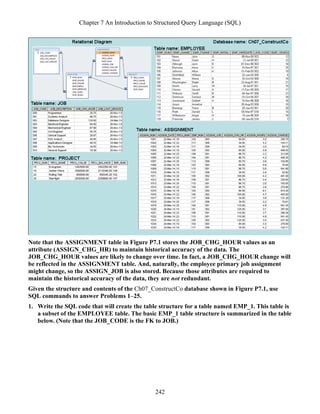
contents of the Ch07_ConstructCo database are shown in Figure P7.1.
Figure P7.1 Structure and contents of the Ch07_ConstructCo database
Chapter 7 An Introduction to Structured Query Language (SQL)
242
Note that the ASSIGNMENT table in Figure P7.1 stores the JOB_CHG_HOUR values as an
attribute (ASSIGN_CHG_HR) to maintain historical accuracy of the data. The
JOB_CHG_HOUR values are likely to change over time. In fact, a JOB_CHG_HOUR change will
be reflected in the ASSIGNMENT table. And, naturally, the employee primary job assignment
might change, so the ASSIGN_JOB is also stored. Because those attributes are required to
maintain the historical accuracy of the data, they are not redundant.
Given the structure and contents of the Ch07_ConstructCo database shown in Figure P7.1, use
SQL commands to answer Problems 1–25.
1. Write the SQL code that will create the table structure for a table named EMP_1. This table is
a subset of the EMPLOYEE table. The basic EMP_1 table structure is summarized in the table
below. (Note that the JOB_CODE is the FK to JOB.)
Chapter 7 An Introduction to Structured Query Language (SQL)
243
ATTRIBUTE (FIELD) NAME DATA DECLARATION
EMP_NUM CHAR(3)
EMP_LNAME VARCHAR(15)
EMP_FNAME VARCHAR(15)
EMP_INITIAL CHAR(1)
EMP_HIREDATE DATE
JOB_CODE CHAR(3)
CREATE TABLE EMP_1 (
EMP_NUM CHAR(3) PRIMARY KEY,
EMP_LNAME VARCHAR(15) NOT NULL,
EMP_FNAME VARCHAR(15) NOT NULL,
EMP_INITIAL CHAR(1),
EMP_HIREDATE DATE,
JOB_CODE CHAR(3),
FOREIGN KEY (JOB_CODE) REFERENCES JOB);
NOTE
We have already provided the EMP_1 table for you. If you try to run the preceding query,
you will get an error message because the EMP_1 table already exits.
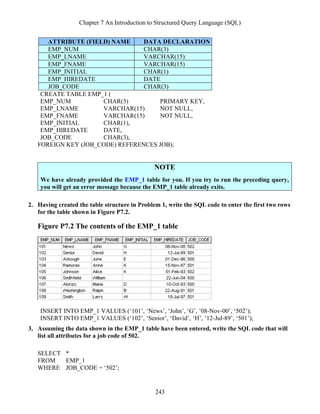
2. Having created the table structure in Problem 1, write the SQL code to enter the first two rows
for the table shown in Figure P7.2.
Figure P7.2 The contents of the EMP_1 table
INSERT INTO EMP_1 VALUES (‘101’, ‘News’, ‘John’, ‘G’, ’08-Nov-00’, ‘502’);
INSERT INTO EMP_1 VALUES (‘102’, ‘Senior’, ‘David’, ‘H’, ’12-Jul-89’, ‘501’);
3. Assuming the data shown in the EMP_1 table have been entered, write the SQL code that will
list all attributes for a job code of 502.
SELECT *
FROM EMP_1
WHERE JOB_CODE = ‘502’;
Chapter 7 An Introduction to Structured Query Language (SQL)
244
4. Write the SQL code that will save the changes made to the EMP_1 table.
COMMIT;
5. Write the SQL code to change the job code to 501 for the person whose employee number
(EMP_NUM) is 107. After you have completed the task, examine the results, and then reset the
job code to its original value.
UPDATE EMP_1
SET JOB_CODE = ‘501’
WHERE EMP_NUM = ‘107’;
To see the changes:
SELECT *
FROM EMP_1
WHERE EMP_NUM = ‘107’;
To reset, use
ROLLBACK;
6. Write the SQL code to delete the row for the person named William Smithfield, who was hired
on June 22, 2004, and whose job code classification is 500. (Hint: Use logical operators to
include all of the information given in this problem.)
DELETE FROM EMP_1
WHERE EMP_LNAME = 'Smithfield'
AND EMP_FNAME = 'William'
AND EMP_HIREDATE = '22-June-04'
AND JOB_CODE = '500';
7. Write the SQL code that will restore the data to its original status; that is, the table should
contain the data that existed before you made the changes in Problems 5 and 6.
ROLLBACK;
Chapter 7 An Introduction to Structured Query Language (SQL)
245
8. Write the SQL code to create a copy of EMP_1, naming the copy EMP_2. Then write the SQL
code that will add the attributes EMP_PCT and PROJ_NUM to its structure. The EMP_PCT
is the bonus percentage to be paid to each employee. The new attribute characteristics are:
EMP_PCTNUMBER(4,2)
PROJ_NUMCHAR(3)
(Note: If your SQL implementation allows it, you may use DECIMAL(4,2) rather than
NUMBER(4,2).)
There are two way to get this job done. The two possible solutions are shown next.
Solution A:
CREATE TABLE EMP_2 (
EMP_NUM CHAR(3) NOT NULL UNIQUE,
EMP_LNAME VARCHAR(15) NOT NULL,
EMP_FNAME VARCHAR(15) NOT NULL,
EMP_INITIAL CHAR(1),
EMP_HIREDATE DATE NOT NULL,
JOB_CODE CHAR(3) NOT NULL,
PRIMARY KEY (EMP_NUM),
FOREIGN KEY (JOB_CODE) REFERENCES JOB);
INSERT INTO EMP_2 SELECT * FROM EMP_1;
ALTER TABLE EMP_2
ADD (EMP_PCT NUMBER (4,2)),
ADD (PROJ_NUM CHAR(3));
Solution B:
CREATE TABLE EMP_2 AS SELECT * FROM EMP_1;
ALTER TABLE EMP_2
ADD (EMP_PCT NUMBER (4,2)),
ADD (PROJ_NUM CHAR(3));
9. Write the SQL code to change the EMP_PCT value to 3.85 for the person whose employee
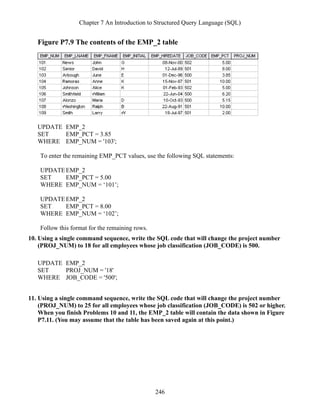
number (EMP_NUM) is 103. Next, write the SQL command sequences to change the
EMP_PCT values as shown in Figure P7.9.
Chapter 7 An Introduction to Structured Query Language (SQL)
246
Figure P7.9 The contents of the EMP_2 table
UPDATE EMP_2
SET EMP_PCT = 3.85
WHERE EMP_NUM = '103';
To enter the remaining EMP_PCT values, use the following SQL statements:
UPDATEEMP_2
SET EMP_PCT = 5.00
WHERE EMP_NUM = ‘101’;
UPDATEEMP_2
SET EMP_PCT = 8.00
WHERE EMP_NUM = ‘102’;
Follow this format for the remaining rows.
10. Using a single command sequence, write the SQL code that will change the project number
(PROJ_NUM) to 18 for all employees whose job classification (JOB_CODE) is 500.
UPDATE EMP_2
SET PROJ_NUM = '18'
WHERE JOB_CODE = '500';
11. Using a single command sequence, write the SQL code that will change the project number
(PROJ_NUM) to 25 for all employees whose job classification (JOB_CODE) is 502 or higher.
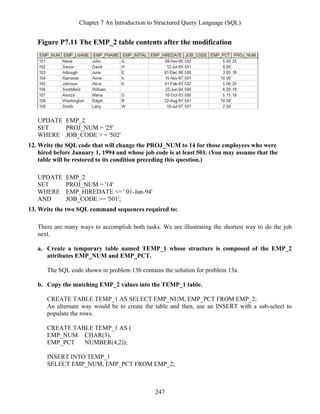
When you finish Problems 10 and 11, the EMP_2 table will contain the data shown in Figure
P7.11. (You may assume that the table has been saved again at this point.)
Chapter 7 An Introduction to Structured Query Language (SQL)
247
Figure P7.11 The EMP_2 table contents after the modification
UPDATE EMP_2
SET PROJ_NUM = '25'
WHERE JOB_CODE > = '502'
12. Write the SQL code that will change the PROJ_NUM to 14 for those employees who were
hired before January 1, 1994 and whose job code is at least 501. (You may assume that the
table will be restored to its condition preceding this question.)
UPDATE EMP_2
SET PROJ_NUM = '14'
WHERE EMP_HIREDATE <= ' 01-Jan-94'
AND JOB_CODE >= '501';
13. Write the two SQL command sequences required to:
There are many ways to accomplish both tasks. We are illustrating the shortest way to do the job
next.
a. Create a temporary table named TEMP_1 whose structure is composed of the EMP_2
attributes EMP_NUM and EMP_PCT.
The SQL code shown in problem 13b contains the solution for problem 13a.
b. Copy the matching EMP_2 values into the TEMP_1 table.
CREATE TABLE TEMP_1 AS SELECT EMP_NUM, EMP_PCT FROM EMP_2;
An alternate way would be to create the table and then, use an INSERT with a sub-select to
populate the rows.
CREATE TABLE TEMP_1 AS (
EMP_NUM CHAR(3),
EMP_PCT NUMBER(4,2));
INSERT INTO TEMP_1
SELECT EMP_NUM, EMP_PCT FROM EMP_2;
Chapter 7 An Introduction to Structured Query Language (SQL)
248
14. Write the SQL command that will delete the newly created TEMP_1 table from the database.
DROP TABLE TEMP_1;
15. Write the SQL code required to list all employees whose last names start with Smith. In other
words, the rows for both Smith and Smithfield should be included in the listing. Assume case
sensitivity.
SELECT *
FROM EMP_2
WHERE EMP_LNAME LIKE 'Smith%';
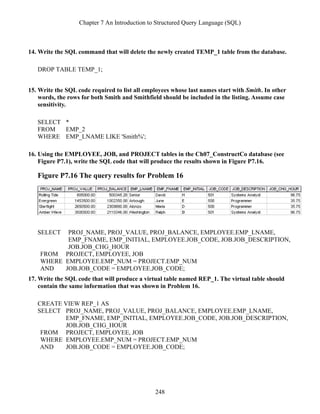
16. Using the EMPLOYEE, JOB, and PROJECT tables in the Ch07_ConstructCo database (see
Figure P7.1), write the SQL code that will produce the results shown in Figure P7.16.
Figure P7.16 The query results for Problem 16
SELECT PROJ_NAME, PROJ_VALUE, PROJ_BALANCE, EMPLOYEE.EMP_LNAME,
EMP_FNAME, EMP_INITIAL, EMPLOYEE.JOB_CODE, JOB.JOB_DESCRIPTION,
JOB.JOB_CHG_HOUR
FROM PROJECT, EMPLOYEE, JOB
WHERE EMPLOYEE.EMP_NUM = PROJECT.EMP_NUM
AND JOB.JOB_CODE = EMPLOYEE.JOB_CODE;
17. Write the SQL code that will produce a virtual table named REP_1. The virtual table should
contain the same information that was shown in Problem 16.
CREATE VIEW REP_1 AS
SELECT PROJ_NAME, PROJ_VALUE, PROJ_BALANCE, EMPLOYEE.EMP_LNAME,
EMP_FNAME, EMP_INITIAL, EMPLOYEE.JOB_CODE, JOB.JOB_DESCRIPTION,
JOB.JOB_CHG_HOUR
FROM PROJECT, EMPLOYEE, JOB
WHERE EMPLOYEE.EMP_NUM = PROJECT.EMP_NUM
AND JOB.JOB_CODE = EMPLOYEE.JOB_CODE;
Visit https://testbankbell.com
now to explore a rich
collection of testbank,
solution manual and enjoy
exciting offers!
Chapter 7 An Introduction to Structured Query Language (SQL)
249
18. Write the SQL code to find the average bonus percentage in the EMP_2 table you created in
Problem 8.
SELECT AVG(EMP_PCT)
FROM EMP_2;
19. Write the SQL code that will produce a listing for the data in the EMP_2 table in ascending
order by the bonus percentage.
SELECT *
FROM EMP_2
ORDER BY EMP_PCT;
20. Write the SQL code that will list only the distinct project numbers found in the EMP_2 table.
SELECT DISTINTC PROJ_NUM
FROM EMP_2;
21. Write the SQL code to calculate the ASSIGN_CHARGE values in the ASSIGNMENT table in
the Ch07_ConstructCo database. (See Figure P7.1.) Note that ASSIGN_CHARGE is a derived
attribute that is calculated by multiplying ASSIGN_CHG_HR by ASSIGN_HOURS.
UPDATE ASSIGNMENT
SET ASSIGN_CHARGE = ASSIGN_CHG_HR * ASSIGN_HOURS;
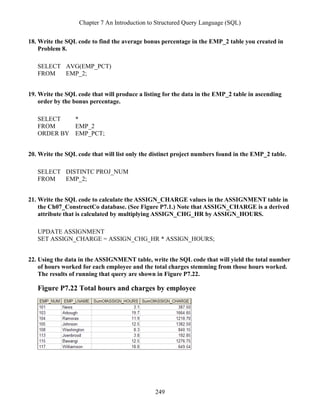
22. Using the data in the ASSIGNMENT table, write the SQL code that will yield the total number
of hours worked for each employee and the total charges stemming from those hours worked.
The results of running that query are shown in Figure P7.22.
Figure P7.22 Total hours and charges by employee
Chapter 7 An Introduction to Structured Query Language (SQL)
250
SELECT ASSIGNMENT.EMP_NUM, EMPLOYEE.EMP_LNAME,
Sum(ASSIGNMENT.ASSIGN_HOURS) AS SumOfASSIGN_HOURS,
Sum(ASSIGNMENT.ASSIGN_CHARGE) AS SumOfASSIGN_CHARGE
FROM EMPLOYEE, ASSIGNMENT
WHERE EMPLOYEE.EMP_NUM = ASSIGNMENT.EMP_NUM
GROUP BY ASSIGNMENT.EMP_NUM, EMPLOYEE.EMP_LNAME;
23. Write a query to produce the total number of hours and charges for each of the projects
represented in the ASSIGNMENT table. The output is shown in Figure P7.23.
Figure P7.23 Total hour and charges by project
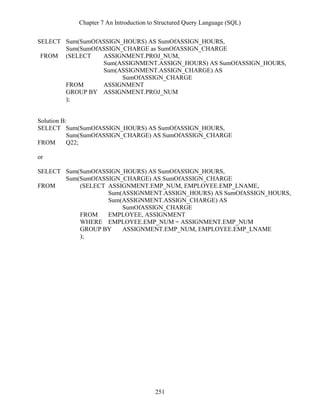
SELECT ASSIGNMENT.PROJ_NUM,
Sum(ASSIGNMENT.ASSIGN_HOURS) AS SumOfASSIGN_HOURS,
Sum(ASSIGNMENT.ASSIGN_CHARGE) AS SumOfASSIGN_CHARGE
FROM ASSIGNMENT
GROUP BY ASSIGNMENT.PROJ_NUM
24. Write the SQL code to generate the total hours worked and the total charges made by all
employees. The results are shown in Figure P7.24. (Hint: This is a nested query. If you use
Microsoft Access, you can generate the result by using the query output shown in Figure P7.22
as the basis for the query that will produce the output shown in Figure P7.24.)
Figure P7.24 Total hours and charges, all employees
Solution A:
SELECT Sum(SumOfASSIGN_HOURS) AS SumOfASSIGN_HOURS,
Sum(SumOfASSIGN_CHARGE) AS SumOfASSIGN_CHARGE
FROM Q23;
or
Chapter 7 An Introduction to Structured Query Language (SQL)
251
SELECT Sum(SumOfASSIGN_HOURS) AS SumOfASSIGN_HOURS,
Sum(SumOfASSIGN_CHARGE as SumOfASSIGN_CHARGE
FROM (SELECT ASSIGNMENT.PROJ_NUM,
Sum(ASSIGNMENT.ASSIGN_HOURS) AS SumOfASSIGN_HOURS,
Sum(ASSIGNMENT.ASSIGN_CHARGE) AS
SumOfASSIGN_CHARGE
FROM ASSIGNMENT
GROUP BY ASSIGNMENT.PROJ_NUM
);
Solution B:
SELECT Sum(SumOfASSIGN_HOURS) AS SumOfASSIGN_HOURS,
Sum(SumOfASSIGN_CHARGE) AS SumOfASSIGN_CHARGE
FROM Q22;
or
SELECT Sum(SumOfASSIGN_HOURS) AS SumOfASSIGN_HOURS,
Sum(SumOfASSIGN_CHARGE) AS SumOfASSIGN_CHARGE
FROM (SELECT ASSIGNMENT.EMP_NUM, EMPLOYEE.EMP_LNAME,
Sum(ASSIGNMENT.ASSIGN_HOURS) AS SumOfASSIGN_HOURS,
Sum(ASSIGNMENT.ASSIGN_CHARGE) AS
SumOfASSIGN_CHARGE
FROM EMPLOYEE, ASSIGNMENT
WHERE EMPLOYEE.EMP_NUM = ASSIGNMENT.EMP_NUM
GROUP BY ASSIGNMENT.EMP_NUM, EMPLOYEE.EMP_LNAME
);
Chapter 7 An Introduction to Structured Query Language (SQL)
252
25. Write the SQL code to generate the total hours worked and the total charges made to all
projects. The results should be the same as those shown in Figure P7.24. (Hint: This is a nested
query. If you use Microsoft Access, you can generate the result by using the query output
shown in Figure P7.23 as the basis for this query.)
SELECT Sum(SumOfASSIGN_HOURS) AS SumOfASSIGN_HOURS,
Sum(SumOfASSIGN_CHARGE) AS SumOfASSIGN_CHARGE
FROM Q23;
or
SELECT Sum(SumOfASSIGN_HOURS) AS SumOfASSIGN_HOURS,
Sum(SumOfASSIGN_CHARGE as SumOfASSIGN_CHARGE
FROM (SELECT ASSIGNMENT.PROJ_NUM,
Sum(ASSIGNMENT.ASSIGN_HOURS) AS SumOfASSIGN_HOURS,
Sum(ASSIGNMENT.ASSIGN_CHARGE) AS
SumOfASSIGN_CHARGE
FROM ASSIGNMENT
GROUP BY ASSIGNMENT.PROJ_NUM
);
O n l i n e C o n t e n t
Problems 26−43 are based on the Ch07_SaleCo database, which is available at www.cengagebrain.com.
This database is stored in Microsoft Access format. Oracle, MySQL and MS SQL Server script files are
available at www.cengagebrain.com.
The structure and contents of the Ch07_SaleCo database are shown in Figure P7.26. Use this
database to answer the following problems. Save each query as QXX, where XX is the problem
number.
26. Write a query to count the number of invoices.
SELECT COUNT(*) FROM INVOICE;
27. Write a query to count the number of customers with a customer balance over $500.
SELECT COUNT(*)
FROM CUSTOMER
WHERE CUS_BALANCE >500;
Chapter 7 An Introduction to Structured Query Language (SQL)
253
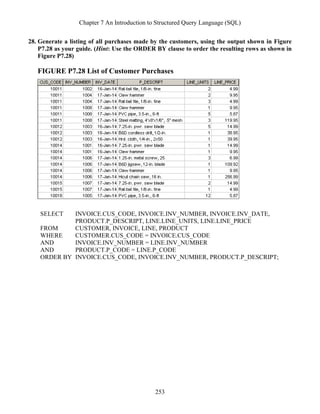
28. Generate a listing of all purchases made by the customers, using the output shown in Figure
P7.28 as your guide. (Hint: Use the ORDER BY clause to order the resulting rows as shown in
Figure P7.28)
FIGURE P7.28 List of Customer Purchases
SELECT INVOICE.CUS_CODE, INVOICE.INV_NUMBER, INVOICE.INV_DATE,
PRODUCT.P_DESCRIPT, LINE.LINE_UNITS, LINE.LINE_PRICE
FROM CUSTOMER, INVOICE, LINE, PRODUCT
WHERE CUSTOMER.CUS_CODE = INVOICE.CUS_CODE
AND INVOICE.INV_NUMBER = LINE.INV_NUMBER
AND PRODUCT.P_CODE = LINE.P_CODE
ORDER BY INVOICE.CUS_CODE, INVOICE.INV_NUMBER, PRODUCT.P_DESCRIPT;
Other documents randomly have
different content
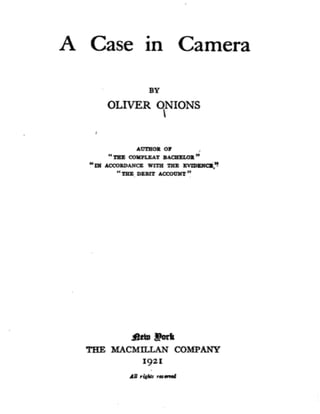
The Project Gutenberg eBook of A Case in
Camera
This ebook is for the use of anyone anywhere in the United States
and most other parts of the world at no cost and with almost no
restrictions whatsoever. You may copy it, give it away or re-use it
under the terms of the Project Gutenberg License included with this
ebook or online at www.gutenberg.org. If you are not located in the
United States, you will have to check the laws of the country where
you are located before using this eBook.
Title: A Case in Camera
Author: Oliver Onions
Release date: June 29, 2013 [eBook #43063]
Most recently updated: October 23, 2024
Language: English
Credits: E-text prepared by Caitlin Hesser, Suzanne Shell, and the
Online Distributed Proofreading Team
(http://www.pgdp.net) from page images generously made
available by the Google Books Library Project
(http://books.google.com)
*** START OF THE PROJECT GUTENBERG EBOOK A CASE IN
CAMERA ***
The Project Gutenberg eBook, A Case in Camera, by Oliver Onions
Note: Images of the original pages are available through the
Google Books Library Project. See
http://www.google.com/books?id=SnMmAAAAMAAJ
A CASE IN CAMERA
THE MACMILLAN COMPANY
NEW YORK · BOSTON · CHICAGO
DALLAS · ATLANTA · SAN FRANCISCO
MACMILLAN & CO., Limited
LONDON · BOMBAY · CALCUTTA
MELBOURNE
THE MACMILLAN CO. OF CANADA, Ltd.
TORONTO
A Case in Camera
BY
OLIVER ONIONS
AUTHOR OF
"THE COMPLEAT BACHELOR"
"IN ACCORDANCE WITH THE EVIDENCE"
"THE DEBIT ACCOUNT"
New York
THE MACMILLAN COMPANY
1921
All rights reserved
Copyright, 1920 and 1921,
By THE MACMILLAN COMPANY
Set up and electrotyped. Published March, 1921
TO
OLE LUK OIE
"Our Life is like a curious Play
Where each doth strive to hide himself.
One Mask doth to another say
'Let us be open as the Day'
The better to conceal himself."
PART I
WHAT HAPPENED IN LENNOX
STREET
I
The tale I am setting out to tell has to do with the killing, on a May
morning of the year 1919, of one young man by another who
claimed, and still claims, to have been his friend. The circumstances
were singular—perhaps even unique; the consequences affected a
number of people in various interesting ways and byways; and since
the manner of telling the story has been left entirely to me, I will
begin with the breakfast-party that Philip Esdaile gave that morning
at his studio in Lennox Street, Chelsea.
II
Philip had at least two good reasons for being in high feather that
morning. The first of these was that barely a week ago, with a
magnificent new quill pen, he had signed the Roll, had shaken
august hands, and was now Philip Esdaile, A.R.A., probably the most
gifted among the younger generation of painters of the pictorial
phenomena of Light.
I and his second reason for contentment happened to arrive almost
simultaneously at the wrought-iron gate that opened on to his little
front garden. We all knew that for many months past our barrister
friend, Billy Mackwith, had been tracking down and buying in again
on Philip's behalf a number of Philip's earlier pictures—prodigal
pictures, parted with for mere bread-and-butter during the years of
struggle, and now very well worth Philip's re-purchase if he could
get them into his possession again. (I may perhaps say at once that
I don't think Philip owed his Associateship to his pictures of that
period. It is far more likely that the artist thus honored was
Lieutenant Esdaile, R.N.V.R., sometime one of the Official Painters to
the Admiralty.)
A carrier's van stood drawn up opposite the gate, and I saw
Mackwith's slim, silk-hatted and morning-coated figure jump down
from the seat next to the driver. Evidently Philip had seen the arrival
of the van too, for he ran down the short flagged path to meet us.
"You don't mean to say you've brought them all?" he cried eagerly.
"The whole lot. Fourteen," Mackwith replied. "Glad I just caught you
before you left."
Esdaile and his family were leaving town that morning for some
months on the Yorkshire Coast, and it was this departure that was
the occasion of the farewell breakfast.
The three of us carried the recovered canvases through the small
annexe, where the breakfast-table was already laid, and into the
large studio beyond. There we stood admiring them as they leaned,
framed and unframed, against easels and along the walls. No doubt
you remember Esdaile's paintings of that period—the gay white and
gray of his tumultuous skies, the splash and glitter of his pools and
fountains, the crumbling wallflowered masonry of his twentieth-
century fêtes-champêtre. There is nothing psychical or philosophic
about them. He simply has that far rarer possession, an eye in his
head to see straight with.
"Well, which of 'em are you going to have for yourself, just by way of
thank-you, Billy?" the painter asked. "Any you like; I owe you the
best of them and more.... And of course here comes Hubbard.
Always does blow in just as things are being given away, if it's only a
pink gin. How are you, Cecil?"
The new-comer wore aiguillettes and the cuff-rings of a Commander,
R.N. He was a comparatively new friend of mine, but for two years
off and on had been a shipmate of Esdaile's, and I liked the look of
his honest red face and four-square and blocklike figure. We turned
to the pictures again. I think their beauties were largely thrown
away on Hubbard. Somebody ought to have told him that their
buying-in meant a good thousand pounds in Esdaile's pocket. Then
he would have looked at them in quite a different manner.
In the middle of the inspection Joan Merrow's white frock and
buttercupped hat appeared in the doorway, and we were bidden to
come in to breakfast. Monty Rooke and Mrs. Cunningham had just
arrived, which made our party complete.
The little recess in which we breakfasted was filled with the sunlight
reflected from the garden outside. Everything in it—the napkins and
fruit and chafing-dishes on the table, the spring flowers in the bowls,
the few chosen objects on the buff-washed walls, the showery
festoon of the chandelier overhead—had the soft irradiation of a face
seen under a parasol. Little shimmers of light, like love-making
butterflies, danced here and there whenever glasses or carafes were
moved, and the stretches of shining floor almost looked as if trout
might have lurked beneath them.
And where the tall French windows stood wide open the light
seemed to be focused as if by a burning-glass on the two little
Esdaile boys who played beneath the mulberry that rose above the
studio roof.
I don't suppose the whole of Chelsea could have shown a merrier
breakfast-party than we made that May morning. For, in addition to
our host's new Associateship and those fourteen wandering pictures
safely back home again, we had a further occasion for light-
heartedness that I haven't mentioned yet. This was the wedding, to
take place that day week, of Mrs. Cunningham and Monty Rooke.
Philip was generously lending them his house and studio for the
summer. Monty we had all known for years, but Mrs. Cunningham I
for one set eyes on for the first time that morning. Later I got a
much more definite impression of her. For the present I noticed only
her slender and beautiful black-chiffon-covered arms, the large
restless dark eyes that seemed to disengage themselves from under
the edge of her black satin turban hat, and her manicured fingers
that reminded you of honeysuckle. The Esdailes had received her
"on the ground floor," so to speak, and it obviously pleased Monty
that Philip had called her Audrey straight away.
So we talked of the approaching wedding, and the Associateship,
and the painting-cottage in Yorkshire, and so back to the pictures
again. On this subject Commander Hubbard unhesitatingly took the
lead.
"Well, it's certainly Art for mine my second time on earth," he good-
humoredly railed, the aiguillettes swinging gently on his breast.
"Fancy going out of town this weather! Taking away all that gear
behind the bulkhead there,"—he jerked his head to where Philip's
painting paraphernalia lay ready packed in the hall—"a few yards of
raw canvas bent on battens—and bringing it back again worth
twenty pounds an inch!"
Hubbard had a Whitehall job that summer, and loathed it. Esdaile
laughed.
"Can't see why they didn't make me a full Academician while they
were about it," he said.
"And he's grumbling!" Hubbard retorted. "Perfectly revolting fellow.
That's too much lunching with Admirals. Listen, Mrs. Esdaile, and I'll
tell you the kind of thing we mere senior officers had to put up with.
A hoist breaks out from the flagship, and every glass in the
Squadron is glued to it. You'd think at least we were to proceed to
sea immediately. Nothing of the sort! It's the Admiral presenting his
compliments to this wretched wavy-ringed fellow your husband, and
would he give him the pleasure—would Lieutenant Esdaile, R.N.V.R.,
condescend—stoop—to take luncheon with him! The Admiral, if you
please! And that's what it is to be an Official Painter!"
Esdaile laughed again. He was trying to remove in one unbroken
piece the paring of an apple for Joan Merrow.
"Give him a smile now and then and he'll eat out of your hand,
Mollie," he said. "Now, Joan, the last little bit—this is where a steady
hand comes in—there!" He held up in triumph the wiggle of apple
paring. "Throw it over your left shoulder and see what initial it
makes on the floor. Here's my guess on this bit of paper under my
napkin—'C for Ch' ... Ah, clumsy infant!" The strip had fallen in two
pieces. "There goes your luck. Allee done gone finish. I'll have the
apple myself; you'd better go and write the rest of those labels."
The Esdailes had to all intents and purposes adopted Joan Merrow
now that she was alone in the world. On the day when Philip, half
scared by the risks he was taking, had informed his private pupils
that their tuition took up too much of his painting-time, he had not
included Joan. She had continued to prime his canvases and to make
use of his models at long range from odd corners of the studio; and
then, during his absence on Service, she had come to live in the
house, had taught and mended for the children, and had been
companion and friend to Mollie. By an affectionate fiction, her former
fees were supposed to cover the cost of her board, and a proper
arrangement was to be come to one of these days. She was twenty,
had only lately ceased to have the stripling figure that is all youth
and no sex, and was already acquiring that mystery of physical
shape and of mind and emotion that causes men's heads to turn
behind and their lips to murmur, "Ah—in another year or so——"
There was still the faint echo of chattering schoolrooms in the
repartee that came from her pretty lips. Pertly and with little tosses
of her head she enumerated the duties she had discharged that
morning.
"The labels are all distinctly written, with the name at the top, then a
space, and 'Santon, Yorks' quite at the bottom so you can tear it off
and use the label again for somewhere else. Both the taxis are
ordered for one-thirty, and Mr. Rooke won't have to send on letters
because they're all being re-addressed at the Post Office. The doors
and windows are all fastened, and I've shown Mrs. Cunningham
where everything is for after the wedding. And I didn't want the
apple, and you've no business to write things about me on your
horrid bits of paper!"
And we all laughed as she suddenly twitched Philip's napkin away
and tucked the horrid bit of paper safely away into her bosom.
III
I have told the foregoing in some detail because I want you to see
the careless and happy party into which that morning's bolt dropped
a quarter of an hour later. I want you to see the contrast between
our homely light-heartedness and the complex tangle of all that
followed. I will now tell you what the bolt was.
Breakfast was over, and we men had gone into the studio again.
Mrs. Cunningham was helping Mollie to clear away, and Joan Merrow
had joined the children in the garden, and with them was looking up
at an aeroplane, the soft organ-like note of which had suddenly
ceased. We were having Hubbard's views on Art again.
"But that submarine sketch of yours is the pick of all you've done to
my mind, Esdaile," he was saying. "Old Horne at the periscope, eh?
You caught him to a hair; a snapshot couldn't have been better! And
we bagged that beggar ten minutes later, Norwegian flag and all,"
he added with professional satisfaction.
Philip Esdaile gave a quick exclamation.
"By Jove, that just reminds me! The orange curaçao, of course! The
very thing after all that fruit—corrects the acidity, as the doctors say.
We'll have some."
The Commander gave him a sharp look. On the face of it there was
no very evident reason why the torpedoing of a German ship flying
the Norwegian flag should remind Esdaile of orange curaçao, but no
doubt there was a story behind that we others knew nothing of. If
ships have to be put down there is no sense in sending bottles of
delectable liqueur to the bottom of the sea also.
"What!" cried Commander Hubbard, R.N. "You don't mean to say
that you had the infernal neck to take your whack——"
A mere wretched wavy-ringed fellow to loot bottle for bottle with his
betters like that!
But Esdaile, with a wink, demanded the key of the cellar from Monty
Rooke, told him to get the liqueur glasses out, and was off.
It was at that moment that the crash came that seemed to bring the
whole of Chelsea running out of doors.
The shrill cry of "The aeroplane! The aeroplane!" was hardly out of
the children's mouths before it was upon us—I don't mean the
aeroplane, but the other thing. Judging from the harsh but muffled
roar, the first installment of the crash, so to speak, which was the
plane itself, must have been a quarter of a mile away; but between
that and the second one there was hardly time to take breath.
Simultaneously, as it seemed, there came a rushing of air, a loud
cracking, and a nauseating thud on the studio roof; and Joan
Merrow ran in with the children, one under either arm and her head
down. The street outside was a sudden clatter of running feet and
short spasmodic cries.
"Good God, right on our heads!" the Commander muttered, his eyes
aloft.
The next moment he was at the studio door looking for Esdaile.
Had he found him I should not be writing this story. Not finding him,
he assumed command.
"All right. All over now, little fellows. There won't be any more. Mrs.
Esdaile, you ladies will stay just where you are, please. Get on to the
telephone, Mackwith. You other fellows come with me."
He thought it better that somebody should investigate before the
women began to move about too freely.
IV
One order at any rate was superfluous—that to telephone to the
police. Aeroplanes do not crash in Chelsea in the middle of the
morning unobserved. Already the windows on the other side of the
street were packed with faces, and every face was turned in the
same direction.
This was towards the torn fabric of a parachute that had lodged
partly on the studio roof, partly in the branches of the mulberry in
the garden.
Hubbard ran out through the French windows and looked up. Tapes
trailed and rippled and fluttered in the merry morning breeze, and
the gray silk ballooned and rose and fell. But the sound of running
feet warned Hubbard not to pause. He strode quickly down the
flagged path, shot the catch of the wrought-iron gate in the faces of
the too curious, and then hurried into the house again. He
addressed Rooke, who stood by the group of shocked women.
"Here, you seem to know this house pretty well. How do we get up
there?" he asked.
"Bathroom window, I should think," Rooke replied. "This way."
The bathroom lay at the end of a short passage on the floor above.
The three of us dashed upstairs. Rooke tried the bathroom door, but
found it locked. "Damn!" he muttered, and then I reminded him that
possibly he had the key of it in his pocket.
It was oddly irritating to watch him try first one key and then
another. We wanted to tell him to make haste, as if he could have
made any greater haste than he was doing. Then luckily he hit on
the right one. The door opened, we sprang across the cork-covered
floor, and Rooke began to tug at the window-catch. The window was
one of these late-Victorian windows with a colored border and white
incised stars, and already the tragic huddle a dozen yards away
could be seen, violently crimson through the red squares and
morbidly blue through the blue ones.
Then, as the sash flew up, all was sunshine again, and the wrecked
parachute and the two men enwrapped in its folds could be seen
only too clearly.
Monty Rooke had a new silver-gray suit on that morning, but already
he had thrown one leg over the sill.
"I'm not so heavy as you fellows," he muttered. "I'm not so sure
about this gutter—give me a hand while I try it. Then I can shin up
that spout over there."
Hubbard took the small, nervous hand in his own beefy fist and let
him down three or four feet. "All right," said Rooke, after a
moment's trial; and, spread-eagled out on the annexe roof, he
began to make his way towards the higher roof of the studio
beyond.
"Tapes oughtn't to have fouled like that," I heard the Commander
say under his breath as we watched. "Parachuting's safe enough if
you're any height at all. This breeze, I suppose, and risking the
double load. Wonder they didn't go slap through."
It was, indeed, merely by inches that the two men had missed the
roof-glass. Apparently the parachute, the roof-frame and the
mulberry had shared the shock among them. Not that another
fifteen feet would have made much difference to the poor devils, I
couldn't help thinking.
The street was now a densely-packed mass of faces, all watching
Rooke's progress. Even the whispering had ceased. Then cries of
"Make way there!" were suddenly heard. Fifty yards away a ladder,
preceded by a plump young man in a horsey check coat, was being
passed over people's heads. Every hand that could touch the ladder
did so, as if out of some odd pride of assistance. What anonymous
mind had foreseen the need of it none could have told. Down below
Mackwith opened the gate; an Inspector, followed by a couple of
constables and the last relay that bore the ladder, entered; and
Mackwith closed the gate again. The ladder was set up by the
splintered mulberry, and the Inspector and one of the constables
joined Rooke on the roof.
Five minutes later Rooke was down again. Hubbard and I had also
descended. We met him as he came in at the French window.
"Well?" we both demanded at once.
He was agitated, as indeed he had some reason for being. He had
had an unpleasant task. Before replying he advanced to the
breakfast-table and poured himself out some water into the nearest
glass. The glass knocked unsteadily as he set it down again. Then he
glanced down at his clothes, made a movement as if to brush the
grime from them, but gave a jerk to his tie instead.
Nevertheless his news was not all bad. In one particular it was
rather astonishingly good. One of the two men, it appeared, was by
no means fatally hurt—was, indeed, quite likely to pull through.
"Do you know who they are?" Hubbard asked.
Again Monty seemed preoccupied with his clothes. Then we had his
tidings, jerkily and bit by bit.
The plane itself had come down somewhere by the Embankment,
and was said to have caught fire. Parts of the parachute seemed to
be singed too. Both men were civilian flyers; at least neither was in
uniform. The other poor fellow was killed. The ambulance had been
sent for, and for the present there was little more to be done. The
police were seeing to the rest. This was the sum of what Monty told
us.
Then we heard the voice of Mackwith, who had come up behind us.
"That's so," he confirmed. "I've just been having a word with the
Inspector about that. He doesn't think anybody here will have to
attend any inquiry or anything; the police evidence ought to be
enough. So I was thinking, Mrs. Esdaile," he turned to Mollie, whose
face was still pale and drawn and who bit the corner of her lip
incessantly, "that the best thing for you to do is to stick to your
program just as if this hadn't happened. You'll do no good staying
here. You didn't see it,"—here Joan Merrow, from the little sofa,
raised her head but dropped it again without speaking—"well, I
mean that even Joan didn't see anything that five hundred other
people didn't see just as well. Rooke may just possibly be wanted,
but anyway he'll be here. And as for Philip——"
He broke off abruptly. Of a sudden we all stared at one another. We
had forgotten all about Philip. Where was he?
If you remember, he had gone down into the cellar to fetch a bottle
of wine. And in performing this simple errand he had been away for
close on half an hour.
Mollie Esdaile, all on edge again, turned swiftly to Monty Rooke.
"Where is he? He did go down there, didn't he? You did give him the
cellar key, didn't you? And nobody heard him go out of the house?"
Well, that was a matter that was very easily ascertained. Already
Hubbard had taken a stride towards the door that led to the cellar.
But he did not reach the door. A footstep was heard behind it and
the turning of a key, and Esdaile entered. In one hand he carried a
stone jar of Dutch curaçao. In the other, arrestively out of place in
the spring sunshine, its flame a dingy orange and its little spiral of
greasy smoke fouling the air, he held a lighted candle in a flat tin
stick.
V
For a moment we all gazed stupidly at that jar and candle; but the
next moment our eyes were fastened on Philip's face.
Now ordinarily Esdaile's face, clean-shaven since 1914, is quite a
pleasant one to look at, lightly browned, and with the savor of the
sea still lingering about it. Nor was it noticeably pale now. Indeed,
you might have said that some inner excitation made it not pale at
all. But there was no disguising the strained tenseness of it. At the
same time he was obviously attempting such a disguise. His features
were set in a would-be-easy smile, but the smile stopped at his
eyes. These blinked, though possibly at the sudden brightness after
the obscurity below. And he spoke without pause or preliminary, as if
rehearsing something he had had time to get letter-perfect but not
to make entirely and naturally his own.
"Did you think I was never coming up?" The mechanical smile was
turned on us all in turn. "I suppose I have been rather a long time.
Just wool-gathering. I apologize to everybody. Where are the
liqueur-glasses?"
There was a dead silence. Was it possible that he had heard nothing,
knew nothing of what had occurred?
Monty Rooke was the first to speak.
"Do you mean to say you didn't hear it?" he blurted out.
Then, as Philip seemed to concentrate that artificial smile suddenly
on him alone, he seemed sorry he had drawn attention to himself.
"And where on earth have you been?" Philip demanded slowly.
"What's the matter with your clothes? Been emptying the dustbins?
Here, let me give you a clean-up, man——"
He got rid of the jar of liqueur, not by putting it down on a table, but
by the simple if unusual expedient of letting it drop through his
fingers, where it made a heavy thump, rolled over on its side, and
came to rest. He stepped forward.
But Rooke, for some reason or other, stepped much more quickly
back. He muttered something about his clothes not mattering—it
was only a few grains of dust, but damp—better let it dry before
touching it——
It was at this point that I caught Cecil Hubbard's eye.
Hubbard's is a bright blue eye, with angular lids like little set-squares
and a tiny dark dot in the middle of the blue. That eye may not
know very much about pictures, but it knows a good deal about men
and their faces. Esdaile was taking risks if he hoped to play any
tricks with that eye on him.
Then, having caught mine for that moment, the eye was attentively
fixed on our host again.
You see how preposterous it was already. Esdaile apparently could
notice a trifle like the dust on Rooke's clothes, but he seemed to be
both blind and deaf to everything else—the soft surging murmurs of
the crowd outside, the voice of the Inspector in the garden, the
shadows of strangers across the French windows. He just dropped
heavy stone jars to the floor, talked about wool-gathering, and had
not even thought of extinguishing the candle that was melting and
guttering in his hand.
Wool-gathering—Philip Esdaile, the least woolly-minded of men!
Already I was certain that he was deliberately acting, and acting far
from well at that.
It was little Alan, the elder of the two boys, who broke the spell that
seemed to have benumbed us all. He ran forward, his blue-and-
white check smock against his father's knees and his little face
upturned.
"A naeroplane, daddy!" he cried eagerly. "Some men fell out of a
naeroplane close to Jimmy and me, didn't they, Auntie Joan? In a
parachute, bigger'n this room!" The little arms were outstretched to
their widest reach. "Do come quick and look, daddy!"
And he seized his father's hand.
Again I caught Hubbard's eye. Esdaile was at it again, this time with
a badly-exaggerated gesture of astonishment. He might have made
just such a gesture if Alan had told him that the Grandmother in the
bed was really a Wolf—good enough for children but not for anybody
else. Hubbard at any rate thought that this had lasted long enough.
"Do you mean to say that you didn't feel the whole house shake half
an hour ago?" he demanded.
Esdaile turned, but with a curious reluctance that I didn't
understand.
"I did fancy I heard a noise of some sort," he admitted. "What about
it?"
Hubbard gave it to him plain and unvarnished, for all the world as if
he had been in the Admiral's office with a sentry with a bayonet at
the door.
"A plane crashed, and two men came down on your roof in a
parachute. One's living, the other's killed. Those are the police in
your garden now. That's all—except that you seem to live in a pretty
solidly-constructed house."
This time Esdaile made no demonstration. He stood listening for a
moment longer, as if he thought Hubbard might add something;
then, without a word, he released himself from Alan's hand and
strode, not to the garden where the voices were, but towards the
studio door.
VI
The studio (into which Hubbard and I immediately followed him)
was a large oblong apartment, with a portion of one of its longer
sides and almost the whole of the roof glazed. More or less light
could be admitted by means of a system of dark blue blinds and
cords running to cleats on the walls. It was to the roof-glass that my
eyes turned first of all. One corner of it was darkened, as if melted
snow had slipped down its slope, but the irregular triangle thus
made was not so dark but that the shapes of the two heads could be
seen, a little darker still. Nearer up to the ridge one thick pane was
badly starred, and in the middle of the star was a small hole. This I
judged to have been made by the broken branch that still brushed
and played about it. A couple of pictures had fallen from the walls
and lay face downward among their sprinklings of broken glass on
the floor. One or two others were disarranged. Otherwise the
apartment seemed to be undamaged.
Esdaile's behavior was now odder than ever. With those two men
lying on the roof just over his head and the police moving about the
garden outside, apparently he found nothing more urgent to do than
to move displaced rugs about and to push at the bits of broken glass
with his foot. And he did this with the candle, now a stalagmite of
tallow, still licking and flickering in his hand.
He made no remark when Hubbard took the candle almost roughly
from him, blew it out, and set it down on the table where the artist's
tubes and brushes usually stood.
"We'll be rid of that first of all," he said. "Unless it's a mascot.
Scaring 'em to death with that in your hand like a sleepwalker in
traveling-tweeds! Now what about it, Esdaile?"
There was sudden attention in Philip's attitude, though he still looked
down at the floor and pushed at a rug with his toe.
"What about what?" he asked.
"About this last half-hour."
"You mean where have I been? I went down into the cellar. I went
to get that liqueur."
"That doesn't take half an hour—and it certainly didn't take this
particular half-hour."
To this Esdaile made no reply.
"Come," said Hubbard again after a pause. "You admitted just now
that you thought you heard something."
The words came slowly. "Did I? Yes, I remember. But it was all
muffled. Honestly, I couldn't tell from the sound that it was—that it
was all this."
"Was that when you were down there, or as you were going down,
or when?"
"I'd just got down, I think."
"But didn't you wonder what was the matter? What kept you all that
time? And what's the matter with you now that you have come up?"
"The matter?" Esdaile began once more to parry; and then suddenly
his manner changed. For the first time he looked up from the floor,
and the mask, whatever it was, almost dropped. "Look here, you
fellows," he said almost appealingly, "you might see I'm a bit
worried. I've been trying to hide it, but perhaps it wasn't much of an
effort. Not so dashed easy to hide. But if you're suggesting that I've
been somewhere else besides in the cellar I can only tell you I
haven't. Couldn't for one thing; Rooke's got every key of this house.
I had to get the cellar one from him. By the way, what's he doing
now?"
"Looking out your next train. But what I want to know is——"
He broke off suddenly as sounds were heard over our heads. About
the snowslip on the roof other shadowy shapes could be seen. Feet
shuffled and moved, and the broken branch was dragged away.
They were preparing to get the two men down.
And until they should have finished our conversation ceased.
But in the meantime Esdaile did yet another trivial incongruous
thing. Moving towards one set of blind-cords he motioned to me to
take another set. With short sticking tugs we drew the blinds across
a foot at a time, and soon only narrow gold lozenges of sunlight
showed among the rafters. All below was a dark blue twilight, as if
for an obsequy within instead of for one on the roof.
Then, when from the cessation of sound all appeared to be over,
Hubbard made a fresh appeal. He took the painters arm.
"Now let's have this out," he said. "No good letting a thing get way
on when a few plain words will stop it. A perfectly ordinary thing's
happened. Simple parachute accident. No mystery about it whatever.
The mystery only begins when you come in carrying your damned
candles and dropping jars and coming in here to tidy up instead of
going outside to see what's happened. That's where the answer
begins to be a lemon, my son. Listen to me. Whether you heard that
crash or whether you didn't, at any rate you know all about it now.
Then why can't you be just decently upset like the rest of us and
have done with it?"
"Decently upset?" The words seemed to strike him. "Have I been
behaving any other way?"
"You were behaving damnably indecently when you came up out of
the orlop there—and that was before you were told a word of all
this, remember."
At last Esdaile saw the point. His behavior had been extraordinary
for whole minutes before the situation had been explained to him.
One would have thought that during those minutes he had been
deliberately trying to find out how much we knew about something
or other before committing himself. When next he spoke it was
almost apologetically.
"I see," he said quietly at last. "Yes, you're perfectly right. That was
certainly the proper way to take it—just be decently upset. I see
now. I must have looked a perfect zany.... Now look here: I want to
tell you both all about it, but the trouble is that I can't just at this
moment. At present it's somebody else's affair, not mine at all. Must
get that cleared up first. I'm not perfectly sure of my ground either;
you'll see by and by. But as regards the accident—well, that's the
whole point at present. I mean anybody would say it was an
accident, wouldn't they? It looked like one, I mean? It would never
occur to anybody who saw it that——"
But here he broke off abruptly as his wife appeared in the doorway.
VII
Perhaps at this point I had better tell you who "I" am who write this,
and also how our little circle came to choose me for the task.
As a minor actor in these events you may set me down as a working
journalist. Among other things I am one of the sub-editors of the
Daily Circus. But that is not the whole of my life. I am also a novelist
of sorts. And one of my reasons for sticking to journalism when I
could manage at a pinch to do without it is that in this way I escape
the doom of having to produce two novels a year whether I have
anything to write about or not.
But that was not their idea in asking me to put into shape the
mosaic of differently-colored pieces that constitutes this Case. I
believe their idea was that my two capacities might supplement one
another—that I might hold fast (so to speak) to the bed-rock facts
with my journalistic hand while the other was left free for the less
tangible elements. I don't know that I altogether agree with this
distinction. I happen to have some experience of how much fiction
people swallow when they take up their morning papers, and also of
how much mere hurdy-gurdy-grinding they accept as "human
nature" when it comes to them in the form of a novel. But that is
their look-out. I told them that with their help I would do my best.
I had to have their help. Obviously I could not always be at the side
of this person or that, Rooke or Esdaile or Hubbard, throughout
every winding of a complicated chain of events. But I have known
Esdaile for twenty years, Rooke for a dozen, and most of the others
long enough to have a fairly reliable impression of them, and their
accounts are quite trustworthy. If I have any doubt about this I say
so.
I cannot deny that we took a good deal of responsibility when we
conspired to hush up the facts of this Case. We have no more right
to come between the agents of the Law and their duty than any
other set of private persons. And, though many of the beaten tracks
are lost in these changing days, and new precedents are making
whichever way you turn, I for one don't like making new precedents,
especially moral ones. I like tradition to have my homage even when
I am resolved to break it. But we are dealing with a fait accompli.
The Case is a Case. It became so in spite of laws and customs and
institutions. First one person acted as according to the laws of his
individual being he had to act, and another did the same, and then
another and so on, until the phenomenon was complete.
So, as my chief business in life is precisely those human accidentals
that make us all different beings destined to different acts, perhaps
they have chosen their historian more or less rightly after all.
One caveat (as Mackwith would say) I must enter, however. This is
with regard to my own Services in the War that is now over. Most of
these services, though as a matter of fact performed in belt and
khaki, might just as well have been discharged in a dressing-gown,
so unadventurous for the most part were they. Thanks to a "joy-
ride," I did just see War, but for the rest I went where I was told to
go and did what I was told to do. It is therefore just possible that
from the point of view of those who lived in the hell I only briefly
visited, one or two of my values may be a little "out." The North Sea
cannot be quite the same to me that it was to Esdaile and Hubbard,
the air means just what it meant to Maxwell and Chummy Smith. For
this I am afraid there is no help. But there is always the chance that
if I have minimized, they might have stressed a little unduly. For
while our Case has nothing to do with War, War is always antecedent
to it, as for a generation to come it will be antecedent to everything.
So, on this understanding, we may get on with the tale.
VIII
A slightly embarrassing little scene next took place in that breakfast-
room in Lennox Street, Chelsea. Rooke had put down the Time
Table, and Mollie Esdaile's face wore an expression of exasperation.
It appeared that Philip wanted to pack his family off according to
program but wished to remain behind himself. For this he gave no
reason—or rather he gave several reasons, all of the thinnest
description.
"But how tiresome!" broke from Mollie. "Why on earth do you want
to upset everything like this?"
Philip muttered something about the newly-arrived pictures needing
a thorough overhauling.
"And the children all ready, all but their hats!" Mollie exclaimed.
"Better hurry them up.... At least seven of them are to frame too."
"Then there's Monty and Audrey, what about them? When you offer
people a house——"
But at this one of Mrs. Cunningham's slender hands was imploringly
raised. Her small mouth was parted in appeal.
"Oh, please! Don't think of that! I should be miserable if I thought
that was going to make any difference!"
"But of course it makes a difference!" Mollie declared. "All your
things will be coming here, all your things for the wedding, and
anyway you won't want Philip hanging about the place. Better never
have offered the house at all!"
"Oh—for a day or two—I shan't be in the way," said Philip uneasily.
But it was awkward for all that. If Esdaile had offered his house to
one of his more prosperous friends he would not have hesitated to
say frankly that he was sorry, but something unforeseen had
happened, and the hospitality must be considered "off." But this was
different. It was known that these two were the reverse of well-off.
Monty as a matter of fact had already given up his rooms in Jubilee
Place, and I had gathered at breakfast that Mrs. Cunningham only
intended to occupy her bed-sitting-room in Oakley Street for a very
few days longer. There was her story, too, which I shall come to
presently. Philip's decision certainly upset a number of minor
arrangements.
"Oh, it's too ridiculous!" Mollie declared again with vexation. "If it
means that the wedding's to be put off I don't feel like going away
at all."
But Philip only continued to mumble soothingly that it would be
quite all right, and it wasn't for long, and nobody had said anything
about putting off the wedding. The situation looked rather like a
deadlock, and Mackwith already had his silk hat in his hand and the
Commander's white-topped cap was tucked under his upper arm.
Whether Philip went or stayed was a private family matter after all.
But as we were on the point of taking our leave yet another
significant little trifle was added to all the rest. And again Monty
Rooke provided the occasion.
Monty, I ought to say, is one of these fellows who, whenever any
odd job is to do, especially a domestic one, instinctively seems to
take it upon himself. I dare say his living in rooms and studios hardly
big enough to turn around in has made him methodical in his habits.
It was Monty, for example, who had looked out the train in the Time
Table; it was Monty who had picked up the jar of curaçao when
Esdaile had let it fall to the floor; and it was Monty who, just as the
rest of us were leaving, wandered off towards the studio, presently
returned again, sought the kitchen, and reappeared with a
sweeping-brush.
"What are you going to do with that?" Philip asked, seeing him
making for the studio again.
"I thought I'd just sweep up that broken glass," Monty replied.
"Better leave it," Philip answered.
Monty carried the brush back to the kitchen again, and presently
wandered off to the studio once more. Esdaile must have had eyes
in the back of his head, for I, who was facing the studio, had not
seen Monty preparing to draw back the roof-blinds again.
"I wouldn't bother about that just at present," Esdaile called rather
loudly. "Just see if there's a train about tea-time, do you mind?"
Monty, once more returning, took up the Time Table again. Philip
walked with us to the door. Then another little exclamation broke
from him. Monty had put down the Time Table and had asked him
for the cellar key.
"What on earth do you want the cellar key for?" Philip demanded.
"To put this jar of stuff back," Monty replied. "It won't be wanted
now."
Hereupon Philip broke out with a petulance that struck me as
entirely disproportionate, if indeed there had been any occasion for
petulance at all.
"Oh, we can do that any time. We've got all the rest of the day to
ourselves, haven't we? Sit down and smoke a cigarette or
something; you've done about enough for one morning——"
It was then that we left.
PART II
WHAT HAPPENED OUTSIDE
Welcome to our website – the perfect destination for book lovers and
knowledge seekers. We believe that every book holds a new world,
offering opportunities for learning, discovery, and personal growth.
That’s why we are dedicated to bringing you a diverse collection of
books, ranging from classic literature and specialized publications to
self-development guides and children's books.
More than just a book-buying platform, we strive to be a bridge
connecting you with timeless cultural and intellectual values. With an
elegant, user-friendly interface and a smart search system, you can
quickly find the books that best suit your interests. Additionally,
our special promotions and home delivery services help you save time
and fully enjoy the joy of reading.
Join us on a journey of knowledge exploration, passion nurturing, and
personal growth every day!
testbankfan.com

Database Systems Design Implementation and Management 11th Edition Coronel Solutions Manual

  • 1.
    Database Systems DesignImplementation and Management 11th Edition Coronel Solutions Manual download https://testbankfan.com/product/database-systems-design- implementation-and-management-11th-edition-coronel-solutions- manual/ Explore and download more test bank or solution manual at testbankfan.com

  • 2.
    Here are somerecommended products for you. Click the link to download, or explore more at testbankfan.com Database Systems Design Implementation and Management 11th Edition Coronel Test Bank https://testbankfan.com/product/database-systems-design- implementation-and-management-11th-edition-coronel-test-bank/ Database Systems Design Implementation and Management 12th Edition Coronel Solutions Manual https://testbankfan.com/product/database-systems-design- implementation-and-management-12th-edition-coronel-solutions-manual/ Database Systems Design Implementation And Management 13th Edition Coronel Solutions Manual https://testbankfan.com/product/database-systems-design- implementation-and-management-13th-edition-coronel-solutions-manual/ Business Law in Canada Canadian Edition Canadian 10th Edition Yates Test Bank https://testbankfan.com/product/business-law-in-canada-canadian- edition-canadian-10th-edition-yates-test-bank/
  • 3.
    Modern Advanced Accountingin Canada Canadian 7th Edition Hilton Solutions Manual https://testbankfan.com/product/modern-advanced-accounting-in-canada- canadian-7th-edition-hilton-solutions-manual/ Information Systems A Managers Guide to Harnessing Technology 1st Edition Gallaugher Test Bank https://testbankfan.com/product/information-systems-a-managers-guide- to-harnessing-technology-1st-edition-gallaugher-test-bank/ Organizations Behavior Structure Processes 14th Edition Gibson Test Bank https://testbankfan.com/product/organizations-behavior-structure- processes-14th-edition-gibson-test-bank/ Finite Mathematics and Its Applications 12th Edition Goldstein Solutions Manual https://testbankfan.com/product/finite-mathematics-and-its- applications-12th-edition-goldstein-solutions-manual/ Human Resource Information Systems 3rd Edition Kavanagh Test Bank https://testbankfan.com/product/human-resource-information- systems-3rd-edition-kavanagh-test-bank/
  • 4.
    Chemistry An AtomsFirst Approach 2nd Edition Zumdahl Solutions Manual https://testbankfan.com/product/chemistry-an-atoms-first-approach-2nd- edition-zumdahl-solutions-manual/
  • 5.
    Chapter 7 AnIntroduction to Structured Query Language (SQL) 239 Chapter 7 Introduction to Structured Query Language (SQL) NOTE Several points are worth emphasizing: • We have provided the SQL scripts for both chapters 7 and 8. These scripts are intended to facilitate the flow of the material presented to the class. However, given the comments made by our students, the scripts should not replace the manual typing of the SQL commands by students. Some students learn SQL better when they have a chance to type their own commands and get the feedback provided by their errors. We recommend that the students use their lab time to practice the commands manually. • Because this chapter focuses on learning SQL, we recommend that you use the Microsoft Access SQL window to type SQL queries. Using this approach, you will be able to demonstrate the interoperability of standard SQL. For example, you can cut and paste the same SQL command from the SQL query window in Microsoft Access, to Oracle SQL * Plus and to MS SQL Query Analyzer. This approach achieves two objectives: ➢ It demonstrates that adhering to the SQL standard means that most of the SQL code will be portable among DBMSes. ➢ It also demonstrates that even a widely accepted SQL standard is sometimes implemented with slight distinctions by different vendors. For example, the treatment of date formats in Microsoft Access and Oracle is slightly different. Answers to Review Questions 1. In a SELECT query, what is the difference between a WHERE clause and a HAVING clause? Both a WHERE clause and a HAVING clause can be used to eliminate rows from the results of a query. The differences are 1) the WHERE clause eliminates rows before any grouping for aggregate functions occurs while the HAVING clause eliminates groups after the grouping has been done, and 2) the WHERE clause cannot contain an aggregate function but the HAVING clause can. 2. Explain why the following command would create an error, and what changes could be made to fix the error. SELECT V_CODE, SUM(P_QOH) FROM PRODUCT; The command would generate an error because an aggregate function is applied to the P_QOH attribute but V_CODE is neither in an aggregate function or in a GROUP BY. This can be fixed by either 1) placing V_CODE in an appropriate aggregate function based on the data that is being requested by the user, 2) adding a GROUP BY clause to group by values of V_CODE (i.e. GROUP BY V_CODE), 3) removing the V_CODE attribute from the SELECT clause, or 4) removing the Sum aggregate function from P_QOH. Which of these solutions is most appropriate depends on the question that the query was intended to answer.
  • 6.
    Chapter 7 AnIntroduction to Structured Query Language (SQL) 240 3. What type of integrity is enforced when a primary key is declared? Creating a primary key constraint enforces entity integrity (i.e. no part of the primary key can contain a null and the primary key values must be unique). 4. Explain why it might be more appropriate to declare an attribute that contains only digits as a character data type instead of a numeric data type. An attribute that contains only digits may be properly defined as character data when the values are nominal; that is, the values do not have numerical significance but serve only as labels such as ZIP codes and telephone numbers. One easy test is to consider whether or not a leading zero should be retained. For the ZIP code 03133, the leading zero should be retained; therefore, it is appropriate to define it as character data. For the quantity on hand of 120, we would not expect to retain a leading zero such as 0120; therefore, it is appropriate to define the quantity on hand as a numeric data type. 5. What is the difference between a column constraint and a table constraint? A column constraint can refer to only the attribute with which it is specified. A table constraint can refer to any attributes in the table. 6. What are “referential constraint actions”? Referential constraint actions, such as ON DELETE CASCADE, are default actions that the DBMS should take when a DML command would result in a referential integrity constraint violation. Without referential constraint actions, DML commands that would result in a violation of referential integrity will fail with an error indicating that the referential integrity constrain cannot be violated. Referential constraint actions can allow the DML command to successfully complete while making the designated changes to the related records to maintain referential integrity. 7. Rewrite the following WHERE clause without the use of the IN special operator. WHERE V_STATE IN (‘TN’, ‘FL’, ‘GA’) WHERE V_STATE = 'TN' OR V_STATE = 'FL' OR V_STATE = 'GA' Notice that each criteria must be complete (i.e. attribute-operator-value). 8. Explain the difference between an ORDER BY clause and a GROUP BY clause. An ORDER BY clause has no impact on which rows are returned by the query, it simply sorts those rows into the specified order. A GROUP BY clause does impact the rows that are returned by the query. A GROUP BY clause gathers rows into collections that can be acted on by aggregate functions. 9. Explain why the two following commands produce different results. SELECT DISTINCT COUNT (V_CODE) FROM PRODUCT;
  • 7.
    Chapter 7 AnIntroduction to Structured Query Language (SQL) 241 SELECT COUNT (DISTINCT V_CODE) FROM PRODUCT; The difference is in the order of operations. The first command executes the Count function to count the number of values in V_CODE (say the count returns "14" for example) including duplicate values, and then the Distinct keyword only allows one count of that value to be displayed (only one row with the value "14" appears as the result). The second command applies the Distinct keyword to the V_CODEs before the count is taken so only unique values are counted. 10. What is the difference between the COUNT aggregate function and the SUM aggregate function? COUNT returns the number of values without regard to what the values are. SUM adds the values together and can only be applied to numeric values. 11. Explain why it would be preferable to use a DATE data type to store date data instead of a character data type. The DATE data type uses numeric values based on the Julian calendar to store dates. This makes date arithmetic such as adding and subtracting days or fractions of days possible (as well as numerous special date-oriented functions discussed in the next chapter!). 12. What is a recursive join? A recursive join is a join in which a table is joined to itself. Problem Solutions O n l i n e C o n t e n t Problems 1 – 25 are based on the Ch07_ConstructCo database located www.cengagebrain.com. This database is stored in Microsoft Access format. The website provides Oracle, MySQL, and MS SQL Server script files. The Ch07_ConstructCo database stores data for a consulting company that tracks all charges to projects. The charges are based on the hours each employee works on each project. The structure and contents of the Ch07_ConstructCo database are shown in Figure P7.1. Figure P7.1 Structure and contents of the Ch07_ConstructCo database
  • 8.
    Chapter 7 AnIntroduction to Structured Query Language (SQL) 242 Note that the ASSIGNMENT table in Figure P7.1 stores the JOB_CHG_HOUR values as an attribute (ASSIGN_CHG_HR) to maintain historical accuracy of the data. The JOB_CHG_HOUR values are likely to change over time. In fact, a JOB_CHG_HOUR change will be reflected in the ASSIGNMENT table. And, naturally, the employee primary job assignment might change, so the ASSIGN_JOB is also stored. Because those attributes are required to maintain the historical accuracy of the data, they are not redundant. Given the structure and contents of the Ch07_ConstructCo database shown in Figure P7.1, use SQL commands to answer Problems 1–25. 1. Write the SQL code that will create the table structure for a table named EMP_1. This table is a subset of the EMPLOYEE table. The basic EMP_1 table structure is summarized in the table below. (Note that the JOB_CODE is the FK to JOB.)
  • 9.
    Chapter 7 AnIntroduction to Structured Query Language (SQL) 243 ATTRIBUTE (FIELD) NAME DATA DECLARATION EMP_NUM CHAR(3) EMP_LNAME VARCHAR(15) EMP_FNAME VARCHAR(15) EMP_INITIAL CHAR(1) EMP_HIREDATE DATE JOB_CODE CHAR(3) CREATE TABLE EMP_1 ( EMP_NUM CHAR(3) PRIMARY KEY, EMP_LNAME VARCHAR(15) NOT NULL, EMP_FNAME VARCHAR(15) NOT NULL, EMP_INITIAL CHAR(1), EMP_HIREDATE DATE, JOB_CODE CHAR(3), FOREIGN KEY (JOB_CODE) REFERENCES JOB); NOTE We have already provided the EMP_1 table for you. If you try to run the preceding query, you will get an error message because the EMP_1 table already exits. 2. Having created the table structure in Problem 1, write the SQL code to enter the first two rows for the table shown in Figure P7.2. Figure P7.2 The contents of the EMP_1 table INSERT INTO EMP_1 VALUES (‘101’, ‘News’, ‘John’, ‘G’, ’08-Nov-00’, ‘502’); INSERT INTO EMP_1 VALUES (‘102’, ‘Senior’, ‘David’, ‘H’, ’12-Jul-89’, ‘501’); 3. Assuming the data shown in the EMP_1 table have been entered, write the SQL code that will list all attributes for a job code of 502. SELECT * FROM EMP_1 WHERE JOB_CODE = ‘502’;
  • 10.
    Chapter 7 AnIntroduction to Structured Query Language (SQL) 244 4. Write the SQL code that will save the changes made to the EMP_1 table. COMMIT; 5. Write the SQL code to change the job code to 501 for the person whose employee number (EMP_NUM) is 107. After you have completed the task, examine the results, and then reset the job code to its original value. UPDATE EMP_1 SET JOB_CODE = ‘501’ WHERE EMP_NUM = ‘107’; To see the changes: SELECT * FROM EMP_1 WHERE EMP_NUM = ‘107’; To reset, use ROLLBACK; 6. Write the SQL code to delete the row for the person named William Smithfield, who was hired on June 22, 2004, and whose job code classification is 500. (Hint: Use logical operators to include all of the information given in this problem.) DELETE FROM EMP_1 WHERE EMP_LNAME = 'Smithfield' AND EMP_FNAME = 'William' AND EMP_HIREDATE = '22-June-04' AND JOB_CODE = '500'; 7. Write the SQL code that will restore the data to its original status; that is, the table should contain the data that existed before you made the changes in Problems 5 and 6. ROLLBACK;
  • 11.
    Chapter 7 AnIntroduction to Structured Query Language (SQL) 245 8. Write the SQL code to create a copy of EMP_1, naming the copy EMP_2. Then write the SQL code that will add the attributes EMP_PCT and PROJ_NUM to its structure. The EMP_PCT is the bonus percentage to be paid to each employee. The new attribute characteristics are: EMP_PCTNUMBER(4,2) PROJ_NUMCHAR(3) (Note: If your SQL implementation allows it, you may use DECIMAL(4,2) rather than NUMBER(4,2).) There are two way to get this job done. The two possible solutions are shown next. Solution A: CREATE TABLE EMP_2 ( EMP_NUM CHAR(3) NOT NULL UNIQUE, EMP_LNAME VARCHAR(15) NOT NULL, EMP_FNAME VARCHAR(15) NOT NULL, EMP_INITIAL CHAR(1), EMP_HIREDATE DATE NOT NULL, JOB_CODE CHAR(3) NOT NULL, PRIMARY KEY (EMP_NUM), FOREIGN KEY (JOB_CODE) REFERENCES JOB); INSERT INTO EMP_2 SELECT * FROM EMP_1; ALTER TABLE EMP_2 ADD (EMP_PCT NUMBER (4,2)), ADD (PROJ_NUM CHAR(3)); Solution B: CREATE TABLE EMP_2 AS SELECT * FROM EMP_1; ALTER TABLE EMP_2 ADD (EMP_PCT NUMBER (4,2)), ADD (PROJ_NUM CHAR(3)); 9. Write the SQL code to change the EMP_PCT value to 3.85 for the person whose employee number (EMP_NUM) is 103. Next, write the SQL command sequences to change the EMP_PCT values as shown in Figure P7.9.
  • 12.
    Chapter 7 AnIntroduction to Structured Query Language (SQL) 246 Figure P7.9 The contents of the EMP_2 table UPDATE EMP_2 SET EMP_PCT = 3.85 WHERE EMP_NUM = '103'; To enter the remaining EMP_PCT values, use the following SQL statements: UPDATEEMP_2 SET EMP_PCT = 5.00 WHERE EMP_NUM = ‘101’; UPDATEEMP_2 SET EMP_PCT = 8.00 WHERE EMP_NUM = ‘102’; Follow this format for the remaining rows. 10. Using a single command sequence, write the SQL code that will change the project number (PROJ_NUM) to 18 for all employees whose job classification (JOB_CODE) is 500. UPDATE EMP_2 SET PROJ_NUM = '18' WHERE JOB_CODE = '500'; 11. Using a single command sequence, write the SQL code that will change the project number (PROJ_NUM) to 25 for all employees whose job classification (JOB_CODE) is 502 or higher. When you finish Problems 10 and 11, the EMP_2 table will contain the data shown in Figure P7.11. (You may assume that the table has been saved again at this point.)
  • 13.
    Chapter 7 AnIntroduction to Structured Query Language (SQL) 247 Figure P7.11 The EMP_2 table contents after the modification UPDATE EMP_2 SET PROJ_NUM = '25' WHERE JOB_CODE > = '502' 12. Write the SQL code that will change the PROJ_NUM to 14 for those employees who were hired before January 1, 1994 and whose job code is at least 501. (You may assume that the table will be restored to its condition preceding this question.) UPDATE EMP_2 SET PROJ_NUM = '14' WHERE EMP_HIREDATE <= ' 01-Jan-94' AND JOB_CODE >= '501'; 13. Write the two SQL command sequences required to: There are many ways to accomplish both tasks. We are illustrating the shortest way to do the job next. a. Create a temporary table named TEMP_1 whose structure is composed of the EMP_2 attributes EMP_NUM and EMP_PCT. The SQL code shown in problem 13b contains the solution for problem 13a. b. Copy the matching EMP_2 values into the TEMP_1 table. CREATE TABLE TEMP_1 AS SELECT EMP_NUM, EMP_PCT FROM EMP_2; An alternate way would be to create the table and then, use an INSERT with a sub-select to populate the rows. CREATE TABLE TEMP_1 AS ( EMP_NUM CHAR(3), EMP_PCT NUMBER(4,2)); INSERT INTO TEMP_1 SELECT EMP_NUM, EMP_PCT FROM EMP_2;
  • 14.
    Chapter 7 AnIntroduction to Structured Query Language (SQL) 248 14. Write the SQL command that will delete the newly created TEMP_1 table from the database. DROP TABLE TEMP_1; 15. Write the SQL code required to list all employees whose last names start with Smith. In other words, the rows for both Smith and Smithfield should be included in the listing. Assume case sensitivity. SELECT * FROM EMP_2 WHERE EMP_LNAME LIKE 'Smith%'; 16. Using the EMPLOYEE, JOB, and PROJECT tables in the Ch07_ConstructCo database (see Figure P7.1), write the SQL code that will produce the results shown in Figure P7.16. Figure P7.16 The query results for Problem 16 SELECT PROJ_NAME, PROJ_VALUE, PROJ_BALANCE, EMPLOYEE.EMP_LNAME, EMP_FNAME, EMP_INITIAL, EMPLOYEE.JOB_CODE, JOB.JOB_DESCRIPTION, JOB.JOB_CHG_HOUR FROM PROJECT, EMPLOYEE, JOB WHERE EMPLOYEE.EMP_NUM = PROJECT.EMP_NUM AND JOB.JOB_CODE = EMPLOYEE.JOB_CODE; 17. Write the SQL code that will produce a virtual table named REP_1. The virtual table should contain the same information that was shown in Problem 16. CREATE VIEW REP_1 AS SELECT PROJ_NAME, PROJ_VALUE, PROJ_BALANCE, EMPLOYEE.EMP_LNAME, EMP_FNAME, EMP_INITIAL, EMPLOYEE.JOB_CODE, JOB.JOB_DESCRIPTION, JOB.JOB_CHG_HOUR FROM PROJECT, EMPLOYEE, JOB WHERE EMPLOYEE.EMP_NUM = PROJECT.EMP_NUM AND JOB.JOB_CODE = EMPLOYEE.JOB_CODE;
  • 15.
    Visit https://testbankbell.com now toexplore a rich collection of testbank, solution manual and enjoy exciting offers!
  • 16.
    Chapter 7 AnIntroduction to Structured Query Language (SQL) 249 18. Write the SQL code to find the average bonus percentage in the EMP_2 table you created in Problem 8. SELECT AVG(EMP_PCT) FROM EMP_2; 19. Write the SQL code that will produce a listing for the data in the EMP_2 table in ascending order by the bonus percentage. SELECT * FROM EMP_2 ORDER BY EMP_PCT; 20. Write the SQL code that will list only the distinct project numbers found in the EMP_2 table. SELECT DISTINTC PROJ_NUM FROM EMP_2; 21. Write the SQL code to calculate the ASSIGN_CHARGE values in the ASSIGNMENT table in the Ch07_ConstructCo database. (See Figure P7.1.) Note that ASSIGN_CHARGE is a derived attribute that is calculated by multiplying ASSIGN_CHG_HR by ASSIGN_HOURS. UPDATE ASSIGNMENT SET ASSIGN_CHARGE = ASSIGN_CHG_HR * ASSIGN_HOURS; 22. Using the data in the ASSIGNMENT table, write the SQL code that will yield the total number of hours worked for each employee and the total charges stemming from those hours worked. The results of running that query are shown in Figure P7.22. Figure P7.22 Total hours and charges by employee
  • 17.
    Chapter 7 AnIntroduction to Structured Query Language (SQL) 250 SELECT ASSIGNMENT.EMP_NUM, EMPLOYEE.EMP_LNAME, Sum(ASSIGNMENT.ASSIGN_HOURS) AS SumOfASSIGN_HOURS, Sum(ASSIGNMENT.ASSIGN_CHARGE) AS SumOfASSIGN_CHARGE FROM EMPLOYEE, ASSIGNMENT WHERE EMPLOYEE.EMP_NUM = ASSIGNMENT.EMP_NUM GROUP BY ASSIGNMENT.EMP_NUM, EMPLOYEE.EMP_LNAME; 23. Write a query to produce the total number of hours and charges for each of the projects represented in the ASSIGNMENT table. The output is shown in Figure P7.23. Figure P7.23 Total hour and charges by project SELECT ASSIGNMENT.PROJ_NUM, Sum(ASSIGNMENT.ASSIGN_HOURS) AS SumOfASSIGN_HOURS, Sum(ASSIGNMENT.ASSIGN_CHARGE) AS SumOfASSIGN_CHARGE FROM ASSIGNMENT GROUP BY ASSIGNMENT.PROJ_NUM 24. Write the SQL code to generate the total hours worked and the total charges made by all employees. The results are shown in Figure P7.24. (Hint: This is a nested query. If you use Microsoft Access, you can generate the result by using the query output shown in Figure P7.22 as the basis for the query that will produce the output shown in Figure P7.24.) Figure P7.24 Total hours and charges, all employees Solution A: SELECT Sum(SumOfASSIGN_HOURS) AS SumOfASSIGN_HOURS, Sum(SumOfASSIGN_CHARGE) AS SumOfASSIGN_CHARGE FROM Q23; or
  • 18.
    Chapter 7 AnIntroduction to Structured Query Language (SQL) 251 SELECT Sum(SumOfASSIGN_HOURS) AS SumOfASSIGN_HOURS, Sum(SumOfASSIGN_CHARGE as SumOfASSIGN_CHARGE FROM (SELECT ASSIGNMENT.PROJ_NUM, Sum(ASSIGNMENT.ASSIGN_HOURS) AS SumOfASSIGN_HOURS, Sum(ASSIGNMENT.ASSIGN_CHARGE) AS SumOfASSIGN_CHARGE FROM ASSIGNMENT GROUP BY ASSIGNMENT.PROJ_NUM ); Solution B: SELECT Sum(SumOfASSIGN_HOURS) AS SumOfASSIGN_HOURS, Sum(SumOfASSIGN_CHARGE) AS SumOfASSIGN_CHARGE FROM Q22; or SELECT Sum(SumOfASSIGN_HOURS) AS SumOfASSIGN_HOURS, Sum(SumOfASSIGN_CHARGE) AS SumOfASSIGN_CHARGE FROM (SELECT ASSIGNMENT.EMP_NUM, EMPLOYEE.EMP_LNAME, Sum(ASSIGNMENT.ASSIGN_HOURS) AS SumOfASSIGN_HOURS, Sum(ASSIGNMENT.ASSIGN_CHARGE) AS SumOfASSIGN_CHARGE FROM EMPLOYEE, ASSIGNMENT WHERE EMPLOYEE.EMP_NUM = ASSIGNMENT.EMP_NUM GROUP BY ASSIGNMENT.EMP_NUM, EMPLOYEE.EMP_LNAME );
  • 19.
    Chapter 7 AnIntroduction to Structured Query Language (SQL) 252 25. Write the SQL code to generate the total hours worked and the total charges made to all projects. The results should be the same as those shown in Figure P7.24. (Hint: This is a nested query. If you use Microsoft Access, you can generate the result by using the query output shown in Figure P7.23 as the basis for this query.) SELECT Sum(SumOfASSIGN_HOURS) AS SumOfASSIGN_HOURS, Sum(SumOfASSIGN_CHARGE) AS SumOfASSIGN_CHARGE FROM Q23; or SELECT Sum(SumOfASSIGN_HOURS) AS SumOfASSIGN_HOURS, Sum(SumOfASSIGN_CHARGE as SumOfASSIGN_CHARGE FROM (SELECT ASSIGNMENT.PROJ_NUM, Sum(ASSIGNMENT.ASSIGN_HOURS) AS SumOfASSIGN_HOURS, Sum(ASSIGNMENT.ASSIGN_CHARGE) AS SumOfASSIGN_CHARGE FROM ASSIGNMENT GROUP BY ASSIGNMENT.PROJ_NUM ); O n l i n e C o n t e n t Problems 26−43 are based on the Ch07_SaleCo database, which is available at www.cengagebrain.com. This database is stored in Microsoft Access format. Oracle, MySQL and MS SQL Server script files are available at www.cengagebrain.com. The structure and contents of the Ch07_SaleCo database are shown in Figure P7.26. Use this database to answer the following problems. Save each query as QXX, where XX is the problem number. 26. Write a query to count the number of invoices. SELECT COUNT(*) FROM INVOICE; 27. Write a query to count the number of customers with a customer balance over $500. SELECT COUNT(*) FROM CUSTOMER WHERE CUS_BALANCE >500;
  • 20.
    Chapter 7 AnIntroduction to Structured Query Language (SQL) 253 28. Generate a listing of all purchases made by the customers, using the output shown in Figure P7.28 as your guide. (Hint: Use the ORDER BY clause to order the resulting rows as shown in Figure P7.28) FIGURE P7.28 List of Customer Purchases SELECT INVOICE.CUS_CODE, INVOICE.INV_NUMBER, INVOICE.INV_DATE, PRODUCT.P_DESCRIPT, LINE.LINE_UNITS, LINE.LINE_PRICE FROM CUSTOMER, INVOICE, LINE, PRODUCT WHERE CUSTOMER.CUS_CODE = INVOICE.CUS_CODE AND INVOICE.INV_NUMBER = LINE.INV_NUMBER AND PRODUCT.P_CODE = LINE.P_CODE ORDER BY INVOICE.CUS_CODE, INVOICE.INV_NUMBER, PRODUCT.P_DESCRIPT;
  • 21.
    Other documents randomlyhave different content
  • 25.
    The Project GutenbergeBook of A Case in Camera
  • 26.
    This ebook isfor the use of anyone anywhere in the United States and most other parts of the world at no cost and with almost no restrictions whatsoever. You may copy it, give it away or re-use it under the terms of the Project Gutenberg License included with this ebook or online at www.gutenberg.org. If you are not located in the United States, you will have to check the laws of the country where you are located before using this eBook. Title: A Case in Camera Author: Oliver Onions Release date: June 29, 2013 [eBook #43063] Most recently updated: October 23, 2024 Language: English Credits: E-text prepared by Caitlin Hesser, Suzanne Shell, and the Online Distributed Proofreading Team (http://www.pgdp.net) from page images generously made available by the Google Books Library Project (http://books.google.com) *** START OF THE PROJECT GUTENBERG EBOOK A CASE IN CAMERA ***
  • 27.
    The Project GutenbergeBook, A Case in Camera, by Oliver Onions Note: Images of the original pages are available through the Google Books Library Project. See http://www.google.com/books?id=SnMmAAAAMAAJ A CASE IN CAMERA THE MACMILLAN COMPANY NEW YORK · BOSTON · CHICAGO DALLAS · ATLANTA · SAN FRANCISCO MACMILLAN & CO., Limited
  • 28.
    LONDON · BOMBAY· CALCUTTA MELBOURNE THE MACMILLAN CO. OF CANADA, Ltd. TORONTO A Case in Camera BY OLIVER ONIONS AUTHOR OF "THE COMPLEAT BACHELOR" "IN ACCORDANCE WITH THE EVIDENCE" "THE DEBIT ACCOUNT" New York THE MACMILLAN COMPANY 1921 All rights reserved
  • 29.
    Copyright, 1920 and1921, By THE MACMILLAN COMPANY Set up and electrotyped. Published March, 1921 TO OLE LUK OIE "Our Life is like a curious Play Where each doth strive to hide himself. One Mask doth to another say 'Let us be open as the Day' The better to conceal himself."
  • 30.
    PART I WHAT HAPPENEDIN LENNOX STREET
  • 31.
    I The tale Iam setting out to tell has to do with the killing, on a May morning of the year 1919, of one young man by another who claimed, and still claims, to have been his friend. The circumstances were singular—perhaps even unique; the consequences affected a number of people in various interesting ways and byways; and since the manner of telling the story has been left entirely to me, I will begin with the breakfast-party that Philip Esdaile gave that morning at his studio in Lennox Street, Chelsea.
  • 32.
    II Philip had atleast two good reasons for being in high feather that morning. The first of these was that barely a week ago, with a magnificent new quill pen, he had signed the Roll, had shaken august hands, and was now Philip Esdaile, A.R.A., probably the most gifted among the younger generation of painters of the pictorial phenomena of Light. I and his second reason for contentment happened to arrive almost simultaneously at the wrought-iron gate that opened on to his little front garden. We all knew that for many months past our barrister friend, Billy Mackwith, had been tracking down and buying in again on Philip's behalf a number of Philip's earlier pictures—prodigal pictures, parted with for mere bread-and-butter during the years of struggle, and now very well worth Philip's re-purchase if he could get them into his possession again. (I may perhaps say at once that I don't think Philip owed his Associateship to his pictures of that period. It is far more likely that the artist thus honored was Lieutenant Esdaile, R.N.V.R., sometime one of the Official Painters to the Admiralty.) A carrier's van stood drawn up opposite the gate, and I saw Mackwith's slim, silk-hatted and morning-coated figure jump down from the seat next to the driver. Evidently Philip had seen the arrival of the van too, for he ran down the short flagged path to meet us. "You don't mean to say you've brought them all?" he cried eagerly. "The whole lot. Fourteen," Mackwith replied. "Glad I just caught you before you left." Esdaile and his family were leaving town that morning for some months on the Yorkshire Coast, and it was this departure that was the occasion of the farewell breakfast.
  • 33.
    The three ofus carried the recovered canvases through the small annexe, where the breakfast-table was already laid, and into the large studio beyond. There we stood admiring them as they leaned, framed and unframed, against easels and along the walls. No doubt you remember Esdaile's paintings of that period—the gay white and gray of his tumultuous skies, the splash and glitter of his pools and fountains, the crumbling wallflowered masonry of his twentieth- century fêtes-champêtre. There is nothing psychical or philosophic about them. He simply has that far rarer possession, an eye in his head to see straight with. "Well, which of 'em are you going to have for yourself, just by way of thank-you, Billy?" the painter asked. "Any you like; I owe you the best of them and more.... And of course here comes Hubbard. Always does blow in just as things are being given away, if it's only a pink gin. How are you, Cecil?" The new-comer wore aiguillettes and the cuff-rings of a Commander, R.N. He was a comparatively new friend of mine, but for two years off and on had been a shipmate of Esdaile's, and I liked the look of his honest red face and four-square and blocklike figure. We turned to the pictures again. I think their beauties were largely thrown away on Hubbard. Somebody ought to have told him that their buying-in meant a good thousand pounds in Esdaile's pocket. Then he would have looked at them in quite a different manner. In the middle of the inspection Joan Merrow's white frock and buttercupped hat appeared in the doorway, and we were bidden to come in to breakfast. Monty Rooke and Mrs. Cunningham had just arrived, which made our party complete. The little recess in which we breakfasted was filled with the sunlight reflected from the garden outside. Everything in it—the napkins and fruit and chafing-dishes on the table, the spring flowers in the bowls, the few chosen objects on the buff-washed walls, the showery festoon of the chandelier overhead—had the soft irradiation of a face seen under a parasol. Little shimmers of light, like love-making butterflies, danced here and there whenever glasses or carafes were
  • 34.
    moved, and thestretches of shining floor almost looked as if trout might have lurked beneath them. And where the tall French windows stood wide open the light seemed to be focused as if by a burning-glass on the two little Esdaile boys who played beneath the mulberry that rose above the studio roof. I don't suppose the whole of Chelsea could have shown a merrier breakfast-party than we made that May morning. For, in addition to our host's new Associateship and those fourteen wandering pictures safely back home again, we had a further occasion for light- heartedness that I haven't mentioned yet. This was the wedding, to take place that day week, of Mrs. Cunningham and Monty Rooke. Philip was generously lending them his house and studio for the summer. Monty we had all known for years, but Mrs. Cunningham I for one set eyes on for the first time that morning. Later I got a much more definite impression of her. For the present I noticed only her slender and beautiful black-chiffon-covered arms, the large restless dark eyes that seemed to disengage themselves from under the edge of her black satin turban hat, and her manicured fingers that reminded you of honeysuckle. The Esdailes had received her "on the ground floor," so to speak, and it obviously pleased Monty that Philip had called her Audrey straight away. So we talked of the approaching wedding, and the Associateship, and the painting-cottage in Yorkshire, and so back to the pictures again. On this subject Commander Hubbard unhesitatingly took the lead. "Well, it's certainly Art for mine my second time on earth," he good- humoredly railed, the aiguillettes swinging gently on his breast. "Fancy going out of town this weather! Taking away all that gear behind the bulkhead there,"—he jerked his head to where Philip's painting paraphernalia lay ready packed in the hall—"a few yards of raw canvas bent on battens—and bringing it back again worth twenty pounds an inch!"
  • 35.
    Hubbard had aWhitehall job that summer, and loathed it. Esdaile laughed. "Can't see why they didn't make me a full Academician while they were about it," he said. "And he's grumbling!" Hubbard retorted. "Perfectly revolting fellow. That's too much lunching with Admirals. Listen, Mrs. Esdaile, and I'll tell you the kind of thing we mere senior officers had to put up with. A hoist breaks out from the flagship, and every glass in the Squadron is glued to it. You'd think at least we were to proceed to sea immediately. Nothing of the sort! It's the Admiral presenting his compliments to this wretched wavy-ringed fellow your husband, and would he give him the pleasure—would Lieutenant Esdaile, R.N.V.R., condescend—stoop—to take luncheon with him! The Admiral, if you please! And that's what it is to be an Official Painter!" Esdaile laughed again. He was trying to remove in one unbroken piece the paring of an apple for Joan Merrow. "Give him a smile now and then and he'll eat out of your hand, Mollie," he said. "Now, Joan, the last little bit—this is where a steady hand comes in—there!" He held up in triumph the wiggle of apple paring. "Throw it over your left shoulder and see what initial it makes on the floor. Here's my guess on this bit of paper under my napkin—'C for Ch' ... Ah, clumsy infant!" The strip had fallen in two pieces. "There goes your luck. Allee done gone finish. I'll have the apple myself; you'd better go and write the rest of those labels." The Esdailes had to all intents and purposes adopted Joan Merrow now that she was alone in the world. On the day when Philip, half scared by the risks he was taking, had informed his private pupils that their tuition took up too much of his painting-time, he had not included Joan. She had continued to prime his canvases and to make use of his models at long range from odd corners of the studio; and then, during his absence on Service, she had come to live in the house, had taught and mended for the children, and had been companion and friend to Mollie. By an affectionate fiction, her former
  • 36.
    fees were supposedto cover the cost of her board, and a proper arrangement was to be come to one of these days. She was twenty, had only lately ceased to have the stripling figure that is all youth and no sex, and was already acquiring that mystery of physical shape and of mind and emotion that causes men's heads to turn behind and their lips to murmur, "Ah—in another year or so——" There was still the faint echo of chattering schoolrooms in the repartee that came from her pretty lips. Pertly and with little tosses of her head she enumerated the duties she had discharged that morning. "The labels are all distinctly written, with the name at the top, then a space, and 'Santon, Yorks' quite at the bottom so you can tear it off and use the label again for somewhere else. Both the taxis are ordered for one-thirty, and Mr. Rooke won't have to send on letters because they're all being re-addressed at the Post Office. The doors and windows are all fastened, and I've shown Mrs. Cunningham where everything is for after the wedding. And I didn't want the apple, and you've no business to write things about me on your horrid bits of paper!" And we all laughed as she suddenly twitched Philip's napkin away and tucked the horrid bit of paper safely away into her bosom.
  • 37.
    III I have toldthe foregoing in some detail because I want you to see the careless and happy party into which that morning's bolt dropped a quarter of an hour later. I want you to see the contrast between our homely light-heartedness and the complex tangle of all that followed. I will now tell you what the bolt was. Breakfast was over, and we men had gone into the studio again. Mrs. Cunningham was helping Mollie to clear away, and Joan Merrow had joined the children in the garden, and with them was looking up at an aeroplane, the soft organ-like note of which had suddenly ceased. We were having Hubbard's views on Art again. "But that submarine sketch of yours is the pick of all you've done to my mind, Esdaile," he was saying. "Old Horne at the periscope, eh? You caught him to a hair; a snapshot couldn't have been better! And we bagged that beggar ten minutes later, Norwegian flag and all," he added with professional satisfaction. Philip Esdaile gave a quick exclamation. "By Jove, that just reminds me! The orange curaçao, of course! The very thing after all that fruit—corrects the acidity, as the doctors say. We'll have some." The Commander gave him a sharp look. On the face of it there was no very evident reason why the torpedoing of a German ship flying the Norwegian flag should remind Esdaile of orange curaçao, but no doubt there was a story behind that we others knew nothing of. If ships have to be put down there is no sense in sending bottles of delectable liqueur to the bottom of the sea also. "What!" cried Commander Hubbard, R.N. "You don't mean to say that you had the infernal neck to take your whack——"
  • 38.
    A mere wretchedwavy-ringed fellow to loot bottle for bottle with his betters like that! But Esdaile, with a wink, demanded the key of the cellar from Monty Rooke, told him to get the liqueur glasses out, and was off. It was at that moment that the crash came that seemed to bring the whole of Chelsea running out of doors. The shrill cry of "The aeroplane! The aeroplane!" was hardly out of the children's mouths before it was upon us—I don't mean the aeroplane, but the other thing. Judging from the harsh but muffled roar, the first installment of the crash, so to speak, which was the plane itself, must have been a quarter of a mile away; but between that and the second one there was hardly time to take breath. Simultaneously, as it seemed, there came a rushing of air, a loud cracking, and a nauseating thud on the studio roof; and Joan Merrow ran in with the children, one under either arm and her head down. The street outside was a sudden clatter of running feet and short spasmodic cries. "Good God, right on our heads!" the Commander muttered, his eyes aloft. The next moment he was at the studio door looking for Esdaile. Had he found him I should not be writing this story. Not finding him, he assumed command. "All right. All over now, little fellows. There won't be any more. Mrs. Esdaile, you ladies will stay just where you are, please. Get on to the telephone, Mackwith. You other fellows come with me." He thought it better that somebody should investigate before the women began to move about too freely.
  • 39.
    IV One order atany rate was superfluous—that to telephone to the police. Aeroplanes do not crash in Chelsea in the middle of the morning unobserved. Already the windows on the other side of the street were packed with faces, and every face was turned in the same direction. This was towards the torn fabric of a parachute that had lodged partly on the studio roof, partly in the branches of the mulberry in the garden. Hubbard ran out through the French windows and looked up. Tapes trailed and rippled and fluttered in the merry morning breeze, and the gray silk ballooned and rose and fell. But the sound of running feet warned Hubbard not to pause. He strode quickly down the flagged path, shot the catch of the wrought-iron gate in the faces of the too curious, and then hurried into the house again. He addressed Rooke, who stood by the group of shocked women. "Here, you seem to know this house pretty well. How do we get up there?" he asked. "Bathroom window, I should think," Rooke replied. "This way." The bathroom lay at the end of a short passage on the floor above. The three of us dashed upstairs. Rooke tried the bathroom door, but found it locked. "Damn!" he muttered, and then I reminded him that possibly he had the key of it in his pocket. It was oddly irritating to watch him try first one key and then another. We wanted to tell him to make haste, as if he could have made any greater haste than he was doing. Then luckily he hit on the right one. The door opened, we sprang across the cork-covered floor, and Rooke began to tug at the window-catch. The window was one of these late-Victorian windows with a colored border and white
  • 40.
    incised stars, andalready the tragic huddle a dozen yards away could be seen, violently crimson through the red squares and morbidly blue through the blue ones. Then, as the sash flew up, all was sunshine again, and the wrecked parachute and the two men enwrapped in its folds could be seen only too clearly. Monty Rooke had a new silver-gray suit on that morning, but already he had thrown one leg over the sill. "I'm not so heavy as you fellows," he muttered. "I'm not so sure about this gutter—give me a hand while I try it. Then I can shin up that spout over there." Hubbard took the small, nervous hand in his own beefy fist and let him down three or four feet. "All right," said Rooke, after a moment's trial; and, spread-eagled out on the annexe roof, he began to make his way towards the higher roof of the studio beyond. "Tapes oughtn't to have fouled like that," I heard the Commander say under his breath as we watched. "Parachuting's safe enough if you're any height at all. This breeze, I suppose, and risking the double load. Wonder they didn't go slap through." It was, indeed, merely by inches that the two men had missed the roof-glass. Apparently the parachute, the roof-frame and the mulberry had shared the shock among them. Not that another fifteen feet would have made much difference to the poor devils, I couldn't help thinking. The street was now a densely-packed mass of faces, all watching Rooke's progress. Even the whispering had ceased. Then cries of "Make way there!" were suddenly heard. Fifty yards away a ladder, preceded by a plump young man in a horsey check coat, was being passed over people's heads. Every hand that could touch the ladder did so, as if out of some odd pride of assistance. What anonymous mind had foreseen the need of it none could have told. Down below Mackwith opened the gate; an Inspector, followed by a couple of
  • 41.
    constables and thelast relay that bore the ladder, entered; and Mackwith closed the gate again. The ladder was set up by the splintered mulberry, and the Inspector and one of the constables joined Rooke on the roof. Five minutes later Rooke was down again. Hubbard and I had also descended. We met him as he came in at the French window. "Well?" we both demanded at once. He was agitated, as indeed he had some reason for being. He had had an unpleasant task. Before replying he advanced to the breakfast-table and poured himself out some water into the nearest glass. The glass knocked unsteadily as he set it down again. Then he glanced down at his clothes, made a movement as if to brush the grime from them, but gave a jerk to his tie instead. Nevertheless his news was not all bad. In one particular it was rather astonishingly good. One of the two men, it appeared, was by no means fatally hurt—was, indeed, quite likely to pull through. "Do you know who they are?" Hubbard asked. Again Monty seemed preoccupied with his clothes. Then we had his tidings, jerkily and bit by bit. The plane itself had come down somewhere by the Embankment, and was said to have caught fire. Parts of the parachute seemed to be singed too. Both men were civilian flyers; at least neither was in uniform. The other poor fellow was killed. The ambulance had been sent for, and for the present there was little more to be done. The police were seeing to the rest. This was the sum of what Monty told us. Then we heard the voice of Mackwith, who had come up behind us. "That's so," he confirmed. "I've just been having a word with the Inspector about that. He doesn't think anybody here will have to attend any inquiry or anything; the police evidence ought to be enough. So I was thinking, Mrs. Esdaile," he turned to Mollie, whose face was still pale and drawn and who bit the corner of her lip
  • 42.
    incessantly, "that thebest thing for you to do is to stick to your program just as if this hadn't happened. You'll do no good staying here. You didn't see it,"—here Joan Merrow, from the little sofa, raised her head but dropped it again without speaking—"well, I mean that even Joan didn't see anything that five hundred other people didn't see just as well. Rooke may just possibly be wanted, but anyway he'll be here. And as for Philip——" He broke off abruptly. Of a sudden we all stared at one another. We had forgotten all about Philip. Where was he? If you remember, he had gone down into the cellar to fetch a bottle of wine. And in performing this simple errand he had been away for close on half an hour. Mollie Esdaile, all on edge again, turned swiftly to Monty Rooke. "Where is he? He did go down there, didn't he? You did give him the cellar key, didn't you? And nobody heard him go out of the house?" Well, that was a matter that was very easily ascertained. Already Hubbard had taken a stride towards the door that led to the cellar. But he did not reach the door. A footstep was heard behind it and the turning of a key, and Esdaile entered. In one hand he carried a stone jar of Dutch curaçao. In the other, arrestively out of place in the spring sunshine, its flame a dingy orange and its little spiral of greasy smoke fouling the air, he held a lighted candle in a flat tin stick.
  • 43.
    V For a momentwe all gazed stupidly at that jar and candle; but the next moment our eyes were fastened on Philip's face. Now ordinarily Esdaile's face, clean-shaven since 1914, is quite a pleasant one to look at, lightly browned, and with the savor of the sea still lingering about it. Nor was it noticeably pale now. Indeed, you might have said that some inner excitation made it not pale at all. But there was no disguising the strained tenseness of it. At the same time he was obviously attempting such a disguise. His features were set in a would-be-easy smile, but the smile stopped at his eyes. These blinked, though possibly at the sudden brightness after the obscurity below. And he spoke without pause or preliminary, as if rehearsing something he had had time to get letter-perfect but not to make entirely and naturally his own. "Did you think I was never coming up?" The mechanical smile was turned on us all in turn. "I suppose I have been rather a long time. Just wool-gathering. I apologize to everybody. Where are the liqueur-glasses?" There was a dead silence. Was it possible that he had heard nothing, knew nothing of what had occurred? Monty Rooke was the first to speak. "Do you mean to say you didn't hear it?" he blurted out. Then, as Philip seemed to concentrate that artificial smile suddenly on him alone, he seemed sorry he had drawn attention to himself. "And where on earth have you been?" Philip demanded slowly. "What's the matter with your clothes? Been emptying the dustbins? Here, let me give you a clean-up, man——"
  • 44.
    He got ridof the jar of liqueur, not by putting it down on a table, but by the simple if unusual expedient of letting it drop through his fingers, where it made a heavy thump, rolled over on its side, and came to rest. He stepped forward. But Rooke, for some reason or other, stepped much more quickly back. He muttered something about his clothes not mattering—it was only a few grains of dust, but damp—better let it dry before touching it—— It was at this point that I caught Cecil Hubbard's eye. Hubbard's is a bright blue eye, with angular lids like little set-squares and a tiny dark dot in the middle of the blue. That eye may not know very much about pictures, but it knows a good deal about men and their faces. Esdaile was taking risks if he hoped to play any tricks with that eye on him. Then, having caught mine for that moment, the eye was attentively fixed on our host again. You see how preposterous it was already. Esdaile apparently could notice a trifle like the dust on Rooke's clothes, but he seemed to be both blind and deaf to everything else—the soft surging murmurs of the crowd outside, the voice of the Inspector in the garden, the shadows of strangers across the French windows. He just dropped heavy stone jars to the floor, talked about wool-gathering, and had not even thought of extinguishing the candle that was melting and guttering in his hand. Wool-gathering—Philip Esdaile, the least woolly-minded of men! Already I was certain that he was deliberately acting, and acting far from well at that. It was little Alan, the elder of the two boys, who broke the spell that seemed to have benumbed us all. He ran forward, his blue-and- white check smock against his father's knees and his little face upturned.
  • 45.
    "A naeroplane, daddy!"he cried eagerly. "Some men fell out of a naeroplane close to Jimmy and me, didn't they, Auntie Joan? In a parachute, bigger'n this room!" The little arms were outstretched to their widest reach. "Do come quick and look, daddy!" And he seized his father's hand. Again I caught Hubbard's eye. Esdaile was at it again, this time with a badly-exaggerated gesture of astonishment. He might have made just such a gesture if Alan had told him that the Grandmother in the bed was really a Wolf—good enough for children but not for anybody else. Hubbard at any rate thought that this had lasted long enough. "Do you mean to say that you didn't feel the whole house shake half an hour ago?" he demanded. Esdaile turned, but with a curious reluctance that I didn't understand. "I did fancy I heard a noise of some sort," he admitted. "What about it?" Hubbard gave it to him plain and unvarnished, for all the world as if he had been in the Admiral's office with a sentry with a bayonet at the door. "A plane crashed, and two men came down on your roof in a parachute. One's living, the other's killed. Those are the police in your garden now. That's all—except that you seem to live in a pretty solidly-constructed house." This time Esdaile made no demonstration. He stood listening for a moment longer, as if he thought Hubbard might add something; then, without a word, he released himself from Alan's hand and strode, not to the garden where the voices were, but towards the studio door.
  • 46.
    VI The studio (intowhich Hubbard and I immediately followed him) was a large oblong apartment, with a portion of one of its longer sides and almost the whole of the roof glazed. More or less light could be admitted by means of a system of dark blue blinds and cords running to cleats on the walls. It was to the roof-glass that my eyes turned first of all. One corner of it was darkened, as if melted snow had slipped down its slope, but the irregular triangle thus made was not so dark but that the shapes of the two heads could be seen, a little darker still. Nearer up to the ridge one thick pane was badly starred, and in the middle of the star was a small hole. This I judged to have been made by the broken branch that still brushed and played about it. A couple of pictures had fallen from the walls and lay face downward among their sprinklings of broken glass on the floor. One or two others were disarranged. Otherwise the apartment seemed to be undamaged. Esdaile's behavior was now odder than ever. With those two men lying on the roof just over his head and the police moving about the garden outside, apparently he found nothing more urgent to do than to move displaced rugs about and to push at the bits of broken glass with his foot. And he did this with the candle, now a stalagmite of tallow, still licking and flickering in his hand. He made no remark when Hubbard took the candle almost roughly from him, blew it out, and set it down on the table where the artist's tubes and brushes usually stood. "We'll be rid of that first of all," he said. "Unless it's a mascot. Scaring 'em to death with that in your hand like a sleepwalker in traveling-tweeds! Now what about it, Esdaile?"
  • 47.
    There was suddenattention in Philip's attitude, though he still looked down at the floor and pushed at a rug with his toe. "What about what?" he asked. "About this last half-hour." "You mean where have I been? I went down into the cellar. I went to get that liqueur." "That doesn't take half an hour—and it certainly didn't take this particular half-hour." To this Esdaile made no reply. "Come," said Hubbard again after a pause. "You admitted just now that you thought you heard something." The words came slowly. "Did I? Yes, I remember. But it was all muffled. Honestly, I couldn't tell from the sound that it was—that it was all this." "Was that when you were down there, or as you were going down, or when?" "I'd just got down, I think." "But didn't you wonder what was the matter? What kept you all that time? And what's the matter with you now that you have come up?" "The matter?" Esdaile began once more to parry; and then suddenly his manner changed. For the first time he looked up from the floor, and the mask, whatever it was, almost dropped. "Look here, you fellows," he said almost appealingly, "you might see I'm a bit worried. I've been trying to hide it, but perhaps it wasn't much of an effort. Not so dashed easy to hide. But if you're suggesting that I've been somewhere else besides in the cellar I can only tell you I haven't. Couldn't for one thing; Rooke's got every key of this house. I had to get the cellar one from him. By the way, what's he doing now?" "Looking out your next train. But what I want to know is——"
  • 48.
    He broke offsuddenly as sounds were heard over our heads. About the snowslip on the roof other shadowy shapes could be seen. Feet shuffled and moved, and the broken branch was dragged away. They were preparing to get the two men down. And until they should have finished our conversation ceased. But in the meantime Esdaile did yet another trivial incongruous thing. Moving towards one set of blind-cords he motioned to me to take another set. With short sticking tugs we drew the blinds across a foot at a time, and soon only narrow gold lozenges of sunlight showed among the rafters. All below was a dark blue twilight, as if for an obsequy within instead of for one on the roof. Then, when from the cessation of sound all appeared to be over, Hubbard made a fresh appeal. He took the painters arm. "Now let's have this out," he said. "No good letting a thing get way on when a few plain words will stop it. A perfectly ordinary thing's happened. Simple parachute accident. No mystery about it whatever. The mystery only begins when you come in carrying your damned candles and dropping jars and coming in here to tidy up instead of going outside to see what's happened. That's where the answer begins to be a lemon, my son. Listen to me. Whether you heard that crash or whether you didn't, at any rate you know all about it now. Then why can't you be just decently upset like the rest of us and have done with it?" "Decently upset?" The words seemed to strike him. "Have I been behaving any other way?" "You were behaving damnably indecently when you came up out of the orlop there—and that was before you were told a word of all this, remember." At last Esdaile saw the point. His behavior had been extraordinary for whole minutes before the situation had been explained to him. One would have thought that during those minutes he had been deliberately trying to find out how much we knew about something
  • 49.
    or other beforecommitting himself. When next he spoke it was almost apologetically. "I see," he said quietly at last. "Yes, you're perfectly right. That was certainly the proper way to take it—just be decently upset. I see now. I must have looked a perfect zany.... Now look here: I want to tell you both all about it, but the trouble is that I can't just at this moment. At present it's somebody else's affair, not mine at all. Must get that cleared up first. I'm not perfectly sure of my ground either; you'll see by and by. But as regards the accident—well, that's the whole point at present. I mean anybody would say it was an accident, wouldn't they? It looked like one, I mean? It would never occur to anybody who saw it that——" But here he broke off abruptly as his wife appeared in the doorway.
  • 50.
    VII Perhaps at thispoint I had better tell you who "I" am who write this, and also how our little circle came to choose me for the task. As a minor actor in these events you may set me down as a working journalist. Among other things I am one of the sub-editors of the Daily Circus. But that is not the whole of my life. I am also a novelist of sorts. And one of my reasons for sticking to journalism when I could manage at a pinch to do without it is that in this way I escape the doom of having to produce two novels a year whether I have anything to write about or not. But that was not their idea in asking me to put into shape the mosaic of differently-colored pieces that constitutes this Case. I believe their idea was that my two capacities might supplement one another—that I might hold fast (so to speak) to the bed-rock facts with my journalistic hand while the other was left free for the less tangible elements. I don't know that I altogether agree with this distinction. I happen to have some experience of how much fiction people swallow when they take up their morning papers, and also of how much mere hurdy-gurdy-grinding they accept as "human nature" when it comes to them in the form of a novel. But that is their look-out. I told them that with their help I would do my best. I had to have their help. Obviously I could not always be at the side of this person or that, Rooke or Esdaile or Hubbard, throughout every winding of a complicated chain of events. But I have known Esdaile for twenty years, Rooke for a dozen, and most of the others long enough to have a fairly reliable impression of them, and their accounts are quite trustworthy. If I have any doubt about this I say so.
  • 51.
    I cannot denythat we took a good deal of responsibility when we conspired to hush up the facts of this Case. We have no more right to come between the agents of the Law and their duty than any other set of private persons. And, though many of the beaten tracks are lost in these changing days, and new precedents are making whichever way you turn, I for one don't like making new precedents, especially moral ones. I like tradition to have my homage even when I am resolved to break it. But we are dealing with a fait accompli. The Case is a Case. It became so in spite of laws and customs and institutions. First one person acted as according to the laws of his individual being he had to act, and another did the same, and then another and so on, until the phenomenon was complete. So, as my chief business in life is precisely those human accidentals that make us all different beings destined to different acts, perhaps they have chosen their historian more or less rightly after all. One caveat (as Mackwith would say) I must enter, however. This is with regard to my own Services in the War that is now over. Most of these services, though as a matter of fact performed in belt and khaki, might just as well have been discharged in a dressing-gown, so unadventurous for the most part were they. Thanks to a "joy- ride," I did just see War, but for the rest I went where I was told to go and did what I was told to do. It is therefore just possible that from the point of view of those who lived in the hell I only briefly visited, one or two of my values may be a little "out." The North Sea cannot be quite the same to me that it was to Esdaile and Hubbard, the air means just what it meant to Maxwell and Chummy Smith. For this I am afraid there is no help. But there is always the chance that if I have minimized, they might have stressed a little unduly. For while our Case has nothing to do with War, War is always antecedent to it, as for a generation to come it will be antecedent to everything. So, on this understanding, we may get on with the tale.
  • 52.
    VIII A slightly embarrassinglittle scene next took place in that breakfast- room in Lennox Street, Chelsea. Rooke had put down the Time Table, and Mollie Esdaile's face wore an expression of exasperation. It appeared that Philip wanted to pack his family off according to program but wished to remain behind himself. For this he gave no reason—or rather he gave several reasons, all of the thinnest description. "But how tiresome!" broke from Mollie. "Why on earth do you want to upset everything like this?" Philip muttered something about the newly-arrived pictures needing a thorough overhauling. "And the children all ready, all but their hats!" Mollie exclaimed. "Better hurry them up.... At least seven of them are to frame too." "Then there's Monty and Audrey, what about them? When you offer people a house——" But at this one of Mrs. Cunningham's slender hands was imploringly raised. Her small mouth was parted in appeal. "Oh, please! Don't think of that! I should be miserable if I thought that was going to make any difference!" "But of course it makes a difference!" Mollie declared. "All your things will be coming here, all your things for the wedding, and anyway you won't want Philip hanging about the place. Better never have offered the house at all!" "Oh—for a day or two—I shan't be in the way," said Philip uneasily.
  • 53.
    But it wasawkward for all that. If Esdaile had offered his house to one of his more prosperous friends he would not have hesitated to say frankly that he was sorry, but something unforeseen had happened, and the hospitality must be considered "off." But this was different. It was known that these two were the reverse of well-off. Monty as a matter of fact had already given up his rooms in Jubilee Place, and I had gathered at breakfast that Mrs. Cunningham only intended to occupy her bed-sitting-room in Oakley Street for a very few days longer. There was her story, too, which I shall come to presently. Philip's decision certainly upset a number of minor arrangements. "Oh, it's too ridiculous!" Mollie declared again with vexation. "If it means that the wedding's to be put off I don't feel like going away at all." But Philip only continued to mumble soothingly that it would be quite all right, and it wasn't for long, and nobody had said anything about putting off the wedding. The situation looked rather like a deadlock, and Mackwith already had his silk hat in his hand and the Commander's white-topped cap was tucked under his upper arm. Whether Philip went or stayed was a private family matter after all. But as we were on the point of taking our leave yet another significant little trifle was added to all the rest. And again Monty Rooke provided the occasion. Monty, I ought to say, is one of these fellows who, whenever any odd job is to do, especially a domestic one, instinctively seems to take it upon himself. I dare say his living in rooms and studios hardly big enough to turn around in has made him methodical in his habits. It was Monty, for example, who had looked out the train in the Time Table; it was Monty who had picked up the jar of curaçao when Esdaile had let it fall to the floor; and it was Monty who, just as the rest of us were leaving, wandered off towards the studio, presently returned again, sought the kitchen, and reappeared with a sweeping-brush.
  • 54.
    "What are yougoing to do with that?" Philip asked, seeing him making for the studio again. "I thought I'd just sweep up that broken glass," Monty replied. "Better leave it," Philip answered. Monty carried the brush back to the kitchen again, and presently wandered off to the studio once more. Esdaile must have had eyes in the back of his head, for I, who was facing the studio, had not seen Monty preparing to draw back the roof-blinds again. "I wouldn't bother about that just at present," Esdaile called rather loudly. "Just see if there's a train about tea-time, do you mind?" Monty, once more returning, took up the Time Table again. Philip walked with us to the door. Then another little exclamation broke from him. Monty had put down the Time Table and had asked him for the cellar key. "What on earth do you want the cellar key for?" Philip demanded. "To put this jar of stuff back," Monty replied. "It won't be wanted now." Hereupon Philip broke out with a petulance that struck me as entirely disproportionate, if indeed there had been any occasion for petulance at all. "Oh, we can do that any time. We've got all the rest of the day to ourselves, haven't we? Sit down and smoke a cigarette or something; you've done about enough for one morning——" It was then that we left.
  • 55.
  • 56.
    Welcome to ourwebsite – the perfect destination for book lovers and knowledge seekers. We believe that every book holds a new world, offering opportunities for learning, discovery, and personal growth. That’s why we are dedicated to bringing you a diverse collection of books, ranging from classic literature and specialized publications to self-development guides and children's books. More than just a book-buying platform, we strive to be a bridge connecting you with timeless cultural and intellectual values. With an elegant, user-friendly interface and a smart search system, you can quickly find the books that best suit your interests. Additionally, our special promotions and home delivery services help you save time and fully enjoy the joy of reading. Join us on a journey of knowledge exploration, passion nurturing, and personal growth every day! testbankfan.com