Database Scalability
                   {Patterns}

                          / Robert Treat


Thursday, April 8, 2010
robert treat
                                 omniti
                               postgres
                            oracle - mysql
                          mssql - sqlite -nosql


Thursday, April 8, 2010
What are “Database Scalability Patterns?”


Thursday, April 8, 2010
Part Design Patterns


                                  Part Application Life-Cycle


Thursday, April 8, 2010
MyFirstDatabase


Thursday, April 8, 2010
Vertical Partitioning


Thursday, April 8, 2010
Vertical Scaling


Thursday, April 8, 2010
Vertical Scaling


Thursday, April 8, 2010
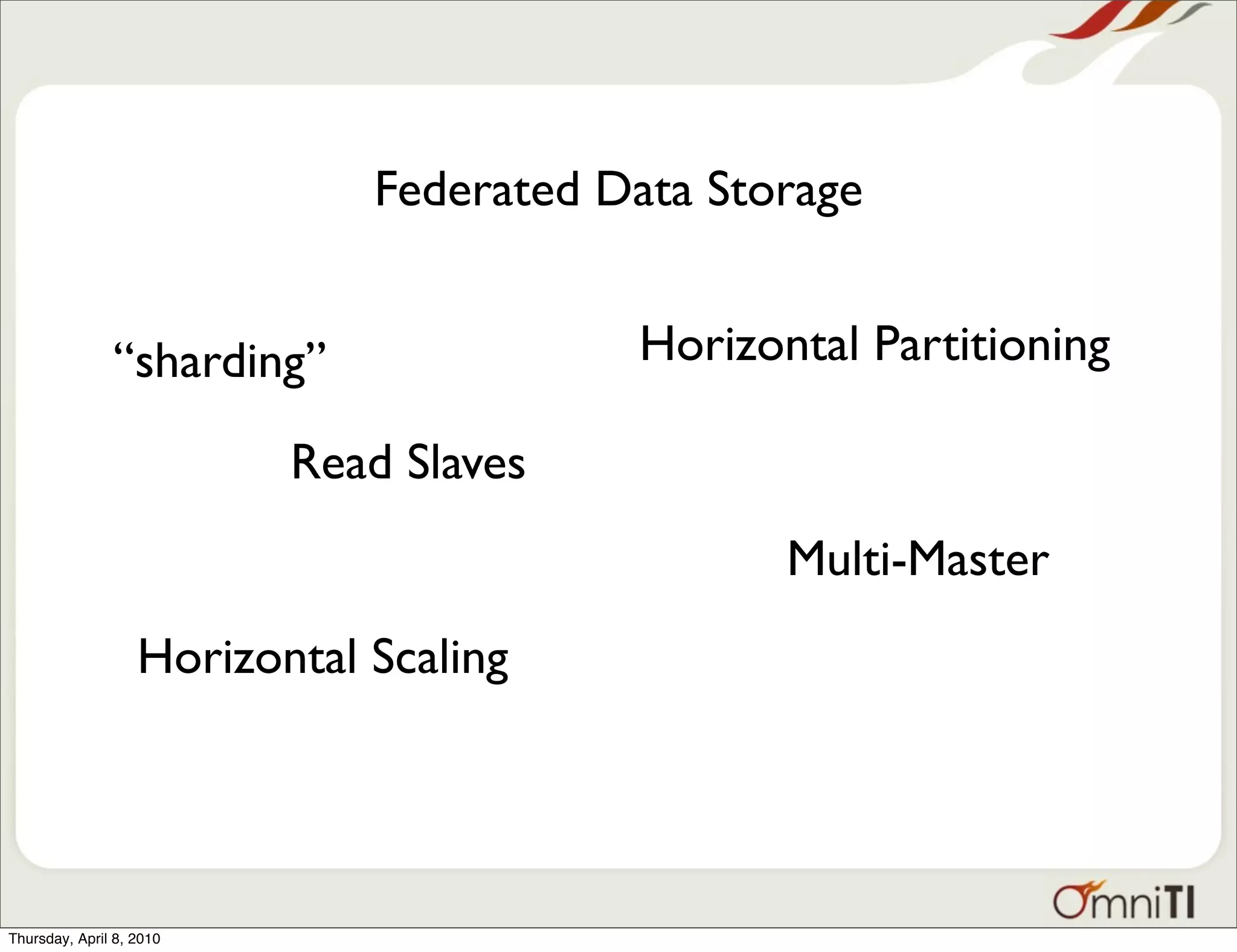
Federated Data Storage


               “sharding”                Horizontal Partitioning

                          Read Slaves
                                                Multi-Master
                   Horizontal Scaling


Thursday, April 8, 2010
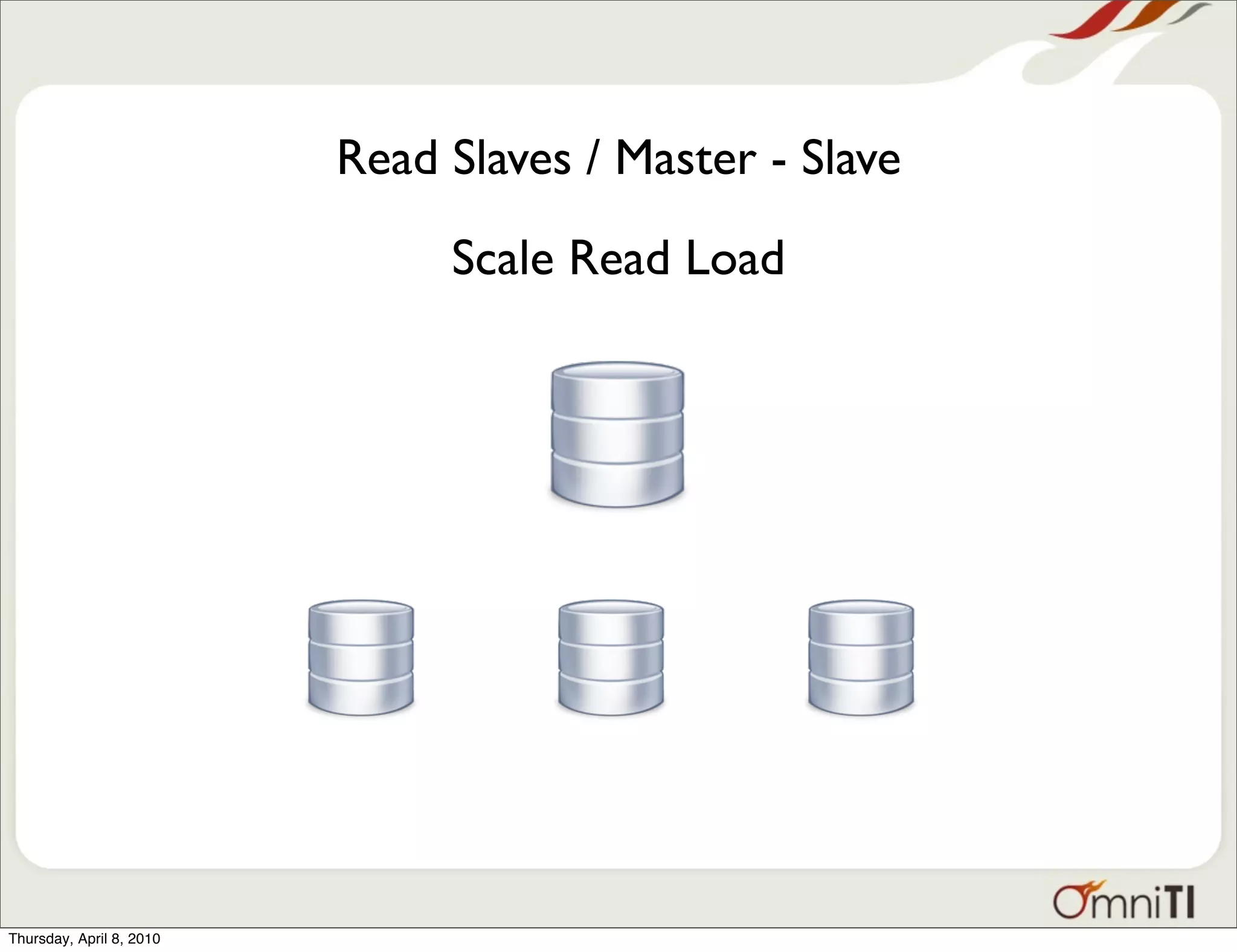
Read Slaves / Master - Slave
                               Scale Read Load


Thursday, April 8, 2010
Read Slaves / Master - Slave
                               Scale Read Load

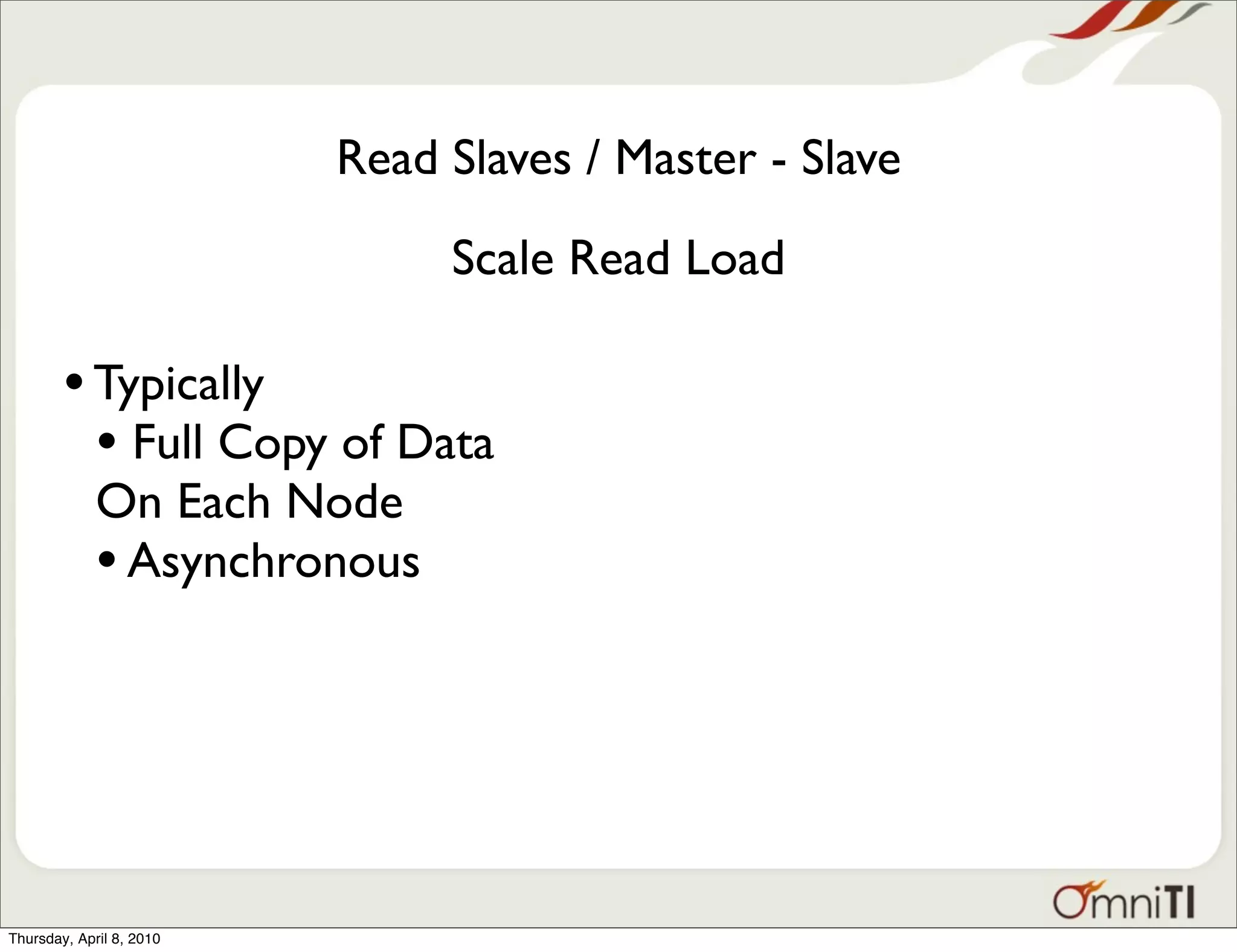
        • Typically
          • Full Copy of Data
             On Each Node
             • Asynchronous


Thursday, April 8, 2010
Read Slaves / Master - Slave
                               Scale Read Load

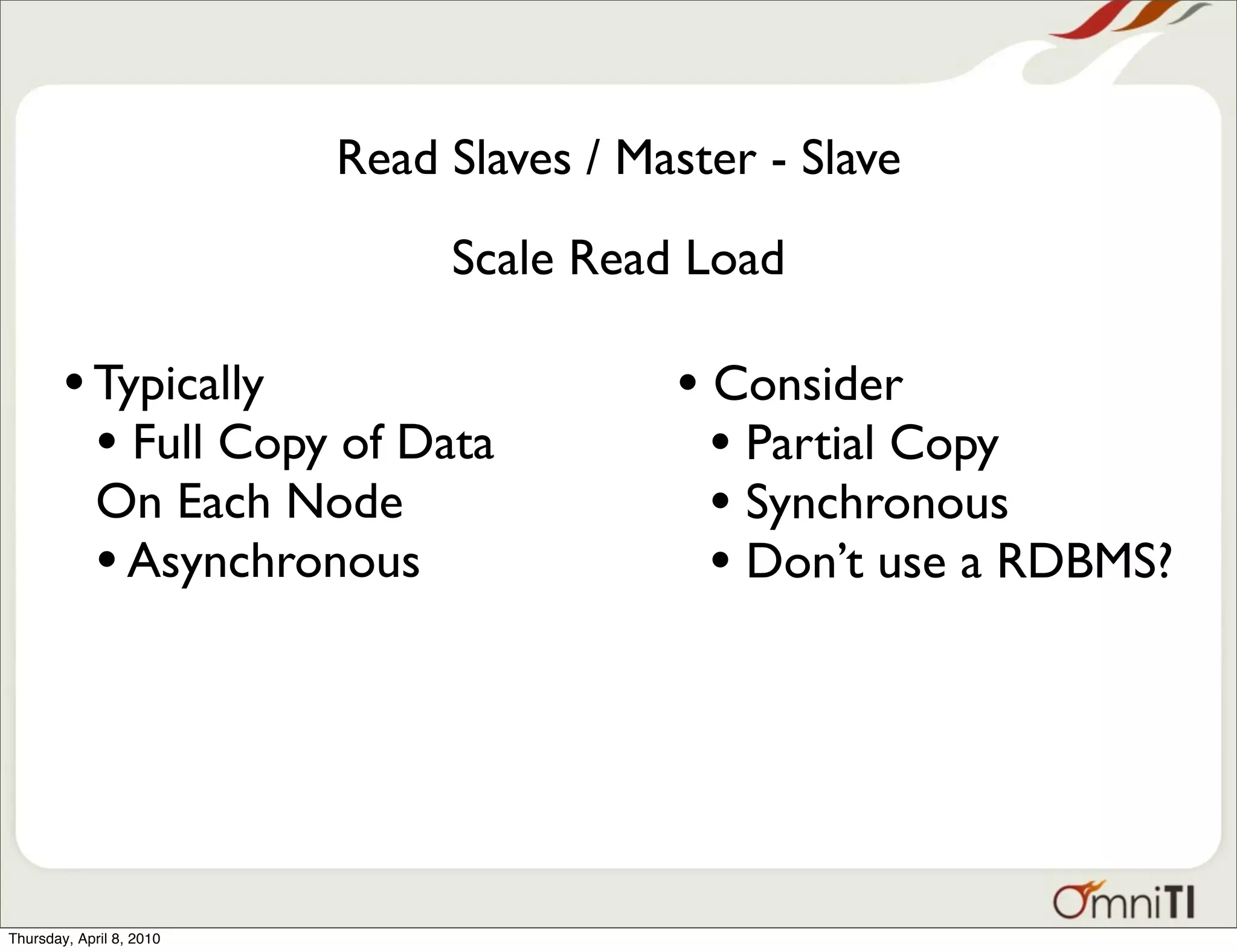
        • Typically                       • Consider
          • Full Copy of Data               • Partial Copy
             On Each Node                   • Synchronous
             • Asynchronous                 • Don’t use a RDBMS?


Thursday, April 8, 2010
Read Slaves / Master - Slave
                                Scale Read Load

        • Typically                        • Consider
          • Full Copy of Data                • Partial Copy
             On Each Node                    • Synchronous
             • Asynchronous                  • Don’t use a RDBMS?
                          Requires Application Changes


Thursday, April 8, 2010
Read Slaves / Master - Slave
                                Scale Read Load

        • Typically                        • Consider
          • Full Copy of Data                • Partial Copy
             On Each Node                    • Synchronous
             • Asynchronous                  • Don’t use a RDBMS?
                          Requires Application Changes
                                     “easy”

Thursday, April 8, 2010
Scaling Writes


                           “not easy”


Thursday, April 8, 2010
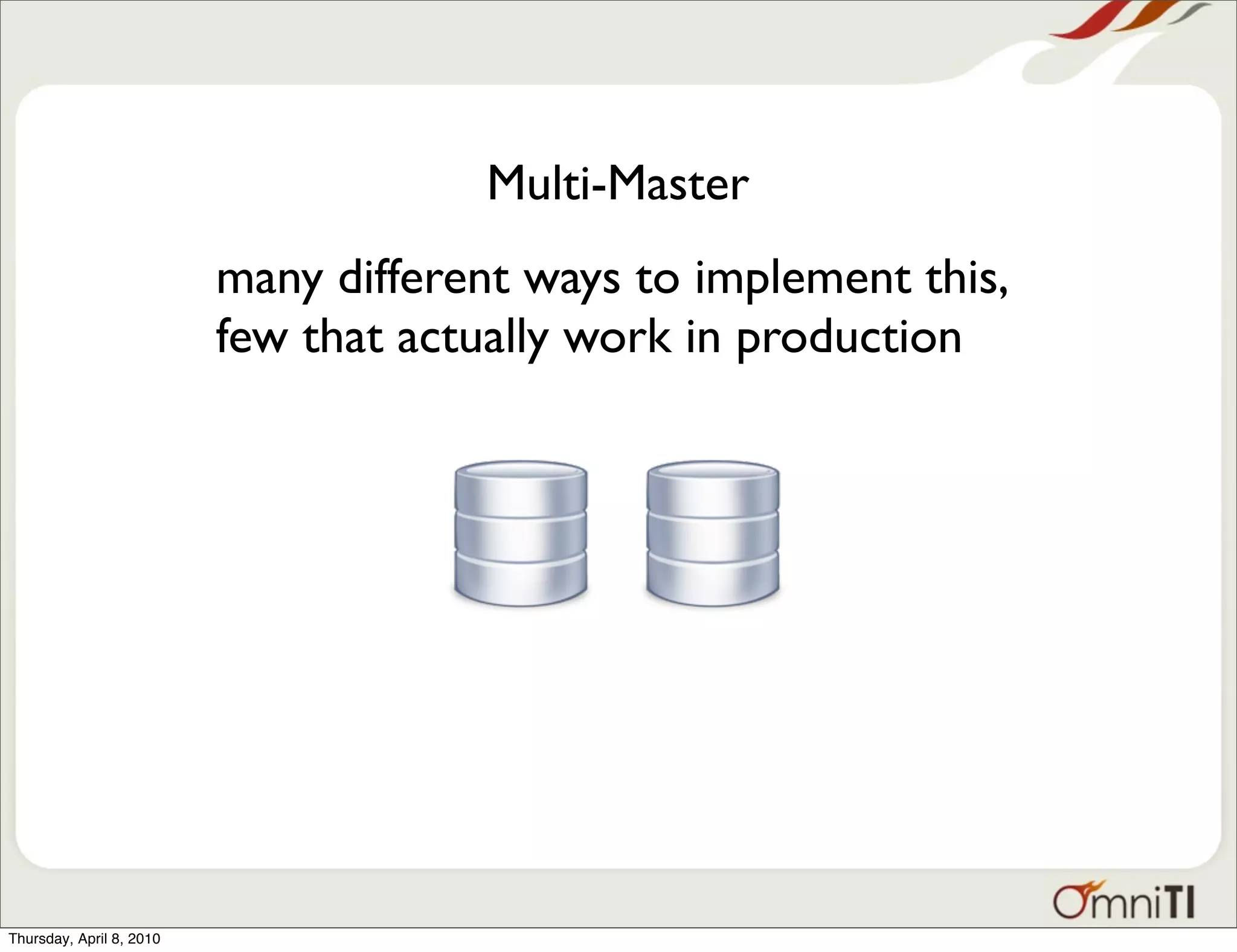
Multi-Master
                          many different ways to implement this,
                          few that actually work in production


Thursday, April 8, 2010
Multi-Master
                          many different ways to implement this,
                          few that actually work in production


                          write to any node, database syncs data


Thursday, April 8, 2010
Multi-Master
                          many different ways to implement this,
                          few that actually work in production


                          write to any node, database syncs data
                            can reduce cpu, doesn’t reduce i/o


Thursday, April 8, 2010
Multi-Master
                          many different ways to implement this,
                          few that actually work in production


                          write to any node, database syncs data
                            can reduce cpu, doesn’t reduce i/o


                                     failover solution
                                 not a scalability solution

Thursday, April 8, 2010
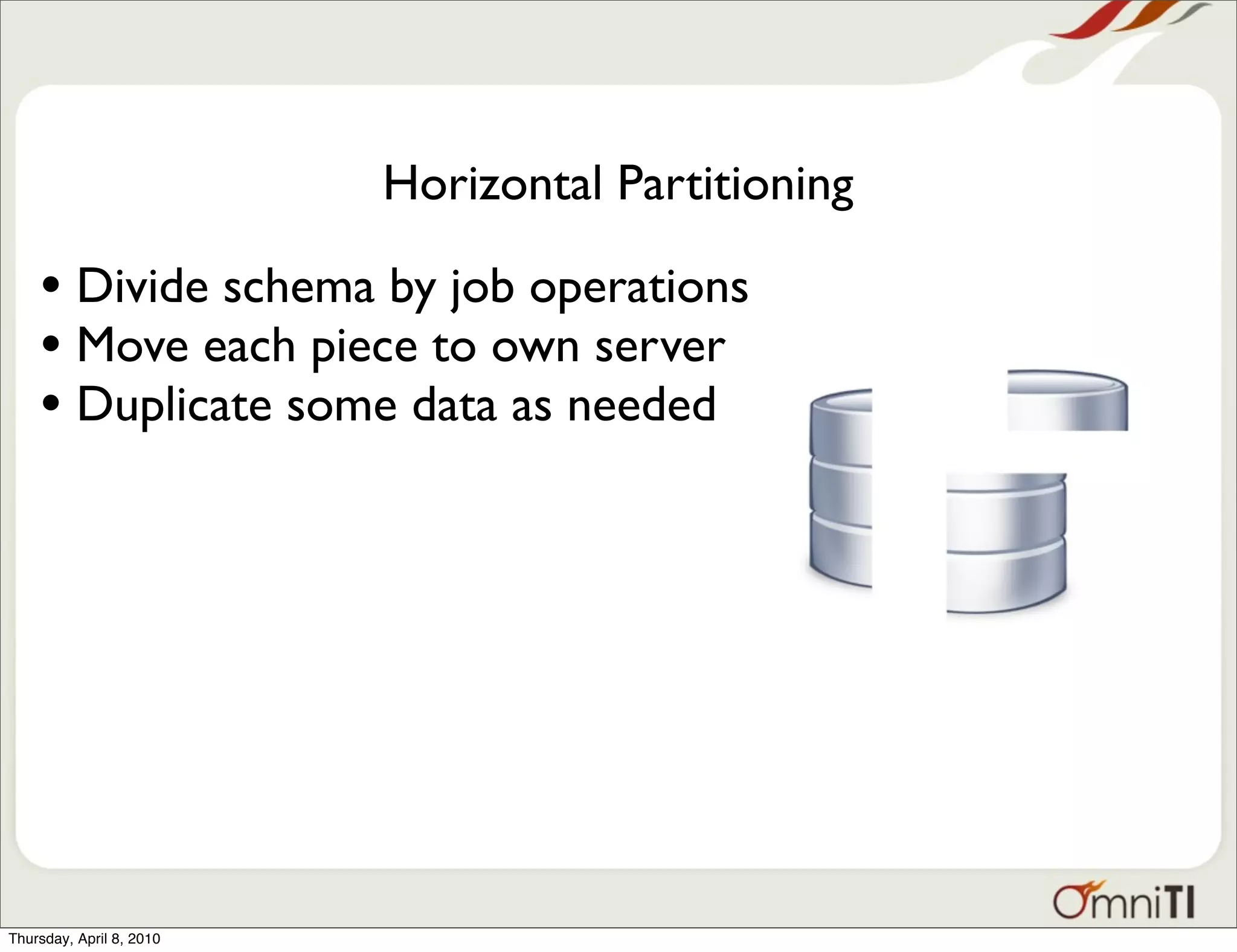
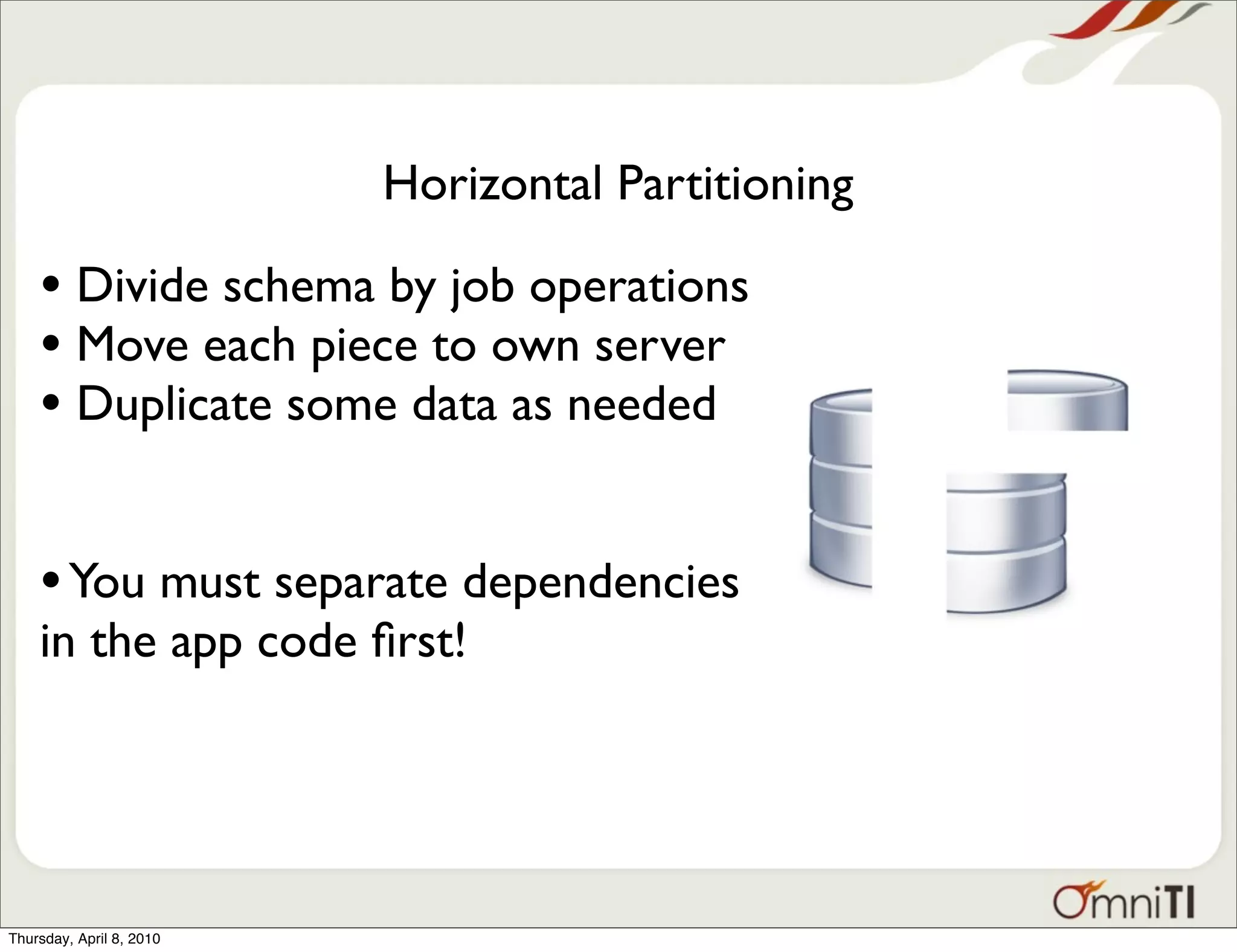
Horizontal Partitioning

    • Divide schema by job operations
    • Move each piece to own server
    • Duplicate some data as needed


Thursday, April 8, 2010
Horizontal Partitioning

    • Divide schema by job operations
    • Move each piece to own server
    • Duplicate some data as needed

    • You must separate dependencies
    in the app code first!


Thursday, April 8, 2010
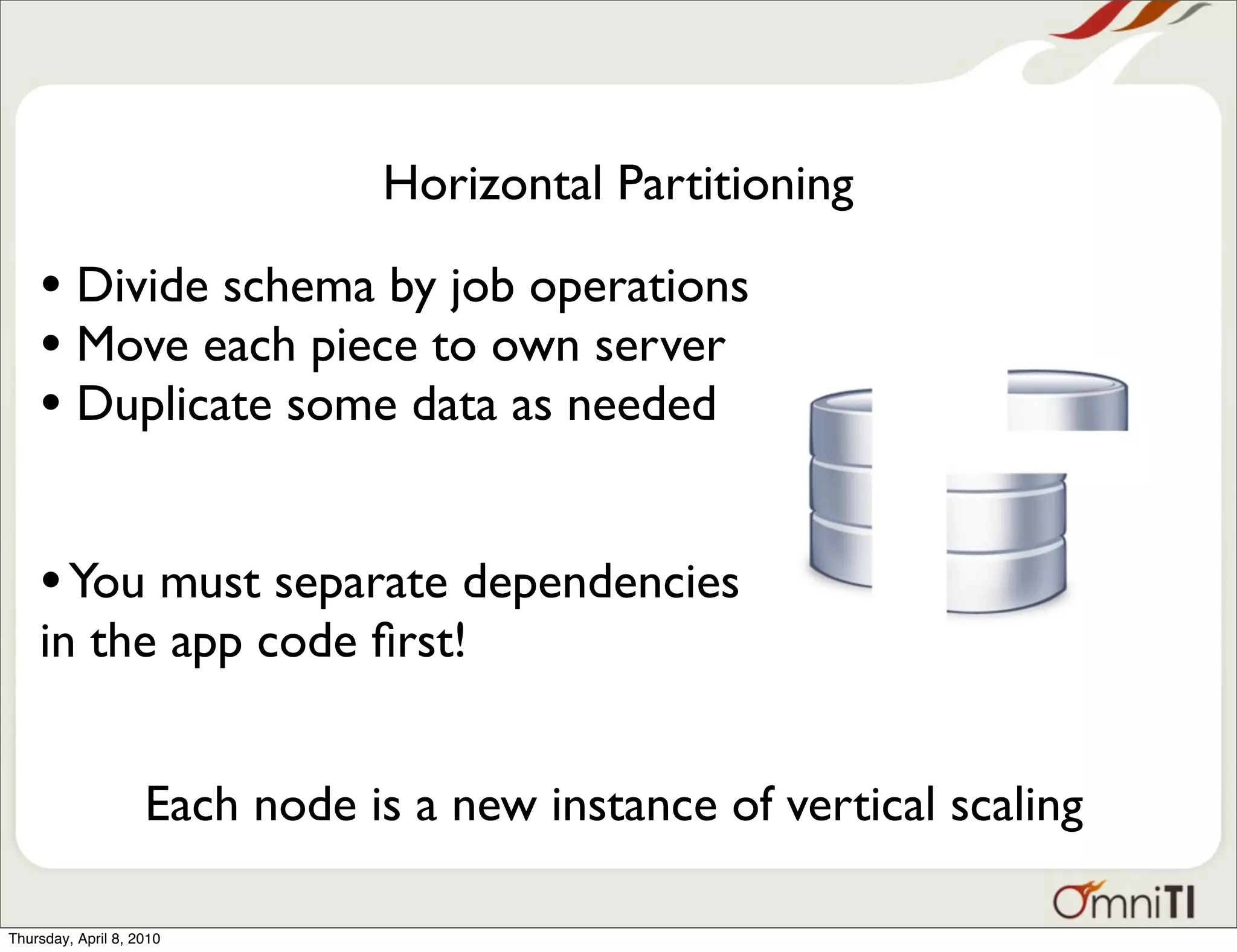
Horizontal Partitioning

    • Divide schema by job operations
    • Move each piece to own server
    • Duplicate some data as needed

    • You must separate dependencies
    in the app code first!


                    Each node is a new instance of vertical scaling

Thursday, April 8, 2010
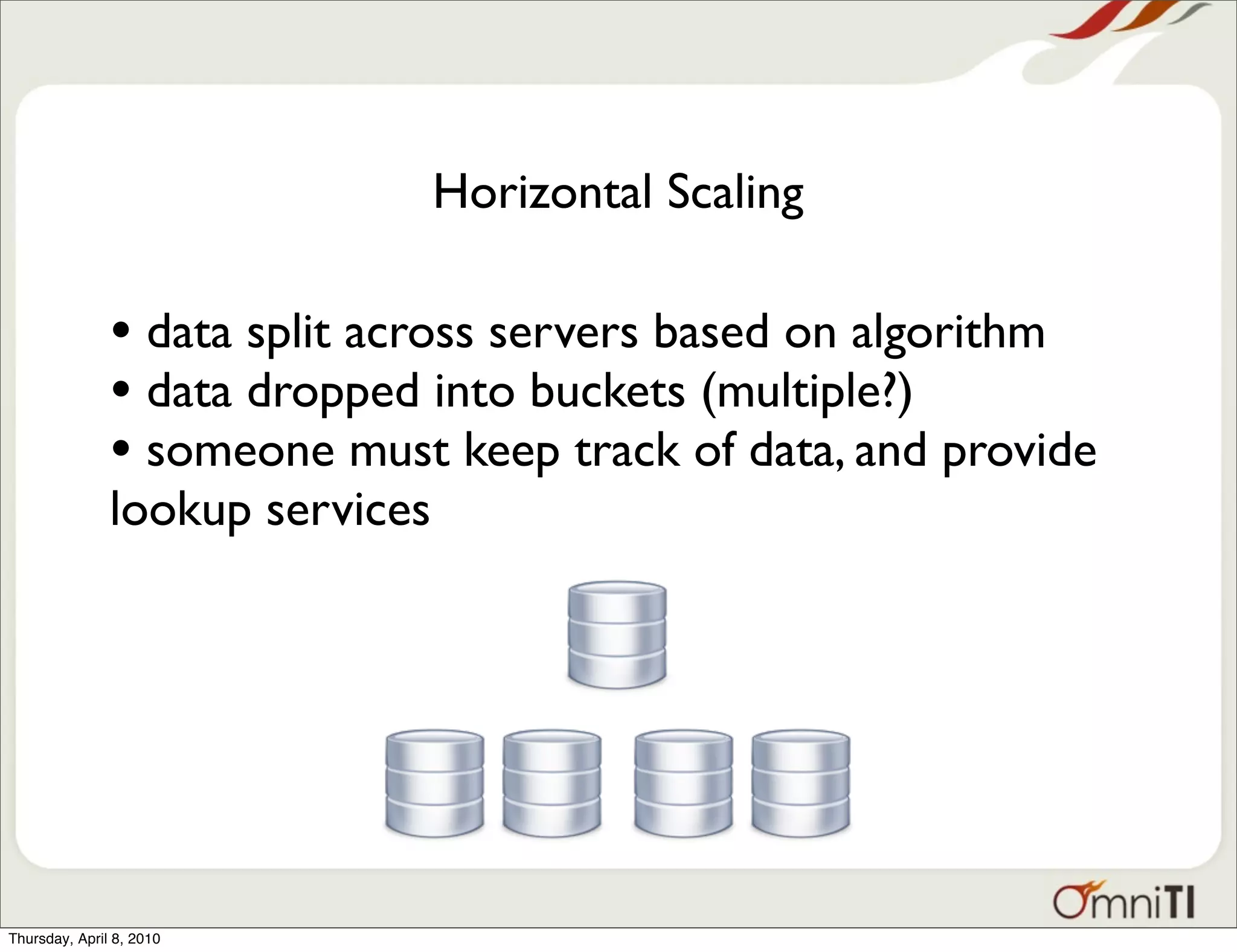
Horizontal Scaling

               • data split across servers based on algorithm
               • data dropped into buckets (multiple?)
               • someone must keep track of data, and provide
               lookup services


Thursday, April 8, 2010
Universal Truths of Scaling Databases

                     Vertical Scalability is Helpful for Every Pattern


                     Even in a horizontally scaled, fully distributed
                     database, the number of nodes needed is
                     affected by vertical scalability


Thursday, April 8, 2010
Universal Truths of Scaling Databases

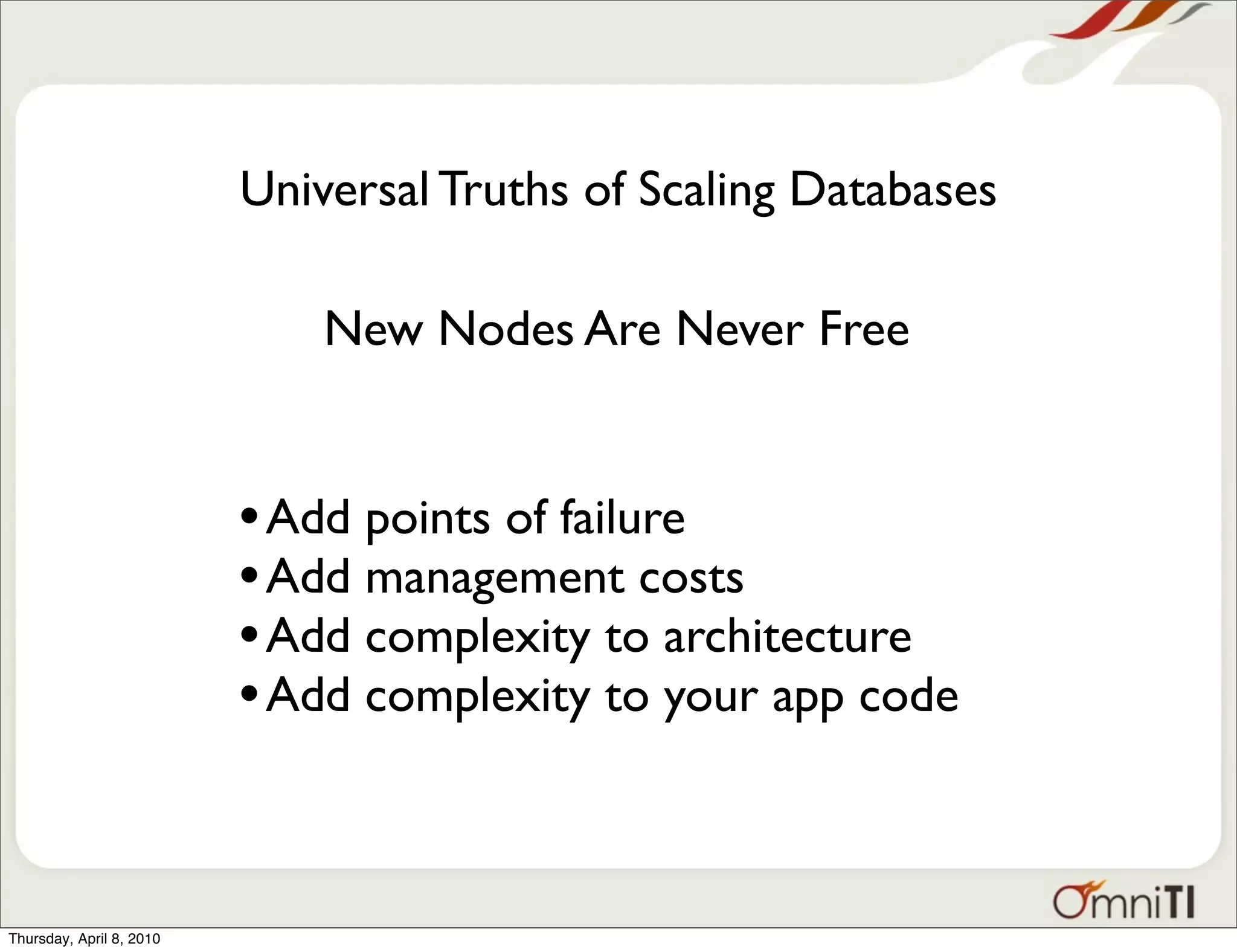
                              New Nodes Are Never Free


                          • Add points of failure
                          • Add management costs
                          • Add complexity to architecture
                          • Add complexity to your app code


Thursday, April 8, 2010
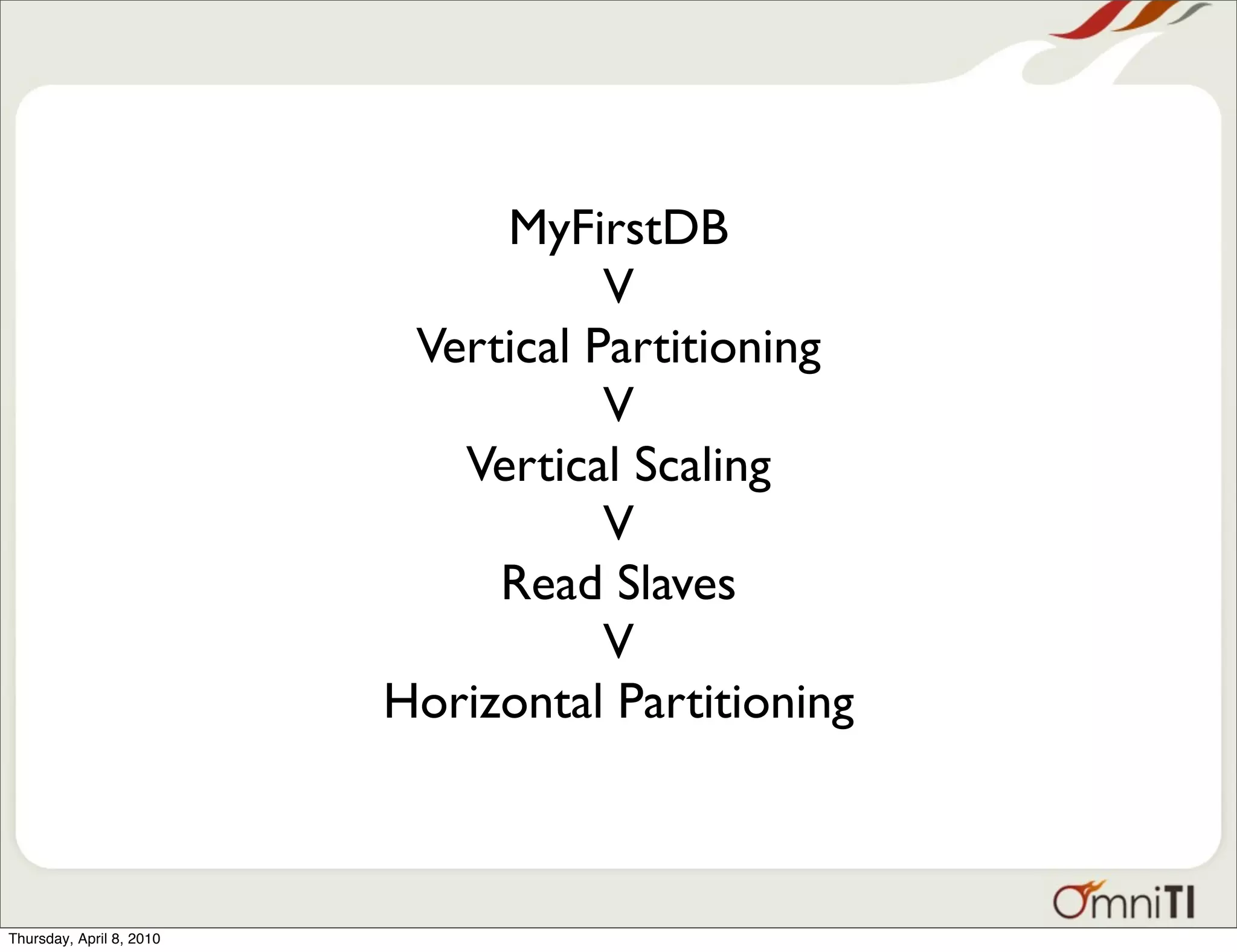
MyFirstDB
                                     V
                           Vertical Partitioning
                                     V
                             Vertical Scaling
                                     V
                               Read Slaves
                                     V
                          Horizontal Partitioning


Thursday, April 8, 2010
plan for layered data sources
                          read / write connections in code
                          use schemas to separate services


Thursday, April 8, 2010
plan for layered data sources
                          read / write connections in code
                          use schemas to separate services

                                  use postgres :-)


Thursday, April 8, 2010
THANKS!

                            more:
                           xzilla.net
                          @robtreat2
                          omniti.com


Thursday, April 8, 2010

Database Scalability Patterns

  • 1.
    Database Scalability {Patterns} / Robert Treat Thursday, April 8, 2010
  • 2.
    robert treat omniti postgres oracle - mysql mssql - sqlite -nosql Thursday, April 8, 2010
  • 3.
    What are “DatabaseScalability Patterns?” Thursday, April 8, 2010
  • 4.
    Part Design Patterns Part Application Life-Cycle Thursday, April 8, 2010
  • 5.
  • 6.
  • 7.
  • 8.
  • 9.
    Federated Data Storage “sharding” Horizontal Partitioning Read Slaves Multi-Master Horizontal Scaling Thursday, April 8, 2010
  • 10.
    Read Slaves /Master - Slave Scale Read Load Thursday, April 8, 2010
  • 11.
    Read Slaves /Master - Slave Scale Read Load • Typically • Full Copy of Data On Each Node • Asynchronous Thursday, April 8, 2010
  • 12.
    Read Slaves /Master - Slave Scale Read Load • Typically • Consider • Full Copy of Data • Partial Copy On Each Node • Synchronous • Asynchronous • Don’t use a RDBMS? Thursday, April 8, 2010
  • 13.
    Read Slaves /Master - Slave Scale Read Load • Typically • Consider • Full Copy of Data • Partial Copy On Each Node • Synchronous • Asynchronous • Don’t use a RDBMS? Requires Application Changes Thursday, April 8, 2010
  • 14.
    Read Slaves /Master - Slave Scale Read Load • Typically • Consider • Full Copy of Data • Partial Copy On Each Node • Synchronous • Asynchronous • Don’t use a RDBMS? Requires Application Changes “easy” Thursday, April 8, 2010
  • 15.
    Scaling Writes “not easy” Thursday, April 8, 2010
  • 16.
    Multi-Master many different ways to implement this, few that actually work in production Thursday, April 8, 2010
  • 17.
    Multi-Master many different ways to implement this, few that actually work in production write to any node, database syncs data Thursday, April 8, 2010
  • 18.
    Multi-Master many different ways to implement this, few that actually work in production write to any node, database syncs data can reduce cpu, doesn’t reduce i/o Thursday, April 8, 2010
  • 19.
    Multi-Master many different ways to implement this, few that actually work in production write to any node, database syncs data can reduce cpu, doesn’t reduce i/o failover solution not a scalability solution Thursday, April 8, 2010
  • 20.
    Horizontal Partitioning • Divide schema by job operations • Move each piece to own server • Duplicate some data as needed Thursday, April 8, 2010
  • 21.
    Horizontal Partitioning • Divide schema by job operations • Move each piece to own server • Duplicate some data as needed • You must separate dependencies in the app code first! Thursday, April 8, 2010
  • 22.
    Horizontal Partitioning • Divide schema by job operations • Move each piece to own server • Duplicate some data as needed • You must separate dependencies in the app code first! Each node is a new instance of vertical scaling Thursday, April 8, 2010
  • 23.
    Horizontal Scaling • data split across servers based on algorithm • data dropped into buckets (multiple?) • someone must keep track of data, and provide lookup services Thursday, April 8, 2010
  • 24.
    Universal Truths ofScaling Databases Vertical Scalability is Helpful for Every Pattern Even in a horizontally scaled, fully distributed database, the number of nodes needed is affected by vertical scalability Thursday, April 8, 2010
  • 25.
    Universal Truths ofScaling Databases New Nodes Are Never Free • Add points of failure • Add management costs • Add complexity to architecture • Add complexity to your app code Thursday, April 8, 2010
  • 26.
    MyFirstDB V Vertical Partitioning V Vertical Scaling V Read Slaves V Horizontal Partitioning Thursday, April 8, 2010
  • 27.
    plan for layereddata sources read / write connections in code use schemas to separate services Thursday, April 8, 2010
  • 28.
    plan for layereddata sources read / write connections in code use schemas to separate services use postgres :-) Thursday, April 8, 2010
  • 29.
    THANKS! more: xzilla.net @robtreat2 omniti.com Thursday, April 8, 2010