(c)
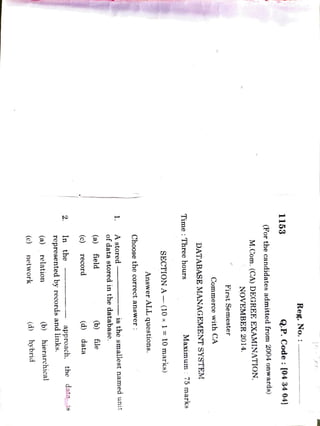
network
(d)
hybrid
(a)
relation
(b)
hierarchical
represented
by
records
and
links.
2
In
the
approach,
the
data
is
(c)
record
(d)
data
(a)
field
(b)
ile
of
data
stored
in
the
database.
1
A
stored
is
the
smallest
named
unit
Choose
the
correct
answer:
Answer
ALL
questions.
SECTION
A
(10
×
1=
10
marks)
Time
:Three
hours
Maximum:75
marks
DATABASE
MANAGEMENT
SYSTEM
Commerce
withCA
First
Semester
NOVEMBER
2014.
M.Com.
(CA)
DEGREE
EXAMINATION,
(For
the
candidates
admitted
from
2004
onwards)
1153
Q.P.
Code
:
[04
34
04)
Reg.
No. :
2
1153
(e)
IMS
(d)
IC
(a)
DBMS
(b)
DBS
ordinary
subroutine
calls.
invoked
7
The
data
manipulation
language
is
(c)
specific
(d)
atomic
(a)
unique
(b)
non-atomic
independent A
relátion
that
cannot
be
decomposed
into
said to
components
6.
be
(c)
functional
(d)
hierarchical
(a)
operational
(b)
structural
integrity
constraint.
5.
A
dependence
is
a
special
form
of
(c)
primary
(d)
alternate
(a)
candidate
(b)
foreign
4.
the
existenceof
Referential
constraints
are
constraints
implied
by
keys.
(c)
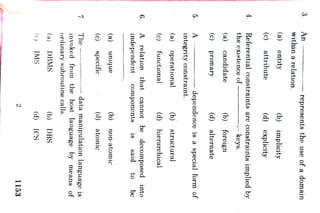
attribute
(d)
explicity
(a)
entity
(b)
implicity
within a
relation.
3
An
represents
the
use
of
a
domain
from
the
host
language
by
means
of
6
1153
3
1153
(b)
Write
short
notes
on
distributed
databases.
Or
11.
(a)
block
diagram.
Describe
the
database
svstem
Answer
ALL
questions.
SECTION
B
(5
x
5=
25
marks)
(c)
DROP
(d)
REMOVE
(a)
DELETE
(b)
ERASE
of
run-unit
and
all
its
descendants.
10.
ALL
statement
deletes
the
current
DML.
Narrate
about
miscellaneous
statements
in
(c)
Set
schema
(d)
(b)
Sub
schema
(a)
Super
schema
(b)
Simple
schema
Or
handling in
DBMS.State
the
basic
9
(a)
An
external
view
in
DBTG
is
defined
by
means
of
Concepts
of
(d)
Sequence
Search
Argument
(b)
for
logical
databases.
Enumerate
the
various
rules
and
restrictions
(c)
Select
Segment
Argument
Or
(b)
Segment
Search
Argument
database.
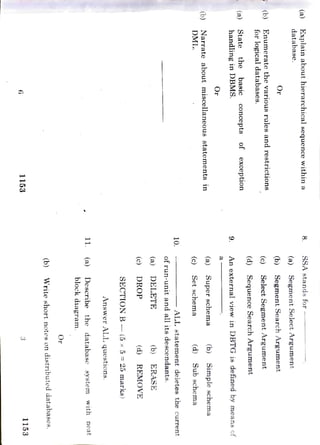
Explain
about
hierarchical
sequence
within
a
(a)
(a)
Segment
Select
Argument
SSA
stands
for
with
neat
exception
1153
5
currency in
DBTG.
(b)
Describe
the
fundamental
conceptsof
(b)
DBMS.
Discuss
about,various
update
operations
Or
Or
the
sub
schema
and
schema:
15.
(a)
Enumerate
the
various
differences
between
18.
(a)
on
(b)
communication
block.
the
State
basic
conceptsof
program
(b)
relational
data
structure.
Discuss
the
basic
Or
Or
14.
(a)
Describe
the
database
description
in
DBMS.
17.
examples.
(a)
Explain
about
referential
integrity
(b)
Write
short
notes
on
normal
forms.
Or
(b)
management
system.
Discuss
the
storage
structures
in
datab
involving
with
cursors.
Or
13.
(a)
Enumerate
the
various
operations
not
(b)
Describe
relational
algebra
in
DBMS.
16.
(a)
database
administrator.
Enumerate
the
various
responsibilities
Or
Answer
ALL
questions.
12.
(a)
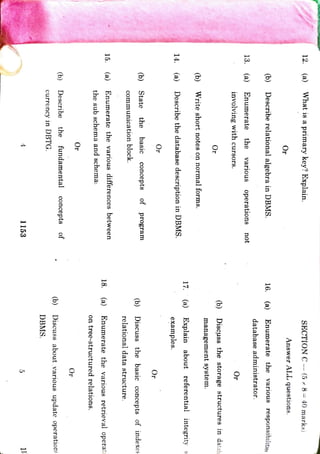
What
is
a
primary
key?
Explain.
SECTION
C-
(5
x8=
40
marks)
tree-structured
relations.
Enumerate
the
various
retrieval
operat:
conceptsof
indexes
Divisional
Maximum:
75
marks
Sectional
Functional
Operational
Answer
ALL
questions.
Commerce
with
CA
particular
enterprise.
data
used
by
the
application
systems
of
some
SECTION
A
(10x
1
=
10
marks)
A
database
is
a
collection
of
stored
Choose
the
correct
answer:
DATABASE
MANAGEMENT
SYSTEM
First
Semester
Q.P.
Code:
[04
34
04]
Reg.
No.:
(d)
(c)
(b)
(a)
Part
III
Time:
Three
hosrs
M.Com.
(CA)
DEGREE
EXAMINATION,
APRIL
2014.
(For
the
candidates
admitted
from
2004
onwards)
1.
3688
2
3.
4.
5.
6.
Expand DDL
(a)
(b)
(c)
(d)
(a)
(c)
The
Key constraints are constraints implied by the
existence of
DataDictionary Language
Data Directory Language
DataDefinition Language
DataDecision Language
primary
alternate
(a) Hierarchical
(a)
(c) Systematical
(c)
set operations are union,
intersection, difference and Cartesian product.
(a) QBE
(c) RSS
automatically eliminates
redundant duplicates from a query result.
2 NF
(b) foreign
4 NF
keys.
(d) candidate
2
(b) Traditional
Projection join normal form is also known as
(d) Symmetrical
(b) SQL
(d) DML
(b)
(d)
3NF
5 NF
3688
3688
3
3688
(c)
Currency
(d)
Constraint
(a)
Concurrent
(b)
Common
value
is
a
database
key.
10.
A
indicator
is
an
object
whose
(c)
DDDL
(d)
DDSL
(a)
DSDL
(b)
DADL
9.
by
the
storage
schema,
written
in
a
The
storage
structure
of
the
database
is
described
(d)
Program
Control
Block
set
construct.
(b)
List
out
the
several
network
examples
of
the
(c)
Program
Communication
Block
(b)
Physical
Communication
Block
Or
(a)
Physical
Control
Block
with
neat
diagram.
(a)
llustrate
the
architecture
of
a
DBTG
system
8.
PCB
stands
for
detail.
A
Enumerate
the
various
DII
examples
in
(c)
Functional
(d)
Relational
(a)
Logical
(b)
Physical
Or
A)
Explain
logical
databases
in
DBMS.
database
description.
7.
Each
database
is
defined
by
a
4
3688
5
(b)
Explain.Whatdo
you
mean
by
sensitive
fields?
(b)
suitable
Or
Or
14.
(a)
Describe
18.
(a)
dictionary.
Narrate
the
basic
concepts of
(b)
Write
short
notes
on
QBE.
Or
(b)
relations.
Write
about
Or
13.
(a)
with
cursors.
Enumerate
the
various
operations
involving
17.
(a)
DBMS.
Discuss
about
special
examples.
(b)
Describe
the
traditional
set
operations
with
(b)
techniques
Or
Or
12.
(a)
Explain. What
is
a
relation
in
16.
(a)
centralized
control
of
the
data.
Enumerate
the
advantaz
(b)
State
about
relation
approach
in
DBMS.
Answer
ALL
questions.
Or
SECTION
C-(5
x
8=
40
marks
11.
(a)
for
a
database
system.
Enumerate
the
various
levels
of
Architecture
(b)
an
example.
Write a
Or
Answer
ALL
questions.
SECTION B
(5
x.5
25
marks)
15.
(a)
examples.
Explain
about
singular
sets
with
a,
examples.
State
about
functional
dependence
physical
databases in
DBMS.
attribute
names
ior
ders
relational
operation:
in
detail.
Narrate
the
various
types
of
in:
a
relational
database?
several
simple
noteson
RECON"HT
SNRT
255
Structured
data
model
(d)
Select.
None.
(b)
Network
data
model
Hierarchical
data
model
represents
data
for
an
entity
set
(b)
Delete
2
(d)
Schema.
statement,
the
only
data
(b)
Second
relation
(d)
Calculus
(b)
Algebra
by
a
logical
record
type.
Update
(C)
retrieval
statement
in
SQL.
First
relation
(a)
Third
relation
(a)
Insert
The
(c)
Relations
The
(c)
The
difference
operation
removes
common
tuples
(a)
from
the
(c)
sQL
(a)
manipulate
Relational
algebra
is
a
collection
of
operations
to
6.
3
255
Frame.
(b)
Event
d)
All
Stored
procedure
Tree-locking
protocol
is
a
data
structure
senting
3
form
free
data
item
are
called
The
storage
structure
of
the
database
is
in
the
d)
(b)
All
Attribute
(d)
Constraint
Select
(b)
Delete
Object
Constraint
description
of
stereotype
object.
the
collection
of
the
expected
and/or
predicted
Buffer
(d)
(c)
(b)
Update
(a)
Insert
(C)
a)
blocks
are
read
into
blocks
of
main
memory
called
To
reduce
the
number
of
accesses
to
disk,
the
(a)
Deadlock
A
(c)
(a)
are
done
using
commands
to
insert
a
new
record.
Operation
on
a
hierarchical
database
10.
9.
8.
255 6
(b)
Explain
in
detail
DBTG
Data
Manipulation.
Or
network
model.
Briefly
explain
Data
Description
in
the ).
(a)
255
5
(b)
Discuss
the
Database
Manipulation.
(b)
Write
the
expression
of
Query
Evaluation
Or
15
(a)
Discuss
the
Network
Data
Model.
Or
(b)
Write
update
in
hierarchical
database.
Hierarchical
Model.
19.
(a)
Explain
in
detail
Data
Manipulation
Or
14.
(a)
Explain
the
concept
in
hierarchical
model.
(b)
Explain
the
Boyce
Codd
Normal
Form.
(b)
Discuss
about
Data
Redundancy.
Or
Or
18.
(a)
Briefly
explain
Basic
Data
Retrieval
in
13.
(a)
Write
short
(b)
Briefly
explain
Set
Manipulation.
(b)
Discuss
views
in
SQL.
Or
Or
17.
(a)
Explain
Relational
Algebra.
12.
(a)
Explain
Integrity
Rules.
(b)
Discuss
about
Index-sequential
Files.
(b)
Discuss
about
components
of
a
DBMS.
Or
Or
11.
(a)
Write
short
notes
on
keys.
16.
(a)
Model.
Briefly
explain
about
Entity
Relation
Answer
ALL
questions.
Answer
ALL
questions.
SECTION
B
(5
x
5
=
25
marks)
SECTION
C-
(5
x
8=
40
marks)
notes
on
Aggregation
in
QBE.
(c)
structured
(d)
logical
(a)
distributed.
(b)
relational
system.
2.
of
sites,
each
of
which
maintains
a
local
database
database
system
consists
of
a
collection
(c)
entity
(a)
informnation
relation
(d) (b)
DBMS
1
A(n)
access
that
data.
interrelated
data
and
a
collection
of
programns
to
collection
consists
of
a
of
Choose
the
correct
answer
:
Answer
ALL
questions.
SECTION
A
(10
×
l=
10
marks)
Time
:
Three
hours
Maximum:75
marks
DATABASE
MANAGEMENT
SYSTEM
Commerce
with
First
Semester
M.Com.
(CA)
DEGREE
EXAMINATION,
APRIL
201Z.
('or
the
candidates
admitted
from
2004
onwards)
2439
Q.P.
Code
:
[04
34
04]
Reg.
No. :
Computer
Applications
2
2439
(d)
Query
Base
Encoding
(c)
QueryBy
Example
(b)
Query
Base
Execution
(a)
Query
By
Execution
6
QBE
stands
for (c)
INSERT
(d)
All
of
the
above
(a)
SELECT
(b)
UPDATE
not
need
cursors.
5
The
data
manipulation
statement(s)
do
(c) (a) X
(b)
(d) p
4
in
relational
algebra.
symbol
can
be
used
to
denote
selection
(c)
foreign
(d)
intelligent
(a)
primary
(b)
candidate
3.
table.
uniquely
identifies
the
record
from
a
different
key
is
a
column
in
the
table
that
A
2439
3
2439
(c)
model
(d)
schema
(a)
type
(b)
structure
database
10
The
overall
design
of
the
database
is
called
the
(c)
Program
(d)
Task
(a)
Tree
(b)
Data
representing
the
design
of
a
network
database.
9.
A
structure
diagram
is
a
scheme
(d)
Hierarchical
(b)
with
example.
Enumerate
the
DBTG
data
retrieval
facility
(c)
Or
(b)
Hierarchical
Sequential
Access
Method
Hierarchical
Sequential
Access
Management
(a)
Hierarchical
System
Access
Method
(a)
CODASYL
is
an
expansion
of
HSAM.
in
IMS
with
example.
(b)
Explain
the
different
record
access
schemes
(c)
Files
(d)
Data
(a)
Records
Or
(b)
Fields
(a)
hierarchical
model.
Discuss
the
tree
structure
diagram
of
7.
through
links. A
Scheme
Access
Management
model?
Discuss
them.
What
are
the
primary
sources
of
the
DBTG
hierarchical
database
consists
of
a
collection
of
which
are
connected
to
one
another
2439
5
program
communication
block
in
IMS.
Enumerate
(b)
(b)
forms
with
illustration.Write
about
the
Second
and
Third
Nr
Or
Or
14.
(a)
Write
a
short
note
on
IMS
database
system.
18.
(a)
statement
with
example.
Explain
the
(b)
candidate
key
concept.
Explain
the
relation
with
more
than
one
(b)
in
relational
algebra.
Enumerate
any
four
fundamental
operst
Or
Or
13.
(a)
Write
about
dynamic
SQL
with
illustration.
17.
(a)
Discuss
the
relation
relational
algebra.
(b)
Describe
any
three
additional
operators
in
brief.
(b)
Write
about
the
distributed
processi
Or
Or
12.
(a)
What
are
the
properties
of
relation?
Explain.
16.
for
a
database
system.
(a)
Explain
the
three
levels
of
the
archit
(b)
data.
Write
about
the
method
for
representing
Answer
Or
SECTION
C-(5
x
8=
40
marka)
(a)
data
Independence.
Distinguish
between
logical
and
physical
(b)
Describe
set-processing
11
any
two
optiona
in
Answer
ALL
questions.
Or
SECTION
B
(5
x
5
=
25
marks)
Network
model.
15.
(a)
the
method
for
defining
the
general
formof
Embedded
variables
with
exam
ALL
questions.
facility
with
ampel.axe
Explain
the
data
gtructure
diagram
Hybrid
(b)
relational
(d)
(d)
All
of
the
above
(b)
elationship
records
connected
to
one
another
through
links.
database
consists
of
a
ction
of
network
hierarchical
mum:75
Constraints
Choose
the
correct
answer.
Answer
ALL
questions.
SECTIONA-(10x
1
=
10
marks)
Data
Which
of
the
following
is
a
database
lement?
Q.P.
Code:
(04
34
DATABASE
MANAGEMENT
SYSTEM
Commerce
with
CA
First
Semester
Reg.
No.:
(c)
NOVEMBER
2011.
M.Com(CA)
DEGREE
NATION,
(a)
A
(c)
(a)
Time:
Three
hours
(For
the
candidates
admitted
from
2004
rds)
2.
480
1.
(d)
program
(b)
task
(d)
Recovering
structure
diagram
is
the
scheme
for
(b)
Compilation
(d)
CLOSE
MODIFY (b)
(d)
p
Join
2
(b)
Difference
is
not
executable
statement
to
operate
structures
to
store
data.
is
the
process
of
building
database
symbol
can
be
used
to
denote
(d)
data
(b)
tree
a
hierarchical
database.
Normalization
Modeling
(c)
(a)
A
(c)
(c)
FETCH
(a)
(a)
OPEN
projection
in
relational
algebra.
Divide
on
cursors.
Intersect
(c)
II
(a)
X
(c)
(a)
first
and
not
the
second
of
two
specified
relations.
relation
containing
all
tuples
that
appear
in
the
relational
algebra
operator
returns
a
1.
6.
5.
4.
3.
(b)
Explain
the
distributed
databases
in
brief.
11.
(a)
List
the
major
functions
Performed
by
(d)
ne-to-many
3
(b)
o-many
links
can
be
Answer
ALL
the
questions.
SECTION
B--
(5
X5=
25
marks)
Or
(d)
link
(b)
data
DBA.
one-to-One
(a)
many-to-one
structure
is
an
association
between
10.
In
DBTG
model,
only
(c)
used.
is
an
expansion
of
HSAM.
Hierarchical
System
Access
Method
(C)
(a)
file
two
records.
(d)
Hierarchical
Scheme
Access
ment
Hierarchical
Sequential
Access
(b)
Hierarchical
Sequential
Access
Method
A
(c)
(a)
9.
8
460 6
in
brief.
(b)
Discuss
the
DBTG
data
manipulation
facility
Or
CODASYL
model?
Enumerate
them.
0
(a)
What
are
the
primary
sources
of
the
DBTG
46 with
example.
(b)
Explain
the
IMS
data
ulation
e
Or
in
IMS
with
example.
19.
(a)
Discuss
the
different
record
access
Normal
forms
with
example.
(b)
Write
a
detailed
note
on
First
and
Or
involving
and
not
involving
cursors.
Explain
the
Embedded
SQL
with
with
example.
(b)
Enumerate
the
special
elational
Or
variables
with
example.
Discuss
the
general
form
of
ation
di
Or
18.
(a)
Hierarchical
data
models.
a
short
note
on
nal
am
Answer
ALL
questions.
a)
SECTIONC-(5x
8=40
marks)
for
a
database
system.
16.
(a)
Explain
the
three
levels
of
the
17.
460
(b)
Write
about
the
external
level
of
DBTG.
Or
15.
(a)
Describe
the
data
structure
diagram
of
(b)
Explain
the
history
and
evolution
of
IMS.
Or
Network
model.
model.
14.
(a)
Write
about
update
facility
in
hierarchical
dependencies.
Enumerate
some
basic
concepts
of
functional
Or
(b)
(a)
Write
about
the
QBE
dictionary.
Or
relations.
(b)
Describe
the
attribute
names
for
derived
(a)
Write
about
the
domain
with
example.
13.
12.
(b)
Write
none
of
the
above
Maximum:75
marks
few-user
multi-user
Answer
ALL
questions.
SECTION
A(10 x
1=
10
marks)
First
Semester
many
users
can
acces8
the
database
at
the
same
systerm
is
a
system
in
which
Q.P.
Code:
[04
34
04]
(a)
single-user
Reg.
No.:
(d)
Choose
the
corTect
answer:
DATABASE
MANAGEMENT
SYSTEM
Commerce
with
Computer
Applications
(c)
(b)
time
NOVEMBER
2010.
M.Com.
(CA)
DEGREE
XAMINATION,
A
Time:
Three
hours
(For
the
candidates
admitted
from
2004
onwards)
2583
2583
Design-definition
language
Data-definition
language
Device-definition
language
none
of
the
above
functional
database
consists
of
a
collection
2
(d)
(d)
None
of
the
above
(b)
Program
(d)
none
of
the
above
None
of
the
above
algebra
is
a
collection
of
(b)
Network
of
tables,
each
of
which
is
assigned
a
unique
name.
DDL
stands
for
Hierarchical
Relational
special
relational
(c)
(b)
system
(a)
data
(d)
(c)
(b)
and
return
a
relation
as
their
result.
operators
that
take
relations
as
their
operands
(a)
A
(c)
(a)
The
(c)
(a)
users
with
an
abstract
view
of
the
A
major
purpose
of
a
database
system
is
to
provide
5.
4.
3
2.
2583
none
of
the
above
ork
ma
system
of
is
(d)
(b)
design
diagram the
links
database
representing
data-structure
None
of
the
above
database
consists
of
a
ion
SQL
Hierarchical
Network
None
of
the
above
Statistics
Query
Language
(c)
None
of
the
above
(a)
Definition
relational
calculus
of
records
connected
to
one
another
through
nks.
Domain
rational
calculus
A
Domain
relational
calculus
(d)
(c)
(b)
(a)
(b)
Structured
Query
Level
Structured
Query
Language
A
(d)
sQL
stands
for
(c)
(a)
(d)
(c)
(b)
(a)
The
second
form
of
relational
calculus
called
9.
8.
6
2583 6
Network
Model.
(b)
Explain
the
Implementation
Techniques
of
Or
(a)
Discuss
the
DBTG
CODASYL
Model.
on
of
R
5
a
detailed
note
(a)
Explain
the
Structure
Or
Structure
Discuss
the
mple.
Or
Explain
the
Embedded
SQL.
database.
Or
the
(b)
Write
the
Discuss
the
Data
nce.
Or
What
are
the
various
data
Or
Databases.
Describe
Answer
ALL
estions.
SECTION
C-(5x
8=
40
)
What
do
you
mean
by
work
(a)
Explain
the
Relational
ebra.
explain
(b)
Diagrarms.
Briefly
(a)
(b)
(b)
(a)
(b)
(a)
19.
18.
17.
16.
15.
2583
What
is
IMS
Database
System?
Write
a
short
note
on
Hierarchical
database.
4
Or
Language?
What
are
the
different
parts
of
sQL
(b)
What
is
Embedded
DML?
Discuss
the
Query
Languages.
Or
Write
a
short
note
on
Relationship
Sets.
Systems.
List
out
any
four
purpose
of
Database
(d)
None
of
the
above
Data
Or
Or
What
is
a
database
system?
Answer
ALL
questions.
(b)
SECTION
B-
(6
x
5
=26
marks)
(b)
(a)
(a)
(b)
(a)
(b)
File
Records
through
links.
(c)
14.
11.
(a)
(a)
13.
12.
that
are
connected
to
each
other
10.
A
hierarchical
database
consists
ofa
collection
of

Database Management System previous year question paper M.Com CA QP