
www.edureka.co/data-warehousing-and-biEDUREKA’S DATA WAREHOUSING & BI CERTIFICATION TRAINING
Data Warehousing Interview Questions & Answers
 What is a Data Warehouse?1
www.edureka.co/data-warehousing-and-biEDUREKA’S DATA WAREHOUSING & BI CERTIFICATION TRAINING
Data Warehousing Interview Questions & Answers
 What is a Data Warehouse?1
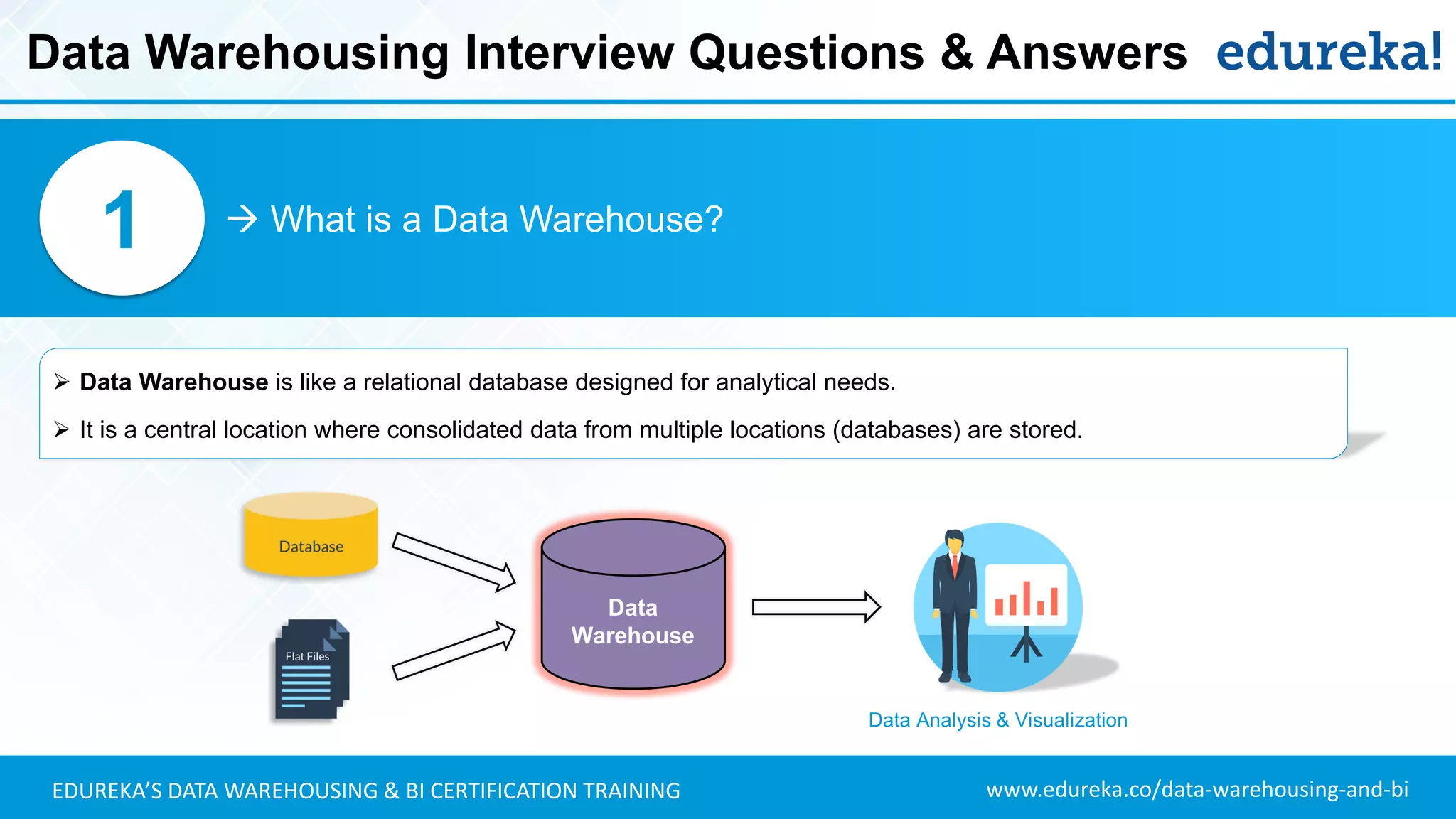
➢ Data Warehouse is like a relational database designed for analytical needs.
➢ It is a central location where consolidated data from multiple locations (databases) are stored.
www.edureka.co/data-warehousing-and-biEDUREKA’S DATA WAREHOUSING & BI CERTIFICATION TRAINING
Data Warehousing Interview Questions & Answers
 What is the very basic difference between a Data Warehouse and an
operational Database?2
www.edureka.co/data-warehousing-and-biEDUREKA’S DATA WAREHOUSING & BI CERTIFICATION TRAINING
Data Warehousing Interview Questions & Answers
 What is the very basic difference between a Data Warehouse and an
operational Database?2
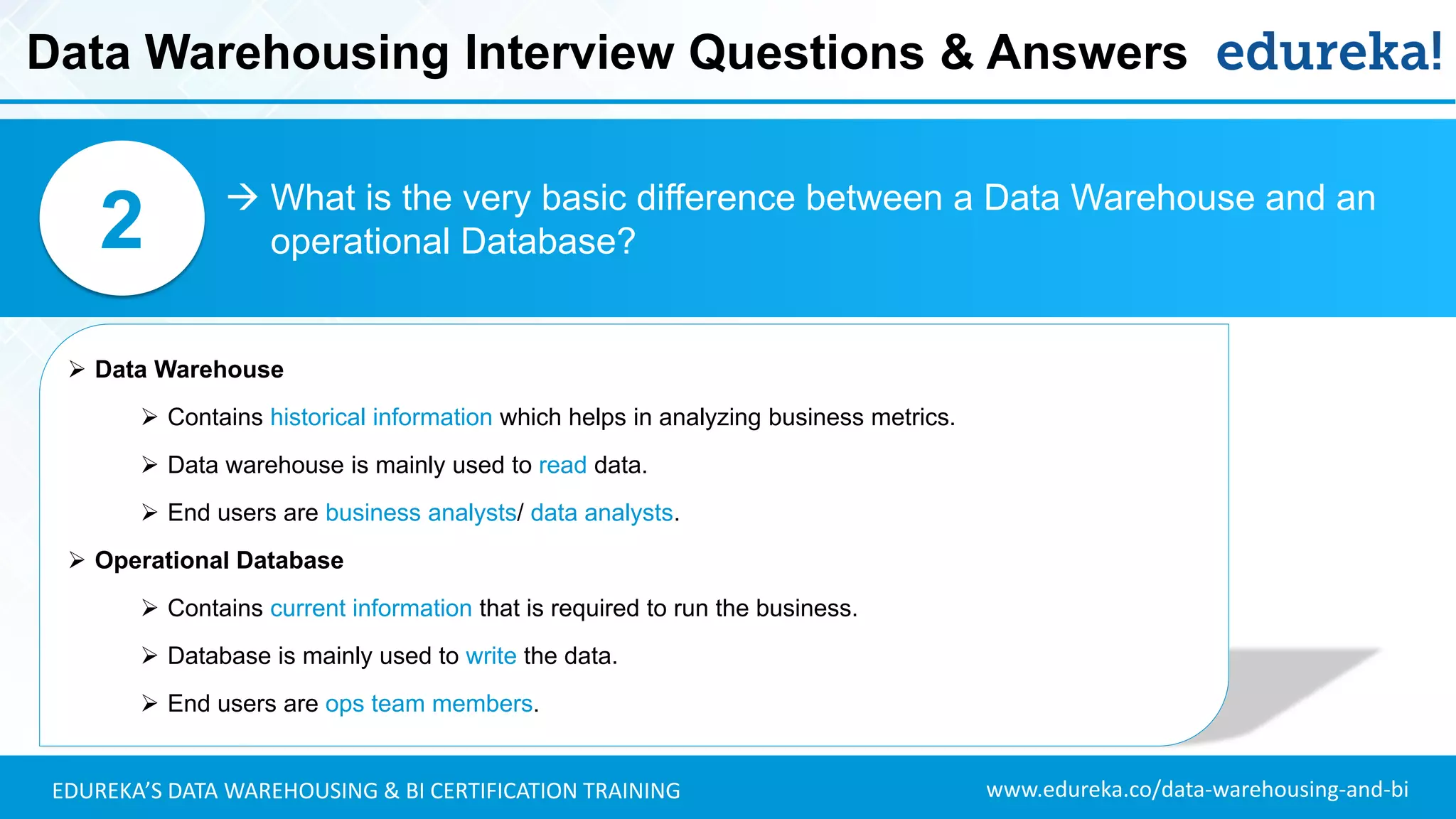
➢ Data Warehouse
➢ Contains historical information which helps in analyzing business metrics.
➢ Data warehouse is mainly used to read data.
➢ End users are business analysts/ data analysts.
➢ Operational Database
➢ Contains current information that is required to run the business.
➢ Database is mainly used to write the data.
➢ End users are ops team members.
www.edureka.co/data-warehousing-and-biEDUREKA’S DATA WAREHOUSING & BI CERTIFICATION TRAINING
 What is Data Warehousing?3
Data Warehousing Interview Questions & Answers
www.edureka.co/data-warehousing-and-biEDUREKA’S DATA WAREHOUSING & BI CERTIFICATION TRAINING
 What is Data Warehousing?3
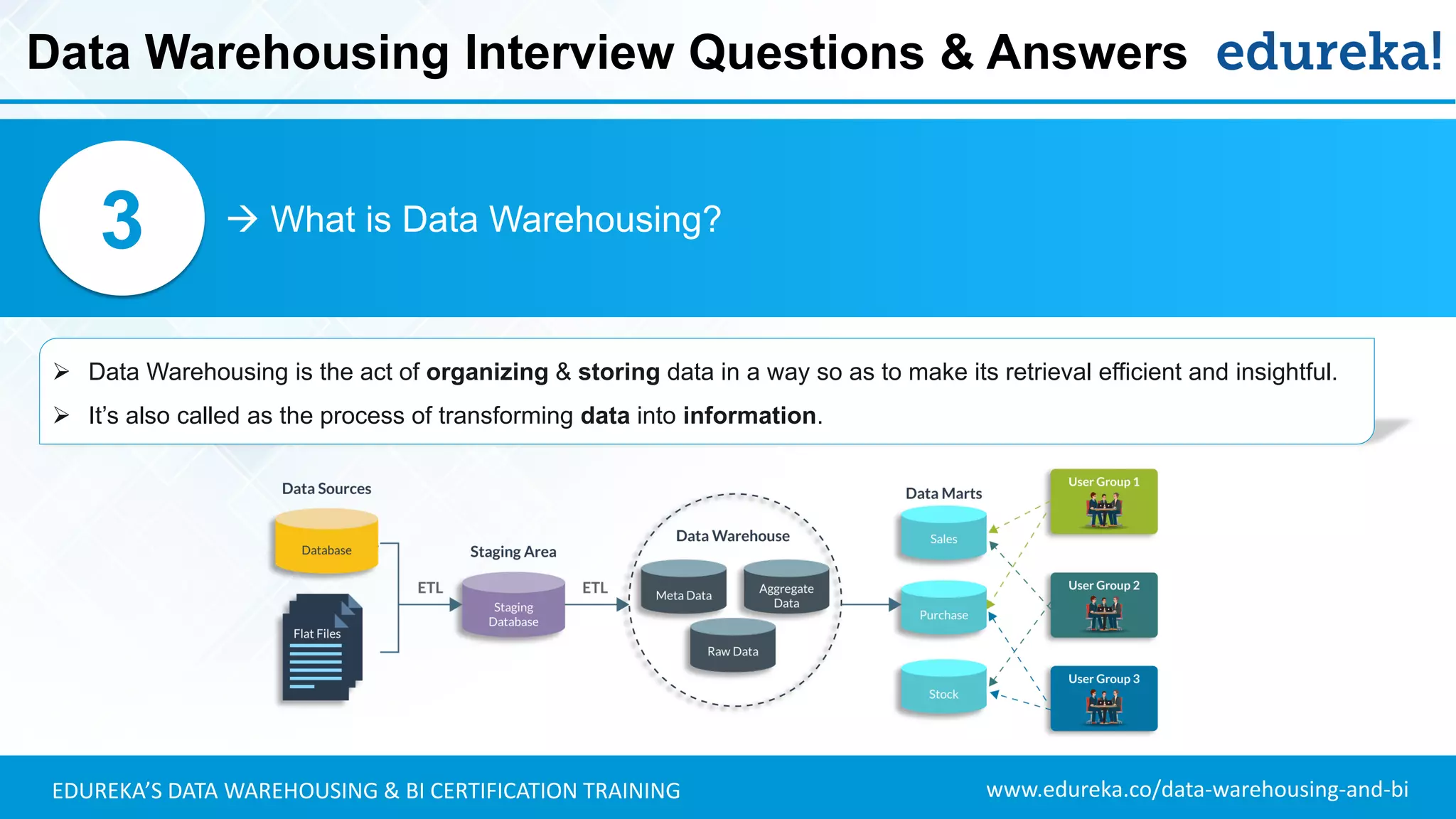
➢ Data Warehousing is the act of organizing & storing data in a way so as to make its retrieval efficient and insightful.
➢ It’s also called as the process of transforming data into information.
Data Warehousing Interview Questions & Answers
www.edureka.co/data-warehousing-and-biEDUREKA’S DATA WAREHOUSING & BI CERTIFICATION TRAINING
 What is OLAP?4
Data Warehousing Interview Questions & Answers
www.edureka.co/data-warehousing-and-biEDUREKA’S DATA WAREHOUSING & BI CERTIFICATION TRAINING
 What is OLAP?4
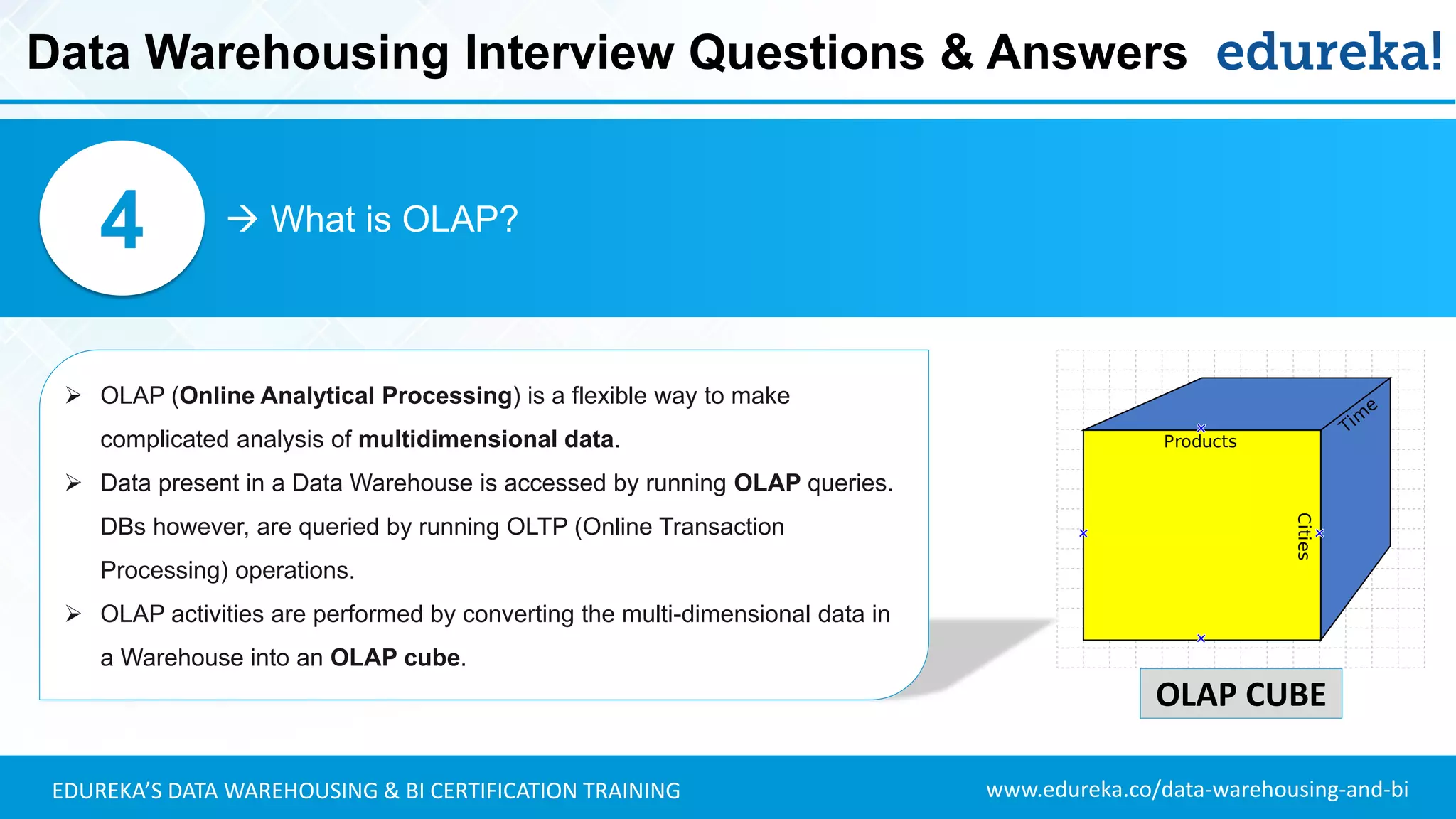
➢ OLAP (Online Analytical Processing) is a flexible way to make
complicated analysis of multidimensional data.
➢ Data present in a Data Warehouse is accessed by running OLAP queries.
DBs however, are queried by running OLTP (Online Transaction
Processing) operations.
➢ OLAP activities are performed by converting the multi-dimensional data in
a Warehouse into an OLAP cube.
OLAP CUBE
Data Warehousing Interview Questions & Answers
www.edureka.co/data-warehousing-and-biEDUREKA’S DATA WAREHOUSING & BI CERTIFICATION TRAINING
 What is OLTP? How different is OLAP from OLTP?5
Data Warehousing Interview Questions & Answers
www.edureka.co/data-warehousing-and-biEDUREKA’S DATA WAREHOUSING & BI CERTIFICATION TRAINING
 What is OLTP? How different is OLAP from OLTP?5
➢ OLTP stands for Online Transaction Processing.
OLTP queries are used to perform DDL operations on a Database.
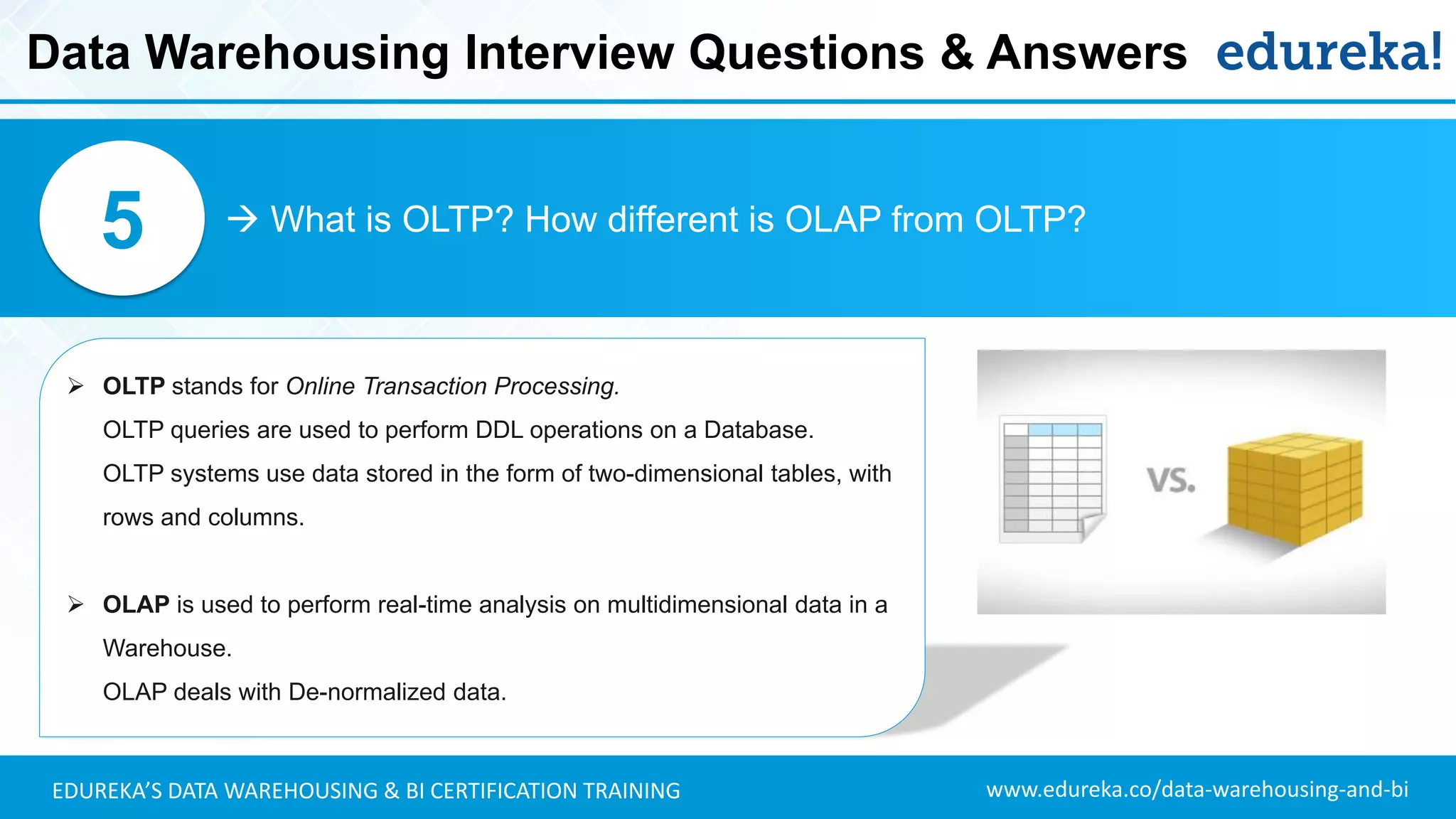
OLTP systems use data stored in the form of two-dimensional tables, with
rows and columns.
➢ OLAP is used to perform real-time analysis on multidimensional data in a
Warehouse.
OLAP deals with De-normalized data.
Data Warehousing Interview Questions & Answers
www.edureka.co/data-warehousing-and-biEDUREKA’S DATA WAREHOUSING & BI CERTIFICATION TRAINING
 What is a Dimension Table?6
Data Warehousing Interview Questions & Answers
www.edureka.co/data-warehousing-and-biEDUREKA’S DATA WAREHOUSING & BI CERTIFICATION TRAINING
 What is a Dimension Table?6
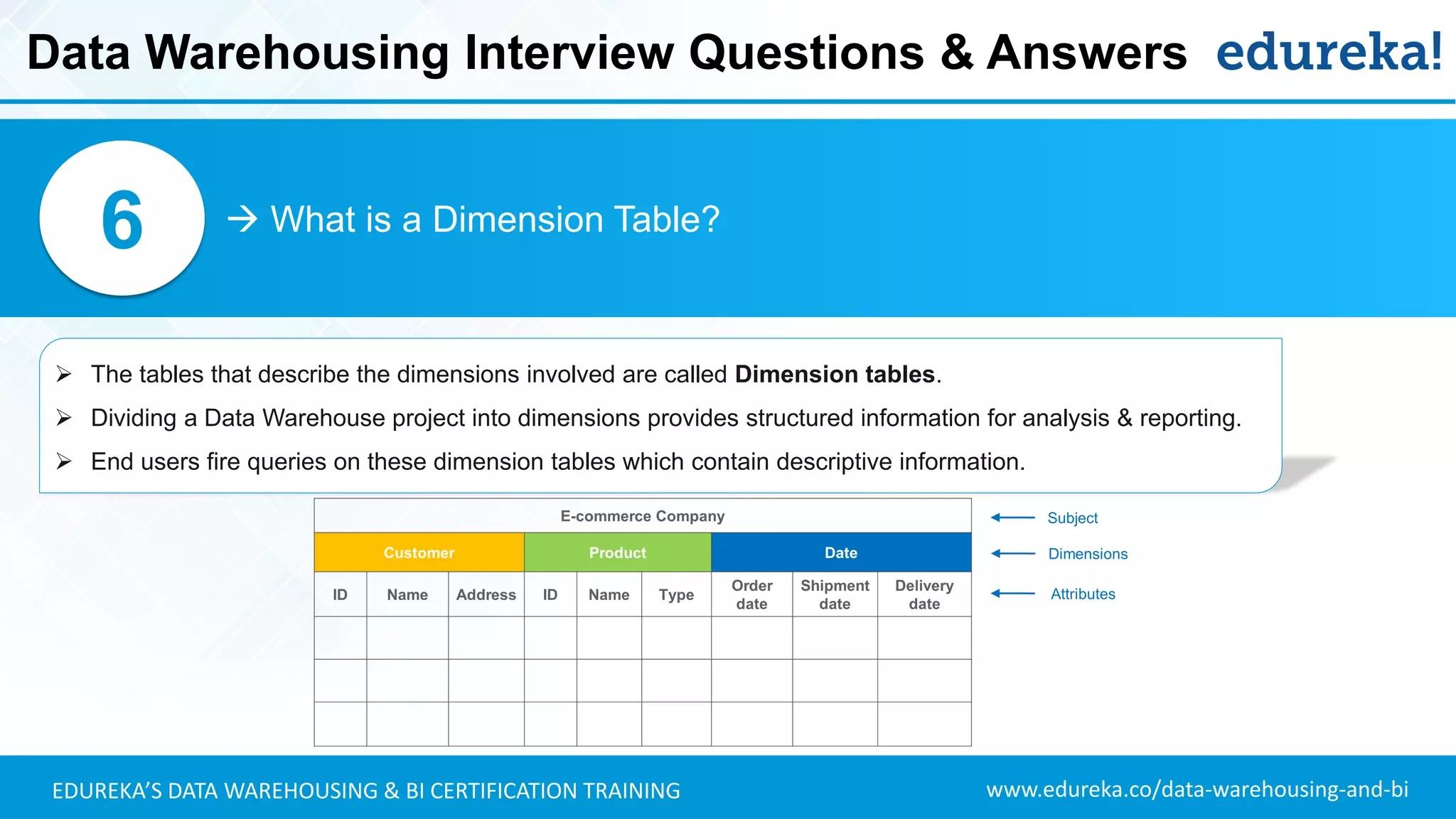
➢ The tables that describe the dimensions involved are called Dimension tables.
➢ Dividing a Data Warehouse project into dimensions provides structured information for analysis & reporting.
➢ End users fire queries on these dimension tables which contain descriptive information.
Data Warehousing Interview Questions & Answers
www.edureka.co/data-warehousing-and-biEDUREKA’S DATA WAREHOUSING & BI CERTIFICATION TRAINING
 What is a Fact Table?7
Data Warehousing Interview Questions & Answers
www.edureka.co/data-warehousing-and-biEDUREKA’S DATA WAREHOUSING & BI CERTIFICATION TRAINING
 What is a Fact Table?7
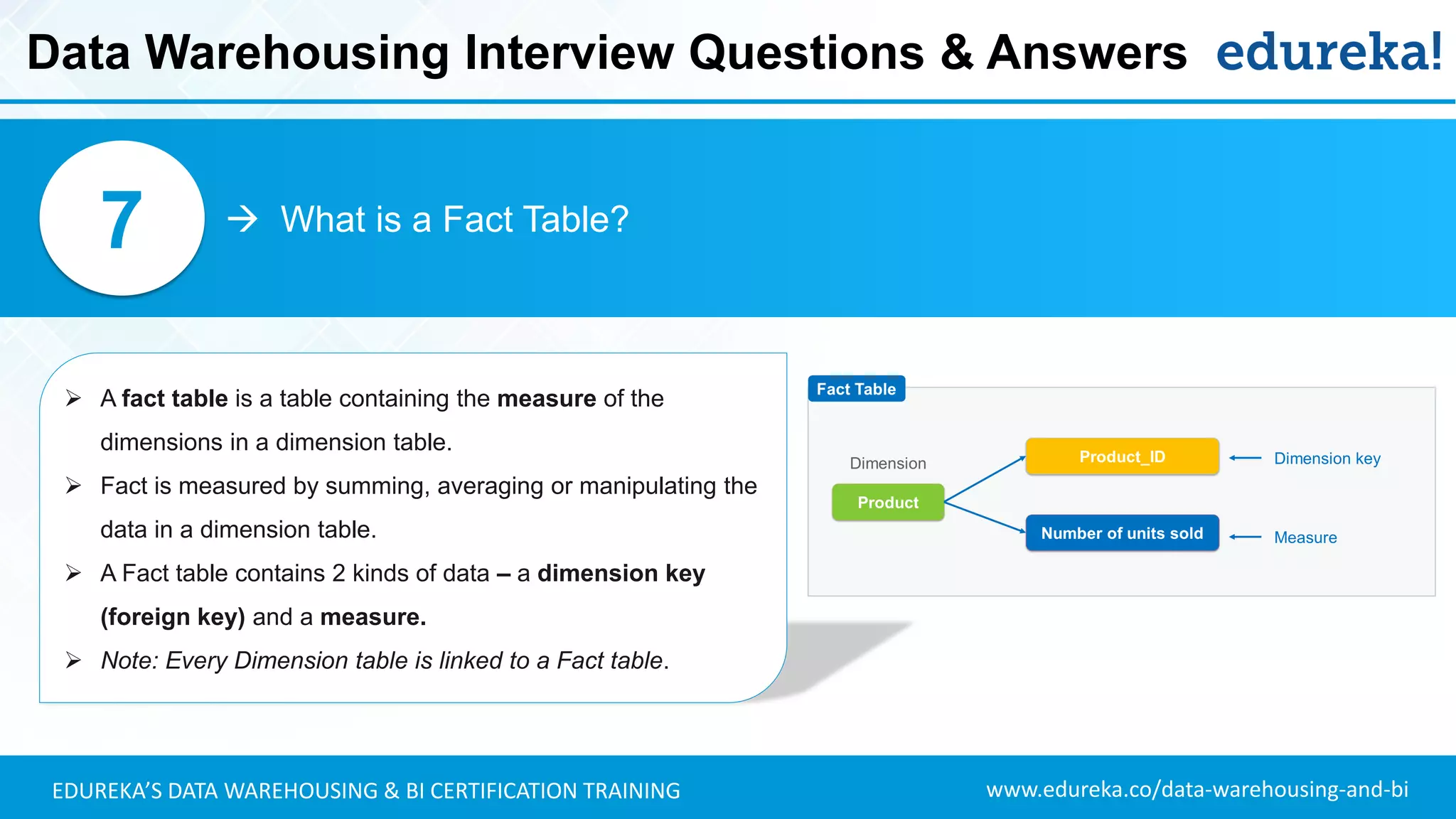
➢ A fact table is a table containing the measure of the
dimensions in a dimension table.
➢ Fact is measured by summing, averaging or manipulating the
data in a dimension table.
➢ A Fact table contains 2 kinds of data – a dimension key
(foreign key) and a measure.
➢ Note: Every Dimension table is linked to a Fact table.
Data Warehousing Interview Questions & Answers
www.edureka.co/data-warehousing-and-biEDUREKA’S DATA WAREHOUSING & BI CERTIFICATION TRAINING
 What is the level of Granularity of a fact table?8
Data Warehousing Interview Questions & Answers
www.edureka.co/data-warehousing-and-biEDUREKA’S DATA WAREHOUSING & BI CERTIFICATION TRAINING
 What is the level of Granularity of a fact table?8
➢ The depth of data level is known as granularity.
➢ A fact table is usually designed at a low level of Granularity.
➢ Examples:
➢ Lower level granularity of date dimension can be year, month, week, etc.
➢ Lower level granularity of employee_performance can be employee_performance_daily,
employee_perfomance_weekly.
Data Warehousing Interview Questions & Answers
www.edureka.co/data-warehousing-and-biEDUREKA’S DATA WAREHOUSING & BI CERTIFICATION TRAINING
 What is the difference between Additive, Semi-additive and Non-additive
facts?9
Data Warehousing Interview Questions & Answers
www.edureka.co/data-warehousing-and-biEDUREKA’S DATA WAREHOUSING & BI CERTIFICATION TRAINING
 What is the difference between Additive, Semi-additive and Non-additive
facts?9
➢ An Additive fact is a measure in a fact table that can be fully summed across any of the dimensions
associated with it.
➢ A semi-additive fact is a measure in a fact table that can be summed across some dimensions associated
with it, but not all.
➢ A non-additive fact is a measure in a fact table that cannot be summed across any of the dimensions
associated with it.
Data Warehousing Interview Questions & Answers
www.edureka.co/data-warehousing-and-biEDUREKA’S DATA WAREHOUSING & BI CERTIFICATION TRAINING
 What is a factless fact table?10
Data Warehousing Interview Questions & Answers
www.edureka.co/data-warehousing-and-biEDUREKA’S DATA WAREHOUSING & BI CERTIFICATION TRAINING
 What is a factless fact table?10
➢ Factless fact tables are the fact tables which do not contain numeric fact column in the fact table.
Data Warehousing Interview Questions & Answers
www.edureka.co/data-warehousing-and-biEDUREKA’S DATA WAREHOUSING & BI CERTIFICATION TRAINING
 What are Conformed dimensions and Conformed facts?11
Data Warehousing Interview Questions & Answers
www.edureka.co/data-warehousing-and-biEDUREKA’S DATA WAREHOUSING & BI CERTIFICATION TRAINING
 What are Conformed dimensions and Conformed facts?11
➢ A dimension table which is used by more than one fact table is known as a conformed dimension.
Conformed dimensions can be used across multiple Data Marts in combination with multiple facts tables accordingly.
➢ Similarly, Conformed fact is a fact which is used in more than one fact table.
Conformed fact is a fact table which can be used across multiple data marts in combination with multiple fact tables.
Data Warehousing Interview Questions & Answers
www.edureka.co/data-warehousing-and-biEDUREKA’S DATA WAREHOUSING & BI CERTIFICATION TRAINING
 What are Aggregate tables?12
Data Warehousing Interview Questions & Answers
www.edureka.co/data-warehousing-and-biEDUREKA’S DATA WAREHOUSING & BI CERTIFICATION TRAINING
 What are Aggregate tables?12
➢ Aggregate tables are tables which contain the existing warehouse data, grouped to certain level of dimensions.
It is easy to retrieve data from the aggregated tables than the original table which has more number of records.
➢ This table reduces the load in the database server and increases the performance of the query.
Data Warehousing Interview Questions & Answers
www.edureka.co/data-warehousing-and-biEDUREKA’S DATA WAREHOUSING & BI CERTIFICATION TRAINING
 What is Summary Information?13
Data Warehousing Interview Questions & Answers
www.edureka.co/data-warehousing-and-biEDUREKA’S DATA WAREHOUSING & BI CERTIFICATION TRAINING
 What is Summary Information?13
➢ Summary Information is the area in a Data Warehouse where predefined aggregations are kept.
Data Warehousing Interview Questions & Answers
www.edureka.co/data-warehousing-and-biEDUREKA’S DATA WAREHOUSING & BI CERTIFICATION TRAINING
 What is ETL?14
Data Warehousing Interview Questions & Answers
www.edureka.co/data-warehousing-and-biEDUREKA’S DATA WAREHOUSING & BI CERTIFICATION TRAINING
 What is ETL?14
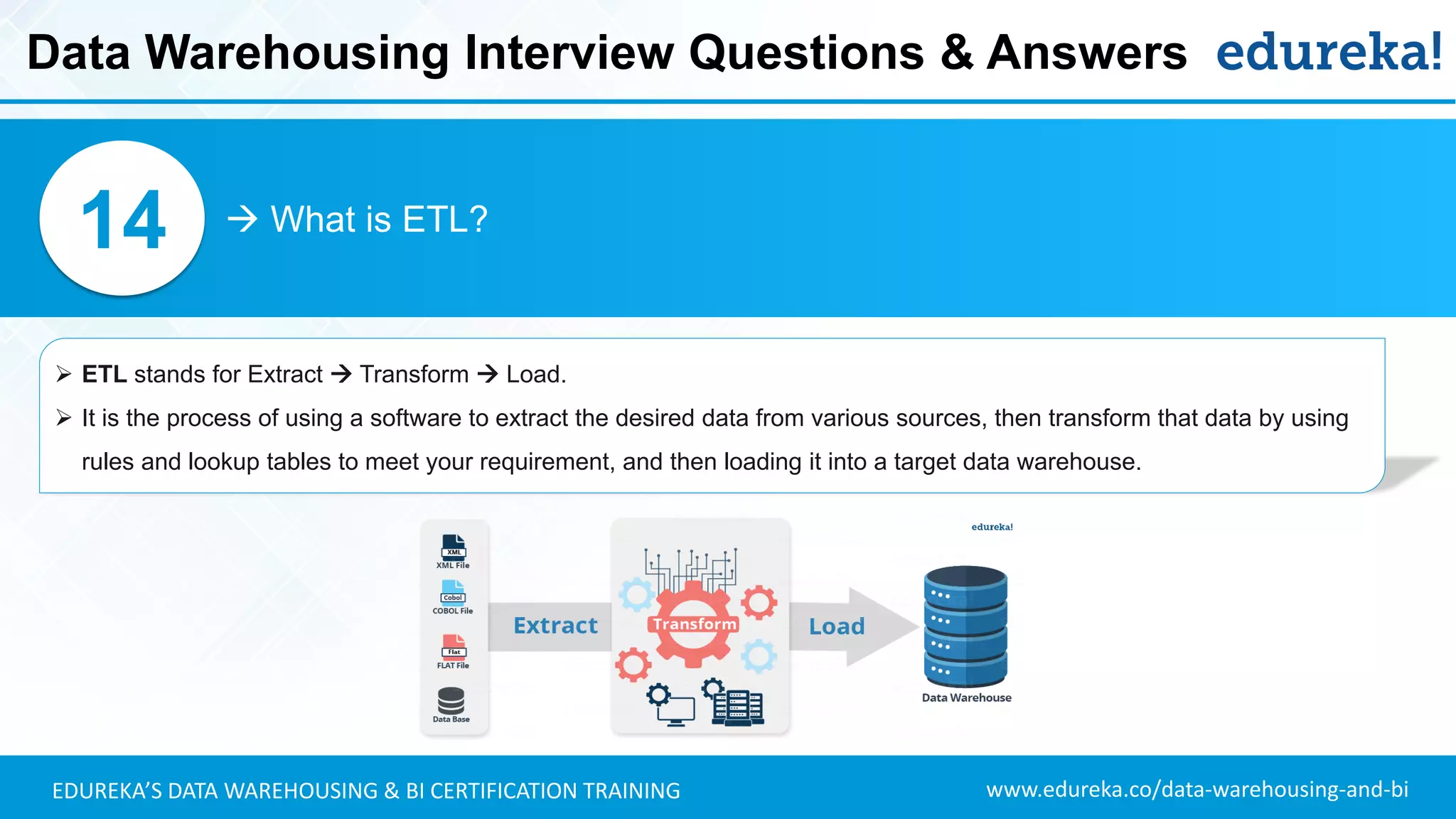
➢ ETL stands for Extract  Transform  Load.
➢ It is the process of using a software to extract the desired data from various sources, then transform that data by using
rules and lookup tables to meet your requirement, and then loading it into a target data warehouse.
Data Warehousing Interview Questions & Answers
www.edureka.co/data-warehousing-and-biEDUREKA’S DATA WAREHOUSING & BI CERTIFICATION TRAINING
 What are the tools available for ETL?15
Data Warehousing Interview Questions & Answers
www.edureka.co/data-warehousing-and-biEDUREKA’S DATA WAREHOUSING & BI CERTIFICATION TRAINING
 What are the tools available for ETL?15
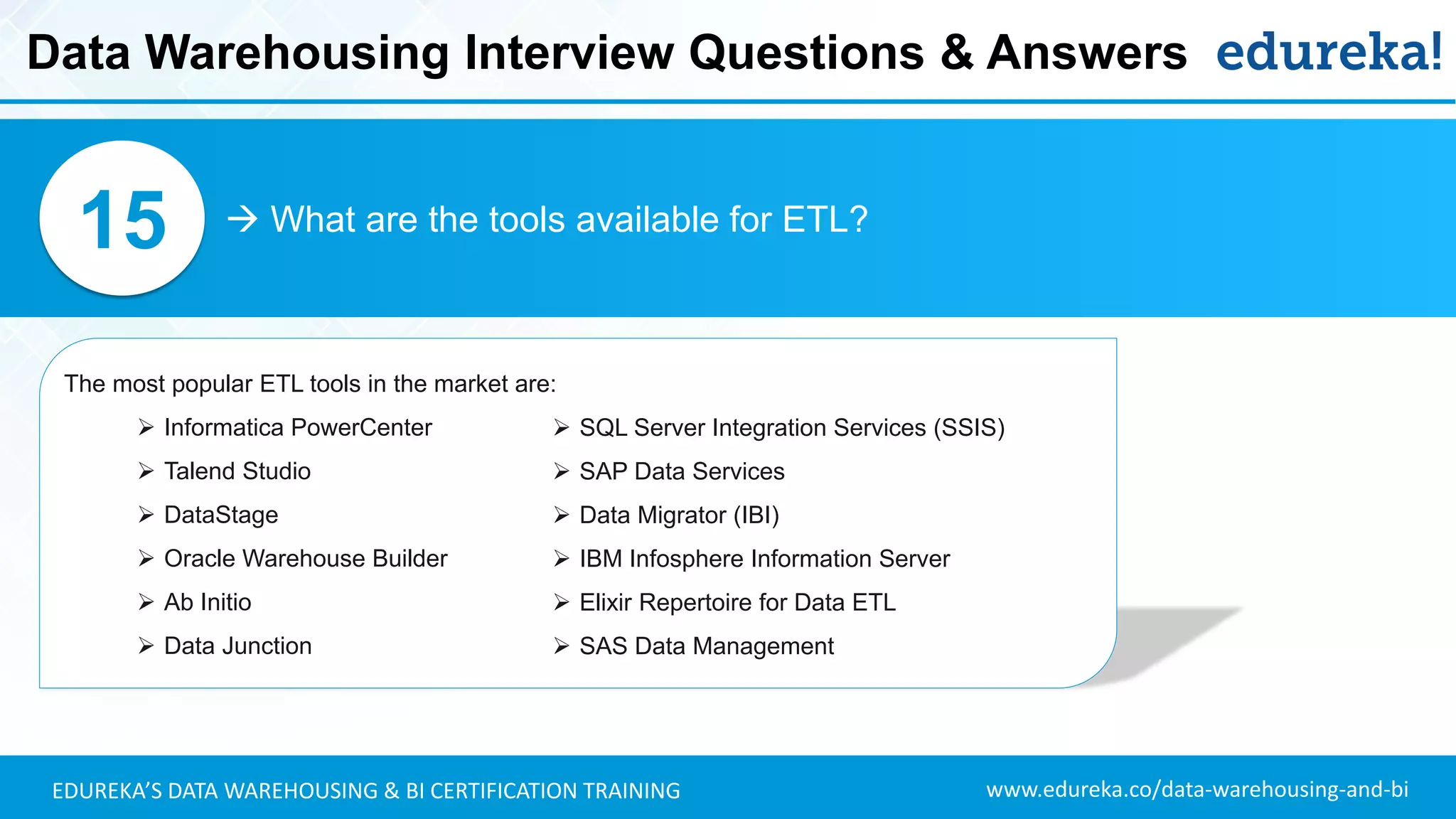
The most popular ETL tools in the market are:
➢ Informatica PowerCenter
➢ Talend Studio
➢ DataStage
➢ Oracle Warehouse Builder
➢ Ab Initio
➢ Data Junction
Data Warehousing Interview Questions & Answers
➢ SQL Server Integration Services (SSIS)
➢ SAP Data Services
➢ Data Migrator (IBI)
➢ IBM Infosphere Information Server
➢ Elixir Repertoire for Data ETL
➢ SAS Data Management
www.edureka.co/data-warehousing-and-biEDUREKA’S DATA WAREHOUSING & BI CERTIFICATION TRAINING
 What is a Data Mart?16
Data Warehousing Interview Questions & Answers
www.edureka.co/data-warehousing-and-biEDUREKA’S DATA WAREHOUSING & BI CERTIFICATION TRAINING
 What is a Data Mart?16
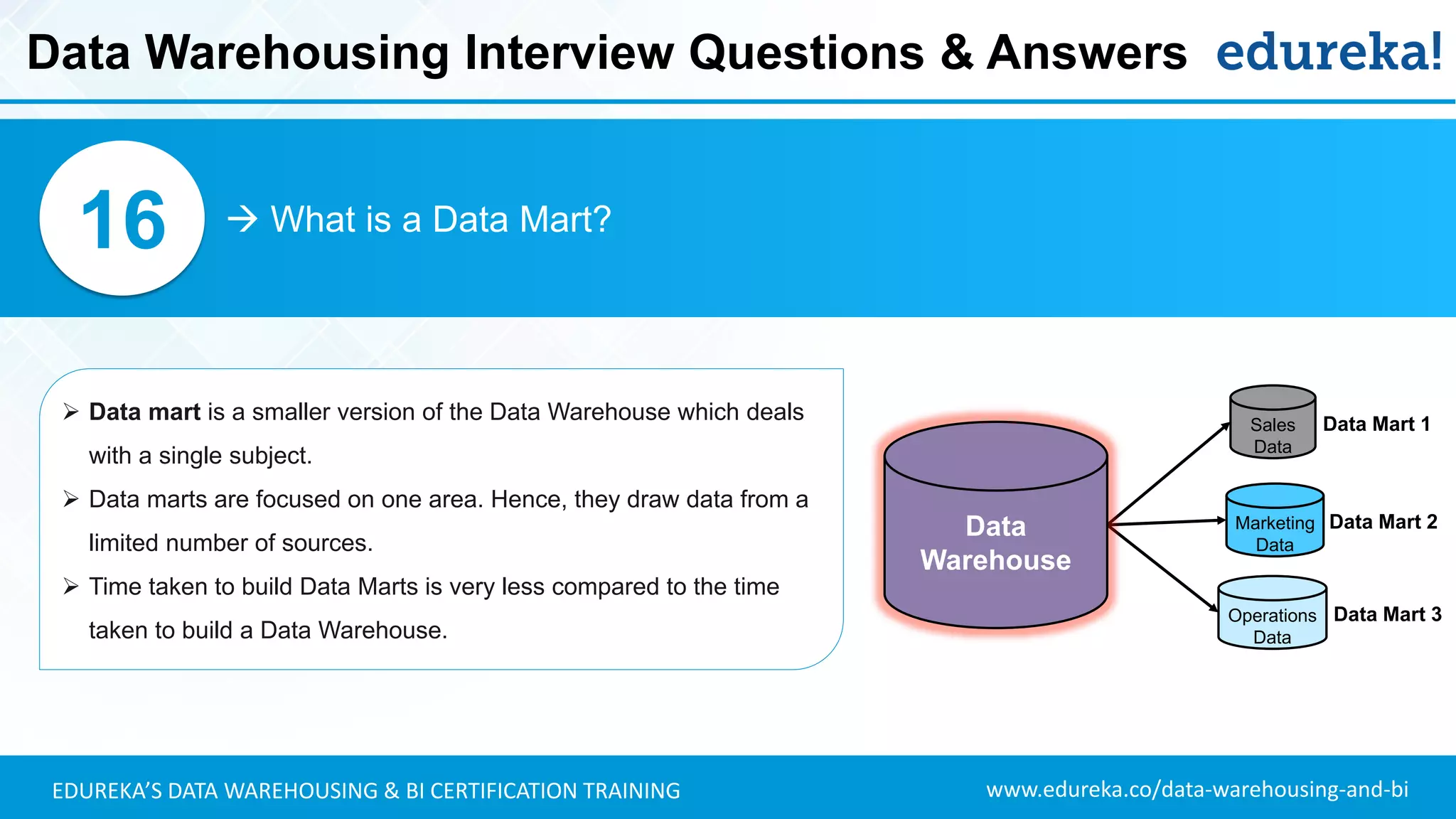
➢ Data mart is a smaller version of the Data Warehouse which deals
with a single subject.
➢ Data marts are focused on one area. Hence, they draw data from a
limited number of sources.
➢ Time taken to build Data Marts is very less compared to the time
taken to build a Data Warehouse.
Data Warehousing Interview Questions & Answers
Sales
Data
Marketing
Data
Operations
Data
Data Mart 1
Data Mart 2
Data Mart 3
Data
Warehouse
www.edureka.co/data-warehousing-and-biEDUREKA’S DATA WAREHOUSING & BI CERTIFICATION TRAINING
 What is Metadata?17
Data Warehousing Interview Questions & Answers
www.edureka.co/data-warehousing-and-biEDUREKA’S DATA WAREHOUSING & BI CERTIFICATION TRAINING
 What is Metadata?17
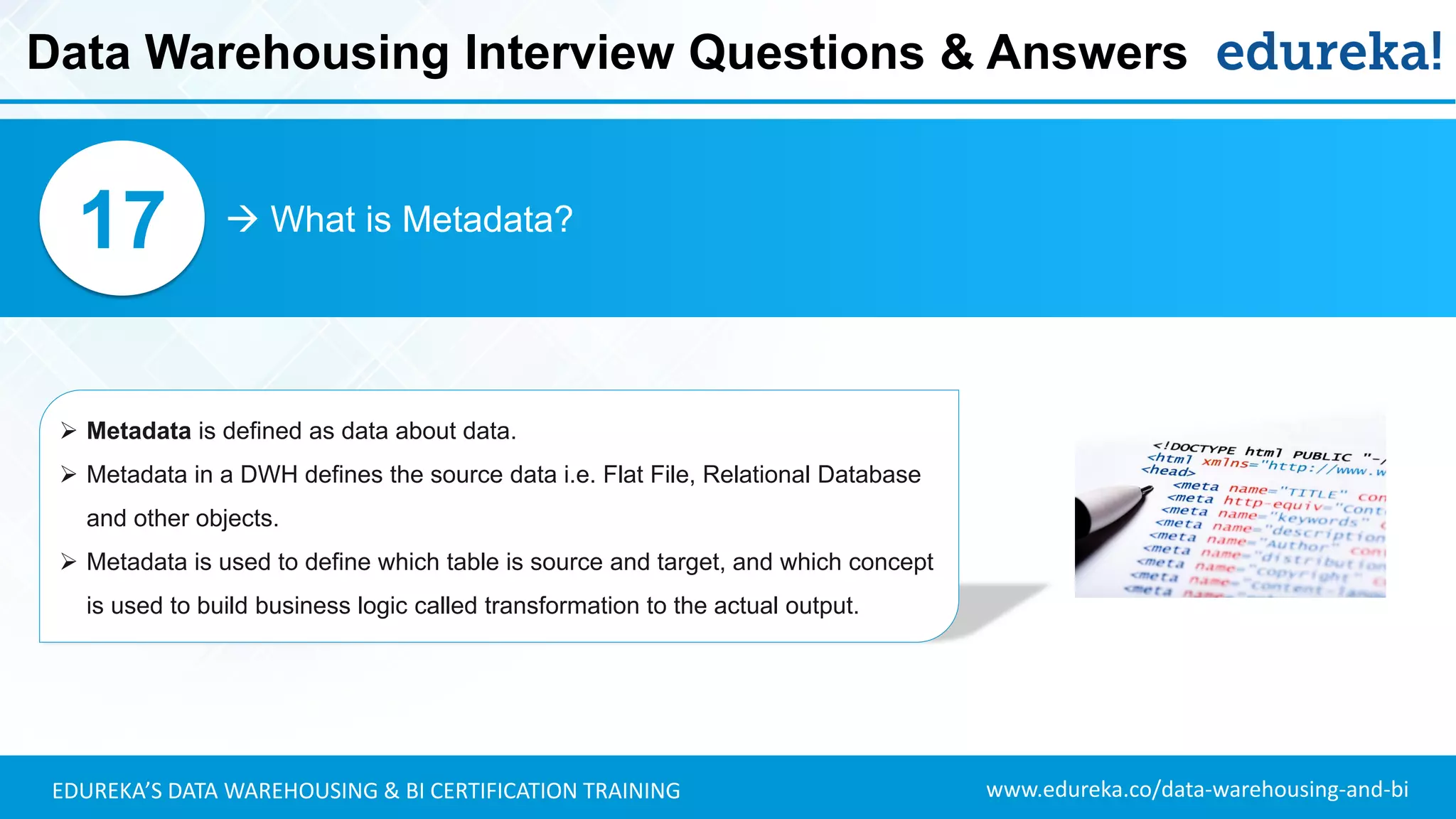
➢ Metadata is defined as data about data.
➢ Metadata in a DWH defines the source data i.e. Flat File, Relational Database
and other objects.
➢ Metadata is used to define which table is source and target, and which concept
is used to build business logic called transformation to the actual output.
Data Warehousing Interview Questions & Answers
www.edureka.co/data-warehousing-and-biEDUREKA’S DATA WAREHOUSING & BI CERTIFICATION TRAINING
 What is Data Mining?
 How is it different from Data Warehousing?18
Data Warehousing Interview Questions & Answers
www.edureka.co/data-warehousing-and-biEDUREKA’S DATA WAREHOUSING & BI CERTIFICATION TRAINING
 What is Data Mining?
 How is it different from Data Warehousing?18
➢ Data mining is the process of analyzing data in different dimensions & summarizing it into useful info.
Data is searched, retrieved and analyzed from a data warehouse (or other data storage mechanism) to answer
business questions.
➢ Data warehousing is about storing analytical data in a structure suitable for data mining. This analytical data is
extracted from operational systems usually on a daily basis.
Data Warehousing Interview Questions & Answers
www.edureka.co/data-warehousing-and-biEDUREKA’S DATA WAREHOUSING & BI CERTIFICATION TRAINING
 List the types of OLAP servers.19
Data Warehousing Interview Questions & Answers
www.edureka.co/data-warehousing-and-biEDUREKA’S DATA WAREHOUSING & BI CERTIFICATION TRAINING
 List the types of OLAP servers.19
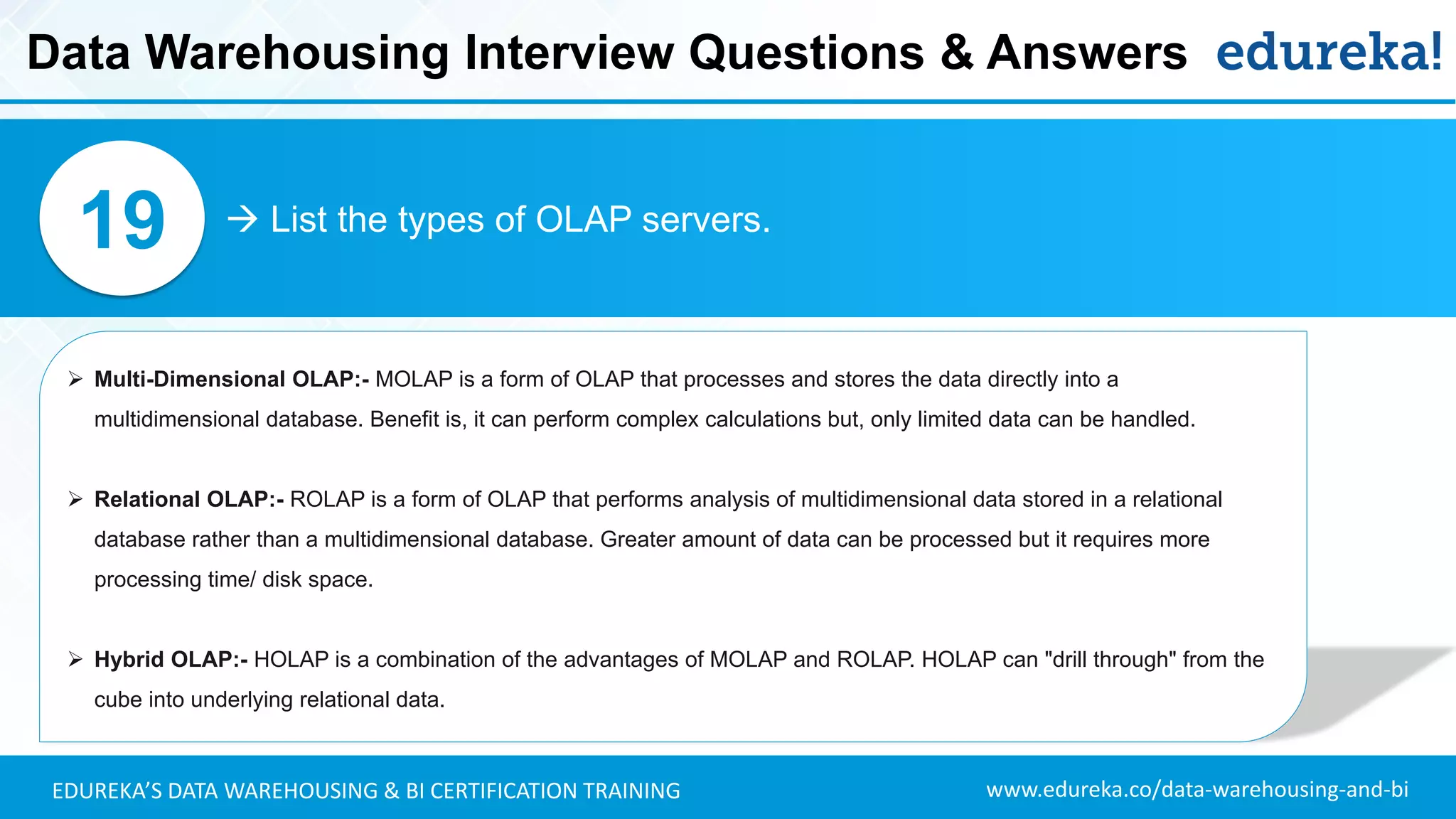
➢ Multi-Dimensional OLAP:- MOLAP is a form of OLAP that processes and stores the data directly into a
multidimensional database. Benefit is, it can perform complex calculations but, only limited data can be handled.
➢ Relational OLAP:- ROLAP is a form of OLAP that performs analysis of multidimensional data stored in a relational
database rather than a multidimensional database. Greater amount of data can be processed but it requires more
processing time/ disk space.
➢ Hybrid OLAP:- HOLAP is a combination of the advantages of MOLAP and ROLAP. HOLAP can "drill through" from the
cube into underlying relational data.
Data Warehousing Interview Questions & Answers
www.edureka.co/data-warehousing-and-biEDUREKA’S DATA WAREHOUSING & BI CERTIFICATION TRAINING
 Which one is faster, Multidimensional OLAP or Relational OLAP?20
Data Warehousing Interview Questions & Answers
www.edureka.co/data-warehousing-and-biEDUREKA’S DATA WAREHOUSING & BI CERTIFICATION TRAINING
 Which one is faster, Multidimensional OLAP or Relational OLAP?20
Multidimensional OLAP is faster than Relational OLAP.
Data Warehousing Interview Questions & Answers
www.edureka.co/data-warehousing-and-biEDUREKA’S DATA WAREHOUSING & BI CERTIFICATION TRAINING
 What are the operations that can be performed by an OLAP cube?
 Explain each operation.21
Data Warehousing Interview Questions & Answers
www.edureka.co/data-warehousing-and-biEDUREKA’S DATA WAREHOUSING & BI CERTIFICATION TRAINING
 What are the operations that can be performed by an OLAP cube?
 Explain each operation.21
Functions which can be performed by OLAP are:
➢ Roll-up
➢ Drill-down
➢ Slice
➢ Dice
➢ Pivot
Data Warehousing Interview Questions & Answers
www.edureka.co/data-warehousing-and-biEDUREKA’S DATA WAREHOUSING & BI CERTIFICATION TRAINING
 What are the operations that can be performed by an OLAP cube?
 Explain each operation.21
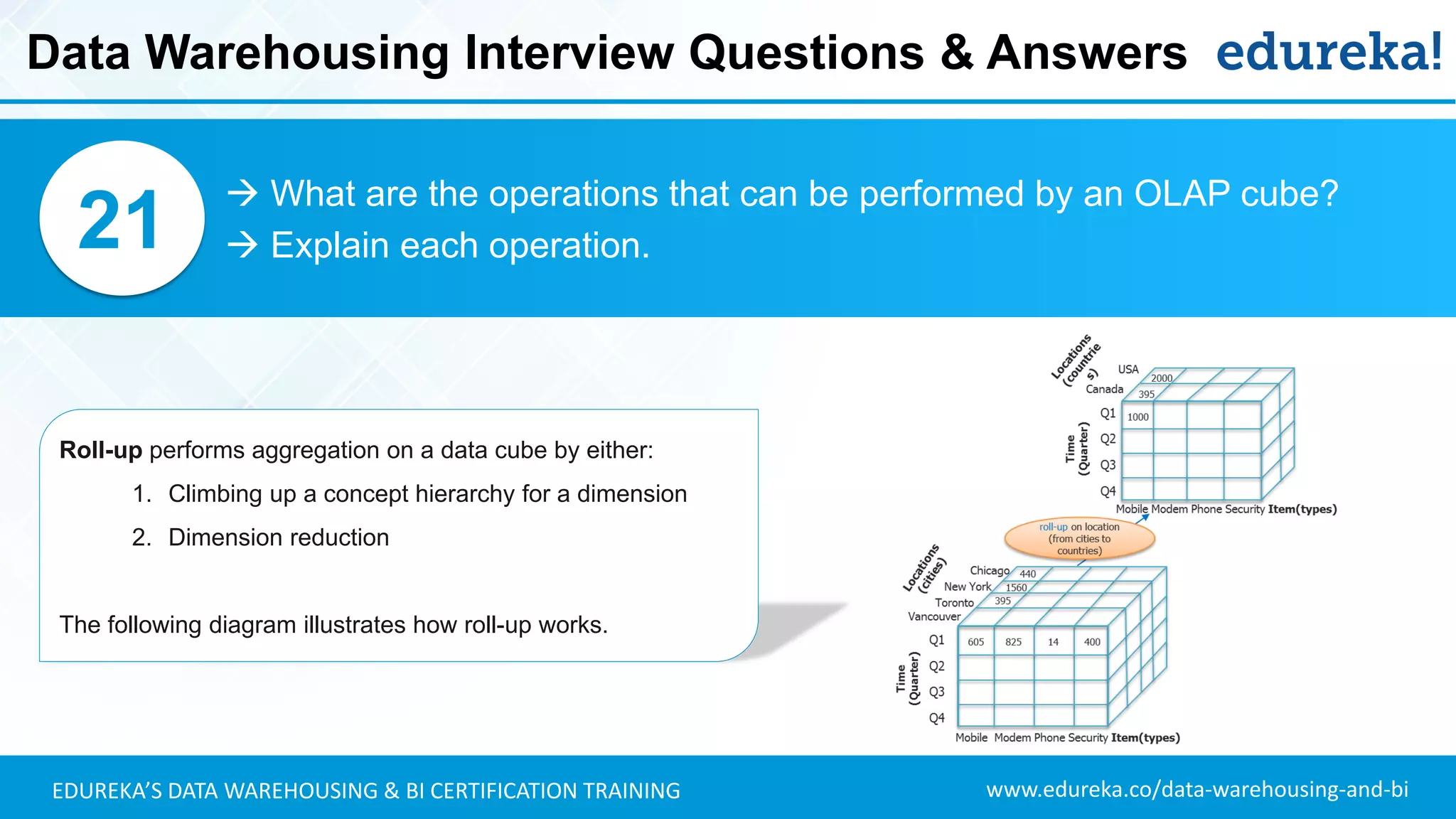
Roll-up performs aggregation on a data cube by either:
1. Climbing up a concept hierarchy for a dimension
2. Dimension reduction
The following diagram illustrates how roll-up works.
Data Warehousing Interview Questions & Answers
www.edureka.co/data-warehousing-and-biEDUREKA’S DATA WAREHOUSING & BI CERTIFICATION TRAINING
 What are the operations that can be performed by an OLAP cube?
 Explain each operation.21
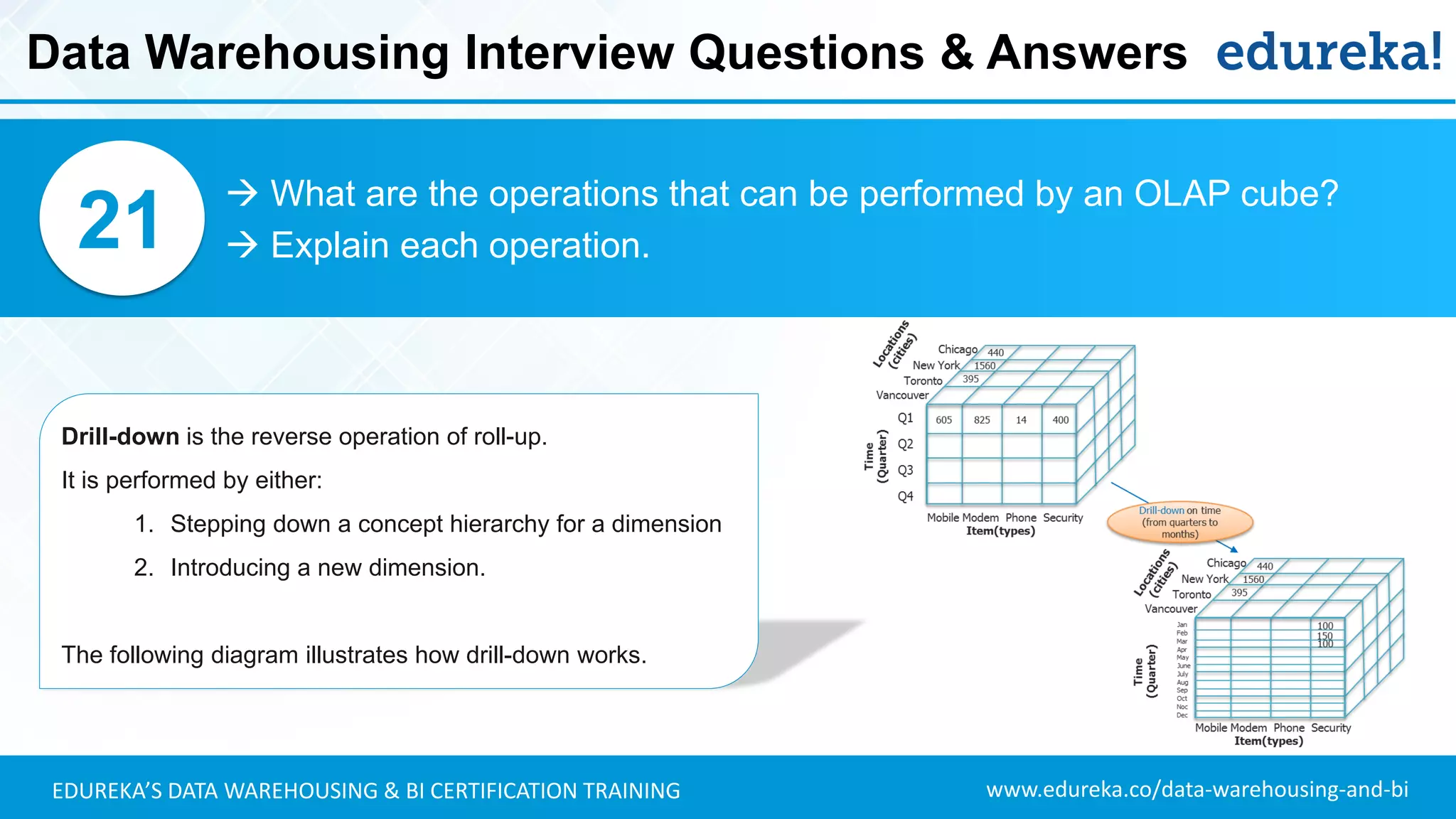
Drill-down is the reverse operation of roll-up.
It is performed by either:
1. Stepping down a concept hierarchy for a dimension
2. Introducing a new dimension.
The following diagram illustrates how drill-down works.
Data Warehousing Interview Questions & Answers
www.edureka.co/data-warehousing-and-biEDUREKA’S DATA WAREHOUSING & BI CERTIFICATION TRAINING
 What are the operations that can be performed by an OLAP cube?
 Explain each operation.21
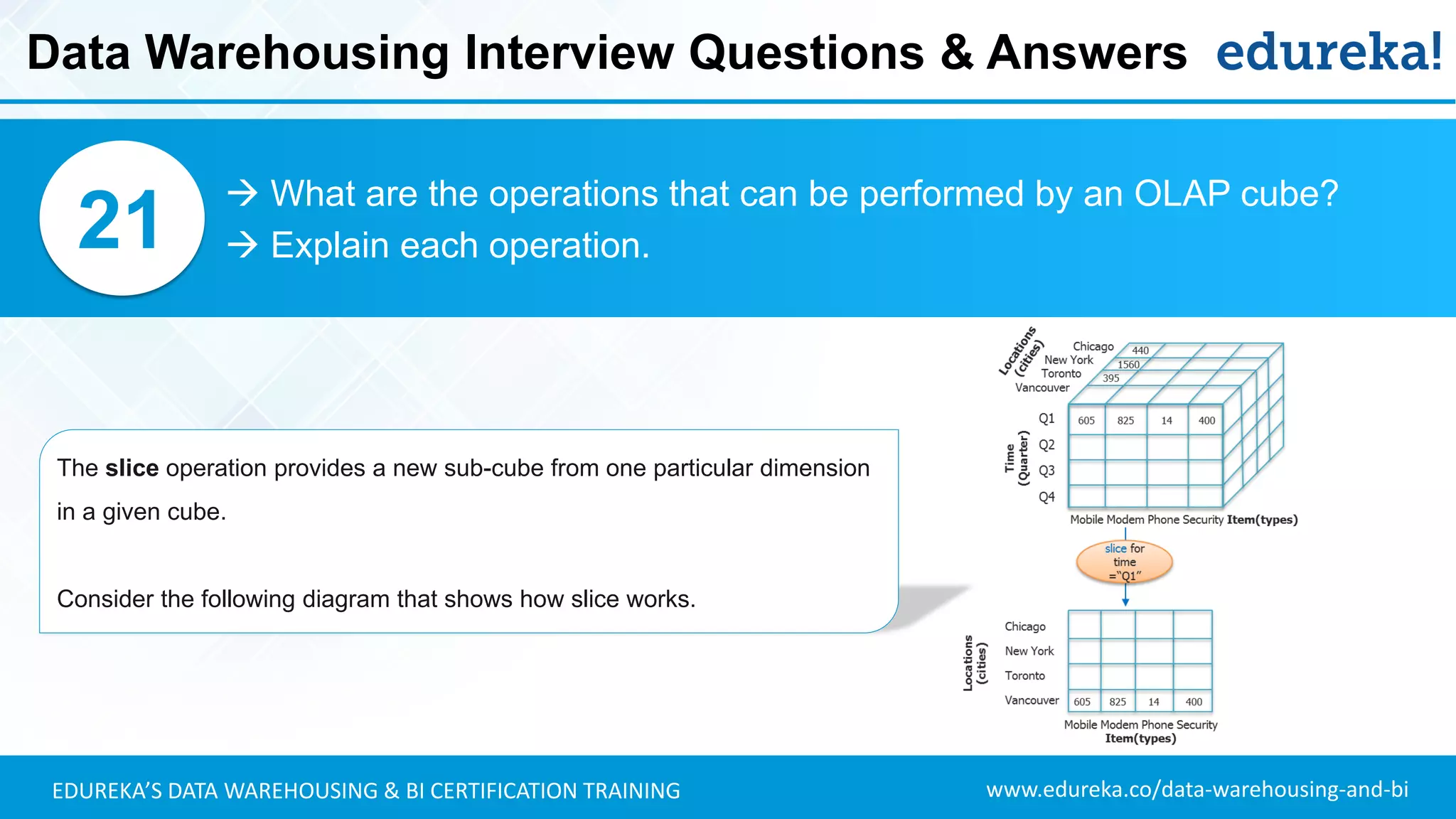
The slice operation provides a new sub-cube from one particular dimension
in a given cube.
Consider the following diagram that shows how slice works.
Data Warehousing Interview Questions & Answers
www.edureka.co/data-warehousing-and-biEDUREKA’S DATA WAREHOUSING & BI CERTIFICATION TRAINING
 What are the operations that can be performed by an OLAP cube?
 Explain each operation.21
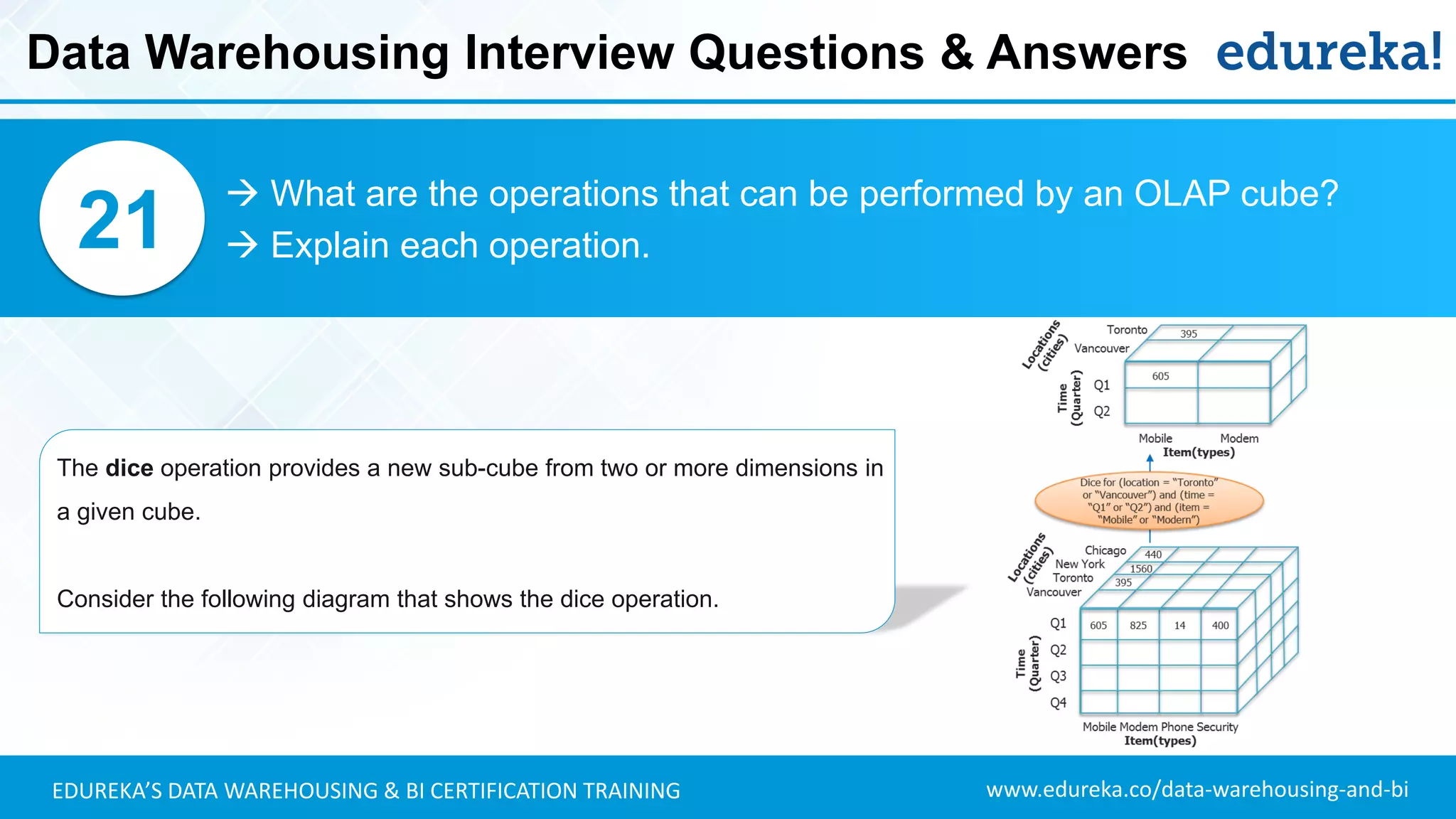
The dice operation provides a new sub-cube from two or more dimensions in
a given cube.
Consider the following diagram that shows the dice operation.
Data Warehousing Interview Questions & Answers
www.edureka.co/data-warehousing-and-biEDUREKA’S DATA WAREHOUSING & BI CERTIFICATION TRAINING
 What are the operations that can be performed by an OLAP cube?
 Explain each operation.21
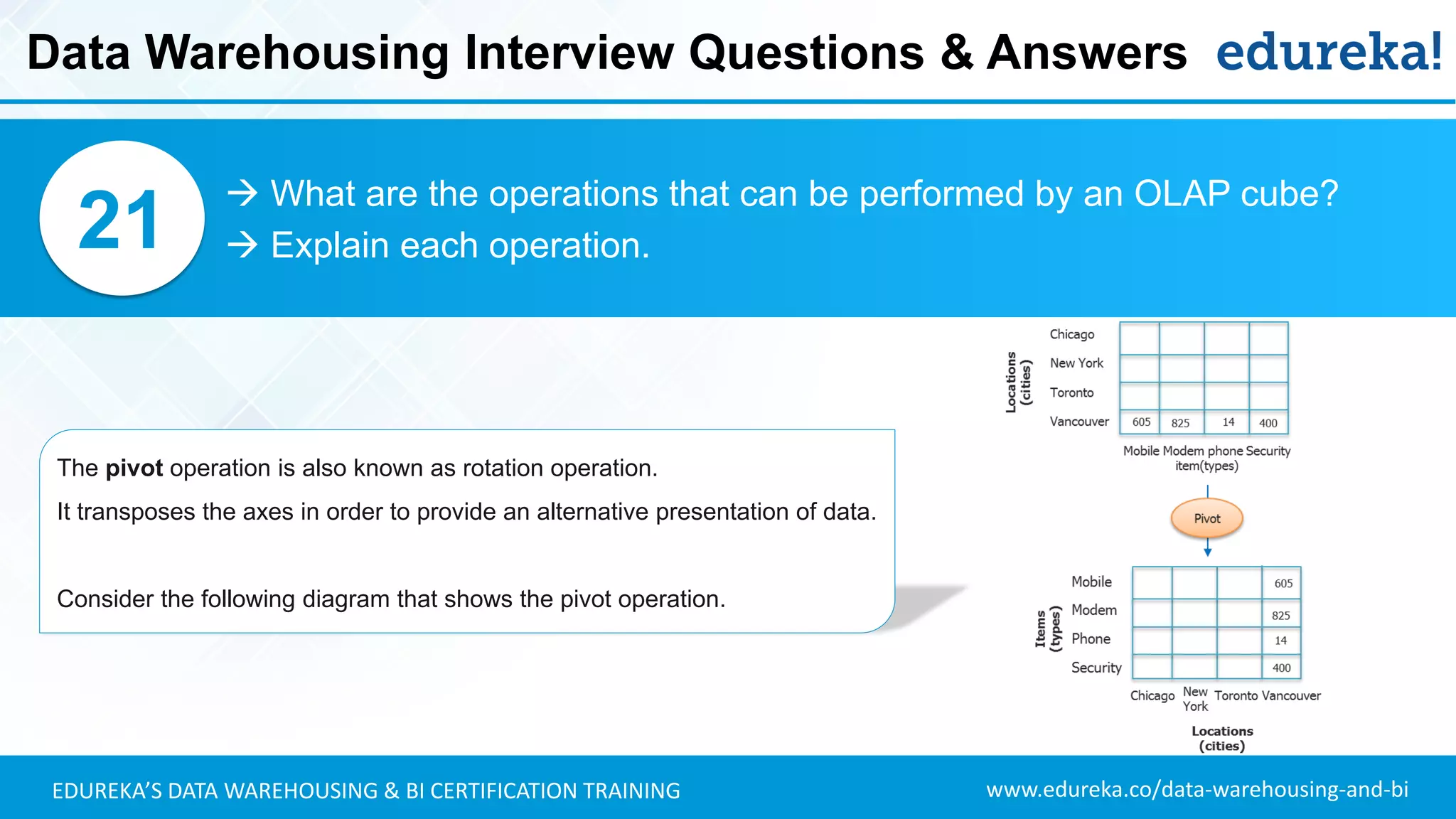
The pivot operation is also known as rotation operation.
It transposes the axes in order to provide an alternative presentation of data.
Consider the following diagram that shows the pivot operation.
Data Warehousing Interview Questions & Answers
www.edureka.co/data-warehousing-and-biEDUREKA’S DATA WAREHOUSING & BI CERTIFICATION TRAINING
 How many dimensions are selected in Slice operation?
 How many dimensions are selected in Dice operation?22
Data Warehousing Interview Questions & Answers
www.edureka.co/data-warehousing-and-biEDUREKA’S DATA WAREHOUSING & BI CERTIFICATION TRAINING
 How many dimensions are selected in Slice operation?
 How many dimensions are selected in Dice operation?22
➢ Only one dimension is selected for the slice operation.
➢ For dice operation, two or more dimensions are selected for a given cube.
Data Warehousing Interview Questions & Answers
www.edureka.co/data-warehousing-and-biEDUREKA’S DATA WAREHOUSING & BI CERTIFICATION TRAINING
 What is Normalization?
 What is the benefit of Normalization?23
Data Warehousing Interview Questions & Answers
www.edureka.co/data-warehousing-and-biEDUREKA’S DATA WAREHOUSING & BI CERTIFICATION TRAINING
 What is Normalization?
 What is the benefit of Normalization?23
➢ Normalization is the process of splitting up the data into multiple tables.
Different normalized forms of data are 1NF, 2NF and 3NF.
The process converting data in 1NF  2NF and 2NF  3NF is called normalizing data.
➢ The benefit with Normalization is that, it helps in reducing data redundancy.
Data Warehousing Interview Questions & Answers
www.edureka.co/data-warehousing-and-biEDUREKA’S DATA WAREHOUSING & BI CERTIFICATION TRAINING
 What is an ER Diagram?
 Is it implemented in a Data Warehouse?24
Data Warehousing Interview Questions & Answers
www.edureka.co/data-warehousing-and-biEDUREKA’S DATA WAREHOUSING & BI CERTIFICATION TRAINING
 What is an ER Diagram?
 Is it implemented in a Data Warehouse?24
➢ ER diagram is abbreviated as Entity-Relationship diagram.
It illustrates the interrelationships between the various entities in a database.
➢ No, ER diagram is not implemented in a data warehouse.
We make use of Dimensional Modeling in a data warehouse.
Data Warehousing Interview Questions & Answers
www.edureka.co/data-warehousing-and-biEDUREKA’S DATA WAREHOUSING & BI CERTIFICATION TRAINING
 What is called as Dimensional Modelling?
 What are the types of Dimensional Modeling?25
Data Warehousing Interview Questions & Answers
www.edureka.co/data-warehousing-and-biEDUREKA’S DATA WAREHOUSING & BI CERTIFICATION TRAINING
 What is called as Dimensional Modelling?
 What are the types of Dimensional Modeling?25
➢ Dimensional Modeling is a concept which can be used by data warehouse designers to build their own data
warehouse. This model can be stored in two types of tables – Facts and Dimension table.
Fact table has facts and measurements of the business and dimension table contains the context of
measurements.
➢ Types of dimensional modeling are:
➢ Conceptual Modeling
➢ Logical Modeling
➢ Physical Modeling
Data Warehousing Interview Questions & Answers
www.edureka.co/data-warehousing-and-biEDUREKA’S DATA WAREHOUSING & BI CERTIFICATION TRAINING
 What is SCD?
 What are the types of SCD?26
Data Warehousing Interview Questions & Answers
www.edureka.co/data-warehousing-and-biEDUREKA’S DATA WAREHOUSING & BI CERTIFICATION TRAINING
 What is SCD?
 What are the types of SCD?26
➢ SCD is short for Slowly Changing Dimensions, and it applies to the cases where records change over time.
➢ There are three types of SCDs and they are:
➢ SCD 1 – The new record replaces the original record
➢ SCD 2 – The new record is added to the existing customer dimension table
➢ SCD 3 – The original data is modified to include new data.
Data Warehousing Interview Questions & Answers
www.edureka.co/data-warehousing-and-biEDUREKA’S DATA WAREHOUSING & BI CERTIFICATION TRAINING
 What are the key columns in Fact and Dimension tables?27
Data Warehousing Interview Questions & Answers
www.edureka.co/data-warehousing-and-biEDUREKA’S DATA WAREHOUSING & BI CERTIFICATION TRAINING
 What are the key columns in Fact and Dimension tables?27
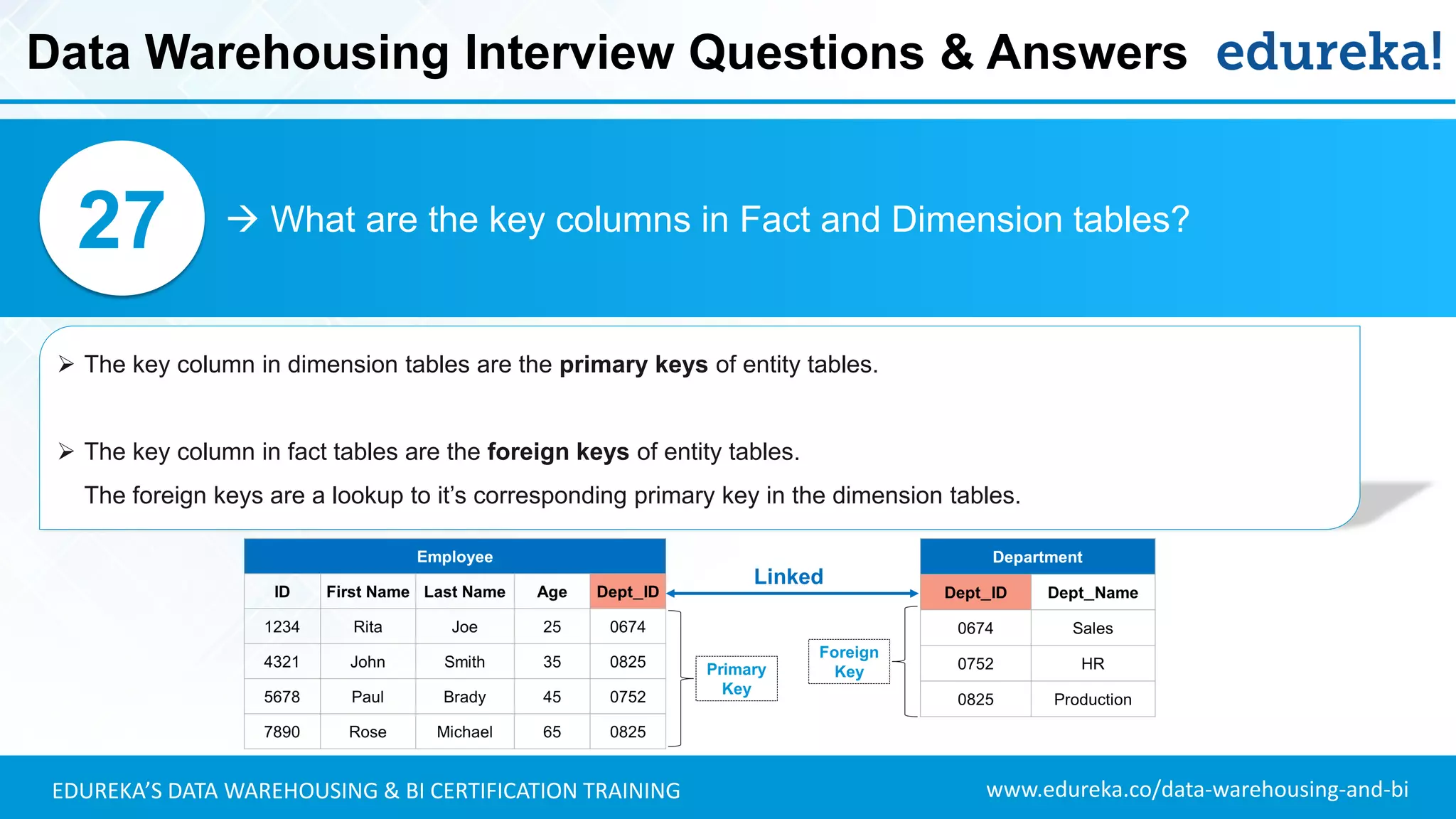
➢ The key column in dimension tables are the primary keys of entity tables.
➢ The key column in fact tables are the foreign keys of entity tables.
The foreign keys are a lookup to it’s corresponding primary key in the dimension tables.
Data Warehousing Interview Questions & Answers
www.edureka.co/data-warehousing-and-biEDUREKA’S DATA WAREHOUSING & BI CERTIFICATION TRAINING
 Which Schemas do data warehouses implement?
 Explain each of them.28
Data Warehousing Interview Questions & Answers
www.edureka.co/data-warehousing-and-biEDUREKA’S DATA WAREHOUSING & BI CERTIFICATION TRAINING
 Which Schemas do data warehouses implement?
 Explain each of them.28
A data warehouse implements the following schemas:
➢ Star schema
➢ Snowflake schema
➢ Fact Constellation schema.
Data Warehousing Interview Questions & Answers
www.edureka.co/data-warehousing-and-biEDUREKA’S DATA WAREHOUSING & BI CERTIFICATION TRAINING
 Which Schemas do data warehouses implement?
 Explain each of them.28
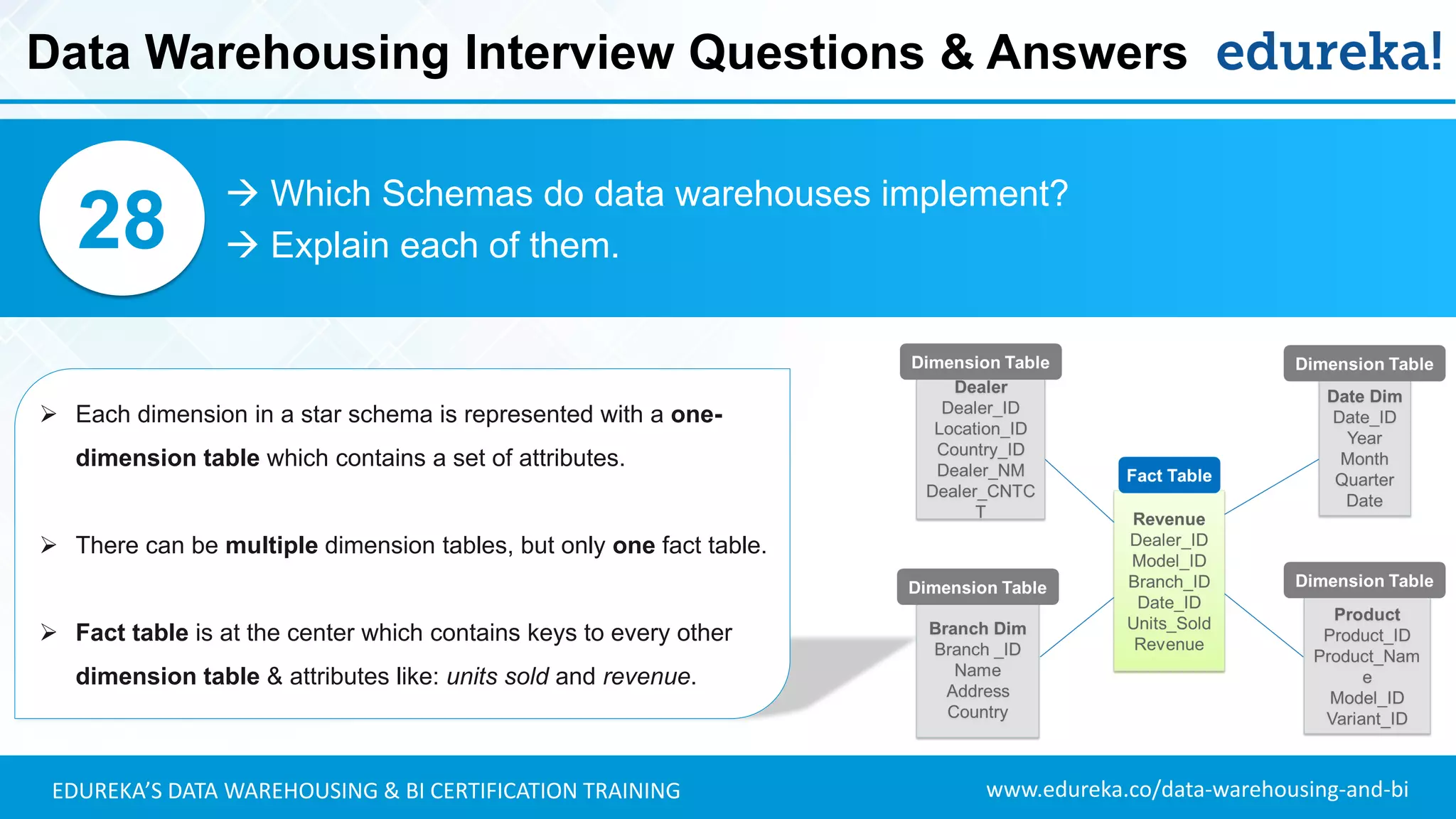
➢ Each dimension in a star schema is represented with a one-
dimension table which contains a set of attributes.
➢ There can be multiple dimension tables, but only one fact table.
➢ Fact table is at the center which contains keys to every other
dimension table & attributes like: units sold and revenue.
Data Warehousing Interview Questions & Answers
www.edureka.co/data-warehousing-and-biEDUREKA’S DATA WAREHOUSING & BI CERTIFICATION TRAINING
 Which Schemas do data warehouses implement?
 Explain each of them.28
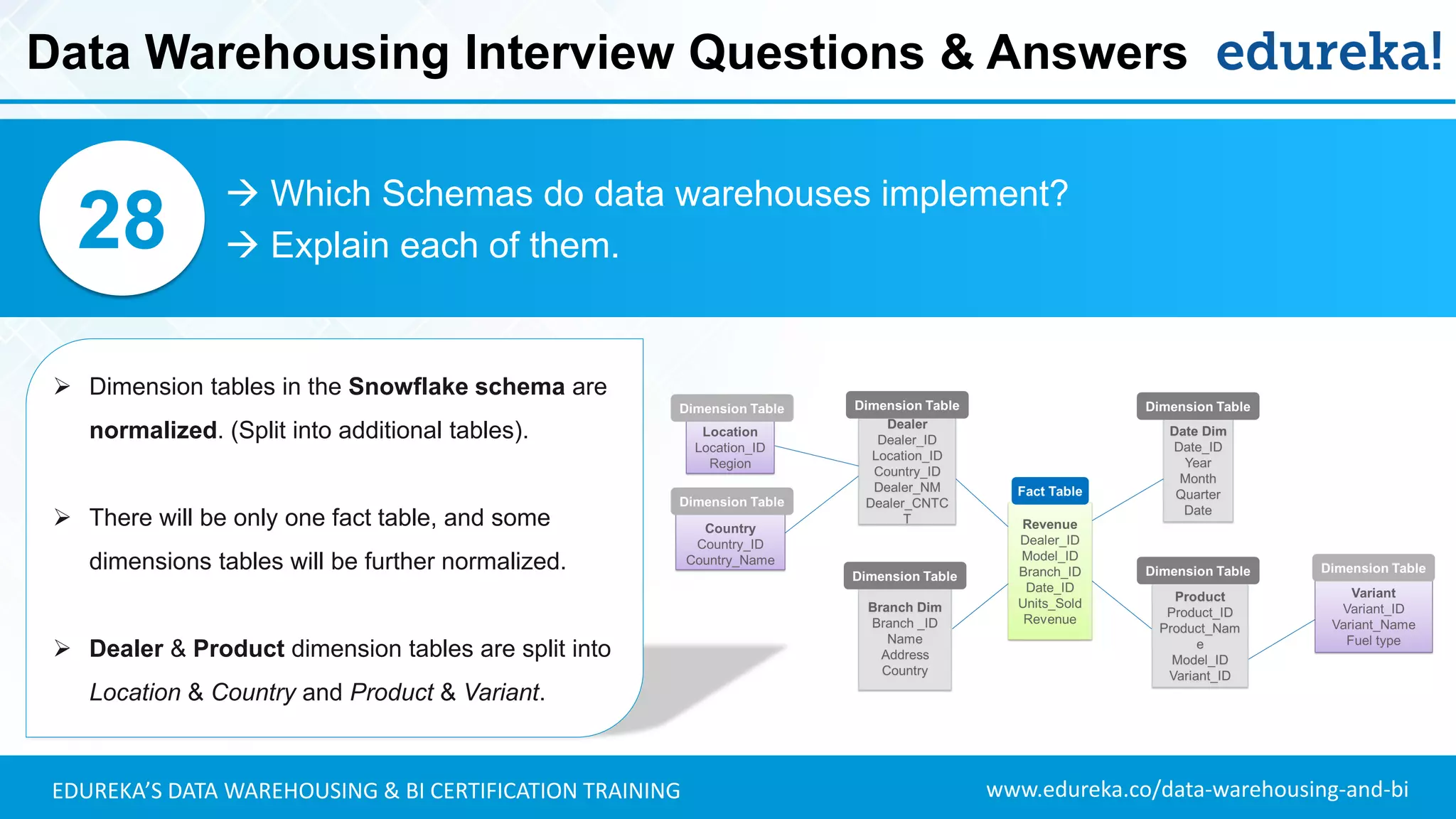
➢ Dimension tables in the Snowflake schema are
normalized. (Split into additional tables).
➢ There will be only one fact table, and some
dimensions tables will be further normalized.
➢ Dealer & Product dimension tables are split into
Location & Country and Product & Variant.
Data Warehousing Interview Questions & Answers
www.edureka.co/data-warehousing-and-biEDUREKA’S DATA WAREHOUSING & BI CERTIFICATION TRAINING
 Which Schemas do data warehouses implement?
 Explain each of them.28
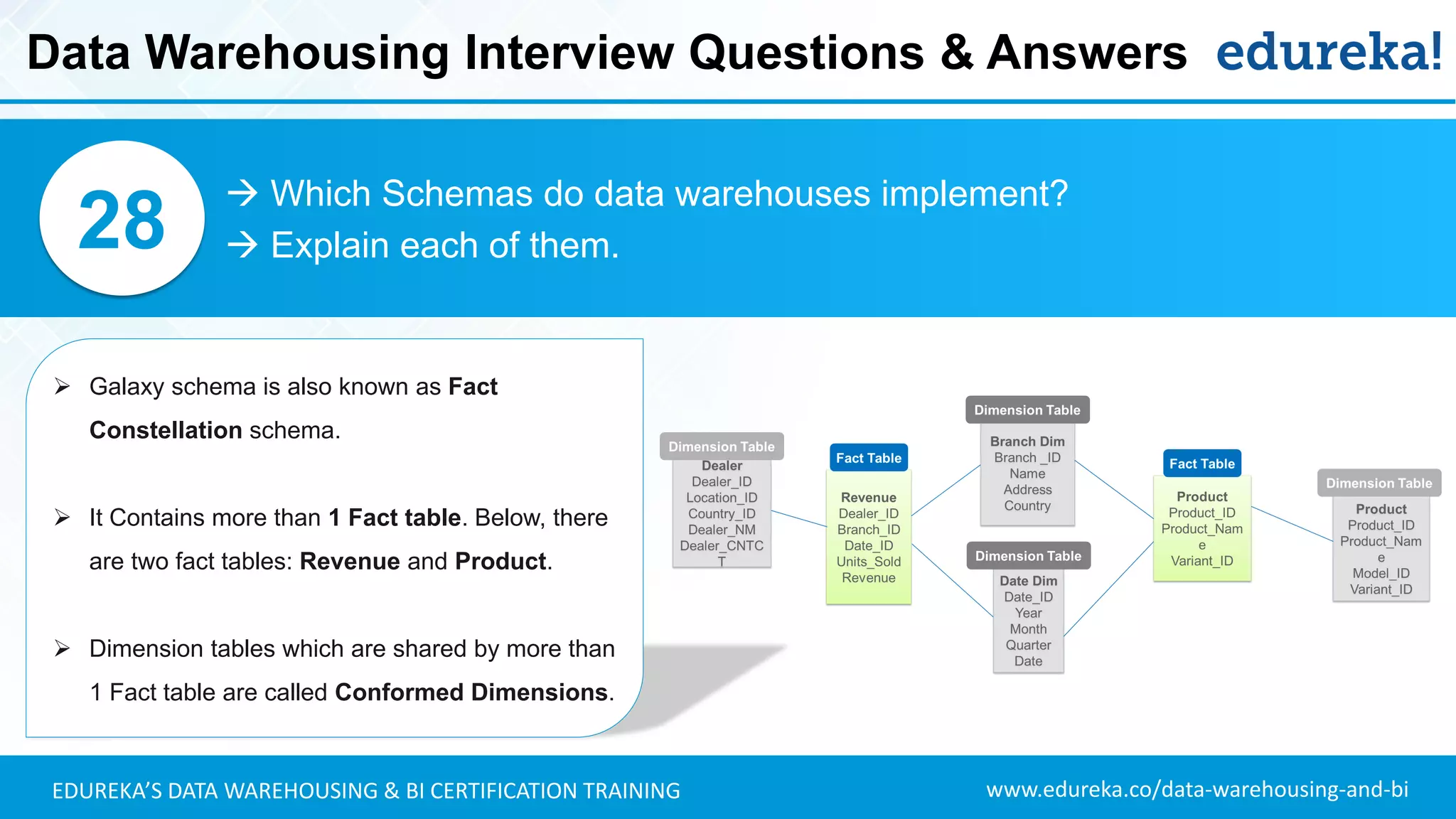
➢ Galaxy schema is also known as Fact
Constellation schema.
➢ It Contains more than 1 Fact table. Below, there
are two fact tables: Revenue and Product.
➢ Dimension tables which are shared by more than
1 Fact table are called Conformed Dimensions.
Data Warehousing Interview Questions & Answers
www.edureka.co/data-warehousing-and-biEDUREKA’S DATA WAREHOUSING & BI CERTIFICATION TRAINING
 What is real-time Data Warehousing?29
Data Warehousing Interview Questions & Answers
www.edureka.co/data-warehousing-and-biEDUREKA’S DATA WAREHOUSING & BI CERTIFICATION TRAINING
 What is real-time Data Warehousing?29
➢ Real-time data warehousing captures the business data whenever it occurs.
➢ When ever a business activity gets completed, that data will be available in the flow and become
available for use instantly.
Data Warehousing Interview Questions & Answers
www.edureka.co/data-warehousing-and-biEDUREKA’S DATA WAREHOUSING & BI CERTIFICATION TRAINING
 Which language is used for defining Schema Definition?30
Data Warehousing Interview Questions & Answers
www.edureka.co/data-warehousing-and-biEDUREKA’S DATA WAREHOUSING & BI CERTIFICATION TRAINING
 Which language is used for defining Schema Definition?30
Data Mining Query Language (DMQL) is used for Schema Definition.
Data Warehousing Interview Questions & Answers
www.edureka.co/data-warehousing-and-biEDUREKA’S DATA WAREHOUSING & BI CERTIFICATION TRAINING

Data Warehouse Interview Questions And Answers | Data Warehouse Tutorial | Edureka

  • 1.
  • 2.
    www.edureka.co/data-warehousing-and-biEDUREKA’S DATA WAREHOUSING& BI CERTIFICATION TRAINING Data Warehousing Interview Questions & Answers  What is a Data Warehouse?1
  • 3.
    www.edureka.co/data-warehousing-and-biEDUREKA’S DATA WAREHOUSING& BI CERTIFICATION TRAINING Data Warehousing Interview Questions & Answers  What is a Data Warehouse?1 ➢ Data Warehouse is like a relational database designed for analytical needs. ➢ It is a central location where consolidated data from multiple locations (databases) are stored.
  • 4.
    www.edureka.co/data-warehousing-and-biEDUREKA’S DATA WAREHOUSING& BI CERTIFICATION TRAINING Data Warehousing Interview Questions & Answers  What is the very basic difference between a Data Warehouse and an operational Database?2
  • 5.
    www.edureka.co/data-warehousing-and-biEDUREKA’S DATA WAREHOUSING& BI CERTIFICATION TRAINING Data Warehousing Interview Questions & Answers  What is the very basic difference between a Data Warehouse and an operational Database?2 ➢ Data Warehouse ➢ Contains historical information which helps in analyzing business metrics. ➢ Data warehouse is mainly used to read data. ➢ End users are business analysts/ data analysts. ➢ Operational Database ➢ Contains current information that is required to run the business. ➢ Database is mainly used to write the data. ➢ End users are ops team members.
  • 6.
    www.edureka.co/data-warehousing-and-biEDUREKA’S DATA WAREHOUSING& BI CERTIFICATION TRAINING  What is Data Warehousing?3 Data Warehousing Interview Questions & Answers
  • 7.
    www.edureka.co/data-warehousing-and-biEDUREKA’S DATA WAREHOUSING& BI CERTIFICATION TRAINING  What is Data Warehousing?3 ➢ Data Warehousing is the act of organizing & storing data in a way so as to make its retrieval efficient and insightful. ➢ It’s also called as the process of transforming data into information. Data Warehousing Interview Questions & Answers
  • 8.
    www.edureka.co/data-warehousing-and-biEDUREKA’S DATA WAREHOUSING& BI CERTIFICATION TRAINING  What is OLAP?4 Data Warehousing Interview Questions & Answers
  • 9.
    www.edureka.co/data-warehousing-and-biEDUREKA’S DATA WAREHOUSING& BI CERTIFICATION TRAINING  What is OLAP?4 ➢ OLAP (Online Analytical Processing) is a flexible way to make complicated analysis of multidimensional data. ➢ Data present in a Data Warehouse is accessed by running OLAP queries. DBs however, are queried by running OLTP (Online Transaction Processing) operations. ➢ OLAP activities are performed by converting the multi-dimensional data in a Warehouse into an OLAP cube. OLAP CUBE Data Warehousing Interview Questions & Answers
  • 10.
    www.edureka.co/data-warehousing-and-biEDUREKA’S DATA WAREHOUSING& BI CERTIFICATION TRAINING  What is OLTP? How different is OLAP from OLTP?5 Data Warehousing Interview Questions & Answers
  • 11.
    www.edureka.co/data-warehousing-and-biEDUREKA’S DATA WAREHOUSING& BI CERTIFICATION TRAINING  What is OLTP? How different is OLAP from OLTP?5 ➢ OLTP stands for Online Transaction Processing. OLTP queries are used to perform DDL operations on a Database. OLTP systems use data stored in the form of two-dimensional tables, with rows and columns. ➢ OLAP is used to perform real-time analysis on multidimensional data in a Warehouse. OLAP deals with De-normalized data. Data Warehousing Interview Questions & Answers
  • 12.
    www.edureka.co/data-warehousing-and-biEDUREKA’S DATA WAREHOUSING& BI CERTIFICATION TRAINING  What is a Dimension Table?6 Data Warehousing Interview Questions & Answers
  • 13.
    www.edureka.co/data-warehousing-and-biEDUREKA’S DATA WAREHOUSING& BI CERTIFICATION TRAINING  What is a Dimension Table?6 ➢ The tables that describe the dimensions involved are called Dimension tables. ➢ Dividing a Data Warehouse project into dimensions provides structured information for analysis & reporting. ➢ End users fire queries on these dimension tables which contain descriptive information. Data Warehousing Interview Questions & Answers
  • 14.
    www.edureka.co/data-warehousing-and-biEDUREKA’S DATA WAREHOUSING& BI CERTIFICATION TRAINING  What is a Fact Table?7 Data Warehousing Interview Questions & Answers
  • 15.
    www.edureka.co/data-warehousing-and-biEDUREKA’S DATA WAREHOUSING& BI CERTIFICATION TRAINING  What is a Fact Table?7 ➢ A fact table is a table containing the measure of the dimensions in a dimension table. ➢ Fact is measured by summing, averaging or manipulating the data in a dimension table. ➢ A Fact table contains 2 kinds of data – a dimension key (foreign key) and a measure. ➢ Note: Every Dimension table is linked to a Fact table. Data Warehousing Interview Questions & Answers
  • 16.
    www.edureka.co/data-warehousing-and-biEDUREKA’S DATA WAREHOUSING& BI CERTIFICATION TRAINING  What is the level of Granularity of a fact table?8 Data Warehousing Interview Questions & Answers
  • 17.
    www.edureka.co/data-warehousing-and-biEDUREKA’S DATA WAREHOUSING& BI CERTIFICATION TRAINING  What is the level of Granularity of a fact table?8 ➢ The depth of data level is known as granularity. ➢ A fact table is usually designed at a low level of Granularity. ➢ Examples: ➢ Lower level granularity of date dimension can be year, month, week, etc. ➢ Lower level granularity of employee_performance can be employee_performance_daily, employee_perfomance_weekly. Data Warehousing Interview Questions & Answers
  • 18.
    www.edureka.co/data-warehousing-and-biEDUREKA’S DATA WAREHOUSING& BI CERTIFICATION TRAINING  What is the difference between Additive, Semi-additive and Non-additive facts?9 Data Warehousing Interview Questions & Answers
  • 19.
    www.edureka.co/data-warehousing-and-biEDUREKA’S DATA WAREHOUSING& BI CERTIFICATION TRAINING  What is the difference between Additive, Semi-additive and Non-additive facts?9 ➢ An Additive fact is a measure in a fact table that can be fully summed across any of the dimensions associated with it. ➢ A semi-additive fact is a measure in a fact table that can be summed across some dimensions associated with it, but not all. ➢ A non-additive fact is a measure in a fact table that cannot be summed across any of the dimensions associated with it. Data Warehousing Interview Questions & Answers
  • 20.
    www.edureka.co/data-warehousing-and-biEDUREKA’S DATA WAREHOUSING& BI CERTIFICATION TRAINING  What is a factless fact table?10 Data Warehousing Interview Questions & Answers
  • 21.
    www.edureka.co/data-warehousing-and-biEDUREKA’S DATA WAREHOUSING& BI CERTIFICATION TRAINING  What is a factless fact table?10 ➢ Factless fact tables are the fact tables which do not contain numeric fact column in the fact table. Data Warehousing Interview Questions & Answers
  • 22.
    www.edureka.co/data-warehousing-and-biEDUREKA’S DATA WAREHOUSING& BI CERTIFICATION TRAINING  What are Conformed dimensions and Conformed facts?11 Data Warehousing Interview Questions & Answers
  • 23.
    www.edureka.co/data-warehousing-and-biEDUREKA’S DATA WAREHOUSING& BI CERTIFICATION TRAINING  What are Conformed dimensions and Conformed facts?11 ➢ A dimension table which is used by more than one fact table is known as a conformed dimension. Conformed dimensions can be used across multiple Data Marts in combination with multiple facts tables accordingly. ➢ Similarly, Conformed fact is a fact which is used in more than one fact table. Conformed fact is a fact table which can be used across multiple data marts in combination with multiple fact tables. Data Warehousing Interview Questions & Answers
  • 24.
    www.edureka.co/data-warehousing-and-biEDUREKA’S DATA WAREHOUSING& BI CERTIFICATION TRAINING  What are Aggregate tables?12 Data Warehousing Interview Questions & Answers
  • 25.
    www.edureka.co/data-warehousing-and-biEDUREKA’S DATA WAREHOUSING& BI CERTIFICATION TRAINING  What are Aggregate tables?12 ➢ Aggregate tables are tables which contain the existing warehouse data, grouped to certain level of dimensions. It is easy to retrieve data from the aggregated tables than the original table which has more number of records. ➢ This table reduces the load in the database server and increases the performance of the query. Data Warehousing Interview Questions & Answers
  • 26.
    www.edureka.co/data-warehousing-and-biEDUREKA’S DATA WAREHOUSING& BI CERTIFICATION TRAINING  What is Summary Information?13 Data Warehousing Interview Questions & Answers
  • 27.
    www.edureka.co/data-warehousing-and-biEDUREKA’S DATA WAREHOUSING& BI CERTIFICATION TRAINING  What is Summary Information?13 ➢ Summary Information is the area in a Data Warehouse where predefined aggregations are kept. Data Warehousing Interview Questions & Answers
  • 28.
    www.edureka.co/data-warehousing-and-biEDUREKA’S DATA WAREHOUSING& BI CERTIFICATION TRAINING  What is ETL?14 Data Warehousing Interview Questions & Answers
  • 29.
    www.edureka.co/data-warehousing-and-biEDUREKA’S DATA WAREHOUSING& BI CERTIFICATION TRAINING  What is ETL?14 ➢ ETL stands for Extract  Transform  Load. ➢ It is the process of using a software to extract the desired data from various sources, then transform that data by using rules and lookup tables to meet your requirement, and then loading it into a target data warehouse. Data Warehousing Interview Questions & Answers
  • 30.
    www.edureka.co/data-warehousing-and-biEDUREKA’S DATA WAREHOUSING& BI CERTIFICATION TRAINING  What are the tools available for ETL?15 Data Warehousing Interview Questions & Answers
  • 31.
    www.edureka.co/data-warehousing-and-biEDUREKA’S DATA WAREHOUSING& BI CERTIFICATION TRAINING  What are the tools available for ETL?15 The most popular ETL tools in the market are: ➢ Informatica PowerCenter ➢ Talend Studio ➢ DataStage ➢ Oracle Warehouse Builder ➢ Ab Initio ➢ Data Junction Data Warehousing Interview Questions & Answers ➢ SQL Server Integration Services (SSIS) ➢ SAP Data Services ➢ Data Migrator (IBI) ➢ IBM Infosphere Information Server ➢ Elixir Repertoire for Data ETL ➢ SAS Data Management
  • 32.
    www.edureka.co/data-warehousing-and-biEDUREKA’S DATA WAREHOUSING& BI CERTIFICATION TRAINING  What is a Data Mart?16 Data Warehousing Interview Questions & Answers
  • 33.
    www.edureka.co/data-warehousing-and-biEDUREKA’S DATA WAREHOUSING& BI CERTIFICATION TRAINING  What is a Data Mart?16 ➢ Data mart is a smaller version of the Data Warehouse which deals with a single subject. ➢ Data marts are focused on one area. Hence, they draw data from a limited number of sources. ➢ Time taken to build Data Marts is very less compared to the time taken to build a Data Warehouse. Data Warehousing Interview Questions & Answers Sales Data Marketing Data Operations Data Data Mart 1 Data Mart 2 Data Mart 3 Data Warehouse
  • 34.
    www.edureka.co/data-warehousing-and-biEDUREKA’S DATA WAREHOUSING& BI CERTIFICATION TRAINING  What is Metadata?17 Data Warehousing Interview Questions & Answers
  • 35.
    www.edureka.co/data-warehousing-and-biEDUREKA’S DATA WAREHOUSING& BI CERTIFICATION TRAINING  What is Metadata?17 ➢ Metadata is defined as data about data. ➢ Metadata in a DWH defines the source data i.e. Flat File, Relational Database and other objects. ➢ Metadata is used to define which table is source and target, and which concept is used to build business logic called transformation to the actual output. Data Warehousing Interview Questions & Answers
  • 36.
    www.edureka.co/data-warehousing-and-biEDUREKA’S DATA WAREHOUSING& BI CERTIFICATION TRAINING  What is Data Mining?  How is it different from Data Warehousing?18 Data Warehousing Interview Questions & Answers
  • 37.
    www.edureka.co/data-warehousing-and-biEDUREKA’S DATA WAREHOUSING& BI CERTIFICATION TRAINING  What is Data Mining?  How is it different from Data Warehousing?18 ➢ Data mining is the process of analyzing data in different dimensions & summarizing it into useful info. Data is searched, retrieved and analyzed from a data warehouse (or other data storage mechanism) to answer business questions. ➢ Data warehousing is about storing analytical data in a structure suitable for data mining. This analytical data is extracted from operational systems usually on a daily basis. Data Warehousing Interview Questions & Answers
  • 38.
    www.edureka.co/data-warehousing-and-biEDUREKA’S DATA WAREHOUSING& BI CERTIFICATION TRAINING  List the types of OLAP servers.19 Data Warehousing Interview Questions & Answers
  • 39.
    www.edureka.co/data-warehousing-and-biEDUREKA’S DATA WAREHOUSING& BI CERTIFICATION TRAINING  List the types of OLAP servers.19 ➢ Multi-Dimensional OLAP:- MOLAP is a form of OLAP that processes and stores the data directly into a multidimensional database. Benefit is, it can perform complex calculations but, only limited data can be handled. ➢ Relational OLAP:- ROLAP is a form of OLAP that performs analysis of multidimensional data stored in a relational database rather than a multidimensional database. Greater amount of data can be processed but it requires more processing time/ disk space. ➢ Hybrid OLAP:- HOLAP is a combination of the advantages of MOLAP and ROLAP. HOLAP can "drill through" from the cube into underlying relational data. Data Warehousing Interview Questions & Answers
  • 40.
    www.edureka.co/data-warehousing-and-biEDUREKA’S DATA WAREHOUSING& BI CERTIFICATION TRAINING  Which one is faster, Multidimensional OLAP or Relational OLAP?20 Data Warehousing Interview Questions & Answers
  • 41.
    www.edureka.co/data-warehousing-and-biEDUREKA’S DATA WAREHOUSING& BI CERTIFICATION TRAINING  Which one is faster, Multidimensional OLAP or Relational OLAP?20 Multidimensional OLAP is faster than Relational OLAP. Data Warehousing Interview Questions & Answers
  • 42.
    www.edureka.co/data-warehousing-and-biEDUREKA’S DATA WAREHOUSING& BI CERTIFICATION TRAINING  What are the operations that can be performed by an OLAP cube?  Explain each operation.21 Data Warehousing Interview Questions & Answers
  • 43.
    www.edureka.co/data-warehousing-and-biEDUREKA’S DATA WAREHOUSING& BI CERTIFICATION TRAINING  What are the operations that can be performed by an OLAP cube?  Explain each operation.21 Functions which can be performed by OLAP are: ➢ Roll-up ➢ Drill-down ➢ Slice ➢ Dice ➢ Pivot Data Warehousing Interview Questions & Answers
  • 44.
    www.edureka.co/data-warehousing-and-biEDUREKA’S DATA WAREHOUSING& BI CERTIFICATION TRAINING  What are the operations that can be performed by an OLAP cube?  Explain each operation.21 Roll-up performs aggregation on a data cube by either: 1. Climbing up a concept hierarchy for a dimension 2. Dimension reduction The following diagram illustrates how roll-up works. Data Warehousing Interview Questions & Answers
  • 45.
    www.edureka.co/data-warehousing-and-biEDUREKA’S DATA WAREHOUSING& BI CERTIFICATION TRAINING  What are the operations that can be performed by an OLAP cube?  Explain each operation.21 Drill-down is the reverse operation of roll-up. It is performed by either: 1. Stepping down a concept hierarchy for a dimension 2. Introducing a new dimension. The following diagram illustrates how drill-down works. Data Warehousing Interview Questions & Answers
  • 46.
    www.edureka.co/data-warehousing-and-biEDUREKA’S DATA WAREHOUSING& BI CERTIFICATION TRAINING  What are the operations that can be performed by an OLAP cube?  Explain each operation.21 The slice operation provides a new sub-cube from one particular dimension in a given cube. Consider the following diagram that shows how slice works. Data Warehousing Interview Questions & Answers
  • 47.
    www.edureka.co/data-warehousing-and-biEDUREKA’S DATA WAREHOUSING& BI CERTIFICATION TRAINING  What are the operations that can be performed by an OLAP cube?  Explain each operation.21 The dice operation provides a new sub-cube from two or more dimensions in a given cube. Consider the following diagram that shows the dice operation. Data Warehousing Interview Questions & Answers
  • 48.
    www.edureka.co/data-warehousing-and-biEDUREKA’S DATA WAREHOUSING& BI CERTIFICATION TRAINING  What are the operations that can be performed by an OLAP cube?  Explain each operation.21 The pivot operation is also known as rotation operation. It transposes the axes in order to provide an alternative presentation of data. Consider the following diagram that shows the pivot operation. Data Warehousing Interview Questions & Answers
  • 49.
    www.edureka.co/data-warehousing-and-biEDUREKA’S DATA WAREHOUSING& BI CERTIFICATION TRAINING  How many dimensions are selected in Slice operation?  How many dimensions are selected in Dice operation?22 Data Warehousing Interview Questions & Answers
  • 50.
    www.edureka.co/data-warehousing-and-biEDUREKA’S DATA WAREHOUSING& BI CERTIFICATION TRAINING  How many dimensions are selected in Slice operation?  How many dimensions are selected in Dice operation?22 ➢ Only one dimension is selected for the slice operation. ➢ For dice operation, two or more dimensions are selected for a given cube. Data Warehousing Interview Questions & Answers
  • 51.
    www.edureka.co/data-warehousing-and-biEDUREKA’S DATA WAREHOUSING& BI CERTIFICATION TRAINING  What is Normalization?  What is the benefit of Normalization?23 Data Warehousing Interview Questions & Answers
  • 52.
    www.edureka.co/data-warehousing-and-biEDUREKA’S DATA WAREHOUSING& BI CERTIFICATION TRAINING  What is Normalization?  What is the benefit of Normalization?23 ➢ Normalization is the process of splitting up the data into multiple tables. Different normalized forms of data are 1NF, 2NF and 3NF. The process converting data in 1NF  2NF and 2NF  3NF is called normalizing data. ➢ The benefit with Normalization is that, it helps in reducing data redundancy. Data Warehousing Interview Questions & Answers
  • 53.
    www.edureka.co/data-warehousing-and-biEDUREKA’S DATA WAREHOUSING& BI CERTIFICATION TRAINING  What is an ER Diagram?  Is it implemented in a Data Warehouse?24 Data Warehousing Interview Questions & Answers
  • 54.
    www.edureka.co/data-warehousing-and-biEDUREKA’S DATA WAREHOUSING& BI CERTIFICATION TRAINING  What is an ER Diagram?  Is it implemented in a Data Warehouse?24 ➢ ER diagram is abbreviated as Entity-Relationship diagram. It illustrates the interrelationships between the various entities in a database. ➢ No, ER diagram is not implemented in a data warehouse. We make use of Dimensional Modeling in a data warehouse. Data Warehousing Interview Questions & Answers
  • 55.
    www.edureka.co/data-warehousing-and-biEDUREKA’S DATA WAREHOUSING& BI CERTIFICATION TRAINING  What is called as Dimensional Modelling?  What are the types of Dimensional Modeling?25 Data Warehousing Interview Questions & Answers
  • 56.
    www.edureka.co/data-warehousing-and-biEDUREKA’S DATA WAREHOUSING& BI CERTIFICATION TRAINING  What is called as Dimensional Modelling?  What are the types of Dimensional Modeling?25 ➢ Dimensional Modeling is a concept which can be used by data warehouse designers to build their own data warehouse. This model can be stored in two types of tables – Facts and Dimension table. Fact table has facts and measurements of the business and dimension table contains the context of measurements. ➢ Types of dimensional modeling are: ➢ Conceptual Modeling ➢ Logical Modeling ➢ Physical Modeling Data Warehousing Interview Questions & Answers
  • 57.
    www.edureka.co/data-warehousing-and-biEDUREKA’S DATA WAREHOUSING& BI CERTIFICATION TRAINING  What is SCD?  What are the types of SCD?26 Data Warehousing Interview Questions & Answers
  • 58.
    www.edureka.co/data-warehousing-and-biEDUREKA’S DATA WAREHOUSING& BI CERTIFICATION TRAINING  What is SCD?  What are the types of SCD?26 ➢ SCD is short for Slowly Changing Dimensions, and it applies to the cases where records change over time. ➢ There are three types of SCDs and they are: ➢ SCD 1 – The new record replaces the original record ➢ SCD 2 – The new record is added to the existing customer dimension table ➢ SCD 3 – The original data is modified to include new data. Data Warehousing Interview Questions & Answers
  • 59.
    www.edureka.co/data-warehousing-and-biEDUREKA’S DATA WAREHOUSING& BI CERTIFICATION TRAINING  What are the key columns in Fact and Dimension tables?27 Data Warehousing Interview Questions & Answers
  • 60.
    www.edureka.co/data-warehousing-and-biEDUREKA’S DATA WAREHOUSING& BI CERTIFICATION TRAINING  What are the key columns in Fact and Dimension tables?27 ➢ The key column in dimension tables are the primary keys of entity tables. ➢ The key column in fact tables are the foreign keys of entity tables. The foreign keys are a lookup to it’s corresponding primary key in the dimension tables. Data Warehousing Interview Questions & Answers
  • 61.
    www.edureka.co/data-warehousing-and-biEDUREKA’S DATA WAREHOUSING& BI CERTIFICATION TRAINING  Which Schemas do data warehouses implement?  Explain each of them.28 Data Warehousing Interview Questions & Answers
  • 62.
    www.edureka.co/data-warehousing-and-biEDUREKA’S DATA WAREHOUSING& BI CERTIFICATION TRAINING  Which Schemas do data warehouses implement?  Explain each of them.28 A data warehouse implements the following schemas: ➢ Star schema ➢ Snowflake schema ➢ Fact Constellation schema. Data Warehousing Interview Questions & Answers
  • 63.
    www.edureka.co/data-warehousing-and-biEDUREKA’S DATA WAREHOUSING& BI CERTIFICATION TRAINING  Which Schemas do data warehouses implement?  Explain each of them.28 ➢ Each dimension in a star schema is represented with a one- dimension table which contains a set of attributes. ➢ There can be multiple dimension tables, but only one fact table. ➢ Fact table is at the center which contains keys to every other dimension table & attributes like: units sold and revenue. Data Warehousing Interview Questions & Answers
  • 64.
    www.edureka.co/data-warehousing-and-biEDUREKA’S DATA WAREHOUSING& BI CERTIFICATION TRAINING  Which Schemas do data warehouses implement?  Explain each of them.28 ➢ Dimension tables in the Snowflake schema are normalized. (Split into additional tables). ➢ There will be only one fact table, and some dimensions tables will be further normalized. ➢ Dealer & Product dimension tables are split into Location & Country and Product & Variant. Data Warehousing Interview Questions & Answers
  • 65.
    www.edureka.co/data-warehousing-and-biEDUREKA’S DATA WAREHOUSING& BI CERTIFICATION TRAINING  Which Schemas do data warehouses implement?  Explain each of them.28 ➢ Galaxy schema is also known as Fact Constellation schema. ➢ It Contains more than 1 Fact table. Below, there are two fact tables: Revenue and Product. ➢ Dimension tables which are shared by more than 1 Fact table are called Conformed Dimensions. Data Warehousing Interview Questions & Answers
  • 66.
    www.edureka.co/data-warehousing-and-biEDUREKA’S DATA WAREHOUSING& BI CERTIFICATION TRAINING  What is real-time Data Warehousing?29 Data Warehousing Interview Questions & Answers
  • 67.
    www.edureka.co/data-warehousing-and-biEDUREKA’S DATA WAREHOUSING& BI CERTIFICATION TRAINING  What is real-time Data Warehousing?29 ➢ Real-time data warehousing captures the business data whenever it occurs. ➢ When ever a business activity gets completed, that data will be available in the flow and become available for use instantly. Data Warehousing Interview Questions & Answers
  • 68.
    www.edureka.co/data-warehousing-and-biEDUREKA’S DATA WAREHOUSING& BI CERTIFICATION TRAINING  Which language is used for defining Schema Definition?30 Data Warehousing Interview Questions & Answers
  • 69.
    www.edureka.co/data-warehousing-and-biEDUREKA’S DATA WAREHOUSING& BI CERTIFICATION TRAINING  Which language is used for defining Schema Definition?30 Data Mining Query Language (DMQL) is used for Schema Definition. Data Warehousing Interview Questions & Answers
  • 70.