Binary Search Trees
Binary Search Trees (BSTs) are a fundamental data structure in
computer science, providing an efficient way to store and manage
sorted data. They exhibit a hierarchical tree-like structure, with each
node containing a key value and having at most two child nodes.
by Thiruniraiselvi Urkalan
Definition and Key Properties
1 Ordered Structure
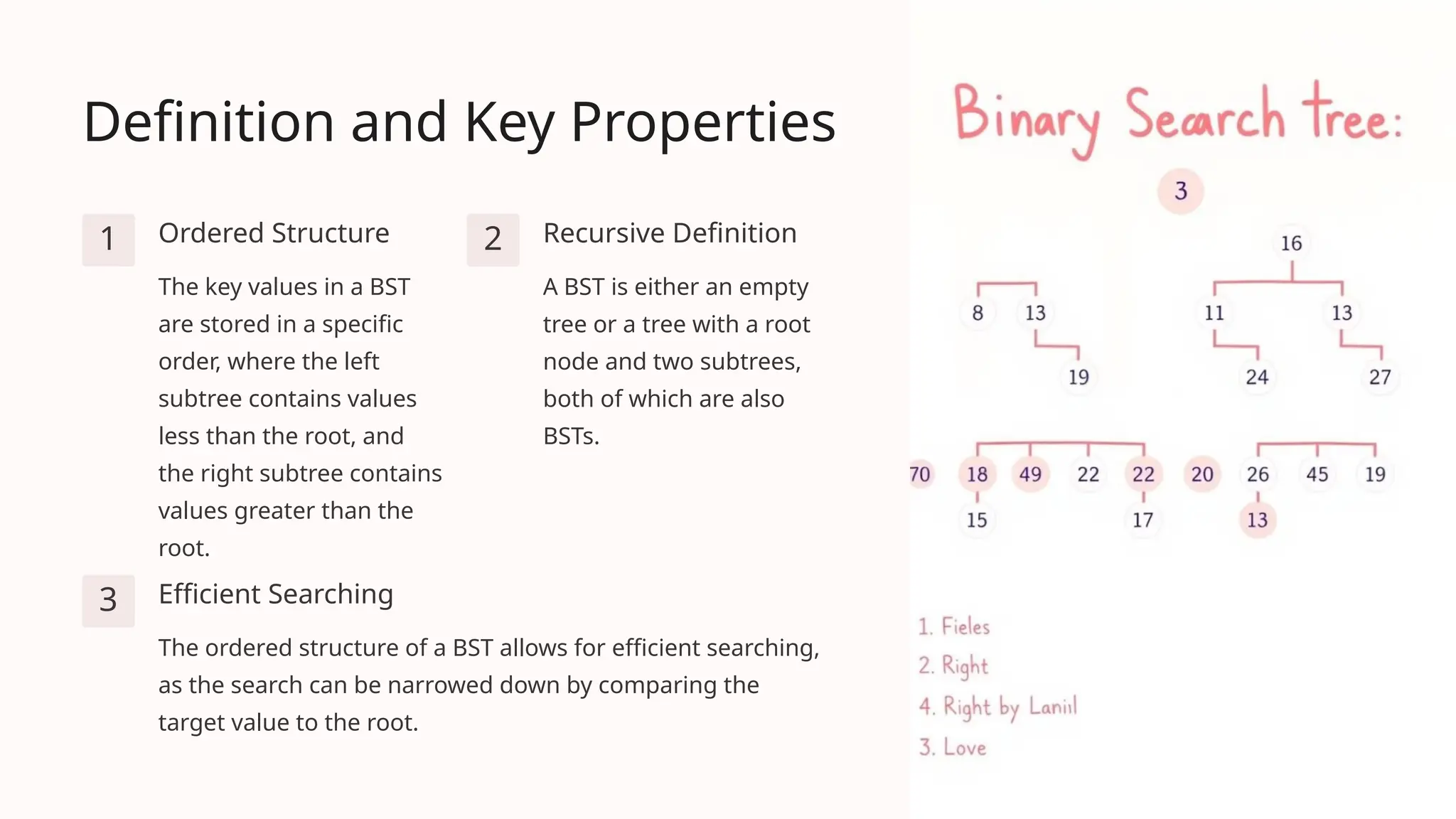
The key values in a BST
are stored in a specific
order, where the left
subtree contains values
less than the root, and
the right subtree contains
values greater than the
root.
2 Recursive Definition
A BST is either an empty
tree or a tree with a root
node and two subtrees,
both of which are also
BSTs.
3 Efficient Searching
The ordered structure of a BST allows for efficient searching,
as the search can be narrowed down by comparing the
target value to the root.
Insertion
1 Compare to Root
Start at the root node and compare the new value to
the current node's value.
2 Move Left or Right
If the new value is less than the current node, move
to the left child. If it's greater, move to the right
child.
3 Insert the Node
Once an appropriate empty spot is found, insert the
new node into the tree.
Deletion
Leaf Node
If the node to be deleted is a leaf
(has no children), simply remove it
from the tree.
Single Child
If the node has one child, replace
the node with its child.
Two Children
If the node has two children,
replace it with the in-order
successor (the smallest value in the
right subtree) or predecessor (the
largest value in the left subtree).
Search
Compare to Root
Start at the root node and compare the target value
to the current node's value.
Move Left or Right
If the target value is less than the current node, move
to the left child. If it's greater, move to the right child.
Found or Not Found
If the target value is found, the search is successful. If
the target value is not found, the search has failed.
Traversal
In-order
Visit the left subtree, then the root,
and finally the right subtree. This
results in a sorted list of the node
values.
Pre-order
Visit the root, then the left subtree,
and finally the right subtree. This is
useful for creating a copy of the
tree.
Post-order
Visit the left subtree, then the right
subtree, and finally the root. This is
useful for deleting the tree.
Advantages and Applications
Efficient Searching
BSTs provide logarithmic
time complexity for search
operations, making them
well-suited for applications
that require fast lookups.
Ordered Data Storage
The inherent ordering of
BSTs makes them useful for
storing and retrieving data in
a sorted manner.
Flexible Implementations
BSTs can be implemented in
various ways, such as self-
balancing trees, to maintain
efficiency even in the face of
skewed data.
Wide Applications
BSTs are used in file systems,
database indexing, decision
trees, and various algorithms
and data structures.
Time Complexity Analysis
1 Search
O(log n) time complexity for searching a value in a
balanced BST.
2 Insertion
O(log n) time complexity for inserting a new value in
a balanced BST.
3 Deletion
O(log n) time complexity for deleting a value from a
balanced BST.
Summary and Key Takeaways
Ordered Structure
BSTs store data in a specific order, with the left subtree containing values less than the
root, and the right subtree containing values greater than the root.
Efficient Operations
BSTs offer logarithmic time complexity for search, insertion, and deletion operations,
making them highly efficient for various applications.
Versatile Applications
BSTs are widely used in file systems, database indexing, decision trees, and numerous
other data structures and algorithms.

Data- Structures-Binary-Search-Trees.pptx

  • 1.
    Binary Search Trees BinarySearch Trees (BSTs) are a fundamental data structure in computer science, providing an efficient way to store and manage sorted data. They exhibit a hierarchical tree-like structure, with each node containing a key value and having at most two child nodes. by Thiruniraiselvi Urkalan
  • 2.
    Definition and KeyProperties 1 Ordered Structure The key values in a BST are stored in a specific order, where the left subtree contains values less than the root, and the right subtree contains values greater than the root. 2 Recursive Definition A BST is either an empty tree or a tree with a root node and two subtrees, both of which are also BSTs. 3 Efficient Searching The ordered structure of a BST allows for efficient searching, as the search can be narrowed down by comparing the target value to the root.
  • 3.
    Insertion 1 Compare toRoot Start at the root node and compare the new value to the current node's value. 2 Move Left or Right If the new value is less than the current node, move to the left child. If it's greater, move to the right child. 3 Insert the Node Once an appropriate empty spot is found, insert the new node into the tree.
  • 4.
    Deletion Leaf Node If thenode to be deleted is a leaf (has no children), simply remove it from the tree. Single Child If the node has one child, replace the node with its child. Two Children If the node has two children, replace it with the in-order successor (the smallest value in the right subtree) or predecessor (the largest value in the left subtree).
  • 5.
    Search Compare to Root Startat the root node and compare the target value to the current node's value. Move Left or Right If the target value is less than the current node, move to the left child. If it's greater, move to the right child. Found or Not Found If the target value is found, the search is successful. If the target value is not found, the search has failed.
  • 6.
    Traversal In-order Visit the leftsubtree, then the root, and finally the right subtree. This results in a sorted list of the node values. Pre-order Visit the root, then the left subtree, and finally the right subtree. This is useful for creating a copy of the tree. Post-order Visit the left subtree, then the right subtree, and finally the root. This is useful for deleting the tree.
  • 7.
    Advantages and Applications EfficientSearching BSTs provide logarithmic time complexity for search operations, making them well-suited for applications that require fast lookups. Ordered Data Storage The inherent ordering of BSTs makes them useful for storing and retrieving data in a sorted manner. Flexible Implementations BSTs can be implemented in various ways, such as self- balancing trees, to maintain efficiency even in the face of skewed data. Wide Applications BSTs are used in file systems, database indexing, decision trees, and various algorithms and data structures.
  • 8.
    Time Complexity Analysis 1Search O(log n) time complexity for searching a value in a balanced BST. 2 Insertion O(log n) time complexity for inserting a new value in a balanced BST. 3 Deletion O(log n) time complexity for deleting a value from a balanced BST.
  • 9.
    Summary and KeyTakeaways Ordered Structure BSTs store data in a specific order, with the left subtree containing values less than the root, and the right subtree containing values greater than the root. Efficient Operations BSTs offer logarithmic time complexity for search, insertion, and deletion operations, making them highly efficient for various applications. Versatile Applications BSTs are widely used in file systems, database indexing, decision trees, and numerous other data structures and algorithms.