Carmela Arino
MHA690: Health Care Capstone
(MFQ1602A)
Professor Jared Rutledge
January 7, 2016
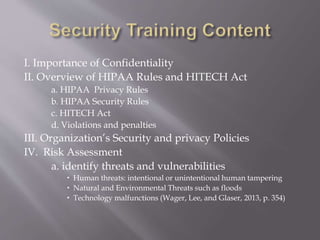
I. Importance of Confidentiality
II. Overview of HIPAA Rules and HITECH Act
a. HIPAA Privacy Rules
b. HIPAA Security Rules
c. HITECH Act
d. Violations and penalties
III. Organization’s Security and privacy Policies
IV. Risk Assessment
a. identify threats and vulnerabilities
 Human threats: intentional or unintentional human tampering
 Natural and Environmental Threats such as floods
 Technology malfunctions (Wager, Lee, and Glaser, 2013, p. 354)
 V. Physical, Technical , and Network Security
a. Physical Security (e.g. lock doors, don’t
leave the files unattended, and etc.).
 b. Technical Security (e.g. access controls
such as using user name and passwords).
c. Network Security (e.g. secure data exchange)
 VI. Appropriate practices related to the use any
online communication such as emails and
internet.
 Data Security Breach Notifications Protocols
Security and Management Training: Best Practice
Considerations. Retrieved from
http://ptac.ed.gov/sites/default/files/issue
-brief-security-training.pdf
Wager, K., Lee, F., & Glaser, J. (2013). Wager, K.
A., Lee, F. W., & Glaser, J. P. (2013). Health
care information systems: A practical
approach for health care management (3rd
ed.). San Francisco, CA: Jossey-Bass.

Data security training

  • 1.
    Carmela Arino MHA690: HealthCare Capstone (MFQ1602A) Professor Jared Rutledge January 7, 2016
  • 2.
    I. Importance ofConfidentiality II. Overview of HIPAA Rules and HITECH Act a. HIPAA Privacy Rules b. HIPAA Security Rules c. HITECH Act d. Violations and penalties III. Organization’s Security and privacy Policies IV. Risk Assessment a. identify threats and vulnerabilities  Human threats: intentional or unintentional human tampering  Natural and Environmental Threats such as floods  Technology malfunctions (Wager, Lee, and Glaser, 2013, p. 354)
  • 3.
     V. Physical,Technical , and Network Security a. Physical Security (e.g. lock doors, don’t leave the files unattended, and etc.).  b. Technical Security (e.g. access controls such as using user name and passwords). c. Network Security (e.g. secure data exchange)
  • 4.
     VI. Appropriatepractices related to the use any online communication such as emails and internet.  Data Security Breach Notifications Protocols
  • 5.
    Security and ManagementTraining: Best Practice Considerations. Retrieved from http://ptac.ed.gov/sites/default/files/issue -brief-security-training.pdf Wager, K., Lee, F., & Glaser, J. (2013). Wager, K. A., Lee, F. W., & Glaser, J. P. (2013). Health care information systems: A practical approach for health care management (3rd ed.). San Francisco, CA: Jossey-Bass.